


Introduction
The Gulf of Guinea Thrush Turdus olivaceofuscus has, for over 80 years, been regarded as a polytypic species, with the nominate subspecies on São Tomé Island and the form xanthorhynchus on Príncipe Island (e.g. Sclater Reference Sclater1924, Amadon Reference Amadon1953, Collar Reference Collar, del Hoyo, Elliott and Christie2005, Jones and Tye Reference Jones and Tye2006). However, recent taxonomic revision using multiple lines of evidence indicates that the Gulf of Guinea Thrush is in reality two species, the São Tomé Thrush T. olivaceofuscus and the Príncipe Thrush T. xanthorhynchus (Melo et al. Reference Melo, Bowie, Voelker, Dallimer, Collar and Jones2010).
Unfortunately, owing to its previous treatment as a subspecies, the conservation status of the Príncipe Thrush has long been masked by the abundance of the São Tomé species, resulting in the Gulf of Guinea Thrush having the IUCN category ‘Near Threatened’ (BirdLife International 2000, 2009). While the thrush on São Tomé is common and occurs in most habitats with tree cover, from primary forest to urban gardens, the Príncipe Thrush has been rare since its discovery (Jones and Tye Reference Jones and Tye2006). A single specimen was collected by the Italian naturalist Leonardo Fea in 1899, when it was already considered uncommon (Naurois Reference Naurois1984). The next records came in 1928, when four specimens were obtained (Amadon Reference Amadon1953). After this the species was not re-encountered until 1997 (S. Lima in litt.). Subsequent surveys showed it to be confined to the southern third of Príncipe, where mature forest still occurs from the highest peak (Pico do Príncipe: 948 m) down to the southern coast (Baillie and Gascoigne Reference Baillie and Gascoigne1999, King and Dallimer Reference King and Dallimer2008).
The Príncipe Thrush is still considered rare. This judgement is reinforced by the fact that the thrush on Príncipe is very tame compared to the one on São Tomé. Individuals readily approach people and may forage on the ground a few metres away from observers (Baillie and Gascoigne Reference Baillie and Gascoigne1999, Melo Reference Melo2007, King and Dallimer Reference King and Dallimer2008), but sightings remain scarce and have only been noted within primary forest, an area of approximately 45 km2 (Jones et al. Reference Jones, Burlison and Tye1991). A re-evaluation of its conservation status is therefore needed. This is a particularly pertinent exercise at this time, as the government of the islands has recently declared the southern forests on Príncipe a protected area (the Parque Natural d’Obô do Príncipe). Here we estimate the population size and densities of the thrush in order to provide baseline data and to establish the relevant threat level for this little-known endemic bird species.
Methods
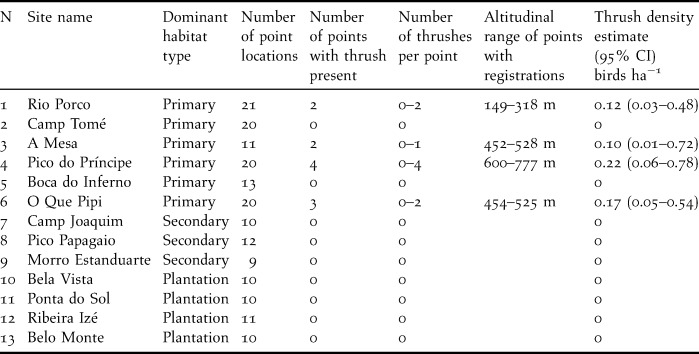
In order to maximise our chances of encountering the thrush, field surveys were carried out during the period corresponding to the breeding season of the Gulf of Guinea Thrush on São Tomé (November and December). In total, 13 survey sites were visited in 2007 covering representative areas of the island (Figure 1). Six were within primary forest, three in secondary forest and four in plantations (Table 1).
Survey sites for the Príncipe Thrush Turdus xanthorhynchus on the island of Príncipe, West Africa. The shaded area indicates the extent of primary forest, hatched area the extent of the Parque Natural d'Obô, and the solid line the 400 m contour. The location of the main town on the island, Santo Antonio, is indicated.

Characteristics of survey sites, number of point locations, Príncipe Thrush registrations and density estimates across the island of Príncipe, Gulf of Guinea.
To assess the population size of the thrush, we estimated its density across the survey sites using distance sampling methodology (Thomas et al. Reference Thomas, Buckland, Rexstad, Laake, Strindberg, Hedley, Bishop, Marques and Burnham2010). We chose this technique as it was likely that in a closed forest environment the detectability of the thrush would vary according to habitat, and distance sampling can account for these potential biases. In addition, many registrations were likely to be purely aural, but judging the location of singing birds in densely vegetated habitats is known to be subject to error (Simons et al. Reference Simons, Alldredge, Pollock and Wettroth2007). Such errors were minimised here as the observers were already fully familiar with the species and its habitat, and by using a laser rangefinder (Rangemaster LRF 800, Leica Camera AG, Germany) for distance measurement. This allowed the inclusion of aurally detected birds in the distance analysis. However, where it was not possible to locate a distant singing bird reliably, the species was noted as present and records not included in density estimation.
In each study site, point count locations were placed independently of the local topography and with the intention of covering the range of available habitat in that area. Point locations were separated by at least 150 m, a distance that was considered adequate by the observers to avoid double sampling the same areas of forest. On arrival at a counting point, an initial five-minute settling-down period was used to note positions, identities and flock size of birds present. Thereafter, five minutes of actual survey time were allowed to measure distances, confirm locations and identifications. The short survey time of this method ensured that biases associated with birds moving in response to the observer were minimised. Incorporating an excessively long 10 minute settling-down period into field methods has been criticised as it could result in lower density estimates (Buckland et al. Reference Buckland, Marsden and Green2008, Lee and Marsden Reference Lee and Marsden2008). The shorter five-minute period both allowed birds to resume normal behaviour and enabled the detection of cryptic or skulking species with as much certainty as possible in a forest environment.
Results
In total 177 locations across the 13 study sites were visited (Table 1, Figure 1). Eighteen individuals were recorded at 11 different locations across four sites (Table 1). All encounters were in primary rainforest and the majority (9/11) were above 400 m. The thrush was not detected in two of the primary forest sites, and in two cases we were not able to locate a distant calling bird and therefore only recorded the species as present at that location.
There were insufficient registrations to generate a species-specific detection function. Instead, we used the detection function of the thrush on São Tomé as a surrogate to generate a detectability-corrected density estimate (Dallimer and King Reference Dallimer and King2008, Dallimer et al. Reference Dallimer, King and Atkinson2009). Thrush density estimates varied from 0.10 (95% CI 0.01–0.72) to 0.22 (95% CI 0.06–0.78) birds ha−1, with the highest density estimated for the Pico do Príncipe high altitude site. Across all primary forest survey locations, thrush density was 0.10 (95% CI 0.05–0.22) birds ha−1.
Although 72% (13/18) of our encounters with the Príncipe Thrush were confirmed visually, five were purely aural. This compares to 68% of all encounters on São Tomé that were confirmed visually (Dallimer et al. Reference Dallimer, King and Atkinson2009). Hence although the Príncipe Thrush is less vocal than the species on São Tomé (Melo et al. Reference Melo, Bowie, Voelker, Dallimer, Collar and Jones2010), it is unlikely that this difference in behaviour will have unduly biased our density estimates for the thrush on Príncipe.
Primary forest covers approximately 45 km2 of the island (Jones et al. Reference Jones, Burlison and Tye1991). Based on recent vegetation maps (Diniz and de Matos Reference Diniz and de Matos2002), 41.05 km2 of this occurs in a single contiguous block. We used the latter figure to calculate a population size of the Príncipe Thrush of 435 birds (95% CI 208–913), which assumes that thrushes occur at similar densities throughout the forest. However, density showed a significant positive correlation with altitude (r = 0.22, P = 0.003) and the highest density was calculated for the single site above 600 m (Pico do Príncipe). Less than 7.5% of the forest area (3.1 km2) is found above this altitude. If we assume that the highest density estimate 0.22 (95% CI 0.06–0.78) applies only to this area and the mean density (0.08 birds ha−1; 95% CI 0.04 – 0.20) from the remaining sites applies to lower altitude forest elsewhere, we arrive at an adjusted population size of 364 individuals (95% CI 186 – 887).
Discussion
Historically, it is likely that the thrush population on Príncipe suffered a dramatic reduction in extent of occurrence after human colonisation in the 1500s resulted in the loss of most of the island’s original forest (Jones and Tye Reference Jones and Tye2006). Since its description in 1899, the species has always been considered rare and restricted to primary rainforest (Naurois Reference Naurois1984). This habitat association contrasts with the wide range of biotopes used by the São Tomé Thrush and may reflect its vulnerability to hunting pressures rather than a habitat specialisation. The Príncipe Thrush actively approaches humans and it is the tamest species of any bird on both islands. People who use the forest (hunters, parrot collectors and snail harvesters) therefore readily kill thrushes if the chance arises. This may explain why, as with the endemic land snail Archachatina bicarinata (Dallimer and Melo Reference Dallimer and Melo2010), the highest densities are restricted to the most inaccessible areas within the primary forest.
Thrush density near the ‘Camp Tomé’ site was estimated as 0.36 birds ha−1 (95% CI 0.16–0.80; six registrations) in 2002 (Dallimer and King Reference Dallimer and King2008). Although we were unable to revisit the exact locations, we did survey a substantial portion of lowland forest in a similar area and did not encounter the thrush. ‘Camp Tomé’ is located in an area that had recently become the focus of parrot harvesting (Melo Reference Melo1998). The other primary forest site in which the bird was not recorded (‘Boca do Inferno’) was considered by harvesters of edible snails to be an area where thrushes were abundant in the very recent past. This evidence strongly suggests that the thrush population is declining, and that the mechanism might be direct human impact.
The Príncipe Thrush was encountered only in primary forest, and occurred at its highest density at the site above 600 m. We estimate that the current size of its population is 364 individuals. Even if based purely on the upper 95% confidence interval estimate of 887 individuals, the species would qualify for an IUCN listing of ‘Vulnerable’ (criterion D1: fewer than 1,000 mature individuals). However, the actual population size is likely to be substantially lower than our maximum figure. First, the thrush does not occupy all areas of primary forest. Second, a relatively high proportion of the individuals we encountered were likely to have been non-breeders. Out of three individuals captured as part of this study, two were juveniles (Melo et al. Reference Melo, Bowie, Voelker, Dallimer, Collar and Jones2010). Third, as the Príncipe Thrush readily approaches humans, there may have been an upward bias in the density estimates themselves. The actual population size is therefore likely to be well below 250 mature birds. This, combined with evidence for a continuing population decline and the entire population being restricted to a single location, warrants the thrush being re-classified as ‘Critically Endangered’ under IUCN Red List criterion C2a(ii). In addition, as the extent of occurrence of the species is less than 100 km2, the population is restricted to a single location and there is evidence of a continuing decline in the extent of occurrence and the number of mature individuals, the species also qualifies for the ‘Critically Endangered’ category under criterion B1a+b(iii and v). In contrast, the São Tomé Thrush occurs at much higher densities in primary forest (4.28 birds ha-1: Dallimer et al. Reference Dallimer, King and Atkinson2009), and is common across the entire island in most habitats (Christy and Clarke Reference Christy and Clarke1998). We therefore also recommend that the São Tomé Thrush should be downlisted to the IUCN category ‘Least Concern’.
The primary rainforests of southern Príncipe have been overlooked in terms of their conservation importance when compared to the forests on the neighbouring island of São Tomé (e.g. Collar and Stuart Reference Collar and Stuart1988). Despite containing 37 endemic angiosperm species (Figueiredo Reference Figueiredo1994), 25 endemic land snails (Gascoigne Reference Gascoigne1994) and 11 endemic birds (Jones and Tye Reference Jones and Tye2006), the species most frequently associated in the public mind with forests on Príncipe is the Grey Parrot Psittacus erithacus. While the parrot is the symbol of the island, it is neither endemic nor of urgent conservation concern. In contrast, the Príncipe Thrush is under some immediate threat, and now that it has been established as a full species it merits adoption as a flagship behind which government and non-government organisations and the international conservation community can unite. The recent legal designation of these forests as a protected area is a step forward and, although management resources are limited, the Department of Protected Areas for São Tomé and Príncipe has taken some action to promote the conservation of the Príncipe Thrush following our survey. As part of the management plan for the protected areas currently being drafted by the government department and ECOFAC (an EU-funded conservation programme for the forests of Central Africa), the thrush was chosen as one of a suite of indicator species that will be regularly surveyed in order to assess the effectiveness of the protected areas for biodiversity conservation. However, if our assumptions concerning the local disappearance of the thrush is correct, a major programme will be needed to control the exploitation of wildlife within the protected area, with appropriate alternative provision for those affected.
Acknowledgements
We thank Eng. Salvador Sousa Pontes, Director of Protected Areas for São Tomé and Príncipe, for arranging permits. On Príncipe we are grateful to A. and K. Salvaterra, R. Delport and P. Bosman of the Bom-Bom Island Resort and the Society for Conservation and Development. Bikegila and Sátiro were indispensable guides in the forests. R. Prŷs-Jones supported our grant applications. Andy Symes of BirdLife International advised on IUCN threat categories. The fieldwork was funded by the University of Edinburgh’s Davis Expedition Fund, the British Ecological Society and the British Ornithologists’ Union.



