


INTRODUCTION
Cyclosporiasis is a gastrointestinal illness caused by the protozoan parasite Cyclospora cayetanensis. The symptoms of infection include: prolonged diarrhoeal illness, frequent and sometimes explosive bowel movements, loss of appetite, weight loss, stomach cramps, bloating, nausea, vomiting, fatigue, body aches, headache and low-grade fever. The median incubation period is about 7 days, and the duration of symptoms ranges from a few days to several weeks or months, with relapses common [Reference Herwaldt1, Reference Ortega and Sanchez2].
Cyclospora is not transmitted from person-to-person, as freshly excreted Cyclospora oocysts are non-infectious. The Cyclospora organism takes a few days to weeks in the environment to mature and become an infective sporulated oocyst. The conditions causing sporulation are not fully understood, and while Cyclospora does not appear to be zoonotic, this is also uncertain [Reference Chacin-Bonilla3]. The most likely transmission routes are ingestion of food, water or soil contaminated with human faecal material containing Cyclospora [Reference Chacin-Bonilla3].
Cyclosporiasis appears to be endemic in many developing countries, particularly in Central and South America, as well as parts of Asia [Reference Chacin-Bonilla3]. Outbreaks and sporadic cases of cyclosporiasis identified in developed countries are mostly associated with travel to developing countries, or eating food imported from developing countries [Reference Herwaldt1, Reference Chacin-Bonilla3–Reference Doller5]. Previous foodborne Cyclospora outbreaks in Canada, USA, Germany and Sweden were linked to consumption of fresh produce items such as basil, snow peas, raspberries, lettuce and herbs, and sugar snap peas [Reference Herwaldt1, Reference Ortega and Sanchez2, Reference Herwaldt and Beach4–Reference Insulander9]. Investigations of these outbreaks indicated that the organism can survive well on fresh produce. It has also been shown that routine preparation by washing with potable water, with or without the addition of disinfectants such as chlorine, is not likely to be effective in removing Cyclospora from contaminated produce [Reference Ortega and Sanchez2].
There have been two previous reports of Cyclospora outbreaks on cruise ships, in 1997 [10] and 2009 [11]. Bacterial pathogens such as Salmonella, Shigella and enterotoxigenic Esherichia coli are more commonly reported agents in foodborne outbreaks on cruise ships [Reference Rooney12]. However, norovirus causes the majority of cruise-ship gastroenteritis outbreaks, primarily by person-to-person transmission [Reference Antonio13]. The cruise-ship industry uses guidance from The Centers for Disease Control and Prevention's Vessel Sanitation Program to prevent and respond to acute gastroenteritis outbreaks [14].
In June 2010, a private pathology laboratory in Perth, Western Australia (WA) notified the Department of Health Western Australia (WA Health) that Cyclospora had been detected in five recently processed faecal specimens. Pathology request forms for these patients noted recent travel to Asia on a cruise ship. Interviews revealed that all five cases travelled on a cruise that departed from the port of Fremantle, WA on 14 May and returned on 31 May (cruise 1).
During the subsequent cruise of the same ship (cruise 2), which departed from Fremantle on 31 May and returned on 21 June, the ship's medical clinic observed increased cases of gastrointestinal illness, and a foodborne cause was suspected. The cruise line removed ready-to-eat food items from service under the assumption that the likely cause of the outbreak was bacterial and transmission was through ready-to-eat food products. After reporting this outbreak to WA Health, the cruise company was informed that Cyclospora infection might be the cause of the cruise 2 outbreak. The ship's health staff collected faecal samples from 12 symptomatic passengers on cruise 2 and submitted the specimens for testing when the ship returned to port in Fremantle. Of those, 10 were positive for Cyclospora, therefore confirming that passengers on two successive cruises of the same ship had been infected with Cyclospora.
The itinerary for cruise 1 included port visits to Geraldton, Australia; Langkawi, Penang, and Port Kelang, Malaysia; and Singapore. The itinerary for cruise 2 included port visits to Geraldton, Australia; Benoa, Indonesia; Phu My, Vietnam; Sihanoukville, Cambodia; Port Kelang, Malaysia; and Singapore.
This study describes the investigation to determine the source of the Cyclospora infection on the cruise ship.
METHODS
Laboratory methods
Cyclospora-positive faecal specimens were detected in five pathology laboratories. For diagnosis of Cyclospora, the laboratories used microscopy examination of saline wet mounts and specimens concentrated with formalin ethyl acetate and stained with iodine; as well as examination of smears stained with hot Safranin/Methylene Blue stain (one laboratory), iron haematoxylin (one laboratory), modified Ziehl–Neelsen (two laboratories) or both iron haematoxylin and modified Ziehl–Neelsen (one laboratory). In addition, faecal specimens were examined for the presence of other parasites, and cultured for the presence of bacterial enteropathogens.
No food samples from the cruises were able to be tested for the presence of enteric pathogens.
Case definition
A confirmed case was defined as a person with laboratory-confirmed Cyclospora infection who had travelled on either cruise 1 or cruise 2. A suspected case was a person who did not submit a specimen for laboratory testing, but had gastroenteritis symptoms, with at least three episodes of diarrhoea; or vomiting and at least one additional symptom [including one or more episodes of loose stools in a 24-h period, abdominal cramps, headache, muscle aches, or fever (temperature >38 °C)]; with an onset date between 31 May 2010 and 21 June 2010; and who had travelled on either cruise 1 or cruise 2.
Case ascertainment
There were 2047 passengers (1138 female) and 975 crew members (134 female) on cruise 1, and 2010 passengers (1097 female) and 1022 crew members (134 female) on cruise 2. Most of the crew members were on both cruises. A log of both passengers and crew who presented to the onboard medical centre with acute gastrointestinal symptoms was maintained on each cruise. This illness log was used to make an initial list of cases.
Additional cases were identified by WA pathology laboratories, who were asked to report Cyclospora-positive faecal specimens to WA Health, as this infection is not formally notifiable in WA. Other passengers telephoned WA Health, reporting gastrointestinal illness acquired on these cruises. Some of these calls were received after passengers received a post-disembarkation letter from the cruise company informing them that illness associated with these cruises may have been caused by Cyclospora, and others after passengers had seen media reports concerning the outbreak. Members of OzFoodNet (an Australian network of foodborne disease epidemiologists in all states and territories) were asked to interview cases reported in other Australian jurisdictions. Information was recorded on NetEpi, a web-based tool that is used by health departments in Australia for recording information during multi-jurisdictional disease outbreaks. For each of these additional cases, information was recorded detailing passengers' home address, gender, age, date of onset of illness, symptoms, duration of illness and whether hospitalized.
Hence, confirmed and suspected cases were a mixture of cases identified from the ship illness log; notifications from local laboratories; passengers who self-reported illness to the investigators; and reports referred by other Australian health departments. As no systematic survey of passengers or crew was undertaken only minimum attack rates can be estimated.
Case-control study
A case-control study was initiated using cruise 2 crew members, to test the hypothesis that illness was associated with one or more of the following:
(1) consumption of fresh produce items brought onboard the ship in either Malaysia or Singapore, from 24 to 26 May;
(2) consumption of fresh produce items that were brought onboard earlier, but not served until after the ship had visited Singapore;
(3) drinking water onboard the ship;
(4) exposures associated with onshore visits.
Cases were recruited from the group of crew members who met the case definition for a suspected or confirmed case as defined above, and who had onset dates from 31 May to 21 June, which is the range of onset dates reported by passengers from both cruises. Crew members were excluded from the study if they had joined the ship after the 24 May, in order to exclude those who may have acquired their illness before boarding the ship.
Three controls were selected for each case to ensure adequate power. Controls were selected from crew members who were onboard during at least the latter part of cruise 1 (24–31 May), and the whole of cruise 2, and did not report any gastrointestinal symptoms. Cruise company public health staff reported that the crew members who became ill were those who were in occupational groups that had the opportunity to eat from the same dining areas as passengers. To control for differences in potential food exposures, the controls were frequency-matched to cases by occupational grouping and class (officer and crew), as well as gender and nationality.
A systematic questionnaire was used to obtain information on gastrointestinal illness onset, symptoms and duration, and exposures during the period of 24 May (Singapore onwards on cruise 1) to 21 June (whole of cruise 2). Crew members completed questionnaires between the dates of 29 June 2010 and 1 July 2010. Information was sought regarding where most meals had been consumed (for breakfast, lunch, dinner); whether specific fresh produce items were consumed (from a list of 54 items brought onboard the ship in Malaysia and Singapore or potentially first served after Singapore); the primary sources of drinking water consumed; whether onshore visits were made at each of the ports visited during the selected time period; and whether food was eaten or water consumed during these onshore visits.
Environmental investigation
The ship was visited and food handling practices were reviewed when the ship returned to Fremantle port after cruise 2 on 21 June 2010. Logistic issues at the time, including the short turnaround time of several hours, and difficulty in accessing the large volume and potential range of food items, precluded collection of food samples.
Statistical analyses
The relative risk of illness for female and male passengers was calculated using Epi Info™ v. 6 (CDC, USA). χ2 and t tests were used to examine the similarity of case and control groups. Univariate associations between each of the exposure variables (n = 117) and presence of illness were examined using odds ratio (OR) and χ2 tests. Exposures with univariate P values of <0·1 and where the percentage of cases with that exposure was ⩾30% were entered into a backward stepwise multivariate logistic regression model and retained in the model when P < 0·05. Analyses were performed using PASW® Statistics 18 (SPSS Inc., USA).
RESULTS
The illness log from cruise 1 recorded that eight passengers and three crew members developed gastroenteritis while the cruise was in progress. However, laboratory and telephone reports to the investigators after the cruise had finished provided information on an additional 26 confirmed Cyclospora cases and eight suspected cases in passengers from cruise 1 who all became ill after the cruise had finished. As all of the confirmed cases had onset of illness after the cruise had ended, the passengers and crew with details recorded in the ship's illness log for cruise 1 were considered sporadic and unrelated to this outbreak.
The onset dates for the cruise 1 outbreak cases ranged from 31 May 2010 (the day the cruise finished) to 8 June 2010, with a median onset date of 3 June 2010 (Fig. 1). The minimum attack rate for passengers was 1·7% (34/2047). All cases were residents of Australia. Cases ranged in age from 47 to 82 years (median 70 years).
Date of onset for confirmed and suspected passenger cases from cruise 1.

From all reporting sources there were a total of 232 passenger cases from cruise 2 who met the case definition, of whom 46 were confirmed cases, and 186 were suspected cases, giving a minimum attack rate of 11·5% (232/2010). One crew member on cruise 2 was a confirmed case, while 47 crew members met the suspected case definition [minimum attack rate in crew was 5·7% (48/847)]. Passenger cases from cruise 2 ranged in age from 2 to 85 years (median 65 years). Of the 230 cases where nationality was recorded, 226 were Australian. The date of onset for passenger cases from cruise 2 ranged from 2 to 19 June 2010 (median 9 June 2010) (Fig. 2).
Date of onset for confirmed and suspected passenger cases from cruise 2.

Twenty-seven (79%) of the 34 passenger cases on cruise 1 were female and 65·5% (152/232) on cruise 2 were female. This was higher than the percentage of passengers who were female (56% and 55% on cruises 1 and 2, respectively). Hence, the risk of becoming ill was greater for females than for males [relative risk 2·56, 95% confidence interval (CI) 1·91–3·43].
The duration of illness for cruise 1 passengers ranged from 1 to 33 days (median 6·5 days). Duration of illness data was not complete for passengers from cruise 2, as the illness log recorded the duration of illness at the time passengers presented for medical attention, not when they had recovered. The frequency of specific symptoms was similar for both suspected and confirmed cases, from both cruises, with the exception of fever which was reported more frequently in cruise 1 cases (Table 1). However, there was a difference between the two cruises in how symptom information was collected, with information for cruise 1 passengers self-reported during interviews by the investigators, whereas for cruise 2 information was collected by onboard medical staff. The most common symptom reported by both suspected and confirmed cases from both cruises was diarrhoea (96% of confirmed cases, 93% of suspected cases, 94% overall).
Frequency of symptoms reported by confirmed and suspected passenger cases from cruises 1 and 2
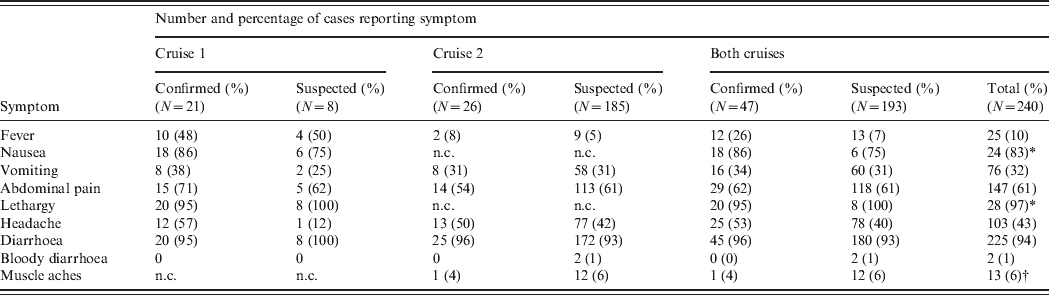
n.c., Data not collected
* Symptom information only reported for passengers from cruise 1.
† Symptom information only reported for passengers from cruise 2.
No other notifiable enteric pathogens were detected in faecal specimens from passengers or crew from either of these cruises that were submitted to WA pathology laboratories during the investigation.
Case-control study
There were 31 cases and 97 controls enrolled in the study. There were no statistically significant differences (P < 0·05) between cases and controls for gender, officer status or age (Table 2). Dates of onset for crew cases ranged from 4 to 19 June 2010 with a median onset date of 8 June 2010.
Demographic characteristics of case and control groups in case-control study
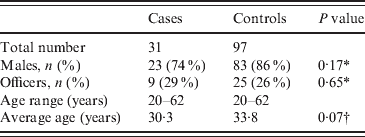
* χ2 test.
† t test.
Univariate analysis was performed with 117 variables. Of these variables, six were significant at a P value of <0·01, with lettuce consumption having the strongest association with illness (OR 4·7, 95% CI 1·7–14·1, P < 0·001) (Table 3). There were 19 variables that had P values <0·1 and where the percentage of cases exposed was ⩾30% (Table 3). When entered into a backward stepwise logistic regression analysis, cantaloupe, chives and lettuce were retained in the final model as independently associated with illness (P < 0·05) (Table 4).
Results from univariate analysis of cruise-ship exposures, showing number of participants with exposure, for exposures with P values <0·1 and percentage of cases exposed ⩾30%

N, Total number of respondents; OR, odds ratio; CI, confidence interval.
Exposures retained in the multivariate logistic regression model predicting illness in crew members, and country of origin

OR, Odds ratio; CI, confidence interval.
Environmental investigation and trace-back
When the ship was visited by the investigators on 21 June there appeared to be satisfactory food-handling processes in place, with no recommendations for improvements. The investigators were informed that food was taken onboard at different ports, both at the starting port and other ports visited during the cruise, and could be consumed on different cruises. The majority of drinking water on the ship was produced by evaporative desalination followed by chlorination, with some water bunkered at ports of call. Routine bacteriological tests were conducted onboard on water that was bunkered during stops in Port Kelang on 24 May and Singapore on 25 May. These tests were negative for the presence of total coliforms and E. coli. Further water samples collected from the ship in Singapore on 14 June 2010 tested negative for faecal indicator bacteria and parasites, including Cyclospora.
For the foods that were significant in the multivariate logistic regression analysis, the country of origin is shown in Table 4. Cantaloupe was traced to two growing areas in the north-west of Australia. Investigation showed that growing practices in both areas were not likely to result in human faecal contamination of cantaloupe. Trace-back to the growing area was not possible for chives and the multiple sources of lettuce.
DISCUSSION
This investigation confirmed that a gastroenteritis outbreak caused by Cyclospora infection affected passengers and crew on two successive cruises of a ship that departed from Fremantle, Australia on 14 and 31 May 2010, respectively. From information collected from different sources, it was estimated that at least 266 passengers and 48 crew members had symptomatic infection, with 73 of these laboratory confirmed. The number of affected people is likely to have been greater than this, as not all cases would have been reported to the investigators or to the medical facility onboard the ship, and the microscopy methods used for Cyclospora detection may not have been sensitive enough to detect all Cyclospora cases [Reference Eberhard, Pieniazek and Arrowood15].
Using the onset dates for the cases from cruise 1, and an average incubation period of 7 days for Cyclospora infection [Reference Herwaldt1, Reference Ortega and Sanchez2], the likely time of exposure was on or after 27 May 2010 for cruise 1. This was 2 days after the ship was in port at Singapore, and 4 days after the ship was in port in Port Kelang, Malaysia. The type of food most likely to be a source of Cyclospora is raw, fresh produce which can become contaminated during growing, harvesting or handling, and which is eaten without an effective kill step [Reference Herwaldt1, Reference Ortega and Sanchez2, Reference Herwaldt and Beach4–Reference Insulander9]. It was hypothesized that contaminated fresh produce had been brought onboard the ship in Malaysia or Singapore, or at least first served after that time, and continued to be served during the early stages of cruise 2, causing continuation of the outbreak.
The risk of becoming ill in this outbreak was significantly higher for females than for males, which supports the hypothesis that illness was associated with fresh fruit and vegetables, as these food items are typically more frequently consumed by females than by males [Reference Wood and Daly16].
In the case-control study conducted as part of the investigation, the only variables retained in the final multivariate logistic regression model were eating cantaloupe, chives and lettuce. While this supports the hypothesis that illness was related to eating raw, fresh produce, the model did not identify a single fresh produce item as the cause of illness. Lettuce was the food item most frequently eaten by cases, had the strongest univariate association with illness, and was included in the multivariate model. Lettuce of several varieties was taken onboard the ship in Singapore, and countries of origin for lettuce were Australia, Malaysia, USA and The Netherlands. Cyclospora is endemic in South East Asia, so Malaysia may be a more likely source of contaminated produce than the other listed countries. However, it is also possible that produce listed as originating in a particular country may have actually been sourced from another endemic country. Cantaloupe originated in WA, and trace-back showed that growing practices were unlikely to have resulted in faecal contamination. Moreover, locally acquired cases of Cyclospora infection are rarely identified in WA, the primary market for this product. Although chives were included in the final multivariate model, they were knowingly eaten by only 33% of cases, so were less likely to have been the cause of illness.
As the outbreak appeared to be linked to fresh produce taken onboard in a South East Asian port, national focal points in the relevant countries were notified of the incident according to WHO International Health Regulations (2005), article 44 [17].
This outbreak demonstrates the difficulties of recognizing and managing a cruise-ship outbreak caused by Cyclospora. The cruise line adhered to guidelines regulated by the United States Food and Drug Administration through the Federal Food Code, which include discarding potentially hazardous ready-to-eat food items that have not been consumed within 7 days of preparation. This cruise line also had in place additional food safety procedures for disinfecting raw produce items, which included total immersion in a chlorine solution for a minimum of 10 s. While this procedure would be effective at eliminating most bacteria from the surfaces of food, Cyclospora cannot be effectively killed through chlorine immersion [Reference Ortega and Sanchez2].
Unfortunately, we were unable to collect food samples from either cruise and hence there was no microbiological confirmation of a contaminated food source. This was because cruise 2 had commenced before the outbreak on cruise 1 was identified, and logistic issues associated with the short turnaround time between cruises and difficulty in accessing the large volume and potential range of food items precluded collection of food specimens from cruise 2.
There were also a number of factors that limited the ability of the case-control study to identify a particular food item as the cause of this outbreak. First, only one crew member on cruise 2 was a confirmed Cyclospora case, so the case group may have also included participants whose gastroenteritis was not caused by Cyclospora. The study questionnaire was administered at the end of June, and covered an exposure period between 24 May and 21 June, so cases may have had difficulty recalling or identifying foods eaten in multiple meals occurring over this extended period. It is also possible that cross-contamination of food products occurred during storage, preparation or serving, with the result that multiple foods were contaminated. In addition there was close correlation between the consumption of various fresh produce items, making it difficult in the analysis to identify a single food item as the source.
CONCLUSIONS
This is the first detailed description of a Cyclospora outbreak on a cruise ship, and the first to affect large numbers of people in Australia. It was hypothesized that the outbreak was caused by contaminated fresh produce brought onboard the ship in Malaysia or Singapore, but an analytical study was not able to conclusively identify a particular fresh produce item as the cause of illness. As Cyclospora can survive well on fresh produce, and is not easily removed by washing, steps should be taken to ensure that produce consumed on cruise ships is supplied free of contamination. Either fresh produce should be sourced from areas of low Cyclospora endemicity, or if supplied from areas of high endemicity, then cruise companies need evidence from local suppliers that appropriate standards of food production and hygiene have been applied to the supply chain to ensure the safety of produce. Such measures could include providing adequate sanitation in growing areas, and the use of treated water for irrigation and processing.
ACKNOWLEDGEMENTS
Thanks to Jared Koutsoukos, Paul Effler, Bill Calder, Stan Goodchild, and other staff at the Department of Health Western Australia who were involved with the outbreak investigation. We gratefully acknowledge the microbiology staff at Western Diagnostic Pathology, PathWest Laboratory Medicine, Clinipath Pathology, St John of God Pathology and Healthscope Pathology, for notifying us of Cyclospora-positive specimens. In particular we acknowledge Western Diagnostic Pathology for associating an increased number of cases with a potential common source, and reporting this to the Department of Health. We also acknowledge the assistance of the OzFoodNet network with this investigation, and the Commonwealth Department of Health and Ageing for funding OzFoodNet: Australia's enhanced foodborne disease surveillance system. We also thank the passengers and ship's crew who participated in the study.
DECLARATION OF INTEREST
None.



