

Introduction
Access to cheap energy-protein sources by people experiencing poverty in sub-Saharan Africa is limited by the much emphasis devoted to major staple food crops to the detriment of indigenous underutilized leguminous crops (Aremu et al., Reference Aremu, Ojuederie, Ayo-Vaughan, Dahunsi, Adekiya, Olayanju, Adebiyi, Sunday, Inegbedion, Asaleye and Abolusoro2019). In recent times, genetic improvement of indigenous legumes such as African yam bean (AYB) [Sphenostylis stenocarpa (Hochst ex. A. Rich) Harms] is gaining popularity in Africa. The focus on AYB is not only for its nutritional values, but also for its socio-cultural significance (Ojuederie et al., Reference Ojuederie, Balogun, Akande, Korie and Omodele2015), adaptive nature to wide climatic and soil conditions (Aremu et al., Reference Aremu, Ige, Ibirinde, Raji, Abolusoro, Ajiboye, Obaniyi, Adekiya and Asaleye2020), nitrogen-fixing ability which makes it useful in land reclamation (Assefa and Kleiner, Reference Assefa and Kleiner1997; Oganale, Reference Oganale2009), medicinal properties (Potter, Reference Potter1992) and its inherent lectin which is useful against storage pests (Omitogun et al., Reference Omitogun, Jackai and Thottappilly1999). However, due to some non-appealing characteristics, lack of exchangeable planting seeds and non-availability of improved cultivars, the few available accessions are left in the hands of indigenous farmers (Klu et al., Reference Klu, Amoatey, Bansa and Kumaga2001). Although several reports have revealed considerable variation in yield and yield-associated traits among AYB accessions, no improved variety has been released. The current average yield reported for AYB range from 200 to 550 kg/ha (Aremu et al., Reference Aremu, Ige, Ibirinde, Raji, Abolusoro, Ajiboye, Obaniyi, Adekiya and Asaleye2020).
Yield is a quantitative trait with quite low heritability, and it is the product of several interacting component traits that are highly subjective to environmental influences (Zhao et al., Reference Zhao, Wang, Wang, Tian, Li, Chen, Chao, Long, Xiang, Gan, Liang and Li2016). Yield improvement in crops is associated with the optimization and selection of heritable yield components (Olomitutu et al., Reference Olomitutu, Paliwal, Abe, Oluwole, Oyatomi and Abberton2022a). Selecting any heritable component trait(s) involves a complex pathway that leads to the formation of the complex (quantitative) trait (Nwofia et al., Reference Nwofia, Awaraka and Agbo2013; Kang, Reference Kang2015). Correlation coefficients help to measure the level of interrelationship existing between paired traits. It is very effective in determining yield contributing characters and in indirect selection (Kumar et al., Reference Kumar, Sharma, Sharma and Devi2015; Sesay et al., Reference Sesay, Ojo, Ariyo, Meseka, Fayeun, Omikunle and Oyetunde2017). However, the use of correlation coefficients alone is not always adequate, as it provides only one-dimensional information without considering the interrelationships among all yield component traits (Nwofia et al., Reference Nwofia, Awaraka and Agbo2013; Kang, Reference Kang2015). Path coefficient analysis is a standardized regression statistical technique that untangles correlation coefficients into direct and indirect effects in such a way that the contribution of each causal character to yield is known. It estimates the direct effect of a component trait on yield, and its indirect effects through another predictor component traits and helps in partitioning the traits into order of importance for selection and improvement purposes (Dewey and Lu, Reference Dewey and Lu1959; Cramer and Wehner, Reference Cramer and Wehner2000; Nwofia et al., Reference Nwofia, Awaraka and Agbo2013; Kang, Reference Kang2015; Kumar et al., Reference Kumar, Sharma, Sharma and Devi2015; Sesay et al., Reference Sesay, Ojo, Ariyo, Meseka, Fayeun, Omikunle and Oyetunde2017). Kumar et al. (Reference Kumar, Sharma, Sharma and Devi2015) suggested that combining correlation with path coefficient analyses provides a better appreciation of the causal relationship between pairs of characters. Previous studies in AYB by Nwofia et al. (Reference Nwofia, Awaraka and Agbo2013) and Aremu et al. (Reference Aremu, Ojuederie, Ayo-Vaughan, Dahunsi, Adekiya, Olayanju, Adebiyi, Sunday, Inegbedion, Asaleye and Abolusoro2019) have shown that yield is high corrected with and directly influenced by seeds per pod, pod filling time, pod length and pods per plant.
Though correlation and path coefficient analysis are still very useful in identifying these key yield component traits, the inconsistencies in the performance of the same genotype in many environments for specific traits make prediction of their phenotypic performance across a wide environment difficult (Perkins and Jinks, Reference Perkins and Jinks1968). Hence, there is a need to evaluate the crop varieties' stability across contrasting environments to facilitate the selection of high-yielding and consistently performing varieties (Ariyo, Reference Ariyo1990). Several stability statistics are used in partitioning genotype × environment interaction. The additive main effect and multiplicative interaction (AMMI) method (Gauch, Reference Gauch1992) is one of the most frequently used. The AMMI method combines analysis of variance for genotype and environment main effects with the principal component analysis of the genotype × environment interaction into one (Zobel et al., Reference Zobel, Wright and Gauch1988). Because the AMMI model does not provide a specific stability measure, AMMI stability value (ASV) was proposed by Purchase (Reference Purchase1997) to rank genotypes according to their yield stability value. The ASV is estimated using interaction principal component axes (IPCA) 1 and 2. Genotypes with the least ASV are considered stable or adapted (Purchase, Reference Purchase1997). However, the idea that the most stable genotypes would not necessarily give the best yield performance has necessitated approaches incorporating both mean yield and stability in a single index, hence the yield stability index (YSI) (Bose et al., Reference Bose, Jambhulkar, Pande and Singh2014). The identified stable, high-yielding AYB genotypes can serve as valuable parents to develop improved varieties with enhanced yield stability. This study was conducted to (i) investigate inter-relationship and relative importance of some yield-related traits on seed yield of 196 AYB accessions and (ii) assess seed yield performance of AYB accessions evaluated in six environments.
Materials and methods
Experimental materials, research sites and experimental design
The experimental materials, research sites, experimental design, site management practices and data collection are as described by Olomitutu et al. (Reference Olomitutu, Paliwal, Abe, Oluwole, Oyatomi and Abberton2022a, Reference Olomitutu, Abe, Oyatomi, Paliwal and Abberton2022b). Briefly, the genetic materials comprised 196 accessions of AYB, obtained from the Genetic Resource Center, International Institute of Tropical Agriculture (GRC-IITA), Ibadan. The field experiments were conducted over a 2-year period at Ibadan, Kano and Ubiaja. At each location, a 14 × 14 lattice design with three replicates was employed. The plots were single rows measuring 4.0 m in length and spaced 0.75 m. Seeds were sown 0.5 m apart within the rows, resulting in a plant population density of 26,666 per hectare. Staking was done 3 weeks after sowing. Weeds were controlled manually. Phosphorus fertilizer application in the form of triple superphosphate at a rate of 50 kg P/ha and staking were performed 3 weeks after planting. Fortnightly, Cypermethrin 30 g/l + Dimethoate 250 g/l EC and Macozeb 80% WP were applied at the rate of 200 ml and 200 g per 20 l of water, respectively, from the inception of flowering to harvest maturity, to control floral and pod pests, and fungal diseases. Ibadan and Kano were irrigated, while Ubiaja was rainfed. Manual weeding was carried out when necessary to keep the field clean.
Data collection
Data were collected on days to flowering, days to maturity (DM), pod filling time (PFT), number of pod/plant (NPPL), pod weight (PW, g/plant), pod length (PL, cm), number of locules/pod (NLPD), number of seeds/pod (NSPD), shelling percentage (SP), 100-seed weight (HSW, g), seed yield (SY, g/plant), seed length (SL, mm), seed width (SW, mm) and seed thickness (ST, mm) using the IITA descriptors for AYB (Adewale and Dumet, Reference Adewale and Dumet2011).
Data analyses
Trait associations
To determine the inherent relationships between paired traits, genotypic (r g) correlation coefficients were estimated using META-R (Multi Environment Trail Analysis with R for Windows) version 6.04 (Alvarado et al., Reference Alvarado, López, Vargas, Pacheco, Rodríguez, Burgueño and Crossa2015). Path coefficient analysis based on genotypic correlation was performed to determine each trait's direct and indirect effects on seed yield according to the procedure described by Kang (Reference Kang2015).
AMMI analysis
Plot mean of seed yield/plant (SYPL) in each of the six year × location environments was subjected to AMMI analysis using GEA-R (Genotype × Environment Analysis with R for Windows) Version 4.1 (Pacheco et al., Reference Pacheco, Vargas, Alvarado, Rodríguez, Crossa and Burgueño2015). The AMMI model is given as follows:

where; Yij = mean of yield of ith accessions in the jth environment; μ = grand mean; Gi = the ith accession mean deviation; Ej = the jth environment mean deviation; λk = square root of the eigenvalue of the PCA axis k; αik and γjk = the ith accession and jth environment PCA scores; eij = residual.
AMMI stability value (ASV)
The ASV was estimated following the formula proposed by Purchase (Reference Purchase1997) as follows:

where; SSIPCA1 = sum of squares of interaction principal component analysis 1; SSIPCA2 = sum of squares of interaction principal component analysis 2; IPCA1 and IPCA2 = interaction principal component analysis one and two. The smaller the ASV value (negative or positive), the more stable the accession across environments (Purchase, Reference Purchase1997).
Yield stability index (YSI)
The YSI was calculated based on the rank of the mean seed yield of accessions across the six environments and the rank of ASV.

where; RASV = rank of the accessions based on the AMMI stability value; RSY = rank of the accessions based on seed yield across environments. Accessions with the least YSI, i.e. high seed yield and low ASV, are considered superior (Tumuhimbise et al., Reference Tumuhimbise, Melis, Shanahan and Kawuki2014).
Results
Genotypic correlation
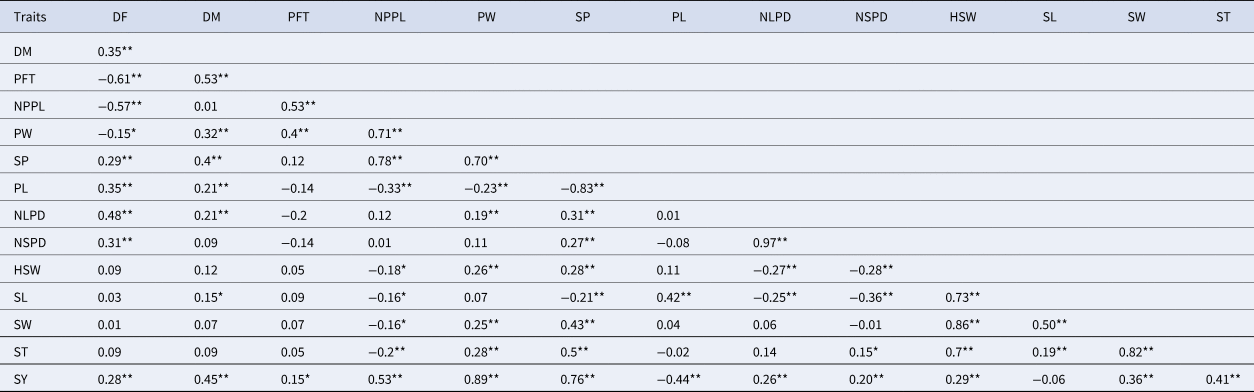
Except for SL and PL, all measured traits had positive significant genotypic relationships with SY (Table 1). The highest genotypic correlation coefficient with SY was recorded by PW (r g = 0.89**), followed by SP (r g = 0.76**), NPPL (r g = 0.53**) and DM (r g = 0.45**). Pod length had a significant relationship (r g = −0.44**) with SY. Significant positive genotypic correlations were also recorded between yield-related traits. Days to flowering was significantly correlated with DM, SP, PL, NLPD and NSPD. Pod filling time, PW, SP, PL and NLPD were significantly correlated with DM. The associations between NPPL on the one hand, and PW and SP on the other were significant. Also, PW was significantly correlated with SP, NLPD, 100-seed weight (HSW), seed width (SW) and seed thickness (ST). Hundred-seed weight, SL, SW and ST were also significantly associated with one another (Table 1).
Genotypic correlation coefficients among 14 traits of 196 accessions of African yam bean evaluated in six environments
*, **, significant at 0.05 and 0.01 probability levels, respectively.
DF, days to flowering; DM, days to maturity; PFT, pod filling time; NPPL, number of pods/plant; PW, pod weight; SP, shelling percentage; PL, pod length; NLPD, number of locules/pod; NSPD, number of seeds/pod; HSW, 100-seed weight; SL, seed length; SW, seed width; ST, seed thickness; SY, seed yield.
Path coefficient analysis
Path coefficient analysis revealed that DM (1.493), PW (0.839), SP (0.389) and NSPD (0.155) had positive direct effects on SY, whereas the direct effects of PFT (−1.757), DF (−1.452), NPPL (−0.290) and NLPD (−0.109) on SY were negative (Table 2). Days to flowering had positive indirect effects on SY through DM (0.523) and SP (0.112). Pod filling time had positive indirect influence on SY through DM (0.796) and PW (0.338). Number of pods/plant positively contributes indirectly to SY through PW (0.595) and SP (0.304). Pod length also indirectly influenced SY through DM (0.306). Number of locules/pod indirectly influences SY through DM (0.306), PW (0.160), NSPD (0.151) and SP (0.120). Seed length had an indirect contribution to SY through DM (0.219). Seed width had an indirect effect on SYPL through PW (0.212) and SP (0.167). The residual value of 0.30 was recorded.
Path analysis showing the direct (diagonal bold) and indirect effect of 13 agronomic traits on seed yield of 196 accessions of African yam bean evaluated in six environments
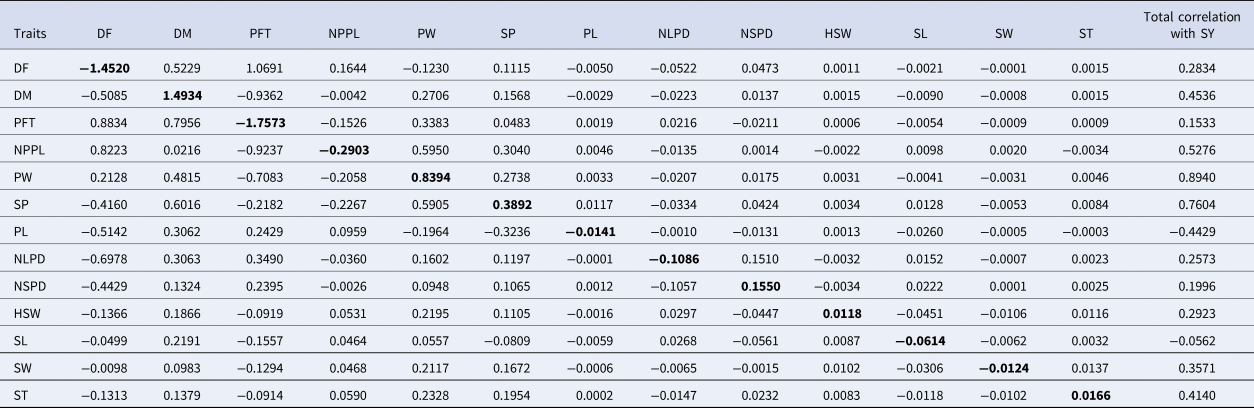
Residual = 0.303, coefficient of determination = 0.9083.
DF, days to flowering; DM, days to maturity; PFT, pod filling time; NPPL, number of pods/plant; PW, pod weight; SP, shelling percentage; PL, pod length; NLPD, number of locules/pod; NSPD, number of seeds/pod; HSW, 100-seed weight; SL, seed length; SW, seed width; ST, seed thickness.
Yield stability index
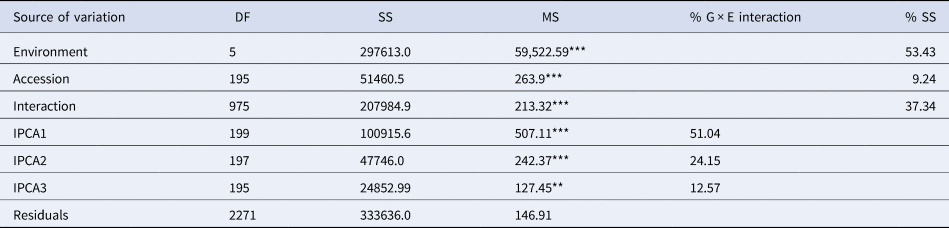
The analysis of the AMMI model for SY revealed highly significant (P ≤ 0.01) variations among accessions, environments, accession × environment interaction and interaction principal components 1, 2 and 3 (Table 3). Accessions significantly contributed 9.2% to the total sum of squares, while environment and accessions × environment interaction contributed 53.4 and 37.3%, respectively. By partitioning the interaction term through the AMMI model, the first three multiplicative terms (PC1, PC2 and PC3) of AMMI significantly explained 51.0, 24.2 and 12.2% of the interaction sum of squares (Table 3).
Analysis of AMMI model for seed yield of 196 accessions of African yam bean evaluated in six environments and the proportion of the total variance attributable to the sources of variation
**, *** significant at P-value <0.01 and <0.001, respectively.
DF, the degree of freedom; SS, the sum of square; MS, mean square.
The SY of the accessions ranged from 31.6 g/plant for accession TSs-421 to 6.2 g/plant for accession TSs-309 with a mean of 15.3 g/plant. Half (50.0%) of the AYB accessions in this study had a SY greater than 15.0 g/plant. The ASV of the accessions ranged from 0.018 for accession TSs-143 to 2.139 for accession TSs-195 (Table 4). Based on YSI criterion, accessions TSs-119 (12), TSs-101 (22), 138A (29), TSs-4 (39), TSs-157A (39), TSs-61 (49), TSs-63A (52), 55A (77), TSs-280 (78), TSs-56 (79) and TSs-10A (79) were the top-ranking accessions. Accessions TSs-421 (93) and TSs-195 (102) had the highest mean seed yield per plant and high ASV. Accession TSs-143 though had the lowest ASV, had a mean seed yield below the grand mean. Accessions such as TSs-104, TSs-363, TSs-29, TSs-278, TSs-19, TSs-443 and TSs-11 were low-yielding accessions with high ASV.
Mean seed yield, AMMI stability value, yield stability indices and their ranks for the 196 accessions of African yam bean evaluated in six environments

SY, seed yield (g/plant); IPCA, interaction principal component (PC); ASV, AMMI stability value; RSY, rank of seed yield; RASV, rank based on AMMI stability value; YSI, yield stability index; YSIR, yield stability index rank.
Discussion
Genotypic correlation
Genotypic correlation coefficients were used in this study to give an indication of true associations, while excluding environmental influences associated with phenotypic correlation (Kang, Reference Kang2015). The significant negative association between SY and PL suggests that longer pods may not necessarily translate to higher seed yield in AYB. This finding is consistent with the report of Osuagwu et al. (Reference Osuagwu, Chukwurah, Ekpo, Akpakpan and Agbor2014), that longer pods may not necessarily translate to high seed yield in AYB. The finding also challenges conventional assumptions and highlights the importance of evidence-based selection criteria in breeding programmes. The positive significant genotypic association between SY and other traits is useful in indirect selection to improve seed yield. Ibirinde and Aremu (Reference Ibirinde and Aremu2013), Aremu et al. (Reference Aremu, Ojuederie, Ayo-Vaughan, Dahunsi, Adekiya, Olayanju, Adebiyi, Sunday, Inegbedion, Asaleye and Abolusoro2019) and Alake and Porbeni (Reference Alake and Porbeni2020) reported similar results for different traits in AYB. Simultaneous improvement of these yield-related traits could also be possible due to their significant positive associations. The high genotypic correlation coefficients between SY and PW, SP, NPPL and DM suggest that breeding efforts focused on these traits would be most effective for improving seed yield in AYB. However, the results also suggest potential trade-offs in selection, particularly regarding the association between DM and SY. While longer maturity showed a positive correlation with yield, practical considerations such as growing season length and growers' preferences may necessitate finding an optimal balance between DM and SY potential.
Path coefficient analysis
In the present study, the high coefficient of determination (0.9083) indicates that the analysed traits effectively explain approximately 91% of the total variation in SY, suggesting that our model captured the most significant yield-determining factors. The residual value of 0.30 suggests that 30% of the variation in SY of the AYB accessions is influenced by factors not included in this study, suggesting opportunities for further investigation of additional yield-related traits. The positive direct effects of DM, PW, SP, NSPD, HSW and ST on SY indicated the need to place special emphasis on these traits for the genetic improvement of SY in AYB. Using fewer number of AYB accessions, Nwofia et al. (Reference Nwofia, Awaraka and Agbo2013) had earlier reported a similar effect of HSW on SY in AYB, while Aremu et al. (Reference Aremu, Ojuederie, Ayo-Vaughan, Dahunsi, Adekiya, Olayanju, Adebiyi, Sunday, Inegbedion, Asaleye and Abolusoro2019) identified NSPD and DM as important first-order predictor variables of SY. Though DM exhibited the highest positive direct effect on SY, DF and PFT had a strong negative direct effect, suggesting a complex relationship between these phenological traits and yield. This indicates that early flowering combined with longer PFT might be optimal for yield improvement through indirect selection.
Apart from DF and PFT, other traits such as NPPL, NLPD and SW had a negative direct effect on SY, despite having significant positive genotypic correlations with SY. This was due to their positive indirect effects on SY through other traits. For instance, DF and PFT had a high positive indirect effect on SY via DM, suggesting that selection for these traits would be effective and hence influence SY and DM indirectly. This complex interaction emphasizes the need for careful consideration of trait relationships in breeding programmes. The negative direct effect of NPPL was unexpected given its positive correlation with yield, highlighting the importance of considering both direct and indirect effects in selection decisions.
Yield stability index
The YSI was used to identify stable accessions with good SY performance. The high contribution of environment (53.4%) to the total sum of squares indicated that environmental diversity caused most of the observed variation in SY. The higher magnitude of accession × environment interaction sums of squares compared to that of accession indicated the differential response of accessions in the environments and crossover genotype × environment interaction effects for SY. A similar result was reported by Aremu et al. (Reference Aremu, Ige, Ibirinde, Raji, Abolusoro, Ajiboye, Obaniyi, Adekiya and Asaleye2020) in AYB. The relatively smaller genotypic contribution to total variation, while still significant, suggests that genetic differences among accessions were masked by environmental effects and G × E interactions. This further buttress the need to employ selection strategies that account for both yield potential and stability. The high proportion explained by IPCA1 (51.0%) suggests that a considerable portion of the genotype response patterns can be captured by this first component, providing a reliable basis for selecting stable genotypes.
Accessions TSs-119, TSs-101, 138A, TSs-4, TSs-157A and TSs-61 were ranked most desirable, integrating stability with high mean seed yield. These accessions represent valuable germplasm for breeding programmes targeting broad environmental adaptation. A similar result had been reported by Aremu et al. (Reference Aremu, Ige, Ibirinde, Raji, Abolusoro, Ajiboye, Obaniyi, Adekiya and Asaleye2020) for TSs-61. Accessions TSs-143, TSs-280, 138A, TSs-84, TSs-69, TSs-157A, TSs-119, 151B, TSs-361 and TSs-22B with the lowest ASV were the most stable of the 196 accessions studied across the six environments. In a study involving 23 accessions of AYB, Aremu et al. (Reference Aremu, Ige, Ibirinde, Raji, Abolusoro, Ajiboye, Obaniyi, Adekiya and Asaleye2020) also reported TSs-69 as one of the most stable accessions in SY. In another study involving 30 AYB accessions, Adewale (Reference Adewale and Kehinde2016) identified accession TSs-84 as the most stable for 100-seed weight. Although accession TSs-143 was the most stable, it was not the most desirable due to its low SY, while accessions TSs-421 and TSs-195, which had the highest SY, were not the most desirable. These findings buttress the fact that stable genotypes do not necessarily give the best performance and vice versa (Bose et al., Reference Bose, Jambhulkar, Pande and Singh2014). While the stability trait of accessions like TSs-143 with low SY and high ASV could be valuable, their use in breeding programmes would need to be carefully considered to avoid compromising yield potential. Furthermore, the lower but consistent yield character of these accessions could reflect conservative resource management strategies which are particularly valuable under limited resource conditions. Also, while high-yielding accessions with low ASV may not be suitable for broad deployment, they could be valuable in breeding programmes targeting specific environments. Accessions such as TSs-104, TSs-363, TSs-29, TSs-278, TSs-19, TSs-443 and TSs-11 were low yielding and less stable, hence, they are least desirable. However, they may possess other valuable traits not captured in this study.
Conclusion
This study revealed days to maturity, pod weight, shelling percentage, number of seeds per pod, 100-seed weight and seed thickness as important traits that should be included in a selection criterion for improved seed yield in AYB. Further studies on marker–trait association for these traits should be encouraged to accelerate the genetic improvement of AYB for seed yield. Accessions TSs-119, TSs-101, 138A, TSs-4, TSs-157A and TSs-61, which combined superior seed yield with stability, should be considered in future breeding programmes for seed yield improvement. The identification of stable, high-yielding accessions and key yield-related traits provides a framework for accelerating AYB improvement across diverse agro-ecologies, while offering a valuable model for breeding programmes of other underutilized legumes in similar environmental conditions.
Acknowledgements
The authors express gratitude to GRC seed bank staff members, IITA, Ibadan, the cassava breeding unit, IITA, Ubiaja, and the cowpea breeding unit, IITA, Kano for field assistance.
Author contributions
Conceptualization, M. T. A., A. A. and O. E. O.; funding acquisition, M. T. A.; investigation, O. E. O.; methodology, O. E. O., A. A., R. P. and O. A. O.; data curation, O. E. O.; formal analysis, O. E. O.; writing – original draft, O. E. O.; writing – review and editing, A. A., M. T. A., R. P. and O. A. O.
Funding statement
This study is funded by the Crop Trust through GRC-IITA.
Competing interests
None.


 Open access

