


Introduction
The global wildlife trade is a multibillion-dollar industry, involving the sale and exchange of hundreds of species of animals, plants, and their derivatives (Roe Reference Roe2008, Wyler and Sheikh Reference Wyler and Sheikh2013, TRAFFIC 2015). While it serves as means of income generation and social mobility for a number of developing communities, the trade is largely exploited for profits by major businesses and illegal syndicates (TRAFFIC 2017). The prevalence and magnitude of the international demand and trade in wildlife has deleterious consequences on wild animal populations, leading to overharvesting and the influx of invasive species and pathogens (TRAFFIC 2008, Hulme Reference Hulme2009, Travis et al. Reference Travis, Watson and Tauer2011, Chin Reference Chin2012, Olah et al. Reference Olah, Butchart, Symes, Guzman, Cunningham, Brightsmith and Heinsohn2016, Parnell Reference Parnell2016, Tingley et al. Reference Tingley, Harris, Hua, Wilcove and Yong2017).
Parrot populations are under severe threat from hunting and they rank among the most threatened groups of birds, with 28% of extant species classified as globally threatened (Olah et al. Reference Olah, Butchart, Symes, Guzman, Cunningham, Brightsmith and Heinsohn2016). A number of parrot species formerly abundant are now facing extinction (Tella and Hiraldo Reference Tella and Hiraldo2014, Olah et al. Reference Olah, Butchart, Symes, Guzman, Cunningham, Brightsmith and Heinsohn2016). Wild populations of African Grey Parrots Psittacus erithacus, for instance, have decreased by over 50% in many areas due to overharvesting and habitat destruction (Dasgupta Reference Dasgupta2016). The global parrot trade is also implicit in the spread of invasive species (Neo Reference Neo2015, Cardador et al. Reference Cardador, Tella, Anadon, Abellan and Carrete2019) and zoonotic diseases (Karesh et al. Reference Karesh, Cook, Bennett and Newcomb2005, Kilpatrick et al. Reference Kilpatrick, Chmura, Gibbons, Fleischer, Marra and Daszak2006, Toledo et al. Reference Toledo, Asmüssen and Rodríguez2012).
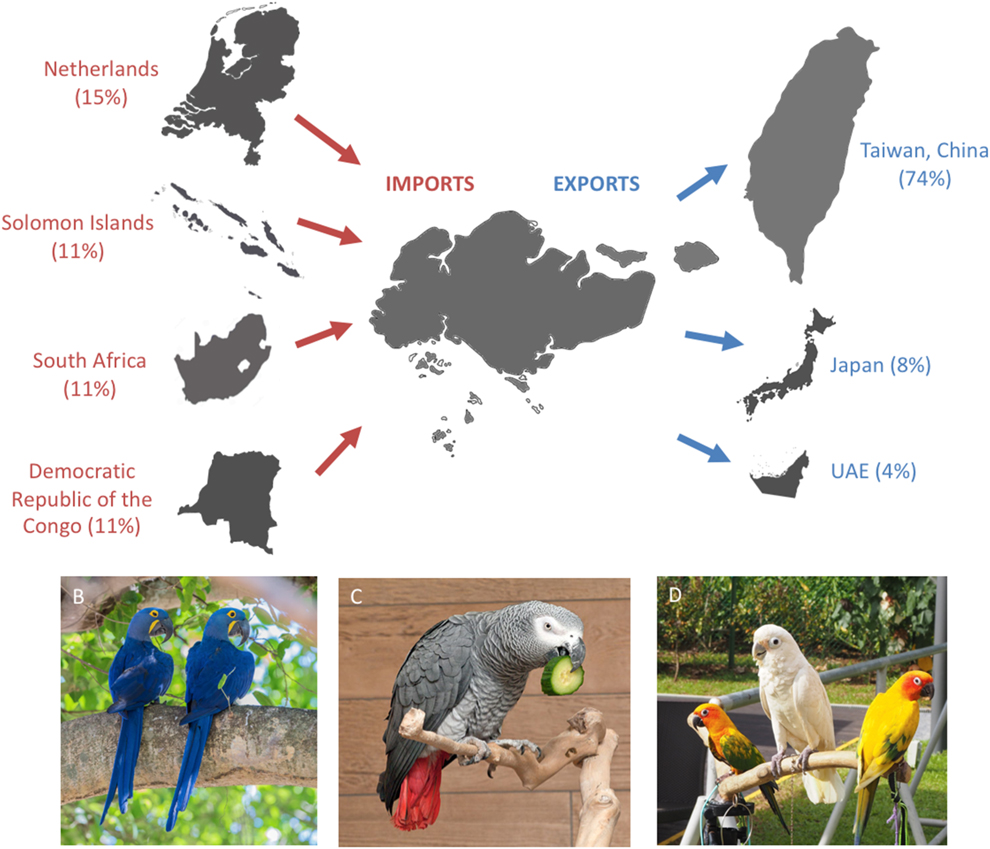
The South-East Asian region is a well-established trading hub for many parrot species, in terms of its diversity and sheer quantity (Sodhi et al. Reference Sodhi, Koh, Brook and Ng2004, TRAFFIC 2008, Rosen and Smith Reference Rosen and Smith2010, Chng et al. Reference Chng, Lee and Shepherd2016). The region’s role in the global bird trade is also increasing, following the 2005 European Union (EU) ban on wild-caught bird imports, which redirected trade from the EU to South-East Asia (Figure 1; Reino et al. Reference Reino, Figueira, Beja, Araujo, Capinha and Strubbe2017). Furthermore, some countries in the region have inadequate regulations protecting biodiversity, leaving it susceptible to unsustainable exploitation (Lin Reference Lin2005, Chin Reference Chin2012).
(a) Singapore’s top import and export countries/territories for CITES-listed parrots from 2005 to 2016 (see Table S3 for details) (b) Hyacinth Macaw Anodorhynchus hyacinthinus (photo credit: Bjorn Olesen) can fetch up to S$40,000 in Singapore, (c) African Grey Parrots Psittacus erithacus are popular pets for their ability to mimic human voices (photo credit: Wikipedia Commons) and (d) Tanimbar Corella Cacatua goffiniana and Sun Conures Aratinga solstitialis on display at a parrot hobbyist group gathering in Singapore.
Singapore is the largest importer of CITES-listed birds in South-East Asia contributing to 18% of imports in the region, followed by Thailand (7%) and Malaysia (7%) (CITES 2018). Its position as a major transhipment centre has been exploited for decades for the international avian trade where birds from Africa and Europe transit through Singapore to be re-exported to East Asia and the Middle East (Chng et al. Reference Chng, Eaton, Krishnasamy, Shepherd and Nijman2015, TRAFFIC 2016). Wild birds are also sourced from various parts of Indonesia and the Philippines to Singapore, to be re-exported globally (Bashari Reference Bashari2015, TRAFFIC 2016). Recent studies reported Singapore’s role in the movement of a significant number of CITES-listed birds that were falsely declared as captive-bred out of the Solomon Islands (Shepherd et al. Reference Shepherd, Stengel and Nijman2012) and Australia (Low Reference Low2014).
Singapore’s domestic bird trade was previously considered too small to explain the difference between the import and export of CITES Appendix I and II listed birds from 2005 to 2014 (Poole and Shepherd Reference Poole and Shepherd2016). However, recent media reports suggest that Singapore’s domestic parrot trade had been previously underestimated. The demand for parrots in Singapore has been growing since 2011 (Chan Reference Chan2016, Vasko Reference Vasko2014). This includes globally threatened and/or CITES-listed species (Eaton et al. Reference Eaton, Leupen and Krishnasamy2017).
At present, it is uncertain how Singapore’s international import and export of CITES-listed parrots (including native and exotic species) relates to its rising domestic market for these parrots. The latter is often overlooked, as studies tend to focus on Singapore’s international wildlife trade. To address these gaps in knowledge, our study aims to assess the trends in the volume and diversity of Singapore’s CITES imports and exports of parrots from 2005 to 2016, and how they relate with the domestic sale of parrots in local pet shops, paying close attention to the trade of IUCN (International Union for Conservation of Nature) red-listed and native parrot species. We also support our research with interviews with parrot owners in Singapore.
Methods
Market survey data collection
The key market surveys reviewed in this paper included: Nash (Reference Nash1994), Lee (Reference Lee2006), ACRES (2016) and Eaton et al. (Reference Eaton, Leupen and Krishnasamy2017). Previous reviews such as Chin (Reference Chin2012) and Poole and Shepherd (Reference Poole and Shepherd2016) were also compiled. The articles were acquired from online databases Google Scholar and the Web of Science during a systematic literature search conducted on November 2017. TRAFFIC publications were accessed from the online repository: http://www.traffic.org.
Interviews with parrot owners
Between January and August 2017, we conducted 30 semi-structured interviews with parrot owners, which included two local parrot breeders, a founder of a local parrot hobbyist group and two parrot sitters. The interviews explored the factors that drive the demand for parrots in Singapore by asking the following questions:
1. Why do you think parrots are increasingly popular as pets in Singapore? If you belong to a parrot hobbyist community, please elaborate how you were introduced and the activities conducted?
2. Which factors motivate you to keep parrot(s)?
3. What are your main considerations when purchasing a parrot?
All interviews conformed with the British Sociological Association guidelines. The interviewer explained the objectives and implications of the research in sufficient detail to each interviewee who provided freely given and informed consent for their participation. The interviews were conducted in person or over the phone, one-on-one, in a quiet setting and the interviews were voice recorded using an iPhone (voice memo) after seeking the interviewee’s consent.
Participants for the interviews were selected via targeted sampling, a non-probabilistic method of sampling, in which only parrot owners were selected. We contacted friends and acquaintances who kept parrots, and asked if they were willing to be interviewed.
Additional participants for the interviews were acquired via chain referral, which involved snowball sampling and respondent-driven sampling. In snowball sampling, we asked interviewees if they could provide details of potential participants that may be willing to participate in the study, who we then contacted directly. In respondent-driven sampling, interviewees were asked to let others know of our project and to contact us if interested in participating (Newing Reference Newing2011).
CITES trade data collection
Singapore CITES bird trade data from years 2005 to 2016 were extracted from https://cites.org, which contains import, export and re-export records of CITES Appendix I, II and III-listed bird species, to and from Singapore as reported by CITES Parties to the CITES Secretariat (see Table S1 in the online supplementary material for definitions). Only gross trade output was available i.e. immediate import and export data, without re-export data. CITES data for 2017 were unavailable at the time our study was conducted. The export figures were deducted from import figures (both as reported by Singapore) to quantify the annual difference in the number of birds i.e. imports that were not re-exported from Singapore. Variables for YEAR (2005 to 2016), TERM (Live), SOURCE (ALL Sources) and PURPOSE (Commercial) were kept constant for all searches. “ALL Sources” included— “Captive-bred animals”, “Captive-bred/artificially propagated”, “Born in captivity”, “Confiscations/seizures”, “Pre-Convention”, “Ranched”, “Source unknown”, and “Wild”.
Our study focuses on the commercial trade of CITES-listed birds. Our dataset differed from Poole and Shepherd’s (Reference Poole and Shepherd2016) study in that we included Appendix III birds and all sources including “confiscated”, “ranched”, “born in captivity” and “unknown”. Market survey data were compared with CITES Appendix I, and the IUCN Red List of Threatened Species, extracted from “http://cites.org” and BirdLife International (2017) respectively.
Statistical analyses
The change in the following numerical variables over time was examined over a 12-year period (2005 to 2016): (a) total CITES-listed bird imports, (b) total CITES-listed bird exports, (c) percentage of CITES- listed parrot imports out of total CITES-listed bird imports, (d) percentage of CITES-listed parrot exports out of total CITES-listed bird exports (e) percentage of CITES-listed wild caught bird imports out of total CITES-listed bird imports, and (f) percentage of CITES-listed wild caught parrot imports out of total CITES-listed bird imports. Pearson product-moment correlation was performed on variables “e” and “f”, while Spearman rank correlations were performed on variables “a”, “b”, “c” and “d” which were not normally distributed. The Shapiro-Wilk test was used to assess the normality of the datasets. All statistical analyses were performed using R software (R Core Team 2017).
Results
CITES trade data
Singapore’s top 10 CITES-listed bird species by import and export volumes during 2015 and 2016 was composed entirely of parrots, consistent with imports and exports during 2005 to 2014 (with the exception of the Common Hill Myna Gracula religiosa), as reported by Poole and Shepherd (Reference Poole and Shepherd2016) (Table S2).
Temporal trends in CITES import and export
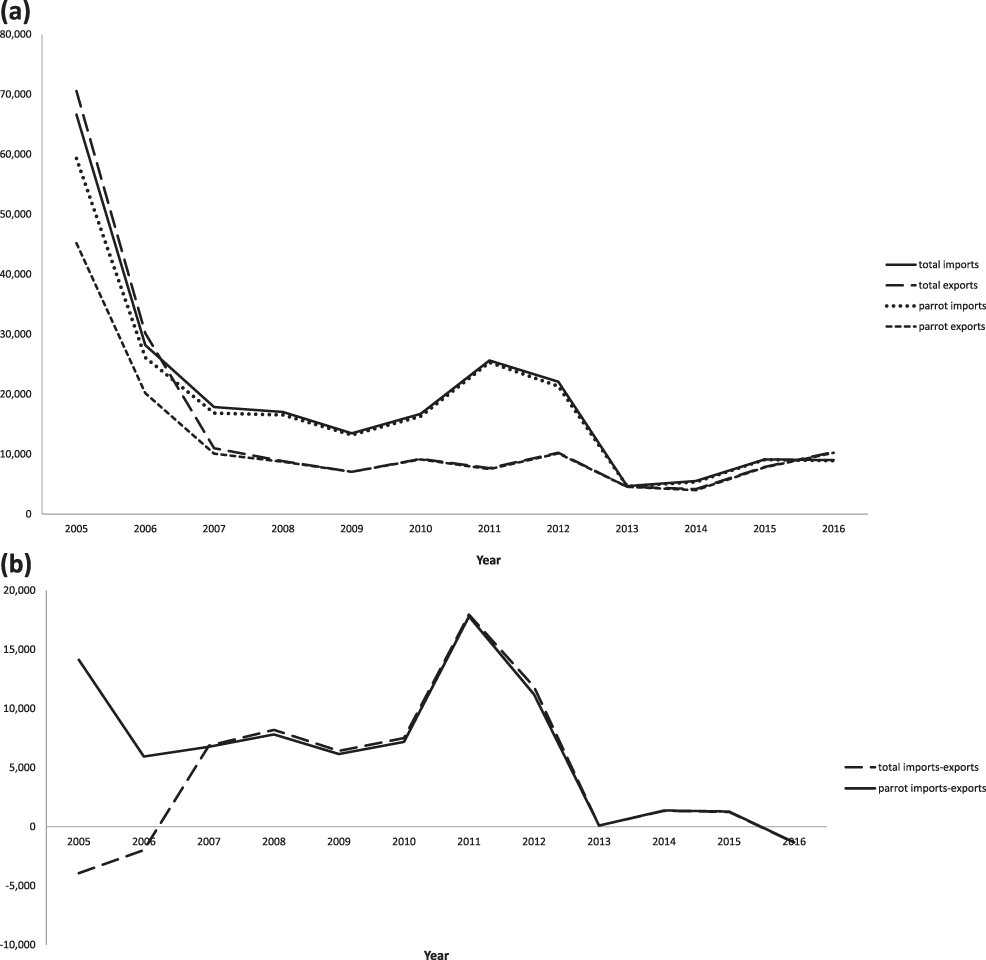
Total imports and exports of CITES-listed birds (by volume) in Singapore decreased from 2005 to 2016 (Figure 2a). A strong negative, linear relationship was detected between imports and year of trade from 2005 to 2016 (Spearman’s correlation, n = 12, r = -0.76, P < 0.05). Specifically, imports and exports dipped sharply during 2005–2007 and then increased from 2010 to 2012. After another dip in 2013, trade increased slightly during 2014–2016 (Figure 2a). Singapore became a net exporter of birds in 2016 (Figure 2b). Total imports and exports of CITES-listed parrots similarly decreased from 2005 to 2016; however, parrots made up the majority (94.5%) of imports (Table 1), and the percentage of parrot imports out of total imports had increased. A strong positive linear relationship was detected between the percentage of parrot imports out of total imports and year of trade from 2005 to 2016 (Spearman’s correlation, n = 12, r = 0.76, P < 0.05).
(a) Imports and exports of CITES-listed birds and CITES-listed parrots from 2005 to 2016. (b) Imports minus exports of CITES-listed birds and CITES-listed parrots from 2005 to 2016.
Number of CITES-listed birds imported or exported by Singapore from 2005 to 2016.
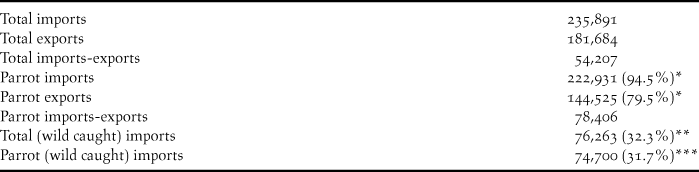
* Percentage of parrots out of total bird imports/exports.
** Percentage of wild caught bird imports out of total bird imports.
*** Percentage of wild caught parrot imports out of total bird imports.
Singapore as a transit destination for parrots
Singapore’s top three import markets for CITES-listed parrots from 2005 to 2016 were the Netherlands (15%), Solomon Islands (11%) and South Africa (11%) and the top three export markets were Taiwan, China (74%), Japan (8%) and the United Arab Emirates (4%) (Figure 1; Table S3).
The import and export percentages for top three markets varied substantially over the years. Imports from the Netherlands varied from zero in 2007 to 47.6% in 2011, imports from the Solomon Islands declined sharply from 2005 to 2009 with no imports since 2010, and imports from South Africa varied from zero in 2005–2006 to 48.9% in 2010. Exports to Taiwan, China varied from 60% in 2006 to 93.5% in 2015, exports to Japan varied from 2.8% in 2009 to 17.9% in 2014 and exports to UAE have been nearly zero since 2009 (Figure 1).
Imports from the Netherlands and South Africa were largely of African and South American origin. Solomon Islands traded mostly regionally sourced parrots including Solomon and New Guinean endemics. The Philippines was the only import market from South-East Asia and contributed to only 2% of total imports.
Exports to Taiwan, China comprised globally sourced parrots of African, Australasian, South-East Asian and South American origin. However, there is no way to verify the actual number of parrot exports to Taiwan, China, since it is not a Party to CITES and does not submit its trade reports. The exporting country, in this case, Singapore, reports Taiwan, China’s import figures. South-East Asian countries contributed only 3.8% of Singapore’s total parrot exports.
Wild-caught bird trade
The proportion of wild caught bird imports out of total imports increased even though total wild-caught bird imports decreased from 2005 to 2016 (consistent with a decrease in overall trade). A strong positive relationship was detected between the percentage of wild caught bird imports and year of trade from 2005 to 2016 (Pearson’s correlation, n = 12, r = 0.61, P < 0.05). Similarly, a strong positive relationship was detected between the percentage of wild caught parrot imports and year of trade from 2005 to 2016 (Pearson’s correlation, n = 12, r = 0.61, P < 0.05). All CITES-listed birds from Singapore were captive bred, as declared by the exporting country (Singapore).
CITES import and export difference
A total of 54,207 (23% of total imports) of CITES Appendix I, II and III listed birds; and 78,406 (35.2% of total parrot imports) of CITES Appendix I, II and III listed parrots were not re-exported for after their arrival into Singapore during 2005 to 2016 (Table 1). However, import-export discrepancies decreased drastically from 2011 to 2016 for both parrots and all birds (Figure 2b), consistent with a decrease in overall trade.
The total import-export difference we report is smaller than that of 85,649 birds reported by Poole and Shepherd (Reference Poole and Shepherd2016). This is possibly due to the difference in methodologies used in that we included in our study: a) CITES Appendix III listed birds for which there were more exports than imports from 2005 to 2016; and b) all sources of birds from CITES database (see section 2.2).
Review of previous market surveys
There was a huge disparity in survey effort among past market surveys which made it impossible to identify a trend in abundance and/or diversity of parrots traded over time (Table S5). Nash (1993) surveyed pet shops in Singapore over 17 months but only recorded non-CITES listed birds. Lee (Reference Lee2006) and Eaton et al.’s (Reference Eaton, Leupen and Krishnasamy2017) surveys involved a smaller sampling effort – 24 pet shops over six months, and 28 pet shops over four days respectively. ACRES (Animal Concerns Research and Education Society) (2016) monitored wildlife trade advertisements on online platforms in Singapore over three months (June to August 2016).
Market volume and diversity
The majority of birds sold in Singapore’s pet shops were songbirds: 69.5% (Lee Reference Lee2006) and 98.3% (Eaton et al. Reference Eaton, Leupen and Krishnasamy2017). However, parrots made up 49% (84 of 172 species; Lee Reference Lee2006) and 40% (44 of 209 species; Eaton et al. Reference Eaton, Leupen and Krishnasamy2017) of bird species recorded. The most common parrots sold included the Budgerigar Melopsittacus undulatus, Cockatiel Nymphicus hollandicus, and Monk Parakeet Myiopsitta monachus, all of which are not CITES-listed (Table S7). The majority of the parrots (67.9 % and 78.8 %) recorded by Lee (Reference Lee2006) and Eaton et al. (Reference Eaton, Leupen and Krishnasamy2017) in market surveys respectively, were CITES-listed. A significant proportion (273 out of 655; 41.7%) of wildlife trade advertisements identified on online platforms also involved CITES-listed birds (ACRES 2016).
Further, parrots comprised a substantial proportion (44.4%) of threatened birds recorded in pet shops (see Table 2) including the Yellow-crested Cockatoo Cacatua sulphurea and African Grey Parrot that have possibly been wild caught and trafficked into the country (AVA 2002, WWF 2016, CNA 2015).
List of IUCN threatened birds recorded at pet shops in Singapore by previous researchers. The list is compared with CITES trade data to identify birds that were imported but did not show up in market surveys and vice versa.
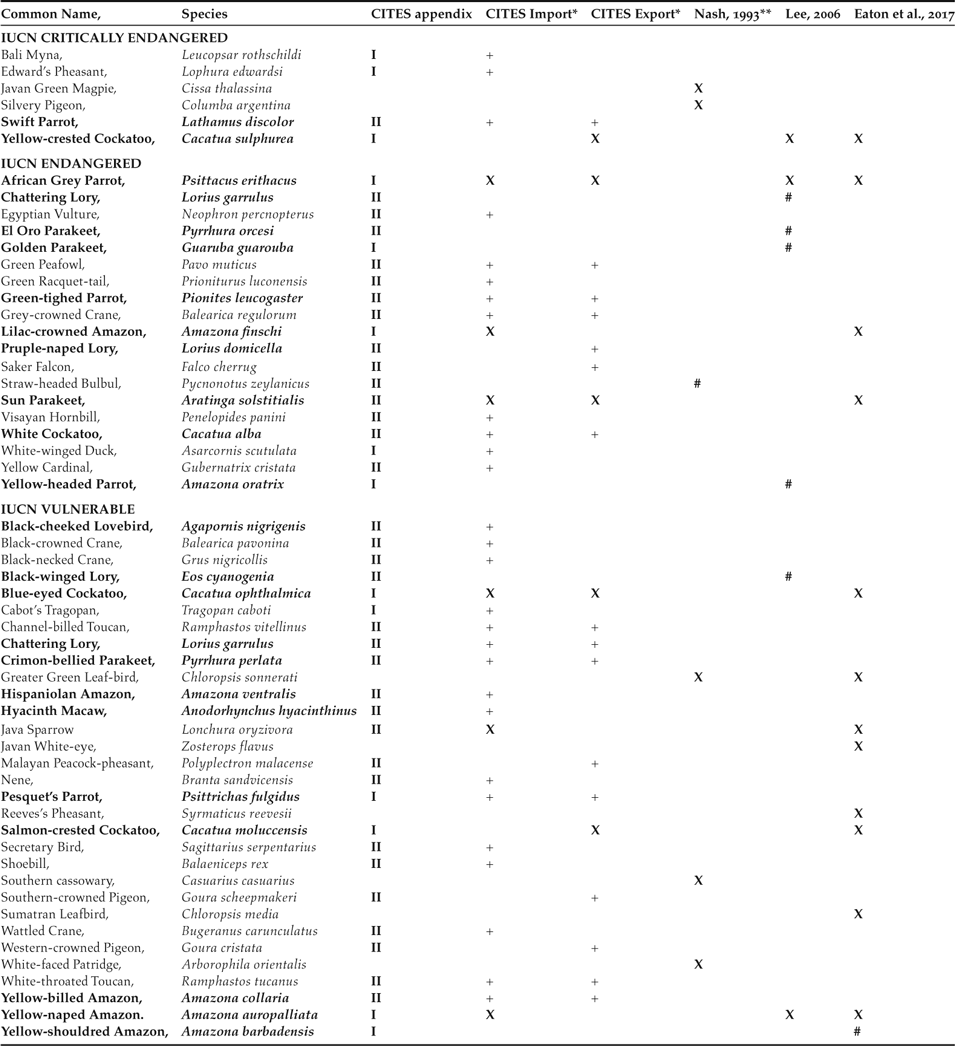
Parrots in BOLD;
Species recorded in market surveys labelled X;
CITES-listed birds traded but not recorded in market surveys labelled +;
Birds recorded in market surveys but not in CITES trade data labelled #;
* From 2005 to 2016;
** Only Non-CITES birds.
Seven (30.4%) CITES-listed threatened parrot species were recorded in market surveys but not in Singapore’s CITES import or export database (Table 2). Conversely, the majority (80.5%, 33 species) of threatened bird species recorded in the CITES database were not documented in market surveys. These birds could have been re-exported out of Singapore for the international trade.
Interviews with parrot owners
A detailed description of the interview results and analysis will be covered in a separate study. Here, we present results that explore the changing ownership trends in Singapore and how it relates to the country’s international trade of parrots. Interviewees were numbered from 1 to 30 based on the date of the interview. Selected quotes, each labelled with the interviewee’s assigned number are listed in Figure S2.
Interviews with parrot owners in Singapore revealed that pet shopsFootnote 1 and hobbyist groups in Singapore function as key platforms that influence the public to keep parrots, and sometimes on impulseFootnote 2. Parrot hobbyist group events such as the free-flying of parrots in the open are especially effective at attracting interest from passers-byFootnote 3. These groups also leverage social media to draw attentionFootnote 4 and recruit members.Footnote 5 Hobbyist group members agreed that the number of hobbyist groups and membership within these groups have increased over the past five yearsFootnote 6 (A. J. pers. comm.).
A local breeder whom we interviewed said that although the majority of parrots sold consist of the smaller, non-CITES listed parrots such as budgies and cockatiels (also see Lee Reference Lee2006, Eaton et al. Reference Eaton, Leupen and Krishnasamy2017), the demand for larger parrots has also increased. Interviewees also shared that some parrot owners keep smaller parrots to gain handling experience before progressing to larger parrots.Footnote 7 The breeder confirmed the growing anecdotal evidence which suggests that macaw sales have increased by 50% in Singapore from 2001 to 2016, including threatened species such as the globally ‘Vulnerable’ Hyacinth Macaw Anodorhynchus hyacinthinus (Chan Reference Chan2016). Further, some owners purchase additional parrots to keep their first parrot company.Footnote 8
Local breeders also state that parrots are the most expensive birds sold in Singapore, with their price ranging from SGD $200–$40,000 (USD $150–$30,000; Table S6). This is consistent with anecdotal records that suggest the Hyacinth Macaw was the most expensive bird, priced between SGD$35,000 (USD $26,170) and SGD $40,000 (USD $30,000) in 2014 (Vasko Reference Vasko2014, Chan Reference Chan2016).
Discussion
Decline in CITES imports and exports
The decline in Singapore’s CITES-listed bird trade since 2005 is consistent with the global drop in trade volume following the EU imposed ban on wild-caught birds (Reino et al. Reference Reino, Figueira, Beja, Araujo, Capinha and Strubbe2017). Regional declines in South-East Asia were also attributed to the avian flu outbreak, which led to more stringent regulations on veterinary conditions and limited trade to bird-flu-free zones (Anonymous 2005, Lee Reference Lee2006, AVA 2015, Zannia Reference Zannia2017). Since 2015, the Agri-food and Veterinary Authority (AVA), Singapore’s CITES management and scientific authority) had also increased surveillance efforts and exerted stricter control over CITES permits to regulate trade (S. A. pers. comms. with owner of commercial bird breeding farm in Singapore). For instance, the AVA pledged to stamp out the illegal wildlife trade (CNA 2015) and destroyed 7.9 tonnes of elephant ivory publicly to reiterate the government’s zero tolerance towards wildlife trafficking (PHYS 2016).
Increasing domestic demand for parrots
Our interview results confirm a growing domestic demand for parrots and an increase in parrot hobbyist group membership in Singapore as also reported by anecdotal media reports (Chan Reference Chan2016, Vasko Reference Vasko2014, Woo, Reference Woo2018), e.g. one media reported that pet shop owners in the country have found a consistent (estimated 10%) increase in parrot sales every year from 2011 to 2013 (Vasko Reference Vasko2014). The yearly increase in the percentage of CITES-listed parrot imports out of total CITES-listed bird imports from 2005 to 2016 also supports this assertion.
The increasing popularity of parrots among pet owners in Singapore may reflect a broader demand for parrots in the South-East Asian pet trade and perhaps globally, with detriment to wild parrot populations. Globally, parrots remain the most traded group among CITES-listed birds. Although other taxa (e.g. passerines) have declined substantially since the 2005 EU trade ban, the trade of parrots has since recovered to almost 60% of their pre-ban levels by 2011 (Reino et al. Reference Reino, Figueira, Beja, Araujo, Capinha and Strubbe2017). The South-East Asian and New Guinean parrot trade constitute a significantly greater proportion of global parrot trade as compared to pre-EU trade ban levels (Reino et al. Reference Reino, Figueira, Beja, Araujo, Capinha and Strubbe2017).
The increase in the domestic demand for parrots in Singapore is of concern because there is evidence that globally threatened species such as the Yellow-crested Cockatoo are in trade, which have been possibly wild caught and trafficked into the country. In addition, a substantial proportion of wildlife trade in Singapore takes place online with almost no regulations in place (ACRES 2016, Mahmud Reference Mahmud2017). The scale of the online trade may have been previously underestimated with the potential of contributing to a significant proportion of Singapore’s total wildlife trade.
Parrot importing and exporting countries
CITES-listed parrot imports to Singapore originated from diversified sources from the Netherlands and South Africa which trade in a variety of parrot species, to the Solomon Islands, Democratic Republic of the Congo and Guyana which export mostly regional species. The large volume of parrot imports from the Solomon Islands is particularly worrying because it involves restricted-range species such as the Solomons Cockatoo Cacatua ducorpsii. However, trade with the Solomon Islands has reduced sharply since 2006 when the Solomon Islands Government imposed a ban on wildlife exports to give time to develop protection acts (Shepherd et al. Reference Shepherd, Stengel and Nijman2012). Singapore also imported parrots from the broader New Guinea region, which has a history of poorly regulating CITES permits and exceeding CITES trade quotas (Shepherd et al. Reference Shepherd, Stengel and Nijman2012).
Singapore’s CITES-listed parrot exports, in contrast, were far less diverse, and were directed to developed markets in Asia (Taiwan, China, Japan, UAE and Hong Kong) and Europe (Netherlands, Denmark and Spain). Given that Taiwan, China contributed to nearly 75% of Singapore’s parrot exports, bilateral agreements on sustainable sourcing of parrots should be developed.
Singapore’s trade with South-East Asian countries was insignificant. This is despite the fact that there is domestic and international demand for South-East Asian parrot species. Our interviews with parrot owners confirmed the popularity of South-East Asian parrots such as the Yellow-crested Cockatoo and Chattering Lory Lorius garrulus in Singapore. Similarly, South-East Asian parrots are popular pets in Indonesia (Bashari Reference Bashari2015) and Philippines (Tabaranza and Lepiten-Tabao Reference Tabaranza and Lepiten-Tabao2001). The CITES data suggests that Singapore imports a number of captive-bred South-East Asian parrot species from Europe and South Africa. This may be because breeders in Europe and South Africa have access to better facilities and expertise for captive-breeding of parrots compared to breeders in the region. This is laudable as a move to promote sustainably sourced parrot species in trade.
CITES import and export difference
We suggest that the difference in imports and exports could be due to permitting issues and time lag in exports. Following Poole and Shepherd’s (Reference Poole and Shepherd2016) study, the AVA clarified that reporting before 2016 was based on permits issued, which did not reflect actual trade figures. AVA has since provided actual trade figures (Neo Reference Neo2016). Indeed, we noticed that Singapore updated its 2005–2016 CITES import and export numbers in 2017 (S. A. pers. obs.). However, the updated numbers still reflect a large difference (54,207 birds) in imports and exports. Poole and Shepherd (Reference Poole and Shepherd2016) suggested that a large number of birds could be housed in local captive-breeding farms in Singapore for re-export.
In response to Poole and Shepherd’s (Reference Poole and Shepherd2016) study, AVA further clarified that birds may not be re-exported within the same year that they were imported into the country due to time-lag in exports i.e. they could have remained in Singapore for a few years before re-export (Lim and Tan Reference Lim and Tan2016). However, it is unlikely that tens of thousands of birds can be kept for years before they are re-exported because of high mortality rates and lack of space in land-scarce Singapore. Import-export difference could increase further if the trade in non-CITES birds is also considered (Poole and Shepherd Reference Poole and Shepherd2016).
We hypothesize that a large proportion of the CITES-listed birds that were not re-exported were directed into Singapore’s domestic bird market, which was previously underestimated. Parrots that were not re-exported (78,406 individuals or 35.2%) constitute a significant proportion of total CITES listed parrot imports, including species native to and/or naturalised in Singapore. This observation corroborates with anecdotal reports of the rising domestic demand of parrots in Singapore. It also highlights the need for better documentation of the rising domestic demand.
Limitations of CITES-trade and market survey data
Birds recorded as imported in CITES datasets and not documented in market surveys may be re-exported to other countries or housed in captive breeding or exporting facilities. These birds could have also been sold in Singapore but were overlooked in market surveys because they were not displayed publicly. Conversely, it is possible that bird species and numbers documented in market surveys but not in CITES datasets may refer to captive-bred individuals from local breeding facilities and/or birds imported prior to 2005 but housed in breeding farms or pet shops (J.G.H.L. unpubl. data). It is also possible that these birds were illegally trafficked into the country (Poole and Shepherd Reference Poole and Shepherd2016).
Finally, there is missing data from non-CITES party states, and potential inconsistency in species identification by CITES regulatory bodies. CITES permits are generally issued on the basis of declarations, which involve the attachment of photographs of the species in trade. In certain cases, enforcement authorities may lack the capacity to identify species accurately, especially similar-looking species or subspecies or parrots with colour mutations and hybrids. The latter adds another layer of complication on the identification of already cryptic, similar-looking species/subspecies (J.G.H.L. unpubl. data). The technical capacity of Singapore’s CITES authority is expected to greatly improve with the National Parks Board replacing AVA as the CITES authority of Singapore from April 2019 (Wong Reference Wong2018) – a move that has been praised by the conservation community.
Recommendations
Previous market surveys in Singapore merely provided snapshots of species volume and diversity at any given time that also fail to capture turnover of birds (e.g. Eaton et al. Reference Eaton, Leupen and Krishnasamy2017), making it challenging for direct comparison with annual CITES datasets. Given the severity of the bird trade on wild bird populations (Harris et al. Reference Harris, Massimino, Newson, Eaton, Balmer, Noble, Musgrove, Gillings, Procter and Pearce-Higgins2015), we recommend the implementation of a systematic and long-term monitoring effort of key pet shops, captive-breeding farms and exporting facilities in Singapore, to document the temporal turnover of species volume and diversity and ideally as a collaborative effort between CITES authorities, other government agencies and independent parties e.g. universities and non-government organisations.
Moreover, regulatory bodies in Singapore should consider implementing a licensing and records system, such as in Australia (DBCA 2013), to track the movement of birds through local captive-breeding farms, exporting facilities and pet shops. The trade in African Grey Parrots in particular should be monitored in domestic markets to assess if its uplisting to CITES Appendix I status in October 2016 (CITES 2016, Dale Reference Dale2016) had any impact on subsequent trade. Authorities involved in the enforcement of CITES could be better trained in species identification to detect cryptic and similar-looking species/subspecies. A consultative panel comprising of technical authorities from universities, zoological institutions and conservation NGOs could be established to support species identification and taxonomic issues.
The wildlife trade also contributes to the spread of zoonotic diseases (Karesh et al. Reference Karesh, Cook, Bennett and Newcomb2005) and parrots are susceptible to a range of pathogens, a number of which need to be carefully managed in captivity due to their high transmission rates, mostly developing no symptoms despite harbouring and/or shedding the pathogen and high mortalities (J. L. pers. comm. with Neo P.). Birds in trade are often kept in overcrowded and poor conditions, and these factors along with poor disease management play a role in exacerbating the spread of pathogens and diseases (Karesh et al. 2007). Outbreaks of avian disease not only impact the avicultural industry, but also on native bird populations, livestock and humans such as in the case of Chlamydia psittaci, which causes psittacosis in humans (Karesh et al. 2007, Vanrompay et al. Reference Vanrompay, Ducatelle and Haesebrouck1995). Current disease control measures are mostly restricted to disease-causing pathogens with implications to livestock or human health. As such, there is a need for more extensive measures such as comprehensive disease testing and the implementation of proper biosecurity protocols and mandatory screening programs in pet shops and veterinary clinics (J.G.H.L. unpubl. data).
The scale of the online bird trade and its contribution to CITES trade has also been previously underestimated in Singapore (Iqbal et al. Reference Iqbal2015), and there are currently no regulations governing wildlife trade online (Mahmud Reference Mahmud2017). However, the CITES authority in Singapore has conducted monitoring efforts on platforms such as “Gumtree”, “Locanto”, and “Facebook”, where a large proportion of CITES-listed birds are known to be traded (ACRES 2016); and informed users about laws prohibiting the sale of illegal wildlife in Singapore (Mahmud, Reference Mahmud2017). Studies in future could assess the efficacy of these monitoring efforts.
Finally, unsustainable trade can be averted with a change in consumer behaviour (WWF 2012, Neo Reference Neo2016). Regulatory bodies should encourage pet shops to display the IUCN conservation status and source of parrots sold, to inform customers before they make a purchase. This could be done in collaboration with existing measures such as the “You Buy They Die” campaign by TRAFFIC and Wildlife Reserves Singapore that advocates against the purchase of threatened bird species (TRAFFIC 2015). A combination of improved trade monitoring, capacity development and responsible consumer behaviour is necessary to manage the trade of parrots, and the broader conservation of wild parrot populations.
Supplementary Material
To view supplementary material for this article, please visit https://doi.org/10.1017/S0959270919000182
Acknowledgements
We thank Mr Vinayagan Dharmarajah from BirdLife International, Ms Serene Chng from TRAFFIC, Dr Janice Lee from Nanyang Technological University and the anonymous reviewers for their constructive comments.



