





Suicidal behavior exacts immense personal and societal costs and is a persistent public health concern. Suicide accounts for >700,000 worldwide deaths annually (World Health Organization, 2023), and nonfatal attempts are up to 25 times more common (Centers for Disease Control and Prevention, 2021). Risk is multifactorial and dynamic: Biological, psychosocial, and environmental factors all contribute to liability (Durkheim, Reference Durkheim, Spaulding and Simpson1951; Klonsky & May, Reference Klonsky and May2015; Turecki & Brent, Reference Turecki and Brent2016; van Orden et al., Reference van Orden, Witte, Cukrowicz, Braithwaite, Selby and Joiner2010). Explication of specific correlates, particularly those causally related to suicidal behavior, is essential for improved targeting of high-risk groups in prevention and intervention efforts.
Individuals of low socioeconomic status or experiencing financial strain are at higher risk for suicidal behaviors (Beautrais et al., Reference Beautrais, Joyce and Mulder1998; Choi et al., Reference Choi, Marti and Choi2022; Elbogen et al., Reference Elbogen, Lanier, Montgomery, Strickland, Wagner and Tsai2020; Llamocca et al., Reference Llamocca, Yeh, Miller-Matero, Westphal, Frank, Simon, Owen-Smith, Rossom, Lynch, Beck, Waring, Lu, Daida, Fontanella and Ahmedani2023; Milner et al., Reference Milner, Page and LaMontagne2014; Stack & Wasserman, Reference Stack and Wasserman2007). A systematic review found that the population-attributable risks for low educational attainment and occupational status on suicide were of similar magnitude to those for psychiatric and substance use disorders (Li et al., Reference Li, Page, Martin and Taylor2011). However, this association might not persist after controlling for a history of psychiatric illness (Duberstein et al., Reference Duberstein, Conwell, Conner, Eberly and Caine2004; Roelfs & Shor, Reference Roelfs and Shor2023). Limitations of prior studies include the use of cross-sectional data, brief follow-up periods, focus on older adults (Choi et al., Reference Choi, Marti and Choi2022; Duberstein et al., Reference Duberstein, Conwell, Conner, Eberly and Caine2004; Rojas, Reference Rojas2022), and failure to account for the genetic component of suicidality (Docherty et al., Reference Docherty, Mullins, Ashley-Koch, Qin, Coleman, Shabalin, Kang, Murnyak, Wendt, Adams, Campos, DiBlasi, Fullerton, Kranzler, Bakian, Monson, Renteria, Walss-Bass, Andreassen and Ruderfor2023; Docherty et al., Reference Docherty, Shabalin, DiBlasi, Monson, Mullins, Adkins, Bacanu, Bakian, Crowell, Chen, Darlington, Callor, Christensen, Gray, Keeshin, Klein, Anderson, Jerominski, Hayward and Coon2020; Edwards et al., Reference Edwards, Ohlsson, Moscicki, Crump, Sundquist, Lichtenstein, Kendler and Sundquist2021; Fu et al., Reference Fu, Heath, Bucholz, Nelson, Glowinski, Goldberg, Lyons, Tsuang, Jacob, True and Eisen2002), which could operate in the context of a diathesis-stress model (Monroe & Simons, Reference Monroe and Simons1991; van Heeringen & Mann, Reference van Heeringen and Mann2014) wherein financial stress exacerbates an underlying genetic diathesis. Furthermore, while the majority of prior research has focused on suicide death, evaluating risk of nonfatal suicide attempt is imperative given its high prevalence and evidence that the relative impact of financial stress differs across suicide attempt versus death (DeJong et al., Reference DeJong, Overholser and Stockmeier2010).
Here, we evaluate the role of three financial stress indicators — receipt of social welfare, unemployment benefits, and early retirement (the Swedish equivalent of long-term disability) — as correlates and/or potentially causal risk factors for nonfatal suicide attempt and suicide death. In Sweden, these social safety nets are made available to those in need in a timely, efficient manner, but provide support that is considerably lower than the status quo ante. By leveraging large, representative population registers, we address important considerations that some prior work has not accounted for, including potential sex differences, shifts in risk as a function of age, and robustness of effects when controlling for psychopathology. The genetically informative nature of the data enables us to test a diathesis-stress model, which could yield insight to whether individuals with a high genetic propensity toward suicidal behavior warrant particular concern when faced with financial challenges. These analyses elucidate the complex relationship between financial circumstances and suicide risk.
Materials and Methods
Sample
We collected information on individuals from Swedish population-based registers with national coverage, linking each person’s unique personal identification number which, to preserve confidentiality, was replaced with a serial number by Statistics Sweden. We secured ethical approval from the Regional Ethical Review Board in Lund and no participant consent was required (No. 2008/409 and later amendments).
Measures
Our outcome variables, nonfatal suicide attempt (SA) and suicide death (SD), were assessed using information from national patient and mortality registers. The main exposure variables — receipt of social welfare, early retirement, unemployment benefits — were collected from the Swedish Longitudinal Integration Database for health insurance and labor market studies (LISA). All three exposures were categorized into binary variables based on whether the individual received a specific benefit during a given year. Social welfare is designed to provide support for an individual’s upkeep and for other items to provide a reasonable standard of living. Unemployment benefits were based on whether the individual was registered as a jobseeker at the Employment Service, able to work at least 3 hours a day and 17 hours a week and actively seeking a suitable job. For a full definition of all variables see the supplementary material.
Statistical Analyses
Dataset generation
We created three separate datasets that included all individuals born in Sweden between 1960−1990 to Swedish-born parents. We included first year of registration for unemployment benefits, early retirement, and/or receipt of social welfare. Taking the example of social welfare, we matched welfare recipients with five controls on year of birth, sex, and municipality of residence. The control could not have been registered for social welfare at the time of the case’s registration. SA was measured from the year of registration. To ensure that the registration of social welfare was the first registration, we excluded all individuals with a first registration between years 1990 and 1997 (i.e., individuals had to be free from social welfare for at least 8 years). We also included information on parental education, registrations of SA prior to the social welfare, a familial genetic risk score for SA (FGRSSA) as well as externalizing (ED), internalizing (ID), and personality disorder (PD) registrations (measured prior to social welfare and categorized into binary variables). Individuals with registrations for schizophrenia or bipolar disorder were excluded from all analyses (excluded N’s ranged from 1816-5988, and were highest for early retirement).
Cox proportional hazards models
We used Cox proportional hazards models, with a separate stratum for each case and their controls, to investigate the association between exposures and SA. We report the hazard ratio (HR) and 95% confidence intervals. We follow individuals from year of exposure until end of the follow-up (SA, death, emigration, or 12-31-2018, whichever came first). Model A is adjusted for SA prior to the year of registration for the exposure (only for models with SA as the outcome); model B also adjusts for parental education and FGRSSA; model C further adjusts for ED, ID, and PD.
We tested for violations of the proportional hazards assumption by including an interaction term between the exposure and log of time. Because we only have information on yearly basis, we cannot determine whether the SA occurred prior to exposure within that calendar year. Therefore, we included an extra term for the specific effect during the first year of follow-up. In additional models, we tested the interaction with age at registration for the exposure.
Family Genetic Risk Score analyses
We investigated whether risk of suicidal behavior in the wake of exposure to financial stressors was exacerbated among individuals with a high genetic propensity toward suicidality, using our validated FGRS for SA or SD. These scores are based on data from 1st-5th degree relatives, control for cohabitation among family members, and have been shown to reflect components of genetic liability that are complementary to polygenic scores based on molecular genetic data (Krebs et al., Reference Krebs, Appadurai, Hellberg, Ohlsson, Steinbach, Petersen, Consortium, Werge, Sundquist, Sundquist, Cai, Zaitlen, Dahl, Vilhjalmsson, Flint, Bacanu, Schork and Kendler2023). We tested an interaction between the exposure and FGRSSA/FGRSSD and present the interaction using the relative risk due to interaction (RERI) value from extensions of Model C. For unemployment benefits, we also had information on number of days during the year that the individuals received it. We used an interaction term to evaluate whether this variable had an impact on the association between unemployment benefits and SA.
Co-relative models
We replicated the matching approach but instead of using nonrelated random individuals as controls, we matched on cousins, half-siblings, full-siblings and MZ twins who had not been registered for the financial stressor at the time of the registration in the case. This accounts for unmeasured genetic and familial environmental factors. We replicated this approach with a separate stratum for each relative pair. We then combined the population, cousin, half-sibling, full-sibling, and MZ twin datasets, and performed two co-relative analyses as described in the Supplementary Material. All analyses were performed on females and males separately. All analyses were performed using SAS 9.4.
Results
Here, we report findings from analyses with SA as the outcome, as prior reports on SA are sparse and statistical power is higher. Corresponding analyses with SD as the outcome are provided in the supplementary material.
Descriptive Statistics
Table 1 provides details on cases and matched controls for each of the three financial stressors. In all cases, the prevalence of SA, both during and prior to the observation period, was higher among cases than controls (chi-square p < .0001). The prevalences of psychiatric illness were higher among cases than controls.
Descriptive statistics for the analytic sample of suicide attempt cases and matched controls for a cohort born 1960–1990. Variables are described for each of the three financial stressor exposures
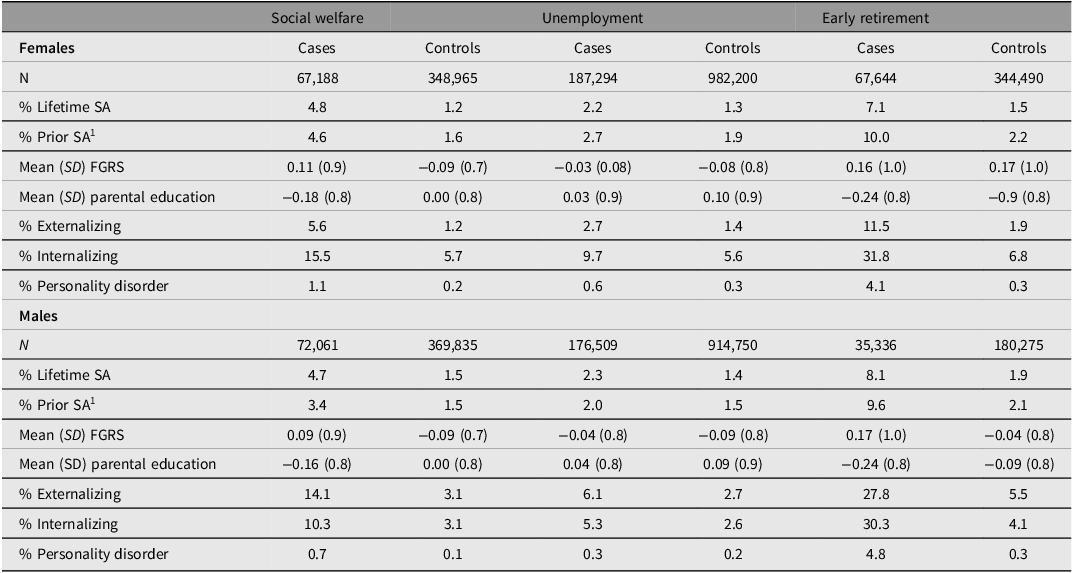
Note: SA, suicide attempt; SD, standard deviation.
1 Prior SA refers to a nonfatal suicide attempt that predated registration for the financial stressor exposure.
Preliminary Analyses
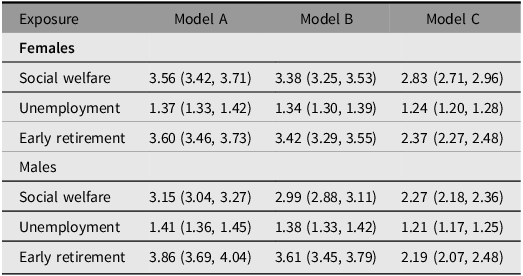
We tested the associations between each exposure and risk of SA in a series of standard Cox models (Table 2 and Supplementary 1). For both sexes, hazard ratios (HRs) from Model A ranged from ∼1.4 for unemployment to >3.5 for social welfare and early retirement. Estimates were slightly lower in models adjusted for parental education and FGRSSA (Model B). After adjusting for psychopathology (Model C), estimates were further attenuated, but remained >1 and statistically significant in all cases. HRs were slightly higher for females and were appreciably lower for unemployment.
Hazard ratios and 95% confidence intervals from preliminary models estimating the association between each exposure and risk of suicide attempt (SA). Model A is adjusted for SA prior to the year of registration for the exposure; Model B further adjusts for parental education and family genetic risk score for suicide attempt; Model C further adjusts for externalizing, internalizing, and personality disorder registrations
Proportional Hazards Assumption
We evaluated violations of the proportion hazards assumption, that is, whether the effects were consistent across time, executing Model A again with the new parameterization. P values for one or both parameters (same-year registration, and an interaction with the log of time) were significant in each case (Supplementary Table S1). As shown in Figure 1 and 2, which depict results from fully adjusted Model C, risk of SA is highest in the year of exposure to a financial stressor, though we are unable to know with certainty the order of events in that year. Afterwards, the decline in effect size is modest. For social welfare and early retirement, SA risk was increased 1.7−3.3-fold for at least 20 years beyond initial registration. In contrast, risk of SA was no longer significant 12−13 years after unemployment registration. For social welfare and early retirement, HRs were higher for females in the first few years after registration, but estimates were similar across sexes for unemployment (Figure S2).
Hazard ratios and 95% confidence intervals from a model estimating the association between exposure to a financial stressor and risk of suicide attempt. The model is parameterized to account for violations of the proportional hazards assumption. Estimates are from Model C, which is adjusted for suicide attempt prior to the financial stressor, parental education, FGRSSA, and psychopathology (externalizing, internalizing, and personality disorder registrations). The dashed black line represents the null hypothesis (hazard ratio = 1). The y-axis is on the log scale. The shaded areas represent 95% confidence intervals.
Note: FGRSSA, familial genetic risk score for SA.

Hazard ratios and 95% confidence intervals from a model estimating the association between exposure to a financial stressor and risk of suicide attempt, illustrating the interaction between the exposure and age at registration. Estimates are from Model C, which is adjusted for suicide attempt prior to the financial stressor, parental education, FGRSSA, and psychopathology (externalizing, internalizing, and personality disorder registrations). The dashed black line represents the null hypothesis (hazard ratio = 1). The y-axis is on the log scale. The shaded areas represent 95% confidence intervals.
Note: FGRSSA, familial genetic risk score for SA.

Interaction With Age at Registration
We next assessed potential differences in the effects of financial stressors as a function of the age at first registration. To facilitate interpretation, these models, expanded from Model C, assumed a constant effect over time, since changes in effect sizes were largely limited to the first year while remaining somewhat stable thereafter. The effects of each exposure varied considerably depending on the age at registration (Figure 2). For social welfare, HRs were highest among those whose first registration occurred around age 30 (females) or age 40 (males). For unemployment overall, HRs were lower than for the other stressors, but increased among those experiencing their first registration later in life. This effect was more pronounced, and nonlinear, among females. Among males, SA risk was highest for those registered for early retirement from age 35−40. However, for females, we observed a nearly linear decrease in HRs as a function of age at registration for early retirement.
Co-Relative Analyses
We conducted co-relative analyses to consider whether familial confounders accounted for associations between financial stressors and SA. Supplementary Table S2 provides fit statistics for models based on observed data versus where we impose a genetic model and estimate HRs for monozygotic twins; AIC differences were minor and varied by exposure and sex. Figure 3 presents estimates from both models. For social welfare and early retirement, HRs were generally lower in relative pairs of greater genetic relatedness, consistent with modest familial confounding. However, even among MZ pairs, predicted HRs remained above 1, indicating a residual association that could be due to a causal pathway or nonfamilial confounding. For unemployment, HRs were more stable across relative pairs, particularly males, suggesting that familial confounding does not meaningfully contribute to the observed associations. However, the lower confidence intervals in MZ twin pairs included or approached 1 (females: 0.86; males: 1.01).
Hazard ratios and 95% confidence intervals from co-relative models estimating the effects of financial stressors on risk of suicide attempt across relative pairs of varying genetic relatedness. In the top panels (‘Observed’ models), results for monozygotic (MZ) twins are excluded due to small sample sizes and low statistical power. In the bottom panel (‘Predicted’ models), estimates reflect the incorporation of a genetic model as described in the Methods. The dashed black line represents the null hypothesis (hazard ratio = 1). The y-axis is on the log scale.

Secondary Analyses
To better understand the joint effects of genetic liability and financial stress, we tested whether the stressors’ effects were exacerbated among those with higher FGRSSA. We observed main effects of FGRSSA (Supplementary Table S3), but no deviation from additivity (Supplementary Table S4). We also evaluated whether SA risk varied as a function of the duration of unemployment benefits, the only predictor for which suitably fine-grained data were available. As shown in Figure S4, across Models A−C, and for both sexes, HRs were higher among those who received benefits for longer.
Analyses of Risk of Suicide Death
Given prior evidence that the etiology of nonfatal SA and SD differ (Edwards et al., Reference Edwards, Ohlsson, Moscicki, Crump, Sundquist, Lichtenstein, Kendler and Sundquist2021) and that, in particular, the effects of socioeconomic stress might vary across outcomes (DeJong et al., Reference DeJong, Overholser and Stockmeier2010), we pursued additional analyses with SD as the outcome of interest. Results are presented in the supplementary material. Overall, findings were similar to those for SA (Supplementary Tables S6-9 and Figures S5-S9), with some notable differences. First, HRs for social welfare and early retirement on suicide death were slightly higher. Second, in adjusted models, HRs for early retirement exceeded those for social welfare, though confidence intervals overlapped. Third, HRs from co-relative analyses were imprecise, yielding less reliable evidence of a residual causal effect, most notably for unemployment. Fourth, HRs for SD among females did not significantly differ depending on the duration of benefits.
Discussion
We aimed to address several knowledge gaps regarding the association between indicators of financial stress — here, registration for social welfare, unemployment, or early retirement in a matched Swedish cohort — and suicidal behavior. By leveraging longitudinal data from Swedish national registers, we confirm prior reports of modestly increased suicide risk, clarify differences across indicators and sex, provide insight to how risk shifts as a function of time since exposure and across the life course, and provide preliminary support for a causal pathway from financial stress to suicidal behavior.
We evaluated the effects of three separate indicators of financial stress — social welfare receipt, unemployment, and early retirement — within one cohort, enabling us to consider whether associations varied as a function of how socioeconomic stress is operationalized. We found that, overall, in adjusted models, social welfare was most strongly associated with risk of SA, with the HRs for early retirement modestly lower. HRs for unemployment were lowest, and did not differ from the null hypothesis (HR = 1) after ∼12 years beyond the initial exposure. Thus, individuals experiencing different types of socioeconomic stress are not at equal risk of suicidal behavior, information that can be used to identify groups in greater need of prevention efforts; however, as we detail below, these differential risks shift across the life course.
We observed several notable sex differences. First, the magnitude of effect was higher for females in certain circumstances, most prominently in the early years after initial receipt of social welfare or early retirement benefits, but not for unemployment. This contrasts with findings from a meta-analysis where no significant sex differences in the effect of financial stress on suicide death were detected (Roelfs & Shor, Reference Roelfs and Shor2023); however, a large US study of unemployment and suicide death also reported higher risks among females (Kposowa, Reference Kposowa2001). Studies of depression, a related outcome, demonstrate inconsistent results. One study found a suggestive, but nonsignificant, increased risk among females (Maciejewski et al., Reference Maciejewski, Prigerson and Mazure2001), while another found a significantly worse impact among males (Gonzalez & Vives, Reference Gonzalez and Vives2019). These disparate findings could be related to variation in the precise exposure, sample age, or other factors.
Second, there was suggestive evidence that females’ elevated risk of SA, relative to males’, was driven by registrations that occurred earlier in life. For example, females with first registrations for social welfare prior to age ∼40 were at increased SA risk relative to males. Third, the residual causal pathway from unemployment to SA was only observed among males in our most conservative models.
Effect sizes differed markedly as a function of time since exposure. SA risk peaked during the first year after exposure and declined thereafter to different degrees. For early retirement, which is received when an individual will no longer be in the workforce, this could reflect an acclimation to one’s limited financial circumstances. However, social welfare and unemployment benefits are not lifelong; here, the attenuated risk could reflect a return to financial stability. This is supported by our finding that risk of SA increased the longer an individual received unemployment benefits: Concern about being able to re-enter the workforce likely increases the longer one is out of work, potentially leading to despair. Our results are consistent with previous studies underscoring the negative impact of increased duration of unemployment (Classen & Dunn, Reference Classen and Dunn2012; Milner et al., Reference Milner, Page and LaMontagne2013). Thus, the longer term unemployed may warrant additional outreach about mental health resources.
Patterns of SA risk varied depending on age at registration. HRs for unemployment increased with later onset, suggesting that among young people job loss is potentially less stressful than it is among older adults who have, for much of their lives, experienced job stability. This is consistent with prior research showing that wellbeing is higher among younger versus older unemployed people (Creed & Watson, Reference Creed and Watson2003), potentially due to fears about greater difficulty finding a new position later in one’s career, or worry about a sudden loss of an income that is typically higher later in life relative to during young adulthood. In contrast, HRs for early retirement were lowest when registration occurred later in life, especially for females. Those who experience a disability toward the end of their working years may be less daunted by this change than those facing the prospect of not working for much of their adult lives.
We observed an attenuation of HRs across exposures when controlling for psychopathology, raising the possibility that one or more manifestations of psychiatric illness could confound the association between socioeconomic stress and suicidality by increasing risk of both. For example, major depression and substance use disorders are associated with both lower income and suicidal behavior (Cai et al., Reference Cai, Xie, Zhang, Cui, Lin, Sim, Ungvari, Zhang and Xiang2021; Edwards et al., Reference Edwards, Ohlsson, Moscicki, Crump, Sundquist, Kendler and Sundquist2022; Edwards et al., Reference Edwards, Ohlsson, Sundquist, Sundquist and Kendler2020; Kendler et al., Reference Kendler, Ohlsson, Karriker-Jaffe, Sundquist and Sundquist2017; Whooley et al., Reference Whooley, Kiefe, Chesney, Markovitz, Matthews, Hulley and CARDIA2002). In co-relative models, the lower HRs in relative pairs of higher relatedness indicate that familial confounding does contribute to the observed associations. However, in all but one case — unemployment among females — HRs remained above 1 even in our most conservative models (monozygotic twins discordant for the exposure), providing support for a residual causal pathway between certain financial stressors and SA. We note, though, that most fully adjusted HRs were <2.
Finally, we did not observe a heightened vulnerability to the adverse effects of financial stressors among individuals with a high genetic propensity toward suicidal behavior. Thus, the diathesis-stress model was not supported. Such analyses should be pursued in samples with genotype data to bolster confidence in these findings.
Although prior evidence suggests that the etiology of nonfatal and fatal suicide attempts overlap only incompletely (Beautrais, Reference Beautrais2001; Edwards et al., Reference Edwards, Ohlsson, Moscicki, Crump, Sundquist, Lichtenstein, Kendler and Sundquist2021), including with respect to exposure to financial stressors (DeJong et al., Reference DeJong, Overholser and Stockmeier2010), we observed few differences in how financial stressors were related to these outcomes. However, HRs for suicide death were markedly higher than for attempts in the period immediately following exposure, underscoring the importance of developing just-in-time prevention and intervention programs (Coppersmith et al., Reference Coppersmith, Dempsey, Kleiman, Bentley, Murphy and Nock2022), though such efforts face considerable challenges (Bryan et al., Reference Bryan, Wastler, Allan, Khazem and Rudd2022).
The loss of financial stability could impact risk of suicidality through various means. The benefits of paid employment include income, social contact, social status and identity, collective purpose, and a sense of structure (Muller et al., Reference Muller, Creed, Waters and Machin2005; Warr, Reference Warr1982). In contrast, loss of employment has negative psychological effects (Garton et al., Reference Garton, Rogers and Berle2022; Gnambs et al., Reference Gnambs, Stiglbauer and Selenko2015). An Australian study found poorer mental health among welfare recipients during the time they received benefits relative to the periods when they did not; transition to long-term disability benefits was one of the strongest predictors of poor mental health (Kiely & Butterworth, Reference Kiely and Butterworth2013). This could be due to the stigma experienced by some welfare recipients (Jun, Reference Jun2019; Mitchell & Vincent, Reference Mitchell and Vincent2021). While providing opportunities to achieve socioeconomic stability and independence is crucial, the threat of losing access to social safety nets has been indirectly linked to increases in suicide and adverse mental health outcomes (Barr et al., Reference Barr, Taylor-Robinson, Stuckler, Loopstra, Reeves and Whitehead2016). Reducing the stigma associated with such benefits may be beneficial (Lasky-Fink & Linos, Reference Lasky-Fink and Linos2022). However, elevated risk of suicidality was observed even in models controlling for psychiatric illness, indicating that other, as yet undetermined, factors are also at play.
We note a number of limitations to these analyses. First, the use of registry data to identify suicide attempt cases limits us to medically serious attempts; future studies should pursue these questions using self-reported SA. Second, there may be unmeasured nonfamilial confounders whose identification and inclusion would attenuate HRs in our co-relative analyses. Investigating the impact of other confounders is critical, as intervention and prevention programming are most likely to be successful for true causal variables. Third, our results are representative of a large Swedish birth cohort, but might not generalize to other cultural contexts. Sweden offers extensive social safety nets, including the benefits we included here as indicators that an individual had experienced a financial stressor. In countries with fewer resources for vulnerable individuals, socioeconomic stress could have more dire consequences. It is therefore prudent to consider the current estimates to be somewhat conservative.
The efficacy of potential suicide intervention and/or prevention efforts for individuals experiencing socioeconomic stress should be considered in future research. Given information gleaned from the current findings, such efforts might be tailored toward, for example, adults registered for social welfare or early retirement benefits in their 20s to mid-30s, or older adults registering for unemployment. While potential causal effects are small, consistent with prior studies (Beautrais et al., Reference Beautrais, Joyce and Mulder1998), the large sample of at-risk individuals to whom such efforts could be applied might meaningfully impact the prevalence of suicidal behavior.
In summary, this study provides additional evidence that exposure to financial stressors is related to increased risk of suicidal behavior, and that this association is likely partially causal. Risk of suicidality remains elevated for years after initial exposure, suggesting that long-term mental health outreach among financially insecure individuals may be warranted; stigma reduction should be further examined as a potential intervention. Our findings underscore the complexity of this association with respect to sex as well as age at registration for, and duration of, benefits. Additional research is necessary to determine whether effect sizes are similar among populations with less access to social resources.
Supplementary material
For supplementary material accompanying this paper, visit https://doi.org/10.1017/thg.2025.19.
Data availability
Data were obtained from Statistics Sweden. The authors cannot provide data access but researchers can apply to obtain data from Statistics Sweden.
Acknowledgments
The Swedish Twin Registry, managed by Karolinska Institutet, provided access to zygosity information on twins.
Financial support
This work was supported by grant MH129356 from the US National Institutes of Health to ACE and grants from the Swedish Research Council to JS (2021-06467, 2024-02796).
Competing interests
The authors declare that they have no conflict of interest.
Ethical standards
This research did not involve human experimentation. We secured ethical approval from the Regional Ethical Review Board in Lund and no participant consent was required (No. 2008/409 and later amendments).


 Open access

