

Many discussions of the Mesolithic-Neolithic transition in central and north-western Europe have focused on how things changed for populations as a whole; how the diet changed, and how the Linearbandkeramik (LBK) archaeological assemblage, including longhouses, pottery, domestic animals and plants, was rapidly spread from Hungary to eastern France during the sixth millennium BC. At this stage, we are now in a position to examine the development of diversity and specialisation in the earliest Neolithic communities. It is doubtful that everyone in each LBK community made pottery, herded livestock and cultivated plants as equal generalists. Did subsistence specialisations, such as livestock herding vs. crop cultivation develop over time? If so, were early LBK communities socially subdivided in ways that mirrored these specialties?
One of the ways of investigating this question is through stable isotope analysis of human and domestic animal teeth from LBK communities (e.g. Reference PricePrice et al. 2001; Reference BalasseBentley et al. 2002; Reference BentleyBentley et al. 2003). The isotopes of strontium, for example, can represent a geographic 'signature' from archaeological tooth enamel, indicating where the animal spent its time when the enamel mineral was forming. Strontium isotope ratios (87Sr/86Sr) are conveyed from weathering rocks, through the soil, into the food chain and ultimately into the skeleton of local animals, without the ratio measurably altering during that process.
Geologically speaking, south-western Germany is an ideal study region for strontium isotope analysis of LBK skeletal samples. On both sides of the Upper Rhine Valley are the Vosges and Black Forest uplands, which are underlain by gneisses and granites that have significantly higher 87Sr/86Sr values than the Jurassic and younger sedimentary rocks of the regional lowlands. In the early stages of this project, the expected strontium isotope ratios were predicted from published measurements in area rocks and stream waters (compiled by Reference BentleyBentley et al. 2003; Reference PricePrice et al. 2003). More recently, we 'mapped' the biologically-available isotopic signatures of prehistoric Southern Germany using archaeological tooth enamel samples from domestic pigs (Reference BentleyBentley & Knipper 2005). The mapping shows a marked upland-lowland difference in biologically-available 87Sr/86Sr values, ranging between 0.7086 and 0.7103 in the sedimentary lowlands, and from 0.710 to as high as 0.722 in crystalline uplands such as the Black Forest.
Within this region, at the early Neolithic settlement of Vaihingen (near Stuttgart), we have begun investigating the possible existence of specialised livestock herders. Vaihingen was occupied from the early (Flomborn) phase of the LBK through to at least the mid-LBK, with the remains of at least 80 longhouses recovered in the excavations led by Rüdiger Krause (2000). Bentley et al. (2004) found that pigs had the narrowest range of 87Sr/86Sr values from the site, and, consistent with the expectation for domestic pigs, must have been kept locally. That study also found, however, a wide range of 87Sr/86Sr values from cattle, sheep and goats, suggesting they were pastured into regional uplands, consistent with archaeological survey evidence that Neolithic cattle were pastured in the Black Forest during the summer months (Reference KienlinKienlin & Vlade-Nowak 2003). With only one sample per animal, however, Reference BentleyBentley et al. (2004) could not be certain whether these animals were brought from different locations, or pastured seasonally from one location.
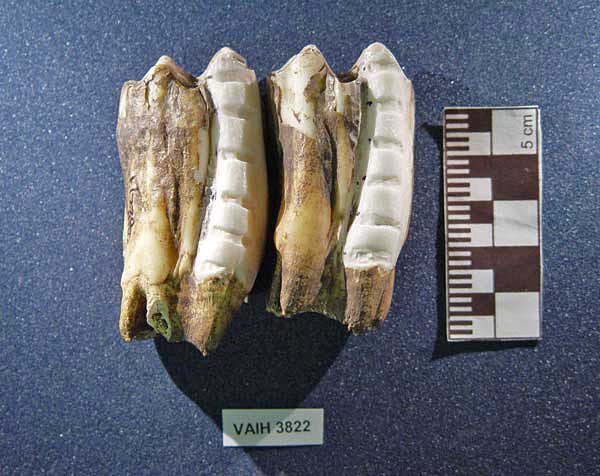
Now, by measuring 87Sr/86Sr in excavated LBK cattle teeth at regular intervals along the growth axis of the tooth enamel (Figure 1), we have confirmed that transhumance was practiced at Vahingen, and that herding grounds were not restricted to the loess areas where most of the LBK settlements were situated. Following Reference BalasseBalasse et al. (2002), this method yields a continuous 87Sr/86Sr record for approximately the first two years of the cow's life.
Molars from Vaihingen cow number 3822 (upper right M3 and M2), showing the six enamel sample locations per tooth.

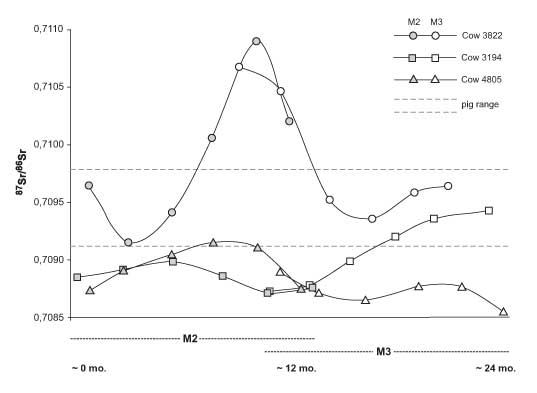
Our early results (Figure 2), from three Vaihingen cows, already show that at least one cow (3822) was taken to pasture in the uplands, potentially the Black Forest, during the summer. Interestingly, as Figure 2 shows, the other two cows were led to different places. In fact, what is intriguing about our results so far is that the three Vaihingen cows are different; one (3822) appears to have gone from the settlement into the uplands and then returned to the settlement, whereas the others (3194 and 4805) seem to have started somewhere away from Vaihingen (dashed lines in Figure 2). It may be that different groups, possibly family lineages, maintained access to different pasture lands of the area, or perhaps even each household, as a distinct lineage (Bentley & Shennan 2003), had rights to a particular place to pasture their cattle. Could this explain the relatively unceremonious human burials in the fill of the ditch that encircled Vaihingen for a short period during the LBK? Reference BentleyBentley et al. (2003) found significantly more 'non-local' strontium isotope signatures in human tooth enamel samples from the ditch burials than from the settlement burials. Our discovery of two cows (so far) that apparently were born outside Vaihingen suggests another intriguing possibility: that some pastoralists, lacking rights to lands controlled by the villagers, were in fact nomadic. In any case, we hope that our future analyses of cattle teeth from all areas and levels of Vaihingen will help us answer such questions.
Strontium isotope ratios (87Sr/86Sr) in teeth from three different cows from Vaihingen. Cattle teeth grow at different times after birth, with the second molar (M2) growing from about birth to about ten months, and the third molar (M3) growing from about age 10 months to about 2 years old. For each cow, the 87Sr/86Sr curves link together, confirming the continuity of temporal sequence. The dashed line shows the local range at Vaihingen, as estimated by Reference BentleyBentley et al. (2004) from tooth enamel of archaeological pigs.