


Introduction
By human migration, we refer to the multi-directional movement of people and their thoughts, relationships, and materiality—in large groups, smaller units or as individuals, over long distances or within a region, and across various time scales. Migration is a specific form of mobility that occurs when people move ‘to settle in another destination’, resulting in a (semi)permanent stay (Fernández-Götz et al. Reference Fernández-Götz, Nirnura, Stockhammer, Cartwright, Fernández-Götz, Nirnura, Stockhammer and Cartwright2023a, 3; see also Gori & Abar Reference Gori, Abar, Fernández-Götz, Nirnura, Stockhammer and Cartwright2023; Hofmann et al. Reference Hofmann, Frieman, Furholt, Burmeister and Nørkjær Johannsen2024). It is an established topic in archaeology, approached by researchers in multiple ways (Adams et al. Reference Adams, Van Gerven and Levy1978; Daniels Reference Daniels2022a; Fernández-Götz et al. Reference Fernández-Götz, Nirnura, Stockhammer and Cartwright2023b; Hofmann et al. Reference Hofmann, Frieman, Furholt, Burmeister and Nørkjær Johannsen2024). However, as discussed by many scholars, migration has been an under-theorized topic in archaeology (e.g. Anthony Reference Anthony2023; Daniels Reference Daniels2022a; Fernández-Götz et al. Reference Fernández-Götz, Nirnura, Stockhammer and Cartwright2023b; Furholt Reference Furholt2017; Reference Furholt2019a, Reference Furholtb; Reference Furholt2021; Hakenbeck Reference Hakenbeck2008; Hofmann et al. Reference Hofmann, Frieman, Furholt, Burmeister and Nørkjær Johannsen2024).
With this study, our aim is to provide analytic tools to re-theorize migration. We apply a transdisciplinary theoretical approach that draws on results from (critical) migration studies, critical heritage studies and archaeology. We elaborate on migration as a constant of social life and an endless flow of human encounters. We engage with variation between disciplines and show that, depending on disciplinary contexts, migration studies result in various and sometimes conflicting interpretations. Dealing with causes for migration processes, we also discuss aspects of people involved. Further, we underline the vast diversity of perspectives that can be applied in migration studies in relation to spatio-temporal engagements. Aspects of social transformation and migration relationships are discussed, followed by a section on cultural encounters, intercultural knowledge and skills involved when people meet cross-culturally. Our focus is to uncover complexities in what these topics may imply for migration studies in archaeology. Based on our findings, we propose a conceptual/theoretical framework to re-theorize migration, as our contribution to the field of migration studies in archaeology. We draw upon studies from the past c. 50 years that examine migration during the first half of the third millennium bce in southern Scandinavia (see Supplementary material), to argue for the necessity of rethinking migration.
Thinking in new ways to re-theorize migration
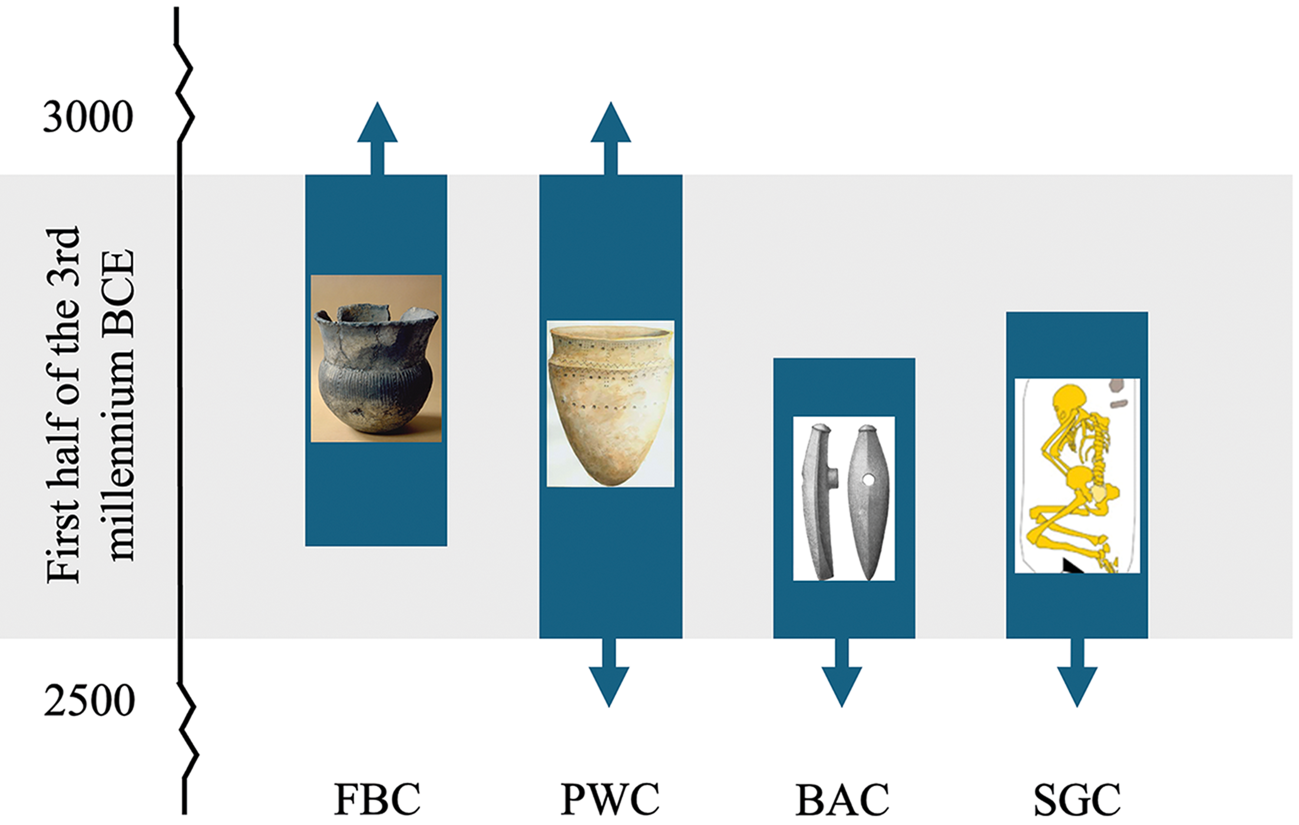
With the so called ‘third science revolution’ (Kristiansen Reference Kristiansen2014), migration studies have found a renewed place in archaeology (Anthony Reference Anthony2023). Ancient DNA (aDNA) studies and other archaeometric analyses (e.g. Allentoft et al. Reference Allentoft, Sikora and Fischer2024; Seersholm et al. Reference Seersholm, Sjögren and Koelman2024) have significantly changed the ways in which we now can explore migration (Furholt Reference Furholt2021). The period spanning the first half of the third millennium bce has become prominent in these studies, as it offers multiple examples of material culture changes and spatio-temporal variation in genetic ancestry related to external influx (Allentoft et al. Reference Allentoft, Sikora and Fischer2024). Heyd (Reference Heyd, Fernández-Götz, Nirnura, Stockhammer and Cartwright2023, 54) discusses these centuries as a time when present-day Europe was ‘moving and shaking’, as groups migrated throughout the continent. As a result, an intricate interplay of archaeological complexes (e.g. Yamnaya, Corded Ware and Bell Beaker) was formed. This happened ‘against a background of a set of “indigenous” societies, genetically descended from “Early Neolithic farmers” and people of “western hunter-gatherer” ancestry’ (Heyd Reference Heyd, Fernández-Götz, Nirnura, Stockhammer and Cartwright2023, 41). Several archaeologically defined cultures are known from southern Scandinavia from this spatio-temporal section of the Stone Age, with regional variation in how they materialized and transformed (Malmer Reference Malmer2002). These are the Funnel Beaker Culture (FBC), the Pitted Ware Culture (PWC), the Swedish-Norwegian Battle-Axe Culture (BAC) and the Single Grave Culture (SGC) (Fig. 1). FBC is linked to the first evidence of a Neolithic lifeway in south Scandinavia from c. 3900 bce (Blank et al. Reference Blank, Sjögren and Storå2020; Shennan Reference Shennan2018). People associated with the archaeologically defined PWC were largely maritime hunters (Fornander et al. Reference Fornander, Eriksson and Lidén2008). The economy of the BAC and SGC were mainly based on a Neolithic lifeway, with animal husbandry and cattle herding as a significant part (Fornander Reference Fornander2013; Malmström et al. Reference Malmström, Günther and Svensson2019). Genetic analysis from samples associated with these archaeologically defined cultures show differences, generally (and simply described) linking samples from FBC to Anatolian-derived ancestry (Seersholm et al. Reference Seersholm, Sjögren and Koelman2024), PWC to eastern Scandinavian hunter-gatherer-derived ancestry (Günther et al. Reference Günther, Malmström and Svensson2018) and BAC and SGC to eastern steppe-derived ancestry (Allentoft et al. Reference Allentoft, Sikora and Sjögren2015; Reference Allentoft, Sikora and Fischer2024; Malmström et al. Reference Malmström, Günther and Svensson2019). Using Heyd's (Reference Heyd, Fernández-Götz, Nirnura, Stockhammer and Cartwright2023) words quoted above about the first half of the third millennium bce, FBC and PWC are ‘indigenous’ and BAC and SGC a result of present-day Europe ‘moving and shaking’.
Schematic illustration of overlap in time for the archaeologically defined cultures in the first half of the third millennium bce in southern Scandinavia: the Funnel Beaker Culture (FBC), the Pitted Ware Culture (PWC), the Swedish-Norwegian Battle-Axe Culture (BAC) and the Single Grave Culture (SGC), with examples of finds that have given name to each archaeologically defined culture. Arrows indicate earlier and/or later extensions for each archaeologically defined culture. Note that the presence in the landscape of FBC, PWC, BAC and SGC in terms of contemporality and intensity varies between areas in southern Scandinavia. (Re-worked from Iversen et al. Reference Iversen, Philippsen and Persson2021, 52, fig. 3, with additions from Brink Reference Brink2009. Photograph of funnel beaker: Historical Museum Stockholm accession number 94838_HST; photograph of PWC vessel from Kihlstedt Reference Kihlstedt, Bratt and Grönwall2011, 49; drawing of SGC burial from Furholt Reference Furholt2019a, 118. Photographs are cropped.)
Since archaeology emerged as an academic discipline, questions about how to understand the relationships between these archaeologically defined cultures in terms of migration have been extensively discussed (e.g. Becker Reference Becker1954; Brink Reference Brink2009; Coutinho et al. Reference Coutinho, Günther and Munters2020; Damm Reference Damm1991; Edenmo Reference Edenmo2008; Iversen Reference Iversen2015; Iversen et al. Reference Iversen, Philippsen and Persson2021; Kristiansen Reference Kristiansen1991; Å. Larsson Reference Larsson2009; L. Larsson Reference Larsson, Adamsen and Ebbesen1986; Reference Larsson and Larsson1989; Reference Larsson1991; Reference Larsson, Larsson, Callmer and Stjernquist1992; M. Larsson Reference Larsson2006; Malmer Reference Malmer1962; Reference Malmer1975; Nielsen & Johannsen Reference Nielsen and Johannsen2023; Prescott Reference Prescott1996; Prescott & Walderhaug Reference Prescott and Walderhaug1995; Tilley Reference Tilley1982; von Hackwitz Reference von Hackwitz2009). An early example is Müller's study from 1898. In a comparative study of graves, he concludes that the SGC and FBC archaeological complexes are significantly different. From this, he speculates that the archaeologically defined SGC culture is the result of ‘a tribe coming from the south’ (Müller Reference Müller1898, 279). At the same time, he notes that we are ‘still lacking […] decisive proof that the single graves contain a new advancing tribe’ and suggests that alternative interpretations to migration should also be considered (Müller Reference Müller1898, 281).
While archaeologists for more than hundred years have drawn on aspects of both migration and diffusion to explain variation in the first half of the third millennium bce, current aDNA studies and other archaeometric analyses are dominated by the so-called ‘steppe migration/influence/ancestry’ narrative (e.g. Egfjord et al. Reference Egfjord, Margaryan and Fischer2021), including what Allentoft et al. (Reference Allentoft, Sikora and Fischer2024, 334) define as a rapid and ‘near-complete population turnover’ at the time in southern Scandinavia (for critical discussions on this narrative, see e.g. Furholt Reference Furholt2019b; Reference Furholt2021; Nielsen & Johannsen Reference Nielsen and Johannsen2023).
However, several studies have noted that archaeology is struggling to understand the implications of new results from aDNA and other archaeometric studies in terms of how we can conceptualize Stone Age migration in new ways (Anthony Reference Anthony2023; Hofmann et al. Reference Hofmann, Frieman, Furholt, Burmeister and Nørkjær Johannsen2024). Johannsen et al. (Reference Johannsen, Larson, Meltzer and Vander Linden2017) and Hofmann et al. (Reference Hofmann, Frieman, Furholt, Burmeister and Nørkjær Johannsen2024), for example, call for refined integrated transdisciplinary approaches. Along similar lines, Furholt (Reference Furholt2021, 482) discusses that archaeology in general has not been able to ‘integrate the current state of theoretical awareness into the archaeogenetic discourse’, and thus fails to capitalize fully on the potentials that the results from aDNA and other archaeometric studies offer.
In principle, we agree with Furholt. But we also question that ‘the current state of theoretical awareness’ is sufficient to approach migration in new ways. Our rationale is as follows. Inspired by trends from evolving processual archaeologies in the second half of the twentieth century, a hesitancy to discuss migration developed (Kristiansen Reference Kristiansen and Daniels2022). At this time, ‘migration … almost disappeared from archaeological explanation in western universities’ (Anthony Reference Anthony2023, 1; see also Härke Reference Härke1998; Nielsen & Johannsen Reference Nielsen and Johannsen2023). In a south Scandinavian context, Malmer's (Reference Malmer1962) work became especially influential. To Malmer, variation could only be explained by diffusion and in-group social and religious change, not by migration or ‘simple reference to waves of immigration’ (Malmer Reference Malmer2002, 175). Malmer's work became instrumental, to the extent that Edenmo in 2008 notes that migration ‘has few advocates today, after Mats Malmer's work from 1962’ (Edenmo Reference Edenmo2008, 15; see also discussion in Cassel Reference Cassel2000; Reference Cassel2008; van Dommelen Reference van Dommelen2014). At the time, criticism of Malmer's theoretical work on migration was discussed, migration theory was elaborated upon, and migration was considered as an explanatory model for variation in the third millennium bce (Johansen Reference Johansen1989; Kristiansen Reference Kristiansen1991; L. Larsson Reference Larsson, Larsson, Callmer and Stjernquist1992; Prescott & Walderhaug Reference Prescott and Walderhaug1995). Nevertheless, from our reading of studies on migration in the first half of the third millennium bce in southern Scandinavia published over the last c. 50 years (see Supplementary material), we see that an explicit and outspoken ‘non-migration narrative’ has dominated research for decades. While some researchers integrated theory and data (e.g. Holmqvist et al. Reference Holmqvist, Larsson and Kriiska2018; Iversen Reference Iversen2010; Kristiansen et al. Reference Kristiansen, Allentoft and Frei2017; Å. Larsson Reference Larsson2009; Malmström et al. Reference Malmström, Günther and Svensson2019; Sørensen Reference Sørensen2014b; Vandkilde Reference Vandkilde2007), the ‘non-migration narrative’ has generally hindered the development of migration theory. This is reflected in that most of the studies from the last c. 50 years only address migration from ad hoc or post hoc positions—either by already ahead of analysis maintaining that spatio-temporal variation is or is not a result of migration (ad hoc), or by interpreting results from excavations, archaeological data analysis or aDNA and other forms of archaeometric studies in terms of migration, without engaging with migration theory as a tool to do so (post hoc) (see also Nielsen & Johannsen Reference Nielsen and Johannsen2023 for similar discussion).
Consequently, as only a limited number of theoretical approaches to migration have been explored over the last c. 50 years in studies on the first half of the third millennium bce in southern Scandinavia, it is reasonable to assume that new data emerging from new methods require us to think in new ways in order to re-theorize migration.
In the next section we unwrap what this means and what might be involved in terms of theory when archaeology engages with migration studies. Our approach is theoretical, with the purpose of exploring complexities in transdisciplinary approaches to migration. Hence, we do not present examples or new interpretations of what happened in terms of migration in the first half of the third millennium bce. This is a topic we leave for future research.
Transdisciplinary theoretical approaches to migration
Migration, a basic organizing force
Migration has always existed, as a constant of social life and constituent element of humankind (Cabana & Clark Reference Cabana, Clark, Cabana and Clark2011a; Greenblatt Reference Greenblatt2010; Hollfelder et al. Reference Hollfelder, Breton, Sjödin and Jaokobsson2021, contra Clark Reference Clark1994; Hoerder Reference Hoerder2002; Rodat Reference Rodat2020):
Migration might be conceived of as physical movements of humans from one place to another, but on a deeper level it should press us to recognize movement and mobility as basic organizing forces of humans and all earthly reality, as hidden as it often seems within that reality (or denied by certain members of that reality). (Daniels Reference Daniels and Daniels2022b, 18)
If we accept this, it means that we are impelled to analyse specific migration events within a flow of endless human migrations; but such an approach lacks precision (see e.g. Furholt Reference Furholt2021; Hofmann Reference Hofmann2016, for discussion). Migration varies over time and place. Therefore, it needs to be analysed and understood as social behaviour in specific contexts.
No consensus exists on how to define migration. As discussed by Brettell (Reference Brettell, Brettell and Hollifield2023), researchers instead need to rely on a range of descriptions to capture and compare the variations that migration processes encompass. At the same time, we need to avoid definitions we use giving a static and homogeneous picture of processes that are ‘flexible over the life course of an individual migrant or the domestic cycle of a household, varied within a population, subject to change over time, and laden with culturally contextualized meanings’ (Brettell Reference Brettell, Brettell and Hollifield2023, 199; see also Frachetti Reference Frachetti2011).
Cabana (Reference Cabana, Cabana and Clark2011, 17) reminds us that archaeologists’ frequent use of migration as ad hoc and post hoc explanations has resulted in an unspoken set of assumptions about the nature of migration. One such assumption is the conceptual link between people, culture and place, a way of thinking established more than a century ago and closely linked to the roles of archaeology in the formation of nineteenth-century modern nation states (e.g. Bonacchi Reference Bonacchi2022). Brettell and Hollifield (Reference Brettell and Hollifield2015) show that research (and indeed more general discussions in society on migration) is dominated by axiomatic conceptualizations of culture as static, linked to modern geographic borders, defined by your place of birth, and something you carry with you unchanged throughout life as a ready-made package (see discussion in Favell Reference Favell, Brettell and Hollifield2023; Gabaccia Reference Gabaccia, Brettell and Hollifield2023; Högberg Reference Högberg2013; Reference Högberg2016). It is an approach that presupposes a pre-existing ‘purity’, i.e. a group or culture unmixed since time immemorial. As Linton (Reference Linton1937) argued almost a century ago, such an approach makes us think in the wrong way. As all cultures are mixtures, pure or essential cultures have never existed (see also Liebmann Reference Liebmann and Card2013, 31). As an alternative, Furholt (Reference Furholt2021) and others (e.g. Hoerder Reference Hoerder2002; Robb Reference Robb2013) emphasize that we need to understand culture as fluid, and social group composition as dynamic. This is in line with Hastrup (Reference Hastrup2010), who shows that the social environment in societies is characterized by a high degree of flexibility and intrinsic unpredictability.
Variation among disciplines
Migration studies is a well-established multidisciplinary field, with researchers working across several disciplines (Cabana & Clark Reference Cabana, Clark, Cabana and Clark2011a, Reference Cabana and Clarkb; Cameron Reference Cameron2011; Reference Cameron2013; Clark Reference Clark2001; Gabaccia Reference Gabaccia, Brettell and Hollifield2023; Levy et al. Reference Levy, Pisarevskaya and Scholten2020). While some encourage us to explore migration studies as a research field in its own right (Brettell & Hollifield Reference Brettell and Hollifield2023), others emphasize that migration is best embraced within each discipline (e.g. Daniels Reference Daniels and Daniels2022b; Hoerder Reference Hoerder2002). Table 1 builds on Brettell and Hollifield (Reference Brettell and Hollifield2015; Reference Brettell and Hollifield2023) and is a schematic overview that exemplifies the inherent logics of a selection of disciplines in their studies of migration. Note that we only use Table 1 here to exemplify how a selection of different disciplinary foci may result in specific ideas about migration. Others may add examples from e.g. history, archaeolinguistic or genetic studies.
Migration theories across disciplines, reworked from Brettell & Hollifield (Reference Brettell and Hollifield2015; Reference Brettell and Hollifield2023).

At their core, theories of migration are often outlined from either a macro- or a micro-analytical perspective (Takeyuki Reference Takeyuki, Cabana and Clark2011). While macro-theoretical approaches refer to large-scale changes for society, micro-theoretical approaches focus on the individual and small-scale transformative changes in social and material lives (Portes Reference Portes2008). Uses of the terms ‘macro’ and ‘micro’ may refer to, for example, length of movement, frequency of movement, intensity of movement, or scale of groups moving (Porter Reference Porter and Daniels2022, 249). Macro- and micro-analytical perspectives are common in various disciplines, but multi-scalar perspectives also exist. Regarding Table 1, it is clear that disciplines work with various conceptualizations of migration, resulting in differences in how it is understood. For example, a focus on macro-analytical perspectives investigates structural effects of migration, while a micro-analytical approach studies individual migration experiences. Similar variation is common in archaeological studies (see examples in Hofmann et al. Reference Hofmann, Frieman, Furholt, Burmeister and Nørkjær Johannsen2024). Studies may reach conclusions (right-hand column in Table 1) that at first glance seem contradictory. Applying for example, a macro-analytic cost and benefit perspective in a multi-scalar spatio-temporal approach might contradict results from a micro-analytical social approach (see Högberg et al. Reference Högberg, Berggren and Brink2023). However, as Table 1 shows, such contradictions are typically the result of various disciplinary approaches to migration studies. Hence, for archaeology, results from different studies should best be understood not as exclusive, but as parts of the larger complexity that studies of migration encompass.
Causes for migration
As Chapman and Dolukhanov (Reference Chapman and Dolukhanov1992) demonstrate, people's reasons (thinking and feeling) for migration are difficult to depict through archaeological analysis. Along similar lines, Anthony (Reference Anthony1992, 174) argues that such causes for prehistoric migrations ‘are likely lost forever’. Clark et al. (Reference Clark, Birch and Hegmon2019), however, remind us that archaeologists working with migration often infer causes without actually presenting an analysis to justify such interpretations. We agree with Anthony (Reference Anthony1990; Reference Anthony1992) and others (e.g. Chapman & Dolukhanov Reference Chapman and Dolukhanov1992) that causes in prehistoric migration are difficult to unravel. But as archaeologists do elaborate on causes, we here briefly touch upon the subject to show its complexity. In doing so, we focus on causes related to structural factors that may be involved in migration.
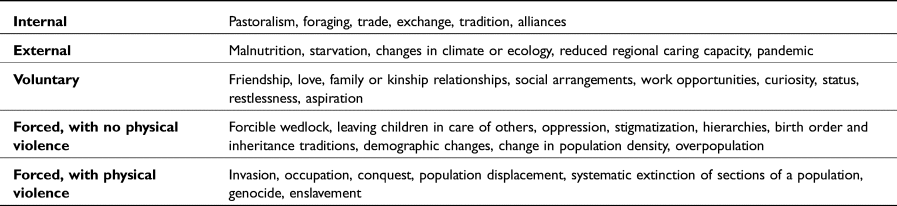
In Table 2, a multitude of causes for migration are exemplified as internal, external, voluntary and forced (Anthony Reference Anthony1990; Reference Anthony1992; Brettell & Hollifield Reference Brettell and Hollifield2015; Reference Brettell and Hollifield2023; Burmeister Reference Burmeister2000; Cameron Reference Cameron2011; Clark et al. Reference Clark, Birch and Hegmon2019; Daniels Reference Daniels and Daniels2022b; Hoerder Reference Hoerder2002; Hofmann Reference Hofmann2016; Kristiansen Reference Kristiansen1991). As emphasized by many (see Daniels Reference Daniels and Daniels2022b), causes are rarely independent. Instead, the reality of migration processes is characterized by multiple combinations. The multiple causes illustrated in Table 2, and the fact that causes are rarely exclusive but relational, make it imperative for archaeology to explain the basic outlines behind interpretations of causes presented in studies of prehistoric migration.
Causes for migration: examples refined from Anthony (Reference Anthony1990; 1992); Kristiansen (Reference Kristiansen1991); Burmeister (Reference Burmeister2000); Hoerder (Reference Hoerder2002); Vandkilde (Reference Vandkilde2007); Iversen (Reference Iversen2010); Cameron (Reference Cameron2011); Sørensen (Reference Sørensen2014b); Brettell & Hollifield (Reference Brettell and Hollifield2015; Reference Brettell and Hollifield2023); Hofmann (Reference Hofmann2016); Clark et al. (Reference Clark, Birch and Hegmon2019); Daniels (Reference Daniels and Daniels2022b); Hofmann et al. (Reference Hofmann, Frieman, Furholt, Burmeister and Nørkjær Johannsen2024). Note: even if causes are for clarity here listed as exclusive, they should be understood relationally.
Those involved
Burmeister (Reference Burmeister2000, 543) shows that, normally, ‘established societies or social groups do not migrate as a whole; usually the group of migrants represents a more or less clearly defined segment of the aggregate population’. Discussing migration frequency, Anthony (Reference Anthony1990) demonstrates that those individuals or groups who have migrated before are likely to do so again. Established social structures such as kinship relations or previous experiences of migration provide opportunities for migration and may also contribute to an overall inter-generational willingness to migrate (Clark et al. Reference Clark, Birch and Hegmon2019). Gender, age and class are important factors when discussing selectivity in relation to migration (e.g. Burmeister Reference Burmeister2000). Brettell (Reference Brettell, Brettell and Hollifield2023) identifies that gender roles are often varied in migration networks with, for example, women and men taking on different but complementary roles (Sørensen Reference Sørensen2014a). However, other studies show that analyses based on gender, age and class are sometimes limiting (e.g. Favell Reference Favell, Brettell and Hollifield2023). In archaeological studies of prehistoric migration, we must therefore remain open to broader definitions of people and groups that might have acted. In addition to gender, age and class, these can for example be: elderlies, adults, adolescents, children, traders, merchants, facilitators, artisans, apprentices, workers, builders, peasants, herders, hunter-gatherers, warriors, rulers, chiefs, leaders, religious practitioners, partners, man, wife, slaves, servants, unfree, shamans, emigrants, immigrants, or second-generation immigrants, to name a few examples. As Graeber and Wengrow (Reference Graeber and Wengrow2021) discuss, we must assume that a mix of roles was common amongst migrants, and that individuals likely moved in and out of social roles based on the contexts in which they found themselves. Clark et al. (Reference Clark, Birch and Hegmon2019) discuss additional ways of naming migrants:
If history is written by the migrants, the newcomers are typically portrayed as colonists and local groups are characterized as indigenous, aboriginal, or native, with connotations varying from inferior to quaint and pitiable. If history is written by the locals, the native-born are described as the hosts or defenders of the homeland and the migrants are identified as invaders, aliens, or foreigners. (Clark et al. Reference Clark, Birch and Hegmon2019, 265)
In line with Clark et al. (Reference Clark, Birch and Hegmon2019), we do not see this form of value-based definition as a constructive way to work in archaeological research on prehistoric migration.
Variation, spatio-temporal scales
Although Hägerstrand (Reference Hägerstrand, Hannerberg, Hägerstrand and Odeving1957, 132) was early to point out that migration processes are best understood as feedback loops driven by social relationships, much work on migration assumes dualistic models that disconnect or oppose sending and receiving areas, and separate push factors of out-migration from pull factors of in-migration (Brettell Reference Brettell, Brettell and Hollifield2023, 199; see also Hoerder Reference Hoerder2002). Such models have proved inadequate for analysis of the spatio-temporal variation involved in migration processes (Brettell Reference Brettell, Brettell and Hollifield2023). Along similar lines, Anthony (Reference Anthony and Daniels2022, 56) concludes that archaeologist have been slow to recognize that migration processes normally are ‘complex, multigenerational human processes that take different forms based on different causes and different pre-migration social relations between the local people in the destination and pre-migration population in the home region’. From this, Anthony concludes that archaeology has failed to study how migration created new social dynamics in both sending and receiving areas (Anthony Reference Anthony and Daniels2022, 56; see also Clark et al. Reference Clark, Birch and Hegmon2019 for similar discussion).
One reason for this might be that migration is commonly described by using water metaphors, such as a ‘stream’, ‘wave’ or ‘flow’ (see Ammerman & Cavalli-Sforza Reference Ammerman, Cavalli-Sforza, Renfrew and Cooke1979; Anthony Reference Anthony1990; Reference Anthony and Daniels2022; Cabana Reference Cabana, Cabana and Clark2011; Cabana & Clark Reference Cabana, Clark, Cabana and Clark2011a for examples). The use of such metaphors creates an illusion of migration in only one direction. To continue with the water metaphor, a river delta may appear to be a more suitable image. A delta connects in many directions, and new links constantly arise when river streams merge, water breaks new courses or streams are stopped by sediment banks. But a delta is also inadequate as a metaphor since it presupposes a one-directional constant flow from the spring of the river to its mouth by the sea. Migration flows in multiple directions; forwards, backwards and sideways. As Anthony (Reference Anthony1990) discusses, migration can, for example, happen through return migration; that is, by people moving ‘against the stream’, to use the water metaphor again.
To illustrate this complexity (beyond streams, waves, or flows), we have developed examples to show variation (Figs 2–5). Our intention is to illustrate complexity in how migration over time may result in various spatio-temporal effects. For clarity in these examples, they start from one specific spatio-temporal ‘situation’ and end in another. Needless to say, these ‘situations’ are dynamic, with a history as well as a future. Also, the word ‘group(s)’ in our examples is here used schematically to illustrate a segment of a population. As is clear from our discussion throughout the text, we recognize that groups are dynamic and complex clusters that normally are defined from contextual relations and seamlessly may flow into one another, often without clear boundaries, throughout the processes we illustrate.
Schematic illustrations of hypothetical migration events. Rectangle symbolizes the landscape; circle = a group in a delimited location or area in the landscape; curved line in rectangle = a section of the landscape; arrows show direction of migration.
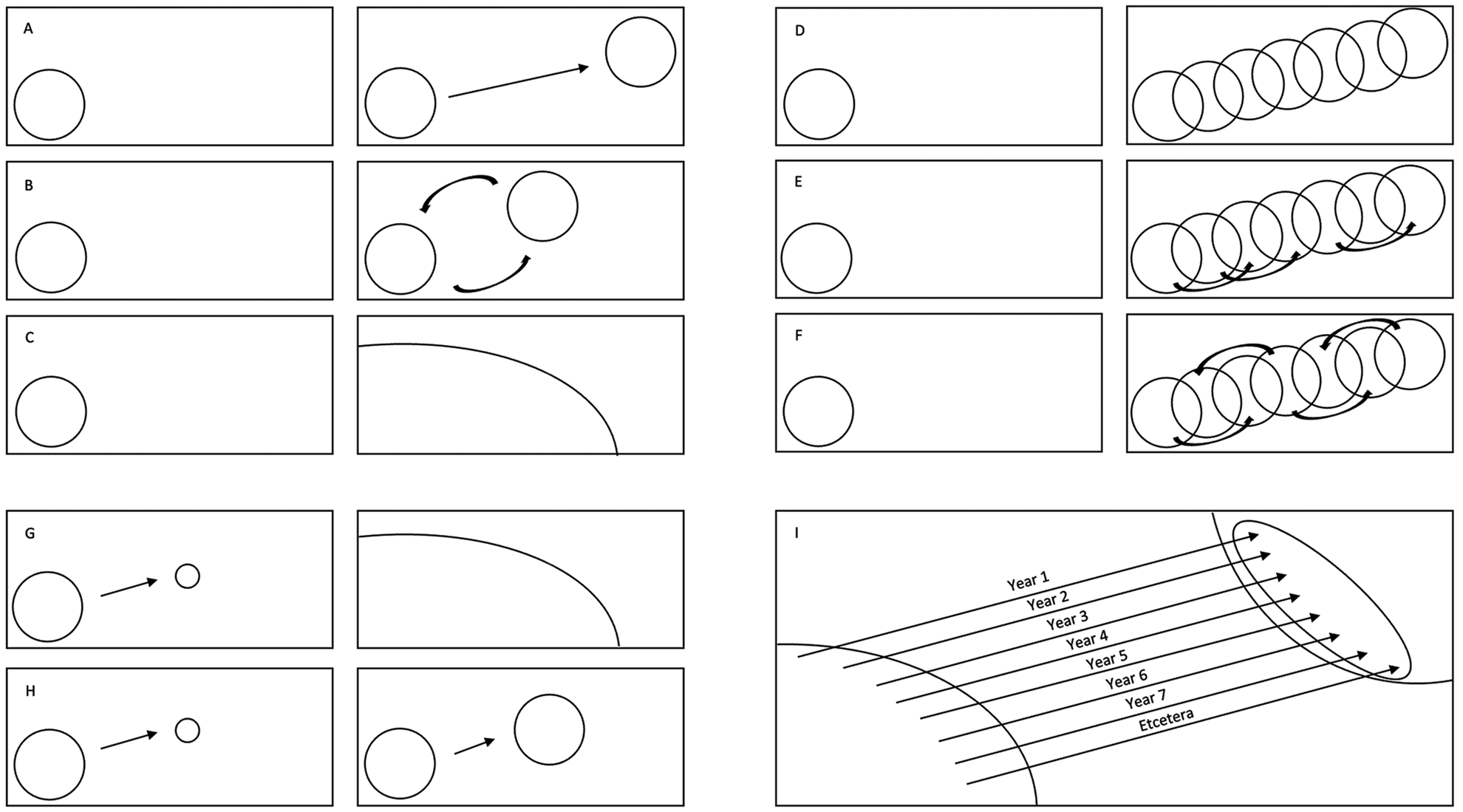
Our examples are inspired by others (e.g. Anthony Reference Anthony1990; Reference Anthony and Daniels2022; Brettell & Hollifield Reference Brettell and Hollifield2023; Burmeister Reference Burmeister2000; Daniels Reference Daniels and Daniels2022b; Moore Reference Moore2001). Figure 2A demonstrates a simple way of describing migration, in the form of a group moving from one location to another. Although this form of migration is rare, it is common in explanations on prehistoric migration (see discussion in Anthony Reference Anthony1990; Reference Anthony and Daniels2022; Cameron Reference Cameron2011). Return migration is a well-known aspect of migration (Anthony Reference Anthony1990, 898). Figure 2B shows the same simple model as in Figure 2A, but with the addition that migration can take place in multiple directions. Figure 2C demonstrates that migration does not have to end in a specific location, but in an entire landscape section. In Figure 2D, we illustrate a variant of a model where overlapping migration occurs to partially new areas, while former areas are still inhabited. Here, the result of migration over several generations is that the group has moved over the landscape, while individuals in each generation did not necessarily experience it as migration (see similar discussion on mobility in Furholt Reference Furholt2021). In Figure 2E & F, we add complexity with non-overlapping migration (Fig. 2E) and multiple directions (Fig. 2F) to the overlapping generations (see discussion in Hofmann Reference Hofmann2016).
Figure 2G illustrates a scenario where a smaller group of ‘scouts’ survey potential areas to move to, with a group thereafter settling within a new landscape section. This has been described by Anthony (Reference Anthony1990, 902) as ‘leapfrogging’, when ‘great distances may be jumped, and large areas bypassed through the agency of advance “scouts” who collect information on social conditions and resource potentials and relay it back to the potential migrants’ (see also Sørensen Reference Sørensen2014a). Figure 2H exemplifies a scenario in line with Figure 2G, but where leap-frogging results in a group moving from one location to another, for example by ‘scouts’ having surveyed suitable places for a group to move to, which is then followed by group-organized migration (see Anthony Reference Anthony1990, 902f; Sørensen Reference Sørensen2014a, 50ff).
Figure 2I shows a scenario where repeated independent individual migration, with no collective agency, happens over time. Isayev (Reference Isayev and Daniels2022, 139) defines it as ‘private mobility’, not related to collective movement. However, over time, repeated migration events result in what after generations and in hindsight may appear as group movement (see also Furholt Reference Furholt2021). As Isayev shows, it can over time also result in an overall impression of the existence of a defined group driven by collective agency (Isayev Reference Isayev and Daniels2022, 139).
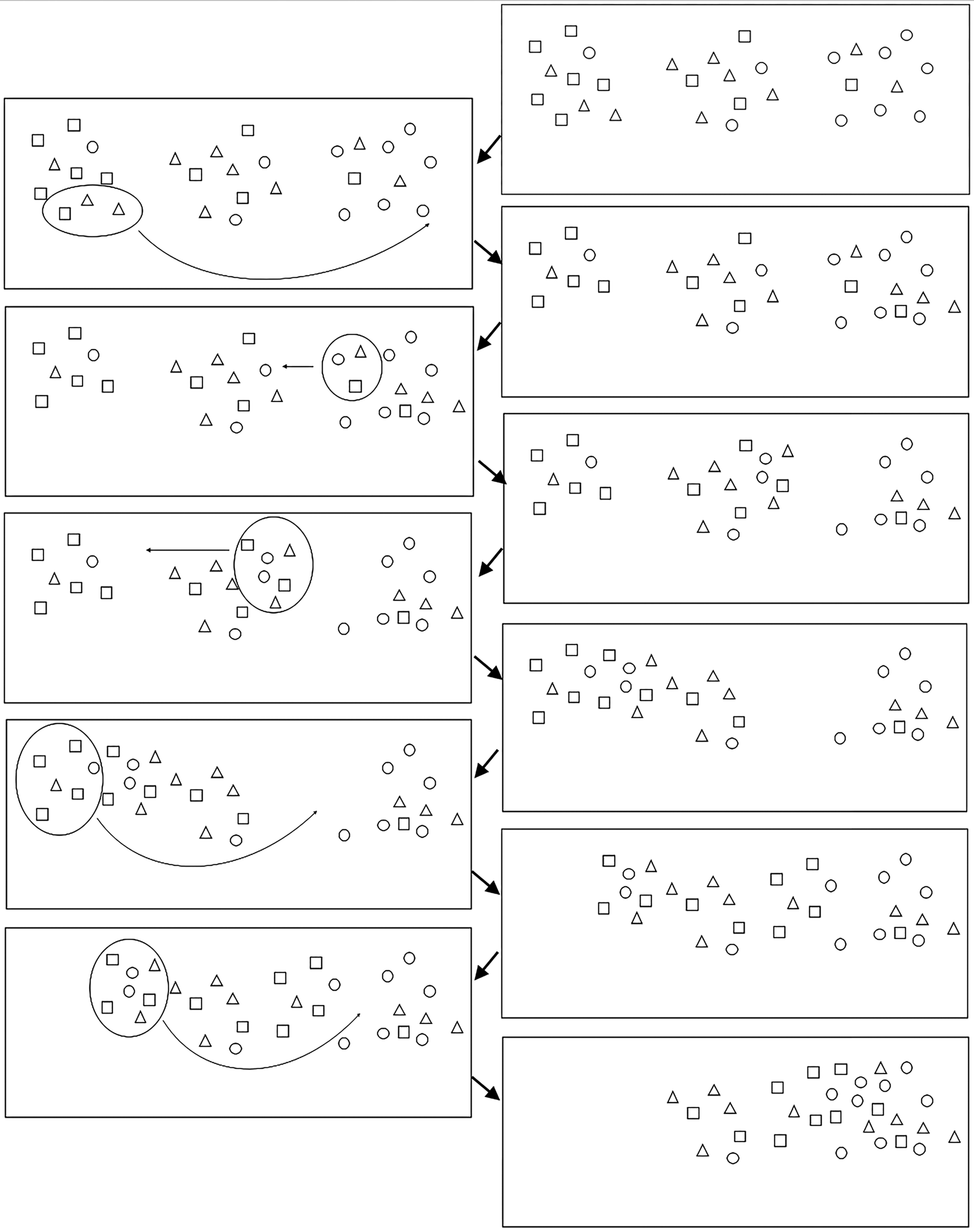
In Figure 3, we elaborate on time and change in another way. Inspired by Hofmann (Reference Hofmann2016) and Furholt (Reference Furholt2021) and their discussions on regional mobility, Figure 3 exemplifies how small migration events over time may result in large changes. At the top of the figure in the right-hand column, three clusters of a mix of groups are shown within the landscape (the rectangle), each group illustrated with squares, triangles and circles. The left-hand column shows examples of accumulative movements within the landscape, each resulting in minor changes illustrated in the column to the right. From one step to another, changes are small, with several of them almost negligible. However, if the top and bottom rectangles in the right column are compared, the cumulative effect of small changes over time is clear and the result is large spatial changes in group relations and landscape use.
Schematic illustration of spatio-temporal variation. The right column of images shows three hypothetical groups (illustrated by triangle, circle and square) and how these change in relationships over time through migration (time is read from top to bottom in the figure) within a landscape (illustrated by rectangles). The left column of images shows the hypothetical clusters of migrations at different times, contributing to change.
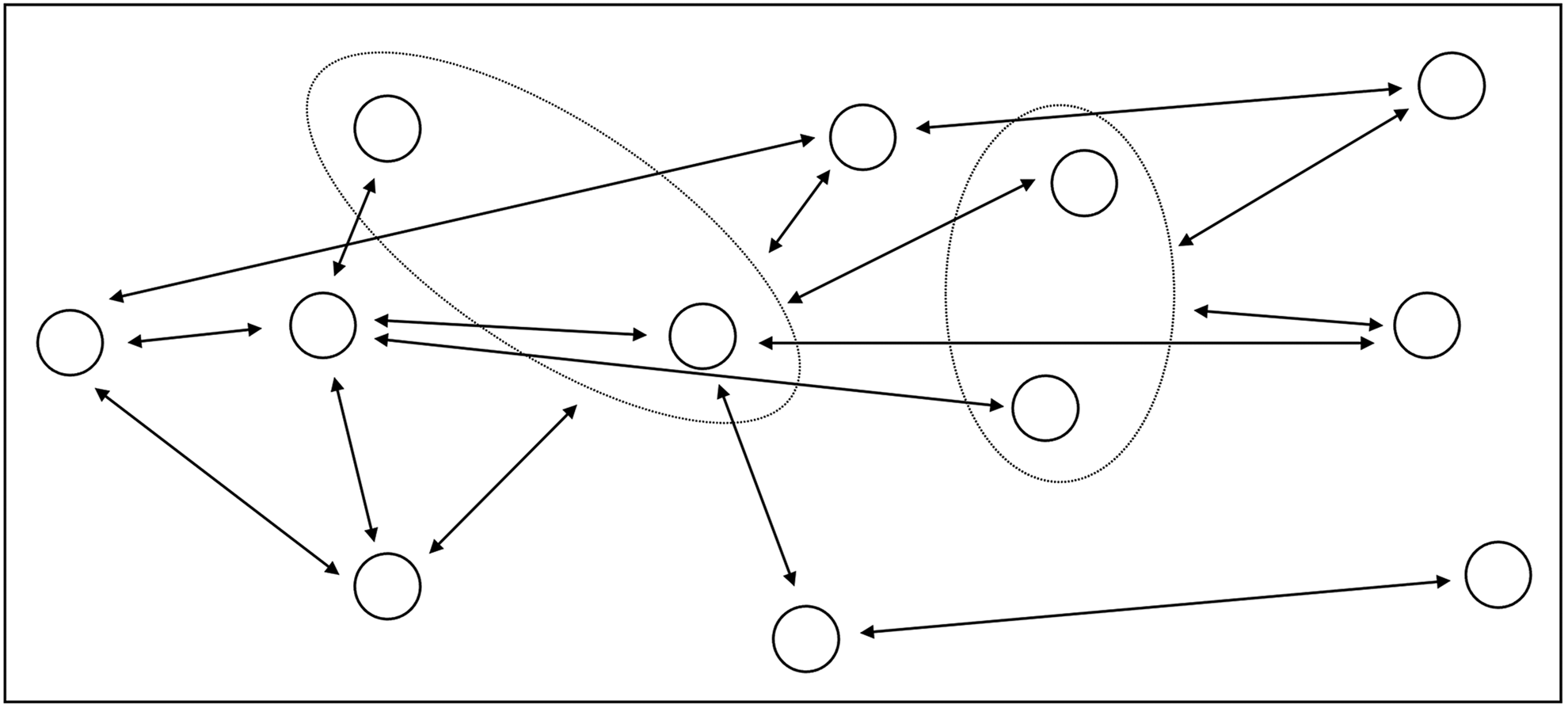
Tamar Wilson (Reference Wilson1994) discusses ‘network-mediated migration’, i.e. migration networks that are ‘facilitating rather than encapsulating, as permeable, expanding, and fluid, rather than as correlating with a metaphor of a rigid and bounded structure’ (Wilson Reference Wilson1994, 275). Building on Wilson (Reference Wilson1994), processes are in focus in Figure 4 to illustrate how social networks over time and space may connect migrants and those who remain at home (Burmeister Reference Burmeister2000, 544). Inspired by, among others, Hofmann's (Reference Hofmann2016, 241) discussion on continued migration, Figure 4 illustrates spatio-temporal dynamics in relation to various multiple migration movements. To the left in the figure, ‘social segments’, to use a term from Anthony (Reference Anthony and Daniels2022, 60), of one group (illustrated with a circle) are migrating at different times to various locations. Over time, processes of migration (and indeed other forms of socio-economic processes) form new groups (circles and ovals). On the far right of the figure, migration patterns over time have resulted in three groups. None of these have a direct relationship to the ‘social segments’ migrating from the first group on the far left in the figure. But, through complex migration patterns over time, groups (i.e. circles and ovals) are connected.
Schematic exemplification of spatio-temporal dynamics. Relations (arrows) over time (time is read from left to right in the figure) between groups (circles), starting from one group to the left, ending with three groups to the right. Segments of groups are migrating in multiple directions within a landscape (rectangle), over time new groups (circles and ovals) are formed. These interact with each other in various spatio-temporal ways.
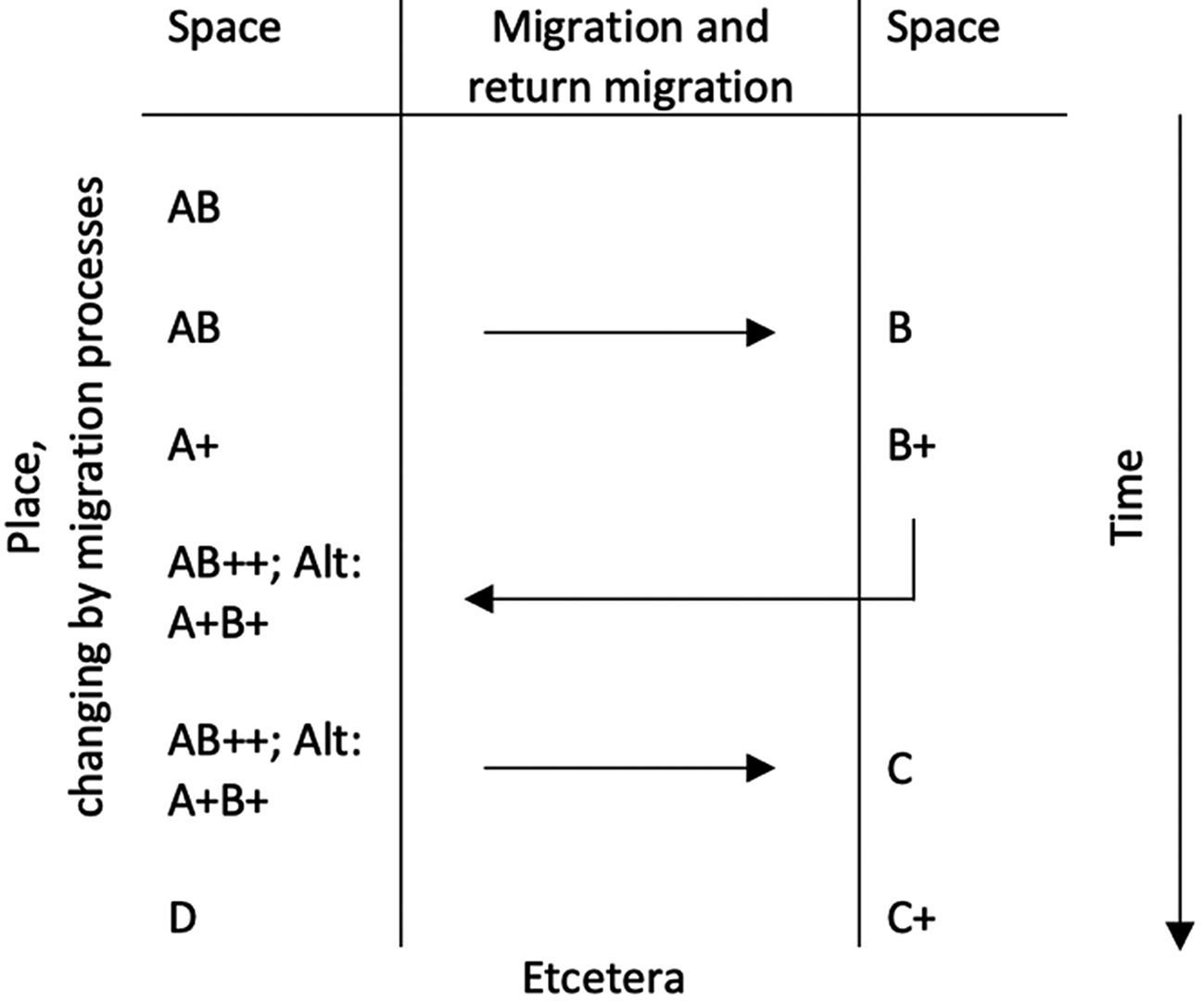
‘Space’ and ‘place’ are useful analytical concepts for exploring spatio-temporal aspects of human experiences and relations (Warf & Arias Reference Warf, Arias, Warf and Arias2009). Space is a location with a physical geography, for example a river valley where people live. Place is space with social and cultural meaning, for example what people living in a river valley refer to as a home full of place-specific memories and lived realities shared with others who also call the same space home. In migration, place tends to change while space is constant. In that sense, ‘return migration’, as in returning to the same place, is an illusion, as only the former space not the place is possible to be returned to. This is schematically illustrated in Figure 5.
Schematic illustration of changes in places within the same spaces, caused by migration. When B migrate from AB, A and B change. A becomes A+ and B becomes B+. When B+ migrate to A+, A+ and B+ change, e.g. into AB++ or A + B+. Repeated over time, A and B will change and no longer resemble the A and B that existed from the beginning. Instead, by an outsider, they might be perceived as, for example, C and D. However, it is not uncommon for someone, for example A in a situation as described, not to acknowledge this change and instead claim that A is still A.
Social transformation and relationships
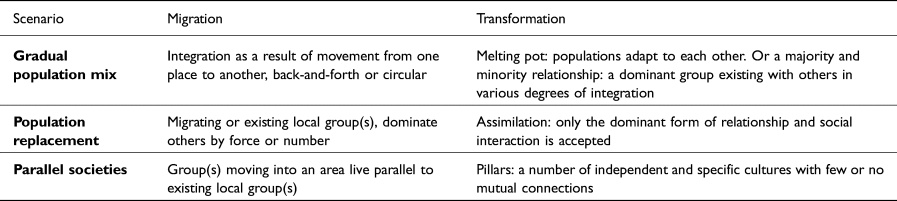
In both sending and receiving communities, as well as in other communities in which people who migrate operate, they do so within existing systems of traditions, materialities, economies, social contexts, cosmologies, religions, networks, exchange and mobility systems, contact, trade and migration routes, power relationships, etc. They operate in ways that over time both constitute and change these existing systems, affecting the relations between involved groups (Daniels Reference Daniels and Daniels2022b; Högberg et al. Reference Högberg, Berggren and Brink2023). In Table 3 we elaborate on scenarios of social transformation because of migration events, including population mix and replacement, as well as a scenario where parallel societies may exist.
Various scenarios of social transformation from migration events (modified from Högberg et al. Reference Högberg, Berggren and Brink2023; see also Ashworth et al. Reference Ashworth, Graham and Tunbridge2007). Note: the scenarios exemplified here should not be seen as exclusive, but may occur in parallel or change from one scenario to another over time.
As discussed by Clark et al. (Reference Clark, Birch and Hegmon2019, 265), migration ‘generates a complicated social map of migrant enclaves, zones of hybridity, and areas of local resistance’. This includes structural change, that may take various organizational and technological forms. It also involves socio-cultural changes, at the levels of values, norms, symbolic representations and mentalities (Rodat Reference Rodat2020, 179). Along similar lines, Burmeister (Reference Burmeister, Meller, Daim, Krause and Risch2017, 61ff, see also McSparron et al. Reference McSparron, Donnelly, Murphy and Geber2020) elaborates on internal and external domains as proxies for analysing group agency and migration relationships. Some groups may retain features that refer to the group's history in the form of, for example, material culture within the internal domain (e.g. inside their house). At the same time, the group integrates new features in its external domain (e.g. the outside of the house). In this, aspects that are new and old for the group are under renegotiation. Building on the work of Burmeister (Reference Burmeister2000; Reference Burmeister, Meller, Daim, Krause and Risch2017), McSparron et al. (Reference McSparron, Donnelly, Murphy and Geber2020, 230) present a theoretical model to examine group agency for both the migrant group and host community, and to study how variation in group agency may result in inter-group tensions or cooperation (see Clark et al. Reference Clark, Birch and Hegmon2019, 265) (Table 4).
Examples of variation in group agency and migration relationships as it may play out in internal and external domains. Legend column to the right: large circle = migrant group internal domain; large square = host community internal domain. Area with small circles and squares in between large circle and large square = external domain. Note that the figure only schematically exemplifies variation. It is not intended to illustrate processes of change from one relationship to another. (Modified from Burmeister Reference Burmeister2000; Reference Burmeister, Meller, Daim, Krause and Risch2017; McSparron et al. Reference McSparron, Donnelly, Murphy and Geber2020, 228f, fig 1; see also Clark et al. Reference Clark, Birch and Hegmon2019).

Cultural encounters, intercultural competences
Christiansen et al. (Reference Christiansen, Galal and Hvenegaard-Lassen2017) discuss cultural encounters as a concept used when conceptualizing variation and dynamics in interaction between groups and individuals across ‘established cultural boundaries’ (Christiansen et al. Reference Christiansen, Galal and Hvenegaard-Lassen2017, 599). However, as discussed, cultural boundaries are rarely stable. Discussing aspects of cultural encounters and migration processes, Rodat (Reference Rodat2020, 181) instead emphasizes that cultural boundaries are ‘constructed and reconstructed not only by learning the norms and internalizing the values within the own group, but, above all, by comparing with other groups’.
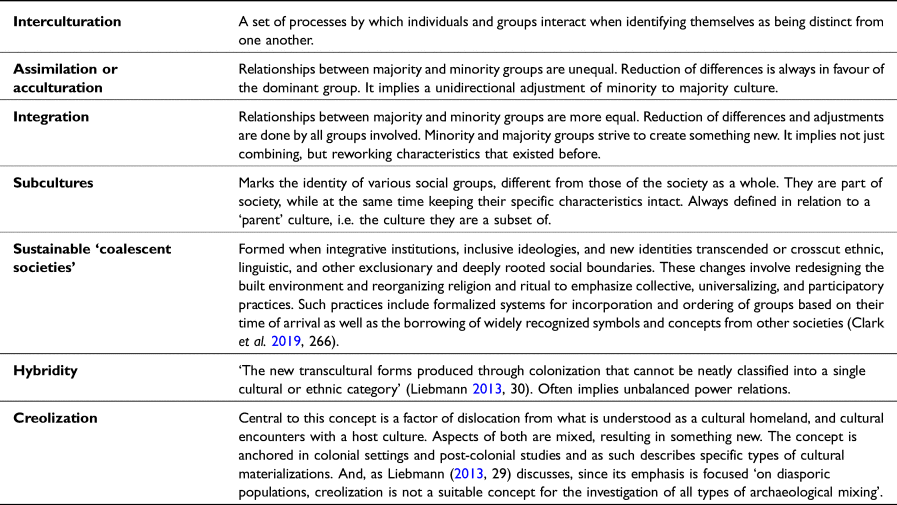
Cultural encounters as a result of migration processes take place at individual, group and societal levels (Table 5). This involves social interaction and mutual influences or encounters with what is familiar or recognizable, but also different or foreign. The process in itself is what creates meaning. Boundaries that are involved become ready to be renegotiated when behaviours and actions are not compatible, social functions are incomprehensible, knowledge is different, or symbols contrast with each other. Hence, individuals, groups, or societies define themselves by meeting others. In this way, it is not culture per se that defines, but the boundaries created and re-created in processes of cultural encounters.
Schematic list of terms for cultural interaction that illustrate variation in how to define cultural encounters as a result of migration processes. Note that listed concepts are not necessarily exclusive but integrated as various parts of the same complexity. Our purpose is to illustrate complexity from various angles. (From Gutmann Reference Gutmann1994; Ashworth et al. Reference Ashworth, Graham and Tunbridge2007; Högberg Reference Högberg2013; Liebmann Reference Liebmann and Card2013; Clark et al. Reference Clark, Birch and Hegmon2019; Rodat Reference Rodat2020; Hofmann et al. Reference Hofmann, Frieman, Furholt, Burmeister and Nørkjær Johannsen2024).
There are vast spatio-temporal variations in how cultural encounters can develop. As Hofmann et al. (Reference Hofmann, Frieman, Furholt, Burmeister and Nørkjær Johannsen2024) illustrate, these variations relate to differences in size of affected places (from small to large scale, from one place to many), in tempo and time (slow, fast; temporary, long-lasting, or permanent), or in intensity (from few persons in few places to many persons in many places). Practically, these normally come in combinations (Sørensen Reference Sørensen2014a, 44ff).
What the processes of cultural encounters result in depends on variation in intercultural competence of the people, groups, or societies involved (Dietz Reference Dietz and Callan2018). Hoffmann and Briga (Reference Hoffmann and Briga2018, 4) describe intercultural competence as ‘the ability to mobilise and deploy relevant attitudes, skills and knowledge in order to interact effectively and appropriately in different intercultural situations’ (see also Deardoff Reference Deardoff2009; Dietz Reference Dietz and Callan2018; Högberg Reference Högberg2013). Learning from knowledge and skills is necessary to provide individuals, groups, or societies with abilities to understand culture as both self-experienced (essentialist understanding of both one's own culture and that of others) and in flux (understanding of culture as something in constant transformation). According to Bennett (Reference Bennett and Wurzel2004), this requires moving from ‘ethnocentrism’ to ‘ethno-relativism’ (Table 6).
Ethnocentrism and ethno-relativism according to Bennett (Reference Bennett and Wurzel2004, 63); see also Kemp (Reference Kemp2005).

Figure 6 exemplifies activities, processes, outcomes, and practices that hypothetically can affect results from cultural encounters, and also move individuals, groups, and society from ethnocentrism to ethno-relativism (Table 6). In relation to archaeological studies of migration, the figure provides us with examples of qualities of intercultural competences that may have been involved in prehistoric migration processes and may have affected results from cultural encounters in various ways. Hence, if people, groups, or societies involved in cultural encounters are dominated by ethnocentric approaches to culture, the outcome of migrations will be different from a situation in which people, groups, or societies embrace ethno-relativism.
Schematic model on hypothetical intercultural competences that may affect results from cultural encounters. (Re-worked from Lorentz Reference Lorentz, Lorentz and Bergstedt2016.)

In summary, the theoretical review presented in this section shows the complexities involved in migration processes. As such, it elucidates hypothetical aspects related to archaeological research on migration (and beyond). Below, we take the above discussion as a point of departure and transform it into a conceptual/theoretical framework.
Concluding discussion
De Haas et al. (Reference De Haas, Miller and Castles2020) argue that we are currently in a new age of migration. Never have so many people moved over such large areas in so many places on Earth. And, as Altschul et al. (Reference Altschul, Kintigh and Aldenderfer2020) show, global migration will increase over the next decades. As discussed by many scholars, this calls for new ways to understand migration (e.g. Brettell & Hollifield Reference Brettell and Hollifield2023). As numerous studies cited throughout this text demonstrate, this also applies to archaeology. However, according to Hofmann et al. (Reference Hofmann, Frieman, Furholt, Burmeister and Nørkjær Johannsen2024, 1), archaeological perspectives on past migrations have for long been ‘biased by specific national attitudes, historical traditions, and contemporary politics’. Such biases are deeply rooted in the way migration is understood (Gabaccia Reference Gabaccia, Brettell and Hollifield2023). Hofmann et al. (Reference Hofmann, Frieman, Furholt, Burmeister and Nørkjær Johannsen2024, 11) illustrate for example how ‘the present experiences of migration filtered through the news media’ tend to influence many current migration narratives in archaeological studies. This occurs through, for example, ‘crisis narratives’ of uncontrolled migration or by conceptualizing migration through the lens of the history of European colonial expansions as models for human movement (see also Gori & Abar Reference Gori, Abar, Fernández-Götz, Nirnura, Stockhammer and Cartwright2023, 25). Combined with a ‘public perception of DNA … characterised by the idea that our genes offer a source of absolute truth about who we “really” are’ and that ‘with aDNA this idea has been projected onto the past’ (Strand & Källén Reference Strand, Källén, Strand, Källén and Mulcare2024, xviii), archaeological migration studies carry an overload of (often unintended) political baggage (see discussion in e.g. Frieman & Hofmann Reference Frieman and Hofmann2019).
We started our study from the assumption that new data from aDNA and other archaeometric methods require us to think in new ways to understand migration. This is an assumption based on our reading of studies that engage with migration in the first half of the third millennium bce in southern Scandinavia (Supplementary material). We concluded that over the last c. 50 years, a prevailing ‘non-migration narrative’ has hampered migration-theory development. Hofmann (Reference Hofmann2016, 236) emphasizes that a focus for migration studies in Stone Age archaeology should be to understand migration as social and cultural behaviours embedded in given spatio-temporal settings (see also Cabana Reference Cabana, Cabana and Clark2011; Cabana & Clark Reference Cabana, Clark, Cabana and Clark2011a; Cameron Reference Cameron2011; Reference Cameron2013; Furholt Reference Furholt2021; Hofmann et al. Reference Hofmann, Frieman, Furholt, Burmeister and Nørkjær Johannsen2024). As Högberg discusses (Reference Högberg2013; Reference Högberg, Brink, Hydén, Jennbert, Larsson and Olausson2015; Reference Högberg2016), this is in line with developed migration studies as the field has advanced in recent years by applying transdisciplinary approaches to understand variation and complexity involved in migration (see Brettell & Hollifield Reference Brettell and Hollifield2023; Takeyuki Reference Takeyuki, Cabana and Clark2011). Along similar lines, we have applied a transdisciplinary theoretical approach to build a conceptual/theoretical framework to re-theorize migration. Table 7 summarizes our results, by outlining topics, questions and rationales for applying theoretical perspectives on archaeological migration studies.
A conceptual/theoretical framework, outlined from our results.

If we return to the archaeology of the first half of the third millennium bce in southern Scandinavia and reflect on it through the lens of our conceptual/theoretical framework (as outlined in Table 7), what examples of main challenges, key unanswered questions, significant over-simplifications, or lines of directions of additional approaches can we see? Without an ambition to map out all possible areas of interest, we here consider some examples.
A main challenge in archaeological migration studies is to find ways to embrace complexity. This does not mean addressing every aspect presented in Table 7 in each study. Rather, it involves developing a deeper understanding of the limitations and opportunities these aspects embrace in relation to specific archaeological spatio-temporal contexts. Hofmann et al. (Reference Hofmann, Frieman, Furholt, Burmeister and Nørkjær Johannsen2024, 6) conclude that as migration is ‘a constant feature of Neolithic human society … there is no unitary model that can explain [all] past migration events’. Along similar lines, we conclude that a wide range of questions are explored in migration studies that are relevant to archaeology (see also Daniels Reference Daniels2022a): what do migrants do when they migrate? When do they migrate? How is migration initiated and when does it end? Is this at all a relevant question to ask? How does migration play out on varied spatio-temporal scales? Is it structured, impulsive or a combination of these and/or additional aspects? Do large groups or individuals migrate? Which gender, agency, or socio-economic structures are instrumental in initiating or regulating migration? What does migration lead to in terms of change and continuity? For whom does it lead to change or continuity; individuals, families, groups, or communities? Does everyone involved perceive that change has happened, or does migration occur in ways that extend over time and space, so it is actually perceived as continuity?
The theoretical complexities inherent in these questions contrast with the over-simplification found in the ad hoc and post hoc positions prevalent in many of the studies we have read (as discussed above). If migration theory as presented here is accepted as relevant for archaeology, then ad hoc and post hoc positions can no longer be applicable for analysing events in the first half of the third millennium bce in southern Scandinavia (or in other spatio-temporal contexts). This implies that studies which, prior to analysis, assert that variation is or is not a result of migration (ad hoc), or studies that interpret analytical results in terms of migration without engaging with migration theory (post hoc), should acknowledge that they are only speculating from an ad hoc or a post hoc position.
Another challenge for future research is how to understand migration as an ongoing organizing force of social life and society. To start, we need to abandon the idea of linear ‘one-directional’ migration flow so common in archaeology, with a clear beginning and an end (see discussion in Frieman Reference Frieman, Hofmann, Frieman and Nyland2023; Hofmann Reference Hofmann2016). Given that migration is multi-directional and constant, it is essential to recognize that what we in an analysis isolate as starts and ends of processes always have a history and a future with multiple spatio-temporal implications. A key challenge here is to find ways to combine an understanding of migration as ongoing, with the ‘increasing regionalisation in material culture’ (Hofmann et al. Reference Hofmann, Frieman, Furholt, Burmeister and Nørkjær Johannsen2024, 159) we can observe in the archaeological data from the first half of the third millennium bce in southern Scandinavia (see, for example, discussion in Iversen Reference Iversen2015; Nielsen & Johannsen Reference Nielsen and Johannsen2023).
The topic of young male warriors and their violence as driver of change has become central in several studies that explore migration, transformation processes and changing social relationships in the first half of the third millennium bce, in southern Scandinavia and beyond (see discussion in e.g. Heyd Reference Heyd, Fernández-Götz, Nirnura, Stockhammer and Cartwright2023; Kristiansen Reference Kristiansen and Daniels2022; Kristiansen et al. Reference Kristiansen, Allentoft and Frei2017). Adding migration theory to this topic allows us to consider additional approaches to analysing social roles and transformation processes. Migration happened within existing systems of traditions, materialities, economies, social contexts, cosmologies, religions, networks, exchang, and mobility systems. Thus, migrating male warriors are both leaving and entering existing systems of relationships, as well as creating new ones in the process. Questions to explore in such a scenario include: how did these systems transform with this specific type of migration? How did they change through violence, and what happened after the violence? What additional social roles are relevant to explore? If we see evidence for population replacement (as exemplified in Table 3), how do we conceptualize variation in the spatio-temporal scales involved? For instance, when Allentoft et al. (Reference Allentoft, Sikora and Fischer2024, 335) define change over time in aDNA as evidence for a ‘rapid population turnover’ in the third millennium bce in southern Scandinavia, what does ‘rapid’ mean in different spatio-temporal perspectives? Allentoft et al. (Reference Allentoft, Sikora and Fischer2024) elaborate on a timeframe of 200 years. From an archaeological deep-time perspective, 200 years is indeed rapid. From a human life-history perspective, it is not. If we compare year 1 with year 200 within this period, a ‘near-complete population turnover’ is evident. But, if we focus on, for example, years 20 to 70 within the same 200-year timeframe, we get a period of 50 years that may equal a lifetime. This opens other potential scenarios, such as periods of processes with gradual population mixing or parallel societies (as exemplified in Table 3), instead of a population replacement. Moreover, if we stay in this scenario and shift our focus from male warriors to other social roles, as for example children (see discussion in Baxter Reference Baxter2005), alternatives for additional approaches emerge. A group of children who grew up during what is retrospectively termed rapid change might perceive their time as normality (i.e., not rapid change). This allows us to ask questions about the variation in how different social roles played out in this specific time-slice of the Stone Age (see Hofmann et al. Reference Hofmann, Frieman, Furholt, Burmeister and Nørkjær Johannsen2024, 111). This could be explored by examining, for example, spatio-temporal variation in processes of intra- and inter-generational knowledge transfer systems in relation to social learning and intentional teaching (Gärdenfors & Högberg Reference Gärdenfors and Högberg2017; Högberg Reference Högberg2008). In doing so, variation over time in the qualities of intercultural competences involved in migration processes may unfold, resulting in a range of ways to understand cultural encounters (see Figure 6 and Tables 5 & 6). Such theoretical endeavours might add complexity to the archaeological interpretation of transformation processes in the first half of the third millennium bce. Potentially, this could lead to analyses of what happened (impact) as an addition to studies like Allentoft et al. (Reference Allentoft, Sikora and Fischer2024) that explains change based on the cumulative result of/outcomes from what happened (effects) (see Furholt Reference Furholt2021 for a similar discussion).
As mentioned, aDNA studies and other archaeometric analyses have significantly altered our approaches to how we can explore migration. Initially, findings from such studies were presented in generalized (atheoretical) terms of linear inheritance and population exchange (e.g. Skoglund et al. Reference Skoglund, Malmström and Raghavan2012). At the same time, a dominating trend to embrace a non-migration narrative in archaeological theory and analysis existed (see Edenmo Reference Edenmo2008 for discussion). More than a decade later, conditions for exploring aspects of migration in the first half of the third millennium bce (and beyond) have changed. aDNA studies and other archaeometric analyses have matured (e.g. Seersholm et al. Reference Seersholm, Sjögren and Koelman2024); non-migration narratives are no longer dominating as archaeologists have started to explore migration theories in new ways (e.g. Hofmann et al. Reference Hofmann, Frieman, Furholt, Burmeister and Nørkjær Johannsen2024). Hofmann et al. (Reference Hofmann, Frieman, Furholt, Burmeister and Nørkjær Johannsen2024, 3f) conclude however, that ‘the concept of migration is not yet fulfilling its potential for history-making, largely because discussion of key questions surrounding the process of migration … are only just beginning’. Given that the last c. 50 years of research on the first half of the third millennium bce in southern Scandinavia have been dominated by an explicit and outspoken ‘non-migration narrative’, it is reasonable to assume that new interpretations may emerge from re-visiting these previous studies, in addition to exploring new ones. We hope that our conceptual/theoretical framework, as summarized in Table 7, may bring in novel perspectives to archaeological studies that address migration in ways not yet explored.
Supplementary Material
To view supplementary material for this article, please visit https://doi.org/10.1017/S0959774325000046
Acknowledgements
Thanks to Peter Skoglund for comments on a previous version of the text and to two anonymous reviewers and the editor for their constructive feedback on our initial submission. This work was supported by the Swedish Research Council (grant no. 2021-01522).


 Open access

