

Bioarchaeologists often are faced with the challenge of managing field excavations and lab analyses of skeletal remains at the same time. They may also be tasked with simultaneously training students and staff and managing ongoing curation challenges. Excavation of osseous remains also may occur, for many reasons, when a bioarchaeologist is not present. A specialist in skeletal biology can re-create biological profiles by studying only the bones, but interpretation of cultural patterns requires an in-depth understanding of the burial and the body's interaction with the environment. This is especially important when complex burial practices are involved, such as the reuse of graves, interment of multiple individuals, or use of complex body positions such as seated or bundled burials.
Many cultures practiced some type of funerary tradition that complicates biological and archaeological analyses. This may include cremating the dead, moving (some or all) skeletal remains after inhumation, or placing graves in buildings that were later remodeled. All of these practices are reported in the Maya region, where the deceased were interred in middens, ballcourts, caves, residential structures and patios, and plazas and public architecture. As a result, excavations geared toward non-burial research questions frequently encounter human remains. In addition, many sites are located in remote locations where security concerns require rapid excavation of even complex burial deposits and where environmental conditions may create further challenges for work.
This article offers one set of solutions to the challenges of bioarchaeology in Latin America and similar locations. Alternatives for planning, documentation, recovery, analysis, and curation of human remains are described using a case study from Actuncan, Belize, where multiple complex burials were excavated simultaneously using experienced and novice excavators working in tandem with a bioarchaeologist. The combined efforts allowed the project to reconstruct the taphonomic profiles of the burials, as well as the individuals’ biological ones, and to better interpret the meaning of the body positions. These strategies can guide other complex burial excavations too. Interpretations of similar commingled skeletal assemblages have ranged from mass sacrifice to reuse of a revered space for ancestors (e.g., McAnany Reference McAnany, Storey, Lockard and Houston1998; Welsh Reference Welsh1988). Use of these and similar protocols also meets the ethical obligations anthropologists have when excavating human remains and illustrates some of the challenges faced by bioarchaeologists working with fragmentary remains in tropical environments.
EXCAVATION STRATEGIES FOR SEATED AND OTHER COMPLEX BURIALS
Burial 11 is one of 21 burials containing at least 29 individuals at the site of Actuncan, Belize (Freiwald, Mixter, and Billstrand Reference Freiwald, Mixter and Billstrand2014:96). Like many sites, some burials were discovered accidentally because the Maya interred their dead everywhere they lived, worked, and worshipped. At least 11 of the graves were reentered or disturbed in antiquity, resulting in complex skeletal assemblages with disarticulated and poorly preserved remains that require osteological expertise to interpret (Freiwald Reference Freiwald, LeCount and Keller2012; Freiwald, Mixter, and Billstrand Reference Freiwald, Mixter and Billstrand2014).
One burial in particular merited close attention to detail. Burial 11 contained the only upright flexed, or “seated,” individual, at a site where the standard burial position was a prone, extended body position with a southern orientation, like elsewhere in the Belize Valley (Freiwald Reference Freiwald2011, Reference Freiwald, LeCount and Keller2012; Schwake Reference Schwake2008; Welsh Reference Welsh1988; Willey et al.Reference Willey, Bullard, Glass and Gifford1965; Yaeger Reference Yaeger, Iannone and Connell2003). Only 63 seated burials were documented in a survey of >4,000 individuals buried at 63 central lowland sites during the Classic period (AD 250-900; Figure 1, Table 1). The seated position is interpreted as a marker of status and authority in Mesoamerica (Duncan et al. Reference Duncan, Balkansky, Crawford, Lapham and Meissner2008; Marcus and Flannery Reference Marcus and Flannery1996; McAnany et al. Reference McAnany, Storey and Lockard1999; Pereira Reference Pereira2013:454; Sempowski and Spence Reference Sempowski and Spence1994; White et al. Reference White, Spence, Longstaffe and Law2004). For example, at Kaminaljuyu, 19 males and adolescents were placed in seated positions in tombs filled with grave goods (Kidder et al. Reference Kidder, Jennings and Shook1946).
Map of sites surveyed with Classic period seated burials. No interments in seated positions were reported at Altun Ha, Benque Viejo, Blackman Eddy, Cahal Pech, Chan, Esperanza, Floral Park, Holmul, Piedras Negras, Pook's Hill, San Lorenzo (Belize), Tonina, Uaxactun, Xunantunich, Zubin (Adams Reference Adams1998; Audet Reference Audet2006; Braswell Reference Braswell1998; Brown et al. Reference Brown, Glassman, Ford, Troell, Garber and Glassman1996; Cheetham Reference Cheetham and Garber2004; Connell Reference Connell2000; Freiwald Reference Freiwald2011; Freiwald, Mixter, and Billstrand Reference Freiwald, Mixter and Billstrand2014; Freiwald, Yaeger et al. Reference Freiwald, Yaeger, Awe, Piehl and Wrobel2014; Garber et al. Reference Garber, Kathryn Brown, David Driver, Glassman, Hartman, Kent Reilly, Sullivan and Garber2004; Glassman Reference Glassman, Guderjan and Garber1995; Helmke Reference Helmke, Helmke and Awe2006; Helmke et al. Reference Helmke, Piehl, Bassendale, Ishihara, Griffith and Awe2001; Iannone Reference Iannone1996; MacKie Reference MacKie1985; McRae Reference McRae, Audet and Awe2004; Mitchell Reference Mitchell2006; Novotny Reference Novotny and Robin2012; Peuramaki-Brown 2009; Piehl Reference Piehl and Lucero2002, Reference Piehl2006, Reference Piehl, Helmke and Awe2008; Sanchez and Chamberlain Reference Sanchez, Chamberlain and Lucero2002; Schubert et al. Reference Schubert, Kaphandy, Garber, Garber and Kathryn Brown2001; Schwake Reference Schwake and Iannone1996; Song Reference Song, Healy and Awe1995; Welsh Reference Welsh1988; Yaeger Reference Yaeger2000), or other Belize cave and surface sites (Actun Halal, Actun Nak Beh, Actun Tunichil Muknal, Actun Uayazba Kab, Actun Yaxheel Ahau, Arenal, Cahal Pech, Cahal Uitz Na, Caledonia, Ontario, Pacbitun, Slate Altar Group, and X-Ual-Canil [Schwake Reference Schwake2008]).

Classic Period Burials Described as Seated in the Maya Region (Awe et al. Reference Awe, Weinberg, Guerra and Schwanke2005; Black Reference Black2007, Suzuki in Davies Reference Davies2012:198; Freiwald and Billstrand Reference Freiwald, Mixter and Billstrand2014; Gwyn Reference Gwyn2016; Haviland Reference Haviland1985; Hoggarth Reference Hoggarth2012; Kidder et al. Reference Kidder, Jennings and Shook1946; Lee et al. Reference Lee, Helmke, Piehl, Awe, Griffith, Ishihara and Awe2000; Lucero Reference Lucero2006; Miller Wolf Reference Miller2015; Pendergast Reference Pendergast1982; Ricketson and Ricketson Reference Ricketson and Ricketson1937, Schwake Reference Schwake2008; Smith Reference Smith1950; Thompson Reference Thompson1939; Tourtellot Reference Tourtellot1990; Welsh Reference Welsh1988; Willey et al. Reference Willey, Bullard, Glass and Gifford1965, Wrobel et al. Reference Wrobel, Helmke, Freiwald and Wrobel2014).

a: M = male, F = female, I = indeterminate.
However, the seated position itself is not well-defined (e.g., Knüsel Reference Knüsel2014) and includes flexed body positions as well as those described as “reclining” or with “legs crossed” (Willey et al. Reference Willey, Bullard, Glass and Gifford1965), which may encompass primary inhumations as well as secondary ones. A seated primary inhumation might signal a foreign origin or burial practice (e.g., Fash et al. Reference Fash, Fash, Davis-Salazar, Bell, Canuto and Sharer2004; Weiss-Krejci Reference Weiss-Krejci and Sachse2006a), or in a different context, a dedicatory offering. Conversely, a bundled secondary fully flexed burial in a dedicatory deposit might be that of a revered ancestor (Becker Reference Becker, Danien and Sharer1992; Bell et al. Reference Bell, Sharer, Traxler, Sedat, Carrelli, Grant, Bell, Canuto and Sharer2004; Freiwald, Mixter, and Billstrand Reference Freiwald, Mixter and Billstrand2014). Seated burials are reported at some central lowland Preclassic sites but were not part of the funerary repertoire again until the Postclassic period (Chase Reference Chase1982; Chase Reference Chase1983; Chase and Chase Reference Chase and Chase1988; Cohen et al. Reference Cohen, O'Connor, Danforth, Jacobi, Armstrong, Whittington and Reed1997:80; Graham et al. Reference Graham, Pendergast and Jones1989; McAnany et al. Reference McAnany, Storey and Lockard1999; Robin Reference Robin1989; Robin et al. Reference Robin, Gerhardt, Hammond and Hammond1991; Shiratori Reference Shiratori2014). This could reflect a change in burial practices or even religious beliefs (Graham et al. Reference Graham, Simmons and White2013). Only careful documentation will help us gain a better understanding of this burial practice.
Multiple burials were discovered simultaneously at Actuncan and with limited excavation time, one bioarchaeologist on site for field and lab work, and the danger of looting and damage to the burial during the rainy season, we had to adjust our excavation procedures to maximize data collection in a real (vs. ideal) setting. In-depth taphonomic analysis is not new to the Maya world, nor is the influence of Duday and colleagues’ (Reference Duday, Courtaud, Crubezy, Sellier and Tillier1990, Reference Duday, Guillon, Schmitt, Cunha and Pinheiro2006, Reference Duday, Cipriani and Pearce2009) field anthropology methods (Novotny Reference Novotny2015; Tiesler and Cucina Reference Tiesler and Cucina2006; Tiesler et al. Reference Tiesler, Cucina, Kam Manahan, Douglas Price, Ardren and Burton2010; Weiss-Krejci Reference Weiss-Krejci, Colas, LeFort and Persson2006b), which have altered interpretations of notable burials such as the Red Queen at Palenque, Mexico, and at Tikal in Guatemala (Tiesler and Cucina, eds. Reference Tiesler and Cucina2006; Weiss-Krejci Reference Weiss-Krejci, Agarwal and Glencross2011). However, in situations where students and local archaeologists with varying amounts of osteological training often serve as excavators, clear guidance on excavation strategies is needed to allow bioarchaeologists to re-create taphonomic profiles as well as biological ones.
Supplementary information geared specifically toward this archaeological environment focuses on five topics: planning, exposing and documenting the burial, recovery and transport, analysis, and long-term curation of skeletal remains, simultaneously addressing excavation challenges and research questions related to seated burials and other complex burials (Freiwald Reference Freiwald, LeCount and Keller2012, Reference Freiwald and LeCount2013; Freiwald and Billstrand Reference Freiwald, Mixter and Billstrand2014; Freiwald and Micklin Reference Freiwald, Micklin and LeCount2013; Freiwald, Mixter, and Billstrand Reference Freiwald, Mixter and Billstrand2014; Mixter Reference Mixter, LeCount and Keller2012).
Planning
An overview of planning that includes long-term curation serves as a useful guide (e.g., Childs and Benden Reference Childs and Benden2017), but burial-specific concerns include specialized laws, analyses, documentation, materials and space, communication, costs, and health. First, what regulations and laws govern the discovery of burials, and how will personnel be trained on how to avoid or how to excavate burials when discovered unexpectedly? Second, each bioarchaeologist needs to design his or her data collection methods. While a burial form serves as a guide for the information to be collected, it must be supplemented by photos, drawings, notes, and other documentation. More important, the specialist can guide the bioarchaeological research strategy because DNA analyses, direct radiocarbon dating of burials, and isotopic reconstructions of migration and diet are increasingly common. The bioarchaeologist, conservationist, or other researcher also will have specialized resource needs, such as protected space for analysis of fragile skeletal remains, appropriate lighting, trained field staff, and materials that are unavailable near the field location. For example, the potential discovery of a tomb might require chemicals that are not locally available to collect environmental pollen samples or recover fragile offerings (Cameron McNeil, personal communication 2018). Another decision relates to use of digital or paper references where electricity or internet services may be unreliable. Long-term planning is key, as human remains frequently are studied years after the excavations occur and by multiple researchers with distinct questions (e.g., Weiss-Krejci Reference Weiss-Krejci, Agarwal and Glencross2011).
Communication includes identifying interested parties such as descendant communities and local stakeholders and their role in the project, even when not required by law. Their participation may be limited to sharing project results or extend to contributing to research design or even funding. Nearly 30 years after the Native American Graves Protection and Repatriation Act's implementation, it is still common to hear stories about excavations that occurred in advance of notification of Native American tribal representatives even where mandated by state and/or federal laws. It also can take years of investment and planning to organize community archaeology fairs, produce materials for tour guides, and construct long-term storage facilities or museum exhibits and/or the museums themselves. A communication plan is recommended among project staff as well. If the bioarchaeologist is not on site, s/he should be consulted as new discoveries are made for better data recovery. This includes a plan for reports, publication, and data sharing so specialists’ data is available to project members but are not simply relegated to appendices or acknowledgments.
The costs of excavating burials can add up quickly, since excavations may include more burials than expected or complex burial contexts with fragile goods that require specialized care, export and repatriation expenses, and lab payments for chemical analyses. At a minimum, the bioarchaeologist can estimate the number of hours each burial requires so that budgets—which vary by country—include a real estimate of the money and hours needed. Excavating human remains is an investment: finding personnel with a long-term interest in the project is a better strategy than using a shifting pool of students or consultants that changes each year. This also allows for the development of a better interpretive framework for burial populations that result from unintentional discoveries rather than a specific research design (see Martin et al. Reference Martin, Harrod and Pérez2013 for a good guide).
A final but important cost consideration is planning for health. Excavations in historic cemeteries should consider the possibility of arsenic and heavy metal contamination and the potential for bodies (vs. skeletonized remains) in sealed coffins (Jonker and Olivier Reference Jonker and Olivier2012; Konefes and McGee Reference Konefes, McGee, Poirier and Feder2001; Meyers et al. Reference Meyers, Borstel, Breetzke and Holt1998). In the Maya region, burials may present hazards beyond dangers presented by normal wildlife such as dogs, bees, snakes, or cows. Excavations of burials in caves or other closed spaces may expose excavators to histoplasmosis or similar diseases. Tombs with hematite or cinnabar (or mercury) may require special protocols. Burials more than 100 years old generally present fewer risks of toxins or pathogens than more recent ones (Antoine and Taylor Reference Antoine, Taylor, Fletcher, Antoine and Hill2014), but a thorough consideration of both modern and ancient health risks is needed.
Example: Planning
Before the 2011 field season began at Actuncan, Belize, the project team and the new bioarchaeologist considered burial forms and specialized supplies, such as sterile gloves, masks, and Whirl-Pak bags, for collection of potential DNA samples. The lab was equipped with additional lighting, scales, and digital microscope cameras appropriate for very small objects like teeth that we planned to export for isotopic analysis (including radiocarbon dating). We thought it unlikely that Maya household burials would contain toxic substances like mercury, hematite, or cinnabar but underestimated the time needed for analysis of the remains. Instead of the one or two burials expected during the one-month field season, we uncovered and chose to excavate 10 of them, including the seated individual in Burial 11. To plan for future years, we increased training investment in local Belizean staff, including students and local seasonal archaeologists and lab technicians.
Excavation: Exposure and Screening
The initial goal of the excavation is to expose the skeletal remains, minimizing contact with the bones and exposure to environmental changes such as direct sunlight, heat, or humidity. The remains are not cleaned until they are ready to map and photograph. Inexpensive wood or plastic tools such as bamboo skewers may be as useful as specialty supplies to remove dirt around bones, including nonhuman fauna and fragile artifacts, without dislodging or damaging them.
I map the burial not as a single deposit but as a feature where each bone or bone cluster is documented. Each bone is numbered sequentially (1, 2, 3, etc.), which is useful for nonspecialists who may incorrectly identify bones that are not in anatomical position. Burials in the Maya region frequently contain the remains of more than one individual, where graves are reentered or disturbed and skeletal remains are commingled. Each bone may be marked with a numbered marker, available from biological supply and forensic companies, to serve as a reminder of its location as the excavation proceeds.
Screen size affects the recovery of bone, especially in burials of juveniles or fragmentary remains. Wet or dry screening depends on availability of water and the preservation of the bone. Wet screening may damage fragile bone, which can be mitigated to some extent by maintaining a constant environment for the bone (i.e., not letting bone dry out then re-wetting it). Wet screening using a tulle fabric over ⅛-inch mesh is time-consuming but provides good recovery of the bone fragments of infants or perinates. I screen matrix separately for each bone/bone cluster since even small fragments may contain useful information on the extent or location of pathologies. This is useful in understanding burial context as well. We recovered most fragments from an incised deer antler bloodletting implement underneath the highly fragmented rib cage of a prone burial by screening the upper chest area separately from the rest of the base of the grave.
Example: Burial 11 Excavation
Colleague David Mixter (Reference Mixter, LeCount and Keller2012) uncovered a burial pit cut into the plaster terrace floor, and the position of the leg bones suggested an upright body position. I was already excavating a series of burials in another household, so his team carefully exposed and documented 76 numbered bones and bone clusters. Mixter had mapped a single tooth that was discovered in advance of the grave, showing the benefit of carefully mapping even isolated skeletal finds that appear to be unassociated with a burial.
Drawings and Photographs
Drawings contain different information than photographs, in which all bones are not visible and may be hard to distinguish from the surrounding matrix. The three-dimensional location (X, Y, Z coordinates) of each bone or cluster of bones is recorded using either manual or digital methods. Multiple elevations are useful if there is a change of more than 5 cm in elevation of the same bone. In situ measurements are part of the drawing process, and many references offer detailed procedures for recovery and analysis (e.g., Bass Reference Bass2005; Steele and Bramblett Reference Steele and Bramblett1988; White and Folkens Reference White and Folkens2005; see also Baker et al. Reference Baker, Dupras, Tocheri and Wheeler2006; Dupras et al. Reference Dupras, Schultz, Wheeler and Williams2011; Scheuer et al. Reference Scheuer, Black and Schaefer2010; Ubelaker Reference Ubelaker1978).
An artist's drawing board works better than a standard clipboard, and metric graph paper should be large enough for a 1:5 scale for an adult burial or a 1:2 scale for an infant or close-up drawing of a hand or foot. While 1:10 is considered acceptable for burial documentation, more space may be desired for disturbed burials, commingled remains, or other complex burials. Writing on transparencies placed over graph paper works well to record elevations (top and bottom) and/or bone numbers, as well as grave goods identified with unique special find numbers.
As photogrammetry and automated mapping techniques become more popular, it is important to consider how they may complement rather than replace traditional mapping techniques (Novotny Reference Novotny2019). Techniques such as reflectance transformation imaging may capture more detail than a close-up photo, and three-dimensional models can provide spectacular tomb reconstructions (Berggren et al. Reference Berggren, Dell'Unto, Forte, Haddow, Hodder, Issavi, Lercari, Mazzucato, Mickel and Taylor2014; De Reu et al. Reference De Reu, De Smedt, Herremans, Van Meirvenne, Laloo and De Clercq2014; DiBiasie-Sammons Reference DiBiasie-Sammons2018). Digital mapping also can produce georeferenced ortho-images that can be imported directly into a geographic information system (GIS), potentially creating more accurate images and reducing drawing time.
A separate drawing and set of photographs are made for each level of bones before they are removed. Most burials in the Maya region will have at minimum two to three layers of skeletal remains, although Burial 11 had six. Numbering the bones even when their identification seems obvious is important. A body may appear to be articulated in anatomical position, but only an experienced osteologist might note that a bone is in the wrong place, as bones were often moved in antiquity as graves were reentered (Nilsson Stutz Reference Nilsson Stutz2003, Reference Nilsson Stutz, McCarten, Schulting, Warren and Woodman2008).
Example: Burial 11 Taphonomic Profile
Figure 2 shows a digitized plan view of Burial 11, with bones critical to understanding the body's original position and subsequent decomposition labeled. The inset shows an interpretation of the body position. The exact position would not be interpretable until more than 60 bones were mapped and documented in three dimensions. The small grave (60 × 60 cm wide and 25 cm deep) held a semi-flexed individual who was bent over rather than seated upright. The pit was not sealed, so cobble fill from the floor constructed above it collapsed into the pit as the body decomposed, contributing to the postmortem movement of the cranium (Freiwald, Mixter, and Billstrand Reference Freiwald, Mixter and Billstrand2014:102). None of the limb bones were sufficiently complete to estimate stature, even using partial bones (i.e., Steele and Bramblett Reference Steele and Bramblett1988), but an in situ measurement of the right ulna suggests a height of 5′6″ to 5′9″.
Key bones mapped in six burial layers, resulting in an interpretation of the body position (inset). Image modified after drawings by David Mixter digitized by Nicholas Billstrand.
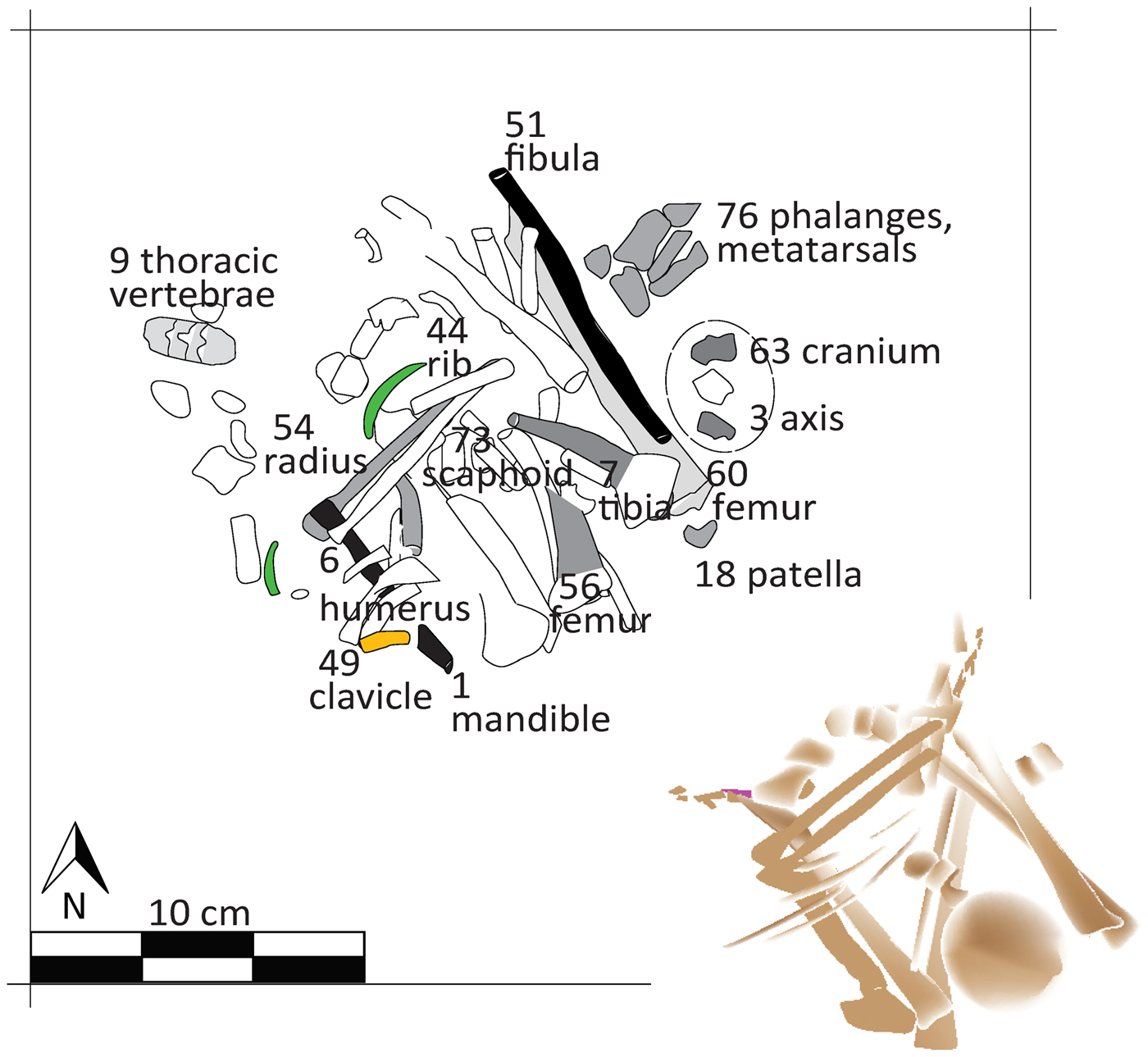
The legs were semi-flexed, and the arms were placed at a 90-degree angle across the body. Long-bone preservation was good (average score “1” for completeness, “0” for surface preservation [Buikstra and Ubelaker Reference Buikstra and Ubelaker1994]). However, the loose fill may have allowed more decomposition at the top of the grave, resulting in long bones consisting only of shafts and only partial mandibular, frontal, and temporal portions of the skull.
Recovery and Transport
Burials usually require multiple days to expose, document, and remove, depending on the complexity of the burial, the number of individuals, and the burial context. However, many circumstances require excavations to occur more quickly. For example, in remote locations, the threat of looting can pose a real physical danger to project members when whole vessels, jade, or other valuables are present (or perceived to be). These circumstances may require rapid excavation, as do tropical storms or hurricanes if excavations occur during the rainy season.
After the drawings and photographs are complete for each burial layer, the bones and associated matrix can be gently dislodged and placed in foil in their original position so that I can complete the excavation in the lab. Because burials in the Maya region are oriented to specific directions, both the orientation and physical position of the bone are recorded. If a nonspecialist is assisting, marking the foil with the bone position and a north arrow (orientation) is sufficient to capture the information for the bioarchaeologist. This also is useful to hold highly fragmented bones in place until they can be analyzed, as the foil and soil matrix offer support for bones and maintain constant environmental conditions (i.e., does not let the bone dry too quickly).
Removing fragmented bones and the associated matrix in foil and completing the excavation in the lab retains the same information as the use of preservatives or consolidants, avoiding the lengthy cleaning process required to remove them (but see Beaubien Reference Beaubien2019 for alternative procedures). More important, this avoids potential contamination that could affect aDNA, isotope, and protein analyses. For example, France and colleagues (Reference France, Giaccai and Doney2015) found that Paraloid B-72 and Butvar® B-79, common consolidants, affected oxygen isotope values in some tissues but left others unaltered. Diagenesis is a critical concern for isotope geochemistry, but there often is a disconnect between these analyses and excavation and lab procedures in museum settings.
Analysis should occur within a short period of time to avoid damage from fungi, molds, or dampness. However, if a specialist is not present, more information may be lost by processing the skeletal remains than by storing them until in-depth analysis is possible during subsequent field seasons. Burials discovered at the end of a field season might be looted if left in situ, leaving excavators little choice but to recover and store the materials even if a specialist is not present. In this case, bones may be dried before storage. Potential diagenetic contamination from materials used to store the bones is not well understood, so sterile bags such as those used for DNA samples are another possible storage technique.
Laboratory Analysis
The bioarchaeologist may complete the final stage of excavation in the lab by excavating the bones removed in foil. Ideally, a specialist can be present to record the information in the field. If not, each bone's orientation and position should be captured as the bones are removed and placed in foil. The bioarchaeologist can use the burial drawings and excavation notes as a guide to reconstruct the taphonomic profile of the burial before beginning the osteological analysis. For articulated burials, identifying the bone position and orientation is straightforward. However, precise bone positions are informative: the articulation of labile hand bones can be used to identify bundled or wrapped bodies or open or filled-in graves (Duday et al. Reference Duday, Cipriani and Pearce2009). In climates where fragile hand bones are poorly preserved, the positions of the lower arm bones might reveal the original placement of the hands.
Most projects likely have washing procedures that include using fine mesh to collect tiny bone fragments, sieving the water after processing each bone or context (e.g., Bass Reference Bass2005). A light brush may work for cleaning in dry climates, but in the tropics, the bones may be rinsed if they are not overly friable. If the bones are held together with matrix in the medullary cavity, recording measurements of the whole or partial bone should precede washing.
Example: Burial 11 Analysis
In the lab, I was able to successfully record the position and orientation of most mapped bone elements, including 67 bone orientations and 64 bone positions of 76 mapped bones and bone clusters. In all, 1,085 bone fragments were identified (771 g), representing 60% of the body (Freiwald and Billstrand Reference Freiwald, Mixter and Billstrand2014:80). Spongy bones such as the vertebrae, ribs, pelvis, and cranium were present but generally <25% complete. Appendicular skeletal elements (arms, legs, hands, and feet) were >75% complete but represented mainly by bone shafts.
Recording Osteological Information
Most osteologists working in North America use variations of the forms published by Buikstra and Ubelaker (Reference Buikstra and Ubelaker1994), modified paper forms (ASM 2011), or the Smithsonian's Osteoware (https://osteoware.si.edu/) and other digital recording systems (see Osterholtz Reference Osterholtz2019). Researchers commonly supplement these forms with data collection methods of their own design, especially in the case of complex burial practices or taphonomy. I draw from zooarchaeological and forensic sciences, which requires quantification of bone assemblages (counts and weights for each element) and documents the type(s) of animal, natural, and human activities that affected each bone fragment (Lyman Reference Lyman2001; Nawrocki Reference Nawrocki, Blau and Ubelaker2011; Redding et al. Reference Redding, Zeder, McArdle, Meadow and Zeder1978). Counting and weighing each bone documents fragmentation, which in turn provides information on postmortem processes and the effectiveness of recovery, transport, and ongoing curation. Counting and weighing the fragments from each bone element also serves as a backup provenience in place of writing on the bone or gluing labels to it, which over time can damage the bone and is disallowed by many indigenous or descendant communities.
Example: Burial 11 Biological Profile
Burial 11 contained the remains of a (probable) male, aged 36–44 years, whose robust muscle attachments (clavicle, tibiae, ulna, radius) suggest a relatively active lifestyle. Some osteoarthritis was observed on two proximal rib facets, pedal bone elements, and cervical vertebrae. Pathologies included a fused pedal second and third phalanx and nonspecific periosteal reactions on multiple bone fragments (Freiwald and Billstrand Reference Freiwald, Billstrand and LeCount2014). Recovering bones in foil and excavating them in the lab allowed me to observe where on the bone lesions were found even though they were highly fragmented. I documented no animal damage on the bones from rodents, carnivores, or insects. Nor were cutmarks or other taphonomic indicators of body processing present.
Our sampling strategy included analysis of dental health and isotopic research. The single tooth (lower left canine) showed no indications of childhood stress (Billstrand Reference Billstrand2016). A left femur fragment was used to determine that the individual died during the Late or Terminal Classic period (AD 685–780 or 790–870 at the 2-sigma level, UCIAMS #132220: 1240 ± 20; David Mixter, personal communication 2018). The strontium isotope value in his tooth enamel (0.708169 87Sr/86Sr) suggests an origin in the Belize Valley where Actuncan is located. The value, however, is a statistical outlier from those of seven individuals buried in a different Actuncan residence although they lived at approximately the same time (Freiwald et al. Reference Freiwald, Fulton, Billstrand and Micklin2018; Micklin Reference Micklin2015).
Long-Term Storage
Curation standards differ in tropical climates. Use of any kind of paper product, even acid-free, can result in collection management disasters. If (when) materials become wet, mold and fungus can destroy the containers, tags with context information, and eventually the bones. In general, dry bone fragments may be stored in polyethylene curatorial 2- or 4-ply sealed plastic bags. Write-on-white bags and permanent marker work well to record provenience on the exterior of bags, and Tyvek tags work well for a duplicate interior tag, including the number assigned to the bone in the drawing. While it is initially more work to write tags than to use preprinted paper, high-quality materials are a good investment. Storing dried osseous materials in sealed bags creates a microenvironment that reduces the effect of changes in humidity even without climate-controlled facilities. Placing the sealed plastic bags in airtight plastic containers with nondegradable padding protects the bones and maintains a relatively constant environment that minimizes further deterioration.
A related challenge is the increasing use of electronic data collection systems to record data, such as tablets or GIS for mapping and laptops for digital data entry. Replacing paper forms and traditional photographs with electronic records solves problems of accessibility and accuracy in data entry and provides faster, better burial documentation (Novotny Reference Novotny2019; Osterholtz Reference Osterholtz2019; Wrobel Reference Wrobel, Biggs and Hair2019). New technology, however, also creates novel challenges with hardware and software failures and potential data loss. Duplicate paper records in sealed containers attach provenience to the collections and retain all original records in a single location (vs. with each analyst). Reuse of existing collections is increasingly important as new bioarchaeological techniques are developed, existing ones are improved, and collections are studied decades after excavation (Roberts and Mays Reference Roberts and Mays2011; Weiss-Krejci Reference Weiss-Krejci, Agarwal and Glencross2011; Wrobel Reference Wrobel, Biggs and Hair2019).
Results
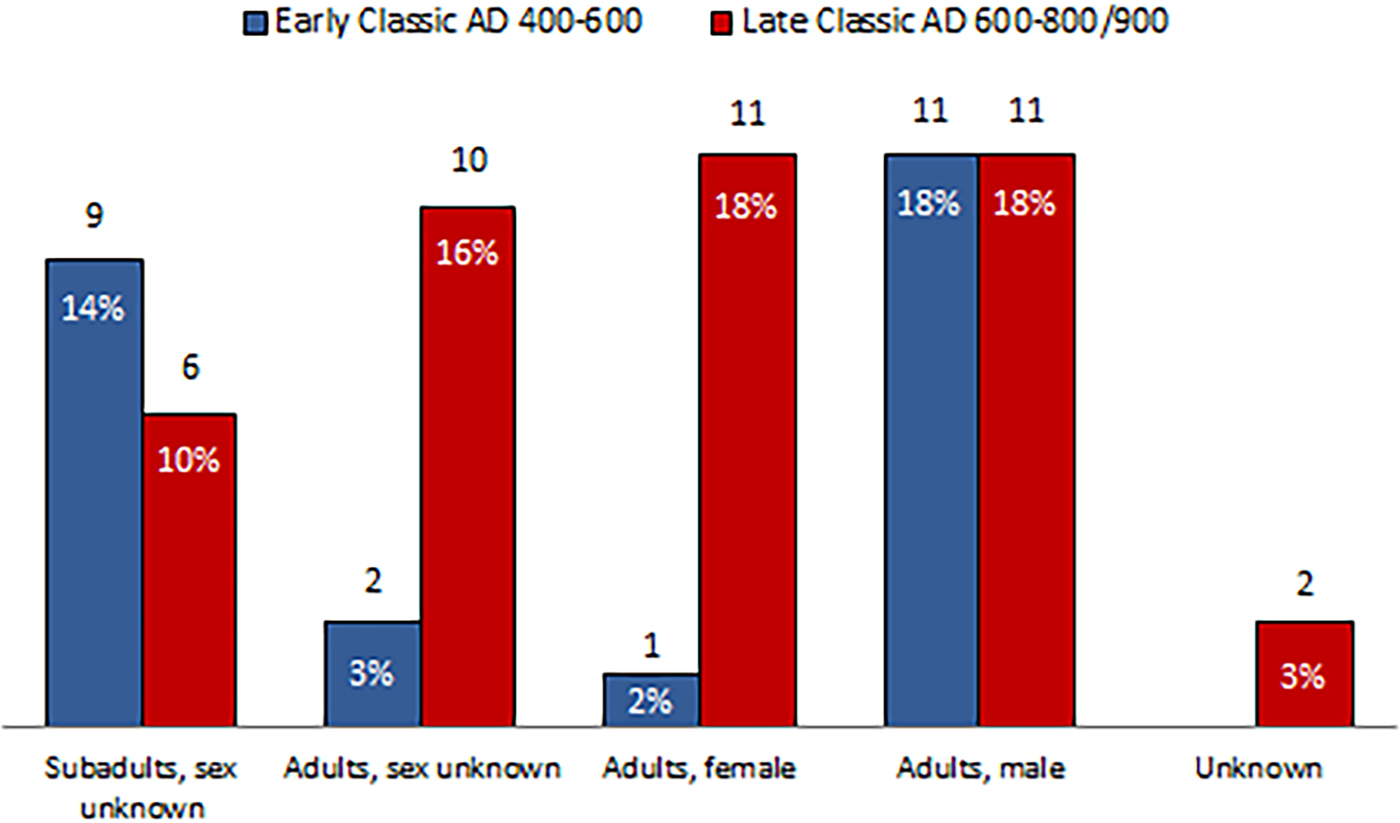
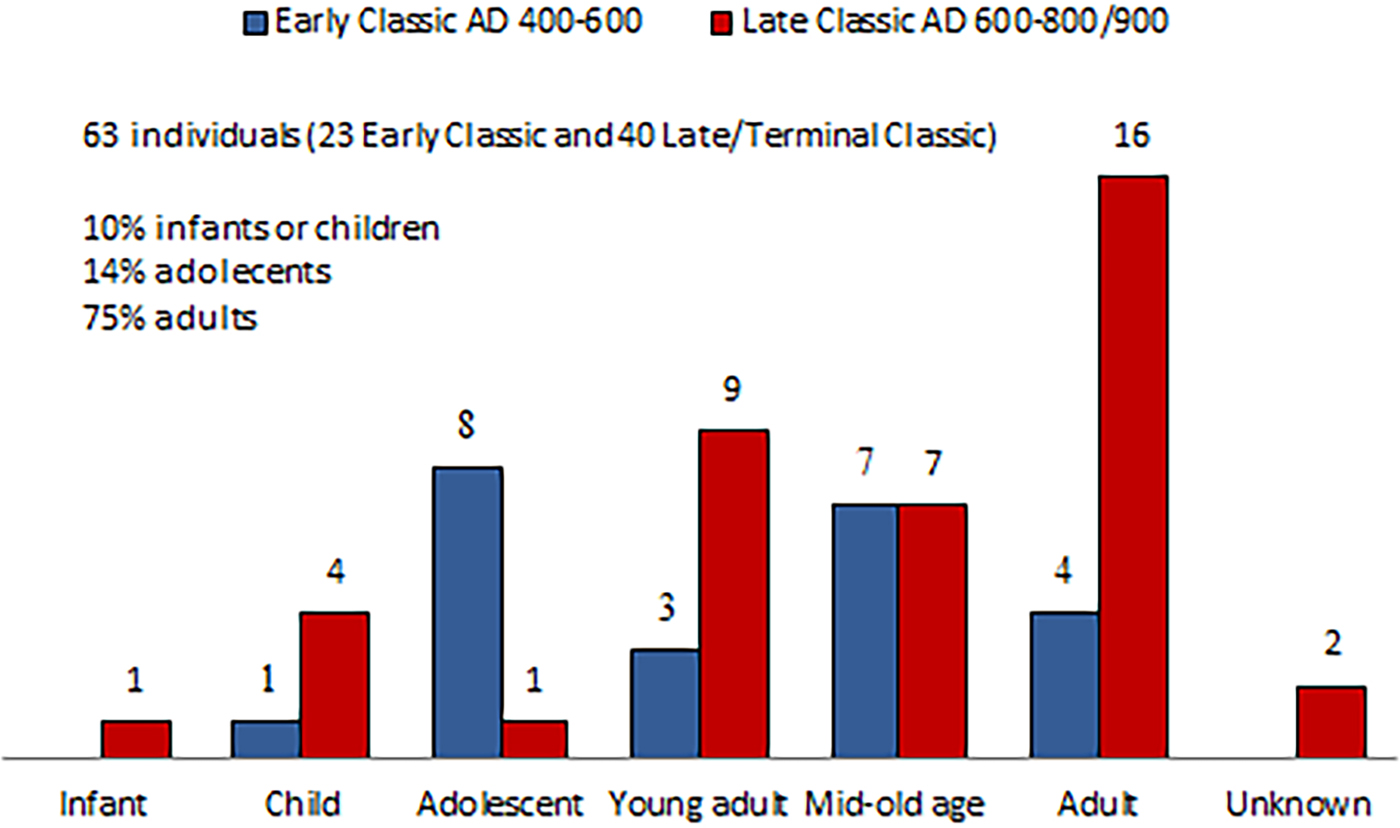
A detailed bioarchaeological analysis of a seated burial was possible using a combination of detailed field mapping and excavation in the lab, which showed that the individual was placed in a semi-flexed position in a shallow grave. This variation of an upright body position reflects the complexity of the seated burial classification. Examination of other aspects of seated burials shows additional variation. For example, of the 63 “seated” central lowland burials, both sexes were interred in seated positions, including men at Altar de Sacrificios, Saturday Creek, and Tikal and women at Barton Ramie and Minanha, and included mainly adults, although more information on subadult burials is needed (Figures 3 and 4). The number of grave goods also varies. Twenty-five of 38 burials with available data had fewer than 5 items, 13 had fewer than 10 objects, and just 3 (excluding Kaminaljuyu) included more than 10 items.
Early and Late to Terminal Classic seated burials and biological sex.
Early and Late to Terminal Classic seated burials and age-at-death estimates.
However, like Burial 11, 12 seated individuals at 10 sites have strontium isotope values consistent with a local rather than foreign origin. Strontium isotope ratios (87Sr/86Sr) are a good proxy for an individual's birthplace as they reflect values in the soils, plants, water, and fauna in catchment areas near sites (Bentley Reference Bentley2006; Freiwald Reference Freiwald2011; Price et al. Reference Price, Burton, Fullagar, Wright, Buikstra and Tiesler2008). Individuals whose values are statistical outliers from the sample population are interpreted as migrants, or people who relocated sometime after the strontium isotope values formed in their tooth enamel during infancy and early childhood. 87Sr/86Sr values in “seated” individuals’ tooth enamel are similar to those of non-seated burials that are interpreted as local to their burial locations, including Actuncan B11, Baking Pot B96-4, Barton Ramie B1-6 and B130-5, Buenavista BV-85-2, the Chaa Creek chultun chamber 3 burial, the Je'reftheel Cave young adult, San Bartolo B8, Saturday Creek B2, Copan burials B17-18 and B45/160-2, Kaminaljuyu Tomb AIV Individuals 1, 2, and 3 and Tomb AV Individual 1, and possibly for Minanha and Copan individuals as well (Davies Reference Davies2012; Freiwald Reference Freiwald2011; Hoggarth Reference Hoggarth2012; Miller Reference Miller2015; Price et al. Reference Price, Burton, Sharer, Buikstra, Wright, Traxler and Miller2010, Reference Price, Nakamura, Suzuki, Burton and Tiesler2014; Spotts Reference Spotts2012; Sutinen Reference Sutinen2014; Wright et al. Reference Wright, Valdés, Burton, Douglas Price and Schwarcz2010; Wrobel et al. Reference Wrobel, Helmke, Freiwald and Wrobel2014).
We ultimately relied on the archaeological context to interpret the burial as part of a household renovation, likely the remains of an ancestor or other individual who was important to its occupants (also see Pereira Reference Pereira2013). It is intriguing that the individual's strontium isotope value differs from the others at the site, even as it fits well with values identified in the region. We relied on a similar strategy for the complex burials in other households, one that allows a team of researchers to contribute to the analysis and complement the bioarchaeologist's expertise, so that we could obtain a holistic view of the meaning of burial positions at Actuncan.
CONCLUSION
This narrative offers a number of strategies that are specific to projects in tropical environments where burials are poorly preserved and bioarchaeology can be challenging. Highly fragmentary remains can be excavated in the lab by a specialist if additional information, either using traditional methods or with new technologies, is collected during the burial excavation. Curation standards in tropical environments are not commonly addressed, and the specific strategies described here serve to maintain a microenvironment for osseous remains that is relatively stable where climate-controlled storage is not a viable option. While the materials chosen are distinct from those used in the United States, similar principles apply. Comprehensive guides to burial excavation and curation in the forensic, archaeological, museum, and zooarchaeological literature are available and serve to frame this discussion.
Bioarchaeologists are not always present to excavate burials but still are responsible for interpreting them. Poor skeletal preservation combined with difficulties in long-term curation in tropical environments compound the problem, but a broader discussion of strategies that work, as well as those that do not, is sorely needed. Long-term curation of both excavation records and of the remains themselves also presents a critical ethical consideration for scientific reasons, where advances in DNA and other technologies require reuse of existing collections, and for ethical ones, where bioarchaeologists around the world recognize their responsibilities to descendant communities, especially when the ancestors they are studying are not their own.
Acknowledgments
Actuncan research was funded by University of Mississippi and National Science Foundation (BCS0923747) and National Geographic Society grants (Dr. Lisa LeCount). Shannon Black, Diane Davies, Julie Hoggarth, the BVAR project, Katherine Miller Wolf, John Spotts, and Jessica Sutinen generously shared unpublished data. David Mixter, Cruz Puc, Carlos Mendez, Santo Penados Jr., Laura Monahan, Nicholas Billstrand, Douglas Kennett, and Paul Fullagar contributed to the research, which is supported by the Belize Institute of Archaeology. Nancy Peniche May translated the abstract into Spanish, and the journal editors and anonymous reviewers made significant improvements to the ideas presented in this paper.
Data Availability Statement
Primary data on burials in seated body positions and Actuncan Burial 11 are available in references, as cited.



