

INTRODUCTION
In the last few decades, extensive research has been conducted to examine the impacts of future climate change on agricultural production, more so recently, with the growing concern over food security (Rötter & Van De Geijn Reference Rötter and Van De Geijn1999; Chang Reference Chang2002; Craigon et al. Reference Craigon, Fangmeier, Jones, Donnelly, Bindi, De Temmerman, Persson and Ojanpera2002; Jones & Thornton Reference Jones and Thornton2003; Nelson et al. Reference Nelson, Rosegrant, Koo, Robertson, Sulser, Zhu, Ringler, Msangi, Palazzo, Batka, Magalhaes, Valmonte-Santos, Ewing and Lee2009, Reference Nelson, Rosegrant, Palazzo, Gray, Ingersoll, Roberton, Tokgoz, Zhu, Sulser, Ringler, Msange and You2010; Ciscar et al. Reference Ciscar, Feyen, Soria, Lavalle, Perry, Raes, Nemry, Demirel, Rozsai, Dosio, Donatelli, Srivastava, Fumagalli, Zucchini, Shrestha, Ciaian, Himics, Van Doorslaer, Barrios, Ibáñez, Rojas, Bianchi, Dowling, Camia, Libertá, San Miguel, De Rigo, Caudullo, Barredo, Paci, Pycroft, Saveyn, Van Regemorter, Revesz, Mubareka, Baranzelli, Rocha Gomes, Lung and Ibarreta2013; Shrestha et al. Reference Shrestha, Ciaian, Himics and Van Doorslaer2013; Witzke et al. Reference Witzke, Ciaian and Delince2014). Many of these studies have concluded that the effects of climate change on crop yields is highly dependent upon the geographical location of crop production, with crops in some regions benefiting (Cuculeanu et al. Reference Cuculeanu, Marica and Simota1999; Ghaffari et al. Reference Ghaffari, Cook and Lee2002; Witzke et al. Reference Witzke, Ciaian and Delince2014) while crops in other regions show adverse effects under new climatic conditions (Morison & Lawlor Reference Morison and Lawlor1999; Jones & Thornton Reference Jones and Thornton2003; Parry et al. Reference Parry, Rozenzweig, Iglesias, Livermore and Fisher2004; Witzke et al. Reference Witzke, Ciaian and Delince2014). In general, higher CO2 concentration and an increase in spring/summer air temperatures as well as the length of growing season will be beneficial to crop production, especially in northern temperate latitudes (Cannell & Thornley Reference Cannell and Thornley1998; Campbell & Smith Reference Campbell and Stafford Smith2000; Donatelli et al. Reference Donatelli, Srivastava, Duveiller, Niemeyer, Seppelt, Voinov, Lange and Bankamp2012). However, an increase in temperature during crop development will depress yields in those regions where summer temperature and water stress are already limiting factors for plant growth (Rosenzweig & Tubiello Reference Rosenzweig and Tubiello1997). Similarly, higher rainfall can enhance grass growth in regions where water is a limiting factor, but it will be detrimental on grazing and grass conservation in areas with poor water drainage due to water logging (Cooper & McGechan Reference Cooper and McGechan1996). This regional variation of the impact of climate change on agricultural production eventually leads to differences in farms’ responses to such change in different regions (Mendelsohn et al. Reference Mendelsohn, Nordhaus and Shaw1996; Bryant et al. Reference Bryant, Smit, Brklacich, Johnston, Smithers, Chiotti and Singh2000; Tan & Shibasaki Reference Tan and Shibasaki2003; Seo & Mendelsohn Reference Seo and Mendelsohn2008; Walker & Schulze Reference Walker and Schulze2008; Nelson et al. Reference Nelson, Rosegrant, Koo, Robertson, Sulser, Zhu, Ringler, Msangi, Palazzo, Batka, Magalhaes, Valmonte-Santos, Ewing and Lee2009, Reference Nelson, Rosegrant, Palazzo, Gray, Ingersoll, Roberton, Tokgoz, Zhu, Sulser, Ringler, Msange and You2010; Ciscar et al. Reference Ciscar, Feyen, Soria, Lavalle, Perry, Raes, Nemry, Demirel, Rozsai, Dosio, Donatelli, Srivastava, Fumagalli, Zucchini, Shrestha, Ciaian, Himics, Van Doorslaer, Barrios, Ibáñez, Rojas, Bianchi, Dowling, Camia, Libertá, San Miguel, De Rigo, Caudullo, Barredo, Paci, Pycroft, Saveyn, Van Regemorter, Revesz, Mubareka, Baranzelli, Rocha Gomes, Lung and Ibarreta2013; Shrestha et al. Reference Shrestha, Ciaian, Himics and Van Doorslaer2013; Witzke et al. Reference Witzke, Ciaian and Delince2014).
Research has also been carried out in recent years to determine the effects of climate change on Irish farms (Brereton & O'Riordan Reference Brereton, O'Riordan and Holden2001; Holden et al. Reference Holden, Sweeney, Brereton, Fealy, Keane and Collins2004, Reference Holden, Brereton, Fitzgerald, Sweeney, Albanito, Brereton, Caffarra, Charlton, Donnelly, Fealy, Fitzgerald, Holden, Jones and Murphy2008). Many of these studies included regional variation in farm responses to climate change. For instance, Holden et al. (Reference Holden, Brereton, Fitzgerald, Sweeney, Albanito, Brereton, Caffarra, Charlton, Donnelly, Fealy, Fitzgerald, Holden, Jones and Murphy2008) included a number of adaptation measures such as changing stocking rate, N-inputs, silage area and grazing period to examine the impact of climate change on Irish livestock farms in different regions. They concluded that livestock farms in some areas, such as in the southern regions, would not benefit by adopting these changes whereas livestock farms in the eastern regions would improve production by increasing stocking rate or moderately decreasing N-input on farms. These previous Irish studies included farm adaptations as fixed measures implemented on all farms without considering the variability between different farm types. It is argued that use of generalized measures may not be ideal at a farm level without taking account of farm variability (due to socio-economic conditions and farm management), which would have a strong relationship with farm performances and hence influence their responses to future changes (Reidsma et al. Reference Reidsma, Ewert, Lansink and Leemans2010). This variability can be examined properly by providing modelled farms with more flexibility on selecting management strategies according to their individual needs to adjust under new conditions (Ramsden et al. Reference Ramsden, Wilson and Gibbons2000; Gibbons et al. Reference Gibbons, Sparkes, Wilson and Ramsden2005).
With 4·4 million ha of farming land, Irish agriculture covers only a small area of land compared to other EU countries (CSO 2012). However, there is a wide diversity among farms across the country. There are seven nomenclature of territorial units for statistics (NUTS) III agricultural regions in Ireland; border, mid-east, midlands, mid-west, south-east, south-west and west regions. The NUTS is a single uniform breakdown of territorial units for the production of regional statistics for the European Union (for details see http://ec.europa.eu/eurostat/ramon/nuts/introduction_regions_en.html). Both of the southern regions are dominated by dairy-production-oriented farms, whereas the north and west regions have smaller extensive farms. Tillage farms are scattered over southern and eastern regions of the country. Table 1 shows the characteristics of average farms in different regions to illustrate the variability between these regions.
Characteristics of representative farms in different regions in Ireland

* Excluding single farm payments.
Source: Connolly et al. (Reference Connolly, Kinsella, Quinlan and Moran2008).
In addition to the regional variations, there is also substantial variation between different farm types within each region based on their main production system, management, economics and physical size. A number of studies have examined this variability and showed that in Ireland, different farms responded differently to changed conditions (Shrestha & Hennessy Reference Shrestha and Hennessy2006; Shrestha et al. Reference Shrestha, Hennessy and Hynes2007). For example, in response to the decoupling of farm payments, within the south-west region larger beef farms responded by reducing beef numbers by 50% whereas smaller beef farms entirely de-stocked beef animals (Shrestha et al. Reference Shrestha, Hennessy and Hynes2007).
The current paper examines the regional variation of impacts of climate change on Irish farms. It sets up different farm types in each of the regions in Ireland and aims to capture the variability between farms as mentioned above and explores the differences in farm response between those farm types under the changed climate.
MATERIALS AND METHODS
The methodology behind the current study was divided into two phases as shown in Fig. 1. The first phase determined the effects of future climate on yields of crops and grass in Irish regions using biophysical models. The second phase then used these model outputs in a farm-level economic model to examine farm responses under the changed climate. Family farm income, which represents net margin of a farm, was used as an indicator to determine the effects of climate change. A more detailed description of the data inputs and models is given below.
A schematic diagram of the methodology.

Data input
The data used in the current paper was provided by two sources; farm-level data from the National Farm Survey (NFS) (Connolly et al. Reference Connolly, Kinsella, Quinlan and Moran2008) and climate data from the Irish National Meteorological Service (McGrath et al. Reference McGrath, Lynch, Dunne, Hanafin, Nishimura, Nolan, Venkata Ratnam, Semmler, Sweeney and Wang2008). In addition, farm management data and other farm variables that were not available in the NFS dataset were taken from the Teagasc Management Handbook (Teagasc 2009). The NFS data consisted of farm-level data from 1151 farms, representing 111 913 farms nationally and the NFS survey collects physical as well as financial information from each of the sampled farms. Farms were well distributed over the seven regions of the country and were classified as dairy, beef, sheep and tillage farms, based on the major activity taking place on the farm. Within each of the regions, a cluster analysis was carried out in SPSS (version 16.0.1) to group farms with similar characteristics together. Seven farm variables (production system, farm gross margins, land, animal number, labour, feed and milk yield) were used to group the farms: these variables were assumed to be the main differences between farms. The squared Euclidean distance method was used in finding similarities between the farms: it is commonly used in cluster analysis when there are multi-dimensional variables such as the farm variables used in the current study (Solano et al. Reference Solano, Leon, Perez and Herrero2001). A more detailed description of this methodology is available in Shrestha (Reference Shrestha2004).
The weather data used were a set of modelled data that were down-scaled from 136 weather stations throughout Ireland and had a horizontal resolution of 25 km (McGrath et al. Reference McGrath, Lynch, Dunne, Hanafin, Nishimura, Nolan, Venkata Ratnam, Semmler, Sweeney and Wang2008). The data included daily solar radiation, maximum and minimum air temperature, precipitation, dew point and wind speed at a height of 10 m. The weather data were obtained for a baseline scenario (1961–1990) and a climate change scenario (2061–2090). The climate scenario was based on the ‘high’ emission scenario A1B (IPCC Reference Nakicenovic and Swart2000) under a general climate model, HadCM3, which was down-scaled to regional level by using a regional climate model, RCA3 (McGrath et al. Reference McGrath, Lynch, Dunne, Hanafin, Nishimura, Nolan, Venkata Ratnam, Semmler, Sweeney and Wang2008). A number of emission scenarios based on different extents of GHG emissions were available under these models but only the ‘high’ scenario was chosen for the current study, to determine the largest response of farms under the changed climate.
Simulation models
Three different types of simulation models were used; crop and grass growth models in phase 1 and a linear programming farm-level model in phase 2.
Crop environment resource synthesis model
The crop environment resource synthesis (CERES) model was used to assess the impacts of climate change on winter wheat, spring barley and forage maize yields. The model was originally developed under the auspices of the USDA-ARS Wheat Yield Project and the US government multi-agency AGRISTARS programme, which was later modified into different modules (CERES-Wheat, CERES-Barley and CERES-Maize) to simulate yields for different crops (Ritchie & Otter Reference Ritchie, Otter and Willis1985; Otter-Nacke et al. Reference Otter-Nacke, Ritchie, Godwin and Singh1991; Ritchie et al. Reference Ritchie, Singh, Godwin, Bowen, Tsuji, Hoogenboom and Thornton1998). The CERES model has been parameterized worldwide for major crops and has shown reasonable agreement between measured and modelled results in a number of locations (Holden & Brereton Reference Holden and Brereton2006; Lizaso et al. Reference Lizaso, Fonseca and Westgate2007; Robredo et al. Reference Robredo, Perez-Lopez, De La Maza, Gonzalez-Moro, Lacuesta, Mena-Petite and Munoz-Rueda2007; Meza et al. Reference Meza, Silva and Vigil2008).
Johnstown grass model
The Johnstown castle grass model (JGM; Brereton et al. Reference Brereton, Danielov and Scott1996) was used in the current study for simulating Irish grass growth. It is a simple empirical pasture model that predicts vegetative growth and development in permanent pastures (Brereton Reference Brereton, Jeffrey, Jones and McAdam1995) and was developed for the purpose of understanding the behaviour of grassland systems herbage supply in response to weather variations. This model simulates the production of pasture dominated by perennial ryegrass, which is the common basis of livestock production in Ireland. It has been tested and validated against measured production over a wide geographical range and found suitable for simulating Irish pasture production (Brereton Reference Brereton, Jeffrey, Jones and McAdam1995; Holden et al. Reference Holden, Brereton, Fitzgerald, Sweeney, Albanito, Brereton, Caffarra, Charlton, Donnelly, Fealy, Fitzgerald, Holden, Jones and Murphy2008).
Farm-level linear programming model
An optimizing farm-level linear programming (FLLP) model was developed for the current study. The FLLP is based on a farm-level dynamic linear programming model which is described in detail in Shrestha (Reference Shrestha2004). Modified versions of FLLP have been used in a number of farm-level analyses of Irish Agriculture (Shrestha & Hennessy Reference Shrestha and Hennessy2006, Reference Shrestha and Hennessy2008; Shrestha et al. Reference Shrestha, Hennessy and Hynes2007; Hennessy et al. Reference Hennessy, Shrestha and Farrell2008). The FLLP model assumes that all farmers are profit oriented and maximize farm net income within a set of limiting farm resources. For the purpose of the current study, four production systems were considered; dairy, beef, sheep and arable production systems. These systems were constrained by land labour, feed and stock replacement available to a farm. The total land available on a farm was fixed but farms were allowed to transfer land between different production systems. Farms were also allowed to buy in feeds, animal replacements and hire labour if required. The farm net income comprised the accumulated revenues collected from the final product of the farm activities (crops, animals and milk) plus farm payments minus costs incurred for inputs under those activities. The input costs were replacement costs for livestock, variable costs including labour, feed and veterinary costs and overhead costs on farms.
In the crop production system, the model consisted of the three most common crops in Ireland; winter wheat, spring barley and forage maize. The initial land under these crops in each farm was based on the farm-level data; however, as mentioned earlier, the model was allowed to reallocate land under these crops as well as transfer to grass production. The stocking rate on each farm was also fixed to the farm-level data, assuming that all farms were operating under optimum stocking rate. The dairy system had a 4-year replacement structure where dairy animals were culled every 4 years. Similarly, beef and sheep systems followed a 2-year replacement structure. The animals were replaced by on-farm or off-farm replacement stocks. A feed module, based on Alderman & Cottrill (Reference Alderman and Cottrill1993), was used in the model to determine feed requirements for each of the animals based on type, age and production level of the animal. Feeds available to the livestock were fresh grass, grass silage, maize silage and concentrate feeds. Concentrate feed included cereal produced on farms as well as those feed bought from outside the farms. Grass silage was produced under one-cut (May) or two-cut (May and June) silage production systems. The quality of the one-cut and two-cut grass silage was assumed to be similar in the current study. The two-cut silage system produces more grass silage annually but has twice the labour costs of the one-cut silage system.
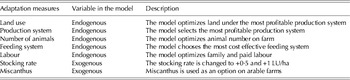
The FLLP model is pseudo-dynamic in nature, such that it runs for a 10-year time frame but the results from the first 3 years and the last 3 years were discarded to minimize the starting and terminal effects of linear programming (Ahmad Reference Ahmad1997; Shrestha Reference Shrestha2004). The model outputs from the middle 4 years were averaged to provide the final results for both the baseline scenario and the climate change scenario runs. Farm activities chosen by the model under the climate change scenario which were different from the baseline scenario were considered as farmers’ responses under the changed climate. A list of adaptation variables used in the current study is provided in Table 2. It should be noted here that the study focused only on short-term farm adaptations that could be adopted easily by a farmer on-farm. Long-term adaptations that require large investments, such as installation of irrigation/drainage facilities on farms, were not considered for the current study as they were not assumed to be farmers’ immediate response under a changed climate. The adaptation variables considered in the current study can be divided into two types; endogenous farm variables, which were the existing farm management practices and were adjusted by the model during optimization; and exogenous farm variables, which were introduced in the model externally. Two exogenous adaptations were examined in the current paper: stocking rate and introduction of Miscanthus. The stocking rate was increased by +0·5 livestock units (LU)/ha and +1 LU/ha in separate model runs to provide flexibility on farms to increase animal numbers. Miscanthus is provided in the model as an optional crop: it was included as a possible adaptation because of its importance as a biofuel crop and it is considered to be suitable for future growing conditions in Ireland (Breen et al. Reference Breen, Clancy, Moran and Thorne2009). The gross margin for Miscanthus was set at €30·7 per tonne (Clancy et al. Reference Clancy, Breen, Butler and Thorne2009).
A list of adaptation measures used in FLLP model
The current study only considered the changes on crops and grass yields under a climate change scenario. Direct effects of climate change on grazing animals were not covered in detail because, in a temperate climate like Ireland, animals are expected to be capable of tolerating heat stress for the next 50 years (Parsons et al. Reference Parsons, Cooper, Armstrong, Mathews, Turnpenny and Clark2001). However, a 10% increase in livestock variable costs (especially increases in veterinary costs) was included in the study to enable livestock farms to undertake any preventive measures against the possibility of parasitic infestation. It should also be noted here that the current study focused entirely on the impacts of climate change and all other external factors such as market prices, technological progress and agricultural policies were kept unchanged.
RESULTS
Model validation
Crop environment resource synthesis model
The CERES crop model results for winter wheat and spring barley were validated using field data. As shown in Table 3, the model baseline average yields fall within the range of field data and RMSE value for winter wheat and spring barley are both 0·5 t/ha. The model, however, underestimated the biomass of forage maize with an RMSE value of 1·5 t/ha.
A comparison of CERES baseline yields against field data for three crops
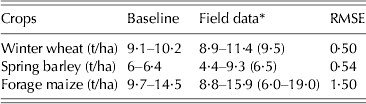
* Winter wheat and spring barley field data (1998–2006) taken from Forristal (Reference Forristal2007) and Forage maize field data (1992–1998) taken from Holden & Brereton (Reference Holden, Brereton and Sweeney2003a , Reference Holden and Brereton b ).
Farm-level linear programming model
The baseline farm net incomes provided by the FLLP model were compared with the farm family net income of all farm types in each of the region. Figure 2 presents a snapshot comparison of farm types in two regions; southwest (one of the most efficient production regions) and border (one of the least efficient production regions). The comparison for other regions is similar to these two regions. The FLLP is robust for large and efficient farms but it overestimated the farm income for some of the small and less efficient farms. This is understandable as FLLP is an optimizing model, hence tries to maximize utilization of farm resources on those small and less efficient farms. The model is not adjusted in the current study for these small farms since the focus was to examine counterfactual scenarios and compare them with a baseline scenario.
Comparison of farm net incomes between FLLP baseline and NFS farm-level data for southwest and border regions.

Farm types
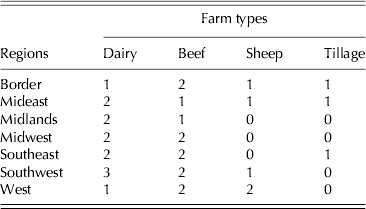
The cluster analysis resulted in different farm groups in each of the seven regions. The number of farm types in each of the regions is shown in Table 4. All of the regions contained both dairy and beef farm groups, whereas sheep farm groups are identified only in the border, mid-east, south-west and west regions and tillage farm groups are concentrated only in border, mid-east and south-east regions (it should be noted that all regions actually contain some sheep and tillage farms, but in order to preserve confidentiality those groups with fewer than 15 farms were not considered in the current study).
Number of farm types in each of the regions
Based on their characteristics, the farm groups were arbitrarily designated as small-, medium- and large-sized farms to differentiate them from each other. Some major characteristics of the farm groups in each of the regions are provided in Table 5, showing the size of farm, available family labour, farm gross margins and livestock units. The results showed that the northern regions have smaller, extensive livestock farms whereas southern regions consisted of more intensive livestock farms. It also showed that most of the Irish tillage farms had beef or sheep activities on farms.
Characteristics of farm groups in different regions
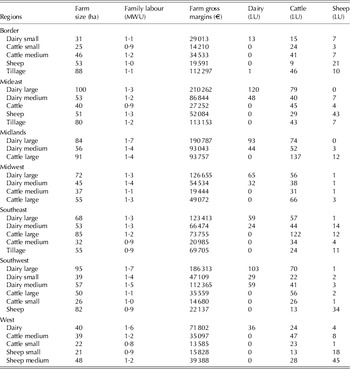
MWU: man work unit; LU: livestock unit
Crop yields
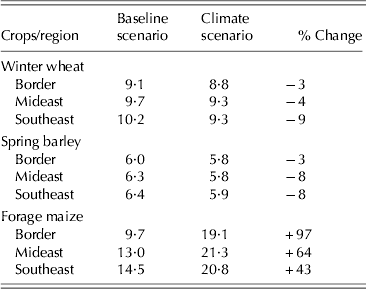
Both of the cereal crops used in the current study, winter wheat and spring barley, showed a decrease in yields on farms under climate change in all three tillage regions (Table 6). The extents of impact on yields were different in each of the regions. The most severe impact for both winter wheat and spring barley crops was observed on farms in the south-east region compared to farms in the mid-east and border regions. In contrast to the cereal crops, forage maize production in the three regions investigated was increased substantially under the climate change scenario compared to the baseline scenario, with yields ranging from 19·1 to 21·3 t/ha which represented increase of 43–97%.
Effects of baseline and climate change scenario on crop yields (t/ha) and % change in yields on a regional basis
Grass yield
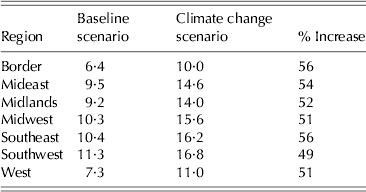
Under the climate change scenario, grass growth was substantially increased in all regions compared to the baseline scenario with yields ranging from 10·0 to 16·8 t/ha (Table 7). The south-west region had the highest grass yield in the baseline scenario but had the lowest increment (49%) of yield under the climate change scenario. In contrast, the border region had the lowest grass yield in the baseline scenario but the increase under the climate change was the highest at 56%.
Effects of baseline and climate change scenario on the grass biomass production (t/ha)
Impacts on farms
The model results for farm net income under the climate change scenario are shown in Table 8. In the table, the first column represents the region and farm types within each region. The second column provides farm income data under the baseline scenario. The third column, which is the climate scenario column, is further divided into four columns; the first column, ‘Basic’, is the climate change scenario where only endogenous adaptations were considered in the model. The remaining columns in the table provide the results with exogenously introduced adaptation measures as indicated by corresponding column titles. The results are discussed in more detail for each region below.
Percentage change in farm net incomes under climate change scenarios in different regions
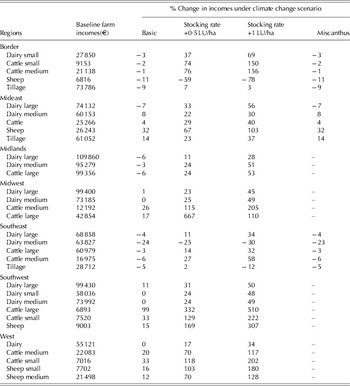
LU: livestock unit
In the border region there was a negative impact on all farm types under the climate change scenario. The impact was small in the case of dairy farms and beef farms but the sheep and tillage farms showed relatively larger negative impacts (c. −10%). There was a very small replacement of concentrate feed by grass and grass silage on dairy farms, but for beef and sheep farms there was no change in feeding system as these farms already had a system based completely on grass. There was no change for animal number but most of the farms benefitted when stocking rate was increased. Sheep farms, however, did not improve for farm income since the productivity of these farms decreased when the number of animals on farms increased.
In the mid-east region, dairy farms showed mixed responses with larger farms losing out but medium-sized farms benefitting under the ‘Basic’ climate change scenario. Sheep and tillage farms had higher gains under the climate change scenario compared to the beef farms. The medium dairy farms replaced only 0·40 of the concentrate feed by grass feeds, whereas the beef farms replaced concentrate feed by up to 0·84. All other farms replaced concentrate completely with grass and grass silage feeds. The tillage farms removed all land under crop production and moved to grass production. These tillage farms increased beef numbers by 0·30. Increased stocking rate on farms substantially improved the family income in all farm types, especially in the sheep farms where there was over 100% increase in farm incomes.
In the midlands region, all farm types showed a decrease in their farm incomes. The only adjustment on these farms was to replace the entire use of concentrate feed by grass and grass silage feeds. Dairy farms in the mid-west region, however, showed only a negligible impact from climate change. However, all beef farms in this region benefitted substantially. These farms replaced all concentrate feed used on farms with grass and grass silage feeds.
Of all farm types in all regions, the large-sized dairy farms in the south-east region had the highest loss (−24%) in farm income under the ‘Basic’ climate change scenario. These farms are the milk producers with highest costs of production (€928/dairy LU). The 10% increase in variable costs under climate change affected these farms more than any other farms. These farms opted to reduce dairy animals on farm by 2%. These farms were affected more when the number of animals was increased under the higher stocking rate scenarios. The small dairy farm as well as all types of beef and tillage farms had comparatively a smaller reduction in farm income. However, these farms show an improvement on farm income under the higher stocking rate scenarios. The tillage farms benefitted by increasing 0·5 LU of animals on farms but further increase in stocking rate had a negative impact on incomes of these farms. The medium dairy farms showed a very small improvement in farm income when Miscanthus was allowed on farm. These farms had a small piece of arable land (c. 4 ha) used for cereal production to feed animals. Miscanthus as a cash crop was slightly more profitable alternative for these farms, as the farms could sell it to the market.
In the south-west region, the large dairy farms had an increase in farm income under the ‘Basic’ climate change scenario. These farms replaced c. 0·30 of concentrate feed with grass, grass silage and maize silage in animal feed and also put the animals on grass 1 month earlier in the ‘Basic’ climate change scenario compared to the baseline scenario. However, for smaller dairy farms in this region there were no impacts of climate change on farm incomes. The beef and sheep farms, however, had substantial increases in farm income under the climate change scenario. This was entirely due to replacing concentrate feed by grass feeds and hence lowering expenses. Increasing animals on farms benefitted all farms in this region.
In the west region, there was no impact of the ‘Basic’ climate change scenario on dairy farms but the cattle and sheep farms had a larger beneficial effect of climate change. These farms also exploited increase in grass yield by replacing the concentrate feed completely with grass feed. These farms also improved their incomes substantially when more animals were allowed on farms.
Farms in all regions also opted for one-cut grass silage production system to minimize production costs. As the quality of grass silage was assumed to be the same in all types of grass conservation method, the results suggested that the higher production costs for two-cut silage systems outweighs the benefits of an increase in grass silage compared to one-cut silage system.
DISCUSSION
Previous studies have shown that the growth models used in the current study (CERES and JGM) can predict crop production in Ireland reliably (Holden & Brereton Reference Holden and Brereton2002, Reference Holden, Brereton and Sweeney2003a , Reference Holden and Brereton b , Reference Holden and Brereton2006). The future crop yields projected under the climate change scenario were lower compared to the baseline scenario for both winter wheat and spring barley crops in all three regions. This result contrasts with the results of some earlier studies (Holden & Brereton Reference Holden, Brereton and Sweeney2003a , Reference Holden and Brereton b ; Holden et al. Reference Holden, Sweeney, Brereton, Fealy, Keane and Collins2004, Reference Holden, Brereton, Fitzgerald, Sweeney, Albanito, Brereton, Caffarra, Charlton, Donnelly, Fealy, Fitzgerald, Holden, Jones and Murphy2008), where positive yield for cereal crops was provided. The difference, however, lies in the climatic scenario used. Owing to the uncertainty of future climate change, a number of climatic scenarios are available ranging from low- to high-temperature change. For the current study, a ‘high’ A1B climate scenario was used to determine the farm responses under extreme conditions. Although a mild increase in temperature would benefit crops in temperate regions such as Ireland, as indicated in earlier studies, a higher temperature would cause crop stress and shortening of the grain filling period (Midmore et al. Reference Midmore, Cartwright and Fisher1982; Blum et al. Reference Blum, Sinmena, Mayer, Golan and Shpiler1994; Wolfe Reference Wolfe and Pessarakli1994; Luo & Mooney Reference Luo and Mooney1999; Anwar et al. Reference Anwar, O'Leary, McNeil, Hossain and Nelson2007), therefore reducing grain yields. This difference in the use of climate change scenario has also been illustrated by Donatelli et al. (Reference Donatelli, Srivastava, Duveiller, Niemeyer, Seppelt, Voinov, Lange and Bankamp2012), who showed that for the northern European regions, cereal production would increase by up to 20% under a ‘mild’ climate scenario but decrease by −20% under a ‘warm’ climate scenario. The ‘warm’ scenario used in the Donatelli study is similar to the ‘high’ climate scenario used in the current study.
The effect of climate change on forage maize and grass yields is generally positive in all regions in Ireland. Warmer conditions are more favourable for maize production and recent projections show a projected substantial increase (up to 200%) in maize yield in all Irish regions with climate warming (Holden & Brereton Reference Holden, Brereton and Sweeney2003a , Reference Holden and Brereton b ). It has also been suggested that the predicted future dry summers (McGrath et al. Reference McGrath, Lynch, Dunne, Hanafin, Nishimura, Nolan, Venkata Ratnam, Semmler, Sweeney and Wang2008) may affect biomass production of forage maize negatively, as higher precipitation is important for higher crop yield (Mera et al. Reference Mera, Niyogi, Buol, Wilkerson and Semazzi2006; Kovacevic et al. Reference Kovacevic, Jolankai, Birkas, Loncaric, Sostaric, Loncaric and Maric2009a , Reference Kovacevic, Sostaric, Josipovic, Iljkic and Markovic b ). However, the model results suggest that future warmer temperatures will increase forage maize biomass production sufficiently to compensate yield reduction due to expected reduced precipitation. Increases in grass yields were due to the combined effects of increasing winter rainfall, temperature and CO2 concentration (McGrath et al. Reference McGrath, Lynch, Dunne, Hanafin, Nishimura, Nolan, Venkata Ratnam, Semmler, Sweeney and Wang2008). There have been several studies suggesting that increases in precipitation (Rosenzweig & Tubiello Reference Rosenzweig and Tubiello1997; Izaurralde et al. Reference Izaurralde, Rosenberg, Brown and Thomson2003; Mearns Reference Mearns2003), temperature (Fiscus et al. Reference Fiscus, Reid, Miller and Heagle1997) and carbon dioxide concentrations (Mitchell et al. Reference Mitchell, Mitchell, Driscoll, Franklin and Lawlor1993; Anwar et al. Reference Anwar, O'Leary, McNeil, Hossain and Nelson2007) have a positive effect on grass productivity. Increase in future grass biomass production in Ireland due to climate change has been suggested by Holden & Brereton (Reference Holden and Brereton2002) and Fitzgerald et al. (Reference Fitzgerald, Brereton and Holden2009) using the Dairy_Sim model, and Abdalla et al. (Reference Abdalla, Jones, Yeluripati, Smith, Burke and Williams2010) using the DeNitrification – DeComposition (DNDC) and DayCent models.
The FLLP model results suggested that there is a regional variation in the impacts of the climate change scenario on farms and the response of farms are different between farms in all regions. Livestock farms in the border region had reductions in farm net margins under the climate change scenario. The increase in grass yield under the climate change scenario did not make any difference to their farm management as these farms were already using grass-based systems. These farms, however, had an increase of 10% in livestock variable costs under the climate change scenario, which reduced their net margins. The farms in the west region, which are assumed to be very similar to farms in the border region, have higher costs of production and used more concentrate feed compared to their counterparts from the border region (Connolly et al. Reference Connolly, Kinsella, Quinlan and Moran2008). Moving to a complete grass-based system decreased the costs of production on these farms, hence improving the farm margins. Similarly, in the dairy producing southern regions, dairy farms in the south-west region improved their farm net margin under climate change by replacing 0·30 of concentrate feed with grass-based feed. However, dairy farms in the south-east region replaced the entire concentrate feed used on farm with grass feeds to minimize production costs. The livestock farms in all regions also opted for one-cut silage production on farms. It has been suggested that cost-saving strategies such as lowering labour costs would be preferred by farmers in the future (Ramsden et al. Reference Ramsden, Gibbons and Wilson1999). Rötter & Van De Geijn (Reference Rötter and Van De Geijn1999) also pointed out that the impact of climate change would be more favourable to a grass-based livestock production system as they could lower the costs of production further.
For a majority of farm groups, a restriction on stocking rate seemed to be a major constraint as their farm incomes improved when stocking rate was increased. This shows that these farms could exploit an increase in grass yield under climate change by simply increasing the number of animals. Parsons et al. (Reference Parsons, Cooper, Armstrong, Mathews, Turnpenny and Clark2001) also suggested that farmers benefit from increased grass yield under climate change when stocking rate was relaxed. However, increasing stocking rate has its own consequences and may not be applicable because of policy restrictions, the possibility of damaging soil and an increase in variable costs. Some farms are not profitable enough to increase animal numbers, such as sheep farms in the border and medium dairy farms/tillage farms in the south-east regions. The productivity of animals could also be affected adversely by increasing stocking rate, as reported by Gordon (Reference Gordon and O'Grady1986) who found a decrease of 4% in milk yield per cow when stocking rate was increased from 2·5 to 3 cows/ha in northern Ireland. Ruminants are also considered to produce 17% of the total global methane emission (Benchaar et al. Reference Benchaar, Rivest, Pomar and Chiquette1998) so any activity leading to further increases in the methane emissions should be considered carefully, especially if there is a limit imposed on farms on total GHG emissions.
For tillage farms, lower crop yields under the climate change scenario had a negative impact on farms. However, tillage farms in the mid-east region showed an improvement in their incomes under climate change by moving from tillage to beef farming. Beef production in this region is more commercialized with higher beef price and has a tendency to increase the number of animals when possible (Shrestha et al. Reference Shrestha, Hennessy and Hynes2007). The tillage farms in this region already have a capacity in beef production and hence can expand beef production without incurring a large investment. In the current study, Miscanthus, as an alternative crop, could not compete with other arable crops and hence most of the farms did not choose it as an adaptation. The only farms that chose Miscanthus were the medium-sized dairy farms in the south-east region, which had a small piece of land under cereal production to feed their animals. These farms moved completely to the grass-based feed system and opted for Miscanthus on arable land to sell it in the market. The prices of Miscanthus in the current study were fixed to the 2004 level but under future price projections, Miscanthus could be more competitive and considered as an adaptation measure to improve farm margins (Styles et al. Reference Styles, Thorne and Jones2008).
There are some limitations in the current study. The responses examined were based on the assumption that all farmers were profit oriented: farmers are known to take up new technologies and change their management practices to improve their profits (Kaiser & Crosson Reference Kaiser and Crosson1995). However, the current study did not cover those farmers whose responses were not always aimed at maximizing farm profits, such as hobby farmers. The study also only focused on farm adaptations and did not include long-term adaptations which would incur large investments. Another limitation of the current study is that the results are highly dependent on the outcomes of the crop growth models and climate change scenarios. Different sets of crop growth model or climate change scenarios could provide entirely different sets of crop yield results. Since only one climate change scenario was included, the sensitivity of the growth models to temperature and rainfall suggests that further research would be beneficial under a range of climate change scenarios to identify the full scale of possible strategies under different climatic conditions. It should also be noted that prices for the future were fixed at the current level and the study did not consider any price or market effects on farm responses to the future climate.
CONCLUSIONS
Most of the farms in the border, midlands and south regions suffered while farms in rest of the regions benefitted under the climate change scenario used in the current study. A majority of livestock farms replaced all concentrate feed with grass feeds, but a number of farms opted for only a fraction of such replacement. Dairy farms in south-east regions responded to climate change by decreasing dairy animals on farms whereas dairy farms in other regions benefitted when stocking rate was increased on farms. Tillage farms in the mid-east region were able to compensate for a loss in crop yield under climate change by shifting from crop production to beef production. The current paper shows that there exists a regional variability in farm responses to the impacts of climate change on Irish farms.
The authors would like to acknowledge the Department of Agriculture and Food, Ireland for providing funding for this study under the Research Stimulus Fund Programme, project no. 06/316, C4I, Ireland for providing weather data and FBS, Teagasc for providing farm-level data and two anonymous referees for providing valuable comments to prepare this paper.



