


Impact statement
With concerns about extreme events and ecosystem restoration on large shallow lakes growing, the wind is often the focus for driving the hydrodynamic process and profoundly impacting water quality and the ecosystem. In this study, we review how the wind field disturbs the flow movement and the sediment at the bottom of the shallow lake, as well as the chain impact on the aquatic organism, such as the bacterioplankton, plankton and fish. In order to better understand the wind-driven hydrodynamic process with the help of the model, we summarize the mathematical expressions of the wind field for depicting the wind-driven force in the hydrodynamic model of lakes. Furthermore, the hurricanes’ impact on lakes and the wind-induced impacts on biodiversity are put forward prospectively. Our work, therefore, points out the direction for future research across the lake ecosystem.
Introduction
Owing to the vast water area and small vertical depth of large shallow lakes, wind force is inevitably one of the most crucial parts of the hydrodynamic process (Li et al., Reference Li, Jalil, Du, Gao, Wang, Luo and Acharya2017). The effects of wind fields on the motion of water, possibly leading to nutrient redistribution and food web reconstruction in lakes (Stockwell et al., Reference Stockwell, Doubek, Adrian, Anneville, Carey, Carvalho and Wilson2020), are raising concerns, especially for dealing with severe eutrophication as well as water-quality degradation (Shi et al., Reference Shi, Zhu, Van Dam, Smyth, Deng, Zhou, Pan, Yi, Yu and Qin2022). In this study, we clarify the characteristics of the wind-driven hydrodynamic process of shallow lakes and their profound influence on the water quality and ecological process. Then, the mathematical expression of the wind-driven force in the hydrodynamic model is summarized. Additionally, the response of shallow lakes to extreme climates and the potential impacts of wind turbulence on biodiversity are put forward prospectively.
Impact of wind force on the large shallow lake ecosystem
Here cluster analysis of a wind-driven large shallow lake was obtained from Figure 1. The keywords were “wind” and “lake.” The larger the node circle, the stronger the influence of the keyword in the related research, and the more connections between the nodes indicated that the keyword was more closely related to other keywords. The results showed that “wind” and “lake” were the core of related research. Besides, “large shallow lake,” “dynamic” and “model” were the hot research object, process and method, respectively; “water quality” and “eutrophication” were important issues people were concerned. In addition, “wind-driven circulation” and “sediment resuspension,” “phytoplankton,” “nutrient” and “cyanobacteria” were the focal processes or objects in the study of hydrodynamic–water quality–ecological system of lakes.
Cluster analysis and keywords co-occurrence of a wind-driven large shallow lake ecosystem. A total of 6,917 papers on the response of lakes to wind field were obtained from Web of Science Core Collection (WOSCC) published during 1985 to 2023; the keywords were the “wind” and “lake.”

Wind-driven hydrodynamics
Wind speed and direction dominate the flow movement of large shallow lakes straightforwardly. The water velocity of shallow lakes increases with stronger winds; meanwhile, the surface velocity is generally higher than the bottom velocity, and the vertical interlayer velocity distribution is approximately logarithmic (Zheng et al., Reference Zheng, Wang, Wang and Hou2015). Besides, reverse flows usually occur in each layer of the water body except the surface under dominant winds. The mesoscale shear appears at the middle layer and the reverse flow is dominated by wind speed, while the large-scale shear appears at the bottom layer and the reverse flow is dominated by wind direction (Li et al., Reference Li, Jalil, Du, Gao, Wang, Luo and Acharya2017). The surface flow pattern in large shallow lakes will be steady under a long-term stable wind field, and the development of wind-induced flow in lakes could be divided into three stages: the flow direction is nearly consistent with the dominant wind direction at first, then it gradually deviates from the dominant wind direction, and, finally, a relatively stable circulation forms. The duration of wind field is different when each layer of the water body reaches a steady state; the closer the water body is to the surface, the shorter the time required. Generally, the duration of wind field in the same direction in Taihu Lake is 10–11 hours when the wind-induced flow is stable (Ma et al., Reference Ma, Pu and Luo2013). Actually, the wind speed and direction change continuously in a natural wind field. The wind direction of a high frequency will have a more complicated influence on the shear of flow field, which means that the reverse flow field occurs more frequently in all layers of the water body (Li et al., Reference Li, Jalil, Du, Gao, Wang, Luo and Acharya2017).
Impacts of wind-driven hydrodynamics on water quality and ecological activity
The wind-induced flow movement affects the temporal and spatial distribution of water quality in the lake by affecting processes such as sediment resuspension and dissolved oxygen concentration (Roberts et al., Reference Roberts, Moreno-Casas, Bombardelli, Hook, Hargreaves and Schladow2019). The sediment resuspends when the shear force of the flow on the surface of the sediment is higher than the critical shear force, which then accelerates the circulation of nutrients and the migration and diffusion of pollutants in the overlying water body (Lövstedt and Bengtsson, Reference Lövstedt and Bengtsson2008). Compared with light and moderate winds, shallow lakes under strong winds are accompanied by greater shear force, significantly increasing suspended sediment concentration. The resuspension of sediment is also accompanied by a change in the physical and chemical properties of overlying water and sediment, including pH, dissolved oxygen and redox potential. The nitrification and denitrification in water are intense under the disturbance of wind field, which can promote the conversion of different forms of endogenous nitrogen in shallow lakes and might enhance endogenous phosphorus rapidly by even tens of times than before the disturbance (McCarthy et al., Reference McCarthy, Gardner, Lehmann, Guindon and Bird2016; Shi et al., Reference Shi, Zhu, Van Dam, Smyth, Deng, Zhou, Pan, Yi, Yu and Qin2022). Note that the input of particulate and interstitial P into the water body by wind energy may be in the orders of magnitude greater than those of external loading inputs, and the release rate is directly related to the intensity of sediment disturbance (Huang et al., Reference Huang, Fang, He, Jiang and Wang2016). The redox environment at the sediment–water interface may change continuously owing to the disturbance of suspended sediment, which can strongly affect the binding of iron, aluminum, calcium and other metal ions with phosphate (McCarthy et al., Reference McCarthy, Gardner, Lehmann, Guindon and Bird2016). Furthermore, wind direction affects nutrient distribution by means of different lake flows (Huang et al., Reference Huang, Fang, He, Jiang and Wang2016). The concentration of dissolved oxygen in the water body is enriched when absorbing more oxygen from the air through wind and wave processes, and the rate of reaeration increases with increasing wind-induced hydrodynamic force. Nonetheless, the extinction of algae will deplete oxygen in the water, and wind directly drives algae migration and impacts the horizontal and vertical distribution of dissolved oxygen concentration in different regions, which in turn limits the redox process in lakes (Deng et al., Reference Deng, Chen, Liu, Peng and Hu2016).
Ecological activities in shallow lakes are also affected by wind-driven lake environments. There are differences in the adaptability of phytoplankton to a series of changes in lake environments, resulting in an entirely new competition for nutrients, light energy and buoyancy regulation (Mesman et al., Reference Mesman, Ayala, Goyette, Kasparian, Marcé, Markensten and Ibelings2022). Therefore, biological species that can quickly absorb and store nutrients and grow well in low light can get growth advantages, and eventually, the biological community is restructured (Ptacnik et al., Reference Ptacnik, Moorthi and Hillebrand2010). As a result of an hurricane, the dominant algae in Lake Okeechobee, a shallow tropical lake, changed from a cyanobacteria community that is easily limited by nutrients to a diatom community that is tolerant to weak light (Stockwell et al., Reference Stockwell, Doubek, Adrian, Anneville, Carey, Carvalho and Wilson2020). The phytoplankton biomass in the downwind direction is higher than that in the upwind direction, and the gap increases linearly with an increase in wind speed (Cyr, Reference Cyr2017). As for the zooplankton, the respiration rate under wind and wave disturbance increases by 90% compared with that under static conditions (Alcaraz et al., Reference Alcaraz, Saiz and Calbet1994). Higher metabolic rate and energy consumption together caused by exercise (Visser et al., Reference Visser, Mariani and Pigolotti2008) has an adverse effect on the maintenance of biomass. It has gradually become a consensus that there is a “dome effect” of hydrodynamics on plankton, that is, hydrodynamics promotes the growth of plankton in a certain range of low wind and wave intensity, but not if the intensity exceeds (Mackenzie et al., Reference MacKenzie, Miller, Cyr and Leggett1994). However, in comparison, the phytoplankton community is less sensitive to wind and waves, which may be related to its high abundance, high potential for rapid growth and strong ability to adapt to evolution through gene mutation (Zhou et al., Reference Zhou, Qin and Han2016). The competition among species does not affect apparently their abundance, while plane turbulence significantly will (Zhou et al., Reference Zhou, Qin and Han2016). At higher trophic levels of the food web, wind-induced hypoxia events negatively impact the distribution of benthic invertebrates such as Drosophila melanogaster and fish (Jabbari et al., Reference Jabbari, Ackerman, Boegman and Zhao2021). Coincidentally, significant research links the onset of lake trout reproduction with strong autumn winds, indicating the importance of wind events on fish reproduction (Callaghan et al., Reference Callaghan, Blanchfield and Cott2016).
Mathematical expressions of wind-driven hydrodynamics
The influence of wind field on wind-induced flow field in the hydrodynamic mathematical model was mainly imposed in the wind stress term as surface boundary conditions (Jin and Ji, Reference Jin and Ji2001; Koçyigit and Falconer, Reference Koçyigit and Falconer2004). Wind stress can be expressed as a function of wind velocity at 10 m above the lake surface using a bulk formulation:
 $$ \tau =\rho\;{C}_{\mathrm{d}}{U}_{10}^2, $$
where τ is the lake surface wind stress, N/m2, increasing with wind speed; ρ is the air density, kg m-3; U 10 is the wind speed, m s-1; C d is the wind drag coefficient. Therefore, the impact of wind stress on hydrodynamics is also related to the wind drag coefficient, which represents the momentum transfer intensity between air and water.
The expression of C
d is traditionally considered as constant between 0.001 and 0.003 (Botte and Kay, Reference Botte and Kay2002; Koçyigit and Falconer, Reference Koçyigit and Falconer2004) or linear functions of wind speed ranging from 5 to 25 m/s, as shown in Table 1, formed like $ {C}_{\mathrm{d}}=\left(\beta +\gamma {U}_{10}\right)\times {10}^{-3} $
regressed by a tremendous number of observations and experiments over open seas, in which β and γ are the underdetermined coefficients (Garratt, Reference Garratt1977; Smith, Reference Smith1980; Large and Pond, Reference Large and Pond1981; Wu, Reference Wu1982; Eqs. 1–4). However, most of these formulae are representative of moderate wind speeds. Under extremely high winds, the wind drag coefficient may reach up to 0.0025. It might then decrease slightly with wind speed because of wave breaking and airflow separation accompanied by solid wind waves over seas (Jarosz et al., Reference Jarosz, Mitchell, Wang and Teague2007). Wind speed over inland lakes is mostly below 5 m/s wherein C
d decreases with increasing wind speed (Bradley et al., Reference Bradley, Coppin and Godfrey1991; Edson et al., Reference Edson, Jampana, Weller, Bigorre, Plueddemann, Fairall, Miller, Mahrt, Vickers and Hersbach2013) and can reach two or more factors of that over seas (Lükő et al., Reference Lükő, Torma, Weidinger and Krámer2022). A minimum value for U
10 ranges from 2 to 5 m/s, and C
d for U
10 = 2 m/s is around 0.002 (Geernaert et al., Reference Geernaert, Larsen and Hansen1987; Wüest and Lorke, Reference Wüest and Lorke2003). The negative relationship between C
d and U
10 at low winds in inland lakes might be caused by the shallow water effect (Zhao et al., Reference Zhao, Liu, Li, Dai, Song and Lv2015), while some others believe that wind stress of shallow lakes is dominated by viscous stress and follows the law of smooth flow (Wu, Reference Wu1982), which differs from the rough flow characteristics at moderate and high winds. Expressions of C
d decrease with wind speed or depend on both wind speed and water depth at light winds (Jarosz et al., Reference Jarosz, Mitchell, Wang and Teague2007; Zhao et al., Reference Zhao, Liu, Li, Dai, Song and Lv2015).
$ {C}_{\mathrm{d}}=\left(\beta +\gamma {U}_{10}\right)\times {10}^{-3} $
regressed by a tremendous number of observations and experiments over open seas, in which β and γ are the underdetermined coefficients (Garratt, Reference Garratt1977; Smith, Reference Smith1980; Large and Pond, Reference Large and Pond1981; Wu, Reference Wu1982; Eqs. 1–4). However, most of these formulae are representative of moderate wind speeds. Under extremely high winds, the wind drag coefficient may reach up to 0.0025. It might then decrease slightly with wind speed because of wave breaking and airflow separation accompanied by solid wind waves over seas (Jarosz et al., Reference Jarosz, Mitchell, Wang and Teague2007). Wind speed over inland lakes is mostly below 5 m/s wherein C
d decreases with increasing wind speed (Bradley et al., Reference Bradley, Coppin and Godfrey1991; Edson et al., Reference Edson, Jampana, Weller, Bigorre, Plueddemann, Fairall, Miller, Mahrt, Vickers and Hersbach2013) and can reach two or more factors of that over seas (Lükő et al., Reference Lükő, Torma, Weidinger and Krámer2022). A minimum value for U
10 ranges from 2 to 5 m/s, and C
d for U
10 = 2 m/s is around 0.002 (Geernaert et al., Reference Geernaert, Larsen and Hansen1987; Wüest and Lorke, Reference Wüest and Lorke2003). The negative relationship between C
d and U
10 at low winds in inland lakes might be caused by the shallow water effect (Zhao et al., Reference Zhao, Liu, Li, Dai, Song and Lv2015), while some others believe that wind stress of shallow lakes is dominated by viscous stress and follows the law of smooth flow (Wu, Reference Wu1982), which differs from the rough flow characteristics at moderate and high winds. Expressions of C
d decrease with wind speed or depend on both wind speed and water depth at light winds (Jarosz et al., Reference Jarosz, Mitchell, Wang and Teague2007; Zhao et al., Reference Zhao, Liu, Li, Dai, Song and Lv2015).
Expressions of wind drag coefficients and their adaptation to hydrodynamic models of large lakes at light winds (U 10 = 2 m/s)

* z 0 is roughness length, m; β 10 and β * are wave ages corresponding to wind speed (U 10) and friction wind speed u *, respectively; δ is the wave steepness; R B is wind sea Reynolds number; F is wind fetch, m; and d is water depth, m.
In addition, based on the observations of wind waves in Lake Ontario, it was found that the higher C d in shallow water might be related to the changes in surface wave state (significant height, period, phase speed, wave age, and steepness) and wave energy spectrum (Anctil and Donelan, Reference Anctil and Donelan1996). As widely recognized by Edson et al. (Reference Edson, Jampana, Weller, Bigorre, Plueddemann, Fairall, Miller, Mahrt, Vickers and Hersbach2013), wind stress is supposed to be divided into a smooth component and a rough component according to the surface wave state at different wind speeds (Eq. 5). The parameters of wave age and wind sea Reynolds number, containing information on both wind field and wind-induced wave, are paid more attention for precise physical mechanisms (Gao et al., Reference Gao, Wang and Zhou2009; Wang et al., Reference Wang, Song, Huang and Fan2013). They have often been used to describe momentum exchange intensity of the coexistence interface between wind and wave, and so Eqs. 6–7 were proposed. Moreover, the wave state varies with wind fetch, and thus, wind stress is also fetch-dependent, which might have a significant impact on the vorticity field of flow field in different spatial regions of lakes. Eq. 8, which depends on wind fetch and water depth, was also proposed (Gao et al., Reference Gao, Wu, Wu, Dai, Wang and Wu2022).
At present, a considerable number of commonly used hydrodynamic models adopt empirical constants or linearly increasing wind drag coefficient expressions to depict the surface wind stress of lakes (Koçyigit and Falconer, Reference Koçyigit and Falconer2004). For example, the Delft3D model defaults to set C d to 0.0025 without limiting the wind speed. In the MIKE21 model, C d was set to be a constant between 0.0016 and 0.0026 according to the settled wind speed range. The EFDC and SWAN models adopt the empirical formula by Wu (Reference Wu1982) (Eq. 4) to calculate the wind drag coefficient. In the WCCM (Wave and Current Coupled Model) model constructed by Wu et al. (Reference Wu, Qin, Huang, Sheng, Feng and Casenave2022) and the CE-QUAL-W2 model, sectional expressions (Eqs. 9, 10) were provided, in which C d increases with winds over the critical wind speed while it remains a constant at first in the former model and negatively correlates with winds in the latter one.
Overall, wind speed dominates wind stress on water surface, and the wave state, water depth and wind distance are also of great importance. The mathematical expression for wind stress is generally semi-empirical and semi-theoretical. The adaptation of different mathematical expressions for wind stress in lake models might result in apparent errors in the hydrodynamic process at low wind speed. For example, it was found that a short-term underestimation of water level modeling in Lake Ontario might result from the wind drag coefficient as an inappropriate constant (Paturi et al., Reference Paturi, Boegman and Rao2012). Recent studies have shown that the water velocity in the Upper Klamath Lake in Oregon, USA, based on the EFDC model was seriously underestimated, while the problem was alleviated effectively by expanding the wind drag coefficient using a multiplier based on the original C d formula that only increases with winds (Chen et al., Reference Chen, Zhang, Brett and Nielsen2020). In this study, the calculated wind drag coefficients of several expressions at 2 m/s were compared with observed values around 0.002 (Wüest and Lorke, Reference Wüest and Lorke2003) for hydrodynamic modeling of shallow lakes at light winds. The adaptation of these expressions to shallow lakes was evaluated and shown in Table 1. The adaptation was “good” when the relative error (RE) between reference and actual results was within 20%, while it was “normal” when the RE was between 20% and 50%, and “poor” when the RE was above 50%. The results showed that a comprehensive consideration of the negative relationship between drag coefficient and wind speed was recommended for the hydrodynamic model of inland lakes, whose adaptation was better at light winds (Eqs. 3, 5, 9). Besides, the surface wave state of shallow lakes is essential for depicting the drag coefficient (Eq. 5); nevertheless, more pertinent observations for U 10 < 5 m/s are needed. There is no doubt that linear expressions of C d are no more appropriate in lake models.
Perspective of further studies
Hurricanes impact on lakes
There are still many complicated problems to be studied regarding the process of wind-driven hydrodynamics of lakes. Under the catastrophic events of short-term hurricanes, submersed and emergent macrophytes in shallow lakes and even in deep lakes were uprooted (James et al., Reference James, Chimney, Sharfstein, Engstrom, Schottler, East and Jin2008; Stockwell et al., Reference Stockwell, Doubek, Adrian, Anneville, Carey, Carvalho and Wilson2020), the spatial distribution of both micro- and macro-zooplankton changed substantially, and even the fishery collapsed (Havens et al., Reference Havens, Beaver, Casamatta, East, James, Mccormick and Rodusky2011). Previous studies have shown that extreme wind events still have an increasing trend in various regions (e.g., Western Europe), including intensification of intensity, duration and frequency, which may have an aggressive impact on the structure and function of lake ecosystems (Mesman et al., Reference Mesman, Ayala, Goyette, Kasparian, Marcé, Markensten and Ibelings2022). Clearly, the global influence of extreme events on lake ecosystems warrants further study.
The response of lake ecosystems to hurricanes can be similar to that of seasonal wind events, but more intense and persistent. The wind-induced flow is mainly monolayer downwind flow in the entire water column under strong wind stress, without an opposite bottom compensation flow at light wind speed (Wu et al., Reference Wu, Qin, Ding, Zhu, Zhang, Gao, Xu, Li, Dong and Luo2018). Meanwhile, seiches are induced by the pulse disturbance of wind, potently destroying the vertical thermal structure and thermocline of the stratified lake. The mixing depth also deepens rapidly, which limits light for the growth of aquatic organisms to a certain extent, thus reshaping the physical and chemical environments of the lake (Stockwell et al., Reference Stockwell, Doubek, Adrian, Anneville, Carey, Carvalho and Wilson2020). For closed shallow lake systems without substantial flushing, severe sediment resuspension magnifies the contradictory effects of wind events on nutrient release and light limitation, which are more persistent than in estuarine and deep waters (Havens et al., Reference Havens, Beaver, Casamatta, East, James, Mccormick and Rodusky2011; Mesman et al., Reference Mesman, Ayala, Goyette, Kasparian, Marcé, Markensten and Ibelings2022). Besides, the possibility of “escape” of motile organisms through the water space under anoxic conditions is also limited to stratified lakes (Clegg et al., Reference Clegg, Maberly and Jones2007).
In addition, apart from the intensity, duration and frequency of the storm, the topography and size of the lake and antecedent lake conditions, such as the turbidity, oxygen saturation, stratification and pH, are particularly significant to the resistance of the lake ecosystem after the hurricane. For example, a clear lake may be less resistant to turbidity changes. In contrast, if the lake is mixed entirely before the hurricane, extreme wind events might have little effect on phytoplankton since the previous turbidity was mainly driven by algae in the lake (Thayne et al., Reference Thayne, Kraemer, Mesman, Ibelings and Adrian2021). In particular, the physical structure of lakes will recover to pre-storm levels in a few days, while biogeochemical processes might take months or even a year or two to recover fully (James et al., Reference James, Chimney, Sharfstein, Engstrom, Schottler, East and Jin2008; Thayne et al., Reference Thayne, Kraemer, Mesman, Ibelings and Adrian2021).
Wind-induced biodiversity changes
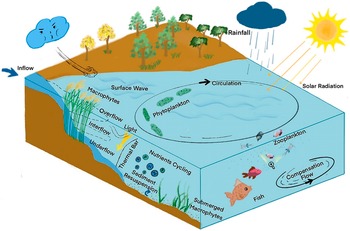
Wind forces affect the biodiversity of lakes directly or indirectly. The wind-driven hydrodynamic–water quality–ecological process of a shallow lake ecosystem is shown in Figure 2. Strong winds could remove attached algae to drive the succession of the epiphytic community and reduce biodiversity; then prostrate diatoms with strong adhesion will gain the advantage for growth (De et al., Reference De Faria, De and Marques2016, Reference De Faria, De and Marques2021). Wind-induced lake mixing could also redirect successional trajectory by changing the critical regulatory factors such as water temperature, light and nutrient availability, as well as the interactions between biotic and abiotic factors (Strock et al., Reference Strock, Saros, McGowan, Edlund and Engstrom2019). For example, changes in water temperature and light limitations directly impact the photosynthesis/respiration (P/R) ratio of primary producers and the metabolic rate and ratio of consumers to decomposers (Havens et al., Reference Havens, Beaver, Casamatta, East, James, Mccormick and Rodusky2011). Nitrogen-fixing algae (e.g., Alternaria) and Cyanobacteria tend to multiply in nitrogen-limited lakes (De et al., Reference De Faria, De and Marques2016). The diversity of phytoplankton may be higher at the mean wind speed of about 6 m s–1, which obeys the intermediate disturbance hypothesis (Cornell, 1978), while it could decrease with increased wind speed or a sudden fall in disturbance intensity and frequency (De et al., Reference De Faria, De and Marques2016, Reference De Faria, De and Marques2021). Some believe that the reduction of disturbance leads to competitive exclusion, thus reducing the abundance and diversity of the community to a minimum. In the food web, phytoplankton is a quality food resource for many consumers, which results in a potential response of aquatic biodiversity to wind disturbance. Studies have shown that the Copepods and Cladocerans follow large motile diatoms in abundance. The significant correlation between algae diversity and rotifer abundance indicates the bottom-up or top-down regulation of the food web (Agasild et al., Reference Agasild, Zingel, Karus, Kangro, Salujõe and Nõges2012). When wind waves and turbulence are strong, the loss of submerged vegetation and increased turbidity will reduce the efficiency of visually feeding fish. The contact frequency between zooplankton and its prey increases while the capture rate decreases (Pécseli et al., Reference Pécseli, Trulsen and Fiksen2014). Therefore, Copepods and other zooplankton avoid the risk of being preyed on by visible fish when the daytime light conditions are good (Seuront et al., Reference Seuront, Yamazaki and Souissi2004), and the biomass increases significantly.
Wind-driven hydrodynamic–water quality–ecological process of shallow lake ecosystems.

It should be noted that the understanding of wind-induced changes in lake ecosystems is still based on the monitoring results at present, while the understanding of the mechanisms of wind-induced disturbance affecting biodiversity directly or indirectly is relatively superficial, so the conclusions proposed by different teams are contradictory to each other. For example, Strock et al. (Reference Strock, Saros, McGowan, Edlund and Engstrom2019) believed that deepening the wind-induced mixed layer could increase the yield of diatoms, dinoflagellates, chrysophytes and other algae. Conversely, Bergeretal (Reference Berger, Diehl, Stibor, Trommer and Ruhenstroth2010) believed that the total yield of phytoplankton is not affected by the deepening of the mixed layer, while it could increase when the mixed layer becomes shallow. The disagreements could possibly address the possible effects on accurately predicting the impact of wind-induced lake mixed changes on aquatic food webs. Research on the wind-induced disturbance mechanism was still urgent.
Heterogeneous wind field variability
The wind field is rarely wholly uniform in the lake scale, but is considerably variable (Rueda et al., Reference Rueda, Schladow, Monismith and Stacey2005). The main external reasons for the spatial variability of wind field are the topography, the islands in the lake, the shielding effect of coastal buildings and trees, and the uneven roughness of the lake surface (Juntunen et al., Reference Juntunen, Ropponen, Shuku, Krogerus and Huttula2019). Besides, the variability also results from the varying wind force with the fetch. Although people gradually realize the influence of non-uniform wind fields on flow movements in lakes, there is little practical application of heterogeneous wind fields in lake models (Venäläinen et al., Reference Venäläinen, Sahlgren, Podsechin and Huttula2003). First of all, the reason lies in the lack of enough meteorological stations on the lake scale to represent the local wind field. The wind field over lakes is sometimes represented by the observations on the land shore when conditions for observability are limited. However, the wind field also has spatial heterogeneity between the land and the lake regions. The wind on lake surface is more robust than on land because of less surface friction (Li et al., Reference Li, Zhong, Bian and Heilman2010). Secondly, there is a lack of economical and effective methods to calculate local wind field in models (Juntunen et al., Reference Juntunen, Ropponen, Shuku, Krogerus and Huttula2019). Therefore, further efforts are expected to observe the local wind field with sufficient density, and studies are needed to determine the form of an heterogeneous wind field model.
Challenges for modeling
Following an extensive review of the responses of large shallow lakes to surface wind field, it is realized that not only the hydrodynamic process but also the water quality and aquatic process are continuously impacted by the wind, and the challenge remains to clarify the response mechanism through a process-based model. The development of wind and wind wave-dependent mathematical expressions imposed on the process-based model can be effective in improving hydrodynamic process modeling, and it is suggested that the expressions need to have high adaptability to different scenarios. In this regard, the burgeoning data-driven model (i.e., machine learning) is available to combine with the process-based model, making use of the data-driven model’s high computational efficiency and making up for its lack of physical mechanism (Castelletti et al., Reference Castelletti, Galelli, Restelli and Soncini-Sessa2012; Peach et al., Reference Peach, Silva, Cartwright and Strauss2023). Various efforts to derive a hybrid model have been carried out pointing out a promising direction for the promotion of models of water environments (Feng et al., Reference Feng, Liu, Lawson and Shen2022).
Open peer review
To view the open peer review materials for this article, please visit http://doi.org/10.1017/wat.2023.14.
Acknowledgements
We would like to express our gratitude to the Editors-in-Chief Professor Richard Fenner and Professor Dragan Savic, and the Scientific Editor Deborah Oluwasanya for inviting us to write a review article for Cambridge Prisms: Water. We also much appreciate Tong Chen for processing the concept diagram (Figure 2), and our colleagues for supporting the manuscript.
Data availability statement
The authors confirm that the data supporting the findings of this study are available within the article.
Author contribution
Study design, material analysis, and writing were the shared responsibilities of the authors.
Financial support
This research was supported by the National Natural Science Foundation of China (No. 52079089).
Competing interest
The authors declare none.



 Open access


Comments
Professor Richard Fenner & Dragan Savic MAR. 26, 2023
Editor in Chief, Cambridge Prisms: Water
Dear Editors:
Please consider our manuscript titled “A review of wind-driven hydrodynamics in large shallow lakes: Importance, process-based modeling and perspectives” for publication to Cambridge Prisms: Water. We are much appreciated to be invited to publish a review article for the journal at launch in May 2023 relevant to topic: Hydrodynamics. The hydrodynamic progress is the basis of the water quality and ecological progresses, especially, the surface wind field drives momentum and energy exchange at the air-water interface in large shallow lakes. In this paper, we review the response of the shallow lake to the wind-driven wave and flow field and summary the mathematical expression of the wind-driven force in the hydrodynamic model. In additional, the response of shallow lakes to extreme climates and potential impacts of wind turbulence on biodiversity are put forward prospectively. Our work could advance the application study of hydrodynamic models in large shallow lakes in a solution into practice focus.
No conflict of interest exits in the submission of this manuscript, and the manuscript is approved by all authors for publication. I would like to declare on behalf of my co-authors that the work described is original research that has not been published previously, and has not been under consideration for publication elsewhere, in whole or in part. All the authors listed have approved the manuscript that is enclosed.
The manuscript word count includes 3561 words (5262 words including REFERENCE, if the total words in the manuscript exceeds the requirements, please allow us to shorten words in revision) in text and two figures and one table. We also thank for the article publication charges are waived with the invitation.
Thank you very much for considering our paper for publication to Cambridge Prisms: Water.
Sincerely yours,
Chen Zhang, Professor, Tianjin University