

The second part of this book focusses on Pater’s engagement with a number of major English writers. Appreciations covers all post-medieval centuries, excluding only the ‘Augustan’ period about which Pater was rather less than enthusiastic (though he did design, and perhaps complete, an essay on Dr Johnson). Pater is not normally thought of as a leading Shakespearean, but unsurprisingly Shakespeare was central to his idea of English literature, and at one point he may possibly have planned a whole volume on him; he was also at least sympathetic to the idea of undertaking a commentary for schoolboy use on Romeo and Juliet, whose ‘flawless execution’ he commended (‘Measure for Measure’, App., 170). Typically he did not write about the most celebrated plays (his own favourites also included Hamlet), but instead chose for treatment ones less popular in his day: Love’s Labour’s Lost (perhaps because of its reflections on language and style), Measure for Measure (arguably the finest of his three essays, centrally concerned with the way a work of art can profitably engage with ethics), and Richard II (the main focus of ‘Shakespeare’s English Kings’, where Pater contributed to the idea of Richard as the ‘poet-king’ and added to the understanding of the deposition scene). Alex Wong examines all three essays in detail, and comments on the overall value and distinctive character of Pater’s view of Shakespeare.
Pater was part of a critical movement that gradually brought back into favour seventeenth-century writers of prose, neglected in the previous century. Kathryn Murphy explores Pater’s use of the word ‘quaint’ in ‘Sir Thomas Browne’ to examine the qualities in Browne’s prose that attracted him, despite any reservations he might have felt about a mode of writing that often fell short of classical precision. Through a careful reception history she shows that Pater develops the earlier positive estimates by Coleridge and Lamb, and anticipates the revaluation of the ‘metaphysical’ writers (so dubbed by Dr Johnson in critical vein) in the Modernist generation.
Pater was committed to stressing the importance across time of the ‘romantic’ tradition in English literary history, and included in Appreciations three essays on writers of the generation now generally described as Romantic. While Blake never became the subject of an essay, Pater refers to Blake on what is, for him, a quite unusual number of occasions, from the essay on Michelangelo (1871) onwards. This is doubtless partly because Blake is both a poet and a painter, and thus relevant to the issue of the relationship between the various arts discussed in ‘The School of Giorgione’, partly because Blake is a figure in some ways ‘out of his time’ or particularly relevant to other times (something that always fascinated Pater). Luisa Calè suggests that Pater’s interest may have been triggered by exhibitions in 1871 and 1876, at which he encountered Blake’s paintings The Spiritual Form of Pitt, of Nelson, and of Napoleon. It also seems likely that Pater’s interest throughout was fuelled by his still greater interest in the art and poetry of Rossetti, and in Pre-Raphaelitism and Aestheticism generally. Blake’s illustrations to Job were highly admired in these circles, especially ‘When the Morning Stars Sang Together’, mentioned by Pater more than once. Blake can readily be seen as a forerunner of Romanticism and of the Pre-Raphaelites, for example in his hostile annotations to Reynolds’s art theories, from which Pater quotes. Next Charles Mahoney demonstrates the ways in which Pater’s accounts of two of the great Romantic poets, Coleridge and Wordsworth, established new terms for their consideration (in Coleridge’s case in the context of his relative neglect; in Wordsworth’s, as an alternative to an already established pattern of reading his poetry), that in a number of important respects helped to evolve approaches that are still operative in our appraisal of their works. Of course Pater, like his contemporaries, did not use the designation ‘English Romantic poets’ in the current manner – for him Wordsworth and Coleridge were part of the ‘Lake School’ – but the word ‘romantic’ is used throughout the essay on Coleridge to characterise both the man and his work. In the last chapter on this group of writers Stacey McDowell explores Pater’s view that the writings of Lamb illustrate ‘the value of reserve’ in literature and examines what Pater meant by the term. Within the context of the Tractarian doctrine of reserve, Keble and Newman identify its poetic expression with verbal indeterminacy, indirectness, metaphor, and irony. By flaunting such qualities, Lamb’s openness becomes a form of deflection, his lightness valued in itself and for what it modestly conceals.
Finally, we come to the Victorians. Lewis R. Farnell, who was inspired by Pater’s lectures on Greek sculpture to become an archaeologist, records a dinner-party conversation in Oxford:
One of our best conversationalists was Walter Pater, who gave charming dinner-parties, where his talk had the delicate aroma of his writings, but with more ease and simplicity. … we were talking of the comparative merits of contemporary poets, Tennyson, Browning, Swinburne, Matthew Arnold and William Morris, each of whom had his champion, when Pater summed up with a gentle but emphatic decision that each of the others excelled Tennyson in some particular quality, but that generally and all round Tennyson excelled them all and would outlive them.
Characteristically Pater did not write about the acknowledged favourite (though he did review Arthur Symons’s book on the more controversial Browning). Instead, consonant with his especial interest in Pre-Raphaelitism and Aestheticism, he published essays on Morris and Rossetti (the latter not included in Farnell’s list, presumably because already dead). Marcus Waithe takes Pater’s engagement with Morris as a basis for thinking about his contribution to the development of English studies, exploring his evaluative criteria and methodology; what Pater values in Morris also envisions what he values in literature more generally. As a poet-painter, like Michelangelo and Blake, Rossetti was always a special point of reference for Pater; William Sharp recalls Pater describing him in 1880 as ‘the greatest man we have among us, in point of influence upon poetry, and perhaps painting’ (‘Reminiscences of Pater’, 1894, in Walter Pater: A Life Remembered, ed. R. M. Seiler, 81). Elizabeth Prettejohn argues not only that Pater’s densely intertextual essay plays a more important role in Pater’s overall critical project than previous scholars have recognised, but also that Pater’s treatment had a distinctive impact on the next generation of Modernist critics. Indeed, Pater’s essay may be most important for explaining to us a historical fact that may seem difficult to understand: the extraordinary influence of Rossetti on both painters and poets of his own and succeeding generations, an influence out of all proportion, some may think, to his actual achievement in either art form.
Besides the many scattered references that appear throughout his writing, Pater’s Shakespearean criticism is contained in three published essays, all finally included in Appreciations. At one time, however, they may have been intended for parts in a larger whole.
‘A Fragment on Measure for Measure’ was the earliest, printed in the Fortnightly Review in November 1874. Pater may have intimated that it was to be the first of several such pieces: that very month, the ‘Notes and News’ section of the Academy reported that he meant ‘to continue his short aesthetic studies of Shakspere’s plays’, building up a ‘series that will some day make a book’. A note in December added: ‘we understand that Mr Pater’s next Shakespeare “study” for the Fortnightly Review will be on Love’s Labour’s Lost’.1 But the essay ‘On Love’s Labours Lost’ did not appear in print until December 1885, almost exactly eleven years later, and not, as promised, in the Fortnightly, but in Macmillan’s Magazine.
A brief letter survives from Pater to the scholar F.J. Furnivall (1825–1910), founder in 1873 of the ‘New Shakspere Society’. It is dated only ‘May 18’. ‘I should like much to edit a play of Shakspere, e.g. Romeo and Juliet, for schoolboys,’ Pater writes, ostensibly replying to an invitation from his correspondent, ‘but see no prospect of my having time to do so for a long while to come, so must deny myself the pleasure of saying and fancying that I will do so.’2 He also remarks that he has ‘not yet had time to read over again [his] notes on L.L.L.’. Lawrence Evans plausibly dates the letter to 1875, supposing that Furnivall had been prompted to write to Pater by the Measure essay and the notes in the Academy. If this is correct, then Furnivall was kept waiting three years for the piece on Love’s Labour’s Lost: Society records indicate that a paper of Pater’s on that play, probably an early version of the essay, was read (we do not know by whom) at a meeting on 13 April 1878. Six months later, apparently willing to give up the idea of a whole book on Shakespeare, we find Pater listing both of the then completed essays in a list of proposed contents for a book, pitched to Macmillan, to be called The School of Giorgione, and Other Studies.3 That book never came into being, but neither was any notion of a Shakespeare volume ever practically revived. Pater sat on his study of Love’s Labour’s Lost for seven more years before seeing it into print, and the third of his Shakespeare essays, ‘Shakespeare’s English Kings’, did not appear until April 1889 in Scribner’s Magazine, not long before its inclusion in Appreciations in the following November.4
The three plays to which Pater substantially attended were relatively unpopular in his own day, and rarely if ever performed. Richard II, the main focus of ‘Shakespeare’s English Kings’, he had seen as a schoolboy, after which it was not performed again in commercial English theatres until after Pater’s death. Measure he could never have seen professionally performed before writing about it, though a production was mounted at the Haymarket Theatre in April 1876, the sole London production in Pater’s adult life. Having missed it, presumably, at Sadler’s Wells in 1857, he could not have seen Love’s Labour’s Lost acted either.5 As Adrian Poole notes, Pater ‘fastened on plays that had been caviar to the general’.6 Not only to the ‘general’, theatre-going public, however, but also to most critics of his own day and of preceding decades. Measure had been branded ‘painful’ by Coleridge, and Swinburne speaks of ‘the relative disfavour’ in which the play had ‘doubtless been at all times generally held’.7 Richard II, though the Romantic critics brought some new appreciation, had been relatively neglected since the early seventeenth century, save for some periods in which current affairs reactivated its political valency. Love’s Labour’s Lost, meanwhile, had more consistently been regarded as Shakespeare’s first and worst play. Pater’s appreciations were supplied where they were needed.
Measure for Measure
Of the three essays, the study of Measure for Measure has had the least effect on later Shakespearean criticism. It is, however, the most obviously revealing of Pater’s own values. His reading of the play is unusual, turning the familiar moral complaints of most other nineteenth-century critics virtually inside out. Coleridge’s famous objections to Measure, for example, with which many have concurred, are squarely moral. He finds the comedic aspects of the play ‘disgusting’ and the tragic aspects ‘horrible’, but really it is the play’s ending that makes it so obnoxious to him, for ‘the pardon and marriage of Angelo not merely baffles the strong indignant claim of justice’ but is furthermore ‘degrading to the character of woman’.8 Swinburne, writing a little later than Pater’s essay, pays more attention to the aesthetic character of the play, but considers its merits essentially tragic, and so returns to an ethical criterion: the ‘evasion of a tragic end’ is ‘ingenious’ in its management, but unworthy of Shakespeare ‘in a moral sense’.9 Yet for Pater, Measure for Measure is ‘an epitome of Shakespeare’s moral judgments’:
The action of the play, like the action of life itself for the keener observer, develops in us the conception of this poetical justice, and the yearning to realise it, the true justice of which Angelo knows nothing, because it lies for the most part beyond the limits of any acknowledged law. The idea of justice involves the idea of rights. But at bottom rights are equivalent to that which really is, to facts; and the recognition of his rights therefore, the justice he requires of our hands, or our thoughts, is the recognition of that which the person, in his inmost nature, really is; and as sympathy alone can discover that which really is in matters of feeling and thought, true justice is in its essence a finer knowledge through love. … It is for this finer justice, a justice based on a more delicate appreciation of the true conditions of men and things, a true respect of persons in our estimate of actions, that the people in Measure for Measure cry out as they pass before us …
Poetical justice is ‘true justice’, truer than the law’s inflexible approximations. It has for its objects the facts of human lives and selves, ‘that which really is’ – the facts that must be found out through sympathy; a knowledge that comes from love, which, to those who can apprehend it, confers ‘rights’ which are ethically imperative. It has to do with a ‘finer’ estimate of reality – ‘life itself’ – and not only reality as simulated by a work of poetic creation.
But the ethical appeal of a play like Measure is reliant on its being, to sensitive minds, ‘like the action of life itself’ – more like reality than a simpler or more reductively moralistic play might be. And, as Pater will confirm with his passionate final sentence, it may be that the moral exercise of attending keenly to such works of literature can make us keener observers in the real world too, perhaps not only through the simulation of moral situations, but through the discriminating activities of mind always required and rewarded by poetry, in which intellectual understanding of subtle language is connected naturally to feelings and values:
It is not always that poetry can be the exponent of morality; but it is this aspect of morals which it represents most naturally, for this true justice is dependent on just those finer appreciations which poetry cultivates in us the power of making, those peculiar valuations of action and its effect which poetry actually requires.
‘Actually’, the penultimate word in the essay, has the effect here of dissolving the boundary between reading and reality. Poetry and the actual world may not be identical, but poetry is part of our actual lives and ‘actually’, really, makes demands upon us, which in turn may modify our habits of mind and conduct. The ‘finer appreciations’ which the reader or critic of poetry is called upon to make are offered as the basis for true justice beyond the limits of literature. It is fitting that the essay finally found a place in a volume called Appreciations. The kind of criticism Pater writes is ‘appreciative’, and, while the word implies evaluation, and could in one sense be glossed as the setting of prices on things, Pater is particularly in the habit of raising, not lowering, the accepted price. Taking another etymological route, we might think of his appreciations as contributions towards the ‘prizing’ of things of value, often things undervalued or ignored by others but for which he feels a special affinity or sympathy. In this sense it is a process of ‘finer knowledge through love’.
This theme of taking care over what others neglect is obliquely suggested in Pater’s striking choice of illustrative quotation:
Earlier, Pater has said that ‘it is Isabella with her grand imaginative diction … who gives utterance to the equity, the finer judgments of the piece on men and things’; she is one of the women in Shakespeare whose ‘intuitions interpret that which is often too hard or fine for manlier reason’ (179; emphasis added). But these lines on the jewel, the ones he actually quotes, are spoken not by the virtuous Isabella, nor by the philosophical Duke, but by Angelo, the play’s chief villain. Inclining to be rigid in exercising legal justice in the case of Claudio (held guilty of pre-nuptial fornication), he has just been advised by Escalus to consider whether he himself, Angelo –
– might not by some imaginable chance have ‘erred’ in a like manner. What Escalus puts to Angelo is an ethical urging of the very point Pater stresses in various parts of the essay: his conviction that Shakespeare ‘inspires in us the sense of a strong tyranny of nature and circumstance’, the tyranny of chance ‘over human action’ (174, 180). In fact, those lines from Escalus, which he does not otherwise quote, Pater echoes closely in his own elaboration of the point, taking the character of Angelo as his example:
The bloodless, impassible temperament does but wait for its opportunity, for the almost accidental coherence of time with place, and place with wishing, to annul its long and patient discipline, and become in a moment the very opposite of that which under ordinary conditions it seemed to be, even to itself.
The unusual use of ‘coherence’ helps to mark the echo. But Angelo’s own airing of the jewel metaphor, which Pater does quote – though without reminding us of the context or the speaker – is all the more powerful in Pater’s hands for being an ironic reflection on that very ‘tyranny’ of chance. Angelo replies to Escalus by emphasising the difference between temptation and the actual commission of ‘error’: no simple distinction in cases such as his own will turn out to be, though he little suspects it at this moment. He acknowledges that the jurors may well be guiltier than Claudio, but sees this as no impediment. ‘What’s open made to justice, / That justice seizes’ (II.1.21–22). The lines about the jewel, almost immediately following this, are meant to convince Escalus that it’s no use worrying about the jewels, or the crimes, you can’t see: what is obvious is what one has to deal with, even if it becomes obvious only by chance. When Pater repurposes the lines, they become – with an ironic edge for those who recall the context – a moving exhortation, without exhorting, to look for the unnoticed jewels trodden underfoot: to ‘see’ more, and so ‘tread’ more carefully. Angelo subverts the essential, commonplace meaning of the lines, by making jewels stand for crimes; but in restoring Angelo’s chosen maxim (for it is produced as a piece of conventional wisdom) to something closer to its basic sense, Pater has allowed it to retain the dramatic irony it has accrued through Angelo’s use of it, and through its applicability to his later actions and experience in the plot. The sentiment is given a renewed humaneness, not only by its having been sullied by Angelo first, but by the breadth of moral meaning which Pater’s whole interpretation of the play gives to it.
In its ‘finer’ details, that interpretation is Pater’s; but it has one important forerunner and inspiration in Hazlitt’s book, The Characters of Shakespear’s Plays (1817). In the first place, several critics and surely many readers have been struck by the prominence given by Pater to the character of Claudio, and his claim that ‘the main interest in Measure for Measure is not … in the relation of Isabella and Angelo, but rather in the relation of Claudio and Isabella’ (177). But this is where Hazlitt also fixed his focus, calling the scene in which Isabella visits her condemned brother in his cell ‘one of the most dramatic passages’ in the play, and then quoting from it extensively.10 It is on just that exchange between brother and sister that Pater focuses his own attention. As with Angelo, he is exercised by the way in which, under the stress of unexpected circumstance, each character’s nature is revealed in a new way. Isabella, a ‘cold, chastened personality’, is exposed in the drama to ‘two sharp, shameful trials’ which ‘wring out of her a fiery, revealing eloquence’ (177–8) – and this is the second of those trials. She becomes ‘the ground of strong, contending passions’, undergoing a ‘tigerlike changefulness of feeling’; her angry indignation at Claudio’s apparent willingness to sacrifice her honour (perhaps her soul) in order to live, leaves her ‘stripped in a moment of all convention’, revealing her in a new light, or atmosphere – ‘clear, detached, columnar’ (178). But, as in Hazlitt, it is the offending eloquence wrung out of Claudio in the same scene that strikes Pater most forcefully.
Called upon suddenly to encounter his fate, looking with keen and resolute profile straight before him, he gives utterance to some of the central truths of human feeling, the sincere, concentrated expression of the recoiling flesh. Thoughts as profound and poetical as Hamlet’s arise in him; and but for the accidental arrest of sentence he would descend into the dust, a mere gilded, idle flower of youth indeed, but with what are perhaps the most eloquent of all Shakespeare’s words upon his lips.
Adrian Poole has paid tribute to Pater’s ‘deep feeling’, in this essay, ‘for the force of words that can take us by surprise, for better or worse, revealing capacities in us we did not know we had and the absence of others we supposed that we did’.11
But Pater’s closeness to Hazlitt goes further than this. Like Pater, Hazlitt too rises from specific criticisms of Measure to broader comments on the moral significance of Shakespeare’s work. ‘In one sense,’ Hazlitt says, ‘Shakespear was no moralist at all: in another, he was the greatest of all moralists.’ That what he provides to us is ‘like the action of life itself for the keener observer’, and thus able, as Pater thought, to develop in us a ‘finer’ sense of justice, is implied by Hazlitt’s comment that Shakespeare was ‘a moralist in the same sense in which nature is one’. Unlike the ‘pedantic moralist’, he does not seek out ‘the bad in every thing’, but the opposite: his talent, according to Hazlitt, ‘consisted in sympathy with human nature, in all its shapes, degrees, depressions, and elevations’.12 Pater’s emphasis on ‘sympathy’ seems clearly indebted to Hazlitt’s memorable chapter on the same play, though it is also highly characteristic of himself. Inman makes a telling comparison when she notes that the argument here about Shakespeare recalls Pater’s earlier essay on Botticelli: ‘His morality is all sympathy’ (Ren., 43).13
Strangely enough, before arriving at his formulation of Shakespearean ‘sympathy’, Hazlitt has already, in the same brief chapter, made the seemingly contradictory point that in this particular play there is ‘a general system of cross-purposes between the feelings of the different characters and the sympathy of the reader or the audience’. ‘Our sympathies’, he says, ‘are repulsed and defeated in all directions.’14 How, then, does a consideration of this play, which he seems to find defective in the very quality for which he lauds Shakespeare as a moralist in general, lead Hazlitt shortly into those grand statements about Shakespeare’s sympathetic morality? In fact, he arrives there by way of a discussion of the minor ‘low’ characters – Barnardine, Lucio, Pompey, Master Froth, Abhorson. He thinks Schlegel too ‘severe’ on such characters in calling them ‘wretches’; Shakespeare himself does not look at them with such contempt.15 Pater will be still more apologetic, and he sympathises with them all the more because they do so with one another:
The slightest of them is at least not ill-natured: the meanest of them can put forth a plea for existence—Truly, sir, I am a poor fellow that would live!— … they are capable of many friendships and of a true dignity in danger, giving each other a sympathetic, if transitory, regret—one sorry that another ‘should be foolishly lost at a game of tick-tack.’
For him too the ‘low’ characters are important to a moral reading of the play, but he brings them into closer proximity to at least some of the major characters (and their weaknesses), and so for him the Shakespearean sympathy is not limited to the peripheries of the drama but extended to its whole purview. They belong to the ‘group of persons’ powerfully portrayed by Pater as ‘attractive, full of desire, vessels of the genial, seed-bearing powers of nature, a gaudy existence flowering out over the old court and city of Vienna, a spectacle of the fulness and pride of life which to some may seem to touch the verge of wantonness’ (173–4). Pater is ‘pleasantly unshocked’, says Poole, suggestively, ‘by the seedier aspects’ of the play.16 Seedy or, as Pater has it, seed-bearing. He places himself on the side of ‘life’. It is Claudio’s horror of death that seems to move him most. The ‘low-life’ characters are united with Claudio in their vitality – not only their ‘vivid reality’ (174), but their earthiness and alliance with what is generative and vibrant in human experience, even unto the ‘verge of wantonness’. They are among ‘the children of this world’, though not among ‘the wisest’.17
As Mark Hollingsworth simply puts it, ‘Pater has found a moral in Shakespeare’s play—but it is not a moral of which certain of his contemporaries would approve’.18 Largely avoiding the main ethical cruces of the plot – totally neglecting, above all, to make any explicit comment on its ending – Pater’s reading relies on an appreciation of Shakespeare’s treatment of the material as being true to life in its multiplicity: not only in the moral implications of the action itself, but through the presentation of characters, the sentiments put into their mouths, the seeming gratuitousness of small details. Though, via its source in Whetstone, the play inherits some evolved qualities of the older morality plays, it achieves its moral significance by implicitly denying the validity of that tradition’s didactic clarity:
The old ‘moralities’ exemplified most often some rough-and-ready lesson. Here the very intricacy and subtlety of the moral world itself, the difficulty of seizing the true relations of so complex a material, the difficulty of just judgment, of judgment that shall not be unjust, are the lessons conveyed.
In the words of Philip Davis, the Victorian period was ‘full of commentators anxiously concerned about the work of Shakespeare being no more than (as it were) the world all over again, lacking an extrapolatable morality or an external philosophy that could give extra meaning to the universe’.19 These are the commentators who might have been less willing to ‘approve’, as Hollingsworth says, of Pater’s interpretation. Arnold is one of the chief critics of the period who are troubled by Shakespeare’s putative lack of interest in committing to a distinct governing conception to which details are subservient, and the antagonism between his and Pater’s approaches to Shakespeare has been helpfully emphasised by Poole.20 But Pater was far from alone in adhering to a rather different tradition, reaching back into the prehistory of Romanticism: the vision of Shakespeare as specially endowed to recreate reality itself. He was ‘Nature’s darling’, as Gray had famously called him, to whom ‘the mighty Mother did unveil / Her awful face’, conferring upon him the pencil to ‘paint’, like her, the natural world, and the ‘golden keys’ to open human experience: joy, horror, fears – and ‘sympathetic tears’.21 Hazlitt is invoking the same notion in his notes on Measure when he calls Shakespeare ‘a moralist in the same sense in which nature is one’, adding, in a movement not unlike Gray’s: ‘He taught what he had learnt from her. He shewed the greatest knowledge of humanity with the greatest fellow-feeling for it.’22 From this to ‘finer knowledge through love’ is a small but Paterian step.
For Pater, Shakespeare’s moral intelligence is that of an ‘observer’, a ‘spectator’, who ‘knows how the threads in the design before him hold together under the surface’, in hidden complexities or complications. He is also a ‘humourist’, ‘who follows with a half-amused but always pitiful sympathy, the various ways of human disposition, and sees less distance than ordinary men between what are called respectively great and little things’ (184). These terms, taken from the final paragraph of the essay, are very similar to those in which he will later describe and celebrate Montaigne, and indeed the connection between the two writers is explicitly made: ‘Shakespeare, who represents the free spirit of the Renaissance moulding the drama, hints, by his well-known preoccupation with Montaigne’s writings, that just there was the philosophic counterpart to the fulness and impartiality of his own artistic reception of the experience of life’ (Gast., 83, ch. 4; CW, iv. 80). Again what is stressed is a fullness of receptivity to reality as experienced. Thinking of Montaigne brings Pater close, again and again, to his thoughts on Measure. When he speaks of Montaigne’s apprehension of ‘the variableness, the complexity, the miraculous surprises of man, concurrent with the variety, the complexity, the surprises of nature, making all true knowledge of either wholly relative and provisional’, we are reminded of the interplay of nature and circumstance, the tyranny of their chance ‘coherence’, that he sees in Shakespeare: ‘coherent’, borrowed from Escalus, becomes ‘concurrent’ (89; CW, iv. 83). A few pages later, another version of the same thought, and two more Latinate words in substitution: here we have the ‘collision or coincidence, of the mechanic succession of things with men’s volition’ (Gast., 101, ch. 5: CW, iv. 90). Montaigne, like Shakespeare, has ‘many curious moral variations’ to show us, unsettling easy judgements on human conduct (94; CW, iv. 86).
But for the reader of Appreciations, the closing paragraphs on Measure are most likely to recall Pater’s study of Charles Lamb, placed earlier in the same volume. Shakespeare’s ‘half-amused but always pitiful sympathy’ (‘Measure’, App., 184) is that of the ‘humourist’, a type exemplified in Pater’s work most obviously by Lamb. In both writers, the ‘laughter which blends with tears’, humour as distinguished from wit, proceeds from a ‘deeply stirred soul of sympathy’ (‘Charles Lamb’, App., 105). The latter phrase is applied to Shakespeare, but ‘a sort of boundless sympathy’ belongs also to Lamb (110). He too attends closely to life’s ‘organic wholeness, as extending even to the least things in it’ (116). He ‘can write of death, almost like Shakespeare’ (120). And perhaps Pater is thinking in part of Elia’s love for life and ‘recoil’, like that of Claudio, from death. Both are genial natures who find they must, in Elia’s phrase, ‘reluct at the inevitable course of destiny’.23
Love’s Labours Lost
The humour of Lamb finds interest and significance, not mere trivialising or scoffing mirth, in ‘fashions’, ‘tricks’, and ‘habits’, the trappings and ephemera of a time and place – including one’s own, which the humourist can see with an uncommon ‘understanding’, amounting to a ‘refined, purged sort of vision’. The humourist sees any instance of such ‘outward mode or fashion, always in strict connexion with the spiritual condition which determined it’ (‘Lamb’, App., 114–15). It is in similar terms, and from the same perspective, that Pater was able in his study of Love’s Labours Lost [sic] to make an important defence of one of Shakespeare’s least popular works. ‘Shakespeare brings a serious effect’, he says, ‘out of the trifling of his characters’ (App., 161–2). Reminding us of the theoretical distinction with which he had opened his essay on Lamb, Pater tells us that the play contains ‘choice illustrations of both wit and humour’ (161); but the implication of the essay as a whole, especially in the light of the essays on Lamb and Measure, appears to be that the ‘wit’ is part of the material with which the ‘humour’ is dealing. Pater asks us to see the wit not, as earlier critics had done, as a youthful author’s fashionable vice in an age of witty conceit and modish artificialities, but as an object we are to regard through the essential humour of the treatment.
Modern critics and editors of Love’s Labour’s Lost, in contrast with those of Measure, have been much readier to recognise Pater’s importance in the critical tradition. The play’s unmistakable ‘foppery’ of language, as Pater calls it, had seemed off-putting to most of its earlier critics, as well as to theatre companies. His essay is an early and innovative insistence that a concern with style and ‘euphuism’, with fashions and modes, was a sophisticated and self-conscious theme in the play; and this is an idea that most later critics have taken for granted. One recent editor comments that Pater, exceptionally before the 1920s, ‘does justice’ to the play’s ‘curious foppery of language’ and also to Shakespeare’s own ‘ambivalent attitude towards it’.24 Most others, in going over the reception of the play, have felt at least the obligation to register in a passing mention Pater’s voice in the wilderness.
For Pater it is the humourist’s peculiar gift to be able to see the modes of contemporary life, including its small details and fribbling aspects, with something of the vision that hindsight will later give to others (‘Lamb’, App., 114–16). Shakespeare, in Pater’s view, was actively reflecting on current and recent literary styles, including his own. His true subject was ‘that old euphuism of the Elizabethan age’,25 –
that pride of dainty language and curious expression, which it is very easy to ridicule, which often made itself ridiculous, but which had below it a real sense of fitness and nicety; and which, as we see in this very play, and still more clearly in the Sonnets, had some fascination for the young Shakespeare himself. It is this foppery of delicate language, this fashionable plaything of his time, with which Shakespeare is occupied in Love’s Labours Lost.
‘Play is often that about which people are most serious’, Pater says, ‘and the humourist may observe how, under all love of playthings, there is almost always hidden an appreciation of something really engaging and delightful’ (164). Shakespeare can show this, and we ought to be engaged, delighted – to appreciate the appreciation. Pater himself, whether a humourist or not, is certainly a literary aesthete willing to give hints of his own predilection for this ‘foppery’ of language, which ‘satisfies a real instinct in our minds—the fancy so many of us have for an exquisite and curious skill in the use of words’ (166).
John Kerrigan is unusual among the more recent editors in his having taken Pater’s ‘magnificent but flawed essay’ seriously enough as to argue with it. In identifying the theme of linguistic foppery and showing how the play displays it to us in various degrees of ‘sophistication’, Pater was the first ‘to unite’, in Kerrigan’s words, ‘the high and low’, the courtiers and the commoners, explaining the ‘dramatic function’ of the latter and bringing into focus an overarching thematic cohesion. ‘In one sense’, Kerrigan judges, ‘Pater did not go far enough, though in another he went too far’. If Pater had focused less exclusively on the language theme, he might have found other things to say. ‘He overestimated the unifying power of the language theme, because he was unresponsive to the other integuments which hold the play together. Sex, for instance.’ (Unresponsive or not, it is true that Pater has nothing to say on the sexual themes or their structural import.) On the other hand, Kerrigan argues, had he thought further about the language theme, he might have been led to recognise the centrality of another theme: ‘fame’, the prize at which all the fancified talking is aimed, and a ‘more radical and inclusive principle of unity’ than the one Pater identified. The vow of studious homosocial retirement from the world (and especially from female company) made by the King and his male companions at the start of the play was not, in Kerrigan’s view, acknowledged by Pater as ‘both the lynch-pin of the action and a recurring centre of dramatic interest’. To Kerrigan it is clear that the oath belongs with the vulgar or extravagant language of the ‘low characters’, sharing with them the purpose of attracting admiration.26 What seems to be suggested here is that Pater’s silence on the theme of ‘fame’ is at least in part the consequence of a lack of interest in the sequence of events and their dramatic handling.
In one of Anne Barton’s very early essays, Pater serves as a point of reference in another discussion of the play’s ‘unity’. His ‘beautiful’ essay on ‘Shakespeare’s English Kings’ provides her with a useful maxim: ‘into the unity of a choric song the perfect drama ever tends to return, its intellectual scope deepened, complicated, enlarged, but still with an unmistakable singleness, or identity, in its impression on the mind’ (App., 203–4). In her opinion, such a unity is ‘evident throughout’ Love’s Labour’s Lost, in spite of Pater’s remarks (which she also quotes) about its composition into ‘pictorial groups’:
The grouping of the characters into scenes would appear, however, to have been dictated by a purpose far more serious than the mere creation of such patterns; it is one of the ways in which Shakespeare maintains the balance of the play world between the artificial and the real, and indicates the final outcome of the comedy.27
She disagrees with Pater’s evaluation of the dramatic cohesion of Love’s Labour’s Lost by insisting that his more general comments elsewhere should be held relevant here too. She defends the play as drama by using Pater against himself. But the essay’s debts to Pater go far beyond the explicit discussion of him. ‘Often, beneath ornament and convention the Elizabethans disguised genuine emotion’, she writes, reminding us of Pater’s own defence.28 ‘Mannered and artificial, reflecting an Elizabethan delight in patterned and intricate language, Navarre’s lines at the beginning of the play are nevertheless curiously urgent and intense’: the diction, even the syntax could not be more Pateresque, but these are Barton’s words; and it is so again when she talks of the song of the Owl and the Cuckoo from the play’s end, ‘a song into which the whole of that now-vanished world of Love’s Labour’s Lost seems to have passed, its brilliance, its strange mingling of the artificial and the real, its loveliness and laughter gathered together for the last time to speak to us in the form of a single strain of music’.29 Slight touches recall some of Pater’s most famous passages: the beauty of Leonardo’s Mona Lisa, ‘into which the soul with all its maladies has passed’ (Ren., 98); the ‘strange dyes, strange colours’ and human ‘brilliancy’ of the ‘Conclusion’ (Ren., 189). The phrase ‘a single strain of music’ appears verbatim in ‘Shakespeare’s English Kings’ (App., 203).
It is a Paterian conception of ‘Renaissance’ that Barton evokes, too, even as she reveals what Pater leaves out of his own discussion of the play. The academic oath springs ‘from a recognition of the tragic brevity and impermanence of life that is peculiarly Renaissance’, she says, grazing Pater’s own phrase, ‘awful brevity’, in the ‘Conclusion’ (Ren., 189). She connects the humanist cult of ‘fame’ with the fact that, as she puts it (or Pater might have put it himself), ‘the thought of Death was acquiring a new poignancy in its contrast with man’s increasing sense of the value and loveliness of life in this world’. And if the other primary theme left out in Pater’s study is sex, this train of thought leads there as well. The oath, an ‘elaborate scheme which intends to enhance life, … would in reality, if successfully carried out, result in the limitation of life and, ultimately, in its complete denial’.30 It is partly because Barton’s critical idiom is in such close contact with Pater’s at this point that she allows us to see what may be behind Pater’s tight-lipped comment that the votaries are ‘of course soon forsworn’ (164), and how it might connect with his view of the ‘genial, seed-bearing’ vitality of Claudio and the ‘low’ characters in Measure, ranged on the side of life and worldly experience. The oath and the King’s judicial strictures, like Angelo’s in Measure, represent a misguided attempt to keep life at bay.
Another striking aspect of Pater’s reading of this play is his overwhelming preoccupation with the character of Biron (Berowne). He is the ‘perfect flower’ of that foppery in which Pater would like us, with Shakespeare, to see the ‘really delightful side’ and hidden depths. In him such a manner, which is merely ‘affected’ in others, ‘refines itself … into the expression of a nature truly and inwardly bent upon a form of delicate perfection’; the outward fashion ‘blends with a true gallantry of nature and an affectionate complaisance and grace’ (166). He sees things clearly, is sensitive to the feelings and conduct of social intercourse, and – as the ‘Conclusion’ to The Renaissance seems to persuade us to do – he trusts more in ‘actual sensation’ than in ‘men’s affected theories’. He ‘delights in his own rapidity of intuition’, such as ‘could come only from a deep experience and power of observation’ (167). The passage in which his qualities are described reads at times like an apologia, and Biron seems to have many of the ideal qualities of the Paterian aesthetic critic.
‘Power of observation’ is not the endowment only of the critic, but also of the ‘humourist’, and so of Shakespeare himself – an ‘observer’ and ‘spectator’ of life (‘Measure’, App., 184). Implied there is a quality of detachment. In the final sentence of the Love’s Labours Lost essay we are presented with a Biron who, though peculiarly sensitive and intelligent, is ‘never quite in touch, never quite on a perfect level of understanding, with the other persons of the play’ (169). This, together with another brief passage a little earlier, is as close as Pater comes to grappling with the more rebarbative qualities that modern critics have been much readier to see in Biron, a cynical, embittered character taken unawares by his depth of feeling. Yes, ‘that gloss of dainty language is a second nature with him: even at his best he is not without a certain artifice’ (167); but one might have expected Pater to go further, to show the glossy, defensive, and deflective reliance on tricks of ‘wit’ as a kind of irony or ‘reserve’, such as he identifies in Lamb. Shakespeare, ‘in whose own genius there is an element of this very quality’, is a sympathetic painter of it, and the essay all but overtly invites us to infer that Pater, in his emphasis on Biron, is also displaying a natural sympathy (168). He was known as a defensive, provocative conversationalist himself. Here, as in the essay on Lamb and the Montaigne chapters of Gaston de Latour, he takes it for granted that there is ‘something of self-portraiture’ in Shakespeare’s Biron, ‘as happens with every true dramatist’ (168) – but also, as in the case of Lamb and Montaigne, with the essayist.
Shakespeare’s English Kings
Biron is a figure with ‘that winning attractiveness which’, Pater says, perhaps betraying another aspect of what seems throughout a delicate and speculative identification with him, ‘there is no man but would willingly exercise’ (168). He has gallantry and grace; he is ‘the flower’ of the play’s precious euphuism (166). Claudio, in the Measure essay, was a ‘flowerlike young man’, ‘a mere gilded, idle flower of youth’, raised, in his revolt from death, to a height of Shakespearean eloquence (180–1). Both are attractive young men to whom floral imagery is applied. In ‘Shakespeare’s English Kings’ we find Pater again exercised particularly by a winning and flowerlike young man, Richard II, ‘that sweet lovely rose’ (App., 189, quoting Hotspur’s line in 1 Henry 4, I.3.175). In Richard’s case there is more overt and sustained emphasis on his personal beauty, ‘that physical charm which all confessed’, and on his attractive ‘suavity of manners’ (197, 194). He is ‘graceful’, ‘amiable’ – possessed of ‘those real amiabilities that made people forget the darker touches of his character’ (195). Richard’s ‘fatal beauty, of which he was so frankly aware’, and which Pater thinks Shakespeare has dwelt upon with particular attentiveness (194), is potent in its effect:
it was by way of proof that his end had been a natural one that, stifling a real fear of the face, the face of Richard, on men’s minds, with the added pleading now of all dead faces, Henry [Bolingbroke] exposed the corpse to general view; and Shakespeare, in bringing it on the stage, in the last scene of his play, does but follow out the motive with which he has emphasised Richard’s physical beauty all through it—that ‘most beauteous inn,’ as the Queen says quaintly, meeting him on the way to death—residence, then soon to be deserted, of that wayward, frenzied, but withal so affectionate soul.
‘Affectionate’, like Biron. Readings of Richard’s character have rarely been so affectionate.
Richard II had been a set text in Pater’s school days, forming part of the Sixth Form examination in July 1858.31 At his school’s Speech Day in the same year, the part of Richard in an extract from the play was played by Pater’s close friend Henry Dombrain, with whom Pater and a third friend, John Rainier McQueen, had a year earlier at the same event performed a scene from Henry IV, Part I – Pater playing Hotspur, and very probably speaking the line about the old King Richard as a ‘sweet lovely rose’.32 Unlike the other plays, moreover, Richard II is one Pater had seen professionally performed. It was in the same year, 1858, that he saw Charles Kean’s magnificent production at the Princess’s Theatre, an experience he recalls evocatively in the essay, three decades later. ‘In the hands of Kean the play became like an exquisite performance on the violin’ (195).
In Pater’s reading, Richard is an aesthete, a poet by nature, who happens to be a king. Shakespeare’s English Kings are ‘a very eloquent company’, Pater says, ‘and Richard is the most sweet-tongued of them all’ – ‘an exquisite poet if he is nothing else, from first to last, in light and gloom alike, able to see all things poetically, to give a poetic turn to his conduct of them’ (194). He is the spin-doctor of his own downfall, even if, in the final analysis, the spin is mainly for his own benefit. But, just as Kean’s performance could resemble an ‘exquisite performance on the violin’, so Richard’s performance of himself, as he ‘throws himself into the part’ that Fate and his enemies have assigned him, and so ‘falls gracefully as on the world’s stage’ (198), is compared with wordless music: ‘As in some sweet anthem of Handel, the sufferer, who put finger to the organ under the utmost pressure of mental conflict, extracts a kind of peace at last from the mere skill with which he sets his distress to music’ (200). This is not only the comfort of poetry as reinterpretation, poetry as rhetoric; it implies the comfort of the aesthetic more narrowly defined, of aesthetic form in itself as soothing, or perhaps of the capacity of verbal artistry to accommodate one to circumstance by enacting, through a beautified and rhetorically controlled and contrived speech, the nature, as speaker, of a role with which one must identify: the role made acceptable through the fashioning of the speech which delineates it, imaginatively, creatively, in a way to which one can adjust one’s own sense of self. In Pater’s words, Richard in his ordeal ‘experiences something of the royal prerogative of poetry to obscure, or at least to attune and soften men’s griefs’ (200). Poetry can console by reinterpreting circumstance, by obscuring certain facts, which might amount to a softening of grief; but it can also soften by attuning the feelings. Attunement, as accommodation, may be of self to circumstance, as in Richard’s poignantly self-indulgent speech about ‘worms and graves and epitaphs’ (III.2.144–77). But attunement is more than accommodation; it suggests harmony as judged by aesthetic instinct.
Pater’s essay instigated what might be called the ‘aesthetic’ reading of the play, associated later with C.E. Montague and W.B. Yeats.33 The aesthetic approach was vigorously repudiated by Edward Dowden and others of a more ‘moralistic’ persuasion, who ‘tended to stress Richard’s contemptible weakness and want of virility’.34 Yeats pleaded for Richard’s ‘fine temperament’ and ‘contemplative’ nature, calling him ‘an unripened Hamlet’: ‘I cannot believe that Shakespeare looked on his Richard II. with any but sympathetic eyes, understanding indeed how ill-fitted he was to be King, at a certain moment of history, but understanding that he was lovable and full of capricious fancy, “a wild creature” as Pater has called him.’35 Denis Donoghue frames matters in a more politicised way when he writes that ‘Pater started a little fashion of saying that Shakespeare’s imagination was ashamed of its duty’ – the duty, that is, of legitimising and celebrating the Tudor dynasty and its antecedents – ‘and insisted on giving the defeated kings the most touching lines’.36
A.C. Bradley, whose influence on twentieth-century Shakespearean criticism and pedagogy was perhaps pre-eminent, offers a middle-ground reading of Richard. In a lecture given in 1904 he classes him among those, like Romeo and Orsino, of an ‘imaginative nature’, but draws attention also to the ‘weakness’ inherent in such natures.37 Like Pater, and Hazlitt before him, Bradley was particularly responsive to, and has sometimes been held accountable for others’ overemphasis upon, subtleties of ‘character’. In his non-Shakespearean lectures, he speaks of Pater admiringly, even citing him as an ‘authority’.38 The fact that Bradley in his monumental writings on Shakespeare focused mainly on characters and plays that Pater did not (or not substantively) discuss, leaves us to wonder whether Pater’s place in the background of mainstream twentieth-century Shakespearean studies might have been easier to see had Bradley chosen any of the same few plays for his prime examples. But Pater directed his appreciative efforts onto jewels that others tended to tread over without stooping, and the refined alterity of his reading of Shakespeare was not Bradley’s way.
More modern critics and editors of Richard II, though they sometimes recall, as an extreme example, Pater’s sympathetic reading of its protagonist, have generally been more mindful of one particular passage in the essay:
In the Roman Pontifical, of which the order of Coronation is really a part, there is no form for the inverse process, no rite of ‘degradation,’ such as that by which an offending priest or bishop may be deprived, if not of the essential quality of ‘orders’, yet, one by one, of its outward dignities. It is as if Shakespeare had had in mind some such inverted rite, like those old ecclesiastical or military ones, by which human hardness, or human justice, adds the last touch of unkindness to the execution of its sentences, in the scene where Richard ‘deposes’ himself, as in some long, agonising ceremony …
Pater’s phrase ‘inverted rite’ is still regularly quoted, especially by editors, though few now seem interested in returning to the essay in detail. An editor who did was John Dover Wilson in 1939. First declaring that Pater’s essay on Love’s Labour’s Lost was ‘the only critique with any understanding of that play which appeared during the nineteenth century’, Dover Wilson expresses his agreement with Pater’s emphasis on the ‘simple continuity’ of Richard II, and his estimation of the style’s appropriateness to the matter. Pater is ‘the one writer to see’ that the play has more in common with the Catholic Mass than with a play by Ibsen or Shaw, and ‘ought to be played throughout as a ritual’. Pater’s commentary on the deposition scene ‘goes to the heart of the play, since it reveals a sacramental quality in the agony and death of the sacrificial victim’.39 Pater’s insight in this regard was also acknowledged by the historian Ernst Kantorowicz in his important study of medieval ‘political theology’, The King’s Two Bodies (1957), containing his own brilliant reading of the relevant scene. ‘Walter Pater has called it very correctly an inverted rite, a rite of degradation and a long agonizing ceremony in which the order of coronation is reversed.’40
‘Shakespeare’s English Kings’ is significant more generally in its emphasis on ‘the irony of kingship’ as a unifying theme in the history plays, with Richard ‘the most touching of all examples’ (189). ‘The irony of kingship—average human nature, flung with a wonderfully pathetic effect into the vortex of great events’: this is the side of kingship Shakespeare has made ‘prominent’ in his histories, making ‘the sad fortunes’ of these pre-eminent individuals ‘conspicuous examples of the ordinary human condition’ (185–6). Pater’s is the classic critical expression of this idea: ‘No! Shakespeare’s kings are not, nor are meant to be, great men: rather, little or quite ordinary humanity, thrust upon greatness, with those pathetic results, the natural self-pity of the weak heightened in them into irresistible appeal to others as the net result of their royal prerogative’ (199). ‘No! I am not Prince Hamlet, nor was meant to be’, says Eliot’s Prufrock, remembering, perhaps ironising, Pater, but also using Pater’s ‘irony of kingship’ in his effort to ironise himself. He is no king, no prince, not thrust upon greatness, with no great momentous decisions to make – only ordinary human nature in an ordinary condition, or thrust upon petty banalities which, being the material of a life, have a trick of feeling weighty.41 As Eliot’s echo registers, Pater’s focus is again on personal experience, the single nature in contact with circumstance. The sense of this irony, which Pater makes us feel, elicits sympathy with the individual.
Richard oscillates between eloquent meditations on his frailty and precariousness – as of any other person, though with further to fall and stronger enemies – and proud declarations of his divine sanction as anointed monarch. He takes rhetorical hold of the glimpses he has of his own ironic situation. ‘And in truth’, Pater says, ‘but for that adventitious poetic gold, it would be only “plume-plucked Richard”’ (199). His is the ‘ordinary human condition’, heightened by a streak of the poetic that is itself only adventitious. The ‘strong tyranny’ of chance here becomes, in another variation on the notion Pater raises in all his Shakespeare studies, ‘the somewhat ironic preponderance of nature and circumstance over men’s artificial arrangements’ (188). Arrange a system to choose you a king, and you may well end up the fool of those ironists, Nature and Circumstance, whose unpredictable concurrences and cohesions Pater finds so powerfully portrayed in the works of Shakespeare.
Conclusion
Christopher Ricks is particularly impatient with the preoccupation with finesse in the Shakespeare essays. Pater wanted something ‘finer than fineness’, says Ricks, and was attracted to Measure mainly because it showed Shakespeare reworking a rougher source to ‘finer issues’ – Pater’s own phrase, but borrowed, as Ricks reminds us, from the play: ‘Spirits are not finely touch’d, / But to fine issues’ (I.1.35–36). Shakespeare refines. Pater, in a critical response that is itself ‘creative’ (for Ricks not a term of praise), refines further.42
Cognates of ‘fine’, however, are not the only central or repeated words across these essays. In Measure we have, in close connection with them, justice and the just; also ‘grace’ – but not another word which might have seemed salient, ‘mercy’. What would Pater have made of The Merchant of Venice? ‘Grace’, unlike ‘mercy’, has both moral and aesthetic senses, its spiritual or theological meaning contributing potentially to the aura of both. In an essay so clear about the intertwining of ethics and aesthetics, that slippage or ambivalence is both useful and suggestive. ‘Fine’ may seem better suited to aesthetics than to ethics, but when allied with ‘justice’ it again helps to make the essential connection; while ‘just’, as in the phrase le mot juste, can have its aesthetic applications too; and the basically moral idea of justice is not insignificant to Pater’s frequent use of ‘just’ as a modifier implying critical or artistic discrimination: just here, just there, just that, in just this way. In ‘Love’s Labours Lost’, Pater’s emphasis on styles of language might seem to tip his vocabulary towards more clearly aesthetic terms or senses – grace, delicacy, daintiness, refinement; but his insistence on the depths underlying ostensibly superficial fashions encourages us to see the moral correlatives of these qualities, and the essay gravitates towards a consideration of the connections between manner and temperament. ‘Intuition’ is a moral quality; Biron’s attractiveness is more than a surface appearance but a matter of conduct and appeal to sympathy. In all three essays, poetry, style, eloquence, and beauty are shown in their relations to the inner life – especially in Biron and Richard – and with the moral faculties, whether in a wide or, as in Measure, even in a narrow sense: the matter of justice and judgment.
What, in sum, does Shakespeare seem to have meant to Pater? Large sympathies; a sensitivity to difficulties of ‘moral interpretation’; a ‘finer justice’, in part manifested through a commitment to the many-sidedness of real life and the avoidance of simple lessons. Pater’s Shakespeare does not sympathise only with the refined, but also with the coarse ‘low’ characters in their ‘vivid reality’ and ‘pride of life’. He is a poet of the ‘tyranny’ of chance, of life’s ironies in the junctures of ‘nature and circumstance’; but also a humourist who can see the real significance of apparently small or trivial things. And the fineness of his work, as a workman, cultivates in appreciative readers a fineness of judgment which is of a piece with the sympathetic morality he offers. Love’s Labour’s Lost, especially in the person of Biron, offers, in Pater’s words, ‘a real insight into the laws which determine what is exquisite in language, and their root in the nature of things’ (166). Fineness and delicacy in poetry do not exist in a sealed-off world of art: their roots are in reality, where we live as practical, moral agents, however far some may withdraw to the position of spectator or observer.
Pater’s ‘Sir Thomas Browne’ begins by observing the lawlessness and lack of classical balance in early modern English prose. While ‘English prose literature towards the end of the seventeenth century’, Pater writes, ‘was becoming … a matter of design and skilled practice, highly conscious of itself as an art, and, above all, correct’, the earlier literature was ‘singularly informal’ and ‘eminently occasional’, marred by ‘unevenness, alike in thought and style; lack of design; and caprice’. A few early exceptions, like Hooker, Latimer, and More, instituted a ‘reasonable transparency’, ‘classical clearness’. Otherwise, before Dryden and Locke, English prose was wayward. Of such writers, Browne was, Pater tells us, ‘[t]he type’ (App., 124–5).
And yet. Despite these faults, there are compensations to be found. Pater writes:
in recompense for that looseness and whim, in Sir Thomas Browne for instance, we have in those ‘quaint’ writers, as they themselves understood the term (coint, adorned, but adorned with all the curious ornaments of their own predilection, provincial or archaic, certainly unfamiliar, and selected without reference to the taste or usages of other people) the charm of an absolute sincerity, with all the ingenuous and racy effect of what is circumstantial and peculiar in their growth.
Pater’s inverted commas abstract ‘quaint’ from the flow of his prose and distance him from its use, an effect compounded by the parenthesis stalling the sentence’s progress in mimicry of the distractible prose of the seventeenth century, with its habits of self-annotation and erudite display.1 Reluctantly, Pater finds a charm in quaintness. Something in Browne beguiles.
This chapter aims to expose what ‘quaint’ means for Pater, and the work it does in his criticism. Despite the inverted commas, it is a word which appears frequently – a tic of Pater’s critical prose. Its meaning, however, is never directly addressed: the closest Pater gets to a definition is his parenthesis on ‘coint’. It is nonetheless, as I hope to show, a keyword, marking a simultaneous discomfort with and interest in the lingering appeal of outmoded aesthetic objects which connects it to Pater’s broader theoretical statements on style, and on the relationship between classicism and romanticism. Pater’s use of ‘quaint’ is idiosyncratic, but connected to a wider pattern in criticism: on the one hand, the attempt of his predecessors and contemporaries to account for Browne’s peculiarity, what Coleridge called his ‘Sir-Thomas-Browne-ness’; on the other, a vogue for the word as a critical term which, as we will see, has strong and ambivalent associations. The later part of this chapter shows how Pater’s quaintness fits in the longer history of the reception of Browne, a history which traces changing attitudes to difficulty, Latinity, and ‘metaphysical’ style. These qualities were associated with forms of religion and philosophical education which were rejected in the later seventeenth century, just as ‘classical clearness’ became the ideal of prose, and they have remained variously embarrassing, threatening, or appealing ever since: a complex of aesthetic effects which ‘quaint’ works both to name and conceal.
Quaintness of Mind
What does ‘quaint’ mean? Derived ultimately from Latin ‘cognitus’ – a person or thing known, acknowledged, approved – it comes into English in the thirteenth century from the Anglo-Norman cointe: astute, clever, fashionable, devious, ingenious. Its earliest appearances in English fall under this rubric; over the centuries, it slips from associations with cunning, craftiness, and ingeniousness to ornament and elaboration, and thence into affectation, daintiness, fastidiousness, whether applied to persons, speech, or style.2 Of the nine main definitions offered by the OED, only three are not now marked as obsolete. The last citation for the sense most relevant to writing – ‘carefully or ingeniously elaborated; highly elegant or refined; clever, smart; (in later use also) affected’ – is from 1841. What survives is what the dictionary now deems to be the ‘usual sense’: ‘attractively or agreeably unusual in character or appearance; esp. pleasingly old-fashioned’, first registered in 1762.3
The word ‘quaint’ is thus now itself quaint. That its senses related to ingeniousness, cunning, and ornament should obsolesce, leaving only today’s faint residue as a mark of the quirkily old-fashioned, is ironic. In ‘Sir Thomas Browne’, Pater foregrounds both the obsolescence and the irony. His account is deliberately archaic: the ‘quaint’ writers are quaint not only in a contemporary sense, but ‘as they themselves understood the term’. Pater’s gloss supplies not quite a definition of ‘quaint’, but a characterisation: adorned, but strangely or excessively so, with ‘curious ornaments’ idiosyncratic to the writer, pursued with a kind of blind determination which ignores the taste of the generality. Pater’s italics and inverted commas present the words ‘quaint’ and ‘coint’ as specimens. ‘Coint’ offers the Anglo-Norman spelling; it is an archaic fossil in Pater’s own prose. Whether Pater knew it or not, it also had an air of the antique for Browne: in the seventeenth century, the French form appears only in editions of Chaucer, etymological notes on Milton, and dictionaries of French or older English. Coint was marked as either foreign or archaic. This doubleness, in which ‘quaint’ and ‘coint’ at once characterise obsolete styles of language and exemplify them, is typical of the word’s ambivalence.
‘Quaintness’ recurs in the Browne essay particularly in connection with Browne’s Hydriotaphia, or Urne-Buriall (1658): a treatise in five chapters which takes as a prompt the discovery of urns buried in a field near Walsingham, Norfolk. Browne’s initial displays of antiquarian erudition on the sepulchral and funereal practices of the ancients transform into arias of ornate prose on the inevitability of oblivion, the futility of monuments, and the necessity of trust in the Resurrection. That the work’s subject is the more literal resurrection of the artefacts of antiquity and the relics of long-dead people keys it closely to Pater’s double quaintness, and the antiquarian revivification of the obsolete.
It is therefore no surprise that ‘quaintness’ is important in Pater’s discussion of Hydriotaphia. It is a composition, he writes, which ‘with all its quaintness we may well pronounce classical’ (154). Pater expands:
Out of an atmosphere of all-pervading oddity and quaintness—the quaintness of mind which reflects that this disclosing of the urns of the ancients hath ‘left unto our view some parts which they never beheld themselves’—arises a work really ample and grand, nay! classical … by virtue of the effectiveness with which it fixes a type in literature …
This is a tonally and rhythmically sympathetic sentence, working out its sense with the echo of Browne in the ear. The period style steals out from the quotation to render Pater’s ‘hath’ archaic; the interjection of ‘nay!’ has just the touch of simultaneous oddity and amplitude which he diagnoses, poised between quaint and grand. As a review of Appreciations claimed, ‘Pater really renders [Browne] for us, conveying to us the finest inflexions of his voice as if by some eclectic telephone’.4 If Pater’s essay is a technology which revives Browne’s long-dead voice, then his sympathetic and emulative criticism performs its own quaint archaisms.
The passage also registers Browne’s mixture of grandeur and bathos: his ability to generate multum ex parvo, to take the negligible or minute and derive from it sublimity, to spin from the uncovered urns both reams of erudite lore, and splendid passages of elegant writing on oblivion. Samuel Johnson wrote of Browne that ‘it is a perpetual triumph of fancy to expand a scanty theme, to raise glittering ideas from obscure properties, and to produce to the world an object of wonder to which nature had contributed little’.5 The Garden of Cyrus, the companion piece to Hydriotaphia, takes the quincunx (a pattern of five dots arrayed as a square with one in the middle), and makes it the leitmotif of God’s creative energy discovered in nature. ‘Quaintness’ here marks the oxymoron of something at once triflingly oblique and monumental.
In the opening of ‘Sir Thomas Browne’, Pater makes it sound as if ‘quaint’ is a strange word, a foreign and archaic fossil lodged in the purer classical throat of the language. But this is the only place where he holds ‘quaint’ gingerly in the prophylactic tweezers of inverted commas; elsewhere, the word is unostentatiously a feature of his own critical vocabulary. Though Browne is the type of the quaint writer, it is a word which peppers Appreciations, The Renaissance, Greek Studies, and Imaginary Portraits, as well as the novels. Across Pater’s work, it becomes possible to discern contours of the quaint and its siblings. It is collocated with antiquity and antiquarianism, oddity, heterogeneity, curiosity, conceits, the grotesque, remoteness, foreignness, barbarity, and the medieval. It appears differently in different media. In literature, in regard to content, it is antiquarianism, an interest in minute discriminations, and an erudite assembly of disparate material; in style, elaborate, recondite, or archaic vocabulary and syntax. In art, it is attention, or over-attention, to ornament and decoration, varying the texture of fabric or pavement or sward with repetitive patterns or floral motifs. It fetishises archaism. We hear, for example, that Sir Thomas More wrote a life of Pico della Mirandola in ‘quaint, antiquated English’ (‘Pico della Mirandola’, Ren., 27). That near-anagram of ‘quaint’ and ‘antiquated’ stresses the sense the word always carries, in Pater, of historicity.
‘Nothing’, writes Grace Lavery in her recent study of fin-de-siècle japonisme, ‘is quaint from the get-go; an object, text, body, or event acquires the quality of quaintness as it becomes historical—or, more precisely, as it fails to become historical’. The oddity of quaintness, for Lavery, is of something which has persisted beyond its time, which comes trailing its history into the present.6 Pater shares this sense of quaintness as marking a temporal residue, but with a subtle difference. Pater’s quaint is not a measure of how far a work differs in its aesthetic protocols and canons from his present, but a detection of a work’s internal anachronisms and incongruities. Some things, contra Lavery, are quaint from the get-go, carrying within themselves a temporal differentiation of surplus historicity even before they have retreated into the past. This is obvious in Pater’s comments on the archaisms of Coleridge’s ‘Rhyme of the Ancient Mariner’. It is not just overt pastiche, however, which Pater calls ‘quaint’. As Uttara Natarajan remarks of the Lamb essay, ‘Pater declares that Lamb endows the present itself with the quality of past-ness’.7 Pater finds in Lamb an ability to see a future-perfect quaintness – what will have become quaint – in the present. Lamb, as Pater puts it, ‘anticipates the enchantment of distance’. He preserves ‘[t]he quaint remarks of children which another would scarcely have heard’ like ‘little flies in the priceless amber of his Attic wit’ (‘Charles Lamb’, App., 115, 110). Like the urns of Hydriotaphia, Lamb’s essays are a medium preserving quaint ephemera.
Modern discussions of quaintness account differently for this fossilised persistence of a previous era in the art of the present. Daniel Harris suggests that quaintness is what happens to the tools of work and forms of labour of prior periods when they have been technologically superseded, and are used aesthetically or ironically in the present: a typewriter deployed as an ornament; artificially distressed furniture; fashions for artisanally produced food and clothing.8 This is not what Pater registers, however. While the opposite of Harris’s quaintness is the modern, the consumerist, the new, the opposite of Pater’s is the classical, the regular, the orderly: the timeless. In Pater’s quaintness, it is not that the aesthetic object is appealing because obsolete, but that its appeal is troubling because it manifests historical inconcinnity, a persistence of superseded styles.
This is closer to Lavery, for whom ‘quaint temporality’ is ‘an aesthetic and elliptical feeling of historicalness’ which at the same time refuses to conform to the ‘more muscular historical explanations’ of historicism; ‘what finally defines the quaint’, she writes, is ‘its irretrievability by any major history’.9 It is historical while refusing to be typical, maintaining its minor irrelevance. That Pater, too, is interested in the relation of the quaint to historicism is explicit in ‘Two Early French Stories’, where he addresses the appeal of the antique, and its relation to aesthetic anachronism. ‘To say of an ancient literary composition that it has an antiquarian interest’, he writes, ‘often means that it has no distinct aesthetic interest for the reader of today’. This is not to say that it does not have its pleasures, but the appeal involves an anachronistic posture: ‘Antiquarianism, by a purely historical effort, by putting its subject in perspective, and setting the reader in a certain point of view, from which what gave pleasure to the past is pleasurable for him also, may often add greatly to the charm we receive from ancient literature.’ There is no point, however, unless there is ‘real, direct, aesthetic charm in the thing itself’: ‘no merely antiquarian effort can ever give it an aesthetic value, or make it a proper subject of aesthetic criticism’. The critic takes pleasure in the attempt to ‘define, and discriminate’ this real charm from the ‘borrowed interest’ of antiquarianism (Ren., 14–15).
‘Quaint’ then sits for Pater at a point of crisis, in that word’s etymological sense. It marks a point of decision, where the critic determines between what is purely antiquarian, and what is of enduring and transcending aesthetic value. Sometimes, ‘quaint’ names the first pole of that opposition: those things which have historical charm but not beauty, which are merely curious. This critical sifting is clear in the Browne essay, which repeatedly attempts to separate Browne’s beauties from ‘what is circumstantial and peculiar’ (126), the classical from the quaint. But Pater finds them perplexingly inextricable. Peculiarity and strangeness are not burned off in the flame of aesthetic criticism. When Pater writes that, in Hydriotaphia, ‘a work really ample and grand’ arises ‘[o]ut of an atmosphere of all-pervading oddity and quaintness’, or that ‘with all its quaintness we may well pronounce [it] classical’, the initial sense is surprise and concession (156, 154). But the suspicion that oddity and quaintness are the materials out of which the grandeur emerges, that it is classic not despite but with quaintness, still lurks.
The essay on Botticelli in the Renaissance addresses this problem directly. For Pater, Botticelli’s Venus typified his strange combination of ‘classical subjects’ with realism in depiction of the Italian landscape and its people. Pater is again attuned to stylistic anachronism: in the painting, ‘the grotesque emblems of the middle age, and a landscape full of its peculiar feeling, and even its strange draperies, powdered all over in the Gothic manner with a quaint conceit of daisies, frame a figure that reminds you of the faultless nude studies of Ingres’. Pater strikes nearly every adjective in his repertoire of quaint collocations: grotesque, medieval, peculiar, strange, Gothic, conceited. What makes the quaintness remarkable is its anachronism: the jarring effect of its yoking with something classical, something recognisably of a different aesthetic order. Pater harps on the word. ‘At first, perhaps’, he writes, ‘you are attracted only by a quaintness of design, … afterwards you may think that this quaintness must be incongruous with the subject’. Quaintness is attractive but inappropriate, and a mature aesthetic sense must surely reject it. But eventually, when ‘you come to understand what imaginative colouring really is, … you will find that quaint design of Botticelli’s a more direct inlet into the Greek temper than the works of the Greeks themselves’ (‘Sandro Botticelli’, Ren., 45–6). If ‘quaint’ registers anachronism, here the usual temporal relation is reversed: rather than the uncanny or unexpected survival of the antique into the present, Botticelli manifests the spirit of Greek style more vividly than it was realised in the place or period for which it was named.
Pater’s insistence on Botticelli’s quaintness reflects one of the main resonances of the term in the late nineteenth century: its association with the Pre-Raphaelites, for whom Botticelli was a particular model. In David Masson’s early critical assessment, published in the British Quarterly Review in 1852, a ‘studied quaintness of thought, most frequently bearing the character of archaism, or an attempt after the antique’ is the ‘third peculiarity of the Pre-Raphaelite painters’, after their disregard for established aesthetic canons and ‘fondness for detail, and careful finish’.10 The Pre-Raphaelites were thereafter so persistently linked with quaintness that Dante Gabriel Rossetti, in a letter of 2 August 1871 to fellow artist and poet William Bell Scott, bewailed the revival of ‘that infernal word “quaint”’. ‘I cannot see the faintest trace of this adjective in either of your etchings … nor in the design of your mantelpiece’, Rossetti consoled Scott, ‘though I suppose … it might be described as peculiar, if that is one meaning of the hellish “quaint”’.11 Rossetti’s oxymoron, applying the sulphuric terms ‘infernal’ and ‘hellish’ to the belittling ‘quaint’, indicates both his frustration with a term which does not seem to take its subject seriously, and quaintness’s own typical incongruity.
Masson’s ‘attempt after’ suggests that quaintness is an unsuccessful pastiche of the antique – the opposite of what Pater finds in Botticelli. This is not the only distinction in their use of the term. Although Masson introduces it as a ‘peculiarity’ of painters, he turns to the writing of the Pre-Raphaelites for examples. The desire to be true to nature, he argues, results in ‘a kind of baldness of thought and expression, a return to the most primitive style of thinking and speaking; a preference … for words of one syllable’. Masson’s immediate example is Wordsworth – whom Pater only once, and glancingly, designates ‘quaint’, for his use of ‘a certain quaint gaiety of metre’ (‘Wordsworth’, App., 58). Quaintness for Masson leads away from ‘artificiality and rhodomontade’, towards ‘an affected simplicity often offensive to a manly taste’.12 Neutral description tips into implicit critique: there is something juvenile and artificial about the quaint.
Though Pater frequently uses the phrase ‘quaint simplicity’, this is not what he finds in Browne, whom no one could accuse of being simple. Browne’s quaintness is complexity, overwroughtness, involution. Nonetheless, Masson’s discussion of the Pre-Raphaelites links with the roots of the vogue for quaint in nineteenth-century criticism. To object to ‘quaint’ as infernal and hellish seems an escalation of register. But it fits with what I will argue, later in this chapter, is the apotropaic role that ‘quaint’ has for some of Pater’s contemporaries.
The Quaintness of Sir-Thomas-Browneness
Opening a review of a new edition of Thomas Browne in 1923, Virginia Woolf lamented its limited scope and its high price, despite the editors’ claim of ‘a great revival of interest in the work of Sir Thomas Browne’. ‘But why fly in the face of facts?’ she went on: ‘Few people love the writings of Sir Thomas Browne, but those who do are of the salt of the earth.’13 Woolf’s suggestion of coterie connoisseurship sits with Pater’s remarks on historicism in ‘Two Early French Stories’. A passion for Browne, Woolf implies, is at once a minority interest, and a litmus of cultivated taste.
Though feted and fashionable in his lifetime, and much imitated, by Browne’s death in 1682 he had already been consigned to an earlier age. As Pater suggests, the emergence of the classical formalities of Dryden, and the plain style of Locke, Hobbes, and the Royal Society, rendered Browne’s orotundities characteristic of the religious and political strife of the earlier part of the century, cancelled and made obsolete by the Restoration. During the eighteenth century, with one notable exception, he was neglected.
The first revival of Browne’s reputation came with the enthusiasm of Coleridge and Lamb. In William Hazlitt’s essay ‘Of Persons One Would Wish to have Seen’ (1826), Lamb names Browne and Fulke Greville as ‘the two worthies whom he should feel the greatest pleasure to encounter on the floor of his apartment in their nightgowns and slippers’. Lamb chose Browne and Greville because, as Hazlitt records, ‘their writings are riddles, and they themselves the most mysterious of personages’; reading the ‘obscure but gorgeous’ Urne-Buriall is like looking into ‘a deep abyss, at the bottom of which are hid pearls and rich treasure; or it is like a stately labyrinth of doubt and withering speculation’.14 Coleridge’s response to Browne emerges in entertaining marginalia and in a letter written to Sara Hutchinson in a fly-leaf of Browne’s Works on 10 March 1804, later printed in Blackwood’s Magazine, which begins ‘Sir Thomas Brown is among my first Favorites’. Browne is, Coleridge writes,
Rich in various knowledge; exuberant in conceptions and conceits, contemplative, imaginative, often truly great and magnificent in his style and diction, tho’ doubtless too often big, stiff, and hyperlatinistic …. Fond of the Curious, & a Hunter of Oddities and Strangenesses, while he conceives himself with quaint & humorous Gravity a useful enquirer into physical Truth …15
Both Lamb and Coleridge found in Browne not only anachronistic appeal, but a model for prose which could embrace at once curiosity and metaphysics: an endorsement for the involutions of Biographia Literaria, or for the essays of Elia, steeped in the humours of Jacobean and Caroline literature. For Hazlitt, Lamb was ‘the only imitator of old English style [he] can read with pleasure’, because his ‘inward unction, a marrowy vein, both in the thought and feeling … carries off any quaintness or awkwardness arising from an antiquated style and dress’.16 If others pastiche the ‘old English style’, Hazlitt suggests, Lamb revivifies it in his person; like Botticelli’s ‘inlet’ into the ‘Greek temper’, this is not anachronistic reiteration, but reanimation.
That the sequence of essays in Appreciations runs ‘Style’, ‘Wordsworth’, ‘Coleridge’, ‘Charles Lamb’, ‘Sir Thomas Browne’ shows that Pater recognises and pursues this affinity. He depicts Coleridge and Lamb both as interested in the quaint, and as practitioners of it. Pater notes Coleridge’s reading in sixteenth- and seventeenth-century literature – ‘the old-fashioned literature of the marvellous’ – and points to his own ‘quaint conceits’ (‘Coleridge’, App., 96, 95; see also 99); similarly, Lamb is described relishing the ‘quaint, dimmed’ literature of the Jacobean period, while exhibiting his own ‘quiet, … quaintness, … humour’ (‘Charles Lamb’, App., 115, 121). Pater remarks on Lamb’s ‘fine mimicry’ of Browne’s Pseudodoxia Epidemica in the late Elia essays on ‘Popular Fallacies’. Such imitation, he writes, shows Lamb’s ‘mastery … of those elements of [Browne] which were the real source of style in that great, solemn master of old English, who, ready to say what he has to say with fearless homeliness, yet continually overawes one with touches of a strange utterance from worlds afar’ (113). The incongruous mingling of the strange and familiar is legible in Hazlitt’s image of Browne in his slippers, admitting Lamb to labyrinths and abysses. This is characteristic of the uncanny: the jarring effect of incompatible frames presented simultaneously, ‘all … so oddly mixed’ (‘Sir Thomas Browne’, App., 126).
In 1835–6, Simon Wilkin published a four-volume edition of Browne’s works, which laid the foundation for subsequent nineteenth-century encounters with Browne and was reprinted in 1852 and 1884. It was read in America, and influenced Hawthorne, Emerson, and Thoreau, as well as Melville, who called Browne a ‘crack’d Archangel’ and wrote, in Mardi, ‘Be Sir Thomas Brown our ensample’.17 Wilkin’s edition – titled Sir Thomas Browne’s Works: Including His Life and Correspondence – provides compendious supporting material, including Coleridge’s remarks on Browne and Johnson’s ‘Life of Sir Thomas Browne’. The lending records at Brasenose College Library show that Pater borrowed a copy of Religio Medici from 27 August to 16 October 1871; and, from 28 February to 20 May 1883, the first volume of Wilkin’s Works. In the same period, he began reading more widely in criticism on Browne, resulting, in 1886, in the first publication of the Browne essay.18
Pater’s initial reading of Religio Medici in 1871 may have been prompted by the first publication of Leslie Stephen’s essay ‘Sir Thomas Browne’ in that year in the Cornhill Magazine. Stephen’s long assessment is a cabinet of curiosities, curating the oddest of Browne’s many oddities. Stephen takes it upon himself to exhibit ‘the strange furniture of [Browne’s] mind’, providing a guide to his ‘queer museum’ – a space in which Pater too locates Browne, to whom, he claims, ‘the whole world is a museum’ (134).19 Stephen describes Browne compulsively as ‘quaint’: he remarks his ‘quaint pages’, ‘quaint apologue’, ‘his usual quaint and eloquent melancholy’, his ‘quaint train of reflections’. Browne ‘asks, not whether a dogma is true, but whether it is imposing or quaint’. In Pseudodoxia Epidemica, Browne is interested only in the ‘quaintness of the objects unearthed’. His wide-ranging erudition reflects an ‘omnivorous appetite for every quaint or significant symbol to be discovered in the whole field of learning’.20
Stephen’s quaint blizzard – these examples are not exhaustive – makes clear that Pater was not alone. Indeed, it suggests that Pater’s inverted commas around ‘quaint’ might register not unease with the word, but an ironic recognition of its predictability. Certainly ‘quaint’ was in fashion: the admittedly fallible guide of Google n-grams shows a significant peak in usage around 1900, and the 1890s show a rash of books with the word in the title: to take examples from 1895 and 1896 only, Quaint Epitaphs; Quaint Korea; Quick Truths in Quaint Texts; Dundee: Its Quaint and Historic Buildings (all 1895); Quaint Nantucket; Quaint Crippen (both 1896) – et cetera. ‘Quaint’ was also used to describe ornamented Arts and Crafts and Art Nouveau objects.21 But while Stephen’s use is an unstudied reaction to Browne’s curiosity, there is something more complex at work in Pater: something which sees in ‘quaint’ not just old-fashionedness, but a register of anachronicity, a residue of historical style out of its time, or temporal differentiation within a work of art.
It may have been the sense that ‘quaint’ was a period term of the 1890s which led to a rejection of it in twentieth-century discussions of Browne. In The Seventeenth-Century Background, Basil Willey claimed that it was ‘a romantic falsification to “relish” Browne for his “quaintness”’. Instead, he wrote, ‘[i]t is more valuable … to try to recover something of his own inclusiveness, in virtue of which his juxtapositions are not quaint, but symbols of his complex vision’.22 Joan Bennett, meanwhile, taking Stephen and Pater to task, asserted that ‘[i]n his own time [Browne’s] style was not in any sense quaint although it was from the first individual’.23 But while Willey and Bennett had work to do to recuperate Browne’s reputation from the belittling implications of the ‘infernal word’, their rejection misses Pater’s grasp of the power in quaintness. In most other critical usages, ‘quaint’ attempts to diminish the power with which things come back from the past and to relegate them safely to it. It wards off strangeness and peculiarity, and defangs and belittles what it identifies. Lavery notes that quaintness can be read as ‘an emptied out remnant of what once might have been “charm”—quaintness as a low-intensity aesthetic fondness, enabled and finally marred by its reassuring historical irrelevance’.24 It is striking how frequently Pater uses the word ‘charm’ in close proximity to ‘quaint’, since ‘charm’, too, has undergone a semantic diminution: a slip from bewitchery and enchantment to mere appeal.25 ‘Charm’ and ‘quaint’ work along the same axis from potentially destabilising power to mere fancy. To apply them to a literary work usually suggests they take the frightening power of the uncanny and render it safe. But Pater’s sense of quaintness retains the power.
Heterogeneous Composition
One of the works which Wilkin printed alongside Browne was Johnson’s ‘Life’, first published in 1756 as a preface to an edition of Christian Morals. Johnson interspersed a chronological account of Browne’s life and works with acute criticism of his style, on which he writes: ‘it is vigorous, but rugged: it is learned, but pedantick; it is deep, but obscure; it strikes, but does not please; it commands, but does not allure: his tropes are harsh, and his combinations uncouth’.26 Johnson’s rhythmically repetitive phrases of qualification, praising only to retract, are typical of criticism of Browne in its ambivalence and mistrust – the sense that Browne’s powers cannot be wholeheartedly assented to. Johnson, predictably, finds Browne ‘curious’; ‘quaint’, however, appears nowhere.
Pater evidently read Johnson’s life, possibly in the Wilkin edition, and referred to it repeatedly in ‘Sir Thomas Browne’. Pater writes of Browne’s Norwich home, which ‘must have grown, through long years of acquisition, into an odd cabinet of antiquities’. This is analogous to his books, Pater suggests: ‘The very faults of his literary work, its desultoriness, the time it costs his readers, that slow Latinity which Johnson imitated from him, those lengthy leisurely terminations which busy posterity will abbreviate, all breathe of the long quiet of the place’ (133–4). It is not only Johnson who is imitative here. Pater’s sentence enacts the slumberous dilation of which he convicts Browne’s prose: the four parenthetical examples of fault interpose before the verb ‘breathe’ to suspend the sentence’s sense; despite the ostensible lack of patience for the sesquipedal polysyllables that are Browne’s medium and forte, Latinity suffuses the subsequent clause in the terminations which posterity will abbreviate. Again, Pater detects a ‘fault’ in Browne which turns out to give pleasure.
There is another telling Johnsonian influence in Pater’s essay. Johnson characterised Browne’s style as ‘a tissue of many languages; a mixture of heterogeneous words, brought together from distant regions, with terms originally appropriated to one art, and drawn by violence into the service of another’.27 In his life of Abraham Cowley, Johnson reworked the terms he used for Browne, and made them stand for a whole seventeenth-century mode. Johnson’s account of Cowley’s style again rests on ambivalence: acknowledging its wit, eloquence, and intellectual power, but also discomfort at oddity and incongruity. This inconcinnity of force of thought and naturalness of expression Johnson took as characteristic of the age. The famous passage begins ‘About the beginning of the seventeenth century appeared a race of writers that may be termed the metaphysical poets’. Such writers are characterised by their tendency to
a kind of discordia concors; a combination of dissimilar images, or discovery of occult resemblances in things apparently unlike. … The most heterogeneous ideas are yoked by violence together; nature and art are ransacked for illustrations, comparisons, and allusions; their learning instructs, and their subtilty surprises; but the reader commonly thinks his improvement dearly bought, and though he sometimes admires is seldom pleased.28
Pater almost certainly knew this passage: he knew Johnson well, and wrote an unfinished study on him which has been lost.29 Its traces are detectable in Pater’s remarks that the Walsingham urns, for Browne, ‘resuscitated … a whole world of latent observation, from life, from out-of-the-way reading, from the natural world, and fused into a composition, which with all its quaintness we may well pronounce classical, all the heterogeneous elements of that singular mind’ (154). Cowley’s ransacking of nature and art is reiterated in Pater’s observation of Browne’s disparate sources. That Johnsonian word ‘heterogeneous’ draws Browne, and quaintness, into the ambit of the metaphysical.
‘Quaint’ and ‘metaphysical’ both mark the appeal and discomfort of heterogeneous fusion. Stephen finds in Browne ‘a strangely vivid humour that is always detecting the quaintest analogies; and, as it were, striking light from the most unexpected collocations of uncompromising materials’ – making ‘quaint’ the measure of the distance between the terms of an analogy, the width of the hinge of the metaphysical conceit – while his daughter Virginia Woolf, recalling Johnson, notes Browne’s ‘power of bringing the remote and incongruous astonishingly together’.30 All of this associates Browne with what has been called the ‘metaphysical revival’ of the late nineteenth century, and allies his changing reputation to that of John Donne.31 Like Browne, Donne was much read and imitated in the seventeenth century, until taste turned against him at the Restoration. Dryden chided him in 1693 for ‘affect[ing] the Metaphysicks … in his amorous verses, where nature only shou’d reign; and perplex[ing] the Minds of the Fair Sex with nice Speculations of Philosophy’.32 The sin is metaphysical incongruity. The rescue of Donne’s reputation from eclipse was, like Browne’s, begun by Coleridge, and, with his ‘metaphysical’ contemporaries, accelerated between 1880 and 1910.33 The first anthology of metaphysical poetry, Herbert Grierson’s Metaphysical Lyrics and Poems of the Seventeenth Century, was published in 1921; a review by T.S. Eliot in the Times Literary Supplement canonised the term.
In the Winckelmann essay, Pater suggests, with reluctance, that ‘a taste for metaphysics may be one of those things which we must renounce, if we mean to mould our lives to artistic perfection’ (Ren., 183). But everywhere the yen for metaphysics persists. Pater recognises it in Coleridge, who encountered a living metaphysical tradition in Germany – ‘What an opportunity for one reared on the colourless analytic English philosophies of the last century, but who feels an irresistible attraction towards bold metaphysical synthesis!’ (‘Coleridge’, App., 74). In his review of Grierson, Eliot lamented that ‘metaphysical’ had for too long been ‘the label of a quaint and pleasant taste’: that sense of a coterie historicism and antiquarianism which Woolf saw typified in lovers of Browne, and Pater criticised as lacking aesthetic value. Eliot’s review, and the general ‘metaphysical revival’, invites us to consider quaint and metaphysical style under a different rubric – as the last exemplification of a poetic sensibility which is ‘constantly amalgamating disparate experience’, fusing heterogeneity ‘into a composition’. ‘In the seventeenth century’, Eliot famously wrote in his review, ‘a dissociation of sensibility set in, from which we have never recovered’; an effect produced in poetry by the baleful influence of Milton and Dryden. Before 1660 it was still possible to fuse sensuousness and metaphysics. Grierson’s anthology offers Eliot the opportunity to rescue the quaintness of metaphysics from belittling critics, and to make the metaphysical poets forebears of the difficult poetry he champions – and writes. They have, he writes, ‘been enough praised in terms which are implicit limitations because they are “metaphysical” or “witty,” “quaint” or “obscure”’; it is time, instead, to take them seriously.34 Like Willey and Bennett, Eliot feels the faint praise of ‘quaint’, and reasserts the style’s intellectual claims.
Metaphysical Browne
Browne’s fortunes in the later nineteenth and early twentieth century are implicated in this ‘metaphysical revival’: a revaluation of the ‘difficult’ and conceited literature of the seventeenth century, ‘the Stuart age revenant in the present’.35 Browne himself is referred to as ‘metaphysical’, and associated with the conceits which are the badge of the style – Pater refers to ‘the strange “conceit” of his nature’ (130). Though Eliot demotes the period’s prose below his praise for the poetry (from which he would later exempt the sermons of Lancelot Andrewes), the same claims may be made on its behalf. Pater’s ambivalent quaintness is the prehistory of this recuperation.
I want to suggest that there is more here; that there is a particular uncomfortable anachronism and style which ‘quaint’, like ‘metaphysical’, works to name without summoning it directly, and which is for historical reasons difficult to assimilate or metabolise within English canons of taste. The connection is clear in Masson’s essay on the Pre-Raphaelite brotherhood. His discussion of the quaint simplicity of Rossetti’s poetry slips to ‘the same tendency to quaintness and archaism’ in those Pre-Raphaelites who were ‘guiltless of the use of the pen’, who exhibit quaintness in their sympathy with ‘the peculiarities of mediæval ecclesiastical art’. This Masson exemplifies by quoting at length from Ruskin, who judges that if the Pre-Raphaelites paint with ‘the earnestness of the men of the thirteenth and fourteenth centuries’, they will succeed; if, however, ‘their sympathies with the early artists lead them into mediævalism or Romanism, they will of course come to nothing’. ‘There may be some weak ones’, Ruskin continues, ‘whom the Tractarian heresies may touch; but if so, they will drop off like decayed branches from a strong stem’. Masson takes up this worry, noting that ‘Mr. Collins’ is the only one of the brotherhood ‘in whom this tendency takes so pronounced a form as to indicate what would be called a leaning to Puseyism’; worse: ‘one or two of the original Pre-Raphaelites have gone farther in this direction than he, and actually fulfilled Mr. Ruskin’s prediction, by laying their Pre-Raphaelitism at the feet of the ancient mother-church’.36 Quaintness, in other words, is a gateway to Rome.
Browne’s earliest readers worried about his closeness to Catholicism. Religio Medici, published in 1642, was a young man’s statement of faith, in which Browne, while asserting his adherence to the English church, also insisted on tolerance, abjuring controversy and expressing his eirenic attraction to various Romanist practices. This instantly raised his contemporaries’ suspicions. A Parisian Latin edition, published in 1645, claimed that Browne was a Roman Catholic, only kept from admitting so by repression in England. The cantankerous Scottish scholar and controversialist Alexander Ross joked that Browne’s religion ‘may be indeed religio Medici, the religion of the House of Medicis, not of the Church of England’.37
What was alarming for some of Browne’s contemporaries, however, made him attractive in the late nineteenth century, as debates over English churchmanship were again in spate. This, Tracy Seeley argues, is the basis of the ‘metaphysical revival’: the topical salience of writers in the thick of Reformation controversy, negotiating inherited styles and their theological implications. W.A. Greenhill, who published a selection of Browne’s works in 1881, just before Pater began working on his essay, was a friend of Newman’s. Seeley argues that the ‘critical language’ of fin-de-siècle converts ‘resonates with the Catholic incarnational world view: the metaphysical conceit conjoins, as the divine incarnation conjoins, spirit and flesh’.38 The fusion of the heterogeneous so threatening to Johnson becomes, in this light, a reassociation of sensibility through conversion to Roman Catholicism.
Though it is rare to see the connection made so directly, the frequent association of the ‘quaint’ with the medieval brings the word into the ambit of Catholicism; more precisely, it reiterates a way of characterising difficulty, ornament, and obscurity as either suspiciously or attractively crypto-Catholic which emerged in the seventeenth century. Pater’s references to quaintness in The Renaissance cluster around traces of superseded medieval religion, liturgy, and architecture. Pater refers to the ‘quaint Latin of the middle age’ (‘Two Early French Stories’, Ren., 4). It is ‘in the Gothic manner’ that Botticelli sprinkles his draperies with ‘a quaint conceit of daisies’ (‘Sandro Botticelli’, Ren., 45). The ‘character of medieval art’ expresses itself ‘as a subdued quaintness or grotesque’ in Michelangelo’s poetry (‘The Poetry of Michelangelo’, Ren., 57). The essay on ‘Joachim du Bellay’ sees ‘the old Gothic manner’ persist even ‘when the spirit of the Renaissance was everywhere, and people had begun to look back with distaste on the works of the middle age’; one example is the ‘quaint, remote learning’ of Ronsard (Ren., 123, 133). The Renaissance is especially interested in the persistence of these Gothic, medieval, grotesque energies beyond their own time.
That Browne’s style evokes earlier religious institutions is clear in critical metaphor. Reading Browne, Woolf suggests, ‘[i]t is as if from the street we stepped into a cathedral where the organ goes plunging and soaring and indulging in vast and elephantine gambols of awful yet grotesque sublimity’.39 This picks up a simile used by her father: for Stephen, ‘Sir Thomas’s witticisms are like the grotesque carvings in a Gothic cathedral’. He suggests that Browne’s ‘imagination everywhere diffuses a solemn light such as that which falls through painted windows’; this light ‘harmonises the whole quaint assemblage of images. The sacred is made more interesting instead of being degraded by its association with the quaint’. This reconciles Reformation breach: ‘painted windows’ restore the stained glass smashed by iconoclasts. More: ‘a page of Sir Thomas seems to revive the echoes as of ancient chants in college chapels, strangely blended with the sonorous perorations of professors in the neighbouring schools, so that the interferences sometimes produce a note of gentle mockery and sometimes heighten solemnity by quaintness’.40 Browne, for Stephen, revives the bare ruined choirs where once the sweet birds sang.
Stephen’s reference to the schools takes quaintness into the realm of the pedagogy and philosophy with which ‘metaphysical’ is associated. Metaphysics was identified with scholasticism: with styles of education and philosophy which descended from Aristotle and St Thomas Aquinas, and bolstered the sacramental theology of the Roman Catholic church. Such ‘dialectical quaint subtilties’, according to Reformers, mired writing in riddling quibbles.41 But quaint subtlety has its charms, and despite attempts by later English stylists to reject what Milton called ‘metaphysical gargarisms’, it is for and not despite hyperlatinity and riddling complexities that Browne’s style is relished.42 Pater himself observes his ‘difficulty and halting crabbedness of expression’ (155). In ‘Style’, such involutions are suggestively described: great style, he suggests, requires pliancy to ‘the inherent perplexities and recusancy of a certain difficult thought’ (App., 32). ‘Perplex’ was Dryden’s word for Donne’s metaphysical style, and ‘recusancy’ the technical early modern term for the refusal of Catholics to adhere to the English church.
Browne appears explicitly only once in ‘Style’, used in the first paragraph as an example, alongside Plato and Michelet, of ‘mystical and intimate’ style (6). But his influence can be detected elsewhere. Pater famously writes of the ‘literary artist’: ‘Racy Saxon monosyllables, close to us as touch and sight, he will intermix readily with those long, savoursome Latin words, rich in “second intention”’ (16). This is, as usual, mimetic, turning from the speedy single-syllable trochaic phrase ‘close to us as touch and sight’ to the long vowels and languor of ‘savoursome’ – a word which itself yokes the ultimately Latinate ‘savour’ with the Germanic ending ‘-some’. It also recalls the tone of Browne’s most recognisably ‘metaphysical’ passages. In Religio Medici, for example, he discusses the nature of God’s existence: ‘he onely is, all others have an existence with dependency and are something but by a distinction; … God being all things is contrary unto nothing out of which were made all things, and so nothing became something, and Omneity informed Nullity into an essence’.43 Stanley Fish called this passage ‘bastard scholasticism’.44 Though meant as criticism, this gets at something Pater likewise recognises. Browne alternates between articulating the same idea in simple ‘Saxon’ phrases (‘he onely is’), and Latinate metaphysical terms of art (‘dependency’, ‘distinction’, ‘Omneity’, ‘Nullity’). The monosyllabic phrase ‘out of which were made all things’ has exactly the stress of Pater’s ‘close to us as touch and sight’, and achieves the same effect of contrast between simple rhythmic alternation and the syncopation of the nearby polysyllabic Latinities.
The term ‘second intention’, as Angela Leighton has pointed out, is used in logic ‘to mean a concept of reason rather than of sense perception’ – precisely the kind of metaphysical abstraction from the ‘touch and sight’ of experience which writers of the later seventeenth century mistrusted, and which led to the obsolescence of the Brownean style. Pater reverses this polarity, as Leighton observes, preferring – or at least relishing – the secondary.45 The metaphysical concept and style ends up savoured, favoured.
Pater is explicit about this, identifying ‘a kind of poetry of scholasticism’ in Browne (‘Sir Thomas Browne’, App., 147). When Willey chides early critics for the ‘romantic falsification’ of relishing Browne’s quaintness, it is in order to appreciate something else: he claimed that Donne and Browne shared a fusion of thought, experience, and sensibility, which they ‘owe … to the scholastic tradition’.46 Pater’s quaintness, however, recognises precisely this debt; the peculiar qualities of English seventeenth-century writing which are ‘scholastic’, associated with forms of religion and literary education which would later be rejected, and which have remained embarrassing, threatening, or mysteriously beguiling ever since.
Conclusion
Browne makes a brief incognito appearance in Pater’s ‘Sebastian van Storck’. The imaginary portrait, set unspecifically in the Dutch Golden Age, describes an incident in which an unusually low tide on the coast reveals ‘some remarkable relics’: a preserved ‘chariot of state’. To ‘antiquarians’ this is an accident, an ancient chief overwhelmed in a storm; to Sebastian’s temperament, however, ‘this object was sepulchral … the one surviving relic of a grand burial’. Pater then quotes a phrase from Browne, ‘Sunt metis metæ!’, not from Hydriotaphia, but from a shorter essay-letter ‘Of Artificial Hills, Mounts, or Burrows’ (IP, 93–4; CW, iii. 103).47 Browne’s fascination with the uncanny preservation of the artefacts of the past, with antiquarian pleasure and the melancholy contemplation of oblivion it bequeaths, is here deployed to characterise Sebastian.
The ambivalent word ‘relics’ imports traces of Roman Catholic practice, secularised into a style and mental attitude – just as ‘recusancy’, ‘metaphysical’, ‘Gothic’, or ‘quaint’ suggest without emphasis associations with modes of religious institution. As Lene Østermark-Johansen remarks, ‘Sebastian von Storck’ is in part a transposed portrait of Browne. It is therefore significant that Sebastian is described as ‘not altogether a Hollander’: ‘His mother, of Spanish descent and Catholic, had given a richness of tone and form to the healthy freshness of the Dutch physiognomy’ (IP, 82; CW, iii. 97). In Sebastian, as in Browne, the influences of the Catholic south and the Reformed north, of hyperlatinity and racy Saxon monosyllable, mingle, the disparate influences of the ‘great theological strife’ fusing in a single figure.
It is important, however, that while Sebastian is ‘[a]live to that theological disturbance in the air all around him’, it is not in itself important:
he refused to be moved by it, as essentially a strife on small matters, anticipating a vagrant regret which may have visited many other minds since, the regret, namely, that the old, pensive, … Catholicism, which had accompanied the nation’s earlier struggle for existence, and consoled it therein, had been taken from it.
In associating the ‘quaintness’ that Pater finds in Browne with Catholicism, I have not meant to suggest actual confessional allegiance, either on Browne’s part or Pater’s. Instead, the taste for the quaint and metaphysical expresses that vagrant regret, which salvages the relics of the obsolete, transposed from sacramental efficacy or theological commitment, into style – perplexity and recusancy, the savoursome syllables of latinity, the charm of the strange, grotesque relic revivified in the present.
But it is not only that. If quaintness can subside into nostalgia, the merely curious or charmingly old-fashioned, for Pater, at its best – in Lamb, Browne, Botticelli – it marks heterogeneous fusion, successful composition, unifying the fractured and dissociated inheritances of varied aesthetic impetus, overcoming the anachronisms of periodisation. If Johnson objected to the ‘violence’ with which disparate ideas are yoked together, Pater suggests they can be ‘fused into a composition, which with all its quaintness we may well pronounce classical’ – a fusion which does not dissolve the oddity of quaintness, but instead acknowledges it part of aesthetic success. In the ‘Postscript’ to Appreciations, Pater turns to the ‘old opposition’ between the classical and romantic in European style, and suggests that the best art couples the curious, peculiar energies of romanticism with classical beauty. ‘If there is a great overbalance of curiosity’, he writes, ‘we have the grotesque in art: if the union of strangeness and beauty, under very difficult and complex conditions, be a successful one, if the union be entire, then the resultant beauty is very exquisite, very attractive’ (243, 247). The ‘Postscript’ can seem an incongruous capstone to Appreciations, turning from the largely English concerns of the earlier essays into critical generalisation, and European literature. But in the studies of Lamb and Browne, the large question of the ‘union of strangeness and beauty’ has a peculiarly English expression. How to account for the strain of ‘quaintness’, metaphysicality, oddity of which Browne is the type, and its persistent recurrence in English literature? If some critics tend to reject quaintness as a foreign importation into a clear, unadorned, simple English style, then Pater encourages us to see it as integral to the literature’s history. It is precisely in ambivalent incongruity, its yoking of the verbally and intellectually heterogeneous, that its charm lies.
The relationship between the arts was central to Walter Pater’s literary criticism. In the works of the painter-poets William Blake and Dante Gabriel Rossetti, Pater found an ideal corpus for thinking about form through visual analogies. However, while Rossetti plays a significant role in Appreciations (1889), Blake is a subterranean presence. Although Pater never devoted a whole essay to Blake, his name surfaces in discussions about form and style, image and meaning, and soul and mind. Artistic examples and analogies shape a comparative and complementary understanding of literature and art through exercises in appreciation and inter-artistic lines of cultural influence.
Pater made a significant number of references to Blake between 1871 and 1889, at a time when ‘this no longer unknown painter-poet … became a figure in our life of culture that it was in future impossible to ignore’, as Edmund Gosse put it.1 Blake’s Victorian position as a poet-painter was established by Alexander Gilchrist’s Life of William Blake, ‘Pictor Ignotus’ (1863), published after Gilchrist’s untimely death with a selection of Blake’s writings heavily edited by Dante Gabriel Rossetti and a catalogue by his brother William Michael. This was soon followed by Algernon Charles Swinburne’s William Blake: A Critical Essay (1868), and by two editions of Blake’s writings in 1874. Exhibitions in 1871 and 1876 were crucial to Pater’s engagement with Blake: in 1871 Blake’s tempera The Spiritual Form of Pitt featured in the second Exhibition of the Works of the Old Masters, associated with the Works of Deceased Masters of the British School at the Royal Academy. In 1876 Blake’s visual corpus was crystallised in a retrospective of 333 works at the Burlington Fine Arts Club, which also included The Spiritual Form of Nelson and The Spiritual Form of Napoleon. It is from these picture titles, rather than from Blake’s poetry, that Pater drew the concept of ‘spiritual form’, which is central to his essay ‘A Study of Dionysus: The Spiritual Form of Fire and Dew’ (1876). Tracing Pater’s explicit references brings into view Blake’s Illustrations of the Book of Job (1823–26), and visual modes of appreciation of verbal texts by means of an intermedial reading practice. For instance, Pater associates Sir Thomas Browne with the Soul ‘exploring the recesses of the tomb’ in Blake’s illustration to Robert Blair’s The Grave (1808) (App., 155). In addition to identifying the sensory work of visual images in shaping Pater’s acts of reading, references to Blake shed light on Pater’s tendency to turn to visual compositions to exemplify the interfusion of form and matter in literary writing. This chapter reconstructs Pater’s engagement with Blake, and examines the role that art appreciation played in developing his writing about literature. Pater’s Blake identifies a discipline of literary form that defies the separation of literature as a distinct aesthetic domain, showing how writing and reading are shaped by the multisensorial aesthetic of an inter-art critical practice.
Anachronies
Pater’s aesthetic criticism is underpinned by an ‘anachronic’ apprehension of time in which different historical moments can coexist.2 In a review of poems by William Morris (1868), Pater distinguishes his engagement with the past from ‘vain antiquarianism’, arguing for an embodied aesthetic: ‘the composite experience of all the ages is part of each one of us’. Looking back ‘we may hark back to some choice space of our own individual life’, capture a ‘more ancient life of the senses’, and experience ‘a quickened, multiplied consciousness’.3 In ‘The School of Giorgione’ (1877) Pater associates this temporal mode with ‘the highest sort of dramatic poetry’ for its capacity to create an interval, ‘a kind of profoundly significant and animated instants … which seem to absorb past and future in an intense consciousness of the present’ (Ren., 118). This composite experience of time paves the ground for Blake’s appearances in different historical moments in Pater’s writing.
Blake’s name first surfaces on the initial page of Pater’s essay on ‘The Poetry of Michelangelo’, published in the Fortnightly Review in 1871, where Pater identifies the appeal of Michelangelo’s ‘sweetness and strength’ in terms of ‘strangeness’, a key element of ‘all true works of art’ (Ren., 57). ‘Strange’ is also a recurrent keyword in Swinburne’s Blake essay.4 Instead of a composed classical ideal, Pater appreciates in Michelangelo ‘the presence of a convulsive energy’, which is ‘the whole character of medieval art’ (57). Yet the medievalism that Pater finds in Michelangelo has a nineteenth-century ring, evoking the contortions of the swan’s neck in a poem that Baudelaire dedicated to Hugo,5 the first modern poet to be named on the opening page of the essay as a point of comparison. Then Pater refers to Leonardo and Blake to illuminate a contrast: ‘The world of natural things has almost no existence’ for Michelangelo; ‘He has traced … nothing like the fretwork of wings and flames in which Blake frames his most startling conceptions’ (58). These words allude to an engraving from Blake’s Illustrations of the Book of Job captioned ‘When the morning Stars sang together, & all the Sons of God shouted for joy’, which is a recurring image in Pater’s aesthetic thinking. While Blake’s composition might in itself exemplify ‘convulsive energy’, its function here is to foreground what is not found in Michelangelo’s ‘blank ranges of rock, and dim vegetable forms’ (58). However, as Pater locates these forms in ‘a world before the creation of the first five days’ (58), his explanation paradoxically brings Michelangelo closer to the Blake illustration used as a benchmark for thinking about such energy, since in Blake’s ‘When the morning Stars sang together’ ‘the fretwork of wings’ captures angels singing at the dawn of creation.
Pater’s appreciation is informed by a physiological aesthetic. Reworking Winckelmann’s classical ideal, he redefines the embodied relationship between surface and depth:
Beneath the Platonic calm of the sonnets there is latent a deep delight in carnal form and colour … The interest of Michelangelo’s poems is that they make us spectators of … the struggle of a desolating passion.
‘Carnal form’ surfaces through glimpses and an indirect play of allusions:
That strange interfusion of sweetness and strength is not to be found in those who claimed to be his followers; but it is found in many of those who worked before him, and in many others down to our own time, in William Blake, for instance, and Victor Hugo, who, though not of his school, and unaware, are his true sons, and help us to understand him, as he in turn interprets and justifies them. Perhaps this is the chief use in studying old masters.
Pater’s choice of words reveals a dialogue with Swinburne’s essay about Blake, celebrated for his ‘mixed work’ in which ‘text and design … so coalesce or overlap as to become inextricably interfused’.6 By echoing Swinburne’s critical account of Blake in his appreciation of Michelangelo, Pater’s writing evokes the intermingling and inextricable twofold nature of the hermaphrodite, and thus translates the concept of carnal form into an emblem for the fusion of the arts. Their ‘strange interfusion’ functions as a token for a hermaphroditic inter-art community in which Pater’s Michelangelo identifies Blake in the company of Swinburne and Rossetti, Gautier and Baudelaire.7 Perception generates anachronic, reciprocal ways of seeing: ‘studying old masters’ requires a practice of appreciation in which the reader understands Michelangelo through Blake and Hugo, and interprets and justifies Blake and Hugo through Michelangelo. Their simultaneous coexistence in the act of perception revokes the distance established by historical thinking.
Blake stands out of time in Pater’s ‘Preface’ to Studies in the History of the Renaissance (1873). Against the historical impulse to identify the workmen embodying ‘the genius, the sentiment of the period’, Pater uses Blake to critique periodisation: ‘“The ages are all equal,” says William Blake, “but genius is always above its age”’ (Ren., xxi). 8 This aphorism from Blake’s marginalia to Sir Joshua Reynolds’s Royal Academy Discourses was excerpted in Gilchrist’s Life:
With strong reprobation our annotator breaks forth when Sir Joshua quotes Vasari to the effect that Albert Dürer ‘would have been one of the finest painters of his age, if,’ &c. ‘Albert Dürer is not “would have been!” Besides, let them look at Gothic figures and Gothic buildings, and not talk of “Dark Ages,” or of any “Ages!” Ages are all equal, but genius is always above its Age’.9
Blake’s criticism of periodisations that close off the past as past helps Pater to articulate the function of aesthetic criticism: to revitalise the past by identifying ‘the virtue, the active principle’ or ‘unique, incommunicable faculty, that strange, mystical sense of a life in natural things’ (Ren., xxii). In the ‘Conclusion’ to The Renaissance, reworked from his review of Morris, Pater advocates an enhanced aesthetic practice to capture fleeting impressions, ‘exquisite intervals’, ‘momentary acts of sight and passion and thought’ through ‘constant and eager observation’. ‘Every moment some form grows perfect in hand or face … for that moment only’; hence the need to ‘grasp at any exquisite passion, or any contribution to knowledge that seems by a lifted horizon to set the spirit free for a moment’ (186, 187, 188, 189). In what follows I will explore how this poetics of the moment informs Pater’s encounter with Blake.
When the Stars Sing Together
Blake’s anachronic appearances in ‘momentary acts of sight’ revitalise glimpses of a utopian past in essays associated with the plan for Dionysus and Other Studies, and published posthumously in Greek Studies in 1895. In an essay on Demeter and Persephone, published in the Fortnightly Review in January 1876, Pater discusses Blake in association with Edward Burne-Jones:
If some painter of our own time has conceived the image of The Day so intensely, that we hardly think of distinguishing between the image, with its girdle of dissolving morning mist, and the meaning of the image; if William Blake, to our so great delight, makes the morning stars literally ‘sing together’10 – these fruits of individual genius are in part also a ‘survival’ from a different age, with the whole mood of which this mode of expression was more congruous than it is with ours. But there are traces of the old temper in the man of to-day also.
Pater’s visual references flesh out an experience of erotic revelation surfacing in moments of vision that disappear in the rhythm of Pater’s syntax, concealed within an accumulation of hypothetical clauses, which move so fast as to limit or pre-empt the translation of words into images. First, a ‘girdle of dissolving morning mist’ promises to bring into full view not a landscape, but the genitalia of a handsome naked man in Burne-Jones’s painting Day (1870).11 His identity as a personification of Day is crystallised in a quatrain composed by William Morris inscribed on a fictive label in the threshold of the doorway, beneath the figure’s feet:
The ‘dissolving mist’ in this painting can be compared to the falling drapery revealing male genitalia in Burne-Jones’s Phyllis and Demophoön, a picture that he withdrew from the exhibition of the Society of Painters in Water-Colours in 1870. Burne-Jones painted Day for his patron Frederick Leyland, who had also bought Phyllis and Demophoön. The Illustrated London News compared Phyllis and Demophoön to ‘the amatory poetry of the Swinburne school’.13
A Swinburnian way of reading clarifies Pater’s juxtaposition of Burne-Jones with Blake. Pater’s ‘dissolving morning mist’ evokes the prophetic imagery that Swinburne associates with Blake, the ‘oracular vapour’ of work ‘made up of mist and fire’.14 In his essay on Blake Swinburne developed a hermaphroditic myth of origin in his reading of Blake’s emblem book The Gates of Paradise (1793, 1818), supplementing the ‘keys’ that Blake had provided ‘for the sexes’ in later printings. Swinburne could read Blake’s key to plate 5 in Gilchrist’s Life:
In Blake’s reasoning and self-doubting Swinburne registers the fall into division, turning Blake’s emblems into an expanded myth of origin in which man is: ‘“a dark hermaphrodite,” enlightened by the light within him, which is darkness – the light of reason and morality; evil and good, who was neither good nor evil in the eternal life before this generated existence; male and female, who from of old was neither female nor male, but perfect man without division of flesh, until the setting of sex against sex by the malignity of animal creation. Round the new-created man revolves the flaming sword of Law, burning and dividing in the hand of the angel, servant of the cruelty of God, who drives into exile and debars from paradise the fallen spiritual man upon earth’.16 Swinburne returned to his hermaphroditic aesthetics to capture the ‘double-natured genius’ and ‘double-gifted nature’ of the artist as poet and painter in his review of Rossetti’s poetry in 1870.17 His critical idiom resonates in Pater’s writings as a cipher for an intergenerational aesthetic community, opening the door to queer readings of Blake, which help to make sense of Pater’s critical juxtaposition of Blake with Burne-Jones.
The second image that Pater evokes is plate 14 from Blake’s Illustrations of the Book of Job, captioned ‘When the morning Stars sang together, & all the Sons of God shouted for joy’, a quotation from Job 38:7 (Figure 1). This work had great impact among the Pre-Raphaelites. Rossetti rephrased its caption in his poem ‘The Blessed Damozel’ (1850): ‘and then she spake, as when / The stars sang in their spheres’; in 1870, he added a variation: ‘Her voice was like the voice the stars / Had when they sang together.’18 In the entry on Blake’s Job inventions, which Rossetti contributed to Gilchrist’s Life, the engraving is praised as ‘a design which never has been surpassed in the whole range of Christian art’ (ii. 286–7). The framing roundels depicting the days of creation in Blake’s engraving inspired roundel decorations for the frames that Rossetti designed for his paintings Beata Beatrix (1864–70) and The Blessed Damozel (1875–79) to mark the threshold of experiences of mystic incarnation.19
William Blake (1757–1827), ‘When the morning Stars sang together, & all the Sons of God shouted for joy’, Illustrations of the Book of Job (1825), plate 14, 40.6 × 27.3 cm, Yale Center for British Art, Gift of J. T. Johnston Coe in memory of Henry E. Coe, Yale BA 1878, Henry E. Coe Jr., Yale BA 1917, and Henry E. Coe III, Yale BA 1946 (B2005.16.15).
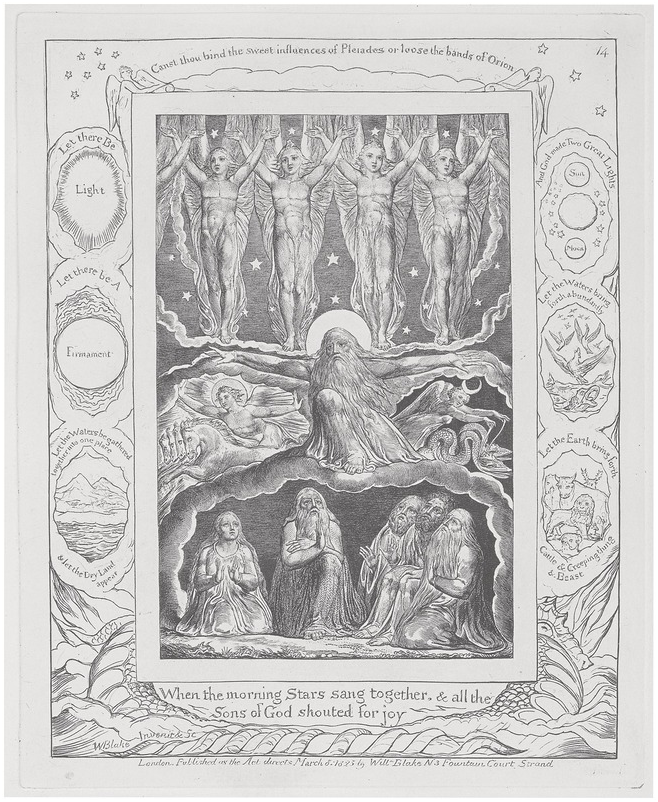
In Pater’s writing, Blake’s illustration of Job demonstrates the visionary potential of aesthetic criticism. Blake’s engraving captures the speech with which ‘the Lord answered Job out of the whirlwind’ (Job 38:1). The Biblical text addresses the reader in the second person: ‘gird up now thy loins like a man’ (38:3). Although this line is not reproduced in Blake’s engraving, it helps us to understand Pater’s incongruous association of the scene with the girdle of mist and the erotic promise of frontal revelation in Burne-Jones’s painting. While the Lord speaking in the whirlwind harshly questions where Job was at the moment of creation (38:4), suggesting that he was not there when ‘all the sons of God shouted for joy’ (38:7), this negative element is not featured in Blake’s selective quotation of ‘When the morning Stars sang together’. Both Blake and Burne-Jones open up that experience through a form of vicarious participation and re-enactment. In Pater’s prose the morning stars ‘sing together’ with Burne-Jones’s Day, offering a glimpse of utopian promise, perhaps announcing a new day of sexual freedom.
Most readers of the Fortnightly would hardly have visualised or remembered Burne-Jones’s painting, let alone grasped such a reference to an ‘image’ that is so intense that ‘we hardly think of distinguishing between the image … and the meaning of the image’ (‘The Myth of Demeter and Persephone’, GS, 99; CW, viii. 68). If Pater’s reference meant to evoke an experience of erotic incarnation, it was not for all to see. Unlike Blake’s Job illustration, which was printed in multiple copies, Burne-Jones’s Day is a unique art work produced for the dining room of Leyland’s home;20 it was not exhibited until two years after the publication of Pater’s essay.21 Burne-Jones’s withdrawal from the Water Colour Society exhibitions after 1870 indicates the boundaries of social decorum: the visual revelation of the male nude could only be shared within a restricted aesthetic community.22 Can prose evoke what painting cannot show? Pater’s later essay ‘Style’ argues that ‘the figure, the accessory form or colour or reference, is rarely content to die to thought precisely at the right moment, but will inevitably linger awhile, stirring a long “brain-wave” behind it of perhaps quite alien associations’ (App., 18). What defines the writer is a ‘tact of omission’, but also a tactic that activates the utopian possibility of images glimpsed in an ecstatic interval, ‘singing together’ for a moment, before disappearing in the rhythm of Pater’s prose.
Pater’s anachronic practice draws on an anthropological concept from E. B. Tylor’s influential Primitive Culture (1871). Like Michelangelo, who ‘lingers on; a revenant, as the French say, a ghost out of another age’ (Ren., 71),23 Blake and Burne-Jones are a ‘“survival” from a different age’. Tylor defines ‘survivals’ as ‘processes, customs, opinions … carried on by force of habit into a new state of society different from that in which they had their original home, and they thus remain as proofs and examples of an older condition of culture’.24 Pater applies this concept to the ‘spiritual life’ of nature in Wordsworth’s writing, a ‘“survival” … of that primitive condition, … that mood in which the old Greek gods were first begotten, and which had many strange aftergrowths’ (App., 46–8). While Pater’s Wordsworth reveals the survival of the primitive moods of nature in the present, his classical criticism finds modern counterparts in the past.
Spiritual Form
The most striking use of Blake occurs in ‘A Study of Dionysus: The Spiritual Form of Fire and Dew’, first published in the Fortnightly Review in December 1876, subsequently collected in Greek Studies in 1895. In this essay, Pater tracks the emergence of Dionysus as ‘the spiritual form of the vine, … of the highest human type’, ‘the reflexion, in sacred image or ideal’ of ‘the mystical body of the earth’, ‘the vine-growers’ god’ (GS, 15, 25, 28; CW, viii. 94, 99, 100). Religion emerges as a process of knowing by making, ‘shadowing forth, in each pause of the process, an intervening person—what is to us but the secret chemistry of nature being to them the mediation of living spirits’, a ‘fantastic system of tree-worship’ (GS, 13, 14; CW, viii. 93). For Pater the ‘office of the imagination’ (GS, 32; CW, viii. 102) is to capture this evanescent form refracted through different arts: remnants of ‘primitive tree-worship … found almost everywhere in the earlier stages of civilisation, enshrined in legend or custom’ show that the ancient ‘fancy of the worshipper’ persists in modern ‘poetical reverie’. For instance, in Percy Shelley’s Sensitive Plant the spiritual metamorphosis of plants ‘may still float about a mind full of modern lights, the feeling we too have of a life in the green world, always ready to assert its claim over our sympathetic fancies’ (GS, 11; CW, viii. 92). Sculpture can ‘condense the impressions of natural things into human form; … retain that early mystical sense of water, or wind, or light, in the moulding of eye and brow; … arrest it, or rather… set it free’ (GS, 32–3; CW, viii. 102). Human form offers a mould for ‘the spiritual flesh allying itself happily to mystical meanings’, but this human limitation is precarious, always in ‘danger of an escape from them of the free spirit of air, and light, and sky’ (GS, 34; CW, viii. 103). Pater’s search for the primitive mystical union of the spirit with nature, working against the divided condition of the modern mind, is close to Blake’s embodied enthusiasm.
The notion of ‘spiritual form’ derives from Emanuel Swedenborg’s account of human perfection seen from an angelic point of view and underpinned by a dualist distinction between the human body’s earthly and spiritual form.25 Emblematic of this ‘divided imperfect life’ is the ‘spiritual philosophy’ of Samuel Taylor Coleridge (App., 71, 82), whose poetry Pater compares to Blake’s visionary ability to see spirits in the everyday, ‘that whole episode of the re-inspiriting of the ship’s crew in The Ancient Mariner being comparable to Blake’s well-known design of the “Morning Stars singing together”’ (App., 97). The difference between the painter-poet and the philosopher-poet indicates ‘a change of temper in regard to the supernatural which has passed over the whole modern mind, and of which the true measure is the influence of the writings of Swedenborg’ (98). Access to a supernatural sense requires an altered state, or a visionary work of art that exhibits a moment of revelation and ‘re-inspirits’ the reach of words through a complementary appeal to the senses, which can heal the division between spirit and matter, subject and form.
In Pater’s writing, the concept of ‘spiritual form’ signals a paradox; so too does its attribution to Blake two-thirds of the way into the Dionysus essay:
Well,— the mythical conception, projected at last, in drama or sculpture, is the name, the instrument of the identification, of the given matter, — of its unity in variety, its outline or definition in mystery; its spiritual form, to use again the expression I have borrowed from William Blake—form, with hands, and lips, and opened eyelids—spiritual, as conveying to us, in that, the soul of rain, or of a Greek river, or of swiftness, or purity.
The term ‘spiritual form’ appears only once in Blake’s poetical corpus. While Blake uses the expression ‘spiritual body’ in the Swedenborgian sense in an illustration for ‘To Tirzah (‘It is raised a spiritual body’) and in Night VIII of Vala or the Four Zoas, 26 in Jerusalem, the ‘spiritual forms’ in Luvah’s sepulchre will ‘wither’ without a veil. An apocalyptic weaving of bodies is required to protect humanity from its state of splitting and separation in order to restore the original unity of the eternals.27 In other words, Blake uses the word ‘spiritual’ to describe a fallen state of separation that emphasises the paradoxical contradiction inherent in the concept of ‘spiritual form’. The tension between ideal, dystopian, and parodic is active in William Michael Rossetti’s ‘Prefatory Memoir’ to the Aldine edition of Blake’s works in 1874. After discussing Blake’s ‘spiritual sense’ and ‘spiritual eye’, he alludes to the ‘spiritual visitants’ that Blake captured in his visionary heads, and wonders whether Blake will approve of ‘the present re-issue of the Poetical Sketches’, a ‘portrait’ that is ‘a reflex of his “spiritual form”’.28 Will the edition capture Blake’s corpus or a divided image, a caricatural distortion like his visionary heads? The ambiguous possibilities of this statement register Blake’s own ambivalent relationship with Swedenborg.
The Blakean source for Pater’s concept of ‘spiritual form’ is a pictorial title: The Spiritual Form of Pitt is the only Blake painting entered in the Royal Academy’s Old Masters exhibition in 1871, but the English politician is joined by the ‘Spiritual Forms’ of Nelson and Napoleon in the Burlington Fine Arts Club Blake retrospective in 1876.29 In the ‘Introductory Remarks’ to the catalogue, William Bell Scott argues that ‘the Spiritual Form of Pitt’ is a puzzle, ‘among the most difficult to decipher’.30 A review of the 1876 exhibition recalls the public’s reaction to the painting at the Old Masters exhibition in 1871: ‘a stout segment of Respectability who looked at the picture, solemnly read to his companion the title, The spiritual form of William Pitt guiding Behemoth, looked again, shook his head’.31 Yet what the review cites is the title as it appears in the catalogue of 1876.32 The catalogue entry in 1871 reads:
William Pitt
‘The spiritual form of Pitt guiding Behemoth. He is that angel who, pleased to perform the Almighty’s orders, rides in the whirlwind, directing the storms of war. He is commanding the Reaper to reap the vine of the earth, and the ploughman to plough up the cities and towers.’ —.
In 1871 comparing the catalogue entry with the tempera hanging on the wall produced an experience of double vision. The title, ‘William Pitt’, raised the expectation for a historical portrait, but it was subverted by the grotesque revelation of a nude and a demonic Dionysian counterpart. Blake’s visionary portraiture exploits the possibilities of allegory as a satirical yoking of opposites, which is closer to Samuel Johnson’s denunciation of metaphysical wit, than to an ideal of style in which form and meaning coalesce in ways that cannot be separated.
The dialectical tension between visionary allegory and historical portraiture in The Spiritual Form of Pitt undermines the Swedenborgian framing of Blake in the Burlington Fine Arts Club catalogue of 1876. In his ‘Introductory Remarks’, Scott quotes from the Swedenborgian John Garth Wilkinson’s preface to Songs of Innocence and of Experience (1839): ‘if it leads one reader to think that all Reality for him, in the long run, lies out of the limits of Space and Time; and that Spirits, and not bodies, and still less garments, are men … it will have done its work in its little day’.34 Still drawing on Wilkinson, Scott goes on to detail Blake’s objection to nature – ‘natural objects did and do weaken, deaden, and obliterate imagination in me’ – to articulate an alternative form of ‘determinate vision’, which does not mean that ‘the object is visible to the eye, but that it is apparent to the mental vision, by interior light’.35 Scott cites Wilkinson announcing that Songs of Innocence represent ‘the New Spiritualism which is now’, in 1839, ‘dawning on the world’ (9). This Swedenborgian reception of Blake can find some corroboration in Blake’s ambivalent return to Swedenborg in the late 1800s, probably under the influence of Charles Augustus Tulk, whose copy of Songs provided the basis of Wilkinson’s edition.36 However, Scott’s claim that Blake was ‘sympathetic’ to Swedenborg (10) goes against the evidence of Blake’s ‘objurgatory’ marginalia to a copy of Swedenborg’s Angelic Wisdom, which was brought to the Burlington Fine Arts Club at the time of the exhibition. W. M. Rossetti’s review of Scott’s catalogue reminds the reader of Blake’s critical denunciation of Swedenborg in The Marriage of Heaven and Hell, where he claimed that ‘any man of mechanical talents may, from the writings of Paracelsus or Jacob Behmen, produce ten thousand volumes of equal value with Swedenborg’s’.37 In the context of the exhibition Pater’s incongruous association between Dionysus as a celebration of nature and Blake’s dystopian pictorial title is puzzling. The strong language that shapes Pater’s attribution of ‘spiritual form’ to Blake as an example of ‘unity in variety’ suggests something more than meets the eye.
Both Blake and Pater think about form through a relationship with Greek sculpture and Greek gods. Blake first exhibited his spiritual form paintings in 1809 and discussed them in A Descriptive Catalogue of Pictures, Poetical and Historical Inventions, reprinted in Gilchrist’s Life: ‘The two Pictures of Nelson and Pitt are compositions of a mythological cast, similar to those Apotheoses of Persian, Hindoo, and Egyptian Antiquity … wonderful originals … from which the Greeks and Hetrurians copied Hercules Farnese, Venus of Medici, Apollo Belvidere, and all the grand works of ancient art.’38 In the next catalogue entry on Chaucer’s Canterbury Pilgrims, also exhibited in 1876, Blake uses classical sculptural prototypes to capture ‘characters repeated again and again, in animals, vegetables, minerals, and in men … physiognomies or lineaments of universal human life’.39 Such were, for Blake, the ‘Grecian gods’, ‘visions of eternal attributes, or divine names, which, when erected into gods, become destructive to humanity’.40 Blake develops his negative account of the effects of apotheosis in his entry about The Spiritual Preceptor, an experiment Picture, a subject
taken from the Visions of Emanuel Swedenborg. Universal Theology, No. 623 … corporeal demons have gained a predominance; who the leaders of these are, will be shown below. Unworthy Men, who gain fame among Men, continue to govern mankind after death, and, in their spiritual bodies, oppose the spirits of those who worthily are famous.41
Here ‘spiritual’ stands for an antithetical destructive power of division.
Pater repurposes Blake’s dystopian image through an intermedial act of criticism that exemplifies the practice of misquotation, misrepresentation, or deliberate appropriation discussed by Christopher Ricks.42 Pater’s intervention discards the negative associations of ‘spiritual form’ as an instrument of political imposition. It is Blakean in spirit, if not in the letter, because to repurpose the concept of ‘spiritual form’ means to release the utopian potential of the ‘human form divine’ and restore the eternal body that Blake sought to heal in his prophetic writings.
Style: ‘Soul and Body Reunited’
Blake’s visual inventions come to Pater’s mind when he explores forms that cannot be captured through logical processes of reasoning structured around distinctions or boundaries between the arts. In ‘The School of Giorgione’ Pater argues for the incommunicable, ‘untranslatable sensuous charm’ peculiar to each art (Ren., 102). Building on Lessing’s Laocoon, Pater argues that ‘[o]ne of the functions of aesthetic criticism is to define these limitations; to estimate the degree in which a given work of art fulfils its responsibilities to its special material’ (102). Yet as the artist produces form out of matter, ‘in its special mode of handling its given material, each art may be observed to pass into the condition of some other art, by what German critics term an Anders-streben —a partial alienation from its own limitations’ (105). This does not mean that they can replace each other or turn into music, following the progression from more material to more spiritual forms set out in Hegel’s Aesthetics, but that they ‘reciprocally … lend each other new forces’ in the ‘constant effort … to obliterate’ the distinction between matter and form (105, 106). Since Pater argues that poetry needs to find ‘guidance from the other arts’ (105), what ‘guidance’ do Blake’s visual compositions provide in Pater’s search for literary form?
At the level of composition, in Blake’s Chaucer’s Pilgrims and the Spiritual Form of Pitt Pater finds visual approaches to the revelation of eternal characters resurfacing in different times, a type of recognition that Pater explored in different writing genres, from classical criticism to the Imaginary Portraits. The ‘Grecian gods’ that Blake sees in Chaucer’s Pilgrims may well have prompted Pater’s association of Chaucer with the Marbles of Aegina, discussed in Chapter 2, while Blake’s Dionysian Pitt offers a model for developing literary character in his ‘quaint legend’ ‘Denis L’Auxerrois’ (IP, 47; CW, iii. 81).
Blake’s art helps define form in literary writing by means of analogy, through visionary moments of aesthetic plenitude. While ‘poetry … works with words addressed in the first instance to the pure intelligence’ (Ren., 107), in Blake Pater finds art informed by artistic spirit that can heal the modern dissociation of mind and soul: ‘meaning reaches us through ways not distinctly traceable by the understanding, as in some of the most imaginative compositions of William Blake’ (Ren., 108). Visual associations complement words, enhancing their reach by appealing to the senses and supplementing the limitations of the understanding.
In ‘Style’, after defining the pleasure of ‘conscious artistic structure’, Pater turns to the literary artist’s mode of communication by means of soul as opposed to mind and finds in Blake ‘an instance of preponderating soul, embarrassed, at a loss, in an era of preponderating mind’ (App., 24, 25). Consider Pater’s wording against J. Comyns Carr’s introduction to Blake for T. H. Ward’s English Poets (1880), which sums up a nineteenth-century tradition around Blake’s insanity:
he possessed only in the most imperfect and rudimentary form the faculty which distinguishes the functions of art and literature; and when his imagination was exercised upon any but the simplest material, his logical powers became altogether unequal to the labour of logical and consequent expression. … If Blake had never committed himself to literature we should scarcely be aware of the morbid tendency of his mind. It is only in turning from his design to his verse that we are forced to recognize the imperfect balance of his faculties.43
Blake’s appeal to Pater is in stark contrast to Comyns Carr’s indictment of his ‘imperfect balance’ of faculties. On the contrary, Pater reaches out to Blake to rebalance the division of the faculties; against Comyns Carr’s separation of the artist from the poet, Pater seeks in the artist the complement of sense that is needed to ‘inspirit’ poetry.
Blake’s visionary art articulates an aesthetic politics for modern literature, which is neither objective, nor ‘legible to all; by soul, he reaches us, somewhat capriciously perhaps, one and not another, through vagrant sympathy and a kind of immediate contact’ (‘Style’, App., 25). This formula activates an experience of aesthetic embodiment that traverses Pater’s critical idiom, from the early formulation of ‘carnal form’ to ‘spiritual form’. Pater goes on to discuss ‘soul’ operating through ‘unconscious literary tact’ and ‘immediate sympathetic contact’ (26) in terms of religious literature and the ‘plenary substance’ of ‘what can never be uttered’ (27), then shifts to the ‘martyr of literary style’, Gustave Flaubert, and returns to Blake to illustrate his ‘adaptation’ between thought and language, ‘meeting each other with the readiness of “soul and body reunited,” in Blake’s rapturous design’ (27, 30, Figure 2). This reference to Blake ironically recentres the passion for style that Flaubert advocates in a passage from his correspondence with Madame X quoted in the essay. As a tangible image of what is left unsaid, Blake’s illustration to Robert Blair’s The Grave becomes an emblem of the complementarity of text and image, showing how visual allusion integrates writing by addressing the senses and pointing to an experience of embodiment in which thought and language coalesce in ways that words alone fail to express.
Louis Schiavonetti (1765–1810), after William Blake (1757–1827), ‘The Reunion of the Soul & the Body’, illustration to The Grave, A Poem. By Robert Blair. Illustrated By Twelve Etchings Executed From Original Designs. To Which Is Added A Life Of The Author, London, Published Mar. 1st 1813, by R. Ackermann, 101 Strand, sheet 38.1 × 28.9 cm, plate 29.8 × 22.9 cm, Yale Center for British Art, Paul Mellon Collection (B1974.8.6).
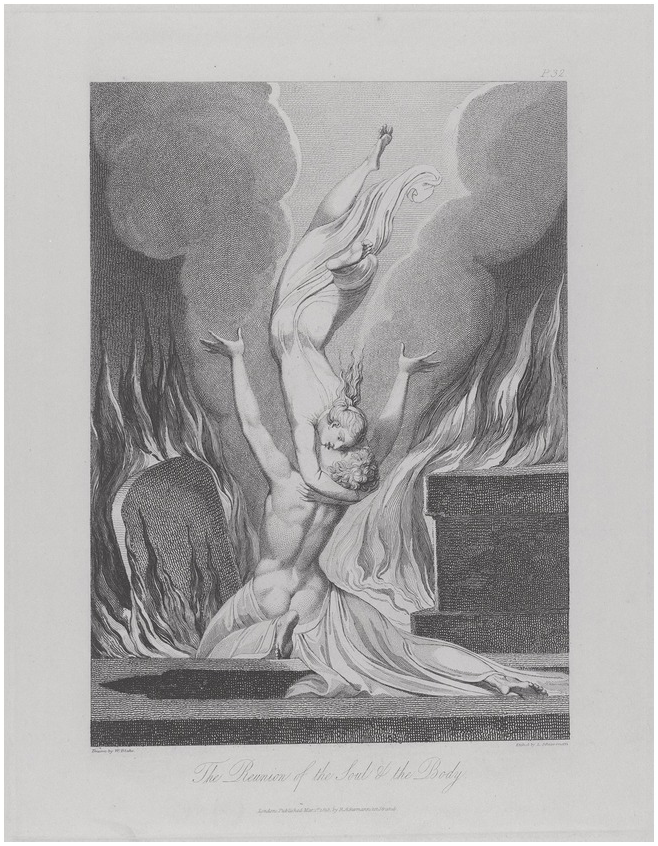
When Walter Pater’s Appreciations was first published in 1889, the chapters on Wordsworth and Coleridge were prominently afforded pride of place, uniformly praised, and generally considered the finest in the volume. In reviewing it for the Athenaeum, Arthur Symons astutely connected Appreciations with the critical principles outlined in the ‘Preface’ to The Renaissance (1873). Reminding readers of Pater’s language there regarding the role of the ‘aesthetic critic’ in distinguishing the special ‘virtue’ of a work of art in order to ‘disengage’ them from the undistinguished aspects, he inflected ‘appreciation’ as precisely that sort of critical weighing and valuing.1 Symons cited the Wordsworth essay as ‘certainly the very best example of this, for it has fallen to the lot of Wordsworth to suffer more than most at the hands of interpreters’. The writing on Wordsworth was ‘perhaps the finest of Mr Pater’s critical essays’, because in ‘Disengaging the better from the baser elements, he seizes thus upon what is fundamental, getting at the true root of the matter’. Symons was not alone in lavishing praise on the Wordsworth essay: in the Spectator, C. L. Graves thought it ‘excellent, and full of acute remarks’, while Oscar Wilde, in the Speaker, singled it out as ‘the finest’ in the book, because ‘It appeals, not to the ordinary Wordsworthian with his uncritical temper, and his gross confusion of ethical with aesthetical problems, but rather to those who desire to separate the gold from the dross’.
Although not noticed in as much detail, the Coleridge essay was considered ‘difficult to overpraise’ and ‘one of the most delightful of all’, according to Clement Shorter in the Star. Graves thought that ‘Mr Pater is at his best in what he says of Coleridge’s superlative skill in handling the supernatural’ in ‘The Rhyme of the Ancient Mariner’, while W. J. Courthope, in the Nineteenth Century, noted that ‘Mr Pater’s appreciation of Coleridge is more severe, and therefore more just’. Although Pater had previously published versions of both essays (on Coleridge in 1866 and on Wordsworth in 1874, with additional commentary on Coleridge’s poetry in 1880), the essays in Appreciations are the most frequently cited. In order responsibly to assess Pater’s ‘appreciations’ of both writers – and to understand the importance of these writings for Pater’s critical achievements as well as for the late nineteenth-century reputations of Wordsworth and Coleridge – it will be valuable to contextualise these essays within the longer arc of Pater’s career.
***
Pater commenced his career as a critic with ‘Coleridge’s Writings’, published anonymously in the Westminster Review in January 1866. Nominally a review of the third edition of Thomas Allsop’s Letters, Conversations and Recollections of S. T. Coleridge, it evaluates the competing priorities in Coleridge’s prose writings between his ‘religious philosophy’ and his ‘theory of art-criticism’ (‘CW’, 114, 117). It marks Pater’s first attempt to delineate the functions of criticism and culture in relation to religion (Christianity) and philosophy (both Greek and German Idealist) and, in doing so, offers a preview of the ‘religious aestheticism’ later developed in The Renaissance. It is an ambitious first foray into criticism: tackling the contested matter of Coleridge’s posthumous reputation, Pater examines both the prose writings and the man (with whom he clearly sympathises, even as he outlines what he considers to be Coleridge’s shortcomings) in the course of setting forth his own priorities as a critic. When he later revised much of ‘Coleridge’s Writings’ for the chapter on Coleridge in Appreciations, Pater reworked material from the opening sixteen pages and final two paragraphs of the article (excising most of the material in which he criticised prevalent Christian dogmatics) to bookend that study around the consideration of Coleridge’s poetry that he contributed to T. H. Ward’s The English Poets (1880).
In order to arrive at a proper assessment of both Pater’s aspirations and his achievements in the early essay, it will be useful to consider the book allegedly under review: the Letters, Conversations and Recollections of S. T. Coleridge. First published in 1836 (then republished in 1858 and 1864), Allsop’s volume had played a significant role in the shaping of Coleridge’s posthumous reputation for thirty years.2 Noting in the preface to the third edition that ‘the name of Samuel Taylor Coleridge [is] a puzzle to this later generation’ (np), Allsop sought to resolve the ‘puzzle’ through presenting Coleridge as first and foremost a religious thinker, one who systematically attempted to ‘reconcile religion with philosophy’ and ‘truth with Christianity’ (np). This is not the (now) better-known Coleridge of the early poetry or the Biographia Literaria (1817), but the Coleridge of the Aids to Reflection (1825) and On the Constitution of the Church and State (1829), whose readers were imagined as young men who were ‘becoming conscious of the difficulty of holding Christian beliefs within the new intellectual climate’ of the early nineteenth century.3 Aids to Reflection had been a popular, influential book since its first publication, and (after Coleridge’s death in 1834) was instrumental for the public perception of Coleridge and his writings.4 Coleridge was admired by many mid-century critics for his recognition of the need for a ‘spiritual’ religion and his attempt to define Christianity in philosophical terms, apart from questions of historical evidence. In undertaking a review of the third edition of Allsop’s collection (and taking various of his bearings from Allsop’s preface to the same), Pater in his first publication was plunging into a contentious public debate, not merely about Coleridge’s posthumous reputation but also about the authority of religion for English culture in the 1860s.5
‘Coleridge’s Writings’ may be considered Pater’s attempt to solve the ‘puzzle’ of Coleridge. He touches on numerous points from Allsop’s preface to the third edition (for example, the importance of German Idealist thinkers such as Kant for effecting the reconciliation Coleridge sought between religion and philosophy), and focuses on Aids to Reflection as the central text of what he ultimately denigrates as Coleridge’s reliance on ‘inferior theological literature’ (‘CW’, 111–12), when compared with his theory of poetry, or ‘art-criticism’, in which, according to Pater, Coleridge ‘comes nearest to true and important principles’ (117). As John Beer has noted, ‘Pater was singularly well equipped to attempt a critical re-evaluation of Coleridge, being temperamentally attuned to his poetic sensibility yet aware of the growth of evolutionary and relativist thinking’.6
Pater frames his approach to Coleridge in terms of the tension between the ‘relative’ (or modern) spirit and the ‘absolute’ (or ancient) spirit: whereas ancient philosophy ‘sought to arrest every object in an eternal outline, to fix thought in a necessary formula’, for the modern spirit ‘nothing is or can be rightly known except relatively under conditions’ (107):
The literary life of Coleridge was a disinterested struggle against the application of the relative spirit to moral and religious questions. Everywhere he is restlessly scheming to apprehend the absolute; to affirm it effectively; to get it acknowledged. Coleridge failed in that attempt, happily even for him, for it was a struggle against the increasing life of the mind itself.
Coleridge’s pursuit of an absolute was both his greatest ambition and his greatest shortcoming – his signature failure. In light of Pater’s conviction that only the relative can make a difference in contemporary thought, Coleridge’s insistence throughout his prose writings on fixed principles, in concert with his refusal ‘to see the parts as parts only’ (132), brings into view his ‘chief offence’ – namely, an ‘excess of seriousness, a seriousness that arises not from any moral principle, but from a misconception of the perfect manner’ (111). In other words, Coleridge’s insistence on thinking in terms of an absolute marred what Pater would later denominate his ‘style’ as a critic, and compromised both his appeal and his reputation as a humanist. Despite this, there is for Pater a ‘peculiar charm’ about Coleridge, the ‘charm of what is chastened’ in Coleridge’s lifelong contention against the relative and ‘the new order of things’ (107).
Pater’s critical re-evaluation of Coleridge operates under two antagonistic yet complementary headings, as he disparages Coleridge’s ‘religious philosophy’ in order to celebrate his ‘theory of art-criticism’. Allsop’s volume is representative of the degree to which Coleridge’s posthumous reputation was tied to his status as a religious thinker, and Pater is pointedly taking aim at Allsop’s veneration of Coleridge when he castigates Aids to Reflection (the central text in the Victorian valorisation of Coleridge as one of the greatest philosophers of his age) as ‘ennuyant, depressing’, little more than ‘Archbishop Leighton’s vague pieties all twisted into the jargon of a spiritualistic philosophy’ (112). He repeatedly dismisses Coleridge’s attempt to fashion ‘an intellectual novelty in the shape of a religious philosophy’ that could reconcile the conflict between reason and faith (114):
The peculiar temper of Coleridge’s intellect made the idea of reconciling this conflict very seductive. With a true speculative talent he united a false kind of subtlety and the full share of vanity. A dexterous intellectual tour de force has always an independent charm … A method so forced as that of Coleridge’s religious philosophy is from the first doomed to be insipid.
Pater seems more interested in Aids to Reflection for its ‘dexterity’ as an ‘intellectual tour de force’ (a signature mark of Coleridge’s ‘literary egotism’ (112)) than as a sustained argument about the possible relation between rational thought and spiritual devotion.
Beyond the specific engagement with Aids to Reflection, Pater’s re-evaluation of Coleridge’s religious thinking provides him with the opportunity for a wholesale disparagement of Christianity. Maintaining that ‘what chains men to a religion is not its claim on their reason, their hopes or fears, but the glow it affords to the world, its “beau ideal”’, Pater argues at some length that, for those who no longer believe in traditional Christianity, its most compelling features are to be replaced by ‘culture’, understood as our ‘intellectual life’ (126). Characterising this new ‘spiritual element’ as ‘a chastened temper’, with its ‘passion for inward perfection with its sorrows, its aspirations, its joy’, Pater declares that ‘These mental states are the delicacies of the higher morality of the few’ and that ‘like culture itself they are remote, refined, intense, existing only by the triumph of a few over a dead world of routine in which there is no lifting of the soul at all’ (126). It is an uncompromising substitution of culture for religion, which Pater sums up thus:
Our culture, then, is not supreme, our intellectual life is incomplete, we fail of the intellectual throne, if we have no inward longing, inward chastening, inward joy. Religious belief, the craving for objects of belief, may be refined out of our hearts, but they must leave their sacred perfume, their spiritual sweetness, behind. This law of the highest intellectual life has sometimes seemed hard to understand …. How often do we have to look for some feature of the ancient religious life, not in a modern saint, but in a modern artist or philosopher!
David DeLaura has written of Pater’s ‘remarkable argument’ here that it not only ‘breathes a total and almost contemptuous detachment from Christianity and Christian belief’, but that it furthermore provides ‘the most explicit rationale for what may be called a “religious aestheticism”, not only in Pater but perhaps in the English language’, which ‘Pater himself, even in the years of the Renaissance studies, never again revealed so uncompromisingly’.7 It is one of the most memorable passages in ‘Coleridge’s Writings’, and (as is also the case with the criticism of Aids to Reflection) it was removed when Pater revised the article for Appreciations.8 Under the heading of ‘the higher morality of the few’, Pater is attempting here to preserve a spiritual element in life ‘For those who have passed out of Christianity’ (127) – or, as T. S. Eliot put it, ‘to get all the emotional kick out of Christianity one can, without the bother of believing it’.9
In between the critique of Coleridge’s theological writings and the celebration of a new religious aestheticism (both excised in 1889), Pater offers a sustained and sympathetic account of Coleridge’s art criticism (most of which was retained in Appreciations), claiming that it is here that Coleridge ‘comes nearest to true and important principles’ (117). Integral to Pater’s assessment of Coleridge’s non-religious criticism is his emphasis on the importance of German Idealist philosophy (what Pater goes so far as to claim was his ‘one singular intellectual happiness’), which Coleridge applied ‘with an eager, unwearied subtlety’, in an ‘attempt to reclaim the world of art as a world of fixed laws’ (117, 118). This is most evident in the Biographia, in which Coleridge ‘refine[d] Schelling’s “Philosophy of Nature” into a theory of art’ (118). Pater is unusual among nineteenth-century readers in that he shares Coleridge’s interest in transcendental philosophy (certainly not the case with the first reviewers of the Biographia), and neglects the long chapters on Wordsworth (the usual centre of attention) in order to explain Coleridge’s critical philosophy, tracing the ‘Philosophy of Nature’ all the way back to evidences of pantheism in Greek philosophy (‘the suspicion of a mind latent in nature’, which he valorises as the ‘Greek spirit’ or ‘Greek mind’ (119, 132)). He even detects ‘that faint glamour of the philosophy of nature’ in Coleridge’s famous definitions of the imagination in the Biographia, setting forth the Coleridgean imagination as that faculty which ‘attains a strange power of modifying and centralizing what it receives from without according to an inward ideal’: in Pater’s interpretation, ‘in imaginative genius, ideas become effective; the intelligence of nature, with all its elements connected and justified, is clearly reflected; and the interpretation of its latent purposes is fixed in works of art’ (121, 120).
Pater singles out Coleridge’s Shakespeare criticism (at the time available in the Literary Remains (1836–39) and Sara Coleridge’s Notes and Lectures upon Shakespeare (1849)) to explain Coleridge’s theory of organic unity, the ‘law of gravitation from within’ that finds ‘the most constraining unity in the most abundant variety’ (121). In Coleridge’s terms, ‘The organic form is innate; it shapes, as it developes [sic], itself from within, and the fulness of its development is one and the same with the perfection of its outward form’ (quoted, 122).10 Under the Coleridgean heading of organic unity, ‘“the absolute” has been affirmed in the sphere of art’ (Coleridge again ‘straining’ after the absolute), yet Coleridge ultimately ‘overstrained the elasticity of his hypothesis’, rendering the artist ‘almost mechanical’ as a result: while a theory of organic form may explain the ‘impression of a self-delighting, independent life which a finished work of art gives us’, it ‘does not express the process by which that work was produced’ (122). Such an achievement, and such a limitation, are characteristic of Coleridge’s work as a critic: while he excels in determining the ‘metaphysical definition of the universal element in an artistic effort’ – the ‘absolute formula’ – he is less adept in explaining the ‘subtle gradation of the shades of difference between one artistic gift and another’ (123). His comments on individual works of art are therefore of less interest and value than his abstract pronouncements on the rules of art: Pater’s Coleridge is ultimately not a practical but a philosophical critic.
When Pater revised ‘Coleridge’s Writings’ for inclusion in Appreciations, he retained much of his account of Coleridge the critic (rather than Coleridge the theologian) as a way to preface the ‘critical introduction’ to Coleridge’s poetry that he had initially contributed in 1880 to T. H. Ward’s multi-volume anthology The English Poets, which he then inserted fundamentally unabridged (collated with several pages on Wordsworth from ‘Coleridge’s Writings’) as the second half of the Coleridge chapter.11 Pater continues to emphasise Coleridge’s dissemination of German metaphysics and transcendental philosophy (presented here as a manifestation of ‘the a priori, or absolute, or spiritual, or Platonic, view of things’) as ‘the one thread of continuity in a life otherwise singularly wanting in unity of purpose, and in which he was certainly far from uniformly at his best’ (App., 81, 82). ‘Fragmentary and obscure’ as he may have been, Coleridge was ‘often eloquent, and always at once earnest and ingenious’, classified by Pater ‘as a student of words, and as a psychologist, that is, as a more minute observer or student than other men of the phenomena of mind’ (82). The latter designation is particularly important for Pater’s subsequent analysis, providing as it does a way to explain both Coleridge’s ‘imaginative philosophical expression’ in so much of his meditative blank verse and his ‘presentation of the marvellous’ in the supernatural poems ‘The Rhyme of the Ancient Mariner’ and ‘Christabel’ (93, 97).
Pater sympathetically describes Coleridge in terms of his ‘morbid want of balance … [mixed with] a kind of languid visionariness’, a poet who claimed he wrote poetry ‘after the more violent emotions of sorrow, to give him pleasure, when perhaps nothing else could’, which poetry was then characterised by ‘a certain languidly soothing grace or cadence’ (83).12 The languid Coleridgean combination of sorrow and pleasure is central to Pater’s estimation of the poetry: as he remarks of several youthful lines pertaining to the mode in which ‘even saddest thoughts / Mix with some sweet sensations’, the ‘expression of two opposed, yet allied, elements of sensibility in these lines, is very true to Coleridge:—the grievous agitation, the grievous listlessness, almost never entirely relieved, together with a certain physical voluptuousness’ (84). A related register is that of ‘stifled, drowsy, unimpassioned grief’ (the source of which was closely allied with the source of those pleasures), as Coleridge puts it in ‘Dejection: An Ode’, a poem critical for Pater’s understanding of Coleridge’s temperament, ‘with its faintness, its grieved dejection’, such as when he laments, ‘I may not hope from outward forms to win / The passion and the life whose fountains are within’ (86; ll. 22, 45–6).13
Pater initially contrasts Coleridge’s dejection with Wordsworth’s joy, his ‘joyful and penetrative conviction of the existence of certain latent affinities between nature and the human mind, which reciprocally gild the mind and nature with a kind of “heavenly alchemy”’ (85). But whereas Wordsworth instinctively believed in the reciprocal and ‘exquisite’ fit of the mind of man and the external world (such as in the ‘Prospectus’ to The Recluse, which Pater quotes), for Coleridge this was not a belief so much as an idea (and one that failed him in moments such as those recorded in ‘Dejection’): ‘In Coleridge’s sadder, more purely intellectual, cast of genius, what with Wordsworth was sentiment or instinct became a philosophical idea’ (87). He is also compared and contrasted with the prolix Wordsworth in terms of the ‘limited quantity of Coleridge’s poetical performance’, memorably described as ‘like some exotic plant, just managing to blossom a little in the somewhat un-english air of Coleridge’s own south-western birthplace, but never quite well there’ (84–5). As astute as Pater can be in managing the comparison of the two poets, he somewhat reductively confines much of Coleridge’s poetic output to the annus mirabilis of 1797–98 with Wordsworth (to which Pater assigns the composition of ‘Kubla Khan’, ‘The Rhyme of the Ancient Mariner’, and the first part of ‘Christabel’), lamenting ‘the sudden blossoming, through one short season, of such a gift already perfect in its kind, which thereafter deteriorates as suddenly, with something like premature old age’ (87).
Of much greater value, and lasting insight into Coleridge’s poetics, is Pater’s sustained and nuanced explication ‘of what Coleridge meant by Imagination’ across a wide range of poems (88). Pater demonstrates an uncannily Coleridgean sense of the ‘infusion … of the figure into the thought’, of the ways in which Coleridge manages the ‘identification of the poet’s thought … with the image or figure which serves him’, such as when he writes in ‘To a Gentleman [William Wordsworth]’, ‘Amid the howl of more than wintry storms, / The halcyon hears the voice of vernal hours / Already on the wing’ (88–9; ll. 89–91). In Coleridge’s compressed figure here, in the collision of the winter tumult and the summer calm, the halcyon (already on the wing itself) ‘hears’ the voice of the (halcyon) vernal hours as if in anticipation of the peace that is nigh, the peace that Coleridge found so elusive. This sort of imaginative identification is in turn integral to the ‘impassioned contemplation’ (similar to Wordsworth’s) ‘on the permanent and elementary conditions of nature and humanity’ that Pater celebrates throughout Coleridge’s writing, nowhere perhaps as prominently as in ‘To [William Wordsworth]’, when Coleridge’s celebration of Wordsworth’s Prelude – ‘high and passionate thoughts / To their own music chanted’ (ll. 46–7) – may be said to apply equally to his own blank verse, such as in the infrequently cited ‘Lines Written in the Album at Elbingerode’, in Coleridge’s declaration to have found ‘That outward forms, the loftiest, still receive / Their finer influence from the world within’ (89–91).14 A crucial manifestation of the Coleridgean imagination is to be read in his ‘imaginative treatment of landscape’, such as in his foregrounding in ‘Fears in Solitude’ of ‘A green and silent spot amid the hills, / A small and silent dell!’ (ll. 1–2), against which silence his fears of a French invasion reverberate. In this pointedly political poem, ‘written in April 1798, during the alarm of an invasion’, the ‘silent dell is the background against which the tumultuous fears of the poet are in strong relief, while the quiet sense of the place, maintained all through them, gives a true poetic unity to the piece’ (92). Coleridge’s ‘singular watchfulness for the minute fact and expression of natural scenery’ (here, the dwelling of the poet’s mind on a particular spot, green and small and silent, and ‘bathed by the mist’), in concert with his ‘minute realism’, is integral to his imaginative and ‘highly sensitive apprehension of the aspects of external nature’ and, in the end, ‘pervad[es] all he wrote’ (90–1).
Pater reserves his most sustained attention for ‘The Rhyme of the Ancient Mariner’ (the 1817 text, with gloss) and the first part of ‘Christabel’. These are Coleridge’s ‘greatest’ poems, for ‘In poetic quality … they are quite out of proportion to all his other compositions’ (95). They are both ‘romantic’ poems, notable for their ‘bold invention, and appealing to that taste for the supernatural, that longing for le frisson, a shudder’, Coleridge’s taste for which had been ‘encouraged by his odd and out-of-the-way reading in the old-fashioned literature of the marvellous’ (96). Pater is particularly interested in Coleridge’s handling of this aspect of the poem: ‘it is the delicacy, the dreamy grace in his presentation of the marvellous, which makes Coleridge’s work so remarkable’ (96–7). Whereas intruders from the spiritual world are typically too palpable (even in Shakespeare and Walter Scott), Coleridge writes with a plausibility which Pater finds it hard to pin down: his power ‘is in the very fineness with which, as by some really ghostly finger, he brings home to our inmost sense his inventions, daring as they are—the skeleton ship, the polar spirit, the inspiriting of the dead corpses of the ship’s crew’, resulting in a ‘finer, more delicately marvellous supernaturalism’ (97, 98). Ever attentive to the fragmentary nature of Coleridge’s oeuvre, Pater celebrates ‘The Ancient Mariner’ for being a finished poem: ‘It is Coleridge’s one great complete work, the one really finished thing, in a life of many beginnings’ (99). ‘Christabel’, despite its length (and Coleridge’s repeated promises to complete it), ‘remained a fragment’, albeit one also representative of the tendencies of the ‘old romantic ballad, with a spirit made subtle and fine by modern reflection’, and notable for Coleridge’s innovative experiments in metre (Pater being regularly attentive to Coleridge’s ‘cadence’ (100, 102)).
In citing the passage on the friendship of Sir Roland and Sir Leoline (from the second part of ‘Christabel’) as an illustration of Coleridge’s ‘gift of handling the finer passages of human feeling’, Pater revisits the question of Coleridge’s ‘grieved dejection’ in order to invert it, in his conclusion, into something radically different (100, 86). What is the predominant quality in Coleridge’s poetry? Joy is the unexpected answer:
[I]t is the sense of such richness and beauty which, in spite of his ‘dejection,’ in spite of that burden of his morbid lassitude, accompanies Coleridge himself through life. A warm poetic joy in everything beautiful, whether it be a moral sentiment, like the friendship of Roland and Leoline, or only the flakes of falling light from the water-snakes [in ‘The Ancient Mariner’]—this joy, visiting him, now and again, after sickly dreams, in sleep or waking, as a relief not to be forgotten, and with such a power of felicitous expression that the infection of it passes irresistibly to the reader—such is the predominant element in the matter of his poetry …
That ‘joy’ should emerge as the signature component of the matter of Coleridge’s poetry (as ‘cadence is the predominant quality of its form’ (102)) comes as something of a surprise so near the conclusion of a long chapter that has attended throughout to Coleridge’s manifold failures, his characteristic dejection, his morbid languor, and his ‘diseased or valetudinarian temperament’ (84). Making this claim sets Pater up for a long excerpt from the late poem ‘A Tombless Epitaph’. In it, Coleridge describes someone who, though ‘besieged’ by sickness, ‘maintained / The citadel unconquered, and in joy / Was strong to follow the delightful Muse’. Equally familiar with the hidden paths of Parnassus and the ‘long-neglected holy cave’ of ‘old Philosophy’, he bears an uncanny resemblance to Coleridge the ‘Poet-philosopher’ (as fondly designated by Humphry Davy), and is finally eulogised for the same: ‘O studious Poet, eloquent for truth! / Philosopher! contemning wealth and death, / Yet docile, childlike, full of Life and Love!’ (102–3; ll. 18–20, 29–30, 35–7). Standing at the end of Pater’s long and sympathetic engagement with Coleridge’s poetry in Ward’s English Poets, these lines serve as Coleridge’s own epitaph – as postulated in the poem’s final lines (which Pater does not include), ‘Here, rather than on monumental stone, / This record of thy worth thy Friend inscribes, / Thoughtful, with quiet tears upon his cheek’ (ll. 38–40). It is with this sympathetic tribute that Pater concludes his commentary in 1880.
Attending simultaneously to both Coleridge the poet and Coleridge the philosopher allows Pater deftly to link the early writing for the Westminster Review with the later commentary for Ward’s English Poets, and prepare the way for the valedictory conclusion, in which Pater reminds us of the abiding tension in Coleridge’s life and work: everywhere ‘We see him trying to “apprehend the absolute”’, to attain ‘fixed principles’, ever ‘refusing to see the parts as parts only’ (103). And it is in this quest that Coleridge’s signature failure is most legible:
‘From his childhood he hungered for eternity’. There, after all, is the incontestable claim of Coleridge. The perfect flower of any elementary type of life must always be precious to humanity, and Coleridge is a true flower of the ennuyé, of the type of René. More than Childe Harold, more than Werther, more than René himself, Coleridge, by what he did, what he was, and what he failed to do, represents that inexhaustible discontent, languor, and home-sickness, that endless regret, the chords of which ring all through our modern literature.
Through his summoning of the sensitive, restless, and melancholy heroes of Goethe’s The Sorrows of Young Werther, Chateaubriand’s René, and Byron’s Childe Harold’s Pilgrimage (three immensely popular and influential examples of a certain type of Romantic malheur), Pater enshrines Coleridge too as a discontented outsider (‘the perfect flower of the romantic type’, as he put it in ‘Coleridge’s Writings’ (‘CW’, 132; emphasis added). Coleridge furthermore epitomises what Pater repeatedly celebrates as the ‘simple, chastened, debonair’ essence of the ‘Greek spirit’: ‘with his passion for the absolute, for something fixed where all is moving, his faintness, his broken memory, his intellectual disquiet, [Coleridge] may still be ranked among the interpreters of one of the constituent elements of our life’ (App., 104). Coleridge matters for Pater because he failed, because he provided an example of heroic, romantic failure that resonated for Pater himself. Pater clearly identifies with Coleridge, not least in terms of the languor and dejection he attributes to the older writer (with Coleridge’s ode on the same arguably the critical poem for Pater’s evaluation), and sympathises with the irony of his successful and abiding failure.16 Had Coleridge achieved the absolute after which he hungered, he would not have mattered nearly as much to Pater.
***
If Pater’s Coleridge is principally distinguished by his languor and his abiding dejection, Pater’s Wordsworth is, among other things, a poet of joy and optimism. Pater compares the two in ‘Coleridge’s Writings’, confidently pronouncing that, as early as their collaboration on Lyrical Ballads (1798), ‘What Wordsworth then wrote is already vibrant with that blithe élan which carried him to final happiness and self-possession’, whereas in Coleridge ‘we feel already that faintness and obscure dejection which cling like some contagious damp to all his writings’ (‘CW’, 108).17 In support of this stark contrast, Pater cites the important lines from the ‘Prospectus’ to The Recluse in which Wordsworth jubilantly proclaims, ‘How exquisitely the individual Mind / / … to the external World / Is fitted: —and how exquisitely, too, / The external World is fitted to the Mind’ (ll. 63–7).18 This is Wordsworth’s grounding belief, his ‘dream’, made possible by ‘that flawless temperament … which keeps his conviction of a latent intelligence in nature’ (‘CW’, 109). Coleridge, on the other hand, ‘could never have abandoned himself’ to this dream of the abiding affinity between the natural world and the mind of the poet. His temperament, ‘with its faintness, its grieved dejection, could never have been like that’ (109), Pater explains, going on to cite Coleridge’s despair in ‘Dejection’. What for Wordsworth was a fundamental conviction and a permanent consolation was for Coleridge a source of doubt, a ‘vain endeavour’ (l. 42). For Coleridge’s sadder, more purely intellectual, cast of genius, according to Pater, ‘What in Wordsworth is a sentiment or instinct, is in [him] a philosophical idea’, subject to intellectual assent (110). Wordsworth’s ‘instinct’ was central to his genius: it was his belief in the ‘exquisite’ alliance between the natural world and the human mind that made possible his ‘sense of a life in natural objects’ and his depiction of nature as ‘ennobled by a semblance of passion and thought’ (App., 46, 48).
Wordsworth’s optimism (by which Pater means his sense of ‘the proportion of man to his place in nature’ (‘CW’, 109–10)), his sense of the sentience of apparently little or familiar things, his deeply reflective bent of mind, and the startling intensity of his best poetry – these qualities provide the basis for Pater’s sustained analysis in his essay ‘On Wordsworth’, first published in the Fortnightly Review in April 1874, and reprinted (largely unchanged) in Appreciations. Pater’s Wordsworth is an heroic example of ‘impassioned contemplation’ (App., 60), a poet whose work is to be celebrated less for the triumph there of imagination over fancy (a distinction which Pater immediately discounts) than for the ‘intensity in the poet’s perception of his subject, and in his concentration of himself upon his work’ (39). It is for this intensity, and for the ‘bold thought’ and ‘strange speculations’ (54, 53) that it made possible, that Wordsworth is to be read and studied. The challenge in reading Wordsworth, however, is that this ‘special power’ is not always on display, due to the perplexed mixture of the ‘higher and lower moods’ in his poetry (40, 41).
‘On Wordsworth’ was Pater’s first publication following The Renaissance, and it has been argued that it was originally intended for publication in that volume.19 DeLaura describes the essay not only as a landmark in Wordsworth criticism (appearing five years before Arnold’s influential ‘Preface’ to his anthology of Wordsworth’s poetry) but also as ‘one of the most crucial statements of his career’, a ‘distillation of the first decade of Pater’s critical career, his most precise attempt up to this time to define the nature of art and the nature of the perfected life’.20 As a definition of the nature of art, the essay is arguably ‘Pater’s most consistent performance as an aesthetic critic’, a sustained exercise in ‘aesthetic criticism’, written according to the tenets set forth in the ‘Preface’ to The Renaissance.21 Indeed, Pater’s comments on Wordsworth in the ‘Preface’ provide the template and the critical lexicon for understanding the analysis of the poetry in ‘On Wordsworth’, for it is in the ‘Preface’ that Pater initially tries to explain the role of the critic in untangling the ‘absolute duality between higher and lower moods’, between the poetic and the prosaic, in the work of even the greatest artists (41).
Pater is concerned in the ‘Preface’ to define the role and function of the aesthetic critic in identifying and analysing the ‘elements’ and ‘virtues’ of a work of art, whose ‘end is reached when he has disengaged that virtue, and noted it, as a chemist notes some natural element’ (Ren., xxi). Once the critic has identified the particular virtue of a work of art – the power or ‘property’ it has ‘of affecting one with a special, a unique, impression of pleasure’ (xx) – it becomes his responsibility to ‘disengage’ that virtue from ‘the commoner elements with which it may be found in combination’ (xxi), since the virtue does not necessarily appear in isolation or everywhere in an artist’s work. Noting that few artists (not even Goethe or Byron) ‘work quite cleanly, casting off all débris, and leaving us only what the heat of their imagination has wholly fused and transformed’ (xxi), Pater suddenly presents Wordsworth as an example of a great artist whose work is far from free of débris: ‘The heat of his genius, entering into the substance of his work, has crystallised a part, but only a part, of it; and in that great mass of verse there is much which might well be forgotten’ (xxi–xxii). Pater will repeat these points in ‘On Wordsworth’, characterising the ‘heat’ of his imaginative genius as his ‘intensity’, and noting that ‘Of all poets equally great, he would gain most by a skilfully made anthology’, for ‘nowhere is there so perplexed a mixture as in Wordsworth’s own poetry, of work touched with intense and individual power, with work of almost no character at all’ (App., 40).
The function of the critic, then, is to read for the parts of an artist’s work that have been ‘crystallised’ by the ‘heat of his genius’, in the knowledge that it will be rare to find an entire composition so characterised (Pater cites ‘Resolution and Independence’ and the Intimations Ode as two isolated Wordsworthian examples). Instead, the critic must vigilantly comb the work, ever on the lookout for ‘a fine crystal here or there’ (part of what Pater has in mind in citing the Arnoldian dictum that the aim of criticism must be ‘To see the object as in itself it really is’ (Ren., xix)), in which he can ‘trace the action of [Wordsworth’s] unique, incommunicable faculty’ (Ren., xxii). This is no small task, but rather one that ‘will require great nicety’ (xxi): as Pater explains when developing this point, ‘the mixture in his work, as it actually stands, is so perplexed, that one fears to miss the least promising composition even, lest some precious morsel should be lying hidden within—the few perfect lines, the phrase, the single word perhaps, to which he often works up mechanically through a poem’ (App., 41). Once he has identified the embedded lines which reveal Wordsworth’s ‘unique, incommunicable faculty, that strange, mystical sense of a life in natural things, and of man’s life as a part of nature, drawing strength and colour and character from local influences’ (Ren., xxii), the critic must proceed to disentangle them from the surrounding brush and make them legible for other readers. As Pater exclaims in concluding this Wordsworthian preview, ‘Well! that is the virtue, the active principle in Wordsworth’s poetry; and then the function of the critic of Wordsworth is to follow up that active principle, to disengage it, to mark the degree in which it penetrates his verse’ (xxii). In his later writing on Wordsworth, Pater proceeds to do precisely this.
What Pater here denominates Wordsworth’s ‘unique, incommunicable faculty’ he later inflects as the ‘special power’ of Wordsworth’s poetry, that which produces ‘precious morsels’ (akin to the earlier ‘fine crystals’) to be unearthed here and there, ‘the golden pieces, great and small, lying apart together’ that reward the attentive reader (App., 40, 42–3). Pater consistently emphasises the difficulty of reading Wordsworth in this regard, and the ‘peculiar savour’ available to the vigilant reader who persists (40). Pater’s Wordsworth is a challenging poet, and can be unsettling; to read him successfully requires an unusual degree of discipline and concentration. The constant tension and unpredictable alternation between the poet’s higher and lower moods ‘makes the reading of Wordsworth an excellent sort of training towards the things of art and poetry’:
It begets in those, who, coming across him in youth, can bear him at all, a habit of reading between the lines, a faith in the effect of concentration and collectedness of mind in the right appreciation of poetry, … coming to one by means of a right discipline of the temper as well as of the intellect. He meets us with the promise that he has much, and something very peculiar, to give us, if we will follow a certain difficult way, and seems to have the secret of a special and privileged state of mind.
The key term here may be ‘difficult’: reading Wordsworth is for Pater a sort of training, a ‘disciplina arcani’ which he characterises as an ‘initiation’ (42). Pater’s own essay is itself an initiation in the ways of reading this ‘strange’ and ‘peculiar’ poet, one designed to assist its readers in locating Wordsworth’s ‘secret’ and distinguishing ‘that which is organic, animated, expressive’ in Wordsworth (the bolder, higher mood) from ‘that which is only conventional, derivative, inexpressive’ (the tedious and prosaic lower mood (42)).22
Wordsworth’s virtue – the ‘active principle’ that produces a particularly Wordsworthian ‘impression of beauty or pleasure’ – may be said to be twofold, consisting in both his heightened ‘sense of a life in natural objects’ (a new possibility of poetical thought, according to Pater) and the strange, ‘bold speculative ideas’ that Pater attributes to his peculiarly philosophical imagination (46, 56). This is what Pater is on the lookout for in Wordsworth’s poetry, what he tries to ‘disengage’ from the perplexed mixture of intense and tepid in the poet’s vast oeuvre. Proposing a ‘just criticism and true estimate’ of Wordsworth’s poetry (42), Pater sets forth several questions as the criteria for his assessment:
What are the peculiarities of this residue [the ‘golden pieces’]? What special sense does Wordsworth exercise, and what instincts does he satisfy? What are the subjects and the motives which in him excite the imaginative faculty? What are the qualities in things and persons which he values, the impression and sense of which he can convey to others, in an extraordinary way?
First and foremost there is Wordsworth’s ‘intimate consciousness of the expression of natural things, which weighs, listens, penetrates’, a product of the poet’s ‘quiet, habitual observation of inanimate, or imperfectly animate, existence’ in concert with his ‘quite unusual sensibility, really innate in him, to the sights and sounds of the natural world’ (43, 44). Here Pater cites ‘Resolution and Independence’ (as also in the ‘Preface’ to The Renaissance) as a storehouse of such images, one of Wordsworth’s few poems that is entirely characterised by the higher mood and the heat of genius.
Pater turns to The Prelude to demonstrate the precision of Wordsworth’s imagery, such as the desolation of ‘The single sheep, and the one blasted tree, / And the bleak music of that old stone wall’ that anchor the second of the ‘spots of time’,23 and quotes extensively from ‘Home at Grasmere’ (published for the first time in 1888) as evidence of ‘the leading characteristics of Wordsworth’s genius’, most prominently perhaps his delineation of the ‘close connexion of man with natural objects, [and] the habitual association of his thoughts and feelings with a particular spot of earth’ (46 n.1, 48). And he emphasises Wordsworth’s belief that ‘every natural object seemed to possess more or less of a moral or spiritual life, to be capable of a companionship with man, full of expression, of inexplicable affinities and delicacies of intercourse’ (46–7). Although Pater doesn’t quote Wordsworth’s poetry in support of his ‘power of seeing life … in inanimate things’ (48), he might have turned to ‘Lines Written a Few Miles Above Tintern Abbey’ to do so, specifically the climactic exclamation regarding ‘that serene and blessed mood’ in which we ‘see into the life of things’ (ll. 42, 50). Pater’s Wordsworth has the ‘power to open out the soul of apparently little or familiar things’ and, in doing so, to ‘rais[e] nature to the level of human thought’ (49). The intense correlation of man and nature, with its integration of daily life and permanent natural objects, allows Wordsworth in turn to ‘appreciate passion in the lowly’ (51). Wordsworth ‘chooses to depict people from humble life’, Pater reminds us, ‘because, being nearer to nature than others, they are on the whole more impassioned, certainly more direct in their expression of passion, than other men’ (51). And it was because of this ‘direct expression of passion’, this ‘passionate sincerity’, that Wordsworth ‘chose incidents and situations from common life, “related in a selection of language really used by men”’, as he claims in the ‘Preface’ to Lyrical Ballads (51).24
With this emphasis on passion (what Wordsworth ‘values most is the almost elementary expression of elementary feelings’ (52)), Pater clinches his argument regarding ‘this strange, new, passionate, pastoral world, of which [Wordsworth] first raised the image’ (think of the haunting pastoral ‘Michael’, a frequent point of reference for Pater), and shifts his attention to what he calls the ‘philosophy’ of Wordsworth’s poetry, the ‘strangeness’ of which is for Pater Wordsworth’s other great and distinguishing virtue (53). It is here that the real discernment of Pater’s reading of Wordsworth emerges. Noting the high value that Wordsworth placed on customariness, ‘upon all that is habitual, local, rooted in the ground’, and that, as such, one might ‘regard him as one tethered down to a world … with no broad outlook, a world protected, but somewhat narrowed, by the influence of received ideas’, Pater abruptly pivots to claim that Wordsworth ‘is at times also something very different from this, and something much bolder’ and ‘seems at times to have passed the borders of a world of strange speculations’ (54, 53). This is the essence of the ‘higher mood’ that Pater so values in Wordsworth, when the poet moves away from the humble and the local ‘on bold trains of speculative thought, and comes, from point to point, into strange contact with thoughts which have visited, from time to time, far more venturesome, perhaps errant, spirits’ (54). Pater is thinking here of Wordsworth’s preoccupation (most notably in the ‘Ode (Intimations of Immortality)’) with ‘those strange reminiscences and forebodings, which seem to make our lives stretch before and behind us’ and his ‘sense of man’s dim, potential powers’ (54). More pointedly, Pater is trying to account for moments of intense imaginative power (although Pater doesn’t mention them, the ‘spots of time’ in The Prelude again provide an important example), when ‘the actual world would, as it were, dissolve and detach itself, flake by flake, and he himself seemed to be the creator, and when he would the destroyer, of the world in which he lived’, or ‘periods of intense susceptibility, in which he appeared to himself as but the passive recipient of external influences’ (55, 56). It was in the grip of such susceptibilities that ‘a new, bold thought lifted [Wordsworth] above the furrow, above the green turf of the Westmoreland churchyard, to a world altogether different in its vagueness and vastness, and the narrow glen was full of the brooding power of one universal spirit’ (56).
It is at such times that Wordsworth achieved the ‘conditions of poetical thought’, a rarefied atmosphere in which ‘philosophical imaginings’ find a place in ‘true poetry’, being deployed there for ‘poetical purposes’ (56). Pater admires Wordsworth’s avoidance of technical diction in writing about philosophical concerns in his poetry (he emphasises books 12 and 13 of the 1850 Prelude, regarding the decay then subsequent restoration of the imagination), his ability to keep them ‘within certain ethical bounds’ (57). Nevertheless, it is
the contact of these thoughts, the speculative boldness in them, which constitutes, at least for some minds, the secret attraction of much of his best poetry—the sudden passage from lowly thoughts and places to the majestic forms of philosophical imagination, the play of these forms over a world so different, enlarging so strangely the bounds of its humble churchyards, and breaking such a wild light on the graves of christened children.
The ‘speculative boldness’ of Wordsworth’s philosophical imaginings constitutes for Pater the highest register of his higher mood, that ‘virtue’ which any critic of Wordsworth must ‘disengage’ from the mass of the more prosaic writing in the lower mood. It is a mood characterised by ‘faultless expression’, a seemingly effortless unification of ‘the word and the idea; each, in the imaginative flame, becoming inseparably one with the other, by that fusion of matter and form, which is the characteristic of the highest poetical expression’ (57, 58). Pater’s ‘strange’ Wordsworth is most legible at these moments, such as the stolen boat episode in The Prelude.
Pater’s argument regarding Wordsworth’s arresting strangeness and speculative boldness effectively ends here – but the chapter does not.25 In what remains, Pater moves from ‘aesthetic criticism’ of the poetry to his assessment of the more comprehensive significance of Wordsworth as an example of ‘impassioned contemplation’ (‘being as distinct from doing’), which in turn is ‘the end-in-itself, the perfect end’ and the fundamental principle of what Pater proceeds to formulate as ‘the higher morality’ (60, 62).26 Pater doesn’t present Wordsworth as a moralist per se (his work is ‘not to teach lessons, or enforce rules, or even to stimulate us to noble ends’ (62)) but, like other great poets, as a ‘master’ in the ‘art of impassioned contemplation’ who manifests what it is ‘to withdraw the thoughts for a little while from the mere machinery of life, to fix them, with appropriate emotions, on the spectacle of those great facts in man’s existence which no machinery affects’ (62–3). What are these great facts? Pater turns to Wordsworth for clarification, quoting two important passages from the ‘Preface’ to Lyrical Ballads regarding ‘the great and universal passions of men’ and ‘the operations of the elements, and the appearances of the visible universe’ (63).27 Wordsworth’s poetry serves as an effective stimulant for the ‘appropriate emotions’ with which to contemplate the great facts of life, for ‘he sees men and women as parts of nature, passionate, excited, in strange grouping and connexion with the grandeur and beauty of the natural world’, ‘suffering, amid awful forms and powers’ (63; quoting from Prelude 8.165). This is Pater’s final rationale for persisting with the disciplina arcani necessary to learn how to read the difficult Wordsworth, to access ‘the more powerful and original poet, hidden away, in part, under those weaker elements …, a poet somewhat bolder and more passionate than might at first sight be supposed’ (63).
Pater’s Wordsworth is not the soothing Wordsworth of John Stuart Mill, who characterised the poetry in his Autobiography as ‘a medicine for my state of mind’, or Leslie Stephen, who wrote that Wordsworth ‘seems to me to be the only consoler’, or John Morley, who remarked that ‘What Wordsworth does is to assuage, to reconcile, to fortify’, leading his readers ‘into inner moods of settled peace’.28 Such writers represent the ‘fervent Wordsworthian[s]’ against whom Arnold says one must be on guard, given their propensity to praise Wordsworth for the wrong things.29 Although Arnold too had earlier praised Wordsworth in ‘Memorial Verses’ for his ‘healing power’,30 by the time of his influential ‘Preface’ to his anthology of Wordsworth’s poetry (1879), he sounded much more like Pater, whose essay of 1874 resonates throughout the later ‘Preface’.31 Arnold shares Pater’s conviction that Wordsworth’s oeuvre is radically uneven, that there is a ‘mass of inferior work … imbedding the first-rate work and clogging it’, as a consequence of which ‘Wordsworth needs to be relieved of a great deal of the poetical baggage which now encumbers him’.32 Arnold’s understanding of the work of the anthologiser is precisely what Pater advocated in the ‘Preface’ to The Renaissance, namely ‘To disengage the poems which show his power’.33 Arnold also joins Pater in presenting Wordsworth as a poet ‘Of joy in widest commonalty spread’ (citing the ‘Prospectus’ to The Recluse) and develops Pater’s insight into the unification of word and idea in the poetry of his higher mood when he writes of ‘the successful balance’ in Wordsworth’s best poems ‘of profound truth of subject with profound truth of execution’.34 Arnold departs from Pater, however, in discounting the quality of Wordsworth’s thinking in the poetry: where Pater champions Wordsworth’s ‘bold trains of speculative thought’, Arnold dismisses any ‘formal philosophy’ in Wordsworth: ‘Poetry is the reality, philosophy the illusion.’35
Pater’s influence extends beyond the reception of Wordsworth in the 1870s and 1880s. In his Oxford Lectures on Poetry (1909), A. C. Bradley contrasts Arnold’s and Pater’s essays, criticising Arnold for portraying Wordsworth’s poetry as ‘more easily apprehended than it ever can be’ (far from Pater’s difficult Wordsworth) and for downplaying anything resembling a ‘Wordsworthian philosophy’.36 Pater is praised for not being so one-sided, and for having written ‘an extremely fine piece of criticism’, but Bradley nevertheless takes issue with Pater for what he perceives to be an excessive emphasis on ‘the peculiar function of Wordsworth’s genius’ as a poet of nature.37 Bradley’s objective is to bring into greater critical focus the ‘“mystic”, “visionary”, “sublime” aspect of Wordsworth’s poetry’,38 but that seems to be precisely what Pater had already done in concentrating on the ways in which Wordsworth crosses ‘the borders of a world of strange speculations’ with his ‘speculative boldness’. Indeed, it is the strangeness and difficulty of Pater’s Wordsworth that distinguishes his interpretation from the more conventional emphases on the poet of consolation or the poet of nature. Therein remains Pater’s insight and influence as a critic of Wordsworth.
***
Pater initially wrote about both Coleridge and Wordsworth at times when their posthumous reputations were still unsettled. While certainly viewed as integral parts of what was coming to be called the ‘Romantic’ canon, it was unclear for what writings they would be remembered. After his death, Coleridge was thought of first as a religious ‘philosopher’ and second as a poet. Pater’s essay of 1866 marks an important re-evaluation of his prose writings, with its unabashed criticism of his recycling of ‘inferior theological literature’ (particularly in the Aids to Reflection) and its detailed praise for his ‘theory of art-criticism’ in both the Biographia and the lectures on Shakespeare. Later, in his commentary on the poetry in 1880, Pater was instrumental in redefining Coleridge’s relationship to the ‘Lake School’ and explaining the significance of the poems he considered to be Coleridge’s finest achievements, notably ‘Dejection: An Ode’ and ‘The Rhyme of the Ancient Mariner’. In revising and combining these writings for the chapter on Coleridge in Appreciations, Pater effectively codified the Coleridge that mattered for the final decades of the nineteenth century. In his essay on Wordsworth of 1874, Pater simultaneously completed the work that he proposed in the ‘Preface’ to The Renaissance and anticipated many of the criteria for the evaluation of Wordsworth that Arnold would popularise five years later in his ‘Preface’. He wrote at a time when the textual authority of various editions of the poet’s work was unclear, and for readers who were often confused or put off by Wordsworth’s strange, unwieldy classifications of his own poems. Pater presented Wordsworth as a poet who required effort to read, but rewarded this disciplina arcani with ‘an excellent sort of training towards the things of art and poetry’ (41–2). As is the case with his writing on Coleridge, Pater’s essay on Wordsworth was instrumental in shaping the poet’s reputation and reception from the 1870s onwards.
These writings are significant not only for shaping the posthumous reputations of two Romantic poets, but also for what they reveal about Pater’s development as a critic. The precocious (if not always internally coherent) Coleridge essay reveals Pater assimilating Arnold’s writings, even as he moves away from the older critic in the development of what would become his ‘higher morality’ or ‘religious aestheticism’. And the Wordsworth essay shows Pater completing, as it were, the work he began in The Renaissance in what is arguably his most sustained piece of aesthetic criticism. When revised and republished in Appreciations, they provided telling examples of the combination of critical acumen, admiration, and sympathy that Pater implies in the modest term ‘appreciation’. A remark of Pater’s on Charles Lamb is noteworthy for what it reveals about Pater’s own critical sensibility: ‘To feel strongly the charm of an old poet … and then to interpret that charm, to convey it to others … this is the way of his criticism’ (App., 112). ‘Charm’, of course, is the note on which Pater began the essay on Coleridge in 1866. The ‘disengagement’ and interpretation of that charm (or ‘special power’, in the case of Wordsworth) is integral both to Pater’s aesthetic practice and to his enduring value as a critic.
A sense of humour might not be one of the first qualities that readers associate with Pater. Frequently described as shy, reticent, and reserved in his personal manner, in his writings he maintains a degree of reserve through the careful measure and polish of his style. ‘Yet he was instinct with veritable fun, and wrote with quiet mirth’, Lionel Johnson insists. Reviewing his Essays from ‘The Guardian’, Johnson urges us to ‘have done with the fabled Mr Pater of a strict and strait solemnity’ and to recognise instead ‘the wise laughter rippling so pleasantly beneath the studied phrases’.1 If there is fun beneath Pater’s reserve, then his essay on Charles Lamb in Appreciations asks us to see the reserve beneath the fun, or rather to see Lamb’s fun as its own form of reserve. First published in the Fortnightly Review in October 1878, the essay begins by praising Lamb’s humour, yet concludes: ‘The writings of Charles Lamb are an excellent illustration of the value of reserve in literature’ (App., 121). The remark is surprising. Lamb is said to be so well loved precisely because of his lack of reserve, his easy familiarity, and open and laughing gregariousness. But Pater sees that Lamb’s humour is concealing something, and that it does so through a kind of stylistic flourish, rather than the buttoned-up withholding normally associated with reserve.
Lamb’s way of seeming so familiar while keeping something back raises questions about the place of the critic’s self within critical prose. His essays have an unassuming quality, Pater notes; more suggestive than assertive, they seem merely casual, accidental, and slight, while holding a deeper knowledge in reserve. In the background of Pater’s remarks is the new meaning that reserve had taken on within the context of Tractarian doctrine, which placed an emphasis on indirectness and a certain degree of withholding in matters of religious exegesis. When reserve is thought of as a principle of critical exegesis and as an element of essayistic style, then it begins to seem like something Lamb and Pater might have in common. The two writers can otherwise seem an unlikely pair. ‘A more charming essay on Lamb could hardly be written by a completely un-Lamb-like man’, writes Edward Thomas. A review of Appreciations from December 1889 notes that ‘Mr Pater’s habitual pensiveness as a critic, and the autumnal tone of his work, make this tribute to Charles Lamb all the more remarkable’.2 Pater’s essay shows a side of Lamb’s humour in keeping with reserve, while also bringing out a side of Pater, which, if not exactly laugh-a-minute funny, answers to his description of the critic as humourist. By bringing together two seemingly contradictory qualities in Lamb, the essay helps us to understand what seems so paradoxical about Pater: his famed reserve versus the flair and personal distinctiveness of his style.
Robert Southey was dismayed by Lamb’s attempt to laugh off his heartbreak after he found out that the woman he had loved unrequitedly and penned devoted sonnets to had married someone else. ‘There is something quite unnatural in Lamb’s levity’, Southey wrote:
If he never loved her why did he publish those sonnets? If he did why talk of it with bravado laughter, or why talk of it at all? My opinions are for the world but my feelings are to myself. I would proclaim the one under the gallows, but shrink from the indulgence of the other in the presence of my nearest friends.3
All Lamb’s talk and bravado shocks Southey’s guarded sense of privacy. Yet what Southey does not see is how such bravado works as a form of reserve, its flaunting display concealing the true nature of Lamb’s feelings. If a manner of talk that seems so exposing could keep Southey guessing, then the side of Lamb that is so open and laughing need not be seen as at odds with the quality of reserve. What Pater sees is that in the defences and feints of Lamb’s humour lies a trick of style that reveals as much as it conceals.
It has become common in Lamb criticism to suspect something darker is lurking beneath the humour, but Pater was the first to identify this as a characteristic undertone: ‘Below his quiet, his quaintness, his humour, and what may seem the slightness, the occasional or accidental character of his work, there lies … a genuinely tragic element’ (121).4 When Lamb was twenty-one, his sister Mary killed their mother in a fit of madness and Lamb, to save her from being shut up in an asylum, devoted the rest of his life to looking after her. This was the tragedy lying always beneath the ‘blithe surface’ (107). Then there were the lower-pitched miseries of Lamb’s life: an early disappointment in love, the drudgery of his job as a clerk at the East India Company, the ever-present threat of returning madness – not just for Mary but for Lamb, too, after his own past spell in an asylum. His humour in the face of all this Pater saw not as incongruous but of a piece. If your understanding of comedy appreciated how closely bound it is with tragedy, then Lamb’s humour could be understood not simply as a form of denial or defiance but as an abreactive form of release. In Lamb, Pater identified the ‘union of grave, of terrible even, with gay’ (106).
Lamb’s humour has otherwise been regarded as merely charming, quaint or whimsical, with a fondness that might be dismissive or else working hard to keep something at bay. ‘What is so unsettling about Lamb’, asks David Russell, ‘that he has been so often quarantined by means of an aggressive sentimentality?’5 Pater draws out the edgier side of Lamb’s humour by focusing not only on the pseudonymous Essays of Elia for which he is most famous and best loved, but also on his letters and criticism, and on the grave facts of his life. ‘In estimating the humour of Elia’, Pater says, ‘we must no more forget the strong undercurrent of this great misfortune and pity, than one could forget it in his actual story. So he becomes the best critic, almost the discoverer, of Webster’ (108). This reflects Pater’s principle of viewing a writer within the context of his or her life, while the causal link signalled by that ‘so’ recognises the autobiographical element also involved in writing literary criticism. Lamb’s first-hand knowledge of tragedy is what makes him so responsive to it in the works of others. His Specimens of English Dramatic Poets Who Lived about the Time of Shakespeare (1808) helped to rescue Webster, and early modern drama more generally, from neglect. These works, with their dark morality and violence, had fallen out of fashion in the period surrounding the French Revolution. But they held a fascination for Lamb, whose own life story was, in Pater’s words, ‘dark and insane as in old Greek tragedy’ (122). The insights that appear scattered in the footnotes of his Specimens of English Dramatic Poets are for Pater ‘the very quintessence of criticism’ (111). Lamb’s note on the Duchess of Malfi, for example, begins, ‘She has lived among horrors till she is become “native and endowed unto that element”’, which seems to be echoed faintly in Pater’s description of Leonardo’s Mona Lisa.6
What Pater observes of the function of humour in Lamb, Lamb had similarly noted in his own critical writings. Discussing John Kemble’s performances of Shakespeare, Lamb praises the actor for being particularly alive to ‘the relaxing levities of tragedy’ and for ‘the sportive relief which he threw into the darker shades of Richard’.7 This coincides with Pater’s view that Lamb’s humour works both to relieve and set in relief the tragedy of his life. Pater similarly invokes Shakespeare when drawing a distinction between ‘Wit and Humour’, between ‘that unreal and transitory mirth’ and ‘the laughter which blends with tears and even with the sublimities of the imagination, and which, in its most exquisite motives, is one with pity—the laughter of the comedies of Shakespeare’ (105). Although the essay begins with this conceptual differentiation, the terms ‘wit’, ‘humour’, ‘comedy’, and ‘mirth’ are often so variously used by both writers that it is difficult to keep hold of any firm distinctions. Still, Lamb, like Pater, is keen to elevate a particular kind of humour, one bound up with tragedy and feelings of sympathy or pity. Defending William Hogarth from the imputation that he is a ‘mere comic painter’ preoccupied solely with ‘shaking the sides’, Lamb identifies a ‘tragic cast of expression and incident, blended in some instances with a greater alloy of comedy’ (i. 82, 95, 89–90). His essay ‘On the Genius and Character of Hogarth’ involves an extended discussion of humour as a blended alloy, and Pater singles out Lamb’s criticism of Hogarth when noting that his talent as a critic of art is rarely discussed (which continues to be the case). Shakespeare again provides a touchstone. Comparing the final madhouse scene in The Rake’s Progress to King Lear, Lamb discerns ‘a medley of mirth checked by misery, and misery rebuked by mirth’ (i. 83). Alliteration and chiasmus suggest connection while also asking us to notice that ‘checked’ and ‘rebuked’ are not quite the same thing.
That mirth is not to be rebuked in the face of the misery it can help to assuage is something Lamb firmly believed, even if it occasionally got him into trouble. ‘Any thing awful makes me laugh’, he reports in a letter, ‘I misbehaved once at a funeral. Yet I can read about these ceremonies with pious & proper feelings—. The realities of life only seem the mockeries’.8 He had misbehaved by making a pun. Clowning, cracking jokes, nervous laughter: humour is a common, if precarious, form of defence. ‘Charles who like an undermined river bank leans carlessly [sic] over his jollity’, was John Clare’s impression on first meeting Lamb.9 His famed gregariousness and drinking and fooling in company sometimes seem like the forced sociability of the constitutionally shy man. Writing as Elia, he boasts of his ‘foolish talent’, in moments of awkwardness or ‘in any emergency, of thinking and giving vent to all manner of strange nonsense’ (ii. 275). Making a pun at a funeral is part of this, while doing so also bears out Lamb’s conviction in ‘the compatibility of the serious pun with the expression of the profoundest sorrows’.10 Lamb knows the pun’s best defence is to have none: ‘a man might blur ten sides of paper in attempting a defence of it against a critic who should be laughter-proof’ (ii. 293). Pater, allegedly, did not like puns (although as Lene Østermark-Johansen notes, he employs them often enough in his own writings, and anyone with such a keen interest in words and their shifting usage might be expected to particularly appreciate a pun).11 Pater is not the po-faced, ‘laughter-proof’ kind of critic. His liking for Lamb suggests as much – at least according to the commonly held belief that liking Lamb is proof of the reader’s own good humour.
‘People have come to talk as if a sense of humour were one of the cardinal virtues’, Leslie Stephen gruffly complained in his 1881 article on ‘The Essayists’. He was objecting more to an insiders’ club superiority that he perceived among Lamb ‘worshippers’ than to anything about humour itself.12 The tendency to valorise Lamb is epitomised by the ‘Saint Charles’ epithet, coined by William Makepeace Thackeray, that gained currency in the Victorian period.13 Although Pater does not go this far, his essay on Lamb forms part of a broader claim about the moral value of that particular type of humour that for him defines the humourist. The essay on Lamb, when initially published in the Fortnightly Review, carried the subtitle: ‘The Character of the Humourist’. In his essay on Thomas Browne, Pater makes a case for ‘the literary purpose of the humourist, in the old-fashioned sense of the term’, defined as one ‘who has hardly a sense of the distinction between great and little among things that are at all, and whose half-pitying, half-amused sympathy is called out especially by the seemingly small interests and traits of character in the things or the people around him’ (App., 128). Lamb answers to this description. The words ‘little’ and ‘small’ crop up again and again as Pater notes Lamb’s sympathy for children and animals and sundry things (tatty books, old sundials, china teacups). ‘[H]e could throw the gleam of poetry or humour on what seemed common or threadbare; has a care for the sighs, and the weary, humdrum preoccupations of very weak people, down to their little pathetic “gentilities”’, Pater writes, his finicky adjectives suggesting something of the weary and wearying manner that Lamb observes in such people (he is very good on how annoying ill people can be, for example, or on the gentilities and vain affectations with which individuals attempt to mask insecurity) (119–20). Throwing a gleam of humour over things does not just gloss over them, since what is also acknowledged here is the generosity or fond indulgence such care requires. What makes for the ‘boundless sympathy’ of the humourist is Lamb’s way of being ‘in immediate contact with what is real, especially in its caressing littleness, that littleness in which there is much of the whole woeful heart of things’ (110).
‘What sudden, unexpected touches of pathos in him!’ Pater adds, and there are occasionally such touches in his own writing, too (110). Towards the end of Marius the Epicurean, Marius seems likewise struck:
Men’s fortunes touch us! The little children of one of those institutions for the support of orphans, now become fashionable among us by way of memorial of eminent persons deceased, are going, in long file, along the street, on their way to a holiday in the country. They halt, and count themselves with an air of triumph, to show that they are all there. Their gay chatter has disturbed a little group of peasants; a young woman and her husband, who have brought the old mother, now past work and witless, to place her in a house provided for such afflicted people. They are fairly affectionate, but anxious how the thing they have to do may go—hope only she may permit them to leave her there behind quietly. And the poor old soul is excited by the noise made by the children, and partly aware of what is going to happen with her. She too begins to count—one, two, three, five—on her trembling fingers, misshapen by a life of toil. ‘Yes! yes! and twice five make ten’—they say, to pacify her. It is her last appeal to be taken home again; her proof that all is not yet up with her; that she is, at all events, still as capable as those joyous children.
The opening exclamation seems as much surprised as reassured by this readiness to be touched, before there comes a scene which, in all its humdrum, caressing littleness, cuts to the woeful heart of things and offers an instance of that ‘half-pitying, half-amused sympathy’ by which Pater defines the humourist. It might as easily come from Victorian England as Marius’s Rome. The jibe about fashionable philanthropy serving as a personal tribute gives way to a worldly perspective. The need to outsource care to institutions is not cause for outrage but accepted as a sad matter of fact. Pater does not judge the couple for sending the old woman away. The situation demands kindness but also a degree of detachment, as he says plainly: ‘They are fairly affectionate, but anxious how the thing they have to do may go.’ There is humour in the way the children triumphantly go about their counting, before the old woman’s mimicry and the couple’s playing along bring home the pathos of the scene. The incidents, if not precisely the treatment, are such as might be found in Lamb. Pater may even have had Lamb in mind, since in the preceding paragraph Marius’s pity for an old horse is like the pity for animals Pater associated with Lamb, and the horse is then worked up into a symbol of the ‘imperfect sympathies’ between men, which is the title of Lamb’s essay on that same topic (ME, ii. 175, ch. 25).
If a sense of humour has been raised to a cardinal virtue, as Stephen complained, then taking things, or oneself, too seriously has come to be seen as one of the cardinal sins in literary criticism. It is a sin Lamb sometimes seems too fearful of committing in his quickness to puncture anything in his writing where he might come across as too worthy, too full of himself or highfalutin. In a letter full of brilliant insights about a performance he had just seen of Richard III, Lamb, after running on for several pages, suddenly pulls himself up short: ‘Are you not tired with this ingenious criticism? I am.’14 The bathetic jolt threatens to rebound on the reader (‘have you really been swallowing all this?’). Pater, by contrast, might be accused of taking himself too seriously. A contemporary reviewer of Appreciations owned that ‘one feels now and then an impish longing to play some practical joke on this bland imperturbability, in the hope of extorting from it either a smile or a frown’.15 But Pater’s keen enjoyment of Lamb’s humour rescues him from this caricature.
In outlining ‘the value of reserve’ Pater does not argue for a sense of humility or neutrality regarding the status of criticism; instead he raises questions about where to locate the critic’s self, how obtrusive or personal to be. Lionel Johnson’s review of Appreciations picks up on the title of Pater’s volume, noting its French provenance and suggesting the new twist that Pater gives to the term: ‘we may fancy in it a meaning something more delicate and subtile [sic]; it would seem to promise a quality of reserve, a judgment very personal, a fine tolerance towards the reader’.16 Reserved even about its quality of reserve (here only the conditional hint of a promise), such critical appreciation is of an unassuming, unobtrusive type. For as Lamb complained on being urged to admire some poems: ‘one does not like to have ’em ramm’d down one’s throat— “Pray take it—its very good—let me help you—eat faster”’.17 Pater’s criticism does not assert the self, and yet at the same time still manages to feel like ‘a judgment very personal’.
His comments on the critical writings of others provide a useful guide to what he values in his own. In discussing Lamb’s ‘exquisite appreciations’, he identifies a comparable mix of self-effacement and self-assertion: ‘It was as loyal, self-forgetful work for others, for Shakespeare’s self first, for instance, and then for Shakespeare’s readers, that that too was done: he has the true scholar’s way of forgetting himself in his subject’ (111). That self-forgetfulness, a badge of scholarly distinction, comes to seem like an excessive modesty that does not fully recognise one’s own hand in the process. Lamb’s skill lies first in his ability to ‘feel strongly’ the charm of a given writer, ‘and then to interpret that charm, to convey it to others—he seeming to himself but to hand on to others, in mere humble ministration, that of which for them he is really the creator’ (112). This is the remark that so bothered Christopher Ricks, who complains that ‘the wistful note—“he seeming to himself but to hand on to others, in mere humble ministration”—is a consequence of Pater’s proud, self-conscious longing for Lamb’s humble unselfconsciousness’.18 There is a kind of self-forgetfulness here that equates to a lack of self-awareness, a blind spot when it comes to the critic’s own sense of what they are about: on Lamb’s part, a failure to be conscious of the shaping influence he actually exerts; on Pater’s, a pride that wants to win for himself the quality he extols in another (on Ricks’s too, perhaps, about whatever is driving such indignation in this essay).
The impression Lamb gives of downplaying his criticism also has to do with the form in which it appears. Aside from some review essays published in periodicals, Lamb wrote little formal criticism. Thrown out as a passing remark in a letter or scattered through the footnotes of his Specimens of English Dramatic Poets, his critical insights accordingly strike Pater as ‘casual’, ‘slight’, ‘accidental’ (121). His subjects were the literature and art that happened to please him best: the more obscure works of out-of-fashion seventeenth-century dramatists, or the poetry of George Wither. Pater also wrote according to personal preference, and on a yet more varied and cosmopolitan range of literature and art. Similarly, some of Pater’s sharpest criticism does not announce itself as such, but is woven in with anecdote, disguised autobiography, fiction, and historical study.
Pater saw the ‘slight’, ‘accidental’ quality of Lamb’s writings as an intrinsic feature of the essay. He compares this to Montaigne’s habit of never judging ‘system-wise of things’ but proceeding ‘glimpse-wise’ (116). ‘A casual writer for dreamy readers, yet always giving the reader so much more than he seemed to propose’ (116). Where art comes ‘proposing frankly’, promising ‘to give nothing but the highest quality to your moments’ (Ren., 190), Lamb’s writings keep in reserve more than they seem to propose, giving nothing but ‘glimpses, suggestions, delightful half-apprehensions, profound thoughts of old philosophers, hints of the innermost reason in things, the full knowledge of which is held in reserve; all the varied stuff, that is, of which genuine essays are made’ (App., 117). The list echoes Lamb’s own description, in his essay ‘Imperfect Sympathies’, of individuals who have an unassuming sort of style: ‘hints and glimpses, germs and crude essays at a system, is the utmost they pretend to’ (ii. 68). The essay reels off stereotypes of different kinds of people (in an ironic example of the systematising Lamb derides). The Caledonian is said to have an unyielding need for certainty: ‘surmises, guesses, misgivings, half-intuitions, semi-consciousnesses, partial illuminations, dim instincts, embryo conceptions, have no place in his brain, or vocabulary’ (ii. 69). Pater reads the remark as a self-appraisal of Lamb’s own style, which delights in all that the Caledonian will not brook, but it could also stand as a comment on Pater’s own. Though scrupulously exacting in his vocabulary, Pater’s brain is one that readily admits of half-intuitions and partial illuminations, of misgivings and second thoughts. ‘Half’ often forms a qualifying compound in his writings: ‘half-apprehensions’, ‘half-developed imaginings’, ‘half-conscious intuitions’, ‘a sort of half-playful mysticism’, ‘regrets for a half-ideal’, ‘half-known’ (117, 173, 112, 58, 55, 71). He frequently employs the formulation, ‘sort of’, ‘kind of’, ‘a kind of x y’, or refers only to what ‘may be’ or ‘may seem’.19 All this could look like tentativeness or vagueness; but by working thus ‘glimpse-wise’, through hint and gesture, Pater allows for the kind of intuitiveness and suggestiveness that he admires in Lamb.
Given that Pater discerned ‘something of the follower of George Fox about him’ (116), what Lamb has to say about Quakers in ‘Imperfect Sympathies’ is also worth noting:
The indirect answers which Quakers are often found to return to a question put to them may be explained, I think, without the vulgar assumption, that they are more given to evasion and equivocating than other people. They naturally look to their words more carefully, and are more cautious of committing themselves.
Though more famous for their silence, the Quakers follow a set of rules about the need to speak with truthfulness and simplicity handed down in the teachings of Fox and the early Friends.20 Lamb explains that what looks like evasiveness may be down to a carefulness about words and their significance. Indirection paradoxically arises from a concern for directness, a respect for the committed word. Pater’s carefulness about words may be a cause, rather than a symptom, of the evasiveness or vagueness critics have often detected in him. Edward Thomas notes the impression of ‘detachment’ or remoteness this evasiveness could nonetheless produce: ‘Pater cannot wind into our confidence. He is a shy man, full of “it may be” and “we may think”.’21 This studied manner may be like that of the Quaker who, Lamb says, ‘knows that his syllables are weighed’ and so comes to speak with a sense of ‘imposed self-watchfulness’ (ii. 73). But it is also a mark of care – of the kind that Flavian in Marius the Epicurean describes in setting out his plans for an ambitious study of literary art that will consist in ‘weighing the precise power of every phrase and word’ (ME, i. 96, ch. 6). So a style of hints, suggestions, and glimpses that in Lamb can look like casualness and in Pater like studiedness may be a sign of just how much weight each ascribes to their words.
That Pater associates reserve with Quakerism is telling, because the more immediate religious context that the term was associated with at the time was the Tractarian doctrine of reserve. It might be an easy assumption to make, that Lamb should be aligned with the demotic Quakers and Pater the rarefied Oxford Movement. The particular meaning the term had taken on in Tractarian thought offers insight into what Pater means by reserve and what kind of alternative model he might have found in Lamb. Pater writes that Lamb shared ‘the Quaker’s belief in the inward light coming to one passive, to the mere wayfarer’, one who is quick to recognise in the slightest glimpse or suggestion ‘hints of the innermost reason in things, the full knowledge of which is held in reserve’ (116–17). For the Tractarians, reserve was similarly a means of veiling full knowledge in hints, but as a way of preserving the mystery of God and making it accessible only to the initiated believer. In matters of religious exegesis, God’s word should not be made too explicit but discussed only indirectly. The principle was also linked to poetry, since the figurative mode of poetic expression was able to render religious truth in subtle ways. ‘[O]ne most essential feature of all poetry is a due reserve, which always shrinks from pouring forth everything’, John Keble argued in his Lectures on Poetry (Praelectiones Academicae), delivered in Oxford between 1832 and 1841. Part of the appeal for Pater may have been this extension of reserve from a form of exegesis that preserved the mystery of its subject to a mode of self-expression that, while shying away from spilling all, still allows for veiled disclosure. As Keble went on to say: poetry gives vent to feeling only by hints, granting ‘healing relief to secret mental emotion, yet without detriment to modest reserve’.22 Pater’s insight in the Lamb essay is to apply this principle to prose, and, more unexpectedly, to humour, which gave vent and brought healing relief to the tragedy it also concealed.
Just as Tractarian reserve sought to restrict understanding to only the initiated, Lamb’s humour may have the equivalent exclusivity of the ‘in joke’. The fake obituary Lamb wrote for Elia recalls how ‘he would interrupt the gravest discussion with some light jest; and yet, perhaps, not quite irrelevant in ears that could understand it’ (ii. 172). In the Bible, only ‘those that hath ears to hear’ receive the prophecy about the coming of Elijah.23 Incidentally, Isaac Williams later cited this passage in his essay, ‘On Reserve in Communicating Religious Knowledge’.24 As Emma Mason notes, ‘the reserve which Keble and his supporters pushed towards was as marked by elitism as it was by modesty’.25 The aspect which Lamb helped to draw out was not just about withholding knowledge or concealing the self, but also about a quality of fine discernment that could appreciate, even see through, the reserve in people as well as art. In a letter thanking a friend for a gift of roast brawn, Lamb parodies the way that such discernment risks tipping over into an elitist principle of knowledge restricted only to those in the know:
Brawn was a noble thought. It is not every common Gullet-fancier tha[t] can properly esteem of it. It is like a picture of one of the choice old Italian masters. It’s [sic] gusto is of that hidden sort. As Wordsworth sings of a modest poet: you must love him ere he will seem worth of your love: so Brawn, you must taste it ere to you it will seem to have any taste at all. But tis nuts to the adept: those that will send out their tongue and feelers to find it out.26
Hiddenness, modesty, a taste of the kind only the true adept can feel out: Lamb applies to critical appreciation the same principle of reserve that the Tractarians would apply to religious interpretation. While mimicking the diction of the rarefied gourmand, he upends the standards of aesthetic taste by celebrating brawn, that coarser kind of meat – unlike ‘ham-essence, lobsters, turtle’ which ‘lay themselves out to strike you at first smack, like one of David’s pictures (they call him Darveed), compared with the plain russet-coated wealth of a Titian or a Corregio [sic]’.27 Lamb wants to distinguish between an affected connoisseurship and a genuinely refined sensitivity, able to appreciate what is plain or vulgar, undervalued or obscure. His relish for a meal whose gusto is ‘of that hidden sort’ offers an equivalent to what Pater sees as his ability to discover in mere ‘glimpses, suggestions, delightful half-apprehensions’ those hints of a deeper knowledge held in reserve.
It seems like a surprising turn in Pater’s essay when, having just outlined Lamb’s manner of writing by glimpses and holding things in reserve, he goes on to claim that ‘the desire of self-portraiture is, below all more superficial tendencies, the real motive in writing at all’ (117). This desire ‘is closely connected with that intimacy, that modern subjectivity, which may be called the Montaignesque element in literature’ (117). Such intimacy would seem to rely on a willingness to offer up the revelations of self-portraiture. But Pater suggests that rather than relinquishing reserve, Lamb’s essayistic intimacy is made possible only through a degree of withholding: ‘What he designs is to give you himself, to acquaint you with his likeness; but must do this, if at all, indirectly, being indeed always more or less reserved, for himself and his friends’ (117). The qualifying phrase, ‘if at all’, whenever it appears in Pater’s writings, seems just on the point of whisking away whatever it is barely conceding. Virginia Woolf similarly linked the essays of Montaigne and Lamb, observing in both ‘the reticence which springs from composure, for with all their familiarity they never tell us what they wish to keep hidden’.28 Lamb’s famed familiarity represents a warmer kind of reserve than the chilling effect such withholding might otherwise produce. What Woolf calls composure Pater sees as a kind of suspension, whereby Lamb balances between the competing impulse to ‘give you himself’ and to remain ‘reserved, for himself’. ‘This lover of stage plays significantly welcoming a little touch of the artificiality of play’, Pater adds, in a seemingly offhand comment that offers a hint about how to pull off this balance (117).
The remark implies that Lamb is able to bring to his writings something of the same element of performance that he outlined in his Elia essays on ‘Stage Illusion’ and ‘The Artificial Comedy of the Last Century’. Lamb describes a ‘perpetual sub-insinuation’, ‘a sort of sub-reference’ by which an audience can at once see the performance of character, and see through it (ii. 185, 186). To those who object that ‘there is something not natural in this everlasting acting; we want the real man’, Lamb replies: ‘what if it is the nature of some men to be highly artificial?’ (ii. 192). A similar account of his own writing persona appears in his fake obituary for Elia, where he says of the essays:
crude they are, I grant you—a sort of unlicked, incondite things—villainously pranked in an affected array of antique modes and phrases. They had not been his, if they had been other than such; and better it is, that a writer should be natural in a self-pleasing quaintness, than to affect a naturalness (so called) that should be strange to him.
This offers a gloss on the maxim, ‘the style is the man’, cited in Pater’s essay on ‘Style’ (App., 35). Both Lamb and Pater highlight the paradoxical way in which style can seem so impersonal in its assumed manner, and at the same time so distinctive a mark of the individual.
‘In no critic perhaps—not even in Mr Pater—does style count for so much as in Lamb’, George Saintsbury writes in his History of English Criticism (1911).29 For Thomas De Quincey, the secret of Lamb’s style also reveals, in its ‘coyest and most wayward features’, the secret of his character: ‘the syllables lurk up and down the writings of Lamb which decipher his eccentric nature’.30 Pater does not suggest anything quite so cryptic, or at least he does not go in for any syllable-by-syllable deciphering (in fact he quotes directly from Lamb’s writings only rarely, and is more interested in drawing attention to the stylistic effect of reserve than in exposing what is lying behind it). By contrast, De Quincey’s unshrinking exposure of self in his Confessions of an English Opium-Eater (1821) begins with an apology (really a boast) for the necessity of ‘breaking through that delicate and honourable reserve, which, for the most part, restrains us’.31 In a later autobiographical sketch he links such freedom from restraint with freedom of motion:
vast numbers of people, though liberated from all reasonable motives to self-restraint, cannot be confidential – have it not in their power to lay aside reserve; and many, again, cannot be so with particular people. I have witnessed more than once the case, that a young female dancer, at a certain turn of a peculiar dance, could not – though she had died for it – sustain a free, fluent motion.32
Reserve here is like the feeling of self-consciousness that causes the dancer to stumble. With Lamb and Pater, however, it seems that reserve is kept up by, and inheres within, the maintained fluency of their prose. It is just when their writing is at its most nimble that the writers manage to elude with a flourish. James Eli Adams describes ‘a peculiarly theatrical reticence and ostentatious reserve’ operating in Pater’s prose as a conspicuous mask.33 This helps to account for the apparent incongruity between the distinctiveness of his style, so unmistakeably ‘Pateresque’, and the famed elusiveness summed up by Henry James’s description of him as ‘the mask without the face’.34
An idea of reserve as an achieved performance of style also places it in a different relationship to the forms of shyness and self-effacement with which the term is normally associated. A. C. Benson suggested that, in social settings, keeping up a steady flow of speech was a way for Pater to uphold reserve: ‘he was shy in large mixed assemblies, but his shyness did not make him silent’, writes Benson; rather ‘he was apt to talk, gently and persistently, of trivial topics, using his conversation rather as a shield against undue intimacy’.35 Reserve can be a form of defence, and various critics and biographers have sought to uncover what Pater’s written and public persona may have been shielding: his sexuality, the trauma of childhood bereavement and displacement, an inner turmoil over religion, thwarted ambition, sensitivity to hostile reviews after the backlash against The Renaissance. When the word reserve is used in a military or financial context, it refers to a system of defence that operates by holding back certain powers or resources. Personal reserve, rather than marking a desire for concealment and self-effacement, may convey a self-possession or composure that comes from a quiet confidence in one’s inner resource.
Denis Donoghue suggests that James ‘regarded Pater as one of those who take undue pride in their reserve’.36 Shyness can often be mistaken for haughtiness, its aloofness taken as a sign not of low self-worth but superiority. Pater is alert to this in Marius when describing a stoical composure, which, he is careful to stipulate, is ‘very far from being pride—nay, a sort of humility rather’ (ME, i. 192, ch. 12). Lamb draws a similar distinction when, recalling his schooldays at Christ’s Hospital, he describes the distinctive character of the pupils: ‘there is pride in it … and there is a restraining modesty’. The Christ’s Hospital boy displays ‘silence and a reserve before strangers, yet not that cowardly shyness’, Lamb writes: ‘within his bounds he is all fire and play’ (i. 164). The security of being within one’s own bounds brings a paradoxical sense of release, so Lamb finds release by upholding the reserve of a humour that is all fire and play.
Pater’s recollection of his schooldays at the King’s School in Canterbury, given in the short fictional work ‘Emerald Uthwart’, explores how the bounded refuge of an academic institution instils a self-restraining modesty that is also the basis for scholarly pride. ‘Submissiveness!—It had the force of genius with Emerald Uthwart’ (MS, 217; CW, iii. 185). Pater reiterates: ‘His submissiveness, you see, was a kind of genius; made him therefore, of course, unlike those around him’ (MS, 219; CW, iii. 185). He approaches scholarship with a reverential awe, ‘would scarcely have proposed to “enter into” such matters; was constitutionally shy of them’ (MS, 218–19; CW, iii. 185). Emerald’s earnest scholarliness is questioned, and at times seems not far from parody. ‘He holds his book in a peculiar way’, one of his tutors remarks, ‘holds on to it with both hands; clings as if from below’ (MS, 227; CW, iii. 189). Yet Pater wants to take seriously the sense of awe whereby, ‘just at those points, scholarship attains something of a religious colour’ (MS, 218; CW, iii. 185). This idea of scholarship as religion is one of the touching points with the essay on Lamb, whom Pater describes as ‘one of the last votaries of that old-world sentiment, based on the feelings of hope and awe, which may be described as the religion of men of letters’ (120). Lamb, who for Pater epitomises the value of reserve, also presents a model of scholarship in which reserve is not just a mark of disciplined self-restraint but amounts also to a readiness to be awed.
Pater concludes the essay on Lamb with one of his most personal responses, which suggests the sense of affinity he felt with him. This was partly to do with place: Enfield is where Lamb had moved with his sister in search of quiet refuge, and it is where Pater and his family moved in his infancy following his father’s death. Pater rounds off with a fond recollection of the fields of Enfield, ‘in one of which the present writer remembers, on a brooding early summer’s day, to have heard the cuckoo for the first time’ (122). It is hardly the most revealing disclosure, and yet in another sense it is surprisingly revealing, given that Pater so rarely introduces into his writings any first-person reflections. He might be at his least ‘Pateresque’ just when he is owning to be the ‘present writer’. The cuckoo story has the whimsical, occasional, or accidental character Pater associated with the essayistic style, Lamb’s especially. Having spent the essay explaining how Lamb employs that style as a means of disguise, Pater ends by just briefly dropping his own habitual reserve.
Walter Pater’s answer to the Pall Mall Gazette’s question about a School of English at Oxford confirms the primacy of his affiliation to Classics, as well as his sense of its civilisational priority.1 But equally that response need not imply indifference to the fortunes of literature in English, nor to its critical import as a focus for ‘study’. On the contrary, Pater presents the literatures of ancient civilisation as a beneficent well-spring, a resource ‘effective for the maintenance of what is excellent in our own’. This sense of a radiant, rather than exclusive, good justifies a turn towards a less familiar Pater: a vernacular version of the great critic who lives alongside the Classics don mindful of how the old literary languages could achieve ‘infusion’ with the new. While this rules out thinking of Pater as an architect of modern subject categories – invested, as they tend to be, in distinguishing English literature from other modern literatures – there remains scope for considering him in relation to what English would become, and in particular to its status as a repository of disciplinary thinking. My focus in this respect is his unsigned review of ‘Poems by William Morris’.2 Published in the Westminster Review as far back as 1868, it more often receives attention as a quarry of passages destined for better-known titles. Considered in its own right, however, it offers one of the most concerted, and revealingly counterfactual, accounts of critical method in Pater’s canon of works.
What might we understand by ‘disciplinary thinking’? While the words ‘subject’ and ‘discipline’ are often used interchangeably, the distinction between them has a crucial bearing on this discussion. Literary subjects may differ in their linguistic content but share much of the same disciplinary apparatus; equally, they may coincide in content while differing in discipline, or differ with respect both to content and discipline. Anecdotal reflection is not out of place here because it reveals the staggered, experiential path that disciplinary understanding travels. The last two scenarios dawned on me as an undergraduate when I moved from studying English at a British university to taking courses in French literature at a Belgian university, and also in taking courses there in English literature. Even where the literary content was the same, the methods of commentary, and the judgements at stake, could be radically different. And while the basis for these differences is often a matter of national intellectual tradition, it is not exclusively so, as revealed by the different textual approaches taken in the same university by departments, say, of English, French, History, and Theology. This is one reason why the ‘efficiencies’ delivered when university literature departments merge can be so brutal. Even when separate subject streams are maintained, the result can be annihilation of the disciplines subtly imbricated with them. At stake, then, is not the general understanding of ‘discipline’ as derived from the Latin disciplīna, or ‘branch of study’ (OED). Rather, I am concerned with the rules and laws that become associated with an area. Put differently, this is the regime that transforms a mere pupil (discipulus) into a disciple: one, that is, who upholds an intellectual ‘order’ as derived from the originally monastic form of Western educational norms.
Of course the ‘discipline’ associated with individual subjects is rarely stable, and in the case of ‘English’ notably contested. Only I am thinking here less of changing critical fashions – which may aspire to revolutionise critical methods – than of assumptions and methods embedded more deeply. This distinction is often missed. As Helen Thaventhiran observes, we tend to approach ‘critical history as a pattern of ideas and influences rather than as a … set of practices’.3 Typically, such practices are reproduced institutionally, and expressed across generations, ensuring that new approaches are often more modified by the classroom than modifying. Another way of conceiving this effect arises from Carolyn Levine’s commentary on the studied repetitions of institutional life, and the ‘path dependency’ – or prohibitive cost of change – that reflects and reinforces them.4 Because English is a relatively young subject, it is still possible to identify this disciplinary subconscious with its roots. These are apparent in the Victorian historicism of a subject whose independent status remained uncertain, and then in the philological and ‘practical’ curricula pioneered at Oxford and Cambridge respectively in the early twentieth century.5 The success in particular of the Cambridge School – and of the American New Criticism – in establishing English as reputable, independent, and no longer confined to ‘extension’ teaching, is a familiar story. By attending to ‘the words on the page’, the ‘practical’ method evolved a set of core skills and interpretative priorities that countered Frederic W.H. Myers’s foundational concern about the subject’s uncertain ‘difficulty’, and guided teaching in secondary schools for generations.6
Not accidentally, the interpretative toolkit that English inherited was adapted to parsing modernist literary forms. As many critics note, this circumstance exercised a crucial influence on canon formation.7 A discipline emerged that knew how to talk about verbal concision and compression, about formal integrity, about writing (as opposed to orality), and about austerity (whether linguistic, religious, or political). And it outlined the forms of apprenticeship that authors required to achieve these qualities. When I first encountered Pater as an undergraduate in the 1990s, my critical faculties were still channelled through these precepts, honed as they had been by my Cambridge-trained A-Level teacher. Reading Pater entailed a related sense that he was an accidental Victorian, precisely because he wrote in ways one knew how to explain. His prose seemed not so far removed from the cerebral impressionism of Virginia Woolf, or the early modern preferences of T. S. Eliot. A more historically situated ‘Victorian Pater’ had long since been established in the specialist literature. But my point is that this state of ‘research’ – a scientistic principle domesticated only slowly by the liberal arts – tells us surprisingly little about the practical persistence of disciplines.
Of course there are several reasons for resisting this view of Pater as a precedent for modernist critical orthodoxies. Like the Woolfian impressionism he inspires, his approach feeds more obviously into the poet’s essay – a learned, but not academic, genre revived by the likes of Seamus Heaney, Geoffrey Hill, and Denise Riley – than into the hygienic precincts of academic English.8 Equally, the fundamental aspects of Pater’s convergence of fact and fiction are derived from a range of European progenitors – from authors such as Sainte-Beuve, Lamb, Carlyle, and Ruskin – in a way that confounds the idea of a late Victorian critical ‘big bang’. Rather than seeing Pater as a precursor to the impressionistic strand in Modernism, or indeed the ‘modernist paradigm’ as explored by Francis McGrath, this chapter proposes an alternative way of understanding Pater’s freshness.9 More particularly, it strikes me that Pater’s version of English is less anticipatory than counterfactual, and that its unrealised lineaments might be reconstructed. This possibility is appreciated more readily if, instead of tracing the afterlife of Pater’s prose style, we attend to his status as a disciplinary thinker, and to the origins of his own critical discipline. The essay on ‘Style’ has a great deal to say about discipline in the straining Flaubertian sense (App., 26) – a sense that seems indirectly to channel Carlylean versions of literature as strife and struggle. Pater’s most notorious statement of critical procedure, as set out in his ‘Conclusion’ to The Renaissance (1873), is not exempt from this unification of stylistic discretion with values. It, too, invites us to think forward to Bloomsbury, and if not that, then from the ‘hard, gem-like flame’ (Ren., 189) to Poundian imagism and lapidary poetry.10 Certainly, the work’s broader neoclassicism rejects Gothicist Victoriana in favour of lighter habiliments.
But here we must reconfigure our sense both of origins and of destination. Pater’s ‘Conclusion’ saw its first incarnation as the closing phase of his Morris review. The early part experienced a different second life: in its case, as the essay on ‘Aesthetic Poetry’ in the first edition of Appreciations (1889).11 Indeed, the bare fact that Pater’s most notorious critical statement derives from a reading of modern poetry suggests a view of English literary criticism as generative rather than secondary. Through its subsequent, partial republication, it also represents an unusual instance of a press notice – originally sandwiched between articles on ‘Landed Tenure in the Highlands’ and ‘Reform of Our Civil Procedure’ – attaining the status and primacy of an artwork. Equally pertinent is the author in question. While Pater’s connection to Morris is not much discussed outside Morris studies, its disciplinary import seems not to have been considered at all. The review addresses Morris’s early – and until then neglected – collection of Arthurian and Froissartian lyrics, The Defence of Guenevere and Other Poems (1858), alongside two more recent narrative poems: The Life and Death of Jason (1867) and The Earthly Paradise (1868–70).12 All three apply the referred dreamwork of late Pre-Raphaelitism to familiar mythic subject matter. But while the first work is determinedly Gothic, the last two develop a kind of mythic cosmopolitanism. The Earthly Paradise, most notably, unfolds a story cycle whose frame narrative recalls that of The Canterbury Tales (c.1345–1400) and The Decameron (c.1348–53), and as such facilitates a mixing of Greek, Norse, and Persian legend. Such mixing posits the artful as the artificial: an anticipation of aestheticist ideology according to which roots and realities weaken, and ‘the forms of things are transfigured’ (300). While the combinations are pleasing, things are not found in their usual places.
Pater alters not just the location and use of his review, but redeploys its limited scope to serve a creative art history ranging from the late Middle Ages right up to Winckelmann’s eighteenth-century classicism. That move alone assumes considerable flexibility of purpose, a kind of contextual amplitude. As a critical manoeuvre, however, it is not isolated or accidental: rather, it reflects the breadth of analysis implicit in Pater’s biographical imagination, a method of thinking through texts that not only reimagines them through recycled uses – as the history of the review itself reveals – but addresses wide, unanticipated fields from an initially narrowed point. As Denis Donoghue puts it, ‘Such thinking as Pater did, he did by commenting on the work of other writers’.13 The whiff of condescension in ‘such thinking’ should not distract from the more interesting point that Pater’s critical thinking is also a sympathetic thinking, which is as interested in creating a chain as manifesting a source. The effect, crucially, is not to downgrade his thought but to uplift the status of criticism, so as to spurn the idea of a parasitical or secondary endeavour in favour of a co-creative impulse. As with its heterodox equivalent in theology – which understands artistic creation less as praise or prayer than as occupying a continuum with divine creation – there is a danger of profaning the original word, of overlaying rather than reading.14 Even when that applies, though, an inviting space opens for interpretative work that is not simply exegetical.
Pater’s appreciation of these poems also implies specific critical values. On first publication, The Defence of Guenevere and Other Poems was attacked either for being evasive of modern life, or an inauthentic rendering of the medieval past; by contrast, it now stands alongside Sigurd the Volsung (1876) as the most admired of Morris’s poetical works, largely on account of its Browningesque concision.15 By contrast, The Life and Death of Jason and The Earthly Paradise were popular in their time, as well as admired by, among others, George Eliot and Henry James.16 They have been found unpalatably prolix by modern readers – despite scholarly attempts to rehabilitate them dating back to the 1970s.17 Pater registers the differences between these works, but presents them as a single achievement unrelated to the virtues or the faults detected by later generations. Moreover, he dwells on characteristics that are not just stylistic but suggestive of how we might account for the shape and value of literature as critics. In short, they elaborate a counterfactual formalism – one that points beyond a familiar association of form with fixed or tangible shape, and imagines a poetry whose qualities are keenly felt yet curiously amorphous. If Pater is the inadvertent founder of a subject of which he disapproved – that is, of a vernacular competitor to Classics – he is also the founder of a parallel discipline, a version of English whose tenets were never enacted. The evaluative criteria and methodology of Pater’s review are both germane in this regard: what he values in Morris envisions what he values in literature more generally. Whereas modernist form typically privileges classical aesthetics, clean shapes, and marked boundaries, Pater’s review discloses four alternative formal values.
The most prominent of these is fluidity: a quality that Pater detects and describes before recuperating it as an artistic principle applicable elsewhere. Betokening an aversion to walls and other fixed points, it prepares the ground for the account of ‘flux’ and perceptualism elaborated in The Renaissance. Though not formlessness exactly, it removes Pater’s aesthetics from Poundian values of concretion, or ‘boundary stones’.18 Indeed, he reads ‘The Defence of Guenevere’ as a commentary on sealed ‘outlets’ that beget the ‘tension of nerve’ and ‘convulsed sensuousness’ of medieval poetry (303). But Pater is more precisely concerned with a related set of analogies with water, often expressed through a preference for immersive experience. Morris’s later poems are seen as expressing a Golden Age innocence whose ongoing ‘impression of surprise’ recalls ‘the touch of water as one swims’ (306). Far from being a complete resignation to flow, or a dissolution, the experience is intimate, indeed imputed to the agency of ‘touch’. Escape from the self-confining ego dawns in a suggestion that physical selves – ‘[o]ur physical life’ (310) – might operate across a broader spectrum than the mind knows. We are invited to consider the ‘delicious recoil from the flood of water in summer heat’ (310), in whose moment one learns that ‘those elements, phosphorus and lime, and delicate fibres, are present not in the human body alone’, but extend ‘beyond us’ (310). The bodily imagination of the review thus understands contact with water as a point of interface, an opportunity to connect with a world of related chemical traces. Pater is sensitised, likewise, to physical and architectural symbols of this interrelation, quoting as he does Morris’s lines in which Medea ‘came down to a gilded watergate, / Which with a golden key she opened straight, / And swiftly stept into a little boat’ (308). Medea moves between elements in this way, migrating through a portal – the watergate – that symbolises the kinds of passage that Pater’s prose strives to enact.
The aestheticist watchword ‘exquisite’ recurs here (307, 308, 309, 310, 311), its mobility along the pain–pleasure axis activated by related permeabilities. As the rush of the ‘whirlpool’ (310) and the ‘race of the midstream’ (310) intensify, we approach the perceptual flow better known to readers of The Renaissance, and relatedly the Heraclitan ‘PANTA RHEI’ (‘everything flows’) that animates Marius the Epicurean (1885). Crucially, though, Pater’s attention to water also offers a way of thinking about qualities of story. Claiming that ‘in perfect story-telling like this the manner rises and falls with the story itself’ (309), he imputes a natural swell that turns the painterly category of ‘manner’ into a buoy inseparable from the height of the flood. In the Paterian universe, stories are never far away from histories. In this case, a quotation from The Life and Death of Jason, concerning an encounter with the Sirens, heightens their watery interrelation. Medea invokes ‘lovely things once sung / Beside the sea, while yet the world was young’ (307), and Pater finishes the image: ‘Then literally like an echo from the Greek world, heard across so great a distance only as through some miraculous calm, subdued in colour and cadence, the ghosts of passionate song, come those matchless lyrics’ (307). Once again, his commentary assumes a primary quality, based in textual, generic, and historic permeability – and, more conspicuously, these qualities are staged syntactically by the collapse of a sonorous linguistic wave at the suspended verb, ‘come’.
From these fluid affinities, Pater moves to perverse affinities, between styles, forms, and times. In The Renaissance, he enlarges on the internal conflict between ‘Christian ascetism’ and its provocation ‘of the artistic life, with its inevitable sensuousness’ (‘Winckelmann’, Ren., 177). The abrupt shifts and passionate interjections of The Defence of Guenevere help develop this idea of the unlikely pairing: here, Pater finds ‘the mood of the cloister taking a new direction’ (‘Poems by William Morris’, 302), so that ‘religion shades into sensuous love, and sensuous love into religion’ (301). It is not always clear whether this reading of the Middle Ages is an accessory to a reading of Morris, or whether Morris is an accessory to reading the Middle Ages; but a broader conception of the perverse affinity helps Pater knit together discrete textual bodies. The change of manner from Guenevere to Jason is ‘almost a revolt’ (305), he claims, but a revolt that discloses unsuspected links between opposites. In The Life and Death of Jason and The Earthly Paradise, no such damming up applies. Instead, connections are intensified. And the affinities here are not perverse, but a marker of enlarged consciousness: an anti-purism expressed through Pater’s observation that ‘the choice life of the human spirit is always under mixed lights, and in mixed situations’ (307). The ‘mediævalisms’ of ‘a Greek poem’ – Morris’s Life and Death of Jason – become ‘delicate inconsistencies’ (308). As the review proceeds, such ‘mixed lights’ increasingly resemble an active literary-critical procedure, one that favours a set of alternative structuring mechanisms governing relations between different pasts and different texts. Though heavily invested in periodisation, Pater repeatedly licenses redemptive anachronism. The effect is to recast history as a formal property. By ‘an exquisite dexterity the two threads of sentiment’ – medievalism and Hellenism – ‘are here interwoven and contrasted’ (308). Historical character becomes sentiment, and sentiments are threaded with dexterous hands in a process at once amenable to splicing, and susceptible to cut and paste.
The idea that Morris might inspire this historical amplitude pulls against the way that critics commonly situate Pater. According to Jonathan Freedman, such ‘historical shuttling’ redefines the Renaissance ‘not as a historical phenomenon but rather as an ideal criterion of value, an abstract standard’.19 Certainly, periods become plastic in Pater’s hands. In medieval history and literature, he discovers transitions ‘of which what we call the Renaissance is only a supreme instance’ (305). Losing its singularity, it becomes a vivid example of something that can happen to all cultures. But Freedman also claims that ‘this move … explicitly prohibits the escape into nostalgic reverie that Ruskin and Morris’s critical methodology permitted’.20 One might argue here with ‘nostalgic’. In his criticism, at least, Pater tends to resist fall narratives. But he agrees with Ruskin and Morris – and, indeed, T. S. Eliot – in seeing that ‘anything in the way of an actual revival must always be impossible’ (307). Morris’s opposition to restorative architecture, for instance – his understanding that buildings cannot be returned to an authentic moment – finds a point of origin in the kind of ‘shuttling’ between contexts enacted in The Earthly Paradise.21 This work imagines a haunting down the ages that influences Pater in the ‘real time’ of his review. Recognising this habit of transferred sensibility, Pater speaks of ‘the Hellenism of Chaucer’ (307); and he refers to Morris as ‘this Hellenist of the middle age’ (305).
Apart from redescribing historical periods as repeatable forms to be recycled and spliced, Pater’s interpretative methodology psychologises our relationship with the past. Rather as Freud describes Rome as an analogue for the unconscious, this model of culture posits a place where ‘everything past is preserved’.22 That realm is never wholly alien, Pater explains, because ‘The composite experience of all the ages is part of each one of us’ (307), and equally it is ‘not possible to repress a single phase of that humanity’ (307). Such psychologising leads to the next major structuring mechanism that Pater privileges over concrete form, that of dream. The emphasis here is less on sleep than on the cargo transferred when we move ‘from dreamlight to daylight’ (305). Equally, Pater notices the forms of connection and scene-making that dreams can model for the waking mind: ‘as in a dream the scene shifts’, he remarks on noting the Argus’s embarkation in The Life and Death of Jason, ‘and we go down … to the sea through a pageant of the fourteenth century in some French or Italian town’ (308). If ‘the strangest creations of sleep seem here’ (303), this strangeness is figured as a resource for art, indeed for human civilisation. These dreams are not excluded from the sphere of history – rather, the formal bounds of history and historicity are vastly expanded to accommodate them, so that ‘Reverie, illusion, delirium’ (302) figure less as mind-states than as lapses from medieval civilisation. Importantly, though, it is the structure of the dream, rather than analysis of its content, that preoccupies Pater. This sets in train an associative method of composition that reveals affinities in a ‘strange perpetual weaving and unweaving of ourselves’ (311). Pater takes dreams seriously, then: seriously enough to categorise and distinguish their types. But he does not present them as a content to be read diagnostically, whether in search of coherence or conflict (311). They escape that burden on account of their unconscious artistry, and their tendency to slip between the personal, the collective, and the mythic. Instead, we contemplate a psychologised version of that proto-Arts and Crafts Penelope whom Morris depicts ‘weaving a web within the hall’ that she ‘undid’ at night.23
Pater’s last alternative structure relates back to fluidity, but is expressed in terms of the poem rather than bodily experience. This initially takes the form of an apology for the length of The Earthly Paradise. As if addressing the author’s self-doubt about spawning such ‘flabby’ poems, Pater makes a case for larger units of analysis, a stretching out that is not necessarily a harmful thinning:24
We have become so used to austerity and concentration in some noble types of modern poetry, that it is easy to mislike the lengthiness of this new poem. Yet here mere mass is itself the first condition of an art which deals with broad atmospheric effects.
This ‘lengthiness’ suggests something happening in space, as well as on the folded page: a poem whose sheer mass is hard to see around. But as the idea of atmosphere is introduced, the sense of an environment rather than an obstruction emerges. Pater mentions ‘desolate’ thoughts as if they were coagulating: ‘at times’, he writes, ‘all the bitterness of life seems concentrated in them’ (311). Here he commends a ‘mass’ or volume that rejects ‘austerity’ and ‘concentration’ as critical virtues. Pater’s confidence, here, depends on the notion that something dormant or inert can harbour unexpected rewards in large quantities. Speaking of the fourteenth book of The Life and Death of Jason, he remarks that ‘The power of an artist will sometimes remain inactive over us … till on a sudden we are found by one revealing example of it which makes all he did precious’ (306). Indeed, we are missing something if we mistake tranquillity for a lack of effect in large volumes. In this way, he musters the beginnings of an apology for literature administered in high degrees of dilution. ‘The water is not less medicinal’, he writes, ‘not less gifted with virtues, because a few drops of it are without effect; it is water to bathe and swim in’ (309). There are hints here of the culture of public bathing and spa visits. Pater and his sisters spent several summers by the sea at Sidmouth. Morris, for his part, took the waters at Bad Ems in Germany while he was completing The Earthly Paradise, a trip whose poetic import Dante Gabriel Rossetti lampooned in the form of ‘The M’s at Ems’, a sketch that shows Morris reading the Earthly Paradise to Jane Morris as she lies in the bath, severally drowning her sorrows.25
More seriously, Pater reconfigures Morris’s poetic ‘mass’ – and the narcotic copiousness elsewhere imputed by Edward Burne-Jones26 – as a homeopathic cure: a method, in other words, that recovers strength from the dynamisation of extreme dilution. Pater’s reading of German literature would have exposed him to the debates surrounding this controversial school of alternative medicine. Indeed, the ‘curative’ foot-stomping scene in Goethe’s Faust (1808) explicitly sends up the central claims of its founder, Samuel Hahnemann (1755–1843), that similia similibus currentur (‘like can cure like’, known as the Law of Similars).27 It was in any case a familiar preoccupation of intellectual life in the late nineteenth century: while Oscar Wilde has his hero dress up neat poison as ‘homeopathic medicine’ in Lord Arthur Savile’s Crime (1887), the broader concepts of dose and efficacy arise in The Picture of Dorian Gray (1890) (whose famous allusion to a ‘poisonous book’ could be reread as an aestheticist reclamation of toxicology along homeopathic lines) and in Robert Louis Stevenson’s Strange Case of Dr Jekyll and Mr Hyde (1886).28 Closer to home, the Epps family – who were closely integrated into the social circle surrounding the Rossettis and Ford Madox Brown – were known for their advocacy of Hahnemann. As such, his name would have been familiar to Morris (and probably also to Pater) through personal channels as well.29
Drawing on Paracelsus’s notion that ‘in all good things poison also resides’,30 Hahnemann developed the related Law of the Minimum Dose, applicable to poisons that resemble or simulate the symptoms of a disease. This posits the counterintuitive principle that ‘curative power will be wonderfully increased in proportion to the reduction of the dose’.31 Pater’s figurative attraction to homeopathic methods has been noted only in passing by critics: Jay Fellows observes that ‘To be in a curative position and to be acting from it are not, with Pater, the same thing. Pater’s medicine would only be homeopathic’,32 while Matthew Beaumont compares his focus on the ‘instant itself’ to ‘some homeopathic solution’.33 But the principle of dilution also applies to the critical and poetic values that inform Pater’s high valuation of Morris, and his suspicion of those poetic concentrations later upheld by modernist critics. Had Jacques Benveniste’s more recent conception of ‘water memory’ – according to which water recollects substances previously and undetectably dissolved in it – been a part of the original homeopathic regime, it too might present as a source for Pater’s proto-Jungian notion of ‘composite experience’. But Hahnemann’s equally outlandish notion of succussion, or shaking to activate ‘vital force’, does inflect Pater’s confidence in the principle of mixing, whether of time, cultures, or literature.34 Equally, it recalls that broader aestheticist ‘agitation’ more usually understood as nervous or perceptual. Principles of miscellaneity, flood, and copiousness also resolve back into the immersive principle of the review, where the body is cathartically engulfed in recollection of the fashionable transfer of curative bathing from the eighteenth-century spa to the Victorian coast, and related treatises on medical hydrology.35
The closing phase of this chapter addresses the meaning of these alternative structures at the level of English’s disciplinary fabric. Though inspired by Morris’s poetry, Pater’s review increasingly resists the contingency of that narrowed attention. By the time we reach the last section, on ‘modern thought’ (310), the connection is almost amusingly weak. Pater delights in a gratuitous movement from the particular to the general: he likewise observes of the Sirens episode in The Life and Death of Jason that it prompts the unnerving feeling that literary sources are immaterial – a suspicion strengthened by the ease with which the review’s philosophical conclusion becomes the conclusion to an altogether different work. But of course this vaunting sense of disproportion is part of the appeal, and perhaps a necessary evil which can be accepted in favour of greater gains. It is possible, of course, that the structuring mechanisms I have surveyed are a dead-end: that they are self-confining, in as much as they reflect the limits of a single personality, a single set of associations, a Paterian critical encounter. A ‘discipline’, as such, cannot rely on the vagaries of one personality. But it seems to me that more is at stake in Pater’s refusal to prioritise concision over copiousness, and shape over flow. These are not Victorian critical values. And while T. S. Eliot mounts an apology for Swinburne’s ‘diffuseness’ as ‘one of his glories’, such values are not readily assimilable to modernist aesthetics, hinting as they do at an English organised around radically different principles.36 In this parallel universe, the dilution rendered by length is understood not as a threat to formal integrity or authorial control, but as a cathartic method, and a dispersed source of atmosphere. As Pater intimates in the ‘Conclusion’ to The Renaissance, the means to expand consciousness are not supplied by limitation or refinement. This is not monitory reading – or reading as ‘scrutiny’ – but a ritual dunking that rejects the baptismal divide between new life and old. It is a full-blown immersion that makes everything present and available at once. One might think of Eliot’s ‘Tradition and the Individual Talent’ (1919) – only, here, the new work is not entering ‘an existing order’, but a constant wash of art, experience, fantasy, and dream.37 At the opposite pole from harmful concentration, Pater glimpses ‘the image of one washed out beyond the bar in a sea at ebb, losing even his personality’ (311). Unlike the ‘mixed lights’ of Paterian physical communion, the threat here is of complete dissolution. And it is a threat that he actively resists. His critical method relies on identities, after all, on patterns of association. A discipline based on this might be regarded as an ‘anti-discipline’, in as much as it resists hygienic procedures, but it must retain enough integrity to ensure flow from one position to the next.
This paradoxically amorphous formalism can be parsed in ways that address the four pillars of modern literary criticism: namely, the work, the text, the author, and the reader. Where ‘the work’ is concerned, the link between concentration and significance – understood both as meaning and as artistic value – is broken. Indeed, the word ‘text’ may be more appropriate, albeit without the connotation of more modern ‘textualities’ where a boundless system of signs transgresses the arbitrary limits upheld by title pages. Pater, as we have seen, secures identities, but privileges signs of flow. Contrary to his modernist successors, he avoids analogies that present literature as a fixed shape in the world. Equally, an incipient Arts and Crafts materiality conditions a blended understanding of the work in relation to the text. Pater turns abstractions like history or dream into a physically worked substance, a material form in effect; meanwhile, the hard edges of literature dissolve into an immersive experience that values dilution over concentration, and prolixity over concision. As the names studded through The Renaissance indicate, ‘the author’ remains a meaningful entity in this vision, the proviso being that the work of life is also the work of art. It is not so much that all writing occupies a levelled plain of discourse, but that Paterian criticism undertakes enough biographical thinking to activate the perceptualism upon which his impressionism depends. Walt Whitman manages a similar balancing act in ‘Song of Myself’, where authorial and lyric voices meld in ways offensive to New Critical precepts: ‘To me the converging objects of the universe perpetually flow’, the speaker declares, secure that ‘My foothold is tenon’d and mortis’d in granite’.38 Adding that ‘I laugh at what you call dissolution’, he implies that force of will maintains the distinction between solvent flow and self-annihilation.39 This example acquires an ironic valence in the light of Havelock Ellis’s dismissive description (later recanted) of Edward Carpenter’s Towards Democracy (1st edn, 1883) as ‘Whitman and water’, which by implication imagines the great American poet not as submerged, but as ordinarily having dry feet.40
The Paterian reader follows the author in resisting rigid historicisms and concentrations of focus, preferring to absorb matters even of periodicity into the ambit of manipulable form. A resolution to use the ‘interval’, to get ‘as many pulsations as possible into the given time’ (312), applies here too: it is, in some senses, a theory of reading based on mortal awareness, a version of The Arabian Nights predicament, where stories must be told (or read) to ward off the arrival of death in the morning. This is not reading as ‘research’ or edification, but an existential strategy, far removed from the ideas of scientificity that I. A. Richards instilled through readings unburdened by ‘presuppositions’ and ‘preconceptions’.41 If we are to sum up the fundamental tenet of Pater’s counterfactual disciple, we might just as well concentrate on the word ‘discipline’ itself. It hints at an approach to ‘English’ that relies not so much on a stated content – whether a canon based on value, language, or nation – than on a set of principles applicable across different literatures and different genres. Pater’s version of this – a kind of immersive habitus – assumes a flow between the work and the life, between criticism and authorship, between past states and present ones. The resulting interpretative amplitude flourishes in the ‘dreamlight’ of a fully solvent consciousness, underpinned by the strange affinity of his own Law of Similars.
Dante Gabriel Rossetti died on 9 April 1882, aged fifty-three, on the Kent coast at Birchington-on-Sea, where he was buried without pomp or fanfare, the ceremony attended only by family and close friends. This quiet event, out of London, was the very opposite of the grand funerals accorded to the Victorian literary and artistic giants – Tennyson’s of 1892 in Westminster Abbey, for example, or Leighton’s in St Paul’s Cathedral, early in 1896. Yet Rossetti’s can be seen as the first of the prominent deaths of the fin-de-siècle that spurred reflection on the century’s achievements in art and literature. He was the first of the Pre-Raphaelite Brotherhood to die, and thus to close an era – or perhaps to open a new and different one, not only for his own legend but also for the literary and artistic histories in which he played a part. With a precision that does not detract from its poignancy, Pater captures the complexity of this moment of transition in the opening and closing paragraphs of his essay, first published in the aftermath of Rossetti’s death and later given a key position in Appreciations. ‘Mr. Rossetti’, the reclusive individual who avoided public art criticism by declining to exhibit and who took great pains to control the critical response to his poems, could now emerge as ‘Rossetti’, the historical figure and leader of a school.
Pater had made reference to Rossetti before, although not by name, and one is tempted to wonder whether he was avoiding the jarring sound – or sense – of the ‘Mr.’, required by Victorian critical decorum for living people, when he refers, in ‘The School of Giorgione’ of 1877, to ‘a delightful sonnet by a poet whose own painted work often comes to mind as one ponders over these precious things’ (Ren., 114).1 Pater adheres strictly to the convention in his review-essay of 1868 on the living poet William Morris, but avoids Morris’s name by leaving it to the citation, at the head of the essay, of the three volumes under review; in something of a tour de force he manages to do without the name ‘Mr. Morris’ except on a single occasion late in the essay.2 As many scholars have noted (sometimes censoriously), it was characteristic for Pater to omit the proper names of those with whose work or ideas he was engaging, particularly when they were still living; the reluctance to use the ugly word ‘Mr.’ does not fully explain that practice of Pater’s, but may have been a contributing factor.3
Rossetti’s death freed him from the ‘Mr.’, and also rendered him eligible for inclusion in Thomas Humphry Ward’s seminal anthology The English Poets: Selections, which had an explicit principle of excluding living poets.4 Thus the fourth and final volume of its first edition, published in 1880, had the subtitle ‘From Wordsworth to Dobell’, perhaps bathetic in its effect from the start. The addition of Rossetti at the end of the second edition of 1883 not only solved that problem, but also provided the occasion for an introductory essay by Pater, Ward’s Brasenose colleague, his long-time neighbour on Bradmore Road in Oxford, and the close friend also of Ward’s wife, Mary Augusta, niece of Matthew Arnold, known to the public as the novelist Mrs Humphry Ward.5 In the revised edition, then, Rossetti assumes the culminating final position, with Pater’s introduction and a generous selection of thirteen sonnets and longer poems. It is hard not to imagine Pater and the Wards planning this together. Two other poets who had died since the publication of the first edition were also added: James Thomson, whose City of Dreadful Night was much admired in Rossetti’s circle and whose introduction in the anthology is by Rossetti’s protégé Philip Bourke Marston, and Arthur O’Shaughnessy, another Rossetti disciple, introduced by the mutual friend of Rossetti and Pater, Edmund Gosse. The new arrangement gives Rossetti and his school a distinctive position in the history of English poetry at the end of a ‘romantic’ trajectory, ‘From Wordsworth to Rossetti’. This literary-historical position would become familiar to the many readers of Ward’s influential anthology, rooted in the University of Oxford, with its general introduction by Matthew Arnold, and reprinted fifteen times through to the end of the First World War.6 Pater’s essay marked the transition from ‘Mr. Rossetti’ of literary criticism to the Rossetti of literary history.
This was also a transition from art criticism to art history, something that Pater finds frequent occasion to remind the reader, beginning in the first paragraph: ‘For those poems were the work of a painter, understood to belong to, and to be indeed the leader, of a new school then rising into note’ (‘Dante Gabriel Rossetti’, App., 205). The phrasing seems to echo the earlier reference in ‘The School of Giorgione’ and perhaps to clarify Rossetti’s role in that essay. Rossetti is one of Giorgione’s ‘school’, collaborating across history with his Renaissance forebears, while his sonnet, ‘For a Venetian Pastoral by Giorgione’, provides the intellectual underpinning for the radical aesthetic theory of Pater’s essay.7
But which ‘school’ does Pater mean? Is he referring to Rossetti’s leadership of the Pre-Raphaelite Brotherhood, formed in 1848 just after the composition of ‘The Blessed Damozel’, the poem that initiates the selection in Ward’s anthology? The account of ‘sincerity’, in the next sentence, can be read as an exquisitely succinct summary of the aims of the Brotherhood:
Common to that school and to him, and in both alike of primary significance, was the quality of sincerity, already felt as one of the charms of that earliest poem – a perfect sincerity, taking effect in the deliberate use of the most direct and unconventional expression, for the conveyance of a poetic sense which recognised no conventional standard of what poetry was called upon to be.
That is Pre-Raphaelitism in a nutshell, and the word ‘painting’ could easily be substituted for ‘poetry’. But the precision of chronology, evident throughout the essay, suggests that Pater is referring – primarily or additionally – to a school that was just emerging around 1870, the publication date of Rossetti’s Poems, and Rossetti’s best recent critic, Jerome McGann, takes it for granted that Pater means that new school.8 Such an interpretation is consistent, too, with the original position of the essay in Ward’s English Poets, alongside Rossetti’s own younger followers, Marston, Gosse, O’Shaughnessy, and – as I shall argue – Pater himself. If that is the case, Pater’s claim is a striking one: Rossetti’s teenage production, ‘The Blessed Damozel’, prefigures, or indeed initiates, the aesthetic aims not merely of the Pre-Raphaelite Brotherhood, but also of the next avant-garde, the Aesthetic Movement in poetry and the visual arts. A blurred boundary between those two ‘movements’ has been characteristic of the historiographies of both art and literature of the later Victorian period, something often remarked and sometimes lamented.9 Perhaps, at this early point of reckoning, Pater is already adumbrating the possibility that the blurring might be productive. The history is not like a relay race, in which one movement passes the baton to the next in relentless – and competitive – progressivity, a pattern often attributed to the French avant-garde movements of the same decades. Rather it is one where later artworks may turn for inspiration to possibilities latent in earlier ones, whether of their own ‘school’ or of past ages (as with the ‘school of Giorgione’).
When Pater came to collect the essay with others in his volume of 1889, Appreciations, he placed it immediately after a version of the review-essay of 1868 on Morris, deprived of its final theoretical paragraphs (which in the meantime had become the ‘Conclusion’ to Pater’s previous collection, The Renaissance of 1873), and retitled ‘Aesthetic Poetry’ (see further Chapter 13 in this volume). That sequence predisposes the reader to suppose that the ‘school’ mentioned at the start of the Rossetti essay is the ‘aesthetic’ one, just coalescing around the time of the review-essay on Morris, and the supposition is reinforced by the transitional paragraph Pater provides at the end of ‘Aesthetic Poetry’:
One characteristic of the pagan spirit the aesthetic poetry has, which is on its surface – the continual suggestion, pensive or passionate, of the shortness of life. This is contrasted with the bloom of the world, and gives new seduction to it – the sense of death and the desire of beauty: the desire of beauty quickened by the sense of death. But that complexion of sentiment is at its height in another ‘aesthetic’ poet of whom I have to speak next, Dante Gabriel Rossetti.10
That paragraph, however, had only the briefest existence: it disappeared, along with the entire essay on Morris, from the second edition of Appreciations, published just six months after the first and, in the event, the final version of Pater’s lifetime – taken, therefore, as definitive for the Library Edition of The Works of Walter Pater (1910) and still the copy-text for the new Oxford Collected Works (2019–). For the historian of nineteenth-century art or literature, it is difficult not to regret the loss of the first-edition sequence, with its clear progression from the rugged medievalism of Morris’s Defence of Guenevere (1858) to the ‘aesthetic’ (although still medievalising) poetry of his Life and Death of Jason (1867) and Earthly Paradise (first instalment, 1868), to be followed so closely by Rossetti’s Poems of 1870. In the second edition, moreover, Pater substitutes a different essay, ‘Feuillet’s “La Morte”’, not in the original position of ‘Aesthetic Poetry’ but after the essay on Rossetti. That eliminates one of the most magical moments of the first edition: the page-turn from the end of the Rossetti essay, where Pater has been emphasising the ways in which Rossetti’s poetry is new or novel, to the epigraph of the ‘Postscript’, from Pindar’s 9th Olympian Ode: ‘Praise old wine, but the flowers of new hymns’ (lines 48–9). With the Rossetti essay fresh in the memory, the quotation from Pindar seems also to recall Charles Dickens’s famous attack on the Pre-Raphaelite artists back in 1850, ‘Old Lamps for New’, and the covert reference to it in the preface to the volume of translations by Rossetti, The Early Italian Poets, which plays a conspicuous role in Pater’s essay.11 The discussion of Rossetti’s originality, in this sequence, leads directly to the theoretical discussion of romanticism versus classicism in the ‘Postscript’.
The page-turn also makes vivid another set of connections. Rossetti, in the essay devoted to him, is ‘but the “Interpreter”’ of his own House of Life – his sonnet sequence, which Pater here extends to include ‘the whole of Rossetti’s work’ (214). Rossetti the painter-poet thus becomes an analogue for the ‘true aesthetic critic’ in the first paragraph of the ‘Postscript’, and his House of Life an analogue for a conception of Pater’s own, the ‘House Beautiful’ introduced earlier in Appreciations in the essay on ‘Wordsworth’ (60):12
But in that House Beautiful, which the creative minds of all generations – the artists and those who have treated life in the spirit of art – are always building together, for the refreshment of the human spirit, these oppositions [between ‘classical’ and ‘romantic’] cease; and the Interpreter of the House Beautiful, the true aesthetic critic, uses these divisions, only so far as they enable him to enter into the peculiarities of the objects with which he has to do.
The intertextuality between these passages is not, of course, lost in the second edition, but the intervention of ‘Feuillet’s “La Morte”’ between the Rossetti essay and the ‘Postscript’ makes it significantly less evident.
The change, then, not only disrupts the elegant transition from Morris to Rossetti in the first edition, but also deprives Rossetti of his penultimate position in the sequence – the position that enables his work to complete the set of critical essays and to herald the theoretical discussion about romanticism and classicism of the ‘Postscript’. For the literary or art historian this seems a lost opportunity to create a compelling narrative, although it is some consolation that the essay on the French novelist Octave Feuillet reinforces the cosmopolitan aspect of the collection – its refusal to conform to an exceptionalist history of English literature (or art). Many reasons have been suggested for the change, among them Pater’s putative timidity in the face of increasing moral and sexual regulation, as well as xenophobic attitudes among more conservative critics.13 This explanation, frequent in recent discussion of Pater’s work, seems far-fetched in this case (well over a decade after the scandals of the mid-1870s over supposed peccadilloes in Pater’s personal life and the apparent irreligion of The Renaissance), although it has a certain poetic resonance with the parallel charge against Rossetti, that he refused to exhibit for fear of hostile criticism. A more plausible explanation might be to see the change as a response to certain critics of the first edition, who had reproved the Morris essay for stylistic incongruity with the later writings in the collection.14 Pater included in Appreciations his very first published essay, ‘Coleridge’ of 1866, but this had been much more heavily revised (and amalgamated with the introduction to the selection from Coleridge in volume IV of Ward’s English Poets from its first edition of 1880).15 In a collection framed by ‘Style’ and the ‘Postscript’, Pater might reasonably have decided that the more emphatic or florid writing in the Morris essay made it seem dated. One is tempted to wonder whether Pater might have reinstated it, suitably revised, had he lived to design a third edition (as, indeed, he reinstated the ‘Conclusion’, originally the final paragraphs of the Morris essay, after its deletion from the second edition of The Renaissance).
Perhaps it is most likely that Pater weighed a variety of considerations when he changed the sequence for the second edition, and in our sorrow over the disappearance of the Morris essay we may have overlooked something important. The original sequence makes Rossetti follow Morris’s lead as an ‘aesthetic poet’, even though Pater is at great pains, from the start, to demonstrate the complexity of the chronology: ‘some of his poems had won a kind of exquisite fame before they were in the full sense published’, so that Poems of 1870 – Rossetti’s first volume of original poetry – ‘came at last to satisfy a long-standing curiosity as to the poet, whose pictures also had become an object of the same peculiar kind of interest’ (205). This can be read as an oblique acknowledgement of the occasion for the essay: Rossetti’s death had enabled his paintings at last to emerge into public view, in memorial exhibitions held in the winter of 1882–83, so that Pater’s essay was one of many, that winter, that attempted to size up Rossetti’s role in his generation.16 It also makes the case for Rossetti’s priority over Morris, despite the actual dates of their publications.
Pater deftly transforms these events – the belated public revelations of Rossetti’s poems (in the volume of 1870) and of his paintings (in the memorial exhibitions) – from mere historical facts to qualities or features of the works themselves: ‘archaic’ (216), indeed imitative, to an extreme degree, of the artists and poets of the past, Rossetti’s works are distinctive nonetheless for their originality. The words ‘originality’, ‘new’, and ‘novel’ appear ten times in the essay, and particularly at the beginning and end; at the same time, Pater dwells on the utter fidelity (or what he calls the ‘perfect sincerity’) with which Rossetti transcribes or imitates his poetic or visual matter, whether he has found it in nature, in himself, or in his literary and artistic precursors. As always with Pater, the choice of words is precise. In a review of 1887, Pater repeatedly uses the word ‘modern’ to characterise Browning’s poetic project (‘Browning’, Essays, 43–9), its ‘obscurity’ a necessary counterpart to the ‘difficulty of his matter’ (41). Rossetti is ‘new’, ‘novel’, or ‘original’ rather than ‘modern’, and for Pater that is not inconsistent (as it would become for some modernist critics) with a heightened reverence or faithfulness to artistic precedent.
This paradoxical combination of originality and imitation is the hallmark or leitmotif of Rossetti’s achievement, in Pater’s account, and he finds for it a striking image:
That he had this gift of transparency in language – the control of a style which did but obediently shift and shape itself to the mental motion, as a well-trained hand can follow on the tracing-paper the outline of an original drawing below it, was proved afterwards by a volume of typically perfect translations from the delightful but difficult ‘early Italian poets’: such transparency being indeed the secret of all genuine style, of all such style as can truly belong to one man and not to another.
The sentence recalls a passage in the essay on ‘Style’, which uses precisely the same image apropos translation: ‘if the original be first-rate, one’s first care should be with its elementary particles, Plato, for instance, being often reproducible by an exact following, with no variation in structure, of word after word, as the pencil follows a drawing under tracing-paper’ (14–15) (as we shall shortly see, the reference to Plato is equally apropos). In the context of Appreciations, the sentence in the Rossetti essay appears to echo, or to provide a concrete illustration for, the theoretical point made earlier in ‘Style’. In point of chronology, however, it is the passage in ‘Style’ (1888) that imitates the one in the Rossetti essay (1883). The word ‘transparency’ draws on an even earlier text, ‘Diaphaneitè’ of 1864, where it describes a kind of ideal character: ‘It is just this sort of entire transparency of nature that lets through unconsciously all that is really lifegiving in the established order of things’ (‘Diaphaneitè’, MS, 251; in that context the image is a ‘clear crystal’ (253) rather than the later ‘tracing-paper’). In form as well as content, then, the sentence in the Rossetti essay shows how closely related may be those apparent opposites, imitation and originality – two sides of the same coin, or a dialectical pair.
The same sentence also argues implicitly for an equivalence between the verbal (‘language’) and the visual (‘drawing’) in Rossetti’s work. Translated poems, far from being inferior or subordinate to original creation, are another equivalent, and even come to seem exemplary in their special form of sincerity, fidelity to the source text. Pater here draws on ideas from Rossetti’s own preface to The Early Italian Poets, first published in 1861, which Pater rightly recognises as a significant artistic manifesto (one which also made its impact on Pound, Yeats, and the Modernist generation).18 Pater notes the ‘definiteness of sensible imagery’ in ‘The Blessed Damozel’ (207) and the ‘lovely little sceneries scattered up and down his poems, glimpses of a landscape, not indeed of broad open-air effects, but rather that of a painter concentrated upon the picturesque effect of one or two selected objects at a time’ (211); the phrasing recalls Pater’s comment on the ‘alert sense of outward things’ of Botticelli, the ‘naturalist’ painter of the early Renaissance so closely identified with Rossetti (Ren., 41).19 Here, however, Pater is not primarily concerned with identifying similarities in imagery or incident between poems and pictures. The equivalence between them is to do, instead, with the ‘fundamental brainwork’ that underpins their creation.20 It is important that this is not a matter of establishing an intellectual content that can then be ‘translated’ into the different media of poetry or painting; the first paragraph of ‘The School of Giorgione’ is sufficient warning against that misconception (Ren., 102–3). Instead, it is a matter of the intellectual work the artist must do to ensure ‘perfect sincerity’, and here Pater (the Classics don who taught the philosophical elements in the Greats curriculum) is able to draw out the deep theoretical or philosophical consistency in Rossetti’s way of going about artmaking, in either visual or verbal form.
In part, Pater is arguing against the critics (of our day as well as his and Rossetti’s) who see only the sensuous and sensual in Rossetti’s work, those for whom the paintings of female figures are mere objects of male desire, and the poems immoral or indecent. It may be interesting that, while the latter charge no longer carries conviction in our sexually liberated days, the former remains persistent for current critics who cannot (or will not) see beyond the representational content of the paintings of female figures. McGann digs deeper when he notes that the female figure in Rossetti’s paintings ‘means more and other than we have grown to think’ and he attributes the insight to Pater: ‘This was Pater’s argument when he interpreted the Rossettian woman under her earlier incarnation as the Mona Lisa.’21
If McGann is right, this dates Rossetti’s influence on Pater’s critical project much earlier than his first explicit reference to the painter-poet (in ‘The School of Giorgione’ of 1877), and relates it to Pater’s crucial experiment, also the most enduringly famous passage in his writing: the ecphrasis on the Mona Lisa in Pater’s essay of 1869 on Leonardo da Vinci. Rossetti’s haunting sonnet on Leonardo’s Virgin of the Rocks was not ‘in the full sense published’ until the volume Poems of 1870 – that is, after the publication of Pater’s essay on Leonardo. However, it was circulating in privately printed form among Rossetti’s friends in the late summer and early autumn of 1869, when Pater was at work on the Leonardo essay;22 this was also the period of his closest association with the artistic circle around Rossetti, including Swinburne (who might have had the sonnet by heart) and Gosse (who records the intimacy between Pater and Swinburne at this date).23 In his later essay on Rossetti, Pater evinces considerable familiarity with Rossetti’s personal life – his house with its many mirrors, his insomnia, his ‘great affections’ (213–15), and he also emphasises (as we have already seen) the circulation of his poems, among intimates, before publication (205). Even if he had not seen the Leonardo sonnet, he certainly knew Rossetti’s sonnet on his own painting, Lady Lilith, which Swinburne had printed in his section of the Royal Academy review he published in collaboration with Rossetti’s brother, William Michael Rossetti, in 1868, lines 5–7 from which read compellingly as intertexts for Pater’s ecphrasis on the Mona Lisa:
More generally, Rossetti’s sonnets for pictures (six of which had been published as early as 1850, in the Pre-Raphaelite ‘little magazine’, The Germ) set a kind of precedent for ‘aesthetic criticism’ in Pater’s sense – description not simply of the art object under review but of what it is ‘to me’ (Ren., xx).
Perhaps, then, Pater himself can be seen as one of Rossetti’s ‘school’, of those who learn to write (or paint) under his inspiration. If Pater writes in prose rather than verse, that too is theorised in the essay ‘Style’, and in developing his own critical practice partly by writing about visual art he is following the example of French critics, among them those favourites of Pater, Swinburne, and the Rossetti circle: Gautier and Baudelaire. At the same time, Pater is saying something important about Rossetti’s practice as a painter, when he likens his paintings of women to the Mona Lisa, even though he makes the point in imaginative rather than logical or discursive form.
To borrow McGann’s terms, Pater is prepared to see ‘more and other’ than a sensual woman, a mere object of heterosexual desire, in Rossetti’s paintings. Moreover, he is able to offer a cogent philosophical rationale for his view, one that draws together the disparate points of literary and artistic reference – the objects, one might say, of intellectual or aesthetic desire – that he shares with Rossetti. The reasoning is intricate, and Pater’s craftsmanship leaves it up to the reader whether to follow the argument closely or simply to enjoy the unfolding of the prose. Let us try, however, to follow the argument, beginning with Pater’s deconstruction of the opposition between ‘spirit’ and ‘matter’, so central to negative criticisms of Rossetti’s art as ‘fleshly’ or immoral.25 Pater enlists Dante, Rossetti’s namesake and the focus of his early self-education as a translator, whose Thomist philosophy (or theology) rejected any Manichean division of body and soul: ‘To [Dante], in the vehement and impassioned heat of his conceptions, the material and the spiritual are fused and blent: if the spiritual attains the definite visibility of a crystal, what is material loses its earthiness and impurity’ (212). The image of the crystal harks back all the way to ‘Diaphaneitè’ of 1864 (MS, 253). Perhaps more surprisingly, the sentence recurs, almost verbatim, in the chapter on ‘The Genius of Plato’ in Plato and Platonism of 1893, Pater’s most extended meditation on basic problems of philosophy (PP, 135). There the comparison is between Plato and Dante, but this is just one of a sequence of correspondences between Plato and Platonism and Pater’s essay on Rossetti that set up a sustained comparison between the ancient philosopher and the modern painter-poet, with Dante, perhaps, as mediator. Poetry is a mania in Plato’s thought (‘The Doctrine of Plato’, PP, 172) and in Rossetti’s practice (209). The personifications in Rossetti’s sonnets (‘his hold upon them, or rather their hold upon him’, 208) are like the philosophical Ideas that Plato knows as intimately as one knows a person (his ‘hold on persons, that of persons on him’, ‘The Genius of Plato’, PP, 130). The images and objects in Rossetti’s ‘dwelling-place’ (his poems or paintings, as well as his literal house in Cheyne Walk) have been handed down, each with ‘its associations’ (214); thus they are like the ‘thoughts of Plato’, which ‘have had their earlier proprietors’ (‘The Doctrine of Motion’, PP, 7–8). The phrase ‘fundamental brainwork’ is Rossetti’s, but Pater quotes it not in his essay on Rossetti, but rather in chapter 3, ‘Plato and the Sophists’, of Plato and Platonism, where it is attributed to ‘an intensely personal, deeply stirred, poet and artist of our own generation’ (PP, 118–19).26 In perhaps his boldest move, Pater associates Plato – and, by implication, Rossetti and Dante, since the phrasing in the Rossetti essay is so close to that in ‘The Genius of Plato’ – with Théophile Gautier, unnamed but clearly referenced (by way of an entry in the diary of the Goncourt brothers): ‘one, for whom, as was said of a very different French writer, “the visible world really existed”’ (PP, 126).27
There is more, however, to the dialectic of spirit and matter: ‘In our actual concrete experience, the two trains of phenomena which the words matter and spirit do but roughly distinguish, play inextricably into each other’ (212). Rossetti (as interpreted by Pater) has fully grasped a basic point of Kant’s Critique of Pure Reason, which haunts the essay although (characteristically) it remains unnamed. Humans do not have knowledge of things as they are in themselves, but only of phenomena as we experience them; thus there is no fundamental difference (as there is, for example, in Descartes) between our knowledge of external nature and that of our inward feelings – both are things of our experience, not things-in-themselves.28 Rossetti’s artistic project is devoted to the most sincere or faithful attention to things of either kind, and he makes no difference between them. Pater takes as examples poems by Rossetti that envision, respectively, external nature (‘The Stream’s Secret’) and inward experience (‘Love’s Nocturn’): ‘In the one, what a delight in all the natural beauty of water, all its details for the eye of a painter; in the other, how subtle and fine the imaginative hold upon all the secret ways of sleep and dreams!’ (210).29
In the final paragraph of the essay, Pater generalises the point to describe ‘two distinct functions’ of poetry: one, to reveal ‘the ideal aspects of common things’ and the other, ‘the imaginative creation of things that are ideal from their very birth’ (218). The distinction recalls that between the phenomena of external nature and those of inward experience. It also seems uncannily to prefigure the French Symbolist manifestoes, not published until 1886. Pater’s first function corresponds to realism or impressionism – ‘nature seen through the eyes of a temperament’, or the subjective representation of the external object. The second function corresponds to the theoretical definition of Symbolism as objectifying the subjective, or giving concrete (artistic or poetic) form to the Idea.30 Pater believes Rossetti to have been an originator in both functions, but above all in the second, and he concludes the essay: ‘Rossetti did something, something excellent, of the former kind; but his characteristic, his really revealing work, lay in the adding to poetry of fresh poetic material, of a new order of phenomena, in the creation of a new ideal’ (218). This final sentence also reads as a parallel to what Hegel says about Winckelmann, as Pater had translated it in the essay of 1867 that established his critical project in crucial respects:
‘Winckelmann, by contemplation of the ideal works of the ancients, received a sort of inspiration, through which he opened a new sense for the study of art. He is to be regarded as one of those who, in the sphere of art, have known how to initiate a new organ for the human spirit.’
If, as suggested above, the ecphrasis on the Mona Lisa is intellectually indebted to Rossetti’s sonnets on pictures, then the implied comparison to Winckelmann – whose ecphrases on ancient sculptures are surely another prime inspiration for Pater – is entirely appropriate.
Pater enrols Rossetti among his special pantheon – Winckelmann, Hegel, and Kant; Dante, Gautier, and Plato; Leonardo and Botticelli. As poet-painter, Rossetti is also comparable to other favourites, Michelangelo and Blake. Pater’s reference to Blake’s design from The Book of Job, ‘When the Morning Stars Sang Together’, also acknowledges Rossetti’s fascination with that image, and perhaps credits Rossetti for drawing his own attention to it (210).31 The intertextual network in this essay is particularly dense even for Pater; like Wagner’s Ring cycle from the third act of Siegfried onwards, it seems to multiply and overlap its characteristic leitmotifs with greater complexity than ever before. Thus the essay, although prompted by the specific occasion of Rossetti’s death in 1882, provides the clues by which the literary or art historian may trace the presence of Rossetti and his works throughout Pater’s criticism, at least from ‘The School of Giorgione’ (1877) through to Plato and Platonism (1893). Perhaps, as suggested above, it even reveals the importance of Rossetti in the formation of Pater’s aesthetic criticism from its beginnings in the seminal essays ‘Winckelmann’ (1867), ‘Notes on Lionardo da Vinci’ (1869), and ‘A Fragment on Sandro Botticelli’ (1870).32
The web of allusions can therefore be seen as one way to acknowledge and document the place of Rossetti in Pater’s criticism – or, in the words of the ‘Preface’ to the Renaissance, what Rossetti is ‘to me’ (Ren., xx). But – pace those who find only solipsism in Pater (or Rossetti) – that is just the ‘first step’ in aesthetic criticism (xix), and the critic must proceed to account, rigorously and precisely, for how the artist or work of art has made its impression on her or him, ‘to distinguish, to analyse, and separate from its adjuncts, the virtue’ of the work or artist, ‘as a chemist notes some natural element, for himself and others’ (xx–xxi).33 The analysis may be surprising to those who still cling to received ideas about Rossetti’s art as merely sensual or salacious, self-indulgent or autobiographical, but Pater is clear about the ‘reflective force, the dry reason, always at work behind his imaginative creations, which at no time dispensed with a genuine intellectual structure’ (215). The phraseology recalls, again, the surprising correspondence between Rossetti and Plato that can now be seen as a continuous thread in Pater’s writing, brought together in the final sentences of Plato and Platonism with other recurring points of theoretical, or philosophical, reference: ‘Heraclitus had preferred the “dry soul,” or the “dry light” in it, as Bacon after him the siccum lumen. And the dry beauty, — let Plato teach us, to love that also, duly’ (‘Plato’s Aesthetics’, PP, 283). However, the words also look forward to the famous phrase ‘all dry and hard’, used to describe ‘a properly classical poem’ of any age in T.E. Hulme’s essay, ‘Romanticism and Classicism’, written shortly before the First World War. Hulme’s essay, published after his death in action in a collection entitled Speculations, might be described as a modernist reworking of the essay by Pater, originally entitled ‘Romanticism’, that became the ‘Postscript’ to Appreciations.34
Pater could not, of course, foresee the importance of Rossetti (or indeed of his own writing) to the next, Modernist generation, and in volume IV of Ward’s English Poets Rossetti takes his place among the more limited ‘school’ of his immediate followers: here he is the ‘last romantic’. Aesthetic criticism, as Pater had theorised it from the start, had always included an aspiration to locate its objects within a movement or a history, which is itself distinguished or analysed in the process, as in the case of the Renaissance in Pater’s early essays; such aspiration is also a conspicuous element in the Pre-Raphaelite movement, its insistent historical orientation implied in its very name. The range of allusion in the Rossetti essay expands, in both chronological and cosmopolitan scope, beyond the more limited, Hegelian historicism of the review-essay on Morris. That permits Pater not merely to situate Rossetti as an ‘aesthetic poet’ in his own, late Victorian generation, but also to link him to longer and wider histories, including those not yet written and still unknown, from the Pre-Socratic philosophers to the Modernist poets whose careers had not yet begun. Now that we are at some distance from the first Modernist generation, Pater’s essay can give us what we may call ‘the place of Rossetti’ for a twenty-first century readership.
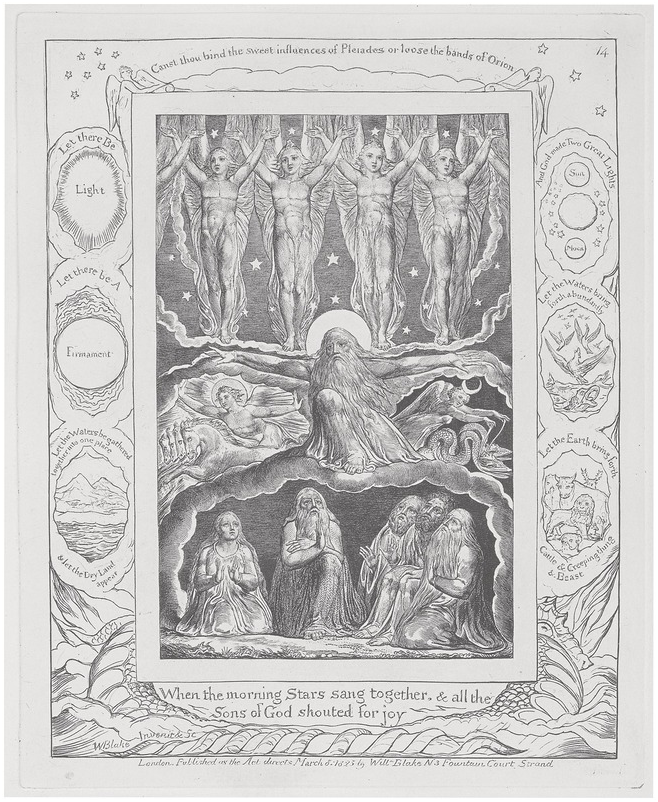

 Open access