

Give a man a fish, feed him for a day, Teach a man to fish, feed him for his life. Lao Tsu, 600 bc
Supporting people in becoming skilled at looking after themselves was recently reaffirmed as ‘one of the key pillars of the NHS Improvement Plan vision for a patient-centred care system’. Reference Cayton1 There is growing evidence in physical healthcare that people with long-term conditions find self-care and self-management to be effective in improving quality of life and promoting appropriate use of services. Reference Foster2
Supporting self-care is a specific work stream arising from the national service framework for long-term conditions linked to the Department of Health's Expert Patient programme. 3,4 Self-care and self-management have an established role in recovery-based practice, 5 and are in line with the expectations laid out in the White Paper Our Health, Our Care, Our Say 6 and in the Department of Health's guidance Supporting People with Long-Term Conditions to Self Care. 7 Additionally, the Royal College of Psychiatrists, along with other medical Royal Colleges, is now required to include competencies in supporting people in self-care in their core curricula.
There is every indication that self-care is ‘an idea whose time has come’, Reference Cottam and Leadbeater8 and the past 10 years have seen the development of a wide range of supports and programmes for self-management of mental health (Box 1). Self-care and self-management approaches are increasingly popular but of uncertain value. An international review Reference Singh and Ham9 found comparatively little experience of self-management methods in mental health settings, no real evidence of impact, and no real clarity on how self-management could be promoted in mental health services. The need for ‘further research on successful methods of supporting self-management and recovery’ identified in the Royal College of Psychiatrists' Fair Deal campaign 10 remains a call that has yet to be answered.
The Wellness Recovery Action Plan (WRAP) is, internationally, the most popular self-management tool for maintaining mental health. Reference Slade11 Although there is a large and growing body of anecdotal reports of benefit, Reference Deegan12-Reference Copeland14 it is largely under-researched. One of the few studies of outcome in using WRAP Reference Copeland15 reported beneficial changes (significant improvement in self-reported symptoms, recovery, hopefulness and self-advocacy), but it was uncontrolled and described self-reported outcomes over a very limited time (1 month). Another study found WRAP significantly associated with an increase in participants' hope for recovery, taking responsibility for their own wellness and having a support system in place. Reference Cook, Copeland, Hamilton, Jonikas, Razzano and Floyd16
The WRAP tool is a structured approach that is written, owned and used by the individual. It is constantly updated in the light of a person's experience of what works for them. It supports a process of structured reflection leading to action plans that an individual uses to modify or overcome adverse experiences and promote well-being. This requires a personal commitment and active engagement to staying well and an ambition to be in control of one's own life. It involves developing a ‘wellness toolbox’ of skills and strategies, planned responses to increasing levels of difficulty and distress, and a crisis plan (advanced directive) as a guide to be followed in the event of recurring severe mental health problems.
The UK mental health organisations' Future Vision Coalition Reference Cook17 highlights WRAP as a key system that supports ‘people with mental distress to work with professionals to identify and prioritise their own personal goals for recovery’ and states that ‘tools of this kind should be much more widely used in everyday practice in mental health services’. Following various training initiatives, WRAP has been used extensively in the south-west of England (www.recoverydevon.co.uk), is promoted by the Black Wellness Initiative (www.blackwellness.co.uk) and forms the core of personal recovery planning at South West London and St George's Mental Health NHS Trust. 18 It has also influenced other illness-specific approaches such as Recovery In-Sight for bipolar disorder (www.recoveryin-sight.com) and there is currently a major national training programme aimed at developing a cohort of WRAP trainers in Ireland, funded by the Department of Justice, Equality and Law Reform (www.imhrec.ie).
Box 1 Supportive resources for self-care and self-management
Information
-
• Mental Health Information from the Royal College of Psychiatrists: www.rcpsych.ac.uk/mentalhealthinformation.aspx
-
• British Association for Behavioural and Cognitive Psychotherapies: www.babcp.com
-
• The Northumberland series of self-help leaflets: www.ntw.nhs.uk/pic/?p=selfhelp
Guidance
-
• Glasgow Steps, stress related topics: www.glasgowsteps.com/self-help
-
• The Expert Patient Programme for self-care in long-term conditions: www.expertpatients.co.uk
-
• Promoting Optimal Self Care: www.swirl.nhs.uk/resource/164
-
• FearFighter: www.fearfighter.com
-
• The Mood Gym: www.moodgym.anu.edu.au
-
• MDF The BiPolar Organisation (Manic Depressive Fellowship): www.mdf.org.uk/index.aspx?o=56979
Support for self-defined self-management
-
• The Wellness Recovery Action Plan: www.mentalhealthrecovery.com; www.recoverydevon.co.uk
-
• Pathways to Recovery: A Strengths Recovery Self-Help Workbook. By P Ridgway, D McDiarmid, L Davidson, J Bayes, S Ratzlaff. Kansas University School of Social Welfare, 2006
-
• Rethink's recovery and self-management project: www.rethink.org/living_with_mental_illness/recovery_and_self_management/index.html
-
• Recovery In-Sight, lifestyle development programme for people with bipolar disorder: www.recoveryin-sight.com
Online self-care planning
-
• Blue Salmon: www.lemosandcrane.co.uk/bluesalmon_trial/
-
• WRAP planning: www.cequick.com/myeln/copeland/default.asp
-
• Living Life to the Full: www.livinglifetothefullinteractive.com
Wellness Recovery Action Plan originated from a service user perspective and is largely delivered by peers (people who have experience of mental distress and who may have used services). The benefits of peer-delivered services and supports have been summarised as including: Reference Perkins and Rinaldi19
-
• positive role modelling (‘If you can, maybe I can too’)
-
• emotional and social support and empathic connection
-
• authenticity of the trainers having experience of using methods they are teaching
-
• practical and usable information and strategies from those who have used them
-
• a sense of normalcy through interacting with others with shared or common experience.
The inception of support time and recovery (STaR) workers followed recommendations from the Workforce Action Team convened by MPs to consider the implications of the national service framework for adult mental health. Reference Corrigan, Muser, Bond, Drake and Soloman20 For the first time, a group of workers were explicitly recruited for their personal qualities rather than professional qualifications, and their personal experience of mental health problems and services was also valued. It was intended that they would work in a variety of statutory and non-statutory settings, provide practical support, promote independence, and support service users in self-care with the aim of empowering them to lead ‘ordinary lives’. Support time and recovery workers were the first and so far only group of mental health workers to be systematically trained in the ten essential shared capabilities for mental health practice, which included training in recovery and supported self-management with WRAP. Reference Copeland14,21
Method
Setting
Devon was an early adopter of the national STaR training initiative and has one of the best networks of STaR workers. 5,10,Reference Hope22 Over 300 people from a wide variety of backgrounds have so far participated in training, which was offered free on an unselected basis to all who were interested. This included service users and carers, workers for voluntary and third-sector agencies, housing support workers and unqualified workers in statutory services undergoing conversion to become STaR workers (see STaR section of www.recoverydevon.co.uk). There was no specific offer or expectation that people who did STaR training would subsequently be employed as STaR workers. The STaR programme offered an entry-level experience for people engaged with, or contemplating, mental health work and strongly represented the values and principles of recovery-oriented approaches which are being broadly promoted in Devon. 10
The STaR initiative in Devon therefore provided an opportunity to see how training unqualified healthcare workers in a specific self-management tool benefits people using WRAP and what helped and hindered that learning. We hypothesised that people with STaR training who also had personal experience of using WRAP, and therefore worked as peers, would be more able to offer that support to others. The study was commissioned by the Devon STaR steering group, with whom we have collaborated on the study design and delivery.
Sample
The questionnaire was sent with a self-addressed return envelope to all participants in the first 2 years of STaR training in Devon (n=128), and followed by a reminder letter and another copy of the questionnaire 6 weeks later. The request to participate was signed by the lead for STaR training in Devon, who was known personally to all participants. Trainees were geographically dispersed and worked for a wide range of statutory and non-statutory employers, were unemployed or independent. A subsequent telephone check revealed that only 71 were still contactable at the addresses they had originally given and they were our study sample.
Data collection
The questionnaire comprised quantitative and qualitative questions. The former covered basic demographic details, training experience, subsequent confidence in WRAP and experience of introducing WRAP to others. The latter asked three open-ended questions on what helped or hindered engagement with WRAP and what could improve this.
-
1 Thinking about those who did take up WRAP and use it, what helped - what are the key issues?
-
2 Thinking of those who did not take it up or use it, what hindered this - what are the key issues?
-
3 If the overall aim is to enable WRAP to be put into practice and to encourage people we are working with to develop their own WRAP plans as a support for self-management, what would enable this to happen?
Analysis
The quantitative results were analysed using SPSS for Mac OS and free-text responses were thematically analysed by two researchers (L.H. and W.I.). The themes and the percentage of respondents positively identifying each theme were recorded. Any disagreements were resolved through discussion or categorised as ambiguous (uncoded). We were supported in both analyses by researchers highly experienced in quantitative and qualitative methods.
Results
Respondents
Out of the total 71 questionnaires sent out, 60 were returned completed (85%); 46 respondents (77%) were female, which was representative of the study sample as a whole. Forty-four of the respondents (73%) were over 40 years old. Just over 40% stated they had personal experience of a mental health problem and 33% used a WRAP plan themselves. Of those respondents who had completed the training, half were subsequently employed in STaR roles, a third of whom reported personal experience of mental health problems.
Training and confidence
Seven respondents had been trained in WRAP within the previous 6 months, 22 within 6–12 months and 25 over the past 12 months; 6 respondents had not been trained in WRAP despite this being core to STaR training. A third of respondents described feeling very confident at introducing WRAP to service users and a further half stated they were moderately confident.
Introducing others to WRAP
At the time of the study, respondents stated they had introduced a total of 477 service users to WRAP (mean=9, range 0-80), of whom 207 (43%) had taken it up. There was no significant difference between individuals currently employed as STaR workers and others in how many service users they introduced to WRAP, and we did not find any association between age of STaR worker and numbers introduced. There was a non-significant trend for those who had personal experience of mental health problems to introduce more people to WRAP. Those who used WRAP themselves introduced an average of 14 people compared with 6 for those who did not.
What helped and what hindered WRAP take up?
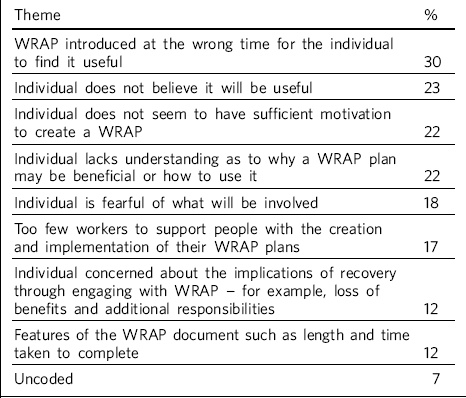
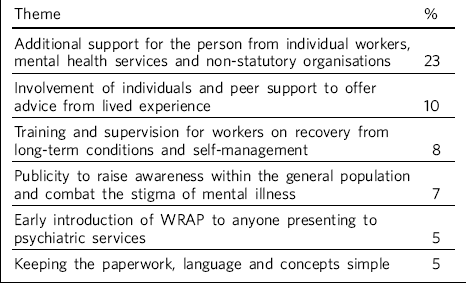
A number of themes emerged during analysis of the free-text responses regarding WRAP take up. The themes and percentage of respondents positively identifying each theme are included in Tables 1, 2, 3. Engagement with WRAP is mediated by a range of factors, but with emphasis on the benefits of a structured approach, introduced with adequate support and at the right time for the individual.
What helped engagement with WRAP?

| Theme | % |
|---|---|
| Individuals valued the structured approach of WRAP and the identification of triggers | 53 |
| Individuals with good insight and understanding about their mental health were more likely to participate in producing and using a WRAP plan | 30 |
| Offering choice and giving control to the individual made them more willing to engage in producing a WRAP plan | 28 |
| Support from workers to help the individual produce a WRAP plan | 18 |
| A person-centred approach which is tailored to meet the individual's needs | 17 |
| Introducing the WRAP at an appropriate time or stage in the illness when the individual is able to engage with the process and explore what works for them | 5 |
| Uncoded | 3 |
What hindered engagement with WRAP?
| Theme | % |
|---|---|
| WRAP introduced at the wrong time for the individual to find it useful | 30 |
| Individual does not believe it will be useful | 23 |
| Individual does not seem to have sufficient motivation to create a WRAP | 22 |
| Individual lacks understanding as to why a WRAP plan may be beneficial or how to use it | 22 |
| Individual is fearful of what will be involved | 18 |
| Too few workers to support people with the creation and implementation of their WRAP plans | 17 |
| Individual concerned about the implications of recovery through engaging with WRAP – for example, loss of benefits and additional responsibilities | 12 |
| Features of the WRAP document such as length and time taken to complete | 12 |
| Uncoded | 7 |
What could improve engagement with WRAP?
| Theme | % |
|---|---|
| Additional support for the person from individual workers, mental health services and non-statutory organisations | 23 |
| Involvement of individuals and peer support to offer advice from lived experience | 10 |
| Training and supervision for workers on recovery from long-term conditions and self-management | 8 |
| Publicity to raise awareness within the general population and combat the stigma of mental illness | 7 |
| Early introduction of WRAP to anyone presenting to psychiatric services | 5 |
| Keeping the paperwork, language and concepts simple | 5 |
Limitations
A surprisingly high number of people who had attended STaR courses had moved on from their initial contact address and were subsequently unavailable to comment on their experience. The study may have been more powerful with a control group who had no previous experience of mental health problems and supporting others in self-management, but as a naturalistic rather than experimental study this was not possible. The anonymity of the study design did not allow us to clarify the meanings of some of the responses or follow up non-responders. Neither can we comment on the effectiveness of WRAP as a self-management tool, or compare it with other approaches to self-management.
Discussion
Self-management is not another treatment but a means of people becoming more active in their own recovery, taking up more responsibility for their experience and regaining more authority and control over their lives. The Wellness Recovery Action Plan is a simple, sensible and structured tool; supporting people in self-management by introducing them to WRAP is a seemingly straightforward, if elusive, goal.
In this initial group of STaR trainees there was a wide variation in the experience of engaging people in WRAP, with seven trainees introducing none. It would appear that there is an appreciable gap between providing people with a theoretical grounding in a self-management tool and them subsequently introducing it to others, hence a continuing need to understand the obstacles between learning principles and changing practice. Clear and practical steps may be needed by organisations, professions and individuals who wish to make the shift towards recovery-oriented services. Reference Slade11,Reference Slade23
Engaging and supporting people in self-care is a required competency within the emerging core curriculum for psychiatrists Reference Shepherd, Boardman and Slade24 and an acknowledged key skill in recovery-based practice. It has been observed 25,Reference Roberts and Hollins26 that for practitioners to support people in self-management, we as practitioners may need to give up some of our power and authority and create more opportunities for personal choice. There are strong theoretical grounds for considering that support for self-management may be most effective when offered by those who have experienced and overcome similar problems themselves, a trend that also appeared in our study. There may be reciprocity between self-management and peer support such that those who have found such measures valuable themselves may be more confident and skilled at introducing them to others. Reference Roberts, Dorkins, Wooldridge and Hewis27 This is the guiding premise of the Expert Patient Programme where ‘experts by experience’ rather than (just) ‘experts by training’ may be more effective and acceptable recovery coaches to service users. 4 It also underpins the ambitious Irish national WRAP training programme (Irish Mental Health and Recovery Education Consortium), which aims to develop its cohort of WRAP trainers from people who have themselves already learnt and used WRAP. Reference Perkins and Rinaldi19
The unexpected finding in this study that many of those who had participated in training had moved on from their initial contact address or affiliation with non-statutory groups during the period covered (2 years) highlights specific workforce issues and has significant implications for turning training into services. Offering training in an open way to unselected applicants under no obligation to subsequently use their skills may be seen as a positive contribution to a broad development of a recovery culture but clearly has different implications for workforce planning. Trainees' subsequent performance may also be influenced by the expectations placed upon them, for although STaR trainees were taught WRAP, they were not specifically expected to be ‘WRAP facilitators’ and much was left to individual interpretation of the STaR role in a wide variety of personal and service provider settings. Taking an inclusive and undemanding stance to trainees may fail to deliver the hoped for benefits from training but indicates a need to reconsider fidelity issues to the STaR role, as well as a need for ongoing support and supervision.
Our study also highlights the importance of individualised, person-centred care. Workers identified insight, understanding and motivation as key mediators to participation in WRAP. This is unsurprising given the complexity of WRAP and underlines the advice that formulating a self-management plan is best done when someone is comparatively well and able to reflect on their experience.
Although self-care and self-management are prominent and valued goals of progressive services, the available models and evidence of successful outcome is partial, provisional and largely anecdotal. This study is set at the most superficial and preliminary level - can people who have been taught a self-management tool (WRAP) pass it on? Our findings of the modest transfer of learning from the inaugural cohort of STaR trainees are disappointing. However, despite its limitations, the study usefully highlights some of the complexities that need to be considered if we are to learn how to more effectively engage people as active participants in their own recovery. Additionally, it suggests that considerable care and ongoing attention need to be given to training, support and supervision if the ambitious gains are to be realised in practice.
Acknowledgements
Thanks to Ann Ley and Tobit Emmens for support in data analysis and to Laurie Davidson, STaR lead in Devon.


 Open access


eLetters
No eLetters have been published for this article.