

Introduction
Graduate programs that specialize in public health preparedness have the potential to increase disaster-related competencies and student knowledge.Reference Chandler, Qureshi and Gebbie1 These programs train students in systems-thinking, critical epidemiologic skills, and effective leadership strategies. Reference Brisolara and Smith2,Reference Kaiser, Barnett and Hsu3 The University of Texas School of Public Health reported the effectiveness of the Student Epidemic Intelligence Society (SEIS) Preparedness Training Program, a skills-based and hands-on program that prepared students to meet the future needs of local public health agencies during emergencies.Reference Montealegre, Koers and Bryson4
The COVID-19 pandemic demonstrated that there was a demand for health professionals who had leadership experience in a dynamic disaster or emergency environment. However, recent public health and medical graduates reported that disaster education was lacking in their training programs. Reference Markenson, Woolf and Redlener5,Reference Charney, Lavin and Bender6 Several academic institutions responded to the demand during the pandemic with hands-on student involvement, including contact tracing, community education, and surge capacity. Reference Brown7,Reference Satterfield, Goodman and Keiser8 The University of Oregon offered Corona Corps in which 40 students helped COVID-19 patients access food, housing, health care, mental health services, and financial assistance.Reference Brown7 Importantly, Corona Corps students were also active in disease management, containment, education, and mental health.Reference Brown7 Also, the University of Texas Medical Branch at Galveston collaborated with the Texas Area Health Education Centers East to mobilize 250 student volunteers in interdisciplinary teams to distribute and administer the COVID-19 vaccine.Reference Satterfield, Goodman and Keiser8
Despite the need for public health professionals who can respond and lead during a disaster or emergency, there is a gap in the literature on the response of academic institutions in providing courses and training to improve understanding of public health preparedness, homeland security, and emergency management. Recognizing in the fall of 2020 that the SARS-CoV-2 vaccines were in clinical trials and may soon receive emergency use authorization, Penn State faculty and staff launched a special topics graduate course intended to develop public health professionals who could lead during the clinical testing and the rollout of the vaccines. The objectives of this brief report were to: (1) describe the development and delivery of a special topics graduate course at Penn State University focused upon clinical and public health aspects of the SARS-CoV-2 vaccines, (2) evaluate the student experience, and (3) inform future efforts to train health professional students to lead in a rapidly changing disaster or emergency environments.
Methods
In 2006, Penn State University began online graduate training in public health preparedness through the Penn State World Campus via the degree program now known as the Master of Professional Studies (MPS) in Homeland Security-Public Health Preparedness. The mission of Penn State World Campus is to “… provide the Penn State educational experience to anyone, anytime — focusing on convenience, flexibility, and quality in delivering accredited degrees and certificates online.”9 Penn State’s MPS degree program was the first and remains the only homeland security graduate program offered by a College of Medicine.10
To address the urgent need to train leaders in the immunology and rollout of SARS-CoV-2 vaccines, Penn State offered in the spring of 2021 a special topics course “PHP 597: Vaccines, Immunity, and Homeland Security: A Case Study of the SARS” to all students including those not in the MPS program. The course examined laboratory, public health, medical, and policy components related to the vaccine. The course also evaluated the homeland security aspects of the pandemic, including biocybersecurity and vaccine diplomacy. The course was intended for graduate students who were interested in the scientific, policy, and public aspects – both domestic and international – of immunity, vaccines, and vaccination. Along with course learning materials and weekly discussions, students participated in a research project that assessed knowledge, attitudes, and perceptions related to specific issues of the SARS-CoV-2 vaccine(s), such as the efficacy and safety standards, vaccinations of special populations, and biocybersecurity for manufacturers.
At the end of the spring semester, students anonymously evaluated the course with Penn State’s standard course evaluation method using the electronic end-of-the-semester assessment that included qualitative and quantitative components. Quantitative questions used a scale from 1 (least favorable) to 7 (most favorable) and were analyzed with descriptive statistics using R Statistical Software (v4.1.0; R Core Team 2021). Qualitative comments were analyzed thematically.
Results
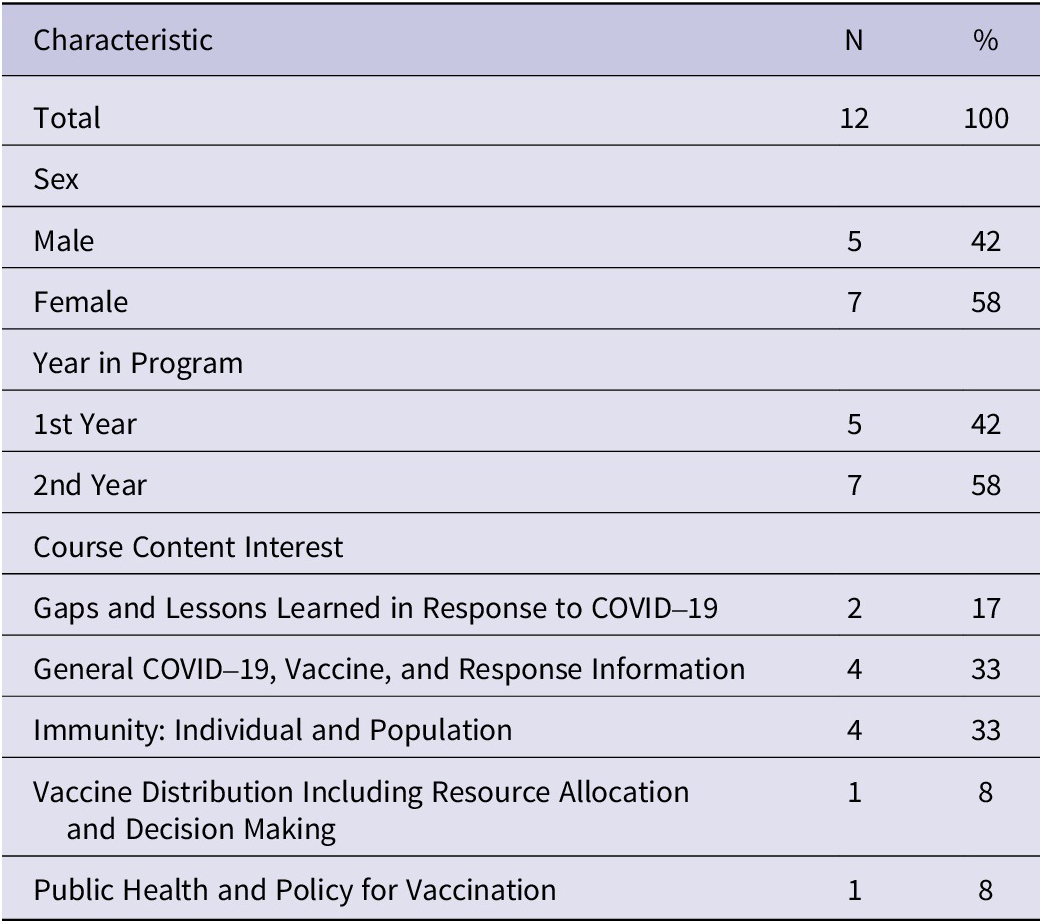
Twelve students enrolled in “PHP 597: Vaccines, Immunity, and Homeland Security: A Case Study of the SARS-CoV-2 Pandemic.” Of the 12 students, 5 were male and 7 were female; 5 were in their first year of graduate school and 7 in their second year (Table 1). Most students reported that they were interested in general COVID-19 knowledge, vaccine development, and immunology at both the individual and population levels. Other areas of interest included: (1) gaps and lessons learned in response to COVID-19, (2) vaccine distribution information with regard to resource allocation and decision-making, and (3) insights related to public health and policy for vaccination.
Demographic characteristics and course content interests of students enrolled in the special topics course. Rapid response in graduate training. (Source: Penn State Graduate Students Enrolled in PHP 597: Vaccines, Immunity, and Homeland Security: A Case Study of the SARS.)

Course Development and Instructional Team
Eight instructors assisted in the development and delivery of course material. Instructors included Penn State professors, an instructional designer, a Certified Child Life Specialist, an epidemiologist at the Central Utah Public Health Department, and a web developer. The various backgrounds and professions fostered discussions from a variety of perspectives. Research interests and experience of faculty at the Penn State College of Medicine varied as well, with one professor who previously conducted outbreak investigations as an Epidemic Intelligence Service Officer while serving as a preventative medicine resident at the Centers for Disease Control and Prevention. Another faculty member is a member of the US Coast Guard Reserve who is a countering weapons of mass destruction subject matter expert focused on natural and terrorist threat assessments, as well as non-medical obstacles in public health preparedness (PHP). The course also included a professor interested in communication, systems, and policy interventions to address vaccine hesitancy. The final professor collaborated with scientists and engineers to develop a free, online COVID-19 course for middle and high school teachers that focused on virology, epidemiology, and PHP. Throughout the semester, the course invited guest lecturers which included a local health department representative who spoke about vaccine accessibility for underserved populations and an epidemiologist who participated in clinical trials for vaccines.
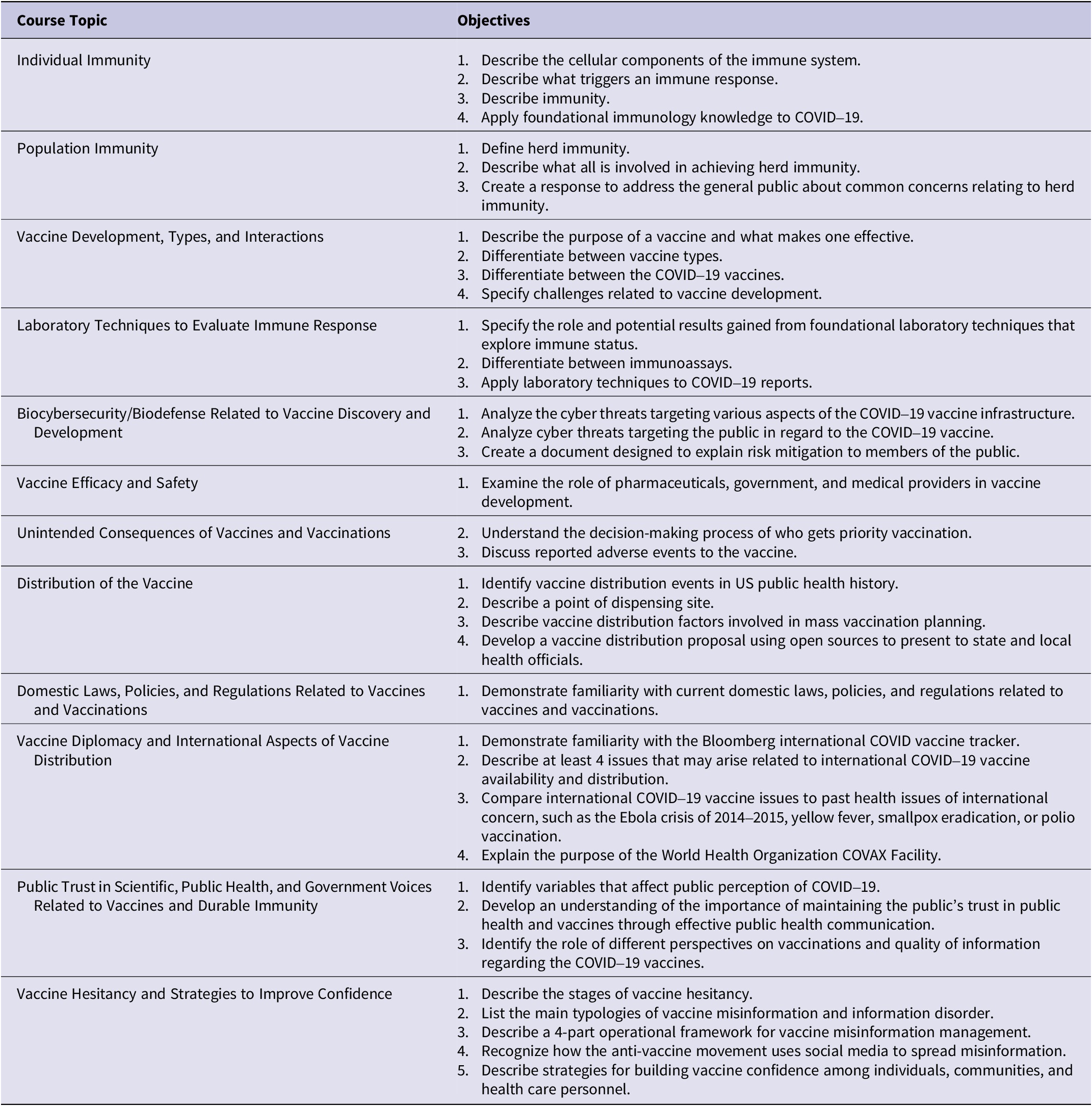
Over the 16-week spring semester, the specialized course covered a variety of topics and objectives (Table 2). Students were asked to complete weekly discussion board posts where the lecture material was applied to the related objectives, while also creating a sense of community among students. During each week, a live (optional) session was offered where instructors and guest speakers reviewed lecture material, addressed questions, and discussed current events with students.
Course topics and objectives met in the special topics course. Rapid response in graduate training. (Source: PHP 597: Vaccines, Immunity, and Homeland Security: A Case Study of the SARS Course Description.)

Coursework—Final Project
At the end of the spring semester, students were asked to select 1 of 4 topics and to work with their team to develop a presentation. Teams included 2-4 students and as a team, they submitted a 10-minute recorded presentation that incorporated evidence for their topic to the class. For those who selected “Persons with previous COVID-19 infection, confirmed by a PCR test,” questions addressed in the presentation were (Reference Chandler, Qureshi and Gebbie1) should they get vaccinated, (2) how many doses, (3) what factors would you consider tailoring your recommendations, and (4) for those who are recommended vaccination, in what phase of vaccine distribution would you recommend? Students who selected, “US Secretary of State” addressed questions (1) should the US divert a substantial portion of its vaccine supply to low and middle income countries before all those in the US who want and are eligible to be vaccinated, (2) what conditions should exist in the US before you recommend vaccine distribution to low and middle income countries, (3) what are the characteristics of the countries that you would/would not consider eligible, and (4) would you recommend future expectations be imposed upon the countries that receive the vaccine? The project focused on “Pennsylvania Health Director” addressed (1) what is the current population level immunity to SARS-CoV-2, (2) in addition to an overall immunity, what specific population strata would you want to know the immunity of, (3) what are the immunity levels, by strata, that you would use to declare “herd immunity” has been reached, allowing commerce and travel to return to pre-COVID situation, and (4) would you incorporate variants into your discussion and recommendation? The final topic area, “Pregnant women,” included questions (1) should pregnant women be vaccinated, (2) would your recommendations be tailored to the stage of pregnancy, (3) would you consider the conditions of the mother, (4) would you use the mother’s immune status in your recommendation, (5) what vaccination rollout phase would you place pregnant women, and (6) would you recommend a specific vaccine manufacturer? Following the submission of the recorded presentations, students were then asked to review and comment on at least one other group’s presentation.
Qualitative and Quantitative Student Evaluation Results
Of the 12 students who completed the anonymous end-of-semester evaluation for the course, both the median and mode scores were 7. Students reported that the course was “timely” and “breaking down complex concepts into simple understanding.”
Discussion
The COVID-19 pandemic disrupted graduate education and required academic institutions to revise well-established instructional content and strategies. In response to the disruption in education, the Penn State College of Medicine offered an innovative course through the collaboration of a multidisciplinary team with the goal to develop students’ real-time understanding of COVID-19, the vaccine, and mitigation efforts. The multidisciplinary team included faculty, graduate students, alumni, and an instructional designer and resulted in the online, hybrid course focused on the development, approval, and dissemination of the SARS-CoV-2 vaccines. The course covered real-time laboratory, public health, emergency management, medical, homeland security, and policy aspects of the COVID-19 vaccines. Pedagogical techniques used to convey the information included weekly modules, discussion boards, guest speakers, and a group project. Within each module, teaching faculty employed in strategic positions offered real-world COVID-19 challenges and adjusted content based on COVID-19 reports. With both the median and mode scores for the course being 7, the course prepared students for their future careers in public health preparedness, homeland security, and emergency management. The success in the format of the course and its content provided students an opportunity to improve their understanding of the COVID-19 pandemic from a variety of subject areas, and the course’s success supports the idea to use this as a model for future classes at Penn State University.
Limitations and Strengths
For our brief report there were 2 limitations. First, a pre-test was not administered on course-related content prior to the start of classes. Therefore, we are unable to measure if the course material was accurately interpreted. Second, the class size was relatively small with12 students, which may impact course evaluation results. In the future, classes based on the content in PHP 597 with similar pedagogical techniques will need to be offered in larger class sizes to see if similar results arise.
Despite these limitations, the report had several strengths. First, to our knowledge, this was the first time a rapid response course was offered to graduate students aimed to develop unique skills that were applicable to public health preparedness, emergency management, and homeland security in relation to the COVID-19 vaccine. Second, the course provided a real-time learning opportunity that was well received by students. Third, since the World Campus is an online degree platform, students enrolled in the course had experience in an online educational environment, limiting potential technological challenges. Fourth, within the online learning environment, instructors provided insight to students on challenges faced related to the COVID-19 vaccine and how to develop feasible solutions based on reliable informational resources which enhanced strategic and critical thinking processes.
Conclusions
To address topics with regard to the COVID-19 pandemic response and vaccines, Penn State offered “PHP 597: Vaccines, Immunity, and Homeland Security: A Case Study of the SARS In the spring 2021 -CoV-2 Pandemic.” The hybrid course offered flexibility for both students and instructors to change topics and subject areas to best fit the interest of students as well as current events related to the pandemic. Students enrolled in this course were able to take away real-time information about the COVID-19 pandemic and apply it to pandemic hypothetical scenarios.
Data availability statement
The datasets generated and/or analyzed during the current study are not publicly available due to the data being collected as confidential course evaluation but are available from the corresponding author on reasonable request.
Acknowledgments
We thank all authors for the design of course materials, providing lectures to students, and comments on the manuscript.
Author contribution
All authors took part in the course and manuscript development. All authors read and approved the final manuscript.
Funding statement
None
Competing interests
The authors declare none.
Experimental protocols and informed consent
The manuscript did not conduct experiments on humans and/or the use of human tissue samples; thus, ethical approval or consent is not applicable to the study
Consent for publication
Not applicable
Availability of data and materials
The course rating is based on an internal, optional, end-of-semester survey where students can rate the course as well as indicate strengths and weaknesses of the course. The survey is deidentified.

 Open access

