

Introduction
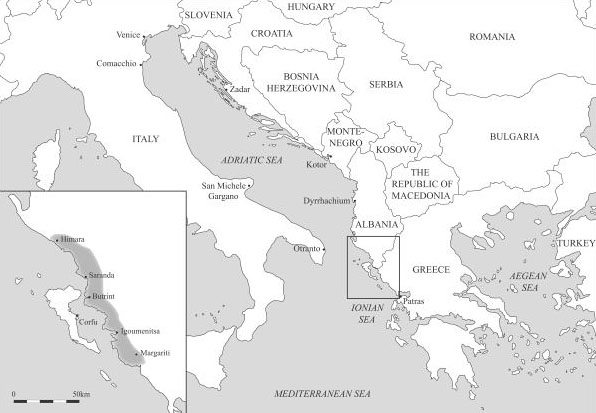
Butrint, ancient Buthrotum, located 3km from the Straits of Corfu on the Vivari Channel at the south end of Lake Butrint in Albania (Figure 1), is a typical illustration of an ancient city that declined in late antiquity before experiencing a Mid Byzantine revival that endured until the later middle ages (Reference HodgesHodges et al. 2004). Occupying a fertile coastal niche extending 10km into a mountainous valley and with access to legendary amounts of fish in Lake Butrint, the seaport of Butrint - on a major artery through the central Mediterranean - was a weathervane of geo-political changes in the region. Recent excavations at Butrint have thrown light on a significant if previously unknown historical episode in its post-Roman history that, in turn, begs questions about the settlement history, ethnicity and geo-politics of this region in the eighth and ninth centuries AD.
Map showing the location of Butrint and associated Adriatic sites (including the territory of the Baiounetai).

Butrint lies in a region known by the thirteenth century as Bagenetia or Vagenetia, a term that can be traced back to the Slavic tribe known as the Baiounetai (Reference ChrysosChrysos 1997: 184-5; Soustal in Hodges et al. 2004: 20-22; Reference CurtaCurta 2006: 103) and which survived until the sixteenth century. The so-called Partitio Romaniae, a document of 1204 describing the division of the Byzantine Empire, records the chartularaton de Bagenetia.
Between the seventh and tenth centuries the few sources make it difficult to judge whether Butrint was in Byzantine or Slavic hands. Occasional finds of so-called Komani jewellery from the region point to contacts with post-Roman tribes from inland Albania (see Reference BowdenBowden 2003; Reference CurtaCurta 2006: 103-4). However, a lead seal found in the Lower Danube region, belonging to a certain Theodorus who was the imperial spatharios and archon of Vagenetia, suggests the region and perhaps Butrint's allegiance was to Byzantium (Reference CurtaCurta 2006: 103; see also Reference ChrysosChrysos 1997: 184-5). In the so-called Notitia of the Iconoclasts, compiled after AD 754, Butrint - Bythipotu - is listed as the fourth and penultimate city of Old Epirus, subject to Nikopolis. In 880-884, St. Elias the Younger and his pupil Daniel were accused of being Hagarenes (foreigners) and spies, and imprisoned at Butrint (polis epineios) by a man presumed to be a Byzantine official. In 904 the relics of St. Elias, who had died in Thessalonika, were brought to Butrint to be taken from there to Calabria. Little more is known about Butrint as a town at this time. Arsenios of Corfu (876-953), who apparently visited Epirus to plead with Slav pirates, recorded that Butrint was rich in fish and oysters, with a fertile hinterland. In sum, between the seventh and ninth centuries Butrint lay in a territory controlled by a local tribe - possibly of Slavic affinity or origin - that intermittently maintained official connection with Constantinople and adhered to a Byzantine administrative ethos (Soustal in Reference HodgesHodges et al. 2004).
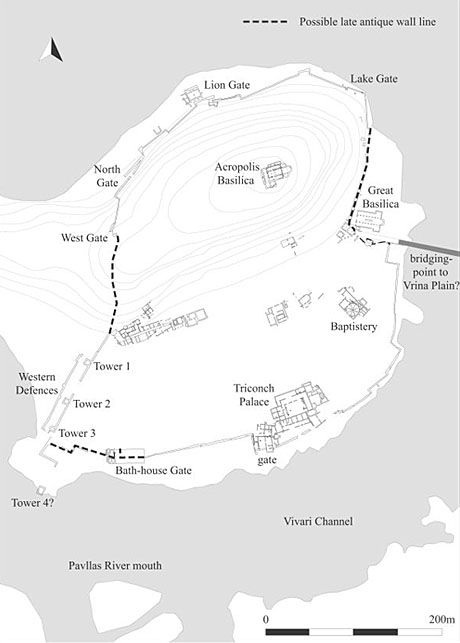
Map of Butrint showing the location of the towers in the western defences.

The towers: destruction and assemblages
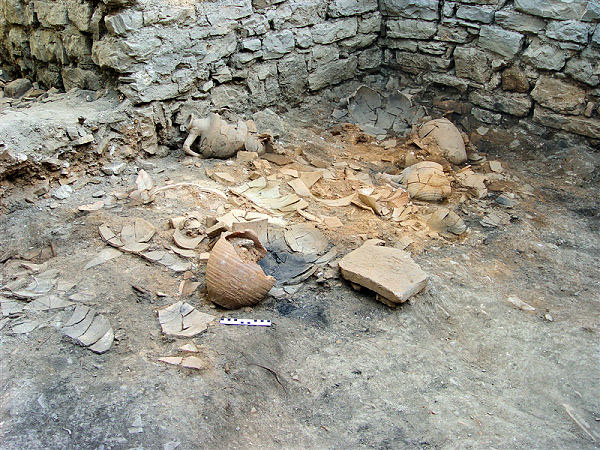
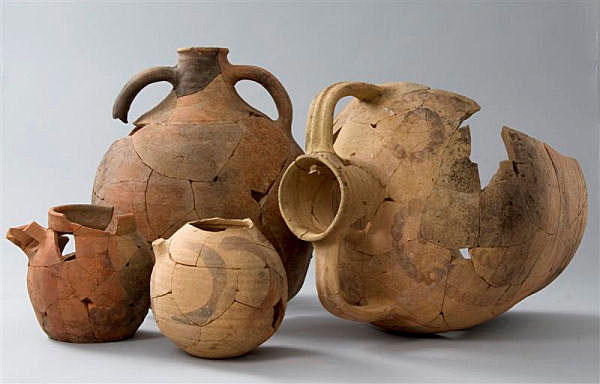
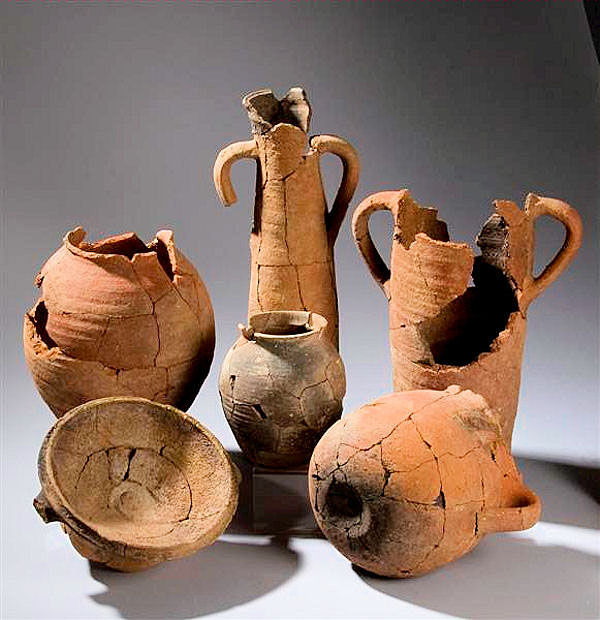
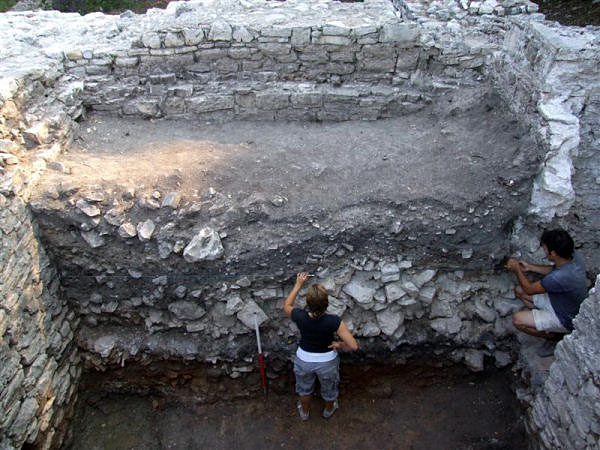
Surveys and extensive excavations at Butrint have now identified the principal stronghold of this period, not on the acropolis as was once believed (Reference HodgesHodges et al. 2004; Reference HodgesHodges 2006) but in at least two adjacent towers in the lower city's west-facing, seaward defences (Figure 2). The fortifications and towers were erected in the later fifth century (Reference HodgesHodges et al. 2004: 131) and the towers have a remarkable Mid Byzantine history. Both towers were burnt down, sealing a rare and rich assemblage of artefacts. In the first tower, excavated in 2004 and 2007, the tiled roof and two floors above collapsed, crushing the stored contents on the ground floor beneath a layer of charcoal 15cm thick (Figure 3). Tucked just inside the door of the tower, lay a crate of glass comprising 61 goblets and cullet - a consignment destined for a glass-maker (see Reference WhitehouseWhitehouse 2003). Some of the goblets are of sixth- or seventh-century date; most were locally made and date to the seventh to ninth centuries. Next to the glass consignment was a line of smashed - mostly globular - amphorae from Otranto and other parts of southern Italy (Figure 4), the Crimea and other parts of the Aegean (perhaps Crete). Fragments of Unglazed White Ware jugs from Constantinople were present as were part hand-made, part wheel-thrown locally made pots, among them shapes of vessels of so-called 'Avaro-Slavic' looking Ware (Figure 5), as well as two chafing dishes or portable ovens. A small painted Hellenistic aryballos was also amongst the medieval pots, looted no doubt from the city's ancient cemetery.
View of the destruction level in Tower 1.

Selection of south Italian wares (including an amphora with painted decoration, probably from Otranto) from Tower 1.

Selection of locally made ceramics from Tower 1.

Excavations in 2008 of the adjacent tower lying 40m to the south produced a similar assemblage, again in a destruction level comprising a collapsed roof, floors and a thick charcoal layer (Figure 6). Discovered in this debris were a portable oven identical to those from the first tower and a group of vessels in a local fabric of an unknown shape. Two such cataclysms cannot have been coincidental; the suggestion is that the towers were destroyed deliberately, presumably in an attack.
View of the destruction level in Tower 2.

Conclusion
As yet the exact date remains imprecise. The ceramics suggest a date in the later eighth or early ninth century. The first three radio-carbon dates of charcoal associated with one of the amphorae found in the ground floor of the first tower suggest an earlier date between the sixth and mid eighth centuries (AD 555±25 (1395+26); AD 676±30 (1274+30); AD 764±45 (1186+45); University of Lecce). These differing dates may reflect the age of the timbers used in the floors and roof which collapsed into the ground-floor storage room.
Who attacked whom? The artefacts show that the towers contained the portable property of a rich household with extensive connections to all quarters of the Byzantine Empire. Butrint, we may deduce with caution, was administered by a commander sympathetic to Byzantium. Yet, as we have seen, the region, known as Vagenetia, was in the hands of a Slavic community, the Baiounetai. Was there some brief uprising as occurred, according to the Chronicle of Monemvasia (see Reference CurtaCurta 2004: 535), further south in AD 805 at Patras? This later text describes how Byzantine Patras was attacked by local Slav communities, in response, perhaps, to increased Byzantine interest in the Adriatic Sea region (Reference CurtaCurta 2006: 134-47). Judging from the archaeological evidence, Byzantine interests plainly suffered at Butrint (as at Patras), but in both cases these were soon re-established. At Butrint, though, a new settlement was established outside the walled city in the old suburb. Here an unfortified, aristocratic settlement comprising a dwelling, shrine, cemetery and workshops has been found, dated by numerous coins and four seals to c. AD 850-950 (Reference GreensladeGreenslade et al. 2006). Meanwhile both towers in Butrint were reoccupied but, judging from the mussel shell middens, only by fishermen in the eleventh or twelfth centuries, until their eventual repair in the thirteenth century.
The towers' destruction levels, in the eighth or early ninth century AD, will require more precise dating; nevertheless their assemblages and historical implications are of singular importance for the southern Adriatic, south-east Italy and the southern Balkans. These discoveries will also prove important for the on-going debates about Mediterranean trade in the eighth and ninth centuries and in particular its impact upon Venice and north-west Europe (see Reference MccormickMcCormick 2007).
Acknowledgements
Our thanks to the Butrint Foundation in partnership with the Packard Humanities Institute for supporting these excavations. Thanks too to Will Bowden, Evangelos Chrysos, Andy Crowson, Florin Curta, Oliver Gilkes, Inge Lyse Hansen, Sarah Jennings, Sarah Leppard, John Mitchell and Pagona Papadopolou.