




Oxford, Bodleian Library, Tanner 10 (s. xin. or x1, prov. Thorney), the oldest substantial copy of the Old English version of Bede’s Historia ecclesiastica gentis anglorum (OEHE), has long been recognized as one of the most important vernacular manuscripts to survive from early medieval England.Footnote 1 Tanner 10 is also one of the few decorated vernacular manuscripts surviving from the first quarter of the tenth century.Footnote 2 The work of the principal scribe-artist (Scribe 1) has been studied extensively,Footnote 3 as have the language of the text,Footnote 4 the codicology,Footnote 5 the palaeography and glossing.Footnote 6 Despite such extensive study, however, several unresolved questions and apparent contradictions persist regarding localization, the cooperation of the scribes, variations between the hands, the creation of the manuscript and the dating of its repair. Proposed dates for aspects of the decoration and the scripts, as well as for some of the scripts in relation to their orthography seem to ‘lead in slightly different directions’.Footnote 7
Since the (arguable) peak of Tanner 10 studies in the 1990s, palaeography and manuscript studies more broadly have been transformed by developments in our understanding of the work of scribes, scripts, writing as a social practice, and examinations of the complete ‘life cycles’ (sociologies) of medieval manuscript books.Footnote 8 These approaches complement efforts to standardize terminology for manuscript descriptions and scribal hands.Footnote 9 Developments in digital technologies have also revived interest in the ‘long-standing discussion of “scientific” method versus connoisseurship in palaeographical study’ and raised fascinating new possibilities for quantitative analysis.Footnote 10 However, few of these developments have yet been brought to bear on Tanner 10. This essay seeks to address this gap, with a focus on the possibility that some of the comparative methods and taxonomies of classification applied in palaeographical studies may be productively re-examined in relation to the contingencies of history, the complexities of culture(s), and the influences of human creativity.
While ‘scientific methods’ in manuscript studies increasingly refers to computer-assisted quantitative analyses and decipherment, comparative methodologies of stylistic analysis and systems of classification for scripts have been patterned on models designed for the natural sciences at least since the late nineteenth century.Footnote 11 Sometimes inherent in these models and systems are deeply embedded terminologies of evolution and development, or of judgment (despite efforts to standardize descriptive terminology).Footnote 12 This may be one of the reasons – despite explicit scholarly attempts to acknowledge the ‘cultural diversity’ and ‘degree[s] of individuality and variation’ of any given manuscript – that ‘[t]here has been a tendency to turn observations of trends into rigid dating criteria, or to interpret a characteristic feature of a period as an absolute terminus post or ante quem for the book as a whole’ in early medieval manuscript studies.Footnote 13 Notions of development, apparent in the critical language of regressive or retrospective scripts, hands or decorations in contrast with those that are innovative or fashionable, underpin (and sometimes complicate) chronologies and the assignment of dates. ‘Deliberate acts of visual anachronism’, which call attention to graphic choices, may also complicate chronologies.Footnote 14 Classifications of style, in turn, tend toward the comparative; that is, they are relational, and therefore structural. Engaging the concepts of writing as a social practice and ‘eventful analysis’, in light of cultural history and the ‘material turn’ in manuscript studies facilitates a new description and interpretation of Tanner 10 that shed light on the historical and sociopolitical contexts of book production in the tenth century, as well as the human agency and creativity involved in the production of this manuscript as a whole book.Footnote 15
More specifically, after brief introductions to the OEHE and Tanner 10, I articulate the unresolved questions summarized above more fully, by providing an overview of the historical scholarship on Tanner 10. I frame an approach via eventful analysis and writing as a social practice, then discuss the complex contexts of the first quarter of the tenth century before re-examining the manuscript and all of the hands in it – with an equal focus on the work of the less well known scribes. Through these descriptions, I show that summative aesthetic judgements may have inadvertently downplayed the value of the work of Scribes 4 and 5, and obscured similarities between the hands of Scribes 1 and 5. A closer look at scribal stints in relation to the quality of the parchment across them helps to resolve questions regarding the creation of the manuscript and the relationship between the group of scribes working in s. x1. Finally, re-assessing the work of Scribe 3 in relation to the consolidations of power and religious reforms occurring across the tenth century, I suggest the possibility that Tanner 10 traveled to Thorney Abbey via the cultural orbit of Dorchester and Abingdon, where it may have been repaired under the influence of Bishop Æthelwold.
The OEHE
The OEHE survives in five manuscripts and three brief excerpts, dating from c. 890 through to the second half of the eleventh century.Footnote 16 It was translated anonymously in the ninth century; according to Greg Waite, the translation was made ‘perhaps in the West Midlands, and within the framework of a culture of Mercian vernacular translation and literary composition’.Footnote 17 In varying degrees, all of the OEHE manuscripts have been updated to the late West Saxon dialect.Footnote 18 While the OEHE was long associated with King Alfred’s programme of translation and education, linguistic evidence suggests that it was translated independently; codicological evidence suggests it was incorporated into Alfred’s programme via compilation and paratexts.Footnote 19 While all five manuscripts derive from a common exemplar, Miller identified two branches based on a divergent section in Book III, Chs. 16–20 in three manuscripts, C, O and Ca (T and B contain the original translation of this section).Footnote 20 Of the surviving manuscripts, only B and Ca contain the front matter; T and O lack beginning and end. C, which originally contained the front matter, was damaged badly in the Cotton Fire of 1731.Footnote 21
The bulk of the translation was made by one principal translator, while the list of Chapter Headings, the Preface, and the divergent section in Book III (in C, O and Ca), were added by three additional translators.Footnote 22 The OEHE abridges Bede’s HE by about a third, cutting primarily Bede’s accounts of Roman Britain, the Pelagian heresy and the Easter Controversy, along with some passages about foreign people and places, and papal letters. In all manuscripts of the OEHE, Gregory the Great’s Libellus Responsionum is placed after Book III, rather than at the end of Book I.Footnote 23 The overall effect of the abridgement is to focus the OEHE more on conversion and the development of the Church, key early English saints and local history.Footnote 24
Tanner 10: the Basics
Tanner 10 contains 139 folios, now foliated 1–139 (replacing an older foliation that omits torn fol. 2 and the originally blank fol. 67). The average size of the leaves after cropping is c. 250 × 165mm, with a written space c. 177 × 107 mm. With one exception in Quire 16, the sheets are ‘arranged so that the hair was outside’.Footnote 25 Tanner 10 was rebound in 2003 by Robert Minte; it was resewn on double linen cords, with double-core primary end bands, laced into quarter-cut oak boards, and covered with alum-tawed goatskin.Footnote 26 Three quires are missing from the beginning and two from the end.Footnote 27 Two series of quire signatures appear at the foot of the pages (some lost); the first series of quire signatures begins with c on 7v and ends with y on 77r; the second series also begins with M at the start of Quire 11 on 77r (also); Ker considered these to be contemporary but Gameson suggests that they are later.Footnote 28 Tanner 10 was also damaged by water in 1731, when it was submerged with the barge transporting Thomas Tanner’s books from Norwich to Oxford.Footnote 29
The majority of Tanner 10 was written by four scribes working sometime in the first quarter of the tenth century; the specifics of their stints are articulated below.Footnote 30 Scribe 3 added a quire and singletons after fol. 104 sometime later in the tenth century (115r is a palimpsest recopied to smooth the insertion).Footnote 31 There is no way to know if additional scribes worked on the lost quires.
The appearance of English Square minuscule in Tanner 10 suggests that some or all of the manuscript was written ‘south of a line running from the Thames to the Severn’, but the exact centre at which it was created remains unknown.Footnote 32 On the basis of place names, Thomas Miller suggested that Tanner 10 may have originated in the midlands.Footnote 33 Waite has shown that ‘Tanner 10 is at some remove from the archetype of surviving manuscripts, which is itself at least one remove from the author’s copy’; this further supports the ninth-century date of translation indicated above.Footnote 34
Tanner 10’s medieval provenance was most likely Thorney Abbey, where it may have been partially glossed and rebound in the fourteenth century.Footnote 35 The Thorney association is based on the use of a mortuary roll and book lending list as pastedowns in the fourteenth-century binding.Footnote 36 As Bately points out, the Thorney provenance assumes that pastedowns ‘must have been introduced into the binding at the place from which they originated’, but concludes that the ‘theory of a Thorney connection for Tanner 10, if not perhaps capable of absolute proof, is both highly attractive and extremely plausible’.Footnote 37
Overview of the Scholarship
A closer examination of the scholarship on Tanner 10 reveals conflicting assessments, localizations and dates, along with terms related to evolution and development. In ‘The Palaeography of the Parker Manuscript of the Chronicle, Laws and Sedulius, and Historiography at Winchester in the Late Ninth and Tenth Centuries’, Malcolm Parkes attributed Tanner 10 to a Winchester scriptorium as part of a small group of manuscripts including Oxford, Bodleian Library, Junius 27, based on what he saw as a ‘pattern of evolution and conformity’ in ‘palaeographical features’ and decoration, along with what he interpreted as a shift towards Continental practices in pricking and ruling.Footnote 38 Richard Gameson, however, has argued in convincing detail against a Winchester origin for Tanner 10. In ‘The Fabric of the Tanner Bede,’ he refutes Parkes’s argument ‘that the manuscript belongs in a particular tradition of changing from insular to continental methods of preparation’.Footnote 39 Gameson, who questions the accuracy of such determinations based on ruling practices, points out that ‘[e]ven the temporary switch from hair facing flesh to like facing like which was made in Quire XVI probably as a response to the unusually glaring contrast between the appearance of these hair and flesh sides is an expedient that can be paralleled in later books’.Footnote 40
In ‘The Decoration of the Tanner Bede’, Gameson further separates Tanner 10’s unique variability from the levels of standardization developing in major centres like Winchester and Canterbury. He acknowledges that the elements and forms of decoration used by Scribe 1 are ‘comparable to those in Junius 27, the Tollemache Orosius, and, in particular, … Boulogne 10’, but he argues that ‘[i]n terms of their complexity, the manner of draughtsmanship and the painting technique, they are notably closer to the examples in this last volume than to the more “polished” style of those in the first two’.Footnote 41 Gameson concludes that nothing in the ‘contents, preparation, script, nor its decoration provides positive evidence to support this’ (i.e. a Winchester origin).Footnote 42 Indeed, while Michelle Brown cautions against interpreting manuscripts based on the attraction of identified house styles, Bately points out that the ‘palaeographical features of Tanner 10 do not appear to reflect any stage in what Parkes has described as the “particular pattern of evolution”’ of the Winchester scriptorium, anyway.Footnote 43 Simon Keynes and David Dumville have also refuted Parkes’s arguments based on diplomatics; Bately agrees, calling Chaplais’s localizations ‘no more than unsupported speculation’.Footnote 44 Nevertheless, some of Parkes’s ideas, including his Winchester localization and his dating of Scribe 3 to 949 based on London, British Library, Cotton Augustus II. 44 (S 552), have continued to be cited in a range of subsequent studies.Footnote 45
Dumville’s foundational studies of English Square minuscule have also had a profound – if inadvertently confusing – impact on the study of Tanner 10. The confusion is, at least in part, due to the timing of relevant publications and the periodization suggested by his titles.Footnote 46 Bately, for instance, followed Dumville’s ‘Background and Earliest Phases’ when she described the first scribe of Tanner 10 as writing ‘the fourth of his [Dumville’s] styles of reformed Insular minuscule’ in 1992.Footnote 47 She also notes that Dumville’s date for Scribe 3, s. x2, differs from Ker’s and Parkes’s, s. xmed., adding that Dumville had yet to publish the second part of his study, ‘setting out his arguments for this revised dating’.Footnote 48 However, when Dumville published the second part of his study, ‘The Mid-Century Phases’, in 1994, he retracted his earlier account of Tanner 10, admitting that it had been ‘almost wholly derivative’ – then substantially revised his conclusions.Footnote 49 In ‘The Mid-Century Phases’, Dumville identifies Scribes 2 and 4 of Tanner 10 as writing Phase I English Square minuscule. He also reassesses the hand of Scribe 1, indicating that ‘he or she was a practitioner of one of the antecedent or transitional styles of reformed Anglo-Saxon minuscule’.Footnote 50 Dumville rejects Scribe 3 from Phase III English Square minuscule altogether.Footnote 51 While this exclusion leaves Bately’s indirect plea for the arguments behind his dating of Scribe 3 unaddressed, Dumville’s larger project was to trace a trajectory of English Square minuscule scripts that align with dated and localized charters; at the same time, however, he actively acknowledges the ‘complexity’ of the script’s history and points out that it ‘defies a simple definition’.Footnote 52
Dumville’s comparative, structural approach using ‘a firm base of dated and localised manuscripts’ is fundamental to palaeographical attributions of origin. As Peter Stokes points out, however:
such a base can be difficult to build … particularly for the Anglo-Saxon period, from which so little survives and that which does is often subject to numerous conflicting attributions from different scholars at different times; these attributions can then be cited over and over in subsequent scholarship.Footnote 53
Such issues loom large in the study of Tanner 10, though my purpose here is clarity, not critique. Scholarly citations in authoritative sources from the early 1990s and beyond lead back to Parkes’s essay and Dumville’s ‘Background and Earliest Phases’.Footnote 54 Arguably, based on titles and the date of Tanner 10 in catalogues, only someone looking for information regarding Scribe 3 would seek out Dumville’s ‘Mid-Century Phases’; pulling this material together is crucial for a fuller understanding of Tanner 10.
Another issue manifest in the scholarship on Tanner 10 is what Elaine Treharne calls the ‘non-scientific traits of connoisseurship and aesthetic preference’.Footnote 55 While the arguments Gameson uses to ‘isolate’ the principal scribe-artist of Tanner 10 and place the manuscript outside known major centres in Winchester and Canterbury are persuasive, he also emphasizes the dynamic beauty of Scribe 1’s hand and decoration.Footnote 56 In contrast, Gameson’s summative accounts of the ‘untidiness’ and ‘inherent ugliness’ of Scribes 4 and 5 provide less information.Footnote 57 Bately reiterates Miller’s description of Scribe 4 as ‘loose and diffuse’, and that of Scribe 5 from as ‘very rude’, and ‘inferior’ (from Miller and Dumville, respectively).Footnote 58 However, she does describe the letter-forms of all of the hands in Tanner 10.Footnote 59 Unfortunately, Bately’s EEMF edition is not readily available to all: according to WorldCat, it is available in only 108 libraries worldwide (cf. 2845 for Seamus Heaney’s Beowulf).Footnote 60 Furthermore, the manuscript is restricted; the full digital facsimile was only published online in October 2025 (while this essay was in press).Footnote 61 A complete understanding of Tanner 10 depends on equal attention to all parts of the book in an updated, accessible source; as Treharne puts it, ‘Every aspect of these unique handwritten books is regarded as interpretable, and necessarily so’.Footnote 62
The quality of the parchment in Tanner 10 is another point of scholarly discord. Both Bately and Gameson studied the manuscript while it was disbound, then published slightly different views. Bately indicates that: ‘The membrane used is uneven in quality and thickness and texture. Some leaves have a very pronounced grain on the hair side (e.g. fol. 70), a few have holes’.Footnote 63 Gameson, in contrast, separates the manuscript into three parts, the first being Quires I–XIII (fols. 1–99), indicating that in ‘in seven of them [the quires] the parchment is of an even thickness and quality; in the remaining six it varies markedly’.Footnote 64 By assigning ‘parts’, Gameson divides the manuscript in a way that initially seems to highlight some of the variability. He then briefly considers the relationship between the parts, concluding that the ‘interweaving of the stints of scribe i and scribe ii, and then of scribe iv and scribe v, establishes the respective contemporaneity of their work; and it is likely, given the changeover from scribe ii to scribe iv in mid-line on 117v, that the work of the second pair followed on immediately after that of the first’.Footnote 65 Bately points out that Scribe 4’s stint begins in ‘the middle of line 13 on fol. 117v’, then states that ‘unless’ Scribes 4 and 5 ‘were engaged in completing a manuscript that had been abandoned unfinished, they must have been writing at the same time as, and in conjunction with, scribes 1 and 2’.Footnote 66 Waite, who also takes orthography into consideration, picks up on this to suggest a possible rupture in time and place: ‘scribes 4 and 5 might have continued the project … at the same centre of production, but perhaps some time after scribes 1 and 2 had ceased work; or alternately they might have even taken up work at another scriptorium’, possibly using another exemplar.Footnote 67 However, the likelihood of these suggestions is hampered by the fact that the variation in the quality of the parchment does not align with the stints of Scribes 4 and 5.Footnote 68
The question of whether Scribe 1 wrote words during the stint of Scribe 5 has a direct bearing on the discussion regarding the contemporaneity (or lack thereof) of the scribes. Miller suggested this was the case in his 1898 edition; Ker concurred, stating that the ‘main hand’ wrote ‘a few words on fols. 126v, 130r, and 131r’.Footnote 69 Bately disagrees, as does Gameson, but, ‘[w]ith the possible exception of sendon (fol. 130r7 (word 2))’.Footnote 70 Miller’s statement reflects his belief that all of the scribes in Tanner 10 (mistakenly including Scribe 3) were working contemporaneously. Ker’s agreement signals as much for Scribes 1 and 5, as does Gameson’s admittance of even that one word. Bately’s rejection, in turn, allows for the possibility that the scribes were not working contemporaneously.
The studies cited here are foundational accounts of Tanner 10’s codicology, palaeography and decoration; their value cannot be overstated. Many consider the agency of individual scribes to some degree, while Gameson also considers the situation of the scriptorium, and outlines certain aspects of the cooperation between the scribes (as does Bately). Nevertheless, questions persist regarding the relationships between the scribes, the variations between their hands, and the date of Scribe 3’s intervention. Differing interpretations of the quality of the parchment and scribal hands have also raised questions regarding and the creation (or compilation) of the manuscript, along with the number of scriptoria and exemplars involved. In my re-assessment, I seek to build on these foundations in a complementary way. I propose an ‘eventful palaeography’, that draws on cultural history and the sociology of the text and writing, as well as theories of writing as a social practice and eventful analysis.Footnote 71
Writing as a Social Practice and Eventful Palaeography I: Problems and Theories
‘Classifying’, as Lawrence Nees puts it:
has been a hallmark of our cultural tradition arguably since Aristotle, but certainly since Carl Linnaeus and his Systema Naturae, first published in 1735. Everything needs to be clearly ‘fish or fowl’ and the rarity of obvious ‘missing links’ long bedeviled evolutionary studies after Charles Darwin posited a mechanism for the change of species through natural selection. Harriet Ritvo’s 1997 study of the problem posed by apparently unclassifiable real creatures such as the platypus, and imagined creatures such as the mermaid, outlines some of the strange places to which the classifying habit can lead, and how hard it is to resist.Footnote 72
Unclassifiable – or difficult to classify – scribal hands, rather than mermaids or the platypus, are the issue here, along with questions of genealogy and the ‘classifying habit’ of the western cultural tradition. As Petros Samara points out, ‘Palaeography has always tried to organize scripts and script types according to an ever more complex, and opaque, taxonomy, and the most convincing way to classify scripts is clearly to limit oneself to a small number of easy to recognize characteristics, so as to avoid ambiguity. Nevertheless, this type of exact classification also comes at a prize [sic]: a certain reductionism’.Footnote 73 The narrow limits Dumville puts on Phases III and IV English Square minuscule arguably demonstrate such an attempt to achieve taxonomic precision, although at the same time they reflect the degree to which chronologies can be selective. Nevertheless, as Derolez points out, ‘Most scholars, however, explicitly or implicitly believe that a more precise terminology is necessary, even if the fluidity of the boundaries between one type of script and another, and the impact of individual hands make such a classification necessarily artificial’.Footnote 74
While precise terminology is indeed necessary, terms such as ‘evolution’, ‘growth’ and ‘birth’ or ‘decline’, feature regularly in palaeographical taxonomies and discourse. According to Julian Brown, for example, ‘It is a commonplace of palaeography that styles of decoration evolve faster than styles of handwriting’, while T. A. M. Bishop argues that ‘[t]he history of a script is commonly one of relatively slow decline from an optimum attained by relatively quick development’.Footnote 75 Along with the powerful analytical tools that textual and manuscript studies successfully derive from models based in the natural sciences, however, also come assumptions about order and development in the natural world that may not apply as neatly to socio-cultural practices like writing and decorating manuscripts as they seem to do for genealogical analyses of manuscripts via shared error.Footnote 76 The Darwinian motivation for natural selection is the ‘survival of the fittest’ – the actual, if unexpected, results of variation that become advantages to any given species.Footnote 77 The accidental genetic mutations driving the evolution of species may on some level be comparable to contingent, variable manifestations of any given ‘script’ written by any given scribal hand, but taking this metaphor to its logical conclusion implies some kind of advantage, progress or superiority in the result. Dumville implies as much when he states that the beginnings of Square minuscule have been characterized as ‘rough’, ‘naïve’ and ‘primitive’, followed by ‘a pattern of gradual standardization and increasing scriptorial discipline’.Footnote 78 At the same time, Dumville cautions against the idea of linear development or any single source of inspiration, asserting instead that the ‘extent of stylistic variation which we discern in the century-long – that is, relatively brief – history of English Square minuscule script may be a continuing reflex of the varying influences which attended its birth and (with further variation) marked its progress through the tenth century’.Footnote 79
And yet, that ‘birth’ itself, in Dumville’s narrative, arises from a ‘seething cauldron’ of ‘many different scriptorial ingredients’, involving both ‘emergence’ and ‘progress’.Footnote 80 Such biological metaphors evoke a kind of ‘primordial soup’ from which forms of life theoretically emerged to develop through stages from single-celled to increasingly complex organisms. In palaeography, metaphors of growth and development imply notions of ‘progress’ and stages of stylistic development. As Silvia Ferrara puts it, however, ‘scripts are not genetic organisms that spring off or evolve biologically from a parent, but rather entities that reflect historical conditions, human input and deliberate intention’.Footnote 81 Origins and changes are important, as is transmission; none of these are simply ‘natural’ occurrences. Nor are ‘writing systems … gases, which inevitably ‘spread’ from areas of higher concentration to lower’.Footnote 82 Rather, stylistic change and the transmission of scripts involve human agency and ‘the choices that are made when a template is adapted into local contexts at the hands of local groups’.Footnote 83 Ferrara also argues that ‘[s]cripts are semiotic systems that stem from deliberate creative efforts, rather than from potent dictates imposed from the top, or from ethnic tags that need to be expressed one way or another, or from an agent-free evolution outside human control’.Footnote 84 While some changes may involve pressure from patrons, others may indeed be unconscious or related to the graphic education of the scribe (or the lack thereof).Footnote 85 It is also possible that the kind of ‘decline’ Bishop describes may be attributed to imitation and adaptation, while the increased standardization Dumville observes may result from self-conscious efforts of scribes themselves. The point here is not to argue against classification or productive engagement with biological models in the study of scripts or hands, but to enjoin awareness should classification inadvertently leave gaps in the analysis of a manuscript (as it has with Tanner 10), or when metaphors from the natural sciences inadvertently either elide human agency and creativity, or imply teleology or progress.Footnote 86
From this perspective, the language of ‘birth’ and ‘progress’ (both singular), arguably undermines Dumville’s otherwise nuanced discussion of how the English Square minuscule style ‘did not proceed from a single stimulus’.Footnote 87 He suggests that changes occurred, at least in part, as responses to the problem that ‘the southern scribes of Alfred’s reign (and his son Edward’s, indeed) seem to have inherited no elevated grade of Insular minuscule in their professional tradition’.Footnote 88 This suggestion begins to get at, but does not fully engage with, the complex historical contexts and contingencies leading to stylistic changes and high levels of variation across Square minuscule hands in the tenth century.
At some point in the assigning of phases – or stages – to Square minuscule, and the increasingly narrow limits of Dumville’s criteria (which are admittedly ever-directed at the clearly stated goals of the project), seem to overwhelm his earlier acknowledgements of variety across and within the script. Increasingly, uncanonical hands, like those of Tanner 10’s Scribes 3 or 5, are excluded or dismissed.Footnote 89 This trend is characteristic of ‘stage theories’ more broadly. According to William H. Sewell, such theories often ‘assume a causal homogeneity within stages but may accept a radical heterogeneity between stages’.Footnote 90 This accounts for the larger break between Insular minuscules and Square ones, but not the kind of acknowledged heterogeneity that exists within the varied practices of writing English Square minuscule – either across the tenth century, or beyond the specific centres in which Dumville locates his canonical scripts.Footnote 91 If writing is a social practice that is ‘like all human practice – fundamentally embedded in a mesh of cultural, social, material and ideological relationships’,Footnote 92 then Sewell’s observation that the common practice of ‘labeling political or social movements as backward-looking and forward-looking … contains an implicit teleological explanation of their histories’ can be applied to labels for forms of writing.Footnote 93 Accordingly, characterizing some hands or styles as ‘old-fashioned’ or ‘retrospective’ but others as ‘fashionable’ or ‘innovative’, interprets scribal choices as ‘doing the work of the future [or past] in some present’, arguably in a teleological way.Footnote 94 Gameson uses such language in relation to Tanner 10, in ways that sometimes seem to be at odds with his statement that ‘the new and old regularly – indeed almost inevitably – coexist in most scriptoria, and may even do so in the work of a single scribe’.Footnote 95 He nevertheless concludes that the ‘contrast between the first two hands points to a scriptorium at a cross-roads of writing styles’,Footnote 96 when the peoples and cultures of Britain were undergoing a series of complex, contested and contingent events and changes.
Unease with notions of both ‘unidirectional development’ of scripts and questions regarding the uniformity of house styles align more neatly with Gameson’s subsequent findings regarding scribal collaboration and visual inconsistencies in early medieval English manuscripts. In ‘Anglo-Saxon Scribes and Scriptoria’, Gameson demonstrates a wide range of ‘different patterns of [scribal] collaboration’ and suggests that ‘strict visual homogeneity was not, in general, a high priority’ in early English scriptoria.Footnote 97 He shows that variations of style, like those found in Tanner 10, may relate to ‘more general factors’, such as ‘the scriptorium itself, its location, size, nature and endowment’, as well as the need to train scribes, age, health, and even ‘the imminent departure of a particular exemplar’, though he does not connect any of these issues or possibilities explicitly to Tanner 10.Footnote 98 There are also substantial variations within and among in the hands of other early tenth-century English manuscripts, such as Oxford, Bodleian Library, Hatton 20 and London, British Library, Additional 47967.Footnote 99 According to Ker, ‘H[atton 20] has to be described at some length because of the continual variation in its make-up of script’; he also writes that the ‘variant forms of letters and strokes’ written by the main scribe ‘are endless’.Footnote 100 Also worth noting is Alistair Campbell’s statement that ‘there is no justification for the view of the editors of the New Palaeographical Society’s facsimiles that the MS [of the Tollemache Orosius] is the work of several hands’, which implies that the variations in the main hand were such that an earlier analysis interpreted the graphic evidence as signs of the work of several hands.Footnote 101 Although none of these manuscripts exhibits precisely the same patterns of collaboration or variation as Tanner 10, the fact that so many manuscripts exhibit differing patterns of collaboration and variations in graphic choices and styles supports Gameson’s assertion that ‘strict visual homogeneity was not, in general, a high priority’.
In many ways, Gameson’s work, along with that of Bately and Dumville, has clearly and carefully sought both to acknowledge the uniqueness of Tanner 10 and to attend to questions of human agency and creativity, historical contexts and contingencies.Footnote 102 But the over-arching purposes of palaeography, ‘first, to read ancient texts with accuracy; secondly, to date and localize their handwriting’,Footnote 103 pull against the unicum. On the one hand, the methods of classification that contribute to palaeography’s central goals importantly reveal ‘the character and difficulties of the primary written witnesses for the literature and history of the Anglo-Saxons be appreciated and enjoyed’.Footnote 104 On the other hand, the discourse and methods of classification do not always come value-free; rather, they can bring with them deeply embedded notions of development that even proponents of socio-cultural evolution tend to eschew or qualify.Footnote 105 As Geoffrey Clark puts it: ‘Modern sociocultural evolution abandons the concept of progress because of inherent subjectivity’.Footnote 106 Comparative methods also tend to prioritize similarities over differences, though Elaine Treharne and Fred Orton have both argued brilliantly for an equal focus on differences, because creative and/or ideological works by different individuals will differ and ‘resist rigid classification’.Footnote 107 As Leslie Webster points out, classification systems sometimes put limits on inquiry. She observes that the ‘circumscribed traditional specializations’ of arts such as stone sculpture and metalwork ‘have provided us with basic typologies and a fairly secure cultural and chronological anchorage; but’, she continues, ‘there is also a sense in which they have served as a constraint, inhibiting a wider and deeper questioning of the evidence’ – though she also notes that this is changing with interdisciplinarity.Footnote 108 So, while some of the concerns voiced in the first parts of this essay have been raised before, combining theories of writing as a social practice and eventful analysis in a palaeographical study of Tanner 10 can help to revise classificatory rhetoric, suggest the viability of other models, and bring changes wrought by the creative agency of the scribes who wrote vibrant living scripts into sharper focus in relation the complex, contingent, historical contexts and cultures of early England.Footnote 109
Writing as a Social Practice and Eventful Palaeography II: Methods
Sewell’s theory of ‘eventful temporality’ offers a theoretical framework for thinking about structural and historical change that combines attention to material resources, human agency and creativity. Rooted in the thought of Marshall Sahlins and Anthony Giddens, as an event-based, material critique of theoretical problems in both history and sociology, Sewell’s ‘eventful perspective is primarily concerned with the dynamics of social reproduction and change’.Footnote 110 Because Sewell combines materiality with a broader understanding of event and structure, and with narrative and quantitative historical strategies, his approach can be applied beyond his fields of sociology and history. This is clear from the explicit adaptation of his conceptual and methodological ideas into the frameworks of archaeology, epigraphy and beyond.Footnote 111 Key insights include the extent to which cultural and social structures ‘are not reified categories we can invoke to explain the inevitable shape of social life’ or cultural practices. Rather ‘to invoke structures’ as Sewell defines them ‘is to call for a critical analysis of the dialectical interactions through which humans shape their history’.Footnote 112 With Giddens and Sahlins, Sewell argues that structures are ‘the outcome as well as the source of social conduct’, and that they are ‘made up of both cultural schemas and material resources’.Footnote 113 He also argues that when humans act in the world, ‘cultural categories acquire new functional values’; that is, social and stylistic structures change with (and because of) use.Footnote 114 Sewell outlines the ways in which the ‘classical model of culture’ as singular has been ‘turned on its head’ by anthropological analyses since the 1960s–70s, so that ‘it now appears that we should think of worlds of meanings as normally being contradictory, loosely integrated, contested, mutable, and highly permeable’.Footnote 115
Louise Revell adapts Sewell’s conception of events, from his focus on ‘pivotal’ historical events to changes in material culture on a smaller scale in the Romanization of Britain. She suggests that evidence ‘[b]rings into question the criteria we use for identifying the event, and the importance we attach to it in terms of complete social transformation’. She points out that the significance of an event depends on the focus and or scope of research questions, in such a way that ‘[t]he challenge then becomes that rather than a return to a single narrative of events with uniform outcomes, we need to allow for a more complex interweaving of event and change, with the explicit assumption that different events may impact upon different social structures’.Footnote 116 She concludes that ‘we may need to look for the events in multiple locations, and involve multiple actors with different constraints and motivations, possibly not even working to the same end’ to analyze the ways in which a ‘sequence or cascade of events’ might accumulate to bring about social and stylistic changes.Footnote 117
Revell’s reframing of Sewell’s theories and methods in relation to archaeological evidence is useful for adaptation to palaeographical evidence, especially in the context of Boyes’s premise that ‘the social context of writing is inextricably entangled with the whole vast and messy bundle of human behaviour and culture’.Footnote 118 While Boyes, Steele and Astoreca also acknowledge that writing ‘can sometimes be seen as eternal and transcending the specific environment of its creation, its cultural meanings can in fact only be understood with reference to the multiple and overlapping contexts of its production, transmission and the various instances of reception’.Footnote 119 Examining Tanner 10 from the perspective that social and manuscript cultures in early tenth-century England were complex, contested and permeable is a step toward an eventful palaeographical analysis. This, along with recognizing scribes as creative human agents who entered into dialogic interactions through which they transmitted and changed both styles and material cultures.
The situations of the five scribes of Tanner 10 were also context- and resource-dependent. And while they seemed to be aware of the existence of ‘canonical’ scripts (Insular and Square minuscule),Footnote 120 each made their own contribution and choices. The changes in the quality of the parchment and the variations within and between the hands in Tanner 10 can be read as evidence and the result of the ‘vast and messy’ array of cultural, historical, material and political pressures and contingencies co-existing during the first quarter of the tenth century in England.
Contexts and Contingencies in Tenth-Century England
Discussion of historical contexts and contingencies depends on localization and dating, so the conclusion of the previous section and sub-heading for this one may seem problematic at first glance. However, while the specific scriptorium at which Tanner 10 was copied has not been identified, we can be reasonably sure that the manuscript was probably created ‘south of a line running from the Thames to the Severn’ or in the Midlands.Footnote 121 While a full account of the histories and cultures of these regions in the first quarter of the tenth-century is beyond the scope of this essay, that they were complex, contested, contradictory and subject to change is clear from wide range of scholarship.Footnote 122 The island of Britain during the early English period hosted ‘a complex and shifting matrix of race and ethnicity’.Footnote 123 In addition to the British and the better known Germanic gentes named by Bede as coming to the island (the Angles, Saxons and Jutes), other communities (ethnie) such as the Hwicce, Gewisse, Feppingas, Arosæte, Magonsæton also existed, but were subsumed into larger groups and kingdoms over time.Footnote 124 This is a massive topic of study in its own right; the main point here being that the name ‘early medieval England’ is a convenient umbrella term that avoids the pitfalls of ‘Anglo-Saxon England’,Footnote 125 but nevertheless glosses over the variety of ways that peoples distinguished themselves or were distinguished by others, and which changed rapidly. Indeed, as Simon Keynes and George Molyneaux (among others), have noted, ‘the kingdom of the English [was] not unified for most intents and purposes until the 960s’.Footnote 126 After the Germanic settlements and expansions, the Scandinavian raids and incursions that began in Lindisfarne and Jarrow in the late eighth century substantially altered the demographics and power structures around Britain over the course of the next century. Some of the Scandinavians began to settle in Britain in the 870s, and forced Alfred, much of whose kingdom was ‘under viking domination’, to seek ‘refuges at a stronghold in Somerset’ in 878. Despite this, Alfred famously rallied to defeat the Scandinavian leader, Guthrum in the same year, but power in both the north and south was ‘fragmented’.Footnote 127 Establishment of an apparently porous and ‘ephemeral’ boundary between the settlements of the Danes and those of the West Saxons did little to inhibit the impact of this first wave of Scandinavians on the language, arts and cultures of the peoples who would become the English.Footnote 128
Raids began again from 892–6, and then again after Alfred’s death. In addition to ‘the threat from the raiders-turned-settlers’, Edward the Elder (who ruled 899–924) also faced an almost immediate challenge from his cousin Æthelwold in 902/3.Footnote 129 Armies from Northumbria, the Danelaw, Ireland and Brittany also raided parts of Wales, Mercia and the Midlands from 902–6, while Edward sought to quell these actions, conquer lands north of the Thames and assert his authority over Mercia in the following years, especially from 909–18. From about 903 to 918, armies crisscrossed parts of western Mercia and the Midlands, including, areas around Oxford, Abingdon, and Dorchester-on-Thames.Footnote 130 While Molyneaux suggests that ‘serious violence only occurred in 917’,Footnote 131 Campbell wonders whether an earlier victory by Æthelwold would have allowed him to unite the same areas and beyond into an ‘England’, but with ‘much less warfare’ than Edward’s conquests.Footnote 132
After Edward’s death in 924, his oldest son by Ælfflaed, Ælfweard, succeeded him, but died within the month. Æthelstan (oldest son of Ecgwynn) became king, but was not crowned until 925. As Sarah Foot puts it, ‘[o]nly one thing is certain about Æthelstan’s succession to Edward the Elder’s throne: it did not occur smoothly’, after which, despite his other successes, especially in establishing dominance north of the Humber, Æthelstan ‘remained something of an outsider in Wessex, maintaining for much of the rest of his life frosty relations with the New Minster at Winchester’.Footnote 133 While the third decade of the tenth century seems to have been more stable than the two previous decades, it was not without contest or conflict. Æthelstan may have sought to consolidate his claims in Wessex by ordering the death of his half-brother Edwin in 933.Footnote 134 Scanning entries of the ASC, from ‘The Battle of Brunanburh’ (937), through the exploits of Edmund, the ‘Capture of the Five Boroughs’ (942), and beyond, one sees a combination of continued conflicts along with fortification and re-building.Footnote 135
Returning briefly to the conflicts, raids and warfare of the previous decades, Campbell discusses a letter from Denewulf, bishop of Winchester, who provides a glimpse into the impact of raids, though not the burden of supplying armies. In the letter, Denewulf grants about 70 hides of land to Edward, and indicating that ‘when Denewulf first received it, it was quite without stock and stripped bare by heathen men. Now, … there were 9 fully-grown oxen, and 114 full-grown pigs and 50 wethers, besides the sheep and pigs … of which 20 are full-grown’.Footnote 136 The letter, now known as Sawyer 1444, dates to 900 × 908; Denewulf was bishop of Winchester from 878/9 to 908.Footnote 137 It seems likely that the raids of 892–6 are those that devastated the Wiltshire estate, putting the number of years to raise nine oxen, 114 pigs and twenty sheep at a minimum of four and up to ten years (or more). Would they have slaughtered animals for parchment or vellum in the meantime? This question is imponderable, but worth noting, because of the pressures put on material resources by the raids and warfare that took place during the first decades of the tenth century, the period during which much of Tanner 10 was probably written.
To bring these contexts and contingencies to bear on Tanner 10 as a material book requires articulating differences between pivotal transformations in history in contrast to smaller cascading events that also had an impact on changing scripts and decorative styles, à la Sewell and Revell. The first wave of Scandinavian invasions has long been recognized as a pivotal historical change that played a major role in the transition from Insular minuscule writing practices to Square minuscule ones. As Stokes points out, ‘[a]t this time, Anglo-Saxon scribal practices seem to have collapsed; a dramatic change has been observed in the quality of both the script and the Latinity of charters from about the 850s’.Footnote 138 Alfred’s ‘Preface’ to the Pastoral Care famously discusses the destruction of books and devastation of learning during the incursions; regarding the wisdom of ancestors he writes: ‘Her mon mæg giet gesion hiora swæð, ac we him ne cunnon æfter spyrigean’ [‘here we can see their track, but we cannot follow it’].Footnote 139 While the ‘scanty’ evidence of surviving ninth-century manuscripts confirms Alfred’s claims, Gameson also observes Alfred’s emphasis on loss of learning (this is a point to which I will return).Footnote 140 Stokes attributes a subsequent, ‘gradual improvement in the standards of writing’ to the stability of Alfred’s later reign and reforms, as do Bishop and Dumville.Footnote 141 As Ferrara suggests, however, such shifts should not only be attributed to ‘dictates from the top’.Footnote 142 This is not to say that Square minuscule styles have nothing to do with royal direction; rather, that chance, choice, access, training (or the lack thereof) and material resources have as much to do with changes in writing practices as royal initiatives.
Choices made over the next few decades, during which Square minuscule writing practices begin to predominate, fall into the kind of accumulation or cascading of events and changes discussed by Revell. Plus, although Alfred committed to restoring lost learning and resources, his actions reveal some inconsistencies, as do those of his heir. As Ganz summarily puts it: ‘Alfred had plundered monasteries for their lands. Edward the Elder increased the number of cathedrals, but not of monasteries. James Campbell reminds us that the important religious communities in most towns were not Benedictine monasteries, but minsters of secular priests. Minsters and cathedrals probably had neither substantial libraries nor scriptoria’.Footnote 143 Ganz compares the situation of writing practices in the early tenth century to that of the Carolingian empire, where:
scribes copy exemplars written in Insular or Caroline minuscule, virtually none of which survive, in the scripts which they have learned or developed in their local centres. … but there was no agreed norm. In this context, similarity of letter-forms in several writing centres is more likely to depend on chance contacts, than on any agreement as to what the national script should be.Footnote 144
Ganz also points out that ‘[e]ven after the reforms of the tenth century, the numbers in a given [monastic] community were often very small… Communities of such a size may not have had many skilled scribes, let alone the means to create and maintain a “house style” of script’.Footnote 145 Petrucci also demonstrates how ‘the graphic education of scribes itself reflected a complex and diversified situation in which the task of writing books often or occasionally (depending on the case) fell not only to those who knew how to do the work satisfactorily, having received special education for the purpose, but to anyone who in any manner could write’.Footnote 146
This account of script changes and the state of monastic communities (and libraries) allows a glimpse of the kinds of limitations, conflicts and contingencies that could have impacted the first stages of Tanner 10’s life cycle, including the graphic training and writing practices of the scribes, as well as the availability of parchment. Key questions remain: whether changes in the quality of the parchment indicate a break in the production of the manuscript, and whether the scribes working s. xi (that is, Scribes 1, 2, 4 and 5) were working in collaboration, despite the differing scripts and levels of skill.
The Scribes and Parchment of Tanner 10
The Parchment
My examinations of the parchment lead me to concur with Bately: the membrane of Tanner 10 is ‘uneven in quality and of changeable thickness and texture’ throughout the manuscript.Footnote 147 The variability can be more noticeable in parts of Quires 14a–16; some folios in this section are discoloured and blotchy, with holes (fols. 127–8, and fol. 129, for example). But, there are holes, uneven tone, and rough patches throughout (specifically on fols. 35–6, 72, 79, 82v and 100). Overall, there is a less dramatic change of quality within the early tenth-century ‘parts’, than Gameson suggests.Footnote 148 Importantly, the parchment in the final surviving quire (17) is thin, but smooth and relatively even. It is also important to note that Quire 14a begins on fol. 100, which is during the stint of Scribe 1. On this folio, one can see that the uneven parchment effects the work of the main hand (in addition to later water damage). This leaf is also direct-ruled on both sides, a variation in ruling practices that may relate to the thickness of the parchment.
An increase in the number of lines ruled and written per folio occurs in Quires 9 through 15. This is unlikely to be random. The number of lines per folio broken down by quire is as follows:
Quires 1–6: 25–26 lines;
Quire 7: 27 lines;
Quire 8: 25–6 lines;
Quire 9: 27 lines; Book III ends on 66v17; 67rv is blank; the last verso of Quire 9, 68v, has 28 lines.
Quires 10–12: 26–7 lines;
Quire 13: 27–8 lines;
Quire 14a: 29 lines;
Quire 14b: 24 lines (this is the quire that was inserted later);
Quire 15: 26–7 lines;
Quires 16–7: 23–4 lines
While there is some slight variation in earlier quires, the number of lines per folio begins to increase at the end of Quire 9 and carries on through Quire 15. Arguably, the scribes became aware of a problem with their supply of parchment, and compensated by adding more lines per page until the problem was resolved.Footnote 149 Difficulties with the supply of parchment may also explain the slightly different make up of Quires 15–16.
Were these changes to begin just after 117v, that would provide evidence supporting a theory that the circumstances under which Tanner 10 was being produced may have changed (i.e. possibly between the stints of Scribes 1–2 and those of Scribes 4–5). But that is not the case; rather, variations in parchment quality run throughout the manuscript, and the increased number of lines ruled and written span quires in which Scribes 1, 2, 4 and 5 work, arguably collaboratively.Footnote 150 Taking the raids and warfare of the first decades of the tenth century into consideration, along with Bishop Denewulf’s account of his sheep and oxen, variations in the overall quality of the parchment in Tanner 10 is unsurprising. The scribes seemed aware of the issues; they appear to have adjusted the number of lines per page, and at one point in Quire 16 the alignment of hair and flesh, so as to be able to continue work on the book.
The 10th-century Hands of Tanner 10
Unresolved questions about the scribes and composition of Tanner 10 overlap with the interpretations of the state of the parchment. The work of each scribe needs to be reassessed, as does Scribe 3’s addition later in the tenth century. This section shows that the work of Scribes 1, 2, 4 and 5 in Tanner 10 exhibit the rapidly changing styles of English writing in the late ninth- to early tenth-centuries. More specifically, in Tanner 10, revived Insular minuscule combines with early English Square minuscule (c. 910–30), and with Francis Wormald’s Type I style of decorated initial – a style that ‘enjoyed a flourishing existence in the first half of the tenth century, and continued to be produced in variant forms throughout the late Anglo-Saxon period’.Footnote 151 The following descriptions go into some detail in order to demonstrate that the kinds of summative aesthetic judgements described above inadvertently downplayed the value of the work of Scribes 4 and 5, and obscured similarities between the hands of Scribes 1 and 5.
Scribe 1, the principal scribe-artist of the manuscript, copied fols. 1–102v, 104r8–104v, 116r13 (‘of his deagolnis’) –116r17, 116v1–116v12 in a blackish-brown ink (see Fig. 1). He or she crafts a form of Insular minuscule usually labelled ‘reformed’ or ‘revived’ to indicate its use after the stylistic break caused by the first wave of Scandinavian incursions. Scribe 1’s hand is generally upright, but sometimes has a slight forward slant. The ‘[l]etters appear narrow because long and well spaced’.Footnote 153 Minims are c. 2 mm in height, with ‘descenders long and tapering and often sloping to the left. Ascenders are frequently slightly tagged … occasionally the stroke is enlarged, to extend from the left- to the right-hand side of the letter’.Footnote 154 Characteristic letter-forms used by Scribe 1 are: rounded and teardrop-shaped a. While square forms of a appear occasionally, especially in ligature with e, the top stroke tends to be angled at about 30° (sometimes more), which helps to maintain the tall, narrow aspect of the hand. The ascender of d is either straight or curves to the left. Tall e, which tends to be exaggerated (but closed), appears in ligatures with a, c and o; low e appears in ligatures with g and t. g is cue-height, the body tends to start from the right end of the top stroke, the tail is almost always open (with the very occasional loop as at 58v5). r is Insular. All three forms of s appear; low s predominates, rounded s is sometimes dramatically left-leaning. þ is tall and angular with a slight wedge at the top of the ascender and long pointed descender that curves very slightly to the left. ð is relatively tall, with a straight ascender and long cross stroke; the ascender sometimes curves slightly to the left or turns slightly concave up.
Oxford, Bodleian Library, Tanner 10, 12v (detail), Scribe 1.Footnote 152

Scribe 1’s word spacing is mostly regular, though some words are run together, while others are broken into morphemic blocks. He or she uses a fairly wide range of abbreviations, and a medial point for punctuation; ends of chapters tend to have a combination of one (or two) points, usually with a 7-shaped mark (sometimes with two). Corrections and additions by Scribe 1 are few, usually above the letter to be replaced, without insertion marks.
The zoomorphic initials and decorations by Scribe 1 have been described in great detail by Gameson and Bately.Footnote 155 Although Tanner 10’s decoration has been compared to that in Oxford, Bodleian Library Junius 27, the differences in tones and colours, attention to detail, and the greater precision with which Junius 27 was painted provide evidence against a close association.Footnote 156 As J. J. G. Alexander also points out, ‘[t]he way that several letters of the opening word or words are decorated [by Scribe 1], not just the initial, recalls Insular manuscripts of the seventh–eighth century’.Footnote 157 During the stints of Scribes 1–2 (fols. 1r–116v), the decoration is by Scribe 1, and consists (with one exception on 104r) of ‘a series of fine Type I initials which head each surviving chapter’.Footnote 158 Although the openings of the first three books in Tanner 10 are missing, the beginning of books IV (68r) and V (115v) are decorated with large, complex illuminations (the initial for book IV is also painted), suggesting that the plan was to illuminate the opening of each of the books with a line of large decorated initials.Footnote 159 Towards the end of Scribe 1’s stint (after 80r), however, the decoration is not complete. Although three subsequent initials are coloured, ten are not.Footnote 160 The initial on 104r, also by Scribe 1, where the stint interlaces with that of Scribe 2, uses a ‘wiry interlace [that] was to become a distinctive feature of the “Type II”, and particularly II(a), initial in the second half of the tenth and the early eleventh century’.Footnote 161
Here, use of standardized typologies (with the corresponding ‘chronological anchorage’) reveals that Scribe 1’s creative choices span over a century of possibilities – longer if one takes into account Alexander’s observation of similarities to the Book of Cerne.Footnote 162 If, as seems to be the case, there was a greater deficit of learning than there was of books after in the late eighth century and into the ninth, Scribe 1 may have had access to a variety of books and the skill to combine, pay homage, or innovate when it came to stylistic choices.Footnote 163 It is also worth stating that the first major shifts in the styles of the script and decoration in Tanner 10 take place during the alternating stints of Scribes 1 and 2.
Scribe 2 works in conjunction with Scribe 1 starting on 103r. Scribe 2 copied fols. 103r–104r5, 115v–116r13, 116r18–29 and 116v–117v13 in Square minuscule.Footnote 164 She or he uses a pen cut more thinly than Scribe 1’s and dark brown (but not blackish) ink. Scribe 2’s hand has an upright aspect (with some occasionally forward tilting letters), with letter-forms that are relatively more square and wider than those of Scribe 1 (see Fig. 2). The spacing between letters and words in Scribe 2’s stints are also wider than Scribe 1’s.Footnote 165 Scribe 2’s use of widely spaced small capitals at the start of grammatical units throughout the text block is distinctive. Characteristic letter-forms are: flat-topped a; mostly low æ, with a nearly straight line across forming the top of the a and the tongue of the e. In ligature, the e is slightly raised (but not as high as Scribe 1 or Scribe 5); generally, Scribe 2’s e has a short lower left and a squinting eye. Minims are short with a slight approach stroke; m and n are flat on top. g is open-tailed and angled; the body connects to the top-stroke at the far right. Scribe 2 also uses all three forms of s (low s can be deeply split), and mostly a curved y (with an occasional f-shaped y, cf. 116v3). As is characteristic of Square minuscule’s economical practices of adaptation, Scribe 2 uses fewer abbreviations, less punctuation and ‘more definite word division’ than Scribe 1.Footnote 166
Oxford, Bodleian Library, Tanner 10, 116v, scribes 1 and 2.Footnote 167

Proceeding chronologically, Scribe 4 picks up from Scribe 2 and copies fols. 117v13–126r and 132r–end (of what survives). Scribe 4’s script, also Square minuscule, is clear and legible (see Fig. 3). Scribe 4’s hand is characterized by its upright aspect and angularity. The minuscule letters are kept almost entirely at or below cue-height. Scribe 4 uses a thin pen and brown ink (golden on the first folio, dark brown after that), words and letters are widely spaced. a is flat-topped, cc-shaped, and horned; æ is squinting and low. d is upright, with a short ascender that is sometimes concave up. e is straight-backed and squinting; the tongue tends to be long and straight. g is open and minimally curved. Minims are short and straight; m and n have flat tops and angled shoulders (not curved). Scribe 4 uses low and round s: round s in initial position, low s is deeply split and slightly shaky. þ is angular, with short, wedged ascenders; the descender is also short and ticks slightly to the left. In general, Scribe 4’s ascenders and descenders are shorter than Scribe 2’s; one exception is ð, which has longer ascenders and long through-strokes. Overall, Scribe 4’s hand is consistent and neat. It is reminiscent of Oxford, Bodleian Library Hatton 20 not in the form of the script, but in its spacing, which is wide horizontally and compressed vertically. Like Scribe 2, Scribe 4 uses few abbreviations; these are mostly limited to ‘⁊’, and an occasional macron for nasals. Scribe 4 also tends to mark insertions with one or more dots.
Oxford, Bodleian Library, Tanner 10, 125v, Scribe 4.Footnote 168

Scribe 4 also decorates several initials during his or her stint. Some, including ‘initial thorns on 123v, 124v and 125v, and the I on 139v’ are ‘in a bold but simple calligraphic style’.Footnote 169 But Scribe 4 also draws two Type 1 initials, on 118r and 119v (capital S and O, respectively), she or he also puts a human face in a capital O on 137v. Gameson discusses these decorations in detail, concluding that they are by the scribe of the section. He considers them to be ‘closely related in style to, and probably contemporary with, the initials of the principal artist’.Footnote 170 The zoomorphic initials by Scribe 4 highlight a (partially) shared decorative vocabulary despite the practice of differing script styles.
Scribe 5, who copied fols. 126v–131v, writes in blackish-brown ink. Scribe 5 does not maintain a consistently square aspect overall; rather, he or she writes with a forward tilt and with narrower proportions than Scribe 2 or Scribe 4 (see Fig. 4). The nib of the pen is fine, but sometimes too heavily inked or pressed too hard, so that some parts of this stint appear somewhat uneven. In some cases, this appearance may also have to do with the uneven quality of the parchment. While Scribe 5 writes a version of the flat-topped a (which also appears in Insular minuscule, though ‘very occasionally’),Footnote 171 the top-stroke tends to be more angled. This angle, combined with forward tilt characteristic of this hand, gives Scribe 5 a strikingly different aspect when compared to Scribes 2 and 4. Scribe 5 also writes round and Caroline a (127r5 and 128v2). e varies: it can be horned, with a short, straight back, and a tongue that can be either thick (but not curved), or thin and angled up (131v23); high e in ligatures tends to be exaggerated. g is open-tailed and curved; the body meets the head-stroke on the far right; the head-stroke can be slightly curved. (Like Scribe 5, Scribes 2 and 4 also sometimes write an open, almost three-shaped g.) Minims are short with a tiny approach stroke or wedge; m and n have a marked forward slant. Low s is not split; high s is horned and hooked. Unlike Scribe 4’s tall ð, Scribe 5’s ð ascender is short and straight, the through-stroke ticks down at the end. þ is short, wedged at the top and pointed at the bottom. Scribe 5 begins some chapters with a blank space for a decorated initial, followed by a word or three in capitals. Like Scribe 2, Scribe 5 also uses small capitals within the text block, often after a medial point. Elena Afros has shown that Scribe 5’s conservative punctuation (which has a high rate of agreement with other manuscripts) and faithful copying of ‘archaic and dialectally-marked forms’ sheds light on ‘antecedent copies’ of the OEHE.Footnote 172
Oxford, Bodleian Library, Tanner 10, f. 130r, Scribe 5.

Scribe 5’s hand does appear to be less practiced than Scribe 1’s; nevertheless, the aspect and some characteristic letter-forms of these two scribes are more similar than has previously been acknowledged. They share an occasional slight forward tilt, narrower proportions, the consistent use of taller letter-forms (especially e and s), as well as curved y, and more extensive use of ligatures than Scribes 2 and 4. Scribe 5’s descenders are not as long as Scribe 1’s but they do share a tendency towards pointed and tapering descenders, many of which slope to the left. Combined, these characteristics suggest that Scribe 5 may also be read as trained in or choosing writing practices that align more with a revived style of Insular minuscule. While Scribe 5’s hand may, in places ‘pertain to Square minuscule’Footnote 173 moreso than that of Scribe 1, the overall aspect of Scribe 5’s hand is markedly less square than the stints by any of the intervening scribes. It seems possible, then, that Scribe 5 may have taken inspiration from Scribe 1, and/or learned via some of the same sources or influences.
The work of Scribes 4 and 5 has been described almost exclusively in negative aesthetic terms; Bately describes the letter-forms used by both in detail, but Dumville and Gameson do not.Footnote 174 Ker’s observations are extremely brief. Arguably, these dismissals have obscured the similarities between Scribes 1 and 5 (see Figs. 5 and 6), and inhibited appreciation of the work of Scribe 4. As I have noted, Miller and Ker suggest that Scribe 1 wrote words on several leaves of Scribe 5’s stint; Gameson admits the possibility of one (‘sendon’ see Fig. 5). In my estimation, Scribe 1 did not; rather, the words in question demonstrate the similarity of writing practices being employed by both. I suspect this visual relationship has been overlooked because Scribe 1’s work is considered aesthetically beautiful, while Scribe 5’s is not. It may well be that Scribe 5 was trained to write, but unlike Scribe 1, he or she was not necessarily trained as a writer of books. As Ker points out, writing a book is a test, ‘as a charter is not … of a scribe’s capacity to maintain a set hand’.Footnote 175
Oxford, Bodleian Library, Tanner 10, 130r (detail), Scribe 5.

Oxford, Bodleian Library, Tanner 10, 4r (detail), Scribe 1.Footnote 176

As I hope has become clear, the writing practices of Scribes 2, 4 and 5 should not be glossed over or neglected. They may have been newly trained, self-trained, or have newly come to writing books. The periods of socio-economic and political upheaval during which they wrote were also times of dramatic stylistic changes and variability, and they may have been copying from an exemplar written in a script (or scripts) other than the one(s) to which they were accustomed. The similarities between the work of Scribe 5 and that of Scribe 1, which are, from my perspective, confirmed by Miller, Ker and Gameson’s identifying of Scribe 1’s hand in Scribe 5’s stint, strongly suggest the relative contemporaneity and collaboration of the four scribes discussed in this section. The use of Type 1 initials that are ‘probably contemporaneous’ by Scribe 1 and Scribe 4 also supports this conclusion.Footnote 177
As for the combination of Insular styles with Square minuscule styles, the many uses of both scripts come very close to resembling the lengthy and wide-ranging historical and manuscript contexts in which Type I initials appear. As Crick points out, Insular minuscule letter-forms were incorporated into other styles and used in England for centuries.Footnote 178 Similarly, Square minuscule was ‘[w]idely practiced with numerous variations, deployed for all purposes …, for all grades of book, and for texts in both Latin and Old English … for much of the tenth century’.Footnote 179 It seems likely, then, given the extent of variations found within Square minuscule as a style and the state of scriptoria, combined with the variability and co-temporalities of different styles outlined above, that the variations between the hands in Tanner 10 are not problems, signs of poor skills, or evidence that the manuscript was completed in different scriptoria. While this last option cannot be entirely ruled out, neither can it be proven based on existing evidence. I believe that the variations and similarities found amongst and between Scribes 1, 2, 4 and 5 of Tanner 10, which are not uncommon, resonate with both the graphic traditions and innovations of early England, at the same time they reflect the material, stylistic and artistic results of the cascading events and upheavals of the first quarter of the tenth century.
Scribe 3 of Tanner 10
Scribe 3 (see Fig. 7) is the scribe who copied the text on the quire (and leaves) inserted into Quire 14 (fols. 105–114) and rewrote 115r; the timing of this intervention is another issue on which the scholarship disagrees. As noted above, Ker dates this hand to s. xmed., as do Parkes, Bately and Gameson. In his retracted description of Tanner 10, Dumville dates it to s. x2, as do Gneuss and Lapidge (much later), but without discussion.Footnote 180 The central question here, from an eventful perspective, is whether the scribe was working before or during the Benedictine Reform and some of the conflicts of the mid-century, or after them – and possibly in the contexts of the renewed Scandinavian raids that began again on a large scale in 981.Footnote 182
Oxford, Bodleian Library, Tanner 10, 115r, Scribe 3.Footnote 181

In and of itself, the intervention by Scribe 3 of Tanner 10 is of interest because – unlike the alternate section of Book III in C, O and Ca, which was supplied by a different translator working from a Latin exemplar – Scribe 3 probably worked from another copy of the OEHE. Neil Ker appears to have been the first to identify Scribe 3’s hand as later than the others, though his treatment contains a gap. According to Ker, Tanner 10 lacks ‘a long passage near the end of bk. 4, passing from “þæs ylcan myn[stres abbodesse]” (Miller 358/20), the closing words of fol. 104v, to “[ðæs ilcan myn]stres abbod” (Miller 382/20), the opening words of f. 115’.Footnote 183 He continues, ‘[l]ater, s. x med. The missing text was added on ten leaves inserted after f. 104 … and in order to make an exact join the 23 lines on f. 115 were erased … and rewritten’.Footnote 184 Bately follows Ker, possibly sceptically, suggesting that Scribe 3 repaired an error that was ‘apparently necessitated by a saute du même au même from þæs ilcan mynstres abbodesse (corresponding to Miller 358/29) to þæs iclan mynstres abbod (corresponding to Miller 382/20)’.Footnote 185 While Ker does observe that 115r was erased and rewritten, neither he nor Bately state explicitly that they verified the reading under the palimpsest on 115r.Footnote 186 As Tanner 10 now stands, the words ‘ðæs ilcan mynstres abb” (abbreviated) appear on 114v19; the opening words on 115r are ‘cyrican wæs’. It may well be that the size and spacing of Scribe 3’s hand required the erasure and re-writing of 115r to ‘match up’ and preserve the decoration on the verso, but in doing so, the scribe made it difficult to assess the cause of the intervention with absolute certainty.Footnote 187 The fact that the gap in the manuscript amounts to ten leaves (rather than a few lines on the same page, as is usually the case with eye-skip) suggests the possibility that Tanner 10’s exemplar may have contained a gap or lost quire. While this question is imponderable, ambiguities in the last leaves of Scribe 3’s intervention leave the possibility open that there was a fault in the exemplar that went unnoticed in a section where Scribes 1 and 2 were alternating stints.
Scribe 3 inserts what is now Quire 14b (ten leaves: ‘four bifolia with singletons between leaves 6 and 7, and 7 and 8’), between two leaves of Quire 14a. Gameson praises Scribe 3’s script as ‘arguably the finest in the book’, but he does not describe the letter-forms.Footnote 188 Bately dates Scribe 3 to the mid-tenth century, citing Parkes’s claim that his or her hand resembles ‘the boundary clause in London, British Library, Cotton Augustus II. 44 (Sawyer 552)’.Footnote 189 This charter dates to 949 and was written by a scribe sometimes referred to as ‘Edmund C’.Footnote 190 Parkes provides little evidence or argument to establish any similarities, beyond reporting that ‘Dr Ker kindly agrees’ that hand of Augustus II. 44 looks more like that of Scribe 3 of Tanner 10, than the first scribe of London, British Library, Cotton Tiberius A. vi, the B copy of the ASC. Footnote 191 In his Catalogue, Ker had noted a resemblance between Scribe 3 in Tanner 10 and that of fols. 1–34 of Tiberius A. vi, which is probably from Abingdon.Footnote 192 A re-examination of these three hands suggests that the work of Scribe 3 aligns more closely with the Tiberius scribe’s than with the work of ‘Edmund C’.
Augustus II. 44 has a medieval provenance of Abingdon, though it was not necessarily written there.Footnote 193 ‘Edmund C’s’ hand, i.e., the hand in Augustus II. 44, is one that Dumville assigns to Phase III English Square minuscule (see Fig. 8), while those of Scribe 3 in Tanner 10 and the Tiberius scribe are not. Footnote 194 This arguably separates Scribe 3 of Tanner 10 from ‘Edmund C’, and further separates Tanner 10 as a book from either a Winchester scriptorium or a royal chancery. The charter is original, but as Susan Kelly eloquently observes, the question of where charters were drawn up in this period ‘impinges on a controversial topic’.Footnote 195 She summarizes the debate as to whether charters were drawn up at royal chanceries (Keynes, Drögereit, Lapidge) or ecclesiastical centres (Chaplais and Parkes).Footnote 196 Keynes also discusses the possibility that some were drawn up (at least in part) at the meeting they recorded.Footnote 197 However, because Parkes’s assertion of the similarity of the hands does not hold up under close scrutiny, this contentious question can be set aside in the present discussion of Tanner 10.
From the British Library Collection: London, British Library, Cotton Augustus II. 44 (detail), ‘Edmund C’.

To be fair, there are a few similarities between Scribe 3’s hand and the boundary clause in Augustus II. 44; these include a propensity to tall ascenders (including on ð), and open-tailed g, but the hands differ in too many other ways to support a close relationship. The aspect of Scribe 3’s script is rounded and relatively heavy, often with a slight forward angle; ascenders tend to be heavily wedged, sometimes with the slight hint of a fork (see Fig. 9). In contrast, the aspect of ‘Edmund C’s’ hand is upright, fine, and often angular. a is almost triangular and sometimes horned; c is two-stroked and angular. Ascenders are forked or split above a comparatively thin stroke; descenders are relatively long and often curve back to the left at the end. Scribe 3’s descenders tend to be shorter and thicker. Because ‘Edmund C’ writes ð only once in the boundary clause in Augustus II. 44, this letter does not provide sufficient grounds for comparison. Furthermore, there are some very marked differences: ‘Edmund C’ favours þ (64 times) over ð (1 time), whereas Scribe 3 favours ð (639 times) to þ (322 times), a ratio of almost 2:1 in favour of ð. Their practices regarding the bows of ƿ and þ also differ (rounded in Scribe 3’s hand, angular in ‘Edmund C’s’). Use of f-shaped versus straight (or curved) y also differ markedly: ‘Edmund C’ uses f-shaped y almost exclusively (11 times), and Scribe 3, who uses it once, on 113v23, compared to 343 straight-limbed ys.
Oxford, Bodleian Library, Tanner 10, 107r, Scribe 3.Footnote 200

The resemblances between Scribe 3 and that of the first thirty-four leaves of Tiberius A. vi are stronger.Footnote 198 Dumville supports Ker’s identification of Scribe 3 with the first scribe of Tiberius A. vi, calling them ‘possible scribal relative[s]’. He indicates also that Tiberius A. vi is written in Square minuscule, attributes it to Abingdon, and dates it to 977/8.Footnote 199 Simon Taylor has suggested broadening the date range for Tiberius A. vi to 977 × c. 1000, arguing that the date of the final entries in the chronicle and regnal lists cannot be taken as certain evidence of the date the manuscript was written.Footnote 201 The fact that Tiberius A. vi has been dated to c. 977 or later likely explains why Dumville, Gneuss and Lapidge date Scribe 3 of Tanner 10 to s. x2.
The hand of the first scribe of Tiberius A. vi is not identical to Scribe 3, but they share several more features than do Scribe 3 and ‘Edmund C’: Scribe 3’s hand and the Tiberius scribe share a heavier aspect (see Fig. 10); Scribe 3’s is slightly more rounded. Forms of a are very similar, often ‘closed at the top with a straight sloping stroke’ and diamond-shaped.Footnote 202 The hands of both Scribe 3 and the Tiberius scribe feature wedged ascenders, though Scribe 3 is more likely to make ascenders slightly forked. The share the upward flourish of the tail, and the use of a trailing-headed and broken-bowed Caroline a. The ascender of d curves to the left and is concave down in both hands. High e is always closed (‘Edmund C’ uses both a high, open, angular e and a closed e; sometimes the closure is very fine and thin, so that the letter form looks almost open). The Tiberius scribe and Scribe 3 write low e with a long tongue that sometimes curves up or closes in a small loop. g is open-bowed in all three hands, but Scribe 3’s g tends to be rather elongated and narrow, without a wide horizontal curve to the tail. In contrast, the tail of ‘Edmund C’s’ g curves deeply. The Tiberius scribe’s g varies in form; it is open tailed, sometimes curving in a pronounced way, sometimes it is more elongated like Scribe 3’s. Ends of the minims on m and n taper and curve slightly inwards in Scribe 3’s stint, while those of the Tiberius scribe tick up slightly to the right at the base. Both Scribe 3 and the Tiberius scribe use all three forms of s. The ascender of ð is exaggeratedly long and concave down in both hands and the bows of þ and ƿ curved rather than angled. The Tiberius scribe mostly uses a curved and dotted y, where Scribe 3 of Tanner 10 uses a straight one.Footnote 203
From the British Library Collection: London, British Library, Cotton Tiberius A. vi, f. 4r (detail).

This possible connection between Scribe 3 of Tanner 10 and Abingdon, or at least its cultural orbit, is tantalizing. It raises the question whether Abingdon housed another copy of the OEHE when the leaves were supplied, or whether the scribe and/or book travelled. Unless further evidence comes to light, this possible scribal connection must remain speculative; it is, however, a fascinating one worth brief consideration.
The destruction and production of manuscripts follow in the shadows of the histories of kings and bishops, as does the restoration of churches and monasteries. The ‘Thames valley, where Dorchester is close to Abingdon in the old borderlands of the West Saxons and Mercians’,Footnote 204 is a fascinating cultural setting in which to consider Tanner 10’s repair by Scribe 3 and movement towards its later medieval home at Thorney Abbey or its cultural orbit. The acquisition and re-foundation of monasteries by Bishop Æthelwold in the second half of the tenth century is a key context here. Susan Kelly has demonstrated that Æthelwold, who had connections with Winchester and Glastonbury, ‘was obsessed with restoring the glories of the early Anglo-Saxon Church, and to this end had a policy of gaining possession of the sites of older minsters’.Footnote 205 He re-founded Abingdon between 950–5, then obtained Ely, Breedon-on-Hill, Barrow-on-Humber and Thorney Abbey, among other minster sites.Footnote 206 Kelly shows that ‘even tiny properties were not below Æthelwold’s notice’, and that ‘the abbot used [his] resources to build up the endowment[s]’ of Ely and Thorney, which are well documented.Footnote 207
Compiling and creating books would have also been necessary. Æthelwold would have had the resources and means to collect materials, possibly some that had been written or relocated (or both) during the tenth century.Footnote 208 Pauline Stafford has demonstrated the very active interest in the ASC and historical writing in the ‘close geographical nexus’ of Oxford, Abingdon and Dorchester on Thames in the second half of the tenth-century.Footnote 209 The ‘old Mercian bishopric of Leicester had been moved’ to Dorchester during the episcopacy of Oscytel, ‘as a result of Scandinavian activity and settlement in north-east Mercia. Its jurisdiction was huge, with a reach that extended up to and north of the Trent, and into the Fens’.Footnote 210 Julia Barrow discusses Oscytel’s ‘powerful family network’, the extent of his land-holdings and the grants he made to Æthelwold.Footnote 211 Combined, the networks and landholdings of Oscytel and Æthelwold connect broad swaths of England (and maybe monastic libraries), possibly creating a scenario in which Æthelwold may have taken possession of Tanner 10, had someone see to its repair, and shifted it to Thorney Abbey when or after he re-founded that monastery in 972.Footnote 212
Conclusions
The premises of this re-examination of Tanner 10 are: that there are contradictions inherent in the act of classifying unique material objects; that systems of classification derived from models originating in the natural sciences sometimes bring with them notions of development rooted in biological processes that are not necessarily suited to the study of human creations; and that establishing timelines may also establish teleologies. Combined in palaeographical analyses, these underlying factors can contribute to seemingly contradictory assessments, for example, with a script style pulling toward one set of dates, while a style of decoration (or another script in the same manuscript) pulls towards another. Examining how styles change and are changed by human agencies, as well as in relation to socio-political and material pressures offers a theoretical awareness that may help avoid turning observations of palaeographical trends into rigid dating criteria. The allure of micro-history and highly granular dating (which admittedly allow high levels of precision when analysing contextual relationships) is incredibly strong, as are the ‘classifying habit’ and desire for an incontrovertible argument. Such precision is not always possible. When it comes to early English manuscripts, the state of the evidence and the qualities of medieval manuscript books as unique artefacts of human agency, creativity and choices – artefacts that are also enmeshed in combinations of social, material and cultural relationships – however, suggest the value of seeking to understand the multiple and overlapping contexts of production, transmission and various instances of reception and/or intervention.
Oxford, Bodleian Library, Tanner 10 is a unique instance of the OEHE. It was formed by and is reflective of the contexts, contingencies and changes taking place in the first decades of the tenth century and beyond. Through eventful analysis and by treating writing as a social practice, I have sought to theorize the relationship between Tanner 10 and its complex socio-political and material contexts more fully, and to reduce the use of evolutionary metaphors when discussing styles, engaging nomenclature and considering dates. Pressures on material resources, such as those outlined in Denewulf’s letter, help to account for the uneven quality of the parchment throughout the manuscript, though such variation is not unusual in the first place. The absence of a dramatic difference in parchment coinciding with the stints of Scribes 4 and 5 (whose writing practices are less ‘poor’ than earlier studies have suggested), reduces the likelihood of some kind of dramatic break in the circumstances in which this manuscript was produced. Such a conclusion is supported by the use of similar script styles by Scribes 1 and 5, along with the similar decorative styles of Scribes 1 and 4 – even admitting a difference in levels of graphic and artistic skills. The state of the exemplar may have led to Scribe 3’s intervention rather than eye-skip; the slightly later dating of Scribe 3’s repair may also help trace the agencies that helped complete the manuscript and bring it to Thorney Abbey.
The interlacing stints of Scribes 1 and 2 – especially on 115v–116v where the decoration of Scribe 1 and hand of Scribe 2 (or both hands, as on 116v) appear together, along with running titles added in the fourteenth century (see Fig. 2) –provides a powerful visual reminder of the complex life-cycle of Tanner 10. The interweaving of Scribe 1’s script and decorations with Scribe 2’s differing writing practices encapsulates a moment in which styles, identities and choices cohere on the leaf in a way that is entirely idiosyncratic to the first decades of the tenth century. The resources, styles and choices combined into this material manuscript book reflect the complex peoples, identities, material assets and limitations also being forged into an ‘English’ kingdom across the same decades. Choices made by the five scribes of Tanner 10 manifest cultural millieux characterized by overlapping styles and complex conditions of production, all of which co-exist within the bindings of this invaluable early medieval manuscript book.
Acknowledgements
This article was made possible by a grant from Christopher Newport University and a Research Fellowship at the Institute for English Studies at the School for Advanced Studies of the University of London. It was first presented as ‘Anonymous, Unlocalized, and Rejected: Revisiting Oxford, Bodleian Library MS Tanner 10’, for the Early Book Society at the 58th International Congress on Medieval Studies, Western Michigan University, 2023. Another early version was presented to the University of London Medieval Manuscripts Seminar in May 2025. My thanks to Dr Martin Kauffmann for permitting me to see Tanner 10 several times, and to Christina von Nolcken for her support and hospitality. My thanks to the anonymous readers, Roy Liuzza, Susan Kim and Greg Waite for their helpful comments and questions; all errors, of course, are my own.

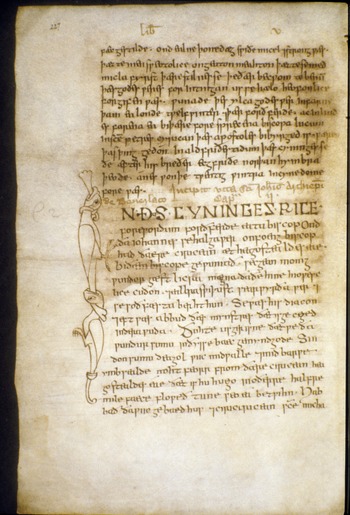
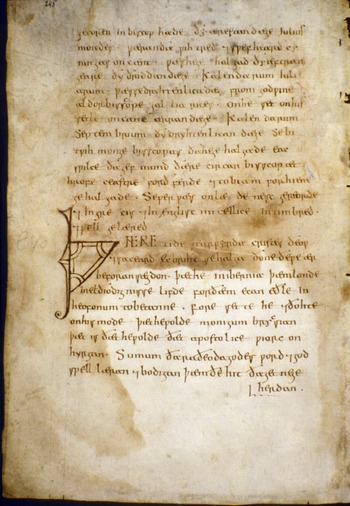


 Open access

