

Background
Antimicrobial resistance (AMR) is a global threat. Reference Huttner, Harbarth and Carlet1 As a result, in September 2024, the United Nations General Assembly discussed necessary political actions to reduce AMR across the world. 2 AMR happens when antibiotics are no longer effective against certain types of bacteria, fungi, parasites, or viruses, and the growing emergence of more infectious microorganisms. 3 Prevalence and the burden of AMR are disproportionately associated with the countries’ levels of income; with low- and middle-income countries (LMICs) being more gravely affected than the high-income countries (HIC). 4 Although resistant microorganisms can be transmitted from person to person, the main causes include a lack of knowledge and misuse and irrational prescribing of antimicrobials. 5
Antimicrobial Stewardship (AMS) program is one of the various interventions that have been used to improve utilization, rational prescribing of antibiotics and to reduce and ultimately eradicate AMR. Reference Majumder, Rahman and Cohall6 The main aim of AMS program is to provide an effective, integrated, and multidisciplinary approach to the appropriate use of antibiotic therapy. This program encourages and supports healthcare providers as well as policymakers to utilize antimicrobials carefully and responsibly.
The role played by medical practitioners and pharmacists, especially in the implementation of stewardship programs, is well documented. Reference Barlam, Childs and Zieminski7,Reference Lai, Islahudin, Ambaras Khan and Chong8 Recently, Cantudo-Cuenca and colleagues reported that there was over 80% acceptance of pharmacists-led AMS interventions, at healthcare settings with no medical practitioners, particularly with regard to the discontinuation of antibiotics when the duration of therapy was considered excessive. Reference Cantudo-Cuenca, Jiménez-Morales and Martínez-de la Plata9 Medical practitioners, particularly in public healthcare settings, adhere to evidence-based standard treatment guidelines and AMS programs. Reference Ervin, Tse, Reid and Smith10 However, Hayat and colleagues reported that there was ambivalence regarding the role played by medical practitioners working in public healthcare teaching hospitals in Pakistan about appropriate prescribing of antimicrobials. Reference Hayat, Rosenthal and Gillani11 While antibiotic stewardship has been introduced to professional nurses, in addition to their traditional roles, they are often faced with numerous institutional and personal barriers. These barriers may relate to their perceived lack of capability as well as poor articulation of professional nurses’ roles in the implementation of AMS policies. Reference van Gulik, Hutchinson and Considine12 Nurse practitioners are likely to accept positions in rural areas and are easily accessible to the public. Reference Lagarde, Blaauw and Cairns13 In rural areas in numerous LMICs and in South Africa, authorized professional nurses prescribe and initiate antibiotic therapy as part of their roles. Reference Yevutsey and Buabeng14,Reference Adegbite, Edoa and Schaumburg15 Recently, Anstey Watkins and colleagues reported successfully initiating treatment for various conditions including antimicrobial therapy. Reference Anstey Watkins, Wagner and Xavier Gómez-Olivé16 Therefore, for a significant reduction in AMR incidences, nurse practitioners should play a meaningful role as stewards of antibiotic therapy. In contrast to the developed countries, Reference Monsees, Goldman, Vogelsmeier and Popejoy17 there is insufficient scientific data on nurse practitioners’ confidence and their educational needs as prescribers and stewards of antibiotics, in rural areas in low- and middle-income countries. There is a marginal difference between self-confidence and confidence. However, the emphasis on self-confidence, as used in this manuscript, is more inward-looking; something similar to self-esteem and self-compassion as in “Confidence-competence alignment and the role of self-confidence in medical education” by Gottlieb and colleagues (2022). Reference Gottlieb, Chan, Zaver and Ellaway18 Therefore, this study investigated the self-confidence levels and educational needs of nurse practitioners in remote countryside healthcare settings as stewards of antimicrobial therapy. In particular, this study sought to answer the following research questions; (a) what are nurses’ perceptions regarding utilization of antimicrobials? (b) what are nurses’ perceptions and knowledge regarding resistance to antimicrobial therapy? (c) what is the level of self-confidence among nurses regarding what is expected from them as stewards of antimicrobial therapy? and (d) what are their educational needs?
Methods
Study design
This was a prospective cross-sectional survey using questionnaires with open-ended and 5-point (ie, 1 = strongly disagree; 2 = disagree; 3 = neutral (don’t know); 4 = agree; 5 = strongly agree) Likert-scale-based items. Permission was granted to adapt and use Wasserman and colleagues’ (2017) questionnaire items to strengthen this study’s questionnaire. Reference Wasserman, Potgieter and Shoul19
Study settings
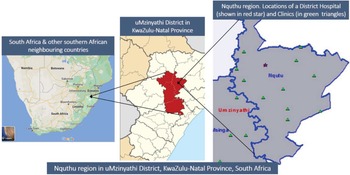
The Nquthu region (or sub-district) in the uMzinyathi District in KwaZulu-Natal Province, South Africa, as depicted in Figure 1, was the main site for this research. This is a deeply rural and the biggest region in the uMzinyathi District with an estimated population size of 178,000 inhabitants. Reference Haynes, Zulu and Mavundla20 This area played a significant role in military battles that changed and reformed South Africa in the 1870s. Reference Yorke21
Map of uMzinyathi District in KwaZulu-Nata; Province, South Africa. Modified from Google Maps and HST, 2017; pp 7. 22

Data collection and analysis
Questionnaires were distributed to all categories of nurse practitioners. Namely; professional nurses (with a degree or diploma in nursing—provide comprehensive nursing care and management for the nursing treatment and rehabilitation), staff nurses (with a diploma in nursing—provide general nursing care for the treatment and rehabilitation of individuals and groups), and auxiliary nurses (provide basic nursing care and the primary responsibilities), and enrolled nurses (working under the direct supervision of registered nurse) as defined in the South African Nursing Act of 2005. 23 Data analysis involved, but was not limited to; participants’ demographics and experience as nurses. Where applicable, statistical significance for categorical variables was tested using the χ2 test at a 5% level of significance. Also, the means together with their standard deviations (SDs) and/or 95% confidence intervals (95% CIs) or medians together with their interquartile ranges (IQRs) were calculated. Differences with p-values less than 0.05 were considered significant.
Results
One hundred and thirty (n =130) participants completed the questionnaires; 69% (n = 89) were females and 31% were males (as depicted in Table 1). The average (the mean, which was similar to the median) age of participants was 40.4 years (sd = 8.4 yr), and the average “period at current position” was 9.2 years (sd = 5.8 yr).
Demographic characteristics of participants (N = 130). *A level-1 district hospital with 349-bed capacity. **Primary healthcare clinics

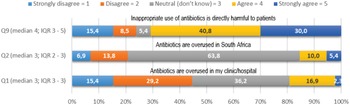
As depicted in Figure 2, 64% (n = 83) of nurse practitioners were not aware of the extent of inappropriate utilization of antibiotics in South Africa, with a median of 3 (IQR 2–3). However, over 70% (n = 91) of participants knew that inappropriate utilization of antimicrobials was harmful to patients, with a medium of 4 (IQR 3–5).
Knowledge regarding appropriate utilization of antimicrobials.

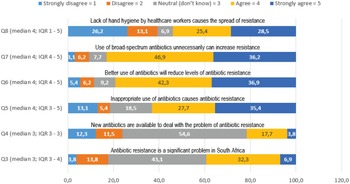
More than 80% (n = 104) of participants believed that better utilization of antimicrobials reduces resistance to antibiotic therapy. About 83% (n = 108) of nurse practitioners believe that unnecessary use of broad-spectrum antibiotics can increase the risk of antibiotic resistance. Altogether, 55% (n = 72) of the nurse practitioners were unaware whether new antibiotics were available to deal with antibiotic resistance. And about 82% (n = 107) of the nurse practitioners were unaware of the extent of antibiotic resistance in South Africa (Figure 3).
Knowledge regarding antimicrobial resistance.

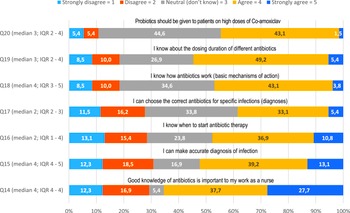
As shown in Figure 4, 55% (n = 72) of the nurse practitioners agreed that they knew how to administer antibiotic doses correctly. Fifty-three percent (n = 70) of the nurse practitioners did not know the basic mechanism of antibiotics. Just over 50% (n = 68) of the nurse practitioners mentioned that they knew how to diagnose bacterial infections accurately. About 65% (n = 85) of the nurse practitioners agreed that the knowledge of antibiotics is critical in their profession median 4 (IQR 4-4).
Knowledge regarding the pharmacology of antimicrobials.

Only 30% (n = 39) of participants felt confident to play a meaningful role as stewards of antimicrobial therapy. As depicted in Figure 5, about 80% (n = 104) and 90% (n = 117) needed more education on AMR and antimicrobial stewardship programs, respectively. Forty-eight percent (n = 72) of the nurse practitioners agreed that the heavy workload is a barrier for implementation of AMS programs.
Self-confidence level of nurses as stewards of antimicrobial therapy.

Over 70% (n = 38) and 51% (n = 51) of professional nurses and staff nurses, respectively, mentioned that they needed help regarding how to choose the correct antibiotic for various infectious diseases. However, the differences were not statistically significant (P > 0.05). About 60% (n = 32) professional nurses were not aware/disagreed when asked whether heavy workload, in their facilities, was a barrier to the implementation of an antimicrobial stewardship program; but 56% (n = 22) of staff nurses agreed that heavy workload was a barrier for implementation of antimicrobial programs. As shown in Table 2, 78% (n = 42) and 65% (n = 24) of the professional nurses and staff nurses, respectively, expressed that they had low self-confidence as stewards of antimicrobial therapy.
Correlations between professional Nurse vs Staff vs Enrolled Nurses; OR = odds ratio; CI = confidence interval; PN = Professional Nurses; SN = Staff Nurses; EN = Enrolled Nurses)

Discussions
The findings of this study, which was the first to be conducted in deep and remote healthcare settings such as the Nquthu region in KwaZulu-Natal, South Africa, suggest that nurse practitioners have positive attitudes towards their much-needed role as stewards of antimicrobial therapy. However, it was unexpected to discover that self-confidence was low and self-perceived inability to choose the correct antimicrobial therapy was high professional nurses because of the level of their qualifications and experience. Nurse practitioners’ beliefs about their practices and organizational culture were recently identified as factors contributing to perceived low self-confidence as stewards of AMS programs, in metropolitan settings in Missouri, United States. Reference Monsees, Goldman, Vogelsmeier and Popejoy17 In this study, however, perceived low self-confidence could have been due to insufficient educational resources and inadequate day-to-day clinical exposure among the most senior nurse practitioners who usually perform managerial roles instead. This is consistent with the findings by Jayaweerasingham and colleagues (2019)—that study reported that self-confidence, among nurse practitioners as stewards of antibiotic therapy, was associated with insufficient routine clinical and prescribing practice. Reference Jayaweerasingham, Angulmaduwa and Liyanapathirana24
In support of the findings of our study, Armstrong and colleagues (2015) reported that nursing unit managers spent 25.8% of their time on direct patient care, 16% on hospital administration, 14% on patient administration, 3.6% on education, 13.4% on support and communication, 3.9% on managing stock and equipment, 11.5% on staff management, and 11.8% on miscellaneous activities. Reference Armstrong, Rispel and Penn-Kekana25 Recently, in support of the findings of our study, Balliram and colleagues (2021) reported low self-confidence level among nurse practitioners regarding prescribing of antibiotics and as stewards of antimicrobials. Reference Balliram, Sibanda and Essack26 In corroboration of the findings of our study, continuous and accessible educational programs have been cited as the best weapons to combat AMR, and to enhance self-confidence among nurse practitioners as the vital stewards of antimicrobial therapy. Reference Farley, Stewart and Davies27,Reference Gotterson, Buising and Manias28 These interventions are needed both in the public and private healthcare settings. Reference Sefah, Chetty and Yamoah29
Reduction of antimicrobial overuse, in public healthcare settings, is one of the critical elements of numerous governments’ national AMR action plans. Reference Rogers Van Katwyk and Grimshaw30 Therefore, it was encouraging that a vast majority of nurse practitioners in rural healthcare settings believed that; better utilization of antimicrobials reduces resistance to antibiotic therapy, and that unnecessary use of broad-spectrum antibiotics can increase the risk of antibiotic resistance—as was reported in this study. However, this study found that perceived pressure from patients made it difficult for nurse practitioners to withhold and reduce the utilization of antibiotic therapy. This was in support of Dixon and colleagues’ (2021) findings of a study which was conducted in the urban settings in Zimbabwe. Reference Dixon, Manyau, Kandiye, Kranzer and Chandler31
In our study, nurse practitioners reported that they have experienced, directly and/or indirectly, patients/parents/guardians’ influence on the decision to prescribe antimicrobials. On the contrary, Mathibe & Zwane (2020) Reference Mathibe and Zwane32 reported that patients/parents/guardians did not influence nurse practitioners’ decisions to prescribe antibiotics. Therefore, there is a need for more research to investigate the impact of patients’ influence and pressure on healthcare workers to prescribe antibiotics.
Conclusions
There is a need for the formal inclusion of nurse practitioners as an integral part of antimicrobial stewardship programs, globally. Regular use of approved standard treatment guidelines is recommended to enable nurse practitioners to prescribe the correct antibiotics and administer doses correctly for their patients. This will contribute greatly, especially in remote rural areas of low-middle-income countries. In these areas, nurse practitioners are often the only healthcare professionals who are accessible to the vast communities; to diagnose infectious conditions and initiate antibiotic therapy when necessary. Nurse practitioners’ positive attitudes regarding their role in the AMS programs, as reported in our study, will indeed be a stimulus to attenuate their low self-confidence and self-perceived inability to choose the correct antimicrobial therapy. In addition to their inclusion, formal recognition, and appreciation, nurse practitioners require regular and convenient educational programs as well as in-service training activities to enhance their self-confidence as stewards of antimicrobials. Reference Lee and Lee33–Reference Catanzaro and Geary35 More studies are required to investigate the possibility of over or underestimation of self-confidence and the real ability of nurse practitioners to participate meaningfully in the AMS programs.
Data availability statement
Data are available from the corresponding author upon request.
Acknowledgments
The authors are indebted to all nurse practitioners who participated in this study. Thank you to the School of Health Sciences, The University of KwaZulu-Natal, and the South African National Research Fund (NRF) for funds (Ref No.: MDN19041 5430 485).
Author contribution
Ziyanda Nzayini (N.Z.) contributed to the design, data collection, analysis of the results, and the writing of the manuscript; Andile Dlungele (A.D.) contributed to data analysis of the results and the writing of the manuscript; Lehlohonolo John Mathibe (L.J.M.) contributed to the design, data collection, analysis of the results, and the writing of the manuscript. All authors approved the final version.
Financial support
Z.N. received grants from the South African National Research Fund (NRF) to pay for the running expenses incurred in this study. L.J.M. received the NRF International Science Council (ICS) grant and presented some of the findings of this study at the 19th World Pharmacology Conference, Glasgow, Scotland, UK, in July 2023.
Competing interests
The authors declare that they have no known competing financial interests or personal relationships that could have appeared to influence the work reported in this paper. Funding agencies did not have any direct or indirect influence in the analysis and/or interpretation of the findings of this study.
Ethics standard
This study received full ethics approval from the University of KwaZulu-Natal Research Ethics Committee, Durban, South Africa.



 Open access

