





Introduction
The aim of this paper is to review how knowledge on European post-socialist civil societies (EPCS) has been produced in research since the 1990s by focusing on (1) how civil society is conceptualized and from whose position; (2) the methodologies employed in this knowledge production, including any reflections on the usefulness and conditions of such knowledge; and (3) existing knowledge gaps and areas where further development is needed within this body of literature.
This is important to study as conceptualizations shift over time, methodologies used to investigate civil societies change (Kim & Raggo, Reference Kim and Raggo2022), as well as the subjects of study (Schoenefeld, Reference Schoenefeld2021), impacted by societal changes and influences coming from adjacent research fields (Della Porta, Reference Della Porta2020; Krasynska & Martin, Reference Krasynska and Martin2017; Salamon & Sokolowski, Reference Salamon and Sokolowski2016). Our contribution lies in analyzing conceptualizations on the development of civil society in the region and in contributing to a more nuanced, methodologically aware, and theoretically robust understanding of this complex and dynamic phenomenon. In the review, we use a broad definition of civil society, including studies focusing on a wide array of organizations, networks, and activities that express shared interests, values, and purposes outside of the state, market, and family. We stress that civil society is not a single progressive force, but a space shaped by competing narratives, strategies, and visions of the social world. Based on the analyzed material, we distinguish between three theoretical approaches to EPCS, the Western-centric, critical, and triple-embedded approaches. These ideal-typical categories partly overlap, but differ in their embeddedness in the field, closeness to the research subjects, and aspirations to include them in theory-building and can be used in scrutinizing conceptualizations of civil societies in and beyond the region that we have focused on.
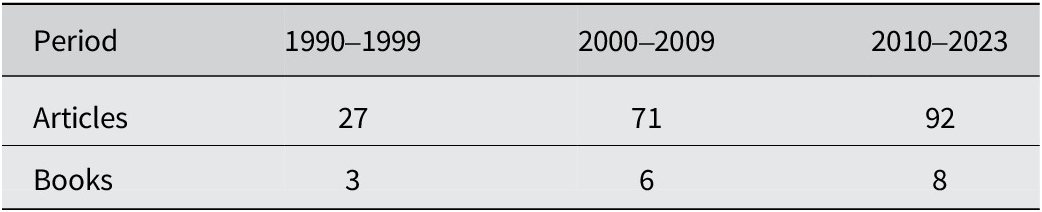
Our work builds on an integrative literature review of scholarship produced on EPCS,Footnote 1 including qualitative and quantitative studies on the topic, as well as combining data from theoretical and empirical literature, aiming at presenting themes prominent in the research field (Booth et al., Reference Booth, James, Clowes and Sutton2021). We began by identifying relevant studies through searching for abstracts in the Web of Science database, focusing on identifying key works on EPCS using different combinations of keywords such as “civil societ(y/ies),” “social movement(s),” “post-socialis(m/t),” “post-communis(m/t),” and “(Central) Eastern Europe” along with terms such as “theory,” “conceptualization,” “typology,” and “classification,” indicating the ambition to advance theory of the workings of civil society in the region, published in the period of 1989–2023. We aimed at original articles, excluding research notes, editorials, and book reviews, written in English. A clear trend in publications during the studied period was the increased number of publications over time. Because our initial sample was quite large (n = 2,971), we narrowed our search to journals in which such work is most frequently published: Communist and Post-Communist Studies, East European Politics and Societies, Europe-Asia Studies, and East European Politics. To ensure broader coverage beyond area-studies-focused outlets, we also included international journals such as Voluntas. This resulted in a refined sample of 377 articles. After reading the abstracts, we narrowed down our selection to the works explicitly dealing with theory development, aiming at advancing the theory of EPCS and including methodological considerations in the abstract for articles, something that we found was not as common as we thought. This meant that purely empirical studies were excluded from the selection, but also studies not directly concerning civil society development and those not mentioning their theoretical ambitions and methodology in the abstract. Since studies on the nonprofit sector tend to be conservative and only a minority demonstrates critical approaches (Coule et al., Reference Coule, Dodge and Eikenberry2022), we have complemented our selection with works that have been recognized as expanding the conceptualizations of EPCS but published in other journals than those included in our initial selection, like for instance Antipode, Interface, and others. Critical research is still scarce in the journals we have studied; however, critical approaches using, for instance, unconventional research methods (participatory/action/collaborative/engaged, etc.) are even more rare, and we had to search more broadly to complement our sample. We wished to also include books and monographs in the review as these outlets can provide comprehensive theorizing due to the format allowing for complex and in-depth arguments and the timelines of such outlets. These were selected according to the same criteria as the articles, but also according to their centrality in the field, here assessed according to their citation statistics, and the ambition was to cover at least three such formats per decade, even if those published more recently often cover previous historical periods in the development of EPCS. Our final selection included works proposing or expanding typologies and theoretical conceptualizations of EPCS amounting to over 200 studies (see Table 1). All selected texts were read in full guided by the questions: How are EPCS conceptualized? What are the origins of these theoretical concepts? Is, and if so, in what way, the theorizing connected to research methodology and is the positionality of the researchers explicitly dealt with?
Selection of studies included in the review

Throughout the whole selection process, we have used the fact that we are three researchers, dividing the material into smaller samples and shifting samples in order to triangulate our individual analyses. A clear limitation of our selection is that our review focuses on peer-reviewed works published in English. This means that publications in other languages and formats have been excluded. We acknowledge that this lens may render some of the most insightful and critical conceptual work on EPCS inaccessible and that our findings should therefore be read as partial and situated within the geopolitics of knowledge production. We have analyzed the texts in chronological order but present them in a somewhat blunt way in the table to give the reader an idea of what the final selection looked like in numbers. Even if we have aimed at including books and monographs in our selection, the majority of works analyzed are articles, demonstrating our “partiality” for articles in literature reviews (Kim & Raggo, Reference Kim and Raggo2022, p. 1111). Also, since we cover a long period and a large region, there is a risk of simplifying and overlooking contextual differences in the development of EPCS. Our review focuses on how concepts, methodologies, and researchers’ positionalities interact in the literature, aiming at identifying conceptual gaps and their connection to methodological choices, not on regional variations per se. Our review is structured as follows: first, we describe how shifts in methodological approaches correspond with shifts in conceptualizations of post-socialist civil societies throughout time. We show how novel methodological considerations have led to new ways of theorizing, creating a more complex and richer variety of approaches to the study of civil societies. Based on this typology, we identify gaps in each methodological approach and propose issues to develop in future attempts at building and moving beyond theories on EPCS.
Theoretical knowledge production on European post-socialist civil societies
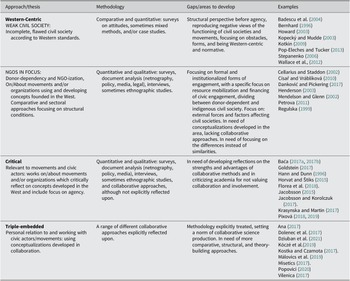
We organize the presentation of the reviewed studies based on their proposed conceptualizations and perspectives on civil societies, along with their relationship to the studied collective actors and researchers’ positionality. We distinguish between (1) Western-centric approach, which views EPCS as flawed due to departing from conceptualizations developed in the West; (2) critical approach, which conveys more critical standpoints to the issue, albeit from the researchers’ distant (or unrevealed) position; and, finally, (3) triple-embedded approach, which presents the researcher’s deep personal, professional, and political involvement in the field they study, which includes not only an explicit collaborative approach to theory-building, but also collective actors’ active participation in the process of theorizing (see Tables 2 and 3). Through these three ideal typical approaches, we aim to emphasize that theory-building is intimately interconnected with research methodology and is always based on specific ontological and epistemological assumptions that need to be understood in relation to present configurations of power in academia and inequalities in the geopolitics of knowledge (see Jehlička, Reference Jehlička2021; Paasi, Reference Paasi2015; Trubina et al., Reference Trubina, Gogishvili, Imhof and Müller2020).
Different conceptualizations of EPCS and their relationship to the studied collective actors
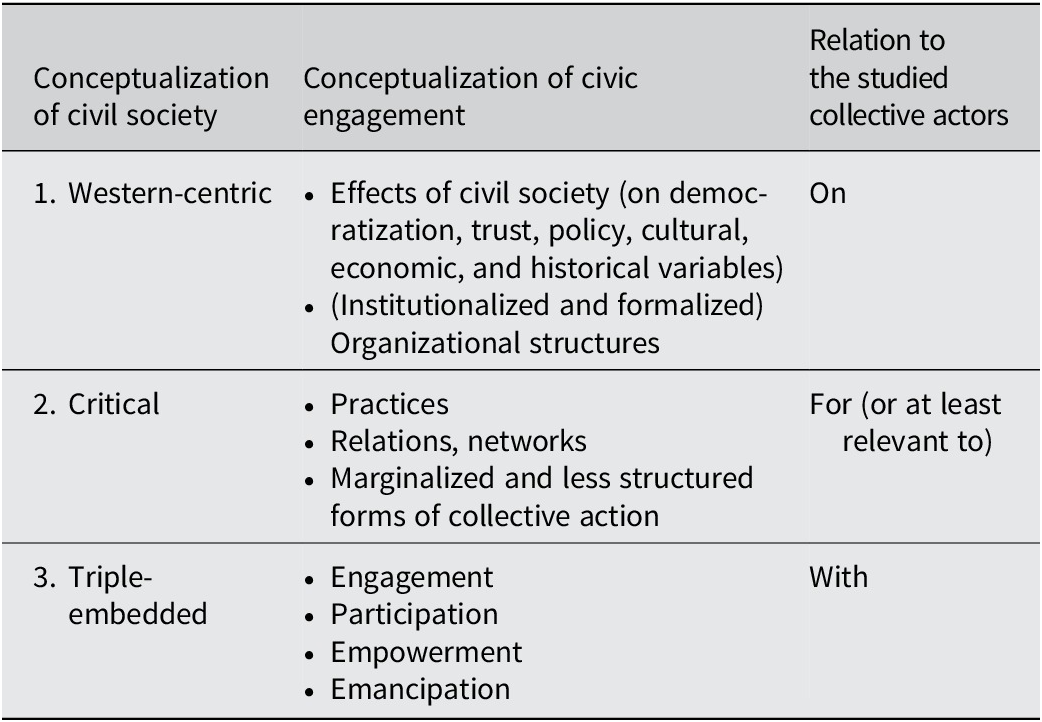
Conceptualizations of EPCS, their methodologies, and areas in need of development
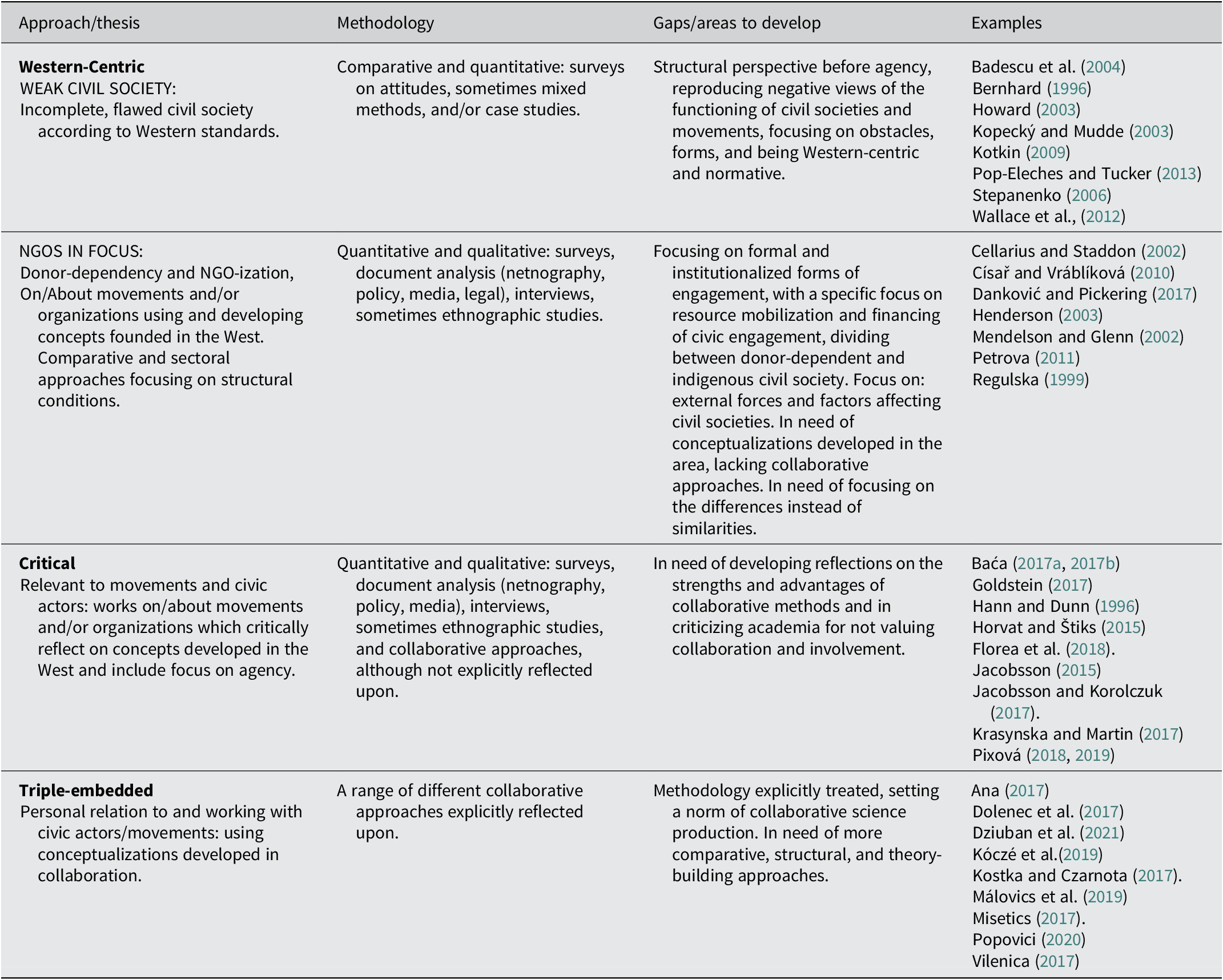
Our reading has been inspired by categories developed in participatory research approaches and utopian frameworks (Bell & Pahl, Reference Bell and Pahl2018; Mountz et al., Reference Mountz, Bonds, Mansfield, Loyd, Hyndman, Walton-Roberts, Basu, Whitson, Hawkins, Hamilton and Curran2015), distinguishing ways for scientists to reflect and engage in social change through critical and collaborative forms of scholarship. However, we do not identify with and promote a particular approach, as we believe that researchers may move between different methodological approaches, based on contextual considerations and limitations. Our understanding of the different ways of conceptualizing EPCS is therefore informed by parameters such as the embeddedness in the research field and the personal relation of the research(er) to the studied subjects and to their cause. This also includes questions of the usefulness and relevance of the research and collective actors’ involvement in knowledge production and theory-building.
Western-centric approach to post-socialist civil societies
The fall of state socialism and the rise of liberal democratic norms in the 1990s shaped how civil society in post-socialist Europe was conceptualized and studied. Civil society was often viewed as a vehicle for democratization, evaluated against Western liberal standards. Substantial donor funding and international assistance bolstered NGOs, which came to be seen as proxies for civic engagement, thus reinforcing a professionalized and institutionalized model of activism. Much of the theoretical work from this era was Western-centric, emphasizing structural variables and employing comparative, top-down methodologies. These approaches typically positioned local actors as data providers rather than as active knowledge producers. In the first two decades of post-socialist transition, research on civil societies focused on institutionalized and formalized organizations—primarily NGOs, but also civil society organizations (CSOs) and social movement organizations (SMOs). This body of work was rooted in a structural and comparative framework characteristic of area studies and adhered to a worldview shaped by the Western liberal victory after WWII. Studies mainly concerned issues such as democratization, trust-building, and policymaking, often emphasizing formalized organizational forms. Although not always uncritical, these studies generally relied on Western-developed concepts and methodologies that maintained a distanced stance toward local actors (see Tables 2 and 3).
In the context of this inadequate Western theoretical focus on the third sector (Kendall et al., Reference Kendall, Anheier and Potůček2000; Kuti, Reference Kuti1999; Regulska, Reference Regulska1999), EPCS often ended up being treated just as a source of empirical data to test already existing theories (Stenning & Hörschelmann, Reference Stenning and Hörschelmann2008; Timár, Reference Timár2004). Due to the structural and sectoral approach of Western conceptualizations of civil societies and their narrow focus on NGOs (Cellarius & Staddon, Reference Cellarius and Staddon2002; Henderson, Reference Henderson2003 ; Mendelson & Glenn, Reference Mendelson and Glenn2002), EPCS were initially criticized as weak, with declining association memberships, inadequate mobilization efforts, and growing public indifference toward civic matters, indicating low formal engagement and participation based on quantitative measures (Howard, Reference Howard2003; Meyer et al., Reference Meyer, Moder, Neumayr and Vandor2020; Pop-Eleches & Tucker, Reference Pop-Eleches and Tucker2013). The concept of transactional activism (Petrova & Tarrow, Reference Petrova and Tarrow2007), which refers to elite-driven, donor-oriented forms of civil society engagement primarily interacting with political parties and power-holders, countered this observation by suggesting that, despite low levels of individual participation, transactional activism is more prevalent in EPCS. This form of activism played a central role in the initial conceptualization of post-socialist civil societies and continues to influence scholarly discussions about the professionalization and institutionalization of civic actors.
Eventually, NGO-ization of EPCS was criticized too. According to the weakness thesis (Bădescu et al., Reference Bădescu, Sum and Uslaner2004; Bernhard, Reference Bernhard1996; Howard, Reference Howard2003; Kopecký & Mudde, Reference Kopecký and Mudde2003; Kotkin, Reference Kotkin2009), which emphasizes the internal, cultural variables, EPCS is generally perceived as backward, stemming from influential works referring to the region’s “economic backwardness” (Chirot, Reference Chirot1989, p. 2), “eastern backwardness” (Ágh, Reference Ágh1998, p. 3), or “civilizational incompetence” (Sztompka, Reference Sztompka1993). While researchers concluded that EPCS in the 1990s were in crisis (Kuti, Reference Kuti1999), suffering from debilitation (Bernhard, Reference Bernhard1996, p. 323), research in the 2000s stressed their “corrupted sociality” (Stepanenko, Reference Stepanenko2006), distrust (Bădescu et al., Reference Bădescu, Sum and Uslaner2004), and even “uncivil” character (Kotkin, Reference Kotkin2009).
Inattentiveness to local conditions and mimicry of Western institutions have been presented as a negative outcome of transition (Cellarius & Staddon, Reference Cellarius and Staddon2002) and EU integration (Guasti, Reference Guasti2016; Horvat & Stiks, Reference Horvat and Štiks2015). In some studies, they were also associated with depoliticization, elitism, and disconnection from appropriate popular representation (Carmin & Jehlička, Reference Carmin and Jehlička2005; Danković & Pickering, Reference Danković and Pickering2017; see also Carmin & Fagan, Reference Carmin and Fagan2010; Fagan, Reference Fagan2005). As the growth of NGOs was increasingly seen as a reflection of civil society’s expansion (Cellarius & Staddon, Reference Cellarius and Staddon2002) and with expectations that they would assume social service roles under neoliberal pressures, some researchers focused on their capacity to utilize economic opportunities (Dabrowski, Reference Dąbrowski2008) and on the influence of foreign donors (Sundstrom, Reference Sundstrom2006). Others studied how NGOs provided “citizens with institutional leverage for engaging with the state” (Petrova, Reference Petrova2011, p. 759). Shared international networks and professional “know-how” were seen as beneficial (Henderson, Reference Henderson2003; Hrycak, Reference Hrycak2006) due to the EPCS’ limitations in terms of organizing, proposal-writing, fundraising, and collaboration with local actors (Regulska, Reference Regulska1999, p. 63). Foreign support also facilitated the emergence and development of advocacy-based activism (Císař, Reference Císař2013) and helped activists to legitimize their claims (Císař & Vráblíková, Reference Císař and Vráblíková2013).
Soon, however, researchers criticized donor dependency, institutionalization, and professionalization (Henderson, Reference Henderson2003; Jacobsson & Saxonberg, Reference Jacobsson and Saxonberg2016; Mendelson & Glenn, Reference Mendelson and Glenn2002), pointing out NGOs’ inability to mobilize at the grassroots level (Danković & Pickering, Reference Danković and Pickering2017; Jacobsson, Reference Jacobsson2015), “cooptation” (Mendelson & Glenn, Reference Mendelson and Glenn2002; Narozhna, Reference Narozhna2004), and “channeling” of activism toward professionalization (Carmin & Fagan, Reference Carmin and Fagan2010; Císař, Reference Císař2010), concluding that CSOs “rather than criticizing the existing government’s agendas tend to trade time and efforts for financial support by aligning with the state priorities” (Agarin, Reference Agarin2011, p. 187). Using NGO-sector growth as an indicator of a functional civil society and democracy (Cellarius & Staddon, Reference Cellarius and Staddon2002) was criticized for being neoliberal and obscuring critical layers of empirical complexity in state–society relations (Horvat & Stiks, Reference Horvat and Štiks2015), including complex histories of social self-organization on issues like the environment, human rights, and religious and intellectual freedom (Cellarius & Staddon, Reference Cellarius and Staddon2002, p. 184). An important role in these assessments was played by EU enlargement and the replacement of previous donors by financial aid from the EU (Císař & Vráblíková, Reference Císař and Vráblíková2010; Guasti, Reference Guasti2016; Jacobsson & Saxonberg, Reference Jacobsson and Saxonberg2016). These perspectives often overlooked the role of the socio-political environment during European integration in which civic mobilization and contestation were largely suppressed or “apolitical” (O’Dwyer, Reference O’Dwyer2012) and where, for example, collective actors such as trade unions were effectively eliminated from political conflicts and economic lobbying due to being framed as remnants of the communist past (Ekiert & Kubik, Reference Ekiert and Kubik1998). In the same vein, activist groups, such as environmentalists, faced marginalization in some contexts due to being seen as an obstacle to economic development.
Critical reassessment of European post-socialist civil societies
By the 2000s, disillusionment with the promises of democratization and the limitations of NGO-led civil society prompted a wave of critical reassessments. Researchers increasingly questioned the effectiveness and legitimacy of professionalized, externally funded activism, highlighting the depoliticizing effects of NGO-ization and the limitations of transactional models. Critical approaches emphasized agency, everyday practices, and informal networks, calling for more context-sensitive frameworks. This period marked a shift from normative evaluation to analytical scrutiny, with a growing concern over geopolitical asymmetries in knowledge production. Critical approach in our review aspires to challenge the weak civil society thesis and to provide new conceptualizations of EPCS “from below.” It criticizes previous research for neglecting “less structured forms of everyday resistance, civic engagement, active citizenship, contentious politics, and social movements” (Baća, Reference Baća2022, p. 1) and proposes a definition of civil society that emphasizes processes and practices rather than rigid norms (Jacobsson & Korolczuk, Reference Jacobsson and Korolczuk2017), which is broader and more inclusive (Fagan, Reference Fagan2005; Fagan & Sircar, Reference Fagan and Sircar2017; Goldstein, Reference Goldstein2017; Jacobsson, Reference Jacobsson2015; Jehlička, Reference Jehlička2021; Pietrzyk-Reeves & McMahon, Reference Pietrzyk-Reeves and McMahon2022; Polanska & Chimiak, Reference Polanska and Chimiak2016; Pungas, Reference Pungas2023) and captures the dynamic character of its constant change and development (Pietrzyk-Reeves, Reference Pietrzyk-Reeves2022; Pietrzyk-Reeves & McMahon, Reference Pietrzyk-Reeves and McMahon2022). Studied subjects are, however, not included in this knowledge production.
The Western concept of civil society, its applicability to post-socialist contexts, and activities that fall under this category have been questioned since the early 1990s (Buchowski, Reference Buchowski, Hann and Dunn1996; Hann & Dunn, Reference Hann and Dunn1996). Accusing the concept of “definitional volatility” (Bilić, Reference Bilić2011), broader and narrower definitions have been distinguished. Existence of civil society during communism was also debated, including its assessment after the regime’s fall.
Several authors later called for a replacement of the Western-centric perspective by knowledge production based on EPCS examples (Jacobsson & Saxonberg, Reference Jacobsson and Saxonberg2016; Pietrzyk-Reeves & McMahon, Reference Pietrzyk-Reeves and McMahon2022). Scholars from post-socialist Europe have questioned Western images of their region (Todorova, Reference Todorova2009) as well as liberal democracy, market economy, and their benefits (Horvat & Štiks, Reference Horvat and Štiks2015). This body of literature also discusses the term “post-socialism,” with Woodcock concluding that it repeatedly situates EPCS “in a stagnant moment of time before capitalism and after socialism, lagging on the singular trajectory of European development” (Reference Woodcock2018, p. 16). Others have proposed broad conceptualizations of EPCS (Jacobsson, Reference Jacobsson2015; Jacobsson & Korolczuk, Reference Jacobsson and Korolczuk2017) and criticized insufficient efforts of academia to use them for theory development beyond area studies (Jehlička, Reference Jehlička2021; Stenning & Hörschelmann, Reference Stenning and Hörschelmann2008; Rekhviashvili, Reference Rekhviashvili2022).
Critical scholars’ methodology focuses on actors, their action, and practices (Baća, Reference Baća2022). According to Petrova and Tarrow (Reference Petrova and Tarrow2007, p. 88), examining relations among collective actors and authorities reveals “a more variegated and richer mix of activism than either the individual level data or case studies of civil groups”. One strand of this research “from below” has focused on filling in the knowledge gaps on urban and environmental activism and how it can be understood in relation to the development of EPCS (Florea et al., Reference Florea, Gagyi and Jacobsson2018, Reference Florea, Gagyi and Jacobsson2022; Jacobsson, Reference Jacobsson2015; Krasznai Kovacs, Reference Krasznai Kovacs2021; Novák & Kuřík, Reference Novák and Kuřík2020; Torsello, Reference Torsello2012), including local political-economic contexts (Jacobsson & Korolczuk, Reference Jacobsson and Korolczuk2017; Pixová, Reference Pixová2018, Reference Pixová2019). Another aspiration within this approach is to examine collective actors’ practices and relations (Jacobsson & Korolczuk, Reference Jacobsson and Korolczuk2017) and forms of civic engagement previously marginalized in research because of their informal character, invisibility, low-key, radical, or even controversial nature (Baća, Reference Baća2017b; Černý et al., Reference Černý, Moskvina and Böhmová2023; Jacobsson, Reference Jacobsson2015; Jacobsson & Korolczuk, Reference Jacobsson and Korolczuk2017; Jacobsson & Saxonberg, Reference Jacobsson and Saxonberg2016; Korolczuk, Reference Korolczuk2022; Polanska & Chimiak, Reference Polanska and Chimiak2016; Woodcock, Reference Woodcock2018).
Another focal issue concerns the problematization of non-progressive counter-movements and right-wing mobilizations to neoliberal crisis management. Anti-establishment and authoritarian shifts in the region provoked different responses from governments to civil society, transforming political possibilities and civic groups’ responses (Kluknavská & Navrátil, Reference Kluknavská and Navrátil2020; McMahon & Niparko, Reference McMahon and Niparko2022). Theoretical contributions aimed to capture the right-wing backlash (Buzogány & Varga, Reference Buzogány and Varga2018; Guasti & Bustikova, Reference Guasti and Bustikova2023; Piotrowski, Reference Piotrowski2020) and its impact on the nature of civic mobilizations. The trend of institutions being subordinated by illiberal and authoritarian governments can also be observed in attempts of established government agencies to control civil society and the distribution of domestic and external funds (Gerő et al., Reference Gerő, Fejős, Kerényi and Szikra2023; Piotrowski, Reference Piotrowski2020) or through the emergence of government-aligned organizations that reinforce party ideology, conservative narratives, and beliefs (Piotrowski, Reference Piotrowski2020). As shown in the case of housing activism in Romania and Hungary, similar issues may be also supported by parallel groups of actors with opposing political agendas (Florea et al., Reference Florea, Gagyi and Jacobsson2022).
Critical authors argue that current definitions of civil society are too narrow to capture developments across the political spectrum, highlighting the urgent need for a more comprehensive analytical framework (Baca, Reference Baća2022; Florea et al., Reference Florea, Gagyi and Jacobsson2022; Jacobsson & Korolczuk, Reference Jacobsson and Korolczuk2017). Methodologically, focus is on critically analyzing the civil society sector, with structural changes playing a dominant explanatory role. Similarly, Piotrowski (Reference Piotrowski2020) emphasizes that observing the political system’s response to grassroots demands reveals changes in public activity. While most critical scholarship regularly engages with social movements and activist circles, we find it often overlooks the collaborative nature of doing research aimed at broadening civil society concepts and the scope of resistance studies, including struggles of those frequently excluded as right-bearing citizens or civil society members (see Rekhviashvili, Reference Rekhviashvili2022).
Triple-embedded research
Both a rise in illiberal politics and a surge in collaborative, grassroots activism across the region were evident in the 2010s and 2020s. We witnessed the growth of cross-border civil society networks (e.g., Polish democracy promotion initiatives), the emergence of place-based commoning initiatives and deliberative urban practices (particularly in Poland and Hungary), and widespread civic mobilization in response to democratic regression (Korolczuk, Reference Korolczuk2022; McMahon & Niparko, Reference McMahon and Niparko2022; Vachudova et al., Reference Vachudova, Dolenec and Fagan2024). While our review does not aim to analyze these developments comprehensively, we recognize them as part of the shifting terrain to which theory is responding, which highlights the need for more participatory and collaborative forms of knowledge production. In response, scholars have been increasingly adopting participatory, embedded, and emancipatory approaches, foregrounding the co-production of knowledge with civic actors. These developments led to the emergence of what we conceptualize as “triple-embedded research,” which incorporates theoretical development, collaborative fieldwork, activist engagement, and personal relation to collective actors and their cause. This period was characterized by a growing emphasis on epistemic justice, long-term collaboration, and moving beyond transactional activism toward transformative, situated understandings of civil society. In our review, this category encompasses studies that are critical, but go a step further by being embedded not only (1) in the research area of EPCS and (2) in the studied collective action, but also (3) in knowledge production and theory-building, which is done via or builds upon interdisciplinary research with collaborative features (broadly understood) and explicitly reflects upon activists and other stakeholders being included as co-researchers in the research process. The category of triple-embeddedness helps us in classifying the positionality and approach to theory-building of particular research carried out in the studied region (Bell & Pahl, Reference Bell and Pahl2018), whose aim is to challenge the frequent disconnection of overly abstract theory and disengaged academic research from activist practice and to overcome increasing isolation of academia stemming from its lack of solidarity with vulnerable and marginalized groups (Baća, Reference Baća2023; Bodorkós & Pataki, Reference Bodorkós and Pataki2009; Kostka & Czarnota, Reference Kostka and Czarnota2017; Málovics et al., Reference Málovics, Creţan, Méreiné-Berki and Tóth2019). Instead, researchers using this approach are embedded in theory-building and as participants in the studied field in ways that go beyond the typical scope of research projects (Ana, Reference Ana2017; Dolenec et al., Reference Dolenec, Doolan and Tomašević2017). Regardless of their nationality or where their funding comes from, researchers using the triple-embedded approach are characterized by their solidarity and intimate relationships with silenced communities, thanks to which they are in a unique position to involve these communities as collaborators in the research process. The triple-embedded approach thus helps us reimagine knowledge production as a common subject and can be used to enrich classical participatory methodologies, such as participatory action research (Málovics et al., Reference Málovics, Creţan, Méreiné-Berki and Tóth2019), participatory activism (Dziuban et al., Reference Dziuban, Możdrzeń and Ratecka2021), public sociology (Pluciński, Reference Pluciński2018), or militant research (Černík & Velicu, Reference Černík and Velicu2023; Popovici, Reference Popovici2020). Rethinking hierarchies between researchers and participants, this approach promotes interaction between theory and action for social change and highlights the importance of recognizing political struggles in theory-making.
Studies using this approach complement canonical social movement theories and often use qualitative and ethnographic research approaches. Particularly, those focused on radical activism go beyond Western models of protest culture and encourage building on post-socialist histories of struggle and resistance, anti-racism, and anti-capitalism (Popovici, Reference Popovici2020). Broadening the scope of resistance beyond conventional citizen categories, they challenge the common image of an activist as a Western, urban, white figure (Kóczé et al., Reference Kóczé, Zentai, Jovanović and Vincze2019). Some examples of collaborative triple-embedded research reveal that structural conflicts may involve unintentional cooperation of different groups with opposing political agendas (Florea et al., Reference Florea, Gagyi and Jacobsson2022), which therefore requires the involvement of a wide variety of co-researchers.
So far, such approaches are largely absent from mainstream scholarship on social movements in post-socialist Europe (Kostka & Czarnota, Reference Kostka and Czarnota2017), but they show how research can contribute to the formation of inter-class alliances in social justice activism (Misetics, Reference Misetics2017) and provide theoretical tools for transformative knowledge production. By highlighting previous discrepancies, it expands the boundaries of academia by using it as a site that can “support non-experts in knowledge production and continuously address the power effects of different modes of knowing” (Kostka & Czarnota, Reference Kostka and Czarnota2017, p. 377). Authors in the region, nonetheless, rarely reflect on the region’s specific academic circumstances and instead focus on emphasizing interconnectedness with activism that can aid in researching silenced groups and communities, whose trust and participation in research may be gained by viewing this as an opportunity to advance community organizing and achieving greater empowerment (Harper et al., Reference Harper, Steger and Filčák2009). Also, matching collaborative practices with theory-making has been another unresolved struggle in PAR (Participatory Action Research)-related research. As Málovics et al. noted, “it is a rather challenging task for PAR to create a ‘non-positivist good theory’: one which enables and empowers community members to make pragmatic and sustainable changes in their lives” (Reference Málovics, Creţan, Méreiné-Berki and Tóth2019, p. 2), referring to the lack of balance between practical cases of empowerment and abstract theorization. We nonetheless hold that triple-embedded research can significantly enable theory-making in the region while also making it more relevant for social movements and for EPCS more broadly. As shown by Gagyi (Reference Gagyi2015), movement-relevant knowledge can, for instance, provide civic actors with concepts and analytical tools that can help them understand their position within the society or consider the role played by their region’s position in the history of modern development in seeking alliances with other social groups. Last but not least, we believe that such knowledge production can also contribute to the region’s epistemological emancipation from the hegemony of Western narratives and core-centric biases and develop organic knowledge that can counter the region’s epistemic provincialization, orientalization, and marginal role in the geopolitics of knowledge, as well as overcoming the socialist vs. post-socialist dichotomy (see Hirt et al., Reference Hirt, Ferenčuhová and Tuvikene2016; Jehlička, Reference Jehlička2021; Petrovici, Reference Petrovici2015; Stenning & Hörschelmann, Reference Stenning and Hörschelmann2008; Trubina et al., Reference Trubina, Gogishvili, Imhof and Müller2020).
Discussion: Setting the conditions for a transformative theory-building
Since the 1990s, the visibility and voice of social scientists from post-socialist Europe have been steadily growing. Though their role in international knowledge production remains limited, theory-building—historically dominated by Western scholars—has advanced significantly, particularly thanks to cutting-edge conceptual and methodological contributions from researchers embedded in their own domestic contexts. In this study, we have developed a model for classifying research conducted on EPCS based on the researcher’s embeddedness and engagement in the research field and the personal relation of the research(er) to the studied subjects and their involvement in theory-building. The relevance of these approaches follows a complex chronology. While they developed in parallel between 1990 and 2023, the Western-centric approach dominated in the 1990s, followed by the rise of the critical approach throughout the 2000s and 2010s, and the emergence of the triple-embedded approach in the 2010s. All three are present in the current studies of EPCS; however, we have observed that the Western-centric approach is losing ground among researchers, while the critical and triple-embedded approaches have been gaining popularity in the past two decades. This particular model of classifying research by asking how theories are built and what their relationship is to methodological choices can be utilized beyond the region of post-socialist Europe, to scrutinize the integration of diverse forms of knowledge in research and theory generation.
We have argued that some ECPS scholars are currently experimenting with critical, collective, and collaborative approaches to data collection and analysis, fostering inclusivity and transformation through peer collaboration with other academics and active involvement of research participants in the process of knowledge production. Transformative theory-building coming from the region, working closely with civic actors and including them in the production of knowledge, contributes to the theoretical developments in civil society studies called for in this special issue. Despite the Western-centric preoccupation with NGOs in the study of ECPS, the critical and the triple-embedded approaches allow us to see the more variegated nature of contemporary civil society, where NGOs often act side by side with grassroots collectives and other less formal collective actors.
From our perspective, based on the gaps we identified in the ideal types, an approach that moves beyond post-socialist theorizations on civil society offers an invaluable contribution—both in scholarship and in practice—in three key ways: (1) it highlights the importance of embeddedness for theory-building and the role played by embedded theory in decolonizing and democratizing science and in advancing theoretical as well as practical debates about civil society and social movements in post-socialist Europe which collective actors can use in dealing with various unfolding socio-ecological challenges and crises; (2) it reinvigorates the increasing calls for long, care-full, transformative, and sustainable research, which contests the deadlock of doing science purely for the sake of quantifiable academic merits and instead strives to contribute to social change by producing engaged knowledge in close long-term collaboration with activists and communities in the foci of academic research, making theory together with and useful for those who are being studied; (3) it challenges the false hegemonic idea of neutral, objective, and depoliticized research, which contributes to elitist, colonial, and socially irresponsible approaches of academia and its syndrome of an ivory tower detached from the reality.
We believe our analysis provides a useful framework for examining the relationship between conceptualization, methodology, and positionality in various contexts. For example, in Latin America, the production of knowledge through collaboration between activists and academics has long challenged elite-driven models of civil society, as seen in participatory research traditions linked to indigenous movements. Similarly, in South Asia and the MENA region, researchers operating within authoritarian constraints and community-based resistance practices have developed embedded forms of knowledge production that align with our framework. We hope our typology serves as a flexible tool for examining how civil society research is influenced by its political, institutional, and epistemological environment. It is not intended as a universal model, but rather as an invitation to critically reflect on theory-building and methodological practices elsewhere.
Funding statement
This work was funded by the Foundation for Baltic and East European studies under grant no. 22-GP-0001.
Competing interests
The authors declare no competing interests.

 Open access

