


Values in Social Representations and in Value Theories
Values are core and definitional characteristics of social representations as a ‘system of values, ideas and practices’ (Moscovici, Reference Moscovici, Israel and Tajfel1972), but they have rarely been given proper attention by researchers working in the social representations paradigm with the exception of some recent work that made some connections between the notion of ‘worldviews’, ‘social axioms’, ‘symbolic universes’, ‘moral frameworks’ and ‘deep stories’ (Misfed & Sammut, Reference Mifsud and Sammut2023). This is surprising given the burgeoning literature on human values, processes of their formation and historical change since the classic work of social psychologist Milton Rockeach. Rokeach (Reference Rokeach1973) listed 18 terminal values which refer to desirable end-states of existence (peace, family security, freedom, equality, self-respect, happiness, wisdom, national security, salvation, true friendship, accomplishment, inner harmony, comfortable life, mature love, beauty, pleasure, social recognition and exciting life) and 18 instrumental values as preferable modes of behavior, or means of achieving the terminal values (cheerfulness, ambition, love, cleanliness, self-control, capability, courage, politeness, honesty, imagination, independence, intellect, broad-mindedness, logic, obedience, helpfulness, responsibility and forgiveness).
In more recent years many social scientists turned to the study of values. Political scientists Inglehart and Welzel (Inglehard, Reference Inglehart2018) propose two dimensions of cross-cultural variation around the world: (1) Traditional values versus secular-rational values (traditional values emphasise religiosity, national pride, respect for authority, obedience and marriage). Secular-rational values emphasize the opposite on each of these accounts). (2) Survival values versus self-expression values (survival values involve a priority of security over liberty, non-acceptance of homosexuality, abstinence from political action, distrust in outsiders and a weak sense of happiness). Based on these two axes countries (that can be grouped by religion and geographical area) can be plotted from findings of comparative world-wide research like the World Values Survey (WVS) (see Figure 3.1).
Positions of cultural groups on Values based on WVS findings.
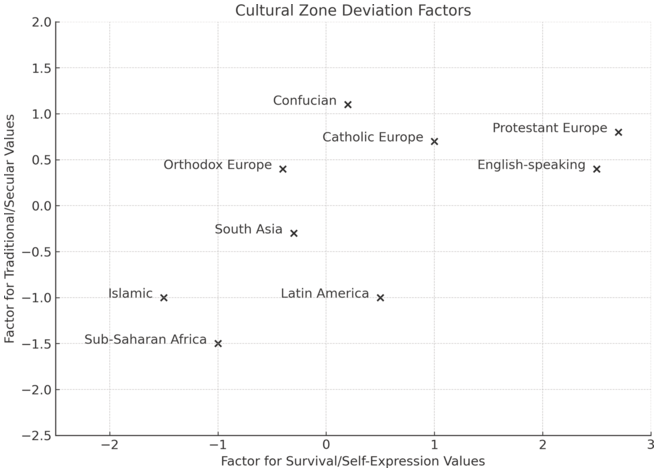
Figure 3.1 Long description
The scatterplot is titled Cultural Zone Deviation Factors. The X-axis, labelled Factor for Survival or Self-Expression Values, ranges from negative 1.00 to positive 1 in increments of 0.25 units. The Y-axis, labelled Factor for Traditional or Secular Values, ranges from negative 1.5 to 1.5 in increments of 0.5 units. Confucian zone is at approximately (negative 0.50, 1.25), strongly leaning toward traditional and secular values and survival. The Orthodox Europe is at (negative 0.50, 0.40), and Islamic is at (negative 0.70, negative 0.50), with a high traditional and survival orientation. South Asia is near (negative 0.30, negative 0.45), and Sub-Saharan Africa is at (negative 0.40, negative 0.95). Latin America is at (negative 0.05, negative 0.5), and Catholic Europe is near (0.00, negative 0.10). Protestant Europe is located at (0.60, 0.60), with stronger self-expression and secular values. English-speaking is at (0.60, negative 0.75), combining strong self-expression with more traditional values.
This approach emphasises national values as the unit of analysis and is rooted in a revision of the idea of modernisation in the classical works of Marx, Weber and Durkheim, which refers to the transition from agrarian-based societies to industrial and then post-industrial, knowledge-based societies. This transition is marked by economic growth, technological advancement and increased levels of education. Importantly for their revised modernisation theory, the transition from agrarian-based societies to industrial societies is expected to lead to progress on the traditional versus secular values axis, whereas transition from industrial to post-industrial and knowledge societies is expected to lead to progress on the survival vs self-expression values.
One of the most widely used theories of human values in social psychology is Shalom Schwartz’s (Reference Schwartz2021) theory of basic human values. It identifies 10 basic values, which are shown to be universal across cultures, although priorities of these values change among individuals and among countries and cultures. These values represent core principles that guide human behavior, and Schwartz posits that they are rooted in one or more of three universal requirements of human existence: needs of individuals as biological organisms; requisites of coordinated social interaction; and survival and welfare needs of groups.
The 10 basic values identified by Schwartz are:
Power (PO): Emphasising social status, control or dominance over people and resources.
Achievement (AC): Valuing personal success through demonstrating competence according to social standards.
Hedonism (HE): Seeking pleasure and sensuous gratification for oneself.
Stimulation (ST): Valuing excitement, novelty and challenge in life.
Self-Direction (SD): Valuing independent thought and action – choosing, creating, exploring.
Universalism (UN): Understanding, appreciation, tolerance, and protection for the welfare of all people and for nature.
Benevolence (BE): Preserving and enhancing the welfare of those with whom one is in frequent personal contact (the ‘in-group’).
Tradition (TR): Respect, commitment and acceptance of the customs and ideas that traditional culture or religion provide.
Conformity (CO): Restraint of actions, inclinations,and impulses likely to upset or harm others and violate social expectations or norms.
Security (SE): Valuing safety, harmony and stability of society, of relationships and of self.
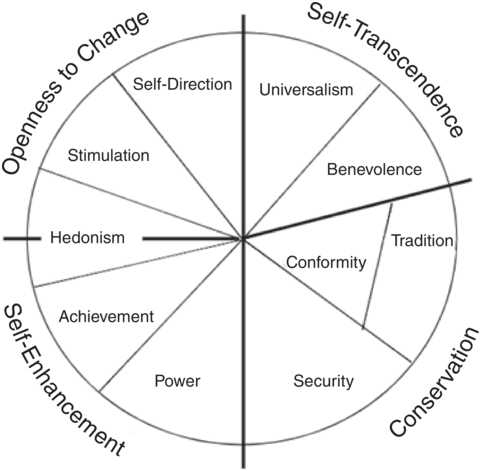
Schwartz’s theory also discusses the dynamic nature of values, suggesting that they are structured in a circular manner, reflecting a continuum of related motivations (see Figure 3.2). Values that are adjacent to each other on the circle are more compatible, while values on opposite sides are in conflict. For example, the pursuit of power conflicts with the value of benevolence. This structure helps to explain individual differences in value priorities and the conflicts that arise when trying to pursue or balance different values.
Shalom Schwartz circumplex model of values.
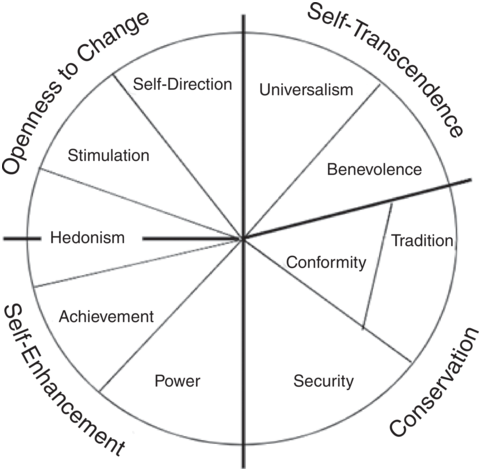
Figure 3.2 Long description
Openness to Change includes Self-Direction and Stimulation. Self-Transcendence includes Universalism and Benevolence. Conservation includes Conformity, Tradition, and Security. Self-Enhancement includes Achievement, and Power. Hedonism forms the boundary between Openness to Change and Self-Enhancement.
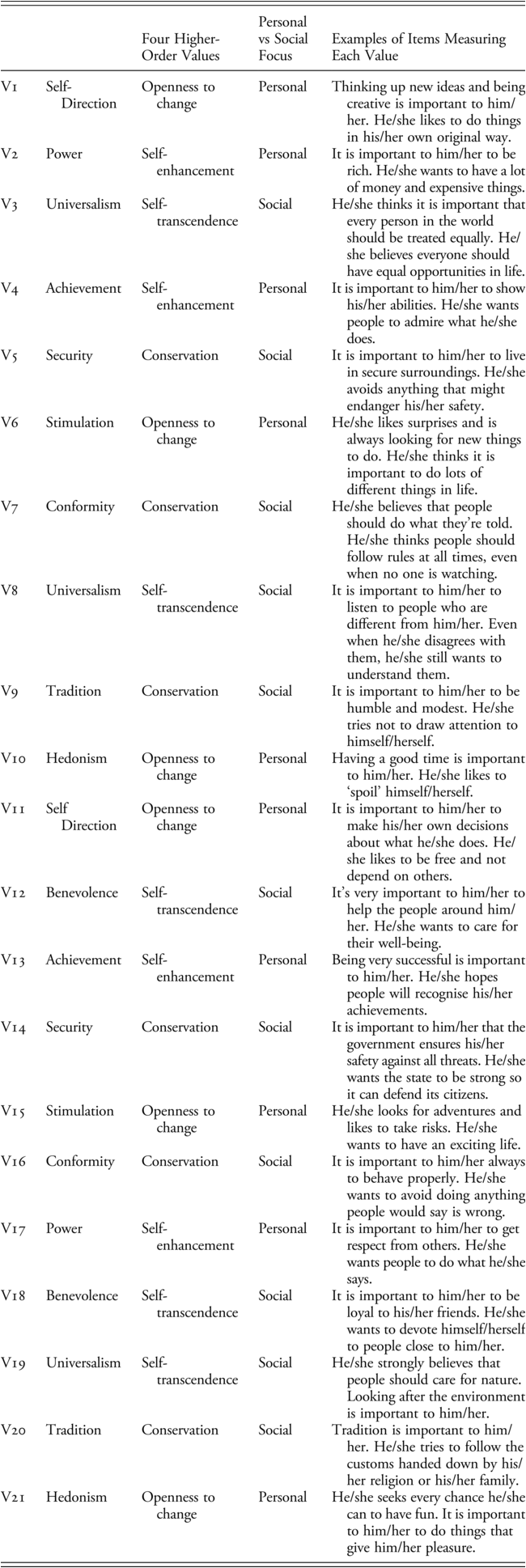
The 10 values can also be grouped into higher-order values (Conservation vs Openness to change and Self-enhancement vs Self transcendence) as shown in Table 3.1.
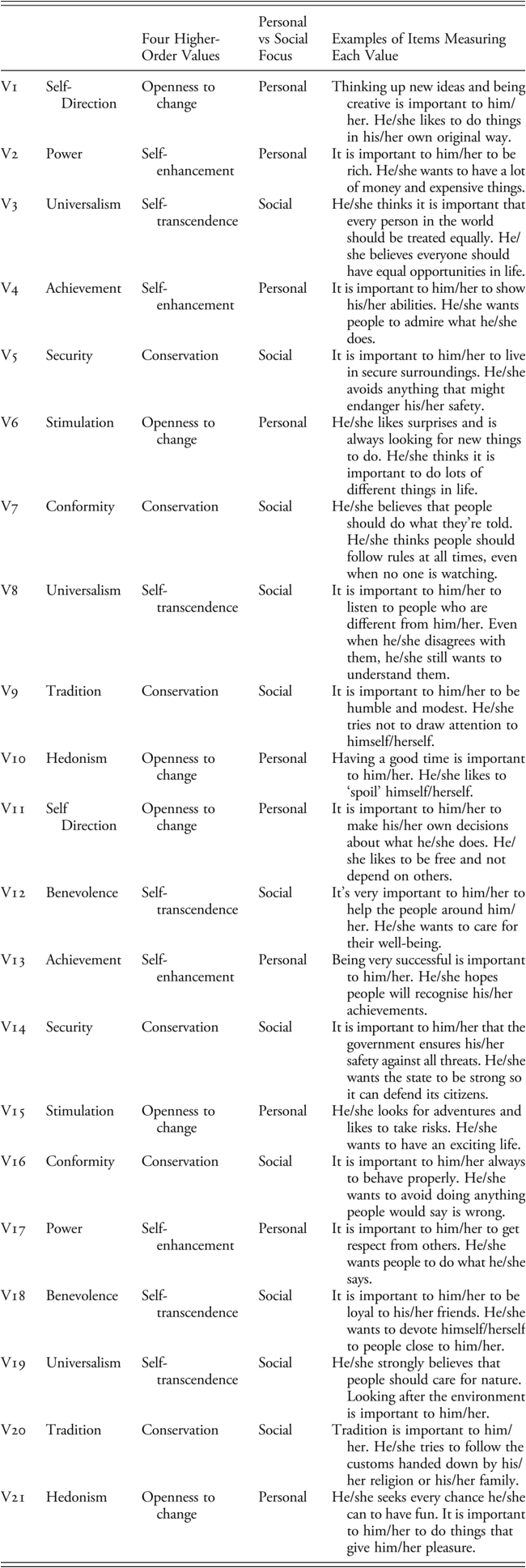
Table 3.1 Long description
The table has five columns titled Blank. Blank. Four Higher-Order Values. Personal versus Social Focus. Examples of Items Measuring
Each Value.
Row 1 column 1 reads. V 1.
Row 1 column 2 reads. Self-Direction.
Row 1 column 3 reads. Openness to change.
Row 1 column 4 reads. Personal.
Row 1 column 5 reads. Thinking up new ideas and being creative is important to him or her. He or she likes to do things in his or her own original way.
Row 2 column 1 reads. V 2.
Row 2 column 2 reads. Power.
Row 2 column 3 reads. Self-enhancement.
Row 2 column 4 reads. Personal.
Row 2 column 5 reads. It is important to him/her to be rich. He or she wants to have a lot of money and expensive things.
Row 3 column 1 reads. V 3.
Row 3 column 2 reads. Universalism.
Row 3 column 3 reads. Self-transcendence.
Row 3 column 4 reads. Social.
Row 3 column 5 reads. He or she thinks it is important that every person in the world should be treated equally. He or she believes everyone should have equal opportunities in life.
Row 4 column 1 reads. V 4.
Row 4 column 2 reads. Achievement.
Row 4 column 3 reads. Self-enhancement.
Row 4 column 4 reads. Personal.
Row 4 column 5 reads. It is important to him/her to show his or her abilities. He or she wants people to admire what he/she does.
Row 5 column 1 reads. V 5.
Row 5 column 2 reads. Security.
Row 5 column 3 reads. Conservation.
Row 5 column 4 reads. Social.
Row 5 column 5 reads. It is important to him or her to live in secure surroundings. He or she avoids anything that might endanger his or her safety.
Row 6 column 1 reads. V 6.
Row 6 column 2 reads. Stimulation.
Row 6 column 3 reads. Openness to change.
Row 6 column 4 reads. Personal.
Row 6 column 5 reads. He or she likes surprises and is always looking for new things to do. He or she thinks it is important to do lots of different things in life.
Row 7 column 1 reads. V 7.
Row 7 column 2 reads. Conformity.
Row 7 column 3 reads. Conservation.
Row 7 column 4 reads. Social.
Row 7 column 5 reads. He or she believes that people should do what they’re told. He or she thinks people should follow rules at all times, even when no one is watching.
Row 8 column 1 reads. V 8.
Row 8 column 2 reads. Universalism.
Row 8 column 3 reads. Self-transcendence.
Row 8 column 4 reads. Social.
Row 8 column 5 reads. It is important to him or her to listen to people who are different from him or her. Even when he or she disagrees with them, he or she still wants to understand them.
Row 9 column 1 reads. V 9.
Row 9 column 2 reads. Tradition.
Row 9 column 3 reads. Conservation.
Row 9 column 4 reads. Social.
Row 9 column 5 reads. It is important to him/her to be humble and modest. He or she tries not to draw attention to himself or herself.
Row 10 column 1 reads. V 10.
Row 10 column 2 reads. Hedonism.
Row 10 column 3 reads. Openness to change.
Row 10 column 4 reads. Personal.
Row 10 column 5 reads. Having a good time is important to him or her. He or she likes to spoil himself or herself.
Row 11 column 1 reads. V 11.
Row 11 column 2 reads. Self Direction.
Row 11 column 3 reads. Openness to change.
Row 11 column 4 reads. Personal.
Row 11 column 5 reads. It is important to him or her to make his or her own decisions about what he or she does. He or she likes to be free and not depend on others.
Row 12 column 1 reads. V 12.
Row 12 column 2 reads. Benevolence.
Row 12 column 3 reads. Self-transcendence.
Row 12 column 4 reads. Social.
Row 12 column 5 reads. It’s very important to him or her to help the people around him or her. He or she wants to care for their well-being.
Row 13 column 1 reads. V 13.
Row 13 column 2 reads. Achievement.
Row 13 column 3 reads. Self-enhancement.
Row 13 column 4 reads. Personal.
Row 13 column 5 reads. Being very successful is important to him or her. He or she hopes people will recognise his or her achievements.
Row 14 column 1 reads. V 14.
Row 14 column 2 reads. Security.
Row 14 column 3 reads. Conservation.
Row 14 column 4 reads. Social.
Row 14 column 5 reads. It is important to him or her that the government ensures his or her safety against all threats. He or she wants the state to be strong so it can defend its citizens.
Row 15 column 1 reads. V 15.
Row 15 column 2 reads. Stimulation.
Row 15 column 3 reads. Openness to change.
Row 15 column 4 reads. Personal.
Row 15 column 5 reads. He or she looks for adventures and likes to take risks. He or she wants to have an exciting life.
Row 16 column 1 reads. V 16.
Row 16 column 2 reads. Conformity.
Row 16 column 3 reads. Conservation.
Row 16 column 4 reads. Social.
Row 16 column 5 reads. It is important to him or her always to behave properly. He or she wants to avoid doing anything people would say is wrong.
Row 17 column 1 reads. V 17.
Row 17 column 2 reads. Power.
Row 17 column 3 reads. Self-enhancement.
Row 17 column 4 reads. Personal.
Row 17 column 5 reads. It is important to him or her to get respect from others. He or she wants people to do what he or she says.
Row 18 column 1 reads. V 18.
Row 18 column 2 reads. Benevolence.
Row 18 column 3 reads. Self-transcendence.
Row 18 column 4 reads. Social.
Row 18 column 5 reads. It is important to him or her to be loyal to his or her friends. He or she wants to devote himself or herself to people close to him or her.
Row 19 column 1 reads. V 19.
Row 19 column 2 reads. Universalism.
Row 19 column 3 reads. Self-transcendence.
Row 19 column 4 reads. Social.
Row 19 column 5 reads. He or she strongly believes that people should care for nature. Looking after the environment is important to him or her.
Row 20 column 1 reads. V 20.
Row 20 column 2 reads. Tradition.
Row 20 column 3 reads. Conservation.
Row 20 column 4 reads. Social.
Row 20 column 5 reads. Tradition is important to him or her. He or she tries to follow the customs handed down by his/her religion or his or her family.
Row 21 column 1 reads. V 21.
Row 21 column 2 reads. Hedonism.
Row 21 column 3 reads. Openness to change.
Row 21 column 4 reads. Personal.
Row 21 column 5 reads. He or she seeks every chance he or she can to have fun. It is important to him or her to do things that give him or her pleasure.
From the perspective of genetic social psychology, the relative priority of personal values can act as organising principles of social representations in the sense that they regulate both the process of their formation and content. For example, a representation of the opening of checkpoints in 2003 in Cyprus for an individual that gives priority to openness to change and not conservation is one that represents this opening as an opportunity for learning new things about the other community and other part of the island (stimulation), exploring new ideas beyond the controlled environment of their communally separated education along ethnic lines, and creating new friendships (self-direction). On the contrary, an individual who gives priority to Conservation values over values of Openness to change might experience the opening of the checkpoints as a threat to the in-group (security) or religious tradition becoming a source of intergroup anxiety and concern about losing one’s national or religious identity. Importantly, the close relationship of tradition with conformity values suggests some important links between the form and content of representations, because traditional values are formed through social influence processes of conformity to norms of values of the in-group, thus enacting relations of constraint that limit the expansion of the ethical horizon of the individual and the developing child. On the contrary, favouring intergroup contact between the two communities enacts a relation of co-operation that expands the individual’s ethical horizon in a universalising direction.
The value priorities of individuals vary by geography and time, and therefore the study of the sociogenesis of social representations through historical time and cultural evolution can be greatly enhanced by an understanding of this change. Here international comparative studies that measure the 10 values mentioned earlier, such as the European Social Survey (ESS), European Values Survey (EVS) and WVS, can offer valuable insights about the direction and rate of change in various countries, revealing more general patterns in other European countries, including those culturally very different to Cyprus.
Cultural Evolution and Values
Broader discussions about cultural evolution from various disciplines at a global level can add considerable historical depth to genetic social psychology, as they offer an analysis of sociogenetic processes of changing values through millennia. In an impressive research programme Henrich (Reference Henrich2015, Reference Henrich2020) has recently synthesised findings from anthropology, evolutionary biology, economics, history and social and developmental psychology into a dual inheritance theory of culture–gene co-evolution, offering ample evidence of cultural evolution patterns of change not only in values but also in cognitive and perceptual skills, morality, social cohesion and societal norms with direct implications for politics, changing democratic cultures and economic development at the country level. One of the biggest and most influential contributions of his work is the introduction of the critique of the false universalistic claims based on research with samples from a thin slice of humanity which he calls WEIRD societies.
In his historical account Henrich documents the crucial role played by religious institutions in this process of cultural evolution. First came a policy by the Roman Catholic Church that broke down large traditional kinship-based social networks through a family planning policy from around 500–1500 AD in western Europe that led to the end of polygamy and polygeny and a strengthening of the nuclear family. Belief in the Roman Catholic doctrine also facilitated trade with strangers (albeit only co-religionists) beyond the close circle of those who individual subjects knew personally. All these changes also led to more co-operation with in-groupers. Then followed the Protestant Reformation in parts of western Europe, which brought a more direct relationship with God without the mediation of church as an institution and its hierarchies with the sola scriptura, which brought significant increase in literacy levels, public education and a new work ethic as we know from the classic work of Weber. This long-term historical shift eventually led to more individualist values in these areas. Henrich (Reference Henrich2020) also argues these shifts slowly changed the brains (not the genes) of people – cognitive abilities in domains of memory, facial recognition, visual processing, numerical exactness and problem solving. For Henrich, higher literacy levels of Protestantism are likened to innovative ideas and technological acceleration. During the Enlightenment new historical phenomena were added in accelerating change around the idea Henrich calls the emergence of the ‘collective mind’ which has to do with (1) apprenticeship institutions, (2) urbanisation and impersonal markets, (3) transregional monastic orders, (4) universities, (5) the Republic of letters (transnational scientific societies), including new religious faiths (e.g. Huguenots) that not only promoted literacy and schooling but also made industriousness, scientific insights and pragmatic achievement sacred.
Heinrich’s (Reference Henrich2020) historical account ends around that time, and he would probably state that the rest is history in how the West became successful. However, it could be argued that some crucial questions arise relating to the history of the 20th and 21st centuries having to do with the failure of the universalising potential of the enlightenment ideas, enduring racism, colonialism and post-colonialism, the rise of nationalism, fascism, Nazism, two world wars, the Holocaust and the Cold War, nuclear threat, increasing inequality and climate change that pose some pertinent questions to the social scientists interested in cultural evolution about how humanity (the successful West included) came to the brink of its own self-extinction.
In this sense, it could thus be argued that the 20th century is actually not the end but the beginning of the story for understanding how humanity can hope for any future. The contribution of genetic social psychology in rendering this conflict-ridden part of the story intelligible is key. I would argue that it is essential for social scientists to explore in depth intergroup ethnic conflicts that undo socio-economic development, and the central role of public education from its first steps in humanity until today in promoting religion and nationalism through hierarchical, ethnocentric and traditional teaching approaches in both WEIRD and non-WEIRD societies. This effort should be put at the heart of our endeavours in the pursuit for an understanding of the formation of historical consciousness and in-group norms promoted by the nation state through the articulation of microgenetic, ontogenetic and sociogenetic processes of change.
To overcome WEIRD biases, comparative work in non-WEIRD settings is of crucial importance, particularly comparisons with Christian Orthodox and Islamic settings. Henrich (Reference Henrich2020) covers some distance in this direction when he explores pro-social behaviour, helping strangers and the difference between in-group and out-group trust from the findings of WVS. He notes that pro-social behaviour and helping strangers are higher in both Catholic and Protestant Christian countries compared to Eastern Orthodox Christian and Islamic countries. Similarly, the difference between in-group trust and out-group trust is also higher in the Orthodox Christian and Islamic countries. Further data collection from countries around the Mediterranean and the Middle East is also of great importance here because most of the cross-cultural psychological comparisons are usually comparing the West to the East, leaving the important geographical middle between them largely unexplored. In some of our recent work with colleagues we explored the existence of honour, face and dignity values in various Mediterranean countries and compared them with Asian and other Western cultures (Uskul et al., Reference Uskul, Kirchner-Häusler, Vignoles, Rodriguez-Bailon, Castillo, Cross and Uchida2023). In this work we discovered that honour values are closely related to religion and traditional values in Cyprus. Given that honour values support traditional asymmetrical masculine and feminine roles, the study of adherence to honour values allows an in-depth exploration of the interanimation of social representations of conflict with social representations of gender.
Despite the impressive and very promising research programme of Henrich (Reference Henrich2015, Reference Henrich2020), which in many ways is compatible with the vision of genetic social psychology for a historical psychology (Muthukrishna, Henrich & Slingerland, Reference Muthukrishna, Henrich and Slingerland2021), there seems to be great reliance on a social transmission metaphor (processes of social learning and imitation) and definition of co-operation as pro-sociality (helping, altruism, etc.) (Henrich & Muthukrishna, Reference Henrich and Muthukrishna2021) that comes mainly through the influence of the work of Michael Tomasello (Reference Tomasello2020). Tomasello’s recent work on the emergence of obligation is certainly relevant to our discussion in the previous section about the ontogenesis of prejudice, as he discusses how at the age of about two to three years a commitment to a shared ‘we’ emerges from shared interpersonal intentionality. The potential of scaling up this ‘we’ and the expansion of the ethical horizon of the child in ontogenesis is also recognised as a possibility, but no discussion of conflicting norms, asymmetries and power can be found anywhere in his theorisation. This is probably due to the fact that his notion of cooperation is different from Piaget’s (Reference Piaget1932) definition of co-operation where it is a relation between equals in status that implies the absence of conformity towards more powerful others; It is also the presence of conflicting representations of the world that become co-ordinated into more powerful knowledge that overcomes one-sided perspectives through decentration. It is important to understand that the quality of co-operative social relations based on mutual respect can be found in adult–child relationships as well. In a similar way, relations of constraint (unilateral respect) can also be located in relations between peers. This was, in fact, one of the major findings from our first line of research with Gerard Duveen (Psaltis & Duveen, Reference Psaltis and Duveen2006, Reference Psaltis and Duveen2007). One could even extend the idea of mutual respect in very early parent–child relationships as suggested by Carpendale and Lewis (Reference Carpendale and Lewis2020), thereby relating this framework with attachment styles in the sensorimotor stage of cognitive development (see the first column in Table 2.1). A lack of mutual respect – for example, of a mother towards her newborn – could be non-responding to the child’s needs appropriately for whatever reason.
But in the work of Henrich ( Reference Henrich2015, Reference Henrich2020) there is not a single citing of either Piaget’s or Vygotsky’s work, which is rather strange for a social scientist who draws so much from the developmental literature. In the study of sociogenetic changes in the West in the 18th century, a period covered by Henrich, greater attention should be given to Jean-Jacques Rousseau, a prominent 18th-century philosopher well known for his contributions to political philosophy, education and literature. His ideas about the importance of the study of nature also influenced Goethe’s organismic model (Wagoner, Reference Wagoner2024). His critiques of various aspects of society and religion were influential in the Enlightenment period, shaping modern political and educational thought as well as the secularist ideals of the French Revolution. Rousseau was critical of both organised forms of Protestant religion (Lutheranism and Calvinism). He was born in Geneva, which was one of the most prominent centres of Calvinism, and he openly criticised (1) the theological Calvinist ideas of predestination (which asserts that God has already chosen who will be saved and who will be damned); (2) the authoritarian involvement of Calvinism in the political life of Geneva, advocating for a separation between church and state; and (3) social inequality, which he saw as being perpetuated by institutions, including religious ones. He believed that Calvinism, like other organised religions, could be used to justify and maintain social hierarchies. Piaget not only was the director of the Jean-Jacques Rousseau Institute in Geneva, but it could be argued that his social psychology of social relations of constraint and co-operation (Piaget, Reference Piaget1932) transferred the same criticisms of suppressive part–whole relations in developmental psychology and epistemology, becoming one of the most influential intellectual figures of the 20th century in the Western world. The human relationship of mutual respect and decentration that he was proposing as the ideal in promoting both cognitive and moral development was also applied in the promotion of international dialogue among educational systems of nation states and the promotion of internationalist ideals through the work of the International Bureau of Education (IBE), which later became part of UNESCO (Psaltis & Zapiti, Reference Psaltis and Zapiti2014). Despite Rousseau’s influence on Piaget, we can see that Piaget surpasses one of the problematic aspects of Rousseau’s thinking when he created a master narrative of the history of humanity as starting from a benign nature that is corrupted by society. For Piaget, society could take the form of either social relations of constraint or co-operation, and in that sense there is nothing inherently good or bad about society. It is the way we formulate our social relations with others that could lead to benign or negative outcomes. In this sense, Piaget can thus be seen as an early critic of Rousseau, whose grand narrative of human evolution has recently been deconstructed by the work of Graeber and Wengrow (Reference Graeber and Wengrow2021).
In fact, Piaget’s social psychology can offer the missing mechanism in Henrich’s work that forms the ‘dark matter’ of the significant structure of the iceberg metaphor that holds together different social representations that lead to in-group norms and the establishment of institutions. Piaget showed that analytic and dispositional thinking can only emerge through unconstrained dialogue or communication with any oppressive authority (God, teachers, parents). We believe this is a universal mechanism, and it is the failure or success of the application of these relations and norms of mutual respect that leads to cross-cultural variation. Thus, existence (or absence) of traditional kinship networks described by Henrich (Reference Henrich2020), urbanisation and adherence to various religions are only distal predictors of the proximal causal factors which is social relational quality at an interpersonal level and part–whole relations relating to the way individuals are embedded in groups. Similarly, values are also predicted by Greenfield (Reference Greenfield2009) to have a mediating role in her theory connecting societal change (urbanisation, formal education, economic development) to human development and the development of more abstract thinking. In her approach the shift from collectivistic to more individualistic values will lead to more abstract thinking. It is important to note here that in some of her findings in Mexico where she compared children’s level of cooperation in 1967 and 2017, importantly defined as a coordination game similar the one used by Doise and Mugny (Reference Doise and Mugny1984) between children on a common goal, she found a decrease in co-operation that she attributed to rising individualist values in this period. Thus, how co-operation is defined in each study is of crucial importance, as this finding reveals that departing from collectivist values could indeed also lead to unproductive forms of individualism. The weakening of traditional, kin-based communities could entail both the reduction in conformity values, thus weakening the developmental pathway or significant structure we describe in Table 2.1, and it could mean an increase in values of rugged individualism, narcissism or Machiavellianism that we describe as the second developmental pathway. Both would make the co-operative path described by Piaget and in our Table 2.1 as the pathway in the third row less likely.
To offer clarity on this point, we believe that exploration of values attached to patterns of thinking is of crucial importance. Thus, we expect the position of submission to tradition to be related with high priority on Conformity (CO) and Tradition (TR) values but low priority on Achievement (AC), Hedonism (HE) and Power (PO) values. Given that religion can also be linked to the idea of helping others but maybe not (depending on the sociocultural context) we cannot make a prediction on Benevolence (BE) and Universalism (UN) values, since they will vary depending on the type of religion people adhere to in each context. On the contrary, we expect the domination position to be related to high Achievement (AC), Hedonism (HE) and Power (PO) Values. We also expect this position to be low on Benevolence (BE) and Universalism (UN), as it would be related to less religious adherence but overinflate the self at the expense of others (self-enhancement).
The third pathway or structure of co-operation would be expected to be related with low Conformity (CO), Tradition (TR) and Hedonism (HE) but high Universalism (UN), as it would be expected to expand the ethical horizon of the individual beyond the ingroup. It should also relate to higher Self-Direction (SD) due to an increasing sense of agency.
Protracted Conflict and Values
Perhaps, one of the most important and complicated contexts for the study of the role of values and their internalisation through social relations of co-operation or constraint and the development of prejudice is in countries where ethnic conflicts are either protracted or frozen. This could, in fact, present a significant departure from the narrow study of values and prejudice solely on its racial dimension in Western countries and mainly the United States. Coleman (Reference Coleman, Coleman, Deutsch and Marcus2014) maintains that protracted or intractable conflicts are characterised by their persistence, a history of failed attempts to resolve the conflict and their centrality in the lives of the communities involved in the conflict influencing all aspects of social life like media, cultural production, films, school and family and peer context often captured by the notion of ethos of conflict (Bar-Tal, Reference Bar-Tal2013; Bar-Tal & Teichman, Reference Bar-Tal and Teichman2009). Bar-Tal (Reference Bar-Tal2013) defines the ethos of conflict as a configuration of central, shared societal beliefs that provide a particular dominant orientation to a society and give meaning to societal life under conditions of intractable conflict. The ethos of conflict, as he found, is organised around eight themes: the justness of one’s own goals, opponent delegitimisation, self-victimhood, positive self-image, security, patriotism, unity and peace. Elements of ethos of conflict have been found in various other conflicts beyond the Israel–Palestine one in which the idea was developed. For example in Cyprus, Hadjipavlou (Reference Hadjipavlou2007) identified widespread beliefs of delegitimisation of the other group and victimisation in both communities of Cyprus. This configuration of beliefs is very similar to what we described in Table 2.1 in the first row as the significant structure of submission or victimisation closely related to traditional values and religiosity and the fact that patriotism and the goals of the group are often sacralised, becoming non-negotiable. But we would argue that there could be elements of ethos of conflict (e.g. threats or lack of empathy) that could be accompanied by a more individualist set of values as the one we describe in the second row of Table 2.1 where we could expect lower levels of ethos of conflict due to lower embeddedness in part–whole relations but still significantly lacking the co-operative potential of conflict transformation that we identify in the third row of Table 2.1.
We would claim that the major reason for this kind of variation of developmental paths relates both to different ontogenetic trajectories and historical socio-economic change. Protracted or intractable conflicts have tremendous negative consequences concerning the social and economic aspects of group life (see Coleman, Reference Coleman, Coleman, Deutsch and Marcus2014), but we should recognise the opposite direction of influence which raises interesting questions. How could conflict transformation evolve in a context of rugged individualism or capitalism that could be different from a context of widespread traditional values? This calls for a broader understanding of political socialisation in the broader socio-economic context of conflict. It is generally accepted that in countries where a protracted conflict is taking place, such as Cyprus and the Middle East, the development of prejudice with increasing age is increasingly influenced by political socialisation. According to Nasie et al. (Reference Nasie, Diamond and Bar-Tal2016), political socialisation is described as the ensemble of activities occurring in a social setting, thus contributing to the emergence of social representations and beliefs concerning political issues. Moreover, they claim that teenagers’ political beliefs and opinions are considerably affected by significant others (parents, educators and peers) (Raabe & Beelmann, Reference Raabe and Beelmann2011). But in the case of conflict and post-conflict settings, political socialisation also involves political parties and their influence through youth organisations, which sometimes extends to actors beyond the specific country. As we will see in the case of Cyprus in the next chapter, the involvement of other countries, regional organisations, regional powers and superpowers in influencing foreign policy options often directly impacts domestic policy and the direction of the educational system. These are issues never discussed by Henrich (Reference Henrich2020) in his recent discussion of cross-cultural variability in values and their historical development but are clearly of crucial importance for our understanding of continuity and change in the study of the articulation of processes of microgenesis, ontogenesis and sociogenesis.
Microgenetic and ontogenetic changes in prejudice should thus be seen as being embedded or canalised by institutional, socio-economic and ideological structures, material and symbolic resources in a process of overdetermination of meaning (Valsiner, Reference Valsiner2000). Overdetermination of meaning comes from the influence of various sources such as mass-mediated processes of historical change of social representations of the other and history of the conflict itself. These are instances of a long-term sociogenetic process of change that takes various forms (e.g. intergenerational transmission of trauma, generational replacement, collective memory). In the case of the Greek Cypriot community, this overdetermination of meaning, as we will see, revolves around the cultural trauma of 1974 (Roudometof & Christou, Reference Roudometof, Christou, Eyerman, Alexander and Breese2015), resulting primarily from the policies of the ministry of education adopting problematic ways of extrapolating sociopolitical processes of dealing with trauma from a limited subset of personal and subjective experiences of trauma (Kansteiner, Reference Kansteiner2004). Usually ones that keep the subject in a mourning and depressing situation. For example, one political socialisation path could be a traditional-religious right-wing orientation, but another could be again a right-wing but neo-liberal and individualist orientation which keeps distance from religion but is more interested in power and making money. In the case of Cyprus, like in Greece, the first would follow the triptych of sacralised values of Greek nationalism: patris, thriskeia, oikogeneia (homeland, religion, family) (Roudometof, Reference Roudometof2014), but the second could only be seeing competition from Turkish Cypriots in the market for jobs and financial resources in a Machiavellian way without the full package of the ethos of conflict. Genetic social psychology can render intelligible these nuanced variations of undermining co-operative conflict transformation.
Moscovici (Reference Moscovici, Duveen and Lloyd1990) suggested that the research strategy to understand the genesis or emergence of more complex representations from the study of simpler ones could be done either ontogenetically (Piaget and Vygotsky’s way) or by a comparison of the representations of various groups (which he called Bartlett’s way). He chose to do the second, although he understood the need for both in a more integrated social developmental psychology. The work of Bartlett (1932/Reference Bartlett1995) on remembering is directly relevant to this discussion, since in the case of post-conflict and divided societies like Cyprus, the past weighs on the present and future of the island through the collective memory of different cultural or chosen traumas (Volkan, Reference Volkan, Hamburger, Hancheva and Volkan2021) in the two communities, with formal and informal education being key actors in this process.
Bartlett studied the reconstructive nature of memory in its social context (Wagoner, Reference Wagoner2017). Whilst he agreed with sociologists like Durkheim and Halbwachs on the social nature of memory, he disagreed with them that the group itself has memories (Wagoner, Reference Wagoner, Sammut, Andreouli, Gaskell and Valsiner2015), hence avoiding sociological holism. His approach is compatible with the call of Moscovici for a genetic social psychology (Reference Moscovici, Israel and Tajfel1972, Reference Moscovici, Duveen and Lloyd1990), where the individual is not lost in the group but where individuality and agency itself are a function of the social relationships of the subject in the subject–object–other triad. Moscovici’s idea of turning the unfamiliar and unfamiliarity into familiar and objectification relates directly to Bartlett’s process of conventionalisation where representations get transformed as they pass from one group to another in historical time in a way that they converge with the values and orientations of the receiving group. Described as such, the study of intergroup contact could be reinterpreted through Bartlett’s work: the broader process of the sociogenesis of social representations can be articulated to widen our view beyond mainstream theorising about the role of intergroup contact in prejudice reduction (Allport, Reference Allport1954). This would be aligned with a methodological suggestion of Lucien Goldmann to follow the study of totality of the phenomenon, which would entail the study of not only the accompanying beliefs, ideas and practices that support the prejudicial beliefs of children but also the study of the historical change of the same structures. It is only natural that one should expect generational differences on values, and given that values function as organising principles of social representations depending on the age of the participants in our research, we should expect the emergence of different significant structures and ‘splits’ from previous positions into other variations in younger generations.
In post-conflict settings and deeply divided societies this suggests the need for an understanding of the societal meaning of intergroup contact itself and especially how it opens or closes opportunities for the flow of ideas between the two groups. The opportunities and outcomes of intergroup contact will be regulated and modulated by the ‘prospect’ of the group. In social representational terms used by Bauer and Gaskell (Reference Bauer and Gaskell1999), it will depend on the representational project of the group, and in the terminology of Goldmann, it will depend on each position in the representational field as a significant structure of a group which expresses an actual and objective possibility for the future of the country.
From this perspective it is important to understand the historical evolution of the positions that are expected to be influenced by significant changes in the recent period under examination, such as the opening of the checkpoints in 2003, Cyprus joining the EU, change of administration and financial policies, financial crises, the COVID-19 pandemic, changes in technologies and the media landscape, the educational system and educational reforms, and processes of communication in social media (propaganda, propagation, diffusion) (Avraamidou & Psaltis, Reference Avraamidou and Psaltis2019). As we have seen earlier, individuals can take a more or less agentic position with regards to the discourse expressed by various institutions. Some teachers, parents and peers would repeat uncritically most of the expressions heard on the news or read in their echo chambers of Facebook or X (former Twitter), but others can be active agents in the effort for conflict transformation via work in local and international non-governmental organisations.
In short, from our genetic social psychological point of view, there are two types of changes: (1) changes that would take time to be effected through qualitative intergroup contact or successful semantic contact (Gillespie, Reference Gillespie2020; Kadianaki & Gillespie, Reference Kadianaki and Gillespie2015) and would lead to an ideological conversion through processes described by Moscovici as cognitive validation in his theory of minority influence and (2) more superficial changes, especially for individuals, high in social conformity or authoritarianism, that could be just momentarily going with the flow through superficial normative influences and can be described as conformity or compliance through processes of social comparison in Moscovici’s (Reference Moscovici1976) terms. The work of Moscovici (1961/Reference Moscovici2008) in the second part of his book on psychoanalysis, regarding mass media, where he introduces the communicative processes of propaganda, diffusion and propagation, are also relevant here, especially his use of ‘semantic barriers’ to the change of representations, as it evokes the microgenetic processes of resistance to change (Duveen, Reference Duveen, Deaux and Philogene2001; Gillespie, Reference Gillespie2020).
Following the methodological suggestions of genetic structuralism, a crucial step of any scientific social analysis is the insertion of a phenomenon into a structured whole of which it is a part and where it has a function. In this case ontogenetic processes need to be understood in the context of institutional practices and activities that are there before children enter the educational system and will probably continue to be there in one form or another when they exit school and enter university. In the case of education in Cyprus they relate to management and re-production of cultural traumas (1974 for Greek Cypriots and 1963–1964 for Turkish Cypriots) that cultivate a certain historical consciousness.
Given the observed sociogenetic changes in values over generations, sometimes discussed as cohort effects in various analyses of ESS, EVS and WVS and explanations like the ones offered by Inglehard (Reference Inglehart2018) and Henrich (Reference Henrich2020), genetic social psychology should also turn its attention to the notion of generations (see Figure 1.1).
The Problem of Generations and Its Relevance to Genetic Social Psychology
The concept of generations has been the central territory of anthropology through its study of kinship relations. It is also a focus of demography in its study of populations, of psychology in its focus on the life span and child development, and of sociology in its focus on parenthood, household and childhood. Within these disciplines and fields, there is considerable variation in the use of the term.
One of the most influential theories about generation and societal change can be found in the sociology of Mannheim (Reference Mannheim1952). Mannheim’s argument is that individuals who went through their formative years during similar historical periods can be grouped into the same generation. Mannheim defined the ‘formative years’ as the period of youth, specifically from late adolescence to early adulthood, roughly between the ages of 17 and 25. During these years, he claims, individuals are most susceptible to the influences of their social environment and most likely to internalise the experiences of their time, which then play a significant role in shaping their world view, values and beliefs. It follows then that individuals belonging to the same generation or age group share ‘a common location in the social and historical process’ and are thereby limited to ‘a specific range of potential experience, predisposing them for a certain characteristic mode of thought and experience’ (Mannheim, Reference Mannheim1952, p. 168).
In the words of Mannheim (Reference Mannheim1952) himself, ‘Youth experiencing the same concrete historical problems may be said to be part of the same generation in actuality; while those groups within the same generation in actuality which work up the material of their common experiences in different specific ways, constitute separate generation units’ (p. 184). Thus, the concept of ‘generation units’ was introduced to describe groups within a broader generation that share a specific collective response to the events of their formative years. These generation units are shaped by factors such as class, education and other sociocultural variables. Mannheim believes that the idea of generation units solves the problem of attributing too much unanimity to all the members of a generation, for it acknowledges different and possibly antagonistic political orientations within the broader grouping.
For example, in the United States, the political views of the Millennials (born between 1981 and 1996) and the Silent Generation (born between 1928 and 1945) vary significantly on topics such as foreign policy, immigration and same-sex marriage, among other things (Pew Research Center, 2015). However, generation units within these generations could be different depending on class, gender and other factors. In the original conceptualisation of Mannheim, a generation had to be self-conscious. Based on this definition, a ‘generation’ is one or more age cohorts, the members of which have in significant numbers become conscious of themselves collectively as a generation. For Cyprus, global definitions like Millennials, Baby Boomers and the like would be meaningless, since they are not used in public debates and therefore not considered relevant to the Cyprus issue. However, a pre- or post-1974 generation is sometimes discussed, and given the ominous position of this year in collective memory, it would probably make sense to explore differences between the pre- and post-1974 generations in Cyprus. Mannheim’s assumptions about the power of traumatic events experienced in adolescence and young adulthood to create the sense of being a member of a generation is relevant here, as one could argue that a relevant generation that experienced the war of 1974 between the ages of about 14–25 would be individuals born between 1949 and 1960, whose age in 2024 would be between 64 and 75. In this sense, studying shorter-period cohorts might allow for a more sensitive identification of interesting cohort effects and historical shifts in values or attitudes. Even this might not be sensitive enough to capture interindividual variability and positioning in the representational field because the relevant generation units might not be defined primarily by social class or gender but rather by ways of interacting and communicating that we identified as the three enduring patterns of organisation of the thought and behaviour of the social psychological subject in Table 2.1 (submission, domination, co-operation). All these are, of course, empirical questions on which the next two chapters (Chapters 4 and 5) will shed light based on data collected from both communities of Cyprus in the period from 2003 to 2023.
The claim that adolescence and early adulthood (called the formative years) are crucial to the formation of one’s values is an interesting one that needs further exploration. For example, those born in Cyprus after 1995 would be entering their formative years just when the opening of the checkpoints happened (2003) and Cyprus joined the EU (2004). This translates into opportunities for intercommunal contact through crossing to the other side of the buffer zone with their family in their early adolescence and alone in their early adulthood, assuming they did not resist such kinds of interactions due to in-group family or broader in-group norms or party allegiances. In the same historical period and during the same life stage they would be exposed in the school context to various intercultural education programs and policies that were implemented according to the alignment of Cyprus with the EU acquis and intergovernmental organisation policies like the Council of Europe (CoE). Should we expect a break in values and attitudes from 1995 onwards that could be predicted by increasing universalistic (UN) values, for example?
Some researchers claim that the same period of early 21st century and after is the time of ‘global’ generations as such, facilitated by transnational media flows and the internet and the appearance of Facebook in 2004 and Twitter (now X) in 2006 as uniquely interactive media platforms. Now people in radically different parts of the world can be linked through shared international experience rather than shared local experience, and thus one could also talk about the new ‘internet generation’ of younger people who are instantly globally connected. However, claims like these should be tested by comparing Cyprus with other countries in the same period. The extent of autonomy of a post-conflict and divided setting like Cyprus from these globalisation trends is also an empirical question to be tested.
In the next chapter we aim to show, based on empirical evidence from Cyprus collected in the last 20 years, how various sociogenetic changes relating to values, prejudice, trust and support or rejection of various possible solutions to the Cyprus issue can be conceptualised in the years after the opening of the checkpoints in Cyprus in 2003, as they directly relate to educational policy and relevant political changes, identifying points of continuity, resistance and change. Through this case study of a less WEIRD setting and the study of changes in values, attitudes and beliefs about otherness we hope to be able to situate Cyprus in the broader context of historical change in the 21st century as a deeply divided society where Muslims and Christians share a common country in a territorial conflict with internal ideological contestations around contact or no contact, unity or separation, always influenced by regional and global powers.

 Open access