




A Rampant Army threaten’d to leave neither Priest nor Steeple-house in England … Sober Men were in Egypt, and long’d for their Exodus.Footnote 2
A predominant theme in memories and traditions about the 1640s and 1650s was the role of military violence in shaping Interregnum parish religious life. The accounts collected by John Walker, an Exeter clergyman, in the early 1700s, which documented the sufferings of loyalist Church of England clergy during the 1640s and 1650s, were based on memories and oral tradition. These were naturally inclined to remember the role of the Parliamentary army negatively. The above quotation, however, was from Edmund Calamy, the eulogist for the Nonconformists, writing in 1702. The Presbyterian Denzil Holles held similar views: his memoirs, published in 1699 after his death in 1680, bitterly castigated soldiers for encouraging disorder in the church, breaking open church doors, interrupting sermons, reviling and assaulting ministers, and generally doing ‘barbarous’ things ‘not fit to be related’ to Christians.Footnote 3 Both Church of England loyalists and Presbyterians thus thought the level of military interference in religion during the Interregnum excessive, although they wrote about it in different ways.Footnote 4
This was not surprising: memory is not an exact record of the past but a dynamic and selective process, the main object of which is to construct a narrative that is coherent and convincing to the individual at the present time. Social groups, like the different religious communities to which the authors belonged, shape personal memories, and create, between them, their own agreed versions of the past.Footnote 5 In the process, events may become distorted and errors may occur, particularly over dates.Footnote 6 Nonetheless, much will be well-remembered, especially when describing events which have personal significance to the narrator, related in the first or second generation after the events described.Footnote 7 Robert Gildea is critical of those attempting to dismiss personal memories, finding that people tend to become more candid with time, and that individuals are often so marked by events, that they become ‘etched in the memory’ and transform their lives.Footnote 8 This is by no means an attempt to downplay the methodological issues associated with narratives about the past such as the Walker archive, and the need to approach them critically and comparatively, as anecdotal products of memory and religious and political faction.Footnote 9 Nevertheless, the themes they highlight and the reasons why, so many years afterwards, so many felt so strongly about the New Model Army’s interventions in religion are topics worthy of investigation.
Many historians have addressed what Barbara Donagan calls the ‘power struggle between military and civilian authority’ during the British Civil Wars and Interregnum.Footnote 10 Justification for the army’s interventions came from both their strength in numbers and their repeated victories, which encouraged them to believe that they were witnessing ‘holy history’, the approaching millennium, themselves acting as holy warriors serving God’s purposes for the country.Footnote 11 In his 1981 thesis, Henry Reece propounded that the army’s influence was pervasive in local government during the Interregnum.Footnote 12 Grounding his argument in the military’s relatively light weight in numbers in local commissions of the peace, Austin Woolrych challenged Reece’s assessment, arguing that what was dictatorial about the regime did not originate with the military, and that even the direct rule of the major-generals in 1655–6 was less oppressive than expected.Footnote 13 While there has been much further debate over the army’s political agency at both local and national levels, and its legacy in negative attitudes towards a standing army in the latter part of the century, discussion of the army’s impact on religious practice in the localities, and reactions to it, has been relatively limited.Footnote 14
This article will explore retrospective viewpoints on the role of the Parliamentary army in religious life in the 1640s and 1650s before considering the extent to which contemporary sources, mainly legal sources from assize records, quarter and borough sessions, corroborate or complicate these later impressions of the degree of military involvement in religious issues at parish level. It will discuss the role of military Justices of the Peace in dealing with contentions relating to religion, the matters which most concerned them, but also the wider involvement of soldiers at lower levels as accusers and witnesses. It argues that while the New Model Army, as a scapegoat for all that was deemed wrong about the 1640s and 1650s, was later generally denounced for its interventions in religious life, contemporary records agree with Woolrych in suggesting that, in reality, its level of agency was more limited than later accounts might suggest. This did not however, make it insignificant, as the military exercised influence through selective representation and subtle networks of power, intervening decisively at particular times and over issues of religion that particularly concerned it or seemed to intersect with the security of the state.
Between 1641 and 1660, a second major reformation of the Church of England took place, involving the ejection of nearly three thousand clergy, the largest such expulsion in the Church’s history.Footnote 15 Ejection by county committee was a novel procedure introduced by Parliament during the Civil War, one by which clergy and their congregations were often completely blindsided, and so resisted, requiring the intervention of the army.Footnote 16 In March 1646, at Wimborne in Dorset, according to a contemporary newsbook account, the new minister, Mr Ford, entered the old minster church escorted by Lieutenant-Colonel Lacy and his soldiers. When the parishioners saw Ford stepping up to the pulpit they cried out, asking for their previous minister, William Stone, and the old service. Lacy, growing angry, threatened to order the musketeers to bring the people to order; but the soldiers, fearing bloodshed, sat still, and Stone was summoned from his home to placate the congregation.Footnote 17 Thus, we have a contemporary description of how military force was necessary to effect the changeover of ministers in the face of popular resistance.
John Walker’s correspondents, writing in the early 1700s, recalled many similar incidents. At Bowdon in Cheshire, Walker’s informant claimed to have witnessed ‘armed men’ lock the church doors against the existing incumbent John Smith, then escort the new minister, ‘one Shaw’, to the pulpit, ‘on the stayrs of which they sate all the time of service with swords and Pistolls in their hands.’Footnote 18 According to Henry Thorne, later incumbent at Winchcombe in Gloucestershire, soldiers, instigated by a ‘party of presbiterians’, broke up the school house door with an iron bar, then ‘pluct’ the minister and schoolmaster William Harvey ‘out of his pew or pulpit’, violently taking possession.Footnote 19 Members of John Gandy’s family recalled that his successor, Christopher Jellinger, waited in the garden at South Brent in Devon while soldiers went in to evict Gandy’s wife and baby daughter from the parsonage at gunpoint.Footnote 20 Multiple individually-remembered incidents suggest that the use of military force at Wimborne was far from unique.
John Walker’s sources frequently suggest that particular named military officers assumed control of parish affairs. At Coppenhall in Cheshire, William Anderton was put in by ‘Sir William Brereton a Parliament Commander’; John Moore, esquire, of Bank Hall near Liverpool, a Parliamentary colonel, was said to have cast out the rectors of Walton and Sefton and put others in their place.Footnote 21 ‘Major Foxworthy … told me I must remove, and give place to another which I readily did, as well knowing there was no opposition to be made against those that have then the power of the sword’, wrote Henry Bagley, rector of Hatch Beauchamp in Somerset, who had been deputizing at the time for his father at Modbury in Devon.Footnote 22 Decades later, these correspondents did not readily forget the names and actions of the military officers who had pushed clergy out of parish livings.
Several Interregnum clergy earned notoriety amongst their parishioners for their military associations. Cornelius Burgess was minister at Wells Cathedral but was said to have lived at Marlborough in Wiltshire with ‘30 troopers, which Cromwell allowed him for his attendants’.Footnote 23 Some new ministers were said to have boasted proudly of their military allegiances. Thomas Twinning from Wilsford, Wiltshire, described how in nearby Patney, John Massey, ‘not according to the Rules of the Gospel … but the practise of the Times … with the assistance of a Troop of Horse … possest himself’ of the rectory, loudly declaring the next Sunday from the pulpit, ‘Beloved, if I did think this Place smelt of a Cavalier, I would not come amongst you.’Footnote 24
A number of ministers were remembered to have worn weapons or military clothing during church services.Footnote 25 Military officers were also recalled ‘frequently’ preaching in red coats in the cathedral and parish churches of Bristol, and in ‘buff-coats and Armour’ at Carlisle.Footnote 26 The line between a military and a clerical identity was not always clear cut: Thomas Palmer, minister at Aston-on-Trent, a former officer in the Parliamentary army, was ‘commonly known’ as ‘Captain Palmer’, according to Derbyshire rector Thomas Bate.Footnote 27 Similarly, the army preacher who came over on Sundays to preach wearing his ‘coate and sword’ at Lower Heyford in Oxford, went by ‘Captain Butler’, according to his successor Hugh Barrow.Footnote 28 Former soldiers said to have been fast-tracked into church livings included Carnsew Helm at Winchcombe in Gloucestershire, described as a ‘lewd soldier in the grand Rebellion’ who had been ‘set up for a godly preacher’.Footnote 29 Edward Bury, commended by Calamy, had formerly carried ‘a Musket in Coventry’, according to Richard Davies, the archdeacon there.Footnote 30 The rise of lay preaching in the 1640s had opened a space, these accounts suggest, in which the clear boundaries between a clerical and a secular military identity, which the church had previously insisted upon, had become blurred.
Loyalist Anglicans much bemoaned the dilapidated state of many parish churches as a consequence of military actions and the depredations of the soldiery. Holy Trinity Church at Exeter, ‘lying without the south gate was totally demolished by fyreing and pulling down the howses in the severall seiges of the Citty’, wrote Mr Hinckson, whose father-in-law had preached there during the Interregnum.Footnote 31 The cathedral at Llandaff ‘was made a Prison for a time’, and the sequestrators and their agents ‘burnt all or most of the seats’, as well as breaking the organ in pieces and selling the leads of the church to a Bristol merchant, wrote Edward Mansell.Footnote 32 Evidence of such destruction is also found in contemporary legal records. At Burton in Cheshire in 1648, there were complaints that soldiers from the Parliamentary garrison had taken all the leads off the church roof, causing the rain to rot the timber work so that inhabitants could not sit comfortably in church.Footnote 33 At Edgbaston in January 1658, the minister James Orton petitioned with other inhabitants to be allowed a collection to pay for the repair of their ‘handsome church’, which during the civil wars had been partly burnt and partly pulled down by Colonel ‘Tinker’ John Fox.Footnote 34 Evidence from contemporary sources supports the Royalist stories of churches becoming severely damaged due to the exigencies of war and an increasing disregard for their sacred function.
This lack of respect could descend into deliberate desecration by soldiers. At Mary Tavy in Devon, farmer Robert Harris affirmed to his vicar Alexander Mayow that he had been ‘an eyewitness’ of the removal of the Ten Commandments from the church walls by ‘Esseck’s soldiers’ crying ‘It is Popery down with them’.Footnote 35 At Sandwich in Kent, a later incumbent recalled that a Captain Wilton had pulled down the panels showing the Ten Commandments.Footnote 36 Thomas Gatchell, vicar at Burstock in Dorset from 1662 onwards, blamed the destruction at nearby Ottery St Mary on soldiers of Captain Middleton’s regiment, who broke down the organ, ‘beheaded every statue in the Isles of the church’, ‘broke off the head of the Eagles on which the Bible lay’, and rifled and scattered the church library so that it took six months to gather up the fragments.Footnote 37 Again, the perpetrators were clearly remembered and denounced by name years afterwards, suggesting the degree of distress their high-handed actions caused local communities.
Soldiers were also remembered to have forcibly prevented clergy from conducting services using the Book of Common Prayer, outlawed during the Interregnum. At Tiverton, according to later incumbent John Newte, James Clarke, a major in the Parliamentary Army, came ‘boldy up thro the church in the Time of divine service with his hat on his head’, and took away the Book of Common Prayer from Eriseius Porter, a neighbouring minister and rector of Butterleigh, who was officiating at that time in place of John Newte’s father Richard.Footnote 38 Judith Maltby has argued for a deep-seated popular attachment to the Prayer Book based on familiarity over a long period of time, which presented a challenge to a government that sought to banish it, hence the need for such shows of force.Footnote 39 William Seddon’s son described how his father’s continued use of the Prayer Book in conservative Lancashire gave his father ‘sometimes the trouble of musquetiers to guard him into Preston as a Prisoner’.Footnote 40 In Dorset, according to William Wake, the father of the later archbishop of Canterbury of the same name, ‘Mr Hooke a sequestred divine … kept upp the discipline of the Church of England’ at Bryanston Chapel until prevented, then at his own house, until Major Pellum sent a troop of dragoons to seize him and his congregation, reportedly murdering one of Hooke’s servants in the process.Footnote 41 At Ottery St Mary, it was said that when Mr Robert Duke, an ‘old Cavaliar’, desired before his death that the funeral service from the Book of Common Prayer be read at his interment, an episcopal minister was procured to officiate. However, soldiers of Captain Middleton’s regiment, quartered in the town, reportedly ‘threw the book into the grave and beat the Clark’.Footnote 42 In Fisherton Anger in Wiltshire in August 1647, there was an armed confrontation between parishioners and soldiers attempting to prevent what they termed a ‘Masse-Book’ service, which resulted in the death of soldier John Lester, which was well-reported both in a contemporary newsbook account and in legal records of the time.Footnote 43 The other remembered examples are not corroborated, probably because these direct interventions by the army were not accompanied by legal process or, if they were, the evidence of that process has been lost, although further evidence of prosecutions for using Common Prayer survives elsewhere.Footnote 44
John Walker’s Royalist correspondents sometimes recalled that members of the military served on clerical ejection committees and as sequestrators of livings, often blaming them for profiteering thereby at the church’s expense. At St Fagans in Glamorganshire, the Presbyterian minister Ellis reputedly ‘grew weary’ at Major Galler and the other sequestrators taking a cut of £60 per annum, more than a third of the value of his living.Footnote 45 In Devon, the soldier and sequestrator Major Saunders was remembered by Roger Grubham, later rector at Kentisbeare, to have terrified John Parsons out of the living to make way for the major’s brother Richard.Footnote 46 On the other hand, in Carlisle, Hugh Todd, whose father was an ejected loyalist minister, although very critical of other aspects of the regime, went against the general inclination to blame military interference in religious affairs, asserting that military officers on committees generally treated clergy with courtesy and respect.Footnote 47 Although the Parliamentary triers of clergy for admittance to livings in the 1650s were dominated by the clergy, the ejectors were all laymen; according to Austin Woolrych’s calculations, around fifty of the 750 appointed were serving officers.Footnote 48 There was plenty of scope for military officers to involve themselves in the new structures for administering religious policy, either with integrity, or as a means to enrich themselves.
Unsurprisingly, Edmund Calamy’s outlook on the relationship between the parish church and the military diverged somewhat from that of John Walker’s loyalists. Where Walker’s correspondents emphasized the close links between Interregnum clergy and the military, Calamy, despite identifying quite a few later Nonconformists as chaplains in the Parliamentary army, was keen to disclaim for them any responsibility for the military or political actions of the 1640s and 1650s. He often proved reticent about the military aspects of the Nonconformist clergy’s careers, except where he could single out examples of their problematic relations with the military, many of whom were Independents and separatists, and liable to clash with ministers of less radical persuasion. One of the best examples of how soldiers sometimes overstepped the mark can be found than in Calamy’s story of how John Rogers, minister at Barnard Castle in Durham, ‘In those Times of Confusion, when Soldiers were Preachers’ was sent a note from an officer quartering in the town ‘to demand his Pulpit’, and ‘bidding him refuse him it at his Peril.’ In answer, Calamy writes, Rogers bravely demurred, asking the officer what authority he had to preach and whether he ‘had his Commission from God’: ‘For he was well aware, that the Ministerial Power and Office were very distinct from the Military; and therefore tho’ the Soldiers kept the Town, he resolv’d to guard the Pulpit.’Footnote 49
Similar examples of soldiers claiming the pulpit are to be found in contemporary records: instances from Northamptonshire, Buckinghamshire, Bedfordshire and Hertfordshire are cited in Thomas Edwards’s Presbyterian polemicist tract Gangraena (1646). When, in the absence of a preacher, a soldier started preaching at Wookey in Somerset in August 1652, a fight ensued amongst a divided congregation, with opponents ringing the church bells to drown him out.Footnote 50 Often conflicts reflected a preference amongst some army members for separatist preaching. In Northumberland, despite the proximity to Scotland, Presbyterianism failed to gain much of a foothold, with only eight out of sixty preachers reported to have Presbyterian sympathies in 1645.Footnote 51 Soon they were being further challenged by separatist ideas promulgated via the army. In 1652, a group of seven Newcastle upon Tyne ministers complained that Captain Robert Everard summoned townspeople by the ‘beat of the drum’ to listen to him preaching Socinian and Arminian doctrines.Footnote 52
The Military and the Parish: The Contemporary Evidence
Having discussed how the military were remembered to have imposed themselves on parish life, I now focus on contemporary evidence, starting by looking at the role of soldiers as Justices of the Peace in dealing with religious issues. The Cromwellian army was at least three times as large as that of Charles I; although most of these forces were not deployed in England and Woolrych considers it to have been ‘on the light side’ compared to continental forces, he gives the number of troops deployed in England at the start of the Protectorate (1653–8) as 11,000, rising to over 13,000 under Richard Cromwell in 1658–9.Footnote 53 Henry Reece estimates these numbers rather higher, peaking at 46,873 in March 1649, decreasing and then peaking again at 45,000 in August 1651, decreasing to 15,000 by December 1652, between 11,194 and 13,500 during the Protectorate, and 14,400 in April 1659.Footnote 54 The ratio of military to civilian Justices of the Peace, according to Woolrych, was around one in thirty, although he excludes a number of individuals from his computations for being members of local militia forces rather than the national army, or because they did not have a clear-cut military identity, despite having a military title.Footnote 55 Examples of the latter would include Sir Thomas Stanley, baronet, who although a colonel, was more significant as a Cheshire administrator and sequestrator than as a military man; and Richard Saunders, mayor of Exeter in 1641 and a very active alderman and JP throughout the Interregnum, who acted as a colonel of the Exeter volunteers between 1642 and 1643, and was involved in far more religious cases than any other JP.Footnote 56 Moreover, some of those possessing military titles were in any case members of gentry or noble families who would traditionally be expected to have a role in local government, such as Sir George Booth, Sir Thomas Stanley and Charles Fairfax. Many military JPs were not cited with military titles on legal records but are only identifiable as such from other sources, suggesting that their military identity was not something they chose to foreground.Footnote 57 The entitlement to be designated an esquire for holding office as a Justice of the Peace was probably seen as a higher distinction of status.Footnote 58 Nevertheless, in assessing military associations this article is more inclusive. Looking at around 6,000 records relating broadly to religion, mainly from assizes, quarter and borough sessions, but including some papers of the Council of State, ninety-one justices were found who had held military titles, amounting to around twelve per cent of all the JPs handling casework in these records: a minority, but a more significant one than Woolrych’s computation.Footnote 59 Henry Reece’s detailed study names 122 officers officially serving on commissions of the peace between 1649 and 1660.Footnote 60 The counties with the most military justices were Yorkshire and Cheshire. These counties also have the largest sets of records on the database, but this is not the entire explanation; rather it appears that areas which were more strategically sensitive tended to have more military JPs. Fifty (55%) of the ninety-one justices with military titles were either colonels or lieutenant-colonels, but a surprising number, twenty (22%), were captains, with fewer majors.
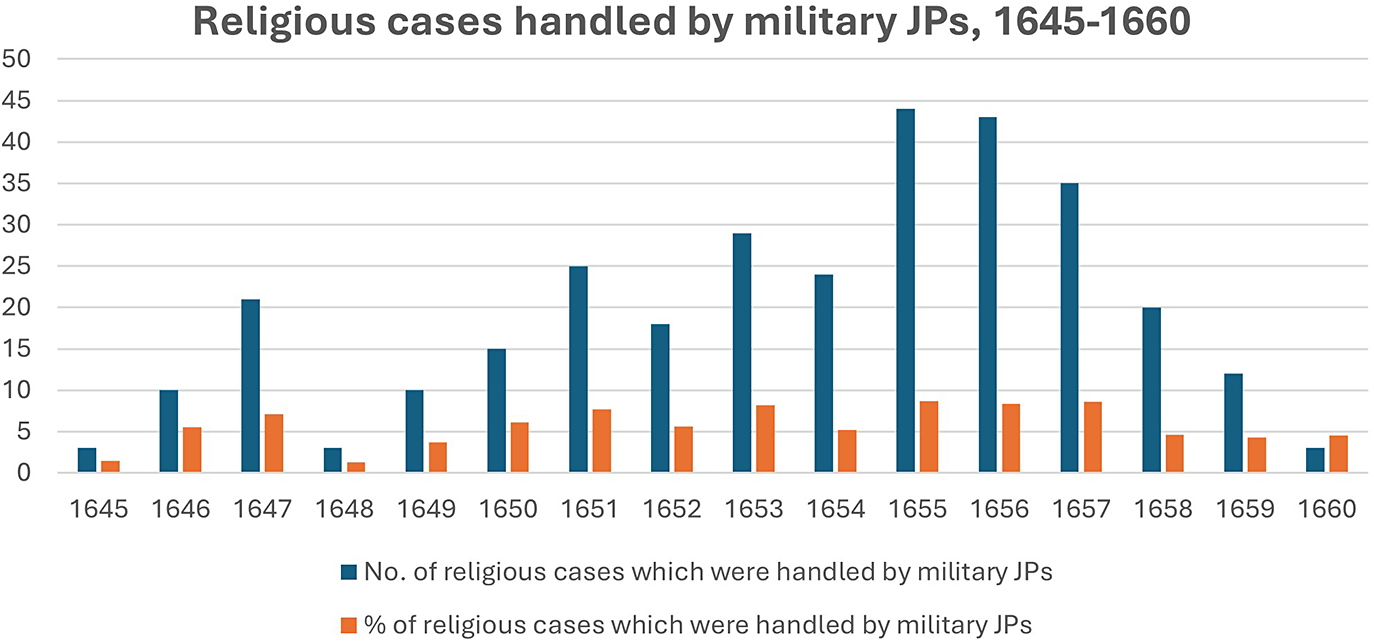
Significant peaks in the number of religious cases handled by military JPs occurred at times of crisis in 1647, 1651 and 1653 (see Figure 1), years in which the number of religious cases also increased overall: at no time did the percentage of religious cases handled by military JPs exceed 10%. In 1647, there was widespread religious unrest following the ejection of large numbers of clergy and the introduction of new religious practices; in 1651, there were acute anxieties about the military threat from the Scots; in 1653, the Barebones Parliament was pressing for radical religious changes, such as the abolition of tithes. Religious cases were at their highest level under the direct rule of the major-generals in 1655–6, with the number dealt with by members of the military again rising sharply, showing the extent to which military commanders perceived they had a religious mission.Footnote 61 ‘I beseech you to consider wee in this nation have long prayed for reformation, and complained for want of it, and most of our talke hath beene about it,’ wrote Major-General James Berry to the Welsh commissioners in December 1655. He prayed that God would stir their hearts to be ‘zealouse for him’ as a ‘terrour to evill doers’.Footnote 62 At a more humble level, the Fifth-Monarchist concept that the army had a part to play in bringing the kingdom of God on earth can be seen in the reported comments of one John Allen of Huntspill in Somerset in November 1656 that ‘there would be as good scriptures made concerning the late wars as any … in the … old and new testament’.Footnote 63
Religious Cases handled by Military JPs, 1645–60.

Figure 1. Long description
The x-axis lists years from 1645 to 1660. The y-axis ranges from 0 to 50. For each year, two bars are shown: blue for number of religious cases handled by military J P s, orange for percent of religious cases handled by military J P s. Blue bars are highest in 1655 and 1656, both reaching 45 cases. Other notable peaks are in 1647, 1651, 1653, and 1657, with values between 15 and 30. Orange bars, representing percent, are consistently lower, peaking in 1647 and 1651 at about 7. For most years, the orange bars remain below 5. Both series show a rise in the early 1650s, peaking mid-decade, then declining toward 1660. The legend identifies blue as number of cases and orange as percent of cases.
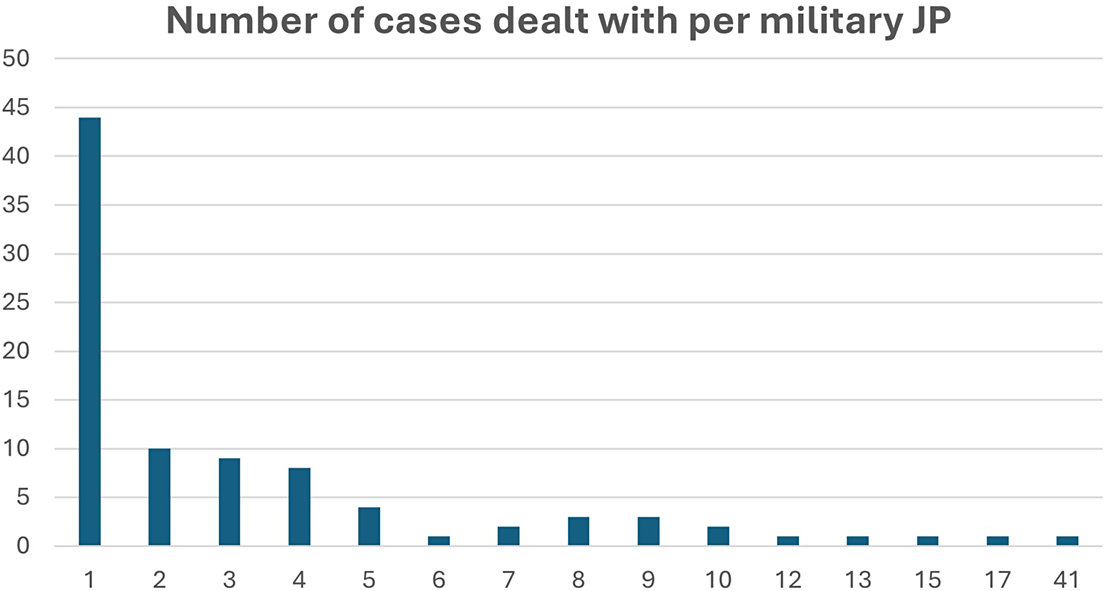
Within the sample of cases discussed here, a large number of military JPs – just over 48% – are recorded as having dealt with only one religious case (see Figure 2), prompting a suspicion that there was more fluidity in who performed the role of JP during the Commonwealth period. Traditionally, justices had to be approved by the Crown; after the regicide, these appointments came under the remit of the commissioners of the new Great Seal.Footnote 64 There are four surviving lists of JPS for the 1650s at the national archives: Henry Reece’s list of military JPs is taken from these and other sources.Footnote 65 However, only eight of the ninety-one justices recorded on actual legal documents as dealing with specific religious-related issues are included in Reece’s list.Footnote 66 Moreover, some officers frequently concerned themselves with religious issues, including in Cheshire Colonel Thomas Brereton, garrison commander, who heard seventeen cases, and Colonel Henry Bradshaw who heard thirteen; in Somerset, Colonel Edward Ceeley heard twelve, and Major Henry Bonner and Captain George Sampson eight and nine respectively.Footnote 67
Number of Religious Cases dealt with per Military JP.

During the 1640s and 1650s, with the church hierarchy and church courts abolished, and Presbyterian classes proving ineffective at censuring the laity, most commentators now argued for ‘the power of the Magistrate in matters of Religion’.Footnote 68 Consequently, an expanded role emerged for judges and justices in interpreting religious policy and policing the boundaries of acceptable religious practice. Henry Reece argues that the activities of military JPs were not limited to cases of violence or treasonable activities affecting state security, but also ‘encompassed much of the routine trivia of local justice’, mirroring the activities of other justices.Footnote 69 However, Reece also stresses military JPs’ ‘intermittent intervention in pursuit of a particular initiative’.Footnote 70 In their dealings with religious issues, we can see this evidence of both the quotidian and the extraordinary. Along with intensifying the prosecution of religious-related offences which were already secular crimes and misdemeanours, such as swearing, military JPs were involved in many routine matters of church administration which might previously have been dealt with by the church courts, including church repairs, financial irregularities and issues relating to church seating.Footnote 71 When queries were raised in 1652 about the amounts claimed by former churchwardens at Winwick in Lancashire for sacraments during the Civil War years, Colonel Gilbert Ireland investigated.Footnote 72 A serious dispute in 1657 over the accounts at Whitegate in Cheshire relating to the costs of repairing the war-damaged church and the hiring of a minister, which resulted in the churchwarden’s being imprisoned for two years, had to be resolved by the intervention of Colonel Thomas Croxton.Footnote 73 Judges and justices had now been given a wider remit for intervention in religion.
Parish financial disputes were passed to military officers to arbitrate. When in early 1650 John Smith, parish clerk at Warblington in Hampshire, petitioned, claiming that the parishioners refused to pay him his wages, this was referred to Colonel Thomas Bettesworth. A few months later, when the Roman Catholic Lord Paulet complained of over-rating on his impropriate parsonage at Nether Wallop, one of those designated to deal with it was Captain John Pittman, an active JP for Hampshire and later patron of the living at nearby Quarley. Paulet’s religion does not seem to have prevented his complaint from being handled conscientiously, if slowly: four years later, he was decreed to have been seriously over-rated and ordered to be compensated.Footnote 74
Military JPs also dealt with cases relating to unexpected disruptions to church services and a large number of cases where religious violence was involved. In 1651, complaints that three female parishioners at Dilhorne in Staffordshire had, on several occasions, violently ‘contended in their seat’ in church on the Sabbath, to the disturbance of the rest of the congregation, were dealt with by Colonel Philip Jackson, but the case was discharged.Footnote 75 In Cheshire, Colonel Thomas Brereton dealt with similar incidents, this time involving aggressive males, in 1657 and 1659.Footnote 76 Complaints made in April 1652 by Richard Gregory, the parish clerk at Bruton in Somerset, that the former parish clerk had attempted to supplant him in the middle a church service, seemingly with the approbation of one of the churchwardens, were heard by Colonel John Pyne.Footnote 77 When Ann Dacy, the wife of the new incumbent in the sequestrated living of Offwell in Devon, complained of intimidation, violence and verbal abuse from her near-neighbour Bartholomew Wollan, Colonel Fry had Wollan imprisoned.Footnote 78 Religious violence and disorder, whether occurring within the church or beyond it, frequently attracted the attention of military JPs.
Military justices often took it upon themselves to punish swearers and cursers, which were probably offences with which they were familiar through maintaining discipline in the army and seeking to differentiate themselves in godliness from the ‘goddamee’ swearing Cavaliers.Footnote 79 The summary nature of the punishment probably also appealed to a military man’s desire for decisive action. In Somerset, Major Henry Bonner was especially vigilant and, along with other military JPs Colonel John Pyne and Captain John Barker, contributed to a ‘Certificate of Convictions for Swearing’ in 1650 and 1655.Footnote 80 A concern with swearing drilled further down the ranks. In May 1651, John Chappell, a soldier under the command of Captain Bethogge, testified that the previous night he had heard Margaret Stye swear three oaths by the name of God in St Mary Steps parish in Exeter.Footnote 81 In May 1653, Exeter Castle soldier William Mole reported chandler William Hill for beating and abusing him, calling the mayor of Exeter ‘A Jack a Naps and A puppey’ and swearing four oaths ‘before God’.Footnote 82 Lieutenant Robert Barrett was called out in 1652 to deal with Thomas Hollingworth of Adswood in Cheshire who was disturbing the neighbourhood at night, and discovered Hollingworth swearing many profane oaths. Barrett threatened that Hollingworth should pay for his swearing, but Hollingworth, he reported, persisted, swearing ‘by the woundes, by his faith, by his troth, by the Masse’ many times over.Footnote 83 Controlling bad language in public, easily dealt with via summary justice and centrally-standardized punishments, allowed members of the military to demonstrate their leadership in setting the moral tone in their locality.
Military JPs frequently dealt with cases relating to observance of the Sabbath, and with adultery cases, which may be seen as symptomatic of a keen interest in seeing the new flagship religious statutes of the regime successfully implemented and godly discipline maintained. In September 1651, Lieutenant-Colonel John Gorges ensured the prosecution of three men seen working at a lime kiln in Pitminster in Somerset on a Sunday. In Hertfordshire in January 1651, a man from North Mymms who was drunk on the Sabbath and abusing his neighbours as whores and rogues, was brought before Colonel Alban Coxe.Footnote 84 In June 1654, William Davie of Wiveliscombe in Somerset faced accusations which included running through the town and reviling those who wanted to observe the Sabbath strictly as ‘tubbypreaching’ [sic] rogues; these were dealt with by Lieutenant-Colonel Bovett.Footnote 85 When the minister of Staple Fitzpaine in the same county faced physical resistance from those he attempted to dissuade from drinking in an alehouse on the Sabbath, it was Major Henry Bonner who handled the case.Footnote 86 In 1656, garrison commander Andrew Gryffith at Conwy compiled a list of eight men and two women who had profaned the Lord’s day and demanded action by the Justices of the Peace.Footnote 87 In Yorkshire in July 1656, Captain Thomas Lassells prosecuted two men who confessed to travelling on the Lord’s day and, not approving of their excuse, sentenced them to fines of ten shillings apiece or six hours in the stocks.Footnote 88 Reece identifies Bristol as a place in which the garrison became particularly involved in city politics.Footnote 89 In September 1657, Alderman Joseph Jackson, also an army captain, dealt with the case of George Ball who had rescued several persons who were in trouble for breach of the Sabbath.Footnote 90 By intervening in these cases, military justices were working actively to promote the godly moral agenda.
However, it was witchcraft which headed the list of religious-related cases with which military JPs concerned themselves, with forty-one cases. In Yorkshire Colonel Henry Tempest, in Somerset Colonel Edward Ceeley, and in Cambridgeshire Captain Thomas Castell, during the tail end of the Mathew Hopkins mass witch hunt, seem to have shown a particular readiness to pursue accusations of witchcraft. In Kent, Captain Thomas Plomer dealt with witchcraft cases in 1651, 1652, 1656 and 1657.Footnote 91 A 1656 witchcraft case from Cheshire involved four JPs with military associations: Henry Bradshaw, Edward Hyde, Thomas Stanley and Thomas Brereton.Footnote 92 During a mass witch hunt in Newcastle upon Tyne in 1649, Lieutenant-Colonel Paul Hobson, deputy governor of the town and a notorious religious radical noted in Gangraena for forcing ministers out of pulpits, looked on as thirty suspected women were examined naked in front of him for witch’s marks. He intervened to spare one of the women because she was better-looking than the rest: of the others, fifteen were subsequently hanged.Footnote 93 The involvement of these military men in witchcraft trials appears to demonstrate the extent to which the crime was feared as a serious religious and social threat, on a par with sedition, and perhaps, as Diane Purkiss has argued, seen as a particular provocation to the masculine values which dominated the army. Both adultery and witchcraft charges, largely targeted at women, represented a much higher proportion of the caseload of the military JPs than their overall proportion in the sample of records examined here.Footnote 94 Military justices appear to have been at the forefront in the increased and more severe prosecution of these two types of religious cases that predominantly targeted female suspects.
Apart from the role of many officers as JPs, soldiers involved themselves in parish life in a number of other ways. They might act as churchwardens. In this capacity, a Captain Gates in October 1645 signed a certificate of good behaviour for Margaret Edwards of Barking after she had wronged the minister there.Footnote 95 In Gwynedd in September 1653, a Captain John Arundell was appointed parish registrar because there were ‘noe officiating ministers’ in most of the parishes in the area.Footnote 96 Officers might make direct appointments to livings. According to his 1654 petition to the Council of State, Arthur Ockley, the preacher on Mersea Island in Essex, had been ‘invited’ there two years before by its governor, Captain Burrell, after its sequestration, an appointment for which he sought official confirmation.Footnote 97 Decisions on augmentations at Scarborough, essential to appointing the right sort of godly minister, were facilitated by the intervention in 1646 of Captain Lawson and Captain Neshfeild making daily attendance at committees at Westminster and in 1658 by Colonel Salmon. When William Langley fell out with his colleague John Butler at Lichfield, and Langley lost the argument, it was ordered that Captain Falconbridge carry out the suspension of Langley’s augmentation from the Trustees for the Maintenance of Ministers.Footnote 98 Whether as church officers, or as influencers behind the scenes, military officers were making their presence felt.
Officers might attempt to remove clergy or to block their appointments. In September 1655, Captain Sheareman was described as having ‘laboured against’ the appointment of Mr Herne as one of the ‘six preachers’ at Canterbury.Footnote 99 Langley Burrell in Wiltshire was a deeply troubled parish: a previous incumbent there, Thomas Webb, had been accused of being a Ranter, and was ejected in 1652.Footnote 100 Henry Massey was the third clergyman serving the living since the ejection of Henry Norborne in 1647. When he was accused of scandal in 1655, twenty parishioners testified in favour of Massey as a ‘man of a godly conversation’, faithful to the Commonwealth, who had been charged out of malice. Nonetheless, Massey’s fate was sealed after his family and servants entered into a violent altercation with Charles Aland, a trooper under the command of Captain Burges, and Massey was soon replaced.Footnote 101 The actions or involvement of the military could have a direct bearing on whether a minister retained his living.
Soldiers might be proactive in witnessing against seditious preaching or speeches on the part of the clergy, and or in preventing the distribution of seditious religious literature, especially during the uncertain years of continuing military conflict between 1649 and 1651, and following the Penruddock uprising in 1655. In September 1649, trooper Robert Moore swore on oath at the Yorkshire assizes that he had seen the book entitled the ‘Tablet or Moderacion of Charles the first Martyr’ passed around by two gentlemen from Pickering; he interrogated them about it and reported it to the local authorities.Footnote 102 In July 1650, a Lieutenant Nicholas Male was amongst nineteen people who complained that Robert Suddon, minister of Altcar in Lancashire had not only called the Engagement a damnable thing, but had neglected his ministry on Sundays and days of humiliation, refusing communion to his congregation and calling them ‘damned divilles’.Footnote 103 In August 1655, Captain Thomas Ewbanks reported a conversation with William Richardson, minister of Broughton in Yorkshire, in which Richardson predicted a revolt against the government within three months.Footnote 104 These officers and soldiers acted as informers against clergy or other individuals perceived to be threatening the security of the state by their religious views.
As loyalist accounts suggest, the records indicate that some soldiers directly intervened against church services they considered as being conducted improperly. At Dunster in Somerset on Sunday 31 October 1652, Captain Nicholas Blake raised an objection to the minister, Mr Dunsterfeild, appointed by a Mr Estcott to preach, because he had not been appointed by the commissioners. Another parishioner, Henry Chapple, then stepped towards the pew in which Captain Blake and Captain Bowers were sitting, and abused them.Footnote 105 In February 1654, Robert Darbyshaire, a soldier in the Ludlow garrison, reported Dr Thomas Warmestry (later dean of Worcester) to the authorities after hearing him preach at Ludford, accusing him of promoting the use of Common Prayer and praying for kings and bishops.Footnote 106 In April 1654, Constant Jessop, minister, petitioned the Protector, claiming that three years previously he had been prevented from preaching in Bristol and banned from coming within ten miles of the city on what he claimed was a misrepresentation by Captain Bishop of his sermon about the choice of mayor.Footnote 107 In January 1657, Major Matthew Bridges vociferously objected to the work done in ‘beautifying and painting’ Alcester church in Warwickshire, declaring ‘the uselessness thereof’ and recommending that the rood loft and ‘all superstitious paints’ be demolished and defaced.Footnote 108 Officers had strong opinions on the way parish religion was conducted and forcibly expressed them.
So did ordinary soldiers: it was reported in January 1659 that a Serjeant Johnson had threatened to pull Mr Matthew Newcomen, minister of Dedham in Essex, out of the pulpit and ‘rost him alive’, and said ‘that Mr Warren of Colchester should bee served with the same sauce’.Footnote 109 However, had he done so, it is likely that his comrades would have contained him: disruptions to church services often attracted the attentions of the military. In February 1653/4 when Charles Summer, the recently-appointed minister at Staunton in Worcestershire, together with the ‘well-affected’ of the parish petitioned the Council of State complaining of the interruptions Summer had experienced in the course of his ministry, Lieutenant-Colonel Grimes and Major Richard Creed were instructed to examine the case and ‘quieten him in his duty.’ That same day the Council dealt with a communication from Colonel Sydenham about the ‘many interruptions’ by ‘ill-affected persons’ to the ministry of Adam Reeves, appointed by the Somerset Committee to be minister at Wyke Champflower.Footnote 110 These cases demonstrate how the military might be called upon to quell the continuing divisions and tensions experienced in many churches throughout the 1650s.
Some officers supported the attempts to establish a Presbyterian classical system in England; the minutes of the Manchester Classis show several acting as elders to congregations and sometimes as delegates to the Provincial Assembly. Captain Robert Ashton, who had facilitated Henry Fairfax’s ejection from Ashton-under-Lyne, was an elder throughout the Interregnum.Footnote 111 Others campaigned for the establishment of separatist churches: a petition from Major Francis Allen at Wanting and Grove in Berkshire to the Council of State in 1653 asked for special provision of space for their separatist congregation to worship.Footnote 112 In 1656, Major-General Desborough intervened to ensure that the Exeter Baptists had the best-repaired public meeting place in the city.Footnote 113 In August 1654, Lieutenant Edward Harper and Ensign Arnold Baxter, from the ‘church of God in Stopford’ petitioned the Council of State for an enlarged augmentation for the Congregationalist Samuel Eaton, ‘a famous instrument for conversion and building up’.Footnote 114 At Nantwich in 1657, Major-General Bridges made sure Mr Hadock, pastor of the ‘congregated’ church, was permitted to preach a weekly lecture in the ‘public meeting place’ (church) of the town.Footnote 115 Where Presbyterianism was strong, as in the north-west, members of the military were prominent in its organization; elsewhere, military officers actively encouraged the establishment of Congregationalism and separatist congregations.
Some types of sectarianism clearly worried the military. At Ely in July 1655, one Daniel Gray, committed by Captain Thomas Castell for coming naked into the house of the Hunt family, is likely to have been a Quaker.Footnote 116 A large open-air Quaker meeting in a garden near a mill in Plymouth in July 1655 clearly alarmed the authorities: a naval officer managed to infiltrate it and reported back on leader Thomas Salthouse’s anti-Trinitarian beliefs.Footnote 117 Salthouse was also present at a large meeting involving four hundred people armed with staves, clubs and pikes at an orchard near Martock in Somerset in April 1657. A Captain Raymond and his troop were sent to keep the peace, but the owner of the orchard, Thomas Budd, refused to cooperate, warning one of the participants, probably Salthouse, to flee on horseback, pursued (unsuccessfully) by three of the soldiers.Footnote 118 When a female mystic, ‘Jaine’, came to the town of New Malton in Yorkshire, attracting crowds of people away from the parish church, Major Baildon, along with the minister Robert Hickson, was amongst those who complained vociferously against her; Baildon protested that she had drawn away the attention and affections of his wife.Footnote 119 Types of separatism which threatened disorder were often perceived as a step too far, even by members of the Parliamentarian army.
Conclusion
The actions of the soldiery loomed large in remembered accounts of the Interregnum parish, probably because a presence which, at the time, had been pervasive, now seemed so singular in a country which, before the 1640s, had never had a standing army, and which was still arguing over the need for one in the 1690s.Footnote 120 Military forces were often blamed as the visible agents of religious policies decided by committees and actors higher up the chain of power. Long-festering resentments over the high-handedness of soldiers’ and officers’ actions, informed by an earlier tradition which saw the soldier as a ‘reprobate’ who ‘inevitably clashed with peacetime society’, led their dramatic interventions, often at the end of a process of decision-making, to become over-emphasized as the readily-remembered ‘flash-bulb’ moment characteristic of traumatic memories.Footnote 121 Godly ministers, congregations, and the majority of the elite well-affected to the government but not members of the military, still had a significant influence over how the religious policies of the Interregnum church were implemented across a nation that was fragmented and temperamental in its religious allegiances.
At the same time, Austin Woolrych’s assessment of the military’s involvement in political life as a yes or no question is surely too binary. As Samuel Finer has argued, military influence on the state can operate in varying forms and at different levels. It is more often exerted indirectly and latently in a ‘dual’ regime, whose twin pillars consist of the army on the one hand and an organized sector of civilian opinion on the other, rather than overtly and directly. The fact that members of the army are minority actors in administrative structures and processes does not lessen their significance; even in states known as military dictatorships, this has usually been the case. Rather than deriving from official administrative structures, the military’s power comes from the use of a ‘set of techniques’ and channels, often behind the scenes, used to serve their personal and sectional interests.Footnote 122 During the Interregnum, soldiers were influential in many aspects of religious life: with a larger standing army than had ever been known in the kingdom before, they were a ubiquitous presence, and inclined to use their influence on issues of religion which concerned them. Particularly notable was their unofficial role in facilitating clergy appointments and ejections, and their tendency to become involved once parish conflicts proved violent or intractable. Some experienced their influence as positive, often as the only means of maintaining order in a fractured and febrile society. For example, by replacing Thomas Brook (nicknamed ‘Bawling Brook’) with Henry Newcome at Gawsworth in Cheshire in 1649, Colonel Henry Mainwaring ended the ‘great passions and contests’ there and ensured that the next eleven years were less troubled in this parish. Newcomb may not have always liked the opinions of all the soldiers and military officers he encountered, but he learned the benefits of working with some of them.Footnote 123 So did Ralph Josselin, pressing a reluctant Colonel Cooke to end a disagreement over the title to the sequestered living of Stisted in Essex.Footnote 124
Cooperation with the military was a modus vivendi for some clergy, but not necessarily one that was popular with the majority: as Finer has also argued, most military dictatorships face a ‘mutinously sullen or openly hostile people’.Footnote 125 The Interregnum regime was no exception. In February 1649/50, a drunken schoolmaster, William Leng, intruded into the soldiers’ quarters at Pocklington in Yorkshire, and challenged them by asking them ‘what they were’. When they replied ‘souldyers’, he retorted that ‘he Cared not a Turd for them’ that ‘Cromwell was the son of an whore’.Footnote 126 A Portsmouth woman was told by her lodger in 1655 that her ‘husband in the Parliament service did not go to Heaven’; a statement from Stepney in 1659 declared that ‘there was not an honest man in the army’.Footnote 127 Clergy and their parishioners were often suspicious, fearful and antagonistic towards the military. One minister described how he changed the contents of his church services if any soldiers were present.Footnote 128 A later minister at Baxterley in Warwickshire reported that the parishioners there, when an officer of the Parliament army came to visit a relation living locally and came to church on Sunday, thinking he came to disturb them, ‘could not forbear affronting the officer’.Footnote 129 Some chose to accept and benefit from the unprecedented influence of the military on parish religion, even if, after the Restoration, they preferred to forget their associations with the now-vilified Cromwellian army. Many more were ambivalent about or resented the army’s influence. It was this sense of outrage, stifled while still subject to the army’s power, which emerged, distilled and concentrated in memory, in the decades after the Restoration.

 Open access

