





Introduction
As children learn to read in an alphabetic language, they need to unravel the relationship between letters and sounds. Accordingly, phonological awareness, the ability to understand and manipulate the sound structure of spoken words, is an essential precursor of literacy (De Cara & Goswami, Reference De Cara and Goswami2003; Garlock, Walley & Metsala, Reference Garlock, Walley and Metsala2001). Phonological awareness typically develops from larger to smaller sound units – that is, from syllables to rimes to phonemes (Carroll, Snowling, Stevenson & Hulme, Reference Carroll, Snowling, Stevenson and Hulme2003 for English; Vloedgraven & Verhoeven, Reference Vloedgraven and Verhoeven2007 for Dutch; Ziegler & Goswami, Reference Ziegler and Goswami2005 for French). According to the lexical restructuring hypothesis, increasing vocabulary size triggers the need to specify phonemic contrasts (e.g., ‘bear’ vs. ‘pear’), leading to enhanced phonological awareness over time (Metsala & Walley, Reference Metsala, Walley, Metsala and Ehri1998). Thus, lexical specificity, is defined as the richness and specificity of, and distinctness between, phonological representations in the emerging mental lexicon (van Goch, McQueen & Verhoeven, Reference van Goch, McQueen and Verhoeven2014, p.157). Hence, lexical specificity is not a skill but rather a characteristic of lexical representations, developing over time from more holistic to more segmental. With regards to bilingual children, becoming phonologically aware also involves comparing and contrasting the phonological representations between the first language (L1) and the second language (L2). Indeed, there is good evidence that training targeting lexical specificity enhances phonological awareness among Dutch monolingual (Van Goch et al., Reference van Goch, McQueen and Verhoeven2014) and Turkish–Dutch bilingual children (Janssen et al., Reference Janssen, Segers, McQueen and Verhoeven2015).
In the present study, we examined English-speaking children acquiring French in early French immersion programs in Canada. Both English and French are considered to have an opaque orthography because letter-to-sound relationships are often not one-to-one and there are many silent letters. As a result of these inconsistencies, learning to read words takes about two years of formal instruction (Seymour, Aro, Erskine & Collaboration with COST Action A8 Network, Reference Seymour, Aro and Erskine2003). In Canada, French immersion programs are offered to children who do not speak French as their L1. During the primary grades, French is the sole language of instruction from senior kindergarten or Grade 1 until Grade 4, at which point English language arts are introduced. Since English is the dominant societal language and often also the home language, children become additive bilinguals (Johnson & Swain, Reference Johnson and Swain1997). The objectives of the present study were twofold. First, we aimed to find support for the lexical restructuring hypothesis by extending previous studies (e.g., Van Goch et al., Reference van Goch, McQueen and Verhoeven2014; Janssen, Segers, McQueen & Verhoeven, Reference Janssen, Segers, McQueen and Verhoeven2015) with a new language pairing among emerging English (L1) – French (L2) bilingual children. Second, we went beyond previous studies and examined the cross-linguistic contribution of lexical specificity from English (L1) to phonological awareness in French (L2). In particular, we investigated whether the ability to identify language-shared versus language-unique phonological contrasts mediates the relationship among vocabulary and phonological awareness outcomes between English and French.
Lexical restructuring and phonological awareness
Initially, young children’s phonological representations of words are holistic (e.g., ‘bear’ can be easily differentiated from ‘dog’, but not from ‘pear’, as ‘bear’ and ‘pear’ are not fully specified at this point, see Van Goch et al., Reference van Goch, McQueen and Verhoeven2014). As early as 1 year of age (Werker, Byers-Heinlein & Fennell, Reference Werker, Byers-Heinlein and Fennell2009), children’s lexical development accelerates as they learn to reorganize phonological differences between speech sounds to include more specific contrasts (e.g., ‘bear’ vs. ‘pear’). However, this notion has been contested by other researchers (see Swingley & Aslin, Reference Swingley and Aslin2002). Successful discrimination of words that differ from each other by only one sound require children to develop a detailed recognition mechanism for lexical representations stored in memory (Werker et al., Reference Werker, Byers-Heinlein and Fennell2009). As a result, it has been proposed that specificity of lexical representations serve as a precursor of phonological awareness (Van Goch et al., Reference van Goch, McQueen and Verhoeven2014). The development of lexical specificity does not occur in isolation: as memory capacity and vocabulary size expand, lexical representations become more detailed (van Goch, Verhoeven & McQueen, Reference van Goch, Verhoeven and McQueen2017).
According to the lexical restructuring hypothesis (Metsala & Walley, Reference Metsala, Walley, Metsala and Ehri1998), increasing vocabulary size influences the segmentation of phonological representations into finer units. A few studies have explored the relationship between vocabulary and phonological awareness among bilinguals. For example, Rolla San Francisco and colleagues (Rolla San Francisco, Mo, Carlo, August & Snow, Reference Rolla San Francisco, Mo, Carlo, August and Snow2006) investigated this relationship among a group of Spanish (L1) – English (L2) bilingual children in kindergarten and Grade 1. Their results revealed that children with a higher receptive vocabulary (either in Spanish or English) performed better on an English phonemic segmentation task than children with more balanced vocabularies. The findings support the lexical restructuring hypothesis, as growth in vocabulary enhances the development of phonological awareness. The researchers expected that children with a large lexicon in both Spanish and English would have superior phonological awareness in English but acknowledged the lack of children with high vocabularies in both languages within their sample. Furthermore, Dixon, Chuang, and Quiroz (Reference Dixon, Chuang and Quiroz2012) examined whether vocabulary knowledge contributed to phonological awareness among three groups of Singaporean kindergarten English-language learners who spoke a different L1 (Mandarin Chinese, Malay or Tamil). The results suggest that growth in English vocabulary influences how lexical items are stored over time from more global to more detailed, influencing the development of English phonological awareness. While the children’s L1 vocabulary was not a significant predictor of English phonological awareness, the influence of the specific L1s was substantial. Specifically, the Malay language children performed the best on phonological awareness assessed in English compared to the other two language groups. Learning to read in a shallow alphabetic orthography (e.g., Malay) enhances children’s phonological awareness because of the consistent correspondence between letters and sounds (Katz & Frost, Reference Katz and Frost1992). Difficulty of acquiring reading and spelling skills will increase from shallow (e.g., Finnish) to deep orthographies (e.g., English, see Seymour et al., Reference Seymour, Aro and Erskine2003). Taken together, previous research has revealed that vocabulary size in both of a bilingual’s languages may enhance aspects of phonological awareness, which is an important precursor for word reading.
Lexical specificity in monolingual and bilingual children
The lexical restructuring hypothesis (Metsala & Walley, Reference Metsala, Walley, Metsala and Ehri1998) proposes that growth in vocabulary affects the specificity of phonological representations, which enhances the development of phonological awareness. Van Goch et al. (Reference van Goch, McQueen and Verhoeven2014) investigated the links between lexical specificity and two other phonological precursors to literacy (i.e., speech decoding and phonological awareness). Using a computerized word learning game, Van Goch et al. (Reference van Goch, McQueen and Verhoeven2014) trained Dutch preliterate kindergarten children on a series of monosyllabic word pairs that differed by one phonological contrast (e.g., raap ‘turnip’, raat ‘honeycomb’). In each block, children saw four pictures on a screen and were asked to click on one of the images in response to an orally presented target word. During the first block, each target word was presented alongside a familiar word (e.g., raam ‘window’) that differed by two features, in addition to two familiar filler items. As a result, children could identify the new target word by contrasting with words already present in the children’s lexicon. In the second block, an unfamiliar word that differed by two features was used (e.g., raaf ‘raven’) along with two filler words; while in the final block, children were required to identify one of the target words, in addition to two familiar filler items. The target words could only be acquired if children attended to the detailed phonological contrasts between the minimal pairs in increasingly greater detail. The results indicated that children who received this intervention outperformed the control group (who received numeracy training) in rime awareness, an aspect of phonological awareness. In line with the lexical quality hypothesis (Perfetti & Hart, Reference Perfetti, Hart, Verhoeven, Elbro and Reitsma2002), multiple encounters with a word contribute to a mental lexicon with highly specific phonological, orthographic, and semantic representations. If any of these components are lacking, the word representation is of a lower quality and it takes more effort to retrieve the representation, leaving fewer cognitive resources available for comprehension (O’Connor, Geva & Koh, Reference O’Connor, Geva and Koh2019).
Whereas monolingual children are exposed to one set of phonological contrasts, bilingual children are confronted with two. However, bilingual children’s phonological representations of L2 phonemic contrasts may be less specific compared to those of contrasts in their L1 or those of monolingual children due to their lack of early experience with the phonological structure of the L2 (Wade-Woolley & Geva, Reference Wade-Woolley and Geva2000; Walley, Metsala & Garlock, Reference Walley, Metsala and Garlock2003). Furthermore, there are large individual differences in vocabulary with L2 learners typically having lower vocabulary in each language compared with L1 children of the same age (Farnia & Geva, Reference Farnia and Geva2011). In spite of these differences, the relationship between lexical specificity training and phonological awareness has been established among L2 bilingual children. For example, Janssen et al. (Reference Janssen, Segers, McQueen and Verhoeven2015) adapted Van Goch et al.’s (Reference van Goch, McQueen and Verhoeven2014) lexical specificity training and assessed two groups of preliterate readers: 4-year-old Dutch monolinguals and bilingual Turkish–Dutch children who were learning Dutch as their L2. The results showed that both the L1 and L2 Dutch children in the experimental group made gains in phoneme blending (and not rime awareness), relative to the control group. Janssen et al. (Reference Janssen, Segers, McQueen and Verhoeven2015) attributed this difference in the results to the children’s age. The participants in Van Goch et al. (Reference van Goch, McQueen and Verhoeven2014) were on average 4 months younger and may have just begun to become aware of rimes, whereas the older children in Janssen et al. (Reference Janssen, Segers, McQueen and Verhoeven2015) were likely to recognize individual phonemes.
In the same vein, Krenca et al. (Reference Krenca, Segers, Chen, Shakory, Steele and Verhoeven2020a) designed a lexical specificity protocol in English and French to examine whether the lexical restructuring hypothesis extends to children’s word reading skills within an early immersion environment. The researchers measured English (L1) – French (L2) emerging bilingual children’s ability to discriminate new English (e.g., ‘foal’ and ‘sole’) and French words (e.g., bac /bak/ ‘bin’ and bague /bag/ ‘ring’) that differ in one phonological contrast from each other using a computerized word learning game similar to the ones adapted in previous studies (e.g., Janssen et al., Reference Janssen, Segers, McQueen and Verhoeven2015). The results revealed that the specificity of English words (at the beginning of Grade 1) predicted English word reading (at the end of Grade 1) and that this relationship was mediated by English phonological awareness (at the beginning of Grade 1). On the other hand, performance on the French lexical specificity task did not predict French word reading, likely because children’s phonological representations of French words lacked specificity due to their low levels of French proficiency. Krenca et al. (Reference Krenca, Segers, Chen, Shakory, Steele and Verhoeven2020a) concluded that emerging bilinguals relied on the degree of specificity of phonological contrasts in English (at the beginning of Grade 1) to develop stronger English phonological awareness (at the beginning of Grade 1), which in turn may have facilitated word reading in English (at the end of Grade 1).
Lexical specificity and cross-language transfer
Theories of cross-language transfer, such as the linguistic interdependence hypothesis (Cummins, Reference Cummins1979), state that for bilingual children, skills developed in one language facilitate similar skills in another language. In particular, Cummins (Reference Cummins1979) suggested that the L1 and L2 are interdependent and depend on a common underlying proficiency, which refers to a shared central processing system from which both languages operate. According to the transfer facilitation model (Koda, Reference Koda, Koda and Zehler2008), metalinguistic skills (e.g., phonological awareness) that develop in one language contribute to the cross-modal development of reading skills in the other language. An extensive body of research has provided support for these theoretical frameworks, including studies examining English–French bilingual children enrolled in French immersion programs. For example, Comeau, Cormier, Grandmaison, and Lacroix (Reference Comeau, Cormier, Grandmaison and Lacroix1999) found that phonological awareness skills in English (L1) predicted word reading skills in French (L2) for children enrolled in French immersion programs. According to Kuo and Anderson’s (Reference Kuo and Anderson2010) structural sensitivity theory, bilingual children’s exposure to features common to the two languages across diverse language contexts results in a positive transfer effect of these features. Taken together, these theories provide evidence for extending the lexical restructuring hypothesis to bilingual learners, as multiple encounters with a word, particularly words with shared phonological similarities, contribute to a mental lexicon with highly specific phonological representations.
Researchers have found evidence of linguistic transfer for phonological representations of words that are shared between the L1 and L2. In Janssen et al.’s (Reference Janssen, Segers, McQueen and Verhoeven2015) lexical specificity task, half of the items involved phonological contrasts shared by Dutch and Turkish, whereas the other half of the words included contrasts unique to Dutch. The researchers examined the proportion of words identified correctly across different periods of the training (i.e., Blocks 1 and 2 versus Block 3) between Dutch (L1) monolingual children and Turkish (L1) – Dutch (L2) bilingual children. In terms of words with phonological contrasts unique to Dutch, the monolingual children outperformed their Dutch (L2) counterparts at all points in the training. However, in Block 3, there was no difference between the two language groups in the proportions of words correctly identified with Dutch-Turkish phonetic distinctions common to both languages. These results are consistent with Kuo and Anderson’s structural sensitivity theory (Reference Kuo and Anderson2010). According to this theory, bilingual children develop more specified representations of phonological contrasts that are common to both languages than with those unique in each language. However, Janssen et al.’s (Reference Janssen, Segers, McQueen and Verhoeven2015) study did not explore whether lexical specificity in the L1 lays the foundation for L2 phonological awareness development.
Cross-language transfer is influenced by the relative level of proficiency the individual has in each of the two languages, with transfer typically occurring from the language in which the individual is most proficient to the language in which the individual is less proficient (Chung, Chen & Geva, Reference Chung, Chen and Geva2019). Indeed, Krenca et al. (Reference Krenca, Segers, Chen, Shakory, Steele and Verhoeven2020a) found that emerging bilinguals relied on the quality and distinctness of phonological contrasts in English (at the beginning of Grade 1) to develop stronger English phonological awareness (at the beginning of Grade 1), which in turn contributed to word reading in French (at the end of Grade 1). The results support the transfer facilitation model (Koda, Reference Koda, Koda and Zehler2008), as metalinguistic skills in one language contributed to the cross-model development of reading skills in the other language. In the beginning of Grade 1, English was the children’s stronger language: as a result, their performance in English was a better indicator of their overall phonological awareness which was a precursor to word reading ability in the L2.
The current study
The following objectives guided our study. First, we examined the association between lexical specificity and phonological awareness among emerging bilingual children by exposing them to English (L1) – French (L2) word pairs that differ in one phonological contrast. By exposing children to low frequency target words, our measure was designed to assess a developing skill that is an important precursor of phonological awareness. Second, we investigated the cross-linguistic contribution of increasingly specified lexical representations to phonological awareness by exploring two mechanisms for transfer. We assessed whether increasingly specified lexical representations from English (L1) mediate the relationship between English vocabulary and French (L2) phonological awareness. Moreover, we investigated whether language-shared versus language-unique phonological contrasts serve as the specific mechanism that mediates the relationship among vocabulary and phonological awareness between English and French.
With regards to the first objective, we hypothesized that children with a larger repertoire of minimal pairs in English (L1) would be able to recognize and manipulate phonemic differences in English – thereby enhancing their phonological awareness. Although the participants in our study were not receiving formal instruction in English, the majority received one year of English instruction in junior kindergarten. The French (L2) vocabulary size of the children was limited because they resided in an English-dominant environment and only received French input at school. However, it was anticipated that exposure to new French words with only minimal differences in phonological structure would stimulate lexical restructuring by increasing the specificity of children’s phonological representations from more global to more detailed – hence, improving French phonological awareness. In terms of the second objective, we hypothesized that children’s lexical representations in English mediate the relationship between English vocabulary and French phonological awareness given that cross-language transfer typically occurs from the more proficient language to the less proficient one (Chung et al., Reference Chung, Chen and Geva2019). In line with Kuo and Anderson’s (Reference Kuo and Anderson2010) structural sensitivity hypothesis, we predicted that language-shared features common to English and French, rather than features unique to English, lead to greater phonological awareness in French.
Method
Participants
There were a total of 62 children (27 boys; Time 1: Mage = 75.7 months, SD = 3.2, age range = 70.0 – 82.0 months; Time 2: Mage = 81.2 months, SD = 3.3, age range = 75.3 – 87.1 months). The sample was recruited from eight classrooms in three early French immersion elementary schools in a predominantly English-speaking region in Canada. The children began French instruction in the fall of senior kindergarten; the majority had attended full-day English junior kindergarten the previous year. The participants were, therefore, in the early stages of acquiring French as an additional language. With respect to the children’s place of birth, 87% were born in Canada (n = 54). The children’s exposure to French was generally limited to input received at school. Based on the demographic data, 61% of children never spoke French at home, while 39% rarely spoke French. With respect to the highest level of education obtained, 61% of the mothers had a university-level bachelor’s degree or higher. Based on parental demographic data, none of the children in this study experienced any learning challenges (e.g., speech, hearing, behaviour). Of the 62 participants, 19 (six boys) had one parent/guardian who spoke languages other than English and French to the child at least 50% of the time (n = 4 for Mandarin, n = 2 for Hungarian, Spanish, and Turkish, and n = 1 for Albanian, Amharic, Arabic, Cantonese, Korean, Russian, Serbian, Swahili, and Urdu). The remaining 43 children (21 boys) had no or minimal exposure to a language other than English at home. The participants from both language groups were combined for analysis (refer to the results section for details).
Measures
In the fall of Grade 1, the participants were individually assessed on lexical specificity and receptive vocabulary in English and in French. The children were individually tested on English and French phonological awareness in the fall and spring of Grade 1. The participants in the present study consisted of the same group of children who took part in a larger collaborative project that examined the relationship among children’s phonological awareness, lexical specificity, and word reading (Krenca et al., Reference Krenca, Segers, Chen, Shakory, Steele and Verhoeven2020a), and the extent to which lexical specificity in English predicts children’s at-risk reading status in French (Krenca et al., Reference Krenca, Gottardo, Geva and Chen2020b). Taken together, these studies have different research questions, measures, and utilized different analyses. In the current study, we report data here on the phonological foundations of early literacy, specifically, the relationships among children’s vocabulary, lexical specificity, and phonological awareness. Moreover, we investigated whether language-shared versus language-unique phonological contrasts serve as the specific mechanism that mediates the relationship among vocabulary and phonological awareness between English and French.
Parental demographic questionnaire
Parents completed a demographic questionnaire adapted from the Alberta Language Environment Questionnaire (ALEQ, Paradis, Emmerzael & Duncan, Reference Paradis, Emmerzael and Duncan2010). Questions targeted the highest level of education attained [6-point scale from (0) primary to (5) advanced university degree PhD, MD, JD], self-rated fluency in English, French, and/or any other language [5-point scale from (0) not fluent to (4) very fluent], current language use by family members in the home, and whether the children experienced any learning challenges (e.g., speech, hearing, behaviour).
Phonological awareness
The elision subtest of the Comprehensive Test of Phonological Processing – Second Edition (CTOPP-2; Wagner, Torgesen, Rashotte & Pearson, Reference Wagner, Torgesen, Rashotte and Pearson2013) was administered to assess phonemic awareness in English. This subtest consists of 34 items and measures children’s ability to remove phonological segments from spoken words in order to form other words. For the first nine items, children were asked to repeat a two-syllable word and then delete one of its syllables [e.g., “Say ‘toothbrush’. Now say ‘toothbrush’ without saying ‘tooth’]. For the remaining items, the children were asked to say a word and then delete its initial (e.g., ‘cup’ without /k/ is ‘up’), medial (e.g., ‘powder’ without /d/ is ‘power’) or final phoneme (e.g., ‘meet’ without /t/ is ‘me’)]. There were 14 test items for which the children received feedback about their accuracy, and 20 test items without any feedback. Administration of the test was discontinued if the children made three consecutive errors. A parallel measure consisting of 26 items was created for French. For the first three items, the children were asked to repeat a two-syllable word and then delete one of its syllables [e.g., “Say surtout. Now say surtout without saying tout”]. For the remaining items, the children were asked to say a word and then delete its initial (e.g., fleur without /f/ is leur), medial (e.g., mardi without /d/ is mari) or final phoneme (mouche without /ʃ/ is mou). There were six practice items, five test items for which the children received feedback about their accuracy, and 21 test items without any feedback. The administration of the test was discontinued if children made six consecutive errors.Footnote 1 In terms of the English task, the Cronbach’s alpha calculated for our sample was .90 and .94 (fall and spring of Grade 1, respectively). With respect to French, the Cronbach’s alpha for our sample was .88 and .94 (fall and spring of Grade 1, respectively).
Receptive vocabulary
English receptive vocabulary was measured using the fourth edition of the Peabody Picture Vocabulary Test (Dunn & Dunn, Reference Dunn and Dunn2007). Administration followed standardized procedures. Children identified one of four pictures that best illustrated a target word spoken by the tester. Three practice items preceded testing. Testing was discontinued on the last item of a set on which the child made eight errors or more. Cronbach’s alpha reliability for our sample was .96. Form A of the Échelle de vocabulaire en images Peabody (Dunn, Theriault-Whalen & Dunn, Reference Dunn, Theriault-Whalen and Dunn1993) normed on a sample of Canadian children who were native speakers of French, was used to assess students’ French receptive vocabulary. A target word was spoken and children identified one of four pictures that best illustrated the item. Three practice items preceded testing. Testing was discontinued when a child made six errors on eight consecutive items. Cronbach’s alpha reliability for our sample was .92.
Lexical specificity
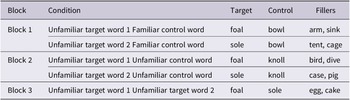
We created lexical specificity tasks in English and French based on the Dutch measure reported in previous studies (Janssen et al., Reference Janssen, Segers, McQueen and Verhoeven2015; Van Goch et al., Reference van Goch, McQueen and Verhoeven2014). Using E-Prime 2.0 (Psychology Software Tools, 2012), the measures were presented as Ziggy’s Word Game on the computer screen. Each trial began with the presentation of a fixation cross. After 500ms, four pictures appeared on the screen. Each picture represented a word within a quadruplet (Figure 1). After 1000 ms, the child heard the auditory request: “Show me the [TARGET]”, while the pictures remained on the screen.Footnote 2 The children then indicated their response to the request by pressing the key that corresponded to one of the pictures on the computer screen (refer to Table 1 for the structure of the task). A silicone keyboard cover was placed on top of a traditional keyboard. All of the keys were covered with black squares apart from four red letters – “a”, “b”, “c” or “d” – which covered the keys “w,” “i,” “z,” and “m”, respectively. If the children chose the correct picture, a smiling face appeared on the screen within 1000 ms. If the children chose an incorrect picture, no feedback was given. Feedback was omitted in the test phase, where pictures of both target words were presented together, but children were asked to identify only one of the target words that differed by one phonological contrast.
English Lexical Specificity Task: Experimental Design and Example Stimuli

An example of a trial sequence from the first block of the English Lexical Specificity task

Each measure contained 20 quadruplets of monosyllabic words with corresponding pictures. Each quadruplet consisted of two unfamiliar minimal-pair target words differing in one phonological feature (e.g., ‘foal’ and ‘sole’, which differ in the place of articulation of the initial phoneme) as well as one unfamiliar control word (e.g., ‘knoll’) and one familiar control word (e.g., bowl) that differed in two phonological features (here, manner and orality with ‘knoll’ versus manner and voicing with ‘bowl’). Six elementary French immersion teachers in Ontario rated the target words on a 5-point scale from (1) highly unfamiliar to (5) highly familiar as they believed they would be known by Grade 1 children. Target words and unfamiliar words were rated as expected (for details refer to (Krenca et al., Reference Krenca, Segers, Chen, Shakory, Steele and Verhoeven2020a). The control words (e.g., ‘egg’, ‘arm’, ‘sink’) were monosyllabic words that differed from the two target words on at least two phonological features. In the English task, half of the phonological contrasts involved phonemes that were unique to English (e.g., ‘hitch’ and ‘fitch’ involve /h/, a phoneme absent from French) whereas the other half involved phonemes shared by both languages (e.g., ‘fawn’ and ‘pawn’; /f/ and /p/ are phonemes in both languages). The structure of the French task paralleled that of the English version; once again, half of the phonological contrasts were unique to French (e.g., cil ‘eyelash’ and cygne ‘swan’ involve word-final /l/ and /ɲ/ with the nasal consonant being unique to French) while the other half were shared between English and French (e.g., bac ‘bin’ and bague ‘ring’ contrast on /k/ and /g/). The phonological contrasts included type (i.e., manner, place, and voicing for stops; height or nasality for vowels) and location of the contrasting phoneme within the word for consonants (initial or final).
The lexical specificity task increased in difficulty in two ways. First, the degree of contrast decreased over time. In Blocks 1 and 2, the children were presented with words that were more contrastive, differing in two phonological features (e.g., the initial consonants of ‘tot’ /tɑt/ and ‘thought’ /θɑt/ differ both in manner and place of articulation). Then, in Block 3, they encountered words that differed in only one feature (e.g., ‘tot’ /tɑt/ and ‘cot’ /kɑt/ differ only in place of articulation). Given that items that differ in a single feature are less distinctive, the measure became more difficult over the course of the lexical specificity task. Second, in Block 1 of the lexical specificity task, the unfamiliar target words were presented together with the familiar control words (e.g., ‘tot’ and ‘thought’), which made distinguishing the new word easier, as it could be contrasted with a word already in the children’s lexicon. In contrast, in the second and third blocks, only unfamiliar words were used (e.g., ‘tot’ and ‘mot’, and ‘tot’ and ‘cot’, respectively). This design forced the children to attend to the phonological make-up of the words in increasingly greater detail. Our analyses were based on the proportion of words correctly identified across all three blocks because we were interested in children’s overall phonological specificity learning.
In both languages, the practice period consisted of 5 trials and was used to familiarize the children with the task. Blocks 1 and 2 consisted of two blocks of 40 experimental trials, and Block 3 contained 20 experimental trials. Nine relatively easy filler trials (highly familiar, phonologically unrelated target words) were interspersed throughout in order to keep participants motivated, however, they were not included in any of the overall learning scores. For additional information concerning the design, readers may consult Krenca et al. (Reference Krenca, Segers, Chen, Shakory, Steele and Verhoeven2020a). The task took approximately 15-20 minutes to complete. The Cronbach’s alpha for our sample was .76 for the English task and .77 for the French task.
Procedure
Parents of the participating children completed a consent form and a questionnaire to collect basic demographic information and background on children’s home language environment. Testing for all students took place at the student’s school during regular instructional hours and took approximately 45-60 minutes (over 2-3 sessions). Children were escorted individually from their classes by carefully trained research assistants and taken to a familiar room in the school to be tested.
Data analysis
To determine the extent to which our theoretical model was supported by the sample data, we performed a series of path analyses, an application of structural equation modeling, without latent (unobserved) variables. Our approach was confirmatory. In other words, the parameters (path coefficients, variances, and covariances) of our hypothesized model were estimated using sample data to create an approximated population covariance matrix. If the hypothesized model fits the sample data (i.e., how measured variables affect each other and the direction of effects), the parameter estimates will produce an estimated matrix that is close to the sample covariance matrix. A non-significant model chi-square test is desired in order to conclude that the hypothesized model fits the data (i.e., that the hypothesized model should be retained). To evaluate model fit, chi-square values and a set of fit indexes were used as follows: (a) the comparative fit index (CFI) and the Tucker-Lewis index (TLI) are each scaled from 0 to 1, with values over .95 signifying a good fit (Hu & Bentler, Reference Hu and Bentler1999); (b) the root-mean-square error of approximation (RMSEA) with values of .05 or less indicating a close fit but values as high as .08 are regarded as acceptable (Browne, Cudeck, Bollen & Long, Reference Browne, Cudeck, Bollen and Long1993); and (c) the standardized root-mean-square-residual (SRMR) with small values indicating good-fitting models; values of .05 or less are desired (Hu & Bentler, Reference Hu and Bentler1999). The fit indices assess the degree to which the model and the data coincide (e.g., CFI, TLI), whereas other fit indices measure the degree to which the model and the data differ (e.g., RMSEA, SRMR). Maximum likelihood estimation procedures were used to analyze the variance/covariance matrix of the observed variables using Mplus version 8.3 (Muthén & Muthén, Reference Muthén and Muthén2013). Specifically, the MODEL INDIRECT command, which uses a Sobel test, was used to estimate all indirect effects. In testing the significance of parameter estimates for the final model, we used nonparametric bootstrapped 95% confidence intervals (e.g., Efron & Tibshirani, Reference Efron and Tibshirani1994). These are particularly important for testing indirect effects, for which traditional z statistics are known to be biased (e.g., MacKinnon, Fritz, Williams & Lockwood, Reference MacKinnon, Fritz, Williams and Lockwood2007). In other words, bootstrapped 95% confidence intervals that do not cover 0 represent statistically significant effects. Standardized regression coefficients associated with each of the causal paths in the model were examined for statistical significance. To interpret the magnitude of effects, we use Cohen’s (Reference Cohen1988) rules of thumb for standardized regression coefficients, where .20 is small, .50 is moderate, and .80 and above is large.
Results
Descriptive statistics
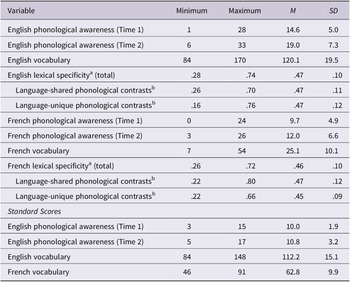
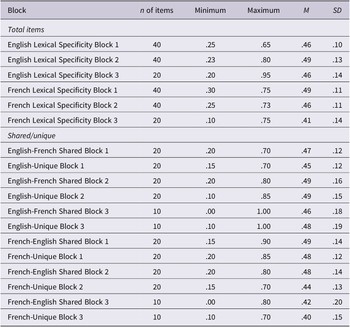
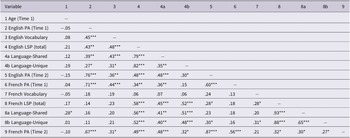
Table 2 summarizes the descriptive statistics for all English and French measures. Table 3 displays descriptive information for the lexical specificity task within each block. Table 4 presents bivariate correlations among the measures with significant correlations among most measures observed with the exception of French vocabulary. Notably, there was no significant correlation between French lexical specificity and French phonological awareness at the beginning of Grade 1, suggesting the children’s phonological representations of French words were rather holistic due to their limited exposure to French at the beginning of Grade 1. Both raw and standard scores are reported for all of the standardized measures, whereas raw scores were used for the statistical analyses. The scaled (standard) scores for the CTOPP-2 are based on a normal distribution with a mean of 10 and a standard deviation of 3. With respect to English phonological awareness, the children in our sample fell within the average range at the beginning and the end of Grade 1. The standard scores for English and French receptive vocabulary are based on a distribution with a mean of 100 and a standard deviation of 15. With respect to English vocabulary, standard scores fell within the average range, whereas children’s performance in French vocabulary was considerably below average when compared to French-Canadian monolingual norms.
Descriptive Statistics
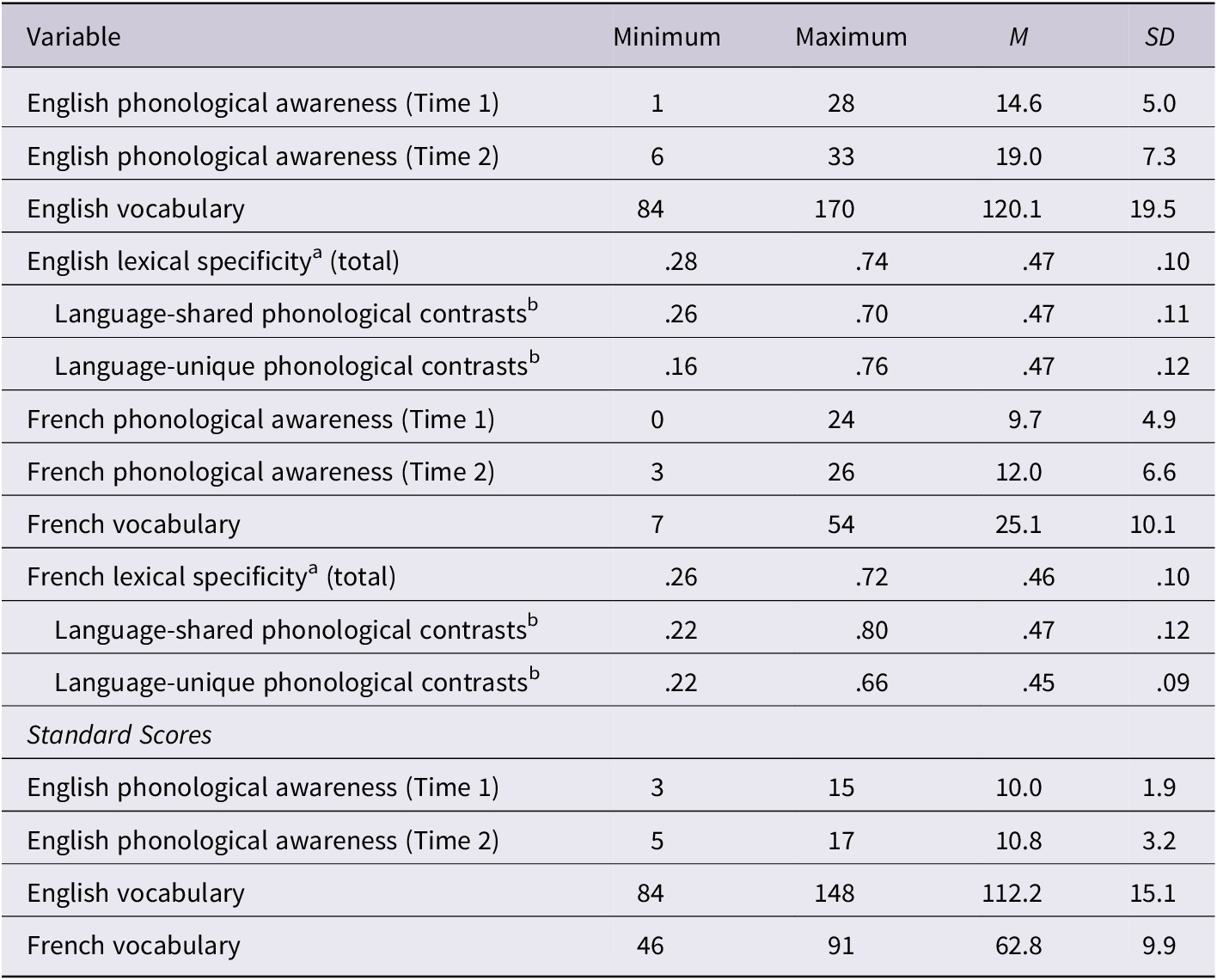
Note. aProportion of correct trials for all items across all three blocks /100 (Blocks 1-3). bProportion of correct trials for all items that shared/were unique within each language across all three blocks /50 (Blocks 1-3). Chance = .25. Time 1 = Beginning of Grade 1. Time 2 = End of Grade 1.
Proportion of Correct Trials in the Lexical Specificity Task per Block
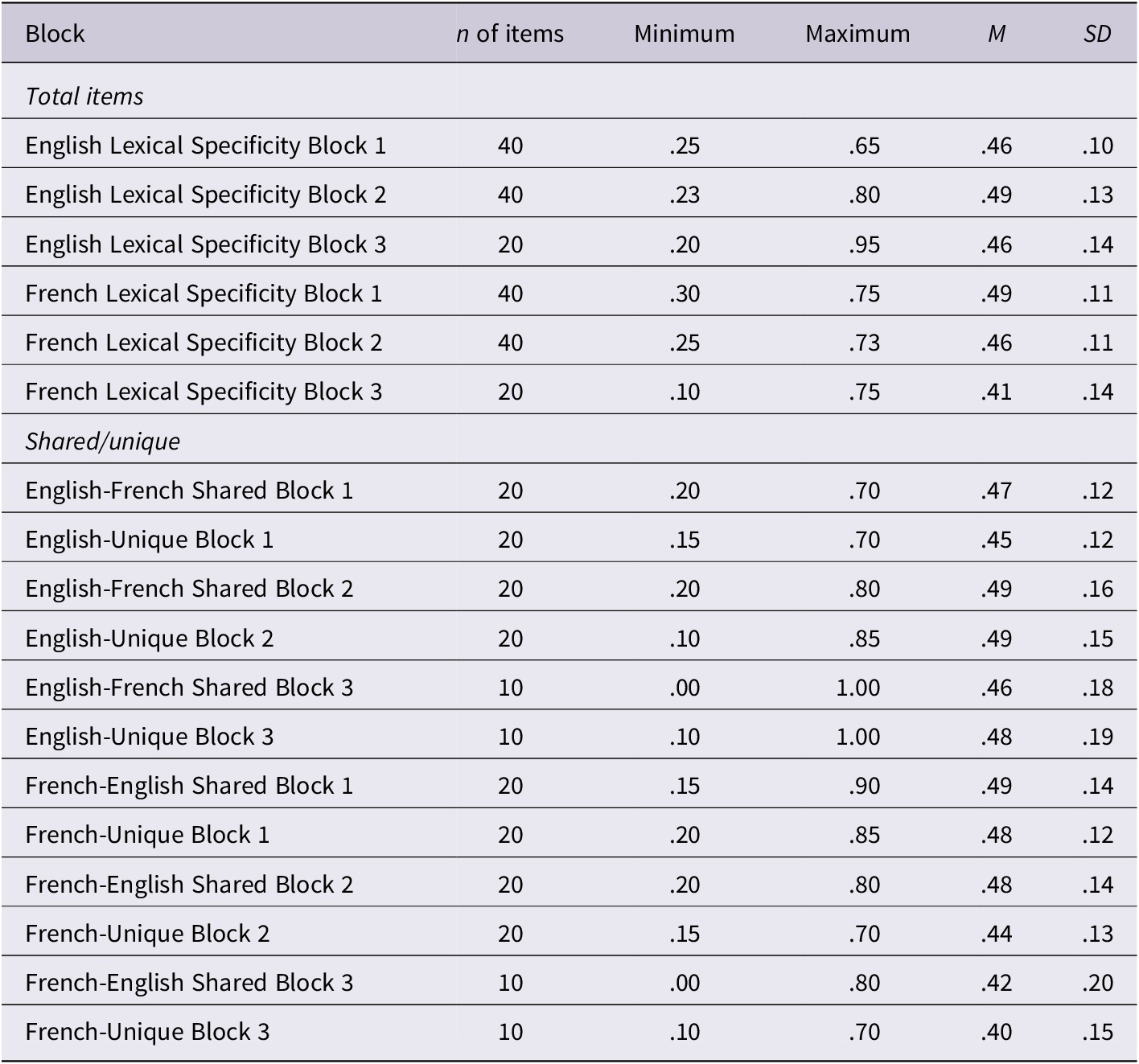
Note. Chance = .25
Pearson Correlation Matrix of Variables

Note. PA = Phonological Awareness. LSP = Lexical Specificity. Time 1 = Beginning of Grade 1. Time 2 = End of Grade 1.
* p < .05, **p < .01, ***p < .001
There were no extreme univariate outliers (z < ± 3.29; Tabachnick & Fidell, Reference Tabachnick and Fidell2007) and very few missing values (less than 3%). Skewness and kurtosis values fell within the acceptable range (i.e., statistic/SE ± 3.29; Tabachnick & Fidell, Reference Tabachnick and Fidell2007). The assumptions of multivariate normality and linearity were evaluated through IBM SPSS (Version 26). Using Mahalanobis distance, one multivariate outlier was detected but retained in the sample (p < .001). The results of Box’s M test indicated no significant difference in the variance-covariance patterns between the children with and without exposure to a minority language at home on English phonological awareness at the beginning and end of Grade 1 (Box’s M = .27, F = .08, p = .969) as well as on French phonological awareness at the beginning and end of Grade 1 (Box’s M = 1.06, F = .34, p = .799). Based on these results, the two groups were combined for the analyses.Footnote 3
The children in our study had learned, on average, approximately nine new minimal-pair words in English and eight new minimal-pair words in French. Performance on the lexical specificity task was above chance in both languages: t(61) = 38.24, p < .001, d = 4.90 in English, and t(59) = 36.38, p < .001, d = 4.74 in French.Footnote 4 Similar to Krenca et al. (Reference Krenca, Segers, Chen, Shakory, Steele and Verhoeven2020a), a composite score was derived from the proportion of correct trials across all lexical specificity items in Blocks 1-3, since these scores correlated highly with each other in both English (Pearson’s r = .77; p < .001) and French (Pearson’s r = .70; p < .001). We conducted an exploratory analysis to examine whether children had greater lexical specificity with phonological contrasts common to both of their languages than with those that occur in just one of their languages. These phonological contrasts correspond to the proportion of correct trials for all lexical specificity items in Blocks 1-3 that are shared or unique to English and/or French. We analyzed these results using a repeated-measures analysis of variance with Language (English and French) and Specificity (Language-shared and Language-unique) entered as within-subject variables. Both of the main effects (Language and Specificity) as well as the interaction between Language and Specificity were non-significant, all ps > .05.
The effect of lexical specificity on vocabulary and phonological awareness in the L1
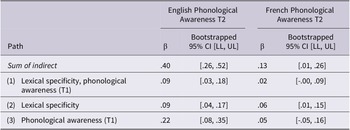
Our first research objective examined the association between lexical specificity and phonological awareness among emerging English (L1) – French (L2) bilingual children. Specifically, we hypothesized that English lexical specificity at the beginning of Grade 1 (T1) would serve as a mediating variable between English vocabulary (T1) and English phonological awareness at T1 and the end of Grade 1 (T2). The hypothesized path analysis model shown in Figure 2 was fitted to the sample data with English phonological awareness (T1 and T2) scores as observed dependent variables. The non-significant regression path between English vocabulary and English phonological awareness (T2) was deleted in order to increase the degrees of freedom. The independence model that tests the hypothesis that all variables are uncorrelated was rejected, χ2 (6, N = 62) = 92.70, p < .001. The hypothesized model provided a good fit to the data, χ2 (1, N = 62) = .27, p =.607, CFI = 1.00, TLI = 1.00, RMSEA = .00 (90% confidence interval [CI; .00, .27]), SRMR = .01. The predictors accounted for a small proportion of the variance for English lexical specificity (R 2 = .23) and English phonological awareness at T1 (R 2 = .26) and a moderate proportion of the variance for English phonological awareness at T2 (R 2 = .61). English vocabulary was a significant concurrent predictor of English lexical specificity (β = .48, p < .001). There were two significant concurrent predictors of English phonological awareness (T1): English vocabulary (β = .32, p = .005) and English lexical specificity (β = .27, p = .022). Longitudinally, there was a strong autoregressive path from English phonological awareness at the beginning to the end of Grade 1 (β = .68, p < .001). The regression path from English lexical specificity to English phonological awareness (T2) was significant (β = .20, p = .016). Results for final mediation effects are shown in Table 5. A bias-corrected bootstrap confidence interval for the indirect effect was above zero, representing a statistically significant effect. The relationship between English vocabulary and English phonological awareness (T2) was mediated by English lexical specificity and English phonological awareness (T1). Likewise, the specific indirect effects between English vocabulary and English phonological awareness (T2) were separately mediated by English lexical specificity, and English phonological awareness (T1).
Indirect Within-Language Effects on Phonological Awareness at the end of Grade 1
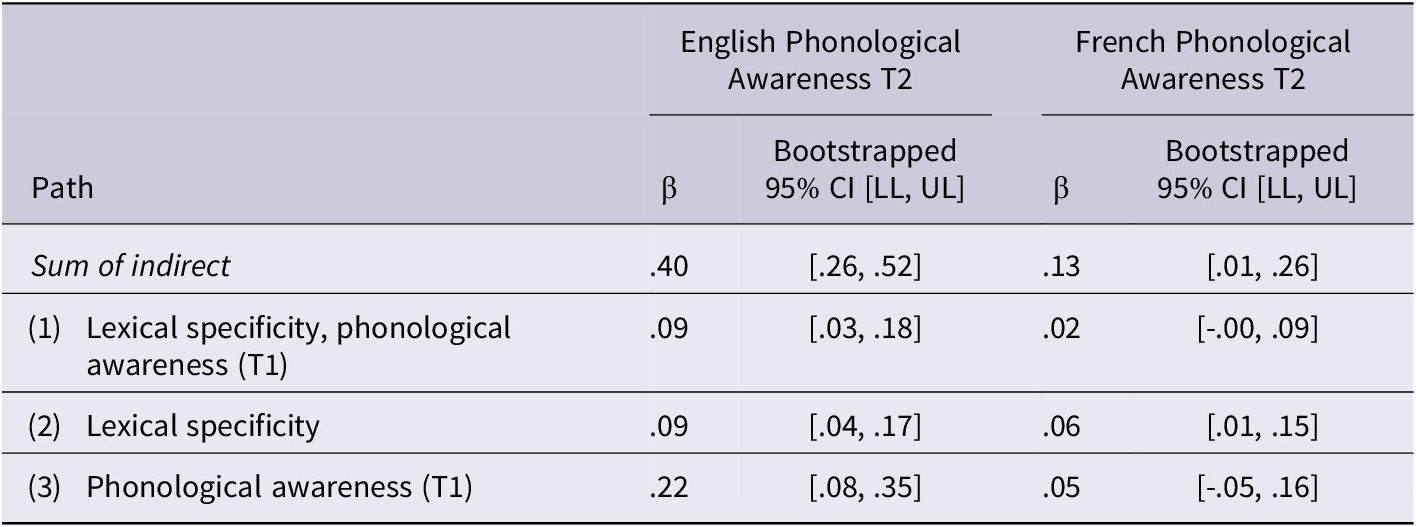
Note. β = Standardized Estimate. T1 = Beginning of Grade 1. T2 = End of Grade 1. CI = Confidence interval. LL = Lower Limit, UL = Upper Limit
Standardized Structural Regression Weights in which English Lexical Specificity (T1) Mediates the Relationship Between English Vocabulary (T1) and English Phonological Awareness (T1 and T2)
Note. Numbers indicate standardized beta coefficients. T1 = Beginning of Grade 1, T2 = End of Grade 1.
*p < .05, **p < .01, ***p < .001

The effect of lexical specificity on vocabulary and phonological awareness in the L2
In line with our first research objective, we hypothesized that French lexical specificity (T1) would serve as a mediating variable between French vocabulary (T1) and French phonological awareness (T1 and T2). To address this objective, we fitted the hypothesized path analysis model shown in Figure 3. The model was fitted to the sample data with French phonological awareness (T1 and T2) scores as observed dependent variables. The non-significant regression path between French vocabulary and French phonological awareness (T2) was deleted in order to increase the degrees of freedom. The independence model that tests the hypothesis that all variables are uncorrelated was rejected, χ2 (6, N = 62) = 32.21, p < .001. The hypothesized model provided a good fit to the data, χ2 (1, N = 62) = .62, p =.430, CFI = 1.00, TLI = 1.00, RMSEA = .00 (90% confidence interval [CI; .00, .31]), SRMR = .02. The predictors accounted for a small proportion of the variance for French lexical specificity (R 2 = .07), French phonological awareness at T1 (R 2 = .04), and French phonological awareness at T2 (R 2 = .37). French vocabulary was a significant concurrent predictor of French lexical specificity (β = .27, p = .021). There were no significant concurrent predictors of French phonological awareness (T1). Longitudinally, there was a strong autoregressive path from French phonological awareness at the beginning to the end of Grade 1 (β = .52, p < .001). The regression path from French lexical specificity to French phonological awareness (T2) was significant (β = .23, p = .022). Results for final mediation effects are shown in Table 5. A bias-corrected bootstrap confidence interval for the indirect effect contained zero. The relationship between French vocabulary and French phonological awareness (T2) was not mediated by French lexical specificity and French phonological awareness (T1). Likewise, the specific indirect effects between French vocabulary and French phonological awareness (T2) were not separately mediated by French lexical specificity, .06 [.01, .15], and French phonological awareness (T1), .05 [-.05, .16].
Standardized Structural Regression Weights in which French Lexical Specificity (T1) Mediates the Relationship Between French Vocabulary (T1) and French Phonological Awareness (T2)
Note. Numbers indicate standardized beta coefficients. T1 = Beginning of Grade 1, T2 = End of Grade 1.
*p < .05, **p < .01, ***p < .001

Evidence of cross-language transfer from the L1 to the L2
Our second research objective examined the effects of exposure to an English (L1) dominant environment on emerging bilingual children’s development of French (L2) phonological awareness. Specifically, we hypothesized that English lexical specificity (T1) would mediate the relationship between English vocabulary (T1) and French phonological awareness at T1 and T2, while controlling for French vocabulary (T1) and French lexical specificity (T1) in the model. Since we were interested in the cross-language effect of English vocabulary and lexical specificity on French phonological awareness (T1 and T2), we removed English phonological awareness (T1) as an observed dependent variable from all subsequent models. We fitted the hypothesized cross-lagged model shown in Figure 4. The model was fitted to the sample data with French phonological awareness (T1 and T2) scores as observed dependent variables. The independence model that tests the hypothesis that all variables are uncorrelated was rejected, χ2 (14, N = 62) = 97.51, p < .001. The hypothesized model provided a good fit to the data, χ2 (1, N = 62) = .09, p =.768, CFI = 1.00, TLI = 1.00, RMSEA = .00 (90% confidence interval [CI; .00, .23]), SRMR = .01. The predictors accounted for a small proportion of the variance for French lexical specificity (R 2 = .11), English lexical specificity (R 2 = .23), French phonological awareness at T1 (R 2 = .22), and French phonological awareness at T2 (R 2 = .43). Both English and French vocabulary were significant concurrent predictors of English (β = .48, p < .001) and French lexical specificity (β = .25, p = .001), respectively. English and French lexical specificity were highly correlated (β = .58, p < .001). English vocabulary was a concurrent predictor of French phonological awareness (T1) (β = .35, p = .015). Longitudinally, there was a strong autoregressive path from French phonological awareness at the beginning to the end of Grade 1 (β = .46, p < .001). The regression path from English lexical specificity to French phonological awareness (T2) was significant (β = .36, p = .019). Results for final mediation effects are shown in Table 6. A bias-corrected bootstrap confidence interval for the indirect effect was above zero. Specifically, the relationship between English vocabulary and French phonological awareness (T2) was mediated by English lexical specificity.
Indirect Cross-Language Effects on Phonological Awareness at the end of Grade 1
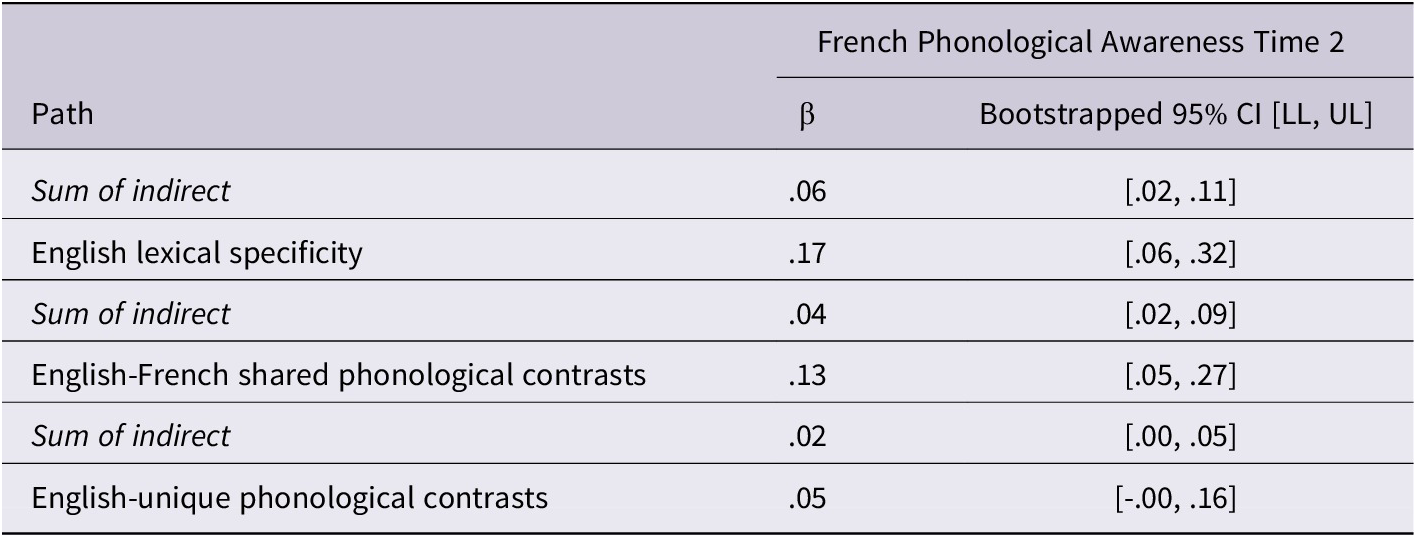
Note. β = Standardized Estimate. CI = Confidence Interval. LL = Lower Limit, UL = Upper Limit
Standardized Structural Regression Weights in which English Lexical Specificity (T1) Mediates the Relationship Between English Vocabulary (T1) and French Phonological Awareness (T2)
Note. Numbers indicate standardized beta coefficients. T1 = Beginning of Grade 1, T2 = End of Grade 1.
*p < .05, **p < .01, ***p < .001

In line with our second research objective, we examined the contribution of language-shared versus language-unique phonological contrasts to children’s development of French phonological awareness both concurrently and longitudinally. Specifically, we hypothesized that shared phonological contrasts between English and French lexical specificity would serve as the specific mechanism that mediates the relationships between English vocabulary (T1) and French phonological awareness at T1 and T2, while considering French vocabulary (T1) and French lexical specificity (T1) in the model. To this end, we fitted the hypothesized cross-lagged model shown in Figure 5. The model was fitted to the sample data with French phonological awareness (T1 and T2) scores as observed dependent variables. The independence model that tests the hypothesis that all variables are uncorrelated was rejected, χ2 (14, N = 62) = 81.21, p < .001. The hypothesized model provided a good fit to the data, χ2 (1, N = 62) = .01, p =.904, CFI = 1.00, TLI = 1.00, RMSEA = .00 (90% confidence interval [CI; .00, .15]), SRMR = .00. The predictors accounted for a small proportion of the variance for French lexical specificity (R 2 = .11), English-French shared phonological contrasts (R 2 = .19), French phonological awareness (T1) (R 2 = .23), and French phonological awareness (T2) (R 2 = .43). English vocabulary was a significant predictor of English-French shared phonological contrasts (β = .43, p < .001), whereas French vocabulary was a concurrent predictor of French lexical specificity (β = .24, p = .003). English-French shared phonological contrasts and French lexical specificity were moderately correlated (β = .41, p < .001). English vocabulary was a concurrent predictor of French phonological awareness (T1) (β = .34, p = .016). Longitudinally, there was a strong autoregressive path from French phonological awareness at the beginning to the end of Grade 1 (β = .45, p < .001). The regression path from English-French shared phonological contrasts to French phonological awareness (T2) was significant (β = .30, p = .016). Results for final mediation effects are shown in Table 6. A bias-corrected bootstrap confidence interval for the indirect effect was above zero. Specifically, the relationship between English vocabulary and French phonological awareness (T2) was mediated by English-French shared phonological contrasts.
Standardized Structural Regression Weights in which English-French Shared Phonological Contrasts (T1) Mediate the Relationship Between English Vocabulary (T1) and French Phonological Awareness (T2)
Note. Numbers indicate standardized beta coefficients. T1 = Beginning of Grade 1, T2 = End of Grade 1.
+ p < .08, *p < .05, **p < .01, ***p < .001

Finally, we hypothesized that phonological contrasts unique to English would not mediate the relationship between English vocabulary (T1) and French phonological awareness at T1 and T2, while considering French vocabulary (T1) and French lexical specificity (T1) in the model. To address this objective, we fitted the hypothesized cross-lagged model shown in Figure 6. The model was fitted to the sample data with French phonological awareness (T1 and T2) scores as observed dependent variables. The independence model that tests the hypothesis that all variables are uncorrelated was rejected, χ2 (14, N = 62) = 74.69, p < .001. The hypothesized model provided a good fit to the data, χ2 (1, N = 62) = .00, p = .992, CFI = 1.00, TLI = 1.00, RMSEA = .00 (90% confidence interval [CI; .00, .00]), SRMR = .00. The predictors accounted for a small proportion of the variance for French lexical specificity (R 2 = .10), English-unique phonological contrasts (R 2 = .10), French phonological awareness (T1) (R 2 = .20), and French phonological awareness (T2) (R 2 = .39). English vocabulary was a significant predictor of English-unique phonological contrasts (β = .31, p = .003), whereas French vocabulary was a concurrent predictor of French lexical specificity (β = .23, p = .028). English-unique phonological contrasts and French lexical specificity were highly correlated (β = .50, p < .001). English vocabulary was a concurrent predictor of French phonological awareness (T1) (β = .43, p < .001). Longitudinally, there was a strong autoregressive path from French phonological awareness at the beginning to the end of Grade 1 (β = .51, p < .001). The regression path from English-unique phonological contrasts to French phonological awareness (T2) was not significant. Results for final mediation effects are shown in Table 6. A bias-corrected bootstrap confidence interval for the indirect effect contained zero. Specifically, the relationship between English vocabulary and French phonological awareness (T2) was not mediated by English-unique phonological contrasts.
Standardized Structural Regression Weights in which English-Unique Phonological Contrasts (T1) do not Mediate the Relationship Between English Vocabulary (T1) and French Phonological Awareness (T2)
Note. Numbers indicate standardized beta coefficients. T1 = Beginning of Grade 1, T2 = End of Grade 1.
*p < .05, **p < .01, ***p < .001

Discussion
The objectives of the present study were twofold. First, we investigated whether the lexical restructuring hypothesis extends to a new language pairing involving emerging English (L1) – French (L2) bilingual children. We performed a series of path analyses to determine the extent to which our theoretical models were supported by the data. The results partially supported our hypotheses. English lexical specificity mediated the relationship between English vocabulary and English phonological awareness both concurrently (beginning of Grade 1) and longitudinally (end of Grade 1). On the other hand, it was observed that French vocabulary size was related to the specificity of lexical representations in French – however, the latter did not contribute to French phonological awareness until the end of Grade 1.
The second objective of this study was to explore whether children’s lexical representations in English (L1) facilitate phonological awareness in French (L2). Specifically, we examined the role of cross-linguistic transfer by making a distinction between words contrasting in phonemes shared by the L1 and L2 versus those involving phonological contrasts limited to one of our bilingual children’s languages. Our findings partially supported our hypothesis. At the beginning of Grade 1, English vocabulary predicted French phonological awareness. Moreover, English lexical specificity mediated the relationship between English vocabulary and French phonological awareness at the end of Grade 1. Second, phonological contrasts shared between English and French served as the specific mechanism that mediated the relationship among English vocabulary and phonological awareness in French. There was no evidence of cross-linguistic transfer for phonological contrasts found exclusively in English.
Lexical restructuring enhances phonological awareness in the L1 and L2
Overall, our within-language findings suggest that lexical specificity contributes to phonological awareness by activating the segmentation of phonological representations into more specific segments of sound within each word. This pattern of results is consistent with the previous literature on Dutch monolingual children (Van Goch et al., Reference van Goch, McQueen and Verhoeven2014) and Turkish (L1) – Dutch (L2) bilingual children (Janssen et al., Reference Janssen, Segers, McQueen and Verhoeven2015). In the Netherlands, L2 learners acquire Dutch within a submersion language learning environment, in which all of school instruction was given in Dutch with little support for the L1. Thus, the present study replicated these effects among a different language combination within an early immersion setting. Children enrolled in French immersion programs are learning to become additive bilinguals in English and French. During the primary grades, French is the sole language of instruction, while English is the dominant societal and home language. Moreover, our findings extend previous work by incorporating two time points, thereby illustrating the relationships among vocabulary, lexical specificity, and phonological awareness longitudinally. Taken together, these studies provide strong support for the lexical restructuring hypothesis in emerging bilingual children in different educational settings.
Notably, lexical specificity exerted an effect on phonological awareness at different time points between English and French. In English, lexical specificity mediated the relationship between vocabulary and phonological awareness at both the beginning and end of Grade 1. Because English was the children’s stronger language, lexical specificity already had an effect on phonological awareness at the beginning of Grade 1, and the effect was maintained at the end of the same grade. In French, however, lexical specificity did not contribute to phonological awareness until the end of Grade 1. Since our task measured both established knowledge and learning potential it is possible that children’s learning potential is constrained by their input to the L1 and the L2. This might explain why French lexical specificity was related to phonological awareness at the end of Grade 1 but not at Time 1. The children in our sample only started learning French in senior kindergarten 12 months earlier and they had no to very limited exposure to French outside of the classroom. Indeed, children’s French vocabulary scores were considerably below average when compared to French-Canadian monolingual norms. With few words in their lexicons, children’s phonological representations at this time were likely largely holistic. There was little need to refine phonological contrasts, as words can be easily differentiated from each other (Werker et al., Reference Werker, Byers-Heinlein and Fennell2009). As children gradually became more fluent in French, lexical restructuring was activated, and phonological representations of words became more specified. As a result, the effect of lexical specificity on phonological awareness appeared overtime and became significant at the end of Grade 1. Indeed, children’s comparable performance on English and French lexical specificity (shown in Table 2) revealed that they likely had the same amount of learning potential in both languages, but their French phonological awareness which measured established knowledge at the beginning of Grade 1 was lower due to their limited French proficiency – hence, it may have taken longer to utilize this potential to acquire French phonological awareness.
Lexical restructuring enhances phonological awareness from the L1 to the L2
In line with our second research objective, we investigated whether children’s lexical representations in English (L1) facilitate phonological awareness in French (L2). The results showed that English lexical specificity mediated the relationship between English vocabulary and French phonological awareness at the end of Grade 1. Since English was the children’s stronger language, their lexical representations in English were more specified. This specificity facilitated the development of French phonological awareness at the end of Grade 1. These results are consistent with cross-language transfer theories, such as the linguistic interdependence hypothesis (Cummins, Reference Cummins1979), as metalinguistic skills in children’s L1 transfer to the same skills in the L2. Furthermore, our results support the perspective that cross-language transfer is conditioned by the relative levels of proficiency of the two languages, with transfer typically occurring from the more fluent language to the less proficient one (e.g., Chung et al., Reference Chung, Chen and Geva2019; Krenca et al., Reference Krenca, Segers, Chen, Shakory, Steele and Verhoeven2020a). On the other hand, French lexical specificity no longer mediated the relationship between French vocabulary and French phonological awareness at the end of Grade 1, once English within-language variables in the model were included. This may be because children’s phonological representations of French words were below a certain specificity threshold, where differentiating lexical items based on a larger number of phonemic features is necessary.
Our finding that cross-language transfer was driven primarily by language-shared phonological contrasts is consistent with Kuo and Anderson’s (Reference Kuo and Anderson2010) structural sensitivity theory, as exposure to features common to both languages results in heightened sensitivity to these features. The regression coefficients between the language-shared phonological contrasts and French phonological awareness at both timepoints were significantly larger compared to the same path coefficients stemming from the language-unique phonological contrasts. This result is likely due to the increased input frequency of these features in both languages – thus facilitating the specificity of lexical representations for said features. Our results add to the growing body of evidence regarding the underlying mechanism that facilitates cross-linguistic transfer. Deacon, Commissaire, Chen, and Pasquarella (Reference Deacon, Commissaire, Chen and Pasquarella2013) reported that children were more likely to judge pseudowords as real words when they contained graphemic sequences common to both English and French (e.g., -oin and -age are word endings that occur in both languages) than for sequences existing in one of the languages alone (e.g., -ook occurs as an ending in English, whereas -eille occurs as an ending in French). Our study demonstrated that lexical restructuring activates children’s phonological awareness, and that in the early stages of language development, increasingly specified lexical representations in the L1 facilitate phonological awareness in the L2. Moreover, our results highlight that phonological contrasts common to both languages serve as the specific mechanism that mediates the relationship between L1 vocabulary and L2 phonological awareness.
Avenues for future research
Some limitations of the current study should be noted. First, a larger sample size would be ideal as the number of parameters associated with a model is related to the number of participants required for path analytic procedures (Bentler & Yuan, 1999). Despite our small sample size, we were able to observe significant results. As such, future studies with a larger sample size would be able to account for more variables. Second, it is important to acknowledge the brevity of our lexical specificity task: which was administered during one session. In terms of future research, it would be useful to extend the current findings by designing an intervention study including multiple lexical specificity sessions to identify the degree of specification of the representations of words in the L2. Despite this note of caution, our study found that lexical specificity plays an important role in the development of English-French phonological awareness and that phonological contrasts common to both languages merit further consideration when examining aspects of phonological development.
Building on our study and similar research conducted previously (e.g., Janssen et al., Reference Janssen, Segers, McQueen and Verhoeven2015), future studies should examine the lexical restructuring hypothesis among children who are exposed to another language at home, in addition to English. For example, Kahn-Horwitz, Kuash, Ibrahim, and Schwartz (Reference Kahn-Horwitz, Kuash, Ibrahim and Schwartz2014) found that, compared to bilingual learners (e.g., Hebrew L1, English L2), multilingual children can draw on larger and more varied phonological contrasts through prior learning experiences with other languages when they acquire specific elements in their fourth language. In terms of practical implications, our findings will be of interest to bilingual educators because they suggest that children’s ability to distinguish phonologically specific contrasts in their dominant L1 may be an indicator of children’s reading potential at the start of an early L2 immersion program. For example, children who struggle with differentiating phonological contrasts may benefit from explicit phonological awareness in English, which facilitates phonological awareness and word reading in French (Wise, D’Angelo & Chen, Reference Wise, D’Angelo and Chen2016). Taken together, the results from this study extend the lexical restructuring hypothesis to emerging bilingual children by demonstrating that lexical specificity is connected to phonological awareness; and contribute to a growing body of evidence that supports the role of cross-language transfer, as bilingual children’s exposure to phonological contrasts common to both languages results in a positive transfer effect of these features.
Acknowledgements
This research was funded by a Social Sciences and Humanities Research Council of Canada Insight Development Grant #430-2015-00786 (to X.C.). Opinions reflect those of the author(s) and do not necessarily reflect those of the funding agency. The author(s) have no conflicts of interest to disclose. A special thank you to Dr. Esther Geva, Dr. Alexandra Gottardo, and Alexandra Bellissimo for their invaluable guidance and support throughout the project. This research would not have been possible without the support of the teachers, parents, and children at our partner schools, in addition to all of the research assistants of the Multilingualism and Literacy Lab. Portions of these findings were presented as a presentation at the 24th Annual Meeting of the Society for the Scientific Study of Reading, Halifax, Canada in July 2017.



 Open access

