




How did one become an astronomer in imperial China? Where did one start? What texts did would-be astronomers study, and what criteria did they have to meet? Historians of Chinese astronomy have long grappled with these questions, though much of the evidence is partial and indirect.Footnote 1 Historical astronomers rarely elaborated on their education, and biographies often only mention it in passing. While astronomical bureaus offered systematical training to their astronomers from at least the Sui period (581–618) onward, documents detailing training practices are scarce. This article sheds light on a significant yet understudied document: the regulation of the Yuan Bureau of Astronomy (Sitianjian 司天監), approved in 1275 and preserved in the bureaucratic communications of the Records of the Palace Library (Mishu jianzhi 秘書監誌). The regulation outlines the curriculum for each of the bureau’s five sections, provides sample examination questions, and sets forth the criteria for promoting astronomers.Footnote 2 To my knowledge, the 1275 regulation of the Bureau of Astronomy is the only surviving document of its kind from imperial China.
Regulations, as we know, work mostly on paper. In this study, I combine the 1275 regulation with biographies of astronomers who worked in different sections of the Bureau. This approach offers valuable insights into the physical, technical, and literary skills required to become an astronomer in late medieval China. Since the Yuan Bureau of Astronomy largely followed its Jin predecessor in its structure and function, and since it in turn shaped astronomical bureaus in late imperial era, this paper reveals the daily training and practices in one of imperial China’s most enduring and vital scientific institutions.
This paper also highlights the significant role of family in producing astronomers, filling an important gap in understanding the relationship between bureaucracy and science in imperial China.Footnote 3 Historical astronomers complained about the competence of hereditary astronomers.Footnote 4 Some modern scholars attributed the stagnation of Chinese astronomy to the Ming Dynasty’s ban on studying astral sciences outside the Bureau of Astronomy and the mandate making positions within the Bureau hereditary.Footnote 5 More recently, the study on Qing hereditary astronomer families of the Bureau of Astronomy has revealed a more complex picture, showing that these families were significant actors in the transitions and developments of Chinese astronomy.Footnote 6 Unlike in the Ming and Qing dynasties, astronomer positions under the Yuan Dynasty were not hereditary. Yuan astronomer families pursued these positions as a strategy for social reproduction, rather than as an obligation. Their experiences prompt us to reconsider the scientific, bureaucratic, and social implications of family expertise in an era when the astronomical bureau claimed authority over astral knowledge.
The Bureau of Astronomy and Its 1275 Regulation
Although Qubilai (r. 1260–1294) officially declared the Yuan Dynasty in China in 1271, Mongol rule in northern China had already been firmly established by 1234, following the defeat of the Jin Dynasty. Several Jin astronomers were promptly recruited into Mongol service, but the Bureau of Astronomy, the focus of this essay, was only established sometime in the 1250s.Footnote 7 In the Yuan era, this bureau was also referred to as the Han Bureau of Astronomy (Han’er sitianjian 漢兒司天監) to distinguish it from the Muslim Bureau of Astronomy (Huihui sitianjian 回回司天監), which was founded in 1271 for Central and West Asian astronomers.Footnote 8 It was not uncommon in imperial China to have more than one astronomical bureau or to employ foreign astronomers in these institutions. However, the Yuan Dynasty was the first to establish a separate bureau specifically for foreign astronomers, a practice that was later adopted by the Ming Dynasty.Footnote 9 From 1273 to the early 1290s, both the Chinese and Muslim astronomical bureaus operated under the jurisdiction of the Palace Library, which explains the preservation of the 1275 regulation in the Records of the Palace Library. Although Chinese and Muslim astronomers showed interest in each other’s knowledge, there seems to have been little crossover in the training of astronomers within the two bureaus.
In 1276, following the fall of the Song Dynasty and the unification of China, Qubilai ordered the “Season-Granting” (Shoushi li 授時曆) astronomical reform. To facilitate this reform, a third astronomical bureau, the Astrological Commission (Taishi yuan 太史院), was established in 1279. While the leading members of the reform and the Commission primarily hailed from northern China, the Astrological Commission largely incorporated astronomers from the former Southern Song territory, and its structure closely mirrored that of the Song Astrological Commission.Footnote 10
The Bureau of Astronomy, in contrast, was staffed primarily by northerners and closely modeled after its Jin predecessor. It was divided into five sections, listed in order of privilege: Omen Astrology (tianwen 天文), Mathematical Astronomy (lisuan 曆算), Three Boards Divination (sanshi 三式), Quantitative Observation (ceyan 測驗), and Time Keeping (louke 漏刻).Footnote 11 Before 1270, the bureau’s personnel situation was far from ideal. Remarkably, three of its six leading members were not based in the capital, Beijing, but served Qubilai’s son Manggala (d. 1278) in Xi’an—a practice unheard of in other dynastic periods.Footnote 12 With the older generation of Jin astronomers having died, Qubilai’s Chinese advisor, Liu Bingzhong 劉秉忠 (1216–1274), who oversaw the regulation of the astronomical bureaus, recruited new members in the early 1270s. Astronomers were drawn from commoners through examinations, resulting in a staff of 116 by 1273. This included six upper-level managers (directors and vice-directors), eighteen mid-level experts (instructors and section heads), seventy-two practitioners, a secretary, eleven copyists of annual ephemeris, and eight students, who were descendants of bureau officials.Footnote 13 By the early 1320s, the staff had slightly grown to 120, with the number of managers (ranked 4a–6a) doubling and the number of students rising to seventy-five. Students seem to have replaced practitioners, who disappeared from the ranks around this period.Footnote 14
While Liu’s examinations were based on the Jin precedent, by 1275, the Bureau of Astronomy had found it necessary to modify the system to reflect recent changes. For instance, some texts previously used in commoner examinations were now part of the Bureau’s assigned curriculum and were banned from general use outside the bureau. This required an adjustment to the content of the exam. The resulting removal of these texts made the exams significantly easier, potentially leading to more successful candidates but fewer highly qualified ones. To address this, a fixed number of examinees was set for each local administrative unit (though the exact number is unknown), and the position of stipend student was created for successful commoner candidates. These students would undergo further training and gain qualifications before becoming practitioners.Footnote 15
The Bureau of Astronomy held a regular examination for selecting commoners once every three years. Candidates underwent a two-day exam consisting of six questions: one on mathematical astronomy, one on marriage divination, three on geomancy (the practice of selecting auspicious locations for dwelling and burial), and a final question on their choice of divination methods and subjects: Book of Changes divination, cosmic boards, the five planets (wuxing 五星), and fate calculation (sanming 三命).Footnote 16
The Bureau of Astronomy also held examinations to periodically assess the bureau’s students, who included both successful commoner candidates and descendants of the bureau’s current experts. Every three years, students from the five sections were tested on the curriculum specific to their specialization. The examination results, which ostensibly reflected the students’ competence, played a crucial role in their future promotions. Those who passed the examination would fill practitioner positions as vacancies arose. The examination comprised two types of questions: one or two technical questions, and two essay questions (yiti 義題). These essays had no word limit, provided that the students maintained the theme. The aim was to demonstrate their literary skills. Those who correctly answered the technical questions were ranked according to their “eloquence” (wenli 文理), and vacant positions were filled based on this ranking.Footnote 17
The third type of examination conducted by the Bureau was the middle-level promotion examination. Advancement from practitioner to head of section, and from head of section to instructor, was based on examination results, which were only held when a vacancy needed to be filled. While sample questions for these examinations have not survived, the Yuan regulation says that candidates for the head of section position answered six test questions from their section’s curriculum: three technical questions and three essay questions. Those who successfully answered all the technical questions were ranked according to their literary skills. Candidates competing for an instructor position had to answer ten questions—two from each section.Footnote 18 The promotion exams assured that those in middle to upper-level positions were astronomers with well-rounded expertise.
Whether the Bureau consistently implemented the examinations is difficult to determine. As we will see below, the Bureau’s officials did not always succeed in implementing what they deemed important, nor did they always perform their duties without neglect. However, there are instances of commoners being recruited through examinations, suggesting that the exams were held, at least occasionally. The 1275 regulation is particularly valuable because it reveals the curriculum studied by students, practitioners, and section heads alike, as well as the skills and knowledge they were expected to acquire. These criteria were not empty words, because the competence of its astronomers was a key concern for the Bureau, as it probably was for astronomical bureaus in other periods.
The Mathematical Astronomy Section
Along with the Jin structure and training model for its Bureau of Astronomy, the Yuan inherited the Jin’s official astronomical system, known as the Revised Enlightenment System (Chongxiu daming li 重修大明曆), for calculating celestial movements and producing official annual ephemeris. As its name suggests, it is a revision from 1171 of the original Enlightenment System created in 1127. By the early 1270s, a century after the Revised Enlightenment System had been implemented, its accumulated errors had become increasingly apparent, particularly when compared to the predictions of Muslim astronomers.Footnote 19 It is in this context that we first encounter Cao Zhengui 曹震圭, the head of the Mathematical Astronomy Section and, as it happens, the only member of the Bureau of Astronomy to lose his head for doing his job.
When someone ended his career disgracefully in imperial China, records of his early life are often absent. Consequently, we know little about Cao Zhengui’s background or how he became the head of the section. We do know that Cao did not take his position lightly. In 1274, he petitioned to revise the Revised Enlightenment System. After nine months with no word back from the Central Secretariat, Cao filed a follow-up petition, adding that he was afraid that the Bureau might “throw off important state affairs,” apparently referring to miscalculation of celestial positions.Footnote 20 Once again, Cao’s proposal fell on deaf ears.
In 1276, when Qubilai Khan finally approved the long-awaited astronomical reform, a new team of astronomers and scholars—all well connected to Liu Bingzhong, who had died by then—took the lead on the project. However, the special reform office lacked the workforce necessary for its calculation and observation tasks, prompting it to borrow thirty astronomers from the Bureau of Astronomy, including Cao Zhengui. Cao and the team developed the Season-Granting System, arguably the most precise traditional astronomical system in Chinese history.Footnote 21 By 1279, this special reform office had turned into the Astrological Commission, which soon built a full-fledged staff and thereafter assumed responsibility for calculating and publishing the annual ephemeris based on the Season-Granting System. It is unclear what Cao’s Mathematical Astronomy Section actually did after 1279.Footnote 22
In any event, in 1275, before the Commission formed, the Mathematical Astronomy Session was still running its business as usual. It updated its curriculum, replacing the older content with the Revised Enlightenment System. Students studied the canon (jing 經) of the system, which provided step-by-step instructions for calculating the annual ephemeris. The older curriculum being replaced had included the Xuanming System (Xuanming li 宣明曆) and the Futian System (Futian li 符天曆).Footnote 23 The Xuanming System had been used officially during the Tang Dynasty from 822 to 892. Between the publication of the Xuanming System and the Revised Enlightenment System, twenty-four different astronomical systems had been developed, so Xuanming was definitely out of date.Footnote 24 Including the Futian System in the Mathematical Astronomy curriculum was even more surprising. Produced around 780, it bore Indo-Iranian influences and introduced several unconventional, though mathematically practical, changes—such as the abolition of the “Supreme Epoch” (shangyuan 上元), the imagined cosmological origin point referenced by all official systems.Footnote 25 But no astronomical bureaus had ever adopted it to produce official annual ephemeris.
The Xuanming and Futian systems might have included something particularly practical for training mathematical astronomy students. The Xuanming System, for example, excelled in calculating eclipses.Footnote 26 The prediction of eclipses, especially solar eclipses, was a central concern of mathematical astronomy—not only because it was mathematically challenging, but also because rulers saw unpredicted solar eclipses as bad omens. The importance of eclipse prediction appears in the technical portion of the Yuan Mathematical Astronomy Section’s examination, which required students to calculate solar eclipses for the years 1180–1185 (as well as the position of one of the planets).Footnote 27 However, technical advantages alone do not fully explain why the Xuanming and Futian systems remained in use for hundreds of years. Probably both sufficed to train students to follow set instructions to perform calculations. As a result, before 1275 senior experts and officials at the Bureau saw little need to replace them.
Whatever the reason for its persistence, the old curriculum blurred the ostensible distinction between official and unofficial astronomy. By the 1270s, the Xuanming and Futian systems circulated widely not only among commoners but also beyond China. The Xuanming System was included in the New Dynastic History of the Tang (Xin tangshu 新唐書), the official history published in 1060.Footnote 28 It had also been introduced to Korea in the ninth century and remained in use until the Season-Granting System was adopted in 1392. It was used in Japan for over 800 years.Footnote 29 Meanwhile, the Futian System found its way to Japanese Buddhist monks and even spread westward. By order of Qubilai’s younger brother, the Ilkhan Hülegü (r. 1256–1265), a Chinese astronomer introduced both the Futian System and the Revised Enlightenment System to the renowned Ilkhanid astronomer Naṣīr al-Dīn al-Ṭūsī (1201–1274). Ṭūsī integrated these systems, referring to them as the “Chinese calendar,” into his influential astronomical handbook, Zīj-i Ilkhanī. Footnote 30
Commoners outside the Bureau of Astronomy, therefore, had plenty of opportunities to study the Xuanming and Futian systems. In fact, those who took the Bureau’s entry examination were tested specifically on their knowledge of these two systems. One of the examination questions required candidates to use the Xuanming System to calculate the true solar term and syzygy for a specified day, month and year. The second question asked them to apply the Futian System to determine the lunar lodge where the sun was located on a particular day. With the aid of handy tables—both systems provided such tables—even beginners with limited theoretical knowledge could manage these calculations.Footnote 31
With family training, commoners could sometimes master calculations even better than students of the official astronomical bureaus, as the example of Qi Lüqian 齊屢謙 demonstrates. Migrating with his family to the Yuan capital, Beijing, Qi received his education at home. He began learning astronomy at the age of eleven, and by seventeen, when the Astrological Commission was newly established, he became a stipend student there. While most students were descendants of official astronomers, Qi outperformed them. According to Qi’s biography, when Wang Xun 王恂, head of the Astrological Commission, tested the students on calculations, Qi answered quickly while the others struggled.Footnote 32 The anecdote should be taken with a grain of salt, but it further demonstrates that entry-level students and functionaries of mathematical astronomy were expected to perform calculations, a skill that could probably be acquired at home, possibly through circulated procedure texts and guidance from family members.
Senior experts like Cao Zhengui required a much deeper understanding than merely following procedures to perform calculations. Wang Xun, when overseeing the astronomical reform, emphasized that while many astronomers were proficient in calculation, he needed someone who grasped the theories and principles underlying mathematical astronomy.Footnote 33 This was probably the standard that Cao had to meet as head of the Mathematical Astronomy Section. In addition to this specialization, Cao also exhibited expertise in astrology and eloquence. He authored an exegetical work on the selection of auspicious and inauspicious days titled Clarifying the Origins of Calendrical Matters (Lishi mingyuan 曆事明原), which remained influential for several centuries.Footnote 34
Cao Zhengui’s expertise in astrology ultimately led to his tragic demise. He cast horoscopes for the influential Central Asian minister Ahmad Fanakati, whose corruption was revealed after his assassination in 1282. Cao was subsequently accused of inciting Ahmad’s disloyalty. He was executed by “flaying,” and his skin was displayed publicly.Footnote 35 More than any specific ability, rulers cared most about the loyalty of astronomers. This loyalty could generally be ensured through generations of service to the state, as exemplified by the case of Yue Xuan.
The Observation Sections
When Liu Bingzhong sought astronomers for the Bureau of Astronomy in the early 1270s, Yue Xuan 岳鉉 (1249–1312) seized the opportunity to present himself. He was born into an esteemed family of astronomers. Yue Xuan’s grandfather, Yue Xizai 岳熙載, had served as the head of the Omen Astrology Section in the Jin Bureau of Astronomy. After the fall of the Jin in 1234, Yue Xizai continued his service under Qubilai’s uncle, Ögödei (r. 1229–1241). Yue Xuan’s father, also a former astronomer of the Jin, served Ögödei’s son Kötan, accompanying the Mongol prince for over a decade in his campaigns in western China and Tibet.Footnote 36 Thus, the family had demonstrated unwavering loyalty to the Mongols.
Yue Xuan’s family connections also highlighted his expertise. When he met Liu Bingzhong, Liu was reading works by Yue Xizai on astral sciences. Liu handed the books to Yue Xuan and posed questions that puzzled him. Knowing his grandfather’s works by heart, Yue closed the books, recited passages, and provided explanations. Greatly impressed, Liu assigned him to the Quantitative Observation Section and arranged an audience with Qubilai the very next day.Footnote 37
The ruler was equally impressed, particularly by Yue Xuan’s appearance. The young man had prominent head bones, beautiful hair, and shiny eyes.Footnote 38 While Yue Xuan’s physical features ostensibly indicated his outstanding character and potential for future achievements, his bright eyes also suggested good eyesight—a prerequisite for admission into the two observation sections: the Quantitative Observation Section and the Omen Astrology Section. During a time when astronomers conducted observations solely with the naked eye, the first criterion evaluated by these sections was the candidates’ eyesight.Footnote 39 In addition to his appointment in the Bureau of Astronomy, Qubilai assigned Yue Xuan to his imperial guard, where members served the khan in rotation. In 1276, Yue Xuan participated in the Season-Granting reform. While Cao Zhengui led the Mathematical Astronomy Section, Yue Xuan took charge of the Quantitative Observation Section. Many others were dispatched to various regions for observations and measurements, but Yue Xuan conducted his work in the capital, probably to ensure his availability to the ruler.Footnote 40
The Quantitative Observation Section was responsible for observing and measuring the night sky. Practitioners relied on the armillary sphere, an instrument composed of a series of concentric rings, to measure celestial positions. There appears to have been only one armillary sphere in the early Yuan Dynasty—the one seized by the Mongols in 1214 from the Jurchen Jin, who had looted it from the Song dynasty in 1127.Footnote 41 Among the many Song large bronze armillary spheres, the one that survived into the Yuan period was most likely the Huangyou 皇祐 armillary sphere, created in 1050.Footnote 42 One of the key texts the Observation section’s students studied was the gridded star maps from the Complete Essentials for the Armillary Sphere (Hunyi zongyao 渾儀總要),Footnote 43 a ten-part compilation dedicated to the Huangyou armillary sphere. Now lost, the Complete Essentials provided a detailed description of the armillary sphere and compared it to other armillary spheres made in Chinese history.Footnote 44
A glimpse of what the star maps in the Complete Essentials might have looked like can be gained from slightly later star maps found in Su Song’s 蘇頌 1094 work New Design for an Armillary Sphere and Celestial Globe (Xin yixiang fayao 新儀象法要). Figure 1 shows the equatorial map from the autumn equinox to the spring equinox. The equator is depicted as a horizontal straight line running through the map (with the ecliptic curves below it), intersecting with vertical straight lines that represent the boundaries between the lunar lodges. This creates a gridded map of 129 constellations, consisting of 666 individual stars.Footnote 45
The equatorial map from the autumn equinox to the spring equinox, Su Song, Xin yixiang fayao, 2.9a–9b. Su Song’s original work has been lost, and the figures here are from the 1781 edition.

Students in the Quantitative Observation Section were expected to memorize all the details in the star maps. During their examinations, they were required to draw constellations from memory, such as the three enclosures (sanyuan 三垣, the three celestial areas surrounding the north celestial pole), the twenty-eight lunar lodges, and the constellations located around the celestial equator. Additionally, the essay question prompted students to discuss the significance of the armillary sphere in understanding the movements of the sun, moon, and planets.Footnote 46 Many astronomers had previously written on this topic when creating or proposing new armillary spheres. Their writings typically related to the ruler’s moral obligation to observe celestial movements or provided a brief history of the instrument, rather than delving into technical specifics.Footnote 47 Consequently, the essay question primarily assessed the students’ eloquence rather than generating new insights.
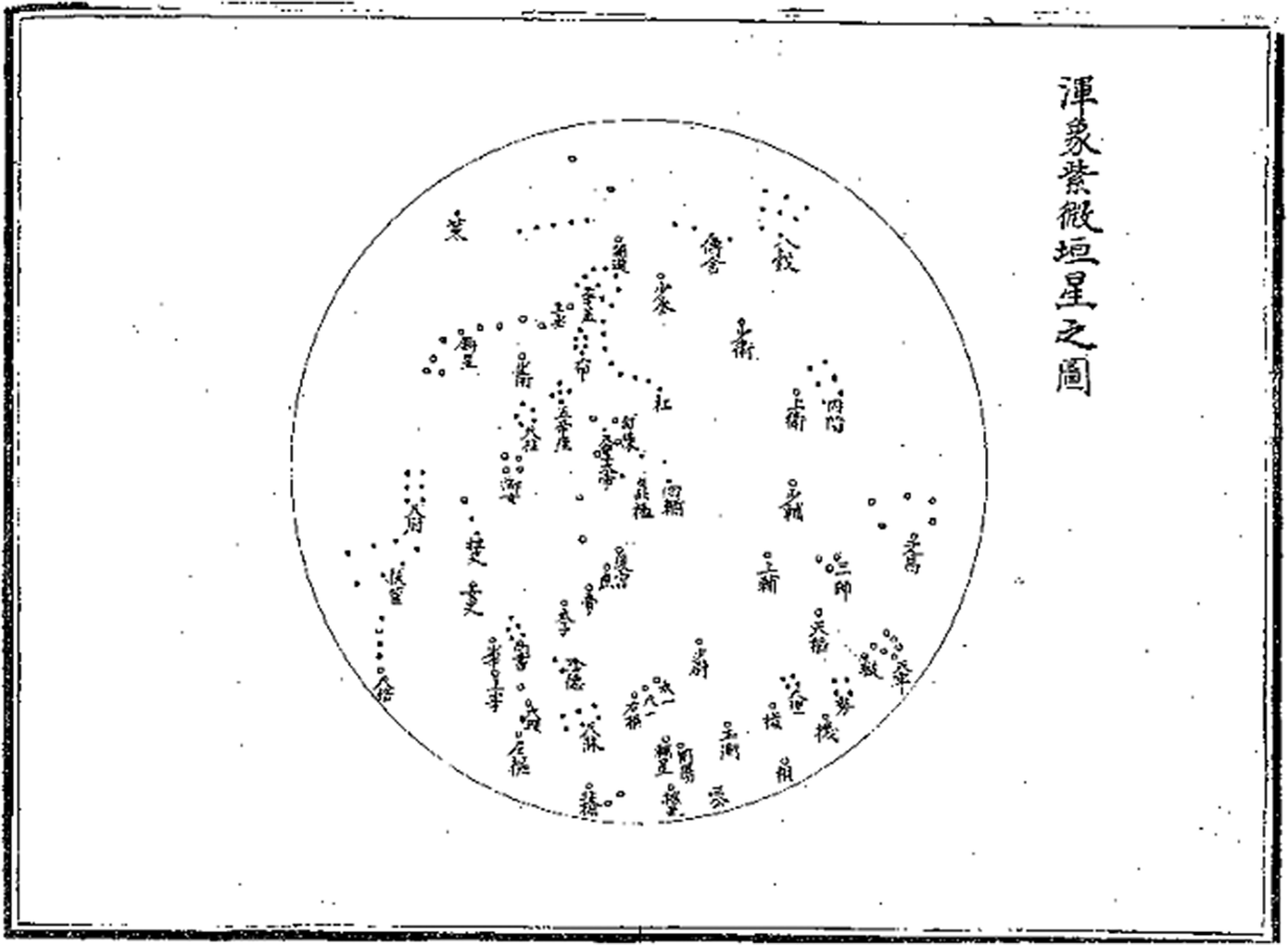
Students in the Omen Astrology Section were required to demonstrate a similar familiarity with the positions of the stars. A sample examination question told them to draw from memory the Purple Forbidden Enclosure (ziwei yuan 紫微垣, see Figure 2), which contains about 174 stars, along with the seven lunar lodges of the east (the left half of Figure 1), comprising approximately 186 stars. The star maps they studied, however, differed from those in the Quantitative Observation Section. The star map’s title, “the Jingyou Direct Gridded Map of the Entire Heaven” (“Jingyou zhoutian xinggetu zhitu” 景祐周天星格圖直圖), suggests it may be the one included in the New Book of the Celestial Phenomena (Jingyou qianxiang xinshu 景祐乾象新書), which was composed during 1034–1038 by imperial order and syncretized earlier works on omen astrology.Footnote 48 However, we cannot confirm this, as the star maps are not extant today. In their essay question, Omen Astrology students were asked to discuss three cosmological theories: the celestial sphere theory (huntian 渾天), the hemispherical dome theory (gaitian 蓋天) and the infinity (xuanye 宣夜).Footnote 49 This question appears to be more of a writing exercise than a theoretical debate, since by the late medieval period, the celestial sphere theory had established its unchallenged dominance among astronomers.Footnote 50 It is worth noting that the examination content did not include omen interpretation. This task was most likely reserved for the section’s senior experts.
The Purple Forbidden Enclosure, Su Song, Xin yixiang fayao, 2.6a–6b.

While both observation sections focused on the night sky, the Omen Astrology Section also interpreted celestial phenomena. These interpretations often related to state affairs, encompassing the well-being and virtue of the ruling elite, political and military matters, harvests, and natural disasters. For instance, stars and constellations in the three enclosures symbolized the heir apparent and the ministers. Thus, a gathering of white gas in the three enclosures foreshadowed Liu Bingzhong’s death.Footnote 51 This emphasis on interpretation elevated the Omen Astrology Section to the most prestigious position within the Yuan Bureau of Astronomy. Similarly, during the Jin Dynasty, the Astronomical Bureau maintained an equal number of six Chinese and six Jurchen astronomers in the Omen Astrology Section, making it the only section with a designated quota for Jurchen astronomers.Footnote 52 However, this prestige came with certain restrictions. Imperial courts commonly prohibited the practice of omen astrology outside the astronomical bureaus, and even within the bureau, not everyone received permission to interpret celestial phenomena. During the Tang period, while students in the Quantitative Observation Section were allowed to report any unusual celestial observations, they were forbidden from interpreting them or reading books on omen astrology.Footnote 53 Similar restrictions appear in the Yuan Bureau of Astronomy, as the 1275 regulation indicated that the Omen Astrology Section studied the curriculum of the Quantitative Observation Section, but not the other way around.Footnote 54
This restriction is somewhat curious, as there was one group of texts that both sections studied: the “Omen Astrology” monographs from the Jin Dynastic History and the Sui Dynastic History, as well as a work referred to as the Song Omen Astrology (Song tianwen 宋天文).Footnote 55 For a long time, researchers debated the nature of this last text. Recently, based on three extant manuscripts, it has been identified as a work composed in 1083 by imperial order. Its primary source was the New Book, and it in turn informed Yue Xizai’s Rhymed Essentials of Omen Astrology (Tianwen jingyi fu 天文精義賦), still extant today.Footnote 56 The Song Omen Astrology was rarely mentioned in popular astrological and bibliographic works, attesting that it circulated only within the astronomical bureaus. Although most its content focuses on astrological omen interpretation, it includes a mixture of cosmological theories, accounts of historical observations, and descriptions of astronomical instruments. Its last chapter lists definitions for dozens of common terms used in omen astrology and board divination, confirming that the text was primarily intended for beginners rather than advanced practitioners.Footnote 57
The fact that both sections studied the same omen astrology texts while only one was permitted to interpret celestial phenomena suggests that the prohibition was more of a gesture. The Jin and Sui Omen Astrology monographs circulated widely with the publication of the official dynastic histories, so commoners outside the Bureau of Astronomy could study them. The famous Suzhou star chart, engraved on a stone stele in 1247, could generate numerous rubbing copies. This widespread circulation of texts and images meant that the Bureau of Astronomy was far from the sole authority in cultivating knowledge of omen astrology. However, through its regulations, the Bureau asserted its authority to license who could legally use this knowledge and who could not.
Yue Xuan, although officially affiliated with the Quantitative Observation Section, apparently had imperial permission to practice omen astrology. On many occasions, he interpreted celestial and meteorological phenomenon for the Mongol rulers.Footnote 58 His proximity to the throne led to quicker promotions within and outside the Bureau of Astronomy compared to those in regular positions. Following his participation in the 1276 reform, Yue Xuan was promoted to Director of the Bureau of Astronomy. In 1288, after accompanying Qubilai on a military expedition and offering sound advice, he was appointed to head the Palace Library. When Qubilai’s successor Temür (r. 1294-1307) ascended the throne in 1294, he further granted Yue Xuan the prestigious title of “Grand Scholar of the Zhaowen Academy” (Zhaowenguan da xueshi 昭文館大學士).Footnote 59
To what extent did Yue Xuan owe his expertise to his family connections? Like his peers in the observation sections, Yue Xuan was blessed with good eyesight and a strong memory. The former was probably an inherited physical trait, while his family may have nurtured the latter. With his father often away in the frontier regions, where he established a new family, Yue Xuan most likely grew up under the guidance of his grandfather, Yue Xizai. One can imagine that at night, the elder Yue probably pointed to the sky and taught his grandson: “Look, this is the Purple Forbidden Enclosure, the center of the three enclosures. It is the palace of the emperor. There are 174 stars in it, but we can group them. Remember? ‘Left and right surround, guarded all around.’”Footnote 60 During the day, the elder Yue probably instructed Yue Xuan using his own works, such as the Rhymed Essentials, which were written in rhyme to aid memorization. While these texts were accessible to others, Yue Xizai’s private conversations with Jurchen and Mongol rulers, along with his decades of empirical experience regarding which predictions came true and which did not, may have remained only within the family.
The Three Boards Divination Section
In comparison to mathematical astronomy and omen astrology, other divination functions of the Bureau of Astronomy have received limited scholarly attention so far.Footnote 61 The Bureau of Astronomy’s recruitment examination indicates that divination loomed large in the bureau’s selection of candidates. Other than one question on mathematical astronomy, all the other questions concerned divination.Footnote 62 While local divination schools taught marriage divination and geomancy, and fortune-tellers practiced fate calculation and planetary divination in the marketplace, diviners selected by the Bureau of Astronomy fulfilled more specialized roles.Footnote 63
Tian Zhongliang 田忠良 (1242–1317) was the son of a commoner diviner who specialized in the Book of Changes and the “six waters divination” (liuren 六壬). Initially, Qubilai intended to recruit Tian’s father, but the elder Tian politely declined the offer, sending his twenty-nine-year-old son in his place.Footnote 64 When Tian Zhongliang met with Qubilai in the early 1270s, Liu Bingzhong was also present. During the interview, the ruler tested Tian’s divination skills by asking him to actually prognosticate. Qubilai pointed to one of his attendants and asked Tian to reveal what the man was holding in his hand. When Tian correctly answered, “An egg,” the khan was pleased. Qubilai then asked him to say what was troubling the ruler’s mind at that moment, and Tian again provided the correct answer. Although impressed by Tian’s abilities, Qubilai did not immediately assign him a position. Instead, he sent Tian to take an examination in the Bureau of Astronomy. Liu Bingzhong later reported that Tian outperformed most of the bureau’s students, leading to his appointment as the head of the Three Boards Divination Section.Footnote 65
The examination that Tian underwent was probably for the students of the Divination Section, focusing on the calculations and interpretations of the three cosmic board divination methods.Footnote 66 This section boasted the most extensive curriculum among all five sections. Students had to study two texts for each of the three board divinations —the “six waters,” the “supreme one” (taiyi 太乙), and the “hidden stems” (dunjia 遁甲)—from which the section derived its name. The Song Bureau of Astronomy had compiled three of these texts in the eleventh century, at which point astronomical bureaus officially employed the three cosmic board divination methods.Footnote 67
The “six waters” method, in which Tian’s family excelled, was widely practiced, as evinced by its inclusion in the Bureau of Astronomy’s recruitment examination. This method utilized a divination board consisting of two plates: the heaven plate, a round, rotating upper piece, and the earth plate, a square, stationary lower piece, reflecting the Chinese cosmological view of the earth as square. The earth plate was divided into representations of the twenty-eight lunar lodges, the ten heavenly stems, and the twelve terrestrial branches, which were used for various purposes, including counting time. The practitioner could adjust the heaven plate according to celestial positions, and then interpret its position relative to the earth.Footnote 68
The other two board divination methods appear to be more confined to the astronomical bureaus, although only the “supreme one” was officially off-limits to commoners.Footnote 69 The “supreme one” utilized a board consisting of five concentric circles, with the outer four divided into sixteen equal segments each, while the inner circle remained blank. This arrangement formed a complex combination of terrestrial branches, trigrams, geographical regions, various deities, and more. Practitioners identified the location of the “supreme one” deity through calculations, and interpreted its implications.Footnote 70 One sample exam question required students to calculate the positions of the year, month, day, and double-hour derived from the Supreme Epoch at a specific time. The “hidden stems” also employed a board consisting of an earth plate and a heaven plate, each divided into eight sectors. Depending on the date the board was operated, practitioners would select the corresponding fortnight period and consult a table that divided this period into three intervals, such as “Winter solstice 1 7 4” (a sample question in the section’s examination). These three numbers would then be applied to a magic square for prognostication.Footnote 71
Tian Zhongliang’s ability to outperform the divination students in the examination shows that he had learned the “supreme one” and the “hidden stems,” probably using the same texts as the students. Therefore, even if the examination Tian took was merely a formality, the requirement for him to undergo it—despite successfully passing the ruler’s interview—carries two significant implications. First, in assessing astral expertise, even the ruler had to share authority with the Bureau of Astronomy. Second, the bureau’s examination licensed Tian’s knowledge. Once he passed the exam, the expertise he had acquired—previously considered legally questionable—was officially certified for state use.
Although cosmic board divination could prognosticate a variety of topics from everyday life to military operations, students in the section probably used the cosmic board for meteorological forecasting, one of the main functions of the Divination Section. The 1275 regulation mandated that the section establish a wind wheel to observe and predict wind direction. Similarly, the section was also tasked with providing an annual ephemeris for meteorological forecasts. The regulation noted that the Divination Section had neglected these responsibilities in the past, but this time they had to be implemented, otherwise practitioners would face punishment.Footnote 72 The reasons for the practitioners’ neglect of their meteorological forecasting duties remain unclear. It may have been due to the section lacking the authority to request the Ministry of Works to produce a wind wheel, or perhaps observing the wind daily was challenging, particularly during the freezing winters and hot summers of Beijing. However, a more likely explanation is that they sought to avoid meteorological forecasting, as reliable predictions using board divination remained elusive.
Another responsibility of the Divination section—probably assigned to more senior practitioners—was to select auspicious dates and locations for rituals. For selecting dates, practitioners probably consulted the official Season-Granting annual ephemeris, although texts such as Cao Zhenggui’s Clarifying the Origins of Calendrical Matters may have also been useful. When determining locations, practitioners would consult works on geomancy, most popular in this period being the New Book of Earth Patterns (Dili xinshu 地理新書), a manual first issued in 1071 and reprinted in 1192. While their methods and the texts they used did not necessarily differ from those employed by commoners, the stakes were higher, and the consequences of mistakes were more severe. The only recorded instance of an employee from the Yuan Bureau of Astronomy being punished with imprisonment involved a failure to select auspicious dates.Footnote 73 The later “calendar case” (1664–1669) underlines the importance of selecting dates is echoed in; Adam Schall von Bell (1592–1666) was imprisoned after other Qing courtiers accused the Jesuits of failing to select an auspicious time for the funeral of the Shunzhi emperor’s son.Footnote 74
While the section’s students and functionaries observed the wind, and its more senior practitioners divined for rituals, as head of the section, Tian Zhongliang focused on more significant prognostications. The years following his appointment were critical and uncertain in the Mongols’ conquest of the Song. Qubilai had dispatched forces to capture Xiangyang 襄陽 and Fancheng 樊城, two key strategic towns, yet years passed without decisive progress. The ruler sought insight into the outcome of the campaign. With confidence, Tian predicted that both towns would fall in 1273, which indeed came to pass. Following this strategic success, early the next year, the military commander Ariq Qaya requested permission to lead his forces further south across the Yangtze River. A court debate ensued but failed to reach consensus. Afterward, Qubilai privately consulted Tian Zhongliang, who confirmed the request through his divination, and Qubilai granted his permission.
According to Tian Zhongliang’s biography in the Dynastic History of the Yuan, during a hunting trip later that same year, while Qubilai was resting in his tent with many officials, military commanders, and attendants, he turned to Tian and asked, “Today I will appoint a commander to lead the conquest of the Jiangnan region. I have already made up my mind. Who do you think this person is?” Tian carefully surveyed the group, his gaze finally resting on Bayan. “This hero can be entrusted with such an important task,” he replied. Pleased with Tian’s answer, Qubilai lavishly rewarded the diviner. Despite his confidence in Bayan, however, Qubilai grew increasingly worried about the military venture in the Yangtze region, which, by the end of the year, had become a costly slog. Qubilai once again consulted Tian Zhongliang as to whether the Mongol army would succeed in crossing the Yangtze River. Tian not only answered in the affirmative, but also predicted that victory would occur in the first month of the coming year. Once again, he was right.Footnote 75
The range of consultations Tian offered to Qubilai highlights the military concerns addressed through divination. Predicting whether a military campaign would succeed (i.e., whether the outlook as auspicious) was a common practice in cosmic board divination. The “when” and “who” questions probably involved other methods as well. Like other section heads, Tian had broader expertise beyond his specialization. He was knowledgeable in omen astrology, as demonstrated by his prediction of Liu Bingzhong’s death in 1274 when a white gas appeared in the three enclosures. In 1281, Tian was appointed to the Commission of Ritual Affairs (Taichang yuan 太常院) and in 1292 he became its head.Footnote 76 The connection between expertise in astral sciences and rituals confirms a similar relationship in earlier periods, as noted by Morgan.Footnote 77 This association extended not only to divination but also to timekeeping.
The Timekeeping Section
Sophisticated mechanical water-driven clocks were invented during the Tang and Song periods, with less advanced yet still impressive clocks developed in the Yuan period. However, for daily timekeeping, the Bureau of Astronomy primarily used simpler instruments like the gnomon and the water clock (also known as the clepsydra). While the gnomon, which measured the shadow length from the sun, could only be used during the daytime and in good weather, the water clock worked at any time, provided it was kept in a warm room during winter to prevent the water from freezing. The water clock displayed time through changes in water level caused by a uniform flow of water. Earlier versions typically had two vessels. The upper one slowly dripped water into the lower one, where a floating placard rose with the increasing water level to display the double-hours. By the Yuan period, typical water clocks consisted of more vessels, offering a steadier flow than the two-vessel versions. One extant example from Guangzhou 廣州, made in 1316, features four vessels arranged vertically.Footnote 78
Unlike modern clocks, which measure time mechanically and independent of celestial movements, medieval timekeeping in China constantly referred to the natural world to mark the passage of time. Timekeepers accounted for the variations in day and night lengths caused by seasonal changes. To reflect these variations, the floating placards needed to be changed every nine days.Footnote 79 The Timekeeping section’s periodic exams asked students to identify the exact time of midnight for a specific date and the length of the gnomon shadow for another.Footnote 80 Although precise calculations required a good understanding of mathematical astronomy, timekeeping students probably relied on handy reference tables, which spared them from the calculation. These tables were available in the assigned curriculum of the section, the “Water Clock Treatise” (loujing 漏經) of the Song Omen Astrology. Footnote 81 Exam essay questions were quite general, asking students to discuss how gnomon shadow lengths and floating placard divisions varied with the changing lengths of daytime and nighttime throughout the four seasons.Footnote 82
There is little direct evidence of the daily timekeeping practices during the Yuan Dynasty, but some insights can be drawn from what is known about other dynasties, particularly from the “Water Clock Treatise” assigned to the Timekeeping Section. Timekeepers were responsible for maintaining the water clocks by adding water and changing the placards four times each day. They announced time, very likely every double-hour, by beating drums and cymbals.Footnote 83 Timekeepers also announced time during state ceremonies. In some ceremonies, time was marked by drum beats, while in others, the Timekeeper (Sichen lang 司辰郎), a position just below the head of the section, would announce the time by imitating a rooster’s crow.Footnote 84 A miniature from the Ilkhanid composition Jāmiʿ al-tawārīkh (A Compendium of History) depicts a few individuals at a Yuan court ceremony, including the Timekeeper, whose role is symbolized by the rooster he holds.Footnote 85 This explains why students who passed the Timekeeping Section exam were ranked based on their voice and etiquette. Since their work was public-facing, timekeepers needed to be presentable in their voice and manner.
Wang Hongjun 王弘鈞, who rose through the ranks within the Timekeeping Section, probably performed both the demanding duties of daily timekeeping and the more prestigious ceremonial roles. His grandfather, proficient in Book of Changes divination, had been recommended to the Bureau of Astronomy, beginning his career there in 1280.Footnote 86 Without prior family connections in the bureau or opportunities to gain the ruler’s favor, the elder Wang probably remained a student throughout his career, never advancing beyond that rank. If Wang’s grandfather had achieved a higher position, his grandson’s biography would have mentioned it.
While Wang Hongjun’s father showed no interest in serving in the Bureau of Astronomy, Wang Hongjun himself “inherited” his grandfather’s position as a student. Probably due to the Wang family’s lack of prestige in the bureau, Wang was assigned to the Timekeeping Section, the least prestigious among the five sections.Footnote 87 However, the Timekeeping Section seems to have offered its students many chances to advance. If we consider the early 1320s personnel numbers, and assume that the seventy-five students were spread equally across the bureau’s five sections (though this may not have been the case), each section would have had fifteen students. With only two section heads, the vast majority would have remained lifetime students. The Timekeeping Section, however, had ten designated timekeeping practitioners, from whose ranks the Timekeeper was selected.Footnote 88 Moreover, two timekeepers were assigned to serve in the ruler’s inner courtFootnote 89—as we have seen, direct access to the ruler was often advantageous for promotion. Wang Hongjun, probably distinguished by his voice and etiquette, or maybe having served in the inner court, rose to become the Timekeeper, and eventually the head of the Timekeeping Section. His expertise extended beyond changing placards and mimicking a rooster’s crow, as he was later promoted to higher management positions within the Bureau of Astronomy. By the early 1320s, in his role as Assistant Director (Shaojian 少監) of the Bureau, Wang interpreted unusual astrological phenomena for the ruler Shidabala (r. 1320–1323). Despite Shidabala’s assassination shortly afterward, Wang’s career continued to advance. By the early 1340s, he had attained the position of Director of the Bureau.Footnote 90
Despite his advanced age while holding this esteemed position, one of Wang Hongjun’s sons, likely not very young himself, was still working as a student in the Bureau.Footnote 91 In principle, the Yuan dynasty forbade two family members from working in the same bureau. However, since astronomical students were not considered formal officials, the Bureau’s officials could allow one descendant to be placed as a student. Wang’s son was probably waiting for his father’s retirement to claim his yin protection privilege—promotion opportunities granted to the descendants of officials, usually several ranks below their parent’s rank, upon the official’s retirement or death. In the Jin dynasty’s Astronomical Bureau, for example, an official ranked four or above could ensure that one descendant received this protection privilege.Footnote 92 Although the Yuan astronomers’ yin protection privileges are not recorded, insight can be drawn from the similar practices of physicians and Confucian scholars, who shared comparable ranks and management structures. Bureau of Astronomy officials ranked 5a and above, such as the Assistant Director and higher, could probably have one descendant promoted to a position four ranks lower upon their retirement.Footnote 93 If the same yin rules that applied to Confucian scholars also applied to astronomers, in the case the descendant opted to take the exam and performed well, he could be promoted an additional rank.Footnote 94 Family connections greatly facilitated one’s promotion.
On the other hand, being promoted through the yin privilege did not imply a lack of capability. Family connections often provided not only opportunities but also abilities and training. Despite the considerable advantages that the descendants of the Bureau’s officials had in terms of promotion, capable students and practitioners like Wang Hongjun still had opportunities to excel. Moreover, some officials of the Bureau chose not to pass their expertise and positions on to their descendants for various reasons. Yue Xuan, for example, did not teach his three sons astral sciences, considering the knowledge too sensitive and dangerous.Footnote 95 Similarly, Tian Zhongliang’s son worked in the Hanlin Academy, a place where Tian himself never held a position, and apparently considered more prestigious than the Bureau of Astronomy.Footnote 96 Continuing the family profession in astral sciences appears more as a strategy of social reproduction than an obligation.
Conclusion
Practicing astral sciences in late medieval China required a combination of technical, physical, and literary skills. Each section of the Yuan Bureau of Astronomy set basic criteria for entry-level students and practitioners, with progressively higher expectations for mid-level experts and above, who were typically well-versed in more than one sub-field of astral sciences. In mathematical astronomy, functionaries followed procedure instructions and relied on handy tables for calculations. This supports Sivin’s observation that functionaries did not need a sophisticated theoretical background.Footnote 97 However, the few knowledgeable experts understood the underlying astronomy behind the calculations and could even improve the procedures. Observation students and practitioners memorized the stars and constellations, while those in the Quantitative Section were proficient in using the armillary sphere. Although students in the Omen Astrology Section studied the interpretation of irregular celestial movements, it was probably senior experts who carried out such tasks. The Divination Section trained students to operate and read divination boards, assuming prior knowledge of other divination methods. While students and practitioners honed skills in weather forecasting and watching the wind, more experienced diviners selected auspicious times and locations for state rituals and provided prognostications for major military undertakings. In the Timekeeping Section, regular practitioners managed the water clock and beat drums, but those with outstanding voices and elegant manners announced the time during state ceremonies.
Modern scholars rarely discuss astronomers’ physical abilities. Understandably, medieval observers required good eyesight, and timekeepers needed strong, clear voices to mimic the rooster. It is easy to imagine that the exhausting night shifts, whether in the observation sections or the Timekeeping Section, were physically demanding. However, the importance of an astronomer’s physical abilities extended beyond technical tasks. Physical traits were believed to reflect a person’s overall capability and character. Thus, an astronomer close to the throne was also expected to exhibit body features and gestures deemed physiognomically favorable.Footnote 98
Literary skills are another often overlooked aspect of expertise for astronomers. While early imperial Chinese astronomers were not mere semi-literate technicians,Footnote 99 those in medieval times were expected to write to the point, fluently, and eloquently. As they advanced in rank in the Bureau, they wrote to persuade rulers of the necessity for astronomical reforms or the construction of large, costly instruments like the armillary sphere. Their interpretations of ominous phenomena were frequently submitted in writing and preserved for future inclusion in official histories, so these reports had to be carefully phrased, especially when they concerned criticism of the ruler and his ministers. Astronomers during the Song, Jin, and Yuan periods also produced many works, conducting textual investigations of earlier compilations of astral sciences, providing commentary, and adapting the content and form for different audiences.
Whether commoners or descendants of astronomers, family played a crucial role in imparting many of the technical, physical, and literary skills necessary for success. Those who enrolled in the Bureau of Astronomy already had proven expertise in mathematical astronomy, divination, and other fields—sometimes even surpassing the Bureau’s students. Hereditary traits like good eyesight and a strong voice could be passed down through families. Technical skills such as calculation, memorization and the operation of divination boards were often learned at home. Since there is no evidence that the Bureau provided training in literary skills, it appears these, too, were cultivated within the family. Familial ties also ensured loyalty, a vital quality in a politically sensitive discipline like astral sciences.
The Bureau of Astronomy, while outsourcing some training to astronomer families, rewarded them with preferential policies for their descendants’ promotion. It also provided training to students and practitioners through a set curriculum, using official compilations, beginner texts, and even some outdated materials. Despite the circulation of astral texts and images outside the Bureau, and despite rulers occasionally interfering in the appointment and promotion of astronomers, the Bureau retained authority by licensing knowledge and practitioners through bureaucratic regulation. Although not a complete monopoly, the Bureau ensured control over the discipline by maintaining this regulatory power. The state’s efforts to institutionalize specialized knowledge while balancing it with the influence of familial expertise is key to understanding the dynamic between bureaucracy and science in late medieval China.
Acknowledgement
I am grateful to Sarah Schneewind, Daniel Morgan, and the reviewers for their careful reading of the draft of this article and their many valuable comments. I also thank the members of the working group ‘Ability and Authority’ for their insightful feedback at various stages of this work.
Competing interests
The author declares none.


 Open access

