

The adornment of the body among Greater Antillean indigenous societies was notably diverse at the time of first contact with Europeans (from AD 1492). It encompassed body paint; feather garments; beaded necklaces and armlets; arm-, ankle- and headbands; embroidered belts and skirts; nose rings; earrings; and ear plugs (Alegría Reference Alegría, Alegría and Rodríguez1995; Fewkes Reference Fewkes1903; García Castañeda Reference García Castañeda2012; Lóven Reference Lóven1935). Early historical accounts have provided privileged lenses through which these practices have been interpreted, with emphasis often placed on the Taíno cacicazgos, or chiefdoms, described by the Spaniards (Curet Reference Curet1996, Reference Curet2014; Keegan Reference Keegan, Keegan, Hofman and Ramos2013; Keegan and Hofman Reference Keegan and Hofman2017:11–14; Rouse Reference Rouse1992; Siegel Reference Siegel2010; Wilson Reference Wilson2007). For instance, gift giving of stone beads and plates of gold-copper alloy (guanín) was allegedly crucial in the maintenance of sociopolitical order, alongside intermarriage between high-status individuals (Lóven Reference Lóven1935:478–479). Furthermore, the religious beliefs of Hispaniolan societies described by Fray Ramón Pané in 1498 have served as the basis for interpreting pendants thought to depict mythical characters (Alegría Reference Alegría, Alegría and Rodríguez1995; Arrom Reference Arrom1975; Fewkes Reference Fewkes1903; McGinnis Reference McGinnis1997; Maciques Sánchez Reference Maciques Sánchez2018). The provenance, manufacture, and sociopolitical role of gold and guanín ornaments have been the focus of considerable research (Lóven Reference Lóven1935; Martiñón Torres et al. Reference Martiñón-Torres, Rojas, Samper and Guerra2012; Oliver Reference Oliver and McEwan2000; Vega Reference Vega1979). An aesthetic of brilliance (Saunders Reference Saunders1999) has been used to explain the indigenous appreciation for certain materials, which would have differed markedly from European monetary systems of valuation (Berman Reference Berman, Hauser and Antonio Curet2011; Helms Reference Helms, Drennan and Uribe1987; Keehnen Reference Keehnen2012; Oliver Reference Oliver and McEwan2000; Ostapkowicz Reference Ostapkowicz2018). Such interpretations have stressed the supernatural character of certain materials, such as guanín, mother-of-pearl, and feathers, as expressed in their exoticness, colors, and reflectance. The adornment of the body would display the political and shamanic powers of the cacique (Oliver Reference Oliver and McEwan2000).
This reasoning has also been extended to less visually conspicuous ornaments, particularly stone beads and pendants from the Late Ceramic Age (AD 800–1492). Nevertheless, it seems paradoxical to include such ornaments in a narrative about the power of exotic and brilliant things, given that their raw materials are dull and widely available. Furthermore, concepts such as "Taíno" have been criticized as artificial labels that obscure the indigenous diversity of the region and simplify the complex relationships that communities maintained with each other (e.g., Curet Reference Curet2014; Hofman et al. Reference Hofman, Hung, Malatesta, Jean, Sonnemann and Hoogland2018; Keegan Reference Keegan, Keegan, Hofman and Ramos2013; Keegan and Hofman Reference Keegan and Hofman2017:239–249; Rodríguez Ramos Reference Rodríguez Ramos2010:200–203; Torres Etayo Reference Torres Etayo2008; Ulloa Hung Reference Ulloa Hung2013; Wilson Reference Wilson1993, Reference Wilson2007). If ornaments were linked to high-status individuals, this exclusive access should be reflected archaeologically, and yet ornaments have seldom been recovered with the deceased. An exception is the site of El Chorro de Maíta (Cuba), where hundreds of ornaments were associated with a burial (Valcárcel Rojas Reference Valcárcel Rojas2012:108–121; see also Oliver Reference Oliver and McEwan2000:201–202). Caches with hundreds of ornaments have also been found inside ceramic and wooden bowls in Puerto Rico (Fewkes Reference Fewkes2009 [1907]:109; Ostapkowicz Reference Ostapkowicz2018) and the Dominican Republic (Ortega Reference Ortega2005:240–244; Ortega and Fondeour Reference Ortega and Fondeour1976; Vega Reference Vega1979). Our knowledge about the biographies of ornaments is otherwise very limited. It has been argued that certain artifacts, such as cemí idols and greenstone celts, acquired their social status as a result of their biographies, involving investment in manufacture, reputation, or antiquity (Breukel Reference Breukel2019; Oliver Reference Oliver2009:255). In this perspective, only thorough examinations of ornaments can allow us to assess how people interacted with them. Here we apply microwear analysis to ornaments from five recently excavated archaeological sites across the Dominican Republic (Table 1; Figure 1), where they were predominantly recovered from domestic contexts. This study allows us to pursue these ornaments’ biographies among indigenous Caribbean communities during the late precolonial period.
Archaeological Sites Referenced in Text, Excavation Details, and Ornament Collections.

a Percentage based on the total number of studied ornaments (n = 312)
Map of Hispaniola with studied sites plotted. (Map by Eduardo Herrera Malatesta.)

Biographies of Ornaments
Previous studies of ornaments have emphasized their symbolic and communicative roles when added to the human body. This perspective has prioritized the meaning of visual aspects of finished ornaments and raw materials. Archaeologists have more recently moved away from the pursuit of meaning in material culture to focus instead on its active potencies in society (e.g., Hodder Reference Hodder2011; Jones Reference Jones2004; Malafouris Reference Malafouris2008). Here, we propose a biographical approach as a means to move past a view of ornaments as passive and unchanging repositories of meaning. In its original proposition, the concept of object biography was connected to the oscillation of objects between different spheres of consumption (Kopytoff Reference Kopytoff and Appadurai1986). The entrance into new social contexts could lead to changes in meaning and expectations surrounding an object (Gosden and Marshall Reference Gosden and Marshall1999; Joy Reference Joy2009).
The study of archaeological artifacts requires a more holistic and empirical approach to the biography concept (Van Gijn and Wentink Reference Van Gijn, Wentink, Hahn and Weiss2013). The biography of an artifact can be assessed through the study of its multiple stages: conceptualization or design, raw material acquisition, manufacture, its addition to an assemblage, (re)use, recycling, fragmentation, and deposition (Van Gijn Reference Van Gijn2010). Understood in such a way, a biographical approach allows us to address the ways people physically interacted with materials. By tracking the ways in which ornaments were transformed, we can begin to explore their past social roles. A first step in this direction involves a focus on the chaîne opératoire of ornaments (Balfet Reference Balfet1991; Cresswell Reference Cresswell1983; Leroi-Gourhan Reference Leroi-Gourhan1993 [1964]). This approach provides a window into the choices made in the past regarding material properties and qualities, production sequences, techniques, tool kits, and gestures (Lemonnier Reference Lemonnier1993; Sillar and Tite Reference Sillar and Tite2000). This type of research also offers insights into the technical stages at which materials reached an archaeological site and were discarded (Perlès Reference Perlès and Évin2007). This can ultimately inform us about networks of material acquisition and exchange.
A technological approach needs to be supplemented by use-wear investigations, which have proved to be an important avenue for understanding how ornaments were (re)used, fragmented, or cared for (Van Gijn Reference Van Gijn2010, Reference Van Gijn, Mayer, Bonsall and Choyke2017; Woodward Reference Woodward2002; Woodward and Hunter Reference Woodward and Hunter2015). Depositional contexts, such as burials, have offered extensive evidence regarding the compositions in which individual beads were attached and their association with certain social categories (e.g., Bonnardin Reference Bonnardin2012; Cristiani and Borić Reference Cristiani and Borić2012; Hommel and Sax Reference Hommel and Sax2014). It is through the combination of different empirical lines of evidence that we can reconstruct the biographies of Late Ceramic Age ornaments.
Archaeological Contexts
Northwestern Region
Recent archaeological surveys across northwestern Dominican Republic have identified a diverse and interconnected sociocultural landscape (Hofman et al. Reference Hofman, Hung, Malatesta, Jean, Sonnemann and Hoogland2018; Ulloa Hung Reference Ulloa Hung2013; Ulloa Hung and Herrera Malatesta Reference Ulloa Hung and Malatesta2015). Ongoing archaeological research focuses on late precolonial and early colonial sites along the route Christopher Columbus followed in 1494 from La Isabela, the first Spanish town in the New World, to the Cibao Valley (Hofman et al. Reference Hofman, Hung and Hoogland2016, Reference Hofman, Hung, Malatesta, Jean, Sonnemann and Hoogland2018; Hofman and Hoogland Reference Hofman and Hoogland2015). The majority of ornaments described in this article were recovered from three open-air sites along this route.
El Flaco is a midsize settlement situated on the southern slopes of the Cordillera Septentrional about 20 km from the present coast. The site presents an occupation pattern characteristic of the northwestern region, which involves intentional modifications to the landscape to create flat areas for the placement of houses and other roofed structures (Hofman and Hoogland Reference Hofman and Hoogland2015; Sonnemann et al. Reference Sonnemann, Hung and Hofman2016; Ulloa Hung Reference Ulloa Hung2013; Veloz Maggiolo and Ortega Reference Veloz Maggiolo and Ortega1980). These flat areas are typically devoid of archaeological material, given that most domestic refuse has been “swept” aside, forming mounds. These mounds present evidence for the burning of garbage, human and dog burials, and food preparation on hearth structures. The lithic collection comprises greenstone celts, hammer stones, and decorated pestles. The celts were mostly imported to the site, with limited local production (Breukel Reference Breukel2019). Flint and quartz remains are nearly absent.
El Carril is currently under investigation and has thus far presented a similar pattern of landscape management (Hofman Reference Hofman2017; Hofman et al. Reference Hofman, Hung, Malatesta, Jean, Sonnemann and Hoogland2018; Sonnemann et al. Reference Sonnemann, Hung and Hofman2016). The settlement is located 2 km from El Flaco; a larger settlement, it has 102 mounds recorded to date (Hofman Reference Hofman2017; Veloz Maggiolo et al. Reference Veloz Maggiolo, Ortega and Caba1981). La Luperona is located on the northern slopes of the Cordillera Septentrional, 8 km distant from El Flaco and 12 km from the coast (Hofman et al. Reference Hofman, Hung and Hoogland2016). The site differs in its spatial organization in that no mounds were recorded.
Playa Grande
Excavations at the site of Playa Grande, located on the northern Dominican coast, have exposed house plans, refuse middens, hearth structures, and potential agricultural mounds (López Belando Reference López Belando2012; Veloz Maggiolo and Ortega Reference Veloz Maggiolo and Ortega1980:42–45). Multiple occupation phases have been identified, including mixed indigenous and Spanish material culture on the upper layers (López Belando Reference López Belando2012). The inhabitants of the site were engaged in the production and regional exchange of greenstone celts, notably of jadeitite—a rare lithic material, the geological source of which is located 20–30 km to the southwest of Playa Grande (Breukel Reference Breukel2019; Knippenberg Reference Knippenberg2012; Schertl et al. Reference Schertl, Maresch, Knippenberg, Hertwig, Belando, Ramos, Speich and Hofman2018). Other recovered lithic tools include flint flakes, grooved grinding stones of sandstone, hammer stones, polishing stones, and pestles (Knippenberg Reference Knippenberg2012).
El Cabo
The eastern tip of the Dominican Republic was a densely occupied region in the late precolonial period (Ortega Reference Ortega1978, Reference Ortega2005; Samson Reference Samson2010; Samson and Hoogland Reference Samson and Hoogland2007). The site of El Cabo is located on a coastal promontory overlooking the Mona Passage, which separates Hispaniola from western Puerto Rico (Hofman et al. Reference Hofman, Hoogland, Samson and Oliver2008, Reference Hofman, Mol, Hoogland and Rojas2014; Samson Reference Samson2010; Samson and Hoogland Reference Samson and Hoogland2007). The earliest occupation, situated on the north of the site, is characterized by ring-shaped midden deposits. The later occupation, situated to the south, continued until about AD 1504, as indicated by associated Spanish material (Keehnen Reference Keehnen2012). Postholes dug into the limestone bedrock enabled the reconstruction of 30 house plans, the establishment of a typology of structures, and insight into the periodical rebuilding of house structures over centuries of occupation (Samson Reference Samson2010, Reference Samson, Hofman and van Duijvenbode2011). Recovered nonceramic artifacts include carved lithic and shell artifacts, greenstone celts, and flint and quartz flakes (Breukel Reference Breukel2019; Samson Reference Samson2010). In addition, a cache with more than 4,000 canine teeth pendants was recovered from a nearby water spring (Ortega Reference Ortega2005:115–116).
Methods
In archaeological contexts without production debris, only limited information can be gathered from observing ornaments with the naked eye. This is because finished ornaments are highly modified and do not preserve clear evidence of their production stages. Microwear analysis offers the possibility of identifying traces formed on the surface of a bead during its lifetime. We examined all potential ornaments to which we had access, and those specimens positively identified as ornaments were analyzed for microwear (n = 312). Analysis was carried out in the Dominican Republic or at Leiden University. Different microscope models were used according to the research setting: DinoLite digital microscopes (magnification: 20–60x), a Leica M80 stereomicroscope (7.5–64x), and a Leica DM6000M and a Nikon Optiphot metallographic microscope (50–500x). An experimental archaeology program was carried out to provide reference materials for the interpretation of tools and techniques used in ornament making (Breukel and Falci Reference Breukel, Falci, Velasquez and Haviser2017; Falci et al. Reference Falci, Van Gijn, Magdalena Antczak, Antczak and Hofman2017; Supplemental Table 1; Figure 2a–o). For the interpretation of use-wear, we referred to our previous study of ethnographic composite ornaments (Falci et al. Reference Falci, Cuisin, Delpuech, Van Gijn and Hofman2018) and to published experiments (e.g., Mărgărit Reference Mărgărit2016; Vanhaeren et al. Reference Vanhaeren, d'Errico, van Niekerk, Henshilwood and Erasmus2013). The results of this analysis provided the basis for grouping ornaments into morpho-technical groups (Table 2).
Experiments with calcite (a–f), diorite (g–i), Lobatus gigas (j, k), Spondylus americanus (l), Oliva reticularis (m, n), and Acropora cervicornis (o). (Color online)

Number of Ornaments in Each Morpho-Technical Group Divided according to Archaeological Site.

We also used a desktop X-ray μ-CT scanner to image the inner structures of 10 beads in 3D. Several researchers (Gu et al. Reference Gu, Zhu, Xie, Xiao, Yang and Wang2014; Ngan-Tillard et al. Reference Ngan-Tillard, Huisman, Corbella and Van Nass2018; Yang et al. Reference Yang, Wang, Gao, Gu, Wang, Xiao and Wang2018) have proven the added value of μ-CT scans in the study of ornaments made of diverse materials, such as lithic, ceramic, shell, and glass artifacts. Scans reveal the morphology of bead perforations, which are difficult to examine using optical microscopy. The resolution of the scans (5–10 micrometers for a 10 mm diameter bead) is sufficient to observe features related to the manufacturing process and use. We selected for scanning beads of different raw materials or with double perforations. Here we include a qualitative assessment of the perforations reconstructed digitally. We offer a preliminary interpretation that contrasts the scanned archaeological specimens (Figure 3a–j) to silicone casts of the materials drilled during the experiments.
μ-CT scans of beads: calcite group 1 (a–c), calcite group 4 (d), diorite group 2 (e, f), other lithic raw material (g), shell group 1 (h), coral (i), and pottery (j). (Color online)

Results
Bodily ornaments were most commonly made of lithic raw materials, particularly calcite and plutonic rocks (Supplemental Table 2). Calcite is a carbonate mineral, characterized by low hardness (3 in Mohs scale) and relative ease of work using abrasive techniques. Beads and pendants made of this material have low translucency and a white color (Figure 4a–q). Plutonic rocks are medium to hard rocks that are generally tough, heterogeneous, and coarse grained (Figure 5a–r). They are composed of mafic and felsic minerals, displaying a mottled white and black or green color. Other lithic materials were also made into varied ornament types (Figure 6a–o). Hispaniola has a diverse geological makeup (Draper et al. Reference Draper, Mann, Lewis, Donovan and Jackson1994), with calcite and plutonic rocks fairly common across the island. Small to medium pebbles can be collected from riverbeds in the northwestern region, such as from the Yaque del Norte and the Bahabonico Rivers. Because of their regional ubiquity, tracing their geological sources with geochemical techniques is challenging. Only at El Cabo can we argue that plutonic rocks originated from elsewhere, because carbonates and volcanics predominate on eastern Hispaniola (Draper et al. Reference Draper, Mann, Lewis, Donovan and Jackson1994).
Calcite ornaments of groups 1 (a), 2 (b), 3 (c), 4 (d), and anthropomorphic pendant (e). Manufacture and use traces: sawing (f, g), grinding (h), polishing (i, j), side perforation and central notch (k), drilled cone in three stages (l), anthropomorphic carvings (m, n), use-wear (o, p), and residue (q). (Color online)

Plutonic rock ornaments of groups 1 (a), 2 (b), 3 (c), 4 (d), other (e), and anthropomorphic twin pendant (f). Manufacture and use traces: sawing and fresh side perforation (g), sawing and incision (h), sawing and snapping (i), grinding (j), polishing (k), pecking (l), unfinished side perforations (m), carvings (n, o), and use-wear on perforations (p–r). (Color online)

Bead preforms (a–f) and ear spools (g–l) made of diverse lithic materials with evidence for manufacture. (Color online)

Many ornaments were produced using marine resources, including varied mollusk shells (Figure 7a–u), corals (Figure 8a–b), and fish skeletal materials (Figure 8c–e). Seashells were the second most abundant raw material. Depending on the species, they provide tough, but relatively soft media (4 in Mohs scale) with a great variety of shapes and colors. The sites in the northwestern region are located at significant distances from the coast. Although marine resources contributed to the local diet (Hofman Reference Hofman2017), the species used for ornament production were not commonly retrieved as production debris or tools. In contrast, both Playa Grande and El Cabo are located on the coast, accounting for the larger percentages there of recovered shell artifacts.
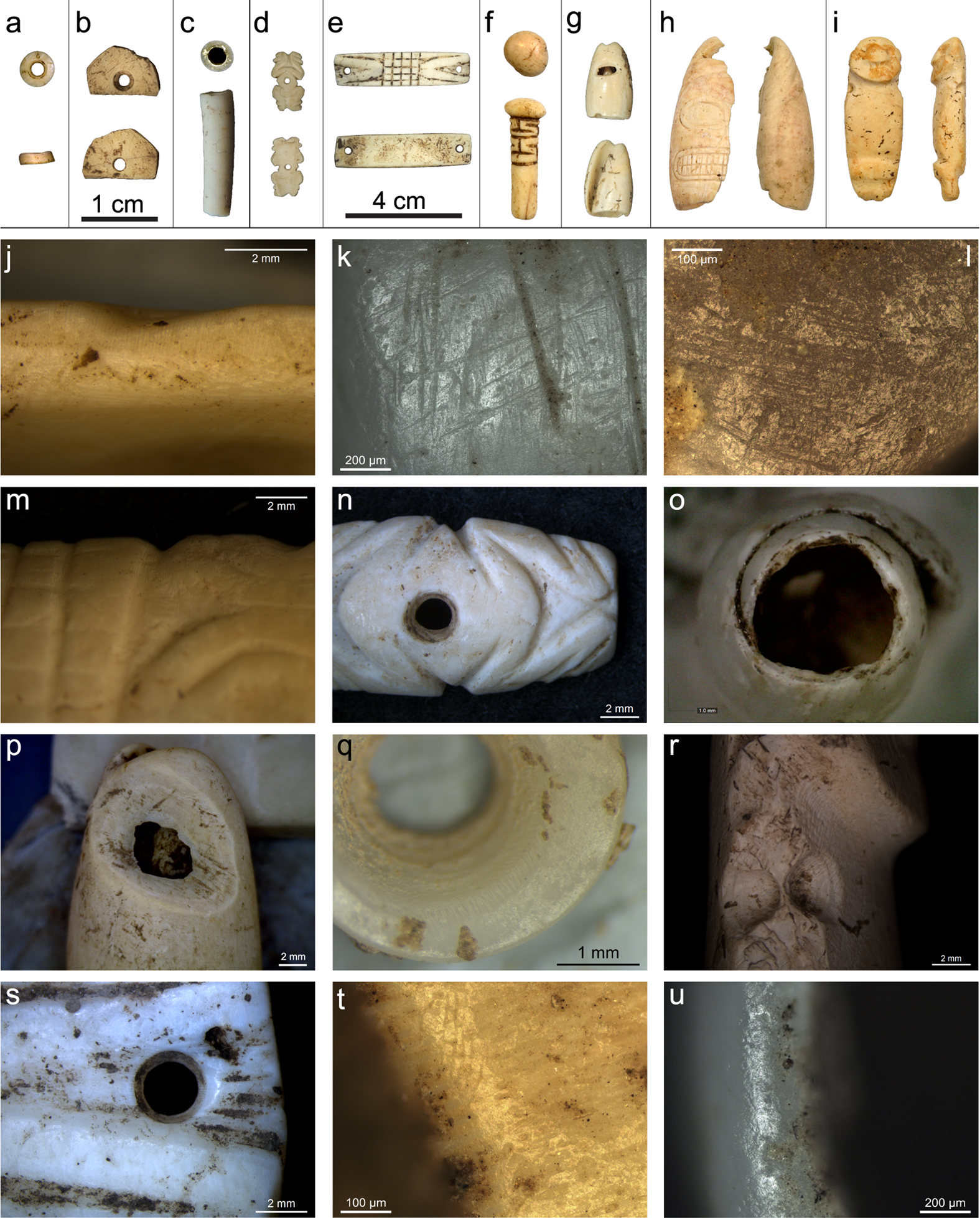
Shell ornaments: “seed bead” (a), disc bead (b), scaphopod bead (c), frog-shaped bead (d), plaque (e), conical plug (f), tinklers (g, h), and anthropomorphic pendant (i). Manufacture and use traces: sawing (j, k), grinding (l), incising and notching (m, n), percussion to remove apex (o), sawn perforation (p), drilling (q), incomplete drilling (r), and use-wear on perforations (s–u). (Color online)
Ornaments of diverse raw materials with manufacture and use traces: coral beads (a, h–m), ceramic bead (b), pendants made of dental elements (c, d), wooden plug (f), and resin plug (g). (Color online)

Production Technologies
The collections recovered from the sites mainly comprise finished ornaments, with few preforms (7%; Supplemental Table 3). Evidence for blank production and early reduction techniques is thus scarce. Most ornaments are well preserved, with only 31.7% displaying postdepositional surface modifications. Surface preservation of shell and certain lithic ornaments was notably poor at El Cabo (n = 46). In addition, 90 artifacts (28.8%) were fragmented, with minor (n = 30) and major breakages (n = 34). Most breakages likely happened before or during deposition (n = 83). The most frequently occurring morpho-technical groups are discussed in the following sections. Detailed data for each group are available in Supplemental Table 4.
Calcite
Calcite is the most prevalent lithic material in the studied sample, being predominantly used for bead production (Figure 4). Cut-and-break was identified as a blank acquisition technique on 11 artifacts (13.6%), which displayed cut marks, a pronounced wedge shape resulting from a poor snapping of the blank, or both. The experiments carried out show that a calcite blank can be easily sawn with a flint flake. This technique offers the possibility of quickly obtaining bead blanks with good control. Pendants were likely produced from whole nodules or crystals, given that they are much larger than the beads.
Grinding is identifiable by coarse striations and by the presence of faceting. Using high magnification, we observed it on 27 specimens, being characterized by a flattened and dull surface, either with no clear polish or with polish restricted to the tops of the micro-topography, alongside bright bands of striations. Polishing was noted on most calcite ornaments (n = 52; 64.2%); it is characterized by a greasy and invasive polish, with some variability in roughness, number of pits, and striations. Polishing experiments were carried out using a dried high-silica leaf (Cecropia sp.) and a cane section from a palm (Sabal cf. domingensis). Some similarity between experiments and recovered artifacts is apparent in the invasiveness and general greasy appearance of the resulting polishes, in particular with the experiments produced with the cane. Despite this similarity, no direct correspondence was possible, in part because of the variability of polish characteristics observed and the interaction between the surface treatment, use-wear, and postdepositional processes. We thus attributed the observed surface treatment to a soft contact material, but we did not consider it to be not sufficiently distinctive for more precise identification.
All calcite ornaments were perforated with massive drill bits. (Bi-)cylindrical perforation profiles with circular grooves and scratches were observed on group 1 beads. These traces suggest that the craftsperson used a long and cylindrical drill bit, probably of organic origin, with abrasives. Drilling experiments with wooden and bone drills to perforate shells (which have a similar composition and hardness to calcite) show comparable perforations with no clear surface polish or scratches but occasional broad circular rings (Figure 2k–l). The end tip of the drilled hole can present polish and fine scratches because of the accumulation of abrasive material on the leading edge.
The drilling method used for group 1 involved two stages: (1) drilling a tubular bead predominantly from one face, thus producing a wide rim of perforation, and (2) drilling the opposite face, producing a small, conical perforation. Additionally, a second perforation was added to the sides of the beads, perpendicular to the first one. Investigation with the μ-CT scan showed that side perforations are similar to the main ones and are therefore likely produced by the same tool kit (Figure 3a, c). In contrast, group 3 and the “other” group were drilled with brittle and hard lithic drill bits, as evidenced by biconical perforations with irregular concentric scratches (cf. Figure 2a). Group 2 disc beads displayed yet another drilling method, involving three stages: before biconical drilling with a hard lithic drill, they were perforated with a cylindrical drill bit, evidenced by a narrow and smooth cylindrical sector in between the two fresher cones. A comparable perforation is observed on a group 4 bead (Figure 3d). Group 1 beads were further modified by the addition of a groove on the side. This groove was made either with the thin edge of a brittle lithic flake, producing an incised line, or with a broader edge that produced a wider groove. Polishing took place after the creation of the grooves and side perforations, thus producing an hourglass shape. Six artifacts display anthropomorphic carvings made with hard and brittle lithic tools, which combine incision, notching, drilling, and bas-relief.
Plutonic Rock
Plutonic rock ornaments display greater morpho-technical variability (Figure 5a–r). Cut-and-break was identified on 10 beads (17.5%). This technique is evident on poorly shaped bead preforms from Playa Grande, which were not extensively modified after sawing. Sawing diorite is a time-consuming task; to avoid mishaps, a deep groove needs to be sawn as a guide to snapping. Pecking was possibly used to remove sharp ridges, but diagnostic traces have been erased in all but two beads. Grinding traces were predominant on 24 ornaments (42.1%), which are characterized by a dull and coarse surface. Polishing with a soft contact material was identified on 23 beads (40.3%). Both treatments were observed in combination on nine ornaments. The main perforations were likely made with the same tool kit used for calcite group 1 beads (organic drill bits), given that bi-cylindrical profiles with circular grooves are common across all bead morpho-technical groups. In contrast, the side perforations, either complete holes or decorative pits (not pierced through), were produced with hard and brittle lithic tools. Decorative carvings are present on 23 ornaments (40.4%), with the use of hard and brittle lithic tools identified on 10 ornaments. Four artifacts display biomorphic carvings made by a combination of incision, excision, and notching.
Other Lithic Materials
Beads, pendants, and an inlay were made of diverse materials, including stalactite (n = 2), limestone (n = 1), and “greenstones” (n = 4). Some of these beads do not fit any previously defined group, testifying to the existence of ornament biographies that are poorly represented at the sites. Two examples are the only lithic bead preforms recovered from El Flaco and El Cabo: a large and faceted disc bead (Figure 6a) and a plano-convex bead (Figure 6b). Both beads display misaligned and unfinished perforation cones (Figure 6, c–d) and rough grinding (Figure 6, e–f), having been abandoned before completion. The two beads are different from all other studied beads.
Plugs. Both conical and biconical plugs are represented, with a great variety in raw materials. Biconical plugs were likely ear spools, whereas T-shaped conical specimens could have been ear or lip plugs. The conical plugs were produced by a combination of grinding, sawing, and scraping to create different shapes varying from a marked T-shaped artifact (Figure 7f) to a nearly perfect cone (Figure 8f–g). Incised patterns were added to the surfaces of conical plugs made of stalactite and shell. The stone ear spools (Figure 6g–l), all from Playa Grande, were shaped in multiple stages: (1) grinding a thick circular blank in shape, (2) drilling a biconical perforation on its center, (3) sawing a notch around the sides with a V-shaped lithic tool, (4) widening the notch with a broad-edged tool, (5) smoothing the drilled hole with an abrasive tool, and finally (6) polishing with soft contact materials. Their dull surfaces, with preserved manufacture traces, suggest that certain specimens were discarded during production, but the small number of specimens and their fragmented nature limit interpretation.
Shell
Shell ornaments encompass great variability (Figure 7). One morpho-technical group includes 20 “seed beads”—very small disc beads made of different shell species: Lobatus gigas, Chama sarda, and an unidentified bivalve. The recurring diameters (5–6 mm) and perfectly circular shapes of the beads suggest some standardization of production, probably by grinding their sides on a mineral platform while strung together (Lammers-Keijsers Reference Lammers-Keijsers2007:64). The beads were individually perforated with tiny flakes of hard and brittle lithics.
Nine tubular beads were made from sections of tusk shell (Scaphopoda). They are hollow and slightly curved, with a smooth surface. Most beads display stepped fractures at the ends; in addition, cut marks or incisions left from blank acquisition are commonly seen (Figure 7c, k). Complete shells were not identified, although beads of different heights were retrieved from El Flaco. Their recurring diameters suggest a sustained preference for the least curved sector of the shell for bead making.
Flat and three-dimensional pendants, plaques, and inlays were produced with mollusk shell, often L. gigas. Different parts of the shell were selected (e.g., lip or columella), depending on the desired volume and shape of the artifact. The blanks of both flat and three-dimensional artifacts were initially shaped through sawing. Next, they underwent grinding and biconical drilling with hard lithic drills. Flat ornaments received geometric patterns through incision and the creation of bas-relief, whereas three-dimensional specimens underwent notching, incising, excising, and drilling. The combination of techniques allowed the carvers to create both anthropomorphic and zoomorphic figures.
Tinklers were carved on whole gastropod shells, particularly Oliva reticularis. Their production consisted of two operations: (1) removal of the apex of the shell through percussion (Figure 7o), grinding, or both and (2) perforation of the body whorl. In most cases, the perforation displays a U-shaped profile produced by sawing with a broad-edged lithic tool or with an organic tool, such as a wooden one, with abrasives (Figure 7p). Six specimens do not display a side perforation, being possibly unfinished. Four tinklers display incised and drilled carvings made with hard and brittle lithic tools, creating facial attributes or geometric patterns. O. reticularis shells were also used for the sawing of blanks for frog-shaped beads. These blanks were ground, drilled biconically with a hard and brittle lithic bit, and carved into a flat schematic frog by notching, incising, and creating bas-relief areas.
Stony Coral
Eight coral beads—most of which were made of Acropora cervicornis (Figure 8a, h–m)—were recovered from three sites. Two specimens have unfinished perforations, being interpreted as preforms. Unperforated branches of A. cervicornis were also recovered. One bead displays cut marks close to its edge, possibly linked to the splitting of the branches in small sections. The beads were drilled and sometimes also chiseled. The specimen scanned by the μ-CT does not display clear drilling traces. Our drilling experiment has shown that a calcium carbonate paste forms on the perforation on drilling, which may account for the absence of diagnostic traces.
Use-Wear
Worn artifacts are prevalent across nearly all raw materials (Supplemental Table 5). More than 70% of lithic ornaments are worn in contrast to about 15% of preforms and ornaments without use-wear. A different picture is observed for shell ornaments: more than 50% of the ornaments are worn, whereas 20% are unfinished or do not display use-wear. Because of the poor preservation of shell ornaments from El Cabo, use-wear could not be assessed on many specimens found there (25.4%). The difference in the presence of use-wear in shell and lithic ornaments can also be related to the greater number of shell preforms. We observed a predominance of worn ornaments across all sites and nearly all morpho-technical groups (Table 3; Supplemental Table 4). Playa Grande is the only site where the percentage of worn ornaments does not reach 50%. This is not surprising considering that it is the only site for which sustained evidence for ornament making is available.
Use-Wear Presence per Archaeological Site.

a Use-wear presence/absence is not applicable to half products, as they are not finished ornaments.
Discussion
The particular trajectories of artifacts within each morpho-technical group help us understand ornament biographies at the sites and the different interaction spheres enabling their acquisition. Even though lithic raw materials tend to be locally available, the samples do not display evidence for local production of most morpho-technical groups. Production waste, blanks, and preforms are absent, and the lithic tools likely used for drilling and carving were not commonly recovered. Nevertheless, the presence of two lithic bead preforms at El Flaco and El Cabo shows that bead-making knowledge was present to some degree in these communities. In other words, most ornaments were brought into the sites already finished, despite the local availability of raw materials and the presumed existence of local bead-making knowledge. Nevertheless, Late Ceramic Age stone bead-making workshops, from where such finished beads could have come, are not known.
The final products and production sequences of certain lithic morpho-technical groups are quite similar, despite the use of raw materials such as calcite and plutonic rocks with different physical properties. A shared mental template and some degree of standardization were involved in the production of double-perforated beads, as suggested by the occurrence at all sites of specimens made with similar tools and on select raw materials. At the same time, instances of poor technical performance were commonly noted, including technical errors (Supplemental Table 4) and a lack of regularity in shape and size. Such variations in performance and resulting morphologies suggest, among others, a low level of standardization of production, a low level of craftsmanship, presence of apprentices, or a lack of care in production. Double-perforated beads occur across the Greater Antilles (e.g., Fewkes Reference Fewkes2009 [1907]:109; García Castañeda Reference García Castañeda2012:71). Group 1 calcite beads are the most standardized and well distributed of all morpho-technical groups. Plutonic rock beads are more common at El Cabo than at El Flaco, where they are responsible for the larger variability in morpho-technical groups. By contrasting the most common bead groups in El Cabo and El Flaco, we can argue that there were different production centers, likely specializing in different raw materials and end products. Therefore, multiple production centers may have supplied beads to these communities. Bead groups that were only recovered from one site may be the result of local networks of artifact distribution.
Double perforated beads are of particular interest because it was previously speculated that the main perforation served for the insertion of feathers, whereas the bead was attached to a string composition through the side perforation (Fewkes Reference Fewkes2009 [1907]:109). This traditional assumption is challenged by the use-wear distributions, which show that double perforated beads were assembled in a variety of compositions. For instance, beads with string-wear located exclusively on the main perforation were fairly common. These beads must have been strung exclusively along their longest axis; that is, as common beads. Evidence for the placement of adjacent beads or knots was also noted, in the form of deformed concavities on calcite beads. In contrast, 12 beads display string-wear on both length and side perforations; three such specimens also display evidence of a string being wrapped around the center of the bead, connecting the cones of the side perforation (Figure 4p). Beads with strings passing along both axes may have served to connect multiple strands of an ornament. An anthropomorphic calcite bead displays black residue on one of its faces (Figure 4q) but no clear string-wear. The observed residue can be the result of an attachment string covered with residue or of an adhesive being used to fix something inside of the bead, such as a feather. Beads with string-wear exclusively on the side perforations, such as the two stalactite beads, would have hung asymmetrically, similarly to pendants.
Most lithic ornaments from Playa Grande do not fit the morpho-technical groups noted from the other sites. In particular, the plutonic rock beads from Playa Grande constitute a very diverse group in size, shape, and subtype. Four of these beads are preforms, whereas others display rather coarse surface treatments. Ear spools were also potentially made locally. Ornament production from lithic materials was taking place at the site, but it was not a specialized activity. Playa Grande did not provide other sites with lithic ornaments, in contrast to its known role as provider of greenstone celts to a wide region. Ornament production was likely connected to local use.
In addition to “imported” lithic ornaments, the inland sites in the northwest of the Dominican Republic also yielded ornaments made of marine resources. We interpret this as evidence of multiple networks of ornament and/or material acquisition. Shell “seed bead” production centers have been identified in the Turks and Caicos, dated from around AD 1100–1300 (Carlson Reference Carlson, Alegría and Rodríguez1995; Keegan et al. Reference Keegan, Fitzpatrick, Sealey, LeFebvre and Sinelli2008:645; Littman and Keegan Reference Littman, Keegan, Cummins and King1991; Sinelli Reference Sinelli2001:94). The sites were interpreted to be outposts in these small islands, specializing in the acquisition of L. gigas and C. sarda shells for large-scale bead making. Although these small beads could be used in necklaces, they are generally thought to be part of embroidered fabrics involving thousands of beads (Ostapkowicz Reference Ostapkowicz2013, Reference Ostapkowicz2018; Ostapkowicz et al. Reference Ostapkowicz, Brock, Wiedenhoeft, Schulting and Saviola2017). In the present study, we noted standardization in the production of “seed beads,” in stark contrast with lithic beads and other shell ornaments. Therefore the “seed beads” recovered from El Flaco and El Cabo may have been obtained from workshops.
The shell bead production centers do not present evidence for the manufacture of the other shell ornaments we studied. As such, an alternative pattern of acquisition can be suggested. Evidence has been found for the local production of ornaments from marine resources at El Flaco (tinklers and coral beads), El Cabo (frog-shaped beads and plaques), and Playa Grande (biomorphic pendants and disc beads). In all cases, the production was of relatively small scale. It was likely not sufficient for local consumption, given that composite ornaments would have required numerous elements. This is clearer for tinklers, large numbers of which are believed to have hung in rattling bands tied around the arms and ankles of dancers (García Castañeda Reference García Castañeda2012:58; Lovén Reference Lóven1935:481). During use, it is likely that individual tinklers often broke because of collision with neighboring components. Locally produced tinklers may have served as replacements for repairing and thus extending the life of a rattling ornamental band. This reasoning can perhaps be extended to other forms of local production, with the possible exception of three-dimensional pendants. Large figurative pendants were likely central pieces around which composite ornaments were conceived. Diverse marine resources could be directly acquired by the inhabitants of the coastal sites of Playa Grande and El Cabo. The inhabitants of the northwestern sites were immersed in a regional network of villages located in different ecological niches (Hofman et al. Reference Hofman, Hung, Malatesta, Jean, Sonnemann and Hoogland2018; Ulloa Hung Reference Ulloa Hung2013). Shells, corals, and fish skeletal materials were obtained directly or through exchange with people occupying mangrove or coastal sites and used as food resources, raw materials, and ornaments.
In sum, there was nonspecialized household-level production of ornaments in different raw materials at the three most extensively excavated sites. The difference between locally produced and imported ornaments did not correlate strictly to raw material variability (e.g., marine versus lithic resources). It was dependent on the specific trajectories of certain morpho-technical groups within each raw material. The depositional data also testify to the varied biographies of ornaments at these settlements.
Deposition of Ornaments
Most of the analyzed ornaments were not found in large groups or in closed contexts, which prevents us from assessing how composite body ornaments would have looked. At El Flaco, ornaments follow the pattern observed for other archaeological materials: they are found in the mound structures or adjacent to house structures. La Luperona and El Carril have thus far presented a similar picture. There is only one context from El Flaco where multiple beads were seemingly deposited as a group: 36 disc and barrel-shaped calcite beads (groups 2 and 3) were recovered from the same square meter in a mound with burials and hearth structures but not in direct association with any one individual. Beads of these two morpho-technical groups have been found only at El Flaco and in very small numbers outside of this particular context. They were likely obtained as a group from a specific producing community. In this sense, the singularity of the two morpho-technical groups is also reflected in their singular deposition.
The majority of ornaments from El Cabo were retrieved from the southern excavation area, which was occupied from AD 800 to about 1504. Some ornaments were recovered from postholes integrating 10 house plans, notably in entrance posts. This pattern arguably represented the ritual deposition of ornaments at the end of the life cycle of a house, before its abandonment and the construction of a new structure (Samson Reference Samson2010, Reference Samson, Hofman and van Duijvenbode2011). Other ornaments were recovered from the areas of greatest artifact density, following the same distribution pattern of most ceramic sherds and shell remains. The contrast between areas of dense artifact distribution and nearly clean areas was proposed to be due to the sweeping of refuse from the habitation areas toward the edge of the cliff (Samson Reference Samson2010). The majority of ornaments found in Playa Grande were retrieved from activity areas associated with hearth structures or food preparation or from refuse middens (80.6%). These areas date from AD 1000 to the early seventeenth century (López Belando Reference López Belando2012).
Most studied ornaments displayed use-wear and were deposited as the result of cleaning the house areas, rather than being deliberately added to hidden caches or burials. Beads can easily be lost, either by chance or by the restringing of composite ornaments. The fact that more than 70% of the sample is not fragmented suggests that these are not cases of intentional discard because of breakage. Integrating mounds and refuse areas, ornaments are the product of the regular maintenance of house areas as clean, functional, and desirable spaces. It may thus be suggested that ornaments reached the archaeological record as a result of their daily use at the sites, in the context of quotidian activities. Likewise, the importance of ornaments in daily life and the difficulty of their acquisition may be the reasons why they were not deposited with the dead, but perhaps were passed on to kin. Their homogeneous distribution throughout the sites can be regarded as an indication that the use of ornaments was widespread across all social categories. There may have been differential use according to social grouping, such as age and gender; nevertheless, these differences cannot be assessed through the data at hand. The small total amount of ornaments recovered from the sites highlights the concern with caring for and maintaining bodily ornaments, which limited their discard outside of prescribed deposition events such as closing rituals and hidden, perhaps votive, caches.
Conclusion
Archaeological debates concerning the adornment of the body in the Greater Antilles have focused on its role in reinforcing the political and religious power of high-status individuals. Little attention has been paid to demonstrating how people interacted with the commonly recovered ornament types. The present study applied for the first time an artifact biography approach to ornaments from Late Ceramic Age settlements. Our results show that bodily adornment cannot be taken for granted as a homogeneous category. First, a given ornament undergoes multiple changes during its lifetime—from raw material through production, circulation in networks of exchange, incorporation into composite ornaments, and eventual loss or discard. An ornament was dealt with in different ways in each life stage, and its status possibly evolved accordingly. Second, the morpho-technical groups had contrasting biographies, possibly as a result of their different expected social roles or of their participation in different social contexts. At the same time, the microwear study revealed how ornaments made of different materials or retrieved from different settlements shared certain biographical stages, such as material acquisition and production. Furthermore, our approach provided evidence for the circulation of ornaments and raw materials across different communities and regions. Future research focused on other sites is necessary to elucidate alternative ornament biographies and the interaction networks that encompassed them. Only then we will be able to more fully understand how ornaments were used in the establishment and negotiation of local and regional identities.
Acknowledgments
The authors acknowledge the Ministerio de la Cultura of the Dominican Republic and the Museo del Hombre Dominicano for granting permission to conduct this research. Furthermore, we would like to thank Jorge Ulloa Hung, Adolfo López Belando, the Torres family, Alice Knaf, Menno Hoogland, Darlene Weston, Eduardo Herrera Malatesta, Diederik Pomstra, Tom Breukel, and the students who assisted with the experiments. The present research was funded by the NWO Spinoza Prize awarded to Prof. Dr. Corinne L. Hofman in 2014. It is also part of the project NEXUS1492, which has received funding from the European Research Council under the European Union's Seventh Framework Programme (FP7/2007-2013)/ERC Grant agreement no. 319209.
Data Availability Statement
The Museo del Hombre Dominicano in Santo Domingo is the official repository of the collections studied in this research.
Supplemental Materials
For supplementary material accompanying this article, visit https://doi.org/10.1017/laq.2019.101.
Supplemental Table 1. List of Experiments.
Supplemental Table 2. Ornament Raw Materials according to Archaeological Site.
Supplemental Table 3. Unfinished Ornaments Retrieved from the Studied Sites.
Supplemental Table 4. Technological and Use-Wear Data Collected for Each Morpho-Technical Group.
Supplemental Table 5. Use-Wear Presence according to Ornament Raw Material.


 Open access

