


1 Introduction
Forty years ago, Reference TverskyTversky and Kahneman (1974) demonstrated that, when making numerical judgments under uncertainty, people often fall prey to anchors: relevant or irrelevant numbers that influence judgments. For example, when guessing the length of the Mississippi River, people first asked if it is longer or shorter than 2,000 miles will give a larger estimate than people first asked if it is longer or shorter than 70 miles (Reference JacowitzJacowitz& Kahneman, 1995). Although the number in the first question should not affect the ultimate judgment of length, since people know it is incorrect and that it is unlikely to provide helpful information, numerical judgments still assimilate to the numerical anchor. Dozens of studies on anchoring effects have documented the impressive extent of anchoring (for reviews, see Chapman& Johnson, 2002; Reference Epley, Koehler and HarveyEpley, 2004; Reference FurnhamFurnham& Boo, 2011). Anchoring effects appear to occur despite forewarning or incentives for accuracy (Reference EpleyEpley& Gilovich, 2005) and regardless of cognitive reflection (Reference Oechssler and RoiderOechssler, Roider,& Schmitz, 2009), and they matter in a wide variety of situations, including estimates of the likelihood of nuclear war (Reference PlousPlous, 1989), math calculations (Reference SmithSmith& Windschitl, 2011), and outcomes of negotiations (Reference GalinskyGalinsky& Mussweiler, 2001).
The influence of anchors even extends to people’s judgments about their own behavior. Reference CervoneCervone and Peake (1986), for instance, found that subjects’ predictions of how many anagrams they could solve were higher when they were exposed to a high anchor than when they were exposed to a low one. In a similar study, anchors also affected subjects’ estimates of how many sentences they would be able to unscramble (Reference SwitzerSwitzer& Sniezek, 1991). Additionally, people’s judgments of confidence in their own performance (e.g., in a signal detection task; Reference Carroll and PetrusicCarroll, Petrusic,& Leth-Steensen, 2009)—as well as the quality of the performance of others (Thorsteinson, Breier, Atwell, Hamilton,& Privette, 2008)—are similarly vulnerable to anchoring effects.
Despite the vast anchoring literature, however, we know of no research that has directly examined the effect of anchors on people’s judgments of their own recent behavior. It seems possible, though, that anchors can influence such judgments, especially given the extent of anchoring effects in other areas of research. On the other hand, people may be particularly aware of their own past behavior, and such knowledge may prevent anchors from affecting their judgment. In other words, whereas when judging future behavior (e.g., anagrams to be solved; Reference CervoneCervone& Peake, 1986) people do not have direct self-knowledge to help them avoid anchoring effects, when judging past behavior, people may have and be able to draw on self-knowledge to counteract anchors. We set out to test these possibilities in the present research.
1.1 Knowledge and anchoring
The possibility that people’s judgments of their own recent behavior will be immune to anchoring effects receives support from several studies showing that knowledge attenuates the influence of anchors (e.g., Mussweiler& Englich, 2003; Reference MussweilerMussweiler& Strack, 2000a; Reference Smith and WindschitlSmith, Windschitl,& Bruchmann, 2013). For example, Reference MussweilerMussweiler and Englich (2003) examined the effects of anchoring on price estimates in Germany during the transition from the Mark to the Euro. They found that, before the transition, German subjects were more susceptible to anchoring when judging prices in Euros (with which they were less familiar) than when judging prices in Marks. In contrast, several months after the transition, when Germany had adapted to the new currency, the pattern reversed: subjects instead anchored more when using Marks. Similarly, Smith et al. (2013) found that people from the U.S. were less influenced by anchors when making judgments about the U.S. then when making judgments about India, whereas people from India were less influenced by anchors when making judgments about India than when making judgments about the U.S.
Furthermore, knowledge may play a particularly important role in judgments of one’s own recent behavior. People attend more to self-relevant information and behavior, and self-referential encoding of information results in better recall (e.g., Rogers, Kuiper,& Kirker, 1977; Reference Symons and JohnsonSymons& Johnson, 1997). Accordingly, people’s knowledge of their own past behavior may be particularly important to them and may therefore limit the influence of anchoring to an even greater extent than the more general knowledge examined in previous studies. Thus, people’s judgment of their own recent behavior could be completely or partially immune to anchoring effects.
However, other studies have found less evidence that knowledge reduces anchoring effects. Englich (2008), for instance, failed to find any evidence that subject’s knowledge about German cars reduced their susceptibility to anchors when making price estimates of cars. Moreover, research on expert judgments has shown that despite their sophisticated knowledge and experience, real estate agents (Reference NorthcraftNorthcraft& Neale, 1987), judges (Reference Englich and MussweilerEnglich, Mussweiler,& Strack, 2006; Reference EnglichEnglich& Soder, 2009), and doctors (Reference Brewer, Chapman and SchwartzBrewer, Chapman, Schwartz,& Bergus, 2007) all exhibit anchoring effects, even when making judgments in their areas of expertise and even when anchors are clearly irrelevant. Therefore, people’s self-knowledge may not actually protect them from anchoring effects.
In fact, some previous research hints at the possible influence of numerical anchors on judgments of past behavior. For example, Loftus (1975) reports that, when people were asked about the number of headache relief products they had tried, those asked“In terms of total number of products, how many other products have you tried? 1? 2? 3?” said they had tried fewer products than those asked“In terms of total number of products, how many other products have you tried? 1? 5? 10?” (p. 561). Apparently, the numbers at the end of the question affected people’s reports about their own past behavior.
Reference Ross and LepperRoss, Lepper, and Hubbard (1975) also found evidence that numerical judgments of past behavior are susceptible to external influence. They provided subjects with false feedback about success on a task that involved determining if suicide notes were real or fake. After completing the task, subjects were first falsely informed that they had either been very successful, somewhat successful, or very unsuccessful. The experimenter then informed subjects that this feedback was completely false and asked them to estimate how many notes they had actually correctly identified. Despite the experimenter’s explanation, subjects who were initially told they had correctly identified more notes subsequently estimated that they had actually successfully identified more notes than did subjects who were initially given more negative feedback. Hence, the initial evaluation provided by the experimenter influenced subjects’ later numerical judgments of their own behavior.
Finally, in a study on drug use and memory, Reference Collins, Graham and HansenCollins, Graham, Hansen, and Johnson (1985) found that people appeared to anchor on their current marijuana use when recalling their previous use more than two years earlier. Thus, although these previous studies did not use the typical anchoring paradigm and the effects may not be due to the same underlying mechanisms as anchoring, they still provide preliminary evidence that people’s judgments of their own past behavior may be vulnerable to anchors.
1.2 The present research
In summary, the effects of domain knowledge on anchoring are not unequivocal, but it is surprising that people with substantial experience in a domain (e.g., in criminal sentencing or real estate sales) are affected by anchors. The present studies sought to extend the investigation of domain knowledge effects to one’s own past behavior. We conducted six studies to examine whether people fall prey to anchors even when judging their own recent behavior. We began by investigating whether anchors affect such judgments at all (Studies 1, 2A, 2B, 3A, and 3B). Then, upon finding that anchors do influence people’s judgments of their own behavior, we tested the prediction that, although anchoring effects still occur, they are weaker when people judge their own behavior than when they judge other people’s behavior (Study 4).
2 Study 1
In the first study, subjects completed anagrams and then estimated how many they had just been given after exposure to a high anchor, a low anchor, or no anchor. If people’s judgments about their own behavior are immune to anchoring effects, then judgments of anagrams given should not differ between anchoring conditions. On the other hand, if anchors do influence such judgments, estimates of anagrams given should be higher in the high anchor condition than in the low anchor condition.
2.1 Method
2.1.1 Subjects
Ninety-two Swarthmore College undergraduates participated as part of the research requirement for an introductory psychology class.
2.1.2 Materials and procedure
Subjects completed the study in individual sessions. In each session, the experimenter sat opposite the subject and held up index cards with anagrams on them one at a time. This procedure prevented subjects from easily counting exactly how many anagrams there were. There were 20 total anagrams, which ranged from simple (e.g.,“hotto” unscrambles to“tooth”) to somewhat more challenging (e.g.,“barked yo” unscrambles to“keyboard”). Subjects had 30 seconds to unscramble each anagram, and if they failed to do so in the time allotted, the experimenter provided the correct answer and moved on to the next anagram.
After going through the 20 anagrams, subjects completed a brief questionnaire that contained three filler questions (e.g.,“How much did you enjoy solving the anagrams?”) and then the main dependent measure. In the high-anchor condition (n = 31), subjects were asked“Do you think you were given more or less than 30 anagrams?” followed by“How many anagrams do you think you were given?” In the low-anchor condition (n = 32), subjects were instead asked“Do you think you were given more or less than 10 anagrams?” followed again by“How many anagrams do you think were given?” In the baseline condition (n = 29), subjects did not receive an anchor; the baseline questionnaire contained only the question“How many anagrams do you think you were given?”
2.2 Results and discussion
A one-way between subjects ANOVA showed that anchors did influence subjects’ judgments, F(2, 89) = 5.05, p = .008. Post hoc analyses using Tukey’s HSD indicated that estimates of anagrams completed were significantly lower in the low-anchor condition ( M = 17.84, SD = 5.35) than estimates in the high-anchor condition ( M = 22.48, SD = 5.55) at the p = .006 level. Subjects’ estimates in the baseline condition ( M = 19.86, SD = 6.51) did not differ from either the high-anchor or low-anchor conditions, p = .193 and .368, respectively. Thus, these results provide preliminary evidence that people’s judgments of their own behavior are, in fact, susceptible to anchoring effects.
Although an anchoring effect did emerge, a possible limitation of this study is that subjects were not technically tracking their ownbehavior. Because they estimated how many they were given, rather than how many they completed, it may be that subjects did not use information about their behavior when answering the question. Despite the fact that they were involved in the anagram task, and thus it was to a certain extent self-relevant, they may have perceived the question as asking about the experimenter’s behavior or the experimental situation more generally. As a result, the findings of this study do not definitively show that anchoring can influence people’s judgments of their own recent behavior. We provide a more direct test in next study.
3 Study 2A
To examine more directly the effect of anchors on people’s judgments of their own behavior, we presented subjects in Study 2A with 22 simple math problems and asked them to estimate how many problems they had correctly completed, thus ensuring that they were explicitly judging their own recent behavior. The problems were designed to be easy enough that most subjects would be able to correctly solve all of them.
3.1 Method
3.1.1 Subjects
One hundred eighty-one subjects completed the study through Amazon’s Mechanical Turk (MTurk; see Reference Buhrmester and KwangBuhrmester, Kwang,& Gosling, 2011) in exchange for $0.25. To be included in data analyses, subjects had to answer all 22 problems correctly. In addition, they had to correctly answer three attention check questions presented after the main study (e.g.,“In the following sentence, what is the fourth word after the semicolon? Mary was disappointed about losing the game; however, she was relieved that the soccer season was now over.”). Only the 109 subjects who met these inclusion criteria were included in analyses.Footnote 1
3.1.2 Materials and procedure
Subjects completed 22 simple math problems (e.g., 27− 4 = ?), which were presented one at a time. After answering all problems, subjects completed a brief questionnaire that contained three filler questions (e.g.,“How much did you enjoy solving the math problems?”) followed by the main dependent measure. In the low-anchor condition ( n = 37), subjects were first asked“Do you think you correctly solved more or less than 11 math problems?” followed by“How many math problems do you think you correctly solved?” In the high-anchor condition ( n = 42), subjects were first asked“Do you think you correctly solved more or less than 33 math problems?” followed again by“How many problems do you think you correctly solved?” In the baseline condition ( n = 30), subjects did not receive an anchor; the baseline questionnaire contained only the question“How many problems do you think you correctly solved?” Subjects then completed the three attention check questions.
3.2 Results and discussion
A one-way ANOVA revealed that anchors did influence subjects’ judgments of their own behavior, F(2, 106) = 59.11, p< .001. Post hoc analyses using Tukey’s HSD indicated that estimates of problems correctly solved were significantly higher in the high-anchor condition ( M = 29.17, SD = 8.23) than in either the low-anchor ( M = 16.46, SD = 3.46) or baseline ( M = 15.87, SD = 4.89) conditions, p< .001. The latter two conditions did not differ from each other, p = .917. Thus, the results of Study 2A provide evidence that even people’s judgments of their own recent behavior are not immune from the influence of anchoring. Despite the fact that all subjects correctly completed the same number of problems, subjects in the high-anchor condition estimated that they had completed more problems than did subjects in the low-anchor condition.
It is interesting that, while subjects in the high-anchor condition made significantly higher estimates than subjects in both the low-anchor and baseline conditions, the latter two conditions did not differ significantly. That is, only the high anchor appeared to impact subjects’ judgments. The absence of an anchoring effect in the low-anchor condition is somewhat surprising, but this result may have occurred because the low anchor was too high; perhaps a lower anchor would have influenced subjects’ judgments. Another potential explanation could be that high anchors simply have a stronger influence than low anchors do, perhaps because a floor effect limits the effect of low anchors and lessens the likelihood that subjects will make a judgment below a certain point. This possibility is consistent with research by Reference JacowitzJacowitz and Kahneman (1995), who found that high anchors influenced judgments more than low anchors did. Of course, a ceiling effect could also conceivably exist for high anchors, though it may be less noticeable in the present design. Future research on possible differences between high and low anchors could address this question.
Additionally, although an anchoring effect did emerge, it is possible that subjects did not actually see the anchors as irrelevant; they may have thought the anchors provided information or hints, or served some other relevant purpose (see, e.g., Schwarz, 1994). To rule out this possibility, in Study 2B, we replicated Study 2A with extreme anchors that could not possibly be the correct answer.
4 Study 2B
Previous researchers have used a range of methods to minimize the likelihood that subjects view anchors as informative. Reference TverskyTversky and Kahneman (1974), for instance, used a spinning wheel to generate the anchor values randomly for subjects. Other studies (e.g., Smith& Windschitl, 2011; Reference Wegener, Petty, Detweiler-Bedell and JarvisWegener, Petty, Detweiler-Bedell,& Jarvis, 2001) have employed extreme and implausible anchors to limit the extent to which subjects see the anchors as informative hints. In Study 2B, we adopted the latter strategy, replicating Study 2A using anchors that were very extreme and implausible. If anchoring still occurs despite the fact that the anchor values are clearly extreme and implausible—for example, the extreme low anchor in this study is a negative number, which is not a possible correct answer—then the effect of numerical anchors on judgments of recent behavior cannot be fully explained by subjects’ reliance on anchors as relevant information or hints (Reference Schwarz and ZannaSchwarz, 1994).
4.1 Method
Ninety subjects completed the study in exchange for $0.25 through MTurk. Data from 66 additional subjects were excluded for failing to meet the inclusion criteria described in Study 2A.Footnote 2 The procedure was exactly the same as in Study 2A, except that there were only two conditions: the extreme-low-anchor condition and the extreme-high-anchor condition. After solving the 22 math problems, subjects in the extreme-low-anchor condition ( n= 44) were asked“Do you think you correctly solved more or less than−128 problems?” before estimating how many they correctly solved, whereas subjects in the extreme-high-anchor condition ( n = 46) were asked“Do you think you correctly solved more or less than 172 problems?” before estimating how many they correctly solved.
4.2 Results and discussion
As in Study 2A, anchors influenced subjects’ judgments of their own recent behavior. Subjects in the extreme-high-anchor condition estimated that they had completed significantly more math problems ( M = 24.13, SD = 9.33) than subjects in the extreme-low-anchor condition ( M = 19.73, SD = 7.49), t(88) = 2.46, p = .016. This was true despite the fact that subjects in both conditions correctly completed the same number of math problems and despite the extremity of the anchors. In line with previous research (e.g., Wegener et al., 2001), the difference between the high and low anchoring conditions was smaller when the anchor values were implausible; nonetheless, a clear difference between high and low anchors emerged. Thus, the influence of numerical anchors on subjects’ judgments cannot be completely explained by a reliance on anchors for information or hints.
5 Study 3A
The results of the previous studies demonstrate that anchors can influence people’s judgments of their own recent behavior. The studies have thus far relied on mental tasks (i.e., solving anagrams or math problems), and in Study 3A we extended our investigation of anchoring effects to a more physical activity. Specifically, subjects walked up a flight of stairs and then immediately estimated how many stairs they had just walked up.
5.1 Method
5.1.1 Subjects
One hundred forty-two Swarthmore College undergraduates participated as part of the research requirement for an introductory psychology class.
5.1.2 Procedure
Subjects followed the experimenter up a flight of stairs with 23 stairs. There was a door at the top of the stairs, and once the experimenter and subject had walked through the doorway and closed the door, the experimenter immediately asked subjects to answer one or two questions, depending on condition. In the high-anchor condition ( n = 47), the experimenter first asked subjects,“Do you think you just walked up more or less than 35 stairs?” followed by“How many stairs do you think you just walked up?” In the low-anchor condition ( n = 47), the experimenter instead asked,“Do you think you just walked up more or less than 11 stairs?” followed again by“How many stairs do you think you just walked up?” In the baseline condition ( n = 48), the experimenter only asked subjects to estimate how many stairs they had just walked up.
5.2 Results and discussion
A one-way between subjects ANOVA revealed that anchors affected subjects’ judgments, F(2, 139) = 15.03, p< .001. Post hoc analyses using Tukey’s HSD indicated that subjects in the high-anchor condition estimated that they had just walked up significantly more stairs ( M = 28.00, SD = 7.26) than subjects in both the low-anchor ( M = 19.87, SD = 7.13) and baseline ( M = 23.21, SD = 7.29) conditions at the p< .001 and p = .004 level, respectively. There was a nearly significant two-tailed difference (although the hypothesis is arguably one-tailed) between the latter two conditions, p = .067. Thus, judgments of recent physical behavior are also susceptible to numerical anchors.
6 Study 3B
As with Study 2B, we replicated study 3A using extreme and implausible anchors (including a nonsensical negative anchor) to rule out the possibility that an anchoring effect emerged only because subjects assumed anchors provided useful information or hints (e.g., Schwarz, 1994).
6.1 Method
Seventy-five Swarthmore College undergraduates participated as part of the research requirement for an introductory psychology class (data from one subject were excluded due to poor comprehension of the task). The only difference in the procedures of Study 3A and Study 3B was that Study 3B contained only two conditions: the extreme-low-anchor condition and the extreme-high-anchor condition. After walking up the 23 stairs, subjects in the extreme-low-anchor condition ( n= 37) were asked“Do you think you just walked up more or less than−31 stairs?” before estimating how many they had just walked up, whereas subjects in the extreme-high-anchor condition (n = 37) were asked“Do you think you just walked up more or less than 77 stairs?” before estimating how many they had just walked up.
6.2 Results and discussion
As in Study 3A, anchors influenced subjects’ judgments of their own recent behavior. Specifically, subjects in the extreme-low-anchor condition ( M = 25.30, SD = 7.77) estimated that they had just walked up fewer stairs than did subjects in the extreme-high-anchor condition ( M = 34.54, SD = 11.14), t(64.32) =−4.14, p< .001. Thus, the influence of numerical anchors on subjects’ judgments cannot be completely explained by a conscious reliance on anchors for information or hints.
7 Study 4
In light of the previous studies, it appears that anchors can influence people’s judgments of their own mental and physical behavior. However, these results do not rule out the possibility that knowledge matters; rather, it may be that knowledge only attenuates—but does not actually eliminate—anchoring effects in judgments of recent behavior. Therefore, in Study 4 we tested the prediction that anchors would have a stronger influence when people judged other people’s recent behavior than when they judged their own. If knowledge does matter, people should be less susceptible to anchors when judging their own behavior than when judging someone else’s. In this study, we had subjects either complete paper and pencil mazes or observe someone else complete paper and pencil mazes, and then estimate how many mazes were completed.
7.1 Method
7.1.1 Subjects
One hundred ninety-four Swarthmore College undergraduates participated as part of the requirement for an introductory psychology course. Four additional subjects participated but did not correctly or completely fill out the post-maze questionnaire.
7.1.2 Materials and procedure
Subjects completed the study in pairs. Based on the results of a coin flip, one member of the pair was assigned to be the“solver” and the other was assigned to be the“observer.” The solver completed 18 relatively simple mazes; the observer watched the solver complete the mazes. After the solver completed the mazes, both the solver and the observer completed a brief questionnaire. Both questionnaires asked about the solver’s experience and behavior; thus, whereas solvers judged their own behavior, observers judged the behavior of someone else. This distinction was the knowledge manipulation.
The solver questionnaire contained three filler questions (e.g.,“Describe any strategies you used to finish the mazes”) and then the anchoring questions. In the low-anchor condition (n = 34), solvers were first asked“Do you think you completed more or less than 9 mazes?” followed by“How many mazes do you think you completed?” In the high-anchor condition (n = 33), solvers were instead first asked“Do you think you completed more or less than 27 mazes?” followed by“How many mazes do you think you completed?” In the baseline condition (n = 31), solvers were only asked“How many mazes do you think you completed?”
The observer questionnaire also contained three filler questions (e.g.,“Describe any strategies you noticed your partner using to finish the mazes”) and then the anchoring questions. In the low-anchor condition (n = 32), observers were first asked“Do you think your partner completed more or less than 9 mazes?” followed by“How many mazes do you think your partner completed?” In the high-anchor condition (n = 32), observers were instead first asked“Do you think your partner completed more or less than 27 mazes?” followed by“How many mazes do you think your partner completed?” In the baseline condition (n = 32), observers were asked only“How many mazes do you think your partner completed?”
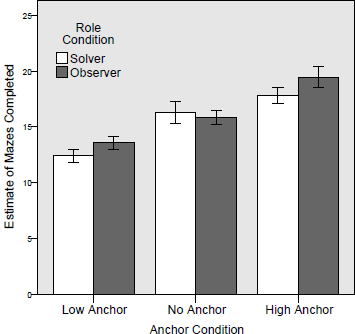
Estimates of number of mazes completed.
7.2 Results and discussion
Results from Study 4 are presented in Figure 1. We conducted a 3 (anchor condition: high vs. low vs. baseline) x 2 (role condition: solver vs. observer) ANOVA to examine the effects of anchor type and knowledge on judgments of recent past behavior. There was a significant main effect of anchor type, F(2, 188) = 28.32, p< .001. There was no main effect of role, F(2, 188) = 1.66, p = .200, nor was there an interaction, F(2, 188) = 1.0, p = .371. To examine the effect of the anchors on judgments of recent behavior more closely, we pooled data from solvers and observers and conducted a one-way ANOVA, F(2, 191) = 28.29, p< .001. Post hoc analyses using Tukey’s HSD indicated that subjects in the high-anchor condition estimated that more mazes were completed (M = 18.63, SD = 4.75) than subjects in the low-anchor condition (M = 12.97, SD = 3.48) at the p< .001 level and they estimated that more mazes were completed than subjects in the baseline condition (M = 16.05, SD = 4.63) at the p = .002 level. Subjects in the low-anchor condition estimated that fewer mazes were competed than subjects in the baseline condition at the p< .001 level.
The results of Study 4 provided no evidence that self-knowledge attenuated the effect of numerical anchors: there was no difference between the anchoring of observers and that of solvers, despite the fact that solvers should have had more knowledge about their own recent behavior. This is particularly surprising given that self-knowledge is privileged in memory and recall (e.g., Rogers et al., 1977; Reference Symons and JohnsonSymons& Johnson, 1997), and thus if general knowledge does reduce anchoring, self-knowledge should, if anything, reduce anchoring even more. Thus, our results fit better with previous studies suggesting that the importance of knowledge in anchoring is at least limited (e.g., Brewer et al., 2007; Reference EnglichEnglich, 2008; Reference Englich and MussweilerEnglich et al., 2006) than with those positing an important role for knowledge (e.g., Mussweiler& Englich, 2003; Reference Smith and WindschitlSmith et al., 2013).
One possible explanation for the lack of influence of self-knowledge is that, although subjects had knowledge that could have potentially attenuated the effect of anchors, they were not motivated to use it. In other words, perhaps only when subjects are motivated to be accurate and use their knowledge does knowledge reduce anchoring effects. However, while this may be an interesting avenue for future research, it is also worth noting that previous research has provided little support for the hypothesis that motivation attenuates or eliminates anchoring. For instance, Reference EpleyEpley and Gilovich (2005) offered financial incentives to increase the motivation of subjects making judgments in the standard anchoring paradigm and found no difference between the anchoring effects of subjects offered incentives and subjects in the control condition. Moreover, Epley and Gilovich (2006) found that neither cognitive busyness nor alcohol consumption reduced anchoring in the standard paradigm. Taken together, these results imply that relatively high motivation or availability of cognitive resources do not necessarily translate into more accurate or less anchored judgments.
8 General discussion
Across six studies, we found that numerical anchors do influence people’s judgments of their own recent behavior. In Studies 1 and 2A, we found that people’s estimates of the number of anagrams they were given or the number of math problems they correctly solved assimilated to numerical anchors. We then showed in Study 2B that this effect could was not merely because people viewed the anchors as informative: even absurdly extreme anchors influenced people’s judgments of the number of math problems they correctly solved. Studies 3A and 3B extended these results to a more physical activity: anchors also affected people’s estimates of the number of stairs they had just walked up.
Finally, in Study 4 we tested the hypothesis that, although people’s self-knowledge does not protect them from the influence of anchors, it does make them less susceptible. Self-knowledge did not appear to reduce anchoring effects: people were equally susceptible to anchors when judging their own recent behavior as they were when judging the recent behavior of someone else. This finding contrasts with previous studies that have found that domain knowledge can reduce anchoring (e.g., Reference Nicholson, Yarbrough, Bruinsma and WeisburdSmith et al., 2013), and suggests that there are at least limitations to the extent to which knowledge attenuates anchoring (e.g., Brewer et al., 2007; Reference EnglichEnglich, 2008; Reference Englich and MussweilerEnglich et al., 2006; Reference NorthcraftNorthcraft& Neale, 1987). Future research might implement a stronger knowledge manipulation to further investigate the role of knowledge; for example, perhaps if observers were engaged in a distractor task, and thus could not pay as close attention to the maze activity, they would subsequently be more susceptible to anchors. Nonetheless, our results suggest that knowledge does not reduce anchoring in all cases.
8.1 Implications and future directions
Beyond demonstrating that people’s judgments of their own recent behavior are susceptible to anchors, our results underline the potential malleability of memory (e.g., Loftus, 2005). A large literature has documented the extent to which memories can be shaped by the way questions are asked. For instance, in a classic study, Reference LoftusLoftus and Palmer (1974) found that after watching a video of a car accident, people estimated that the speed of the cars was faster when asked how fast the cars were moving when they“smashed into each other” than when asked how fast they were moving when they“hit each other”. These studies reveal that subtle linguistic cues can alter people’s judgments of past events, and our anchoring studies extend research on memory to show that exposure to numbers, even irrelevant ones, can similarly influence numerical judgments about the past.
Perhaps the application of research on the malleability of memory that has received the most attention from researchers is eyewitness testimony (e.g., Wells& Loftus, 2013). This line of research is important because despite the fact that eyewitness testimony is vulnerable to influences like leading questions (e.g., Loftus& Zanni, 1975), juries tend to find witnesses extremely convincing (e.g., Nicholson, Yarbrough,& Penrod, 2014). Given that the present research found evidence that numerical anchors represent yet another potential influence on judgments of the past, future research may benefit from exploring the effect of numerical anchors in a context more directly related to eyewitness memory and testimony. Future studies could, for example, investigate the possibility that anchors influence judgments of the number of people present at the scene of a crime, or the number of times a witness asked for help.
Future research might also investigate potential means of reducing or preventing the influence of numerical anchors on judgments of recent behavior. One possible strategy for debiasing judgments of the past derives from the Selective Accessibility Model (SAM) of anchoring (Reference Chapman and JohnsonChapman& Johnson, 1999; Reference MussweilerMussweiler, 2003; Mussweiler& Strack, 1999, 2000b; Reference StrackStrack& Mussweiler, 1997). According to the SAM, anchoring in the standard paradigm occurs in two stages that result from the two questions in the standard anchoring paradigm (i.e., the first, comparative question and the second, absolute question). The first stage occurs when people answer the comparative question (e.g.,“Do you think you completed more or less than 9 mazes?”). When answering the comparative question, people compare the target value (e.g., the number of mazes completed) with the anchor value (e.g., 9) and in doing so, selectively activate anchor-consistent knowledge (Reference MussweilerMussweiler& Strack, 2000b). For example, subjects in Study 4 who received 9 as an anchor may have thought about the fact that the mazes took relatively little time to complete, and thus there were probably not very many mazes. Consequently, anchor-consistent information becomes more available, whereas anchor-inconsistent information is less available (Reference Chapman and JohnsonChapman& Johnson, 1999). The second stage of the SAM then occurs when people answer the absolute question (e.g.,“How many mazes did you complete?”). Because anchor-consistent information has been made more available in the first stage, it is heavily relied upon by people to answer the absolute question (e.g., Higgins, 1996). Therefore, because the available information is anchor-consistent, people’s answers are biased in the direction of the anchor (Reference MussweilerMussweiler, 2003; Mussweiler& Strack, 1999, 2000b).
In addition to providing an explanation of anchoring, the SAM also provides a strategy for debiasing judgments. Given that the process of answering the comparative question increases the availability of anchor-consistent information, increasing the availability of anchor-inconsistent information should help to debias subsequent answers to the absolute question (Reference Chapman and JohnsonChapman& Johnson, 1999; Reference Mussweiler and StrackMussweiler, Strack,& Pfeiffer, 2000). One way to increase the availability of anchor-inconsistent information is to have people directly consider such information. For example, in one study (Mussweiler et al., 2000, Study 1), car experts were exposed to high and low anchors before estimating the appropriate price of a car. Half of the experts were asked to generate anchor-inconsistent arguments (e.g., the car has too much damage for the high anchor to be appropriate) before making an absolute judgment. The generation of anchor-inconsistent information then led to a weaker, though still significant, anchoring effect.
This consider-the-opposite strategy may also diminish the influence of numerical anchors on people’s judgments of their own recent behavior. Future studies might therefore build on the present research by examining the effect of having subjects generate reasons why their recent behavior was inconsistent with the numerical anchor. For instance, if, after being asked if they completed more or less than 27 mazes, subjects first considered the fact that the relative speed with which they completed the mazes was inconsistent with having completed that many mazes, might their subsequent estimates be less biased? Future research on both the susceptibility of people’s judgments of their behavior to sources of bias and methods of reducing such bias will prove useful in furthering understanding of the interactions between knowledge, anchoring, and judgments of the past.
9 Conclusion
In conclusion, the present research showed that people’s judgments of their own recent behavior are susceptible to numerical anchors, and that self-knowledge does not necessarily reduce the influence of anchors. Thus, despite the faith people may place on their memories of the past, especially those of their own actions, our results serve to underline the fact that memories can be far from perfect and robust, even ones from only moments ago.


 Open access

