


1. Introduction
Once a cornerstone of labor protection, the National Labor Relations Act (NLRA or “the Act”) empowered workers to form unions, assert a collective voice, and improve working conditions. Today, labor commentators and scholars criticize both the Act and the agency that enforces it—the National Labor Relations Board (NLRB or “the Board”)—for their inability to prevent or reverse the long-standing trend of deunionization.
Political scientists and political sociologists interpret such problems as outcomes of gradual institutional change. Laws may “drift” by failing to adapt to evolving economic and social contexts, or become “converted,” as existing institutions are reinterpreted toward unintended ends.Footnote 1 Both processes have been used to describe the trajectory of the NLRA: scholars characterize it as ossified and moribund on the one hand, and hijacked or stolen on the other.Footnote 2
I adopt the lens that conversion is the appropriate framework to understand the changes to the NLRA. Following the 1947 Taft–Hartley amendments, the NLRA was recast as a neutral statute intended to referee employer–employee relations. That reinterpretation eclipsed the law’s original purpose of encouraging collective bargaining and provides the rhetorical and legal basis for fighting off reforms.
In response, many labor advocates have disengaged from the NLRA and turned instead to state and local venues—what Daniel Galvin and Jacob Hacker call a new “politics of drift.”Footnote 3 I adopt their insight that gradual change creates new forms of politics, but I broaden the scope to include conversion and ask: How do mission-committed officials within converted agencies sustain enforcement capacity when their institutions’ purposes have been undermined? I argue that bureaucratic legacies enable normative subcultures of enforcement—networks of officials who draw on professional expertise and strategic adaptation to resist institutional change even as conversion fragments their agencies.
The interaction between bureaucratic legacies and conversion produces fragmentation along interpretive lines. On one side, opponents of the institution’s original mandate gain resources to advance converted interpretations. They ignore the statute’s mandate to promote collective bargaining while prioritizing neutrality in contests over employees’ free choice. On the other side, mission-committed officials draw on bureaucratic legacies to form enforcement subcultures that resist these reinterpretations and seek to sustain the original mission. This fragmentation distinguishes gradual change from wholesale institutional collapse: the institution continues operating, but competing factions struggle over its meaning and implementation.
Enforcement subcultures resemble the “pockets of effectiveness” identified in development studies but operate under different constraints.Footnote 4 Pockets of effectiveness control entire agencies, enabling uniform recruitment, training, and strategies to implement their programs. Enforcement subcultures, by contrast, exist as informal networks within fragmented agencies where they lack organizational control. This requires different strategies: instead of building insulated organizational cultures, subcultures mine latent legal resources and experiment with proactive enforcement approaches. Their capacity to pursue these strategies depends on bureaucratic legacies that provide organizational memory, professional expertise and discretion, and career protections that survive political transitions.
Using interviews with Board officials and publicly available documents, I trace how this subculture emerged, persisted across hostile administrations, and became more visible when members ascended to political appointments during the Biden administration. The findings bridge historical institutionalism and public administration scholarship, showing how bureaucratic legacies enable resistance to institutional erosion. They also illuminate urgent questions about whether such resistance can survive systematic civil service dismantling, with implications beyond labor law for understanding mission-driven governance under authoritarian pressure.
2. The NLRA and gradual institutional change
The NLRA supported unionization during the mass production era, boosting wages and benefits in core industries. The original Act was arguably radical in its intentions. The preamble declared it federal policy to encourage collective bargaining; Section 7 guaranteed a right to self-organization for the purposes of unionization, bargaining, and “mutual aid and protection”; Section 8 prohibited unfair labor practices by employers; Section 9 established union representation procedures; and Section 10 created the NLRB’s claims process. The legislative history documents the drafters’ commitment to boosting wages by equalizing bargaining power and establishing democracy in the workplace.Footnote 5 Today, however, union density has dropped into single digits, down from nearly one-third of all private sector workers.
The contemporary NLRA appears to be a policy razed by gradual institutional change. Gradual change unfolds incrementally and endogenously, distinguished from critical junctures that forge new institutional paths altogether. Scholars working in this tradition point to stability in formal mandates—a likelihood in systems with strong veto points—even while effects on the ground are altered or hollowed out.Footnote 6 Thus, new legislation is considered exogenous and abrupt, while administrative neglect or reconsideration of institutional rules is endogenous and gradual. But it is not always clear whether a given change is a departure on or from a given institutional path.Footnote 7 Sometimes there is stability despite widespread upheaval, and other times new laws and policies do much less than promised.Footnote 8 The NLRA is an indisputably weakened statute that nevertheless illustrates the difficulties in classifying types of change.
Scholars variously describe the Act as a case of institutional drift and conversion, although many labor scholars do not use those terms. Drift is the legislative refusal to update institutional rules to contemporary contexts, even when there are plausible alternatives that would restore its original mission.Footnote 9 Conversion happens when institutions are redirected to new aims, without formal changes.Footnote 10 Both processes are slow-moving and leave the original institution in place. But scholars of gradual change argue that drift is more likely to happen to precise rules: Since they cannot be easily redirected, they are left vulnerable to the erosive effects of time. A canonical example is the minimum wage, which is both precise and susceptible to increases in inflation. Conversion, in contrast, happens when laws or policies are vague enough to absorb and reflect new arguments about their purpose. While institutional opponents cause drift simply by blocking needed reforms, conversion requires them to be in decision-making roles (in appointments to administrative agencies, for example) or have the resources to compel others in those positions.Footnote 11
Determining whether drift or conversion happened to the NLRA requires assessing the effect of the 1947 Taft–Hartley amendments.Footnote 12 When scholars use the NLRA as an example of drift, they point to the failed reform efforts in 1978 (and later in 1996 and 2009) that would have updated the law to address changing economic structures and employers’ obstruction of the NLRB’s union election process.Footnote 13 Cynthia Estlund similarly referred to the statute as “ossified” and James Brudney pointed to its isolation from other sources of statutory renewal.Footnote 14 But this framework sidesteps the question of whether the law remained a pro-union law post-Taft–Hartley in 1947, which introduced sweeping formal changes or critical ambiguities depending on the perspective. If the Taft–Hartley amendments altered the NLRA to make it drastically pro-employer, then the law simply maintained that stance in the decades that followed. On the other hand, if the amendments introduced ambiguities, rather than a clear pro-employer bend, then the story is likely one of conversion.
The Taft–Hartley amendments allowed for states to pass right-to-work laws, added to Section 7 an individual “right to refrain” from organizing, created union unfair labor practices under Section 8(b), and gave employers free speech rights in Section 8(c). As historian James Gross clarified, there is no “necessary conflict between the encouragement of collective bargaining and the protection of individual rights,” but how decision-makers weighed the law’s different values became a political question rather than a textual one.Footnote 15 Experts at the time, including NLRB chairperson Paul Herzog, predicted that the new amendments would be interpreted as promoting individual bargaining and an employer right to resist unionization, and they were largely right, although the damage came in fits and starts.Footnote 16 Terry Moe described the years after Taft–Hartley as a stalemate, during which neither labor nor capital could win legislative gains and instead sought incremental advantages through the appointment process. In his telling, Taft–Hartley left the institution in a stronger position, as it was protected from more aggressive attacks.Footnote 17
Charles Morris’s account explains how that stalemate eventually gave way. He contended that by creating union unfair labor practices and giving workers a “right to refrain” from organizing, legislators intended to curb union abuses, rather than dismantle collective bargaining.Footnote 18 As in other examples of gradual change, more aggressive alternatives could not overcome legislative veto points.Footnote 19 Keeping intact the original statement of purpose encouraging collective bargaining was the legislative toll required for passing the law.Footnote 20 For Morris, the primary issue lays not in the statute’s text, but “in the brutal fact that the Act was stolen” through two nonlegislative developments that emerged post-Taft–Hartley.Footnote 21
One was the management effort to disseminate the revisionist understanding, seen in language promoting a view of the NLRB as a neutral referee guaranteeing worker free choice. The other was the practice of appointing Republican nominees who are indifferent at best and hostile at worst to the Act’s policy of encouraging unionization. While Eisenhower first broke with tradition to appoint members from management-side law firms, Reagan’s strategy was even more aggressive as he pulled from the ranks of the overtly hostile to labor.Footnote 22 The Board during this time undermined protections for unionizing while giving employers a “green light to at least try and bash unions” as one Business Week article stated.Footnote 23 Indeed, Mark Stelzner shows that Board law turned sharply against labor not in the immediate period following Taft–Hartley, but during the Reagan administration when chairman Donald Dotson led the Board in reframing the agency as a neutral arbiter of individual rights.Footnote 24
Together, these accounts point to a consistent pattern: the pivotal shift in the NLRA’s trajectory was not Taft–Hartley itself but the longer-term political project that exploited its ambiguities. Both phenomena recounted by Morris are classic mechanisms of conversion: reinterpretation through discourse and selective enforcement through appointments, neither requiring formal legislative change.Footnote 25 Workers once had a statute designed to promote unionization and collective bargaining power. Then management and its political allies converted the law to one that protects their “free choice,” ignoring structural inequalities between employer and employee bargaining power.
To be sure, there are elements of drift present. For example, attempts to broaden joint employer standards to implicate lead firms can be viewed as struggles to realign law and labor market. But the evidence summarized here suggests that the more consequential changes were those that converted the law from its pro-union beginnings to a neutral stance that accepts employer anti-union sentiment as legitimate. The conversion has been successful enough that it is not clear that the failed reforms mentioned in accounts of drift would have staunched or reversed deunionization—the primary outcome associated with the NLRA’s purported drift.Footnote 26 If the core problem was interpretive rather than textual, legislative fixes that left the same ambiguities in place would likely have been subject to the same reinterpretation.
The argument that legislators sowed the seeds of conversion in 1947 without resulting in a clear discontinuity from the NLRA’s path fits with recent strands of historical institutionalism that emphasize intercurrence—or the multiple orders that form “when institutional orders ingrained in an earlier era encounter new and antithetical purposes later on.”Footnote 27 The recognition of intercurrent change relaxes the distinctions between abrupt/gradual and exogenous/endogenous changes. Change never achieves a clean slate, which means that prior orders and logics accumulate and are incorporated into new laws and policies.Footnote 28 Legislation can be an act of conversion, especially when it opens new ambiguities. Like other campaigns to strengthen business’s legal position, opponents of the collective bargaining regime weaponized Taft–Hartley by targeting numerous institutions, including the courts, the Board itself, private employer practices, and cultural discourse.Footnote 29 But the changes have nevertheless been incomplete. Because conversion leaves the institution operating, it also leaves open the possibility of resistance by actors committed to the NLRA’s original values, which are still embedded in the law.
3. Administrative responses to gradual institutional change
I build on Galvin and Hacker’s focus on the political effects of drift, which can be extended to the other mechanisms of gradual change.Footnote 30 Their attention was on the actors downstream of the institutions: the “old groups” that benefited from prior arrangements who must adapt to its changing effects, and the “new groups” formed to ameliorate the problems caused by drift. Because gradual change is slow-moving, the actions of either type of group are often delayed, allowing more change along the path.
By focusing on the NLRB, I expand Galvin and Hacker’s framework to incorporate conversion and to examine a particular type of “old group”—the institutional insiders who make and interpret rules in conversation with societal “rule takers.”Footnote 31 Conversion is a recursive process. External reinterpretations of law—through courts, Congress, and organized interests—reshape internal enforcement norms and priorities. Internal reinterpretations, in turn, feed back into the external political field by legitimizing or contesting dominant understandings of the law. The NLRB exemplifies this dual dynamic: the Taft–Hartley amendments empowered opponents of collective bargaining while furnishing internal resources for pro-management reinterpretation. While some existing literature thus assumes that agency officials are agents of conversion, there is little reason to assume that state officials are united in their efforts to convert statutes. As Erin McDonnell helpfully reminds us, “attention to institutional variation [is a] foundational feature of the organizational sociology of the administrative state.”Footnote 32
Scholars of public administration in developing countries describe “pockets of effectiveness”—agencies that sustain competence and autonomy amid patronage, underfunding, and political interference.Footnote 33 These organizations forge and maintain effectiveness through selective recruitment, strong internal cultures, and alliances with outside organizations. While U.S. agencies generally face less pervasive capacity challenges, conversion produces analogous constraints: politicized leadership that undermines agency autonomy, resource erosion, and mission contestation and a lack of societal support. Just as effective agencies can arise in hostile contexts, so too can intra-agency groups committed to an original mission.
I refer to such groups as normative subcultures of enforcement—informal bureaucratic communities that mobilize relationships and interpretive work to sustain and energize an agency’s founding mission under conditions of institutional subversion. In contrast to the organizational level pockets of effectiveness identified in the developing world, these are intraorganizational enclaves composed of groups of officials who act purposively within an agency undergoing gradual threats.
Normative subcultures of enforcement emerge from the interaction between strong bureaucratic legacies and conversion. A strong prior bureaucracy is necessary because it creates the organizational culture around a shared mission and professional identities that officials can later mobilize. In fact, without a strong bureaucratic foundation, there may be little clear purpose to convert. But conversion is equally necessary because it fragments what was previously unified. By introducing competing interpretations and cycling through ideologically opposed appointees, conversion transforms organizational consensus into contested terrain. Mission-committed officials go from being “the organization” to being a subculture within a fragmented organization. In converted institutions, in particular, mission-committed officials must contend not just with inertia but with a new guard actively advancing rival interpretations.Footnote 34
The NLRB case demonstrates how bureaucratic legacies and fragmentation interact. The agency’s current weaknesses obscure its earlier institutional strength. Moe demonstrated that the NLRB has always been responsive to presidential administrations, but this responsiveness operated differently in the agency’s early decades. When the dust settled after Taft–Hartley, labor and business both advocated for moderate candidates out of concern for stability, creating bipartisan guardrails around appointments. Within this context, the agency’s lower ranks became filled with professionals who had “an abiding respect for the institution” and “were sensitive to any hint of attempted political interference by outsiders.”Footnote 35 By supporting unions and helping large businesses move to a more accommodating stance, the NLRB also changed its environment in a way that led to more stable relations and lent the agency more support and legitimacy—what Daniel Carpenter identifies as a primary feature of bureaucratic autonomy.Footnote 36
This institutional strength eroded dramatically under the Reagan administration and his insistence on appointing members overtly hostile to unions.Footnote 37 The bipartisan consensus that had moderated the politics of Board appointments collapsed. Since there is no longer middle ground acceptable to both labor and business, the agency’s political responsiveness now produces administrative whiplash, with each administration hurrying to undo its predecessor’s decisions. The overt politicization and subsequent deunionization undermined the wide-ranging support that is necessary for autonomy.
Yet even amid this political volatility, the civil service ranks remain characterized by professionalism and mission commitment. Recent observers emphasize the mission-mindedness of NLRB career officials. “In my experience,” law professor Ellen Dannin noted, “most people are at the NLRB because they want to ‘do justice,’” even while some are there just to earn a paycheck.Footnote 38 My interviews confirmed this pattern: officials expressed immense pride in their work and the agency, and crucially, some proved willing to go above and beyond to revitalize its original mission. The combination of bureaucratic legacy creating professionalism and mission commitment, followed by fragmentation creating political volatility, enables normative subcultures of enforcement to emerge and persist.
However, given the highly politicized context of the NLRB, normative subcultures of enforcement do not operate uniformly across political contexts. The degree of alignment or opposition from political appointees shapes which strategies are feasible and what risks officials face. We should expect subcultures to employ different tactical repertoires depending on whether appointees are actively hostile, indifferent to, or aligned with the agency’s original mission. In some cases, political appointees are appointed from within the subculture, lending it the potential for furthering its goals and deeper institutionalization.
Importantly, the subculture’s ability to recognize these opportunities and shift repertoires accordingly depends on the organizational resources created by bureaucratic legacy: career officials who persist across administrations, informal networks that survive political transitions, and accumulated expertise about what strategies work under different conditions. This discretion is facilitated by the structure of the agency, where most complaints are resolved within the regional offices, affording civil servants day-to-day independence that allows for some experimentation. Fragmentation thus produces not just division but a politically adaptive form of bureaucratic resistance.
Enforcement subcultures within a converted agency face unique challenges and therefore require strategies distinct from effective agencies in developing countries. While leadership in those agencies focuses on the selective recruitment, socialization, and retention that lead to a uniform mission-minded organizational culture, enclaves within converted institutions do not have the latitude to change personnel strategies and must work in ways that do not rouse internal opposition, especially from those appointees with a contrary view of the mission.
I identify two strategies for doing so, with mixed results. Enforcement subcultures in the NLRB have sought to uncover latent legal resources and to shift from reactive enforcement strategies (waiting for claims) to more proactively building relationships to encourage claims. These efforts are not unique to the NLRB but have been documented in other U.S. agencies facing challenges, including the early Equal Employment Opportunity Commission (EEOC), the contemporary Wage and Hour Division (WHD), and many state- and city-level agencies.Footnote 39 Such strategies are also analogous to those forged by the mid-level bureaucrats featured in Daniel Carpenter’s account of progressive-era bureaucracies, some of whom successfully deployed their own discretion to experiment with new services and gained support among diverse societal constituencies.Footnote 40
The NLRB, however, has unique challenges. Unlike both the EEOC and WHD, the NLRB’s investigatory functions are fully reactive; absent a charge, officials are unable to proactively inspect workplaces or gather data that would indicate violations.Footnote 41 Nevertheless, enforcement subcultures have sought to find latent legal resources in the NLRA, sometimes by searching for useful precedents, and to make the law more relevant for nonunionized workers by promoting the full breadth of Section 7, which protects workers’ rights to act concertedly. To carry out the latter work, officials have sought to publicize the full rights of the law, both in the workplace, and by building relationships with worker centers—a “new group” identified by historical institutionalists.Footnote 42
Figure 1 summarizes the core theoretical claim of the paper: gradual institutional change does not simply weaken agencies, but reorganizes them internally, producing fragmented bureaucracies in which mission-oriented subcultures coexist with status-quo-preserving actors. The activities of those subcultures vary according to whether political leadership is aligned or opposed to the original mission.
Enforcement Strategies of Civil Servants Under Conversion.

1 Long description
The diagram illustrates the transition from a coherent bureaucracy, described as 'Mission-committed throughout,' to a fragmented bureaucracy through 'Conversion.' The fragmented bureaucracy is divided into two columns: 'Hostile leadership' and 'Aligned leadership.' Under 'Status-quo civil servants,' both leadership types maintain the status quo with no additional effort. Under 'Subculture civil servants,' hostile leadership employs quiet strategies like network maintenance and some novel legal theories, which are rejected by headquarters. In contrast, aligned leadership accepts novel legal theories, engages in visible outreach and focuses on proactive relational capacity building.
4. Data and methods
In this paper, I focused on the efforts by officials within the NLRB that reflect the two strategies described above: refocusing on and deploying latent statutory resources and recalibrating proactive and reactive strategies. While I examined cases issued by the five-member Board that acts as the adjudicative body, I focused more on the activities of the General Counsel’s division—the prosecutorial arm of the agency that manages the regional offices and often acts strategically to solicit cases of interest. Some of the efforts here were also quickly rebuked. Others, however, flew more under the radar. The goal of this project was to understand the trajectory of efforts as societal groups responded.
Interviews that I conducted with officials in headquarters and the regional offices in 2016–2017 speak to their understanding of the agency’s mission over time, their own approaches to the law and outreach, and the caseload in their region. I spoke with three officials in headquarters and twenty-five regional directors out of twenty-six total. I had permission to do these interviews (and only these interviews) from officials in the General Counsel’s office. A handful of others spoke with me off the record. Given the politicized environment in which they operate, I preserve their anonymity here and obscure some demographic details. I do use the names of upper-level officials when the press covered activities and motivations that confirmed what I learned in my interviews.
Interview guides were semi-structured and included questions about how they view the agency’s mission, changes to that mission over time, and new efforts to effectuate it. I supplemented these interviews with publicly available Board documents, such as general counsel memos, media accounts, and memorandums of understanding (MOUs) between the agency and other actors. Combining these data sources allowed me to triangulate what I learned in the interviews with the Board’s public-facing documents. The subculture designation emerged from systematic analytic coding rather than self-identification by participants. I identified the subculture through several criteria including (i) what they said about the mission and their own practices, especially in terms of outreach, and (ii) how they spoke about other directors, including references to those they considered like-minded or inspirational or offices “where the word is out” (indicating an awareness of an informal network). This approach allowed me to identify clear subculture members and nonmembers, though the boundaries between groups should be understood as analytically constructed rather than fixed. Interviews concluded at the beginning of the Trump administration, at which point the agency’s leadership became much more cautious about researcher access. This limited direct access to officials’ strategic thinking during later periods. However, one off-the-record conversation with a regional director confirmed network continuity across administrations. Analysis of the Trump and Biden eras relies more on the publicly available documents than does the earlier periods.
I also examined a more high-profile effort to raise legal awareness among the workforce: the 2011 effort to require employers to post notice of employee rights under the law. I studied the Board’s justifications in the proposed and final rules, and the public comments made during the comment period required by the Administrative Procedures Act. I randomly sampled 1,000 out of almost 7,000 public comments. I then established the codebook by coding and revising the codebook iteratively. Codes included whether a comment was for or against the rule, and the justifications. Justifications were broken down into themes and subthemes. For example, “regulatory unreasonableness” included the subthemes of bias, a lack of statutory authority, excessive burden, and unnecessariness. Once the codebook was established, I worked with two undergraduate research assistants to code the entire sample. We did several rounds of early coding until we achieved over 90 percent agreement. I eventually checked every single comment coded by the research assistants. The rare errors were ones of omission.Footnote 43 The notice posting rule demonstrates how the Board’s more high-profile efforts to update the law generated pushback that leveraged the converted understanding of the Board’s purposes.
Although the notice posting rule did not survive legal challenges, the narrative presented here demonstrates that it was not an isolated effort and instead was part of a broader strategy to make employees aware of the breadth of Section 7 rights through different vehicles. When the rule-making effort failed, agency officials doubled down on alternative strategies, including public outreach and relationships with other employment law agencies and foreign governments.
5. Findings: strengthening claims-making as a reactive agency
5.1. The Bush II Board promotes Section 7 rights
The Bush II Board was notable for narrowing employee rights under the Act.Footnote 44 Nevertheless, it was during this time that the general counsel’s side of the agency made its first push to promote the breadth of the law. Section 7 protects concerted activity for the purposes of unionization and collective bargaining, but also for workers’ own “mutual aid or protection.” The concern for Section 7 rights was central to the efforts to expand the agency’s outreach program. Two civil servants who had recently arrived to work in the Division of Operations Management—Jennifer Abruzzo and Peter Ohr—wanted to revamp the agency’s outreach program.Footnote 45 Prior to this point, outreach was ad hoc, decentralized, and largely consisted of updating the labor-management bar about changes to Board law. Both officials had started in the agency’s regional offices and described themselves as drawn to the mission. They were repeatedly referenced by others in the agency as leaders, and both noted that the rights of nonunion workers were—and still are—a critical motivation for enhanced outreach. Noting their work in the field, one stated:
You recognize how many people don’t know about us. Including other agencies. When I used to do joint outreach in the field, with for example, the EEOC, they only thought we dealt with retaliation for union activity. A large part of what we do is ensure that workers have protected concerted activity. And that’s across the board. Everyone thinks we are about union activity. In [city name], there are large pockets of ethnic communities where there are long histories with unions. In their home countries, they may have been oppressed by something akin to a union. And that’s fine, we are not here to promote unionization. But the fact that they are not aware that two of them speaking to each other is also protected really disturbed me. (Interview 10/24/2017)
Promoting the employee rights that exist between two or more workers trying to gain voice on the job allowed the agency to avoid the now-common accusations of bias in favor of unions. Agency officials can position themselves as focused on the rights of workers rather than unions. Of course, the right to concerted activity is not separate from the right to unionize. The right protects activity that is “pre-organizational”: two or more employees talking, making common cause, and perhaps considering unionization.Footnote 46
Importantly, this effort had the support of a political appointee. The general counsel at the time—appointed by Bush II in 2006—was concerned about the public’s limited view of the Act.
The law protects concerted activity for mutual aid and protection, and for organizing and unionizing …. The Act was passed to protect the formation of the unions, but it was really aimed at non-unionized workplaces. So that just struck me. And it’s absolutely true that people don’t think the Act applies to them unless you have a union. We as an agency don’t have the right to, unless someone files a charge, the agency doesn’t go out and do things. I used to tell people ‘I’m not the sheriff. Unless people file a charge, I can’t do anything.’ That fact struck me. And I thought, we need to try and get rid of that myth. (Interview 4/19/2018)
The logic is simple: If the agency couldn’t go to workers by conducting workplace inspections, they needed to bring more workers to the agency. In 2006, the Division of Operations Management issued a series of memos to the regional offices directing them to seek outreach with opportunities beyond their usual relationships with the labor relations legal community. In particular, one memo stated that “it is essential that we do more to reach out to citizen and community groups to educate those who may not be aware of the Act, including those just entering the workforce.”Footnote 47 While associated with some revisionist interpretations of the law, this general counsel apparently saw outreach around Section 7 concerted activity as more neutral than union promotion.
Indeed, the effort during this period focused outreach on high schools and job fairs, reasoning that most workers enter wage jobs without college education and remain unaware of NLRA protections. To accomplish this, the general counsel’s office took several formal steps. They required each regional office to create a designated outreach coordinator. They asked the coordinators to track outreach events in a shared intranet location, so that officials could learn from each other. They also formally joined forces with other agencies. A 2005 memo noted the EEOC’s extensive outreach staff and proposed joint events.Footnote 48
The outreach initiative reveals the early formation of a normative subculture of enforcement within the NLRB. Abruzzo and Ohr were not simply implementing a directive from leadership—they actively sought to expand the agency’s proactive engagement with workers based on their own mission commitments. Looking back on her time as a career civil servant, Abruzzo told the Nation that the outreach program was part of her goal to educate “not only about [workers’] rights, but that there’s an agency here that exists to protect those rights.”Footnote 49
In follow-up memos about the outreach program, the agency reported 450 outreach events in Fiscal Year 2007 and 525 in Fiscal Year 2008.Footnote 50 In 2008, the associate general counsel noted that most outreach events were at educational institutions, such as high schools and universities. Yet, many regional directors that I spoke with stated that they remembered the Obama years as the period when outreach to nontraditional audiences became a priority. This may well have been due to the failure of a subsequent effort: the notice-posting requirement.
5.2. The Obama Board tries to reach workers in the workplace
The Obama Board ushered in a more pro-worker administration. When the dust settled from an effort to block Obama’s Democratic nominees and to deny the agency a quorum, the Board’s majority worked to restore the focus on facilitating unionization. In Register Guard 351 NLRB 1110 (2007)—which limited workers’ use of company email for organizing purposes—dissenters on the Board urged responsiveness to “enormous technological changes,” a position later vindicated in Purple Communications, Inc., 361 NLRB 1050 (2014), when the Obama Board affirmed workers’ rights to use employer email for organizing. The same logic drove Browning-Ferris Industries of California, Inc., 362 NLRB No. 186 (2015), which expanded the joint employer standard to address outsourcing and franchise work, while other initiatives sought to streamline elections and reduce employer delay tactics.Footnote 51
The Board also made more use of its rule-making powers, including passing one that tried to address delays in election procedures that generally advantage employers. Another rule involved a more direct route to reach workers in the workplace. In December of 2010, the Board issued a notice of proposed rulemaking, requiring employers and unions to hang up posters describing the employee rights under the Act. The Democratic majority laid out their justifications: Legal scholarship suggests that workers are woefully unaware of their right to unionize under the law, and this may be, in part, because “no one is required to inform them.”Footnote 52 Drawing on scholarship showing workers are “largely ignorant of their rights under the NLRA,” the Board argued this ignorance hinders unionizing and limits workplace voice in the nonunion setting.Footnote 53
Thus, the Board’s proposed notice posting included the primary employee rights of the NLRA—particularly the right to concerted activity for unionizing or the “purposes of mutual aid or protection.” The original outreach effort focused on nonunionized workers and allowed pro-enforcement officials to gain the support of conservative insiders and avoid blowback from external opponents; however, the notice-posting did not make such a distinction and generated considerable opposition.
The first dissent came from inside the house. While the majority argued that Section 6 of the Act confers rule-making authority to the Board, “as may be necessary to carry out the provisions of this Act,” the sole conservative member at the time stated that the absence of a notice posting requirement in the statute was an indicator that the Board lacks the authority.Footnote 54 Member Hayes went on to state that Section 10, rather than Section 6, is more telling as it lays out the processes for unfair labor practices and has been widely interpreted as allowing for solely a reactive process, in which the Board must wait for a charge before acting.Footnote 55
Next, members of the public weighed in during the period for public comments, consistent with the Administrative Procedures Act. Of our sample, 93 percent of the comments were against the proposed rule, the majority of which (69.5%) were drawn from scripted messages circulated by interest groups, such as the Society for Human Resource Management (SHRM), the Independent Electrical Contractors, and the Chamber of Commerce. Many of the scripted messages echoed Member Hayes’ arguments about statutory authority. In addition, many such comments accused the Board of bias—an interpretation that squares with the revisionist history of the Taft–Hartley amendments. The comments from the SHRM members all argued that the posting failed to inform employees of the rights they have vis-à-vis unions, and that the NLRA does not have a provision requiring such a notice (as do many other employment law statutes).
Comments from electrical contractors who are represented by the Independent Electrical Contractors—which specifically represents nonunionized shops—framed the rule as an example of Board bias and an affront to market choice, arguing that employees were not “disempowered, but fully aware of their rights” and “make the choice to practice their chosen profession in the overwhelming majority of the industry that is non-union.” This comment again relied on the interpretation of the law as one that facilitates an individual’s right to choose to join a union or not.
Twelve percent of comments included anti-union sentiments, and these often included an argument about individual rights awareness. Individuals are aware of their right to unionize, the comments claimed, they just choose not to because they understand that unions are not in their best interest. Others mentioned the poor economic climate and argued that the notice posting was a burden that would further harm employment.
Those in support of the rule, often unions and labor-side law practices, rarely made a strong case for unions but instead argued that few workers are aware of their rights. One weighed in on the highly contradictory nature of many of the comments, which argued both that “1. Employees already know what their rights are, so there’s no need to tell them, and 2. If employees find out what their rights are, they will join a union and destroy the company.” The commentator went on to make a similar argument as the Board in its final rule: “Fear that employees may exercise their statutory rights is not a valid reason for not informing them of their rights.”Footnote 56
In the final rule, the Board responded to the comments by making individuals’ rights vis-à-vis unions more prominent on the poster. Still, several business groups took the rule to court. The courts were split: A D.C. District Court initially upheld the rule citing the NLRA’s pro-collective bargaining purpose, but the Fourth Circuit and D.C. Circuit Courts of Appeals struck it down, finding it compelled employer speech and exceeded the Board’s reactive authority.Footnote 57 The Board decided not to appeal to the Supreme Court and retracted the rule.
The attempt to require employers to post notice provides several important lessons. First, the struggle shows the power of conversion. The organized opponents of the rule relied on oft-used interpretations of the Taft–Hartley amendments, which are nevertheless equivocal when viewed alongside other language in the NLRA. The ambiguous nature of the law provides significant resources for each side, but the language of neutrality and employee free choice has considerable cultural and legal suasion. Second, even while the Board argued that nonunionized workers are the ones most in need of learning about their rights, employers argued that the posting obstructed the individual right to choose and were successful in curtailing the notice-posting. Finally, the understanding of the Board as fully “reactive” (or dependent on parties to file charges) constitutes a highly policed boundary. Opponents use the language of Section 10—about the processing for unfair labor practice charges—to argue that the Board is unable to undertake any proactive actions in their efforts to fulfill their mission. When agencies seek new enforcement strategies that change or blur the boundary between reactive and proactive strategies, they can expect considerable pushback.
5.3. The Obama Board doubles down on relational efforts
In the wake of the failure of the notice-posting rule, officials intensified other efforts. Many regional directors remember this as the period when the real push for renewed outreach took place, with one telling me that “outreach has really blossomed under this general counsel,” referring to General Counsel Griffin, whose term ended in October of 2017 (Interview 7/11/2017). Several of them noted the connection between outreach and the failure of the notice posting rule in their interviews. When asked about the changes to the outreach program, one director reflected:
We, unlike other agencies like the Equal Employment Opportunity Commission, Wage and Hour, and OSHA, they all can require employers to post posters that say, ‘you’ve got all these rights.’ We can’t because it’s not in our law. We tried to do it … and got slapped down by a circuit court. So, it’s kind of transitioning now as to how we have to get our name out. Before, back in the day, unions were much more active and organizing and all of that. And people knew about us … And now with the decline in unions and decline in organizing, and the decline on the press’s part of really even caring about covering us, there’s wide swaths and segments of society that are unaware of us. (Interview 5/4/2017)
Unable to reach workers in the workplace through the notice posting, the Board turned to finding them in the community, as members of the public. They published on the national website a “protected concerted activity” page in 2012, which described in plain language the rights of nonunionized workers and gave examples from cases around the country. During this time, the agency pursued agreements with foreign consulates to reach foreign-born workers, generally perceived as vulnerable.
These years also saw a divergence in the types of outreach conducted by the regional offices. Interviews with the regional directors showed that while many continued focusing on “traditional” outreach events, such as meetings of the labor-management bar association, some developed rigorous programs designed to reach nonunionized workers in new organizations that offer them services and organizing support. The most ambitious of these included ongoing relationships with representatives from worker centers—community-based organizations that help workers with issues on the job through policy work and occasionally organizing.Footnote 58
The work with worker centers and other organizations associated with the alternative labor movement (“alt-labor”) is especially interesting because it speaks to a responsiveness—albeit an uneven one—to the changing shape of the labor movement. Many Board officials in parts of the country with a dense alt-labor movement recognized worker centers and immigrant rights organizations as important conduits to vulnerable workers. They sought them out proactively and conducted meetings around rights awareness. Building relationships with worker center staff allowed officials to meet workers in contexts where they are more likely to organize.
This activity demonstrates the presence of an informal and implicit enforcement subculture. The enforcement subculture includes officials with ideological commitments to the original pro-worker mission. Subculture members insisted they remained neutral actors who always followed the law as written. Yet they were more likely to emphasize that the Act made collective bargaining federal policy. Nonmembers, by contrast, emphasized individual choice rights and viewed themselves as neutral arbiters; they were not necessarily hostile to proactive enforcement but were indifferent to going above and beyond standard practices. Commitment alone proved insufficient for subcultural activity—officials also needed opportunities to act, which were greater in regions with dense labor organizing infrastructures.Footnote 59
The subculture is evident in the way that regional directors reference each other and the similarities between their caseloads and outreach approaches. Most often, they refer to a regional director who had been part of the earlier effort. One spoke at length of the resources and relationships that guided the outreach program:
But we have our internal webpage with outreach materials. And then, some of us we talk, you know? We see each other at conferences, or we happen to talk. [Regional director] and I have known each other - we did trial training together as attorneys when we were newer, fresher, at the NLRB … but he’s the one I’m stealing my plan for outreach from. (Interview 3/15/2017)
Another spoke in terms of similarities amongst directors who practiced in certain parts of the country, noting the difference between places with significant organizing and those without: “The word is out where there is a vibrant workers’ rights community, but not so much in other parts of the country” (Interview 5/1/2017).
Targeted outreach has several benefits. First, evidence suggests that these activities increased the number of protected concerted activity charges filed with the Board.Footnote 60 Second, such charges strengthened the agency’s case for appropriations. The Board has pointed to charges brought by nonunionized workers as evidence of the modern-day importance of the law. In their 2017 justification for their appropriations request, the Board noted that 45 percent of their FY 2016 cases came from workers with “no recognitional or organizational object at all.”Footnote 61 Finally, one regional director whose office conducts extensive outreach with organizations that work with immigrant workers noted the importance of such outreach for the morale of the rank-and-file civil servants when they “see the statute being used to a good end” (Interview 10/18/2017).
The reliance on workers’ rights organizations to connect with workers and encourage more rights mobilization can be considered a type of “borrowed capacity,” in which agencies build relationships that help overcome capacity constraints.Footnote 62 Because community-based worker centers have established trust with vulnerable workers, they are an important conduit to rights claims.Footnote 63
Another example lies in efforts to pursue agreements with other state actors. Earlier MOUs often gave enforcement primacy to other agencies. A 1975 agreement with the Occupational Safety and Health Administration (OSHA), for instance, directed health/safety-related retaliation complaints to OSHA. This protocol continued until 2014, when agency leaders agreed that OSHA’s 30-day filing window was too restrictive compared to the NLRA’s 6 months.Footnote 64 After this point, the NLRB became the destination for more complaints that implicated both agencies as OSHA field offices were instructed to refer untimely complaints to the NLRB, which directors described as an important new source of cases.
There is also evidence that regional officials within the subculture experiment with legal precedent and sometimes have novel understandings accepted by friendly political appointees. When asked to describe differences among regional offices one told me that some directors are more willing to test novel theories for the law.
Cases about employee handbooks illustrate how normative subcultures expand enforcement capacity by identifying latent legal resources. One regional director argued that overly broad handbook provisions—for example, prohibitions on discussing wages or restricting gossip—violated Section 7 by chilling protected activity. This was novel; the Board traditionally acted only on concrete employer actions, not preventative policies. Headquarters initially resisted, and many in the agency argued that “this just isn’t what we do.” But the regional office persisted, telling me that they had “all out battles” with the Division of Advice at headquarters. When Obama appointees took office, the legal theory found receptive leadership, resulting in formal guidance on lawful versus unlawful handbook language.Footnote 65
This example shows that regional experimentation with the law takes on new meaning and impact under friendly political appointees, even when they are originally met with resistance. Bureaucratic fragmentation creates spaces for legal innovation as subculture members test interpretations in their jurisdictions, build records, and position theories for acceptance when political conditions shift. In addition, the regional variations in outreach intensity reveal an emerging network among mission-committed officials. The shared intranet established during Bush II enabled directors to learn from each other, while interviews showed directors explicitly referencing colleagues’ innovations. This network structure proved crucial when political conditions shifted, allowing subcultural practices in a context of threat.
5.4. The Trump I Board strikes back
The general counsel under Trump 1 was, in many accounts, committed to decimating the agency’s ability to function, largely by targeting the regional offices. Shortly after assuming the position of general counsel, Peter Robb informed the regional offices that he was planning to close some offices in favor of larger districts that would be more tightly controlled by the general counsel. Many of the regional directors would have been demoted in this plan, in violation of the agency’s personnel requirements. Regional officials viewed this as a direct threat to the agency’s mission, and the plan was eventually shelved.Footnote 66 Robb also refused to spend congressionally appropriated funds and fill vacant management-level positions in the regional offices. Bloomberg Law reported in March of 2020 that fifteen offices either had vacancies or acting upper-level management positions despite having available funds.Footnote 67 A Government Accountability Office (GAO) report at the beginning of the Biden administration found that “staff numbers have decreased proportionally more than the number of cases or NLRB’s budget.”Footnote 68
Robb also targeted the outreach program, suggesting that management-side appointees see outreach as a threat to their understanding of the law. In a memo sent to the regional offices on January 16, 2020, he stated that only supervisory officials should be doing outreach, thereby decreasing the capacity of agency personnel to carry out a task deemed as critical by those in the subculture.Footnote 69
The atmosphere changed drastically. One regional director told me that I should not reach back out to interviewees, as the new political appointees would likely not support the research. When asked whether outreach would continue, the director said that it would in some form, but that all were now aware of potential additional scrutiny from political appointees. Under the most hostile administrations, clandestineness among the subculture likely becomes critical. The GAO reported increasing employee dissatisfaction during 2018–2019 compared to the Obama years.Footnote 70
The Board also issued decisions that reversed the pro-worker changes of the Obama Board. Purple Communications was reversed in Caesars Entertainment Corp., 368 NLRB No. 143 (2019); Browning-Ferris was overturned by the Trump Board in Hy-Brand Industrial Contractors, 365 NLRB No. 156 (2017), although that decision was vacated shortly after because of a Board member’s conflict of interest. The Board then sought to lock in a narrower employer standard through rulemaking.
The Trump I Board reversed Obama-era decisions and restricted regional autonomy, demonstrating how politicized appointments enable competing interpretations of the agency’s mission to alternate with each administration. It also demonstrates that the most overtly hostile institutional insiders perceive civil servants in the regional offices as threats to the conversion project and seek the dismantling of the agency’s bureaucratic foundations.
5.5. Biden’s general counsel “mines” the statute
The Biden Board pursued the original mission aggressively. Biden fired Robb immediately upon taking office—a move labor advocates approved, even while it went against historical norms.Footnote 71 Peter Ohr took over as acting general counsel and immediately rescinded Robb’s memos that had constrained the regional officials. He issued a memo stating his intent to vigorously enforce Section 7, including through a broad understanding of what actions are “concerted.”Footnote 72 One former director told a Jacobin reporter that Ohr’s moves “drastically boosted morale … since they felt that they would now be permitted to do their jobs in a basic sense.”Footnote 73 Eventually, Jennifer Abruzzo was confirmed into the position.
Out of the current regional directors, Abruzzo appointed fifteen of them during her tenure. While I lack interview data to confirm their individual enforcement philosophies, the scale and timing of these appointments suggest a potential mechanism for the continuation of an enforcement subculture: General Counsel Robb refused to fulfill regional management-level vacancies, thereby leaving them to be filled by Abruzzo. Her own trajectory from mission-committed career official to general counsel implies she would prioritize directors aligned with proactive enforcement. At minimum, this turnover meant she could appoint officials without the management-friendly orientations that characterized Trump-era leadership.
Abruzzo also brought back educational efforts, including issuing cards that informed workers about their rights and were designed to be printed and folded into their wallets. “The card series is one of many steps we’re taking to ensure that all workers know their workplace rights and understand that there is a federal agency, the NLRB, that they may seek help from …” Abruzzo stated in a press release.Footnote 74 She spoke openly with the press about outreach and noted that it had remained steady even during administration swings.Footnote 75
She openly promoted “mining the statute” for precedents that would restore the Act’s original mission.Footnote 76 Her most notable effort was to revive the finding from the 1949 case Joy Silk Mills, Inc., 85 NLRB 1263, which allowed card-check recognition in lieu of elections when a clear majority favored unionization. In Cemex Construction Materials Pacific, LLC, 372 NLRB No. 130 (2023), the Board edged toward this standard by authorizing bargaining orders when employers commit unfair labor practices after being presented with card check majorities. The Board also overturned Babcock & Wilcox Co., 77 NLRB 577 (1948), which had permitted mandatory “captive audience” meetings, by arguing that they inhibit employees’ right to choose.Footnote 77
General Counsel Abruzzo also worked with OSHA to update the earlier MOU to allow for broader information sharing and to produce a joint flier on anti-retaliation protections.Footnote 78 She also signed new agreements to share information and conduct trainings with the Federal Trade Commission (FTC) and the Consumer Financial Protection Bureau (CFPB). These partnerships reflect a broader view of Section 7 rights, linking labor protections to antitrust concerns such as noncompete and “stay-or-pay” agreements that can make it more difficult for workers to quit. While the trade and consumer-oriented agencies see such clauses as anticompetitive and sometimes deceptive, the NLRB’s concern was for how they further tilt the balance of economic power against workers.Footnote 79 After all, a credible threat of exit can enhance workplace voice.Footnote 80 These collaborations are thus notable but limited attempts to center employees’ bargaining power in questions of whether employer practices violate the spirit of the Act.Footnote 81 As Rosado-Marzan and Oswalt note, MOUs often work best as “one-offs”—short-term collaborations where overlapping violations make referrals natural.Footnote 82 Formal agreements can give officials the confidence to act but depend heavily on relationships.
Abruzzo’s appointment as general counsel exemplifies how bureaucratic legacies shape political appointments in ways that strengthen subcultural resistance. Her career trajectory—from regional official to Bush II outreach innovator, to Obama deputy general counsel, to Biden general counsel—meant she brought not just labor law expertise but insider knowledge of bureaucratic dynamics. Labor commentators argued that she was uniquely poised to make change because she was “able to draw on agency tradition and [was] so conversant in agency processes.”Footnote 83 When subculture members ascend to political leadership, there’s new potential for deeper institutionalization of their practices.
6. Discussion
The findings from this paper demonstrate several key points about the dynamics of gradual institutional change in public sector agencies. First, gradual change does not lead to all-out collapse. Instead, conversion interacts with bureaucratic legacies to fragment public sector agencies. As has been well documented, the Taft–Hartley amendments introduced considerable ambiguity into the law. While the NLRB remained a strong bureaucracy until the Reagan administration, conversion set in during this time. Appointees during Republican administrations since then have been expected to emphasize employer rights and the individual right to refrain.
What has received only sporadic attention and even less exploration is an informal enforcement subculture that has its roots in the NLRB’s bureaucratic legacy.Footnote 84 Some officials maintain the original mission of the agency as a pro-worker statute. While they acknowledge following the vacillations of the law and remaining neutral, they view doing outreach around workers’ rights and attempting to update the law to contemporary contexts as compatible with those responsibilities.
The enforcement subculture emerged when two civil servants—Jennifer Abruzzo and Peter Ohr—launched a concerted push for outreach during the Bush II administration. The subculture subsequently expanded to include sympathetic regional officials, particularly those operating in urban areas with dense labor organizing infrastructures where opportunities for proactive enforcement were greatest. While the subculture is most potent when sympathetic officials hold political appointments in Washington, members also pursued quieter, less controversial strategies during hostile administrations—both at headquarters and in regional offices.
I demonstrate two primary strategies: identifying latent legal resources within the statute and shifting toward more proactive enforcement approaches. The visibility and aggressiveness with which these strategies are pursued vary with political conditions—more cautious during hostile administrations, more ambitious when sympathetic appointees take the helm.
The most prominent example integrating both strategies is the promotion of Section 7 rights for workers who are neither unionized nor attempting to unionize. Officials refocused on the breadth of the protections for concerted activity, recognizing that despite Board decisions narrowing union-related rights, protections for nonunion collective action remained relatively broad. In his discussion of the Fight for $15 movement’s use of “short strikes” to put pressure on McDonald’s and its franchises, law professor Michael Oswalt noted that mobilizing Section 7 is remarkably flexible, with “no lawyer, negotiation or even articulated demand needed.”Footnote 85 Former Board Chairman Lauren McFerran agreed, stating that “whatever workers care about—from unfair scheduling practices to unequal pay to lack of adequate safety equipment, the NLRA gives the right to raise these concerns collectively.”Footnote 86 McFerran’s endorsement as Board Chairman demonstrates how the subculture’s focus on Section 7’s breadth has gained legitimacy even among political leadership.
Focusing on Section 7 and its relevance for nonunionized workers was strategically advantageous for two reasons. Structurally, this interpretation aligned with labor market realities: as union density declined, an ever-larger share of the workforce labored outside unions’ reach. Emphasizing Section 7’s protections for all workers—not just those organizing—made the NLRA relevant to contemporary employment relationships, thereby addressing enforcement challenges without requiring legislative amendments.
Culturally, this framing resonated with dominant values embedded through conversion—particularly employee free choice and individual rights. When workers act together voluntarily to address workplace grievances, there is no possibility of union coercion or pressure. Opponents who invoke “free choice” to contest unionization find it harder to object to workers choosing to exercise their Section 7 rights collectively. As sociologists of law have demonstrated, seeming constraints in legal language can be turned into opportunities by creative actors.Footnote 87 In this case, officials activated legal resources by emphasizing their structural relevance and aligned them with the very cultural frames that opponents use to contest the agency’s pro-union mission. For example, part of the reason why an otherwise conservative general counsel (during Bush II) encouraged the refocused outreach program was because he found this effort less problematic than efforts to shore up unions.
Even during friendly administrations, however, subcultural strategies face significant limits, revealing an additional point: Bureaucratic legacies enable subcultural resistance, but they cannot overcome the legal and cultural resources that conversion has entrenched. Conversion has deeply embedded alternative interpretations of the NLRA—emphasizing neutrality, employer rights, and reactive enforcement—that external opponents can mobilize effectively. When more visible proactive measures are taken (the notice posting rule), opponents mobilized the courts and public opinion against bias and overreach. This explains why the subculture’s most sustainable strategies operate in less publicly contested domains where conversion’s interpretive hold is weaker.
On the one hand, these quiet experiments reflect the incrementalist approach that Carpenter argued was useful for forging autonomy in the Progressive era, as they allow for social learning in contexts of constraint. On the other hand, a skeptic who argues that it is “too little, too late,” wouldn’t be out of line. Without a revival in union density and without a more accommodationist stance from businesses, the NLRB likely won’t be able to establish the widespread basis of support and acceptance, like what it built in the years after Taft–Hartley or what Carpenter’s progressive-era agencies accomplished.Footnote 88 The point is less to predict a revitalization of the original NLRA regime, however, than to explain ongoing experiments in resisting conversion.
There are several important theoretical contributions. The first extends the politics of drift framework in two ways. First, I demonstrate that the mechanisms of gradual change can operate within agencies, not just on societal groups. Galvin and Hacker theorize how drift affects “old groups” and creates “new groups” in civil society but pay less attention to how these processes reshape public agencies themselves.Footnote 89 I show that conversion creates internal fragmentation rather than a full redirection of the agency’s mission. Some officials resist, forming normative subcultures committed to original missions, while others embrace converted interpretations or remain indifferent.
Second, I show that bureaucratic legacies mediate how conversion affects agencies. The NLRB’s formerly strong bureaucracy created organizational resources, especially in terms of professional identities, career pathways, and sufficient discretion, that mission-committed officials can mobilize decades later. This suggests scope conditions for bureaucratic resistance: agencies without such legacies likely cannot sustain enforcement subcultures because officials lack both the institutional memory of an alternative mission and the organizational resources to pursue it.
Pursuing proactive enforcement required building external relationships to compensate for the agency’s reactive mandate. Like other enforcement agencies facing capacity constraints, NLRB officials cultivated partnerships that function as “borrowed capacity.”Footnote 90 These relationships take two forms:
First, partnerships with worker advocacy organizations help reach vulnerable workers and channel claims to the agency. Because community-based organizations have established trust with workers, they serve as crucial intermediaries.Footnote 91 Officials in regions with dense alt-labor networks actively cultivated these relationships, conducting outreach at worker centers and immigrant organizations where workers were already organizing around workplace issues.
Second, interagency partnerships help overcome government fragmentation by sharing information and referrals.Footnote 92 The MOUs with the EEOC and OSHA, and Biden-era partnerships with the FTC and CFPB all reflect efforts to position the NLRB within networks of employment law enforcement. Because workplace violations often co-occur—wage theft, safety violations, and discrimination often go together with retaliation—collaboration expands the NLRB’s reach beyond its limited reactive mandate.
Both forms of borrowed capacity share important characteristics: they require sustained relationship maintenance, depend on local organizational capacity, and remain vulnerable to political pressure. They can expand enforcement reach without statutory amendments but cannot fully overcome conversion’s interpretive constraints. The NLRB cannot force worker centers to refer cases or compel other agencies to coordinate, making these arrangements inherently fragile. Nevertheless, they illustrate how subcultural officials creatively deploy relationships to address capacity constraints, fashioning a form of “relational regulation” suited to a reactive enforcement agency operating in a constrained context.Footnote 93
This contribution adapts the “pockets of effectiveness” framework from development studies to advanced democracies, but with a crucial modification: I identify intraorganizational enforcement subcultures rather than whole-agency pockets. This distinction matters theoretically and empirically. Unlike pockets of effectiveness in developing countries, which control entire agencies and can implement uniform recruitment, training, and enforcement strategies, enforcement subcultures operate within fragmented institutions where they lack organizational control.Footnote 94 They cannot change personnel systems agencywide, must work alongside hostile colleagues and appointees, and face political cycles that alternately empower and suppress their activities. This produces different strategic repertoires: rather than building insulated organizational cultures, subcultures must maintain networks that survive leadership transitions, identify legal resources that hostile appointees haven’t foreclosed, and shift strategies depending on political conditions.
The parallel to developing country contexts lies in the challenges both face—politicization, resource constraints, diminished societal support—but the mechanisms of resistance differ. Pockets of effectiveness in LDCs succeed through organizational insulation; enforcement subcultures in advanced democracies succeed through strategic adaptation within fragmentation. Both contexts demonstrate that mission-committed officials can sustain enforcement capacity under adverse conditions, but the organizational forms this takes vary with institutional context.
This finding has implications for historical institutionalist theories of change. Scholars often emphasize that gradual institutional change is endogenous—or occurring on an institution’s existing path rather than representing junctures onto new paths.Footnote 95 Instead of adopting the distinction between endogenous and exogenous change, I follow Orren and Skowronek to deploy the concept of intercurrence, or the overlapping of multiple orders that can occur when legislative changes introduce new logics.Footnote 96 And while the literature often focuses on societal actors exploiting institutional ambiguities or gaps, I show that state actors themselves can identify and mobilize latent legal resources as a response to their own diminished capacity, even absent sustained external pressure.
This suggests that drift and conversion create not just political opportunities for social movements and organized interests (as existing work emphasizes) but also bureaucratic imperatives for state actors. When agencies lose capacity through resource erosion and mission contestation, mission-committed officials search for alternative enforcement strategies. Legal ambiguity enables conversion, but it also provides raw material for resistance. The NLRB’s Section 7 breadth became salient not primarily because alt-labor groups demanded it, but because officials recognized it as an underutilized resource that could address diminished capacity while fitting within culturally dominant frames.
7. Conclusion
The cyclical nature of subcultural influence raises questions about long-term institutional trajectories. Each political transition brings reversals: Trump I overturned Obama-era decisions, Trump II has begun rescinding Biden initiatives. Does subcultural resistance merely delay inevitable institutional erosion, or can it preserve organizational capacity for potential renewal?
The evidence from the last several administrations suggests the latter, but with important caveats. The enforcement subculture has persisted across multiple political cycles, maintaining networks, developing legal theories, and positioning officials for appointments when opportunities arise. Jennifer Abruzzo’s trajectory from Bush II innovator to general counsel demonstrates how subcultural work can be maintained during times of constraint.
However, this persistence depends on continued bureaucratic legacy. The professional discretion, civil service protections, and career pipelines of career staff must be protected.
Without discretion and job protections, mid-level management cannot safely experiment. And without stable career pathways, institutional memories of those experiments will be lost. Each hostile administration threatens these foundations. In his first term, Trump’s general counsel targeted the discretion of regional officials. In his second term, Trump has issued executive orders to assert more control over independent agencies like the NLRB, and he has attempted to reclassify some civil servant positions to make them easier to remove.Footnote 97
Trump II also went against the agency’s personnel processes and norms to fire a Democratic member of the Board before her term ended, leaving the agency without a quorum for most of 2025.Footnote 98 New appointees have significant ties to anti-union law firms, including some that have taken up cases by Amazon and SpaceX, which argue that the Board’s structure is unconstitutional.Footnote 99 All of these suggest systematic efforts to dismantle the career civil service infrastructure that has sustained resistance. If career officials are replaced with political appointees en masse or if organizational memory is deliberately disrupted through mass departures, the bureaucratic legacy supporting resistance may erode beyond recovery.
Thus, enforcement subcultures demonstrate resilience but not invulnerability. They can sustain capacity through normal political cycles where hostile administrations appoint unfriendly leadership but leave career structures intact. They cannot indefinitely withstand systematic dismantling of the career civil service itself. This distinction matters for understanding the scope conditions of bureaucratic resistance.
8. Limitations and future research directions
This study faces several limitations that also point toward urgent research questions, particularly given current threats to civil service capacity.
8.1 Temporal and evidentiary constraints
My interview data ends at the beginning of the Trump I administration, requiring analysis of later periods through publicly available documents and limited off-the-record confirmation. While this allows me to document subcultural persistence, it prevents systematic analysis of how officials strategically adapted during Trump I or whether Biden-era personnel changes genuinely expanded the subculture versus simply reduced opposition. Future research with access to current officials could examine whether these appointments extended subcultural networks or represented a qualitatively different phenomenon.
More urgently, the Trump II administration’s systematic efforts to dismantle civil service protections provide a natural experiment for testing this study’s core claim: that bureaucratic legacies enable subcultural resistance. If career structures, organizational memory, and civil service protections are eliminated, can enforcement subcultures survive? The NLRB recovered from hostile political appointees because career officials and institutional infrastructure persisted. Whether subcultures can survive wholesale restructuring, or require civil service foundations to function, remains an open and consequential question.
8.2 Single case and generalizability
While the NLRB provides an ideal case with strong bureaucratic legacy, clear conversion, and ongoing mission contestation, conclusions about scope conditions require testing across agencies. Many have argued that the NLRB is weaker than comparable agencies because of its reactive investigatory power, lack of a private right to access, and limited damages.Footnote 100 But agencies across the federal bureaucracy are under attack, raising important questions and opportunities for research, however unfortunate the current moment is. To give a few examples of agencies facing systematic threats: Environmental Protection Agency (EPA) officials committed to climate regulation, Department of Justice (DOJ) officials committed to voting rights and civil rights generally, Center for Disease Control (CDC) officials committed to public health preparedness, and the EEOC officials committed to racial and gender diversity in the workplace.Footnote 101 While these agencies certainly had their own challenges before, none of them were considered as weak as the NLRB. Does the NLRB’s prior experiences with conversion better position officials to resist the current moment? Do these other agencies show evidence of enforcement subcultures? Do independent agencies like the NLRB and the EEOC have an easier time maintaining subcultures than executive branch agencies that are designed to be even more politically responsive? Comparative research could identify which organizational characteristics enable resistance and which strategies prove viable under wholesale civil service restructuring—questions this single-case study cannot answer.
8.3 Measurement and boundary challenges
Identifying “the subculture” relies on officials’ self-reported motivations and behaviors and my interpretation of interviews. Without ethnographic access, I cannot fully map subcultural boundaries, trace socialization processes, or observe internal dynamics. The personnel data is suggestive but incomplete. Regional variation analysis shows relationships between director ideology and labor market context, but questions remain about how officials identify each other in fragmented organizations, and what sustains commitment across career spans.Footnote 102
Future research could employ different methods to address these gaps if access is possible: ethnographic observation of how subcultures operate in real-time under Trump II pressures, network analysis mapping connections between mission-committed officials across agencies, or longitudinal tracking of officials’ career trajectories to understand subcultural recruitment and persistence. Qualitative comparative analysis across agencies could identify necessary and sufficient conditions for subcultural formation and effectiveness.
8.4 The stakes
If bureaucratic legacies enable resistance to drift and conversion, then systematic destruction of those legacies doesn’t just weaken agencies temporarily—it eliminates organizational resources that future officials would need to rebuild capacity. Conversely, if subcultures prove more resilient than expected, this suggests mechanisms of resistance not fully captured here. Either outcome would significantly advance understanding of bureaucratic resistance under authoritarian pressure. The answer will determine not just the NLRB’s fate, but the viability of mission-driven public service in American governance.
Acknowledgements
I gratefully acknowledge Andrew Schrank for reading and commenting on an earlier version of this paper, and two anonymous reviewers and the SAPD editors for their helpful remarks and guidance. I’d like to thank Charles Leach and Mary Willis for their excellent research assistance.
Competing interests
The author declares none.
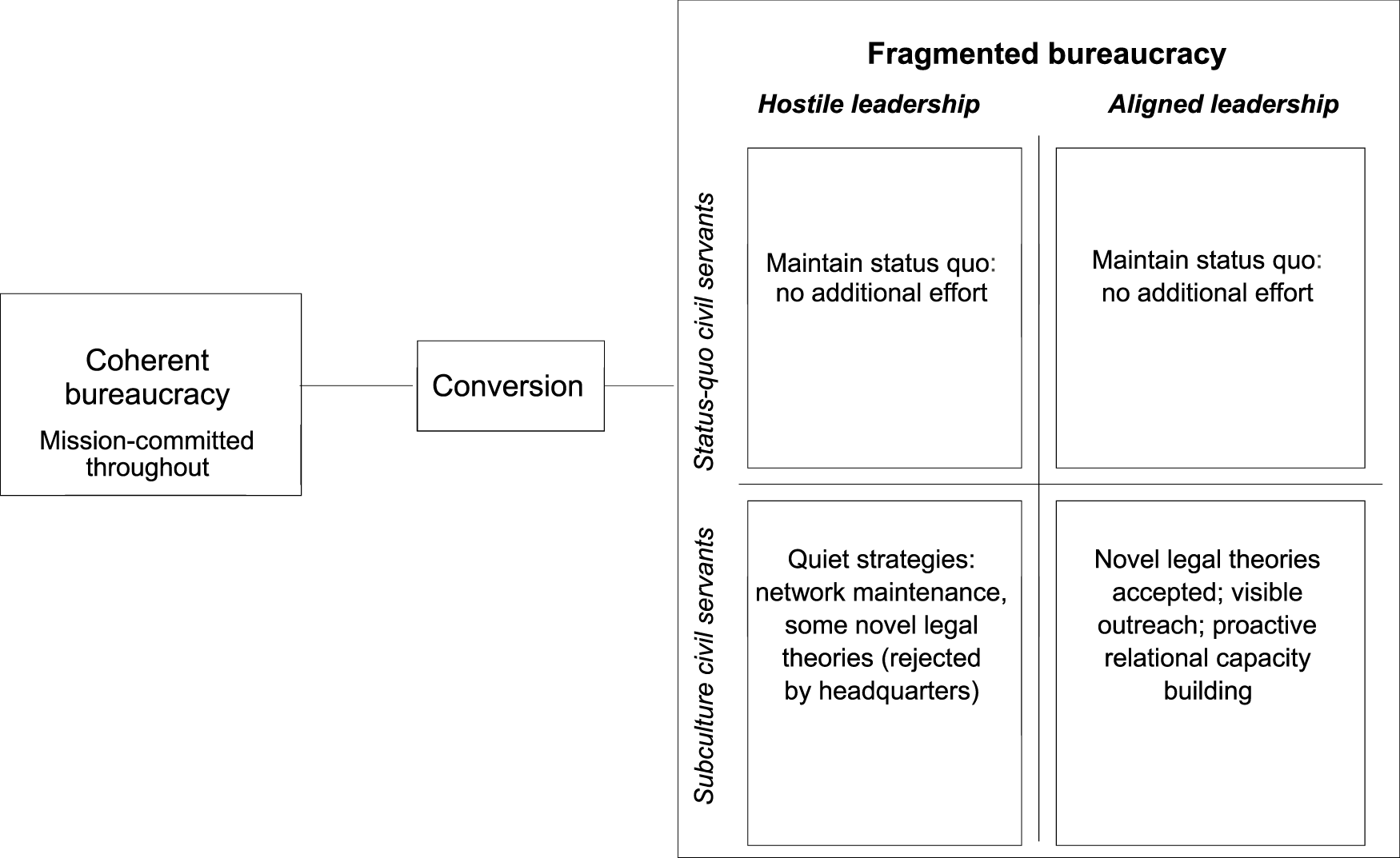

 Open access

