

What is life like for rural youth in southeastern Mexico? We articulate a response as a function of understanding the cultural practices of rural youth in Tabasco, a state undergoing broad territorial transformations due to the impact of development projects. The text is structured around three axes of reflection: rurality as a complex category with distinct facets that combine with elements that are part of the life of the communities studied; an analysis of the material conditions and changes that occur in places where large development projects are undertaken; and a discussion of the experiences of youths in the municipality of Tenosique, Tabasco, site of the Boca del Cerro station of the Tren Maya (Maya Train).
We explore how young people of both sexes construct and signify the territory where they live and how they appropriate the sites they frequent and endow them with meaning according to the activities they perform there and the imaginaries they create out of their construction of those territories. We also address the creation of young people through their experiences, both individual and collective, how they display their rural and urban activities, and how traditional and modern practices coexist and order the various spheres of young people’s daily lives. Thus, we provide an account of the transformations that youths undergo in their immediate contexts and that oblige us to follow them “on the ground,” rethinking the categories we work with in the social sciences.
A review of recent literature on rural youths reveals the scarcity of data broken down by age groups and the need to increase knowledge in order to explain the heterogeneity of this rural population (Barés et al. Reference Barés, Hirsch and Roa2020; González Cangas Reference González Cangas2003; Kessler Reference Kessler2006; Sánchez Sánchez Reference Sánchez Sánchez2020; Senties Portilla Reference Senties Portilla2017; Soloaga Reference Soloaga2018; Urteaga Castro-Pozo Reference Urteaga Castro-Pozo2011). Our review also revealed that rural youth rarely appear as subjects of public policies, as they are designed in urban, adult-centered settings with no active participation by—and only rarely consultations with—young people (Ojeda Reference Ojeda2016). Against this backdrop, we confirmed that youths have few spaces to participate in decision-making on development projects that are implemented in their territories, although these have repercussions for their future and their life projects. This means youths are incorporated, and public policies are forged, vertically and are seen, simply, as belonging to a territory, or as inhabitants of a polygon of poverty, but not as an age group that is characterized and determined specifically (Guiskin Reference Guiskin2019; Sánchez Sánchez Reference Sánchez Sánchez2021; Soloaga Reference Soloaga2018). Likewise, the notion of rural youth is associated with a condition of subordination and tutelage by family, state, church, and other institutions of rural life. Although young people are often regarded as the “ferment of social change,” they are also viewed as “receptacles of knowledge and adults in the making” (Bevilaqua Marin Reference Bevilaqua Marin2009).
There are divergences in scholarly work on how best to conceive of rural people and their sociodemographic data in studies. Authors like Soloaga (Reference Soloaga2018) define the rural condition by the number of inhabitants of towns but question the parameter applied by Mexico’s National Institute of Statistics and Geography (Instituto Nacional de Estadística y Geografía, or INEGI), which classifies as “rural” any locality with fewer than 2,500 inhabitants. Soloaga holds that this number does not reflect social reality and lacks explanatory value. He prefers the figure proposed by the Organisation for Economic Co-operation and Development (OCDE), which defines rural populations as those with fewer than fifteen thousand inhabitants (Soloaga Reference Soloaga2018). Guiskin (Reference Guiskin2019), meanwhile, adopts the definition of the International Fund for Economic Development (IFED), which simply states that “rural” refers to all things not “urban.” However, defining the rural by quantitative elements, like number of inhabitants, or qualitative ones, like opposition to the urban, does not lead to a consensus on rurality. This absence of consensus has impeded the production of a definition of rural youth. At the same time, it is clear that we cannot apply a uniform concept of rural young people because of the heterogeneity that characterizes this sector of the population. Aware of this diversity, in this article, we use the term rural youth (Ojeda Reference Ojeda2016; Soloaga Reference Soloaga2018; Guiskin Reference Guiskin2019; Barés et al. Reference Barés, Hirsch and Roa2020; Sánchez Sánchez Reference Sánchez Sánchez2020). Despite the heterogeneity of rural youth, research trends tend to converge around four major analytical axes: “identities and representations; concerns about the aging of rural populations; territory and livelihood strategies; and, finally, experiences of violence” (Giraldo-Calderón y Becerra-Romero Reference Giraldo-Calderón and Tonantzin Becerra-Romero2023, 144).
Despite the broad diversity among them, rural youth in Latin America share similar contexts, for they are characterized as living in greater poverty than urban youth or rural adults, a situation aggravated, in many cases, by gender or membership in an ethnic group, two features that define an especially vulnerable group (CONEVAL 2018; Guiskin Reference Guiskin2019). Upon exploring the conditions of vulnerability of rural youth (where rural means living in localities with less than fifteen thousand inhabitants), we found that fewer than 20 percent have access to a public health service like the Mexican Social Security Institute (Instituto Mexicano del Seguro Social, or IMSS) or the Security and Social Services Institute for State Employees (Instituto de Seguridad y Servicios Sociales de los Trabajadores del Estado, or ISSSTE). In contrast, almost 40 percent of urban youths have access to these services. Regarding education, male rural youth aged fourteen to twenty-two study almost two years less than their urban counterparts, and 28 percent report that they do not attend school or have jobs, compared to 20 percent of urban males in this age group. The figures for rural versus urban female youths are even more dramatic: 45 percent and 29 percent, respectively (Soloaga Reference Soloaga2018).
As these indicators show, it is much more likely that rural youth live in conditions of poverty and extreme poverty, and that they suffer more severe inequality, than rural adults and urban youths; this situation can be exacerbated by other conditions, such as being female, Indigenous, or of African descent. In Mexico, these factors are also associated with high unemployment rates, work in informal economies, and lack of access to educational and health services (CONEVAL 2018; Guiskin Reference Guiskin2019; Soloaga Reference Soloaga2018). Thus, we reflect on rural youth and rurality as categories of analysis that can be constructed qualitatively and quantitatively.
Analyses of rurality tend to construct concepts based on a few canonical elements. The ones most often utilized in recent decades are place of residence and the site of sociocultural practices, opposition to the urban, links to ethnicity, and as equivalent to precariousness in several domains. Here, however, we rethink the complexity and dynamism of the notion of rurality and address it by analyzing three elements: location and content; opposition to the urban; and equivalence to precariousness, with an additional analysis of time, to argue for its importance in constructing ruralities.
Theorizing rurality
The rural is more than place and content
Space, time, and subject are the basic elements of anthropological analysis, so the location of subjects is a sine qua non for understanding topics in this field. The characteristics of a space give specificity to the subjects who inhabit it. In the case of rurality, it seems that once a place is identified as a rural settlement or zone, no other nuance is required. But space as a place of practice—as De Certeau (Reference De Certeau2000) understood it—not only situates and contains subjects but also imbues them with identities, practices, relations, imaginaries, projects, and ways of signifying life.
These qualitative and quantitative aspects suggest an anchoring that is dynamic, changing, and provisional, so we designed our study to register specific features of this particular geographic environment to elucidate the contexts in which the young people (women and men) we interviewed live, without definitively “tying down” subjects, spaces, times, and practices, because all these aspects are undergoing transformations. Spaces change in tune with distinct economic, social, political, and cultural dynamics. Therefore, we emphasize how spaces are transformed through the influence of various economic projects that operate on different scales following the considerations proposed by Quiroz: Rural environments are determined by the transitions in which they are immersed, due to policies of commercial aperture, reduced supports for agricultural production, sales of lands that will be occupied by industry and housing developments, the abandonment of primary activities in favor of wage work, tertiarization, professionalization [and] multitasking that trigger modifications of the social and cultural; for example, by fostering tighter linkages and greater conflict between the rhythms of rurality and the urban (2023, 4).
Thus, as the rural, understood as location and place, is superimposed on other key elements of analysis, the geographic angle can be “overcome” by cultural practices and dynamics once seen as polar opposites.
The rural and the urban: Beyond opposition
Another way of understanding the rural is as the diametrical opposite of the urban. Over half a century ago, studies by Redfield and Singer (Reference Redfield, Singer and Bassols1988) and Lewis (Reference Lewis1961) posited “the communal” as a characteristic of rural societies, contrasting it to the maelstrom of cities. As a way of relating, the communal marked the difference between the creation of close, long-lasting links in rural areas and the anonymous, ephemeral, utilitarian relations of cities. Biography counts in rural zones, where familiarity with and knowledge of others minimize suspicions, whereas in urban settings, “being” with others implies indifference, anonymity, and mistrust. For those authors, the rural and the urban were frameworks with opposed meanings, where the material conditions of existence influenced how people related, developed their economic activities, constructed identities, performed cultural practices, chose certain consumption patterns, and appropriated the spaces they inhabited and traversed.
In this text, we consider that the urban and the rural can coexist, given two elements that generate cultural dynamics across the planet: migrations—of people and ideas—and cultural industries. Other elements exist, but in our approach, we stress these two. It is the movement of people and ideas over the course of the history of humankind that has generated new cultural forms, mixtures, and hybrids. In local terms, and in the case of young people, this is how certain practices have spread to new places.
Cultural industries, a term coined by Horkheimer and Adorno (Reference Horkheimer and Adorno1998), exert a significant influence everywhere we look. They may take the form of a movie, a series, a song, or a TikTok video; then they “go viral” and influence or establish fashions in places far from their origin. The impact of cultural industries includes not only commercialized cultural products but also ways of signifying everyday life. This is how the urban, understood as cultural practice, overflows the cities to penetrate into rural zones; this process also runs the other way, when a rural practice makes it way to the city, where it is adapted. This tells us that we can no longer speak of a sharp opposition between rural and urban and instead must consider combinations, complementarities, transitory oppositions, and other ways of relating these two spheres of meaning. Various categories have been used in efforts to explain this new relation between the rural and the urban. Here, we mention only two: “new rurality” and “rururban,” the ones most often debated in academia: “Specifically, the appellative ‘rururban’ has been given to the configuration that derives from the expansion of the city; to the demographic mobility from urbs, from a spatial interland between the urban and the rural; a transitional stage toward an inevitable urbanization; or from the economic hybrid generated” (Quiroz Reference Quiroz Ramírez2023, 8). The rural and the urban, then, are interwoven in everyday life, and we see the coexistence of traditional and modern consumption habits, leisure activities, and cultural practices that young people combine and try out from among the universe of resources and tools available to them.
Rurality as a synonym of precariousness
When speaking of rurality, we also refer to a quantitative dimension that entails reporting the resources of a town and its material conditions of existence (Hidalgo López-Chávez Reference Hidalgo López-Chávez2020; Landini Reference Landini2015). In this approach, the absence of elements that exist in urban zones leads to the rural being measured from an optic of precariousness, from what it lacks, from its shortcomings. This comparison implies backwardness compared to modernity and assesses the degree of civilization of the rural in terms of emblematic elements of development like freeways, concrete, asphalt, factories, and traffic, to mention only a few. It is difficult, indeed, to blur the imprint of need on rural places,Footnote 1 for it continues to appear as the starting point for analyses of these contexts. Poverty and the dearth of educational and employment opportunities permeate this social imaginary. While the reality of unequal conditions between urban and rural is undeniable, we consider that beyond this, people internalize a condition of subordination; perhaps better said, the urban is idealized for its progress and modernity, leading to a hyperbole of expectations regarding the implementation of development projects in rural areas. Therefore, we associate rurality with various connotations and combinations as we analyze the different ruralities that exist and seek to explain the hybrid forms that are being generated today through encounters among distinct forms: “Rurality is diversified according to the contexts in which it is anchored, it is possible to speak of ruralities: [some] in areas on the periphery of cities, others based on agriculture, peasant [communities], rurality inserted into cities, and the urbanization of ruralities. In all these, the activities that actors develop play an important role, above all, the denotation of differentiated rhythms that accelerate, decelerate, or heterochronize” (Quiroz Reference Quiroz Ramírez2023, 11–12). Ruralities oblige us to reflect on various constituent elements and distinct temporalities, rhythms, and velocities. For this reason, we explain multiple ways of inhabiting time based on the everyday life of the subjects of our study.
Time as an element of the construction of rurality
Following Quiroz (Reference Quiroz Ramírez2023), we emphasize time as a vital element for understanding the notion of rurality. We see time as a factor that unfolds in various dimensions, not only in temporalities—present, past, future—but also as distance, as space that is traversed and reconfigured, as a voyage that transpired as we reached the study site, and as evidence of the inequalities in living conditions. Time is rhythm, velocity, atmosphere, and meaning. It has symbolic implications not only for people but also for their practices, life histories, territories, and the forging of identities: “We suggest that rururban time emphasizes the diversity, friction and symmetry of the rhythms and temporalities that develop in the territory. Rururban time takes on the characteristic of diversity[;] it moves between continuity and change, with rhythms both local and from ‘without’” (Quiroz Reference Quiroz Ramírez2023, 16). As an oscillation between practices not performed previously but that are now common, temporality is more than a numerical, linear succession (Vergara in Quiroz Reference Quiroz Ramírez2023, 7–8). In Quiroz’s view (Reference Quiroz Ramírez2023), time emerges as a key element for understanding these multiple ruralities, and one that can interact with other variables, in addition to the three factors mentioned earlier. All this to provide an account of the life of young people in Tabasco, an “Eden.”
The material conditions of existence of young people: The setting
We explain the changes among the youths we studied on the basis of the material conditions of the place where they live, approaching this fundamental element from three perspectives: the importance of infrastructure, the various moments of the development projects undertaken in Tabasco, and the specific conditions of the study region. First, the term infrastructure refers to the physical and organizational structures and installations necessary for the functioning of a society, such as transport systems, communication networks, water and energy supply systems, and public institutions. It can include elements both physical and nonphysical; in addition to roads, bridges, and buildings, it encompasses information systems, legal codes, and social institutions. Infrastructure has a material aspect but is not limited to the local physical world, for it results from a migration of ideas and encompasses the underlying framework that supports and facilitates the functioning of a community, region, or entire society. It has several dimensions and comprises social, economic, and technological aspects (Holtz-Eakin and Schwartz Reference Holtz-Eakin and Ellen Schwartz1995). In the twentieth century, a well-developed, efficient infrastructure emerged as essential for fomenting economic growth and improving people’s levels and quality of life (Gordillo Reference Gordillo and Hetherington2019). Governments and others responsible for formulating policies prioritized developing infrastructure as a key element of their broader strategies for promoting development (Holtz-Eakin and Schwartz Reference Holtz-Eakin and Ellen Schwartz1995). The state of Tabasco provides a good example of this process.
Construction of the Ferrocarril del Sureste (Southeastern Railway) in Tenosique, the base of what today is called the Tren Maya (Maya Train), must be explained in a time frame that takes us back to the period 1940–1980, when the state was transformed from a “tropical siesta” to a site of violent modernization (Uribe Iniesta Reference Uribe Iniesta2003). Tudela (Reference Tudela1989) writes that, thanks to a nation-state that incorporated resources in the southeast into the development of Mexico based on the never-realized premise that doing so would modernize the region, Tabasco experienced “forced modernization.” For Uribe Iniesta (Reference Uribe Iniesta2016), this process evolved through three key moments: developmentalism, globalization, and dependence on hydrocarbons. The process of developmentalist modernization began around 1940 with a series of public works designed to control waterways by drying wetlands and creating irrigation systems (Plan Chontalpa) to control flooding by building dams upstream. This was accompanied by a deforestation program, the introduction of new breeds of cattle to support ranching (the Plan Balancán-Tenosique), and infrastructure works designed to improve communications between the state and the rest of the region. Those initiatives included the Southeastern Railway and the Gulf Circuit (Uribe Iniesta Reference Uribe Iniesta2016). However, the creation of infrastructure to connect Tabasco to the wider, globalized context did not occur until after the inauguration of the Southeastern Railway that connected Coatzacoalcos to Mexico City and Campeche and on to Mérida. It took several attempts, but Tabasco eventually completed a railroad link between Tenosique and Teapa (Díaz Perera Reference Díaz Perera2016).
The state’s dependence on hydrocarbons began with the petroleum boom of the 1970s, first on land through expropriations and the drilling of deep wells, and later through state intervention that created productive industrial and agricultural enclaves financed by revenue from the petroleum industry, including the aforementioned Plan Balancán-Tenosique.
Methodology
Our methodological strategy is qualitative and emphasizes the coproduction of knowledge. The tools adopted from the ethnographic method consisted of nine individual, in-depth interviews and two group sessions, each with three subjects, via participant observation and detailed field diaries. We did two periods of fieldwork (September 2022 and October 2023) and visited frequently. In terms of coproduction of knowledge, we sought to gather knowledge from young people in and from the study area. We held a workshop with twelve youths who constructed a collective cartography (see Appendix 1) and elaborated twelve individual maps with the help of the Kobo Collect App on mobile phones.
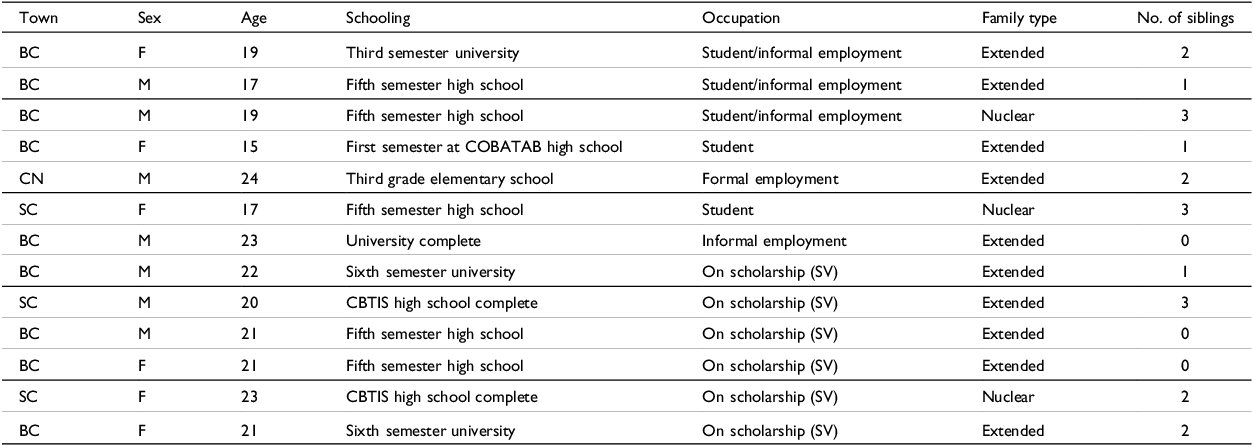
We selected young people to interview in order to capture the heterogeneity of youth inhabiting the territories under study. Thus, the sample included men and women, individuals with formal education, those employed in the formal and informal sectors, unemployed youth, recipients of social programs, Indigenous youth, as well as those who were single or in a union (Table 1).
Profile of interviewees

Notes: BC = Boca del Cerro; CN = Cerro Norte; SC = San Carlos; COBATAB = Colegio de Bachilleres de Tabasco; CBTIS = Centro de Bachillerato Tecnológico Industrial y de Servicios; and SV = Sembrando Vida.
Based on fieldwork conducted in Boca del Cerro, Cerro Norte, and San Carlos, we documented transformations across various spheres of young people’s lives. We used ATLAS.ti software to code data into the following categories: work, family, drug and alcohol use, access to scholarships and government assistance, migration, participation, education, partnering, and backyard activities (e.g., tending vegetable gardens and raising farm animals, such as chickens, turkeys, and pigs). These categories were then grouped into four broader domains: educational, labor, domestic, and leisure.
Context
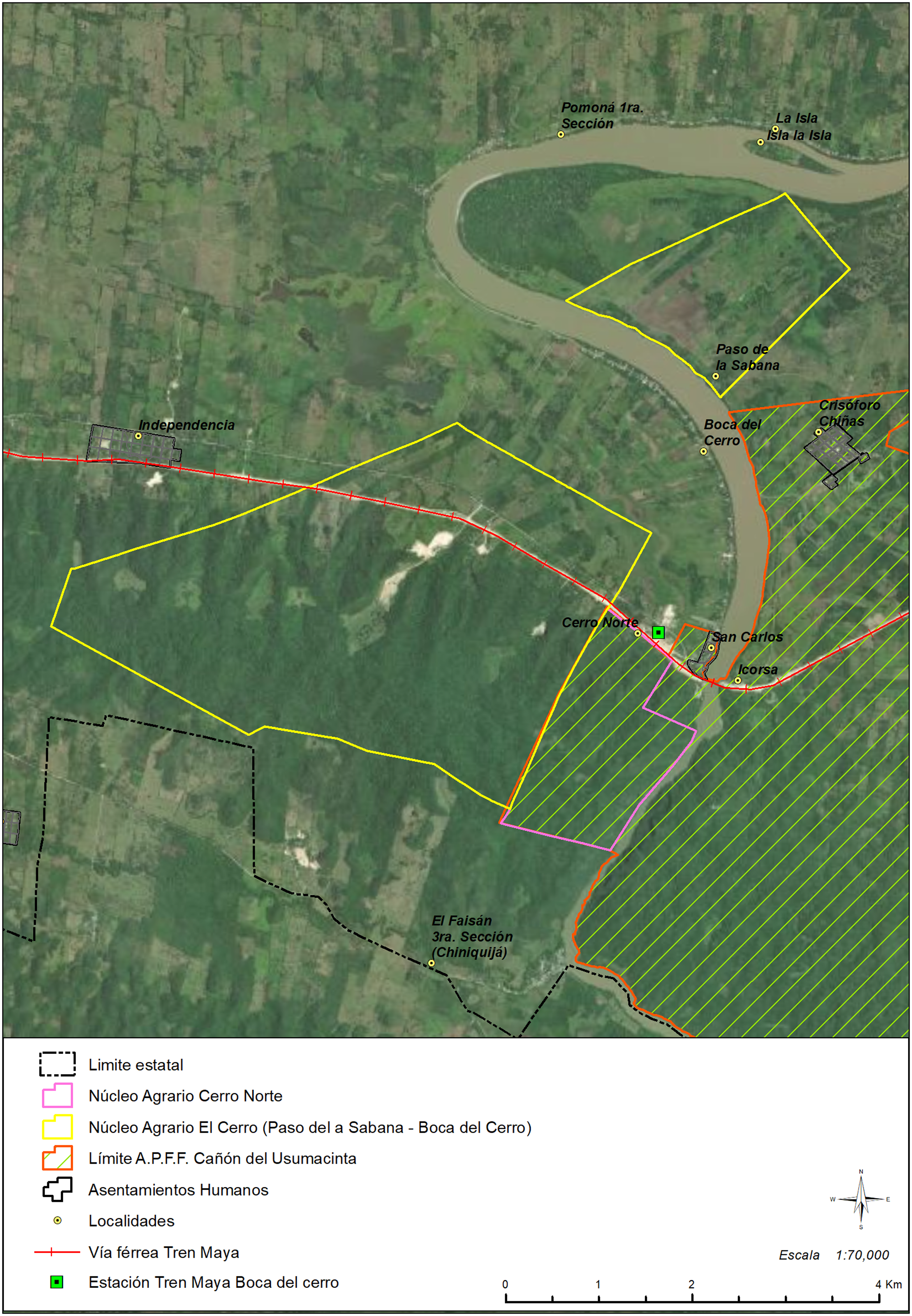
Tenosique shares a border with Guatemala and thus serves as a transit point for migrants. In the communities studied, the predominant productive activities are fishing, agriculture, livestock raising, commerce, and services. Residents of San Carlos and Boca del Cerro exhibit a close relationship with and extensive knowledge of their territory; residents recognize the significance of the river and what it represents to them. Cerro Norte is primarily inhabited by migrants from Chiapas, whereas Boca del Cerro is home to native residents and ejido (communal) landholders. San Carlos was established by splitting off from Boca del Cerro, where ejidatarios now form a minority. These towns are linked to tourism-related activities, such as boat tours and, more recently, adventure tourism: The Boca del Cerro bridge has become a local attraction (Figure 1).
Map of Cerro Norte, San Carlos, and Boca del Cerro, Tenosique, Tabasco. By Rafael García González for the project “El impacto de megaproyectos en sistemas socioecológicos desde una perspectiva transdisciplinaria: El programa de desarrollo integral en los territorios del Tren Maya.”

The predominant productive activities in these towns are agriculture, commerce, and services. Sembrando Vida (Sowing Life) is important as the source of a significant portion of family income in all three towns.Footnote 2 It offers young people scholarships and employment opportunities, thus increasing the likelihood that they will remain in the region to work in agriculture. Construction of the Tren Maya displaced residents of Cerro Norte, caused extensive deforestation in nearby woodlands, and resulted in the now-emblematic bridge of Boca del Cerro. It also brought intense traffic of heavy machinery and hundreds of workers, along with their demands for services like food and lodging, to mention only the most obvious changes.
The Tren Maya is a tourism and territorial reorganization project that spans the south of the country, covering 1,554 kilometers and crossing the states of Chiapas, Tabasco, Campeche, Yucatán, and Quintana Roo. It is an extractivist project, enabling the movement of natural resources from their place of origin to other regions, but the Maya Train also responds to the need for improved connectivity in southeastern Mexico, beyond existing road infrastructure. It aims to reduce regional inequalities as compared to the north of the country by promoting economic and social development, thus aligning itself with the discourse of sustainable development.
According to the INEGI’s 2020 Census of Population and Dwellings, the population aged seventeen to twenty-four in the three towns did not surpass 150 (Table 2). These young people live in rural zones with a population of less than five hundred inhabitants (Table 3). The three towns have basic services—sewers, garbage collection, potable water, transportation, streetlights—but some are of deficient quality. There are schools, from preschool to high school (including the Telebachillerato Comunitario #38, internet service by cell phone—data on their phones to access the internet—a public library with internet service through the México Conectado program, ejidal offices, and multiuse sports and recreation areas.
Profile of young people aged 15–17

Source: Based on the Censo de Población y Vivienda, INEGI 2020.

Findings
Efforts to connect Tabasco with the rest of Mexico’s southeast that were initiated in 1950 with the Southeastern Railway have continued with the construction of the Maya Train, which began in June 2020 as one of the flagship projects of the Fourth Transformation, Andrés Manuel López Obrador’s platform. The Maya Train has since brought territorial, environmental, and social changes; here, we document those that have affected the lives of young people. What follows is an analysis that highlights the various ways rural youth in Tabasco experience and navigate that transformation.
The educational domain
Our interviewees share the idea of a “better future” based on education, especially higher education. Here, we emphasize the aspect of education. The narratives we gathered show that these youth believe that completing university ensures financial success and achieving the ideal of “a better life,” a perspective voiced even by those who did not finish their studies, who attribute their lack of success to this circumstance: “My goal was just to finish high school because, well, I didn’t like it, but looking back, to get a better job I decided to study a program” (interview with Jonathan, September 22, 2022). The construction of these narratives reflects intergenerational relations, since adults (thirteen)—parents (six: three women and three men), teachers (three: two women and one man), and authorities (four: three women and one man) interviewed—all echoed this discourse and said that they try to inculcate it in young people. The horizon of future possibilities emerges, above all, during these young people’s high school years, a decisive moment when they must choose to continue their studies, enter the workforce, migrate in search of better opportunities elsewhere, or leave home to study.
Before the arrival of the Tren Maya, nursing was a field of study that attracted youths in Tenosique, but gastronomy and customs administration has since gained ground. In the imagination of young people, these field allows them to display their culture, resources, and products from their territory. When they talk about gastronomy, of local cuisine, they are also referring to it as a vehicle for showing “their little town” to the world. Also, customs administration students related about new international markets open by the train. On the other hand, the train construction brought many national guard and navy officials, increasing enrollment in the military as a local result. We perceive that this reflects a national tendency with significant local repercussions.
Enrollment in high school is high, as the 2020 census found that of twenty-one young people between the ages of fifteen and seventeen in Boca del Cerro, eighteen attended school. The figures for San Carlos and Cerro Norte were twenty-four of twenty-seven and two of three, respectively. One incentive for staying in school is that in 2023, students received the Benito Juárez Universal Scholarship for Upper Secondary Education Students (BUEMS). However, the number of young people enrolled in university contrasts sharply with the high enrollment rate at the high school level. According to the 2020 INEGI census, only sixteen out of seventy-two young people between the ages of eighteen and twenty-four (18–24) in the three localities were enrolled in higher education. The 2020 INEGI census found that only sixteen of seventy-two young people aged eighteen to twenty-four in the three towns were registered at university.
Regarding employment, the ideal of continuing one’s studies to gain “a better life” was not always realized. We identified young people who opted to end their schooling and take jobs in the informal economy, citing reasons like lack of opportunities for formal employment in the locality and long delays in obtaining their official papers (e.g., diplomas, credentials). Despite this panorama, our interviewees continued to perceive ample possibilities to join the workforce as one of the benefits of the Tren Maya, arguing that it would open spaces for those who have finished university. Other expectations are openings in commerce, jobs to respond to the future needs of the train, and providing services that the train and its passengers will require:
We could open our own small business because tourists and everything are going to come … or a beauty salon, applying artificial nails, doing hair, makeup. (Interview with Saira, September 26, 2022)
Yeah, well, I have the option of going to Mérida because I have three aunts there. I was going to go, but then the Tren Maya came along. It’s another option for when I finish. I think they’re going to need computation, so that would be an option. (Interview with Daniela, September 22, 2022)
In 2023, the direct and indirect employment options that the Tren Maya introduced were concentrated in the areas of construction (unskilled laborers) security, and services like waiters, salespeople, hotel workers, and cooks. There were also opportunities to sell goods in the informal economy, among others.
In Cerro Norte, Boca del Cerro, and San Carlos, young people felt that local activities like agricultural work and local services provision were their only employment options. As the parents’ generation entered the construction and service sectors in nearby localities, this suggests a reencounter with agricultural labor, which are attractive because they entail only four to six hours of work per day but provide economic remuneration similar to that of an eight-hour day in other jobs. It seems that agricultural work is not only deemed profitable but has additional advantages, such as allowing people to remain in their communities near their families and providing them with a measure of freedom. Since they can manage their time to a certain degree, they can decide how many hours they want to work and how much they want to earn. Regarding agricultural work, it is important to note that these youths have found ways to reduce the physical labor once required, as power tools like brush cutters and chainsaws are now widely used. This is called “macheteless cultivation.” Finally, some youths also have their own motorcycles for transportation:
I’m a professional person, so to speak, though I don’t have a job per se, but obviously I studied, right? And work doesn’t scare me, I mean I go to the forest … right now I have a weed-cutter for grass. I don’t mind heavy work. I have a cousin who’s studying to be a chef. He’s almost done, and he’s not scared of work either. [People] call us and say: “Hey, come and give us a hand.” I’m not going to say “No, I won’t” just because I studied. I’m going to make some money. (Interview with Carlos, September 22, 2022)
Another alternative for many unemployed young women and men in the study area has been the Sembrando Vida program, which gives scholarships to those who finish high school or university but have not been able to land jobs.
The Tren Maya project has stoked young people’s expectations, especially in relation to tourism. For example, Carlos, foresee that prosperity is coming to their lands, with improved infrastructure and services, diversified activities, and employment opportunities for those with specialized profiles:
Oh yeah. Wow! It’s going to explode now with the Tren Maya … a project that’s going to bring resources to the community [like] for boats. Here in Boca and over in San Carlos I think they’ve already received resources. We’re a little behind because we didn’t fill out a form right, but there’s going to be resources for a boat and a kayak [and] for zip lines. We want to grab a piece of that budget to set up a restaurant here where the beach comes out. (Interview with Carlos, September 22, 2022)
Other young narratives show that they found a reason to go to university but understand that the Tren Maya will have consequences for other areas of their lives, such as public security, noise, migration, deforestation, water pollution, a collapse of services, and, possibly, broad environmental damage and health risks. As illustrated by Julián’s testimony, he expresses both optimism and concern regarding the environmental impacts associated with the Tren Maya:
It can change things in two areas, both positive and negative. On the positive side, jobs would increase; currently, young people who have already finished their studies but cannot find work are being called and are turning to the Tren Maya. That is a good factor. In the environmental system, however, there is a negative problem: the deforestation of certain ecological areas. As far as I have known, supposedly some species that were endangered were going to be relocated, but I do not know whether they were relocated or have already disappeared. Also, water contamination is going to increase with the drainage from the hotels and the station [Tren Maya]. As for the non-recyclable waste, where is it going to end up? (Interview with Julián, September 25, 2022)
In the domestic sphere, these young people perform reproductive activities like cleaning, preparing food, and caring for children. Significantly, we found that both sexes participate, although young women carry out more of these tasks. They also participate in these tasks outside the home to generate income, for example, by taking care of children, crops, livestock, or family gardens. While they may or may not do this at home, they will do it elsewhere, as this kind of paid labor increases family income and helps cover expenses. Julián, for example, helps his father on their ranch. He does not receive income for his daily activities tending cattle, but when other ranchers hire him, he is paid. He uses some of his earnings to meet family expenses. Daniela helps with housework and babysits for neighbors to earn money that she contributes to her family’s income. Liliana and Saira, in contrast, only do housework at home, without receiving any pay:
There’s more work during vacations because people sometimes ask me to work somewhere, cleaning paddocks, or go and work someplace else, so that’s another kind of work. (Interview with Julián, September 25, 2022)
Sometimes I work for a neighbor, taking care of her little girls. (Interview with Daniela, September 22, 2022)
Flexible school hours at the telebachillerato and vacation time allow these youths to earn money by participating in remunerative activities that, through agreements with other families in the community, play an important role in family economies. The best evidence of this is that all our interviewees reported that they use some of the money they earn to help with family expenses.
Some of the changes that have come with the arrival of construction workers for the Tren Maya affect the attention paid to young people, especially women:
That’s the danger that can arise here because people come from other places and disturb the peace. This is a really peaceful place. (Interview with Daniela, September 22, 2022)
Yeah, sometimes, because trucks drive through taking gravel to other communities up the road or have no choice but to pass through Boca del Cerro. If you walk by, you know … the typical stuff … they honk their horns at you or shout something, so sometimes it’s uncomfortable to be out walking alone. (Interview with Liliana, September 26, 2022)
To these perceptions, we can add parents’ concerns about the influx of people from other places who, in their words, may be “foreign” or “bad.” “It’s scary that bad people come on the trains that stop here” (interview with a grandmother, September 22, 2022). This shows how the security provided by life in a town with low population density, where everyone knows everyone else, is threatened by the arrival of outsiders on the Tren Maya.
In general, people in the study area consider migration dangerous because it perturbs the tranquility of their towns. And they relay this perception to young people. In many cases, this has led parents to exert stricter control over their children. The adults we interviewed (grandparents, teachers, local authorities) stressed the importance of safeguarding young people, especially women, from the “strangers” who come on the Tren Maya because they never know if “bad people” are mixed in with those workers and migrants. Parents insist that the authorities and teachers have some role in caring for their daughters and sons, but they recognize that they have the primary responsibility. Some mentioned that they have limited the hours when young people can go out at night. Maintaining tranquility demands that adult men protect youths, especially young women.
Turning to the domain of leisure activities, we found that they take place in public and private. Activities in the former center on physical spaces in town, like the ball court, mirador (lookout), and beaches, while those in the latter revolve around technology. The cell phone may not constitute a physical space, but thanks to the internet access it provides, it has emerged as a place where the youths we studied watch series and videos, listen to music, read, and play.
The dynamics of leisure in public spaces have been upset with the arrival of construction workers for the Tren Maya and people’s perceptions of insecurity. They attribute this danger mainly to the fact that workers consume alcohol and are anonymous, for they keep their faces covered with ski masks during the day. In reaction to this, some families have restricted the times and places where young people can get together, especially young women. Youths in Cerro Norte, San Carlos, and Boca del Cerro frequent three main sites for their leisure activities: First is the roofed ball court in Boca del Cerro: Young people go there to chat, pass the time, meet before or after school, and arrange soccer games. Second is the mirador located on the banks of the Usumacinta River in San Carlos, close to Cerro Norte; this is the site of the Boca del Cerro bridge and has tables and concrete benches. This space is utilized by the whole community and visitors. Young people go there to rest, talk, see friends, or meet their girl- or boyfriends. In the early evening, some young men (fewer women) come together to listen to music and drink alcoholic beverages. Third is the beaches: In the dry season (April–May), beaches emerge along the Usumacinta River. Interviewees mentioned that they can visit those sites right in front of their homes. They are places to have fun. People from other towns also visit them. Residents speak of these beaches with great pride and suggest they are the most important tourist attraction in their towns. People told us that “before,” in an earlier, unspecified time, young people frequented public spaces in the community (like the ball court), but that get-togethers had become less common. We, however, witnessed such reunions quite often.
The young people we interviewed mentioned a change in their free time due to restrictions on their movement that were imposed during the COVID-19 pandemic. First among these was that accessing the internet became obligatory. This change not only affected access for school tasks (e.g., online classes) but also broadened and facilitated their leisure time activities. Youths in all three towns considered that online entertainment options had displaced some physical activities on the ball court, at the beaches, and around the lookout. They also used cell phones extensively for free-time activities, especially playing video games and watching videos. Saira, for example, watches Korean series, while Jesús and Carlos play race-car games, and Liliana reads:
When we were under quarantine, I found Korean series and started to watch them when I had time, [but] now I don’t have time. (Interview with Saira, September 26, 2022
The kind of games I like are strategy and board games. Sometimes I watch videos on how to resolve certain problems in life, how to confront situations when you’re young. (Interview with Julián, September 25, 2022)
These youths create their own itineraries that involve certain practices and consumption patterns. In this way, they elaborate what it means to be young in their social group. Spaces become elements that give meaning not only to their ludic activities but also to the importance of being together, whether physically or virtually. Acting in those places, or appropriating them, is one way of signifying them, but also of configuring maps and territories, some reserved for young men, others for young women, and some mixed. Likewise, activities like “dating,” drinking, or listening to music emerged as ways of being together that reveal the construction of a “youthful us.” - Understanding this, from the social construction of youth identity and the configuration of rural youth-. (Urteaga; Sanchez, Sanchez)
Young people in the three towns experience daily changes and continuities in different aspects of local life, --he changes occur in the context of the Tren Maya project, while the continuities relate to daily life and how these dynamics coexist and permeate the experiences of young people-. Their age, seventeen to twenty-four, places them in a stage when being young compels them to perform certain cultural practices and take up certain consumption habits. It is on this basis that they express, objectify, and construct the notion of being young: “Leisure and spaces for diversion convoke the subjects in a group, those who see diversion as a way to pass the time and as an opportunity to stage their identity and strengthen the dimension of belonging to a collective, working the difference through leisure activities and, especially, through the tangible dimension of the identity of the subjects in a kind of esthetic hyperbolization that configures the body-subject and inscribes it in different groups and collectivities” (Analco Reference Analco Martínez2019, 67). In this sense, the sphere of fun and entertainment (Hannerz Reference Hannerz1993) becomes very important in displaying one’s youthfulness. Leisure is manifested in sites for diversion, but also—perhaps due to the living conditions imposed by the pandemic—in digital activities that sometimes displace physical forms, as with virtual series and video games.
The youths in this study blame the COVID-19 pandemic for this shift toward digital life, but they invisibilize other conditions, such as stronger parental control exerted under the pretext of the influx of construction workers for the Tren Maya and other “foreigners.” As noted earlier, many workers wear ski masks to protect their faces from the sun and dust, but in the social imaginary, this generates a condition of anonymity that generates feelings of insecurity among local people. Another element that generates mistrust is the train’s role in the transit of migrants.
The four domains addressed—education, work, the domestic sphere, and leisure time—have all undergone changes and transformations with the implementation of the Tren Maya project. This mega-initiative has altered people’s use of time and their daily routines. Today, some economic activities related to agriculture and other primary tasks linked to rural life combine with secondary and tertiary occupations typical of expanding cities. Spaces created for fun and leisure are besieged by flows of outsiders and an intensified parental control over young people. The domestic sphere of these youths may contract or expand, depending on their itineraries and activities.
For these three towns, construction of the Tren Maya from 2020 to 2023 did not occur in a vacuum. In addition to this huge project and the anonymous workers, it has meant the introduction of new communications infrastructure (5G) in the context of the COVID-19 pandemic that led youths to discover some of the many faces of the digital world -K-pop music, video calls, access to documents for completing assignments, among other things-.
Final reflections
At the outset, we proposed three broad areas of reflection: constructing a notion of rurality, the influence of development projects on the everyday life of youth in Tenosique, and the construction of what it means to be young, based on territory, practices, and ways of signifying daily life. The complexity involved in constructing a category resides in the fact that no one notion can account for a whole series of heterogeneous contexts. In this text, we have presented arguments that help explain the notion of rurality on the basis of place and the content of practices, the relation to precariousness, and in opposition to the urban. We complemented these three axes by analyzing notions of time as an important element for understanding different ruralities. In this regard, we understand that the notion of rurality must be analyzed through the lens of intersectionality, due to the overlay and interaction of social factors that comprise its complexity.
We have demonstrated that rural and urban times coexist in a territory. One runs into the other, and both are materialized in practices that speak of distinct rural youths. This led us to open heuristic possibilities to reflect on urban-rural relations, thus distancing our approach from the one proposed by Redfield and Singer (Reference Redfield, Singer and Bassols1988) and Lewis (Reference Lewis1961), leaving no space for that simple opposition. Young people in Tenosique aspire simultaneously for a more urban or modern life while maintaining their connection to their territory and their interest in a life linked to the agricultural activities that are characteristic of their locality (Senties Reference Senties Portilla2017).
Regarding the notion of rurality, the young people in Tenosique meet the parameters of rurality established by the INEGI, localities with fewer than 2,500 inhabitants, but the construction of this rurality is more complex than simply population size, as Soloaga (Reference Soloaga2018) has argued. We registered the coexistence of young people’s rural and urban activities, for example, earning an undergraduate degree in customs administration and conducting job searches in the urban and agricultural domains, living in a rural town that just obtained internet access and watching Korean series, or studying gastronomy while participating in agricultural labor. These coexistences emerge in a specific period: the time between preparing to enter the workforce after finishing high school or university and looking into local employment options, mainly in agriculture, the services sector, or as caregivers.
We also observed the emergence of a shared vision regarding the potential opportunities that the Maya Train may generate, particularly in sectors such as gastronomy and the promotion of local culture. This perspective is especially prevalent among young people with higher levels of education, without children, and not currently employed in the construction of the Maya Train. However, not all young people share this outlook. An exceptional case who does not share this vision of future possibilities is Domingo, a young Indigenous man who works on the Maya Train construction and has no expectations of future employment there once the project is finished. Our descriptions reveal cultural practices that are redefining identity among the youths studied in Tenosique, who are experiencing the “rururban” times proposed by Quiroz (Reference Quiroz Ramírez2023). They aspire to a future that embodies modernization in the style of the twenty-first century, introduced not solely through the material construction of the Maya Train but also within the symbolic real. For example, the anticipated arrival of tourism, the nuances of Korean culture, a “macheteless agriculture,” motorcycle travel, and domestic work that may be remunerated constitute a whole series of aspirations that pertain more to large cities in Mexico.
In a scenario where young people participate only minimally in large-scale development projects, the youth in this study included themselves by constructing imaginaries of the future that awaits them once the train is up and running (it should be noted that field work was carried out in 2022, and currently in 2026, the Maya Train is operational). In projects like the Tren Maya, young people are invisible, incorporated only tangentially, not as active subjects in decision-making about their territory, and never consulted on development proposals. But we perceived individuals’ efforts to make themselves visible, to carve out spaces for themselves, and to be included in a project that never took them into account—actions that might reflect forms of resistance to invisibility.
The forms of resistance manifested in the study area are less reactive than those that have emerged in northern and central Mexico (Castañeda Olvera Reference Castañeda Olvera2023; Morales y Valdivia Reference Morales Flores and Dounce2023), where numerous young people’s movements have opposed megaprojects and defended land, but they do provide evidence of the inclusion strategies that young people display in reaction to the implementation of a project that has raised hopes, led them to construct new imaginaries of their future, and changed their lives.
Development projects involving infrastructure and changes to territory can marginalize vulnerable groups, including young people. However, such projects miss the opportunity to incorporate the innovative capacity of an age group whose lives are being transformed and who will have to confront the unintended effects of development (Gudynas Reference Gudynas2011; Escobar Reference Escobar1995). In the face of a state that renders young people invisible, evidence from Tenosique shows how these individuals find ways to be included and carve out space for themselves through individual practices. When youth are rendered invisible, their innovative power and transformative capacity are lost, as well as the energy that drives continuity, in local productive activities, and change, as new ways of life that span from rural to urban, from local to global, and from tradition to modernity. Both qualities could transform the core essence of development, reconfiguring it to fulfill the objective of improving the quality of life of people and communities and bringing sustainable social and economic well-being for the population.
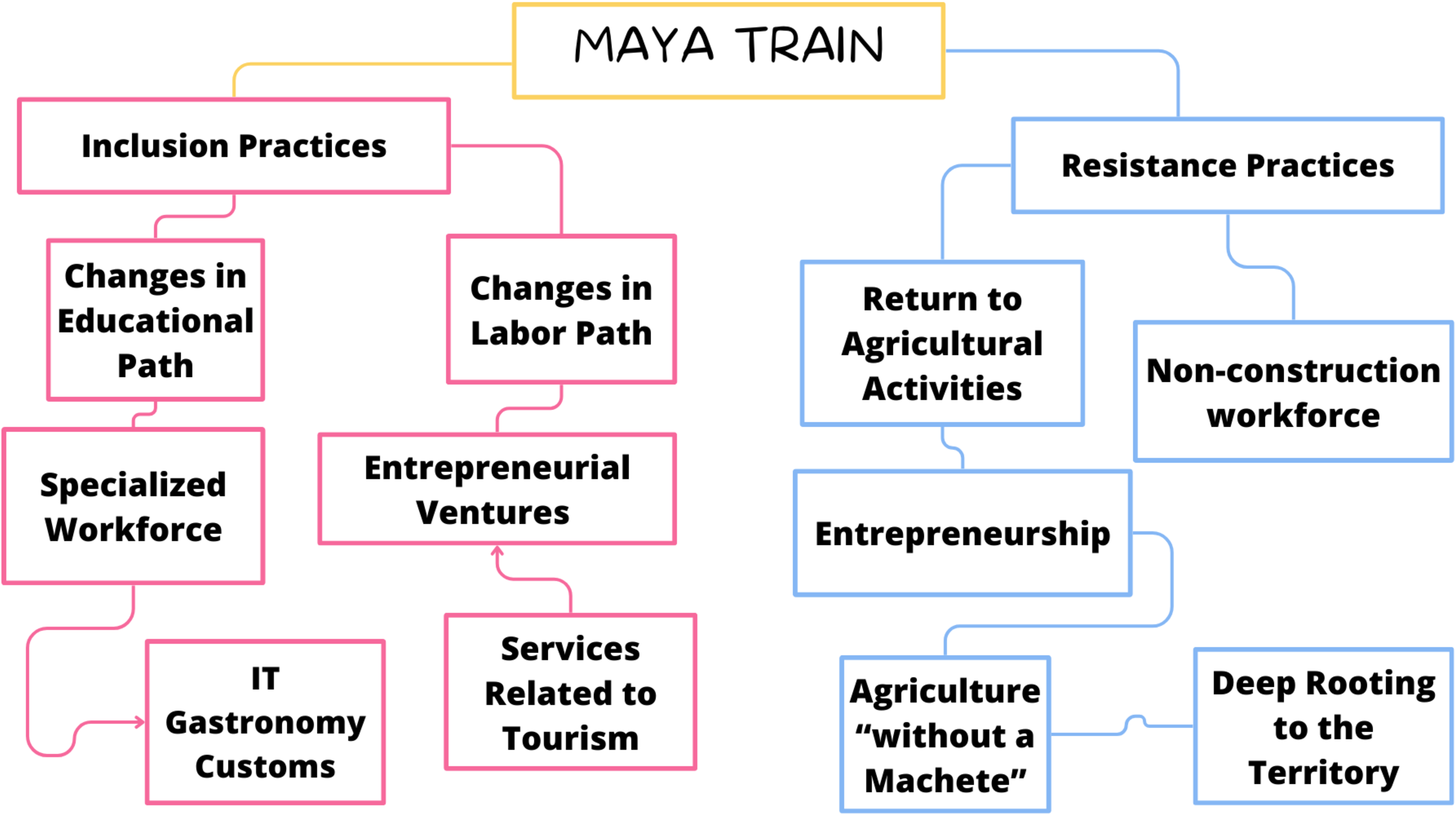
In Tenosique, The Tren Maya has had great impact, shifting youth practices (Figure 2); for them, it is more than just a railway. The station in Cerro Norte has intruded into diverse spheres of the everyday life of youths there, and in Boca del Cerro and San Carlos, due to greater parental control impelled by feelings of insecurity that people blame on outsiders, especially construction workers and in-transit migrants. Along with young people’s expectations of increased tourism visibility are ones related to additional and improved services and infrastructure. But the Tren Maya is altering the future work of local youth, to the extent that they modify their educational trajectories with an eye to attending to the needs of a train that had not yet arrived as of 2022, when the study was conducted; for example, the growing interest in gastronomy that is displacing the study of nursing. The expectations of these young people center on what the train will be, not on the one that is being constructed. The evidence suggests that only one of the fifteen (15) interviewees worked on the construction of the train, while none of the others even attempted to do so.
Youth practices in Tenosique associated with the Maya Train, from data gathered from field research.

At present, these young people show greater economic interest in the hours they devote to agricultural work subsidized by the state for landowners than in participating in the construction of the train. Their expectations for labor market insertion are instead oriented toward the moment when the train begins operations. They anticipate that their educational background will allow them to access formal employment with stable income and opportunities for learning or entrepreneurship.
We have seen how the sphere of leisure and entertainment acquired greater importance for young people as a symbolic space where they display their construction of youth. Activities like drinking alcohol, playing, dating, “hanging out,” and going to the beach, among others, are manifestations of their way of being young. Relations among subjects, practices, and spaces are emphasized as these young people go about constructing territories that they appropriate, ephemerally but constantly, as they create pathways of leisure, inclusion, resistance, differentiated forms of consumption, and collective ways of living and doing in community.
The modernity experienced by these youths does not pass through agricultural enclaves, infrastructure projects, or even the petroleum industry. Rather, it is shaped through the imaginaries they construct from both local and external references, and through a particular way of envisioning the future that draws simultaneously on the local and the global, the urban and the rural, and tradition and modernity. Together, these elements configure a specific way of being rural youth in Tenosique.
The evidence gathered in this study indicates that the social construction of what it means to be young is closely tied to territory, leading us to argue that different territories produce distinct ruralities. This does not imply pushing particularism to its limits; rather, we recognize that multiple axes shape diverse ruralities and reaffirm that there is no single form of rurality.
It is important to note that the analysis of rural youth incorporates several elements commonly associated with rurality. In this way, rural youth are often framed within contexts of inequality and perceived lack of opportunity, conditions of poverty and underdevelopment. At the same time, however, it is striking how rural youth are also positioned as bearers of social imaginaries that portray them as a promise for the future—agents of social and economic transformation, development, and progress in rural areas.
Historically, coordinated efforts by the state, international organizations, nongovernmental organizations (NGOs), and private enterprises have sought not only to ensure that rural youth remain in their places of origin but also to position them as carriers of the long-desired “progress” through education and technological training. These initiatives have often reinforced gendered expectations, channeling young men into farming and young women into domestic roles (Bevilaqua Marin Reference Bevilaqua Marin2009).
The key issue we raise here is how educational and labor opportunities have diversified, opening multiple and sometimes divergent trajectories for rural youth. These new pathways may both support the economic development of their communities of origin and generate new motivations for migration to urban or intermediate cities that offer different opportunities.
We are witnessing a period of significant change and territorial transformation, in which rural youth—such as those described in this study—tend to combine sources of identity construction, negotiate meaning-making frameworks, and resignify their territories and everyday practices, generating new life projects (Giraldo-Calderón and Becerra-Romero Reference Giraldo-Calderón and Tonantzin Becerra-Romero2023, 248).
For this reason, the construction of youth identities rooted in territory and in evolving meanings of everyday life has been reshaped by the arrival of the Maya Train. This reshaping has altered practices ranging from the individual to the collective, from the domestic to the communal, and from the public to the private. These transformations directly impact the control and care of youth, as well as their educational and occupational trajectories—ultimately reconfiguring what it has meant to be a rural youth in these three communities prior to the Maya Train. The challenge for researchers continues to consist in understanding young people in specific contexts, their frameworks of interpretation, and how they perform in their daily lives.
Acknowledgments
Thanks to project 36024, “El impacto de megaproyectos en sistemas socioecológicos desde una perspectiva transdisciplinaria: El programa de desarrollo integral en los territorios del Tren Maya” Proyectos Nacionales de Investigación e Incidencia (PRONAII) SSyS. We especially thank the young people who shared their vision of the world with us and Paul Kersey for his translation.



 Open access

