

1. Introduction
Annelida, of which the largest group are the marine polychaetes, is one of the most speciose and ecologically diverse phyla. However, the annelid fossil record is dominated by their jaw elements known as scolecodonts (Hints and Eriksson, Reference Hints and Eriksson2007) or secreted tubes (Ippolitov et al., Reference Ippolitov, Vinn and Kupriyanova2014). Localities which preserve soft-tissue body fossils are rare and are distributed heterogeneously through time. This includes sites such as the Cambrian Burgess Shale (Conway Morris, Reference Conway Morris1979; Nanglu and Caron, Reference Nanglu and Caron2018) and Chengjiang (Yang et al. Reference Yang, Aguado, Yang and Bleidorn2024), the Silurian Herefordshire (Sutton et al. Reference Sutton, Briggs, Siveter and Siveter2001), the Devonian Arkona Shale (Farrell and Briggs, Reference Farrell and Briggs2007) and Cretaceous sites such as Hakel and Hjoula (Parry et al. Reference Parry, Wilson, Sykes, Edgecombe and Vinther2015) and Conejo Formation (Luque et al. Reference Luque, Hourdez and Vinn2015). However, even among these localities, annelids are particularly rare, and many species are relegated to a handful of specimens. The Carboniferous Mazon Creek fossil site is particularly significant in this context, as the quality of preservation leads to soft-bodied invertebrates being abundant (Clements et al. Reference Clements, Purnell and Gabbott2019), with annelids in particular being highly diverse, with 20 species of extinct annelid described thus far (Thompson Reference Thompson1979; Thompson and Johnson, Reference Thompson and Johnson1979; Parry et al. Reference Parry, Tanner and Vinther2014). These factors have resulted in most major groups of crown annelids being traced back to the Carboniferous (Parry et al. Reference Parry, Tanner and Vinther2014).
However, the last new annelid from the locality was described over 20 years ago (Hay, Reference Hay2002), which has seemed to suggest that Mazon Creek’s contribution to how we understand the evolution of this phylum has finished. Here, we demonstrate that this is not the case through the description of a new Mazon Creek polychaete with remarkable soft-tissue preservation. This new species, Mazovermes magnaterminus, is easily differentiated from other Mazon Creek taxa by the characteristic lanceolate shape, with the posterior-most segments being the widest of the body. This condition is not found in any other polychaete, extinct or extant.
2. Methods and locality
2.a. Methods
Specimens were photographed with a Nikon D7500 DSLR camera fitted with a macro Nikkor 40 mm lens. Fossils were photographed using cross-polarising filters. All measurements were made in ImageJ, and all figures were produced in GIMP 2.10.30 and Inkscape 1.4.1.
2.b. Provenance
All new material included in this study was collected from Francis Creek Shale overburden material from a strip mine located at 41.34256°N and 88.32561°W. This corresponds to the Jugtown Road Locality (Baird, Reference Baird1997a).
3. Systematic palaeontology
Phylum Annelida (Lamarck 1802)
Genus and species: Mazovermes magnaterminus gen. et sp. Nov.
Etymology: Mazo from Mazon Creek, a common prefix for taxa from this site, and vermes, the Latin for worm. Magna is from the Latin for large, and terminus is from the Latin for end, describing the enlarged posterior margin of this new species.
Holotype: FMNH PE 93012. Other material: FMNH PE 46898, FMNH PE 93013, FMNH PE 93014. All specimens are permanently reposited in the Field Museum of Natural History.
Diagnosis: Vermiform and segmented, with enlarged posterior segments, forming a club-shaped terminus with postero-medially directed parapodia. Chaetae are short.
Description: Mazovermes magnaterminus ranges from 28 mm to 46 mm in total length. The head region is only complete in the holotype (Figure 1a-c), and although the prostomium and peristomium are not able to be clearly differentiated from each other, a single pair of short, anterior-facing palps can be discerned.
Mazovermes magnaterminus from the Carboniferous Mazon Creek Lagerstatte. a) Holotype, FMNH PE 93012. b) Close up of the boxed area in (a), focusing on the anterior anatomy. c) Line drawing of (b). d) FMNH PE 46898, 38 chaetigers and details of musculature (i) are preserved. e) FMNH PE 93014. f) Line drawing of (e) focusing on the overall silhouette; the anterior of the specimen is incomplete. Dark grey areas correspond to fans of chaetae. g) Close up of the posterior region boxed in (d) on the counterpart. h) Line drawing of (g): the most posterior set of parapodia and chaetae are highlighted. i) Close-up of the parapodia boxed in (d). Fine striations extending between the base of the parapodia and the midline are consistent with circular muscle elements. j) line drawing of the (i) figure labels: ch – chaetae; cm – circular muscles; gu – gut; pa – parapodia; ph – pharynx; pl – palps; pr – prostomium.

Figure 1 Long description
The image contains multiple photos and diagrams of the annelid Mazovermes magnaterminus. Panel A: A photo of the holotype specimen FMNH PE 93012, showing the entire body with labels for gut, pharynx, parapodia, chaetae, and prostomium. Panel B: A close-up photo of the anterior anatomy of the specimen in Panel A, highlighting details like palps and chaetae. Panel C: A line drawing of the close-up in Panel B, labeling the same anatomical features. Panel D: A photo of specimen FMNH PE 46898, showing 38 chaetigers and details of musculature. Panel E: A photo of specimen FMNH PE 93014, focusing on the overall silhouette with incomplete anterior. Panel F: A line drawing of the specimen in Panel E, highlighting fans of chaetae. Panel G: A close-up photo of the posterior region of the specimen in Panel D. Panel H: A line drawing of the close-up in Panel G, highlighting the most posterior set of parapodia and chaetae. Panel I: A close-up photo of the parapodia from Panel D, showing fine striations consistent with circular muscle elements. Panel J: A line drawing of the close-up in Panel I, labeling chaetae, circular muscles, and parapodia.
The body is divided into 32–42 chaetigers, which are easily identified by the chaetae-bearing parapodia (Figures 1a,d,e and 2a). There is significant tapering across the anteroposterior axis of the body, with the anterior segments being the thinnest and the posterior-most 5 to 7 segments being the widest (Figures 1a–h and 2a,b), with the widest segments being roughly 2.5 times larger than the anterior end of the fossil in all four specimens (Figures 1a,d,e,f–h and 2a). Each chaetiger has a pair of parapodia which are in dorsoventral view and extend roughly 0.4 mm from the body wall (Figures 1 and 2a). The length of the parapodia remains approximately the same across the segments in the anterior third of the body (Figures 1a–f,i,j and 2a) but become smaller and point towards the medial axis at the posterior margin of the body (Figure 1d,g,h). There is no clear differentiation between the dorsal notopodia and the ventral neuropodia (Figure 1). Fans of chaetae extend approximately 0.5 mm from the parapodia and are also preserved regularly, but defining individual chaetae is not possible in most cases (Figure 1a–f, i,j). We estimate each fan to consist of roughly 4–8 chaetae. In low-angle light, a series of thin striations extending from the base of the parapodia towards the medial axis is visible (Figure 1i,j). These striations are extremely thin, measuring between 0.02 mm and 0.03 mm each, and roughly 27 individual striations can be observed (Figure 1i,j). These are consistent with the size and positioning of the circular muscle elements in extant polychaetes (Tzetlin and Filippova, Reference Tzetlin and Filippova2005) as well as fossil annelids (Parry et al. Reference Parry, Wilson, Sykes, Edgecombe and Vinther2015). They may alternatively represent wrinkles of the cuticle. However, there is currently no record of any cuticular texture preserved in any soft-bodied annelid fossil (Parry et al. Reference Parry, Tanner and Vinther2014; Nanglu and Caron, Reference Nanglu and Caron2018; Parry and Caron, Reference Parry and Caron2019; Osawa et al. Reference Osawa, Caron and Gaines2023), and given the association of these structures primarily with the parapodia, we view this hypothesis as less likely. A dark, medial gut is preserved in all four specimens (Figure 1a–e and 2a), and the anterior regions are enlarged, likely representing a pharynx (Figure 1a–c).
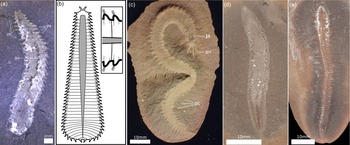
Mazovermes magnaterminus compared with other Mazon Creek polychaetes. a) FMNH PE 93013 showing the same characteristic silhouette of the holotype but with a better-preserved gut. b) Schematic anatomy of M. magnaterminus, and the inset showing a close-up of two segments. c) Esconites zelus. d) PE45536, Pieckonia helenae. e) PE33110, Didontogaster cordylina. Figure labels: an – antennae; ch – chaetae; gu – gut; ja – jaw; pa – parapodia; pc – parapodial cirri.

The pygidium is indistinct and presumably small; in conjunction with the widest segments being at the posterior of the body, M. magnaterminus has the overall appearance of ending in a blunt, rounded, club-like shape (Figure 1a,d,e and 2a,b). In these posterior segments, the parapodia are oriented back and towards the central axis of the body, as opposed to in the anterior segments, where they point directly away from the body wall (Figure 1d,g,h and 2b).
The morphology of M. magnaterminus, particularly the enlarged posterior segments with backwards-facing parapodia and chaetae, is clearly distinct from that of all other Mazon Creek polychaetes. It further lacks the pharyngeal jaws of Esconites (Figure 2c), and unlike Pieckonia and most other errant polychaetes, it does not taper at both the anterior and posterior margins (Figure 2d). The only other Mazon Creek polychaete to show significant differences in width between anterior and posterior is Didontogaster. However, Didontogaster has a slightly enlarged anterior end, which presumably housed an eversible pharynx as well as jaws (Figure 2e), and the difference in width is minor compared with M. magnaterminus (Figure 1a,d,e and 2a).
Remarks and taxonomic affinities: The anatomy of M. magnaterminus does not draw definitive comparisons with any extant annelid clade. Its most prominent features include a small prostomium with a single pair of short palps and homonomous segments with paddle-shaped parapodia that lack any obvious morphological specialisations (i.e., branchiae and cirri). Similarly, there appear to only be simple capillary chaetae, with the lack of specialized chaetae (i.e., hook-shaped, pectinate) making closer assignment to a specific group difficult. These features are broadly distributed throughout Annelida, particularly among the Errantia (Weigert et al. Reference Weigert, Helm, Meyer, Nickel, Arendt, Hausdorf, Santos, Halanych, Purschke, Bleidorn and Struck2014; Rouse et al. Reference Rouse, Pleijel and Tilic2022) and are in fact likely to represent the basic annelid ground pattern (Struck et al. Reference Struck, Paul, Hill, Hartmann, Hösel, Kube, Lieb, Meyer, Tiedemann, Purschke and Bleidorn2011).
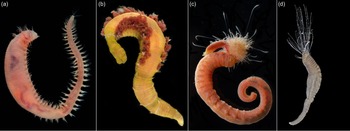
The general body shape showing marked differences in width between the anterior and posterior is present in several modern annelid groups, with some notable examples being the Scalibregmatids (Figure 3a), Arenicolids (Figure 3b), Terebellids (Figure 3c) and Flabelligerids (Figure 3d). These taxa, all of which fall within the major annelid clade Sedentaria (Weigert et al. 2014), have expanded anterior segments, which may argue for the enlarged pole of M. magnaterminus to be anterior rather than posterior. However, these structures in extant polychaetes are enlarged to accommodate eversible, pharyngeal structures such as proboscises (in the case of Scalibregmatids and Arenicolids), arrays of feeding palps (as in Terebellidae and Flabelligeridae) or a cephalic cage of forward-facing chaetae (as in Flabelligeridae specifically) (Rouse et al. 2022). We see no such features in M. magnaterminus, and indeed the gut or pharynx is widest among the thinnest chaetigers (Figure 1a–c), which is particularly notable given the eversible jaws noted among other Mazon Creek polychaetes such as Esconites (Figure 2a) and Didontogaster (Figure 2e) and the occurrence of the flabelligerid Mazopherusa (Hay Reference Hay2002).
A variety of extant annelids showing notable differences in anteroposterior width. a) Scalibregma californicum, Florida Museum of Natural History – Invertebrate Zoology.b) Arenicola sp., Florida Museum of Natural History – Invertebrate Zoology. c) Trichobranchidae, Smithsonian Marine Global Earth Observatory (MarineGEO). d) Pherusa parmata, Auckland Museum.

4. Discussion
Morphologically, two features stand out as significant in M. magnaterminus. The first is the preservation of muscular tissue, which is uncommon even among the already rare polychaete body fossils. Rollinschaeta myoplena from the Cretaceous of Lebanon is an exception (Wilson et al. Reference Wilson, Parry, Vinther and Edgecombe2016). While M. magnaterminus lacks the same degree of detail in its muscular tissue, but it still marks an unusually high quality of preservation of these labile internal tissues among invertebrates at Mazon Creek.
The shape of M. magnaterminus is unusual for an errant polychaete. Most examples of annelids with enlarged posterior regions tend to have highly modified segments adapted to specialized niches, such as the sternaspids, which use their posterior, ventral shields to block their burrows (Day, Reference Day1967). Many clitellates, now recognized as derived within ‘Polychaeta’ rather than their sister group (Struck et al. Reference Struck, Schult, Kusen, Hickman, Bleidorn, McHugh and Halanych2007), also show markedly larger posterior segments anterior to their posterior suckers for host attachment (Tessler et al. Reference Tessler, De Carle, Voiklis, Gresham, Neumann, Cios and Siddall2018), which in itself is formed through a fusion of segments during development (Purschke et al. Reference Purschke, Westheide, Rohde and Brinkhurst1993). While lacking equivalent specialized structures, the overall shape of this new taxon may indicate that it was ecologically relatively sedentary. Parapodia extending around the enlarged posterior segments may have been used to anchor M. magnaterminus in place in a manner similar to the Luolishanids, a group of Cambrian fossil lobopodians (Caron and Aria, Reference Caron and Aria2017), or modern caprellid amphipods (Brusca et al. Reference Brusca, Moore and Shuster2016). The club-like posterior end of M. magnaterminus may have also had structures which are unlikely to fossilize, such as cilia, which may have facilitated benthic attachment in a manner to the juvenile postanal tail of enteropneusts (Eaton, Reference Eaton1970).
Our primary window into early annelid evolution has come from Cambrian fossil sites such as the Burgess Shale (Nanglu and Caron, Reference Nanglu and Caron2018) or the Ordovician Fezouata locality (Parry et al. Reference Parry, Edgecombe, Sykes and Vinther2019). When considering annelid diversity, however, both of these periods pale in comparison to the numerous species described from Mazon Creek alone, and there are few examples of similarly well-preserved annelids between the Ordovician and Carboniferous. M. magnaterminus, thereby, provides a clear example of the importance of revisiting even intensively studied sites such as Mazon Creek.
There are over 100 sub-localities within the Mazon Creek fossil site, many of which are spoil piles from coal mines (Baird, Reference Baird1997a). Intensive census collecting in the 60s and 70s from these spoil piles revealed a high degree of heterogeneity in diversity and relative abundances between sub-localities within the site, and particularly sub-localities which preserve the in situ marine Essex fauna (Baird, Reference Baird1997a; Baird and Anderson, Reference Baird and Anderson1997). Most Essex fauna localities are dominated by Essexella asherae, an anemone (Plotnick et al. Reference Plotnick, Young and Hagadorn2023), but the next most abundant taxon varies from site to site (Baird, Reference Baird1997b). There are a few small regions where organisms that are rare across the entire site are locally abundant (Baird, Reference Baird1997b; Baird and Anderson, Reference Baird and Anderson1997). For example, the sub-locality ‘Jellyfish Hill’ is dominated by the rare jellyfish Octomedusa peickorum; the sub-locality ‘Chiton Hill’ is dominated by the rare chiton Glaphurochiton carbonarius, and ‘H Hill’ is dominated by the rare, enigmatic H-animal Etacystic communis (Baird, Reference Baird1997b). Polychaete abundance also varies substantially between sites. For example, while the polychaete Mazopherusa prinosa is typically rare at Mazon Creek localities, it is one of the most abundant animal fossils at the sub-locality nicknamed ‘Worm Hill’ (Baird, Reference Baird1997b). The polychaetes Esconites zelus and Didontogaster cordyline are also common at various sub-localities and rare at others (Baird, Reference Baird1997b). The polychaete described herein, M. magnaterminus, also follows this pattern, as it has as of yet only been identified from the poorly-studied and polychaete-dominated Jugtown Road locality (also referred to as the Jugtown Embayment (Baird, Reference Baird1997a).
The highly variable faunal composition of these sub-localities suggests that there may be extensive environmental heterogeneity in the ancient Mazon Creek estuary, as would generally be expected for a tidally influenced, transitional nearshore environment (Baird, Reference Baird1997b). However, investigation into the paleoenvironmental variation at the Mazon Creek is largely based on the various faunal assemblages at each sub-locality, with little corresponding information from sedimentology or geochemistry from specific sublocalities. Sedimentological and geochemical analyses have been focused on broad descriptions of the Mazon Creek fossil site as a whole. This is largely due to the fact that concretions are commonly collected in float as they weather out of spoil piles (Baird, Reference Baird1997a), and little research has been done on fine-scale variations in the surrounding shale. However, two approximate clusters of sub-localities, among those that preserve the Essex fauna, have been identified (Baird, Reference Baird1997b): the first cluster largely only preserves swimming and floating animals, and the second predominantly preserves bottom-dwelling organisms. The lack of benthic animals in the cluster one sub-localities may indicate a high sedimentation rate that benthic taxa could not tolerate (Baird and Anderson, Reference Baird and Anderson1997).
Jugtown Road and the collecting localities along it roughly follow the path of an ancient embayment from the palaeocoastline into the nearshore coal swamp. The long narrow shape of the embayment and the surrounding freshwater in the coal swamp would likely have resulted in high variations in salinity within the embayment, which would be further enhanced by heavy rains and tides (Baird, personal communication, n.d.). M. magnaterminus was collected at the northernmost spot of the Jugtown embayment, at its narrowest, most terrestrially influenced end. At this point, salinity variations may have been at their highest, suggesting that this new polychaete may have been locally abundant due to being able to tolerate salinity variations.
These examples suggest that a high degree of environment specificity may obscure the total diversity of annelids at Mazon Creek. Further re-study of the Mazon Creek fossil annelids, with a particular focus on those collected from less well-studied localities, may yield critical insights into the evolution and extinct diversity of this important phylum.
Acknowledgments
K. N. was supported by an NSF CAREER Award granted to Javier Ortega-Hernández.
Competing interests
The authors declare no competing interests.


 Open access

