





Introduction
Despite the culturally positive perception of childbirth (Horesh, Garthus-Niegel, & Horsch, Reference Horesh, Garthus-Niegel and Horsch2021), up to one-third of mothers report their experiences as traumatic (Ayers, Harris, Sawyer, Parfitt, & Ford, Reference Ayers, Harris, Sawyer, Parfitt and Ford2009; Ayers, Handelzalts, Webb, et al., Reference Ayers, Handelzalts and Webbunder review; O’Donovan et al., Reference O’Donovan, Alcorn, Patrick, Creedy, Dawe and Devilly2014; Stramrood, et al., Reference Stramrood, Paarlberg, Huis In’t Veld, Berger, Vingerhoets, Weijmar Schultz and Van Pampus2011). Some go on to develop childbirth-related post-traumatic stress disorder (CB-PTSD), with a recent meta-analysis estimating its prevalence at 4.7% (Heyne et al., Reference Heyne, Kazmierczak, Souday, Horesh, Lambregtse-van den Berg, Weigl and Garthus-Niegel2022). CB-PTSD has been associated with various adverse outcomes for mothers, infants, and family well-being and health (Horsch et al., Reference Horsch, Garthus-Niegel, Ayers, Chandra, Hartmann, Vaisbuch and Lalor2024).
The public health significance of CB-PTSD is underscored by the number of births each year. In 2023 alone, ~140 million children were born worldwide (UN, 2024). Based on the estimated prevalence, this means that around 6.5 million women may develop CB-PTSD every year, underscoring its profound implications for public health and emphasizing the need for greater awareness and support.
According to the diathesis-stress model of CB-PTSD (Ayers, Bond, Bertullies, & Wijma, Reference Ayers, Bond, Bertullies and Wijma2016), risk factors can be categorized into: (1) antenatal factors, such as maternal characteristics and mental health, trauma history, and predisposing demographic factors; (2) birth factors, including subjective birth experiences, operative births, and obstetric complications; and (3) postpartum factors, such as comorbid mental health conditions (e.g. depression and anxiety) and ongoing mother and infant physical complications.
Systematic reviews and meta-analyses (Ayers et al., Reference Ayers, Bond, Bertullies and Wijma2016; Andersen et al., Reference Andersen, Melvaer, Lamont, Videbech and Jørgensen2012; Dekel, Stuebe, & Dishy, Reference Dekel, Stuebe and Dishy2017; El Founti Khsim Martínez Rodríguez, Riquelme Gallego, Caparros-Gonzalez, & Amezcua-Prieto, Reference El Founti Khsim, Martínez Rodríguez, Riquelme Gallego, Caparros-Gonzalez and Amezcua-Prieto2022; Grekin & O’Hara, Reference Grekin and O’Hara2014; Heyne et al., Reference Heyne, Kazmierczak, Souday, Horesh, Lambregtse-van den Berg, Weigl and Garthus-Niegel2022; Kranenburg et al., Reference Kranenburg, Lambregtse-van den Berg and Stramrood2023) consistently identify the birth factor of negative subjective birth experiences as the strongest risk factor, regardless of the level of obstetric complications (Andersen et al., Reference Andersen, Melvaer, Lamont, Videbech and Jørgensen2012; Dekel et al., Reference Dekel, Stuebe and Dishy2017). Additionally, obstetric interventions such as emergency cesarean sections and instrumental vaginal births increase risk (Andersen et al., Reference Andersen, Melvaer, Lamont, Videbech and Jørgensen2012; El Founti Khsim et al., Reference El Founti Khsim, Martínez Rodríguez, Riquelme Gallego, Caparros-Gonzalez and Amezcua-Prieto2022; Heyne et al., Reference Heyne, Kazmierczak, Souday, Horesh, Lambregtse-van den Berg, Weigl and Garthus-Niegel2022; Orovou, Antoniou, Zervas, & Sarantaki, Reference Orovou, Antoniou, Zervas and Sarantaki2025). Antenatal factors are also crucial contributors, including prenatal depression, fear of childbirth, trauma history, and preexisting mental health conditions (Ayers et al., Reference Ayers, Bond, Bertullies and Wijma2016; El Founti Khsim et al., Reference El Founti Khsim, Martínez Rodríguez, Riquelme Gallego, Caparros-Gonzalez and Amezcua-Prieto2022). Postpartum risk factors include inadequate support, postpartum depression, and maladaptive coping (Ayers et al., Reference Ayers, Bond, Bertullies and Wijma2016).
Despite extensive research on CB-PTSD, mostly in high-income countries, cultural and regional factors may limit the generalizability of identified risk factors. The diathesis-stress model emphasizes the cumulative influence of multiple factors across the perinatal period, rather than a single vulnerability. The aim of this study is to examine risk factors within a unified model based on the stress-diathesis model (Ayers et al., Reference Ayers, Bond, Bertullies and Wijma2016) in a large, diverse international sample. We assessed three trauma-related outcomes: possible CB-PTSD diagnosis, symptom severity, and perceived traumatic birth.
Methods
Design
INTERSECT is a cross-sectional survey examining traumatic birth and CB-PTSD in women 6–12 weeks postpartum (mean = 8.5, standard deviation [SD] = 1.9 weeks). The study protocol was preregistered (Ayers et al., Reference Ayers, Handelzalts and Webb2021). Data for INTERSECT (Ayers, Handelzalts, & INTERSECT Consortium, Reference Ayers and Handelzalts2025) were collected between April 2021 and January 2024, and involved 11,302 participants from 31 countries (see eTable 1 in the Supplementary Materials for sample size and selected demographic data by country). The dataset is available on request via the UK Data Service (Ayers, Handelzalts, & the INTERSECT Consortium, 2021–Reference Ayers and Handelzalts2024).
Participants
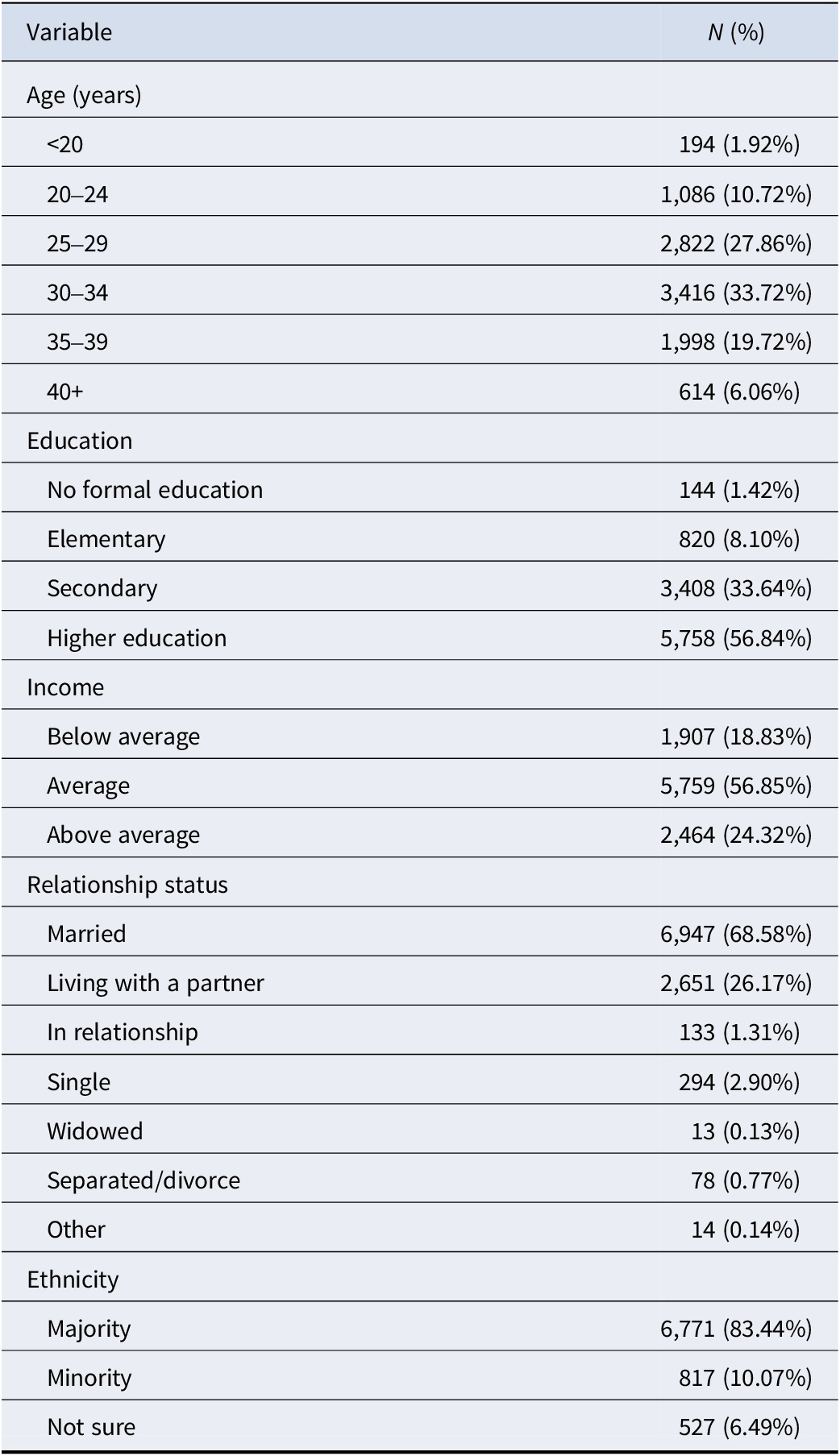
Inclusion criteria required participants to have given birth within the past 6–12 weeks and be legal adults in their country of residence (16+ or 18+ years). The sample comprised 10,086–10,130 women (the number of participants varied, depending on analysis – see flow chart eFigure 1 in the Supplementary Materials) from 30 countries. As shown in Table 1, most participants were aged 30–34 years (33.72%), held higher education qualifications (56.84%), reported an average income (relatively to the country; 56.85%), were married (68.58%), and belonged to the majority ethnic group in their country (83.44%).
Sociodemographic characteristics of the sample (N = 10,130)

Procedures
Ethical approval was obtained by the principal investigators in each country. Inclusion criteria, sampling procedures, and survey questions were consistent across countries (Ayers et al., Reference Ayers, Handelzalts and Webb2021).
Participants were recruited in pregnancy or postpartum through routine maternity care services – for example, hospitals, clinics, and birth centers. To minimize self-selection bias and improve representativeness, recruitment through social media was avoided, except in Slovenia and Norway, where it was used alongside the standard protocol; however, the recruitment mode was not documented separately in these countries. Research teams contacted participants in person, by phone, video call, or email, and provided study information. Those who agreed to participate provided informed consent. Surveys were completed using online forms, paper questionnaires, or telephone interviews.
The INTERSECT survey was originally developed in English. Validated translations were used where available, or survey measures were translated and adapted according to standard cultural adaptation procedures (Wild et al., Reference Wild, Grove, Martin, Eremenco, McElroy, Verjee-Lorenz and Erikson2005).
Measures
Outcome variables
CB-PTSD was measured using the City Birth Trauma Scale (Ayers, Wright, & Thornton, Reference Ayers, Wright and Thornton2018), which uses the Diagnostic and Statistical Manual of Mental Disorders, Fifth Edition (DSM-5) criteria to assess PTSD symptoms due to labor, birth, or immediate postpartum events. Symptom frequency in the past week is rated from 0 (‘not at all’) to 3 (‘5 or more times’). The scale also assesses distress, impairment, and duration of symptoms. CB-PTSD cases are calculated according to the DSM-5 PTSD diagnostic criteria. The scale has good reliability and psychometric validity across translations (Nakić Radoš, Matijaš, Kuhar, Anđelinović, & Ayers, Reference Nakić Radoš, Matijaš, Kuhar, Anđelinović and Ayers2020; Osorio, Darwin, Bombonett, & Ayers, Reference Osorio, Darwin, Bombonett and Ayers2022; Sandoz et al., Reference Sandoz, Hingray, Stuijfzand, Lacroix, El Hage and Horsch2022). Internal consistency in this sample was high (McDonald’s ω = 0.94). Two scores from this scale were used as dependent variables: the total symptom score (range 0–60) and a binary CB-PTSD probable diagnosis (yes/no).
Perceived traumatic birth was assessed using a single item on the extent to which participants experienced their birth as traumatic (Overall, how traumatic did you find your birth) on an 11-point scale, ranging from 0 (‘not at all’) to 10 (‘extremely’).
Risk factors
Birth experience was assessed using the Birth Satisfaction Scale-Revised (Martin & Martin, Reference Martin and Martin2014), a 10-item scale encompassing quality of care, personal attributes, and stress during labor. Responses are rated on a Likert scale ranging from 0 (‘strongly disagree’) to 4 (‘strongly agree’) with total scores ranging from 0 to 40. Internal consistency in this sample was high (McDonald’s ω = 0.87).
Previous trauma was assessed dichotomously (yes/no) using the trauma checklist from the Post-Traumatic Stress Diagnostic Scale (Foa, Cashman, Jaycox, & Perry, Reference Foa, Cashman, Jaycox and Perry1997), which assesses prior traumas – for example, life-threatening illness, physical assault, sexual assault, military combat or experience in a war zone, child abuse, accident, natural disaster, and other trauma. Endorsing any trauma was scored as yes. Additional items assessed previous traumatic birth and pregnancy loss or stillbirth (yes/no).
History of psychological problems and treatment was assessed using items evaluating both current and/or past mental health diagnoses (yes/no), treatment (yes/no), and the type of treatment received (medication, professional support, or both).
Demographic and obstetric information encompassed age, ethnicity, household income, education, relationship status, and immigration status. Obstetric data included the number of children (before this birth), gestational age, birth mode (vaginal/assisted vaginal birth/emergency cesarean/elective cesarean), number of birth companions, as well as perceived level of support from them (measured on a 0–4 Likert scale), and maternal or infant complications (major/minor/none). Obstetric information was self-reported in all countries except Germany, where data were obtained from medical records.
Data handling and governance
Data were collected and coded consistently across countries using a standardized data dictionary. Anonymized data were uploaded to City St. George’s, University of London’s data server. A data protection impact assessment was conducted and approved, and research governance and data-sharing agreements were established between host and partner institutions.
Data analysis
All analyses were conducted in R (Core Team, 2021) using the ‘lme4’ package (Bates et al., Reference Bates, Maechler, Bolker and Walker2015). Part R 2 were calculated using ‘partR2’ package for R (Stoffel, Nakagawa, & Schielzeth, Reference Stoffel, Nakagawa and Schielzeth2021). Data from each country were harmonized and linked as described elsewhere (Ayers et al., Reference Ayers, Handelzalts and WebbUnder review). Participants from Switzerland were excluded from the analysis due to missing data on the number of birth companions. Missing values were not at random and, therefore, not imputed, and participants with missing values were excluded (see flowchart eFigure 1 in the Supplementary Materials). All continuous independent variables were centered. Categorical variables were re-coded using effect coding.
Separate analyses were conducted for dependent variables of CB-PTSD diagnosis, CB-PTSD total symptoms, and traumatic birth. Due to missing values, there are different numbers of participants between models. To construct the final models, a process of variable selection was conducted. We conducted four separate analyses for each dependent variable, systematically examining the significant independent variables within each category as follows (see Supplementary Materials):
-
(1) Background variables, that is, age, level of education, level of income, number of children, immigration status, resident area, relationship status, previous trauma, previous or current mental health diagnosis, current or previous mental health treatment, and type of mental health treatment (Supplementary eTable 2).
-
(2) Pregnancy variables, that is, previous pregnancy loss and previous birth trauma (Supplementary eTable 3).
-
(3) Birth variables, that is, birth method, maternal complications during birth, ongoing maternal complications, DSM-5 criterion A (believed that she or the baby would be severely injured or die during birth), number of birth companions, perceived level of support from birth companions, and birth experience (Supplementary eTable 4).
-
(4) Infant-related variables, that is, infant complications during birth, ongoing infant complications, and gestation (Supplementary eTable 5).
Next, all significant variables from these models were entered together into the final three models, one model for each dependent variable.
To account for the variability of the effects between countries, we compared three covariance matrix structures for each model: (1) a random intercept model; (2) a random intercept + slopes model with a diagonal covariance structure; and (3) a random intercept + slopes model with an unstructured covariance structure. Models were selected based on convergence, absence of singularity, and superior fit. SDs of the random slopes for each model are reported in Supplementary eTable 6.
Based on the results of the first stage of analyses (background variables), the number of children was retained and included as a predictor in the final models. We repeated the analyses with a binary variable representing parity (as reported in many studies). As two models demonstrated a slightly better fit when using the number of children, this specification was retained. Importantly, the overall pattern of results remained unchanged when parity was used as a predictor.
Results
First, we explored the bivariate correlations between dependent variables. Results revealed significant positive correlations between CB-PTSD diagnosis and CB-PTSD symptoms (r = 0.54, p < .001), CB-PTSD diagnosis and perceived traumatic birth (r = 0.31, p < .001), and CB-PTSD symptoms and perceived traumatic birth (r = 0.47, p < .001).
Risk factors for a probable diagnosis of CB-PTSD
The random slopes of the final model predicting CB-PTSD diagnosis were defined for number of children, previous trauma, current mental health diagnosis, level of support from birth companion, ongoing mother and infant complications, birth experience (BSS-R score), and major infant complications during birth (see Equation 1 in the Supplementary Materials), with diagonal covariance structure (Akaike Information Criterion [AIC] = 3009.8, Bayesian Information Criterion [BIC] = 3168.7).
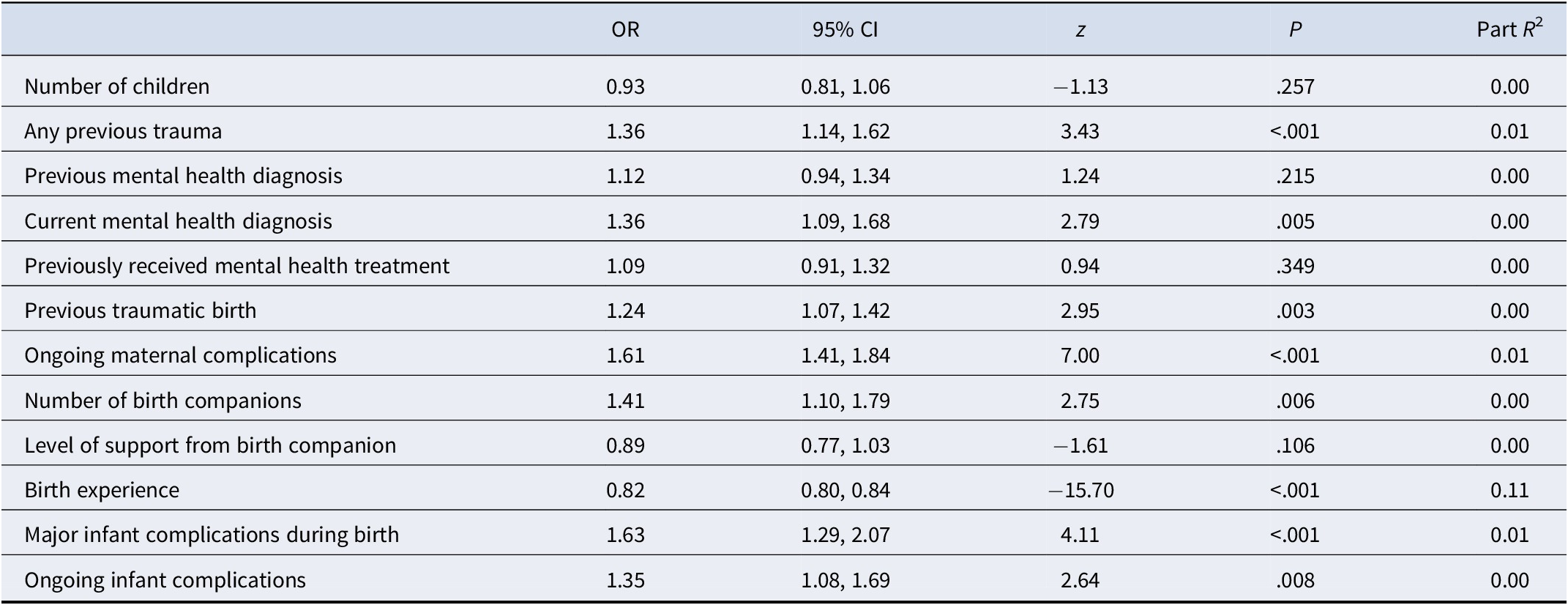
The fixed effects of the final model are shown in Table 2. Significant risk factors for CB-PTSD diagnosis were previous birth trauma and other traumas, current mental health diagnosis, ongoing maternal complications, current infant complications, number of birth companions, and major infant complications during the birth. Negative birth experience was associated with CB-PTSD diagnosis.
Predictors of CB-PTSD diagnosis (fixed effects, N = 10,116)

The conditional R 2 of the final model was 0.58, and the marginal R 2 was 0.36, suggesting that both fixed and random effects accounted for a substantial proportion of variance in PTSD diagnosis. The model had a significantly better fit than a model with only a random intercept (AIC = 3071.5, BIC = 3172.6, χ 2(8) =77.65, p < .001). This indicates significant variation in slopes across countries in the random effect variables. Additionally, the model fit of the final model was not significantly different from a random intercept and slopes model with an unstructured covariance matrix (AIC = 3127.1, BIC = 3784.3, χ 2(69) =20.71, p = 1.000). This means that the more complex model, which addressed the correlations between slopes, did not provide a better fit to the data than the simpler model, suggesting that the added complexity was unnecessary.
Risk factors for CB-PTSD symptom severity
The final model predicting CB-PTSD symptoms is detailed in Equation 2 in the Supplementary Materials. Random slopes were defined for all predictors, except for relationship status (partner), current and past mental health treatment, birth method (elective cesarean), and major infant complications during the birth, with a diagonal covariance structure (AIC = 69867.0, BIC = 70098.0).
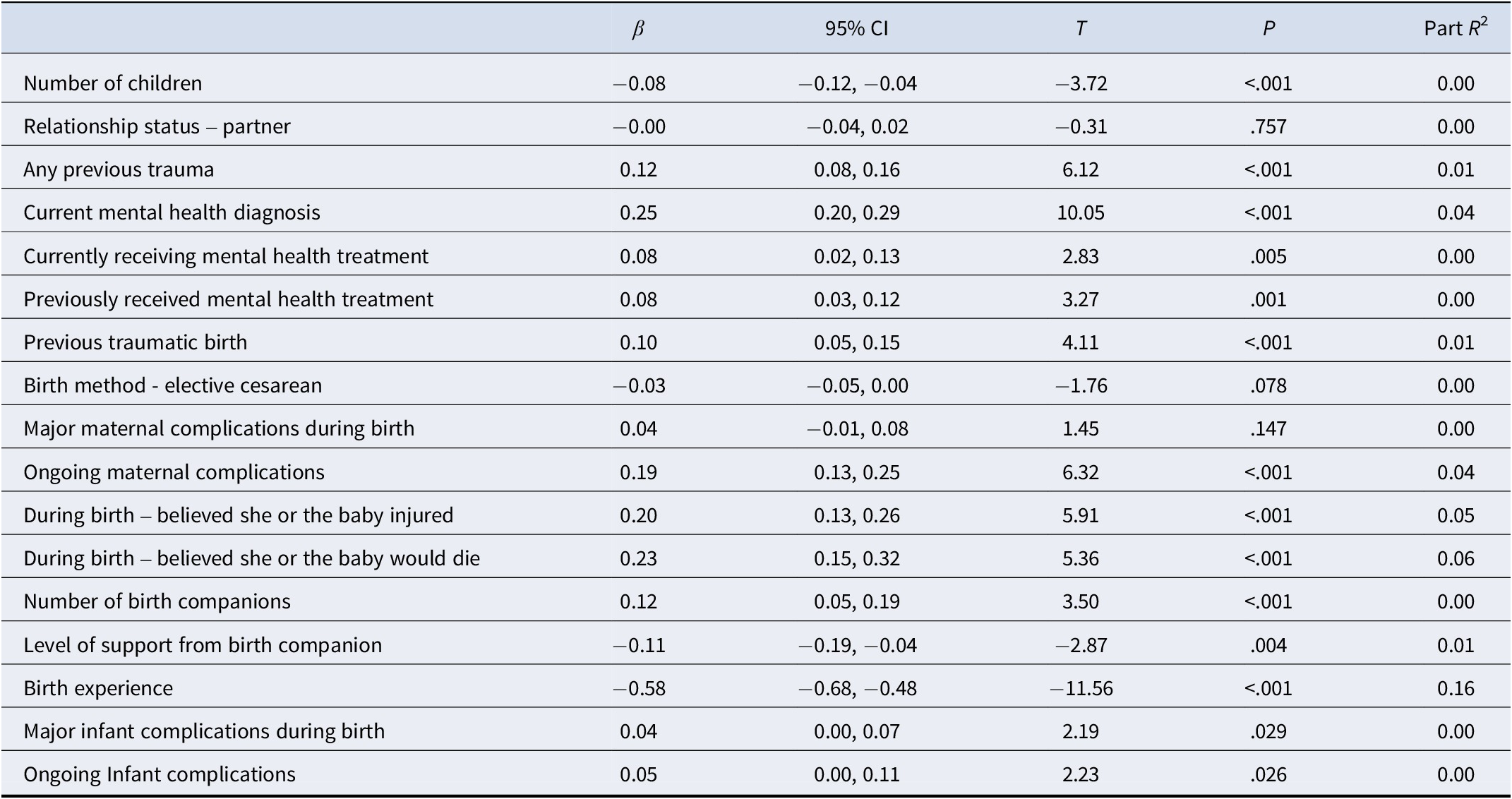
The fixed effects are shown in Table 3. Significant risk factors for CB-PTSD symptoms were any previous trauma, current mental health diagnosis, currently or previously receiving mental health treatment, previous traumatic birth, ongoing maternal complications, believing she or her baby would be injured or die during birth, number of birth companions, major infant complications during birth, and ongoing infant complications. Protective factors were the number of children, level of support from birth companions, and positive birth experience.
Predictors of CB-PTSD symptoms (fixed effects, N = 10,130)

The conditional R 2 of the final model was 0.55, and the marginal R 2 was 0.27, suggesting that both fixed and random effects accounted for a substantial proportion of variance in PTSD symptom severity. A comparison of the final model with a model incorporating additional random slopes revealed no significant improvement in fit (AIC = 69,866, BIC = 70,118, χ 2(3) =7.18, p = .066), thereby supporting the selection of the more parsimonious model. In addition, the final model had a significantly better fit than a model with fixed effects and a random intercept only (AIC = 71,002, BIC = 71,146, χ 2(12) =1158.8, p < .001), suggesting there is variation in slopes between countries in the random effect variables. An alternative model specification using an unstructured covariance structure did not converge and was, therefore, not further analyzed.
Risk factors for perceived traumatic birth
The final model predicting perceived traumatic birth is detailed in Equation 3 in the Supplementary Materials. In this model, random slopes were defined for all predictors, except for number of children and birth method – assisted vaginal, ongoing maternal complications, major infant complications during birth, and ongoing infant complications, with diagonal covariance structure (AIC = 44033.9, BIC = 44207.2).
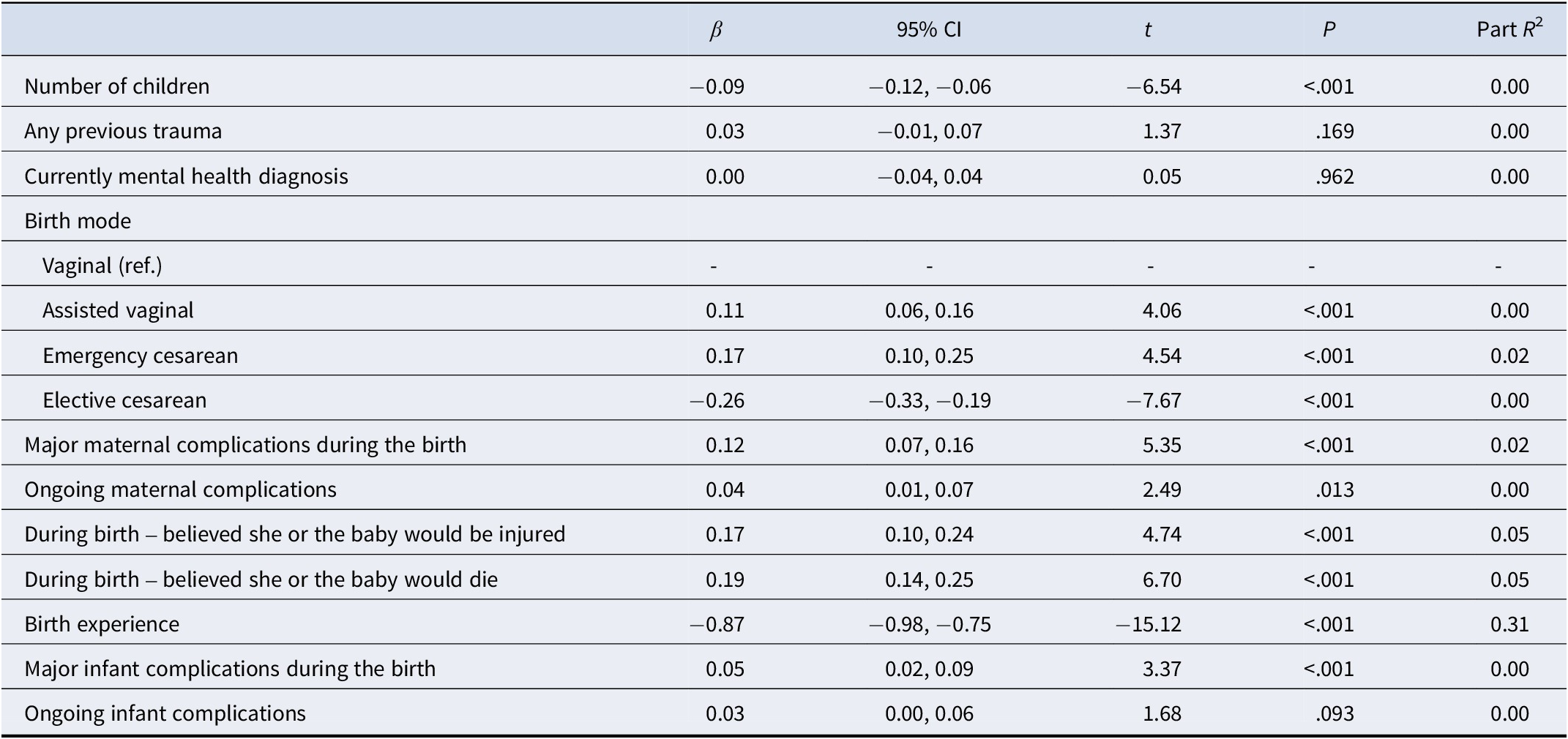
The fixed effects are shown in Table 4. Significant risk factors for perceived traumatic birth were assisted vaginal birth, emergency cesarean, major maternal complications during the birth, ongoing maternal complications, believing she or her baby would be injured or die during birth (criterion A), and major infant complications during birth. Protective factors were the number of children, elective cesarean birth, and positive birth experience.
Predictors of perceived traumatic birth (fixed effects, N = 10,086)

The conditional R 2 of the final model was 0.53, and the marginal R 2 was 0.37, suggesting that both fixed and random effects accounted for a substantial proportion of variance in perceived birth trauma. Comparing the final model with a model incorporating additional random slopes revealed no significant improvement in fit (AIC = 44,039, BIC = 44,207, χ 2(4) =3.28, p = .513); consequently, the more parsimonious model was retained. In addition, the final model demonstrated a significantly better fit than a model with fixed effects and a random intercept only (AIC = 44,561, BIC = 44,677, χ 2(8) =543.53, p < .001), indicating that slopes vary significantly between countries for the defined predictors. An alternative model specification using an unstructured covariance structure resulted in singularity and was not further analyzed.
Discussion
Although CB-PTSD has been widely studied (Andersen et al., Reference Andersen, Melvaer, Lamont, Videbech and Jørgensen2012; Ayers et al., Reference Ayers, Bond, Bertullies and Wijma2016; El Founti Khsim et al., Reference El Founti Khsim, Martínez Rodríguez, Riquelme Gallego, Caparros-Gonzalez and Amezcua-Prieto2022; Gerkin & O’Hara, Reference Grekin and O’Hara2014; Heyne et al., Reference Heyne, Kazmierczak, Souday, Horesh, Lambregtse-van den Berg, Weigl and Garthus-Niegel2022; Kranenburg et al., Reference Kranenburg, Lambregtse-van den Berg and Stramrood2023), this is the first study to examine risk factors in an international sample across multiple countries with standardized measures using the diathesis-stress model that emphasizes the cumulative influence of multiple factors across the perinatal period, rather than a single vulnerability. A key strength is the examination of three outcome variables: CB-PTSD diagnosis, CB-PTSD symptoms, and perceived traumatic birth. This multidimensional approach enabled the identification of shared and unique predictors of traumatic birth and CB-PTSD. In the discussion, we therefore address statistically significant findings but place particular emphasis on those predictors that demonstrate clinical relevance, as reflected in both the magnitude of effect sizes (odds ratios [ORs]/βs) and their unique contribution to the variability of the dependent variables.
Birth experience was strongly associated with all CB-PTSD outcomes. A more negative experience predicted increased likelihood of CB-PTSD diagnosis, higher symptom severity, and greater perceived traumatic birth, independent of birth mode. Importantly, birth experience also showed the largest and most meaningful part R 2 values across all models, indicating that it accounted for a substantial proportion of unique variance in the outcomes, far exceeding the contribution of other predictors. In addition, its OR for CB-PTSD diagnosis and the beta coefficients for symptom severity and subjective traumatic birth highlight the consistency of this effect across different analytic approaches. This finding underscores that birth experience is not only statistically significant but also the most robust and practically relevant predictor of CB-PTSD in real-world terms. This pattern is consistent with meta-analyses highlighting maternal birth experience as a key predictor of the various aspects of CB-PTSD (Andersen et al., Reference Andersen, Melvaer, Lamont, Videbech and Jørgensen2012; Ayers et al., Reference Ayers, Bond, Bertullies and Wijma2016; Dekel et al., Reference Dekel, Stuebe and Dishy2017; El Founti Khsim et al., Reference El Founti Khsim, Martínez Rodríguez, Riquelme Gallego, Caparros-Gonzalez and Amezcua-Prieto2022; Gerkin & O’Hara, Reference Grekin and O’Hara2014; Heyne et al., Reference Heyne, Kazmierczak, Souday, Horesh, Lambregtse-van den Berg, Weigl and Garthus-Niegel2022; Kranenburg et al., Reference Kranenburg, Lambregtse-van den Berg and Stramrood2023).
In addition, mothers who believed that they or their baby might be seriously injured or die during birth (i.e., met criterion A for trauma) had significantly higher CB-PTSD symptoms and traumatic birth perception. This finding highlights the centrality of the perceived threat in CB-PTSD and reflects its gatekeeper role in PTSD diagnostic criteria. Despite ongoing debates on the relevance of criterion A (Marx, Hall-Clark, Friedman, Holtzheimer, & Schnurr, Reference Marx, Hall-Clark, Friedman, Holtzheimer and Schnurr2024), these results suggest that perceived threat to self and/or infant remains a meaningful contributor to CB-PTSD development. Importantly, the part R 2 values for criterion A were also substantial, indicating that its contribution goes beyond statistical significance. Together with consistent ORs and beta coefficients across outcomes, this shows that criterion A is not only a statistical finding but also a predictor of real-world relevance for maternal mental health. Thus, the perception of danger to the self or the baby plays a significant role in the number and severity of symptoms, as well as in the subjective perception of birth.
We next turn to other predictors that reached statistical significance, albeit with smaller effect sizes. It is important to note that within the current model, these findings represent additional contributions, even if modest, beyond the effects of the other variables.
Infant complications during birth and ongoing maternal complications were associated with all three outcomes. Mothers reporting serious neonatal complications or persistent own health issues were more likely to report CB-PTSD symptoms and possible diagnosis, and perceive the birth as traumatic. These findings align with previous evidence that concern for infant well-being and unresolved maternal complications intensify trauma responses (Andersen et al., Reference Andersen, Melvaer, Lamont, Videbech and Jørgensen2012; Ayers et al., Reference Ayers, Bond, Bertullies and Wijma2016; Dekel et al., Reference Dekel, Stuebe and Dishy2017; Duval et al., Reference Duval, Youssefzadeh, Sweeney, McGough, Mandelbaum, Ouzounian and Matsuo2022; Kranenburg et al., Reference Kranenburg, Lambregtse-van den Berg and Stramrood2023).
Preexisting maternal vulnerabilities were primarily linked to CB-PTSD symptoms and diagnosis. Women with prior trauma and current mental health issues were more likely to meet diagnostic criteria and report higher symptoms, aligning with the diathesis-stress model, highlighting preexisting variables (Andersen et al., Reference Andersen, Melvaer, Lamont, Videbech and Jørgensen2012; Ayers et al., Reference Ayers, Bond, Bertullies and Wijma2016; Dekel et al., Reference Dekel, Stuebe and Dishy2017; El Founti Khsim et al., Reference El Founti Khsim, Martínez Rodríguez, Riquelme Gallego, Caparros-Gonzalez and Amezcua-Prieto2022; Gerkin & O’Hara, Reference Grekin and O’Hara2014; Heyne et al., Reference Heyne, Kazmierczak, Souday, Horesh, Lambregtse-van den Berg, Weigl and Garthus-Niegel2022; Kranenburg et al., Reference Kranenburg, Lambregtse-van den Berg and Stramrood2023). On the other hand, although these vulnerabilities were significantly associated with perceived traumatic birth in the preliminary analysis, in the final model, where birth events and outcomes (such as birth type, birth satisfaction, and health complications) were considered, their association with perceived traumatic birth became insignificant.
Our finding that ongoing maternal or infant complications were associated with CB-PTSD symptoms suggests that physical risk factors may extend into the postpartum period. Need for intensive care or a difficult recovery, such as prolonged maternal healing or neonatal health issues, may intensify childbirth-related stress and hinder psychological recovery, thereby sustaining or worsening CB-PTSD symptoms.
Mode of birth was associated only with perceived traumatic birth: assisted vaginal births and emergency cesareans were linked to higher trauma ratings, and elective cesareans to lower ones. This supports prior findings that vaginal instrumental births or emergency cesarean sections evoke feelings of danger and loss of control (Beck-Hiestermann, Hartung, Richert, Miethe, & Wiegand-Grefe, Reference Beck-Hiestermann, Hartung, Richert, Miethe and Wiegand-Grefe2024; Thiel & Dekel., Reference Thiel and Dekel2020). While earlier studies linked them to CB-PTSD symptoms (Carter, Bick, Gallacher, & Chang, Reference Carter, Bick, Gallacher and Chang2022; Ginter et al., Reference Ginter, Takacs, Boon, Verhoeven, Dahlen and Peters2022), mode of birth did not predict diagnosis or symptoms once the subjective experience of birth was considered. These findings suggest that subjective appraisal may play a greater role in CB-PTSD outcomes than birth mode, although the latter still shapes perceived trauma (Ayers et al., Reference Ayers, Bond, Bertullies and Wijma2016; Andersen et al., Reference Andersen, Melvaer, Lamont, Videbech and Jørgensen2012). Of note, in our analysis, only emergency cesarean section demonstrated a meaningful effect size, whereas associations for assisted vaginal and elective cesarean births were negligible once effect sizes were taken into account.
Findings on support during birth and the number of children (parity) were partly consistent with previous research. Greater perceived support from companions was associated with lower symptom severity, in line with prior studies (Andersen et al., Reference Andersen, Melvaer, Lamont, Videbech and Jørgensen2012; Dekel et al., Reference Dekel, Stuebe and Dishy2017; El Founti Khsim et al., Reference El Founti Khsim, Martínez Rodríguez, Riquelme Gallego, Caparros-Gonzalez and Amezcua-Prieto2022), and multiparity was linked to reduced symptoms, as also reported previously (Ayers et al., Reference Ayers, Bond, Bertullies and Wijma2016; Carter et al., Reference Carter, Bick, Gallacher and Chang2022; Chabbert, Panagiotou, & Wendland, Reference Chabbert, Panagiotou and Wendland2021). In contrast, the presence of more companions was unexpectedly related to greater symptoms and diagnosis, contradicting earlier findings (Handelzalts, Levy, Ayers, Krissi, & Peled, Reference Handelzalts, Levy, Ayers, Krissi and Peled2022). However, across all of these variables, the ORs, beta coefficients, and part R 2 values were negligible, suggesting that despite statistical significance, these associations lack clinical relevance.
The finding that multilevel models with random effects for country provided the best fit suggests that associations between risk factors and CB-PTSD outcomes vary across countries – unsurprising given INTERSECT’s international scope. This likely reflects cultural, systemic, and contextual differences in childbirth, healthcare, and social norms. While the identified risk factors reflect overall trends, they may not fully capture country-specific vulnerabilities. Future analyses of the data will examine cross-cultural differences and the contextual relevance of specific predictors.
Strengths and limitations
This study’s strengths include a large international sample, standardized protocol, and use of a CB-PTSD measure aligned with DSM-5, together with the assessment of probable diagnosis, symptom severity, and perceived trauma, which enabled a comprehensive analysis of risk factors. Limitations include reliance on self-report, with no clinical verification of symptoms or complications; limited inclusion of low-income countries; and samples that were not nationally representative. Survey length also restricted detailed assessment of interventions, complications, and prior trauma or mental health. The cross-sectional design limits causal inference, highlighting the need for future studies with clinical interviews, longitudinal methods, and broader inclusion, particularly from low- and middle-income countries.
Conclusion
This international study identified key risk factors for CB-PTSD related to diagnosis, symptom severity, and perceived traumatic birth. Despite some variation, negative birth experiences, PTSD criterion A endorsement, and maternal or infant complications consistently indicated a higher risk. These results highlight the importance of birth factors within the stress-diathesis framework of childbirth PTSD risk factors. They further highlight the importance of improving birth experiences, as subjective perceptions can be as influential as clinical outcomes. Addressing mothers’ experiences and perceptions of danger to themselves or the baby can be key factors in identifying and possibly preventing the development of childbirth PTSD.
Supplementary material
The supplementary material for this article can be found at http://doi.org/10.1017/S0033291725102298.
Data availability statement
Data and supporting documentation for the INTERSECT study (2024) are available through the UK Data Service: SN: 9295, DOI: http://doi.org/10.5255/UKDA-SN-9295-1, URL: https://beta.ukdataservice.ac.uk/datacatalogue/studies/study?id=9295.
Acknowledgments
The INTERSECT Consortium includes the authors and the following members:
-
• Stephanie Alves, Lusófona University, HEI-Lab: Digital Human-Environment Interaction Labs, Campo Grande 376, 1749-024 Lisboa, Portugal.
-
• Carmen Amezcua-Prieto, Faculty of Medicine, University of Granada, Spain.
-
• Stefanía Birna Arnardóttir, Primary Health Care of the Capital Area, Iceland.
-
• Pablo Asensio-Pastor, Hospital Universitario Poniente, Spain.
-
• Ruveyde Aydin, Department of Nursing, Faculty of Health Sciences, Ondokuz Mayis University, Samsun, Türkiye.
-
• Jovana Bacigalupo, Institute of Mental Health, Belgrade, Serbia.
-
• Barbara Baranowska, Department of Midwifery, Centre of Postgraduate Medical Education, Warsaw, Poland.
-
• Stefano Bianchi, S. Giuseppe Hospital, University of Milan, Milan, Spain.
-
• Maja Brekalo, Department of Psychology, Catholic University of Croatia, Zagreb, Croatia
-
• Annette Briley, College of Nursing and Health Sciences, Flinders University, SA, Australia.
-
• Jelena Buzejic, Institute of Mental Health, Belgrade, Serbia.
-
• Magdalena Chrzan-Dętkoś, University of Gdansk, Faculty of Social Sciences, Institute of Psychology, Gdansk, Poland.
-
• Giulia Ciuffo, Trauma Research Unit, Catholic University of Milan, Italy.
-
• Suzana Drobnjak, The Obstetrics and Gynaecology Clinic Narodni Front, Belgrade, Serbia.
-
• Shannon Everest, Southern Cross University, Gold Coast, Queensland, Australia.
-
• Daniela Fidalgo, Lusófona University, HEI-Lab: Digital Human-Environment Interaction Labs, Campo Grande 376, 1749-024 Lisboa, Portugal.
-
• Deborah Fox, School of Nursing and Midwifery, Faculty of Health, University of Technology Sydney, NSW, Australia.
-
• Beata Gidaszewski, Westmead Hospital, Sydney, NSW, Australia.
-
• Tina Jakše, Moja Dula, Slovenia.
-
• James Elhindi, Sydney University, Sydney, NSW, Australia
-
• Elaine Jefford, School of Health, University of Sunshine Coast, Queensland, Australia.
-
• Inês Jongenelen, Lusófona University, HEI-Lab: Digital Human-Environment Interaction Labs, Campo Grande 376, 1749-024 Lisboa, Portugal.
-
• Hallfríður Kristín Jónsdóttir, National University Hospital, Reykjavik, Iceland.
-
• Teodora Jovanovic, Institute of Mental Health, Belgrade, Serbia.
-
• Asta Kirkilytė, Department of Obstetrics and Gynaecology, Medical Academy, Lithuanian University of Health Sciences, Kaunas, Lithuania.
-
• Zeljka Kosutic, Institute of Mental Health, Belgrade, Serbia.
-
• Diogo Lamela, Lusófona University, HEI-Lab: Digital Human-Environment Interaction Labs, Campo Grande 376, 1749-024 Lisboa, Portugal.
-
• Antonia Letnic, Psychology Department, Universidad del Desarrollo, Las Condes, Santiago, Chile.
-
• Bojana Lukic, Institute of Mental Health, Belgrade, Serbia.
-
• Linda Bára Lýðsdóttir, Reykjavik University, Iceland.
-
• Anna Malmquist Department of Behavioral Sciences and Learning, Linköping University, Linköping, Sweden.
-
• Julia Marsden, Southern Cross University, Gold Coast, Queensland, Australia.
-
• Pablo L. Martin-Tortosa, Hospital Materno-Infantil, Malaga, Spain.
-
• Marijana Matijaš, Department of Psychology, Catholic University of Croatia, Zagreb, Croatia.
-
• Amera Mojahed, Institute and Policlinic of Occupational and Social Medicine, Faculty of Medicine Technische Universität Dresden, Dresden, Germany; Department of Psychotherapy and Psychosomatic Medicine, Faculty of Medicine and University Hospital Carl Gustav Carus, TUD Dresden University of Technology, TU Dresden, Dresden, Germany.
-
• Ana Morais, Lusófona University, HEI-Lab: Digital Human-Environment Interaction Labs, Campo Grande 376, 1749-024 Lisboa, Portugal.
-
• Natalia Murawska, University of Gdansk, Faculty of Social Sciences, Institute of Psychology, Gdansk, Poland.
-
• Elizabeth Mwangala, Department of Mental Health Nursing, School of Nursing, Kamuzu University of Health Sciences, Malawi.
-
• Valentin Offredi, University Department of Child and Adolescent Psychiatry, Lausanne University Hospital, Lausanne, Switzerland.
-
• Dharmintra Pasupathy, Westmead hospital, Sydney Medical School, Sydney University, NSW, Australia.
-
• Shayna K. Pierce, Department of Psychology, University of Manitoba, Canada.
-
• Maria Reyes-Morillas, Centro Salud Gongora, Granada, Spain.
-
• Agostina Rinon, Psychology Department, Universidad del Desarrollo, Las Condes, Santiago, Chile.
-
• Blanca Riquelme-Gallego, Faculty of Health Sciences, University of Granada, Spain.
-
• Dangyra Ruseckienė, Department of Obstetrics and Gynaecology, Medical Academy, Lithuanian University of Health Sciences, Kaunas, Lithuania.
-
• Annabel Sheehy, School of Nursing and Midwifery, Faculty of Health, University of Technology Sydney, NSW, Australia.
-
• Lucie Sikorová, Faculty Hospital Ostrava, Ostrava, Czechia.
-
• Metka Skubic, Faculty of Health Sciences, University of Ljubljana, Slovenia.
-
• Valerie Slavin, Gold Coast University Hospital, Queensland, Australia.
-
• Matilde Sousa, Lusófona University, HEI-Lab: Digital Human-Environment Interaction Labs, Campo Grande 376, 1749-024 Lisboa, Portugal.
-
• Greta Sten, Department of Obstetrics and Gynecology in Norrköping, and Department of Biomedical and Clinical Sciences, Linköping University, Linköping, Sweden
-
• Rachael Woodworth, School of Nursing and Midwifery, Faculty of Health, University of Technology, Sydney, NSW, Australia.
-
• Maja Žutić, Department of Psychology, Catholic University of Croatia, Zagreb, Croatia.
-
• Mariza Miranda Theme-Filha, Department of Epidemiology and Quantitative Methods in Health. National School of Public Health. Oswaldo Cruz Foundation. Brazil.
Author contribution
The INTERSECT study was conceptualized, designed, and managed by Ayers, Handelzalts, Webb, Constantinou, and Lucas. Data were managed by Grollman and statistical analyses by Ohayon. All other authors conducted and managed the INTERSECT survey in their country, and were involved in data curation, investigation, project administration, resources, supervision, and validation. The manuscript was drafted by Handelzalts and reviewed by all authors.
Funding statement
The International Survey of Childbirth-Related Trauma (INTERSECT, www.intersectstudy.org) was conducted by the INTERSECT Consortium, funded by the Myriam de Senarclens Foundation and City, University of London. Funding was also obtained for the survey to be conducted in some countries (listed below). The funders had no role in study design, collection, analysis or interpretation of data, writing the report, or the decision to submit the paper for publication. The views expressed are those of the authors and not necessarily those of the funding organizations or the INTERSECT Consortium.
Croatia: INTERSECT in Croatia was funded and supported by an approved research project of the Catholic University of Croatia: “Determinants, outcomes, and interrelation of mental and physical health during pregnancy and postpartum (MumHealth).”
Chile: INTERSECT in Chile was provided by ANID under the project “Fondecyt de Iniciación 11170338” and by research funding from the Psychology Department at Universidad del Desarrollo.
Germany: Funding in Germany was provided by the Deutsche Forschungsgemeinschaft (DFG, German Research Foundation; GA 2287/7–1 and SCHE 1986/6–1).
Portugal: INTERSECT in Portugal was funded by the “la Caixa” Foundation’s Social Research Call 2023, project code LCF/PR/SR23/57000014; FCT - Fundação para a Ciência e a Tecnologia, IP, in the scope of the projects UIDB/05380/2023, with the DOI https://doi.org/10.54499/UIDB/05380/2020, respectively; project 2022.01825.PTDC (http://doi.org/10.54499/2022.01825.PTDC) and by the European Social Fund (ESF) and FCT (2023.06934.CEECIND; https://doi.org/10.54499/2023.06934.CEECIND/CP2877/CT0001; RC research contract).
Iceland: INTERSECT in Iceland was funded and supported by University of Iceland Research Fund.
Sweden: INTERSECT in Sweden was supported by Fredrik & Ingrid Thurings Stiftelse, award number 2020–0056.
Competing interests
The authors declare none.
Ethical standard
The authors assert that all procedures contributing to this work comply with the ethical standards of the relevant national and institutional committees on human experimentation and with the Helsinki Declaration of 1975, as revised in 2008.


 Open access

