




How and why are laws made? And who gets to hold legal political power? These questions are among the most fundamental and critical to social science research about the law (e.g. Montesquieu Reference Montesquieu1900; Rawls Reference Rawls1971; Unger Reference Unger1976). In contrast to a consensus model that suggests laws come out of relatively broad moral harmony on specific issues and a legal formalist focus on reason and consistency with precedents, critical legal perspectives suggest that laws and legal decision-making processes are inherently political and rooted in group conflict (e.g. Horwitz Reference Horwitz1979; Kelman Reference Kelman1987). Critical race theory suggests that the law has been explicitly used to maintain White privilege (Bell Reference Bell2000; Delgado and Stefancic Reference Delgado and Stefancic2012; Haney-López Reference Haney-López2006). One of the most evident and important exemplars of these critical perspectives is the laws and legal decisions surrounding voting rights (e.g. Crowley Reference Crowley2013; Delgado and Stefancic Reference Delgado and Stefancic2012) – those that determine if someone is a participating member of the democratic state.Footnote 1
Despite the important symbolic role that democracy plays in America’s self-image (Huntington Reference Huntington2004), the laws governing political participation have been exclusionary and unequal since the country’s founding (Keyssar Reference Keyssar2009; Lovell and McCann Reference Lovell, McCann, Wolbrecht and Rodney2005). Black Americans, in particular, have long faced significant barriers to voting.Footnote 2 We focus on one set of laws that continues to disproportionately disenfranchise Black Americans: felony disenfranchisement (Aviram et al. Reference Aviram, Bragg and Lewis2017). As with past voting restrictions, these legal statutes have political consequences that disproportionately affect Black Americans. Two percent of the U.S. voting-eligible population has lost the right to vote under these policies (Uggen et al. Reference Uggen, Larson, Shannon and Stewart2022), but more than five percent of voting-age Black Americans have been disenfranchised overall, with much higher rates in many states, particularly in the South (Uggen et al. Reference Uggen, Larson, Shannon and Stewart2022).
Voting laws emerge from specific social contexts, including slavery, Jim Crow, women’s suffrage, the Civil Rights Movement and changing demographics (Anderson Reference Anderson2018; Behrens et al. Reference Behrens, Uggen and Manza2003; Keyssar Reference Keyssar2009; McCammon et al. Reference McCammon, Campbell, Granberg and Mowery2001; Waldman Reference Waldman2022). These contexts help determine both the barriers to and opportunities for change, either through legislative or case law mechanisms. Thus, we are interested in understanding the current social context: how Americans are thinking about voting rights for people convicted of a felony.
Recent years have witnessed significant conflict over the laws allotting political power. On the one hand, there have been setbacks to some of the voting rights achieved during the Civil Rights Era (Anderson Reference Anderson2018; Shattuck et al. Reference Shattuck, Huang and Thoreson-Green2019). On the other hand, there has been increased attention to injustices and inequalities in criminal justice processes – in no small part through the Black Lives Matter movement (Drakulich and Denver Reference Drakulich and Denver2022; Drakulich et al. Reference Drakulich, Wozniak, Hagan and Johnson2021). The denial of voting rights to some Americans – disproportionately those impacted by these biased justice system processes (Crutchfield et al. Reference Crutchfield, Skinner, Haggerty, McGlynn and Catalano2012; Drakulich and Rodriguez‐Whitney Reference Drakulich, Rodriguez‐Whitney, Martinez, Hollis and Stowell2018) – is a significant barrier to addressing either issue because injustices in the criminal legal system help shape who gets to vote, and through that mechanism, the outcome of the votes, which – completing the cycle – helps determine injustices in the criminal justice system (see the “policy feedback loop” in Uggen and Manza Reference Uggen and Manza2002, 783). The consequence is diminished political power among those most negatively affected by the system’s injustices: the people most likely to have critical views of the criminal legal system will have the least political power to change it. In other words, injustices in the criminal legal system and injustices in the voting rights laws are mutually reinforcing and collectively self-sustaining. Thus, the issue of voting rights for those with criminal convictions sits at the intersection of two distinct but interconnected legal systems that serve as key sites in the continuing struggle for racial civil rights.
Our question is how people determine who should and should not have legal voting rights – the right to participate in the democracy. This question highlights the fundamental tension between group interest and the democratic ideal – a tension as old as democracy itself (Plato 1918). We frame this tension as a question of relational rights consciousness – specifically, a civic rights consciousnessFootnote 3 – drawing on work on legal consciousness and legal socialization (Chua and Engel Reference Chua and Engel2019; Fleury-Steiner and Hodge Reference Fleury-Steiner, Hodge, Fleury-Steiner and Nielsen2019) to develop a specifically relational (Nielsen Reference Nielsen2024) model to understand how people come to support or oppose the legal and civic rights of others with whom they share socio-political space (Nielsen Reference Nielsen2009). This consciousness is rooted in the context – the social and cultural location – of individuals (Ewick and Silbey Reference Ewick and Silbey1998; McCann Reference McCann, Fleury-Steiner and Nielsen2006; Nielsen Reference Nielsen2000; Young and Billings Reference Young and Billings2020).
Using two recent surveys conducted by the American National Election Studies (ANES), we explore support for voting rights for people convicted of a felony who have completed their sentence, allowing us to replicate the findings within a single paper. On the one hand, we find that those with a firmer commitment to democratic norms are more likely to support expanding voting rights. On the other hand, Americans who held a racial ideology consistent with the maintenance of racial inequalities were more likely to oppose expanding these voting rights. Critically, and reflecting the tension between these two forces, we find that this racial ideology also weakens or severs the link between a commitment to democratic norms and support for democratic changes that might threaten racial privilege.
Our theoretical model and findings make a key contribution to law and society literature, extending work on relational legal and rights consciousness. Although we focus on felony voting rights specifically, we believe this model may also be useful for legal consciousness research on other topics that are caught in the tension between democratic values and group interest. In a general sense, the most portable implication for the field is that broader commitments to democracy and perceptions of group interest can interact in complex and contradictory ways to shape people’s views of others’ legal rights – a dimension of people’s relational rights consciousness.
We begin to develop this argument with a brief history of voting rights laws to highlight the historical and contemporary ways these laws have served as primary mechanisms of systemic racism. Subsequently, we develop our conceptual model for how people come to determine the civic and legal rights of others, describing a civic rights socialization process.
A brief history of racist voting laws
Voting laws – those that determine access to political voice and power – are among the most straightforward places to see evidence of the kinds of systemic biases suggested by critical legal and critical race perspectives. Since the country’s founding, voting laws have acted to consolidate political power among only some people – initially, in many states, land-owning White men (Waldman Reference Waldman2022).
In 1870, during Reconstruction, the 15th Amendment was ratified, prohibiting states from denying or abridging the right to vote on the basis of race, making Black men eligible to vote. Shortly after the intentional dismantling of Reconstruction efforts that had seen many Black men vote (Du Bois Reference Du Bois1935; Richardson Reference Richardson2004), the recently treasonous states passed new constitutions or amendments restricting voting rights (Ewald Reference Ewald2002). These voting restrictions achieved their intended goal of limiting Black political voice. By the time women were granted the right to vote under the 19th Amendment in 1920, Black Americans were effectively disenfranchised in the states where they lived in the largest numbers.
In the 1960s, a series of court cases, constitutional amendments and legislation – most notably the Voting Rights Act of 1965 – challenged many of the key mechanisms securing the continued disenfranchisement of Black Americans. However, just as the 13th Amendment infamously barred slavery “except as punishment for a crime” (U. S. Const. Amend. XIII), the prohibitions in this act against denials or abridgements of voting rights have generally been ruled not to apply to felony disenfranchisement laws based on the “due process” clauses in the 5th and 14th amendments. This interpretation was challenged in 1972 when the California Supreme Court ruled that disenfranchisement was unconstitutional based on the first section of the 14th Amendment (limiting citizen rights), but was overturned by the Supreme Court (Richardson v. Ramirez Reference Ramirez1974) on the rationale that the second section of that amendment allowed it under the “other crimes” loophole. This decision “codified the legality of felony disenfranchisement” (Staufenbeil Reference Staufenbeil2020, 7), setting the legal standard that still remains more than a half century later.
Notably, voting restrictions for those convicted of a felony were largely passed immediately after voting rights were extended to Black citizens by the 15th Amendment, and both these restrictions and the success of disenfranchisement reforms appear to be the product of racial threat processes (Anderson Reference Anderson2018; Behrens et al. Reference Behrens, Uggen and Manza2003; Manza and Uggen Reference Manza and Uggen2006; Richardson Reference Richardson2004; Uggen et al. Reference Uggen, Behrens and Manza2005). Crime and criminalization were key to the historical disenfranchisement of Black Americans. Some disenfranchisement laws initially focused specifically on crimes more likely to have been committed by Black Americans as a consequence of slavery and reconstruction, while moral turpitude laws targeted Black Americans who had only committed misdemeanors (Ewald Reference Ewald2002). The size of the “minority” population remains an important correlate of the severity of disenfranchisement laws (Preuhs Reference Preuhs2001). Relatedly, incarceration appears to have increased specifically as a response to the enfranchisement of many Black Americans under the Voting Rights Act of 1965 (Eubank and Fresh Reference Eubank and Fresh2022) – “the most important policy response to the Civil Rights Era,” as Munger and Seron (Reference Munger and Seron2017, 331) argue.
Relational civic rights consciousness: understanding how people think about voting rights
From the earliest experiments with placing political power in the people’s hands,Footnote 4 the core question about democracy is who, exactly, gets to count as “the people” (Kasimis Reference Kasimis2018; Katz Reference Katz, Konstan, Felson and Falkner1999; Lape Reference Lape2010). In a representative democracy, this question is raised most specifically in suffrage law: who is legally allowed to vote – and thus who has access to political, social and economic power.
How might people evaluate ending felony voting prohibitions? This question exposes the core tension between democratic ideals and group interests. To develop an answer, we thread together insights from several complementary theoretical literatures. We treat the problem as a question of support for fellow citizens’ civic rights, drawing on rights consciousness – how people interpret and act on legal rights. In particular, we draw on ideas from relational work, asking how people view the legal rights of others. From there, we turn to the question of influences on this relational civic rights consciousness, drawing from work on democratic norms to highlight legal socialization that is critical to maintaining democracies, and on racial threat to identify how group privilege can justify anti-democratic positions – and even mitigate democratic socialization.
Rights consciousness
If legal consciousness captures “the ways in which people experience, understand, and act in relation to law” (Chua and Engel Reference Chua and Engel2019, 336), rights consciousness focuses on how people understand and act on legal rights (see, e.g. Fleury-Steiner and Nielsen Reference Fleury-Steiner and Nielsen2019). Whether and how people act on these rights – a question of mobilization – is a key theme of this work (Marshall and Barclay Reference Marshall and Barclay2003; McCann Reference McCann1994), as is how people react to violations of these rights – through resistance (Fleury-Steiner and Hodge Reference Fleury-Steiner, Hodge, Fleury-Steiner and Nielsen2019; McCann Reference McCann1994) or acquiescence (Halliday et al. Reference Halliday, Jones, Meers and Tomlinson2024).
Two features of rights consciousness work are particularly relevant here. First, rights consciousness emerges from social contexts: it varies across socio-political settings and social locations, often tracking marginalization and privilege (Abrego Reference Abrego2011; Engel Reference Engel2012; Hertogh and Kurkchiyan Reference Hertogh and Kurkchiyan2016; Jacobs Reference Jacobs2010; Kurkchiyan Reference Kurkchiyan2011; McCann Reference McCann, Fleury-Steiner and Nielsen2006; Nielsen Reference Nielsen2000; Young and Billings Reference Young and Billings2020). As McCann (Reference McCann, Fleury-Steiner and Nielsen2006, 18) suggests, a key question for rights consciousness work is how it “interacts with other norms and logics.” As Nielsen (Reference Nielsen2000, 1087) notes, “the social location of subjects, and the experiences that arise from that location, are a vital part of our understanding of legal consciousness.”
Second, variations in rights consciousness can either act to maintain or challenge hegemony (see, e.g. McCann Reference McCann, Fleury-Steiner and Nielsen2006). Legal socialization processes can serve to maintain hegemony by normalizing legal authority in everyday life (Ewick and Silbey Reference Ewick and Silbey1998; Silbey Reference Silbey2005). At the same time, social movements and other actors may seek to increase people’s understanding of their rights and ability to exercise them (Chua Reference Chua2015; Heyer Reference Heyer2015; Hull Reference Hull2016; Vanhala Reference Vanhala2010). Often, these two processes happen simultaneously, creating a complicated mix of rebellion and fatalism (Ewick and Silbey Reference Ewick and Silbey1998; Halliday and Morgan Reference Halliday and Morgan2013).
Relational rights consciousness
Legal consciousness is inherently social (Chua and Engel Reference Chua and Engel2019; Silbey Reference Silbey2005): it is shaped by culture (Ewick and Silbey Reference Ewick and Silbey1998; Young and Billings Reference Young and Billings2020), state messaging (Halliday et al. Reference Halliday, Jones, Meers and Tomlinson2024) and legal decisions (Wasby Reference Wasby2005), and it affects socially-embedded actions such as voting (Jacobs Reference Jacobs2010). Relational rights consciousness “embeds discussions of ‘individual rights’ in their relational context” (Nielsen Reference Nielsen2024, 2), situating legal consciousness in social networks and socialization processes (Cohn et al. Reference Cohn, Trinkner, Rebellon, Van Gundy and Cole2012; Fagan and Tyler Reference Fagan and Tyler2005), including through a symbolic interactionist process of perceptions of the legal consciousness of others (second-order legal consciousness) (Headworth Reference Headworth2020; Hertogh Reference Hertogh2024; Young Reference Young2014; Young and Chimowitz Reference Young and Chimowitz2022).
Relational influences on rights consciousness can be complex and conflicting. Positive proximate relational effects can be necessary to offset the role of “patterns of unhealthy divisive relationships that populism, coloniality, racism, and misogyny have produced” (Nielsen Reference Nielsen2024, 6–7). For citizenship and residency rights, extended family can transmit inclusive meanings (Abrego Reference Abrego2019), while peer comparisons and gendered ties can transmit exclusionary understandings (Abrego Reference Abrego2011; Güdük and Desmet Reference Güdük and Desmet2022; Tenorio Reference Tenorio2024).
Following this work, we are interested in understanding a relational civic rights consciousness – how people determine others’ entitlement to civic rights. We focus here on the right to vote, but other rights – for instance, the rights of others to offensive street speech – have been analyzed through a similar lens (Nielsen Reference Nielsen2000, Reference Nielsen2009). These views of others’ rights are themselves a form of relational rights consciousness (related to but distinct from work on second-order legal consciousness [e.g. Young and Chimowitz Reference Young and Chimowitz2022], which is focused on people’s perceptions of others’ perceptions of their rights). At the same time, it is also relevant – indirectly – to understanding the relational context for others’ understandings of and actions on their own rights.
These views represent relational forces that can either challenge or reinforce the denial of these basic voting rights, serving either as aids or barriers to mobilization. In this way, it may help us understand the factors that reinforce and preserve hegemonic structures.
What influences relational civic rights consciousness?
We are proposing a relational rights consciousness model of how people determine whether they support the voting rights of others. Support for extending others’ rights varies by socio-political context and social location – including privileged as well as marginalized positions. These contexts matter, at least in part, because they are the settings for the kinds of legal socialization that help shape legal and rights consciousness. Thus, echoing Ewick and Silbey (Reference Ewick and Silbey1998, 38), we see the legal socialization happening in these contexts as integrating “human action and structural constraint,” neither purely attitudinal nor epiphenomenal of structure. We focus on two factors emerging from these contexts that may be relevant to people’s relational civic rights consciousness.
Democratic norms
A commitment to democracy is a key symbolic dimension of American identity (Huntington Reference Huntington2004). The idea of democracy was central to its foundational debates (Wilentz Reference Wilentz2009), even as the initial notions of who gets to participate were markedly exclusionary (Reynolds Reference Reynolds2021). Early admirers applauded the supposed commitment (de Tocqueville Reference Tocqueville1899). And it was further bolstered during the Cold War by messaging that America stands as a beacon of democracy – ironically partly in response to Soviet critiques of the obvious threats to democracy presented by Jim Crow laws (Anderson Reference Anderson2018).
Democratic norms – free press, checks and balances, transparency, peaceful protest and accountability (e.g. Kingzette et al. Reference Kingzette, Druckman, Klar, Krupnikov, Levendusky and Ryan2021; McClosky Reference McClosky1964) – are socialized through schooling, rhetoric and popular culture (Conway et al. Reference Conway, Damico, Damico, Farnen, Dekker, Meyenberg and German1996; Flockhart Reference Flockhart and Flockhart2005; Gimpel et al. Reference Gimpel, Lay and Schuknecht2003; Heyne Reference Heyne2019). In fact, laws themselves often contain language endorsing a legal socialization of citizens – even as they also contain profound contradictions to these supposed values (Justice and Meares Reference Justice and Meares2021). Civil Rights Movements attempt to mobilize these norms via a frame resonance strategy linking voting rights for marginalized groups to the broader American democratic ideal (Chua and Engel Reference Chua and Engel2019; Snow and Benford Reference Snow and Benford1988; Snow et al. Reference Snow, Rochford, Worden and Benford1986).
Most Americans remain at least symbolically committed to democratic governance, though there is evidence of a softening of this resolve (Claassen Reference Claassen2020; Drutman et al. Reference Drutman, Diamond and Goldman2018, Reference Drutman, Goldman and Diamond2020; Krigel Reference Krigel2020; Malka et al. Reference Malka, Lelkes, Bakker and Spivack2022; Silva Reference Silva2022; Traverso Reference Traverso2019). These developments mirror a global erosion of liberal democracy (Cooley Reference Cooley2015; Heldt and Schmidtke Reference Heldt and Schmidtke2019), particularly the erosion of constitutional liberalism by populists (Scheppele Reference Scheppele2019).
To our knowledge, no study directly examines the relationship between a commitment to democratic norms and support for ending felony voting restrictions. Work on the consequences of a decline in support for democratic norms has largely focused on the broadest democratic consequences (e.g. Claassen Reference Claassen2020; Tsai and Tsai Reference Tsai and Tsai2024). We are interested in the more concrete mechanisms: if commitments to democracy are slipping, how does this slippage manifest in the specific policies that undergird democracy? Accordingly, we expect that stronger endorsement of democratic norms will be associated with greater support for allowing people with felony convictions to vote after completing their sentence (H1).
Racial threat
Despite the symbolic importance of democracy, the U.S. also has a long history of excluding many from voting, particularly along gendered and racial lines (Keyssar Reference Keyssar2009). This fact introduces the second factor emerging to help us understand how people determine their support for others’ rights: concerns about the relative social, political and economic positions of different groups in America – in particular, the racial threats perceived to White privilege. This factor is reflected in the critical legal and critical race contention that the law is used as a weapon to preserve privileges for some groups over others (Bell Reference Bell2000; Delgado and Stefancic Reference Delgado and Stefancic2012; Keyssar Reference Keyssar2009).
Social policies can be understood by examining who has legal access to political power (Montesquieu Reference Montesquieu1900). However, these laws – and all manifestations of systemic and structural racism – are reinforced and maintained by specific racial ideologies (Drakulich et al. Reference Drakulich, Robles, Rodriguez‐Whitney and Pereira2023). Racist policies can generate racist ideas that then legitimize those policies (Kendi Reference Kendi2017). Thus, the spread of these racist ideas is itself a form of legal socialization, rooted in a form of frame resonance (Snow and Benford Reference Snow and Benford1988): when people perceive threats to their group privileges, they react in ways that attempt to preserve status quo group relations (Blumer Reference Blumer1958; Bobo Reference Bobo1999; Bobo and Hutchings Reference Bobo and Hutchings1996) by adopting frames consistent with the preservation of those unequal policies.
In the “hegemony school” of legal consciousness (Chua and Engel Reference Chua and Engel2019; Silbey Reference Silbey2005), hegemony is maintained – despite the failures of law in practice to live up to the ideals of law in theory – in part by a normalization of the power of the law. This legal socialization process may also reinforce hegemony by promoting a “before the law” frame (Ewick and Silbey Reference Ewick and Silbey1998): that, as a consequence, America’s political-legal system is clear and fair. We are suggesting that the maintenance of hegemony is also served by convincing people to support the oppression of others’ rights through legal means. Such persuasion serves as a bridge between the unjust legal frameworks described by critical legal and critical race studies and the public’s willingness to challenge or defend them.
So, what kinds of ideologies help reinforce and maintain unjust legal structures? As overt exclusion was challenged by the Civil Rights Movement, modern colorblind ideologies emerged to justify similar goals while avoiding centering race (Bobo and Smith Reference Bobo, Smith, Katkin, Landsman and Tyree1998; Jackman and Muha Reference Jackman and Muha1984). These ideologies emphasize individualistic over structural attributions for racial inequalities while minimizing the role of historical and contemporary systemic racism (Bobo et al. Reference Bobo, Kluegel, Smith, Tuch and Jack1997; Bonilla-Silva Reference Bonilla-Silva2018). This ideology is a protective mechanism, triggered by perceived threats to group privilege (Blumer Reference Blumer1958; Bobo and Hutchings Reference Bobo and Hutchings1996).
Evidence of the power of ideologies in protecting privilege can be found in examples of groups attempting to gain privileges by working with rather than fighting exclusionary ideologies. Women’s suffrage organizers, for example, facing an ideology defining men and women as fundamentally and intrinsically different, made a “separate spheres argument” that women had unique knowledge, especially tied to their “separate” domestic sphere, to contribute politically (McCammon et al. Reference McCammon, Campbell, Granberg and Mowery2001, 58). Similarly, many European immigrants and their descendants were able to gain increased legal and social privileges by accepting rather than fighting the ideology of intrinsic White superiority, attempting instead to expand the definition of Whiteness to include themselves (Jacobson Reference Jacobson1999; Justice and Meares Reference Justice and Meares2021).
In short, laws with disparate racial effects are justified and protected by racial ideologies. As a consequence, just as support for voting rights is likely to be buoyed by democratic norms, it is threatened by the racist ideologies that emerge from racial threat and protect racist policies.
Those who are concerned with the threat posed to the privileged position of White Americans do appear to be less likely to support enfranchisement policies (Chouhy et al. Reference Chouhy, Lehmann and Singer2022; Wilson et al. Reference Wilson, Carter and Brown-Dean2018, Reference Wilson, Owens and Davis2015). People who are more accepting of status quo racial inequalities and racially resentful efforts to address inequalities are more likely to oppose extending voting rights to people who were formerly convicted of a felony (Chouhy et al. Reference Chouhy, Lehmann and Singer2022; Wilson et al. Reference Wilson, Carter and Brown-Dean2018, Reference Wilson, Owens and Davis2015). While past work has frequently focused on the widely used measure of racial resentment, which may reflect modern, symbolic, or colorblind racist ideologies (Bonilla-Silva Reference Bonilla-Silva2018; Kinder and Sears Reference Kinder and Sears1981), recent work has identified additional dimensions of racial ideologies that may be relevant (Cullen et al. Reference Cullen, Butler and Graham2021). In particular, White nationalism – the idea, rooted in White identity, that White Americans must maintain socio-political dominance – reflects an open expression of concerns about Whiteness that appears particularly visible in modern conservative politics (Butler Reference Butler2020; Cullen et al. Reference Cullen, Butler and Graham2021; Jardina Reference Jardina2019; Kulig et al. Reference Kulig, Graham, Cullen, Piquero and Haner2021). In this spirit, we also explore a direct concern about diminished White political power. We therefore expect that stronger endorsement of racial ideologies that justify and defend White privilege will be associated with lower support for restoring voting rights (H2).
Intersection: where norms meet perceived threats
This paper rests centrally on a tension between a (at minimum symbolic) commitment to democracy and a desire to preserve group-based privileges. Felony disenfranchisement sits at the intersection of democratic ideals and group privilege: democratic commitments point toward inclusion, yet the criminal legal system has long enacted racial control and preserved White political advantage (Alexander Reference Alexander2020; Wacquant Reference Wacquant, Blomberg and Cohen2003).
In other words, people’s support or opposition to disenfranchising people based on felony convictions may be shaped by competing forces: a symbolic commitment to democracy and a desire to preserve group privileges. Critically, we also suspect these forces are conditional. This suspicion comes from our reading of the literature on democracy and group interest, as well as on group conflict and threat. But once again, we need to start with the context.
In unequal societies, we can imagine two “ideal types” of eras: eras in which those inequalities are robustly and actively challenged in ways that provoke threats, and eras in which the challenge is more muted and less threatening (Jackman and Muha Reference Jackman and Muha1984). Democratic norms always serve to support democracy. In the latter eras, when challenges to inequalities are more muted, they serve quietly to preserve the stasis – to uphold the democracy despite its flaws. In the former eras, as we described in the sections on democratic norms, Civil Rights Movements may use frame resonance strategies to attempt to weaponize democratic norms to support the extension of rights.
Racial threat is activated as a response to that threat with the intention of preserving inequality. Racial threat can work directly by reducing support for policies that might threaten privileges. As we described above, racial threat, ethnic antagonism, White racial inequality and ethnoracial inequality itself all appear to reduce commitments to democracy (Bartels Reference Bartels2020; Jana and Kelly Reference Jana and Kelly2025; Jardina and Mickey Reference Jardina and Mickey2022; Lindsay Reference Lindsay2023; Morgan et al. Reference Morgan, Christiani and Kelly2024).
But this anti-democratic effect may not be enough. Although a commitment to democratic norms has slipped in the U.S., most Americans remain committed to them. And, importantly, the goal of racial threat as a protective force is not to destroy democracy, but to preserve inequalities. Accordingly, we suspect that racial threat may also act to preserve privileges by weakening or severing the tie between democratic norms and support for democratic changes that would threaten those privileges. As a result, some support for democratic norms can remain because it has been disarmed as a threat to group privileges.
Although a commitment to democracy is a key dimension of American identity and a key component of people’s perceptions of American exceptionalism, we expect it to weaken in the face of perceived threats to group interests. In fact, we see these relationships as a microcosm of the same forces driving the overall decline in commitment to democracy: many people are only committed to democratic principles when they believe them to be protecting their group privileges. These forces are always at work because of the core tension between democratic ideals and group interests, but we expect them to be particularly pronounced during eras of increased group conflict – for instance, amid active Civil Rights Movements and counter-movements.
Because we could not find any work directly examining the relationship between support for democratic norms and support for felony voting rights, we also could not find work that examines the intersection of a commitment to democratic norms and racial threat in predicting support for ending felony disenfranchisement – though a populist lack of commitment to democratic norms is often racialized (Greven Reference Greven2016). However, adjacent literatures imply that out-group threat can mute or reverse the otherwise positive forces of democratic support: people who profess democratic norms may break them when they believe an out-group is even less committed (Braley et al. Reference Braley, Lenz, Adjodah, Rahnama and Pentland2023; Pasek et al. Reference Pasek, Ankori-Karlinsky, Levy-Vene and Moore-Berg2022); “ethnic antagonism” predicts anti-democratic views, and ethnoracial inequality itself dampens democratic commitments (Bartels Reference Bartels2020; and see the supplementary analyses in Braley et al. Reference Braley, Lenz, Adjodah, Rahnama and Pentland2023; Jana and Kelly Reference Jana and Kelly2025; Morgan et al. Reference Morgan, Christiani and Kelly2024). Procedural fairness norms – which are distinct from but have parallels to democratic norms – can be overpowered by perceived in-group interest (Armaly Reference Armaly2021); and the citizenship-building effects of direct legislation are weaker where local diversity heightens threat (Dyck Reference Dyck2009). Thus, we expect racial threat to weaken the positive association between democratic norms and support for restoring voting rights (H3).
Other potential factors and controls
Prior research has found several other factors to be potentially relevant to support for ending felony disenfranchisement policies. Given the racist history and racial impact of the laws, it is not surprising that race itself seems relevant, with Black Americans expressing more support for ending the policies (Chouhy et al. Reference Chouhy, Lehmann and Singer2022; Karpf Reference Karpf2020; Mancini et al. Reference Mancini, McDougle and Keegan2021; Wilson et al. Reference Wilson, Carter and Brown-Dean2018).
People’s political ideologies and identities may also be relevant. Those who identify as Democrats or Progressives are, on average, more supportive of enfranchisement, while those who identify as Republicans or Conservatives are more likely to be opposed (Binnall and Petersen Reference Binnall and Petersen2021; Burton et al. Reference Burton, Cullen, Burton, Graham, Butler and Thielo2020; Chouhy et al. Reference Chouhy, Lehmann and Singer2022; Karpf Reference Karpf2020; Mancini et al. Reference Mancini, McDougle and Keegan2021; Wilson et al. Reference Wilson, Carter and Brown-Dean2018). Those with a liberalistic ideology may perceive crime as violating the social contract, support disenfranchisement as a reflection of individual responsibility, and ignore racial discrimination because of a perception that it is not overtly written into the laws (Ewald Reference Ewald2002; Katzenstein et al. Reference Katzenstein, Ibrahim and Rubin2010). Those with a conservative ideology may perceive disenfranchisement as a form of societal expressive punishment meant to preserve election purity and prevent voter fraud (Ewald Reference Ewald2002; Staufenbeil Reference Staufenbeil2020).
That said, for some, political identities may simply be a proxy for racial ideologies (Drakulich Reference Drakulich2015; Matsueda et al. Reference Matsueda, Drakulich, Hagan, Krivo, Peterson, Aldrich and M. McGraw2011). Historically, the Republican “southern strategy” was an explicit effort to recruit voters uncomfortable with changing race relations to the party (Angie and Shields Reference Angie and Shields2019; Kinder and Sanders Reference Kinder and Sanders1996). Additionally, those who identify as liberal but also racially resentful generally opposed ending the disenfranchisement policies in similar ways to those who identified as conservative (Wilson et al. Reference Wilson, Owens and Davis2015).
Data, measures and methods
To explore public opinion on felony voting rights, we use two recent surveys conducted by the ANES to replicate the results within a single paper and protect against false positives (Murayama et al. Reference Murayama, Pekrun and Fielder2014; and see Pickett et al. Reference Pickett, Chiricos, Golden and Gertz2012; Quillian and Pager Reference Quillian and Pager2001; Roche et al. Reference Roche, Pickett and Gertz2016). Our main analyses use the ANES 2020 Time Series (20TS) Study (American National Election Studies 2021), and we conduct a similar analysis using the ANES 2018 Pilot (18PS) Study (American National Election Studies 2018).
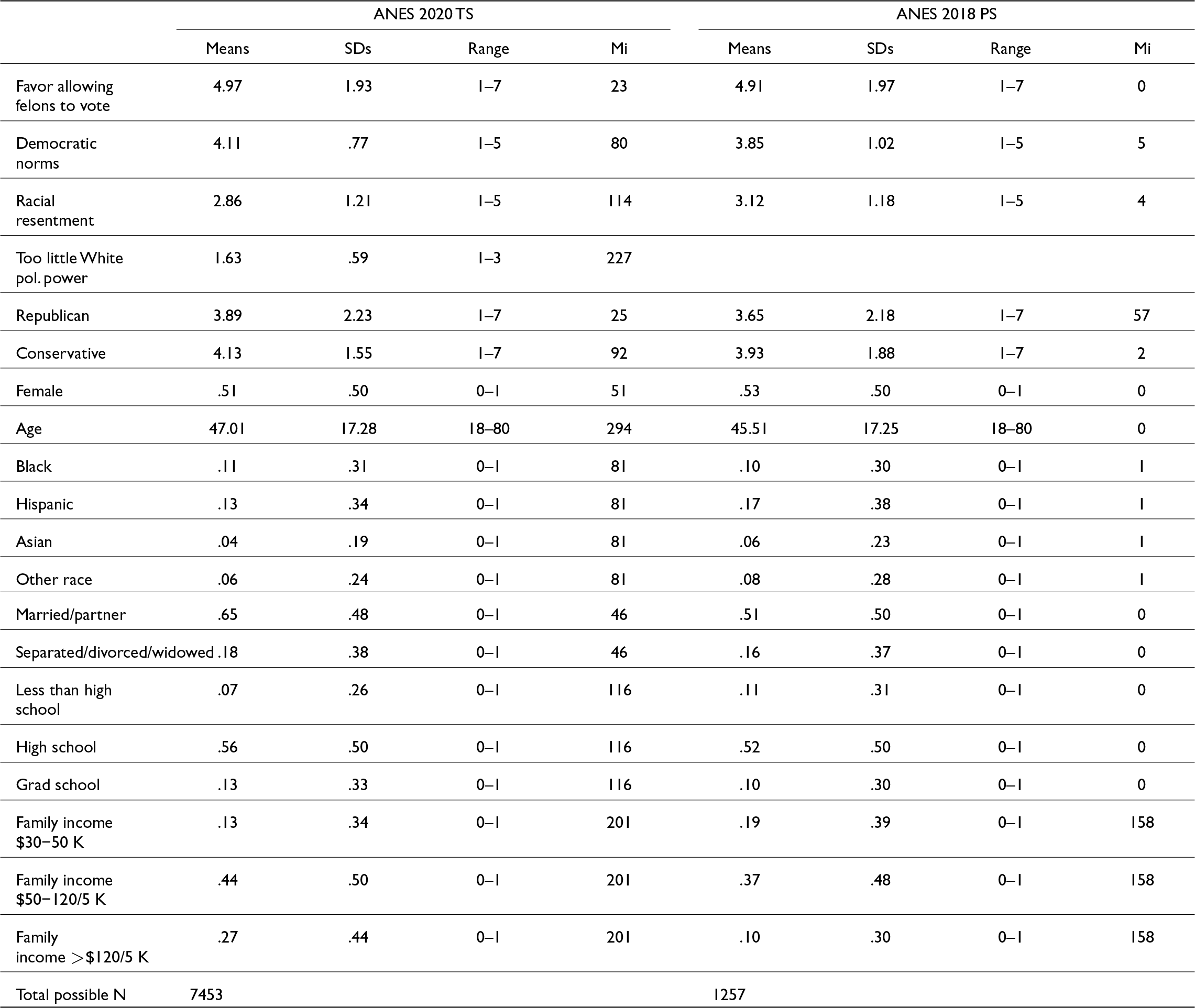
Table 1 presents means, standard deviations, ranges and the number of missing values for variables separately for the two surveys. In both studies, respondents were asked whether (and how strongly) they favored or opposed allowing “convicted felons” to vote once they complete their sentence. To capture commitment to democratic norms, respondents were asked how important a series of democracy-sustaining principles (e.g. free press, checks and balances, accountability, shared facts) were “to the United States maintaining a strong democracy.” In both surveys, we use a measure of racial resentment to capture people’s concerns about the relative position of Black and White Americans, though for the 20TS, we also explore a direct measure of concerns about White political power.
Means, standard deviation, range and missing values for the two surveys

Table 1 Long description
The table reports descriptive statistics for two ANES surveys, comparing 2020 Time Series and 2018 Pilot Study measures using means, standard deviations, ranges, and counts of missing cases. Support for allowing felons to vote is similar across surveys, averaging 4.97 in 2020 TS and 4.91 in 2018 PS on a 1 to 7 scale. Democratic norms are higher in 2020 TS at 4.11 than in 2018 PS at 3.85 on a 1 to 5 scale, while racial resentment is lower in 2020 TS at 2.86 than in 2018 PS at 3.12 on a 1 to 5 scale. Party identification and ideology are slightly higher in 2020 TS, with Republican at 3.89 versus 3.65 and Conservative at 4.13 versus 3.93 on 1 to 7 scales. Demographics are broadly similar: female is about one half in both, average age is about 47 in 2020 TS and 46 in 2018 PS, and race and ethnicity indicators differ modestly, such as Hispanic at 0.13 versus 0.17. Income and education distributions show some differences, including a higher share in the highest income category in 2020 TS at 0.27 compared with 0.10 in 2018 PS. One item, “Too little White political power,” appears only for 2020 TS with a mean of 1.63 on a 1 to 3 scale. Missing data vary by variable and are often higher in 2020 TS, and the two surveys use different weighting approaches, so comparisons should be interpreted cautiously. The total possible sample size is 7,453 for 2020 TS and 1,257 for 2018 PS.
SDs: standard deviations; mi: # missing cases.
Note: 20TS results reflect complex survey weights; 18PS results reflect simple survey weights.
Missing data were relatively rare, but we employed multiple imputation. We use survey weights to account for sample design and attrition. The results from ordinal and linear models were substantively identical, so we present the latter for ease of interpretation. More information on the data, measures and methods – including survey designs, item wording and scale construction and more information on the models – are reported in Appendix A.
Results
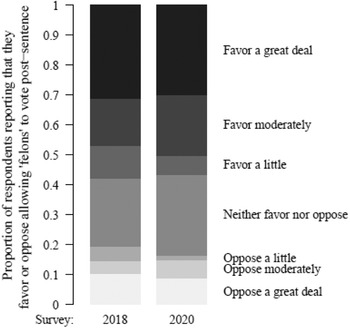
Figure 1 describes the basic distribution of responses to the key question for our paper: how strongly Americans favor or oppose allowing people convicted of a felony to vote after they finish serving their sentence. A majority of people favor allowing these people to vote – as Table 1 suggested, the average respondent to each survey favored the idea “a little.” Much smaller numbers oppose the idea, though a substantial number of respondents are not committed, reporting they neither favor nor oppose these voting rights. Interestingly, public opinion on this question appears relatively stable between 2018 and 2020.
Distribution of support or opposition to allowing people convicted of felonies to vote after completing their sentence.

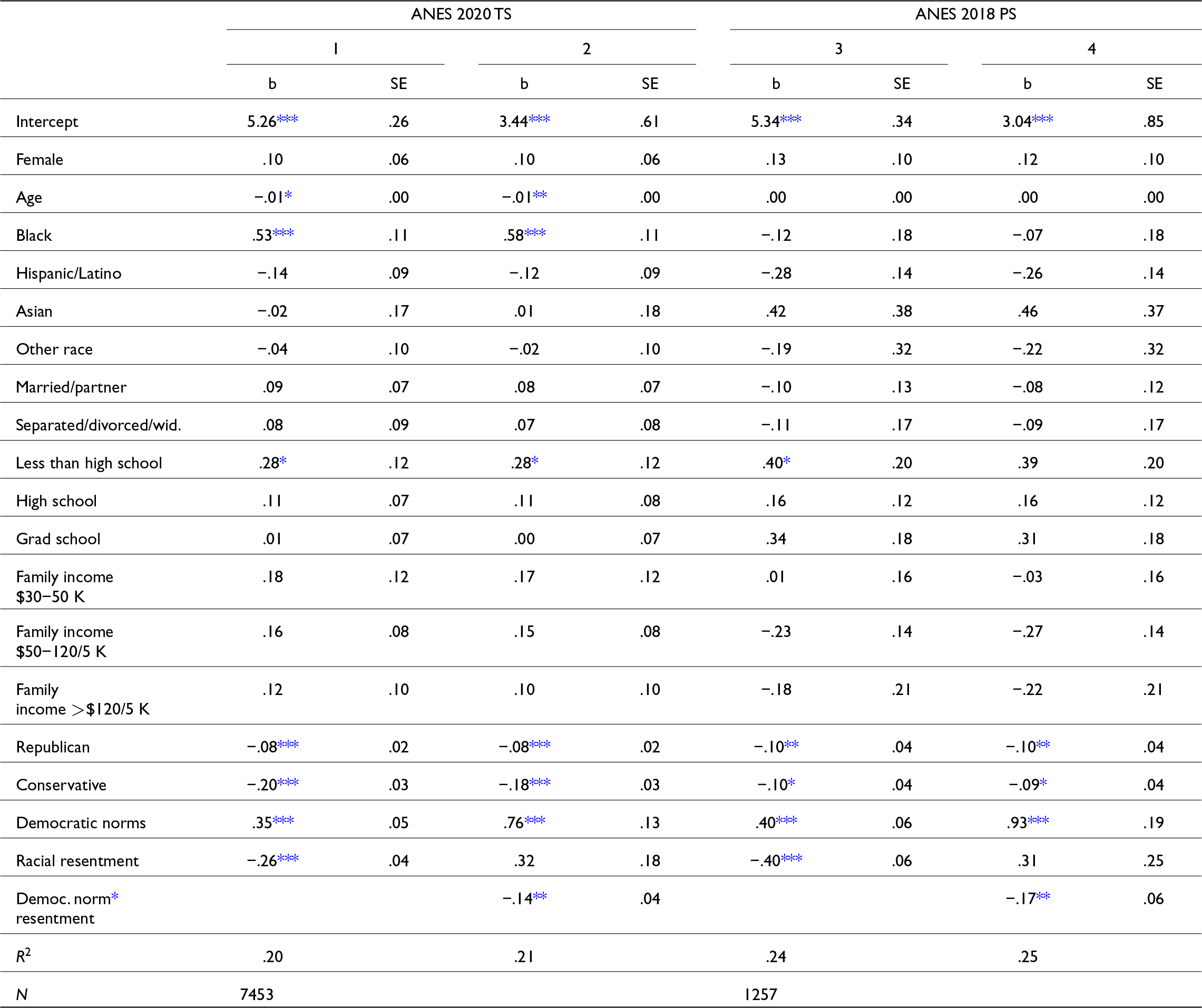
Table 2 presents the results of basic models predicting support for allowing convicted felons to vote once they have completed their sentence (column 1 for the 20TS and column 3 for the 18PS). In both surveys, those who identify as Republican and conservative are less likely to support the idea of allowing convicted felons to vote after they have completed their sentence. Also in both surveys, those with less than a high school education were more likely than those with a college education to support this voting right.Footnote 5 In the 20TS, Black respondents were more likely to support the idea than White respondents, as were younger respondents relative to older respondents.
Regression coefficients and standard errors from ordinary least squares models predicting support for allowing people convicted of felonies to vote after they complete their sentence
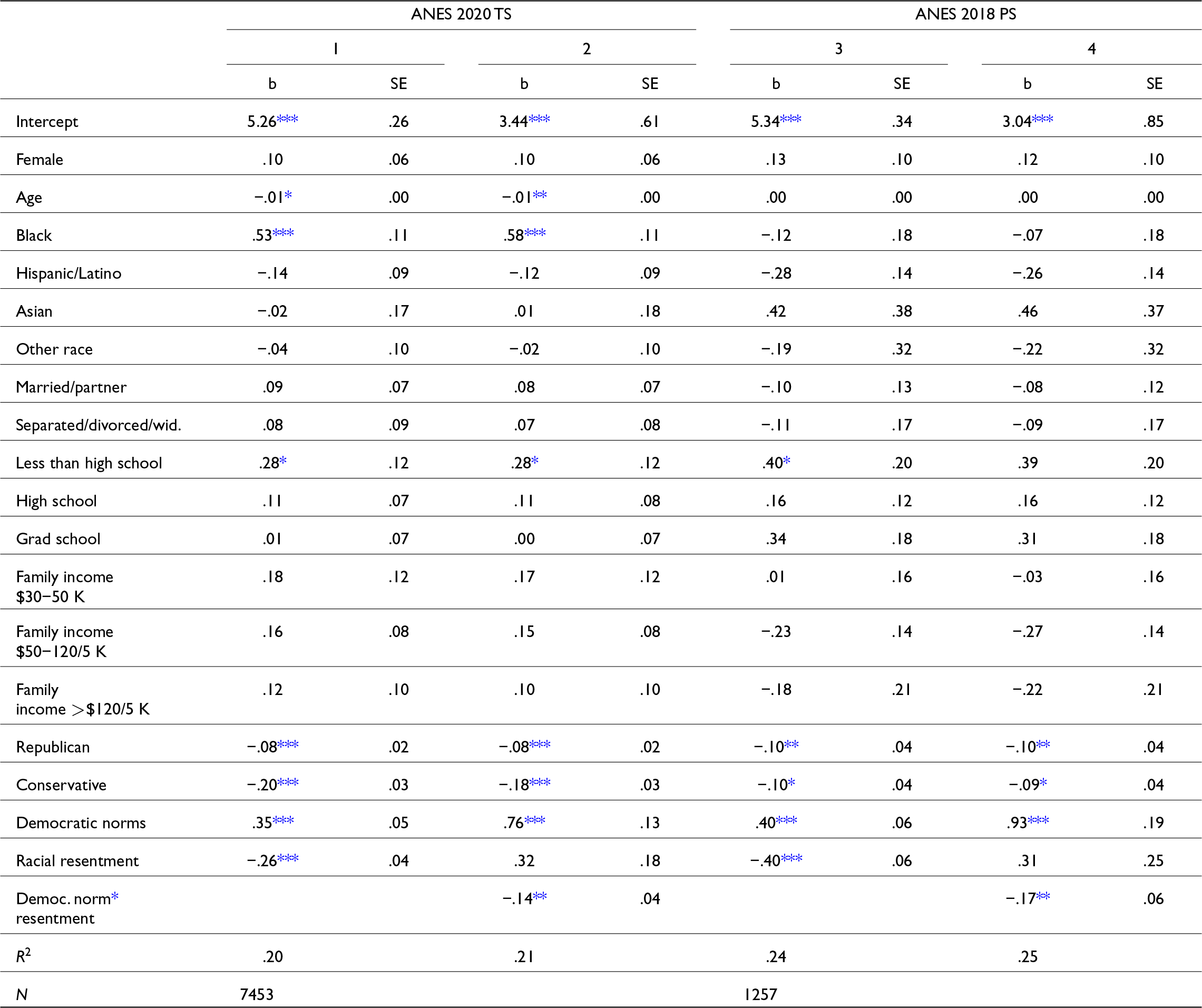
Table 2 Long description
The table reports ordinary least squares regression results predicting support for allowing people with felony convictions to vote after completing their sentence, using ANES 2020 and ANES 2018 samples with four model specifications. In both datasets, democratic norms are a strong positive predictor, increasing from about 0.35 to 0.76 in ANES 2020 and from about 0.40 to 0.93 in ANES 2018 across models, with small standard errors. Republican identification and conservatism are consistently negative and statistically reliable in all models, with coefficients around negative 0.08 to negative 0.10 for Republican and negative 0.09 to negative 0.20 for conservatism. Race effects differ by dataset: in ANES 2020, Black respondents show higher support (about 0.53 to 0.58), while in ANES 2018 the Black coefficient is small and not statistically reliable; Hispanic, Asian, and other race coefficients are generally not statistically reliable. Age is slightly negative in ANES 2020 but near zero in ANES 2018; female and most marital status and income categories show small, mostly non-significant associations. Racial resentment is negative and statistically reliable in the baseline models for both datasets, but becomes statistically unreliable when the interaction with democratic norms is included; the interaction term is negative and statistically reliable in both datasets, indicating the positive association of democratic norms is weaker at higher resentment. Model fit is modest, with R squared around 0.20 to 0.21 in ANES 2020 and 0.24 to 0.25 in ANES 2018, and sample sizes of 7,453 and 1,257 respectively. Coefficients describe associations in these samples and do not by themselves establish causation.
* p < .05.
** p < .01.
*** p < .001.
Democratic norms
Even after controlling for these factors, respondents who support democratic norms – respondents who reported believing that a free press, checks and balances, political accountability and political communication and debate are important to maintaining a strong democracy – were more likely to favor allowing convicted felons who completed their sentence to vote. In substantive terms, in the 2020 TS, a one standard deviation increase in support for democratic norms – the equivalent of rating the various norms about three-quarters of a category more important to democracy on a five-item scale – is associated with an increase of a little more than a quarter of a point (on a 7-point scale) in people’s support for allowing people convicted of a felony to vote.
In other words, amidst evidence of a declining commitment to democratic norms, we found that variations in this commitment were relevant to support for ending felony disenfranchisement (consistent with hypothesis H1). Those with a greater belief in the tools and mechanisms that ensure a healthy democracy supported extending voting rights to those formerly convicted of a felony.
Racial threat
On the other hand, those high in racial resentment – those who are resentful of efforts to disrupt the racial status quo – were more likely to oppose the idea (consistent with hypothesis H2). A one standard deviation increase in racial resentment – the equivalent of an increase of 1.2 categories on the five-item agreement scales with the racial ideologies – is associated with a decrease in support by nearly a third of a point. For comparison, a similar-sized increase in conservative identification is associated with a drop in support nearly as large as that of racial resentment, while a similar increase in Republican identification is associated with a drop in support of only about one-sixth of a category.Footnote 6
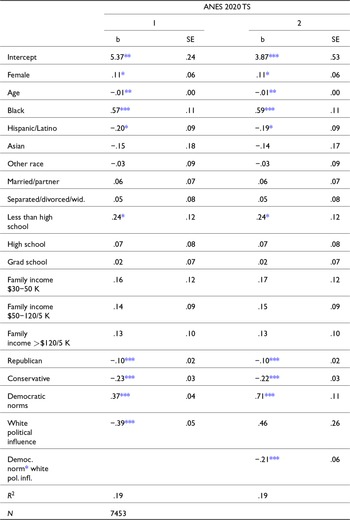
Table 3 presents models identical to those in Table 2 but substituting a new measure of racial ideology: beliefs about White Americans’ political influence. Model 1 in Table 3 suggests that concerns about White political influence are associated with opposition to the idea of ending felony disenfranchisement. This finding is more evidence for our second hypothesis (H2), using a different measure of a racial ideology concerned with racial threat.
Regression coefficients and standard errors from ordinary least squares models predicting support for allowing people convicted of felonies to vote after they complete their sentence

Table 3 Long description
Two ordinary least squares models estimate how demographics and political attitudes relate to support for restoring voting rights after sentence completion, using ANES 2020 Time Series data. In both models, support is higher for Black respondents (about six tenths of a point) and slightly higher for women (about one tenth), while it is lower with age (about one hundredth per year). Hispanic or Latino respondents show a small negative association (about two tenths), while Asian and other-race coefficients are small and not clearly different from zero. Partisanship and ideology show negative associations: identifying as Republican is linked to about one tenth lower support, and being conservative to about two tenths lower support. Endorsement of democratic norms is strongly positive in both models, increasing from about four tenths in model 1 to about seven tenths in model 2. Model 2 adds perceived White political influence and its interaction with democratic norms; the interaction is negative, and the main effect of White political influence is imprecise and not clearly different from zero. Model fit is similar across models (about 0.19 explained variance) with a sample size of 7,453, and coefficients should be interpreted as associations rather than causal effects.
* p < .05.
** p < .01.
*** p < .001.
Thus, Americans who held a racial ideology (racial resentment) consistent with the maintenance of racial inequalities were opposed to abandoning felony disenfranchisement. Those who were concerned about White Americans having too little political power felt the same way. Given the inseparability of people’s concerns about threats to White social, economic, and political power, we see these two findings as telling the same story: that people who want to preserve White privileges appreciate the racially disproportionate consequences of felony disenfranchisement.
Intersection: where democratic norms meet perceived threats
Our key question, however, concerns the interaction of these last two sets of views: do people’s racial views condition the influence of their broader views about democracy on support for this specific guarantee of the right to vote? Columns 2 and 4 of Table 2 present models identical to those above but with the addition of an interaction between support for democratic norms and racial resentment.Footnote 7 In both cases, the interaction is significant, supporting our third hypothesis (H3). Model 2 in Table 3 examines the interaction between concerns about White political power and a commitment to democratic norms, once again finding a significant interaction (more evidence for H3).
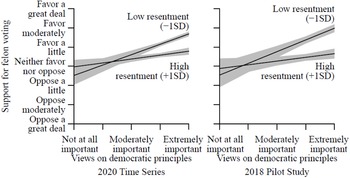
Figure 2 presents predicted values from this model, holding all other variables at their means. Few respondents strongly rejected the democratic norms – a belief in the importance of the tools and mechanisms that foster a healthy democracy – but interesting differences emerge between those who view the democratic norms as moderately important versus extremely important. Among those low in racial resentment, a commitment to democratic norms increases support for ending felony disenfranchisement. Among those high in racial resentment, on the other hand, this relationship is much more muted, producing very little increase in support for ending felony disenfranchisement.
Selected predicted values of support for ending felony disenfranchisement from the interaction of support for democratic norms and racial resentment (holding other variables at their means).

Figure 2 Long description
The graphs depict predicted support for ending felony disenfranchisement based on the importance of democratic principles and levels of resentment. The left graph is labeled ′2020 Time Series′ and the right graph ′2018 Pilot Study.′ Both graphs have the x-axis labeled ′Views on democratic principles,′ with categories: ′Not at all important,′ ′Moderately important,′ and ′Extremely important.′ The y-axis is labeled ′Support for felon voting,′ with levels ranging from ′Oppose a great deal′ to ′Favor a great deal.′ Each graph shows two lines: one for low resentment (minus 1 standard deviation) and one for high resentment (plus 1 standard deviation). In both graphs, support increases with the importance of democratic principles. The increase is more pronounced for low resentment levels, while high resentment levels show a muted increase. The lines do not converge or cross, indicating consistent differences between resentment levels across the importance spectrum.
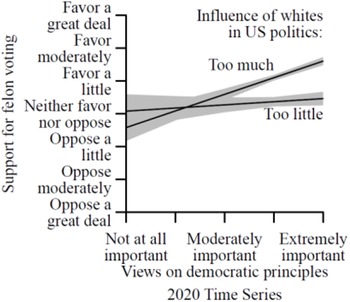
As Figure 3 shows, among those who believe that White people have too much political influence, support for democratic norms is associated with an increase in support for ending felony disenfranchisement. Among those who believe that White people have too little political power, on the other hand, support for democratic norms has, at best, a marginal relationship to support for ending felony disenfranchisement.
Selected predicted values of support for ending felony disenfranchisement from the interaction of support for democratic norms and white political influence (holding other variables at their means).

In other words, although support for democratic norms – a belief in the importance of the mechanisms of a healthy democracy – was strongly associated with support for ending felony disenfranchisement, this effect was only true of those who were not preoccupied with maintaining and reinforcing White social, economic, or political power.
Discussion and conclusion
Democracy is central to America’s self-image, and yet the laws governing its citizens’ civic rights have always been exclusionary. Voting restrictions have long been a primary mechanism by which White political privilege is enacted and protected. Felony disenfranchisement laws continue a long tradition of legal voting restrictions that disproportionately impact Black Americans. These laws emerge from specific historical contexts, which help determine both the barriers to and opportunities for change. In exploring the context of the current era – one characterized both by a large Civil Rights Movement and by a racist counter-movement (Drakulich and Denver Reference Drakulich and Denver2022; Parker Reference Parker2016) – we sought to illuminate the competing ideologies that shape how people think about the civic rights of others.
Specifically, we frame our question as concerning relational rights consciousness: how do people determine their support for the voting rights of others? We develop a model rooted in the social and cultural context in which legal socialization works to influence rights consciousness. Specifically, we identify competing forces emerging from the base conflict between democratic ideals and group interest.
We find evidence that a commitment to democratic norms increases support for extending voting rights to those formerly convicted of a felony. At the same time, Americans who held a racial ideology (racial resentment) consistent with the maintenance of racial inequalities were opposed to abandoning felony disenfranchisement.
Although racial threat, as we found, directly weakens commitments to democratic practices, the ultimate goal of racial threat is not necessarily to destroy democracy, but simply to preserve privilege. In this light, we also expected racial threat to operate by weakening or severing the tie between a commitment to democratic norms and support for democratic changes that might threaten those norms. We found evidence of this expectation in a significant interaction between a commitment to democratic norms and a desire to preserve group privileges. In other words, some Americans selectively support the practice of democracy – as long as it does not threaten status quo inequalities.
Implications for law, society theory and research
We start with our most basic and portable general finding: that people’s understandings of and support for the rights of others – a form of relational rights consciousness – is shaped by a conflict between a commitment to democratic norms and concerns about threats to group privileges. A democracy requires widespread commitment to democratic principles, but is often threatened by people’s commitments to preserving group inequalities. Consequently, we see the tensions of this intersection as likely relevant not just to different dimensions of relational rights consciousness, but also legal consciousness more generally.
Our key finding has significant implications for our understanding of legal and rights consciousness. Legal and rights consciousness is produced through legal socialization in specific social locations and can either stabilize or contest hierarchy (Chua and Engel Reference Chua and Engel2019; Engel Reference Engel2012; Ewick and Silbey Reference Ewick and Silbey1998; McCann Reference McCann, Fleury-Steiner and Nielsen2006; Silbey Reference Silbey2005). We examine this process for relational rights socialization (Chua and Engel Reference Chua and Engel2019; Nielsen Reference Nielsen2024, Reference Nielsen2009; Young and Chimowitz Reference Young and Chimowitz2022) – specifically, whether people support extending basic civil rights to others. Positive socialization into legal and rights consciousness occurs through formal and informal socialization on democratic principles (Conway et al. Reference Conway, Damico, Damico, Farnen, Dekker, Meyenberg and German1996; Flockhart Reference Flockhart and Flockhart2005; Gimpel et al. Reference Gimpel, Lay and Schuknecht2003; Heyne Reference Heyne2019), state and legal messaging that explicitly nurtures civic identities (Cohn et al. Reference Cohn, Trinkner, Rebellon, Van Gundy and Cole2012; Fagan and Tyler Reference Fagan and Tyler2005; Justice and Meares Reference Justice and Meares2021) and participatory, relational contexts – especially social movements and family and community networks – that supply rights language, model claims-making and create frame resonance for recognizing one’s own and others’ rights (Abrego Reference Abrego2019; Chua Reference Chua2015; Güdük and Desmet Reference Güdük and Desmet2022; Heyer Reference Heyer2015; Hull Reference Hull2016; Vanhala Reference Vanhala2010).
However, we find that these pro-social beliefs are only selectively related to actual support for others’ rights. Even among those who endorse democratic norms, support for others’ law-in-action rights is selective and contingent on perceived group threat (Bartels Reference Bartels2020; Blumer Reference Blumer1958; Bobo and Hutchings Reference Bobo and Hutchings1996; Jana and Kelly Reference Jana and Kelly2025). This finding reframes “commitment to democracy” as a conditional, relational disposition. In other words, democratic ideals alone do not guarantee support for others’ rights. Where modern racial ideology heightens perceived group-position threat, it conditions the translation of those ideals into policy support – helping explain how law’s legitimacy endures alongside exclusions.
Although we focus on eliminating a key barrier to voting – felony disenfranchisement – we see this model as potentially relevant to understandings of civic and other legal rights more broadly, including other barriers to voting, citizenship, holding public elected office, serving on juries and – in a more basic sense – rights to protest, assembly and speech.
This work has other implications for socio-legal research. Legal consciousness research has explored in great depth how people understand their own legal rights. But we think it is also important to identify how people think about others’ legal rights – here, their civic rights specifically. We also believe there is value in studying legal and rights consciousness not just among those in marginalized spaces, but also those in privileged spaces, so as to better understand the kinds of consciousness that help repress mobilization and maintain hegemonic systems. Doing so places work on legal consciousness in fruitful conversation with work on democracy as well as with repressive forces such as racial threat.
It also has implications for socio-legal work on felony disenfranchisement. Particularly, existing work on the role of racial threat may benefit from the consideration of other interrelated factors, including a commitment to democratic norms, which we show to have a direct relationship with support for felony voting rights, but also, critically, a relationship conditioned by racial threat. Historical and institutional accounts link racial threat to exclusionary voting rules and feedback loops that entrench them (Behrens et al. Reference Behrens, Uggen and Manza2003; Manza and Uggen Reference Manza and Uggen2006; Uggen et al. Reference Uggen, Behrens and Manza2005; Uggen and Manza Reference Uggen and Manza2002). Our results identify an individual-level mechanism by which institutions are protected: group threat can condition the effects of democratic socialization.
Critical race theory emerged in the aftermath of the Civil Rights Era, amidst a backlash and an erosion of the legal protections gained in that era. In this context, theorists were suspicious of a colorblind liberalism that pervaded some of the politics of civil rights legislation and legal doctrine (Bell and Derrick Reference Bell and Derrick1975; Crenshaw Reference Crenshaw1988; Freeman Reference Freeman1977). The case of felony disenfranchisement laws provides plenty of evidence to support this suspicion. We hope the illumination of these protective mechanisms is a useful way for this social science research to contribute to critical race theory (see Carbado and Roithmayr Reference Carbado and Roithmayr2014). Specifically, we argue that there are multiple ways we can provide evidence of systemic racism in supposedly colorblind systems. One method is to look at the outcomes of the policies, in this case, evidence of a clearly disproportionate impact of felony disenfranchisement laws on Black Americans (Uggen et al. Reference Uggen, Larson, Shannon and Stewart2022). A second is to look at racist intent in the creation of the laws (Behrens et al. Reference Behrens, Uggen and Manza2003). But a third is to look for evidence in the motivations behind the public support that helps sustain and preserve biased laws (Drakulich et al. Reference Drakulich, Robles, Rodriguez‐Whitney and Pereira2023). Crenshaw (Reference Crenshaw1988, 1387) calls for a clearer understanding of the space Black Americans “occupy in the American political consciousness.” To this end, we have identified evidence of the persistent role of an ideology designed to protect White privilege, one which seems to subvert the supposed democratic ideals the country is proud to extoll.
In other words, where critical legal and race perspectives argue that formally neutral law can entrench hierarchy (Bell Reference Bell2000; Carbado and Roithmayr Reference Carbado and Roithmayr2014; Delgado and Stefancic Reference Delgado and Stefancic2012), we provide attitude-level evidence for the protective ideologies that sustain such entrenchment: modern racial ideologies that decouple democratic commitments from support for others’ rights (Bobo et al. Reference Bobo, Kluegel, Smith, Tuch and Jack1997; Bobo and Smith Reference Bobo, Smith, Katkin, Landsman and Tyree1998; Bonilla-Silva Reference Bonilla-Silva2018; Kinder and Sears Reference Kinder and Sears1981).
Broader social implications
America has long fallen short of its promise of democracy. It has been, since its founding, an exclusionary democracy, extending the right to vote in many places initially only to land-owning White men (Waldman Reference Waldman2022). This exclusion was a critical component of the political and legal structures that built and now protect disproportionate White wealth and well-being (Baptist Reference Baptist2016; Kendi Reference Kendi2017). After the 15th Amendment (and eventually the 19th) expanded voting rights, Jim Crow laws effectively suppressed many Black voters into the latter half of the 20th century. Many of these restrictions were struck down during the Civil Rights Era, particularly by the Voting Rights Act of 1965. But one significant restriction remained: a loophole allowing the denial of voting rights as a punishment for crime. Just as Jim Crow laws eroded the effectiveness of the 15th Amendment, the persistence of felony disenfranchisement and the rise in felony convictions eroded the effectiveness of the Voting Rights Act.
In theory, the implication is that voting rights are only lost through due process. In practice, the power to remove these rights rests in a criminal legal system that has long secured White privilege and ensured the exploitation and control of Black people. After all, chattel slavery was legal, as were the Jim Crow statutes authorizing discrimination and segregation. Black Americans remain disproportionately exposed to punishment under this system, and thus Black Americans disproportionately suffer the loss of their political voice under felony disenfranchisement.
Felony disenfranchisement acts in the Era of Mass Incarceration, as poll taxes, literacy tests and grandfather clauses did in the Jim Crow Era. Although felony voting restrictions often predated these Jim Crow voting restrictions, mass punishment has greatly magnified their effect (Behrens et al. Reference Behrens, Uggen and Manza2003; Keyssar Reference Keyssar2009). Despite the explicitly racist roots of these voting restrictions, the modern system is justified by a colorblind racist logic that intentionally minimizes the role of racism to portray unequal outcomes – including in the justice system involvement – as ultimately fair.
The basic components of this story – a conflict between the democratic ideal and group interests – are applicable at any time in the country’s history. The volume of the conflict produced by this tension, however, has peaks and valleys. The dismantling of Reconstruction and establishment of Jim Crow laws was one (Du Bois Reference Du Bois1935), as was the Civil Rights Movement and subsequent backlash and rise of mass punishment (Tonry Reference Tonry2011; Wacquant Reference Wacquant, Blomberg and Cohen2003). This study is situated amidst another: the symbolically important election of Barack Obama as president, status fears about demographic change, the rise of the reactionary Tea Party, the emergence of the Black Lives Matter Civil Rights Movement and the surge of a White nationalist “alt-right” movement (e.g. Hochschild Reference Hochschild2016; Isom Reference Isom2023; Parker Reference Parker2016; Parker and Barreto Reference Parker and Barreto2013; Parker et al. Reference Parker, Sawyer and Towler2009; Smith Reference Smith2020; Taylor Reference Taylor2016). Thus, the alt-right movement relevant to the election and eventual re-election of Donald Trump as president is the continuation of a pattern rather than the invention of something wholly new.
In other words, this era is a moment of particularly pronounced and vocal concerns about threats to White privilege. Not coincidentally, it is also a moment when the public’s commitment to democracy is less firm (Bartels Reference Bartels2020; Jana and Kelly Reference Jana and Kelly2025; Jardina and Mickey Reference Jardina and Mickey2022; Lindsay Reference Lindsay2023; Morgan et al. Reference Morgan, Christiani and Kelly2024). Election crime units and the aggressive prosecution of Black Americans for supposed voter fraud represent particularly visible instances of this synergy of racial threat and anti-democratic practice (Uggen et al. Reference Uggen, Larson, Shannon and Stewart2022). As we find, even a commitment to democratic norms is not enough to generate support for ending this anti-democratic practice in the face of concerns about threats to group privileges.
This story has implications for civil and civic rights. Disproportionately disenfranchising parts of the population makes it harder for those parts to fight that disenfranchisement. The latter 2010s bore witness to a massive racial Civil Rights Movement in Black Lives Matter, focusing in particular on police abuses. But if the communities most impacted by these abuses are also the most disenfranchised (Burch Reference Burch2013), political solutions become more difficult. Similarly, amidst attacks on Civil Rights Era voting protections, the defenses to those attacks have been substantially weakened.
As we argue, synergistic injustices in the criminal legal system and voting rights laws are mutually reinforcing and collectively self-sustaining. Felony disenfranchisement sets in motion a dangerous and self-reinforcing cycle wherein votes to increase punitiveness, by increasing felony convictions, may increase the margin by which similar votes will pass in the future (Uggen and Manza Reference Uggen and Manza2002). As an example, restrictions on abortion rights benefit electorally when people can be charged with a felony for receiving an abortion. Felony drug convictions protect criminalizing approaches to drug use and abuse.
Although America started with an extremely exclusionary democracy, it has made significant progress in increasing suffrage. However, those same exclusionary motives appear to be powering opposition to continuing progress toward a more truly inclusive democracy.
Supplementary material
The supplementary material for this article can be found at https://doi.org/10.1017/lsr.2026.10088.
Funding statement
The authors did not receive funding to conduct this research.
Competing interest statement
The authors report that there are no competing interests to declare.


 Open access

