




1. Introduction
In this article, we investigate a variety of French that is relatively unknown to the general public and linguists alike: MichifFootnote 1 French (MF). It is one of the oldest living offshoots of the Laurentian French (LF) diaspora.Footnote 2 It is still currently spoken by a dwindling number of speakers in the provinces and territories west of Ontario, and perhaps in the Turtle Mountain area of North Dakota. The French language was originally brought to the northern Great Plains of North America during the last third of the eighteenth century by the French-speaking employees of the various fur trading companies, such as the North West Company, the Hudson’s Bay Company and the American Fur Company. Many of these men took Indigenous wives “à la façon du pays” (according to local Indigenous customs) mostly of Ojibwa/Chippewa, Cree, Assiniboine or Dené tribes. The offspring of these unions learned their first language from their mothers: Saulteaux (Plains Ojibwa/Nahkaweewin), Plains Cree (Neehiyaweewin), Assiniboine (Nakoda) or Chipewyan (Denesuline). Sometimes later, they also learned as their second language, the speech of their fathers, a vernacular variety of the French of New France, and it remained the second language for a number of Métis well into the twentieth century (St-Onge, Reference St-Onge2004).
In succeeding generations, the French spoken by the Métis developed on its own with continued grammatical and phonetic influence from either Saulteaux, Cree or Dené,Footnote 3 and from the 1950s on, MF borrowed more and more lexicon from English. After the 1850s, Métis children were often – but for many, only briefly – educated in French, and thus what has been called “Mission French”, i.e. the Standard French (henceforth SF) spoken by the missionaries and nuns from Quebec or Europe, has had some influence on the evolving language. In 1870, when the province of Manitoba was created under the leadership of the Métis leader, Louis Riel, a good proportion of the population mostly spoke MF. Nevertheless, due to the encroaching presence of thousands of settlers from Ontario and elsewhere, many Métis left Manitoba westward for what are now the provinces of Saskatchewan and Alberta, as well as north to the Northwest Territories. Of course, they brought their vernacular with them.
It is extremely difficult to determine the current number of speakers of MF since the Census Canada questionnaire dealing with language aims to determine whether or not a respondent knows or speaks French, not which variety (vernacular or SF). Basically, there is a single community in Canada where MF is still used by a significant, but declining, proportion of the population: St. Laurent, Manitoba. Elsewhere, a few elderly speakers may be found in a number of villages where the Métis have historically settled, but none have enough speakers to be considered as a ‘viable living language community’ (Barkwell, Reference Barkwell2016; Dandeneau et al., Reference Dandeneau, Turenne, Perreault, Penner and Kirmayer2012).
To date, MF has been the subject of a number of studies, most of them being of a descriptive, comparative or ethnolinguistic nature (Douaud, Reference Douaud1985; Marchand and Papen, Reference Marchand, Papen, Leray and Manzano2003; Papen, Reference Papen1998, Reference Papen2002, Reference Papen, Coveney, Hintze and Sanders2004, Reference Papen2018; Rosen and Lacasse, Reference Rosen and Lacasse2014). So far, only three sociolinguistic studies have focused on MF (Mougeon et al., Reference Mougeon, Hallion Bres, Papen and Bigot2010, Reference Mougeon, Hallion Bres, Bigot and Papen2016; Papen and Bigot, Reference Papen and Bigot2010), and to our knowledge, none has been published in English. As a result, MF remains a particularly unknown variety of French to sociolinguists and, of course, to the public at large. Yet, its relatively distant Laurentian origins make it a prime choice for studies on the filiation of the varieties of French spoken in North America. However, one of the challenges this variety of French represents is its dramatic decline, making corpora for sociolinguistic analysis extremely rare. There is consequently an urgent need to exploit and publish the few data still available to the sociolinguistic community.
Therefore, the purpose of the present research is twofold: to introduce MF to a wider audience, and to deepen knowledge of its sociolinguistic properties. To this end, we examine the variation in the realization of the forms tout [tu], toute [tʊt], tous [tu]/[tʊs] and toutes [tʊt] ‘all/every’, in the unique phonetic form [tʊt].Footnote 4
First, we discuss a few typical features of MF. In the following section, we focus on the St. Laurent (Manitoba) community. In Section 4, we summarize previous research on [tʊt]. Finally, we present the results of our analyses, then conclude with a general discussion.
2. The divergence of Michif French
As mentioned in note 1, the term Michif refers to a specific ethnic identity, namely the Métis, one of the three Indigenous Peoples recognized by the Canadian Constitution of 1982. MF, while definitely being a vernacular variety of LF, is said to be divergent because it exhibits several features not found in most other varieties; for instance, the possessive construction Possessor+Possessive marker+Possessed, typical of Algonquian languages (Wolfart, Reference Wolfart1973), as in (1):

The equivalent structure in Cree is as in (2):

The -a suffix on the Possessed indicates the obviative case (also called ‘fourth person’), required in 3rd person possessives.
Other typical Algonquian structures frequently found in Michif French are the detachment of numerals from their original sites as in trois mes enfants ‘my three children’, where the SF form is mes trois enfants and the obligatory use of possessive determiners with inalienable possessions, such as kinship terms, as in une autre ma nièce ‘another niece of mine’. Neither Cree nor Ojibwa has masculine/feminine gender and so many Métis French speakers tend to ignore French third person pronominal gender distinctions and use either the masculine form for both genders, as in (3a) or the neuter pronoun ça, as in (3b):

Other grammatical features unique to Michif French are the possessive pronouns c’la d’mwé, c’la d’twé, c’la d’nous-aut’, etc. (lit. ‘that of me’, ‘that of you’, ‘that of us’) for ‘mine, yours, ours’, etc., and three interrogative structures, as in (4):

In SF, the preposition à is not allowed in constructions such as (4a); the use of oubendon (< SF ou bien donc) in interrogatives involving a choice or ehben ‘well’ as a neutral question marker have not been noted anywhere in the French-speaking world.
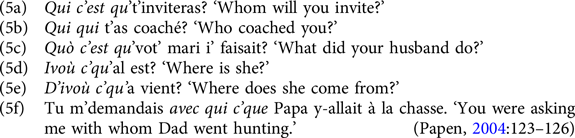
As a conservative vernacular variety of LF, MF retains many of the phonetic, grammatical, and lexical features typical of the vernacular French spoken in the nineteenth and early twentieth centuries in Quebec. Phonetically, for example, words such as neige ‘snow’, père ‘father’, treize ‘thirteen’, etc., are pronounced with a mid-closed front vowel ([e]) rather than with the mid-open vowel ([ɛ]) of SF (Morin, Reference Morin1994); orthographic oi, as in moi ‘me’, toi ‘you’, loi ‘law’, etc., is typically realized as [wɛ] or [we], rather than the SF [wa] (Picard, Reference Picard1974); the rhotic is regularly realized as an alveolar trill [r] rather than a uvular fricative [ʁ] (Cedergren, Reference Cedergren1985). Morphologically, many irregular verbs are regularized or modified: ils s’assoient/s’asseyent ‘they sit’ is realized as ils s’assisent; il fallait ‘it was necessary’ as (il) faulait; ils rient ‘they laugh’ as ils risent; and venir ‘to come’ is viendre. Interrogatives (both direct and indirect) are often complex, as in (5):
Lexically, Michif French has maintained a high number of words that have mostly disappeared in current Quebecois French, such as crire (from quérir) ‘to fetch’, crémone ‘shawl’, soupane ‘gruel’, reinquier ‘backbone’, and has created a number of words unknown elsewhere, such as jus de couvarte (lit. blanket juice) ‘bootleg alcohol’, flécheur ‘liar, who exaggerates’ and piquerelle ‘pretty young girl’, etc. Furthermore, MF has maintained several French lexical items but has given them new meanings, e.g. biche, ‘doe’ in SF, refers to ‘elk’ in MF, catin refers to ‘doll, call girl’ in SF but means ‘girlfriend’ in MF, and boulet ‘fetlock’ means ‘ankle’ (Papen, Reference Papen2012).
As mentioned in the introduction, only three variationist sociolinguistic studies focus on MF. First, Mougeon et al. (Reference Mougeon, Hallion Bres, Papen and Bigot2010) examine the alternation of the 1st person singular semi-auxiliary forms expressing the Future je vais/je vas/m’as/je m’en vais/je m’en vas + Infintive ‘I am going to + Infinitive’ in four LF corpora. The authors document that MF diverges significantly from Quebec, Ontario, Manitoba, and Alberta varieties of French with a much greater use of the vernacular form m’as. Another divergence of the MF corpus lies in the lack of influence of socioeconomic status and gender factors on variation, a result that contrasts with the effect of these two factors on je vais and/or m’as in the other corpora. Mougeon et al. (Reference Mougeon, Hallion Bres, Papen and Bigot2010) suggest that these divergences could be symptomatic of a high level of socio-cultural cohesion within the Michif community.
Papen and Bigot (Reference Papen and Bigot2010) analyze the use of irregular 3rd person plural forms of the Imperfect tense of the verbs ‘to be’ (sontaient instead of étaient) and ‘to have’ (ontvaient instead of avaient). These forms also occur in other vernacular varieties of North American French (Golembeski and Rottet, Reference Golembeski, Rottet, Coveney, Hintze and Sanders2004) but are relatively infrequent. The authors reveal that MF differs in the clear predominance of these forms. Nevertheless, they note a point of convergence with Quebec and Ontario French studies, since in MF, these variants are also representative of the working classes and of men.
The latest variationist research on MF is by Mougeon et al. (Reference Mougeon, Hallion Bres, Bigot and Papen2016) on the expressions of restriction rien que/juste/seulement/seulement que/ne… que ‘only’, based on the same corpora as in Mougeon et al. (Reference Mougeon, Hallion Bres, Papen and Bigot2010). Once again, the MF data reveal three major divergences with other varieties. The first is the total absence of ne… que, the most standard variant, and the high prevalence of rien que, the most vernacular form. The second is that there is no influence of internal constraints on seulement (que), neither favored by verbs nor nouns, contrary to all the other varieties. Finally, the authors find no effect of social classes on the use of juste, rien que and seulement (que), a notable difference that could be attributed to the low normative pressure of the Michif community.
3. The Métis community of St. Laurent, Manitoba
In this section, we describe the community of St. Laurent. We begin with a short history of the community, followed by a brief demolinguistic overview.
3.1. A brief history of St. Laurent
The village of St. Laurent ['sejnt lɔ'ɹɛnt] is located 90 km northwest of Winnipeg, Manitoba, on the southeastern shore of Lake Manitoba. Well into the beginning of the 19th century, Métis communities were to be found throughout the West, including many in what was to become American territory, with Pembina, (immediately south of the Canada-US border in present-day North Dakota) being the most important. The Métis from the settlement found themselves to be in American territory, following the Convention of 1818, establishing the 49th parallel as the border between the United States and British North America. The Catholic clergy urged the Pembina Métis to relocate north of the border. A small number of them decided to settle in an area then called Fond du Lac ‘bottom of the lake’ north of the Red River Settlement (present-day Winnipeg).Footnote 7 In 1826, a number of Métis families were driven out of their homes in the Red River Settlement, due to the flooding of the Red River, and established themselves in Fond du Lac, where hunting, fishing and grazing were excellent. In 1858, a Catholic mission, named Saint-Laurent, was established to serve the forty odd families who had now settled there.
As in the Red River Settlement, the land was originally divided according to the French river lot (or ribbon farm) system of Quebec: a number of lakefront fields heading inland, measuring up to two miles long by less than 300 yards wide. Houses were thus scattered all over with no discernable community center, save for the church and cemetery, and later, a school and other administrative buildings.
Quite early on, the community was rather divided economically, socially and linguistically. According to Métis historian Nicole St-Onge (Reference St-Onge1984, Reference St-Onge1994, Reference St-Onge2004), in the mid-1800s, four Métis merchant families resided full-time in St. Laurent. They gardened and traded European goods for furs, salt, fish and birch sap syrup with the local Saulteaux and Cree population and ice fished during the winter. These families spoke Saulteaux and/or Cree as well as Michif French. A second group consisted of ‘freemen’ from Duck Bay, on the western shore of Lake Winnipegosis, who traveled down to St. Laurent in the spring to trade furs, salt, fish and syrup with the St. Laurent traders and spent the summers bison hunting in the Whitemud River area, west of Lake Manitoba, producing pemmican which they also traded with the commercial families of St. Laurent. These freemen mostly spoke Cree and Saulteaux and (perhaps) the mixed French-Cree hybrid (Michif) but their French was quite poor (St-Onge, Reference St-Onge2004: 15). Between 1865 and 1875, a third group of Métis settled in St. Laurent. These families came from the Red River Colony to the south, fleeing from social and economic strife. These Métis were mostly interested in gardening, commercial fishing or dairy farming and spoke Michif French. Between 1881 and 1891 the old Freemen and trading families as well as the more recent arrivals from the South were faced with the arrival of Catholic French-speaking farming families from Quebec and Massachusetts as well as a few titled families from France, seeking lucrative investment opportunities (St-Onge Reference St-Onge2004: 56).
In the early 1900s, important changes in the local population occurred as more than 120 Breton farmers (men, women and children) from the Finistère area of Britany, France, arrived in St. Laurent (Flatrès Reference Flatrès1959). These immigrants came with some capital and rapidly purchased land, where they undertook gardening, dairy farming and cheese production, while some became very successful ice fishermen. The Bretons were mostly bilingual, speaking both Breton and Continental French. According to St-Onge (Reference St-Onge2004: 81), these new settlers were recruited by the local clergy in the hope of “Frenchifying” and “whitening” the community. Indeed, some of local Métis who had become successful farmers were considered by the clergy as being “French Canadian” rather than “Métis”, and their children were registered as being of white race in the parish registers (St-Onge Reference St-Onge1994: 61). St-Onge (Reference St-Onge2004: 82) goes on to say that “the arrival of European settlers and their apparent success hardened the attitude of lay and church authorities towards the hunting and gathering element of the population.”
St-Onge (Reference St-Onge2004: 85) points out that these Métis tended to live in what was called the “Fort Rouge” (Red Fort), literally on the other side of the railroad tracks.Footnote 8 The fishing-farming families considered the Fort Rouge people “closer in appearance and custom to the Indians”, had few social contacts with them and “denied having relatives there.” Most of the Fort Rouge people still spoke Cree or Saulteaux to each other.
The community had two Catholic schools: a public school at the south end of the village and a private convent school at the north end, the teaching in both being totally in SF. Métis children would be severely punished if they spoke their Indigenous language or even MF. This resulted in a linguistic hierarchy in the community: Standard (Canadian) French, Michif French and Saulteaux/Cree (Lavallée Reference Lavallée2003).
These ethnic and linguistic divisions lasted until the early 1950s, when many younger Bretons married into Métis families and more and more French-speaking Métis became more prosperous. A number of English-speaking Mennonite farming families also settled in St. Laurent. Many of the Fort Rouge residents drifted away to Winnipeg and, according to St-Onge (Reference St-Onge1984) for all intents and purposes, the little community no longer exists. Yet, some of the former Fort Rouge residents St-Onge interviewed in 1984 still remembered how badly they had been treated by the other residents of St. Laurent (St-Onge, Reference St-Onge1984). It is interesting to note that neither Lavallée’s (Reference Lavallée1988) unpublished MA thesis, an ethnographic study of St. Laurent, nor his subsequent publication of it (Lavallée, Reference Lavallée2003) make any mention of the existence of Fort Rouge.
The 1970s witnessed a rising of Métis identity throughout Western Canada and in St. Laurent, MF became a symbol of this renewed identity. The Métis no longer accepted being told their French was inferior or bastardized and instead began emphasizing the linguistic features that distinguished their variety of French from that of the Bretons or the French Canadians. They began to refer to their language as “Michif” rather than “French” and some even declared that it was a different language altogether (Papen Reference Papen, Bouchard, Malette and Pulla2021: 75). Between September 2004 and July 2015, the St. Laurent Métis community was represented in an exhibition of the Smithsonian Museum of the American Indian, Washington, D.C. (Our lives: contemporary life and identities), where thousands of visitors were introduced to Canadian Métis culture and language. The MF audio tracks that could be listened to were presented as simply being “Michif”.
3.2. Contemporary situation of French in St. Laurent
Today, English has become the community language and only a few of the elderly Métis still speak MF, and often only with their immediate family or close friends. Cree or Saulteaux is no longer spoken by anyone. Even though some of the younger Métis attend the community’s French language school, where heavy emphasis is placed on the teaching of Métis culture, the language used and taught is SF, which is what these children now speak.
Table 1 shows the 2016 and 2021 (Statistics Canada 2017; 2023) census figures for various language aspects in the community of St. Laurent.
Language in St. Laurent, Manitoba
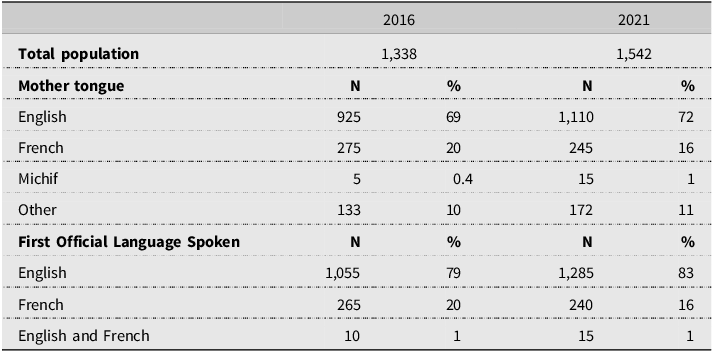
As can be seen, the figures refer to French (or in some cases Michif) but it is impossible to determine precisely whether the variety of ‘French’ being referred to is MF or to another variety of LF. It is obvious that French – of whatever variety – is in an extreme minority situation and is declining year by year, especially if one considers the language most often spoken at home, where the sole use of French is declining, while the use of both official languages is on the rise, but still representing less than 7% of the total population.
4. Previous research about [tʊt]
We propose to review the research on the realization of tout [tu], toute [tʊt], tous [tu]/[tʊs] and toutes [tʊt] in the unique phonetic form [tʊt]. As Leavitt (Reference Leavitt2022) notes, in addition to breaking the syntactic rules that constrain the movement of tout and tous in the sentence, Quebecois French (QF) allows the rules of gender and number agreement to be broken. This neutralization is not exclusive to QF and is also found in MF, as in the following examples, extracted from the St. Laurent corpus (see Section 6.1):

The use of [tʊt] is a well-studied phenomenon (Burnett, Reference Burnett2012). Yet, previous research has almost exclusively focused on QF. Moreover, there has been very little sociolinguistic research.
The first study is by Lemieux-Nieger et al. (Reference Lemieux-Nieger, Leblanc, Paquin, Sankoff and Cedergren1981), which demonstrated that, among 24 Montreal speakers, older mid-linguistic-market women produced no realizations of [tʊt] for tout/tous, while their younger counterparts did. Furthermore, [tʊt] was found to be more frequent among low-linguistic-market speakers, especially men and young women.
Lemieux (Reference Lemieux1982) conducted research based on 31 interviews with Montreal teenagers. The analysis revealed a strong trend whereby there was virtually no variation; [tʊt] turned out to be largely predominant, while [tu] was marginal and [tʊs] was absent.
Lemieux et al. (Reference Lemieux, Saint-Amour and Sankoff1985) is the most comprehensive sociolinguistic study to date. They examined [tʊt], [tu] and [tʊs] in all 120 interviews of the Sankoff-Cedergren Montreal corpus. A strong tendency showed that the neutralization of tout/tous operated in favor of [tʊt] according to its syntactic function. Age also proved significant, as older speakers were more likely to use the normative forms [tu]/[tʊs] than younger speakers who generally favored [tʊt]. We will discuss this research in greater detail below.
Labelle-Hogue (Reference Labelle-Hogue2012) is an analysis of [tʊt] in the La Petite Vie corpus, a comic television series from Quebec featuring characters in a working-class neighborhood of Montreal. He reported a higher frequency of [tʊt] in his corpus than in the Sankoff-Cedergren corpus as analyzed by Lemieux et al. (Reference Lemieux, Saint-Amour and Sankoff1985). The syntactic context also proved to be a determining factor. The author noted that, contrary to Lemieux et al. (Reference Lemieux, Saint-Amour and Sankoff1985), middle-aged and lower-class female characters favored [tʊt]. According to Labelle-Hogue (Reference Labelle-Hogue2012), the divergence observed was most probably the result of an over-representation of the Québécois vernacular, generated by strong stereotypes.
Bigot (Reference Bigot2021) examines the use of [tʊt] in a large corpus of television interviews with speakers from the social and cultural elite of Quebec. His analysis indicates that the use of [tʊt] is extremely rare, thus confirming the variant’s highly vernacular status.
More recently, Leavitt (Reference Leavitt2022) finds that in Quebec rap songs, [tʊt] largely converges with its use in spontaneous Montreal French speech. Indeed, her results reveal a strong influence of syntactic function, as well as gender, with men tending to favor [tʊt], in contrast to women. This suggests that Quebec rap artists apply rules to their musical compositions that are very similar to those found in spontaneous discourse.
5. Research goals and hypotheses
Our research is a continuation of the work of Mougeon et al. (Reference Mougeon, Hallion Bres, Papen and Bigot2010; Reference Mougeon, Hallion Bres, Bigot and Papen2016) on convergence and divergence among varieties of LF. The authors found that MF differs from other varieties in many aspects. This study addresses the question of the extent to which MF diverges from the other LF varieties by measuring the use of a new linguistic variable.
Previous studies underline a high frequency of vernacular variants found in MF (namely m’as, rien que, sontaient and ontvaient). Our results are therefore expected to reflect a clear preponderance of [tʊt], which would confirm the hypothesis of the highly vernacular character of MF.
Mougeon et al. (Reference Mougeon, Hallion Bres, Papen and Bigot2010; Reference Mougeon, Hallion Bres, Bigot and Papen2016) also show that the differences observed in MF are related to the absence of influence of social factors such as gender and social class in conditioning most variables, due to a high level of socio-cultural cohesion within this community. We will test this hypothesis by analyzing the effect of the social class and gender of the speakers, as well as their origins and age.
Our last hypothesis is that, given the Laurentian origin of MF, the internal linguistic factors conditioning the use of the variants should be somewhat similar to the ones of the other varieties.
6. Methodology
In this section, we describe the corpus under study. Then, we present the external and internal variables taken into account. Finally, we detail our analytical tools.
6.1. The Lavallée corpus
In 1987, Guy Lavallée, a Métis Oblate priest born and raised in St. Laurent,Footnote 9 interviewed and recorded a total of 54 French-speaking residents of the community for his MA thesis in anthropology at the University of British Columbia. A few years later, the Manitoba Métis Federation, which had financially funded Lavallée’s research, with the latter’s permission, provided us copies of the 54 cassette tape recordings of the corpus. In the early 2000s, 51 of the tapes were digitalized and transcribed by the first author, who was at that time a doctoral candidate at the Université du Québec à Montréal, Canada.Footnote 10
The interviews, lasting from 45 minutes to 2 hours, for a total of some 60 hours of recordings, consist of casual conversations bearing on a variety of topics dealing with current and past life in St. Laurent, livelihood, schooling, home, social activities, religion, language, local politics, ‘metisness’ and identity issues, etc. Since Lavallée’s objectives were more ethnographic than linguistic, none of the contents of the conversations deal specifically with linguistic features per se.
6.2. External factors
We take four social factors into account. First, we consider the gender of the speakers: women vs. men. The socio-economic status (SES) attributed to each person is determined from Blishen et al. (Reference Blishen, Carroll, William and Moore1987)’s classification, based on the speaker’s trade or employment. Our categories are middle-high, middle, and low.
Since the ethnic or social background (Métis from the Fort Rouge section, Métis from St. Laurent village, French Canadian or Breton) seems to be – or at least has been – a major social and economic factor, we were able to obtain information on this aspect from a well-known community elder. We thus distribute the speakers according to four origins: Fort Rouge Métis vs. St. Laurent Village Métis vs. Breton vs. French Canadian.Footnote 11
The age categories were selected after a pre-analysis. We drew a progression curve to identify significant age peaks and grouped the speakers as follows: young adults (aged 39 and under) vs. adults (aged 40 to 64) vs. seniors (aged 65 to 79) vs. older seniors (80 and over).
6.3. Internal factors
We have adopted Lemieux et al.’s (Reference Lemieux, Saint-Amour and Sankoff1985) analysis, with a few modifications. Their classification takes into consideration the various syntactic roles of [tʊt]:Footnote 12
-
Adverb quantifier masculine plural (Adv QMP):

-
Adverb quantifier masculine singular (Adv QMS):

-
Quantifier, masculine plural (QMP):

-
Quantifier, masculine singular (QMS):

-
Modifier of qu’est-ce que:

-
Pronoun:

-
Modifier of pronoun:

-
Pre-determiner,Footnote 13 masculine:

-
Pre-determiner, masculine + les:

-
Degree word:

-
Modifier of ce que:

Lemieux et al. (Reference Lemieux, Saint-Amour and Sankoff1985) only take into account the singular function of tout as pronoun. In the Lavallée corpus, we count 14 occurrences of plural [tʊt] and three of [tʊs], and therefore choose to separate the singular and plural forms. Further, to deepen our understanding of the variable, we examine the discourse marker function of tout, as in:

910 cases (40.6%) out of a total of 2,240 occurrences of [tu]/tʊs and [tʊt] were eliminated. As in Lemieux et al. (Reference Lemieux, Saint-Amour and Sankoff1985), we exclude the feminine forms toute and toutes since they are always pronounced [tʊt]. We also eliminate all cases of liaison, as in:

However, the vast majority of the excluded cases are frozen expressions such as tout le monde ‘everyone’, tout le temps ‘all the time, always’, pas du tout ‘not at all’, tout de même ‘even though’, tout court ‘briefly’, en tout cas ‘in any case’, etc., for which there is no variation, [tu] being systematically used. Hence, focus is exclusively on variable forms.
6.4. Analytical tools
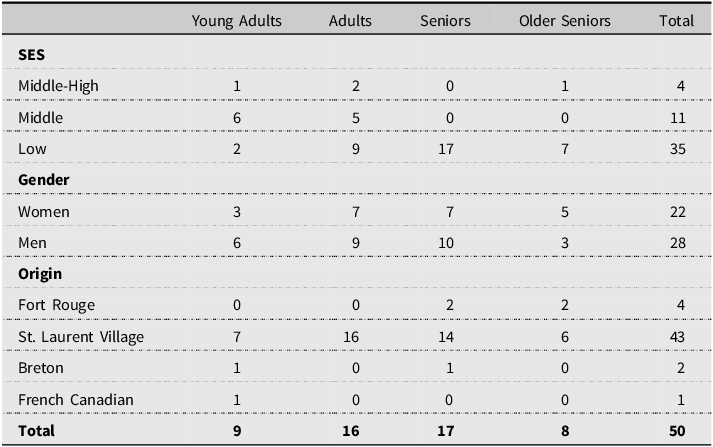
Our analyses are based on a mixed-effects statistical model (Tagliamonte, Reference Tagliamonte2011). To conduct the analyses, we use the program Rbrul (Johnson, Reference Johnson2009). Unlike previous research using Varbrul or Goldvarb (Tagliamonte, Reference Tagliamonte2006), Rbrul takes into account individual variation, thus the relative weight of each speaker. This is important considering the unbalanced speaker distribution in several cells of the Lavallée corpus, as shown in Table 2. Therefore, it offers a more conservative model of the observed linguistic variables by avoiding a factor being selected as significant when it is not (Tagliamonte, Reference Tagliamonte2011). Of course, this may have an impact on the comparisons we make between our results and those of previous studies, as they are not fully comparable. Nevertheless, we believe it is preferable “to overlook something that does exist than to report something that does not” (Johnson, Reference Johnson2009: 369).
Distribution of speakers by age, SES, gender and origin
Notice that, as with Goldvarb, Rbrul produces factor weights (FW) between 0.01 and 0.99 for each independent variable. It also allows analysis even in the presence of invariant factors, which Goldvarb does not. Higher weights reflect a greater likelihood of using the selected variant, and lower weights indicate a greater likelihood of using competitors. The software also provides a p-value, which indicates if the factor is significant when it is below 0.05. Each factor can also be ranked by measuring the difference between the highest and lowest FW values. The larger the gap, the higher the ranking. The “Log Likelihood” (LL) value serves as a gauge of how well a model fits the data. A higher value indicates a better fit. It is important to note that LL can range from -Infinity to +Infinity, but simply looking at the absolute value does not provide meaningful insight. Rather, comparisons between LL values across different models are necessary for assessment. However, we have decided to indicate this value for conventional purposes. Finally, “Input” indicates the general tendency of the dependent variable to appear in the data.
7. Results
In this section, we first present the general frequencies of the variant. Then, we report the influence of internal and external factors.
7.1. General frequency
Table 3 shows the respective frequencies of the three variants [tʊt], [tu] and [tʊs]. We obtained a total of 1,330 occurrences from all the interviews.
General frequencies of [tʊt] - [tu] - [tʊs]

It is striking to note that the vernacular form [tʊt] accounts for a large majority of the total, with over 75% of occurrences, compared with just over 24% for [tu], and almost none for [tʊs] (0.3%). These results diverge from those of previous studies on QF: less than 50% of occurrences of [tʊt] in Lemieux et al. (Reference Lemieux, Saint-Amour and Sankoff1985) and Labelle-Hogue (Reference Labelle-Hogue2012), and less than 20% in Leavitt (Reference Leavitt2022). Only Lemieux’s (Reference Lemieux1982) study found an almost systematic use of [tʊt] in her corpus. However, it should be noted that this corpus was composed exclusively of interviews with (pre)adolescents. Overall, our results provide further support for the highly vernacular character of MF hypothesis.
7.2. Influence of internal and external factors
The analysis of internal and external factors reveals that despite the low proportion of [tu] and [tʊs], the use of [tʊt] is conditioned by its grammatical function, as well as the age and origin of the speakers. Neither SES nor gender were selected as significant factors.
Table 4 shows that five out of 13 functions significantly favor [tʊt], while eight do not. Although their methodology is different from ours, Lemieux et al. (Reference Lemieux, Saint-Amour and Sankoff1985) and Leavitt (Reference Leavitt2022) observe relatively similar trends for the following functions: Adv QMP, Adv QMS, quantifier masculine plural, quantifier masculine singular, pre-determiner masculine, pre-determiner masculine + les, degree word, modifier of qu’est-ce que and modifier of ce que. It should be noted that Lemieux et al. (Reference Lemieux, Saint-Amour and Sankoff1985) do not provide the weight of each function, only percentages, which makes the comparison somewhat skewed. Finally, we should add that Leavitt (Reference Leavitt2022) notes the same tendency in the case of the discourse marker function and plural pronoun. Our results therefore converge with those of previous studies for 11 of the 13 functions.
Influence of internal and external factors on [tʊt]
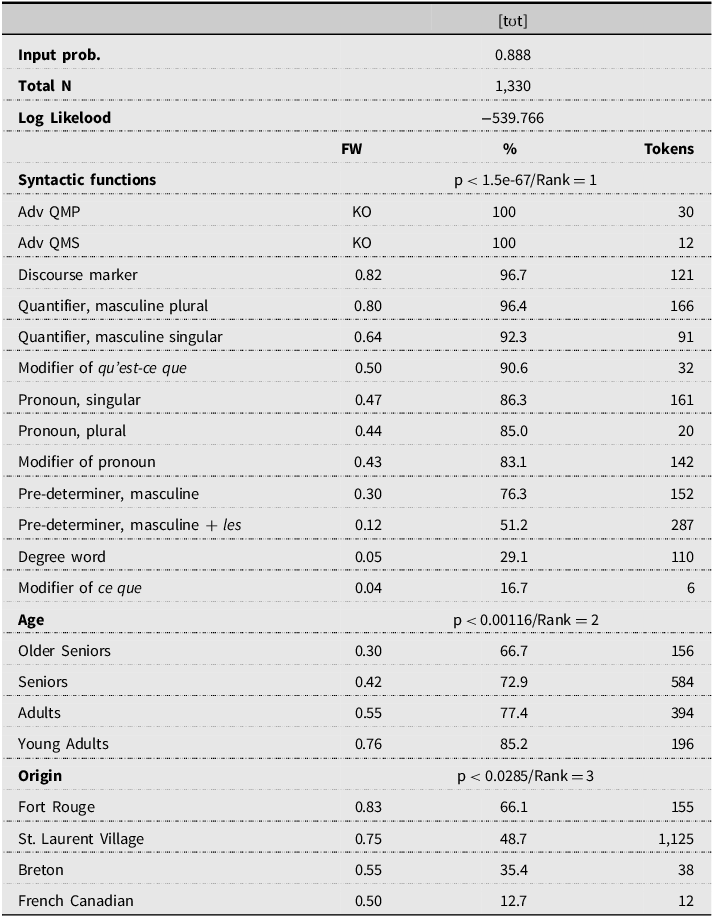
The first significant social factor is age (rank 2). The use of [tʊt] increases as age decreases. This result is not surprising, as it is known that younger speakers are more likely to use vernacular forms than their elders (Downes, Reference Downes1984). In addition, as we have seen in Section 4, this remains relatively consistent with the results of previous studies.
The second significant social factor is the origin (rank 3) of the interviewees. Indeed, those from Fort Rouge and St. Laurent Village strongly favor the vernacular variant. Conversely, speakers of Breton or French-Canadian origin tend to restrict their use of [tʊt]. This result suggests that [tʊt] is a potential marker of Métis identity. Furthermore, there is a difference between the Fort Rouge and Village Métis, which contradicts St.-Onge (Reference St-Onge2004), for whom distinctions between various St. Laurent Métis groups no longer exist. It is also interesting to note that the Bretons score closer to the Métis than do the French Canadians, indicating that the former are better integrated into the Métis community than the latter.
We examine in depth three different syntactic functions to measure in more detail the convergences with previous studies. To do this, we have chosen the functions having the greatest variation. As in the general analysis, we seek to measure the influence of internal and external factors. For the three following variables – Degree word, Modifier and Singular pronoun – no social factor is significant. We present only the significant factors, i.e. the internal factors.
First, we look at the influence of the nature of the adjective on [tʊt] when the latter is a degree word. Results are presented in Table 5.
Influence of adjective on [tʊt] - Degree word
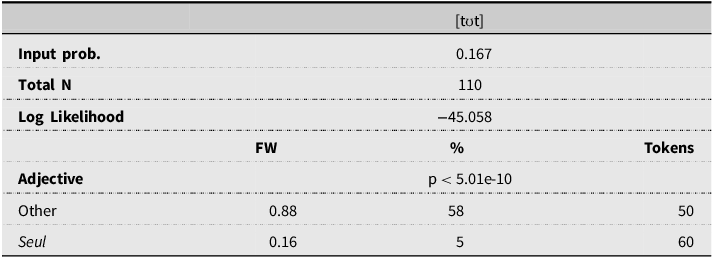
In the case of [tʊt] as degree word, the correlation is significant, and it is worth pointing out that [tʊt] is virtually absent when preceding seul, while [tʊt] is highly favored preceding all other adjectives. These results converge with Lemieux et al. (Reference Lemieux, Saint-Amour and Sankoff1985: 40) and Labelle-Hogue (Reference Labelle-Hogue2012: 161), who found that [tu] was used respectively in 98% and 100% of the time preceding seul. They suggest that [tu] preceding seul functions as a frozen expression in QF, as is the case in MF.
We also observe the frequency and weight of [tʊt] as modifier in Table 6.
Influence of type of modifier on [tʊt] - Modifier
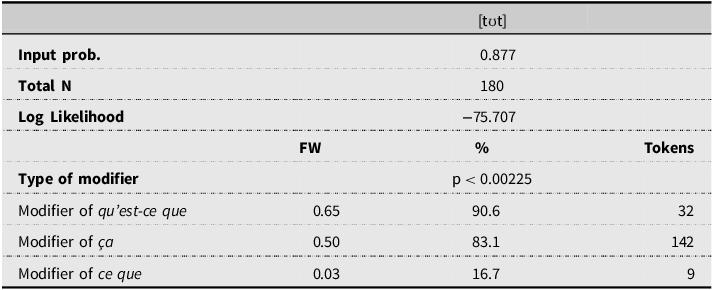
Our results show that [tʊt] is favored when modifying qu’est-ce que, is neutral when modifying ça but disfavored with ce que. These results differ slightly from those of Lemieux et al. (Reference Lemieux, Saint-Amour and Sankoff1985: 42) since they note that [tu] rather than [tʊt] is preferred before ça (FW=.691) in Montreal French. Also note that [tʊt] is used before the vernacular syntactic structure qu’est-ce que, while [tu] is favored before the standard structure ce que. Notice that while age is not a significant factor, [tu] ce que is used quite infrequently (N = 9) in the corpus, and only by older speakers.
Finally, we focus on the influence of the position of [tʊt] when it is used as a singular pronoun. Table 7 reports interesting results.
Influence of position on [tʊt] - Singular pronoun
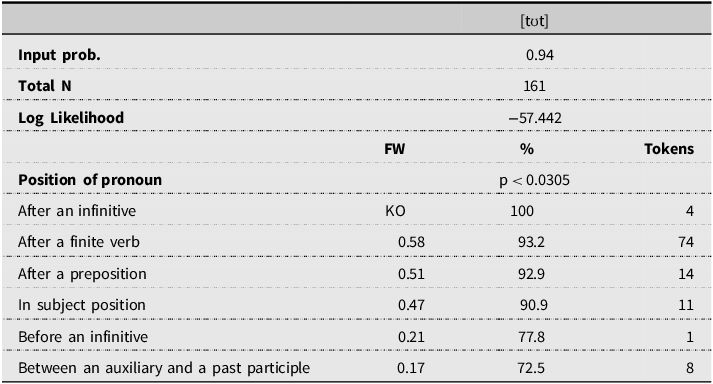
Three of the six positions favor the use of [tʊt]. When after an infinitive, [tʊt] is systematic, followed by two other positions: after a finite verb and after a preposition. The other three positions disfavor the vernacular variant. These results partially converge with those of Lemieux et al. (Reference Lemieux, Saint-Amour and Sankoff1985) and Labelle-Hogue (Reference Labelle-Hogue2012), who found quite similar correlations for after a finite verb, in subject position and before infinitive positions. However, it should be noted that Labelle-Hogue’s (Reference Labelle-Hogue2012) analysis is based on percentages only. He does not provide the relative weight of each position. His results are therefore more or less comparable to ours.
Finally, we measure the influence of external factors on [tʊt] as a Pre-determiner, masculine + les.
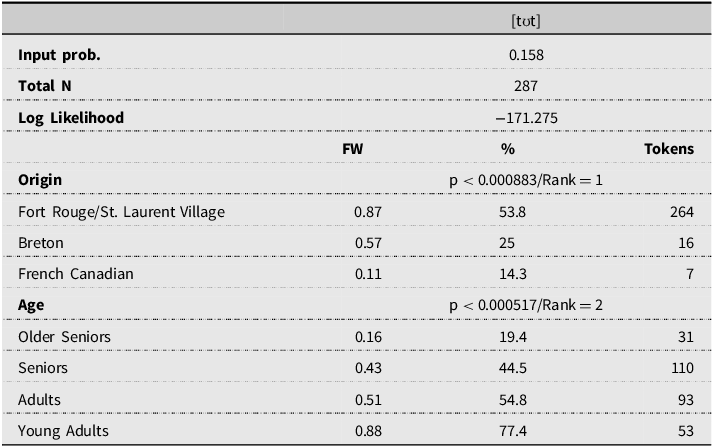
As in Table 8, only origin (rank 1) and age (rank 2) prove significant. However, the correlation is different from that of the analysis of all [tʊt] occurrences. Origin is now the factor that most influences the use of the vernacular variant. However, as in Table 8, we note the absence of gender and SES factors. Lemieux et al. (Reference Lemieux, Saint-Amour and Sankoff1985: 25) found that gender and language market influence the use of the normative form [tu], which is characteristic of speakers at the top of the language market and of women. The absence of gender and SES effects seems to illustrate a certain degree of social cohesion of the Métis community. Nevertheless, we again find a statistical difference between Fort Rouge and St. Laurent village Métis speakers and the two other groups. Moreover, we again note that Bretons have a much greater FW than French Canadians. This could indicate that the degree of social cohesion may not be as high as expected.
Influence of social factors on the use of [tʊt] - Pre-determiner, masculine + les Footnote 14
8. Discussion
Our study focuses on the divergence of MF due to a number of characteristics not found in other varieties of LF. As discussed, this divergence is found both in the use of linguistic forms calqued on Algonquian languages and in the intense use of certain vernacular (conservative or irregular) variants of LF.
Given the high degree of vernacularity of MF observed in previous research, we expected a clear predominance of [tʊt] in the Lavallée corpus as well. Our first hypothesis is comforted since the variant represents more than 75% of the total number of occurrences. This result converges with those of the variants m’as (74%), rien que (76.2%), sontaient (62.9%) and ontvaient (83.3%) in MF, as observed in previous research (Mougeon et al. Reference Mougeon, Hallion Bres, Papen and Bigot2010, Reference Mougeon, Hallion Bres, Bigot and Papen2016; Papen and Bigot, Reference Papen and Bigot2010).
Our study only partially supports the hypothesis of a high level of social cohesion in the St. Laurent community (Mougeon et al. Reference Mougeon, Hallion Bres, Papen and Bigot2010, Reference Mougeon, Hallion Bres, Bigot and Papen2016). Indeed, on the one hand, we found no global effect of speakers’ SES or genderFootnote 15 but the difference between Fort Rouge Métis and St. Laurent village Métis speakers (although both groups tend to favor [tʊt]), as well as the difference between both Métis groups and the other two suggest that this social cohesion is not as high as expected.
Finally, the results of the global analysis support the hypothesis of the filiation of MF and other varieties of LF, since we found trends similar to those of previous studies for 11 out of 13 syntactic functions.
If this hypothesis explains the convergent results of the analysis of internal factors, it remains to determine the driving forces that make MF divergent from the other varieties on the social dimension. We believe the answer lies both in the nature of the St. Laurent community and in the linguistic representations of its individuals.
According to Fought (Reference Fought and Mesthrie2018: 238), “Language plays a crucial role in the construction and maintenance of ethnic identity. In fact, ethnicity can have a more striking relationship to language than other social factors such as gender, age, or social class.” She further contends that “[T]he use of particular linguistic features within a variety can be a key element in the performance and recognition of ethnic identity.” (ibid: 241). She also admits that “the language or dialect associated with […] ethnic identity may be the focus of criticism by others and leave us open to painful ridicule, prejudice, and stereotypes. It can also be a source of pride for us.” (ibid: 238).
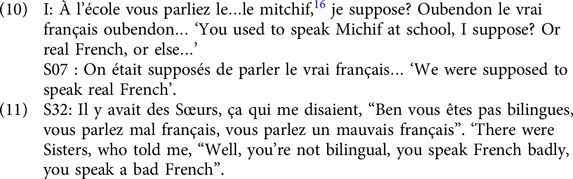
A number of epilinguistic comments collected in the Lavallée interviews exemplify that for many interviewees, the language they speak is not “real” French:
For others, being continually told their French was not “real” French led them to abandon their language and adopt English as their primary language:

The important rise of Métis identity in Canada has resulted in a greater pride in Métis culture and language. More and more francophone Métis now refer to their language as being ‘Michif’ rather than ‘French’:

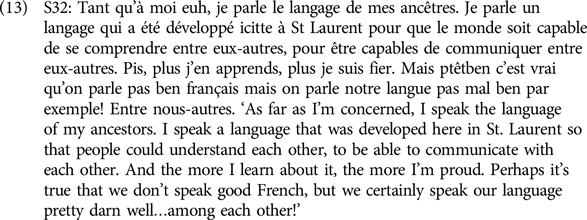
Even if many Métis still feel their French is inadequate, they are now proud of the way they speak, and some even consider it to be a ‘different’ language:
The following passage shows that children no longer speak MF at home and have adopted English. Some speakers even think that MF should replace SF in St. Laurent schools.
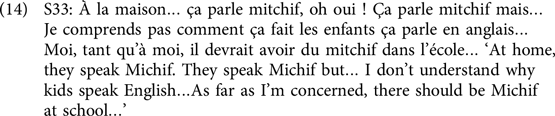
This indicates that MF, despite the stigmatization previously associated with it, benefits from a linguistic capital among certain speakers, who do not hesitate to claim it as a tool for educating the younger generations.
We contend that the St. Laurent Métis are well aware of the highly vernacular nature of their French when compared to the SF they were exposed to at school and that the more intense use of vernacular forms such as [tʊt] by the two groups of Métis of St. Laurent acts as a cultural and linguistic marker of their Métis identity. Moreover, Fort Rouge speech is more intensely vernacularized than that of the village counterpart, as Table 4 shows. As previously stated, this might indicate that former social distinctions between these two groups are still partially present, contradicting St-Onge (Reference St-Onge2004).
Tables 4 and 8 show that the descendants of the Breton families who arrived in St. Laurent at the beginning of the last century are closer to both Fort Rouge and Village Métis in their use of [tʊt] than are the French Canadians, indicating that the present-day Bretons have socially and linguistically integrated quite well into the Métis community. We propose that, as Bucholtz (Reference Bucholtz, Hall and Bucholtz1995: 355) puts it, “[T]he ideological link between language and ethnicity is so potent that the use of linguistic practices associated with a given ethnic group may be sufficient for an individual to pass as a group member.”
In conclusion, our article sheds new light both on a relatively undocumented sociolinguistic variable, but also on a variety of LF that is poorly known, and little studied by linguists. It also provides new evidence and tangible hypotheses concerning both the divergence of MF and its filiation with other varieties of LF. Given the situation of the gradual disappearance of this variety of French, we hope that our study will motivate the research community to explore it even further.
Acknowledgements
We would like to thank the editors and three anonymous reviewers for their very constructive comments (particularly on the methodology) on previous versions of this contribution. We also thank Philip Comeau (UQAM), Nadège Fournier (Université de Montréal), Naomi Nagy (University of Toronto) and Sali Tagliamonte (University of Toronto) for their valuable advice on the use of Rbrul.
Competing interests
The authors declare none.


 Open access

