


Radiation emergencies have a great impact on the community and surrounding environment. Reference Nofal, Alfayyad and Khan1,Reference Alruwaili, Islam and Usher2 Readiness for such disasters may be achieved through knowledge and training on emergency response components. Reference Alruwaili, Islam and Usher2 Variability in staff knowledge, training, and education regarding preparedness for disaster emergency incidents has been reported in several studies in the Middle East.
An essential study, a meta-analysis, undertook the crucial task of assessing the readiness of hospitals in the Middle East for disaster situations, this comprehensive study revealed that 68% of the reviewed articles consistently rated the preparedness of these hospitals as generally very poor, poor, or at best moderate. These assessments were made based on a range of factors, including staff proficiency and training in disaster management, command and control structure, and overall disaster management protocols. Reference Alruwaili, Islam and Usher2
The risk of a catastrophic radiological or nuclear incident has increased significantly during the past 2 decades with the increased threat of terrorist groups using radioactive materials in a radiological dispersal device or the threats of nuclear warfare that has been promulgated in the media. The clinical practice of radiation emergency medicine is deficient due to the rare global occurrence of radiation emergencies. Reference Nofal, Alfayyad and Khan1,Reference Alruwaili, Islam and Usher2 A study done in the United States reflected a similar fact where among 114 medical toxicologists, only a quarter of the respondents had cared for a patient exposed to ionizing radiation, and 13% had cared for patients contaminated with radioactive material. Reference Murray, Kim and Ralston3 The results of another significant study conducted in the United States where an electronic survey was sent to 309 emergency medicine residents and physicians at 3 US academic institutions has shown insufficient knowledge and comfort in dealing with radiological emergencies. In this study, only 37% and 28% of respondents had attended radiological preparedness training in the preceding 5 y or any training in radiation detection, respectively. Responders exhibited areas where their knowledge fell short, particularly in the realm of radiological emergencies. These gaps were most noticeable in their understanding of detecting radiological contamination, handling radiation decontamination (both indications and procedures), and managing patients, which also extended to specific pharmacological aspects. Reference Sheikh, McCormick and Pevear4
Efforts to enhance disaster preparedness education and awareness among medical students, emergency medicine residents, and physicians have grown over the past decade. Additionally, the core content for emergency medicine residency training in the Sultanate of Oman does include chemical, biological, and radiological emergency preparedness. Classroom teaching at the workplace and prepackaged educational materials were most frequently rated as the preferred educational method for radiation preparedness training from previous study in the United States. Reference Murray, Kim and Ralston3
Despite these efforts, existing evidence from recent research in the United States has shown that medical students do not feel prepared to respond to a public health emergency. Reference Murray, Kim and Ralston3 This may be due to the lack of such expertise and scope of practice within existing medical subspecialties. A cross-sectional survey done in southwest Saudi Arabia in 2015, showed a lack of sufficient knowledge and comfort dealing with radiation emergencies. Participants were found to have poor knowledge of using PPE, decontamination, diagnosis, and treatment with chelating agents. Reference Al Shahrani5 In this study, training courses, which were provided, improved emergency physicians’ knowledge but did not change their attitude toward attending and caring for radiation victims. Reference Al Shahrani5
However, it has been shown that medical toxicologists in the United State who had a willingness to participate in radiological or nuclear emergencies or who had taken care of patients contaminated with radioactive material were more likely to perform well on the knowledge assessment. Reference Murray, Kim and Ralston3
To the best of our knowledge, there is no existing literature available assessing the knowledge and attitude of health care professionals toward radiological emergencies in the Sultanate of Oman. The results of this study will support the role of emergency medicine residents and physicians during a radiation emergency. It also helps fill the gap in their current knowledge of caring for patients with radiation injuries.
Methods
The study consisted of an electronic cross-sectional survey of a convenience sample of emergency medicine residents and board-certified emergency physicians to determine if radiological preparedness training improves self-reported knowledge and attitudes. The survey questions were reviewed and validated by 6 emergency medicine and medical toxicology experts. The validation index ratio and score were calculated for all questions and found to be 0.8. The questionnaire contained 26 questions and comprised questions designed to assess knowledge, attitude, and awareness toward radiation emergencies. Ethical approval from the Oman Medical Specialty Board (OMSB) was obtained before initiation of this study.
The survey was emailed to 110 individuals (44 emergency medicine residents and 57 board-certified emergency physicians), from the period of April 24 to May 29, 2022. The survey was conducted using Google Survey form as the platform. Reminder emails were sent to complete the survey.
In addition to demographic variables, the survey collected data related to the attitude, knowledge, and comfort level of respondents toward radiation emergencies. Additionally, the survey collected data on the preferred educational methods for radiation preparedness training according to the respondents. All responses were anonymous. The results from the knowledge tests were analyzed with descriptive analysis and frequency distribution. Descriptive statistical analysis was used to extract the distributions of each variable. The correlation between the level of comfort and the level of knowledge was assessed. The data were analyzed using IBM SPSS Statistics version 27 (IBM Corp. Released 2020. IBM SPSS Statistics for Windows, Version 27.0. IBM Corp; Armonk, NY). For the descriptive analysis, categorical variables were presented with frequency and percentages. For the knowledge items, the total score was calculated and presented with median, standard, and interquartile range (IQR) scores. The knowledge score was compared between the trained and untrained physicians. A P value of <0.05 was considered as statistical significance.
Results
The cross-sectional survey was completed by 34 EM residents and 35 EM physicians. The response rate was 62.7% (N = 69/110). The survey included a wide spectrum of respondents in terms of their training level (37.1% of residents were in their first year of training out of the total 5 y of residency training) and physician work experience (41.2% greater than 10 y) (Table 1).
Descriptive analysis of survey respondents and training on radiation emergencies

Abbreviation: N, number.
Training
With regard to training, 62% (N = 43/69) of the responders had not attended any training in radiation emergencies preparedness. Eighty-four percent (N = 58/69) had never used, nor attended training on operating radiation detection devices. There was no significant difference between junior or senior residents or years of experience between physicians (Table 1).
Attitude
Thirty-seven percent of the participants (N = 26/69) responded that they are likely or very likely to go to work if requested in events of a radiation emergency, 65.3% of them were residents (N = 17/26). However, 73%, the majority, of those who responded that they are unlikely to go to work if requested in events of radiological emergencies were emergency physicians. The data in Table 2 represent self-reported attitude differences toward radiation emergencies among responders. Most respondents, regardless of previous radiation training, rated their comfort level in caring for patients who present acutely with radiation injuries as uncomfortable (46.4%) (N = 32/69) or very uncomfortable (24.6 %; N = 17/69). Only 1.4% (N = 1/69) of the participants felt very comfortable in performing decontamination. Physicians without training or experience in using radiation detection equipment were more uncomfortable in surveying patients with contamination from radioactive materials using detectors (N = 26/69) (N = 16/69). The level of comfort was higher in diagnosing acute radiation syndrome (N = 16/69) compared with diagnosing internal contamination (N = 6/29). There was no statistically significant difference between physicians who received training in the past 5 y, compared with those who did not (P value = 0.6).
Self-reported attitude differences toward radiological emergencies among responders
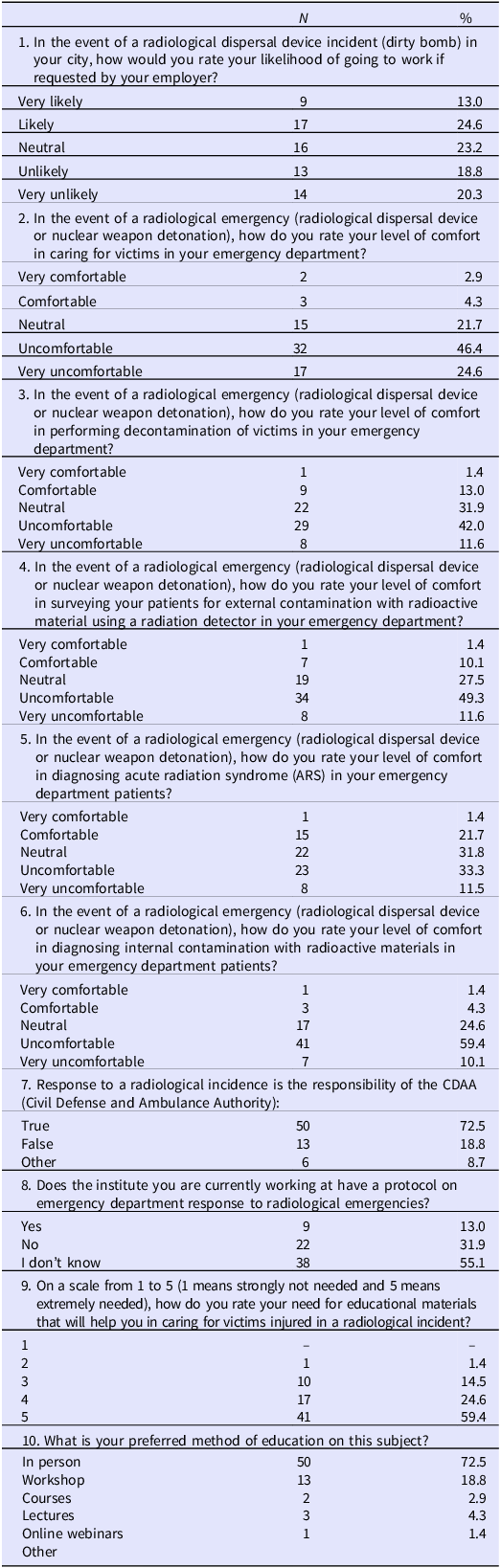
Abbreviation: N, number; SD, standard deviation.
Participants were asked about the main responsible agency for responding to radiation incidents. Seventy-two percent of the respondents (N = 50/69) knew that the Civil Defense and Ambulance authority (CDAA) is the responsible agency. Thirty-one percent (N = 22/69) stated that there are no protocols in their hospital about the response to radiation incidence, while 55% (N = 38/69) were uncertain. Participants were asked to rate their need for educational materials in the department to guide their management of radiation incident victims. Fifty-nine percent (N = 41/69) believed that they were in extreme need of educational materials, and only 1.4% (N = 1/69) believed strongly that they did not need educational material in this field. Subsequently, participants were asked to indicate their preferred method of education in radiological emergencies: 72% (N = 50/69) selected courses as a method of training followed by 18.8% (N = 13/69) who preferred lectures. Only 4.3% (N = 3/69) preferred webinars.
Knowledge
Self-reported knowledge was assessed using 10 knowledge questions in basic physics, diagnosis of radiation injuries, and management of radiation emergencies (Table 3). The median score of self-reported knowledge was 50 with interquartile ranges (IQRs) of 35 and 60. There was no difference in the median score between residents and physicians. Table 4 shows a subgroup analysis of the knowledge score. There was no statistically significant difference in the knowledge score between junior or senior residents (P = 0.32) or years of experience between physicians (P = 0.56). There was no difference as well between those who attended radiation preparedness training and those who did not (P = 0.14).
Self-reported knowledge of total respondents
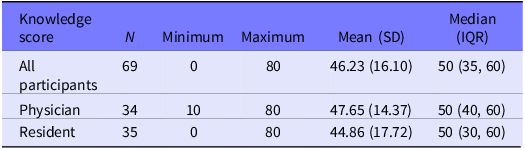
Abbreviations: IQR, interquartile range; N, number; SD, standard deviation.
Self-reported knowledge subgroup analysis
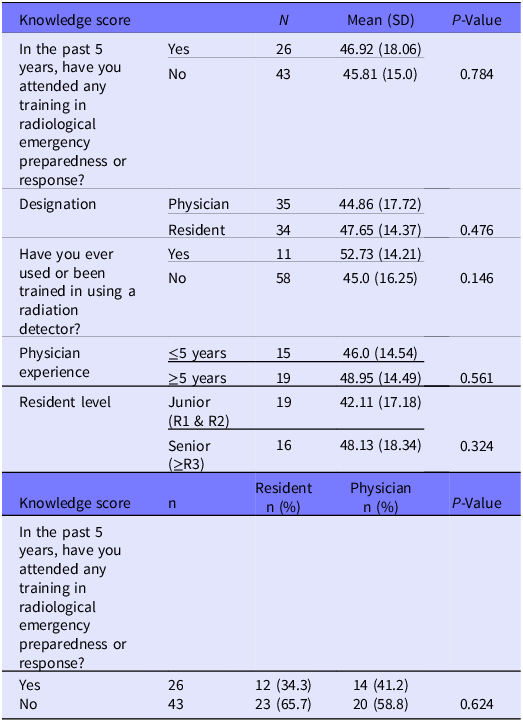
Abbreviations: N, number; SD, standard deviation.
Discussion
Radiation emergencies involve a variety of accidental (eg, nuclear plants) or intentional (eg, nuclear warfare) incidents.Reference Veenema, Lavin and Bender 6 – Reference Nelson, Baker and Osterhoudt 8 Awareness about radiological emergencies, as well as preparedness and establishment of management guidelines, are necessary to recruit adequate resources to prevent, respond to, and recover from such incidents. Our study aimed to characterize the existing gaps in preparedness, training, and knowledge of radiation emergencies among emergency physicians and emergency medicine residents in Oman. Self-reported comfort levels of respondents to deal with radiation emergencies were low. However, self-reported comfort levels increased slightly with some form of radiation emergency preparedness training.
A significant disparity in willingness to work during radiation emergencies, with residents showing a more positive inclination, while a substantial majority of experienced emergency physicians express reluctance.
Most of the responders are aware that CDAA (Civil Defense and Ambulance Authority) is the main responsible agency for radiological incidents. However, most of the respondents are unaware if there is an existing protocol for radiation emergencies in their hospitals. Our results show self-reported knowledge gaps among emergency medicine residents and faculty. These knowledge gaps could be due to rare occurrence of such incidents, limited training, and lack of hands-on practice. Specific areas of gaps in knowledge need to be addressed in future studies.
We believe that emergency department staff should have foundational knowledge about radiation emergencies. Respondents believe that they need education in this area. Results of this survey suggest that in-person courses are preferred educational materials over online learning. Annual radiation drills would provide a means for physicians to practice their knowledge in a safe, controlled environment and may be considered in further studies. Furthermore, establishing continuous communication between the emergency department and CDDA may be important to address the issue. Working on protocols on detection, protection, and management of radiation emergencies are important.
Future research can identify which content areas require further training. This can be applied to other medical specialties as well. Assessing the public awareness of radiation emergencies and efforts to increase patients’ awareness of the effects and risks may be a topic of future investigation.
The significance of this study lies in its call for improved preparedness among emergency department staff when it comes to handling radiation emergencies. The development of future training programs is necessary.
The proposal of annual radiation drills as a means for physicians to practice their knowledge in a safe and controlled environment is noteworthy. This recommendation suggests a proactive approach to ensuring that medical professionals are adequately equipped to handle radiation emergencies, and it invites further research to assess the effectiveness and feasibility of such drills.
The emphasis on establishing continuous communication between the emergency department and the CDDA (presumably an authoritative body or agency related to radiation emergencies) highlights the importance of collaboration and information sharing in addressing this critical issue. This collaborative approach can help in the development and dissemination of protocols for the detection, protection, and management of radiation emergencies.
Furthermore, the suggestion that future research can identify specific content areas requiring further training and that these findings could be applied to other medical specialties underscores the potential broader impact of this study. It highlights the relevance of the findings beyond the emergency department setting.
The idea of assessing public awareness of radiation emergencies and strategies to enhance patient awareness is forward-thinking. This broader perspective acknowledges the importance of not only educating health-care providers but also empowering the public to better understand the risks and effects of radiation emergencies.
However, it is crucial to acknowledge the study’s limitations, including the use of convenience sampling, a relatively small and non-random sample, and the reliance on self-reported knowledge. These limitations should guide future research efforts in refining methodology and addressing potential biases.
Conclusions
Our study revealed that most emergency medicine physicians and residents in Oman who responded to our survey have self-reported knowledge gaps. This affects their comfort level in managing radiation emergencies. Training should be implemented in this group of health--care providers to improve their knowledge. Therefore, we suggest designing and delivering radiation preparedness courses incorporated into the resident curriculum and the continuing professional development requirements to meet those needs. Functional exercises should be performed regularly to solidify the knowledge learned from radiation preparedness courses.
Competing interests
The authors declare no conflicts of interest or sources of funding.


 Open access

