





Introduction
The literature in political science, public policy, and public administration has largely examined the dynamics of agenda setting, showing how issues gain attention and rise to prominence in governmental agendas (Baumgartner, Breunig and Grossman Reference Baumgartner, Breunig and Grossman2019; Baumgartner, Jones and Mortensen Reference Baumgartner, Jones, Mortensen and Weible2023; Baumgartner and Jones Reference Baumgartner and Jones1993; Herweg, Zahariadis and Zohlnhöfer Reference Herweg, Zahariadis, Zohlnhöfer and Weible2023; Kingdon Reference Kingdon1984; Zahariadis and Taylor Reference Zahariadis and Taylor2025). However, little attention has been devoted to understanding how policy issues are deliberately kept off the governmental agenda. Although the literature has explored opposition dynamics in agenda setting processes, studies that explicitly engage with agenda denial theory remain scant (Cobb and Ross Reference Cobb and Ross1997a; DeLeo and Duarte Reference DeLeo and Duarte2022; Harrison Reference Harrison2001; Princen Reference Princen2011). This is surprising given the recognition in the public policy literature that public policy refers to whatever governments ‘choose to do or not to do’ (Dye Reference Dye1972: 1), and that government inaction has an impact on society just as government action does (McConnell and ’t Hart Reference McConnell and ’t Hart2019). This gap in explicit theorization of non-action, stemming from deliberate denial of the necessity to act, is evident in relation to gender and LGBTQ+ equality policy. While agenda setting has been widely explored (Annesley, Engeli and Gains Reference Annesley, Engeli and Gains2015; Annesley and Gains Reference Annesley and Gains2013; Bratton, Haynie and Reingold Reference Bratton, Haynie and Reingold2006; Bratton and Haynie Reference Bratton and Haynie1999; Cowell-Meyers Reference Cowell-Meyers2017; Joachim Reference Joachim2003; Kenney Reference Kenney2003; Murat Yildirim Reference Murat Yildirim2020), and a few studies have focused on multiple institutional and extra-institutional opposition strategies (Feo Reference Feo2022a; Kantola and Lombardo Reference Kantola and Lombardo2021; Lavizzari Reference Lavizzari2020; Prearo Reference Prearo2024a), the agenda denial perspective has received no direct attention. In this article, we examine agenda denial in the field of LGBTQ+ rights.
Despite continuous progress in the past decades, opposition to gender equality policies has been on the rise, shaped by struggles over rights, democracy, and social norms (Verloo Reference Verloo2018). Among these, LGBTQ+ rights have emerged as a site of heated political contestation, intersecting with broader debates on national identity and the extension of gender and sexual equality in the realm of citizenship. While many countries have expanded protections for LGBTQ+ individuals – recognizing same-sex marriage, adoption rights, and protections against discrimination – these advances have been met with significant resistance. Worldwide, conservative and far-right actors, often in alliance with religious institutions and transnational anti-gender networks, have mobilized against LGBTQ+ rights, portraying them as a threat to the ‘natural’ family, cultural traditions, and national sovereignty (Ayoub and Stoeckl Reference Ayoub and Stoeckl2024; Corredor Reference Corredor2019). The conservative backlash against gender equality is not confined to illiberal and authoritarian contexts but is also visible in established democracies, where gender and sexual rights are increasingly framed as ideological impositions, fueling phenomena such as wokeism and cancel culture.
Scholarship on gender politics has focused on the legal and institutional advancements in the protections for LGBTQ+ individuals, highlighting how transnational advocacy networks, European integration, and constitutional courts have facilitated progressive policy change, while also identifying the institutional constraints that limit implementation (Ayoub Reference Ayoub2016; Kollman Reference Kollman2016). At the same time, research applying the morality politics framework has conceptualized LGBTQ+ rights as policies subject to heightened moral and emotional contestation, leading to patterns of sharp policy reversals and extra-institutional interventions (Engeli, Green-Pedersen and Larsen Reference Engeli, Green-Pedersen and Larsen2012). This perspective explains how LGBTQ+ rights are often moved from the ‘normal’ world of policymaking to the ‘morality’ world, where political negotiation is replaced by symbolic and ideological struggles. More recently, LGBTQ+ rights have been investigated as a site of contentious politics, emphasizing the diffusion of anti-gender discourse and movements, and the increasing alignment with right-wing populists (Kuhar and Paternotte Reference Kuhar and Paternotte2017; Lavizzari Reference Lavizzari2025).
This paper seeks to revitalize the agenda denial literature by applying it to the field of gender policy and LGBTQ+ rights, addressing a significant gap in understanding how gender-related issues are actively suppressed or contained within the policy process. Therefore, we ask: How do opponents of LGBTQ+ equality policies employ agenda denial strategies to obstruct their advancement on governmental agendas? Drawing on agenda denial theory and focusing on Italy – specifically on law proposals against homotransphobia – we examine the argumentative tactics employed by anti-gender actors to neutralize LGBTQ+ claims, while maintaining an appearance of political legitimacy.
The article is structured as follows. We begin by situating our work within the agenda setting literature and make the case for an agenda denial perspective, with particular attention to the argumentative tactics that underpin these strategies. We then present our research strategy, which relies on qualitative, interpretive content analysis of parliamentary debates and organizational documents produced by anti-gender actors. We move on to the empirical analysis of agenda denial strategies in response to legislative proposals against homotransphobia, followed by a discussion of our main findings and concluding remarks.
From agenda setting to agenda denial: strategies and argumentative tactics
The agenda setting literature typically examines how issues gain prominence through the actions of non-governmental groups, public officials, or elite networks. Princen (Reference Princen2011), based on the analysis of European Union (EU) agenda setting processes, identifies four types of agenda setting strategies, organized around two fundamental challenges for agenda setters: gaining attention and building credibility. Each strategy leverages two core factors: venues (institutional settings) and frames (issue definitions). Attention and credibility may, therefore, be achieved by acting upon institutional venues, through issue framing, or both. Though developed in the context of EU empirical settings, this typology offers insights broadly applicable to agenda setting processes in general.
The first strategy, mobilizing supporters, involves directing issues to the most supportive institutional venues to gain attention. This may include venue shopping, where agenda setters choose among existing institutional platforms to find the most receptive one. For example, Joachim (Reference Joachim2003) shows that strategies employed by non-governmental organizations (NGOs) to access international institutions, such as the United Nations, have been crucial for issues such as violence against women and reproductive rights to gain acceptance and credibility at the domestic level.
The second strategy, arousing interest, emphasizes the process of framing issues in ways that capture the attention of decision-makers. This can involve linking issues to key policy priorities or overarching values related to, for example, human rights, identity, security, the economy, or democratic accountability. For example, Annesley and Gains (Reference Annesley and Gains2013) show that framing gender equality in economic terms, namely by highlighting the economic benefits and contributions of gender equality policy proposals to the economy, increases the likelihood of policy adoption. Similarly, Kenney (Reference Kenney2003) and Joachim (Reference Joachim2003) argue that framing strategies, which may also rely on emotional mobilization through testimonial knowledge (e.g., through survivors’ testimonies) as well as technical knowledge (e.g., statistics and systematic evidence), are crucial for agenda setting dynamics on issues such as gender violence.
Capacity-building, the third strategy, focuses on enhancing organizational readiness to build credibility and address the issue. This may involve establishing networks of experts and stakeholders, fostering intergroup collaboration, and ensuring sufficient expertise and resources to handle issue credibly. Again, in this regard, gender scholarship has noted the importance of NGOs’ ability to mobilize leadership resources and international networks, as well as the interplay between insider strategies (e.g., involving women in politics) and outsider strategies (e.g., grassroots mobilization and public awareness campaigns), which are crucial to advance feminist agendas (Joachim Reference Joachim2003; Kenney Reference Kenney2003).
The final strategy, claiming authority, builds credibility by framing an issue as one that falls legitimately within the scope of a specific jurisdiction, governmental level, or department. This approach may involve linking the issue to existing policies within a particular policy sector or highlighting shared challenges that justify policy actions by actors operating within that sector.
These strategies provide insights into how issues can gain traction in policy agendas, highlighting the interplay between institutional structures and issue framing to gain attention over policy issues and build credibility for action. In providing valuable perspectives into how issues gain attention and credibility, agenda setting theory also offers a foundation for understanding how mechanisms to elevate issues can also be employed to suppress them. For instance, as the opposite of strategies to gain attention, actors may attempt to divert attention by seeking (un)sympathetic venues or (re)framing issues in such terms to delegitimize them. For example, Kantola and Lombardo (Reference Kantola and Lombardo2021) examine the direct and indirect discursive strategies employed by radical right populists in the European Parliament to oppose gender equality. Direct opposition involves outright rejection of gender equality, whereas indirect opposition takes the focus away from gender equality or bends it towards other issues (see also Krizsán, Roggeband and Zeller 2024). Similarly, Prearo (Reference Prearo2024b) demonstrates how traditionalist rhetoric employed to oppose same-sex partnerships in the Italian parliamentary debate relies mostly on post-materialist argumentation rather than religious justification. Additionally, actors might undermine (rather than enhance) the credibility of institutional action by limiting the capacity for action (e.g., by diverting resources away from certain departments) or casting doubts about an institution’s authority in a given field (e.g., by raising concerns about appropriateness) (Princen Reference Princen2011).
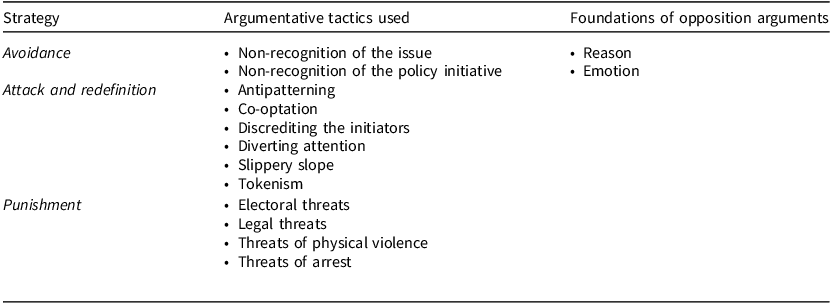
The concept of agenda denial provides an important analytical lens for understanding how actors work to keep contentious issues off the governmental agenda. Agenda denial focuses on the strategies used to suppress, delay, or diminish such advancements, with the aim to maintain the status quo (Cobb and Ross Reference Cobb and Ross1997a; Harrison Reference Harrison2001; Stone Reference Stone2012). Specifically, agenda denial explores how opponents to a certain issue deliberately work to prevent grievances from being taken into serious consideration by policy-makers and actively addressed. As argued by Cobb and Ross (Reference Cobb and Ross1997b), agenda denial strategies may progress from subtle to overt forms of resistance. The authors identify three types of strategies of agenda denial. The first type is characterized by avoidance and nonconfrontation and typically involves ignoring or marginalizing the issue and its proponents, thereby preventing the issue from gaining traction. In this regard, a typical first move by actors to sideline those who raise issues is to deny that any problem exists. This approach is considered more desirable, as it is better to keep an issue unconsidered than to acknowledge it and then have to invest resources to defeat it (Cobb and Ross Reference Cobb and Ross1997b; Stone Reference Stone2012). The second type includes attacks on the credibility of the issue, the legitimacy of its promoters, or attempts to redefine the issue – often escalating conflict. These may involve antipatterning – acknowledging an issue but considering it as an isolated or exceptional case – or co-optation, by citing figures from within the initiators’ side who may disagree with the initiators’ claims (Cobb and Ross Reference Cobb and Ross1997b). Tactics also include discrediting the initiators through stereotypes or personal attacks, and diverting attention towards other issues. Other tactics may involve slippery slope arguments, which warn that a given proposal will inevitably lead to (exaggerated) dangerous consequences (Stone Reference Stone2012). Tokenism may also be used to offer symbolic gestures while avoiding real change. Finally, if the first two types prove ineffective, actors may escalate to a third type of strategy, which can include punishment through electoral threats (e.g., movement actors withholding electoral support for public officials), legal actions, or even physical violence against the initiators (Cobb and Ross Reference Cobb and Ross1997b).
In the context of agenda setting and denial, it is crucial to distinguish between the public agenda, the governmental agenda, and the decision agenda (Cobb et al. Reference Cobb, Ross and Ross1976; Kingdon Reference Kingdon1984). The public agenda comprises issues the general public believes warrant governmental attention. The governmental agenda includes the subset of issues to which policy-makers are actively devoting serious attention. The decision agenda is an even more selective list: it contains only those issues from the governmental agenda that are positioned for imminent, authoritative decision – through legislative action, executive decisions, or regulatory measures.
This article focuses on how agenda denial within parliament – an institutional venue – operates precisely at this critical boundary between the governmental and decision agendas. When an issue reaches parliamentary debate or committee scrutiny, it has clearly entered the governmental agenda. Yet, many such issues never move beyond that point because actors inside parliament actively work to prevent their transition onto the decision agenda. In effect, parliamentary agenda denial serves as a critical mechanism by which actors preserve the status quo – not by excluding issues entirely from government consideration, but by keeping them suspended on the governmental agenda, and out of reach of the decision agenda where real policy change may occur. In addition to the parliamentary institutional venue, we also consider the role of the extra-institutional venue, where anti-gender organizations operate. These actors influence agenda dynamics by mobilizing opposition and shaping discourse, and may therefore reinforce denial strategies from outside the parliamentary arena.
It is critical at this point to note that, within agenda denial, issue containment emerges as a specific objective aimed at narrowing an issue’s scope to reduce its relevance (Bachrach and Baratz Reference Bachrach and Baratz1962; Capano, Galanti and Barbato Reference Capano, Galanti and Barbato2023; Cobb and Ross Reference Cobb and Ross1997b; McBeth, Shanahan, Arnell et al. Reference McBeth, Shanahan, Arnell and Hathaway2007). For example, by reframing broad grievances into narrower, technical concerns, opponents may limit the perceived stakes, thereby minimizing the number of affected stakeholders and diminishing the issue’s broader appeal. This is particularly effective when opponents cannot fully suppress an issue but seek to curtail its influence. While it is not denial in itself, we conceive of actions directed toward issue containment as part of agenda denial dynamics.
Agenda denial and policy argumentation: between reason and emotion
The strategies of agenda denial, we argue, must be understood as embedded within broader processes of policy argumentation. Drawing on the argumentative approach in policy analysis (Fischer and Forester Reference Fischer and Forester1993; Majone Reference Majone1989; Stone Reference Stone2012), we conceive of policy arguments as strategic representations that intertwine empirical claims with normative judgments, aimed at shaping perceptions, mobilizing support or opposition, and maintaining or challenging existing power structures. As such, the three types of strategies described above can be interpreted as being made of argumentative tactics intended to influence what counts as a legitimate issue, who is considered a credible actor, and which values should guide decision-making.
Whereas some policy arguments may be driven by deductive reasoning, others may be characterized by passionate affect-imbued language (Durnova, Hilmar, Blum et al. Reference Durnova, Hilmar, Blum, Císař, Hajer and Kolmaš2025; Gottweis Reference Gottweis, Fischer, Miller and Sidney2007; Jones, McBeth, Shanahan et al. Reference Jones, McBeth, Shanahan, Smith-Walter, Song, Weible and Workman2022). Though we do not draw clear-cut boundaries between reason and emotion, meaning that we recognize that reason and emotion can coexist in policy arguments, we can understand a mode of argumentation in a certain policy context as being primarily shaped by either reason or emotion. Therefore, we may have either reason-centric or emotion-centric policy arguments (see also Arda, Esposito and Wilderom Reference Arda, Esposito and Wilderom2024; Gottweis Reference Gottweis, Fischer, Miller and Sidney2007, Mastroianni and Profeti Reference Mastroianni and Profeti2025; Stone Reference Stone2012). In this vein, the tactics presented above, whether part of strategies of avoidance, attack and redefinition, or punishment, may rely on arguments that predominantly mobilize either reason – aimed at stimulating logical understanding through data, factual evidence, technical knowledge, and empirical proofs – or emotion – intended to evoke sensibilities, passions, and feelings such as fear, distrust, indignation, or anger (Arda, Esposito and Wilderom Reference Arda, Esposito and Wilderom2024; Gottweis Reference Gottweis, Fischer, Miller and Sidney2007; Majone Reference Majone1989; Mastroianni and Profeti Reference Mastroianni and Profeti2025; Stone Reference Stone2012; Verhoeven and Metze Reference Verhoeven and Metze2022) (Table 1).
Strategies of agenda denial

Source: Authors’ own elaboration based on Cobb and Ross (Reference Cobb and Ross1997b).
It is important to underscore that we do not equate reason with instrumental rationality (Gottweis Reference Gottweis, Fischer, Miller and Sidney2007). Indeed, argumentation ‘is not about revealing the truth but attempts to convince’ (Gottweis Reference Gottweis, Fischer, Miller and Sidney2007: 241). When referring to reason-centric arguments, we do not imply that the claims are substantively rational, but rather that they are constructed and presented as ‘rational’ within a particular discursive context in which actors present their positions as neutral, factual, objective, and empirically proven, thereby mobilizing the cultural authority of science and reason to legitimize anti-gender claims.
As for emotions, we consider them as a form of rhetorical praxis in their own right (Gottweis Reference Gottweis, Fischer, Miller and Sidney2007: 240). They can be seen as a form of knowledge, a way to narrate a given policy issue (Durnová Reference Durnová2022). Therefore, our analysis focuses on how explicit or implicit references to emotions are used in policy debates to deny issues access to the agenda. As we shall see, echoing Durnova, Hilmar, Blum et al. (Reference Durnova, Hilmar, Blum, Císař, Hajer and Kolmaš2025), methodologically, we do not treat emotions as standardized metrics, but aim at grasping contextualized emotional expressions.
Research design and methods
Case study
The Italian empirical setting provides a relevant case to investigate agenda denial strategies in LGBTQ+ policy-making, shaped by the entrenchment of anti-gender politics within both institutional and extra-institutional arenas. While legislative debates on LGBTQ+ rights gained traction in the early 2010s with discussions over same-sex partnerships and gender-sensitive education in schools, this period also witnessed the emergence and consolidation of the anti-gender movement, which positioned itself as a public force against gender-oriented policy-making debates (Garbagnoli Reference Garbagnoli2016; Lavizzari Reference Lavizzari2020; Prearo Reference Prearo2024a; Trappolin Reference Trappolin, Möser, Ramme and Takács2022). The anti-gender movement initially mobilized publicly, protesting against bills recognizing LGBTQ+ rights, gradually evolving into a structured political force, an interest group capable of influencing the public and institutional debates. Over the past decade, anti-gender actors in Italy have adapted their discourses and strategies to the changing political landscape, in particular, fostering alliances with right-wing populist parties – Matteo Salvini’s League (Lega) and Giorgia Meloni’s Brothers of Italy (Fratelli d’Italia – FdI) – to enhance their political leverage. This process of institutionalization has allowed them to not only obstruct LGBTQ+ policies but also shape the political discourse on gender, sexuality, and family values, firing a political climate of backlash against gender and sexual rights (Lavizzari Reference Lavizzari2025). Moreover, a defining feature of the Italian context is the persistent influence of the Catholic Church and the Vatican, which has historically shaped the political agenda on moral and social issues, such as family life and sexual rights. The Vatican continues to have an active role in opposing law-making on LGBTQ+ rights, leveraging its moral authority to influence both right-wing and center-left parties (Lavizzari and Prearo Reference Lavizzari and Prearo2019). This institutional embeddedness of Catholic conservatism has ensured that LGBTQ+ rights became a highly contested issue across the spectrum of the mainstream political establishment, and that the direct interference of the Vatican as a political entrepreneur in the socio-political scene remains unquestioned (Ceccarini Reference Ceccarini and Haynes2009).
Recently, Italy has witnessed a surge in LGBTI-phobic violence, exacerbated by hatred narratives propelled by some politicians – especially since the right-wing coalition led by Meloni is in government – prompting international calls on the Italian government to take action (ILGA Europe 2025). In fact, Italy remains significantly behind in LGBTQ+ legislation, as reflected in its 2024 ILGA-Europe Rainbow Map score of just 25.41%, ranking 35th in Europe (ILGA Europe 2025). More specifically, in the category of hate crime and hate speech, Italy scores 0 points, highlighting the country’s absolute lack of legal protections in this area. From a longitudinal perspective, a total of nineteen bills discussing the inclusion of LGBTQ+ hate crimes were presented across Italy’s legislatures since the 1990s. Most of these legislative attempts aimed at modifying existing laws and regulations on hate crimes and anti-discrimination, namely the Reale Law (Law 654/1957), later modified by the ‘Mancino Law’ (Law decree 122/1993), to extend their range of application to gender-based discriminations (Feo Reference Feo2022a). Many of these proposals never reached plenary discussions in Parliament, resulting in long and unsuccessful parliamentary processes.
In this study, we focus on the 17th (2013–2018) and the 18th (2018–2022) legislatures, and the two most significant bills on LGBTQ+ hate crimes discussed during this time. The first is the Scalfarotto bill, endorsed by the Democratic Party parliamentary group, which was approved by the Chamber of Deputies in September 2013. However, despite passing this initial hurdle, it was never brought to discussion in the Senate. The second bill, proposed by the Democratic Party MP Alessandro Zan in 2021 (Zan bill) and ‘aiming at penalizing discrimination, violence and hate speech on grounds of sex, gender, sexual orientation, gender identity and disability, equating these offences with racist crimes already included in the penal code’ (Feo Reference Feo2022b: 1), was rejected by the Italian Senate after a heated debate within and outside the institutional arena, leaving Italy de facto without a law against homotransphobia. The government coalition that had approved the bill in the Chamber of Deputies – composed of the Five Star Movement and the Democratic Party – was replaced by a technocratic government led by Mario Draghi, supported by a broad coalition encompassing all major parties except the far-right Brothers of Italy. This shift reshaped the balance of power within the governing majority, altering party dynamics and weakening the political momentum behind the bill. As a result, the legislative process of the Zan bill stalled, and in November 2021, it was ultimately rejected by the Senate (Feo Reference Feo2022a, Reference Feo2022b).
Most of the opposition centered on the inclusion of gender identity as a protected category against discrimination and the introduction of initiatives for gender-sensitive education in schools and came from both parliamentary groups and anti-gender actors outside the institutional arena. We treat these two arenas in conjunction since they are deeply intertwined and mutually reinforcing. This relationship between actors and arenas is understood as symbiotic, characterized by dense linkage mechanisms, including shared ideology, resource exchanges, and coordinated mobilization (Lavizzari Reference Lavizzari2025). As shown in previous research (Lavizzari Reference Lavizzari2025; Prearo Reference Prearo2024a), anti-gender organizations frequently mobilize in response to parliamentary debates and legislative proposals, directly engaging with ongoing discussions at the institutional level, and providing parties with language, arguments, frames, and knowledge claims – in what has been termed a ‘contamination’ work (ibid.). Civil society actors are also taking part in hearings from parliamentary committees and maintain informal channels with sympathetic MPs. Within Parliament, the strongest resistance was led by right-wing and center-right parties, particularly Go Italy (Forza Italia – FI), Brothers of Italy and the League, and the Union of the Centre (Unione Democratica di Centro – UDC). Opposition was also present within segments of the center-left coalition, particularly among MPs influenced by Catholic conservatism, who sought to weaken or stall the bill’s progress. Beyond the parliamentary setting, opposition was fueled by anti-gender and religious organizations, including the Vatican. To this analysis, we consider ‘ad-hoc’ anti-gender groups and non-profit organizations established in the early 2010s at the onset of the mobilization, such as La Manif Pour Tous Italia (La Manif Pour Tous Italy, LMPTI), rebranded in 2015 as Generazione Famiglia (Family Generation); ProVita Onlus – Notizie ProVita (ProLife Onlus – ProLife News), predecessor of ProVita & Famiglia (ProLife & Family – PV&F), founded in 2019 from the merging of the Family Generation and ProLife Onlus; the Comitato Difendiamo i Nostri Figli (Committee to Defend Our Children – CDNF), rebranded Associazione Family Day – Difendiamo i nostri figli (Association Family Day – Defend our children), and Giuristi per la Vita (Lawyers for Life). These groups primarily focus on disclosure, communication, dissemination, lobbying, and advocacy efforts at the national level, while also organizing protests and grassroots events, workshops, and conferences on gender ideology throughout the territory.
Data collection
Empirical evidence is drawn from documents spanning the period from 2013 to 2021. These were selected through purposeful sampling (Patton Reference Patton2015), based on their availability and direct relevance to the bills under analysis. As for parliamentary debates, we retrieved 19 official transcripts of plenary discussions from the Italian Parliament’s online archives. As for the anti-gender organizations, the corpus includes a total of 14 documents, in the forms of press releases, public awareness campaigns, editorial and opinion pieces, letters to members of the Parliament, documents submitted to parliamentary committees, and calls to action, as well as interviews and newspaper articles released by anti-gender organizations selected for the analysis. We also included the transcription of two Senate hearings by anti-gender actors conducted ahead of the debate in the Senate (details about the collected documents are reported in the online Appendix).
Methods and data analysis
Our study adopts a qualitative, interpretive research design (Schwartz-Shea and Yanow Reference Schwartz-Shea and Yanow2012; van Hulst and Visser Reference van Hulst and Visser2025). Document analysis was conducted through qualitative content analysis using NVivo (Schreier Reference Schreier2012). The analysis has been informed by a codebook structured around the strategies and argumentative tactics presented in Table 1. The coding units consisted of sentences or paragraphs (text segments) and, following Gioia, Corley and Hamilton (Reference Gioia, Corley and Hamilton2013), we organized the coding scheme into first-order and second-order categories. The analysis involved a three-phase coding process. First, we coded the text segments according to the argumentative tactics used by the opponents (first-order categories) (see the Appendix for illustrative quotes). Second, these categories were then clustered into macro-categories (second-order categories) corresponding to the three types of agenda denial strategies: avoidance, attack and definition, and punishment.Footnote 1 The first and second phases of coding yielded a total of 689 coded text segments. In the third phase, we coded for the argumentative foundation of these 689 segments by identifying whether each segment mobilized reason-centric or emotion-centric appeals.
To operationalize the two argumentative registers, we identified discursive appeals as reason-centric or emotion-centric according to their prevailing persuasive logic (on the two faces of persuasion, see Stone Reference Stone2012). Text segments were coded accordingly only if they displayed a prevailing logic aligned with one of the two forms. Reason-centric arguments were characterized by references to data, technical claims, and logically structured reasoning to oppose or delegitimize the proposed legislation. These included, for example, references to existing laws, statistical data on homophobic violence, or legal arguments concerning vagueness or enforceability. We therefore distinguished reason-centric claims by their reliance on external, supposedly verifiable or established legal and procedural standards. For instance, one set of denial arguments claimed non-recognition of the issue on the basis that data do not support the narrative of widespread homophobia in Italy. This included citing surveys to argue that Italy is among the safest countries. Similarly, statements denying the need for further legal protections on the basis that ‘there is no legal gap’ or citing data to downplay the prevalence of discrimination – such as noting that reported incidents include simple discourtesies and not just serious violence – were coded as reason-centric. These examples all point toward a persuasive logic centered on ‘objective’ analysis and legal principle.
As for the coding of emotion-centric arguments, since we situate ourselves within the interpretive tradition in public policy and intend to capture contextualized emotional expressions, we do not use a dictionary-based approach to the analysis of emotions. Therefore, we distinguished emotion-centric claims by identifying language intended to convey meaning associated with affective triggers such as fear, moral panic, distrust, or indignation, even if no explicit emotion word was present. These included securitizing language and arguments warning of ‘civilizational decline’ and metaphors such as ‘cultural colonization’ or ‘thought police’. Some emotional appeals intensified around themes such as children, faith, and national identity, framing LGBTQ+ rights as an existential threat. For instance, some text segments coded as emotion-centric included claims that the LGBTQ+ movements draw their ‘lifeblood from multinational corporations’ to mobilize distrust. Similarly, arguments that the proposed law seeks to establish an ‘Inquisition-style tribunal’ that would ‘imprison anyone who holds views different’ were coded as emotion-centric for leveraging fear and moral panic (see Tables A3 and A4 in the Appendix for the coding guidelines we have followed and for illustrative quotes). This phase of coding yielded a total of 348 coded text segments.
Throughout the coding process, the authors iterated between emerging data and the relevant literature and theory through abductive reasoning (Gioia, Corley and Hamilton Reference Gioia, Corley and Hamilton2013; van Hulst and Visser Reference van Hulst and Visser2025). This iterative process enabled the internal validation of both the deductively derived and inductively generated coding categories, resulting in the data structure presented in Figure 1.
Data structure.
Source: Authors’ elaboration.
Notes: N = number of coded text segments. Inductively generated categories are in italics.

Empirical evidence
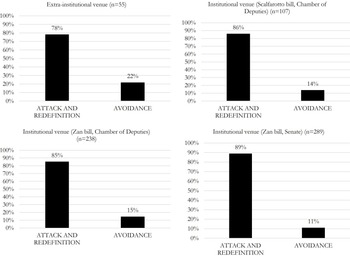
Our analysis shows that attack and redefinition strategies dominate across venues (institutional or extra-institutional) and legislative proposals (Scalfarotto bill or Zan bill). The number of coded text segments for the attack and redefinition strategy is clearly higher than that of the avoidance strategy – a pattern consistent across both right-wing parties and anti-gender organizations, suggesting that the type of venue does not affect the choice of strategy (Figure 2).
Denial strategies by venue and legislative proposal (% of coded text segments).
Source: Authors’ elaboration.
Notes: N = number of coded text segments.

Looking more closely at the distribution of tactics within the attack and redefinition and avoidance strategies, we find some important distinctions between anti-gender actors in the institutional and extra-institutional venue (Figure 3). As far as the avoidance strategy is concerned, anti-gender organizations tend to employ the tactic of non-recognition of the issue (58.3%), denying that LGBTQ+ discrimination is widespread or socially relevant, or that homophobia exists and persists in Italy. In the institutional venue, actors display a more differentiated pattern: during the discussion of the first bill (Scalfarotto), they largely echoed the non-recognition of the issue (53.3%), while in the debate over the Zan bill they shifted toward denying the need for a legislative initiative both in the Chamber of Deputies (54.3%) and the Senate (68.8%), arguing in particular that protections were already in place.
Avoidance strategy: Denial tactics by venue and legislative proposal (% of coded text segments).
Source: Authors’ elaboration.
Notes: N = number of coded text segments.

Within the attack and redefinition strategy, we observe more marked differences across venues and legislative phases (Figure 4). Among the anti-gender organizations, the overwhelming majority of coded text segments (58.1%) fall under flipped discrimination, followed by slippery slope arguments (14%), and discrediting the initiators and diverting attention (both at 9.3%). This pattern shows the centrality of the reversed victimhood as a core logic employed in anti-gender organizations’ arguments (see next section). Political parties, however, show a more dynamic evolution over time. During the Scalfarotto debate, parties prioritized flipped discrimination as well (44.6%), but also relied on diversion tactics and slippery slope arguments (22.8% and 15.2%, respectively). In the Zan debate at the Chamber of Deputies (2020), we find a notable rise in slippery slope arguments, which surpassed flipped discrimination (30.5% versus 28.1%), with diversion remaining prominent. This trend is even more pronounced in the debate at the Senate (2021), where slippery slope arguments increase to 32.7% and flipped discrimination declines to 24.5%. We also note the rise of co-optation tactics over time, from 1.1 % during the Scalfarotto debate to 4.7% during the Zan debate at the Senate. Finally, antipatterning and tokenism tactics remain marginal and relatively stable over time and across actors.
Attack and redefinition strategy: Denial tactics by venue and legislative proposal (% of coded text segments).
Source: Authors’ elaboration.
Notes: N = number of coded text segments.

Figure 5 highlights the contrasting foundations of the opposition arguments that distinguish the two main strategies of agenda denial. The avoidance strategy is primarily sustained through reason-centric argumentative tactics, often in the form of references to legal (in)consistency (see next section). These appeals aim to neutralize the issue by portraying it as already addressed or unfounded. Conversely, the attack and redefinition strategy is overwhelmingly dominated by emotion-centric argumentative tactics. Emotional appeals are especially pronounced in tactics such as flipped discrimination and slippery slope, whereas antipatterning constitutes an exception. As we shall see, this tactic relies predominantly on the selective use of data to portray cases of discrimination as isolated and unrepresentative (details about the prevalence of reason- and emotion-centric arguments by denial strategy and argumentative tactics are reported in the Appendix).
Reason and emotion by denial strategy (% of coded text segments).
Source: Authors’ elaboration.
Notes: N = number of coded text segments.

In the following, we look at the content of the argumentative tactics employed within the two strategies of avoidance and attack and redefinition, describing their meaning and core logic.
Avoidance strategy
Non-recognition of the initiative or the issue
A central argumentative tactic of agenda denial consists in portraying the legislative proposal as unnecessary or legally unfounded. Opponents of the law repeatedly argue that there is no normative gap requiring new protections, since existing legal provisions – such as those against assault, incitement to violence, and aggravating circumstances for heinous motives – already cover discriminatory acts, even against homophobia. This argument works to delegitimize the law by denying both its necessity and proportionality, displacing the debate from questions of structural violence to abstract concerns over legal excess and ideological manipulation:
In reality, there is no emergency related to a legal vacuum; there is no legal gap that prevents adequate protection of citizens from crimes based on sexual identity, orientation, or gender (Ciro Maschio, FdI, Parliamentary debate, Zan bill, Chamber of Deputies, 03.08.2020).
We don’t even punish behaviours that endanger certain categories of people, because these individuals objectively and concretely already enjoy the freedoms and guarantees granted to all citizens—and, if anything, they currently benefit from disproportionate media and political visibility and make use of freedoms that often suppress the educational and cultural needs of others (Gianfranco Amato, Lawyers for Life, 21.06.2013).
Closely linked to the previous strategy, but conceptually distinct, is the outright denial of the issue the law seeks to address. Rather than claiming that anti-LGBTQ+ discrimination is already covered by law, this line of argument asserts that it does not constitute a problem in the first place. Italy is described as a tolerant and inclusive country where LGBTQ+ people already enjoy visibility and success across public domains, from politics to entertainment. The very notion of an ‘emergency’ around homophobia or transphobia is dismissed as an artificial construct – an outcome of media distortion, ideological campaigns, or ‘victimhood narratives’ promoted by political elites. At times, LGBTQ+ identities are denied legal relevance altogether, presented as subjective or arbitrary traits unworthy of targeted protection. This form of issue denial erases the lived realities of discrimination and justifies political inaction by asserting that the problem itself is either fabricated or exaggerated:
First of all, Italy is by no means a country that is hostile toward homosexuals—neither according to the European rankings of gay-friendly countries nor, for that matter, based on data regarding assaults against homosexual individuals (Carlo Doria, group Lega-Salvini Premier-Partito Sardo d’Azione, Parliamentary debate, Zan bill, Senate, 14.07.2021).
Mr. President, I speak here simply to reiterate that we contest the very premises of this bill—namely, the claim that it is self-evident that homosexuality is discriminated against in Italy, and that homosexuals are subjected to particular violence by society. This is by no means self-evident, and we reject it. We believe, as our colleague said, that Italy is a tolerant country (Filippo Busin, League, Parliamentary debate, Scalfarotto bill, 19.09.2013).
Attack and redefinition strategy
Flipped discrimination
This denial tactic focuses on the concerns about the potential to infringe on fundamental rights and freedoms with the introduction of the proposed legislation. The central argument is that protecting a specific group of individuals will not constitute a protection but a discrimination against all others that are not included in the category. It reverses the concept of discrimination toward those who are not included in that category. Opponents contend that the law would establish a hierarchy of victims and create a category of hyper-protected citizen:
And certainly also the concrete possibility of exalting a set of super-rights for a particular category—or, more broadly, for a group of people who would benefit from this law—effectively receiving rights that exceed those granted to the rest of the population (Alessandro Pagano, League, Parliamentary debate, Zan bill, Chamber of Deputies, 27.10.2020).
In particular, opponents argue that the law could be used to punish those who express views against same-sex marriage or adoption by same-sex couples, even if done peacefully, based on their personal or religious beliefs. There are fears that the vague definitions of offenses and the non-exhaustiveness of the norms could lead to the criminalization of opinions that diverge from the prevailing political correctness about LGBTQ+ people:
This bill […] creates the conditions for a real imbalance. […] The heterosexual and homosexual positions will end up being completely unequal: […] associations defending natural morality will no longer be able to engage in any form of public advocacy or activity […] under penalty of being convicted for sexual hatred or sex-phobic discrimination. […] Leading jurists […] speak of a thought crime, in effect a true inner motive being punished (Alessandro Pagano, League, Parliamentary debate, Scalfarotto bill, Chamber of Deputies, 19.09.2013).
This line of argument is strongly emotion-centric, relying on scenarios that invoke censorship, the erosion of fundamental freedoms, and the creation of a ‘thought police’. In particular, there are concerns that the law could be (ab)used to silence opponents who advocate for the traditional family model. The law has been even defined as ‘fascistissima’ (super-fascist law), with the clear objective to send political adversaries to prison. These are argumentations where heterosexual, cisgender, religious, or conservative individuals are portrayed as true victims of discrimination.
Another caveat to this argument is that discrimination against LGBTQ+ people should be addressed through cultural means rather than criminal sanctions, which are perceived as dangerous for freedom of speech and religion. However, as we will see, one of the main critics put forward by opponents revolves around the cultural colonization of society and educational indoctrination of children. This emotion-centric argument is also tightly linked to the concept of woke culture and the balance between protecting certain groups and the misleading argument of preserving fundamental liberties in a pluralistic society.
Slippery slope
The tactic of flipped discrimination is closely linked to slippery slope argumentation, which illustrates how opponents seek to construct a logic of escalation, evoking emotions such as fear and insecurity in order to delegitimize anti-discrimination legislation, portraying it as a dangerous turning point or watershed moment. In particular, the law would constitute the necessary precedent leading to full legal and cultural transformation, including the approval of same-sex marriages, adoption by same-sex couples, and gestational surrogacy. Anti-discrimination laws are thus depicted as authoritarian mechanisms, normative gateways to a broader authoritarian drift that will lead to censorship and the erosion of individual freedoms, particularly freedom of thought, expression, and religion:
The application of the proposed rules hides enormous risks and dangers, because behind the supposed educational goals lies a clear ideology—the very same ideology that perhaps wants to abolish the family and sees the existence of a father, a mother, and a child not as the fundamental unit of our society, but as an offense. The same ideology that wants to cancel Christmas, that bans songs and nativity scenes in schools—in a word, one that rejects our culture, our roots, and our identity (Annagrazia Calabria, Go Italy, Parliamentary debate Zan bill, Chamber of Deputies, 03.08.2020).
In the absence of real and concrete needs, any expansion of existing legal protections would produce the paradoxical effect of overturning and disrupting the ethical order of human society. In fact, the inevitable outcome of any legal intervention—as has already happened in other European countries—is same-sex marriage, the adoption of children by homosexual couples, and even their ‘production’ through the practice of surrogacy (Gianfranco Amato, Lawyers for Life, 21.06.2013).
Within this argumentative tactic, a recurring theme concerns the perceived overreach of judicial prosecution and the severity of the proposed penalties, including fines and imprisonment. These concerns are often tied to the alleged vagueness or indeterminacy of the legal language, as highlighted above:
It does so through a completely misguided instrument—that is, by constructing a juridical-cultural archetype in which every opinion expressed in disagreement with someone’s subjective sense of identity becomes a criminal offense and, therefore, a crime of opinion—an outright legal aberration (Emanuele Prisco, FdI, Parliamentary debate, Zan bill, Chamber of Deputies, 28.10.2020).
A third recurrent argument invokes the phantom of ideological indoctrination in schools, framed as a form of cultural reprogramming targeting children. This type of threat is escalated further into a broader discourse of civilizational decline, suggesting a descent into a post-human society orchestrated by global elites. These arguments collectively enact a ‘domino logic’ of threat escalation, in which a legislative proposal is transformed into the first step toward widespread social and moral disintegration. The argumentation relies on hyperbolic extrapolation, emotional triggers (such as children, faith, and identity), and a paranoid logic of infiltration and subversion.
Diluting the issue/Diverting attention
Another attack and redefinition tactic concerns the dilution of the proposed law by creating false equivalences between homophobia and transphobia and other forms of marginalization, such as obesity, disability, or old age. This form of delegitimization often relies on ridicule, underpinned by emotional registers of contempt and scorn, portraying protections for LGBTQ+ individuals as excessive or absurd. For instance, by comparing them to protections for people who wear glasses, hunters, or football fans. In this sense, homosexuality in particular is minimized through the suggestion that granting legal protection to every ‘minor difference’ would lead to a chaotic and unmanageable legal system:
Why do people with homosexual tendencies or transgender individuals deserve different treatment than—say—the obese, the elderly, or the ‘nerds,’ who are unjustly discriminated against and subjected to violence much more frequently? And honestly—do you really think, nowadays, in an average classroom in any school in Italy, it takes more courage to say ‘I’m gay’ or to say ‘I go to Mass’? (Francesca Romana Poleggi, Pro Vita & Famiglia, hearing at Senate’s Justice committee, 12.07.2021).
We all know the suffering that an overweight teenager must endure […] so what do we do? Do we add the fat kids to the categories protected by the Mancino Law? […] Then what about people who wear glasses, hunters, vegans… there’s no limit to the human categories […] (Andrea Cangini, UDC, Parliamentary debate, Zan bill, Senate, 14.07.2021).
In contrast to this logic of ridicule, some arguments invoke the idea of a more general law that would protect against all forms of discrimination. While framed as a universalist or egalitarian appeal, this approach ultimately flattens or dilutes the specificity of the marginalized group at stake. As we will see, such arguments are often used to suggest that the law is ideologically motivated, lacks empirical grounding, and fails to recognize homophobia as a form of structural violence targeting a specific group:
We believe that it would be possible to impose more appropriate penalties by introducing a general law to combat discrimination […] meaning that no one can be discriminated against based on their personal conditions. Therefore, a general sanction can be established, because we do not believe, for example, that discrimination against a person with a disability is any less serious than discrimination or violence against a homosexual person (Edmondo Cirielli, FdI, Parliamentary debate, Scalfarotto bill, Chamber of Deputies, 17.09.2013).
So, it is equally discriminatory and punishable—if such things are punishable—to say to a homosexual person, ‘You damned homosexual,’ or to a trans person, or a gender [non-conforming person], as it is to say to an unattractive woman, ‘You’re disgusting,’ or ‘You’re a flabby mess,’ or to a poor person, ‘You’re a starving loser.’ It should be punished in the same way, because the intention and the impact on the soul of the person, struck by such vileness, are the same (Luca Rodolfo Paolini, League, Zan bill, Chamber of Deputies, 03.08.2020).
Another tactic consists in diverting the attention to other issues. For instance, reflecting a more classic form of benaltrismo, that is, the rhetorical shift to ‘more urgent’ issues. Here, attention is diverted to other national priorities, such as the COVID-19 pandemic, unemployment, or economic recovery, in order to argue that the debate on anti-discrimination legislation is misplaced or even irresponsible in times of crisis:
Let me give you some data, colleagues. We’ve been closed up in the Senate for months having this discussion, and honestly, sometimes it seems like you live on Mars. If you read the newspapers too, you’ll see that 10 million people risk falling into poverty—and we’re here talking about the Zan bill (Manuel Vescovi, Lega-Salvini Premier-Partito Sardo d’Azione, Parliamentary debate, Zan bill, Senate, 15.07.2021).
These themes function as discursive tactics of agenda dilution, deflecting attention from structural inequality by trivializing or deprioritizing the issue. They effectively depoliticize homophobic and transphobic violence and discrimination by embedding them in a generic discourse of universal suffering, thereby obscuring the specific systems of power and exclusion that target LGBTQ+ individuals.
Discrediting the initiators
A key tactic of the attack and redefinition strategy revolves around discrediting its initiators, shifting the focus from the content of the proposal to the supposed personal, ideological, or political flaws of its promoters. Rather than engaging with the substance of the law, opponents deploy ad hominem attacks questioning the political motivations and intellectual coherence of the proponents. This personalization of critique serves to delegitimize the law by undermining the credibility of its advocates, transforming a policy debate into a character assassination campaign. Closely tied to this is the narrative that the law is not the product of democratic deliberation or societal need, but rather the result of pressure from powerful LGBTQ+ lobbies and progressive cultural elites. This framing mobilizes populist tropes that pit ‘the people’ against ‘the elite’, recasting the law as an imposition by minority interest groups rather than a response to structural injustice. Accusations of hypocrisy and ideological extremism further reinforce this delegitimization. The left is portrayed as morally incoherent, defending civil liberties while imposing ideological orthodoxy, and compared to authoritarian regimes. Finally, critics accuse the law’s supporters of electoral opportunism, using LGBTQ+ rights as symbolic capital to gain visibility (a ‘flagship law’):
The fact that part of the left, under pressure from certain lobbies, insisted so heavily on passing this bill in a way that did not allow for normal democratic debate—suppressing it in a manner that is, to say the least, disturbing—evokes political scenarios reminiscent of the ‘twenty-year regime’ [i.e., Mussolini’s fascist period] (Alessandro Pagano, League Parliamentary debate, Scalfarotto bill, Chamber of Deputies, 05.08.2013).
The truth is that this movement [of promoters] draws its lifeblood from multinationals, from those who control social media, from major television productions and powerful financial centers. This entire mechanism is aligned in promoting the LGBT movement. Let me say it clearly: this movement is powerful (Massimo Ruspandini, FdI, Parliamentary debate, Zan bill, Senate, 15.07.2021).
Antipatterning
In this tactic, opponents aim at minimizing its scope by stripping LGBTQ+ violence of structural depth and political meaning. Typically, homophobic incidents are depicted as isolated from broader social patterns, thus neutralizing the political urgency of the issue. The most widely employed rhetorical move consists in citing low numbers of formal complaints, using selective statistical data to question the need for national legislation. This line of reasoning is rooted in a rational-appearing argumentative tactic, yet it is deeply contradictory. In fact, it rests on the lack of evidence concerning homophobic violence, while simultaneously opposing the creation of national instruments, such as national data collection systems, that could make such evidence available. In a sort of chicken and egg problem, structural invisibility is reproduced through the refusal to measure it:
Is there a phenomenon? Yes, but thankfully it is very limited. You’ll tell me that even a single case is serious – I agree with you: even one case is serious. But this is not the emergency, not the drama that people have tried to portray. These are limited cases (Simone Pillon, Lega-Salvini Premier-Partito Sardo d’Azione, Parliamentary debate, Zan bill, Senate, 14.07.2021).
OSCAD – which is the Ministry of the Interior’s body that monitors all forms of discrimination (.) has recorded an average of 26 cases per year over the past eight years. (…) And let’s be clear: these are reports. (…) We’re talking about 26 reports per year, not convictions, because – as we’ve seen–convictions are extremely rare (Alessandro Pagano, League, Parliamentary debate, Zan bill, Chamber of Deputies, 27.10.2020).
Co-optation
In few cases, opponents instrumentalize feminist and LGBTQ+ voices to reinforce the legitimacy of their position and to show that even within beneficiaries’ communities, there is a lack of consensus for the law. The most cited voices are trans-exclusionary radical feminists and trans individuals who have detransitioned.
In a subtle way, these figures are selectively appropriated to reinforce a distinction between radical and ideologized activists and respectable and reasonable minorities, thus amplifying internal critiques as well as divisions:
We’ve seen Arcilesbica, Anna Paola Concia, and some feminists like Marina Terragni criticize this bill, because the concept of gender identity puts at risk the achievements that women have fought for over many years (Massimiliano Romeo, Lega-Salvini Premier-Partito Sardo d’Azione, Parliamentary debate, Zan bill, Senate, 21.04.2021).
Tokenism
Finally, another tactic adopted is that of tokenistic deflection, in which opponents rhetorically embrace principles of anti-discrimination but resist their institutionalization through meaningful actions. In particular, one way this is performed is by proposing alternative measures in place of legal reforms, such as symbolic motions, already-funded initiatives, or general days against all forms of discrimination. Brothers of Italy, for instance, in several occurrences, performs a strategic externalization of the issue by highlighting LGBTQ+ violations abroad. This form of tokenism suggests that Brothers of Italy is not against homosexuals, but rather against ‘bad laws’:
Brothers of Italy wants to fight violence and discrimination, and that’s why we’re here—indeed, we even submitted a motion to condemn all those countries where homosexuality is still considered a crime (Giovanbattista Fazzolari, FdI Parliamentary debate, Zan bill, Senate, 14.07.2021).
Discussion and conclusions
This article has investigated how anti-gender actors in Italy engage in agenda denial to obstruct the advancement of LGBTQ+ rights, focusing specifically on parliamentary and extra-parliamentary opposition to anti-homotransphobia legislation. Our findings offer novel contributions to both public policy and gender studies scholarship by integrating perspectives on policy argumentation, policy process, and anti-gender politics.
We first contribute to the public policy literature by expanding the relatively underexplored concept of agenda denial within the policy process. While the classic agenda setting literature focuses on strategies to attract attention and gain legitimacy, we shift the focus to strategies designed to suppress, delay, or delegitimize issues. In particular, our findings provide new insights into the behavior of institutional and non-institutional oppositional actors in the policy process. While one might expect anti-gender organizations operating outside decision-making arenas to rely more heavily on confrontational tactics compared to their institutional counterparts, we find that parties within the institutional venue also adopted confrontational tones – at times mirroring the rhetorical registers of movements’ actors. This reflects a growing ideological alignment between right-wing parties and anti-gender organizations (Lavizzari Reference Lavizzari2025). Furthermore, contrary to the escalation logic hypothesized by Cobb and Ross (Reference Cobb and Ross1997a), we found no evidence of a shift from avoidance to attack and redefinition strategies over time, from the Scalfarotto bill (2013) to the Zan bill (2020–2021). Instead, confrontational tactics were already dominant from the outset. This calls for moving beyond a linear and sequential model of strategy escalation.
Our study also underscores the importance of argumentation and discursive agency in the dynamics of agenda denial. The observed strategies of avoidance, as well as attack and redefinition, rely on specific argumentative tactics aimed at shaping perceptions of what constitutes a legitimate issue and who is deemed worthy of protection. This contributes to a longstanding scholarship that explores the role of frames, narratives, discourses, and symbols in public policy (Fischer and Forester Reference Fischer and Forester1993; Jones, Smith-Walter, McBeth et al. Reference Jones, Smith-Walter, McBeth, Shanahan and Weible2023; Roe Reference Roe1994; Stone Reference Stone2012; Yanow Reference Yanow2000). This perspective also allows us to speak to the gender studies research on the institutionalization of anti-gender politics (Graff and Korolczuk Reference Graff and Korolczuk2021; Lavizzari Reference Lavizzari2025) and anti-gender actors’ discursive strategies in parliaments (Kantola and Lombardo Reference Kantola and Lombardo2021; Prearo Reference Prearo2024b).
In particular, our analysis reveals that argumentative tactics evolve over time, moving from denying the problem to contesting the legitimacy or implications of the proposed solution. This shift reflects increasing rhetorical sophistication and appears shaped by broader contextual dynamics, including government priorities and public discourse. For instance, as Feo (Reference Feo2022a) explains, the Scalfarotto bill’s failure was due both to a weak Senate majority and competing priorities like the legalization of same-sex unions. Similarly, our findings show the emergence of co-optation tactics – particularly during the Zan bill debate – which coincide with the increasing public presence of gender-critical feminists, particularly those opposing trans rights (Gusmeroli Reference Gusmeroli2024). This suggests a strategic adaptation to a changing discursive landscape and a broader repertoire of argumentative tactics. These co-optation efforts align with broader political discourses that attempt to distinguish ‘good feminists’ from ‘bad feminists’, a framing seen in the rhetoric of figures like Giorgia Meloni (Lavizzari Reference Lavizzari2025). However, the temporal evolution of movement actors’ argumentative tactics is more difficult to discern, due to the limited availability of documents from the earlier period, around the time of the Scalfarotto bill in 2013. Indeed, at the beginning of the 2010s, the anti-gender mobilization in Italy was still in its early stages, and had not yet consolidated into the visible and politically influential force it would become by 2020–2021. Finally, one of our key findings is the centrality of flipped discrimination and slippery slope as two core argumentative logics across actors and over time. These tactics represent a powerful form of narrative, capable of activating both reason- and emotion-centric registers. It simultaneously delegitimizes the problem and the solution, reflecting the ability to infiltrate mainstream liberal democratic arguments, such as concerns for rights and individual freedoms.
Beyond these temporal and actor-based variations, our analysis offers deeper insights into the argumentative foundations of agenda denial. Drawing from the policy argumentation tradition (Fischer and Forester Reference Fischer and Forester1993; Gottweis Reference Gottweis, Fischer, Miller and Sidney2007; Stone Reference Stone2012), we distinguish between reason-centric and emotion-centric tactics. Reason-centric arguments – such as references to legal technicalities and inconsistencies – are predominantly employed in the avoidance strategy. We also show how factual evidence and data can be at times selectively and strategically mobilized (Esposito, Terlizzi and Crutzen Reference Esposito, Terlizzi and Crutzen2022, Esposito, Felicetti and Terlizzi Reference Esposito, Felicetti and Terlizzi2023; Stone Reference Stone2020) within the attack and redefinition strategy, as in the case of the antipatterning tactic, illustrating how rational-appearing arguments and empirical claims may serve ideological purposes.
In contrast, emotionally charged appeals – such as fear, indignation, and moral panic – are more prevalent in the attack and redefinition strategy. Interestingly, this emotional register often intertwines with (populist) discursive tropes, where conspiracy theories become the dominant interpretive lens (Pirro and Taggart Reference Pirro and Taggart2023) used to delegitimize the law’s proponents. This is evident in the discrediting the initiators argumentative tactic, in which the initiators are portrayed as instruments of powerful LGBTQ+ lobbies, multinational corporations, and financial elites. By showing how emotions are integral to deliberate attempts to keep an issue off the policy agenda, our research directly engages with the growing body of scholarship that integrates the study of emotions into policy process research (Arda, Esposito and Wilderom Reference Arda, Esposito and Wilderom2024; Durnová and Formánková Reference Durnová, Formánková and Hejzlarová2021; Mastroianni and Profeti Reference Mastroianni and Profeti2025; Verhoeven and Metze Reference Verhoeven and Metze2022), particularly in the context of gender policy debates (Fullerton, Durnová and Weible Reference Fullerton, Durnová and Weible2025; Fullerton and Weible, Reference Fullerton and Weible2024).
Relying on the analytical distinction between reason and emotion, our study therefore helps illuminate how actors strategically deploy both cognitive and affective registers in agenda denial dynamics, shedding light on the two faces of persuasion (Stone Reference Stone2012), and contributing to broader efforts to understand the interplay between reason-centric and emotion-centric appeals in policy argumentation (Arda, Esposito and Wilderom Reference Arda, Esposito and Wilderom2024; Esposito, Terlizzi and Crutzen Reference Esposito, Terlizzi and Crutzen2022; Gottweis Reference Gottweis, Fischer, Miller and Sidney2007; Majone Reference Majone1989; Mastroianni and Profeti Reference Mastroianni and Profeti2025).
While this study has focused on argumentative strategies of agenda denial, future research should explore a broader range of mechanisms through which opposition to gender and LGBTQ+ equality policies operates across the policy process. Beyond discursive and symbolic tactics, attention should be given to procedural, legal, and institutional strategies – such as the use of legislative filibusters, procedural delays, amendments designed to weaken proposals, or the strategic use of regulatory and judicial instruments to block or dilute policy advancement. Additionally, comparative studies across countries and policy domains would shed light on how different political systems, media environments, and levels of civil society mobilization shape the forms and effectiveness of agenda denial.
Supplementary material
The supplementary material for this article can be found at https://doi.org/10.1017/S1475676526101327
Data availability statement
Data available on request.
Acknowledgements
We would like to thank Giliberto Capano and Rossella Ciccia for their valuable comments on an earlier draft of this paper. We are also grateful to the participants at the SISP Conference, University of Naples ‘Federico II’, Italy (4–6 September 2025), and at the ECPR General Conference, Aristotle University of Thessaloniki, Greece (26–29 August 2025), for their helpful feedback. We also thank the anonymous reviewers for their insightful suggestions.
Funding statement
This publication is part of the grant RYC2021-032917-I funded by MICIU/AEI/10.13039/501100011033 and by European Union NextGenerationEU/PRTR.
Competing interests
The authors declare no competing interests.
Ethical standards
No ethical issues were identified during the conduct of this research.



 Open access

