





Introduction
Glioblastoma is a highly aggressive brain tumor (Ostrom et al. Reference Ostrom, Cote and Ascha2018) with a median survival of 13.5 months post-diagnosis and a cumulative 5-year survival of 5.8% (Marenco-Hillembrand et al. Reference Marenco-Hillembrand, Wijesekera and Suarez-Meade2020). Due to the rapid progression of GBM, psychological distress (e.g., symptoms of anxiety and depression) is common for patients as their quality of life becomes significantly impaired due to reductions in functional independence, cognitive difficulties (e.g., executive dysfunction, memory and motor deficits), and aphasia (Mugge et al. Reference Mugge, Mansour and Crippen2020; Renovanz et al. Reference Renovanz, Hickmann and Nadji-Ohl2020).
The psychological sequelae of glioblastoma also profoundly affect family caregivers. Family caregivers of glioblastoma patients are often responsible for providing support and coordinating patients’ healthcare needs and communication, learning and navigating the healthcare system, and coping with changes in roles and responsibilities within their family system. These role changes may result in a loss of equality within the patient and caregiver relationship, leaving caregivers with fewer opportunities for self-care and at an increased risk for psychological distress (Giammalva et al. Reference Giammalva, Iacopino and Azzarello2018; O’Keeffe et al. Reference O’Keeffe, Bambury and O’Reilly2021). Additionally, caregivers experiencing high caregiver burden are more likely to report lower levels of resiliency, less likely to be informed and engaged in self-care, and less likely to have coping mechanisms to manage their loved one’s glioblastoma diagnosis (Wu et al. Reference Wu, Colón and Lim2022).
Given the negative impacts of this disease on both patients and family members, there is emerging research on interventions designed to support patients, caregivers, and the patient–caregiver dyad. For example, one study provided patients with a 6-session intervention focused on symptom management, healthcare communication, meaning, and future planning (Loughan et al. Reference Loughan, Willis and Braun2022). Another study offered caregivers cognitive-behavioral, coping, and acceptance-based strategies to reduce their distress and improve self-efficacy (Forst et al. Reference Forst, Podgurski and Strander2024). There have also been patient-focused interventions that encourage but do not require caregiver participation (e.g., Loughan et al. Reference Loughan, Willis and Braun2022; Ownsworth et al. Reference Ownsworth, Chambers and Jones2023), yet outcomes have been primarily focused on the patients or found no positive benefits for the caregiver, perhaps because their participation was optional. Dyadic studies have included a single-session intervention in which dyads engaged in a brief discussion of personal and/or healthcare goals (Ketcher et al. Reference Ketcher, Ellington and Baucom2020) and a dyadic yoga intervention to enhance quality of life and reduce caregiver burden (Milbury et al. Reference Milbury, Li and Weathers2019). Thus, while there have been a number of interventions that show promise in improving outcomes for patients with glioblastoma and their caregivers, there have been very few interventions focused specifically on patient–caregiver communication or other interpersonal processes.
Considering that GBM affects patients, caregivers, and their relationships, our goal was to develop a supportive care intervention that meets both individual and interpersonal needs (e.g., communication skills training) and equally supports both the patient and their family caregiver as the unit of care. In addition, our intervention is designed to be delivered flexibly to the dyad, patient, or caregiver.
The intervention we propose, Empower GBM, is informed by the theory of dyadic illness management (Lyons and Lee Reference Lyons and Lee2018), which theorizes that appraisal and management of illness is dyadic in nature and that it is imperative to optimize the health of each dyad member and the dyad itself. In developing the intervention content, we drew on evidence-based treatments including Cognitive Behavioral Therapy (thoughts, behaviors, feelings), Acceptance and Commitment Therapy (values, mindfulness), and Cognitive Behavioral Couple Therapy (relationship as context, communication). Overall, Empower GBM provides patients and caregivers with information, skills, and strategies to improve distress, manage symptoms, improve communication, and enhance their individual and relational well-being.
In Phase I of the project, we conducted interviews with patients and caregivers to understand their unmet needs, as well as to obtain feedback and suggestions to further develop and refine the intervention protocol. In Phase II of the project, we conducted a single-arm pilot test to evaluate the feasibility and acceptability of the intervention and included assessments that focused on both patient and caregiver outcomes.
Phase I: Refinement of the Empower GBM intervention
Phase I: Methods
The study utilized the following eligibility criteria for Phases I and II of the study. Inclusion criteria for patients and their family caregivers included (1) self-referral to the study through the Glioblastoma Foundation (https://glioblastomafoundation.org), (2) age 18 years or older, and (3) English speaking. Exclusion criteria for patients and their family caregivers included (1) being unable to provide consent/assent, (2) having visual or hearing impairments that precluded participation, or (3) being too sick to participate.
All study procedures were approved by the Duke University Health System Institutional Review Board (Pro00110738). The study is registered through ClinicalTrials.gov (NCT#06038604). Participants and their family caregivers received a study advertisement from the Glioblastoma Foundation detailing the aims and scope of our study, and the foundation provided the research team with contact information of interested individuals. The study staff then contacted interested individuals to provide more information about the study, assessed the participants’ eligibility criteria (e.g., do you have any visual or hearing impairments?), and answered any study-related questions. Informed consent was obtained from all participants for Phases I and II.
Interview procedures
For Phase I, using a standardized interview guide developed by our study team, we collected participants’ demographic information and conducted a 60-minute interview. During the interview, we asked participants about their experience with a glioblastoma diagnosis (e.g., past and current treatments, symptoms and side effects of treatment, and emotional reactions), relationship type and length, and caregiving challenges experienced. We then presented the goals of the study and obtained feedback regarding the format of the intervention, including (1) completing specific sessions individually or as a dyad, (2) frequency of sessions (e.g., weekly and biweekly), and (3) delivery of sessions using a videoconference format. Additionally, we described anticipated session topics (e.g., relaxation, self-care, and pleasant activity scheduling; see Table 1 for session descriptions) and elicited participants’ feedback about each session. Patients and family caregivers each received $20 for completing the interview. All interviews were audio-recorded and transcribed.
Coping skills and strategies presented in interviews

Interview analyses
The interview transcripts were systematically evaluated, with the study team (K.R., L.S.P., and K.L.) reviewing and analyzing each transcript using thematic coding (Braun and Clarke Reference Braun and Clarke2006; Hsieh and Shannon Reference Hsieh and Shannon2005). Following 14 interviews, the study team determined that thematic saturation had been reached. To examine participant responses and reactions to the proposed intervention content, delivery, and format, 2 coders (K.L. and K.R.) independently rated each participant’s responses to the skills presented as positive, neutral, or negative. A total of 94% (98/104) of response ratings were consistent across coders, and the remaining discrepant ratings (i.e., 6%) were resolved through discussion with a third coder (L.S.P.).
Phase I: Results
Of the 19 dyads approached, 14 caregivers and 4 patients participated in the interviews. Four patient–caregiver dyads completed the interview together, and 10 caregivers completed the interview individually. Patients’ mean age was 53.5 (SD = 6.4), and all patients identified as male. Caregivers’ mean age was 54.6 (SD = 14.3); 13 caregivers identified as female, and 1 caregiver identified as male. Twelve caregivers were spouses, 1 was a daughter, and 1 was a sister of the patient. Time since diagnosis as reported by patients and/or caregivers was approximately between 3 and 49 months (mean of 15.9 months). In describing their experiences with glioblastoma, several themes emerged for patients and caregivers. For patients, the most salient themes were fears around disease progression and distress around maintaining dignity and independence. For caregivers, themes included (1) emotional distress from having to adapt to the emotional and physical demands of the glioblastoma diagnosis; (2) difficulty with changes in roles and responsibilities, specifically taking on the primary role and major responsibilities in various settings and contexts; (3) feeling unsure of how to cope with the uncertainty of disease progression; and (4) balancing patients’ dignity and autonomy with their declining function and need for assistance. As dyads, participants reported concerns around care planning, negotiation of roles within the relationship, and maintaining activities and connection with each other.
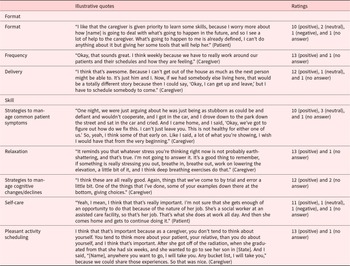
Regarding the format and delivery of the program, 71% of patients and caregivers responded positively to the proposed length (6 sessions), 93% responded positively to the frequency of sessions (weekly or every other week), and 86% responded positively to the videoconference format. Specifically, patients and caregivers reported that they appreciated the flexibility to attend sessions alone as caregivers or to be able to attend sessions together as a dyad (caregiver–patient), given the fluctuating nature of glioblastoma symptoms and progression of the disease. Caregivers also noted that attending sessions individually would provide them with much-needed support, focus, and time to learn how to manage and cope with glioblastoma. In terms of session frequency, patients and caregivers reported that 6 sessions conducted weekly, or every other week, would be feasible. Patients and caregivers liked that the videoconference format would allow for “face-to-face” interactions while simultaneously allowing for increased flexibility, access, and reach.
Regarding the intervention content, a total of 79% of patients and caregivers responded positively to strategies to manage cognitive changes and declines, and 79% responded positively to strategies to manage other common patient symptoms. Patients and caregivers reported that these strategies would be helpful and that they would have benefited from learning these strategies earlier following the diagnosis.
Most patients and caregivers (93%) responded positively to the brief relaxation exercise demonstrated during the interview. They expressed that the relaxation exercise would help with managing and reducing negative emotions such as stress and anxiety, especially when feeling overwhelmed (e.g., increasing patience and facilitating time to think of solutions). Patients and caregivers also responded positively to self-care; 79% of caregivers and patients expressed the importance and benefits of engaging in self-care and self-compassion and found it difficult to incorporate and implement in their daily lives. For example, caregivers described barriers to self-care, including lack of time and not having/knowing ways to implement self-care coping skills. One caregiver who reported frustration at the concept of self-care explained that while others may view self-care as a simple and easy task to engage in, self-care can be complex and difficult to implement as a caregiver due to limited time and competing responsibilities involved with caregiving. Finally, 93% of patients and caregivers responded positively to pleasant activity scheduling. They highlighted the importance of having time alone to engage in activities and hobbies, as well as the importance of quality time spent together and sharing experiences as a dyad. Ratings of responses and illustrative quotes regarding skills presented during the interviews are found in Table 2.
Ratings and illustrative quotes from phase I (patient–caregiver interviews)

Based on these findings, we finalized the intervention protocol for the pilot study to consist of 6 sessions, with flexibility for caregivers and patients to take part in the intervention alone or as a dyad. Additionally, participants were given up to 12 weeks to complete all 6 sessions (either on a weekly or biweekly basis) to accommodate preference for having sessions every other week, illness, travel, and other scheduling issues. In terms of content, given the variability in circumstances presented during the interviews, we realized that it was important to assess the needs of patients and caregivers in the first session so that we could tailor the content appropriately. Second, given the caregivers’ stated logistical and practical support needs, we added content around this topic in session 2. For example, if, during session 1, a caregiver reported high levels of caregiving burden and low support, in session 2, we would focus on identifying and utilizing external resources, as well as strategies around asking for help with the purpose of reducing caregiving burden. Third, when introducing self-care, we provided a definition of self-care and engaged patients and/or caregivers in a discussion about what this concept means to them (e.g., “What are your thoughts about self-care? What does this mean to you? What might be an example of you practicing self-care?”). We took this approach to highlight the individualized nature of self-care and to provide validation or address any frustrations regarding the term. In addition to discussing the benefits of self-care, we provided psychoeducation and introduced a variety of related skills and activities (e.g., self-compassion, pleasant activities, relaxation, and guided meditation). We addressed barriers to self-care implementation using a cognitive-behavioral lens (e.g., thoughts, emotions, and behaviors) and asked participants to practice 1–2 self-care activities in between sessions with check-ins in place to address and problem-solve barriers to implementation. Fourth, we initially combined communication skills and managing common glioblastoma symptoms in a single session. However, we decided to dedicate one session specifically to communication skills training to help caregivers and patients address the most salient themes that emerged from the interviews, including negotiating roles and responsibilities, maintaining patients’ dignity and independence, and increasing their connection with one another.
Finally, given the flexible delivery of the intervention, the content was developed to be relevant to individual patients and caregivers, as well as dyads, and easily adjusted depending on the target of the intervention. For example, session 4 focuses on strategies to manage cognitive changes or decline such as staying organized (e.g., maintaining a routine), becoming flexible (e.g., how to adapt activities as needed, limiting choices to simplify decision making), and promoting independence. These skills can be tailored to individual patients and caregivers, or to dyads, and they require minimal adaptation for delivery in each of these contexts. Another example is the communication skills module. Here we discussed strategies such as stating one main point at a time, using clear and short sentences, acknowledging and reflecting what the other person is saying, and minimizing distractions and avoiding interruptions during discussions. Each of these skills is applicable to patients, caregivers, or dyads without the need for significant adjustments by the therapist.
Phase II: Pilot study
Phase II: Methods
We maintained the same eligibility criteria and overall recruitment procedures as in Phase I. For this pilot study, participants completed baseline surveys, participated in 6 sessions of the intervention, and completed post-treatment surveys. The surveys were completed electronically via REDCap, and each participant received an individual link via email to complete the surveys. Participants each received $40 total: $20 for completing the baseline surveys and $20 for completing the post-treatment surveys.
Measures
Feasibility
The intervention’s feasibility was assessed based on participant completion of sessions and post-treatment surveys over a 4-month period (12 weeks to complete all 6 sessions, and 4 months to complete all study procedures including baseline and post-treatment surveys and sessions), with 70% completion serving as the benchmark.
Acceptability
Acceptability was assessed by participants’ reports of their satisfaction with treatment using the Client Satisfaction Questionnaire (Larsen et al. Reference Larsen, Attkisson and Hargreaves1979), which was tailored to the study intervention and administered post-treatment. A benchmark of 70% of participants reporting satisfaction with treatment (mean of 3.0 on a 1–4-point scale) was used as an indication of satisfaction.
Psychological distress
Depressive and anxiety symptoms were measured using the 14-item Hospital Anxiety and Depression Scale (HADS; Zigmond and Snaith Reference Zigmond and Snaith1983), with higher scores indicating higher levels of anxiety and depressive symptoms. In addition, general distress was measured using the National Comprehensive Cancer Network (NCCN) distress thermometer (Psychosocial Distress Practice Guidelines Panel 1999), a visual representation of a thermometer that ranges from 0 (no distress) to 10 (extreme distress). A score of 3 or above on the distress thermometer is indicative of high levels of distress (Cutillo et al. Reference Cutillo, O’Hea and Person2017). Patients and caregivers completed both the HADS and the NCCN distress thermometer at baseline and post-treatment.
Functional well-being
Functional well-being was measured using the 7-item Functional Well-being Subscale of the Functional Assessment of Cancer Therapy – General (FACT-G; Cella et al. Reference Cella, Tulsky and Gray1993). Scores range between 0 and 28, with higher scores indicating higher levels of functional well-being. Both patients and caregivers completed the survey at baseline and post-treatment.
Caregiver efficacy
Caregiver efficacy was measured using the Caregiver Inventory (CGI; Merluzzi et al. Reference Merluzzi, Philip and Vachon2011; Serpentini et al. Reference Serpentini, Guandalini and Tosin2021). The CGI consists of 21 items to assess caregiving self-efficacy in domains including managing medical information, caring for the care recipient, caring for oneself, and managing difficult interactions and emotions. The items are measured on a 9-point Likert scale, with higher scores indicating higher levels of self-efficacy. Caregivers completed the CGI at baseline and post-treatment.
The Empower GBM intervention
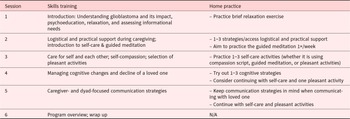
The Empower GBM intervention protocol consists of six 45–60-minute sessions conducted either jointly with patient–caregiver dyads or individually depending on their preference and given the variability and progression of patients’ glioblastoma symptoms. The content of each session is described in Table 3. Briefly, sessions focused on assessing the impact of glioblastoma on both partners and the relationship, teaching skills for self-care including relaxation, self-compassion, and pleasant activities, teaching skills for managing cognitive changes and decline, and dyad-focused communication strategies.
The Empower GBM intervention content

Sessions were conducted by a clinical psychology intern (J.L.) and a clinical psychology postdoctoral fellow (K.L.) with experience working with couples in medical settings. Both therapists received training in the protocol and followed a detailed treatment manual when conducting sessions. Additionally, sessions were audio-recorded, and both therapists received individual supervision from the study’s PIs (L.S.P. and K.R).
Phase II: Results
Feasibility and acceptability
Feasibility
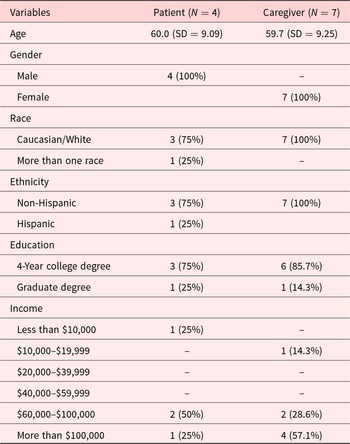
A total of 11 participants consented to participate in the pilot study; 4 were patients, and 7 were caregivers. Three dyads decided to participate in the intervention together, 1 dyad chose to complete the sessions separately, and 3 caregivers participated on their own. Thus, we conducted sessions with 3 patient–caregiver dyads, 1 individual patient, and 4 individual caregivers. Patients’ mean age was 60 years old (SD = 9.1); 3 patients identified as non-Hispanic Caucasian, and the fourth patient identified as Hispanic or Latino and 2 or more races. All patients identified as male. Caregivers’ mean age was 59.7 years old (SD = 9.3); all caregivers identified as non-Hispanic Caucasian and female (see Table 4 for full demographic data). All caregivers were spouses of patients. Time since diagnosis ranged from 4 to 59 months (mean of 25.6 months). 82% of participants (i.e., 75% of patients, 86% of caregivers) completed post-treatment surveys and completed the 6 sessions of the intervention on schedule (6–9 weeks to complete all 6 sessions). One dyad (2 participants: 1 caregiver and 1 patient) completed the baseline surveys and 4 sessions before withdrawing from the study due to limited time and feeling overwhelmed.
Participants’ demographic data for phase II (pilot study)

Acceptability
88.9% of participants who completed all sessions reported a treatment satisfaction score of 3.0 or higher (mean score of 3.57/4.00, SD = 0.46, range = 2.6–4.0). Six participants reported that the number of sessions was “about right,” 1 noted that it was “too many,” and 2 reported that it was “too few.” Seven participants reported that session length (45–60 minutes) was “about right,” one noted that it was “too short,” and another noted that it was “too long.” Four participants reported that it would have been more helpful to have this program closer to diagnoses, 4 reported that the timing was right, and 1 reported that they would have found this program more helpful in the future.
Patient and caregiver outcomes
From baseline to post-treatment, changes in outcome measures were in the expected direction. Specifically, patients and caregivers reported a decrease in symptoms of depression and anxiety (as measured by the HADS), and reductions in overall psychological distress (as captured from the NCCN distress thermometer) from baseline to post-treatment. Patients and caregivers reported slight improvements in functional well-being from baseline to post-treatment, and caregivers reported an increase in caregiving efficacy from baseline to post-treatment. See Table 5 for mean baseline, post-treatment, and change scores for patient and caregiver outcomes.
Baseline and post-intervention mean scores

Note: The negative effect sizes for functional well-being and caregiver efficacy indicate that there were improvements.
Discussion
The aims of this study were to develop a supportive care intervention for patients and caregivers coping with glioblastoma and conduct a pilot test to assess its feasibility and acceptability. The results of the qualitative interviews yielded positive responses for the format, frequency, and delivery of the intervention via videoconference. Most patients and their caregivers responded positively to learning strategies and skills to manage symptoms of glioblastoma, including managing cognitive changes and decline. In addition, most patients and caregivers responded positively to the brief relaxation exercise, reporting that it could help them cope with and reduce negative emotions. Finally, most patients and caregivers noted the importance of self-care, self-compassion, and scheduling pleasant activities yet reported barriers to implementation (e.g., time and caregiving responsibilities).
The results of our pilot study suggest that the intervention was feasible and acceptable. 82% of participants completed the 6-session intervention and post-treatment survey within the allotted 4-month timeline; in fact, participants completed all 6 sessions within 6–9 weeks. 89% of participants reported high treatment satisfaction (score of 3.0 or higher). Additionally, most participants reported satisfaction with the number and length of sessions. Interestingly, there were more varied responses regarding the timing of the intervention; some participants reported that they would have found the program to be more helpful closer to the time of diagnosis, while an equal number reported that this was the right time to participate in the intervention. Upon closer examination of the data, participants who reported that the program would be more helpful closer to the time of diagnosis were about 19–44 months post-diagnosis, while those who reported that the program was helpful at this time were 13 months or less post-diagnosis. One exception to the latter was a caregiver whose spouse was diagnosed almost 5 years ago, which potentially highlights the unique needs of long-term caregiving with glioblastoma. Understanding the most effective timing for participants’ involvement in the intervention is an important area for future research. Finally, most participants noted that the videoconference format of the sessions was convenient and helped facilitate participation. Finally, although most of the participants completed the surveys successfully, one caregiver reported having to read the survey questions to the patient as the patient could not read for long periods of time due to visual impairments as a symptom of disease progression. This feedback points to important considerations for ensuring accessibility when administering self-report surveys to this population (e.g., using large print, telephone, or voice-activated surveys).
The results of this pilot study suggest that the intervention showed promise in improving patient and caregiver adjustment. Specifically, from baseline to post-treatment, patients and caregivers reported decreases in depression and anxiety symptoms as measured by the HADS (Zigmond and Snaith Reference Zigmond and Snaith1983) and in psychological distress as assessed by the Distress Thermometer (Psychosocial Distress Practice Guidelines Panel 1999). Additionally, patients and caregivers reported increased functional well-being, and caregivers reported increased caregiving self-efficacy. While these results are encouraging, they should be interpreted with caution due to the single-arm nature of the study and the small sample size.
Our study demonstrated the feasibility and acceptability of a glioblastoma intervention that has the flexibility to be delivered to patients and caregivers individually or together. Specifically, we had 3 dyads who decided to participate in the intervention together, 1 dyad who chose to complete the sessions individually, and 3 caregivers who participated on their own, highlighting that the intervention is feasible and acceptable while accommodating intervention delivery preferences. An important area for future research is to better understand patients’ and caregivers’ preferences to engage in the intervention individually or as a dyad, and how that impacts the effects of the intervention. For example, Milbury et al. (Reference Milbury, Whisenant and Weathers2023) completed a 3-arm yoga pilot intervention for patients with a primary brain tumor and their caregivers. Results showed that although the dyadic yoga arm had higher attendance, caregivers in the individual yoga arm reported greater subjective benefits, improvements in quality of life, and reduced caregiver burden compared to caregivers in the dyadic yoga arm (Milbury et al. Reference Milbury, Whisenant and Weathers2023). Additionally, the flexible delivery of the intervention may be a strength to help increase reach, utilization, and provide continuity of care (e.g., caregivers could continue to participate if patients are unable to), especially given the nature of the disease progression and the unique and fluctuating needs of patients and their caregivers. Another strength of our study is the comprehensive content of skills and strategies included in the intervention to (1) improve management of patients’ symptoms to increase independence, (2) address the unique challenges faced by caregivers to increase caregiving efficacy and support (e.g., self-compassion), and (3) help caregivers and patients increase their connection and effectively cope with dyadic challenges such as negotiating roles and responsibilities.
Limitations
Despite our study’s strengths, there were also some limitations. In addition to the small sample size, our sample lacked diversity. Most of the study participants identified as Caucasian, non-Hispanic, well-educated, and high SES. Additionally, most of our caregivers were homogenous in terms of gender (i.e., female) and their relationship to the patient (i.e., spouse) for phase II of the study. Additional limitations include a lack of a comparison group and long-term follow-up. For the latter, participants highlighted that they would appreciate a follow-up and/or a “refresher” as coping with glioblastoma evolves with time. Finally, we did not include measures related to dyadic outcomes such as relationship satisfaction or communication in the current study. These are areas to address and improve upon in a subsequent larger randomized controlled pilot study to increase the generalizability and efficacy of the results.
Implications
The results of the current study will be used to refine the Empower GBM intervention for a larger randomized controlled pilot study. For next steps, given the rapid progression of glioblastoma symptoms for patients, it is worth considering the primary recipients of the intervention based on time since diagnosis. For example, within the first 6 months of diagnosis, the intervention could be offered to both the patient and caregiver, an iteration of Empower GBM specifically for the newly diagnosed couple/dyad. For those with a longer period since diagnosis, the intervention can be targeted more at caregivers while encouraging patient participation as they are able, as we did in the current study.
Second, given that caregivers are likely to be the primary recipients of the Empower GBM intervention, the larger pilot study will focus on caregiver distress as the primary outcome and consider both caregiver and patient quality of life as secondary outcomes. It will also assess the patient–caregiver relationship, including relationship adjustment, mutuality, and attachment. This will allow us to have a clearer understanding of how relationship dynamics influence patient–caregiver coping in the context of glioblastoma. Finally, participants highlighted that coping with glioblastoma evolves with time, and previous research has shown that caregivers’ reaction and distress are a function of the patient’s clinical status (Au et al. Reference Au, Willis and Reblin2022). Therefore, it would be important to assess caregivers’ short- and long-term reactions to better understand their unique needs with time, which will help us to refine the intervention.
Conclusions
The study’s initial data suggest that our supportive care intervention is feasible, acceptable, and shows promise in improving outcomes for patients and caregivers. The Empower GBM intervention for patients and caregivers coping with glioblastoma may be an effective approach to helping patients and caregivers cope effectively with the impact of a glioblastoma diagnosis.
Acknowledgments
The authors would like to thank Kaylee Faircloth for her assistance with the study procedures, and our study participants for their time and effort.
Funding
This study was supported by the Glioblastoma Foundation to Drs. L.S.P. and K.R. Additionally, this work was also supported in part by the National Cancer Institute (K.L., grant number F32CA278417; L.S.P., grant number R01CA229425; and K.R., grant number K08CA258947).
Competing interests
The authors have no conflict of interest to disclose.



 Open access

