

Introduction
Watanabeite, ideally Cu4As2S5, was described by Shimizu et al. (Reference Shimizu, Kato, Matsubara, Criddle and Stanley1993) from the Teine mine, Sapporo, Hokkaido, Japan, in association with emplectite, native bismuth, and members of the tennantite–tetrahedrite series. The empirical formula of type material is (Cu3.94Mn0.03Ag0.01)Σ3.98(As1.25Sb0.72Bi0.07)Σ2.04S4.98; some variations in the As/(As+Sb) ratio were reported by Shimizu et al. (Reference Shimizu, Kato, Matsubara, Criddle and Stanley1993), who also found a hypothetical Sb-analogue from the Takinosawa deposit. Owing to the small grain size, single-crystal X-ray diffraction data were not collected and the identification was based on the powder X-ray diffraction pattern only, similar but not identical to that of tetrahedrite-group minerals. Shimizu et al. (Reference Shimizu, Kato, Matsubara, Criddle and Stanley1993) proposed an orthorhombic cell, with a = 14.51(1), b = 13.30(1), c = 17.96(1) Å and Z = 16.
Later, watanabeite was reported by Paar et al. (Reference Paar, Topa and Sureda2002), Makovicky et al. (Reference Makovicky, Karanović, Poleti and Balić-Žunić2005) and Márquez-Zavalía and Galliski (Reference Márquez-Zavalía and Galliski2007) from Catamarca, Argentina, with variable replacement of As by Sb and Bi and the substitution of Cu by Zn, Fe, and minor Mn and Ag. Other occurrences are known from Greece, where Voudouris et al. (Reference Voudouris, Papavasiliou and Melfos2005, Reference Voudouris, Melfos, Spry, Moritz, Papavassiliou and Falalakis2011) and Repstock et al. (Reference Repstock, Voudouris and Kolitsch2015) reported the presence of watanabeite from the Perama Hill, St. Philippos, and Pefka deposits. Zheng et al. (Reference Zheng, Zhong, Bai, Zhang and Wu2021) gave chemical data for watanabeite from the Jiama porphyry system, south Tibet. Some other occurrences should deserve further investigations: for instance, Sidorov et al. (Reference Sidorov, Borovikov, Tolstykh, Bukhanova, Palyanova and Chubarov2020) reported a potential Sb-analogue of watanabeite from the Maletoyvayam deposit, Koryak Highland, Russia, and the same species may occur at the Pefka deposit (Repstock et al., Reference Repstock, Voudouris and Kolitsch2015). Finally, watanabeite is cited also from other localities but no chemical or structural data are given to confirm such an identification (e.g. Papavasiliou et al., Reference Papavasiliou, Voudouris, Kanellopoulos, Alfieris and Xydous2016; Ahmed et al., Reference Ahmed, Shaif, Siddiquie and Khan2018; Efremov et al., Reference Efremov, Spiridonov, Goryachev and Budyak2021). As will be shown later, some of these identifications of watanabeite reported in literature probably correspond to other mineral species.
During the investigation of tetrahedrite-group minerals from the Pefka deposit, leading to the identification of tennantite-(In) (Voudouris et al., Reference Voudouris, Biagioni, Sejkora and Musetti2023), Pb-bearing watanabeite was identified and a grain suitable for single-crystal X-ray diffraction (XRD) study was found. In this paper the description of the crystal structure of watanabeite is reported, along with a discussion of its crystal chemistry.
Experimental
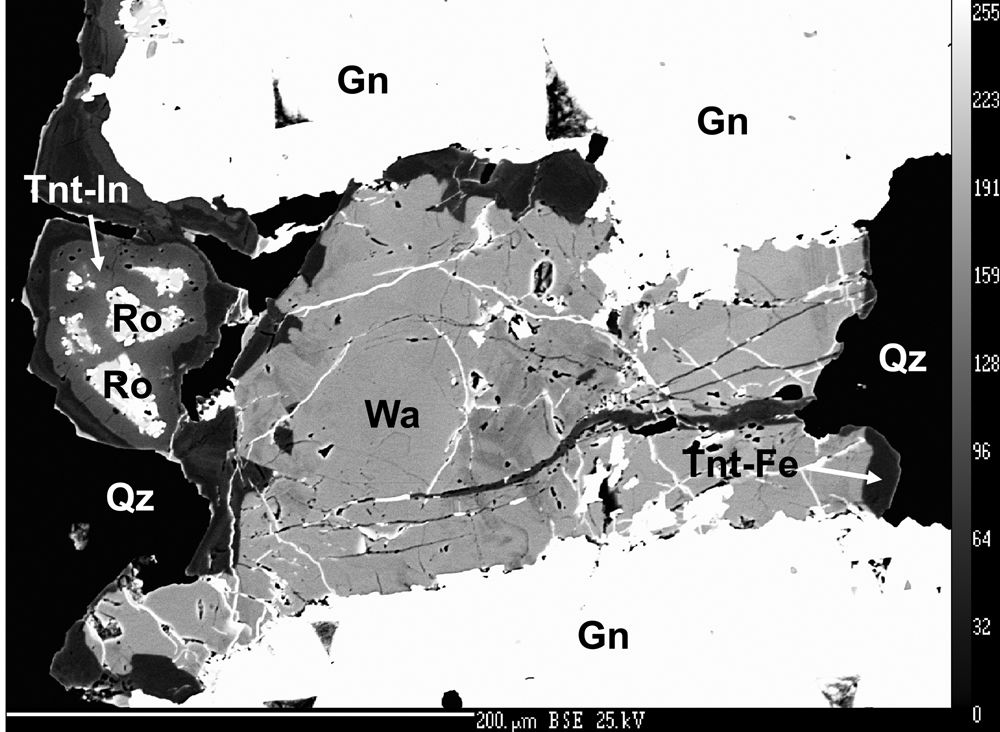
The specimen studied is represented by the type material of tennantite-(In), kept in the mineralogical collection of the Museo di Storia Naturale of the Università di Pisa (Italy), under catalogue number 20029. Watanabeite occurs as anhedral grains, up to 0.2 mm in size, associated with tennantite-(Fe), tennantite-(In), roquesite, galena, bournonite and seligmannite in a quartz gangue (Fig. 1).
Back-scattered electron image of watanabeite from the Pefka deposit, Greece. Mineral symbols (after Warr, Reference Warr2021): Gn = galena; Qz = quartz; Ro = roquesite; Tnt-Fe = tennantite-(Fe); Tnt-In = tennantite-(In); Wa = watanabeite. Catalogue number 20029, Museo di Storia Naturale, Università di Pisa, Italy.
The quantitative chemical analysis of watanabeite was carried out using a Cameca SX 100 electron microprobe (National Museum of Prague, Czech Republic) and the following analytical conditions: wavelength dispersive spectroscopy mode, accelerating voltage 20 kV, beam current 20 nA, beam diameter 0.7 μm. Standards (element, emission line) were: Ag (AgLα), CdTe (CdLα), chalcopyrite (CuKα, SKα), InAs (InLα), Mn (MnKα), NiAs (AsLβ), PbS (PbMα), PbSe (SeLβ), PbTe (TeLα), pyrite (FeKα), Sb2S3 (SbLα) and ZnS (ZnKα). Contents of other elements including Au, Bi, Co, Ga, Ge, Hg, Ni, Sn and Tl were always below detection limits. Matrix correction by the PAP algorithm (Pouchou and Pichoir, Reference Pouchou, Pichoir and Armstrong1985) was applied to the data. Results are reported in Table 1.
Chemical data for watanabeite (wt.%) and atoms per formula unit (apfu) on the basis of 11 apfu.
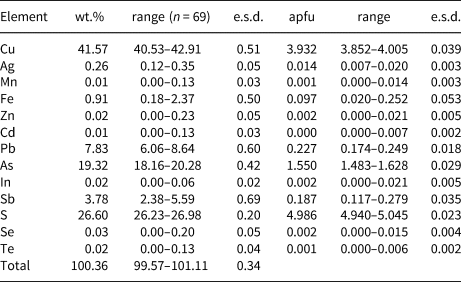
n = number of spot analyses; e.s.d. = estimated standard deviation.
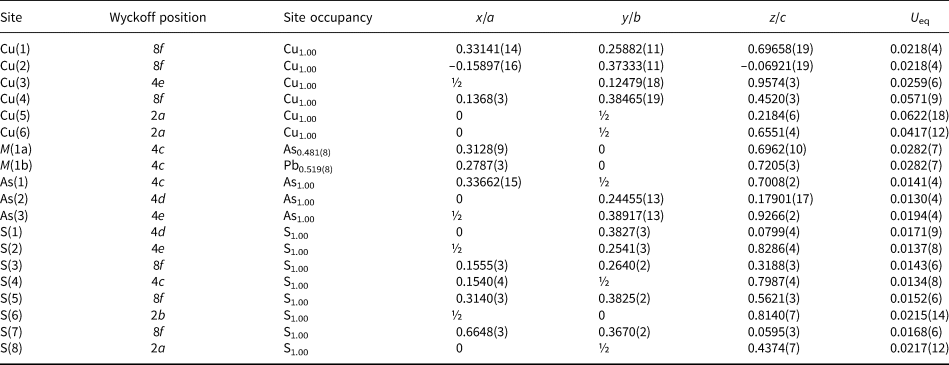
Single-crystal XRD intensity data of watanabeite were collected using a Bruker D8 Venture diffractometer (50 kV and 1.4 mA) equipped with an air-cooled Photon III detector, and microfocus MoKα radiation (C.I.S.U.P., University of Pisa, Italy). The detector-to-crystal distance was set to 38 mm. Intensity data were collected using φ and ω scan modes, in 0.5° slices, with an exposure time of 15 s per frame. A total of 2072 frames was collected. Frames were integrated with the Bruker SAINT software package using a narrow-frame algorithm. The integration of the data using an A-centred orthorhombic unit cell yielded a total of 24,223 reflections to a maximum θ angle of 28.34°. The final cell constants are based upon the refinement of the XYZ-centroids of 8598 reflections above 20σI, with 4.834° < 2θ < 55.15°. The refined unit-cell parameters are a = 10.9601(5), b = 14.6498(8), c = 10.3001(5) Å and V = 1653.82(14) Å3. Data were then corrected for Lorentz-polarisation, absorption and background. The statistical tests on the distribution of |E| values (|E 2 – 1| = 0.912) suggested the possible centric nature of watanabeite. However, the solution of its crystal structure in the space group Ammm was unsuccessful. Eventually, the crystal structure was solved using ShelxTL and refined through Shelxl-2018 (Sheldrick, Reference Sheldrick2015) in the space group Amm2. Neutral scattering curves were taken from the International Tables for Crystallography (Wilson, Reference Wilson1992). In the crystal structure of watanabeite from the Pefka deposit, ten cation and eight S sites were located. Among cation positions, six are fully occupied by Cu, three by As, and one is a mixed and split M(1) site hosting As, Sb and Pb. The displacement parameters of these two split sub-positions were constrained to be the same. The location of minor Fe and Ag was not identified. A racemic twin was modelled, resulting in the ratio 0.13/0.87 between the two components, thus supporting the acentric nature of watanabeite. After several cycles of anisotropic refinement, the R 1 factor converged to 0.0471 for 2108 unique reflections with F o > 4σ(F o) and 123 refined parameters. Some relatively high (unmodelled) residuals (up to ~ 4 e–/Å3) were observed in the difference-Fourier map. The three main maxima are located around Cu atoms hosted at the Cu(4), Cu(6) and Cu(1) sites. These maxima may be related to an incomplete modelling for the racemic twin. Moreover, Cu atoms at the Cu(4) and Cu(6) sites have a bonding environment similar to that of atoms hosted at the M(2) site in tetrahedrite-group minerals, which can be split owing to positional disorder (e.g. Biagioni et al., Reference Biagioni, George, Cook, Makovicky, Moëlo, Pasero, Sejkora, Stanley, Welch and Bosi2020a); it cannot be excluded that a similar phenomenon may occur in watanabeite. The residual around the split M(1) site is probably due to the incomplete modelling of the anisotropic displacement parameters of the As [M(1a)] and Pb [M(1b)] positions, as these values at both sub-positions were constrained to be the same. Finally, reconstructed precession images of the reciprocal lattice of watanabeite revealed the occurrence of some misoriented grains in the sample studied, possibly being an additional reason for the presence of some residuals in the difference-Fourier map.
Details of data collection and refinement for watanabeite are given in Table 2, whereas fractional atomic coordinates and displacement parameters, as well as selected bond distances, are given in Tables 3 and 4. Table 5 reports the bond-valence sums, calculated using the bond parameters of Brese and O'Keeffe (Reference Brese and O'Keeffe1991). The crystallographic information file (cif) has been deposited with the Principal Editor of Mineralogical Magazine and is available as Supplementary material (see below).
Summary of crystal data and parameters describing data collection and refinement for watanabeite.

1 w = 1/[σ2(F o2) + (0.0472P)2 + 38.2973P].
2 Flack (Reference Flack1983)
Sites, Wyckoff positions, site occupancy, fractional atomic coordinates and equivalent isotropic displacement parameters (Å2) for watanabeite.
Selected bond distances (in Å) for watanabeite.

Weighted bond-valence sums (in valence units) for watanabeite.
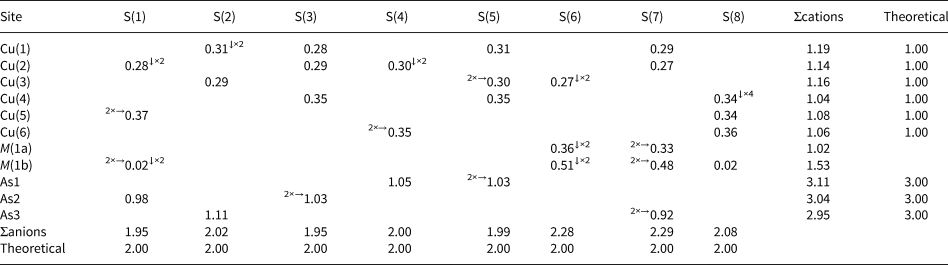
Note: left and right superscripts indicate the number of equivalent bonds involving cations and anions, respectively. The following site occupancies were used for M(1a) and M(1b) sites, respectively: M(1a) = Sb0.21As0.15; M(1b) = Pb0.47Sb0.17.
Results and discussion
Chemical formula of watanabeite
The chemical formula of watanabeite from the Pefka epithermal deposit, calculated on the basis of 11 atoms per formula unit (apfu), neglecting minor Mn, Zn, Cd, In, Se and Te, is Cu3.93Fe0.10Ag0.01Pb0.23As1.55Sb0.19S4.99.
The examination of available literature data, coupled with the results of new electron microprobe analyses performed during this study, allows discussion of two points: (1) distinction of watanabeite from tetrahedrite-group minerals; and (2) chemical features of watanabeite.
Chemical distinction of watanabeite from tetrahedrite-group minerals
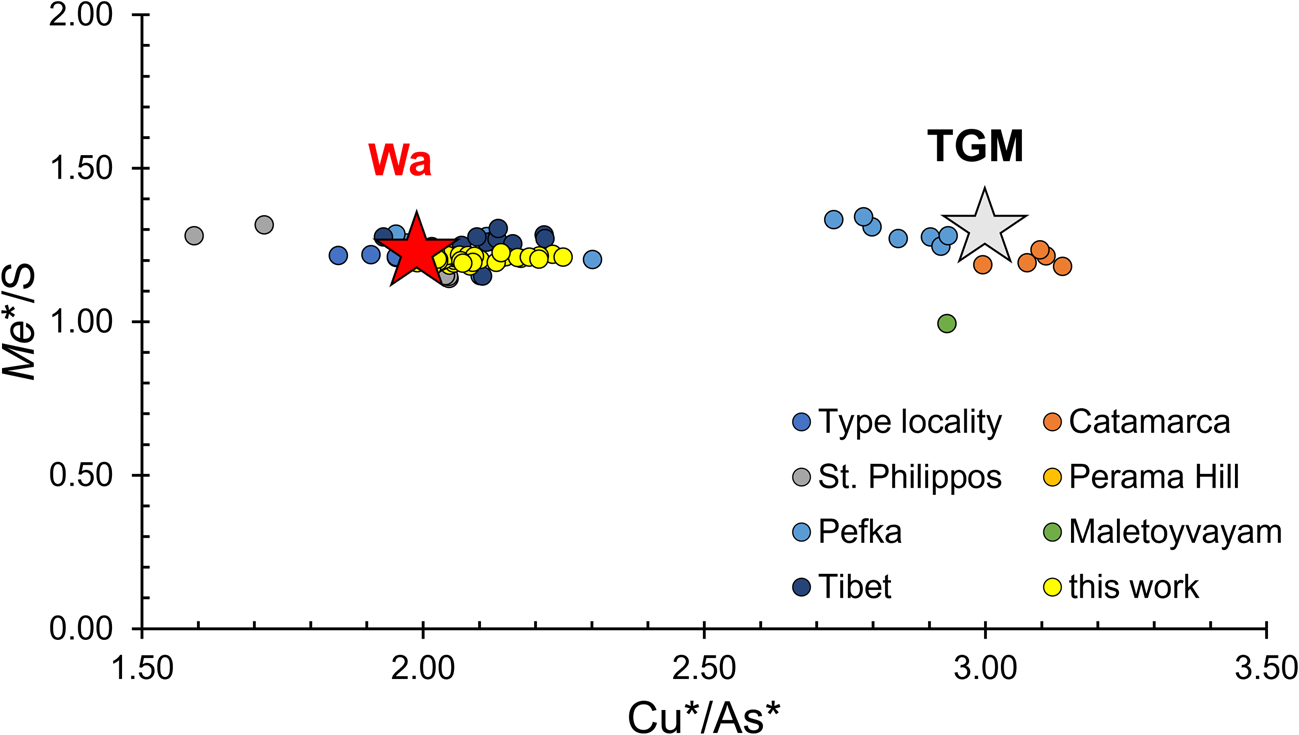
Watanabeite shows the same chemical constituents as tennantite-(Cu) (Biagioni et al., Reference Biagioni, Sejkora, Moëlo, Marcoux, Mauro and Dolníček2022b), i.e. Cu, As and S, and similar (Cu+As)/S ratios, i.e. 1.200 and 1.231, respectively. On the contrary, the ratio between Cu and As is very different, being 2 in watanabeite and 3 in tennantite-(Cu). An examination of the available literature shows that Cu can be replaced by Zn, Fe and other minor elements (e.g. Mn or Ag), whereas As can be substituted by Sb, Bi and Pb.
All the available chemical data referred to as watanabeite in Fig. 2 is plotted as a function of the Cu*/As* vs. Me*/S ratios, where: Cu* is the sum of all metals (Cu+Ag+Zn+Fe… without Pb); As* is the sum of all semi-metals (with Pb); and Me* is the sum of all metals (including Cu) and semimetals. It is apparent that not all the samples labelled as watanabeite on the basis of chemical analysis only are correctly identified as follows. (1) Watanabeite from Cerro Atajo and Mina Capillitas, Catamarca, Argentina, described by Márquez-Zavalía and Galliski (Reference Márquez-Zavalía and Galliski2007), is actually tennantite-(Zn); on the contrary, the two analyses reported by Paar et al. (Reference Paar, Topa and Sureda2002) and Makovicky et al. (Reference Makovicky, Karanović, Poleti and Balić-Žunić2005) from Cerro Atajo correspond to watanabeite. (2) Chemical analyses of watanabeite from Pefka reported by Repstock et al. (Reference Repstock, Voudouris and Kolitsch2015) correspond to watanabeite (analyses 2–6), whereas analyses 7–13 can be identified as tennantite-(Fe) and tetrahedrite-(Fe). Analysis 1 is probably watanabeite with an admixture of a minor amount of a tetrahedrite-group mineral. (3) Two spot analyses reported by Voudouris et al. (Reference Voudouris, Papavasiliou and Melfos2005) from St. Philippos have low Cu*/As* ratios; however, the authors stated that watanabeite was included in galena and the high Pb content could be interpreted as due to the occurrence of inclusions of this lead sulfide. (4) The potential Sb-analogue of watanabeite described from the Maletoyvayam deposit by Sidorov et al. (Reference Sidorov, Borovikov, Tolstykh, Bukhanova, Palyanova and Chubarov2020) has a Cu*/As* ratio similar of those of tetrahedrite-group minerals, but with a lower Me*/S ratio, close to 1. This could be an (As,Se)-rich famatinite.
Diagram showing the relation between Cu*/As* vs. Me*/S ratios for samples of watanabeite described in literature. Red and grey stars indicate the ideal values for watanabeite (Wa) and tetrahedrite-group minerals (TGM). Chemical data are after Shimizu et al. (Reference Shimizu, Kato, Matsubara, Criddle and Stanley1993) for the type locality; Paar et al. (Reference Paar, Topa and Sureda2002), Makovicky et al. (Reference Makovicky, Karanović, Poleti and Balić-Žunić2005), and Márquez-Zavalía and Galliski (Reference Márquez-Zavalía and Galliski2007) for Catamarca province, Argentina; Voudouris et al. (Reference Voudouris, Papavasiliou and Melfos2005) for St. Philippos, Greece; Voudouris et al. (Reference Voudouris, Melfos, Spry, Moritz, Papavassiliou and Falalakis2011) for Perama Hill, Greece; Repstock et al. (Reference Repstock, Voudouris and Kolitsch2015) for Pefka, Greece; Sidorov et al. (Reference Sidorov, Borovikov, Tolstykh, Bukhanova, Palyanova and Chubarov2020) for Maletoyvayam, Russia; Zheng et al. (Reference Zheng, Zhong, Bai, Zhang and Wu2021) for the Jiama porphyry system, South Tibet. Yellow circles represent analytical data from our study.
This review of available chemical data is a fundamental step for discussing the chemical features of ‘true’ watanabeite.
Chemical features of watanabeite
Scrutiny of the available data allows us to report the following chemical features for watanabeite:
(1) Cu content is usually close to 4 apfu, ranging between 3.53 and 4.20 apfu. The lowest value was reported in a sample from St. Philippos, Greece (Voudouris et al., Reference Voudouris, Papavasiliou and Melfos2005), characterised by the highest Ag content so far reported in watanabeite.
(2) Silver content is usually low (<0.02 apfu). Only watanabeite from St. Philippos, Greece (Voudouris et al., Reference Voudouris, Papavasiliou and Melfos2005), has up to 0.22 Ag apfu.
(3) Minor metals which can be present in watanabeite are Fe and Zn (up to 0.40 and 0.10 apfu, respectively, in a sample from the Perama Hill, Greece – Voudouris et al., Reference Voudouris, Melfos, Spry, Moritz, Papavassiliou and Falalakis2011). Up to 0.40 apfu of Pb have been measured in samples of Ag-bearing watanabeite from the St. Philippos deposit (Voudouris et al., Reference Voudouris, Papavasiliou and Melfos2005); as this sample was admixed with galena, it cannot be excluded that some Pb is due to the occurrence of inclusions of this lead sulfide. Minor amounts of Mn (up to 0.07 apfu in type material from Japan – Shimizu et al., Reference Shimizu, Kato, Matsubara, Criddle and Stanley1993) and Hg (up to 0.03 apfu in samples from the Jiama porphyry system, Tibet – Zheng et al., Reference Zheng, Zhong, Bai, Zhang and Wu2021) are also reported;
(4) Arsenic content is variable, ranging between 1.01 and 1.98 apfu. In the Introduction it was reported that a possible existence of the Sb-analogue of watanabeite was proposed by Shimizu et al. (Reference Shimizu, Kato, Matsubara, Criddle and Stanley1993) who reported the identification of a sample from the Takinosawa deposit, Japan, having an As-to-Sb ratio of 41:59; other occurrences of possible Sb-analogues of watanabeite (e.g. Repstock et al., Reference Repstock, Voudouris and Kolitsch2015; Sidorov et al., Reference Sidorov, Borovikov, Tolstykh, Bukhanova, Palyanova and Chubarov2020) correspond to members of the tetrahedrite group or to famatinite. The highest amount of Sb so far observed is 0.88 apfu in watanabeite from the Jiama porphyry system, South Tibet (Zheng et al., Reference Zheng, Zhong, Bai, Zhang and Wu2021). Similar values were reported by Shimizu et al. (Reference Shimizu, Kato, Matsubara, Criddle and Stanley1993), up to 0.87 apfu.
(5) Bismuth is reported in watanabeite, up to 0.44 apfu in samples from Cerro Atajo, Argentina (Makovicky et al., Reference Makovicky, Karanović, Poleti and Balić-Žunić2005).
(6) The occurrence of minor Sn (up to 0.05 apfu) is known from Perama Hill, Greece (Voudouris et al., Reference Voudouris, Melfos, Spry, Moritz, Papavassiliou and Falalakis2011). Its crystal-chemical role is unknown as Sn can occur as Sn2+ or Sn4+.
(7) Sulfur is usually the only anion occurring in watanabeite. Selenium and Te are reported, usually in very low amounts (up to 0.04 and 0.03 apfu, respectively). Finally, the role of Te is ambiguous, as it could also act as a cation (Te4+) as observed in tetrahedrite-group minerals (e.g. Biagioni et al., Reference Biagioni, George, Cook, Makovicky, Moëlo, Pasero, Sejkora, Stanley, Welch and Bosi2020a).
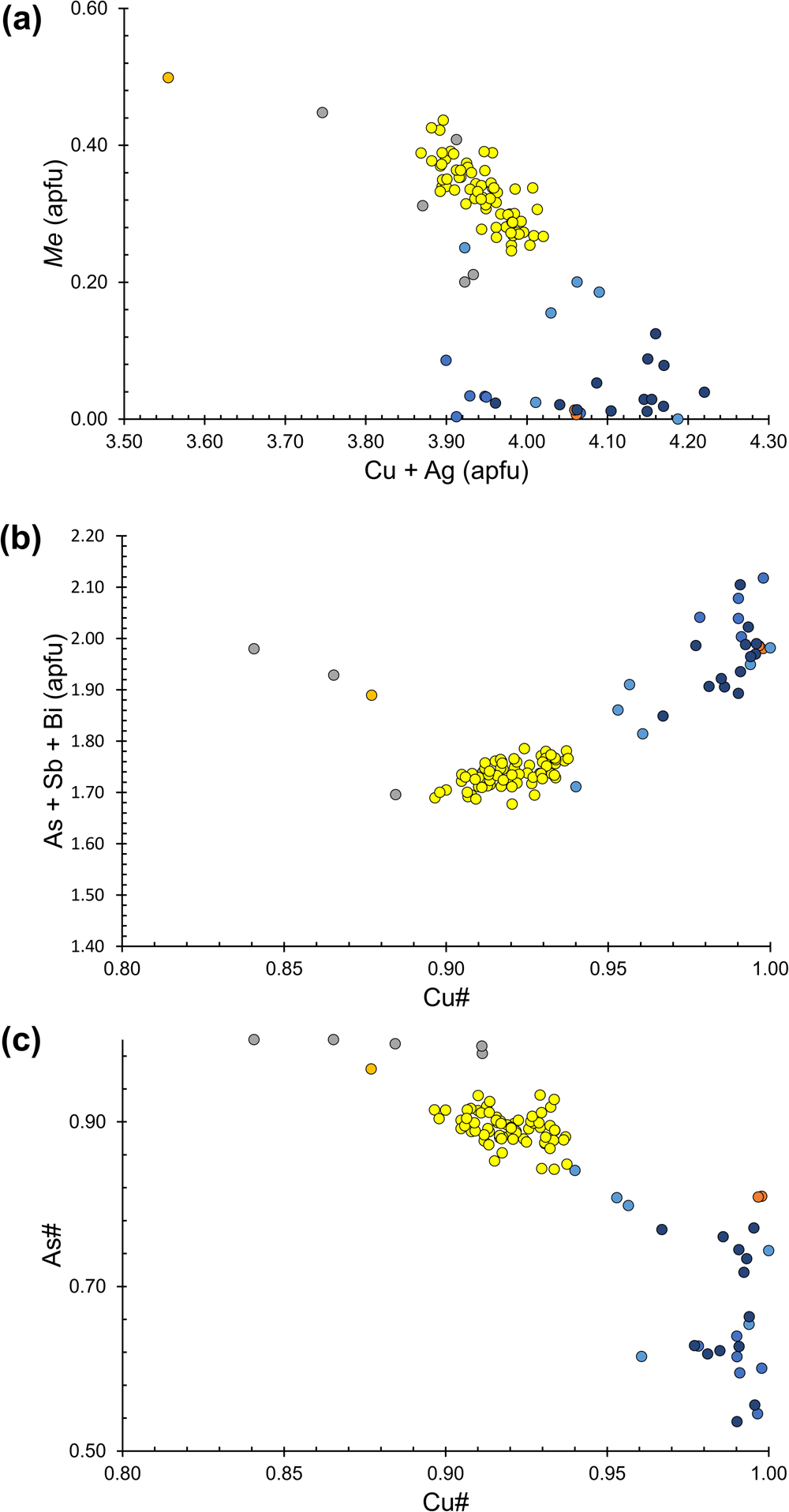
Repstock et al. (Reference Repstock, Voudouris and Kolitsch2015) observed that whereas the sum of metals (e.g. Cu, Ag, Hg, Fe) can be above 4 apfu, the sum of As, Sb and Bi can be below 2 apfu; on this basis, they speculated that Fe3+ may occur in watanabeite, as a substituent for As, Sb and Bi. Actually, the Fe-rich watanabeite they described is a member of the tetrahedrite-(Fe)/tennantite-(Fe) series, and the amount of Fe in true watanabeite is small. However, the excess of Cu, Ag and other metals (up to 0.32 apfu) and the deficit of metalloids (down to 1.70 apfu) was observed in watanabeite from other occurrences. The sum (Cu + Ag) is not clearly correlated with other metals Me (Fig. 3a), whereas the content of As + Sb + Bi is related to the ratio between Cu and the sum (Cu + Me) (this ratio is indicated hereafter as Cu#). In particular, the lower this value, the higher is the As + Sb + Bi deficit with respect to the ideal value of 2 apfu (Fig. 3b). This seems to suggest a role of elements other than Cu in the replacement of As, Sb and Bi. This kind of replacement seems to affect all possible samples of watanabeite, disregarding the ratio As/(As+Sb+Bi) (hereafter As#). Indeed, the Cu# has no clear correlation with As# (Fig. 3c).
Chemical variability in watanabeite. Same symbols as in Fig. 2.
On the basis of these observations, the most likely mechanism favouring the incorporation of formally divalent metals in watanabeite may be the substitution Cu+ + As3+ = 2 Me 2+, with the replacement possibly involving different Me 2+ cations. Indeed, in the specimen studied from the Pefka ore deposit, ~0.25 Pb2+ apfu replaces ~0.25 (As+Sb)3+ apfu. Such a substitution creates a charge imbalance, that could be neutralised replacing Cu+ with formally divalent elements, e.g. Fe2+ (0.10 apfu) and, possibly, of ~0.15 Cu2+. The occurrence of Fe3+, possibly involved in the substitution mechanism Cu+ + 2 (As,Sb)3+ = Fe3+ + 2 Pb2+ is not supported by available data.
Crystal structure
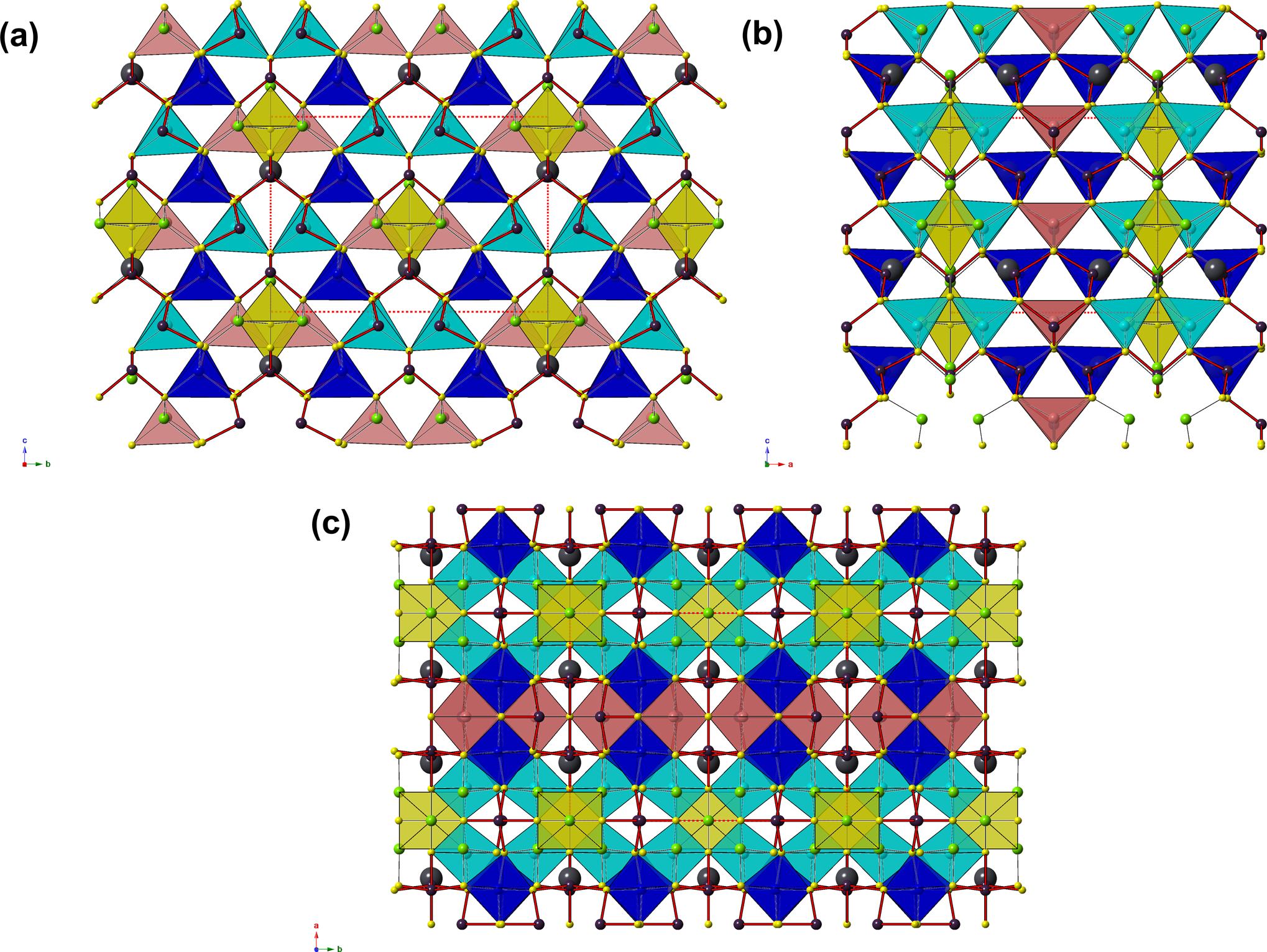
The crystal structure of watanabeite (Fig. 4) shows six independent Cu sites, three As positions, one split and mixed (Sb,As/Pb)-hosting M(1) site, and eight S positions. In the following, the details of atom coordinations and site occupancies will be discussed before giving a general outline of the crystal structure of this copper sulfosalt.
Crystal structure of watanabeite as seen down [100] (a), [010] (b), and [001] (c). Polyhedra: dark blue = Cu(1) site; light blue = Cu(2) site; pink = Cu(3) site; yellow = S(8) site. Circles: green = Cu(4)-Cu(6) sites; violet = As(1)-As(3) and M(1a) sites; dark grey = M(1b) site; yellow = S(1)-S(7) sites. Red dotted lines indicated the unit cell, drawings made using CrystalMaker® software.
Atom coordinations and site occupancies
Copper sites are characterised by tetrahedral and triangular coordination. Copper atoms hosted at the Cu(1), Cu(2) and Cu(3) sites are tetrahedrally coordinated, with <Cu–S> distances ranging between 2.308 and 2.323 Å. These distances can be compared with those reported for other tetrahedrally coordinated Cu sites, e.g. in the virtually pure Cu site M(1) of stibiogoldfieldite (2.329 Å – Biagioni et al., Reference Biagioni, Sejkora, Musetti, Makovicky, Pagano, Pasero and Dolníček2022c) or in chalcopyrite-like minerals (2.302–2.33 – Hall, Reference Hall1975). Bond-valence sums for these Cu atoms vary between 1.14 and 1.19 valence units (vu), agreeing with the occurrence of Cu+.
Sites Cu(4), Cu(5) and Cu(6) host triangularly coordinated Cu atoms, with <Cu–S> distances in the range 2.241–2.254 Å. These values are similar to those reported in other Cu sulfides, e.g. in stibiogoldfieldite (2.251 Å – Biagioni et al., Reference Biagioni, Sejkora, Musetti, Makovicky, Pagano, Pasero and Dolníček2022c), tennantite-(Cd) (2.230 Å – Biagioni et al., Reference Biagioni, Kasatkin, Sejkora, Nestola and Škoda2022a), tennantite-(Cu) (2.230 Å – Biagioni et al., Reference Biagioni, Sejkora, Moëlo, Marcoux, Mauro and Dolníček2022b), and tetrahedrite-(Hg) (2.262 Å – Biagioni et al., Reference Biagioni, Sejkora, Musetti, Velebil and Pasero2020b). Bond-valence sums agree with the occurrence of Cu+, being in the interval 1.02–1.08 vu.
No evidence for the replacement of Cu by other atoms was observed in both tetrahedrally and triangularly coordinated positions. However, it should be kept in mind that the amount of Fe (0.10 apfu) and Ag (0.01 apfu) is low and could not be detected during the crystal structure refinement. Moreover, the atomic number Z of Fe is similar to that of Cu (Z = 26 and 29, respectively), making their distinction more difficult.
Arsenic is hosted at the three pure sites As(1), As(2) and As(3). These sites show the typical trigonal pyramidal coordination of As3+, with <As–S> distances in the range 2.247–2.266 Å. The corresponding bond-valence sums, in the range 2.95–3.11 vu, agree with the occurrence of As3+.
Finally, a fourth position, namely M(1), is actually split into two sub-positions, M(1a) and M(1b), with M(1a)–M(1b) = 0.450(9) Å. The M(1a) position displays a trigonal pyramidal coordination, with three Me–S distances in the range 2.38–2.42 Å; this arrangement is compatible with a mixed (Sb,As) position. The M(1b) site has three short distances, in the range 2.61–2.63 Å, similar to a trigonal pyramidal coordination, and three additional very long distances close to 3.8 Å, with an average distance of ~3.2 Å. The mean atomic numbers (MANs) refined at the M(1a) and M(1b) positions are 15.87 and 42.56 electrons, respectively, summing to a total MAN at M(1) of 58.43 electrons. It agrees with the occurrence of Pb at this split position, partially replacing As and Sb. On the basis of the refined MANs, the observed bond distances, and the electron microprobe data, the site occupancies (Sb0.21As0.15)Σ0.36 and (Pb0.47Sb0.17)Σ0.64 are proposed for the partially occupied M(1a) and M(1b) positions, respectively. The total site occupancy of the M(1) site would be (Pb0.47Sb0.38As0.15)Σ1.00, corresponding to a theoretical MAN of 62.87 electrons, slightly higher than the observed one. The sum of the bond-valence sums, calculated using these proposed occupancies, is 2.55 vu, in agreement with a mixed (Pb2+/Sb3+ and As3+) position.
Sulfur atoms are usually four- or six-fold coordinated. Sulfur hosted at the S(1)–S(7) positions displays a tetrahedral coordination, possibly increased to higher coordination numbers if very long M (1b)(Pb,Sb)–S distances are taken into account (when this sub-site is occupied). Two different kinds of coordination environments are observed, i.e. S bonded to three Cu atoms and one As atom [S(1) to S(5) sites] or S bonded to two Cu atoms and atoms hosted at two M(1) sites, actually split into M(1a) and M(1b) positions [S(6) and S(7) sites]. The former has a bond-valence sum ranging between 1.95 and 2.02 vu, whereas the latter is overbonded, showing bond-valence sums of 2.28–2.29 vu. The overbonding is possibly related to uncertainty in the actual environment around the split position M(1). Sulfur hosted at S(8) is octahedrally coordinated by Cu atoms, in a configuration similar to that observed for the S(2) site in tetrahedrite-group minerals (e.g. Biagioni et al., Reference Biagioni, George, Cook, Makovicky, Moëlo, Pasero, Sejkora, Stanley, Welch and Bosi2020a). Its bond-valence sum is 2.08 vu, in agreement with the occurrence of S2–.
Crystal structure architecture
The tetrahedrally coordinated sites, namely Cu(1), Cu(2) and Cu(3), are corner-bonded to form a three-dimensional framework (Fig. 4) having composition Cu20S38 (Z = 1). Cavities within the tetrahedral scaffolding are occupied by two different kinds of atom clusters. The first one is represented by triangularly coordinated Cu atoms, octahedrally arranged around a central S atom, hosted at the S(8) site, with composition Cu12S2 (Z = 1). Arsenic atoms hosted at the As(1) and As(2) sites encircle this SCu6 anion-centred polyhedron. This configuration is the same observed in tetrahedrite-group minerals (e.g. Biagioni et al., Reference Biagioni, George, Cook, Makovicky, Moëlo, Pasero, Sejkora, Stanley, Welch and Bosi2020a). The second kind of cluster is an As2(Pb,Sb,As)2S7 group, formed by the As(3) and M(1) sites, bonded to S atoms hosted at the S(2), S(6) and S(7) sites, shared with the tetrahedral framework.
The structural formula of watanabeite from Pefka can thus be written as [IV]Cu20S38 + [III]Cu12As8S2 + As4(Pb,Sb,As)4 = [III]Cu12 [IV]Cu20As12(Pb,Sb,As)4S40 (Z = 1), that is [III]Cu3[IV]Cu5As3(Pb,Sb,As)S10 (Z = 4), considering the three independent three-fold Cu sites and the three independent tetrahedrally coordinated Cu sites as aggregated positions. The role of the M(1) site has to be better understood by examining further samples of watanabeite. On the basis of Z = 8, as currently reported in the official IMA List of Mineral Names (Pasero, Reference Pasero2024), the formula becomes Cu4As1.5(Pb,Sb,As)0.5S5.
Comparison between watanabeite and tetrahedrite-group minerals
Shimizu et al. (Reference Shimizu, Kato, Matsubara, Criddle and Stanley1993) pointed out the similarity between watanabeite and tetrahedrite-group minerals, based on physical properties and powder XRD patterns. Following the solution of the crystal structure of watanabeite, it is now possible to compare the structural arrangement of these sulfosalts. Both minerals are characterised by a three-dimensional framework formed by Cu-centred tetrahedra and show the occurrence of S-centred octahedra encircled by AsS3 trigonal pyramids.
The distribution of this latter structural feature in watanabeite and tetrahedrite-group minerals is shown in Fig. 5. In watanabeite this cluster alternates, along a, with an As2(Pb,Sb,As)2S7 cluster, not occurring in tetrahedrite-group minerals. This gives rise to a different distribution of the Cu6As4S clusters between watanabeite and tetrahedrite-group minerals.
Comparison between the crystal structure of watanabeite, as seen down [011] (a) and tetrahedrite-group minerals, as seen down [111] (b).

In Fig. 6 a projection of the crystal structure of watanabeite, as seen down c, is compared with the crystal structure of a tetrahedrite-group mineral as seen down a. One can recognise a common structural module with composition Cu10As4S13 (Z = 2); in watanabeite, these tetrahedrite-like modules are connected along [100] through the occurrence of symmetry-related Cu(1) sites, giving the composition Cu10Cu4As4S13 (Z = 2). It is worth noting that in tetrahedrite-group minerals, the position corresponding to the Cu(1) site in watanabeite has to be considered only half, giving the composition Cu10Cu2As4S13 (Z = 2), corresponding to the composition of tennantite-(Cu). In the crystal structure of watanabeite, the interspace between tetrahedrite-like modules is occupied by an additional slab with composition Cu2As4S7 (Z = 2), where Pb is neglected; the thickness of this slab is ~4 Å. Thus, the crystal structure of this sulfosalt can be described as a one-to-one intergrowth of tetrahedrite-like slabs and additional, As-rich, slabs, i.e. Cu14As4S13 + Cu2As4S7 = Cu16As8S20 (Z = 2) = Cu4As2S5 (Z = 8).
Comparison between the tetrahedrite-like slab of watanabeite, as seen down [001] (a) and the crystal structure of tetrahedrite-group minerals, as seen down [100] (b). Same symbols as in Figure 4.

Following these structural relationships, the unit-cell parameters of watanabeite and tetrahedrite-group minerals are related according to these equations: a Wa = a Ttd × √2/2 + ~ 4 Å; b Wa = b Tnt × √2; and c Wa ≈ c Tnt.
The similarities between watanabeite and tetrahedrite-group minerals could suggest some crystal-chemical implications. For instance, Ag could be hosted preferentially at the triangularly coordinated Cu(4)–Cu(6) sites, as occurs in tetrahedrite-group minerals where Ag is preferentially located at the three-fold coordinated M(2) site (e.g. Kalbskopf, Reference Kalbskopf1972). Moreover, the occurrence of the Cu6S(8) anion-centred polyhedra in the crystal structure of watanabeite may suggest that in Ag-rich environments and under peculiar physical–chemical conditions, some kinds of Ag–Ag interactions could occur, coupled with a S deficit, as observed in tetrahedrite-group minerals (e.g. Welch et al., Reference Welch, Stanley, Spratt and Mills2018; Biagioni et al., Reference Biagioni, George, Cook, Makovicky, Moëlo, Pasero, Sejkora, Stanley, Welch and Bosi2020a). If Ag fully occupies the Cu(4)–Cu(6) sites, the ideal composition of the Ag-isotype would be (Cu2.5Ag1.5)Σ4.0As4S5 (Z = 8); the possible phase with vacancy dominant at the S(8) site and with the formation of metallic (Ag6)4+ clusters would have the chemical formula (Cu2.5Ag1.5)Σ4.0As4S4.75□0.25 (Z = 8). Currently, the highest Ag content reported in watanabeite is 0.22 Ag apfu from the St. Philippos deposit, Greece (Voudouris et al., Reference Voudouris, Papavasiliou and Melfos2005), well below the value proposed for the Ag-isotype of watanabeite. Such a content could correspond to the full occupancy of Cu(5) or Cu(6) sites; however, a crystal structure study of Ag-bearing watanabeite is mandatory to ascertain the ordering of Ag.
Finally, the solution of the crystal structure of Pb-bearing watanabeite indicates a possible mechanism favouring the incorporation of a large-sized cation such as Pb2+ in a tetrahedrite-like tetrahedral framework. Indeed, the occurrence of Pb is reported in some samples of tetrahedrite-group minerals. For instance, Vavelidis and Melfos (Reference Vavelidis and Melfos1997) documented the occurrence of Pb in tetrahedrite from the Maronia area, Greece, with Pb dominating over Fe and Zn. However, Makovicky and Karup-Møller (Reference Makovicky and Karup-Møller1994) observed a maximum Pb content in synthetic samples of 0.45 apfu and they were not able to exclude the possible existence of very fine exsolution of Pb-rich phases within the tetrahedrite matrix. Moreover, it is possible that some occurrences of Pb-bearing tetrahedrite-group minerals are actually Pb-bearing watanabeite, considering the similarity in the physical properties and chemical formula, as discussed above. For instance, the average analysis of Pb-rich tetrahedrite from Maronia (Vavelidis and Melfos, Reference Vavelidis and Melfos1997), i.e. (Cu10.69Ag0.04)Σ10.73(Pb0.96Fe0.19Zn0.03)Σ1.18(Sb4.02As0.04)Σ4.06S13.03, can be recalculated on the basis of 11 apfu, i.e. (Cu4.05Ag0.02)Σ4.07(Pb0.36Fe0.07Zn0.01)Σ0.44(Sb1.52As0.02)Σ1.54S4.94, with a Cu*/As* ratio of 2.18. This formula is similar to that of Pb-bearing watanabeite (even if Sb > As, and consequently the species would be an Sb-analogue), with a deficit of (Sb+As) similar to the sum of divalent elements (Pb, Fe, Zn). This suggests that further data are needed to ascertain the identity of Pb-rich tetrahedrite-group minerals that could be misidentified on the basis of chemical data only.
Watanabeite in the framework of Cu–As–S phases
Watanabeite belongs to the Cu–As–S ternary system, currently formed by six different mineral species (Table 6). Maske and Skinner (Reference Maske and Skinner1971) investigated this system finding enargite, lautite, luzonite, sinnerite, ‘tennantite’, and a new compound (‘compound A’), with formula Cu24As12S31, i.e. Cu4As2S5.167. Shimizu et al. (Reference Shimizu, Kato, Matsubara, Criddle and Stanley1993) compared the powder XRD pattern of watanabeite with that of ‘compound A’ of Maske and Skinner (Reference Maske and Skinner1971), pointing out the similarity. Some similarities can also be found with the ‘compound C’ synthesised in the Cu–Sb–As–S system by Luce et al. (Reference Luce, Tuttle and Skinner1977). This phase has composition Cu4(As/Sb)2S5, with the As/(As+Sb) ratio ranging between 0.455 to 0.74, that is from Sb-dominant to As-dominant.
Minerals belonging to the Cu–As–S ternary system.

s.g. = space group.
Watanabeite contains As3+, as confirmed by the solution of its crystal structure. In this respect it is similar to sinnerite and tennantite-(Cu), both being As3+-species (Bindi et al., Reference Bindi, Makovicky, Nestola and De Battisti2013; Biagioni et al., Reference Biagioni, Sejkora, Moëlo, Marcoux, Mauro and Dolníček2022b). On the contrary, enargite and luzonite are two dimorphs of the compound Cu3AsS4, showing tetrahedrally coordinated As5+ cations (Marumo and Nowacki, Reference Marumo and Nowacki1967; Karanović et al., Reference Karanović, Cvetković, Poleti, Balić-Žunić and Makovicky2002). More complex is the crystal structure of lautite, where As–As bonding was also observed (e.g. Bindi et al., Reference Bindi, Catelani, Chelazzi and Bonazzi2008).
The different oxidation state of As could be related to different $f_{\rm S_2}$ of the crystallisation medium, with the high value of $f_{\rm S_2}$
 favouring the formation of As5+ compounds, whereas lower values may stabilise As3+-phases, among which is watanabeite.
Conclusion
The solution of the crystal structure of watanabeite reveals a potentially more complex crystal chemistry than that suggested by the chemical formula Cu4As2S5. Indeed, several substitutions are observed in natural samples, allowing the incorporation of other cations than Cu having different sizes, such as Pb, Fe and Zn. For this reason, the crystal chemical investigation of more samples, characterised by different chemistries, would be useful, allowing a better understanding of this sulfosalt that is able to host several elements typical of hydrothermal environments. A crystallographic investigation of samples with Sb > As is also mandatory, in order to understand the relationship between watanabeite and its chemically Sb-analogue. Finally, it is probable that several occurrences of watanabeite may have been misidentified, owing to its similarity with tetrahedrite-group minerals. Taking into account the progresses in mineralogical crystallography, allowing the full characterisation of very small grains (less than 50 μm in size), a complete characterisation of the mineralogy of ore deposits should consider the possibility of coupling electron microprobe analyses with XRD data. This would increase our understanding of the mineral systematics and the processes governing the ore formation.
Acknowledgements
The comments of the Associate Editor František Laufek and the revision by Luca Bindi, Peter Leverett, and an anonymous reviewer helped us in improving the paper. CB acknowledges financial support from the Ministero dell'Istruzione, dell'Università e della Ricerca through the project PRIN 2017 “TEOREM – deciphering geological processes using Terrestrial and Extraterrestrial ORE Minerals”, prot. 2017AK8C32. JS and ZD acknowledges financial support from the Ministry of Culture of the Czech Republic (long-term project DKRVO 2024-2028/1.II.a; National Museum, 00023272). The Centro per l'Integrazione della Strumentazione scientifica dell'Università di Pisa (C.I.S.U.P.) is acknowledged for the access to the C.I.S.U.P. X-ray Laboratory.
Supplementary material
The supplementary material for this article can be found at https://doi.org/10.1180/mgm.2024.14.
Competing interests
The authors declare none.


 Open access

