

Introduction
Tidal flats play important economic and ecological roles in coastal ecosystems (Costanza et al. Reference Costanza, D’Arge, deGroot, Farber, Crasso, Hannon, Limburg, Naeem, O’Neil, Paruelo, Raskin, Sutton and van den Belt1997), such as filtering organic wastes (Widdows et al. Reference Widdows, Blauw, Heip, Herman, Lucas, Middelburg, Schmidt, Brinsley, Twisk and Verbeek2004), and provide abundant nutrients that support microbenthic organisms, fish, birds, and even humans (Levin et al. Reference Levin, Boesch, Covich, Dahm, Erseus, Ewel, Kneib, Moldenke, Palmer, Snelgrove, Strayer and Weslawski2001, Wall et al. Reference Wall, Palmer and Snelgrove2001). In particular, tidal flats on the west coast of South Korea are prominent staging sites for migratory shorebirds that use the East Asian-Australasian (EAA) Flyway (Barter Reference Barter2002, Hua et al. Reference Hua, Tan, Chen and Ma2015). Several hundreds of thousands of shorebirds, including several endangered and threatened species, use the EAA Flyway to migrate thousands of kilometres, often travelling from as far as Australia to Siberia and back again. Many of these migrants use tidal flats on the west coast of Korea as stop-over sites for the replenishment of energy stores necessary for continuation of their journey (Barter Reference Barter2002, Moores Reference Moores2006, Rogers et al. Reference Rogers, Moores and Battley2006, Buehler and Piersma Reference Buehler and Piersma2008, Warnock Reference Warnock2010). However, many staging sites in South Korea have been greatly reduced in size owing to land-reclamation projects, with grave implications for many of the migratory shorebird species that travel along the EAA Flyway.
Whereas reclamation projects in north-western Europe must adhere to strict guidelines and restrictions designed to minimise potentially harmful effects (Piersma Reference Piersma, Reinhard and Folmer2009), large-scale reclamation projects in Korea are conducted under laws that date back to 1962, and consequently many ecologically important tidal flats have vanished over the past several decades owing to reclamation. The Saemangeum, a bay-shaped tidal flat, has long been used as a staging ground by hundreds of thousands of migrating shorebirds (Moores Reference Moores2006, Rogers et al. Reference Rogers, Moores and Battley2006); however, the Saemangeum Seawall Project, in which a 33-km sea wall was constructed to isolate the tidal flat from the Yellow Sea, was completed in 2006, with construction of an accompanying sluice gate system to control the water levels in Saemangeum continuing until 2010. As of 2014, ∼400 km2 of the estuarine tidal flats were isolated from the sea, with ∼160 km2 of the flats reclaimed.
Several studies have highlighted the adverse impacts that coastal reclamation has had on ecosystems and the organisms they support, and consequently on humans as well (Laursen et al. Reference Laursen, Gram and Alberto1981, Goss-Custard and Yates Reference Goss-Custard and Yates1992, Li Reference Li2010, Yang et al. Reference Yang, Chen, Barter, Piersma, Zhou, Li and Zhang2011, Wang et al. Reference Wang, Gao, Jia, Thompson, Gao and Yang2012). As has been observed in other reclaimed areas, construction of the Saemangeum seawall has led to considerable deterioration of tidal-flat ecosystem quality, and is causing difficulties for dependent organisms at local, regional, and even global scales. For instance, the biomass and structure of macrozoobenthic communities—important food resources for many shorebirds—were dramatically altered as a result of physical changes in the sediment (Choi et al. Reference Choi, Lee, Lim, Walton and Park2010, Ryu et al. Reference Ryu, Khim, Choi, Shin, An, Park, Kang, Lee and Koh2011, Reference Ryu, Nam, Park, Kwon, Lee, Song, Hong, Chang and Kim2014), which may in turn affect many shorebirds that rely on this area. Degradation of the staging site may have a critical impact on the time and energy budgets of migratory shorebirds, and thus this might prove to be an important contributor to the decline in shorebird populations (Hua et al. Reference Hua, Tan, Chen and Ma2015, Piersma et al. Reference Piersma, Lok, Chen, Hassell, Yang, Boyle, Slaymaker, Chan, Melvile, Zhang and Ma2016). As long-distance migratory birds are incapable of foreseeing or perceiving such dramatic changes in habitat conditions, they are vulnerable to unexpected alterations in climate (Both et al. Reference Both, Bouwhuis, Lessells and Visser2006) and habitat (Fiona et al. Reference Fiona, Schmiegelow and Mönkkönen2002).
Although several studies have been conducted on how reclamation and development in the western Yellow Sea have affected shorebirds (e.g. Yang et al. Reference Yang, Chen, Barter, Piersma, Zhou, Li and Zhang2011, Hua et al. Reference Hua, Tan, Chen and Ma2015), only a handful have focused on the long-term effects of the Saemangeum Project on migratory shorebirds. Moores et al. (Reference Moores, Rogers, Kim, Hassell, Gosbell, Kim and Park2008), for one, reported that shorebird populations declined immediately following completion of the project, and more recently, Moores et al. (Reference Moores, Rogers, Rogers and Hansbro2016) reported the effect of the Saemangeum seawalls on shorebird populations between 2006 and 2014; however, the authors focused solely on the northward migration and limited the period of research to begin from 2006, when the impacts of the project were already being felt. Some shorebirds utilise different staging habitats during their northward and southward migrations; thus, it would be more informative to examine the changes in both the southward and northward migrating populations separately. In addition, expanding the observation period to include data collected prior to 2006 would provide a more comprehensive comparison of shorebird populations before and after the project. By so doing, our research further contributes to a better understanding of the changes in the staging locations of shorebird populations following the deterioration of their original staging sites. Moreover, through comparisons with research focusing on the tidal flats of the eastern Yellow Sea deriving primarily from China, the present study could provide additional information about the overall population trends of the migratory shorebird species that travel the EAA Flyway. As such, our goal here was to examine the responses of shorebirds to the massive reclamation projects undertaken in the Saemangeum, and to suggest short- and long-term conservation strategies for these shorebirds.
Methods
Study sites
Four sites—Saemangeum, Yubu Island, the Janghang coastline, and the Geum River Channel—were selected (Figure 1); these sites represent major staging areas in which many shorebirds have been historically observed during the spring and fall (Kim et al. Reference Kim, Park, Yi, Yoo and Lee1999, Rogers et al. Reference Rogers, Moores and Battley2006). Saemangeum is a tidal flat formed by the estuaries of the Dongjin and Mangyeng rivers (Figure 1, Table 1), whereas Yubu Island, the Janghang coastline, and the Geum River Channel are located in the Geum Estuary, located north of Saemangeum (Figure 1).
Location of Saemangeum, Yubu Island, the Janghang coastline, and the Geum River Channel.
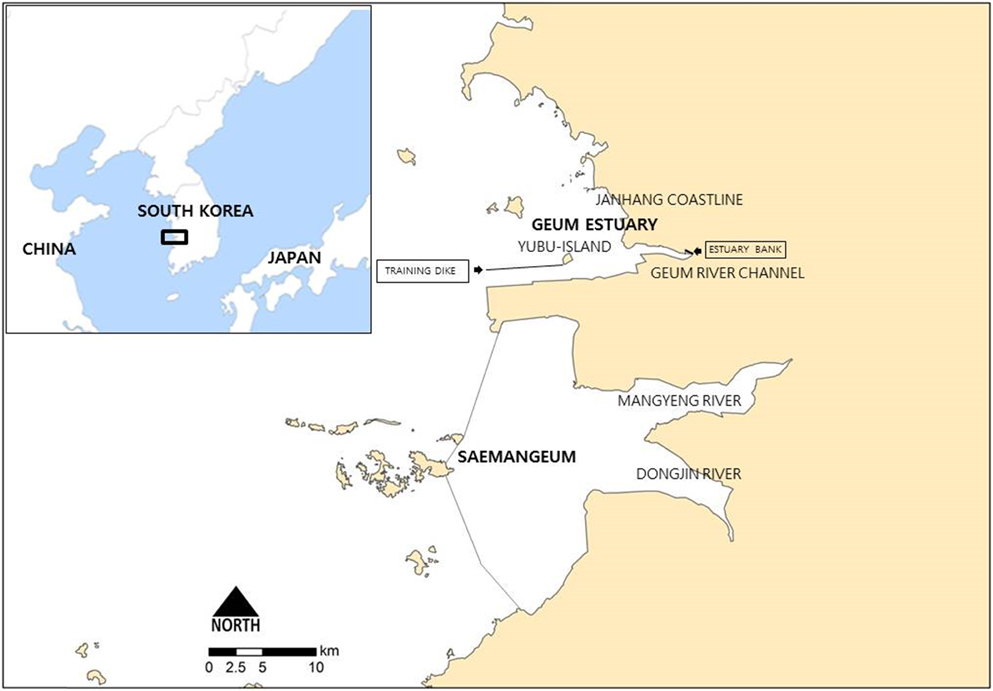
Details of the Saemangeum area and the Geum Estuary.

Data collection
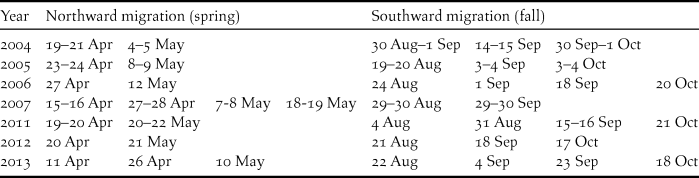
We conducted shorebird counting surveys in Saemangeum and the three sites in the Geum Estuary with telescopes (25–60x) and binoculars (10 × 40). Surveys were conducted at multiple temporal points in the spring and autumn prior to (2004 and 2005), during (2006 and 2007), and after the completion (2011–2013) of reclamation activity. We selected the observation dates based on the time when each shorebird species is known to visit this region (see Rogers et al. Reference Rogers, Moores and Battley2006). Surveys were conducted multiple (2–4) times (Table 2) during the spring and fall migration periods each year. In order to count all birds, we arrived at designated spots where observers were able to view birds moving along with the tide or flying away before full tide (for small birds such as Dunlin Calidris alpina and Red-necked Stint C. ruficollis) 2 h prior to full tide. Primary counts were conducted when shorebirds congregated at the highest spot at each site during full tide. To minimise double counting, shorebird counts at the sites in the Geum Estuary were performed simultaneously by multiple teams, who communicated with one other via mobile phone to share information about the movements of shorebird populations. We estimated the number of shorebirds based on the peak counts of each species from multiple observations at each site; such an approach may underestimate the number of shorebirds using the area for staging, but is helpful in identifying trends in the annual abundance among all sites and changes in abundance within each site (Yang et al. Reference Yang, Chen, Barter, Piersma, Zhou, Li and Zhang2011).
Observation dates during the annual northwards and southwards migrations of shorebirds (Apr: April; Sep: September; Oct: October).
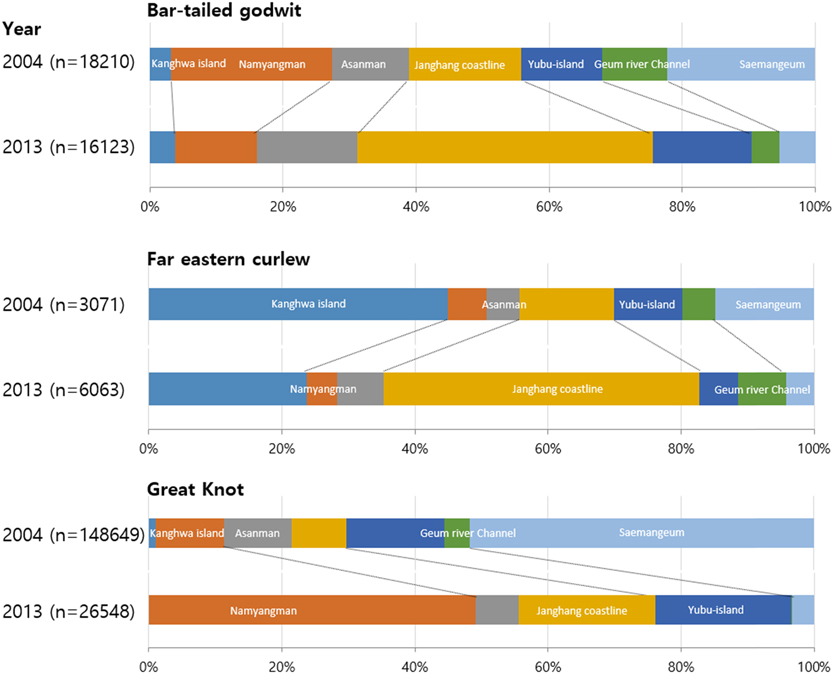
In addition, we compared our results for Bar-tailed Godwit Limosa lapponica and Far Eastern Curlew Numenius madagascariensis (populations of which exhibited a positive trend in our results compared with global trends) and Great Knot Calidiris tenuirostris (populations of which were found to have declined markedly in Saemangeum) to changes in abundance reported at other major staging sites in South Korea. Peak numbers during the northward migration in 2004 (before the Saemangeum Reclamation Project was initiated) and 2013 (after completion of the Saemangeum Reclamation Project) were also compared.
Results
We recorded a total of 48 species of shorebirds in the Saemangeum area, including one ‘Critically Endangered’ species (CR; Spoon-billed Sandpiper Eurynorhynchus pygmeus), three ‘Endangered’ species (EN; Nordmann’s Greenshank Tringa guttifer, Far Eastern Curlew and Great Knot), and nine ‘Near Threatened’ species (NT; Buff-breasted Sandpiper Tryngites subruficollis, Curlew Sandpiper Calidris ferruginea, Red-necked Stint, Red Knot Calidris canutus, Grey-tailed Tattler Heteroscelus brevipes, Eurasian Curlew Numenius arquata, Bar-tailed Godwit, Black-tailed Godwit Limosa limosa and Asian Dowitcher Limnodromus semipalmatus), based on their respective IUCN (2015) listings.
The total number of shorebirds visiting the Saemangeum area decreased dramatically following completion of the Saemangeum Seawall Project (Figure 2). Before the Saemangeum seawall was constructed, over 250,000 birds comprising 26 species visited the Saemangeum, the area where most of the shorebirds were observed (Rogers et al. Reference Rogers, Moores and Battley2006; see below), annually. Since 2007, when the Saemangeum Seawall Project was completed, shorebird populations have decreased substantially, with only ∼50,000 birds of 20 species observed in total. Notably, only one Spoon-billed Sandpiper (CR) was recorded on average following completion of the Saemangeum seawall (Appendix S1 in the online supplementary material), whereas hundreds were typically observed prior to the project (Kim et al. Reference Kim, Park, Yi, Yoo and Lee1999). Populations of Nordmann’s Greenshank and Great Knot (EN) were also significantly reduced, by 47% and 93% compared to their average abundance in the years before the project (Figures 3 and 4), respectively, and populations of four Near Threatened species—Red Knot, Red-necked Stint, Black-tailed Godwit, and Eurasian Curlew—have also been greatly reduced, by 97%, 55%, 56%, and 17%, respectively, since the construction of the Saemangeum seawall (Figures 3 and 4). In contrast, populations of Far Eastern Curlew (EN) have increased markedly, and those of the Bar-tailed Godwit (NT) slightly, in recent years (Figures 3 and 4). Populations of the other four NT species were too small for any clear trends to be discerned, however (Appendix S1).
Sum of the maximum counts of shorebird species observed at Saemangeum, Yubu Island, the Janghang coastline, and the Geum River Channel.

Changes in the average annual numbers of each shorebird species visiting the Saemangeum area during spring (northwards migration) before the seawall project (2004 and 2005), during the reclamation period (2006 and 2007), and after completion of the project (2011–2013). Column plots represent the total number of each species; black dots and lines represent the number of each species observed in Saemangeum; and hollow circles and dotted lines represent the number of each species in the Geum Estuary (Yubu Island, Janghang coastline, and Geum River Channel).

Changes in the average annual numbers of each shorebird species visiting the Saemangeum area during autumn (southwards migration) before the seawall project (2004 and 2005), during the reclamation period (2006 and 2007), after completion of the project (2011–2013). Column plots represent the total number of each species; black dots and lines represent the number of each species observed in Saemangeum; and hollow circles and dotted lines represent the number of each species in the Geum Estuary (Yubu Island, Janghang coastline, and Geum River Channel).

Changes in shorebird abundance during the northward migration
We then focused on 16 species for which it was feasible to track changes in abundance (Figures 4 and 5). Populations of most shorebirds were found to have declined in Saemangeum during the northward migration, with the exception of the Kentish Plover Charadrius alexandrinus (Figure 4); most notably, Great Knots, Red Knots, and Ruddy Turnstones Arenaria interpres have virtually disappeared, whereas populations of Red-necked Stints and Black-tailed Godwits have declined by > 70%, and those of Whimbrel Numenius phaeopus and Lesser Sand Plover Charadrius mongolus by > 50%. In contrast, however, populations of most shorebird species have increased in the Geum Estuary, with the exception of Red Knots and Red-necked Stints, with the larger numbers of Bar-tailed Godwits, Far Eastern Curlews, and Dunlins particularly conspicuous.
Comparison of the peak numbers of Bar-tailed Godwits, Far Eastern Curlews, and Great Knots at major staging sites in South Korea between 2004 and 2013; “n” represents the sum of the peak numbers of each species observed at each site. Kanghwa Island, Namyangman, and Asanman are other major migratory shorebird staging habitats in South Korea (see Rogers et al. Reference Rogers, Hassell, Oldland, Clemens, Boyle and Roges2008, Moores et al. Reference Moores, Rogers, Rogers and Hansbro2016).
Overall, the abundance of 10 species observed at sites in the Saemangeum and Geum Estuary decreased after the Saemangeum Project, whereas that of five species (Bar-tailed Godwit, Eurasian Curlew Numenius arquata, Far Eastern Curlew, Terek Sandpiper Xenus cinereus, and Kentish Plover) increased over the same period, with the populations of Bar-tailed Godwit and Far Eastern Curlew increasing substantially.
Changes in shorebird abundance during the southward migration
Patterns in population changes during the southward migration were similar to those of the northward migration (Figure 5). Overall, shorebird populations in the Saemangeum area generally declined, with populations of six species falling by > 70% and those of four species by ∼50%. In the Geum Estuary, most shorebird populations exhibited increasing trends, similar to those of the northwards migration, with the exception of populations of Eurasian Curlew, Kentish Plover, and Great Knot. As with the northward migration, Far Eastern Curlew and Bar-tailed Godwit populations increased dramatically in the Geum Estuary.
Despite the population expansions observed in the Geum Estuary, the abundance of 12 species in the Saemangeum and Geum Estuary declined after the Saemangeum project, whereas populations of four species increased, with the Far Eastern Curlew population exhibiting the largest increase (an increase larger than that of the northwards migration). Populations of Kentish Plover, which increased slightly during the northwards migration, were considerably smaller during the southwards migration.
Comparison of changes in species abundance after project completion
Comparison of the data for the northward migration with that collected from other stop-over sites in South Korea revealed that in 2003, 52% of the Far Eastern Curlew observed in South Korea staged on Kanghwa Island and at Namyangman and Asanman, but by 2013 this proportion had been reduced to 35% (Figure 6), whereas the proportion of this species staging in the Geum Estuary rose from 29% to 60%, along with a large increase on the Janghang coastline, over this same time period. The Bar-tailed Godwit population observed in the Geum Estuary increased from 39% in 2004 to 69% in 2013; in contrast, only 3% of the total Great Knot population was observed at Saemangeum in 2013, whereas 52% was observed in 2004. Moreover, although the proportions in other habitats increased over the same period, populations in those habitats remained more or less the same because the total number of Great Knots decreased by 82% between 2004 and 2013.
Comparison of sea level at full tide between Yubu Island and the Janghang coastline in 2015. The horizontal lines represent submergence at high tide; thus, during the times when sea levels are higher than the horizontal lines, the areas are submerged and birds have no place to land (www.khoa.go.kr).

Discussion
Populations of long-distance migratory shorebirds that travel the EAA Flyway have been decreasing over the past several decades, with many species in rapid decline (Amano et al. Reference Amano, Székely, Koyama, Amano and Sutherland2010, IUCN 2015, Clemens et al. Reference Clemens, Rogers, Hansen, Gosbell, Minton, Straw, Bamford, Woehler, Milton, Weston, Venables, Weller, Hassell, Rutherford, Onton, Herrod, Studds, Choi, Dhanjal-Adams, Murray, Skilleter and Fuller2016). Wilson et al. (Reference Wilson, Kendall, Fuller, Milton and Possingham2011) reported that in Australia, populations of migratory birds that use the EAA Flyway have declined by 43–78% over the past 15 years. Such dramatic reductions in population size may at least in part be due to the continuing (and escalating) degradation of migratory staging sites (Ma et al. Reference Ma, Hua, Peng, Battley, Zhou, Chen, Ma, Jia, Xue, Bai, Wu, Feng and Tang2013, Hua et al. Reference Hua, Tan, Chen and Ma2015); moreover, the loss of staging sites in the Yellow Sea (Moores et al. Reference Moores, Rogers, Kim, Hassell, Gosbell, Kim and Park2008, Piersma et al. Reference Piersma, Lok, Chen, Hassell, Yang, Boyle, Slaymaker, Chan, Melvile, Zhang and Ma2016) might account for why more shorebird species that use the EAA Flyway are classified as globally threatened than the other major flyways (Kirby Reference Kirby2010). In addition, the impacts are likely to be further accentuated in the future, given that the effects of large-scale reclamation emerge gradually and are exacerbated (and accumulate) over time (MacKinnon et al. Reference MacKinnon, VerKuil and Murray2012).
Large areas of tidal flats, such as those of Bohai Bay in the western Yellow Sea, have already been destroyed owing to the rapid rates of industrialisation and reclamation in China (Yang et al. Reference Yang, Chen, Barter, Piersma, Zhou, Li and Zhang2011, Wang et al. Reference Wang, Liu, Li and Su2014, Hua et al. Reference Hua, Tan, Chen and Ma2015), as have some tidal flats along the west coast of Korea, including those lost to the construction of Incheon International Airport on Yeongjong Island (see Murray et al. Reference Murray, Clemens, Phinn, Possingham and Fuller2014). As such, the Saemangeum area, which supported the largest number of shorebirds during their migration prior to the initiation of the Saemangeum Seawall Project, was an extremely important habitat for the migratory shorebirds that use the EAA Flyway (Yi Reference Yi2001). Completion of the Saemangeum seawall has further exacerbated the decline in usable staging areas for migratory shorebirds (Rogers et al. Reference Rogers, Moores and Battley2006, Moores et al. Reference Moores, Rogers, Kim, Hassell, Gosbell, Kim and Park2008, Yang et al. Reference Yang, Chen, Barter, Piersma, Zhou, Li and Zhang2011); Saemangeum is in fact no longer a suitable staging site for many shorebird species (Rogers et al. Reference Rogers, Moores and Battley2006). Isolation of the tidal flat from regular exposure to seawater has transformed the sediment macrozoobenthic community, as well as sediment structure and texture (Ryu et al. Reference Ryu, Khim, Choi, Shin, An, Park, Kang, Lee and Koh2011, Reference Ryu, Nam, Park, Kwon, Lee, Song, Hong, Chang and Kim2014), with alterations to the macrozoobenthic community signifying a fundamental change in the potential food resources available to the shorebirds; for example, reductions in shellfish abundance may have an enormous impact on Great Knot populations, as Great Knots feed primarily on shellfish (Hong et al. Reference Hong, Yamashita and Sato2007). Unsurprisingly, we found that Great Knot populations have disappeared almost entirely from the area since the reclamation project was completed.
Many shorebirds have lost their staging sites as a result of the degradation of suitable habitats in the Saemangeum, but in contrast, populations of some shorebirds have increased slightly in the Geum Estuary following completion of the Saemangeum project. Patterns of population changes differed for each species; some, such as Dunlin, Black-tailed Godwit, Lesser Sand Plover, Eurasian Curlew, Far Eastern Curlew, Whimbrel, Grey Plover Pluvialis squatarola, Terek Sandpiper, Common Greenshank Tringa nebularia, and Nordmann’s Greenshank, slightly increased in abundance, whereas Great Knot, Red Knot, Red-necked Stint, Kentish Plover, and Ruddy Turnstone did not. It is possible that the former group of shorebirds are more adept at exploiting a broader range of prey resources and thus can more readily adapt to conditions in adjacent areas, whereas the latter group lack such flexibility (Hua et al. Reference Hua, Tan, Chen and Ma2015), which may explain the slight increase in the abundance of some shorebird species in the nearby Geum Estuary. However, even the higher abundance of some species in the Geum Estuary did not fully compensate for the population losses observed in the Saemangeum, with the exception of Far Eastern Curlew and Bar-tailed Godwit populations. Most notably, populations of Far Eastern Curlew, a species recently designated as ‘Endangered’ by the IUCN (2015), increased remarkably following completion of the reclamation project.
Expansion of the Bar-tailed Godwit and Far Eastern Curlew populations may have occurred for different reasons. Although the number of Bar-tailed Godwits stopping over at major staging sites in South Korea did not change considerably between 2004 and 2013 (Figure 6), visitation trends at each site changed considerably; for instance, the percentage of Bar-tailed Godwits visiting the Janghang coastline increased considerably, whereas visitation rates to the Saemangeum and Namyangman regions were substantially reduced. This may be an indication that the population that formerly staged at Saemangeum have shifted to the Janghang coastline following degradation of the Saemangeum habitat. The increasing trend in the Far Eastern Curlew population differs from that of the Bar-tailed Godwit, in that overall populations of Far Eastern Curlews have apparently increased in South Korea as a result of the far larger numbers of this species observed on the Janghang coastline. An influx of the population from Saemangeum cannot account for the increase in the Janghang coastline given that the population of Far Eastern Curlews has doubled; more likely, the expansion of the Far Eastern Curlew population is due to influxes from other stopover sites in China, North Korea, or South Korea, or simply to an increase in the Far Eastern Curlew population itself. Based on recent data indicating that many shoreline habitats in China have deteriorated (Yang et al. Reference Yang, Chen, Barter, Piersma, Zhou, Li and Zhang2011, Hua et al. Reference Hua, Tan, Chen and Ma2015) and that populations of Far Eastern Curlew are on the decline (Rogers et al. Reference Rogers, Hassell, Oldland, Clemens, Boyle and Roges2008, Wilson et al. Reference Wilson, Kendall, Fuller, Milton and Possingham2011, IUCN 2015, Clemens et al. Reference Clemens, Rogers, Hansen, Gosbell, Minton, Straw, Bamford, Woehler, Milton, Weston, Venables, Weller, Hassell, Rutherford, Onton, Herrod, Studds, Choi, Dhanjal-Adams, Murray, Skilleter and Fuller2016), and that populations of this species have remained more or less static at other habitats in South Korea (Figure 5), we can infer that habitat destruction in China and other Asian countries is the primary cause. However, migratory characteristics, such as habitat jumping or hopping strategies, of the Bar-tailed Godwit and Far Eastern Curlew populations in South Korea are unknown.
Overall, Great Knot populations were found to be 82% smaller by 2013, with the abundance of this bird generally lower at each site, a pattern that reflects the global decline in the Great Knot population, as has been reported elsewhere (Rogers et al. Reference Rogers, Moores and Battley2008, Yang et al. Reference Yang, Chen, Barter, Piersma, Zhou, Li and Zhang2011, Hua et al. Reference Hua, Tan, Chen and Ma2015, Clemens et al. Reference Clemens, Rogers, Hansen, Gosbell, Minton, Straw, Bamford, Woehler, Milton, Weston, Venables, Weller, Hassell, Rutherford, Onton, Herrod, Studds, Choi, Dhanjal-Adams, Murray, Skilleter and Fuller2016). The Great Knot population in Saemangeum, which accounted for about 50% of the total population visiting South Korea, was very small in 2013. Increases in the Great Knot population at other sites, such as Namyangman, the Janghang coastline, and so on, were not apparent; thus, it would seem that the Saemangeum Project has contributed greatly to the recent decline in Great Knot populations in the EAA Flyway.
The Kentish Plover exhibited different population dynamics during the northwards and southwards migrations. Generally, this species travelled along different pathways for the two migrations, visiting the South Korean coastline—primarily the Saemangeum area—during the southwards migration (Yi Reference Yi2001); the Kentish Plover population during the northward migration was < 1% that of the southward migration. Thus, the > 90% decline in the southward population should be of particular concern. The loss of the Kentish Plover population at Saemangeum were not offset by increasing populations in the Geum Estuary, a pattern that might be contributing to the downwards population trend for this species (IUCN 2015).
Although the Geum River Channel, Yubu Island, and Janghang coastline may provide suitable alternative habitats for migrating shorebirds temporarily, they cannot be considered as true staging sites, for several reasons. For one, food resources are limited in the Geum River. Mudflats in the Geum River are relatively small, and as such, support prey resources suitable for only a limited number of shorebird species. In addition, estuaries that are enclosed by an estuary bank, such as is the case for the Geum River, are typically unproductive because of limited water exchange with the open sea (Froneman Reference Froneman2002, Reference Froneman2004). Furthermore, sediment particles in the Geum Estuary have become finer over time owing to the presence of the estuary bank and a training dike, and consequently the original sandy soil has been transformed into a predominately muddy soil (Kim et al. Reference Kim, Choi and Lee2006). Shellfish populations that prefer sandy soil are thus in decline, which has had an adverse effect on shorebird species (e.g. the Great Knot) that forage for shellfish. Furthermore, many laver (seaweed) farms have recently been constructed in this area, leading to degraded nutrient conditions. Many Common Shelducks Tadornata dorna now forage on the laver farms because of the lack of suitable food resources elsewhere. Secondly, unlike Saemangeum, mudflat habitats in the Geum Estuary are small and narrow, and thus are often fully submerged during the flood tide, denying shorebirds roosting sites during the full flood tide (Rogers et al. Reference Rogers, Moores and Battley2006), forcing them to waste energy finding a suitable place to land. For example, all roosting areas on Yubu Island and along the Janghang coastline are fully submerged when sea level is higher than 670 mm and 680 mm, respectively; the tidal flats of both Yubu Island and the Janghang coastline were fully submerged for five days in late March, April, and May in 2015 (Figure 6). Periods of inundation were even longer in the fall than in the spring, which could lead to alterations in shorebird refuelling and time-allocation budgets and consequently higher rates of migration failure. In addition, many of these sites are very close to human habitation, and thus shorebirds could easily be disturbed by human activities. Such disturbances may result in modifications to migration patterns and schedules.
We suggest several options for improving conservation of migratory shorebirds. First, in the short-term, abandoned salt farms, which are spared inundation even during the flood ebb, could be converted to roosting sites for some shorebird species during the flood ebb; for instance, a 30-ha abandoned salt farm adjacent to human habitation could be used, although a lack of maintenance has resulted in the salt farm being inundated with 50 cm of seawater during the full tide. Utilising the salt farm to provide shallow water flats would assist shorebirds seeking landing areas. Moreover, the construction of viewing platforms or artificial barriers between the tidal flats and human dwellings could reduce human disturbance when birds are feeding or resting (Burger et al. Reference Burger, Jeitner, Clark and Niles2004). In the mid-term, eliminating the estuary bank in the Geum River would enhance the productivity of the tidal flat in the Geum Estuary as a result of sediment stabilisation and nutrient provisioning (Kim et al. Reference Kim, Choi and Lee2006), which would support larger shorebird populations, as well as seaweed farms. In South Korea, there is considerable debate over whether the estuary bank should be removed or preserved, which includes arguments from both ecological and socio-economic perspectives. As we have shown here, the Geum Estuary has numerous issues that limit its effectiveness as an alternative to the Saemangeum. Rehabilitating and restoring the Saemangeum tidal flats via removal of the seawalls and allowing routine rehydration of the tidal flats therefore represents the only long-term solution to this problem. Whether or not rehabilitation would restore the habitat completely is unknown, but such actions would greatly improve habitat conditions for seabirds. In addition, the reclamation process has been faltering recently owing to inefficient management and utilisation plans, as well as insufficient financing; we strongly urge that the adverse environmental impacts of the Saemangeum reclamation be taken into greater consideration before additional tidal flats are reclaimed.
Supplementary Material
To view supplementary material for this article, please visit https://doi.org/10.1017/S0959270916000605
Acknowledgements
This work was supported by the National Institute of Biological Resources, Korea. This study was conducted in honour of Dr Jeong-Yeon Yi, who dedicated his life to shorebird research.



