


Background
The particular situational contexts of any conflict under discussion are key in acknowledging the role of the past in developing perceived social realities. A short chapter cannot take into account the complexities of such conflicts, but it can provide an introduction to possibilities of discussing these through a brief history, based on the author’s interpretation from a wide range of sources. This serves to suggest how developing social representations can become embedded across communities, societies and their peoples.
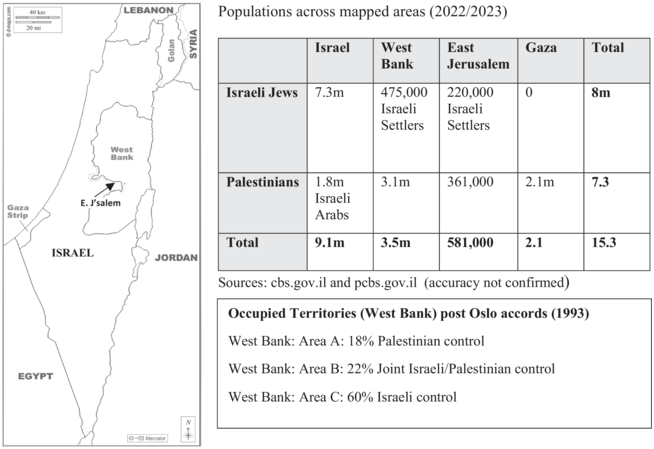
Both Cyprus and Israel/Palestine have been subject to various forms of colonial rule over many centuries culminating in the Ottoman Empire dynasty until the First World War (1914–1918) when Britain, after defeating Germany with her allies, used its powerful global position to attain influence in both locations, amongst many others, for differently held strategies. In Cyprus, its geographical position was useful for Britain’s continued colonial endeavours, leading to its independence in 1961 as the British Empire had been dismantled over previous years. The base of the Israel–Palestine conflict is similarly constructed around political power, competition over land rights and ethnic belonging. Palestine was pledged by Britain, supported by France and the United States, as a ‘national home for Jewish people’ in the Balfour declaration of 1917. Just 10% of the population at that time was Jewish, peacefully co-existing with the Palestinian Arab inhabitants. Promises of a wider independent Arab state were, at the same time, disregarded, and the division of lands gained by France and Britain following the First World War resulted in a new set of geopolitical power struggles across the Middle East (Barr, Reference Barr2011; Smith, Reference Smith2013). Although Britain and France have long given up their direct colonial enterprises in the area, legacies live on through the deeply embedded political cultural fabric created over time. With the rise of the United States as a global power following the Second World War and the end of the Cold War in the late 20th century, a global political shift across the area, both in terms of US security and liberal democratic peace processes, has played a direct role. Since Israel’s own self-claimed statehood in 1948, it has remained the more powerful partner in contrast to the Palestinian position. The complexity of geopolitical changes and further armed conflict inflicted over time has resulted in four separated geographical areas: that of Israel itself, the occupied West Bank (often referred to as Judea and Samaria by Jewish Israelis), Gaza and East Jerusalem. Within each area the intergroup relationship differs, resulting in a particular set of possible contact conditions, as outlined in Figure 11.1.

Figure 11.1 Map and population groups across different areas.
Figure 11.1Long description
The map of Israel and its surrounding regions, including the West Bank, Gaza Strip, Jordan, Lebanon, and Egypt, with key locations such as the West Bank and East Jerusalem labelled. Below the map, a table titled Populations across mapped areas (2022 slash 2023) presents population figures. The Israeli Jewish population is distributed as follows. 7.3 million in Israel, 475,000 Israeli settlers in the West Bank, 220,000 Israeli settlers in East Jerusalem, and none in Gaza, totalling 8 million. The Palestinian population is categorised as 1.8 million Israeli Arabs within Israel, 3.1 million in the West Bank, 361,000 in East Jerusalem, and 2.1 million in Gaza, amounting to a total of 7.3 million. The total population across all regions sums to 15.3 million. Additionally, control areas within the West Bank after the Oslo Accords in 1993 are detailed, specifying that Area A comprises 18 percent under Palestinian control, Area B consists of 22 percent under joint Israeli and Palestinian control, and Area C accounts for 60 percent under Israeli control.
There have been several attempts at peace negotiations, most notably the Oslo Accords of 1993. During these negotiations, a shimmer of a sustained and peaceful future was envisaged with the setting up of a National Palestinian Authority as a first step towards Palestinian statehood and the division of the West Bank as illustrated in Figure 11.1. However, further fractures have resulted in a stalemate position, both within and across cultural and political structures. Palestinian resistance to Israeli hegemony through direct attacks on the Jewish population plus two intifadas have only served to strengthen Israel’s military security systems and defensive attacks to defend their perceived, and often real, weakened status and vulnerability. Internal and antagonistic Palestinian politics developing between Hamas, in power in Gaza, and Fatah within the West Bank and East Jerusalem adds to this mix of political turmoil embroiled within the wider conflict. Palestine remains without sovereignty and statehood, under a continued military occupation and surveillance in the West Bank, a blockade in Gaza and annexation in East Jerusalem. Israel continues to increase its settler population against international and UN responses.
Within the state of Israel, 20% of the population are of Palestinian descent. Collectively known as Israeli Arabs or Palestinian Israelis who remained after the Nakba of 1948 at the time of the birth of Israel, they are given full Israeli citizenship. Two-thirds of the indigenous Palestinians fled or were forced out into refugee camp during the Nakba, to what is now the West Bank, Gaza and nearby states (Lebanon, Syria and Jordan), where their descendants remain. Israel is a democratic state, a member of the United Nations, with close ties with the West, particularly the United States, as both benefactor and supporter for security concerns against local and wider terrorist threats.
Focus on Intergroup Relationships
The relationship across and between conflicting groups is key to understanding the social and cultural maps that form the backdrop to any discussions. Each conflict bears witness to its own particular present and past circumstances, so any generalisation across contexts is fraught with challenges. However, certain processes are common across different contexts, highlighting a process approach over one of entity and structure (Wagoner, Reference Wagoner2014). The process of the dynamic and dialogical nature of each group’s representations of the other remains paramount (Liu, 2006) where each group remains embedded within their knowledge base of their history and culture. The epistemological significance of natural thinking and communication is at base dialogical, multidimensional, heterogenous and diverse (Marková, Reference Marková2016). Any dialogue becomes a carrier of social representations for both individuals and the wider community that communicates and interacts with others in the pursuit and development of social knowledge. The complexity of any social reality can be explored through this dialogical trajectory, to take into account the relationship across groups as co-partners in conflict. Key is the maintenance of this base, coupled with points of any social change through communication, where the co-authoring of a relationship is dependent on perspectives about the other even when not necessarily in direct communication (Moscovici & Marková, Reference Moscovici and Marková1998; Nicholson, Reference Nicholson, Wagoner, Brescó de Luna and Zadeh2020). This chapter takes this genetic framework as a base from which to explore how a complex concrete reality might be discussed through a lens of intergroup contact.
In the case of the Israeli–Palestinian conflict, both histories are parallel histories, where each group can be defined through their collective narratives of past, present and future aspirations, and which, for the most part, have followed divergent paths (Shlaim, Reference Shlaim2009). The consequences of one group’s acting out of those aspirations onto the other activates a response, which activates yet another, as members of both groups continue to be locked in a dialogical painful duet of mutual suffering (Nicholson, Reference Nicholson2016, Reference Nicholson2017). At base there is – and continues to be – a deep-seated asymmetry where the reins of power remain within the domain of Israel’s political and religious practices and ideology. The backing of Western international support reflects how little change is forecast to foster Palestinian autonomy that satisfies Israeli security needs. The resulting political and cultural barriers across the two peoples remain hardened and antagonistic where any political shift to change to the status quo appears more and more distant. A semantic blocking of the realities of the other remains paramount (Gillespie, Reference Gillespie2008, Reference Gillespie2020). And yet during this long period there have also been incidents of intergroup contact that have resulted in the softening of intergroup boundaries, reflecting social change in action across these intergroup relationships (Nicholson & Howarth, Reference Nicholson, Howarth, de Saint-Laurent, Obradović and Carriere2018).
Levels of Explanation
Taking microgenesis, ontogenesis and sociogenesis (Psaltis, Part I in this volume) as a theoretical genetic base when discussing the concrete reality of the intergroup conflict in Cyprus, I turn to Doise (Reference Doise1980, Reference Doise1986) and four levels of explanation to add a further theoretical and empirical perspective. The origins of his work were exploratory to monitor different levels across and between individuals taking part in social psychology experiments as reported in the first 27 volumes of the European Journal of Social Psychology. From this base a theoretical development was followed to reflect how these levels might be viewed to aid discussion of different empirical contexts. The first level (I), the intrapersonal, that of the individual and the ways in which perceptions are organised within a social context, remained the foundation of much of social psychology experimental work. The second level (II), the interpersonal and situational, follows the dynamics of any given individual in any given situation, although it is the individuals who remain the focus of analysis. The third level (III), the positional, explores the effects of differences in social positions between different categories that are represented within group behaviour. Finally, the fourth level (IV), the ideological, represents how society develops its own systems of representations, beliefs, values and norms. I suggest these levels correspond to a deepening of the analysis from the individual to the societal, from the microgenetic to the sociogenetic and the ontogenetic. It is not assumed that a particular social reality is structured around these levels, but by analysis of each of them, as in the case of protracted conflict, we can highlight combinations of perceived social relationships about the other. Doise (Reference Doise1986) suggested that any interactions in negotiations would require the discussion of analysis at levels II (interpersonal and situated) and level III (group membership). Any mediator would need to take into account the ideological aspects of the conflict, so the analysis of these levels II and III should be added at level IV (ideological) for a more comprehensive study of intergroup negotiations and relationships.
Intergroup Contact
The original contact hypothesis formulated by Allport (Reference Allport1954) has been widely used as a base for improved intergroup relations with an assumed plethora of positive effects – but only under certain conditions. The four base relational contexts that form the basic foundations of optimal contact – that of equal group status, common goals, intergroup cooperation and the support of authorities, law or custom – are key to the possibilities of what might be considered a way forward. An oft-cited extensive metanalysis of 515 studies (n = 250,000) (Pettigrew & Tropp, Reference Pettigrew and Tropp2006) reported a significant reduction in prejudice following contact initiatives, more pronounced when contact situations were made through group friendships under a cloak of equality. However, marked differences between the perceptions of minority and majority groups are also evident, suggesting that the different groups might construe interaction differently (Swart, Hewstone, Christ & Voci, Reference Swart, Hewstone, Christ and Voci2011). The erroneous notion that intergroup contact stands to produce improved relations between groups still persists. Assumptions of changing individuals’ prejudice to ripple outwards to shape wider patterns of intergroup conflict and discrimination can lie at the base of the contact hypothesis, yet simple antipathy can be the exception rather than the rule. Prejudice can be seen as the manifestation perceiving a negative attribute and acting upon this judgment towards the outgroup as though it were objectively true (Hall, Reference Hall1997). Yet prejudice is not simply experienced at the level of attitudes across individual interactions, but represents a complex array of underlying attributes that require further analysis and theoretical development. The metaphor of an iceberg (Duveen & Lloyd, 1990), reiterated by Psaltis (Part I in this volume), is useful to illustrate how the tip of the iceberg representing an individual prejudiced attitude towards others can result in only a partial analysis. The greater portion that lies submerged beneath the water, that of the group’s layers of cultural and social values and all that is represented within that, needs to be explored to allow a fuller account to emerge.
Stigmatising representations can be understood as being ideologically constructed, communicated and resisted in systems of difference and privilege that constitute and communicate the social norms and consensual beliefs of a culture (Howarth, Reference Howarth2009) through the media, material culture, social spaces and embodied practices (Howarth, Nicholson & Whitney, Reference Howarth, Nicholson, Whitney and Mason2013). Attempts at shifting these resulting representations across groups in conflict with one another remain at the basis of planned contact work. Yet unplanned contact also plays an important role within this discussion. The key is to explore contextual differences where the study of any form of prejudice cannot be considered worthwhile ‘without taking into account of its life space’ (Moscovici, Reference Moscovici2011, p. 452).
The Context of Israel–Palestine Contact
The geopolitical context of Israel–Palestine remains central to contact discussions; the four distinct regions as described previously in Figure 11.1 present different contact scenarios, though all have in common different degrees of asymmetrical relationships. Through the lens of the four levels of explanation (Doise, Reference Doise1980, Reference Doise1986) different contact scenarios will be discussed to add to the comparison of contact opportunities between that of Cyprus and the Israeli–Palestinian relationship. Significant is the difference between planned and unplanned contact. The opening of the checkpoints in Cyprus in 2003 allowed for unplanned contact between Greek Cypriots and Turkish Cypriots as the two communities found ways of meeting each other with reduced prejudice and increasing friendship opportunities over time (Psaltis, Part I in this volume). One of the studies focused on extended contact, a form of indirect contact where cross-group friendships are imagined through knowing that other ingroup members have cross-group friends. These results align with the concept of imagined contact (Crisp & Turner, Reference Crisp and Turner2009) defined as mental simulation with members of perceived outgroupswhere actual contact is not possible, or as a means of preparing people for future face-to-face contact. In a meta-analysis of more than 70 studies, Miles and Crisp (Reference Miles and Crisp2014) demonstrated that overall prejudice was reduced with imagined positive intergroup behaviour through these imagined contact scenarios. These studies, based on levels I and II of explanation, where individual perceptions of intergroup behaviour demonstrate shifts and development in imagining and thinking, stand out as pertinent developments within this context.
Unplanned Intergroup Contact in Israel/Palestine
Unplanned contact within the four geopolitical areas shown in Figure 11.1 demonstrates differences across all four levels of explanation. First, in Gaza, the Palestinian population is excluded from the rest of the region through an Israeli blockade. Wars between the political resistance party Hamas, denounced as a Palestinian terrorist group by Israel and most of the international community, and the Israeli military have continued over many years, resulting in high numbers of Palestinian deaths and loss of infrastructure throughout the region in 2008, 2012, 2014, and 2023. From 2008 to 2020, 95% of deaths through conflict were on the Palestinian side (UN Office for the Coordination of Humanitarian Affairs, 2021).
Second, within East Jerusalem, both Jewish Israelis and Palestinians, although living segregated lifestyles with security police evident, share the streets across the Old City and the surrounding areas. Recent research (Faibish et al., Reference Faibish, Rajabi, Miodownik and Maoz2023) reports on unplanned encounters between Palestinian and Jewish Israeli students who choose to study at an Israeli higher education institution on a specially designed one-year preparatory programme for later studies within the Israeli education system. The levels I and II study explored how spontaneous intergroup encounters resulted in more positive attitudes towards more intergroup integration within the city of Jerusalem as well as higher cooperation with Israeli Jews. It was also found that the campus allowed a safe space for Palestinians to enable cross-group interactions (Halibi, Reference Elcheroth, Doise and Reicher2022). However, there was no report that considered if Jewish Israelis were similarly changed by having these same opportunities to mix with East Jerusalem Palestinian students.
Third, unplanned contact encounters within the West Bank are not the norm, as the two communities remain separated through Israeli occupation and Jewish settlers scattered across the region, thus military checkpoints throughout the region serve as places of contact. Longo et al. (Reference Longo, Canetti and Hite-Rubin2014) explored whether contact at checkpoints between Palestinians and the Israeli military had the effect of supressing violence or perpetuating it, exploring levels I and II with reference to level III, based on individual and intergroup perceptions. Taking the opportunity of some checkpoints in the Jenin corridor being eased, an opportunity arose to examine political attitudes both before the easement and afterwards. Palestinians during easement were found to be less likely to support violence against Israel or support the militant Islamist group Hamas over the secular-nationalist Fatah. It was suggested that humiliation, rather than fear or financial loss, was a strong variable leading to support violence against Israel. This negative form of contact leading to possible negative consequences has also been observed in Cyprus (Psaltis, Part I in this volume) when Turkish Cypriots crossing into southern regions face a lukewarm or racist attitudes from Greek Cypriot police officers. As conditions of repression lessened, so did the subject population’s preference for dissent. Living within Palestinian communities close to surveillance infrastructures was also found to have an effect on a range of attitudes around forms of action (Penic et al., Reference Penic, Donnay, Bhavnani, Elcheroth and Albzour2024). Living in highly surveilled communities served to make support for forms of support for co-operative actions less likely, suggesting that the silencing of alternative narratives is key, eroding collective support for more local co-operative forms of actions. This is made more apparent when forced indiscriminate surveillance is enforced by a powerful and threatening outgroup (Adelman & Dasgupta, Reference Adelman and Dasgupta2019; Ariyanto et al., Reference Ariyanto, Hornsey and Gallois2010). Thus the aim of stemming violence to boost security might, in effect, undermine a social representation of pluralism, resulting in more aggressive and/or unilateral forms of action (Penic et al., Reference Penic, Donnay, Bhavnani, Elcheroth and Albzour2024).
Fourth, within Israel where Jewish and Palestinian citizens of Israel c-oexist within the state (see Figure 11.1), there is surprising little research into unplanned contact yet an abundance on planned contact, addressed later. Israel is defined through its essence of Jewish ethnicity, allowing worldwide Jewry to freely immigrate to embrace its biblical language of Hebrew, with its particular institutions, official holidays and cultural symbols (Smooha, Reference Smooha1993). The Palestinian Israelis stand as a bicultural minority within this structure, where segregation amidst cultural divisions of separate systems of education, sociopolitical institutions, language (Arabic) and religious following (Muslim, Christian and Druze) form the base of their minority social and cultural reality (Yaftel, Reference Yaftel2000). Military service is not obligatory as it is for all Jewish Israelis, although a small minority of Israeli Arabs choose it. Despite this, there are areas of co-existence where cross-group relational contact is visible, notably within the tertiary education sector and workplaces. For example, Weiss (Reference Weiss2021) found that Jewish contact with a Palestinian medic tended to increase positive attitudes towards the minority group in general. Desivila (Reference Desivilya1998) explored professional relationships within a medical setting on levels of co-existence amongst Jewish and Palestinian Israeli physicians and nurses finding unplanned contact had resulted in satisfactory professional intergroup relationships. However, there were no changes across any perceived sense of changes in national identity across the groups. This result at levels I, II and III demonstrates how intergroup perceptions can remain positive under a cloak of professional equality and yet leave a boundary of divergent national belonging beneath this surface. My own work in this area explored how unplanned contact with both Jewish and Palestinian Israeli medics might be explored that takes into account their professional relationships in the workplace compared to their lives outside of that (Nicholson, Reference Nicholson2019). Their shared work environment, based on medical ethics of life enhancement and healthcare through equality across all staff and patients was key to where respect and friendship flourished in a safe, equal and satisfactory work setting. However, this contrasted with the context away from the work setting where structural and social asymmetry tended to take precedence with the minority group affected by inequality through their Palestinian Israeli status. A sense of threat was picked up within some Jewish Israeli’s narratives, highlighted by the war in Gaza (2014) six months previously, leading to some intergroup tensions that seeped into their relationships. Each group’s narratives fell into distinct foundational bases, stemming from the far and near past, that affected their own and the other’s understanding of these relationships, justifying each group’s way of dealing with the complexity of the situation. These perspectives had shifted back to pre-war relationships at the time of the interviews, yet they had given a glimpse of the uncertainty stemming from the ease with which a threatening context can so easily shift the status quo to one of division rather than forms of co-existence. The study highlights the benefits of exploring the intergroup relationship within two specific contexts to determine their genetic developments with each other rather than taking one group as the focus of study. The four levels, from individual perspectives, to intergroup dynamics, to positioning of oneself in relation to others within this matrix, to the development of cultural norms and belief systems exemplify the utility of exploring these levels of explanation. These unplanned contact studies reflect how all four levels of explanation are intertwined within the societal context, demonstrating its utility in pursuing this mode of study.
Planned Intergroup Contact in Israel
Much of the contact research across the intergroup relationship within Israel has centred on co-existence movements within the state to offset right-wing power groups. Suileman (Reference Suileman2004) directed such encounter groups over an extended period of time between Jewish and Palestinian Israeli students at Haifa University, a city in northern Israel, where intergroup co-existence was judged to be more prominent than in other cities in Israel. He reflected that attempts to play down political components led to the failure of meaningful intergroup contact across the asymmetry, as the sessions tended to reflect a microcosm of the external social reality where ‘a basic contradiction exists between the structure of the encounter group and its potentiality to advance intergroup contents and processes’ (Suileman, Reference Suileman2004, p. 325). Here the tendency is a focus on the first two levels, that of the intrapersonal and interpersonal, while the social, cultural and ideological positions with deeper representations held by the groups remained outside the remit of the group. Maoz (Reference Maoz2011) addressed this examined contact work over a period of 20 years between Jewish and Palestinian Israelis, finding that particular ways of approaching encounter groups was key to reaching across group boundaries to gain intergroup knowledge and understanding. Encounter groups that followed programmes based on the sharing of narratives, as well as those that offered possibilities of confrontation, were found to be more successful in softening boundaries. The co-existence model is based on the spirit of the contact hypothesis (Allport, Reference Allport1954) that promotes a sense of shared intergroup understanding and tolerance in order to reduce stereotypical representations of the other.
However, this approach also comes with a number of limitations. First, it ignores the institutionalised base of discrimination and concentrates more on changing group members’ representations of the other. Second, the joint projects model is designed to cross intergroup boundaries to work together with superordinate goals to unite the group, but it ignores the significance of different identities, collective memories and social representations of their social realities and thus preserves the status quo by normalising existing power asymmetries. Third, the confrontational model is designed to modify constructions of group identities by encouraging awareness of the majority/minority positioning and the ensuing asymmetry, supposedly opening up the way for the Palestinian Israelis to bring up and voice, rather than ignore, aspirations of national identities, discrimination and asymmetry (Halabi & Sonnenschein, Reference Halabi and Sonnenschein2004). In practice, however, challenges in approaching key sensitive topics had the potential to result in verbal violence and degradation of the other, thus leading to distrust and disappointment at not being able to voice and discuss the intergroup relationship in any meaningful depth (Maoz, Bar-On & Yikya, Reference Maoz, Bar-On and Yikya2007). Finally, the narrative model combines elements of the co-existence and confrontational models in an attempt to work through unresolved anger and pain. Sharing individual narratives opens a space for opportunities to build social representations of understanding through storytelling about individual experiences within the conflict, making it possible to build a more complex yet realistic image of intergroup relationships (Bar-On, Reference Bar-On2000; Bar-On & Kassem, Reference Bar-On and Kassem2004).
These models suggest how different levels of enquiry produce different outcomes that reflect the depth to which individuals are compromised by their identification with one group established in the process of protracted conflict with another. Any shift in becoming open to the other assumes that a level where individual positioning, which includes a historical ideological component (level IV), is recognised within an intergroup dialogical relationship and remains central to the encounter. The development of these models demonstrates how the confrontational model supported by the narrative model has the potential to increase intergroup social knowledge encounters. On a smaller scale but offering possibilities for equalising intergroup relationships within Israel, educational developments such as the Hand in Hand schools, where Jewish and Palestinian children come together in equal bilingual and bicultural settings from nursery to high school, suggest a viable alternative route for the future. How they might fare when conducted outside that particular space, where the asymmetry is deeper and conflict narratives are never far from the public consciousness, remains to be investigated.
Planned Intergroup Contact with Israelis and Palestinians by External Agencies
Much of the planned contact between Israelis and Palestinians from the West Bank, East Jerusalem and Gaza are conducted through non-governmental organisations and international agencies as opportunities for intergroup peace building that bypass the political reality to initiate relationships at the local level as a starting point for possible political movement at a later stage. Three such initiatives are presented to exemplify all levels from I to IV. First, following the narrative approach, Hammack (Reference Hammack2011) directed a summer camp in the United States with a group of young Palestinians and Israelis with daily meetings and social activities with a group of young Americans who acted as third-party mediators. All participants were encouraged to think about their own and the other’s social identities, juxtaposed with those of young Americans through group exercises, social events and the writing of individual diaries. The overall approach was based on the softening of intergroup boundaries through these narratives around their social identities that had the potential for transformation towards more understanding of the other. These experiences were thought to be successful in achieving these aims. By opening new identity boundaries it was hoped that once they returned to their respective homes within a conflict zone, a path to better co-existence might be envisaged at some time in the future. However, a year later when revisiting the students, their previous home social identities began to take hold. The importance of this context was key, showing that the political structure of the conflict was a factor (Hammack, Pilecki & Merrilees, Reference Hammack, Pilecki and Merrilees2014), where pressure to remain loyal to the group took precedence as their newly found identities began to fade.
Second, White et al. (Reference White, Schroeder and Risen2021) collected seven years of data from Jewish Israeli and Palestinian youth participating in a ‘Seeds of Peace’ three-week summer camp in the United States. The aim of the organisation, financed by public donations, bases itself on conflict transformation where potential leadership plays a vital role in the future lives of its alumni of more than 8,000 ‘seeds’ as they focused on their personal transformation in the context of wider societal change in the future. This study centred on intergroup relationship formation through joint activities: for example, sharing rooms, dining and dialogue groups. Previous research suggested competing theories for whether propinquity – that is, feeling a sense of kinship – is stronger in developing in-group or outgroup relationships. In this study it was found to be significantly more impactful for outgroup relationships. White et al. (Reference White, Schroeder and Risen2021) proposed that the actual sharing of an activity group can be influential for dyads that are more dissimilar, as it is less likely to spontaneously engage with outgroup members in ways that promote relationships, concluding that well-structured and meaningful engagement can counteract homophily. However, their data was obtained via surveys, based on levels I, II and III, where intergroup perspectives and positions were examined. By exploring level IV across societal and political developments, much needed data to chart deeper changes have been added. As a joint project model, the study exemplifies how the beginning of attachments can occur under optimal conditions, but less so how their ongoing friendships may or may not develop once back in their original asymmetric positions.
Third, the Olive Tree Project, took place in London, UK between 2004 and 2016, where academically successful Israeli and Palestinian students from all areas across the region were sponsored to follow a three-year undergraduate course at City University (Hollis, Reference Hollis2019). As part of this endeavour, students met weekly for group discussions and other programmed events, mediated by the director and an assistant, as well as other activities to support the programme. All models of contact as discussed by Maoz (Reference Maoz2011) were evident: co-existence, joints projects, confrontational and narrative models. Levels I, II, III and IV (Doise, Reference Doise1986) were integral to the students’ group meetings and developing relationships by allowing communication between and across individual perspectives, set within the social, cultural, political and ideological fabric of their experiences. The object was not to change perspectives but to note shifts in the narratives of how the students reacted and related to one another over a relatively long time period. Ideas around theories of resolving the asymmetric conflict were not central to the programme. Instead, opportunities to explore the entrapment of group and personal narratives were encouraged, to retrieve a measure of agency.
The Narrative Trap
The narrative trap as introduced by Hollis (Reference Hollis2019), reflecting levels I to IV, reveals how each group can enshrine a positive trajectory that relies on negative constructions of the other, with the participants moving towards increasingly more extreme behaviour. A survey carried out with Olive Tree students and young people, matched for age and education in Israel and the Occupied Territories, demonstrated how their narratives had shifted during their time away from their homeland, from a base of each group’s narrative having its own internal logic, existing in parallel and blaming the other for forcing them to behave as they do, to a development change after ongoing and prolonged dialogue. Olive Tree Jewish Israelis accepted the legitimacy of a Palestinian nationalism by framing it as a response to the occupation rather than as a direct response to Zionism. The non–Olive Tree Jewish Israelis described Israel as a necessary safe place free from European and wider persecution, and the resulting conflict as a clash between two national movements, with the non–Olive Tree Palestinians harbouring resentment about their resulting losses. Non–Olive Tree Palestinians attributed the origins of the conflict to imperial powers dividing up this area in the Middle East after the First World War, whilst Olive Tree Palestinians perceived it through a lens of cycles of violence and retribution with Israeli settlements expansion and the resulting occupation. The development of the construction of alternative narratives through the unblocking of social and semantic barriers (Bar-Tal & Halperin, Reference Bar-Tal, Halperin and Bar-Tal2011; Gillespie, Reference Gillespie2008, Reference Gillespie2020) highlights genetic shifts that corresponded with the microgenetic at all four levels, the sociogenetic within the social, cultural and political frameworks and the ontogenetic which reflects these developments and change over time. No research to date has been carried out to explore any long-term social representations of the Olive Tree students’ relationships with one other, political perspectives or career paths chosen since graduating.
Level of Explanation and the Genetic Framework in Intergroup Contact Research
Intergroup contact has traditionally been an avenue for the possibilities of developing more tolerant intergroup relations across an array of conflict-ridden contexts. In the case of the Israeli–Palestinian conflict as suggested here, results have been mixed. The social and political asymmetric context of planned contact lies at the base of how social change might be achieved to any satisfactory degree. Surface individual and intra-individual levels show some positive but also ambiguous or negative results, depending on the research strategy (Maoz, Reference Maoz2011). When deeper levels of identity positions within political and ideological constructs are included, some positive results show development, yet the long-term context within the asymmetric interdependent relationship exemplifies the complexities of such well-meaning initiatives.
Within the West Bank, contact programmes have achieved little political symmetry, leading to criticism from Palestinians attempting to build normal relations with Jewish Israelis in the present political climate. Paradoxically, positive intergroup contact experiences can contribute to perpetuating the status quo and entrenching inequalities as deeper levels are overlooked. Normalisation of the context at these levels can act as a sedative to social change by lessening motivation to engage in forms of peaceful resistance where asymmetry remains central (Albzour et al., Reference Albzour, Penic, Nasser and Green2019, Reference Albzour, Bady, Elcheroth, Penic, Riemer and Green2023). Within the context of protracted and asymmetrical conflict we need to ask in what way the contact hypothesis might be a useful tool at all. Durrheim and Dixon (Reference Durrheim, Dixon and Hammack2018) have argued that basing contact research on a form of utopian exercises to find an ideal world bears little relevance to the real complex world. In the case of intergroup conflict, the layers of mistrust and hatred, fuelled by communication of propaganda and strengthening of ingroup and outgroup identities, act as both cultural and semantic barriers to inhibit any softening of boundaries to permit equal contact. Within this framework using an approach that suggests intergroup harmony as a solution to conflict can be deemed simplistic and unrealistic (Dovidio et al., Reference Dovidio, Saguy, Gaertner, Thomas, Dixon and Levine2012). If the goals of contact research tend towards promoting social change by empowering the disadvantaged group, the Palestinians, there remains the issue of the advantaged group, the Israelis, not being in a position to support this endeavour. The intrinsic need to be liked by the other for their involvement in contact work (Bergsieker et al., Reference Bergsieker, Shelton and Richeson2010), as well as searching for intragroup commonalities rather than differences to protect one’s own moral image (Knowles et al., Reference Knowles, Lowery, Chow and Unzueta2014), can become a key concern. Furthermore, intergroup discussions focusing on group differences hold the possibility of heightening threat perceptions, leading to anxiety (Saguy et al., Reference Saguy, Tausch, Dovidio and Pratto2009). All of these practices may lead to remaining motivated to maintain the present status quo (Saguy & Kteily, Reference Saguy and Kteily2014) rather than finding opportunities to move beyond it. And yet initiatives for social change often start at the individual level through personal experiences (Nicholson, Reference Nicholson, Wagoner, Brescó de Luna and Zadeh2020) that widens out to the societal levels leading to collective action (Tropp & Barlow, Reference Tropp and Barlow2018).
The four basic relational contexts that form the foundations of optimal contact from the original work by Allport (Reference Allport1954), that of equal group status, common goals, intergroup cooperation and the support of authorities, law, or custom, remain relevant to these arguments. For each contact situation discussed in this chapter that have shown promise in crossing boundaries from an asymmetric base towards one of intergroup tolerance and some measure of understanding, these basic relational contexts have been present. And with a shift of the social context to one more embedded within an asymmetrical context, any positive move towards tolerance can easily become dislodged to reflect each ingroup positioning and group narratives and thus drawing away from possibilities of any desired political and social change.

 Open access