

Introduction
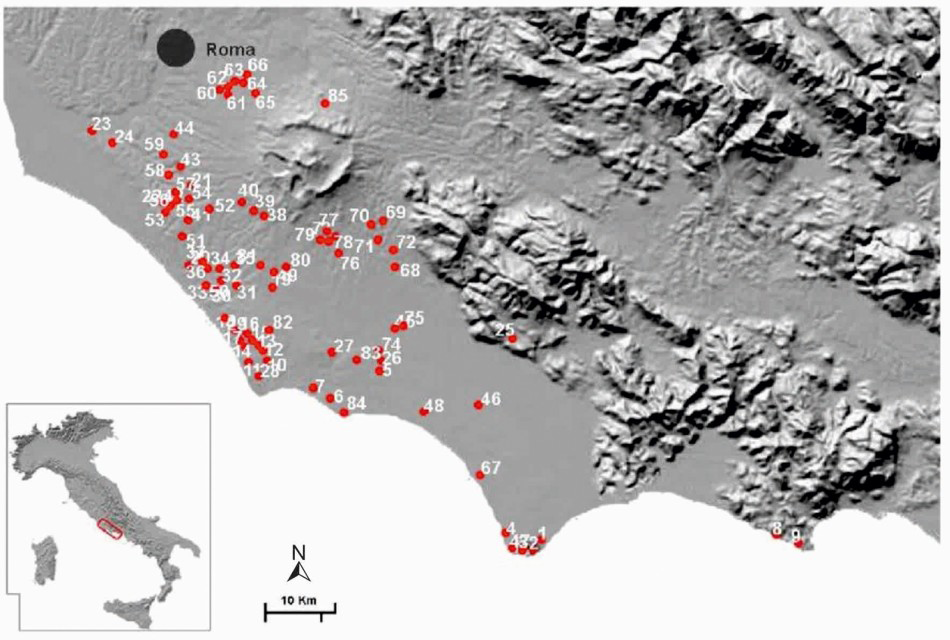
Over the last 70 years, more than 100 Middle Palaeolithic open-air sites of abundant lithic industry have been identified along the coastal plains of Lazio. As a result, the region now has one of the highest densities of known Neanderthal sites in Italy (Aureli et al. 2011) (Figure 1). The recent re-dating to 295 000–220 000 BP of several Middle Palaeolithic sites in this area has further illustrated that this region was also host to the earliest Neanderthal population in the Italian peninsula (Marra et al. 2015). Despite the importance of this archaeological evidence, the role of such sites in their regional context has never been investigated, and techno-economical analyses of the available lithic industry are still missing. The current project aims to fill this knowledge gap and to provide new insights into the Middle Palaeolithic stratigraphies of Lazio.
Middle Palaeolithic (Pontinian) sites of Lazio: 1. Grotta Guattari; 2. Grotta delle Capre; 3. Grotta del Fossellone; 4. Grotta Breuil; 5. Grotta Barbara; 6. Vallone Carnevale; 7. S. Rocco—Foglino; 8. Moscerini; 9. S. Agostino; 10. Ris. Abbruciati; 11. Tor Caldara; 12. Pantano—Riserva S. Olivo; 13. Valle dello Schiavo; 14. Stazione di Nardo; 15. Torre S. Anastasia; 16. Km 9—Valle Maggio; 17. Km 10 500; 18. Fosso Secco; 19. Carroceto—Carrocetello; 20. Campo Iemini; 21. Monte Migliore; 22. Podere Carafa 1–2; 23. Acilia Castel Porziano—Tre Confini; 24. Ficana; 25. Grotta della Cava; 26. B.go S. Maria; 27. Bosco di Nettuno; 28. Fornace Paiella; 29. Nuova California; 30. Valle del Serpentario (1–2)—Capanna Cesavero; 31. Acquasolfa—Fossignano—Rimessone; 32. Vallegrande; 33. Fosso Grande; 34. Ardea; 35. Casalazzara; 36. Cava di Pietra—Nuova Florida; 37. Loc. Piangimino—Campo Sportivo—Cava bosco; 38. Montagnano; 39. Valle Caia—Quarto Montagnello; 40. S. Palomba; 41. Petronella; 42. Colonna; 43. Mandriola; 44. Tenuta Acquacetosa; 45. Borgo Pogdora 1–2; 46. Portosello; 47. Gnif Gnaf; 48. Colle Parito; 49. Casale Pazienti; 50. La Fossa; 51. Pratica di Mare; 52. Zolforata; 53. Quartaccio; 54. Fosso di Leva; 55. Quarto del Cuore; 56. Il Frasso; 57. I Quaranta Rubbii; 58. Monti della Caccia; 59. Tenuta della Perna; 60. Roma Vecchia; 61. Fattoria di Donna Lucrezia; 62. Torre Spaccata; 63. Via del Fosso di S. Maura; 64. Orti Poli; 65. Unità Anagnina; 66. Fattoria Due Torri; 67. S. Andrea; 68. Via di Cori; 69. Lupacchiotti—Malatesta; 70. Colle Ercole; 71. Castel Ginetti; 72. Torrecchia Nuova; 73. Centocolonne; 74. Podere 797; 75. Torre Astura; 76. Lazzaria; 77. Colli di Cicerone; 78. Via di Vigne Nuove; 79. La Parata; 80. Federici; 81. Campo Leone—Casale Arganini; 82. Colle Rotondo; 83. Piano Rosso.

The archaeological framework
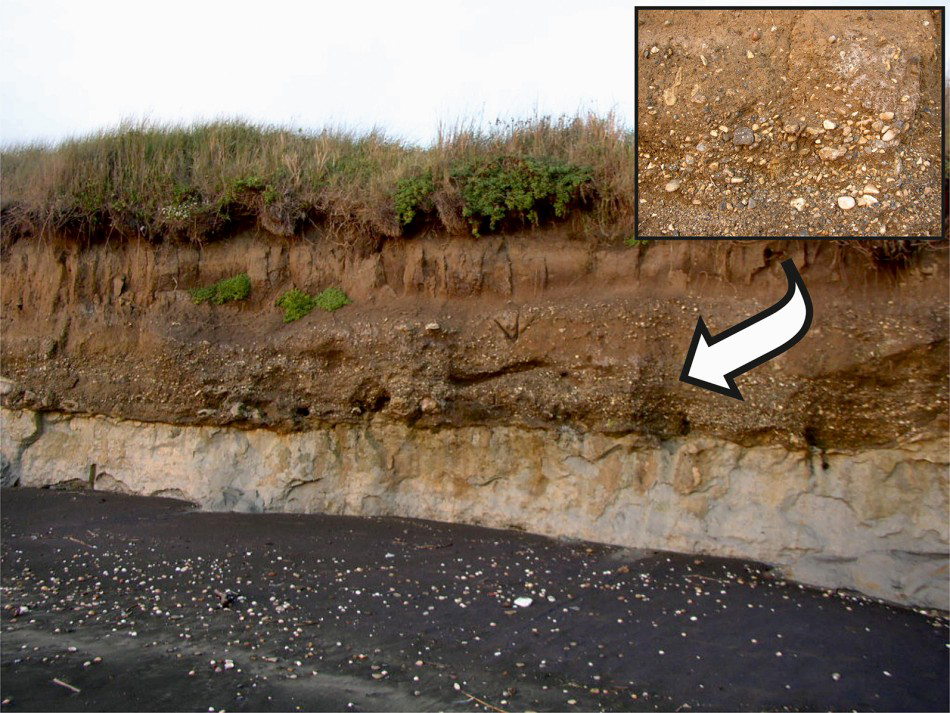
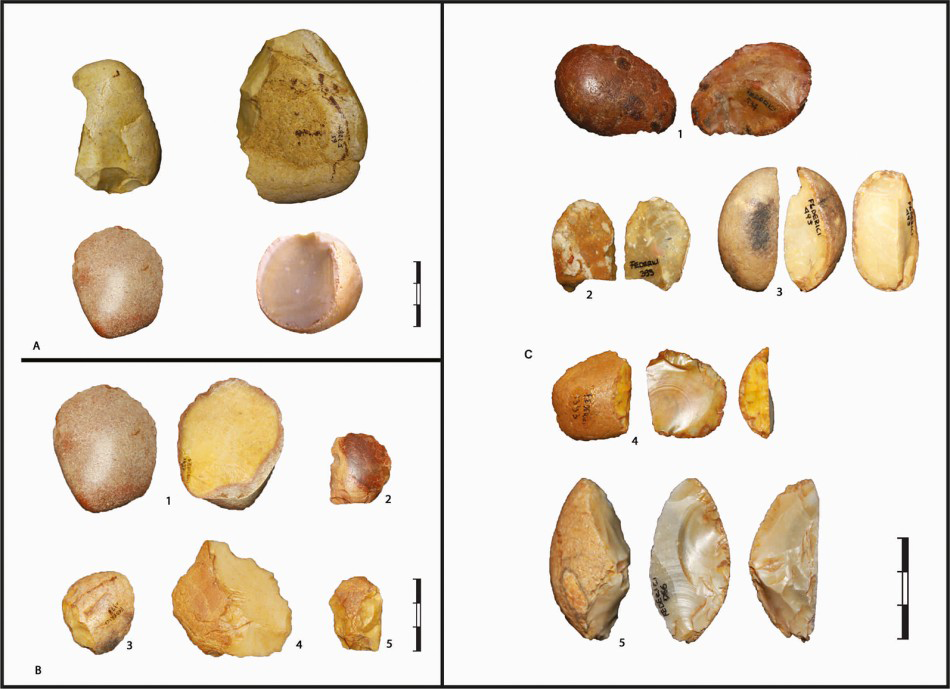
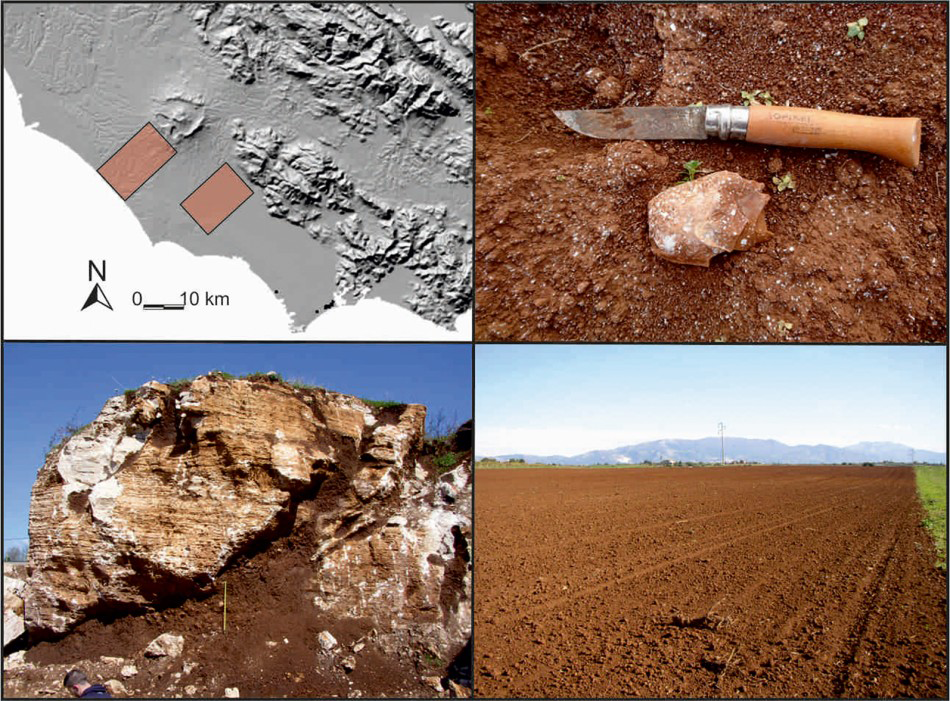
The lithic technology of this area consists of a Mousterian facies characterised by the use of local small pebbles collected along the fossil beaches, which now lay a few kilometres inland (Reference La RosaLa Rosa 2004) (Figure 2). These pebbles were chipped by bipolar percussion to obtain several dihedral-shaped elements, and later retouched to produce corticated flake tools (Reference TozziTozzi 1970: 83). Due to the use of pebbles as raw material, all the industries are much smaller than the European Mousterian ones, with an average diameter of about 30mm (Figure 3). This atypical lithic technology, produced by Neanderthals between 300 000 and 35 000 BP, was initially thought to have been adopted only in the Pontine Plain, and was therefore named ‘Pontinian’ (Reference BlancBlanc 1939). Recent systematic surveys carried out as part of our project, however, have also identified Pontinian tools outside this traditional area. In order to establish the extent of this phenomenon, our project will investigate a broader area lying among the Alban Hills, the Roman and Pontine Plains, and the Lepini Mountains (Figure 4).
Outcrop of a fossil pebble beach in Nettuno (Rome).

Pontinian lithic industry.

PONT-AIR Project: the areas to be investigated and general photographs of the various contexts.

Materials and methods
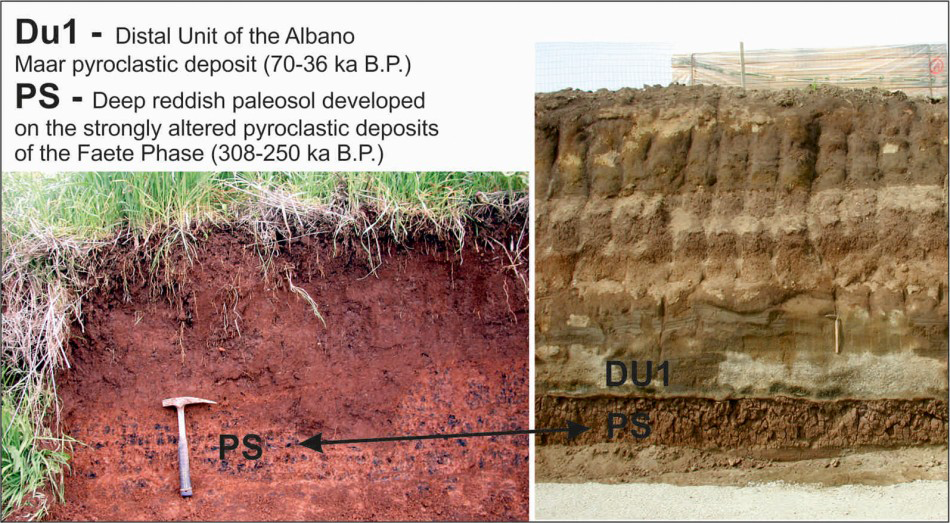
Geological stratigraphy and reddish volcanic palaeosol in S. Cesareo (Rome).

The project will consist of two phases. The first will involve surveys in different eco-zones, from the coastal dunes and river valleys of Pomezia and Cisterna di Latina, to the volcanic district of the Alban Caldera, spanning from between 0 and 900m asl. This phase will focus on the identification of new Pontinian sites, where careful stratigraphic and geopedological analyses will be carried out for the first time. Previous research carried out at the Alban Caldera (Giaccio et al. 2007; Rolfo et al. 2007) showed that the highest concentrations of finds are generally located in a specific reddish volcanic palaeosol (Figure 5) dating to the Faete Phase c. 308 000–250 000 BP (Marra et al. 2003). This palaeosol seems to be attested in all areas with lithic scatters, and will be considered as a ‘soil mark’ for the identification of further collection areas.
This approach will shed light on the relationship between the Palaeolithic groups and their environmental surroundings, with a particular focus on the human response to local volcanic activity. Preliminary data seem to suggest that the cyclic eruptive phases of the Colli Albani Volcanic District caused significant changes in the local eco-system with a potential impact on human groups.
The second phase of the project will consist of a review of the most important lithic assemblages collected over recent decades and currently stored in several archaeological museums across Lazio. A techno-economic study of the chaîne opératoire and the ratio between débitage and retouched tools will allow us to identify the functional variability of these open sites and the networks of human frequentation across coastal Latium. The results of this two-fold research strategy will be collected in a GIS database.
Expected results
This multidisciplinary research will greatly enrich our knowledge of prehistoric Lazio. It will contribute to deeper understanding of the Pontinian facies by highlighting similarities and differences with the coeval Italian and European Mousterian. It will also shed light on the mobility, occupation and exploitation patterns chosen by Neanderthals in this area. Finally, the investigation of these behavioural patterns will help to clarify the organisation of, and the reasons for, the particularly extensive exploitation of Lazio’s coast—an area that could be considered as a distinctive ecological niche during the Middle Palaeolithic.