


Post-traumatic stress disorder (PTSD) is controversial for several reasons. Reference Maercker, Brewin, Bryant, Cloitre, van and Jones1 First, critics have noted the long list of potential PTSD symptoms in diagnostic manuals, leading to the potential for diagnostic inflation, Reference Rosen, Spitzer and McHugh2 and high rates of comorbidity with related psychiatric disorders such as anxiety and affective disorders. Reference Kessler, Sonnega, Bromet, Hughes and Nelson3 Second, PTSD is unusual in psychiatric classification because, unlike other disorders, it requires both a symptom profile and a cause (i.e. trauma - criterion A in DSM-IV 4 ) to be present. The ‘internal logic’ Reference Young and Breslau5 of the PTSD construct assumes an exclusive causal relationship between PTSD symptoms and trauma. The centrality of traumatic events to PTSD has been further emphasised in DSM-5, 6 in which PTSD has been moved from anxiety disorders to trauma and stress-related illnesses. Successive versions of DSM have weakened criterion A without validating its specificity to PTSD symptoms Reference Rosen, Spitzer and McHugh2,Reference Breslau and Kessler7 and the diagnosis is now clinically and in research widely used for more common but less extreme events than originally intended, such as friendship break-ups and exposure to television programmes. Reference Rosen8 This loosening of criterion A is also perhaps an expression of the difficulties inherent in applying it - trauma is defined by subjective experience and there is considerable variation in individual responses to potentially traumatic exposures, making the operationalisation of criterion A difficult. Finally, some commentators Reference Jones and Wessely9,Reference Pupavac10 have remarked how PTSD, more than other psychiatric disorders, owes its origins to a political need - i.e. to characterise the disorders expressed by veterans returning from the Vietnam war, and can be viewed as a socially sanctioned sick role for individuals who have experienced trauma.
Prevalence estimates of PTSD in general population community studies in high-income countries vary widely. In a US national sample, lifetime prevalence of PTSD was 7.8%. Reference Kessler, Sonnega, Bromet, Hughes and Nelson3 In an urban study in Detroit 9.2% of the population had lifetime PTSD. Reference Breslau, Davis, Andreski and Peterson11 Population studies that have assessed 12-month prevalence found it to be 1.3% in Australia Reference Creamer, Burgess and McFarlane12 and 1-2.2% in a study of young people (aged 14-24) in Germany. Reference Perkonigg, Kessler, Storz and Wittchen13 A recent survey in South East London Reference Frissa, Hatch, Gazard, Fear and Hotopf14 suggested prevalence of PTSD symptoms in the past month to be closer to 5.5%. Few general population studies of PTSD exist in low-and middle-income countries (LMICs). Reference Patel and Sumathipala15 Most studies have focused on ‘high-risk’ populations defined by exposure to trauma. In Sri Lanka, the setting for the present study, prevalence in such high-risk populations, exposed to the Civil War (1983-2009), the tsunami (2004) or prolonged internal displacement, indicate prevalence estimates varying from 2.8 to 40%. Reference Hollifield, Hewage, Gunawardena, Kodituwakku, Bopagoda and Weerarathnege16-Reference Siriwardhana, Adikari, Pannala, Siribaddana, Abas and Sumathipala19 Following the 2004 tsunami, PTSD in Sri Lanka became a high-profile and controversial international issue. Reference Sumathipala and Siribaddana20 Despite this, PTSD has not yet been reported in general population samples. Studies on the prevalence of PTSD are difficult to interpret without parallel information on the prevalence of criterion A exposures (traumas) and information on the conditional probability of developing PTSD in the presence of trauma. Reference Breslau, Kessler, Chilcoat, Schultz and Davis21 Further, because comorbidity is high, it is desirable to understand the extent to which PTSD symptoms are a unique and specific response to criterion A traumas as opposed to one of a number of potential psychiatric responses. For that reason we compare conditional probabilities of other psychiatric disorders to such traumas. The aims of this paper therefore were: (a) to estimate the prevalence of criterion A traumas and lifetime PTSD in a Sri Lankan population; (b) to determine the conditional probability of PTSD given any specific traumatic event; and (c) to determine the strength of associations between traumatic events and other psychiatric disorders.
Method
Study design and participants
The Colombo Twin And Singleton Study (CoTASS) is a population-based twin study with a comparable non-twin sample. Full details of the design and implementation of the study are described elsewhere. Reference Siribaddana, Ball, Hewage, Glozier, Kovas and Dayaratne22 The study took place in the Colombo District of Sri Lanka, an area with a population of 2.2 million that includes the island’s capital. The district has a mixture of urban and rural populations with 45% of the population officially designated as living in rural and suburban communities. The area has a diverse population, including people who are more Westernised than in other areas of Sri Lanka. It is also attracts economic migrants and, at the time of the research, individuals displaced by the Sri Lankan Civil War and the tsunami.
The annual update of the electoral register consists of a household census conducted by a local official, the Grama Nildari. We added a question asking whether the householder knew of any twins, and identified 19 302 individual twins by this method. Of these, we randomly selected 4387 twins to take part in the project on common mental disorders. A total of 4024 (91.7%) participated, and interviews were completed for 3995. In addition, we conducted a parallel study of non-twins, randomly sampled from the same local areas from which twins were recruited, with the purpose of identifying any differences between twins in terms of psychiatric morbidity. A total of 2311 non-twins were selected and eligible to participate, of whom 2019 (87.4%) consented and were interviewed. The twin and non-twin samples had similar gender profiles, Reference Siribaddana, Ball, Hewage, Glozier, Kovas and Dayaratne22 although non-twins tended to be older. We included all consenting individuals aged 15 years or older who spoke sufficient Sinhala to understand the interview. Interviews took place between 2006 and 2007, when Sri Lanka had been experiencing violent civil war for over 30 years. There have been uprisings and bombing attacks in Colombo, and at times a strong military presence. Although people in Colombo have been affected by the tsunami of 2004, direct involvement was not on the same scale as on the south and east coasts of the island.
Data collection
Research workers with high-school education (A-level equivalent) visited the participants’ homes, and twins were interviewed separately. We used the Composite International Diagnostic Interview (CIDI), 23 a structured diagnostic interview for use by lay interviewers. This gives DSM/ICD diagnoses of mental disorders. We used lifetime DSM-IV definitions. 4 We defined our outcome as those who met full criteria for CIDI lifetime PTSD. However, we used a modified version of criterion A traumatic events (Table 2) because for a population study where we were contacting people for the first time the local experts were concerned that asking about sexual trauma would not be acceptable. Consequently, we were unable to include rape and sexual abuse in the list of trauma exposures. In addition to PTSD we collected information on affective disorders, anxiety disorders and substance use disorders (alcohol and nicotine dependence). We used the Bradford Somatic Inventory Reference Mumford, Bavington, Bhatnagar, Hussain, Mirza and Naraghi24 that provides a cut-off indicating likely somatoform symptoms.
Measures were translated with great care to ensure they were culturally appropriate. Thirteen bilingual twins (contacted from the registry) and other Sri Lankans fluent in English and Sinhala were asked to translate components of the interview. Each component was translated at least twice independently. The translations were then reviewed in group meetings consisting of seven bilingual healthcare professionals with training in mental health. A scholar in Sinhala also checked the translation. The translation aimed to find forms of words in Sinhala that best described the concepts of interest and where the questions when translated seemed cumbersome, they might be broken down into two component items for clarity. The interviews were then trialed by field workers and four individuals with no connection to the study, in order to confirm that lay people could understand it.
The importance of the contextual framing of questions in the PTSD questionnaire has been suggested in previous studies. Reference Kessler, Sonnega, Bromet, Hughes and Nelson3 Researchers may be more likely to find a high prevalence of PTSD in the context of a survey that frames questions in terms of exposure to conflict or natural disaster. This community-based study includes the PTSD questionnaire as part of a broader questionnaire, where the primary focus was not trauma.
The study received approval from the Institute of Psychiatry, King’s College London Research Ethics Committee, the Ethical Review Committee, University of Sri Jayewardanepura and the World Health Organization’s Research Ethics Committee.
Statistical analysis
A database was constructed in SPSS version 14 for Mac. The descriptive statistics were performed in Stata version 11. All analyses were corrected for non-independence of observations by using robust (sandwich) standard error estimation with the cluster command in Stata, family ID. We used logistic regression to derive odds ratios and 95% confidence intervals to express associations.
Results
The prevalence of significant traumas in an urban LMIC population
Among our sample of 6014 participants, 36.3% (95% CI 35.1-37.5) reported experiencing at least one traumatic event. Lifetime post-traumatic stress disorder (DSM-IV) 4 was present in 2.0% (95% CI 1.6-2.3) of the sample. Table 1 describes associations of trauma and PTSD (for a more detailed version of this Table see online Table DS1). Trauma was strongly associated with male gender, but was not associated with age, marital status or socioeconomic status (SES). By contrast, those with trauma who had PTSD tended to be female, had higher deprivation scores, were more likely to have been previously married, and were more likely to be unable to work (for example, unemployed or sick). The final column of Table 1 shows the association between various sociodemographic variables and PTSD in the entire population, and shows a broadly similar pattern - women, the most deprived, those previously married and those unable to work were most likely to have PTSD.
Analyses of the age at which traumatic events occurred showed that 75 traumatic events were reported as occurring by the age of 9 years; none of these participants had lifetime PTSD. Between the ages of 10-17 years, 385 individuals reported traumatic events, of whom 17 had lifetime PTSD (conditional probability (CP) = 5%). The age at which events had the highest positive predictive value of going on to PTSD was between 31 and 39 years of age (CP = 8%). In the oldest age range, 60-81 years, 42 events were recorded, and one event was associated with PTSD (CP = 2%).
Demographic characteristics of trauma exposed and post-traumatic stress disorder (PTSD) population
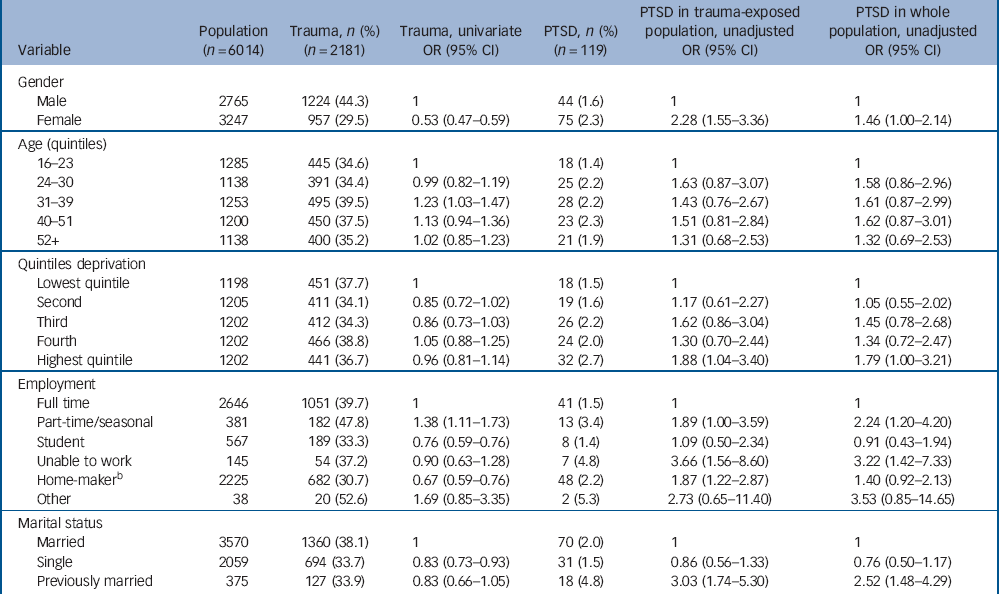
| Variable | Population (n = 6014) |
Trauma, n (%) (n = 2181) |
Trauma, univariate OR (95% CI) |
PTSD,
n (%) (n = 119) |
PTSD in
trauma-exposed population, unadjusted OR (95% CI) |
PTSD in whole population, unadjusted OR (95% CI) |
|---|---|---|---|---|---|---|
| Gender | ||||||
| Male | 2765 | 1224 (44.3) | 1 | 44 (1.6) | 1 | 1 |
| Female | 3247 | 957 (29.5) | 0.53 (0.47-0.59) | 75 (2.3) | 2.28 (1.55-3.36) | 1.46 (1.00-2.14) |
| Age (quintiles) | ||||||
| 16-23 | 1285 | 445 (34.6) | 1 | 18 (1.4) | 1 | 1 |
| 24-30 | 1138 | 391 (34.4) | 0.99 (0.82-1.19) | 25 (2.2) | 1.63 (0.87-3.07) | 1.58 (0.86-2.96) |
| 31-39 | 1253 | 495 (39.5) | 1.23 (1.03-1.47) | 28 (2.2) | 1.43 (0.76-2.67) | 1.61 (0.87-2.99) |
| 40-51 | 1200 | 450 (37.5) | 1.13 (0.94-1.36) | 23 (2.3) | 1.51 (0.81-2.84) | 1.62 (0.87-3.01) |
| 52+ | 1138 | 400 (35.2) | 1.02 (0.85-1.23) | 21 (1.9) | 1.31 (0.68-2.53) | 1.32 (0.69-2.53) |
| Quintiles deprivation | ||||||
| Lowest quintile | 1198 | 451 (37.7) | 1 | 18 (1.5) | 1 | 1 |
| Second | 1205 | 411 (34.1) | 0.85 (0.72-1.02) | 19 (1.6) | 1.17 (0.61-2.27) | 1.05 (0.55-2.02) |
| Third | 1202 | 412 (34.3) | 0.86 (0.73-1.03) | 26 (2.2) | 1.62 (0.86-3.04) | 1.45 (0.78-2.68) |
| Fourth | 1202 | 466 (38.8) | 1.05 (0.88-1.25) | 24 (2.0) | 1.30 (0.70-2.44) | 1.34 (0.72-2.47) |
| Highest quintile | 1202 | 441 (36.7) | 0.96 (0.81-1.14) | 32 (2.7) | 1.88 (1.04-3.40) | 1.79 (1.00-3.21) |
| Employment | ||||||
| Full time | 2646 | 1051 (39.7) | 1 | 41 (1.5) | 1 | 1 |
| Part-time/seasonal | 381 | 182 (47.8) | 1.38 (1.11-1.73) | 13 (3.4) | 1.89 (1.00-3.59) | 2.24 (1.20-4.20) |
| Student | 567 | 189 (33.3) | 0.76 (0.59-0.76) | 8 (1.4) | 1.09 (0.50-2.34) | 0.91 (0.43-1.94) |
| Unable to work | 145 | 54 (37.2) | 0.90 (0.63-1.28) | 7 (4.8) | 3.66 (1.56-8.60) | 3.22 (1.42-7.33) |
| Home-makerFootnote b | 2225 | 682 (30.7) | 0.67 (0.59-0.76) | 48 (2.2) | 1.87 (1.22-2.87) | 1.40 (0.92-2.13) |
| Other | 38 | 20 (52.6) | 1.69 (0.85-3.35) | 2 (5.3) | 2.73 (0.65-11.40) | 3.53 (0.85-14.65) |
| Marital status | ||||||
| Married | 3570 | 1360 (38.1) | 1 | 70 (2.0) | 1 | 1 |
| Single | 2059 | 694 (33.7) | 0.83 (0.73-0.93) | 31 (1.5) | 0.86 (0.56-1.33) | 0.76 (0.50-1.17) |
| Previously married | 375 | 127 (33.9) | 0.83 (0.66-1.05) | 18 (4.8) | 3.03 (1.74-5.30) | 2.52 (1.48-4.29) |
a. See online Table DS1 for a more detailed version of this table that includes information about years of education, urbanicity, ethnicity and twin status.
b. Home-makers are predominantly female.
Conditional probability of PTSD following traumatic events
The conditional probability of developing PTSD and any psychiatric disorder (including depression or dysthymia, anxiety disorders and alcohol dependence) for each criterion A event are given in Table 2. Individual events had a wide variation in prevalence (0.9-14.8%). The most frequently experienced traumatic events among participants were life-threatening accident (14.8%), witnessing intentional or accidental death/injury to another (13.1%) and natural disaster (8.1%). Conditional probabilities of developing PTSD in these groups were 6.0%, 4.1% and 6.4%, respectively. Life-threatening accidents were experienced by the largest number (53) of people with PTSD (44.5%). Only 1.4% of the population reported experiencing trauma as a result of experience as a combatant; in this small group the CP equalled 6.9%. The three categories with the highest conditional probabilities were experiences of intended harm to self. They were endorsed by only a small percentage of the population 0.9-3.6%. These were ‘torture/terrorism’ (CP = 21.2%), ‘physical attack’ (CP = 15.5%), ‘threatened by weapon/kidnapped’ (CP = 14.7%). Although the individual traumas show strong associations with PTSD, they were also associated with other psychiatric disorders, as described in Table 2. For any trauma, the proportion of individuals with other psychiatric disorders was considerably greater than for PTSD. The traumas with the highest prevalence of psychiatric disorders were also those that involved intended harm to the individual.
The bottom half of Table 2 groups the trauma-exposed population according to the number of traumatic events experienced. Consistent with other studies, Reference Breslau, Chilcoat, Kessler and Davis25 Table 2 shows the increase in the prevalence of PTSD as the number of traumatic experiences reported increases. Of participants who reported one event, 3.4% had PTSD, whereas of people who have experienced three or more events, 13.3% had experienced lifetime PTSD. Prevalence of non-PTSD psychiatric comorbidity also increased with increasing numbers of traumatic events, with 40.4% of the population who had experienced three events or more having a non-PTSD psychiatric diagnosis. Overall, there is a higher prevalence of non-PTSD psychiatric disorders in individuals exposed to trauma than in the general population.
Non-PTSD psychiatric illnesses among participants with PTSD
Psychiatric comorbidity among participants with PTSD was high (Table 3): a total of 80 people (70%) with PTSD had at least one additional DSM-IV comorbidity. Comorbidity of PTSD with depression (OR = 9.2, 95% CI 6.3-13.6, P<0.001), panic (OR = 25.3, 95% CI 11.2-57.2, P<0.0001), any anxiety (OR = 7.2, 95% CI 4.9-10.7, P<0.001) or alcoholism (men only) (OR = 8.0, 95% CI 4.4-14.5, P<0.001) were most notably increased in this population.
Discussion
Despite increased injuries from road traffic accidents, interpersonal violence, and war in middle-income countries, Reference Krug, Sharma and Lozano26 our study population reported a lower prevalence of traumatic events and a lower prevalence of PTSD than the majority of high-income community studies. Reference Kessler, Sonnega, Bromet, Hughes and Nelson3,Reference Frissa, Hatch, Gazard, Fear and Hotopf14 The greatest prevalence of psychiatric illness among the trauma-exposed population was non-PTSD psychiatric diagnosis.
Conditional probabilities of post-traumatic stress disorder (PTSD) and non-PTSD psychiatric diagnoses for each traumatic event

| Traumatic event | Population with event, n (%) |
n (%) with each event with PTSD |
n (%) with each event with other diagnosesFootnote a |
|---|---|---|---|
| No event | 3828 (63.7) | 0Footnote b | 590 (16.7) |
| Tortured or terrorised | 52 (0.9) | 11 (21.2) | 24 (46.2) |
| Physical attack | 219 (3.6) | 34 (15.5) | 100 (45.7) |
| Threatened with weapon or kidnapped | 157 (2.6) | 23 (14.7) | 48 (30.6) |
| Other stressful event | 339 (5.6) | 33 (9.7) | 115 (33.9) |
| Shock of event to someone else | 355 (5.9) | 29 (8.2) | 93 (26.2) |
| Involved in combat | 87 (1.4) | 6 (6.9) | 15 (17.2) |
| Natural disaster | 486 (8.1) | 31 (6.4) | 141 (29.0) |
| Life-threatening accident | 891 (14.8) | 53 (6.0) | 254 (28.5) |
| Witnessed killing or accident | 786 (13.1) | 32 (4.1) | 186 (23.7) |
| Cumulative events | |||
| None | 3828 (63.7) | 0Footnote b | 590 (16.7) |
| 1 | 1393 (23.2) | 47 (3.4) | 309 (22.2) |
| 2 | 517 (8.6) | 36 (7.0) | 142 (27.5) |
| 3+ | 270 (4.5) | 36 (13.3) | 109 (40.4) |
a. Depression, dysthymia, any anxiety disorder (including phobias), alcohol dependence.
b. By definition, PTSD could not be diagnosed in individuals with no traumatic event.
Post-traumatic stress disorder (PTSD) comorbidity
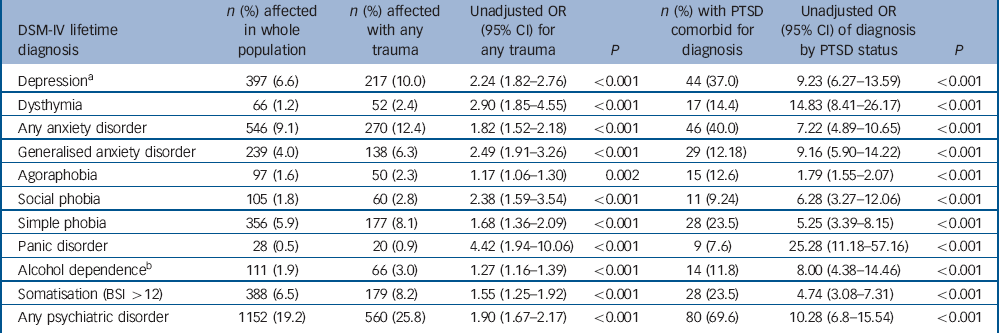
| DSM-IV
lifetime diagnosis |
n (%) affected in whole population |
n (%) affected with any trauma |
Unadjusted OR (95% CI) for any trauma |
P |
n (%) with PTSD comorbid for diagnosis |
Unadjusted OR (95% CI) of diagnosis by PTSD status |
P |
|---|---|---|---|---|---|---|---|
| DepressionFootnote a | 397 (6.6) | 217 (10.0) | 2.24 (1.82-2.76) | <0.001 | 44 (37.0) | 9.23 (6.27-13.59) | <0.001 |
| Dysthymia | 66 (1.2) | 52 (2.4) | 2.90 (1.85-4.55) | <0.001 | 17 (14.4) | 14.83 (8.41-26.17) | <0.001 |
| Any anxiety disorder | 546 (9.1) | 270 (12.4) | 1.82 (1.52-2.18) | <0.001 | 46 (40.0) | 7.22 (4.89-10.65) | <0.001 |
| Generalised anxiety disorder | 239 (4.0) | 138 (6.3) | 2.49 (1.91-3.26) | <0.001 | 29 (12.18) | 9.16 (5.90-14.22) | <0.001 |
| Agoraphobia | 97 (1.6) | 50 (2.3) | 1.17 (1.06-1.30) | 0.002 | 15 (12.6) | 1.79 (1.55-2.07) | <0.001 |
| Social phobia | 105 (1.8) | 60 (2.8) | 2.38 (1.59-3.54) | <0.001 | 11 (9.24) | 6.28 (3.27-12.06) | <0.001 |
| Simple phobia | 356 (5.9) | 177 (8.1) | 1.68 (1.36-2.09) | <0.001 | 28 (23.5) | 5.25 (3.39-8.15) | <0.001 |
| Panic disorder | 28 (0.5) | 20 (0.9) | 4.42 (1.94-10.06) | <0.001 | 9 (7.6) | 25.28 (11.18-57.16) | <0.001 |
| Alcohol dependenceFootnote b | 111 (1.9) | 66 (3.0) | 1.27 (1.16-1.39) | <0.001 | 14 (11.8) | 8.00 (4.38-14.46) | <0.001 |
| Somatisation (BSI >12) | 388 (6.5) | 179 (8.2) | 1.55 (1.25-1.92) | <0.001 | 28 (23.5) | 4.74 (3.08-7.31) | <0.001 |
| Any psychiatric disorder | 1152 (19.2) | 560 (25.8) | 1.90 (1.67-2.17) | <0.001 | 80 (69.6) | 10.28 (6.8-15.54) | <0.001 |
BSI, Bradford Somatic Inventory.
a. Moderate depressive disorder.
b. Men only as alcohol dependence was absent in women.
Trauma exposure in Sri Lanka
The prevalence of traumatic events reported in our population was 36.3%. Community studies in the USA report the prevalence of traumatic events to be higher, between 36.7% and 92.2%. Reference Breslau27 Variation in prevalence of traumatic events may partly be explained by the diagnostic questionnaires used across studies. The number of events defined as traumatic in a questionnaire is likely to affect disclosure. This may be particularly true of highly stigmatised events, for example it has been found that unless individuals are asked about sexual abuse, this exposure is under-reported. Kessler et al (1995), Reference Kessler, Sonnega, Bromet, Hughes and Nelson3 Breslau et al (1998) Reference Breslau, Kessler, Chilcoat, Schultz and Davis21 and de Vries & Olff (2009) Reference Vries and Olff28 used expanded versions of the Traumatic Events Questionnaire, with up to 36 specified traumatic events. The questionnaires applied in our study, and by Breslau et al (1991) Reference Breslau, Davis, Andreski and Peterson11 specify just nine different traumatic events (Table 2).
We removed sexual trauma from the Trauma Events Questionnaire because of concerns about social acceptability in a community survey whose main emphasis was not on PTSD. Although sexual trauma may have been included in response to the category of ‘other’, it is probable that trauma prevalence was underestimated particularly in the female population. This may partially explain why the overall prevalence of traumatic events was lower (36.3%) in our sample than in US community samples (36.7-92.2%). Reference Breslau27
There are likely to be differences in the characteristics that define events as traumatic across populations. Reference Jones and Wessely9 Many factors may change the ways in which events are expected to be, or are accepted as, ‘traumatic’. Reference Jones and Wessely9 Reports of lifetime events reduce in older age, suggesting that reported lifetime traumatic events do not represent lifetime exposure. This has been noted in other cross-sectional studies of traumatic events. Reference Kessler, Sonnega, Bromet, Hughes and Nelson3
PTSD in Sri Lanka
Why is the prevalence of PTSD in our study (2.0%) lower than estimates in Western populations? It has been suggested that PTSD is a relatively rare and atypical response to trauma. Reference Ribeiro, Mari, Quintana, Dewey, Lacko and Vilete29 The prevalence of traumatic events (36.3%) suggests that the low prevalence of PTSD in this study population is not solely explained by low exposure to trauma. This study’s gender and age distributions of PTSD are consistent with findings in other papers.
The removal of sexual trauma from the study questionnaire prevented individuals who had experienced sexual trauma from meeting the Criterion A of a trauma event required to diagnose PTSD unless they endorsed the ‘other’ category. This is likely to disproportionately underestimate the prevalence of PTSD in the female population, which has been suggested by findings that rape and sexual molestation were the traumas most commonly associated with PTSD in women in the USA. Reference Kessler, Sonnega, Bromet, Hughes and Nelson3 However, despite our probable underestimation, it is unlikely that the undetected prevalence of sexual trauma would greatly alter the relatively low prevalence of PTSD in our study compared with the prevalence found in US studies. Reference Kessler, Sonnega, Bromet, Hughes and Nelson3,Reference Breslau, Kessler, Chilcoat, Schultz and Davis21
Commentators have noted that the diagnosis of PTSD, derived in the aftermath of the Vietnam war, does not necessarily cross cultures and is too readily assumed to be linked to a status of victimhood. Reference Summerfield30 Ehlers & Clark Reference Ehlers and Clark31 and Brewin et al Reference Brewin, Andrews, Valentine, Bromet, Dekel and Green32 suggest that individual factors, including individual appraisals of trauma and its aftermath may be more predictive of PTSD than the objective degree of trauma exposure. External attitudes towards trauma-exposed individuals may also influence development of PTSD following traumatic events Reference Pillen33 and good group leadership may reduce an individual’s risk of PTSD following a traumatic event. Reference Jones, Seddon, Fear, McAllister and Wessely34
Local variations in PTSD
Researchers have argued that cultures influence the shape of PTSD over time. Reference Jones, Vermaas, McCartney, Beech, Palmer and Hyams35 In Sri Lanka responses to events Reference Pillen33 and cognitive styles Reference De Silva36 have been found to influence the prevalence of PTSD. Studies of PTSD suggest that symptomatology varies across geographic locations. A study of tsunami-affected populations in Asia found that post-traumatic stress symptoms were common, but functional impairment and avoidance behaviours were absent. Reference Rajkumar, Mohan and Tharyan37 Variations in correlations of symptoms may help to partly explain the low prevalence of individuals who meet full criteria for PTSD in our sample.
PTSD in the non trauma-exposed population
As a result of PTSD’s diagnostic criteria, PTSD was not assessed in individuals who did not report a traumatic event in criterion A. Therefore, as in the majority of studies of PTSD, we are unable to estimate PTSD symptom prevalence among people who do not endorse criterion A. Recently a UK-based study assessed PTSD in individuals who had experienced non-traumatic life events, and found that non-traumatic life events were more predictive of symptoms of PTSD than traumatic events. Reference Mol, Arntz, Metsemakers, Dinant, Vilters-van and Knottnerus38 Further studies have demonstrated the frequent occurrence of PTSD symptoms among people who had not experienced Criterion A life stressors. Reference Scott and Stradling39 These findings challenge the ‘internal logic’ Reference Young and Breslau5 of PTSD.
Conditional probability of events
There is agreement across studies about the kinds of traumatic event that are most likely to cause PTSD. The highest probability of developing PTSD has been reported in civilians who have experienced interpersonal violence, rape or torture, or who have been threatened with a weapon. Reference Breslau27 Breslau reported that the conditional probability for these events was 11-20%. Reference Breslau27 Among our study participants, traumas involving interpersonal violence also have the highest conditional probabilities for developing PTSD (CP = 14.7-21.2%). Studies repeatedly show that experiences of interpersonal violence in inner-city and urban life have a high predictive value of PTSD.
PTSD among combatants
Combatants from our sample are not representative of combatants in Sri Lanka. Sri Lanka has endured decades of civil war. Although Colombo district is not an area highly exposed to conflict it has experienced terrorist bombings and threats. Our study population includes small numbers of inhabitants who have fought in the civil war as well as internal migrants who have moved to Colombo from war affected areas. A total of 21% reported that they had been affected by conflict, but only 2.6% of the population reported being combatants in conflict and only 1.4% reported a combat-related trauma. The conditional probability of developing PTSD among participants exposed to traumatic events in combat was relatively low, just 6.9%, compared with 5.5% in the entire trauma-exposed population, and a conditional probability of non-PTSD psychiatric comorbidity of 17.2%, compared with 16.7% among those with no event. Hanwella’s study found a prevalence of PTSD in Sri Lanka in the special forces of 1.9% and among the regular forces of 2.9%. Reference Hanwella and De Silva40
PTSD in the tsunami-exposed population
The 2004 tsunami in Sri Lanka caused over 35 000 reported deaths, and over 500 000 people were displaced. Colombo was not severely affected by the tsunami, but its population has been exposed to floods, drought, landslides and cyclones and includes internal migrants from tsunami-affected areas. Four percent of participants were directly exposed to the tsunami, and a total of 26% were affected by the disaster, for example by being in an affected area or by losing a family member or friend. Participants who have experienced exposure to natural disaster had a relatively low conditional probability of PTSD of 6.4% and a much higher conditional probability for non-PTSD psychiatric morbidity of 29.0%.
Non-PTSD psychiatric morbidity in trauma-exposed populations
There is controversy over whether the psychiatric needs of trauma-exposed populations can be accurately addressed using the PTSD construct, or indeed the new DSM category of ‘trauma and stress related illnesses’. Reference Young and Breslau5,Reference Jones and Wessely9,Reference Hotopf and Wessely41 Degree of exposure to trauma is associated with risk of PTSD Reference Breslau27 but also non-PTSD psychiatric diagnosis. Reference Ribeiro, Mari, Quintana, Dewey, Lacko and Vilete29 Our results support the finding that non-PTSD psychiatric diagnosis have a higher prevalence than PTSD in trauma-exposed populations - for example, of those with three or more traumatic events 40.4% had a non-PTSD psychiatric diagnosis and 13.3% had PTSD. This suggests that the domination of PTSD as the main psychiatric consequence of trauma in Sri Lanka is misguided and mental public health following traumatic events should have a wider focus that includes depression, anxiety, somatic symptoms and substance misuse.
Strengths and weaknesses
The study had an exceptionally high participation rate and thus avoided some of the systematic underreporting of psychiatric disorders inherent in much of psychiatric epidemiology. Reference Knudsen, Hotopf, Skogen, Overland and Mykletun42 We used a rigorous diagnostic interview to ascertain PTSD, which was carefully adapted using bilingual appraisers. The main weakness of this study was its cross-sectional design. Recall bias and reverse causality cannot be discarded when considering the association between traumatic events and mental disorders. As discussed, sexual trauma was excluded from the questionnaire; this probably led to an underestimation of trauma and PTSD. Individuals who have experienced sexual trauma may be more likely to be captured in the non-trauma-exposed population, under affective and anxiety disorders, simply because they are less likely to endorse criterion A. This may lead to an overestimation of anxiety and depression in the non-trauma exposed group.
Although the use of a twin sample is unusual, it was ascertained from a rigorously defined population with a parallel non-twin comparison group. The two groups showed no difference in prevalence of PTSD and appropriate measures were taken to account for non-independence within-twin pairs within the sample.
In conclusion, we demonstrate a low prevalence of PTSD, despite frequent reporting of traumatic events, an extremely high comorbidity of PTSD (70%), and similar relationships between PTSD and non-PTSD symptoms. These results challenge PTSD as a specific response to trauma and indicate that, in this Sri Lankan sample, other, more prevalent psychiatric disorders, such as depression, anxiety, somatic symptoms and substance misuse, have a higher population impact in the trauma-exposed community population. This suggests that, in this study population, there is no unique relationship between traumatic experiences and the specific symptomatology of PTSD. These findings call into question the face validity of a diagnosis that couples aetiology with phenomenology. We suggest that until we have a better understanding of psychopathology, psychiatric classification decouples these two radically different entities.
Funding
The research was funded by Wellcome Trust.




eLetters
No eLetters have been published for this article.