



Introduction
Being the close relative of a person with a long-term illness may be a stressful situation because illness has a great impact on the daily life of a whole family. Close relatives have to deal with difficult life changes and are forced to have increased responsibility for the person who is ill (Jumisko et al., Reference Hofmann2007; Brännström et al., Reference Buber2007; Olsson Ozanne et al., Reference Mishler2012), which can be difficult and overwhelming because this involvement takes time and energy (Öhman and Söderberg, Reference Westin, Öhrn and Danielson2004). Close relatives generally accompany the ill person when they visit the healthcare (Pennbrant et al., Reference Pennbrant2013), can be seen as a valuable resource for people with an illness (Pennbrant, Reference Olsson Ozanne, Graneheim, Persson and Strang2013). Giving relatives a chance to participate in healthcare encounters to share their experiences and knowledge can enhance the value of healthcare; the relative becomes an implement for knowledge exchange between the physician and patient, which enhances understanding and meaning (Pennbrant, Reference Olsson Ozanne, Graneheim, Persson and Strang2013). Studies (Westin et al., Reference Söderström, Benzein and Saveman.2009; Jonasson et al., Reference Gustafsson, Snellman and Gustafsson2010) have shown that relatives desire continuous involvement in the care of loved ones, as this can facilitate feelings of being important when meeting with nurses.
Relatives have the right to be met in a pleasant manner, with respect and dignity, in encounters with healthcare personnel (Gustafsson et al., Reference Gustafsson, Gustafsson and Snellman2013). In this study, the term word ‘encounter’ plays a central role and relates to all planned and unplanned personal meetings at the healthcare center between close relatives, the person who is ill, and healthcare personnel in the primary healthcare setting. Gustafsson et al. (Reference Gustafsson, Snellman and Gustafsson2013), further describe a meaningful encounter from a relative’s perspective, expressed as a very close connection to the healthcare personnel based on warmth and compassion, unlike many other relationships outside the family. Andersen et al. (Reference Andersen, Saribay and Thorpe2008), show that being warmly responded to may be intensely relevant to one’s well-being and belongs in a relationship. Berg et al. (Reference Nygren Zotterman, Skär, Olsson and Söderberg2007), show that the relationship plays an important role in the context of care. To have respect for each other, a responsibility to reach out to each other, and engagement with each other creates the basis for a caring relationship. A relationship can be established by making relatives feel they are welcomed and motivating them to participate in the care of the ill person (Pennbrant, Reference Olsson Ozanne, Graneheim, Persson and Strang2013).
To our knowledge there is a lack of research describing meanings of encounters in primary healthcare between healthcare personnel, people with a long-term illness and close relatives. Understanding meanings can be important and helpful when it comes to taking note of the need for close relatives as companions for the person who is ill when visiting the healthcare center. Knowledge gained from this study can be used when it comes to creating encounters built on respect and dignity for the person who is ill and their close relatives. Thus, the aim of this study was to elucidate meanings of encounters for close relatives of people with a long-term illness within a primary healthcare setting.
Methods
Design
A qualitative research approach was used in this study, because the aim was to elucidate meanings of encounters for close relatives of people with a long-term illness within a primary healthcare setting. To reach this aim, personal interviews were performed with close relatives.
Context
The context of the study was primary healthcare centers in a county in the northern part of Sweden. Primary healthcare is the first level of care for all healthcare needs and problems and a healthcare contact for people with long-term illness and their relatives (Starfield, Reference Starfield1998). Characteristics for quality in primary healthcare include continuity, communication, and a person-centered care (Hsiao and Boult, Reference Hsiao and Boult2008).
Participants and procedure
The participants were selected through purposeful sampling. Ten close relatives (seven women and three men) of people with a long-term illness, such as asthma, chronic obstructive pulmonary disease, Morbus Bechterew, vascular dementia, rheumatoid arthritis, heart failure, multiple sclerosis, diabetes mellitus, and psoriasis, participated in the study. The close relatives ranged in age from 51 to 87 years (md=65.5). Eight were spouses, one was a daughter, and one was a mother. Participants were selected according to the following criteria: they had to be adults and the close relative of a person with a long-term illness, was not a carer to the ill person and participated in healthcare encounters at the healthcare center as a close relative. The person with a long-term illness visited the primary healthcare setting a minimum of three times a year to as often as several times a week. The healthcare personnel who participated in the encounter were general practitioners, nurses, district nurses, physiotherapists, occupational therapists, curators, and biomedical scientists.
Initially, a letter was sent to 10 close relatives of patients that had participated in our earlier study (Nygren Zotterman et al., Reference Morse2016). They were informed about the aim of the study and three close relatives gave their permission to participate and returned a written informed consent. Further, contact was taken with two healthcare centers for recruitment of additional seven close relatives of patients living with a long-term illness. Two registered nurses at the healthcare centers helped recruit the participants, they informed them about the aim of the study and inviting them to participate. After close relatives agreed to further contact, the first author phoned them and gave them further information, and a time and place for the interviews were decided.
Data collection
Personal interviews were conducted by the first author using a narrative approach (cf. Mishler, Reference Matiti, Cotrel-Gibbons and Teasdale1986; Sandelowski, Reference Ricoeur1991). The participants were asked to narrate their experiences of encounters with healthcare personnel at the healthcare center with which they had regular contact. An interview guide was used and started with the following broad questions: Please, tell me about your experiences of encounters with primary healthcare personnel as a close relative of a person with a long-term illness? Please tell me what makes for a good meeting at the healthcare center? Please tell me what a good encounter means for you as a close relative? Please describe what a poor encounter means for you as a close relative? Clarifying questions were asked during the interviews such as: for example, can you tell me more about that? Can you give any example? Nine of the participants were interviewed in their homes and one participant was interviewed at the healthcare center at their request. The interviews were recorded digitally, lasted between 34 and 68 min (md=52) and were later transcribed verbatim.
Ethical considerations
Before starting the interviews, the participants were informed about the nature of the study, gave their informed consent, and were told they could voluntary withdraw during the interviews at any time. They were guaranteed confidentiality and an anonymous presentation of the findings. The study was approved by the regional Ethical Review Board (Dnr 2010-178-31M) in Umeå, Sweden.
Data analysis
The phenomenological hermeneutical interpretation
A phenomenological hermeneutical interpretation was chosen to interpret the transcribed interviews. The method is inspired by the philosophy of the French philosopher Ricoeur (Reference Pennbrant, Pilhammar Andersson and Nilsson1976) and developed for nursing research by Lindseth and Norberg (Reference Jacobson2004). This method strives to gain a deeper understanding of essential meanings of the phenomena under study, from a dialectic movement between the whole and parts of the text as well as between understanding and explaining, and from explanation to a new comprehension. The process of interpretation consists of three interrelated phases: naïve understanding, structural analysis, and comprehensive understanding. The interpretation process started with a naïve reading in an attempt to reach a first understanding of the text. The next phase was structural analysis, based on ideas from the naïve understanding. During this phase, the text was divided into meaning units and sorted into themes and subthemes based on similarities and differences. Finally, the text was interpreted as a whole, which resulted in new and comprehensive understanding and reflections, based on the naïve understanding, the structural analysis, our pre-understanding, and relevant literature.
Findings
Naïve understanding
Being a close relative of a person with a long-term illness meant spending much time within healthcare settings, since the ill person needed a lot of care. The focus was a struggle for support and comfort. It was important to be met by healthcare personnel with respect and dignity and to be confirmed as a part of a team. Being greeted in a good way was an expression of good care for close relatives. Good communication based on a dialogue with healthcare personnel was fundamental. Being met by competent and efficient healthcare personnel, who encountered the close relatives with interest and helpfulness, made them feel important and confirmed. Close relatives described the importance of being informed about the care of the ill person. It was important that the healthcare personnel viewed close relatives as a significant resource since they sometimes had to act as a spokesperson for the ill person. Close relatives mentioned that a good relationship with the healthcare personnel had a major impact in promoting their feelings of trust and confirmation. It strengthened them in their role as supporters of their ill family member. To be met in a personal manner and having a sense of being cared for positively promoted this relationship. Close relatives experienced a poor encounter when they did not feel welcomed and were not invited to be informed of the care of the ill person. Close relatives were not always seen as a resource; instead, their intentions for being there were questioned.
Structural analysis
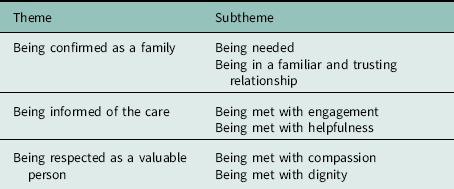
The structural analysis resulted in three themes and six subthemes (Table 1). The themes and subthemes are presented below with quotes from the interviews.
Overview of themes and subthemes constructed from structural analysis of the interviews with close relatives (N=10)
Being confirmed as a family
Being needed: Close relatives described it as meaningful to come with the ill person when visiting primary healthcare. Being with the ill person when having an encounter with their general practitioner or nurse was a way of being informed about the ill person’s health status; family members expressed that ‘four ears hear more than two’. They said that since the ill person was often occupied managing the illness in the healthcare encounter they were sometimes unable to deal with all of the information. This meant that close relatives had to support the ill person in the encounter. The opportunity to be a companion was considered a privilege and this contributed to their feelings of being needed. The close relatives felt it gave meaning to their lives and strengthened them in their own well-being. The family members mentioned that a good encounter was when the ill person was taken care of in a good way and were always the main focus at the healthcare center. At the same time, they experienced a good encounter and appreciated when the healthcare personnel made eye contact and invited them into the conversation, giving them a feeling of comfort and security.
I feel that an encounter has contributed to my inner peace when the healthcare personnel acknowledge me, communicate with me, and explain things to me. Even though it’s outside their work, this is an example of a fantastic encounter.
Close relatives said that part of a good encounter was when they were viewed as a team when they visited the healthcare center. They felt it was important that healthcare personnel listen to what they have to say as a family. Being met as a family facilitated a sense of being confirmed and characterized a good encounter. The close relatives wished to be seen as an important resource, as they claimed that their information could many times contribute to the progress of the care for their ill person. Close relatives also mentioned that the ill person seemed to have more confidence for the care they received and the relationships with healthcare personnel when they were met as a family.
I wish to be seen and met with confirmation during the encounter. I want healthcare personnel to turn to me, since I’m standing beside the patient and can be an important piece of the puzzle for them.
Being in a familiar and trusting relationship: Close relatives expressed that encounters with healthcare personnel with a personal and friendly approach facilitated the relationship in a trusting way and made it easier to connect with each other. Encounters that promoted comfort facilitated the possibilities to communicate and share an understanding about their situation of being a close relative. The way close relatives were encountered was, at many times, crucial for deciding whether the relationship was good. They needed to meet the same nurse or general practitioner each time since this made them more confident that there was continuity in the care for the ill person.
To know the healthcare personnel and to avoid telling the same story again gave them a feeling of faith in the care for the ill person. Close relatives described that a relationship with the healthcare personnel was of importance and gave them support and relief in this difficult situation. The close relatives expressed that some healthcare personnel had given them support, but sometimes they lacked support, which made them sad and frustrated. To be in a close and personal relationship promoted the possibility of communicating about private things, instead of only the healthcare problems regarding the illness.
I value the relationship with the healthcare personnel; it means a lot to get close and it becomes less tense when we talk more like friends during the encounter.
Being informed of the care
Being met with engagement: Close relatives expressed that it was important to be informed about the care of the ill person. Part of a good encounter was when they felt invited at the healthcare center as a close relative. They said that it was of major importance to receive understandable explanations and information regarding the care of the ill person. Healthcare personnel who had the willingness and ability to teach them about diabetes facilities or wound care, for example, made them feel more confident in the care that the ill person received from the healthcare. Close relatives stated that it was important to have a genuine dialogue with the healthcare personnel, which included having the opportunity to ask questions and receive answers. They said that having the healthcare personnel ask questions about their experiences gave them meaning. Close relatives valued being informed, since they support the ill person at home. It was a relief for the close relatives to be given good explanations by the healthcare personnel; it gave them hope and strength to cope with their situation. To be left without explanations caused them feelings of distress and anxiety. Instead, they wanted to be listened to and have a good dialogue with the healthcare personnel, inspiring them to support the ill person. Close relatives mentioned that it was significant that the healthcare personnel were engaged in terms of being present.
I want to be informed about the care of my husband. It’s important that I know what is happening and what will happen later concerning his care. Since we are living with this all the time and sharing our daily life together, not just the moment you are sitting at the healthcare center that plays role.
Being met with helpfulness: Close relatives described it as important that they were encountered by healthcare personnel who had a willingness to provide them with help. Helpfulness was expressed as part of a good encounter. Close relatives said that they needed help in the form of support, nursing and medical care, and referrals to inpatient care or radiology. Sometimes the ill person did not receive the help they needed, and it affected the whole family and caused them excessive worry. In contrast, they felt a great comfort when they could contact the nurse or general practitioner by phone and when they received help in the form of quick counseling; this availability to healthcare was important. Healthcare personnel who seemed to be interested and willingly listened to their stories seemed skilled and competent in their role as nurses or general practitioners, which usually led to good judgment. Part of a poor encounter was when the healthcare personnel ignored those needs and was occupied with other concerns, instead on focusing on them and their requests. Not being listened to family made them sad and frustrated, decreasing their confidence in the primary healthcare.
There was one occasion when we weren’t welcomed to the healthcare center by the nurse, but after a while she examined him herself and we received the help we wanted. That is part of a good encounter, as we sensed that we were getting help at last.
Being respected as a valuable person
Being met with compassion: Close relatives said that healthcare personnel who encountered them with warmth and commitment made them feel like they were truly cared for. When healthcare personnel encountered them with empathy, close relatives felt like they had value as a respectable person. Close relatives expressed that a conversation based on respect made them feel more confident and hopeful. Disrespectful encounters included when they were viewed as a solitary appendage to the ill person and not as a caring family member. In situations like that, healthcare personnel showed no interest in the close relatives and did not give them any attention during the healthcare appointment. This negatively affected the family member and the ill person and induced feelings of sadness and anger. Instead, being met with openness and with a polite approach from the nurses or the general practitioner facilitated a good encounter. They described it as important that the healthcare personnel communicated with respect and understanding, and that a conversation based on respect made them more confident and hopeful. Healthcare personnel, who used medical language or did not have time to explain their intentions for different examinations of the ill person, negatively affected the close relatives, causing them feelings of dissatisfaction and discouragement. Instead, having sufficient time in the encounter was highly valued as something that facilitated a sense of being met into a welcoming atmosphere. General practitioners and nurses, who took their time to listen to their stories, were deemed as healthcare personnel who had their heart in the right place. Close relatives described that being listened to made them feel thankful and appreciated in a caring encounter.
To be met with a friendly and generous reception, with warmth, and that the healthcare personnel says to you ‘here I’m’ and asks, ‘what are your needs?’, and doesn’t not only view you as an object or a tool, they are doing their job properly I value encountering a kindhearted nurse who cares for you and is part of an encounter based on humanity.
Being met with dignity: To experience a good encounter with the healthcare personnel gave the close relatives feelings of being met with dignity, and made it easier to deal with the burden of the illness. They expressed that it was essential for healthcare personnel to show an understanding of their life situation, which could sometimes be difficult. It gave them support and strength to cope with the illness. Close relatives appreciated being seen as human and not as a thing or object, which facilitated their sense of being respected and met with dignity.
For me, as a close relative, a good encounter means I follow my husband to the healthcare center and am met with dignity, as this makes me feel more safe and confident.
To feel that the healthcare personnel have their full concentration on us during the encounter is required. I don’t want to meet stressed personnel. I’m aware that they are busy and have a lot of work, but I don’t want them to show us that; instead, they should concentrate on us. That is when you experience that they care.
Sometimes when the ill people lacked the energy to speak up for themselves, their close relatives acted as their spokesperson. Close relatives regarded this as an important role in the encounter with healthcare personnel, and in situations like that they preferred to be taken seriously. They expressed that it was important they were believed and that their stories were considered. Close relatives also talked about when an encounter failed; instead of being met with respect and dignity, they felt like they were met with suspicion, ignorance, and nonchalance. This affected their sense of faith and trust for the care of the ill person. In times like that, they often raised their voice in disagreement with the healthcare personnel. This affected future encounters in a respectable way. Good encounters were described as met with respect for their human dignity as they accompanied the ill person to the healthcare center.
Comprehensive understanding and reflections
The entire text was read as a whole in this last phase of interpretation. The naïve understanding, the results from the structural analysis, and the authors’ pre-understandings were brought together and reflected in light of the literature in order to reach a new comprehensive understanding (cf. Lindseth and Norberg, Reference Jacobson2004). This study shows that meanings of healthcare encounters for close relatives of people with a long-term illness consist of being confirmed as a family, the opportunity to be informed about the care the ill person received by the healthcare, and being met with respect as a valuable person. Close relatives appreciated the invitation to be informed regarding the care for the ill person at the healthcare center in a welcoming atmosphere based on respect and dignity. Having a good encounter, the healthcare personnel facilitated a familiar and trusting relationship for close relatives. This familiar and trusting relationship gave close relatives support, comfort, and relief, and was seen as an expression of being met as a team. This strengthened them and made it easier to be a good supporter for the ill person. Conversely, encountering nonchalance and ignorance caused feelings of mistrust in the care of the ill person, and the care of the ill person suffered (cf. Eriksson, Reference Brännström, Ekman, Boman and Strandberg2006).
Close relatives described a good encounter as when the ill person was treated as a valuable person and the close relatives were important. The encounter was experienced as an expression of confirmation from the perspective of close relatives. To be acknowledged as important enhanced their feelings of being confirmed. Buber (Reference Buber1997) claimed that the foundation of human life lies in togetherness with other people: all humans wish to be confirmed by others for what they are and what they may become, and they need to confirm the other person in the same way. Further, it is necessary and a privilege for us, as humans, to confirm each other in our individual existence through authentic encounters. Human beings become real in authentic encounters with others. People feeling accepted in meeting with others depends on their experiences of being confirmed with mutual understanding. Söderström et al. (Reference Severinsson2003) explained that confirmation is closely connected to viewing a family member as important, and when nurses confirm the family member in the interaction they are listening and offering them comfort by being present. Severinsson (Reference Sandelowski2001) showed that confirmation is a concept that includes being seen as a human being. Close relatives needed to be confirmed as part of a team with the ill person. Illness is claimed to be a family affair and confirms the family as a unit. If families are informed about the care of the ill person then optimal care for the patient has been provided (Fast Braun and Foster, Reference Edlund, Lindvall, Von Post and Lindström2011).
Close relatives expressed that a close connection with healthcare personnel was important for building a trusting relationship. This is consistent with Gustafsson et al. (Reference Gustafsson, Gustafsson and Snellman2013) descriptions of closeness between close relative and the caregiver. Being in a close and familiar fellowship with the caregiver brings coherence in a difficult situation. According to Buber (Reference Jumisko, Lexell and Söderberg1994 [1923]), a relationship is based on a mutual understanding of each other. Relations in its very existence which are true, affects the one who stands in the relation to one another. Having the opportunity to develop a relationship and continuity in encounters with healthcare personnel facilitated good communication and strengthened this connection in a trusting way. Pennbrant (Reference Olsson Ozanne, Graneheim, Persson and Strang2013) showed that a trustful relationship is when relatives are welcomed to participate in the dialogue with the healthcare provider based on a respectful encounter. According to Söderström et al. (Reference Severinsson2003), a trusting relationship can influence the contact with the family member as well as facilitate the nursing care for the patient. It takes time to create a trusting relationship, but a good relationship makes it possible to support family members in emotionally charged situations by being close and comforting.
Close relatives experienced feelings of comfort, confidence, and meaning when healthcare personnel invited them to be informed about the care of the ill person. We interpreted information about the care for the ill person as part of a good encounter. Pennbrant (Reference Olsson Ozanne, Graneheim, Persson and Strang2013) showed that it is important that healthcare personnel invite close relatives to participate in the encounter, as their experiences can be a tool for knowledge exchange. In this study, close relatives mentioned that a good dialogue with the healthcare personnel was important because it gave them a feeling of being met with compassion and warmth in the encounter. Andersen et al. (Reference Andersen, Saribay and Thorpe2008) showed that warmth and openness are critical to a person feeling satisfaction and well-being. Warmth expresses that the other person belongs and is part of a team. Close relatives described it as positive when they had the chance to ask questions and were given answers and explanations about the care of the ill person. Pennbrant (Reference Olsson Ozanne, Graneheim, Persson and Strang2013) showed that relatives with healthcare experiences are better prepared and more confident about asking questions and capable to have a genuine dialogue with the healthcare provider. Healthcare personnel need to create conditions for a conversation in congruence with the needs of the relatives. According to Buber (Reference Öhman and Söderberg2011 [1954]), the depth of one’s meaning is realized in a true conversation with another person. For a true conversation to be realized, each person must contribute. When the essence of the dialogue is accomplished, togetherness between the conversation’s partners arises.
Close relatives described encounters as highly important and could increase their feeling of being met with dignity. To be encountered with respect and understanding gave them possibilities to support the ill person and a sense of being a human, which was mentioned, as significant. Dignity is important to all people, as well as in a healthcare setting (Matiti et al., Reference Jonasson, Liss, Westerlind and Berterö2007). According to Edlund et al. (Reference Berg, Skott and Danielsson2013), dignity is a concept only applicable to human beings and implies being whole as a human being as an entity of body, soul, and spirit. Hofmann (Reference Fast Braun and Foster2002) stated that ‘dignity refers to the quality or state of being honored or esteemed.’ According to Jacobson (Reference Gustafsson, Gustafsson and Snellman2009), a violation of one’s dignity can contribute to loss of respect and loss of confidence for oneself. It is more common that a violation of dignity occurs in asymmetric relationships when one person has more power, authority, and knowledge, for example, in a healthcare setting. Therefore, it is, according to Gustafsson et al. (Reference Gustafsson, Gustafsson and Snellman2013), important to encounter relatives and care for them in a meaningful way based on support, engagement, attention, and respect for their dignity.
Methodological considerations
The findings from this study can be transferred to similar situations if the findings are recontextualized to the current context. In this study, we chose a phenomenological hermeneutical interpretation because our aim was to elucidate meanings of encounters for close relatives of people with a long-term illness within a primary healthcare setting. According to Ricoeur (Reference Pennbrant, Pilhammar Andersson and Nilsson1976: 73), interpretation is a particular case of understanding – it is understanding applied to the written expressions of life. The interpretation in this study is the one we found as the most probable. According to Ricoeur (Reference Pennbrant, Pilhammar Andersson and Nilsson1976: 79), an interpretation must not only be probable, it must also be more probable than another interpretation. The participants in this study were chosen by purposive sampling, that is, the researchers selected the participants that fulfill the needs of the study. A major criticism of this type of sampling is that the sample is biased by the selection process, the method encourages a certain type of informant with a certain type of knowledge. This criticism however, does not consider that this is the intent in using this method. In qualitative research ‘bias’ is used in a positive way, as a tool to provide a theoretical richness in seeking to elucidate the experiences as richly and accurately as possible (cf. Morse, Reference Lindseth and Norberg1991). The participants in this study varied in age and experiences, such as the symptoms and disease of the ill person and how often they visited primary healthcare settings. All close relatives invited to participate voluntarily agreed to participate in the interviews, and we believe that the sample size of 10 close relatives was sufficient to gain richness in data. As registered nurses and researchers, we have a pre-understanding concerning the phenomenon of encounters within healthcare, and throughout the whole study process we were aware of this and used it with sensitivity and openness to alternative interpretations in discussion with others (cf. Dahlberg et al., Reference Buber2001).
Conclusion and clinical implications
In conclusion, this study suggests that meanings of encounters for close relatives implicate being met with engagement and to receive help in their support of the ill person as a close relative, as this can facilitate their sense of being informed. To be encountered with respect and dignity as a family gave close relatives strength to manage their life situation. An encounter based on confirmation, compassion, and trust entailed feelings of being truly cared for, which enhanced them in their supportive role of the ill person. It is important that healthcare personnel truly listen to the close relatives’ experiences and invite them to be informed of the person with a long-term illness. The healthcare personnel must support and empower close of the ill person to promote health and well-being for the whole family. Healthcare personnel need to be aware of the close relatives’ knowledge and view them as an important resource in the care of people with a long-term illness. The findings of this study indicate a need of further research about how close relative’s role should be defined when not being a career for a person with long-term illness.
Ethical Standards
The authors assert that all procedures contributing to this work comply with the ethical standards of relevant national and institutional guidelines and with the Helsinki Declaration of 1975, as revised 2008.
Acknowledgments
The authors thank the close relatives who participated in this study and shared their experiences.
Financial Support
This research received no specific grant from any funding agency, commercial, or not-for-profit sectors.
Conflicts of Interest
None.



