


A. Introduction
Despite the decades-long recognition of the dangers of climate change through international treaties,Footnote 1 and the continuous collective calls for States in climate negotiations to “urgently” reduce the emissions of heat trapping greenhouse gases (GHG),Footnote 2 concrete action at the individual country level has thus far remained vastly insufficient to stave off a potential climate calamity.Footnote 3 Recent scientific reports, including by the Intergovernmental Panel on Climate Change (IPCC), indicate that, due to past failures to lower emissions, “there is a rapidly closing window of opportunity to secure a liveable and sustainable future for all.”Footnote 4
This schism between the political recognition of the need to act and the continuous failure to do so has been the basis for an ever-growing body of case law in which courts around the world have set legal boundaries on political inaction.Footnote 5 In 2015, a Dutch court in the groundbreaking Urgenda decision for the first time determined that the State had the legal obligation to do its part of the global emissions reductions required to prevent dangerous climate change.Footnote 6 Following the Urgenda judgment, domestic and international courts, including advisory opinions from the International Court of Justice,Footnote 7 the Inter-American Court of Human Rights,Footnote 8 and the International Tribunal for the Law of the Sea,Footnote 9 have engaged with the question of the obligations of States to address the impacts of climate change by reducing emissions.
For Council of Europe Member States, the Grand Chamber of the European Court of Human Rights’s 2024 decision (ECtHR or Court) in Verein KlimaSeniorinnen Schweiz and Others v. Switzerland Footnote 10 represents the most consequential judgment regarding climate obligations and target setting. In what was its first-ever climate case,Footnote 11 the Court ruled that Article 8 of the European Convention on Human RightsFootnote 12 (ECHR or Convention)—the right to respect for private and family life and the home—applies to climate change, and that Switzerland had violated its obligations under that right by failing to put in place a domestic regulatory framework capable of mitigating the adverse effects of climate change.Footnote 13
Following the judgment, a main question—and a point of contention among scholars—is to what extent the ECHR now imposes substantive obligations on States to mitigate climate change and reduce their emissions. The Court has made a number of significant findings on this point, in particular where it formulates the obligation for a State to quantify a “national carbon budget.” This Article delves into the meaning of those findings and contextualizes them, clarifying the human rights obligations of States to mitigate climate change. This analysis shows that Article 8 ECHR requires States to quantify their national carbon budget as a fair share of the remaining global carbon budget for limiting global temperature rise to less than 1.5oC.
Subsequently, the Article applies this framework to the current state of climate science, which indicates that, based on current emissions levels, the global carbon budget for 1.5oC will be depleted before the end of the decade. Focusing in particular on the implications of the judgment for Member States of the European Union (EU), it will be shown on the basis of a report by the European Scientific Advisory Board on Climate Change (ESABCC) that the EU’s emissions reduction targets will lead to cumulative emissions that significantly exceed even the most lenient interpretation of the EU’s fair share carbon budget. The Article then concludes that, based on the latest findings in climate science, EU Member States are precluded from hiding behind EU targets for their supposed compliance with human rights standards.Footnote 14 Moreover, in order to comply with their human rights obligations, these Member States must reduce their GHG emissions domestically at their highest possible ambition, and complement these efforts by supporting emissions reductions outside their territories.
B. Positive Obligations in the Context of Climate Change
I. The Right to Protection Against Climate Change and the Primary Duty of States
In KlimaSeniorinnen, the ECtHR found that Article 8 ECHR encompasses “a right for individuals to effective protection by the State authorities from serious adverse effects of climate change on their life, health, well-being and quality of life.”Footnote 15 In doing so, it recognized that “climate change is one of the most pressing issues of our times,”Footnote 16 and poses “existential risks” with the potential to destroy “the basis of human livelihoods and survival.”Footnote 17 These findings by the Court build on the conclusions of domestic courts throughout Europe over the past decade—with the Court spending no less than sixteen pages to outline the findings of courts in France, Germany, Ireland, the Netherlands, Norway, Spain, the United Kingdom, and Belgium.Footnote 18 In light of this looming existential threat to human rights, as well as the consistent inadequacy of State action, the Court adopted a “tailored approach” to ensure that the Convention remains fit to address the “present-day conditions” caused by climate change.Footnote 19
The core obligation as defined by the ECtHR in KlimaSeniorinnen is that each State has the “primary duty to adopt, and to effectively apply in practice, regulations and measures capable of mitigating the existing and potentially irreversible, future effects of climate change.”Footnote 20 In doing so, States “need to put in place the necessary regulations and measures aimed at preventing an increase in GHG [greenhouse gas] concentrations in the Earth’s atmosphere and a rise in global average temperature beyond levels capable of producing serious and irreversible adverse effects on human rights.”Footnote 21 The Court based these findings on a cornerstone of its case law: ECHR rights must be interpreted and applied in a way that renders them “practical and effective, not theoretical or illusory.”Footnote 22 Whereas a State by itself cannot solve the climate crisis, it can be held to take measures capable of mitigating its adverse effects, and that is what human rights law requires it to do.
II. The Margin of Appreciation
The Court further defined what “margin of appreciation” States enjoy when operationalizing this obligation. This term refers to the level of deference the ECtHR grants to States when scrutinizing their compliance with the Convention.Footnote 23 In the context of climate change, States have a reduced margin of appreciation with regard to their “commitment to the necessity of combating climate change and its adverse effects, and the setting of the requisite aims and objectives in this respect.”Footnote 24 Conversely, States have a wide margin of appreciation in respect of “the choice of means designed to achieve those objectives” or “the details of the State’s climate policy.”Footnote 25 Ultimately, the margin of appreciation is narrow in terms of the emissions that need to be reduced, but wide with respect to the means of achieving that reduction.
In setting out the reduced margin of appreciation for States’ climate targets, the Court referred to the “gravity of the risks arising from non-compliance with the overall global objective,” in light of “the scientific evidence regarding the urgency of combating the adverse effects of climate change, [and] the severity of its consequences.”Footnote 26 This includes “the grave risk of their reaching the point of irreversibility, and the scientific, political, and judicial recognition of a link between the adverse effects of climate change and the enjoyment of (various aspects of) human rights,” as well as “States’ generally inadequate track record in taking action to address the risks of climate change.”Footnote 27
III. Quantifying a Carbon Budget
Based on these findings, the Court went on to articulate five “regulatory obligations” in paragraph 550.Footnote 28 These include an obligation to comply with emissions reduction targets and provide evidence showing such compliance; keeping targets up to date and based on best available science; and acting in good time and consistently.Footnote 29 The Court also gave fundamental guidance to how States must come to their emissions reduction targets, which merits quoting here in full. States must:
-
(a) [A]dopt general measures specifying a target timeline for achieving carbon neutrality and the overall remaining carbon budget for the same time frame, or another equivalent method of quantification of future GHG emissions, in line with the overarching goal for national and/or global climate-change mitigation commitments; [and]
-
(b) [S]et out intermediate GHG emissions reduction targets and pathways (by sector or other relevant methodologies) that are deemed capable, in principle, of meeting the overall national GHG reduction goals within the relevant time frames undertaken in national policies ….Footnote 30
The remainder of this Article will focus on these two regulatory obligations, as they have the potential to shape States’ mitigation policies.
C. The Obligation to Quantify a Fair Share 1.5oC-Aligned National Carbon Budget
I. Introduction
The obligation to quantify a carbon budget is central to the Court’s findings and has given rise to a spectrum of interpretations in scholarly commentaries.
On the one hand, a number of scholars espoused a procedural reading of the judgment with varying levels of nuance.Footnote 31 By way of example, Marko Milanović considers the Court’s approach to be “proceduralist and modest,” with paragaph 550 described as a “fairly minimal standard.”Footnote 32 Chris Hilson explained that this standard may be interpreted as either more substantive, including a fair share determination, or as more procedural, which only assists States in accounting for the goals they themselves set and decide on. He believes that the Court’s intention is “likely the latter, because the Court associates the issue of budget setting with a wide margin of appreciation.”Footnote 33 Similarly, Ole Pedersen stated that “determining what amounts to state’s ‘fair share’ of carbon emissions is left to the state’s own discretion.”Footnote 34
On the other hand, there are those who think the judgment goes beyond “the role of the Court” and has encroached on States’ discretion—notably among them being the (partly) dissenting Judge Eicke, and Switzerland as the Respondent State.Footnote 35 This signals their perception of the judgment as setting boundaries that are overly strict.
Others have concluded that the Court’s carbon requirement “has a significant substantive dimension,”Footnote 36 and requires States to quantify their carbon budget as a fair share of the remaining global carbon budget. In careful analyses of the judgment, the National Human Rights Institutes of Norway, the Netherlands, and Switzerland—the independent institutions formally tasked with protecting and promoting human rights in their StatesFootnote 37 —have separately come to this conclusion,Footnote 38 and found that their respective States fall short of this obligation. A number of scholars have shared the same view—among them Gerd Winter, Footnote 39 Christina Eckes,Footnote 40 and Andrew Jackson and Orla KelleherFootnote 41 —and all conclude that the Court’s application of the carbon budget obligation to Switzerland shows that in effect there is a human rights obligation to quantify a fair share national carbon budget in line with 1.5oC.
Finally, the first Decision by the Committee of Ministers of the Council of Europe in the context of its supervision of the execution of the KlimaSeniorinnen judgment requested Switzerland to “demonstrate that the methodology used to devise, develop and implement the relevant legislative and administrative framework responds to the Convention requirements as detailed by the Court and relies on a quantification, through a carbon budget or otherwise, of national greenhouse gas emissions limitations.”Footnote 42 This also indicates that it interprets the judgment as setting substantive standards—after all, a mere procedural requirement would not necessitate any scrutiny of Switzerland’s methodology.
Against this background of divided interpretations, this section engages in an in-depth analysis of the obligation flowing from the judgment. It first contextualizes the Court’s findings in subsection II, and then identifies the specific obligations that flow from them: to set emissions reductions based on the 1.5oC temperature goal in subsection III; to quantify a national carbon budget on the basis of the remaining global carbon budget in subsection IV; and to base that quantification on a fair share assessment in subsection V.
II. Contextualizing the Judgment: The Court’s Questions to the Parties
Looking in closer detail at the regulatory obligation to set emissions reduction targets based on a national carbon budget, the Court formulates it in relatively general terms in paragraph 550(a). Yet, it is further defined by the Court in its application of this obligation in paragraphs 569 to 572—as discussed below.
To contextualize these findings, it is noteworthy that the assessment of Switzerland’s climate policies in these paragraphs is almost entirely based on the parties’ response to questions the Court posed ahead of the hearing.Footnote 43 These questions are not quoted in the judgment itself. Their phasing, however, is particularly illuminating for the interpretation of the obligation as formulated in paragraph 550(a). The Court inquired:
If the scientific premise of the Intergovernmental Panel on Climate Change (hereinafter: “IPCC”) is accepted that in order to limit global warming to 1.5°C/well below 2°C compared to pre-industrial levels (see the Paris Agreement), humanity needs to remain within a global GHG/carbon budget (within the high and low range assessed by the IPCC; see AR6 [(Sixth Assessment Report)] Climate Change 2022: Mitigation of Climate Change, Summary for policymakers, B.1.3), and that consequently such an overall budget would need to be converted into respective national carbon budgets: Has the respondent State adopted an overall national carbon budget for the period leading to net neutrality; and if so, on what basis has such a budget been calculated? How should each State party’s “fair share” be assessed in terms of the national carbon budget, adequate reductions to historical GHG emission levels in the next several decades, and pursuant to any other relevant scientific, legal or equitable considerations? ….Footnote 44
To put these questions into context, the IPCC has defined the “remaining carbon budget” as “[e]stimated cumulative net global anthropogenic CO2 emissions from the start of [a defined year] to the time that anthropogenic CO2 emissions reach net zero that would result … in limiting global warming to a given level.”Footnote 45 In simple terms, this means that cumulative CO2 emissions until net zero are the definitive factor in limiting global temperature rise to a threshold such as 1.5oC. This also means that a net zero by 2050 target in and of itself, as Switzerland had in place, does not sufficiently inform the total contribution to additional warming. Emissions trajectories that delay emissions reductions in the short term and adopt faster reductions in later decades cumulatively lead to more GHG emissions and thus more temperature increase than emissions trajectories that adopt steeper reduction trajectories in the short term. A budget approach addresses this point, as it pertains to the amount of cumulative emissions before reaching net zero.
The fact that the Court asked these questions confirms that it was fully aware, first, of the relationship between global warming limits and carbon budgets; second, the importance of determining a national carbon budget in light of the global carbon budget; and third, that it considered relevant how a State’s budget corresponds to its “fair share” of the global budget.
Ultimately, the questions are best understood as a test for justification: The Court required Switzerland to justify, through a quantified assessment, that its mitigation policies corresponded to a fair share national carbon budget in relation to the remaining global budget.
The Court subsequently assesses in paragraphs 569 to 572 whether the answers provided by Switzerland satisfy its obligations under Article 8 ECHR. The Court’s assessment in these paragraphs, in combination with its elaboration on the content of the State’s positive obligations in paragraphs 544 to 552, reveal that a State’s emissions reduction targets (1) must be aimed at holding global temperature increase to 1.5°C, (2) be based on a national carbon budget that is set in relation to the global budget, and (3) which is determined on the basis of a fair share assessment. Each of these elements will be further elaborated upon in the following sections. Finally, Switzerland’s position that it is sufficient to align national targets with the IPCC global emission pathway is addressed.
III. Emissions Reduction Targets Must Be Aimed at Holding the Global Temperature Increase to 1.5oC
In defining States’ obligations under Article 8 ECHR, the Court considered that climate change is not merely a future threat, but is already contributing to increases in morbidity and mortalityFootnote 46 and poses a serious current—as well as future—threat to the enjoyment of human rights.Footnote 47 It has been argued that effective human rights protection accordingly requires limiting global warming to lower temperatures than the aims of 1.5oC or well below 2oC included in the Paris Agreement.Footnote 48 At the same time, certain States have resisted the idea that 1.5oC is the relevant target, and have instead insisted that 2oC is the legally relevant temperature limit.Footnote 49 Although the Court did not expressly rule on this issue—likely also because both the applicants and Switzerland took 1.5oC as the relevant target—its reasoning shows that States’ emissions reduction measures need to be aimed at holding the global temperature increase below 1.5°C.
Importantly, in paragraph 550 the Court states that the setting of emissions reduction targets need to be on the basis of “the best available evidence,”Footnote 50 and “in line with the overarching goal for national and/or global climate-change mitigation commitments.”Footnote 51 These commitments are found in the UNFCCC and the Paris Agreement and in this context States’ measures must also be in line with the cogent scientific evidence, in particular by the IPCC.Footnote 52
With regard to the latter, the Court considered that it must take account of “the existing and constantly developing scientific evidence on the necessity of combating climate change and the urgency of addressing its adverse effects, including the grave risk of their inevitability and their irreversibility ….”Footnote 53 Such findings led the Court to accept as a matter of fact “that the relevant risks are projected to be lower if the rise in temperature is limited to 1.5oC above pre-industrial levels and if action is taken urgently.”Footnote 54 It also referred to the “clear indications as regards the adverse effects of climate change, both existing and those associated with an overshoot of 1.5°C global temperature rise,” as underlined by the IPCC as well as experts and scientists intervening as third parties before the Court.Footnote 55
With regard to the relevant political commitments, the Court noted that, since the Paris Agreement, “scientific knowledge has developed further and States have recognized that ‘the impacts of climate change will be much lower at the temperature increase of 1.5°C compared with 2°C’ and thus resolved “to pursue further efforts to limit the temperature increase to 1.5°C’ ….”Footnote 56 In this context the Court included references to recent Conference of the Parties decisions, such as the Glasgow Climate Pact, the Sharm el-Sheikh Implementation Plan, and the first Global Stocktake.Footnote 57 In relation to Switzerland specifically, the Court referred to the updated Swiss Nationally Determined Contribution (NDC) which explicitly included a goal of limiting global warming to 1.5oC.Footnote 58
The obligation to take measures to limit warming to 1.5oC is even more explicit in the Court’s finding of a violation by Switzerland. First, when assessing Switzerland’s mitigation policies and the implementation thereof, the Court referred to 1.5oC as “the currently required 1.5oC limit”—as opposed to the objective of 2 to 2.4oC that Switzerland had pursued in the past.Footnote 59
Second, the Court considered that it flows from the State’s primary duty to adopt measures capable of mitigating climate changeFootnote 60 that each State defines its own adequate pathway towards achieving carbon neutrality “within, in principle, the next three decades.”Footnote 61 This finding should not be misconstrued as meaning that States comply with their obligations as long as they reduce their emissions to net zero around 2050, as will be further elaborated upon in Section C.V.4. However, it is important to note that the objective of reaching carbon neutrality in 2050, as recognized by the Court in its assessment of the facts relating to climate change,Footnote 62 flows from the pathways presented by the IPCC in its Sixth Assessment Report, which provide a greater than 50% chance of limiting global warming to 1.5°C at the end of the century. Thus, the duty as described in this part of the decision is directly derived from the 1.5°C temperature limit.
Finally, and most importantly, the Court based its finding of a violation of the obligations summed up in paragraph 550(a) primarily on evidence provided by the applicants, which relied on 1.5°C as the relevant temperature limit.Footnote 63 The only way for the Court to conclude that the Swiss targets were insufficient on the basis of this evidence, therefore, is if it considered 1.5°C as the relevant temperature limit for defining States’ obligations under Article 8 ECHR.
IV. The Obligation to Quantify of a National Carbon Budget in Light of the Remaining Global Budget
While the general aim of setting targets in line with 1.5°C had not been contested by Switzerland, this was not the case with regards to the question of how specifically to relate its national targets to this global goal. In response to the questions posed by the Court,Footnote 64 Switzerland had argued that its “national climate policy could be considered as being similar in approach to establishing a carbon budget.”Footnote 65 In its view, the cumulative emissions that would occur under its existing emissions reduction targets could be quantified and constitute a “carbon budget.”
The Court logically rejected this argument. As the protection of rights is contingent on limiting global temperature rise, it is impossible to define a meaningful national carbon budget without it being calculated in relation to the remaining global carbon budget for a given temperature threshold. Any national budget that fails to relate to the global budget is wholly divorced from the collective effort required to limit temperature rise to the goals of the UNFCCC and the Paris Agreement, and therefore has no bearing on the actual protection of human rights. An emissions reduction timeline based on anything other than such a quantification is arbitrary and ineffective with respect to mitigating climate change. Relating this to the primary duty as formulated by the Court in paragraph 545: Reduction targets that are not set on the basis of a quantified national contribution in relation to the necessary global effort cannot be “capable of mitigating the existing and potentially irreversible future effects of climate change,”Footnote 66 and thus practically and effectively protect human rights.
Although the Court stated that the assessment of compliance with the regulatory obligations in paragraph 550 would be of an “overall nature,” meaning that shortcomings in one particular aspect would not necessarily lead to a finding of breach, this particular obligation appears to be the exception. The Court was “not convinced that an effective regulatory framework concerning climate change could be put in place without quantifying, through a carbon budget or otherwise, national GHG emissions limitations”Footnote 67 and that “in the absence of any domestic measure attempting to quantify the respondent State’s remaining carbon budget” it “has difficulty accepting that the State could be regarded as complying effectively with its regulatory obligation under Article 8 of the Convention (see paragraph 550 above).”Footnote 68 The Court found that the failure to quantify a carbon budget in relation to the global budget was one of the “critical lacunae” on the basis of which it determined a violation of Article 8 of the Convention.Footnote 69
V. The Obligation to Quantify a National Carbon Budget Based on a Fair Share Assessment
The obligation to set a national carbon budget in relation to the remaining global budget for 1.5°C in itself does not fully answer the question how this budget should be set. As was briefly alluded to the introduction to this section, some scholars read this requirement as fully procedural, thereby falling within the discretion of the State.Footnote 70 Others, including the Committee of Ministers and three national human rights institutes, interpret it as a substantive requirement including standards States must meet.Footnote 71
The question of how to assess the sufficiency of a State’s reduction efforts has been a central point in climate litigation, and climate law and diplomacy more broadly. The IPCC, for its part, has concluded that the fairness of contributions of each State are a necessary condition for sufficient collective action.Footnote 72 Principles of international (environmental) law also play an important role, as illustrated by the extent to which they are debated in the proceedings before the International Court of Justice. A number of national courts have engaged in substance with the sufficiency of States’ emissions reduction targets. The Dutch Supreme Court held in Urgenda “that the courts can establish what … can in any case be regarded as the State’s minimum fair share,” and that “the State must properly substantiate that the policy it pursues meets the requirements to be imposed, i.e. that it pursues a policy through which it remains above the lower limit of its fair share.”Footnote 73 It is against this background that the Grand Chamber in KlimaSeniorinnen asked the Parties how each State party’s “fair share” should be assessed.
In light of the divided views in literature, this Article will now proceed to dissect the responses to these questions as reflected in the judgment to show that the Court engaged in a substantive assessment of the fairness of Swiss mitigation efforts. In doing so, it shows that the Court requires States to quantify their fair share of the remaining global carbon budget, as demonstrated by the fact that it (1) requires States to quantify their carbon budget in line with CBDR-RC; (2) requires States to rely on fairness in their quantitative assessment, rather than merely alluding to fairness in the abstract; (3) relied on evidence based on an equal per capita division of the global budget in finding Switzerland had violated the Convention; and (4) does not find it sufficient that national reduction targets align with the global reduction pathway presented by the IPCC.
1. National Carbon Budgets Must be in Line with CBDR-RC
The Court, as set out above and following well-established case law on the role of relevant rules of international law,Footnote 74 interpreted Article 8 ECHR pursuant to the UNFCCC and the Paris Agreement. A central commitment in those instruments is that States must fairly distribute the emissions reduction burden based on the principle of CBDR-RC. Accordingly, the ECtHR in KlimaSeniorinnen decided that, under Article 8 ECHR, “each State has its own share of responsibilities to take measures to tackle climate change.”Footnote 75 On that basis, the Court concluded that, under the Convention, each State has the obligation to do “its part.”Footnote 76 The Court’s requirement for the national carbon budget to be in line with CBDR-RC is also apparent from its rejection of the Swiss argument that there is no established methodology to determine a State’s carbon budget. It did so by reference to the German Federal Constitutional Court (GFCC):
The Court also finds convincing the reasoning of the GFCC, which rejected the argument that it was impossible to determine the national carbon budget, pointing to, inter alia, the principle of common but differentiated responsibilities under the UNFCCC and the Paris Agreement (see Neubauer and Others, paragraphs 215-29). This principle requires the States to act on the basis of equity and in accordance with their own respective capabilities.Footnote 77
It follows that States’ quantification of their national carbon budget must be based on CBDR-RC. Although CBDR-RC is a general principle that requires interpretation, it still gives rise to practical consequences. First, any quantification on the basis of CBDR-RC should have some reference to both the historic responsibility of emissions that have caused the current level of warming, as well as the capability to adopt emissions reduction measures. Second, effort sharing methodologies that incorporate grandfathering, in which future emission allowances are based on current emissions levels, as well as cost efficiency, the economic principle that underlies the IPCC global emission reduction pathways, are not in line with the legal principle of CBDR-RC and other principles of international environmental law.Footnote 78
The fact that the Court requires States to quantify their carbon budget in line with CBDR-RC therefore means States are required to do their fair share. Emissions reduction targets and carbon budgets that are based on grandfathering and cost efficiency therefore do not comply with the substantive requirements set out by the Court.
2. Fairness Principles Must be Quantified Rather than Alluded To
The Court’s assessment of Swiss climate targets in paragraphs 569 to 572 makes clear that merely stating that principles of fairnessFootnote 79 and CBDR-RC were considered falls short of the regulatory obligation defined in paragraph 550(a). Rather, fairness principles must be at the basis of the methodologies used to quantify the carbon budget. In its response to the questions of the Court,Footnote 80 Switzerland acknowledged the importance of fair share, claiming that its efforts reflected the principles of responsibility and capability, the two central components of the principle of CBDR-RC.Footnote 81 At the same time, however, Switzerland acknowledged that fairness principles had not been used in a quantification of a national budget. In this context, Switzerland referred to its communication to the UNFCCC accompanying its updated NDC, in which it stated that “it is important to Switzerland that the global community shares the required efforts to combat global climate change in a fair and equitable manner” and that its NDC reflected both fairness and equity.Footnote 82 Switzerland substantiated this position with reference to an “internal assessment” on fairness and ambition prepared in 2020.Footnote 83
The Court rejected this argument, concluding that neither the “internal assessment” nor the substantiation of its NDC as submitted to the UNFCCC included a quantification of the fairness principles—and that without such quantification, its climate regulatory framework could not be effective.Footnote 84 The Court concluded that the absence of a quantification of the fairness principles were part of the “critical lacunae”Footnote 85 that could “hardly be compensated for by reliance on the State’s NDC under the Paris Agreement, as the Government seemed to suggest.”Footnote 86
3. The Court’s Reliance on Evidence Dividing the Global Budget on an Equal Per Capita Basis
In finding the Swiss emissions reduction targets insufficient, the Court explicitly relied on estimates of the remaining Swiss carbon budget that the applicants submitted based on an equal per capita allocation of the remaining global carbon budget.Footnote 87 With regard to the requirement to quantify a national carbon budget, Switzerland, in its answers to the Court’s questions, argued that “there was no established methodology to determine a country’s carbon budget.”Footnote 88 To substantiate its argument, Switzerland submitted to the Court a 2012 Policy Brief in which national carbon budgets had been calculated that, according to Switzerland, differed from the reports that the applicants submitted.Footnote 89
The Court explicitly rejected these arguments.Footnote 90 In doing so, it drew from an expert report that assessed the methodology used in the 2012 Policy Brief and applied it to the updated remaining global 1.5°C budget from the IPCC AR6 report,Footnote 91 as well as estimates of the remaining Swiss carbon budget that were submitted by the applicants.Footnote 92 Relying on the expert report, the Court noted that “[o]n the basis of its current and planned targets, Switzerland would apportion itself 0.2073% of the remaining global CO2 budget as of 2022, compared to a population share of 0.1099%.”Footnote 93 In relation to the estimated Swiss carbon budget, the Court observed that, based on its current emissions reduction targets, Switzerland’s carbon budget to remain within 1.5°C would be depleted by 2030, or 2034 at the latest.Footnote 94
Importantly, the Court concluded on this basis that “[t]hus, under its current climate strategy, Switzerland allowed for more GHG emissions than even an ‘equal per capita emissions’ quantification approach would entitle it to use.”Footnote 95 In other words, the Court held that the mitigation policies were deficient even under that methodology—the most lenient approach to calculating fair share, which does not take into account principles such as CBDR-RC—thereby clearly indicating that more stringent fair share methodologies are necessary.Footnote 96
4. IPCC Global Pathways do not Incorporate Fairness Principles
As the principle of CBDR-RC requires States’ efforts to reflect their own responsibility and capability, they cannot simply follow a global trajectory that does not take such circumstances into account. The IPCC global trajectory does not reflect fairness principles, as the IPCC itself acknowledges.Footnote 97 In rejecting Switzerland’s arguments to this end, the ECtHR confirmed this position. If all States were to follow the global trajectory for emissions reductions, this would effectively divide the global carbon budget on the basis of current emissions, which is commonly referred to as “grandfathering.” Such a division of the global budget is not based on fairness considerations and CBDR-RC.
The ECtHR’s rejection of grandfathering is best understood through an analysis of the arguments put forward by the parties, and the Court’s ultimate finding of a violation.
In their response to the questions of the Court, the Swiss Government relied on its NDC, which set a 2050 net-zero target.Footnote 98 The applicants pointed out that following the IPCC global trajectory is a form of “grandfathering” that runs counter to equitable principles of international environmental law.Footnote 99 To substantiate this point, the applicants referred to academic literature,Footnote 100 as well as the internal assessment submitted by Switzerland, which recognized that grandfathering is “not plausible” and does “not give a satisfying answer” to the question of how to distribute the burden of mitigating climate change.Footnote 101 In the same context, the applicants submitted a graph that clearly illustrates the insufficiency of this methodology and is therefore copied in Figure 1 below.Footnote 102
Comparing equal per capita emissions reductions pathways for Switzerland and India
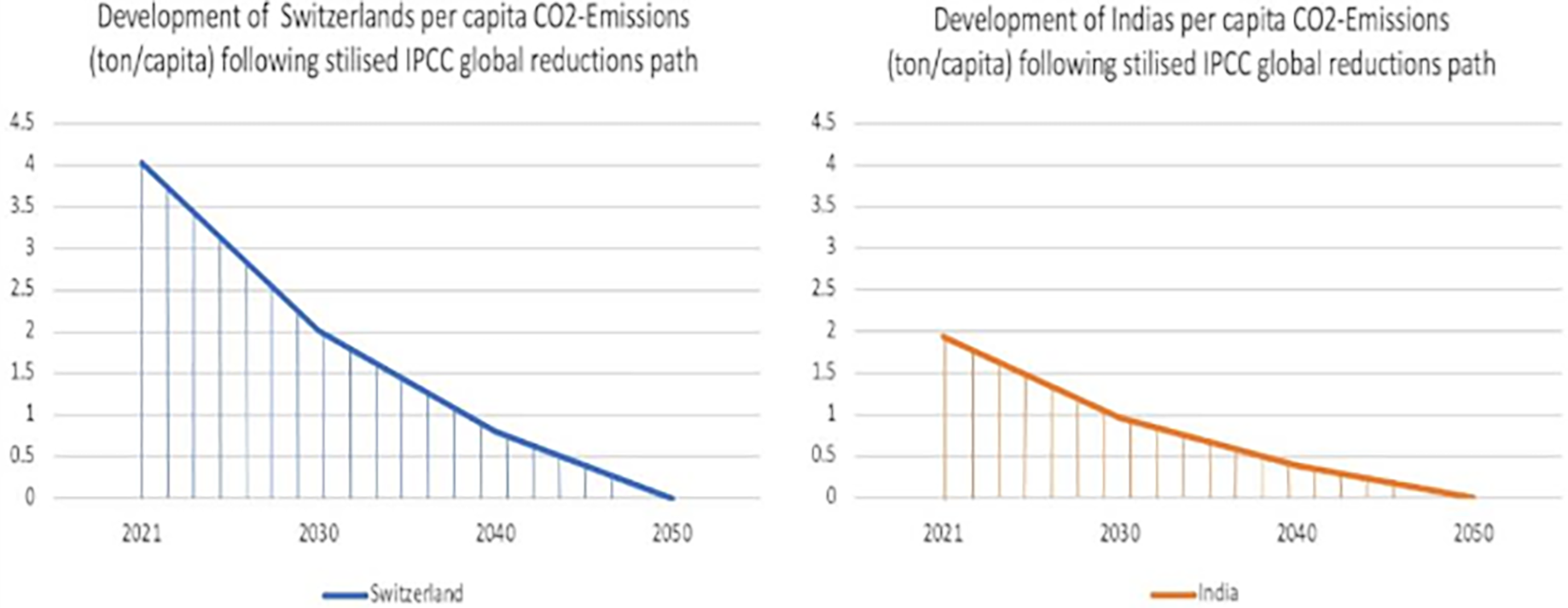
In order to make the consequences of adopting an emissions pathway that is aligned with the global IPCC pathway clear, the graphs above compare Switzerland and India. Both are shown starting from their current level of per capita CO2 emissions—Switzerland, on the left, with 4.02 tonnes of CO2 per capita and India, on the right, with 1.93 tonnes of CO2 per capita. Both States follow the emissions reduction pathway towards zero from the IPCC global trajectories. The dashed areas below the curve, which depict the cumulative emissions emitted by each country until 2050, clearly highlight how this approach would allow Switzerland to emit significantly more CO2 per capita than India by the time it reaches net zero. As grandfathering allows developed countries to determine their future share of global emissions based on disproportionately high levels of current emissions, this methodology cannot be considered a fair share approach.Footnote 103
This exchange of arguments is crucial, because if States merely needed to make an adequate contribution to the global emissions reduction effort—without needing to be fair—then aligning with the global IPCC pathway would be sufficient. This is especially relevant with respect to net-zero by 2050 targets, which have been adopted by a range of countries around the world, as well as the EU. Some scholarship suggests that setting such a target would satisfy the regulatory obligations under KlimaSeniorinnen. Footnote 104 Reference is made in that context to the Court’s language that States should undertake measures to achieve carbon neutrality “within, in principle, the next three decades.”Footnote 105 This position, however, cannot be correct. Switzerland had a 2050 net-zero target in line with the IPCC’s global emission reduction pathways and was nevertheless found in breach of Article 8 ECHR.Footnote 106
Crucially, the ECtHR’s rejection of the Swiss position shows (1) that it requires States to quantify their fair share of the global carbon budget, and (2) that quantifying a budget through grandfathering does not suffice and will constitute a violation of human rights.
VI. Interim Conclusion
In line with the Court’s affording a reduced margin of appreciation to States with respect to their climate commitments and the setting of the requisite aims and objectives, States have limited discretion in relation to the quantification of their national carbon budget and their corresponding mitigation targets. Accordingly, such quantification is subject to strict judicial scrutiny for its conformity with the Convention.Footnote 107
It is clear that the Court indeed engaged in detail with Switzerland’s emissions reduction targets. As such, the standard set by the Court cannot be perceived as a mere procedural obligation that States must simply put forward any number as a national carbon budget.
To the contrary, States must be able to justify how their national carbon budget complies with the effective protection of human rights, as required by the Convention, and that it must hold up to the ECtHR’s substantive assessment of its mitigation measures. As the above has shown, this includes an obligation to quantify a fair share carbon budget.
D. Implications of ECHR Obligations for European Union Member States in Light of the 2040 Report by the European Scientific Advisory Board on Climate Change
This section delves into one of the main practical implications of the Court’s findings in KlimaSeniorinnen: to what extent can Member States of the EU—all of which are party to the ECHR—claim to comply with their human rights obligations by virtue of EU targets and the scientific advice underlying them? Some have argued that “[w]hat comes across as major doctrinal developments is not necessarily significant in the context of European climate governance.”Footnote 108 Based on an analysis of the current state of climate science, this section will show the contrary. The analysis is particularly informed by a European Scientific Advisory Board on Climate Change report from 2023, entitled Scientific advice for the determination of an EU-wide 2040 climate target and a greenhouse gas budget for 2030–2050 (the ESABCC report).Footnote 109
I. The ESABCC’s Findings
The ESABCC was established as an independent scientific advisory body under Regulation No 401/2009 of the European Parliament and of the Council.Footnote 110 Under the 2021 European Climate Law, the ESABCC is given a central position as “a point of reference for the Union on scientific knowledge relating to climate change,” based on its “independence and scientific and technical expertise.”Footnote 111 It thus provides the EU with scientific knowledge, expertise, and advice relating to climate change, based on the “best available and most recent scientific evidence.”Footnote 112 The report that is the focus of this section was undertaken by the ESABCC as part of the requirements of the European Climate Law.Footnote 113
The ESABCC report advises on the EU’s emissions reduction target for 2040—its mandate was not, therefore, to examine the sufficiency of the 2030 target. It analyzes (1) perspectives on the EU’s fair share of the remaining global carbon budget for 1.5°C and (2) EU emissions reduction pathways that can be implemented within its borders, consistent with global emission pathways for 1.5°C. Using the IPCC’s estimate of the global CO2 budget for 1.5°C as a starting point, the ESABCC applied a range of effort sharing methodologies to determine the EU’s carbon budget. The ESABCC took into account legal principles such as the obligation under Article 2 of the Paris Agreement to pursue the temperature goals in accordance with their highest possible ambition, CBDR-RC, fairness,Footnote 114 as well as principles enshrined in the European Climate Law, including the polluter pays, precautionary, and do no significant harm principles.Footnote 115 It also acknowledged relevant ethical principles for effort sharing, covering principles such as sovereignty, equality, responsibility, capability, need, and cost-effectiveness.Footnote 116 Grandfathering and cost-effectiveness methodologies were excluded by the ESABCC, as neither of these approaches are considered to reflect a “standard of equity.”Footnote 117 The ESABCC estimated that the EU’s remaining carbon budget was at most 27 gigatonnes (Gt) CO2 from 2020, using an equal per capita approach.Footnote 118 Most of the methodological approaches that reflected other principles resulted in negative budgets—that is, budgets that have already been exceeded.Footnote 119
The ESABCC then calculated “feasible climate-neutral pathways for the EU and their implications.”Footnote 120 It started with over one thousand scenarios and filtered them based on a range of factors, including feasibility, data availability, consistency with the EU’s climate objectives, and environmental and technological risks. Out of the remaining scenarios, the report concluded that the EU could feasibly achieve up to a 95% reduction in GHG emissions by 2040.Footnote 121 This pathway can be interpreted as the highest level of ambition of emissions reductions within the EU’s own territory that the EU, on the basis of currently available scientific knowledge, can feasibly achieve by 2040, assuming the 55% emissions reduction target in 2030. The ESABCC found that this feasible 95% reduction by 2040 pathway would result in cumulative emissions of 52 Gt of CO2 equivalent (CO2e) by 2050.Footnote 122
The ESABCC then compared this feasible 95% reduction by 2040 pathway, which considers all GHGs, with the EU’s remaining fair share carbon budget, which only pertains to CO2.Footnote 123 Taking all GHG’s into account, the ESABCC concluded that an emissions pathway towards a 95% reduction in GHG emissions by 2040 and net zero by 2050 would lead to cumulative emissions of at least 12 Gt CO2e more than the most lenient interpretation of the EU’s fair share—reflecting an equal per capita allocation.Footnote 124 For the most stringent fair share allocation, reflecting an ability to pay allocation, the gap between the 95% by 2040 pathway and the EU’s fair share would consist of 137 CO2e.Footnote 125
On the basis of this analysis the ESABCC concluded:
As the most ambitious reductions result in cumulative emissions that are higher than the most lenient equity-based fair share estimate (based on equal global per capita emissions), the Advisory Board considers that the EU should be looking to address this shortfall as part of its commitment to the Paris Agreement temperature goal.Footnote 126
To contribute to the achievement to the Paris Agreement, the ESABCC accordingly recommended that the EU “[a]im for the highest ambition in domestic emission reductions and sustainable carbon dioxide removals, while accounting for feasibility constraints, environmental risks and technological deployment challenges.”Footnote 127 It also recommended that the EU “[c]ontribute to direct emission reductions outside the EU” to address the shortfall between the EU’s fair share carbon budget and the most ambitious feasible reductions pathway.Footnote 128
Finally, although the ESABCC was not mandated to advise on the fairness of the EU’s 2030 targets and therefore stopped short of offering a formal conclusion on this topic, it did note that the shortfall that needs to be compensated for could be considerably reduced by increasing the EU’s 2030 target to “well beyond 55%,” which would “increase the fairness of the EU’s contribution to global mitigation of climate change.”Footnote 129 Specifically, the ESABCC estimated that if the EU adopted a higher target of up to 75% by 2030, it would be able to limit cumulative GHG emissions to 32 Gt CO2e by 2050, thereby closing the gap between its domestic emissions and the most lenient interpretation of its fair share.Footnote 130 This is reflected in the ESABCC’s recommendation that “[a]dditional efforts to increase the ambition beyond 55% (up to 70% or more by 2030) would considerably decrease the EU’s cumulative emissions until 2050, and thus increase the fairness of the EU’s contribution to global mitigation.”Footnote 131
II. Implications of the ESABCC Report in Light of KlimaSeniorinnen
The ESABCC’s findings must be viewed in light of the KlimaSeniorinnen judgment and its requirement that each State quantify its fair share national carbon budget and adopt and implement measures to achieve carbon neutrality while respecting that carbon budget. The above overview of the ESABCC’s report shows that the EU’s own scientific advisory body has—based on rigorous scientific research—found that even the fastest feasible emissions reduction pathway, assessed to lead to a 95% reduction in GHG emissions by 2040, would not conform with the EU’s fair share. In March 2026, the EU formally adopted a binding 2040 target of a 90% reduction in net GHG emissions, but weakened its domestic ambition by allowing a share of that target to be met through international credits rather than reductions achieved within the EU.Footnote 132 It follows that EU Member States cannot, as some of them have done,Footnote 133 claim to meet KlimaSeniorinnen’s standards merely by virtue of their EU commitments.Footnote 134 Consequently, the emissions reductions achieved on the basis of this reduction target by itself cannot be deemed capable of mitigating the effects of climate change, and therefore fall short of their “primary duty” as defined in KlimaSeniorinnen.Footnote 135 While the ESABCC report does not provide fair share estimates for individual countries, this conclusion will likely apply to a large section of Member States. Recent developments have only strengthened this. The latest estimates of the global remaining carbon budget are so small that current levels of emissions would mean that the global budget is exhausted before 2030.Footnote 136 This, taken together with the ESABCC fair share estimates, raises serious questions as to whether it is still feasible for States to reduce their domestic emissions fast enough to remain within their fair share carbon budget.
Although this situation is not explicitly addressed in the judgement, the principles as set out by the ECtHR strongly imply that States’ emissions reduction obligations do not stop at their borders. Given the obligation that emissions reduction targets are based on fair share carbon budgets, States with small or depleted budgets should undertake a scientifically grounded analysis of emissions pathways that reduce their domestic emissions at the highest level of ambition—as per the ESABCC recommendations—and determine a timeline for emissions reductions within their territory based on such assessment. Reducing emissions at a lower rate than is scientifically feasible would lead to a faster depletion of the remaining global carbon budget, thus increasing the risk of breaching the 1.5oC limit.
In the event that adequate levels of emissions reductions cannot be realized within a State’s—or region’s—territory through domestic mitigation measures and carbon dioxide removal, any shortfall in emissions mitigation can only and therefore should be addressed through emissions reductions outside of its territory. This obligation also flows from the narrow margin of appreciation in relation to the level of emissions reductions required to remain below 1.5oC of warming and thus prevent the “grave risks” of climate change above this level.Footnote 137 Each State must also show proper due diligence in determining whether its actions are capable of leading to a sufficient level of additional emissions reductions that allows it to cumulatively remain within its fair share carbon budget. The foregoing leads to the conclusion that, after KlimaSeniorinnen, each State will need to adopt emissions reduction targets that not only set goals for feasible domestic emissions reductions with highest possible ambition, but are also expressions of its level of responsibility based on its fair share national carbon budget. For instance, in circumstances in which a State has depleted its entire fair share budget, that State would need to set—at the least—an immediate net-zero target and compensate for all emissions that occur in excess of that target.
In sum, EU Member States cannot rely on EU targets to prove compliance with their obligations under Article 8. They remain the primary actors responsible for safeguarding the effective enjoyment of human rights, and courts—both domestic and international—can and must continue to review the sufficiency of States’ mitigation policies.
E. Conclusion
KlimaSeniorinnen, the first climate case decided on the merits by the European Court of Human Rights, has landmark significance. On a fundamental level, the ruling confirms the applicability of human rights to the issue of climate change and recognizes the right to effective protection from its adverse effects. This Article has shown that human rights law, through the Court’s formulation and application of the obligation to quantify a national carbon budget, requires States to quantify a fair share carbon budget in light of the global remaining carbon budget to remain within the 1.5°C temperature limit.
In doing so, the Court has set a robust standard for human rights protection and climate protection in Europe. States operate under a reduced margin of appreciation when quantifying their fair share 1.5°C national carbon budget, and when they set, on the basis of that budget, the timeframe they have to reach carbon neutrality. When States can no longer feasibly remain within their fair share carbon budget, either because they cannot reduce their emissions sufficiently quickly on their own territories or because their budgets are already depleted, the findings of the Court—read in conjunction with the most recent state of climate science—strongly imply that there is an obligation to effectively compensate any shortfall between feasible domestic emissions mitigation efforts and the overall emissions reductions needed to comply with their fair share carbon budget.Footnote 138 This obligation follows from the primary obligation of States to take measures capable of mitigating the effects of climate change and the State’s narrow margin of appreciation in this respect, as formulated in KlimaSeniorinnen. Under international climate law, measures of States to achieve the overarching goal of limiting global warming to 1.5°C are not restricted to actions to reduce emissions on their own territory, but explicitly extend to efforts to support emissions reductions in other States.Footnote 139 Thus, States’ emissions reduction targets set in line with KlimaSeniorinnen should not only reflect the necessary level of domestic emissions reductions at their highest possible level of ambition, but also the net level of reductions necessary to remain within their fair share. Emissions reductions achieved outside of the own territory should be subject to robust due diligence by the State, to ensure integrity and additionality.Footnote 140
Crucially, the ECtHR’s approach shows that it is for States to justify that they have complied with the requirements set out by the Court: the onus is on the State to demonstrate that the quantification of its national carbon budget corresponds to its fair share, that it respects the limitations to national GHG emissions set by this budget, and that it is taking the measures needed to realize these emissions reductions.
These clear-cut obligations must guide States in adopting, updating, and implementing their mitigation policies. Should States not sufficiently undertake these obligations, the ECtHR’s considerations as to the “key role” of domestic courts will be engaged “to ensure that Convention obligations are observed” in the context of climate change.Footnote 141 To that end, the ECHR, as expressly stated in KlimaSeniorinnen, provides civil society associations and individuals recourse to challenge insufficient climate policies through litigation.Footnote 142 It will then be up to the courts to strictly scrutinize whether States have set their mitigation policies on a national carbon budget, based on an assessment of their fair share of the remaining global carbon budget for 1.5°C, and whether they have compensated for any (potential) emissions mitigation shortfall. Doing so will ensure that domestic authorities are delivering on their human rights obligations such that Convention rights remain practical and effective.Footnote 143
Supplementary material
To view supplementary material for this article, please visit https://doi.org/10.1017/glj.2026.10197
Acknowledgements
The authors declare none.
Funding Statement
No specific funding has been declared in relation to this article.
Competing Interests
The authors declare none.


 Open access

