


Political institutions shape economic outcomes.Footnote 1 While the Washington Consensus espoused by international donors and inflicted upon developing countries in the 1980s and 1990s fought against “oversized” states, policymakers now largely accept that states help rather than hinder long-run economic growth.Footnote 2 The critical question for governments and development practitioners alike is not how to weaken state influence, but how to build state capacity to support development.Footnote 3
State capacity is a multidimensional concept typically described as comprising three elements – coercive, extractive, and administrative capacity.Footnote 4 Coercive capacity refers to a state’s monopoly over violence within the territoryFootnote 5: a strong state has a military that can protect external borders. Extractive capacity assesses a state’s ability to raise funds through taxation. Finally, administrative capacity relates to a state’s ability to implement policies. Accordingly, administrative capacity relates to the concept of governance, defined as “a government’s ability to make and enforce rules, and to deliver services.”Footnote 6 The focus of this book is this third arm of state capacity. The book seeks to understand when politicians will invest in better governance, and to explain variation in governance within countries.
Chapter 2 develops a theory of governance that considers the triad of actors whose incentives and preferences influence investments in state capacity – politicians, bureaucrats, and voters. I theorize that politicians seek to retain (or obtain) electoral office and attract voters by distributing benefits to them. Politicians can deliver universal benefits to voters or benefits that follow rule-based criteria (programmatic distribution) or deliver benefits using ad hoc, discretionary criteria (non-programmatic distribution). When politicians seek to enhance programmatic distribution, they have incentives to professionalize the public sector. Professionalization involves adopting reforms that enhance governance – making policy design and implementation more efficient. Chapter 2 considers one relevant reform that can aid governance: the strengthening or expansion of merit-based selection institutions. Merit-based institutions have the potential to increase bureaucratic competence by selecting better trained and motivated individuals into the public sector.
However, politicians who seek to win votes using non-programmatic distribution will shy away from such reform and seek to retain the status quo because non-programmatic distribution is inherently ad hoc and politically motivated. Engaging in such distribution often involves asking bureaucrats to manipulate formal rules or procedures or take part in corrupt acts. Accordingly, politicians will find non-programmatic strategies easier to implement when bureaucrats are loyal. Loyalty is enhanced when politicians select public employees on the basis of their partisan or personal ties. In other words, politicians who seek to use non-programmatic distribution will have an incentive to maintain the status quo and to select bureaucrats who desire to fulfill the objectives of the incumbent political party or politician, whatever these objectives may be.Footnote 7 Loyalty may stem from ideological allegiances or be the result of ethnic, sectarian, or personal ties.Footnote 8
In practice, politicians in most developing democracies attempt to win votes by engaging in both programmatic and non-programmatic distribution.Footnote 9 Yet mixing programmatic and non-programmatic distributive strategies presents a dilemma for politicians. On the one hand, they have an incentive to invest in bureaucratic competence to aid programmatic distribution. On the other hand, they seek to retain bureaucratic loyalty to make it easier to continue to implement non-programmatic strategies. While bureaucrats who are both loyal and competent would make the ideal recruits, in practice, workers who prioritize partisan attachments are likely to invest less in education and public sector work experience. Indeed, a common assumption is that the pool of partisan workers who are competent is shallower and more heterogeneous than the pool of professional appointees.Footnote 10 Furthermore, bureaucrats who know they are hired partly on the basis of partisan loyalty are likely less hard-working or mission orientated than those hired based purely on merit.Footnote 11
To resolve this dilemma, I argue that politicians will recruit bureaucrats via merit-based institutions, but will seek to retain the ability to control bureaucrats’ career progression, for example, by interfering with their promotions, geographic transfers, or work portfolios. Such interferences, I term career control. Career control tools are powerful because bureaucrats in many developing countries do not have attractive exit options. In such contexts, formal employment remains scarce, and public sector jobs are typically more secure and pay better than those in the private sector.Footnote 12 Politicians benefit from recruiting competent bureaucrats and engaging in career control as this strategy is flexible, and allows them to activate – and switch between – bureaucratic loyalty and competence at different points in time, and potentially across different policy domains. Implementing such a strategy can also help explain variation in administrative performance and levels of corruption within countries as politicians may not be equally incentivized to control bureaucrats’ careers to extract loyalty across geographic districts or policy sectors. Indeed, I argue that politicians’ opportunities and motivation to use career control tools helps explain the internal variation we see in governance across countries around the world.
More generally, political control over, or interference in, bureaucrats’ careers is a central and overlooked factor that explains public sector performance and corruption in low- and middle-income countries. While the literature highlights the importance of merit-based institutions in promoting administrative performance and decreasing corruption,Footnote 13 equal emphasis should be placed on the conditions that bureaucrats face after recruitment, especially those related to politicians’ formal or informal authority over their careers.Footnote 14
2.1 Politicians’ Dilemma: A Trade-off between Bureaucratic Competence and Bureaucratic Loyalty
Politicians’ primary motivation is to gain or retain political office. I assume that politicians attract voters by providing benefits to them via either programmatic or non-programmatic distribution.Footnote 15 Programmatic distribution satisfies two conditions: (i) the criteria for benefits are defined and public and (ii) these criteria shape distribution in practice.Footnote 16 The fact that beneficiaries are publicly defined ensures that benefits are not distributed as a direct reward for voting for a certain political party.Footnote 17 By contrast, non-programmatic distribution involves identifying recipients using ad hoc, and often political, criteria. This method is often contingent on recipients voting (or continuing to vote) for a particular party. Prior work in this area refers to contingent, non-programmatic distribution as clientelism – an electoral strategy that politicians throughout history have used, and continue to use in many countries.Footnote 18
Programmatic distribution includes the delivery of (i) universal public goods, which are non-exclusive and open to all citizens (e.g. economic stability, large-scale public infrastructure) or (ii) goods to which access is automatic for those who satisfy a fixed criterion (e.g. worker benefits, pensions). Non-programmatic distribution includes the delivery of exclusive goods to either individuals (e.g. a public sector job, a gift or money) or communities (e.g. targeted local infrastructure projects).Footnote 19 Programmatic benefits are typically financed by public funds, and, therefore, bureaucrats play a key role in the implementation of such policies. Politicians engage in non-programmatic distribution both during election campaigns and in the electoral off-cycle. This type of distribution often peaks in the run-up to elections, when politicians distribute private benefits to voters to attract their support – a phenomenon sometimes called “vote buying.”Footnote 20
Politicians also often use public funds to distribute benefits non-programmatically to voters.Footnote 21 This, again, usually involves working with bureaucrats. Non-programmatic distribution often involves politicians and bureaucrats converting funds meant for programmatic distribution into non-programmatic benefits. For example, the national government may task bureaucrats with implementing a cash transfer program and provide criteria on how they should select beneficiary households. Local politicians may then request that bureaucrats ensure that specific households receive the transfers. Alternatively, the national government may provide bureaucrats with criteria to select communities that should receive a local public good, but politicians could ask administrators to favor certain communities. Non-programmatic distribution can also involve bureaucrats providing favors or personal services to certain segments of the electorate.Footnote 22 Scholars have identified this type of clientelism (referred to as “relational clientelism”) as a key element of many politicians’ electoral strategies.Footnote 23
Politicians’ desire to distribute private benefits to voters and/or local goods to communities can also encourage them to capture public funds via corrupt practices. For example, embezzlement is one way in which politicians and bureaucrats can convert public funds into cash. Politicians often desire cash because it is completely fungible: they can spend it on private benefits to citizens, campaign or party-related activities, or self-enrichment. Alongside embezzlement, politicians may also interfere in public procurement processes to access funds for non-programmatic distribution.
The way in which politicians seek to distribute goods, will influence the type of bureaucrats they prefer to be hired into the public sector. Politicians who seek only to deliver goods programmatically are likely to prioritize bureaucratic competence, as these officers can efficiently design policies and support rule-based implementation. Therefore, to enhance programmatic distribution, politicians are likely to support the strengthening of meritocratic recruitment processes. In contrast, since non-programmatic distribution often involves manipulating administrative processes or embezzling funds, politicians engaged in such practices are likely to prioritize bureaucratic loyalty over competence. Loyal bureaucrats will be more willing to politicize public programs or engage in corruption that benefits politicians. Accordingly, politicians who favor non-programmatic have fewer incentives to invest in reforms that strengthen meritocratic recruitment. Figure 2.1 displays the two main distributive methods available to politicians and the strategies they use to achieve them. Politicians who seek to move toward programmatic distribution will be inclined to invest in professionalization reforms, while those who prioritize non-programmatic distribution will be motivated to retain the status quo.
Politicians’ aims and methods and the implications for public sector professionalization
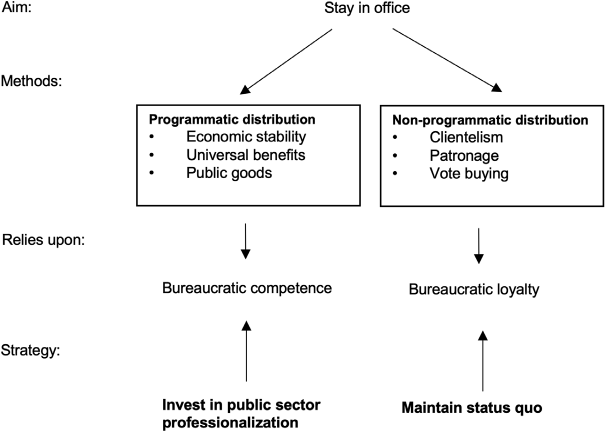
Figure 2.1 suggests that politicians face a stark choice: they adopt either programmatic or non-programmatic ways to distribute resource. Yet, in practice, politicians in most developing democracies are likely to want to mix both modes of distribution.Footnote 24 This is especially likely at different levels of politics. Presidents and ministers, who must satisfy broad, national constituencies, may be inclined toward universalistic programs, large-scale public goods, and programmatic distribution to reach a large number of voters. For example, after democratization in the early 1990s presidential candidates across countries in sub-Saharan Africa abolished primary school fees as a universalistic policy to attract support.Footnote 25 However, local politicians (MPs, mayors, etc.) may be inclined toward non-programmatic distribution. For example, MPs in many low- and middle-income democracies have been granted constituency development funds, which they often use to target club goods at specific communities.Footnote 26 Local politicians often seek to claim credit for local public goods provision.
Introducing universal policies or constructing large-scale public goods is beneficial to politicians because these can benefit large groups of voters. At the same time, because coverage is non-excludable and usage is irreversible, such investments are inherently more risky than excludable transfers to individuals.Footnote 27 Thus, politicians and leaders within political parties are often cautious to wholly rely on universalistic distribution. Awarding benefits via discretion enables politicians to target specific individuals or communities. Non-programmatic distribution can offer politicians more certain electoral returns compared to programmatic distribution because they are targeted and reversible. However, an important downside of targeted strategies is the effort it takes politicians to hand-select recipients and tailor particular goods that suit their needs. Politicians often have to rely on local brokers to gather information and distribute goods to voters, which can result in additional costs for parties and candidates.Footnote 28 Politicians’ desire to build a portfolio of both programmatic and non-programmatic benefits ensures that they have incentives to favor both bureaucratic competence and bureaucratic loyalty.
Beyond politicians’ desire to deliver non-programmatic goods to citizens, they may also seek loyal bureaucrats because such bureaucrats are likely to be more willing to overlook attempts to extract public resources for election campaign activities or self-enrichment.
2.1.1 Politicians’ Need for Loyal Bureaucrats Beyond Non-programmatic Distribution: Financing Election Campaigns
Politicians often seek to redirect public funds allocated for programmatic distribution into funds they can use for non-programmatic purposes. This conversion typically involves asking bureaucrats to modify specific administrative processes. Politicians find it easier to do so when bureaucratic loyalty is high. In addition to capturing public funds for distributive purposes, incumbent politicians also often attempt to use public money or manipulate administrative processes to finance their election campaigns.Footnote 29
Two factors that incentivize politicians to look to the public sector for campaign funds are (i) the lack of alternative funding and (ii) the high costs of election campaigns. The need to self-fund election campaigns can be considered a push factor in administrative interference, while the high cost of elections is an important pull factor. Considering the former, unlike in advanced democracies, where political parties often provide candidates with significant funds, political candidates in many developing democracies are typically expected to use their own funds to finance their campaigns.Footnote 30 While political parties in such contexts sometimes receive public funds, these funds are often insufficient and irregular. Thus, parties cannot use them to cover even basic campaign costs for individual candidates. Considerably more money is available to incumbent political candidates via the illicit capture of public funds.
Regarding high election costs, while election campaigns in democracies all over the world are expensive, they are especially costly in developing countries. High costs partly result from the nature of campaigning in such contexts, with candidates expected to conduct large-scale, face-to-face campaigns. Accordingly, candidates must use rallies and door-to-door canvassing to reach voters.Footnote 31 The need to be physically present across districts imposes high travel costs on candidates, especially when road conditions are poor. At the same times, village meetings, rallies, street processions, and house-to-house canvassing are expensive to organize. The costs of such events include not only the logistics – erecting stages, microphones, speakers, etc.; politicians also often have to pay party workers to mobilize crowds to attend them.Footnote 32 Another significant cost for political candidates are the particularistic benefits that voters often expect to receive during campaigns either when they are canvassed or at public events.
In many countries, campaign costs also soar because of insufficient legal regulations. Formal spending limits during election campaigns are often absent, or where they exist are insufficiently enforced, or set so low that candidates ignore them. As a result, candidates can end up spending large amounts in competition with each other. One example is India, where there are formal campaign spending limits, but candidates routinely spend ten times this amount, and sometimes exceed it by thirty or fifty times.Footnote 33 In the context of Africa, many countries impose no limits on campaign spending. Where limits exist, the institutions that are meant to regulate them are often not independent or lack the resources to monitor donations and spending.Footnote 34 Accordingly, it has been argued that “this type of regulation [regulation on spending] plays no practical role in African political finance.”Footnote 35
In summary, the pressure to engage in, and self-finance, costly election campaigns often means politicians look to the public sector. Corrupting public procurement processes is a common way to capture funds.Footnote 36 Manipulating public procurement processes is attractive to incumbent politicians because of the scale of public contracts within the economy: procurement constitutes about 14% of GDP and averages 50% of government spending in African countries.Footnote 37 Capturing a fraction of such money can significantly aide a candidate’s campaign funds.
Malfeasance in procurement typically requires corrupt actions from three sets of actors – private firms, politicians, and bureaucrats. Private firms often either pay bribes or donate to politicians’ campaigns in exchange for contracts. To favor particular firms, politicians and bureaucrats administer uncompetitive procurement auctions. This quid pro quo between private firms and politicians has been identified in a number of countries, including Lithuania,Footnote 38 India,Footnote 39 Russia,Footnote 40 Brazil,Footnote 41 and Colombia.Footnote 42 Instead of favoring companies that offer bribes or donations, politicians may also seek to favor companies owned by local party officials.Footnote 43 However, again, such an arrangement signifies an exchange between the firm owner and the political candidate: the candidates will likely expect the party official to campaign on their behalf. Whatever the motivation of political candidates, politicians who seek to extract resources for their campaign via public procurement must secure the loyalty of the bureaucrats who administer the procurement process. Such loyalty will be more likely if bureaucrats are recruited on the basis of their personal or partisan attachments. Therefore, politicians who seek to use the public sector to finance their campaigns will be generally hesitant to professionalize the public sector.
2.1.2 Why Professionalizing the Public Sector Decreases Bureaucratic Loyalty
Professionalizing the public sector by strengthening merit institutions and giving bureaucrats more autonomy over their daily tasks can make programmatic distribution more efficient by increasing bureaucratic competence. However, it can also decrease bureaucratic loyalty through at least four mechanisms. First, meritocratic recruitment restricts the opportunities available for political patronage because jobs that were once allocated to party or politician loyalists are now distributed according to competitive criteria. Second, and related, bureaucrats selected through a competitive process are less likely to feel obliged to help politicians convert programmatic funds into non-programmatic benefits than those hired based on their personal ties.Footnote 44 Third, public sector professionalization often involves automating certain processes to limit politicians’ discretion – for example, to select program beneficiaries. This leaves fewer opportunities for politicians to manipulate or interference in distribution. Fourth, public sector professionalization may include the creation of oversight or sanctioning institutions, which can increase the risk of punishment for bureaucrats who engage in corruption. Such institutions can make even loyal bureaucrats more weary of manipulating administrative processes on behalf of politicians.
How do politicians solve this dilemma? Political parties and politicians can partly solve their desire to mix programmatic and non-programmatic distribution by differentially investing in bureaucratic competence across the public sector to create “islands of efficiency.”Footnote 45 This allows politicians to benefit from gains to governance in key sectors that may be highly consequential to, for example, economic growth. Alternatively, national or regional political leaders may use bureaucratic postings to post the most loyal bureaucrats to districts of the country where the need for loyalty is most consequential.Footnote 46
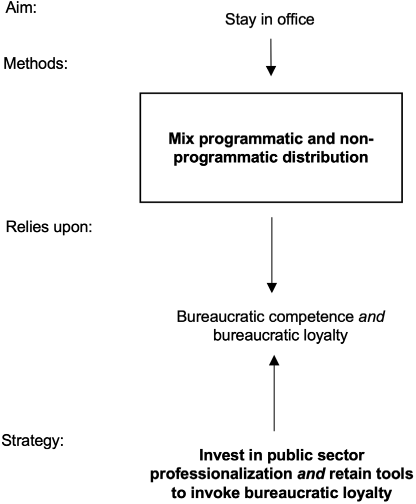
An alternative strategy that allows politicians to increase bureaucratic competence without significantly decreasing bureaucratic loyalty is for them to introduce or rely on merit to recruit bureaucrats, but retain the ability to control their careers to coerce loyalty from them when loyalty is needed. This strategy is depicted in Figure 2.2. It is more flexible than, for example, creating islands of efficiency because it allows politicians to benefit from the gains of bureaucratic competence across multiple policy domains or geographic locations. I next explain why career control is a powerful way to generate bureaucratic loyalty.
Politicians’ aims and methods and the implications for public sector professionalization after assuming a preference to engage in both programmatic and non-programmatic distribution
2.2 Solving the Dilemma: Controlling Bureaucrats’ Careers to Solicit Loyalty
In a recent report, the United National Development Programme stated that “to function effectively and achieve its development agenda, a country must prioritize investments in a professional, merit-based civil service” (274).Footnote 47 Indeed, meritocratic recruitment is widely considered desirable. It is associated with better governance outcomes, including less corruption, lower levels of wasteful government spending, and better management performance.Footnote 48 At the individual level, bureaucrats hired competitively are perceived to have higher levels of public service motivation and to be less corrupt.Footnote 49 However, career control allows politicians to rely on the loyalty even of bureaucrats who were recruited via merit-based, competitive processes, which can undermine some of these positive effects. Politicians can control careers by using promotions, geographic transfers, or bureaucrats’ work portfolios as either carrots to reward compliance (e.g. award promotion, transfer to a favorable post, assign creative or thought-provoking tasks) or as sticks to punish disloyalty (withhold promotion, enact an unwanted transfer, or allocate mundane or menial tasks).
To understand why politicians’ ability to control the careers of bureaucrats is such a powerful tool, I consider two possible mechanisms through which meritocratic recruitment may improve governance. The first is that it boosts bureaucrats’ sense of commitment to corporate goals and esprit de corps within the public sector.Footnote 50 The second mechanism is that meritocracy separates the careers of politicians and bureaucrats.Footnote 51 Career separation can enhance administrative effectiveness by fostering mutual checks and balances, aligning promotions with performance rather than personal connections, and improving trust in bureaucratic leadership.Footnote 52 Indeed, on this last point, bureaucrats are argued to be more likely to trust bureaucratic “managers” than political “owners.”Footnote 53
Both of these mechanisms suggest that what matters is not simply how bureaucrats are recruited, but the autonomy and protections they are granted afterwards. Developing a positive esprit de corps takes time. Similarly, the development of trust and potential gains in agency performance rely on bureaucrats being managed fairly by professional superiors, with these superiors basing promotions on individual productivity. If politicians can control how bureaucrats advance in their careers, these channels for positive effects are undermined. Thus, the benefits of meritocratic recruitment depend not only on bureaucratic selection methods but also on insulating career progression from political interference.
Prior work conflates the distinct concepts of (i) meritocratic recruitment into the public sector and (ii) the career separation of politicians and bureaucrats. For example, Dahlström and Lapuente (Reference Charron, Dahlström, Fazekas and Lapuente2017) explain “to capture the theoretical concept of greatest interest to use – the separation of interest between bureaucrats and politicians – we use an indicator of the extent to which recruitment to the public sector is made by merit” (105, emphasis added).Footnote 54 Using meritocratic recruitment to measure career separation is problematic because treating the two concepts as synonymous suggests that they always occur together. However, I argue that politicians have strong incentives to adopt meritocratic hiring while retaining control over bureaucrats’ careers.
I argue that the control politicians, exercise over bureaucrats’ careers after they have been hired is a central and overlooked impediment to administrative performance. An emerging literature observes that bureaucrats can be recruited based on merit, but can later experience high levels of interference in their careers. For example, recruitment into the top ranks of the Indian public sector – the Indian Administrative Service – is highly competitive; only candidates who achieve top scores on the civil service exam are selected. However, bureaucrats’ career progression has been found to depend on both their abilities and their loyalty to elected officials.Footnote 55 Indian politicians have the authority to transfer and promote bureaucrats who they perceive as loyal; there is evidence that they shuffle bureaucrats after changes in political power – a tactic politicians use to enhance bureaucratic loyalty.Footnote 56 Qualitative research has highlighted the deleterious effects of political control over bureaucrats’ careers. Again in India, politicians exploit their power to transfer bureaucrats to other locations to guarantee their loyalty. In this way, politicians “force” bureaucrats to be corrupt on their behalf; not doing so can result in undesirable transfers.Footnote 57 Research on Hungary also demonstrates the insufficiency of legislation to protect the public sector against politicization: politicians have the discretion to change public servants’ rank and to influence promotions, transfers, and dismissals.Footnote 58 To consider why retaining control over bureaucrats’ career progression is powerful, we must also consider bureaucrats’ incentives.
2.2.1 Bureaucrats’ Incentives: Why Career Control Is an Effective Tool
I have argued that politicians build support for their (re)election in part by distributing a mix of programmatic and non-programmatic benefits to citizens. Because bureaucrats administer public resources, politicians have incentives to influence their actions. I argue that politicians can co-opt bureaucrats and ensure bureaucratic loyalty by using tools to influence bureaucrats’ career progression (e.g. promotions, geographic transfers, and work portfolios) (see Figure 2.2). To understand why career interference is so powerful, we must consider bureaucrats’ incentives.
Bureaucrats seek to use their public sector positions to achieve three goals. First, like most employees, they seek to advance in their careers to increase their salary, status, or influence over policy outcomes. Most bureaucracies are organized hierarchically. Because bureaucrats usually have job security and there are typically high levels of internal recruitment, bureaucrats hope (and expect) to rise through the ranks.
Second, bureaucrats have an incentive to work in locations (or government departments) that they prefer. In developing countries with varying levels of economic development across regions, bureaucrats may pursue a public sector job to work in a richer part of the country that offers better public services, such as schools. For example, a recruitment experiment in Mexico, in which public agencies randomized advertised wages for the same job, shows that candidates are attracted to positions in poorer communities only when they are compensated with high wages.Footnote 59
Third, bureaucrats may also use their positions to capture illicit rents (self-enrichment).Footnote 60 While all bureaucrats may have a motive to engage in corruption for personal gain, not all of them will have an equal opportunity to do so. Variation in opportunity depends on the extent to which bureaucrats work independently, are monitored by either political higher-ups or other bureaucrats, and whether their primary activities involve exchanges with individuals. Front-line service workers such as doctors work independently, are not usually closely monitored, and provide individual services to clients. Under such conditions, bureaucrats have opportunities to extract bribes. By contrast, bureaucrats in line ministries or local governments usually work in teams, are monitored by politicians, and do not directly sell outputs (driving licenses, drugs, electricity connections, etc.) to citizens; corruption requires coordination, which limits the opportunities to capture rents. In this book, I focus on the behavior of the latter type of bureaucrats.
Given these incentives, politicians’ ability to influence the careers of bureaucrats is a powerful tool. Interfering in bureaucrats’ promotions or work portfolios can make it impossible or more difficult for them to rise up the ranks and receive the associated higher salaries and status. Geographic transfers, which dictate where bureaucrats must live, are potent because they impact both quality of life and can make promotions more difficult. For example, being sent to a low-status district or agency with little challenging work could have professional costs. Scholars have described the costs of geographic transfers in India: “Officers are exceedingly sensitive to such moves since prestige, influence, and living conditions vary widely between posts (even for officers with similar levels of seniority).”Footnote 61 In short, certain locations (often more urban areas) may be more prestigious and have better living conditions.
2.2.2 Voters’ Expectations and Electoral Preferences
I argue that politicians seek to mix programmatic and non-programmatic distributive strategies as part of a risk-minimizing electoral strategy. The assumption behind this claim is that voters reward politicians who distribute programmatic and non-programmatic benefits to them. In Section 2.2.2, I assess voters’ preferences in young democracies. Such preferences, especially in African democracies, have been asserted to be based on identity ties rather than retrospective or prospective candidate performance evaluations. However, most scholars now agree that voters’ preferences for co-ethnic candidates are typically instrumental: they expect to receive more (private or public) goods for themselves or their communities from such candidates. Accordingly, much of what was once thought of as “identity politics” can be folded into a model of distributive politics.
In many low- and middle-income democracies, voters expect candidates to distribute non-programmatic benefits (i.e. private goods or favors) either during election campaigns or in the electoral off-cycle. Much of the literature focuses on the former – a phenomenon sometimes called “campaign clientelism.”Footnote 62 While there is variation in the prevalence of campaign gifts, in many countries they are widespread. In Indonesia, Kenya, and Uganda, 25–40 percent of the electorate receive private benefits from candidates during campaigns.Footnote 63
There is evidence that voters reward candidates who provide non-programmatic goods. In Kenya, voters are more willing to support political candidates who dispense money to voters than those who do not distribute private benefits.Footnote 64 Voters often interpret campaign gifts not as a direct quid pro quo,Footnote 65 but as evidence that a candidate (i) is viable and (ii) intends to help constituents if they come to office.Footnote 66 Thus, political candidates distribute gifts partly to construct a public image of individual generosity.
While individual acts of “vote buying” may be beneficial to candidates, distributing gifts during elections may have little overall effect, especially if the impacts of multiple candidates offering private gifts cancel each other out.Footnote 67 However, candidates cannot risk not supplying private benefits to voters in case their competitor gains an electoral advantage from doing so. Indeed, voters are likely to perceive a candidate who does not supply gifts as stingy and unlikely to provide patronage or favors in the future.Footnote 68 In effect, given voters’ expectations and the fact that the benefits influence (some) voters, politicians are trapped in a pure prisoner’s dilemma.Footnote 69 While all candidates would be better off not distributing campaign benefits, this equilibrium cannot be sustained because individual candidates have an incentive to defect to capture an electoral advantage. There is also evidence that distributing private benefits is a more cost-effective strategy for candidates than, for example, advertising policy achievements to voters.Footnote 70
In addition to campaign clientelism, voters also often expect politicians to deliver goods and favors during the electoral off-cycle. Repeated interactions between voters and politicians (or “relational clientelism”) are an important way for politicians to sustain their core support bases.Footnote 71 Politicians may dispense financial favors or help citizens navigate the bureaucracy. For example, politicians may help voters obtain a health insurance card, an electricity connection, or apply for a job – often working with bureaucrats to do so.
While prior studies often focus on voters’ preferences for non-programmatic distribution, there is also evidence that they reward programmatic distribution in the form of public (or collective) goods. For example, there is evidence that voters engage in economic voting and reward parties that provide the important public good of economic growth and stability. The incumbent party’s ability to deliver on macroeconomic policies has been shown to be an important determinant of vote choice in multiple regions, including in Africa, Latin America, and Eastern Europe.Footnote 72 Performance voting has also been demonstrated in individual African countries such as Zambia, Ghana, and South Africa.Footnote 73
Another important type of public good that voters reward is the provision of large-scale public infrastructure.Footnote 74 While it is difficult to parse out the causal effects of new infrastructure on vote choice due to potential endogeneity concerns, micro-level data suggests that voters reward the provision of public infrastructure. For example, in Ghana, they are more likely to re-elect presidents who have constructed (or maintained) schools and roads: a one-standard-deviation increase in average road conditions leads to a 1.4-percentage-point increase in the incumbent party’s vote share.Footnote 75 Further evidence from Ghana uses survey evidence to show that swing voters prefer parliamentarians who prioritize “constituency development” (providing local public goods) over distributing private goods.Footnote 76 In short, there is evidence that voters reward politicians who engage in both programmatic and non-programmatic distribution.
The discussion thus far has assumed that voters’ preferences are homogeneous. Yet in practice, the extent to which voters prioritize non-programmatic versus programmatic distribution will vary across different segments of the population. Importantly, voters’ socio-economic status is likely to influence their preferences for particularistic goods. Poorer voters are more likely than their better-off counterparts to support politicians who distribute private benefits or favors, as such goods have a higher relative value for these voters and can be used to solve their immediate problems. Wealthier voters may be more likely to back candidates who focus on programmatic distribution. Survey evidence from several African countries demonstrates that politicians target poorer voters when they distribute gifts.Footnote 77 Regarding voters’ preferences, survey evidence shows that middle-class voters are more likely than poorer voters to prioritize universalistic over particularistic policies.Footnote 78 In Argentina, local politicians are more likely to “opt out” of clientelistic distribution when voters are wealthier.Footnote 79 However, the extent to which politicians prioritize programmatic distribution will vary based on expectations about whether wealthier citizens will turn out to vote. Some evidence in developing democracies suggests that voters’ propensity to abstain for voting increases as they become wealthier.Footnote 80
To summarize, there is evidence that voters evaluate political candidates based on the extent to which they engage in both programmatic and non-programmatic distribution. Distributive considerations are likely to be especially important where ideological attachments to parties are weak or partisan attachments, more generally, are low. In these contexts, individual candidate actions are more likely to influence vote choices. Similarly, voters may be more likely to reward national politicians (e.g. presidents) for programmatic distribution and universalistic policies, and prioritize the distribution of targeted goods when evaluating local politicians (e.g. MPs, mayors, or local councilors).
2.2.3 Electoral Competition
Thus far, I have argued that state development depends at least in part on which strategies politicians pursue to win votes. I maintain that if voters reward politicians who distribute private goods to them, politicians will favor loyal bureaucrats. Pressures on political candidates to self-fund their election campaigns also influence their incentives to favor bureaucratic loyalty over bureaucratic competence.
Above, I explored how voters’ socio-economic condition influences their preferences. In Section 2.2, I consider another variable that prior research has identified as important in determining politicians’ incentives to professionalize the public sector – electoral competition. While electoral competition is often thought to enhance state development, I make the case that the relationship between the two may be multi-directional, and vary depending on whether the source of electoral competition is at the national or local level. While national-level competition may encourage politicians or governments to invest in governance, local competition may undermine administrative capacity by encouraging clientelism and rent seeking. In the remainder of Section 2.2, I disaggregate the concept of electoral competition, discussing its role in terms of (i) the introduction of elections, (ii) national-level competition, and (iii) local-level competition.
Introduction of Elections
When countries transition from authoritarian to democratic rule, the public sector is likely to be impacted. Holding elections introduces competition between political parties and generates new accountability pressures for politicians. Voters gain the ability to sanction governing parties for poor performance or bad governance, which gives politicians an incentive to invest in state capacity to improve the delivery of public goods and welfare.Footnote 81 In African countries, the introduction of democracy is associated with a boost in education spending, which highlights politicians’ increased need to deliver on welfare policies that voters favor.Footnote 82 Cross-national panel data shows that democratization, on average, enhances state capacity.Footnote 83 A detailed study of the introduction of elections in Indonesia demonstrates that democratization increased politicians’ preferences for competent bureaucrats.Footnote 84
Once elections have been introduced, the intensity of competition between political parties varies by country. While a single party dominates elections in some countries, in others, parties achieve narrow victories to obtain a handful more seats in national parliaments or a slim majority in presidential races.
National-Level Competition
Some scholars argue that national-level competition can discourage political investments in the state, including by reducing politicians’ incentives to secure bureaucratic tenure.Footnote 85 Others note that polarization between parties helps explain politicians’ responses to competition.Footnote 86 Yet in general, the scholarly literature suggests that higher levels of national competition can improve public sector development by promoting investments in state capacity for at least three reasons. First, high levels of national competition between parties ensure that political elites expect to alternate in office. Accordingly, politicians are inclined to adopt reforms that create a more level playing field between the ruling and opposition parties as part of an insurance policy for when they are out of office.Footnote 87 Second, high levels of electoral competition create stronger opposition parties with a significant presence in parliament. This allows the opposition to monitor governing parties and pressure them to adopt reforms to establish, for example, oversight and ombudsman institutions.Footnote 88 Third, political parties that face tight electoral competition have an incentive to adopt administrative reforms to capture votes from pro-reform segments of the electorateFootnote 89 – which may help determine election results.
Local-Level Competition
While high levels of national-level electoral competition may incentivize politicians to invest in state capacity, high levels of local electoral competition do not necessarily improve the delivery of public goods or local state capacity. The mechanisms through which competition induces positive results at the national level are not always present within districts or municipalities. For example, in presidential elections the nation is a single constituency, but the same is not necessarily true in local elections. Especially in poor constituencies, only a very small number of voters may reward politicians who invest in public sector professionalization. Because this group may not be consequential in determining elections, politicians may not be persuaded to improve governance. Relatedly, at the local level it may be harder for an individual politician to get credit for investing in better governance relative to a national political party. Finally, while national-level opposition parties are likely to have sufficient resources to monitor the ruling party, this is rarely the case at the local level. Local councils and councilors are often under-resourced and find it difficult to monitor the actions of incumbent mayors or parliamentarians.
I therefore propose that high levels of local electoral competition can undermine good governance and encourage political interference in administrative processes and corruption. Based on my proposed theory, a potential mechanism through which high levels of local electoral competition may undermine state development is by encouraging candidates to prioritizing non-programmatic distribution to win votes.Footnote 90 As political risk increases, politicians seek to distribute private goods to consolidate electoral support.Footnote 91 Indeed, it has been noted that “especially among poor countries, competition enhances clientelism … politicians will move to employ every imaginable strategy of attracting constituents.”Footnote 92 In general, across a diverse set of countries, data suggests that electoral competition amplifies non-programmatic distribution.Footnote 93
In addition to gifts to voters, another important type of private benefit is public sector jobs. Prior work has identified a positive relationship between the level of local electoral competition and the distribution of patronage jobs. In Indonesia, more patronage hiring occurs in districts that feature a strong opposition compared to those in which the ruling party is electorally secure.Footnote 94 Similarly, data from local governments in Ghana shows that high levels of competition are associated with more public sector jobs, especially lower-ranked (and temporary) jobs, which are given to political party activists in exchange for their support.Footnote 95
A second mechanism through which high levels of local electoral competition undermine state development and encourage political interference in administrative processes is by increasing campaign costs within constituencies. Political competition increases politicians’ demand for campaign funds,Footnote 96 and campaign spending has been found to be higher in competitive constituencies.Footnote 97 In competitive districts, non-programmatic distribution becomes increasingly costly as parties begin to target non-poor and more committed voters.Footnote 98 If incumbent politicians rely on the public sector to fund their election campaigns, rising campaign costs are likely to result in increased corruption within local government offices.
An indirect way to assess how electoral competition influences non-programmatic distribution is to consider its effect on programmatic distribution. Assuming a somewhat fixed budget constraint, increases in non-programmatic distribution should lead to fewer local public goods. While the evidence is mixed, in several contexts where scholars have access to micro-level public goods data, a negative relationship between competition and public goods has been found. For example, rising competition in commune-level elections in Mali resulted in fewer local public goods (measured in terms of the number of schools, water boreholes, and health clinics, and the length of rural roads).Footnote 99 In Brazil, municipalities with competitive elections allocate less to social spending than those with less political competition.Footnote 100 However, another study found no relationship between the level of electoral competition and the provision of potable water and sewage in Mexico.Footnote 101
Two scope conditions likely condition the negative effects of local electoral competition on governance. First, this argument is likely to be confined to low- and middle-income countries or poorer constituencies because voters in these contexts are more likely to reward politicians for providing particularistic benefits. Second, the negative effects of local electoral competition may be confined to countries where local opposition parties are not represented in sub-national parliaments. In federalized systems where opposition parties hold seats in local parliaments, electoral competition may play a positive role similar to that identified at the national level through the mechanisms discussed earlier.Footnote 102
2.3 Observable Implications of the Theory
The theoretical discussion above leads to a set of observable implications that I investigate in the remainder of the book. In Chapters 3–6, I assess the theory using original micro-level data from Ghana. In Chapter 3, I present contextual details of the case, including the country’s political and bureaucratic structures. I also present evidence that the bureaucrats I focus on are recruited on the basis of merit – or, at minimum, are not recruited based on their political ties. In subsequent chapters, I assess three main observable implications of the theory.
First, my argument implies that reforms to enhance governance will not be sufficient to protect against political interference in bureaucratic processes. I focus on one important reform – the meritocratic recruitment of bureaucrats. As discussed earlier, scholars often identify meritocratic selection as the cornerstone of a professional bureaucracy and note its positive association with multiple desirable political and economic outcomes. I instead propose that meritocratic hiring cannot be used as a measure of general bureaucratic isolation, and that meritocracy can co-exist with high levels of both political interference in administrative processes and political corruption. In Chapter 4, I demonstrate that this is the case in Ghana.
The second implication is that if politicians subvert merit institutions via the mechanism of career control, levels of administrative interference and corruption should be highest when politicians exert more control over bureaucrats’ careers. A politician’s ability to interfere in a bureaucrat’s career may vary according to factors such as the former’s status or position. For example, politicians who hold senior positions in the party, have had longer careers in politics, or have larger political networks may find it easier to pull the necessary formal or informal levers to influence a bureaucrat’s promotion, transfer them, or determine their work portfolio. This implication relates to politicians’ opportunity to politicize the public sector. In Chapter 4, I show that bureaucrats who perceive that mayors are easily able to control their careers, are more likely to state that there is corruption in the distribution of local public goods in their districts.
Third, if administrative interference is driven by politicians’ need to either engage in non-programmatic distribution or capture public funds for election campaigns, we should observe more interference when they are under greater pressure to pursue these strategies. An implication of my argument is that two types of constituencies have more bureaucratic interference – those that (i) have a large share of poor voters or (ii) are electorally competitive. Politicians in both types of districts are under pressure to engage in non-programmatic distribution either because they are subject to greater electoral risk or because elections are relatively more expensive. Overall, this observable implication relates to politicians’ motive to politicize the public sector. In Chapters 5 and 6, I demonstrate that politicians are more likely to interfere in administrative processes in electorally competitive districts.Footnote 103 The findings in these chapters support the argument that inference is linked to politicians desire to extract resources and engage in non-programmatic distribution.
In Chapter 7, I assess these implications in the context of two other middle-income democracies: India and Indonesia. I provide evidence that politicians use career control tools to extract bureaucratic loyalty in these contexts. The analysis suggests that politicians do so because of pressures they face to engage in non-programmatic distribution and fund their election campaigns. I also provide evidence that greater levels of local electoral competition encourage non-programmatic distribution, which motivates politicians to interfere in bureaucrats’ careers.

 Open access