

Introduction
In recent years, millions have been compelled to seek refuge in neighboring countries due to crises in their countries of origin. Low- and middle-income countries now host over 40 per cent of the world’s migrant population and 83 per cent of refugees (UNHCR 2022). This has sparked concerns about these resource-constrained countries’ capacity to incorporate displaced individuals, leading to rapidly deteriorating attitudes.
Once anti-immigrant attitudes deteriorate, they are difficult to reverse, posing lasting barriers to immigrant integration and social cohesion. This challenge is acute in middle-income countries, where economic scarcity makes immigration’s economic impacts especially salient. In such contexts, competition for scarce state-subsidized goods and services can fuel conflict with host populations (Dancygier Reference Dancygier2010).
Colombia exemplifies this pattern. Almost seven million Venezuelans have fled their country’s crisis, and Colombia has become their primary destination, receiving over 2.9 million Venezuelan migrants (5 per cent of the population). Public opinion has turned sharply negative: Colombia experienced one of the largest declines worldwide in migrant acceptance, dropping from 61 per cent to 29 per cent during 2016–19. This pattern extends regionally, with Peru declining from 63 per cent to 36 per cent and Ecuador from 61 per cent to 35 per cent (Esipova et al. Reference Esipova, Ray and Pugliese2020).
Existing research highlights perspective-getting interventions – exposing host-nation members to immigrant personal narratives – as a promising path to attitude change. These interventions have proven durable in the United States and Europe (for example, Adida et al. Reference Adida, Lo and Platas2018; Kalla and Broockman Reference Kalla and Broockman2020; Simonovits et al. Reference Simonovits, Kezdi and Kardos2018; Williamson et al. Reference Williamson, Adida, Lo, Platas, Prather and Werfel2021) – where cultural and political concerns typically shape attitudes (Hainmueller and Hiscox Reference Hainmueller and Hiscox2010) – by embedding persuasive information within stories that require cognitive focus, reducing counterarguing (Batson and Ahmad Reference Batson and Ahmad2009; Bilandzic and Busselle Reference Bilandzic, Busselle, Dillard and Shen2013). Yet in resource-constrained host countries, where economic pressures are more salient, these strategies may require adaptation. In these contexts, narratives may need to confront economic concerns directly.
We develop our argument from research showing that both humanitarian and economic concerns shape attitudes towards displaced populations. Humanitarian considerations such as vulnerability and deservingness consistently predict more favorable attitudes (Alrababa’h et al. Reference Alrababa’h, Dillon, Williamson, Hainmueller, Hangartner and Weinstein2021; Bansak et al. Reference Bansak, Hainmueller and Hangartner2016). Economic factors operate through labor market competition – with skilled natives more supportive when they hold an advantage over immigrants (Mayda Reference Mayda2006) – or through fiscal pressures, particularly opposition to low-skilled migration due to welfare state demands (Hainmueller and Hiscox Reference Hainmueller and Hiscox2010; Valentino et al. Reference Valentino, Soroka, Iyengar, Aalberg, Duch, Fraile, Hahn, Hansen, Harell, Helbling, Jackman and Kobayashi2019). Dancygier (Reference Dancygier2010) suggests that conflict results from economic scarcity and competition for state-subsidized goods. This literature implies that narratives portraying humanitarian crises should improve affect towards immigrants. However, when economic impacts are highly salient, as in resource-constrained countries, humanitarian narratives alone may be insufficient to shift support for open immigration. Even when people feel empathy for migrants fleeing difficult circumstances, concerns about economic costs can prevent them from supporting policies that accept more immigrants.
We therefore ask whether narrative interventions need to address economic concerns – rather than only portraying humanitarian hardships – to shift support for open immigration in economically constrained contexts. We argue that narratives portraying migrant hardships may improve natives’ feelings towards immigrants, but to shift support for open immigration, they must address concerns about immigration’s economic costs, particularly regarding pressure on public services and reliance on state subsidies. By countering these concerns, stories reduce counterarguing and change attitudes.
We examine this argument using three preregistered survey experiments conducted in Colombia (n = 12,277) between 2021 and 2023. Colombia’s history as a migrant-sending country may foster warmer feelings towards migrants, but the dynamics we study reflect broader regional patterns where economic concerns dominate public opinion. This single-country study likely generalizes to other middle-income contexts where three conditions converge: (1) large-scale immigration creates salient economic concerns, (2) limited state capacity constrains the ability to offset costs, and (3) host communities experience tension between humanitarian and economic concerns. These conditions are prevalent in many middle-income countries throughout Latin America.
We evaluate perspective-getting interventions with two types of narratives. Building on evidence that humanitarian considerations promote positive attitudes (Alrababa’h et al. Reference Alrababa’h, Dillon, Williamson, Hainmueller, Hangartner and Weinstein2021; Bansak, et al. Reference Bansak, Hainmueller and Hangartner2016), we employ stories portraying migrant hardship related to home-country humanitarian crises, which we call ‘humanitarian narratives’. The second type, ‘economic narratives’, also depict hardship but address concerns about immigration’s economic costs – particularly fiscal burdens and pressure on public services – by emphasizing migrants’ contributions to the host country. We present the narratives in textual (Studies 1 and 2) and video (Study 3) formats, measuring effects immediately after the intervention (all studies) and two weeks later (Study 3).
Given these two narrative types and the theoretical expectations outlined above, we expect that both narratives will increase positive affect by portraying humanitarian hardship, but only economic narratives will also increase support for open immigration policies by directly addressing concerns that would otherwise prompt counterarguing.
Our findings reveal that both content and format are important for narrative effectiveness. Using meta-analysis estimates, we find that economic narratives have positive and statistically significant effects on both positive affect and open immigration policy support. In contrast, humanitarian narratives show positive effects but are only statistically significant for positive affect. While text-based narratives show modest effects, video presentations generate substantially stronger impacts. This format difference is particularly pronounced for humanitarian narratives, which show positive and statistically significant effects only when delivered in video. Economic narratives are effective whether delivered by text or video.
We also find differences across narrative types in the persistence of effects over time. When delivered in video format, both narratives generate immediate positive effects, but only the economic narratives’ effects persist two weeks after the intervention. Additionally, economic narratives specifically ameliorate immigration-related economic concerns, including perceptions of pressure on public services. Together, these findings suggest that economic narratives are more consistently effective across formats and time, possibly because they decrease concerns about immigration’s effects on the economy.
This paper contributes to the literature on attitudes towards migrants and migrant inclusion in several ways. First, it broadens the geographical scope of perspective-getting interventions beyond the high-income focus of most studies to middle-income contexts where economic constraints may alter how interventions work. We present evidence that narratives addressing economic costs are more consistently effective in shaping both affect towards immigrants and support for open immigration policies. This contributes to research on inclusionary interventions, where findings are often mixed: information correcting misperceptions yields null effects (for example, Hopkins et al. Reference Hopkins, Sides and Citrin2019), perspective-taking influences behavior but not attitudes (for example, Adida et al. Reference Adida, Lo and Platas2018), and information targeting immigrant-related concerns boosts affect but not policy support (for example, Williamson Reference Williamson2020). Few interventions increase both affect and policy support; those that do are perspective-getting strategies that address specific concerns by emphasizing migrant contributions (Kalla and Broockman Reference Kalla and Broockman2023), countering perceived security threats (Audette et al. Reference Audette, Horowitz and Michelitch2020), or embedding corrective information (Adida et al. Reference Adida, Lo, Platas, Prather and Williamson2025). Our results suggest this dual effectiveness occurs when narratives preemptively address concerns that would otherwise prompt counterarguing, making interventions more consistently effective across formats, time periods, and outcomes.
Second, our study complements research in developing countries on drivers of anti-immigrant attitudes by assessing interventions to shift attitudes rather than measuring drivers of attitudes, and by finding that interventions addressing immigration’s economic impact can be more consistently effective in reducing anti-immigrant attitudes. Some studies find that the economic impact of immigration does not drive exclusionary attitudes (see for example, Alrababa’h et al. Reference Alrababa’h, Dillon, Williamson, Hainmueller, Hangartner and Weinstein2021). Our findings may seem contradictory, but are actually complementary. In contexts with substantial international aid to support refugee populations, like Jordan receiving Syrian refugees, host communities may perceive immigration’s economic impact as less harmful or even benefit from aid spillovers (see for example, Zhou et al. Reference Zhou, Grossman and Ge2023), ameliorating exclusionary responses. In contexts without such aid, like Colombia, immigration’s economic impact remains salient, and interventions addressing it may be more effective at fostering support for immigration.
Third, our approach advances research by testing key methodological variations. We compare text and video delivery formats, assess persistence over two weeks rather than only immediate effects, and collaborate with migrant advocacy organizations to test stories already circulating in media campaigns, enhancing ecological validity. Fourth, our results suggest that weaker delivery methods (text) require narratives addressing core concerns, while stronger methods (video) can generate immediate effects through emotional engagement alone, though durability requires addressing these concerns.
Our findings have direct implications for advocacy organizations deploying these narratives across Latin America and similar contexts. Organizations can maximize impact by: (1) prioritizing economic narratives when resources are limited, (2) investing in video production when possible, and (3) developing sustained campaigns that build on economic narratives’ durability to achieve cumulative attitude change over time.
Research Design
We assess whether exposing Colombians to Venezuelan immigrant narratives improves affect towards migrants and support for open immigration policies with three preregistered online survey experiments conducted between 2021 and 2023.Footnote 1
We draw from narratives promoted by migrant rights organizations in Colombian media outlets, which collaborated in selecting study materials. Drawing on real testimonies published in leading outlets (El Tiempo, El Espectador, Revista Semana) and UNHCR reports, we enhance ecological validity while providing advocacy groups with actionable evidence for their media campaigns.
We chose stories that evoke humanitarian motives – by illustrating migrant struggles in home countries – and that address economic concerns – by portraying migrants as self-supporting or highlighting their economic contribution. Advocacy leaders (including UNHCR’s Somos Panas Colombia) confirmed this typology reflected how narratives circulate in campaigns. Independent coders reviewed stories, with substantial agreement on classification as humanitarian or economic.Footnote 2
Studies 1–2 presented narratives in text format. Study 3 used the same text as Study 2 but delivered it in video format, filmed with a student production team.Footnote 3 We expected the video format would be stronger because it presents fewer barriers to emotional processing (Bilandzic and Busselle Reference Bilandzic, Busselle, Dillard and Shen2013).
We randomly assigned respondents to three conditions: economic narrative, humanitarian narrative, or pure control. Control participants engaged with outcomes similarly to treatment participants, ensuring differential engagement does not bias results (Appendix A.8).
Narrative types were fixed across studies, but content varied between Study 1 and Studies 2–3 to ensure specific characteristics would not drive results. For humanitarian narratives, we shifted from violence during transit (Study 1) to medicine shortages in home country (Studies 2–3), aligning with research emphasizing home-country hardships (Adida et al. Reference Adida, Lo, Platas, Prather and Williamson2025; Audette et al. Reference Audette, Horowitz and Michelitch2020). For economic narratives, we changed from professional basketball player (Study 1) to manufacturing worker (Studies 2–3), both working in Colombian sugar cane fields, to avoid results driven by exceptional traits rather than economic contribution. Working in agriculture conveys immigrants’ self-sufficiency, addressing concerns about reliance on public assistance.
Main outcome questions measure support for open immigration policies (‘Do you agree or disagree that Colombia should limit the entry of immigrants into the country?’) and affect (‘On a scale from 1 to 7, how warm do you feel towards Venezuelan immigrants in Colombia?’). We included auxiliary questions about immigrants’ impact on public services, crime, and employment to explore whether economic narratives reduce concerns about negative economic effects. We also measured support for immigrant rights policies as an index. Study 3 included a behavioral measure asking participants whether they wanted information about supporting immigrants.
We estimate covariate-adjusted average treatment effects for each study.Footnote 4 To summarize effects across studies, we present pooled effects (meta-analysis estimates) using precision-weighted averages, a common approach in studies that implement the same treatment many times (for example, Kalla and Broockman Reference Kalla and Broockman2023).Footnote 5 Appendix A presents details about samples, stimuli, measures, and estimation methods. Appendix B.1 shows covariate balance.
Results
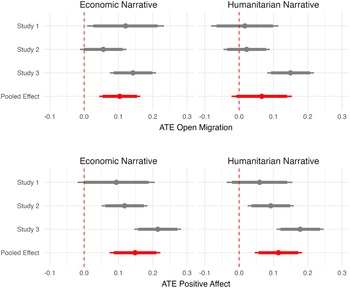
Figure 1 presents the short-term perspective-getting effects on support for open immigration policy (top panel) and positive affect (bottom panel) for each study (in grey) and combined into pooled estimates (in red). Based on the pooled effect estimate, the economic narrative increased support for open immigration by 0.1 standard deviations (s.d.) (p-value < 0.001), with statistically significant effects in Studies 1 and 3 (0.12 and 0.14 s.d., respectively), but not Study 2 (0.056 s.d.).Footnote 6
Average short-term treatment effects of immigrant narratives.
Note: points display covariate-adjusted average treatment effects in standard deviations. Thick and thin lines represent 90 per cent and 95 per cent confidence intervals, respectively. Estimates in red show a pooled precision-weighted average of study-level effects. Appendix H.1 presents tables of these estimates with and without covariate adjustment.
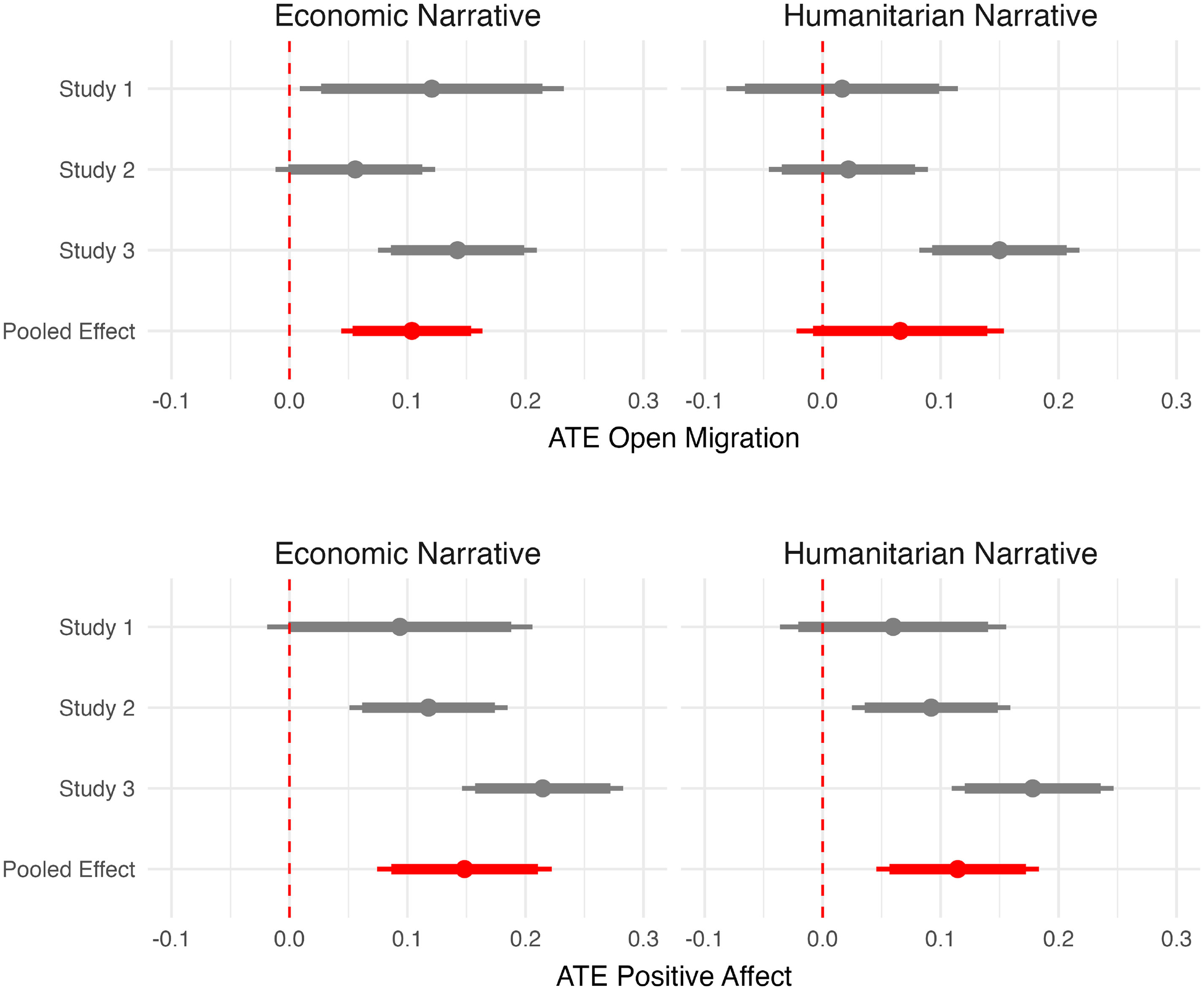
While the pooled effect estimate of the humanitarian narrative on support for open immigration is positive (0.066 s.d.), it is not statistically significant, with the difference between economic and humanitarian narratives being 0.04 s.d. (p-value = 0.48).Footnote 7 The humanitarian narrative treatment effect is close to zero in Studies 1 and 2 (0.02 s.d.), but positive and statistically significant in Study 3 (0.15 s.d., p-value < 0.001).Footnote 8
For positive affect, both economic and humanitarian narratives show statistically significant improvements of 0.15 s.d. (p-value < 0.001) and 0.11 s.d. (p-value < 0.01), respectively. The economic narrative effect is statistically significant in all three studies (although at the 10 per cent level in Study 1), while the humanitarian narrative effect is significant in Studies 2 and 3, but not Study 1.Footnote 9
Beyond these main outcomes, the economic narrative also increased support for immigrant rights policies with a pooled effect above 0.1 s.d. (p < 0.01), while the humanitarian narrative showed no significant effect (Appendix C). This suggests the economic narrative’s influence extends beyond general immigration attitudes to concrete policy preferences involving state resource allocation.
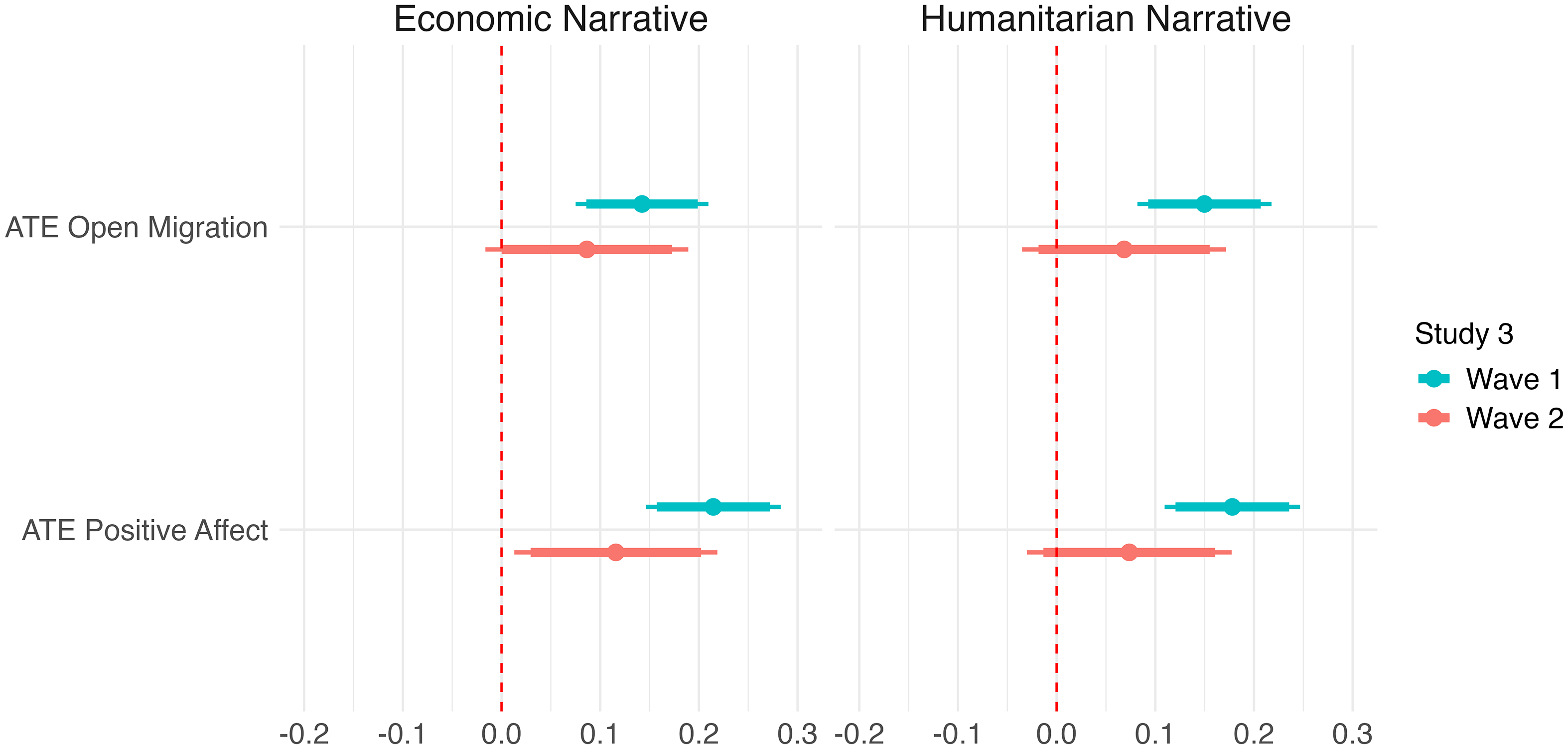
Short- and medium-term average treatment effects of immigrant narratives in Study 3.
Note: points display covariate-adjusted average treatment effects in standard deviations. Thick and thin lines represent 90 per cent and 95 per cent confidence intervals, respectively. Appendix H.1 presents tables of estimates with and without covariate adjustment.
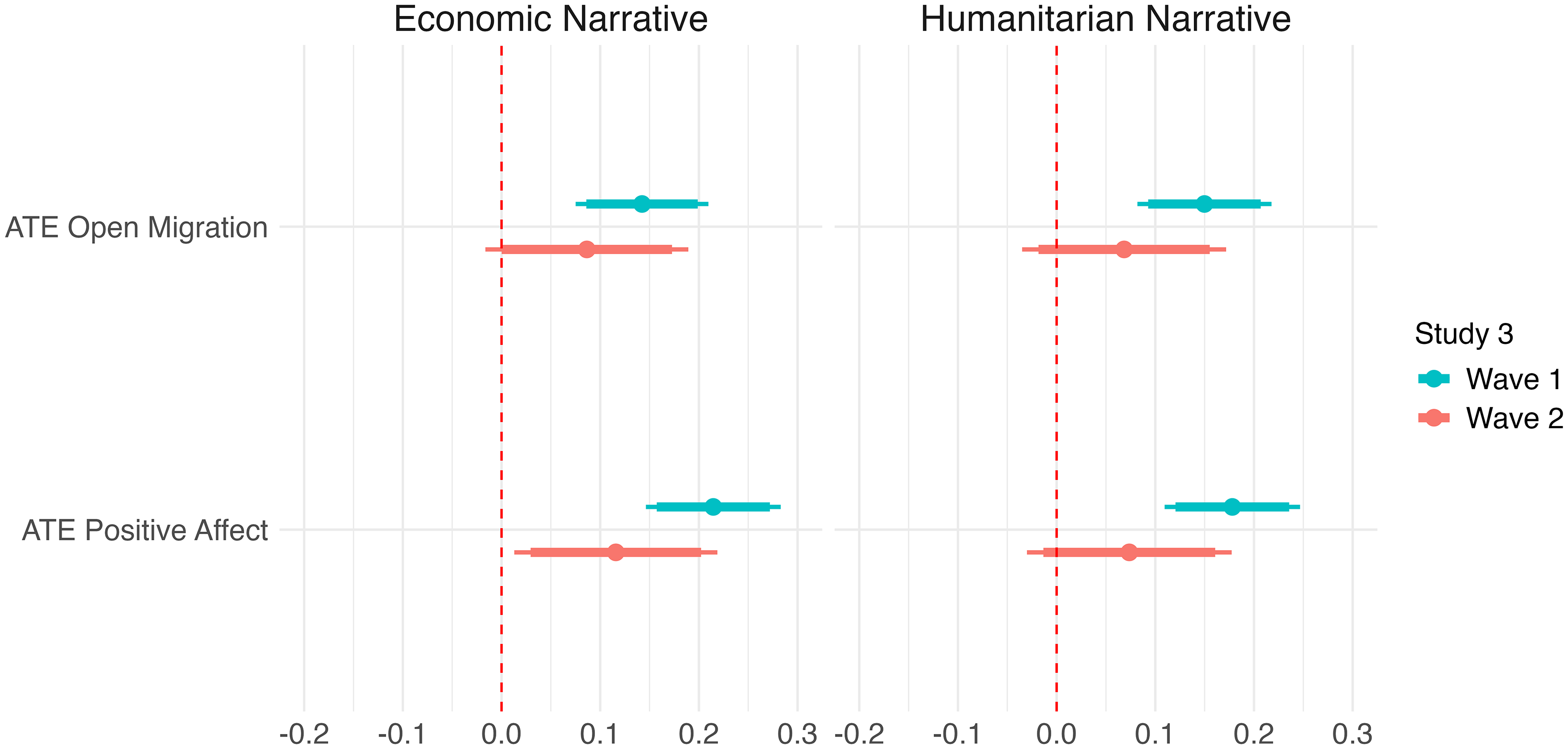
We also measured effects over longer periods. The medium-term (two-week) effect estimates in Figure 2 suggest the economic narrative durably increases positive affect towards immigrants and support for open immigration (although the latter is only statistically significant at the 10 per cent level), while the humanitarian narrative’s positive effects more than halve over this period and are no longer statistically significant.Footnote 10 Supporting economic narratives’ greater durability, participants exposed to economic narratives maintained their willingness to seek information about supporting immigrants two weeks after treatment, while this effect disappeared for humanitarian narratives (Appendix D.1).
Discussion
These results suggest that addressing core concerns about the economic impact of immigration may be crucial for sustained attitude change in middle-income contexts. By directly addressing concerns about strains on public services and fiscal burdens, economic narratives may have been better equipped to reduce counterarguing, especially in text format, where higher barriers to emotional engagement make counterarguing more likely.
To evaluate this possibility, we consider whether stories portraying migrant economic contributions decrease immigration-related economic concerns. This could explain why economic narratives more consistently increase support for open immigration: only economic narratives’ positive effects are consistent across formats (text and video) and time (immediately and two weeks after exposure).
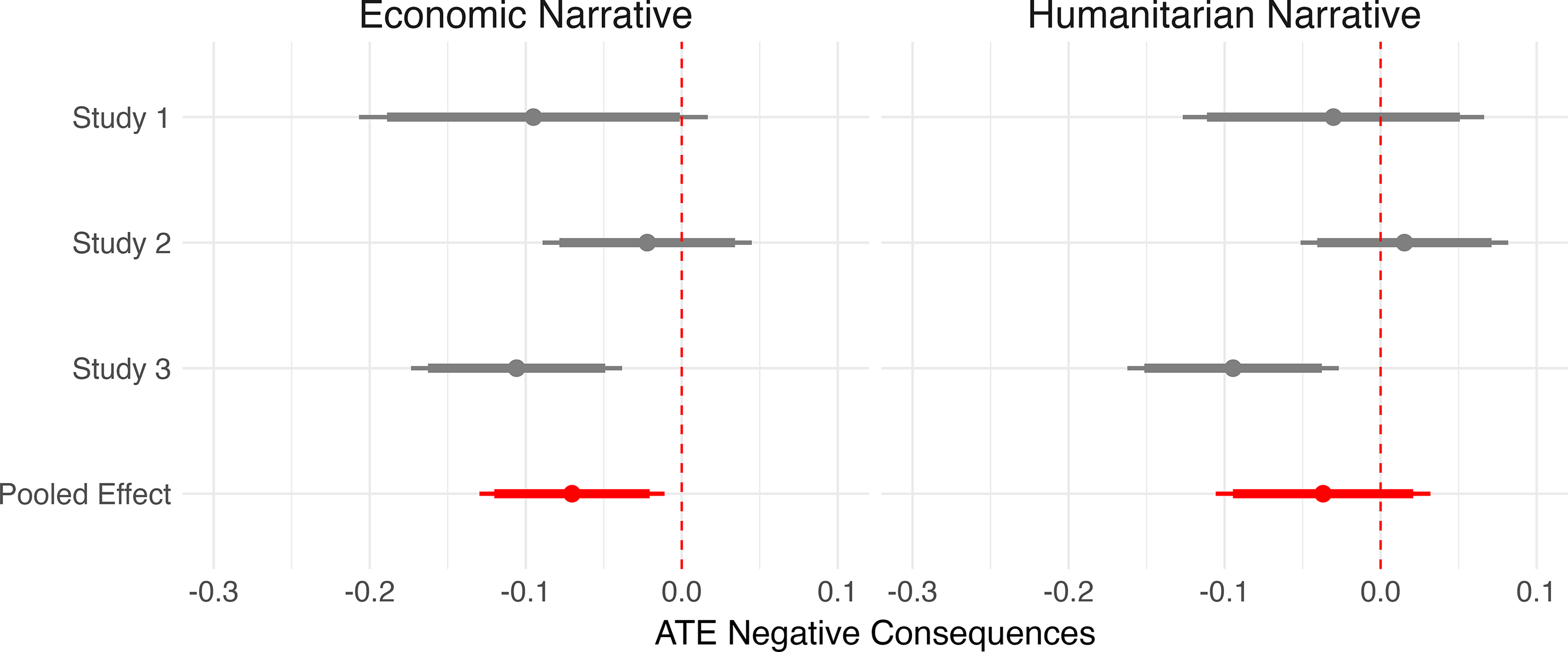
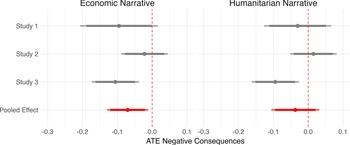
Figure 3 provides supporting evidence that economic narratives reduce immigration-related economic concerns. The economic narrative’s pooled effect estimate is −0.07 s.d. and statistically significant, while the humanitarian narrative’s effect is closer to zero and insignificant. Moreover, economic narrative effects persist two weeks after manipulation (Appendix Figure E.2) and are consistent across formats, reducing economic concerns with textual narratives in Study 1 (albeit statistically significant at the 10 per cent level) and Study 2, and with video narratives (Study 3). Complementing this result, descriptive evidence from manipulation checks in our video pilot study shows the humanitarian narrative primed thinking about immigrant state dependency and public costs more than the economic narrative (24.0 per cent versus 11.3 per cent, statistically significant; see Appendix A.8).
Average treatment effects on immigration-related economic concerns.
Note: points show covariate-adjusted average treatment effects in standard deviations on an index measure of perception of negative economic effects of immigration. Thick and thin lines describe 90 per cent and 95 per cent confidence intervals, respectively. Estimates in red present a pooled precision-weighted average of study-level effects. Appendix H.2 presents tables of estimates
Because economic narratives reduce these cost concerns, natives may become more willing to extend rights to immigrants who contribute economically. Economic narratives’ effectiveness in increasing support for immigrant rights policies (Appendix C) – including access to education, health services, and subsidies – may initially seem contradictory, given these services are often sources of immigrant–native contention. However, by reducing concerns about fiscal burdens, natives may respond more favorably to expanding access for immigrants perceived as self-sufficient contributors rather than dependent beneficiaries.
Findings also suggest that format matters. Studies 2 and 3 presented the same narrative content in text and video format, yet for the humanitarian narrative and policy outcome, only the effect in Study 3 is substantively large and statistically distinguishable from Study 2 (z = 2.18, two-tailed p-value < 0.03). Text format may be weaker because it has fewer ways to elicit emotion, whereas video can directly stimulate emotion (for example, through music) and provide visual cues that prompt a more positive perception of the same content.
We consider the possibility that these effects are driven by experimenter demand or social desirability. Economic narrative effects persist two weeks after exposure, measured in an independent survey unlinked to treatment, making persistence due to demand effects unlikely. Moreover, only economic narratives show consistent effects across outcomes, formats, and time. For demand effects to explain this asymmetry, they would need to arise only with economic narratives despite identical presentations within studies – an implausible scenario. Additionally, narratives have positive and significant short- and medium-term effects on the behavioral measure of immigrant support, and respondents merely trying to respond appropriately would be unlikely to incur the cost of this action (Appendix Figure D.1). Furthermore, we find no evidence that treatment effects are stronger among respondents with greater external motivation to respond without prejudice (Appendix D). These results suggest experimenter demand effects do not drive our estimates, increasing confidence in the intervention’s effects.
Conclusion
We present evidence that narrative-based perspective-getting interventions can increase support for open immigration policies and improve affect towards immigrants in Colombia – a middle-income country with recent large-scale immigration.
Colombia represents a particularly hard case for testing whether economic narratives can shift immigration policy support. Despite shared language, race, and a history of migration into Venezuela – factors that might facilitate humanitarian appeals – the scale of immigration, liberal engagement with immigrants, the resulting economic strain, and the absence of substantive international aid have made economic concerns highly salient. Public opinion data reflect this burden: between 2018 and 2021, as liberal measures were implemented, the share of Colombians who disagreed that the government should offer services to Venezuelans rose by about 18 percentage points (LAPOP Lab 2018, 2021).
This single-country study provides evidence of these interventions’ generalizability to environments where attitudes towards immigrants are increasingly exclusionary and where states have limited capacity to receive them. Our results likely generalize to contexts that, like Colombia, combine deteriorating attitudes, cultural proximity, and perceptions that migrants burden host economies. However, two important distinctions affect generalizability of the economic narrative’s effects. First, policy engagement with immigrants matters: effects should transport more to countries with liberal policies (like Brazil) than to those with restrictive approaches (like Chile, Ecuador, and Peru). Second, international aid capacity is crucial: effects should transport less to countries receiving substantial aid (like Turkey or Jordan with EU support) that can ameliorate economic costs. Future research could test these expectations with multi-country designs.
Our study informs how narratives can reduce preexisting concerns about immigration’s negative effects. Narratives that reduce such concerns are more likely to durably change natives’ feelings and policy attitudes, suggesting a cognitive mechanism whereby narratives provide countering information. Future studies should directly test these mechanisms, particularly in developing contexts where migration concerns are newer and heightened.
This study demonstrates how narrative content and format shape persuasive effects. Narrative-based interventions promote positive affect towards immigrants even without addressing economic concerns. However, to increase support for open immigration – especially when delivered in text format – they may be more consistently effective if they address core economic concerns. These findings bring nuance to the design of strategies that increase support for inclusive policies in contexts experiencing economic strain and demographic change.
Supplementary material
The supplementary material for this article can be found at https://doi.org/10.1017/S0007123426101331.
Data availability statement
Replication data for this paper can be found at https://doi.org/10.7910/DVN/3QK5O1.
Acknowledgements
We thank members of the Cinematic Arts and Production Club at UC Berkeley for excellent video production, Proyecto Migración Venezuela and Somos Panas Colombia for constructive conversations, and David Broockman, Horacio Larreguy, and participants in seminars at Columbia University, ITAM, EGAP, MPSA, the University of Pennsylvania, the Emerging Immigration Scholars Workshop, the Comparative Politics Annual Conference at Washington University in St. Louis, and the Workshop of Experimental and Behavioral Economics of the Americas for helpful comments. We are very thankful to Monica Kosik and Alex Raymond, who provided excellent research assitance.
Financial support
This work was supported by Evidence in Governance and Politics (EGAP).
Competing interests
The authors declare none.


 Open access

