

Equality of opportunity is a central aim in the political agenda of many nations and political leaders consequently speak of the importance of reducing differences in educational attainment between young persons from differing social origins, that is, to reduce Inequality of Educational Opportunity (IEO) (see Boudon Reference Boudon1974). IEO is normally understood as the association between the social origin of students – e.g. by parental class, status, education or earnings – and the education they have attained when leaving school for the labour market.
Two reasons for the importance of reducing IEO are typically referred to; injustice and societal efficiency. Children do not choose their parents, and given the maxim that justice demands that people’s wellbeing should not depend on circumstances over which they have no control (Roemer Reference Roemer1998), the association between parental conditions and children’s educational outcomes ought to be reduced.Footnote 1 The efficiency argument rests on the assumption that if children do not develop their abilities and intellectual potential in full, societal development will be impaired. Thus, if those born by working class parents do not develop their potential in full, the resulting IEO is not only seen as a loss for themselves but also for society.Footnote 2
I will first review how IEO is typically ascertained in empirical studies and give an overview of how it varies among advanced societies and has changed over time.Footnote 3 After having discussed mechanisms behind differences in educational attainment between children of separate social origins, I end by considering the degree to which IEO is amenable to political action.
Inequality of Educational Opportunity
The observation that the educational attainment of students depends on their social origins is one of the most established findings in sociology.Footnote 4 The perhaps most straightforward and simple representation of IEO is the correlation or association between the social origin of individuals and their educational attainment. Different categorisations of the origin have been used, the most common being parents’ (earlier most often fathers’) education, social class, social status or earnings. Regardless of which origin factor is used, the association is positive, and this is the case for all societies where it has been observed. Thus, for developed countries Hertz et al. (Reference Hertz, Jayasundera, Piraino, Selcuk, Smith and Verashchagina2007) found correlations between children’s and parents’ years of educationFootnote 5 of a magnitude between 0.30 and 0.54, with the lowest for Denmark and the highest for Italy.Footnote 6 Given an average correlation of 0.39 and probably rather extensive imprecision in the measurement of both parents’ and children’s education, clearly more than 15% percent of the variation in children’s educational attainment is, in advanced societies, accounted for by their parents’ education.
Other parental factors are likewise related to children’s educational attainment. Positive associations between background factors imply that the effect of one factor is partly the consequence of the associations of other factors. Hence, controlling for other factors tends to reduce the independent effect of a single factor. Even so, origin factors – such as parental social class, education and earnings – have been shown to have independent effects on children’s educational attainment, in addition to the effects of other factors (Bukodi and Goldthorpe Reference Bukodi and Goldthorpe2013; Bukodi et al. Reference Bukodi, Erikson and Goldthorpe2014; Erikson Reference Erikson2016). This fact implies that the total effect of several background factors tends to be greater than the effect of any single factor.
The remarkable expansion of the educational systems of Europe in the post-war period has turned many of the issues of educational policy upside down. Entering the labour market with just compulsory education was the modal pattern not so long ago, which meant that it was a minority of a cohort that took the first step in an educational career beyond compulsory education and, of course, even fewer continued with the second step. Consequently, those who had attained tertiary education formed an exclusive minority, often with advantaged backgrounds. Now, many young men and (fewer) women, who have not passed beyond compulsory school, form a problem group in which many may never become regularly employed. At the other end of the spectrum, more than one third of men and women in recent birth cohorts have attained tertiary education.Footnote 7
The association between social origin and educational attainment was expected to decrease with increasing numbers of students attaining education beyond compulsory. An early comparative study of 13 countries implied that this expectation was not consistent with the actual development, as a decreasing association was observed in only two of the countries (Shavit and Blossfeld Reference Shavit and Blossfeld1993). However, more recent studies show that the association actually fell in a large number of European countries in the period after the Second World War. This decrease was observed among both women and men (Breen et al. Reference Breen, Luijkx, Müller and Pollak2009; Breen et al. Reference Breen, Luijkx, Müller and Pollak2010; Barone and Ruggera Reference Barone and Ruggera2018). The reduction of IEO was mainly a consequence of a reduced inequality in the transition from primary to secondary school (cf. Shavit et al. Reference Shavit, Yaish, Bar-Haim, Sheer, Pollak, Otte and Gangl2007). The change was thus consistent with a hypothesis that educational expansion may result in reduced IEO if the expansion has reached a level where the demand for higher education from more privileged sections of the population is satisfied. In such a case, less privileged classes have to be the source of an increase in the proportions of cohorts attaining higher education (Ekman Reference Ekman1951; Raftery and Hout Reference Raftery and Hout1993). Yet, there is no monotonous trend towards a decreasing association as the change appears to have stalled at the end of last century.
Two Educational Steps
The positive association between social origin and educational attainment establishes the existence of IEO, but more comprehensive studies are needed in order to reach – or at least come closer to – an understanding of the mechanisms behind IEO. Thus, it is for this purpose of value not just to look at differences in the levels of education finally attained, but also to investigate at what stage in the educational careers of men and women that differences according to social origin appear. Two career steps seem most critical in this respect; the transition from compulsory school to upper secondary and the transition from upper secondary school to tertiary institutions. At both steps children from more advantaged backgrounds tend to stay on in school more often than other children and, given staying on, to select academically more advanced alternatives.
The crucial issue at the first step is not only whether to stay on in education or not, but also to what track in secondary school a transition is made – in particular, the choice between academic and vocational tracks is consequential for a continued educational career, and thus for a possible further step to tertiary education.
There are substantial differences between European countries in the proportions making the first transition. These differences seem partly dependent on the age at which pupils leave primary education for the second level and whether the secondary school represents an elite track meant to prepare students for higher education or whether it is a comprehensive alternative followed by close to all children. The proportion of students making the transition appears to be lower in countries such as Germany or the Netherlands where the transition is made at an early age, around 10, and where the secondary level includes selective elite tracks.
IEO at the first transition likewise varies considerably between countries. Thus, according to Jackson and Jonsson (Reference Jackson, Jonsson and Jackson2013), the log odds ratios for the difference in transition rate between children of more or less advantaged backgrounds, made as comparable as the data permits, varied in the post-war period between 1 for Denmark and 3 for Italy (Jackson and Jonsson Reference Jackson, Jonsson and Jackson2013, 319).Footnote 8 The corresponding log odds ratios for England, the United States and Sweden were slightly greater than 1 and those for France, Germany and the Netherlands around 2.
The alternatives that students face at the second step depend on their choice at the first step. To start a tertiary education by entering a university or a school of higher vocational training is, in principle, only available to students who, at the first transition, took the step to enter upper secondary school and thereby have attained the qualifications to be eligible to enter the tertiary level.Footnote 9 The proportions of cohorts that actually enter the tertiary level vary between the European nations, with relatively low proportions in Germany and the Netherlands, relatively large proportions in Denmark and England, and a still larger proportion in Italy (Jackson and Jonsson Reference Jackson, Jonsson and Jackson2013).
The rate of IEO at the second transition is less than that at the first, presumably primarily as a consequence of children from less advantaged backgrounds at the first step being relatively more heavily selected by ability than other children. Thus, while log odds ratios for most countries typically varied between 1 and 2 at step one, at step two they were less than 1, although still positive (Jackson and Jonsson Reference Jackson, Jonsson and Jackson2013, 319).Footnote 10
Transition Mechanisms
A sensible assumption of why students continue to higher levels of education is that they did well at the previous level and that this gave them, and their parents, assurance that they are well equipped for further studies. The reason why children of advantaged social origins more than others continue to higher levels of education could accordingly depend on their greater ability and better performance at school. This seems to be the case, but only partly so. That is, students of separate social origins consistently differ in their performance at school, in that students from more advantaged backgrounds reach better results, but they also differ in their relative tendencies to proceed to higher levels of education given their previous performance. This pattern of differences in performance and choice is illustrated in Figure 1, which shows grade point average (GPA) distributions when leaving compulsory school and probabilities for transition to upper secondary school at different levels of grades for Swedish boys and girls born in 1967. The bell-shaped curves show the distributions of grade point averages for those with parents in the salariat (i.e. the upper middle class), and the working class, respectively. The S-shaped curves show the probabilities for children from the two origin classes to enter upper secondary school at different levels of grades.
Grade point averages and probabilities for entering upper secondary school for children from the salariat and the working class born 1967.
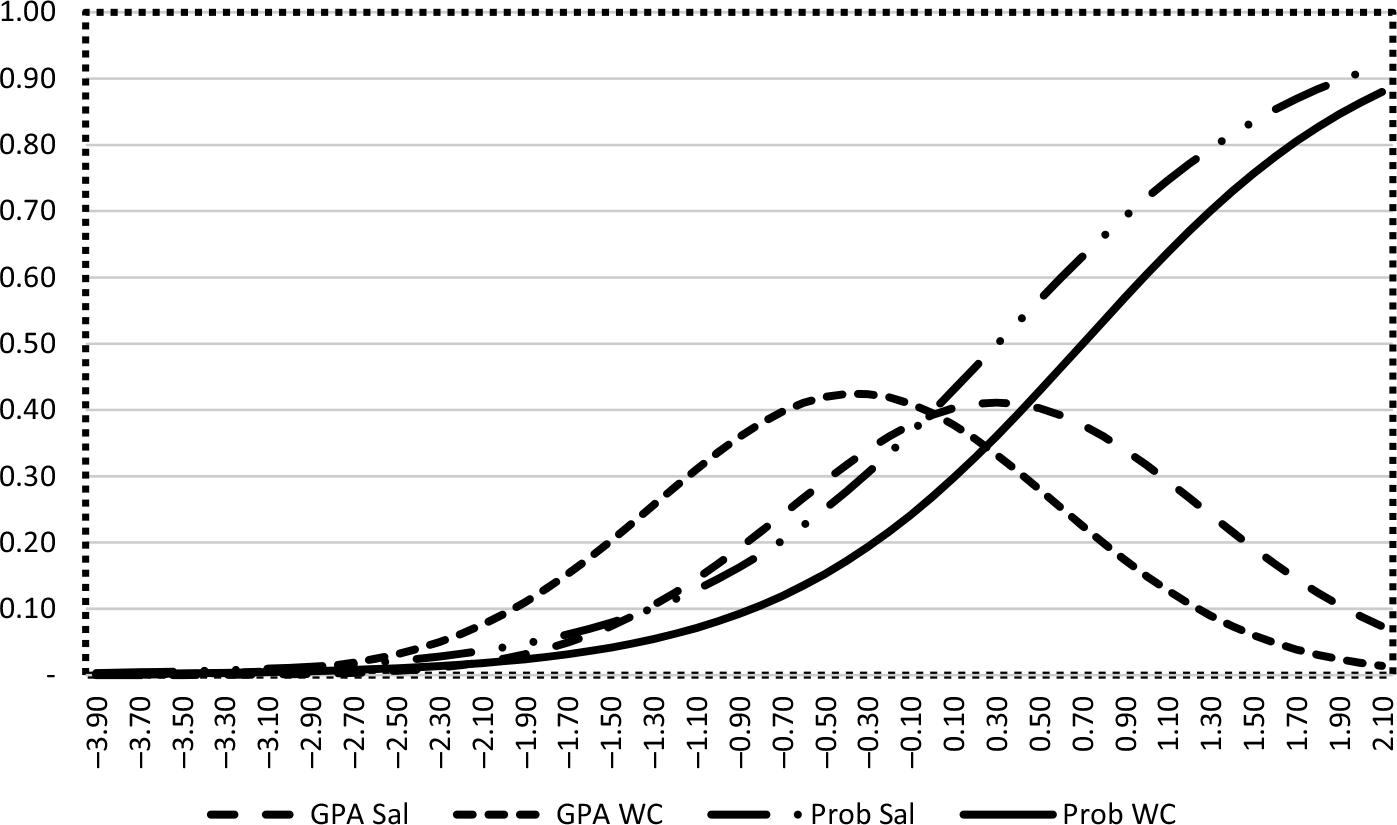
Differences between children from the upper middle class and the working class are marked both in grades and in transition probabilities. Figure 1 is a simple demonstration of a pattern that has been found for all nations for which there are data.Footnote 11
Boalt (Reference Boalt1947) showed that transitions from primary school to upper secondary school in Stockholm followed such a pattern in the 1930s and Girard and Bastide (Reference Girard and Bastide1963) demonstrated that this was likewise the case for French pupils in the early 1960s. Class differences in the transition to higher educational levels have later been studied in several countries. In all of them, children from higher classes tend to do better in school than other children, and relatively more often choose academic alternatives at the higher educational level (Jackson Reference Jackson2013).
Boudon (Reference Boudon1974) referred to transition differences between students related to separate levels of performance as the primary factor behind IEO, and differences in choice of continued schooling as the secondary factor. This labelling has since become established practice. The difference in transition rates between students of differing social origins is present across the full length of the educational ladder, and this is the case in spite of students from lower social origins being more highly selected at each step.
That children from more advantaged backgrounds perform better at school must basically be due to a combination of genetic and environmental factors. For example, children of mothers with higher education are exposed to a more elaborate vocabulary at a very early age and in turn achieve better verbal skills themselves (Hoff Reference Hoff2003). This will in turn lead to a continued enhanced verbal ability as a result of the tendency that ‘skill begets skill’ (Heckman Reference Heckman2008). A consequence is that children from more advantaged backgrounds tend already to have a cognitive advantage at the school start. There may, on top of the effects of nature and nurture, be additional effects not related to children’s development, e.g. teachers could judge pupils differently depending on their social origin.
While differences in performance by social origin can be assumed to be based on genetic and environmental factors in the childhood of students, differences in choice may follow from what can be regarded as rational action by the students and their parents (Erikson and Jonsson Reference Erikson and Jonsson1996; Breen and Goldthorpe Reference Breen and Goldthorpe1997).Footnote 12 The choice for vocational education rather than continuing on an academic track may, to working-class students, seem as a rational choice leading to a positive outcome. Upper-middle-class students may regard a corresponding choice as most probably leading to becoming déclassé, a view that may make them keen to continue towards academic tertiary education.
Pupils’ decisions of how to proceed in school, given previous performance, can in theory be assumed to be dependent on how they judge the benefits and costs that will follow from different choices. Important for which decision to take may also be how they judge the risk of not being able successfully to fulfil the demands of different alternatives and, in connection with this judgement, the extent to which they are risk averse. All these factors can be assumed to make students with advantaged backgrounds choose academically oriented alternatives more than other students (Erikson and Jonsson Reference Erikson and Jonsson1996; Breen and Goldthorpe Reference Breen and Goldthorpe1997).
Children of Immigrants
Children who themselves grew up in the nation of destination, but whose parents had immigrated to an advanced society, form heterogeneous groups in all countries. Some general patterns regarding their path through school seem to exist in spite of this heterogeneity (Jackson et al. Reference Jackson, Jonsson and Rudolphi2011; Jonsson and Rudolphi Reference Jonsson and Rudolphi2011; Waters et al. Reference Waters, Heath, Van Tran, Boliver, Alba and Holdaway2013). Thus, the basic pattern of children from more advantaged social origins performing better at school and making more academically oriented choices at educational transition points tend to be true also for children of immigrant origin. However, except for a few groups, particularly some of East Asian background, children to parents who had immigrated tend to perform less well in school than native-born children. However, given performance, they tend more often than native-born children to make academically oriented choices. Education is presumably a more crucial resource for children from an immigrant background than for young persons with native-born parents, as parents who grew up in other countries tend to have less-developed ties to persons and organisations that could provide help to their children in finding jobs after finishing school.
Educational Systems
Differences in the degree of IEO between countries may to some extent depend on the educational systems, in that the organisation of schooling may make higher education differently available to children of separate social origins. Several ways of how to characterise school organisations in order to account for the degree to which they contribute to IEO have been suggested. Allmendinger (Reference Allmendinger1989) provided an early version where the crucial characteristics are standardisation – whether equal educational standards prevail nationwide – and stratification – essentially the degree to which and at what age pupils are channelled into different tracks in school. A related scheme has been brought forward by van de Werfhorst and Mijs (Reference van de Werfhorst and Mijs2010).
These schemes tend to include the degree of tracking in the educational systems as a central element. In particular, the age at which pupils are channelled into separate tracks is central for differences between nations in IEO. Furthermore, how academically advanced the track curricula are and the degree to which the tracks prepare students for tertiary studies, are central characteristics of educational systems.
The most persistent observation of the effects of the characteristics of the educational system is that early tracking goes together with a greater degree of IEO. Standardisation on the other hand seems to be related to a lower degree of IEO (Bol and van de Werfhorst Reference Bol and van de Werfhorst2013).
It is not self-evident that tracking should go together with higher IEO. Ability tracking results in more homogeneous school classes in terms of academic capability, a condition that in theory ought to make it easier for teachers to adapt their instruction to the intellectual level of the school class and thus to improved learning of all pupils. The standard result is, in contradiction to this assumption, that tracking goes together with higher IEO. One reason why this is the case could be that what is meant to be a division of students according to ability, in practice often is just a division by social class. Higher-class parents generally want their children to be placed in tracks that are expected to lead to higher educational levels and, in consequence, use whatever resources they have to attain such a result. Even if children from advantaged origins on average perform better – and thus should be expected relatively often to be included in the more academically oriented tracks – the outcome may be that, in relation to their lead in ability, they are overrepresented in these tracks. School classes may then be less homogeneous with regard to ability than intended.
Anyway, the inclusion of high-performing pupils in a school class seems to result in better performance by the other pupils. Thus, Sacerdote (Reference Sacerdote, Hanushek, Machin and Woessmann2011) reports that several studies, but not all, find that less heterogeneity in the composition of school classes goes together with better average results, and that it is the high-performing pupils’ results that are most affected. Additionally, relatively more girls in school classes tend to improve average test scores. In contrast to Sacerdote, Sund (Reference Sund2009) reports that it is results of the less well performing students that become better with more high-performing students in the school-class, while the better performing students’ results remain unchanged. Lauder et al. (Reference Lauder, Kounali, Robinson and Goldstein2010) found that the reading ability of working-class children improved when placed together with children who read well, while the reading ability of these children was negatively affected by the inclusion of children with lower reading ability. In total, results on peer effects in school classes are mixed, but the overall impression is that a school with mixed-ability classes with high-performing students in all classes on average reach better learning results than schools with homogeneous classes.
To What Extent is Reduction of IEO Amenable to Political Action?
As mentioned, a political aim in many nations is to reduce IEO; but what measures do politicians have for this purpose? The mechanisms behind primary and secondary effects are most probably different, which makes it sensible to consider measures related to them separately. Primary effects are basically due to social differences in children’s cognitive development, while secondary effects depend on how families of different origins judge the benefits, costs and difficulties of the available educational paths.
High quality pre-school education has been shown to be of advantage for children’s intellectual development, but its introduction is an uncertain way to reach lower IEO, since good pre-schools seem to be of similar value for all children and thus may not reduce social origin differences (Sylva et al. Reference Sylva, Melhuish, Sammons, Siraj-Blatchford and Taggart2008). Differences in children’s cognitive development can be supposed to be mainly dependent on various factors related to the interaction between parents and children. Such factors may be difficult to influence and moreover be unsuitable as objects for political intervention (Swift Reference Swift, Bowles, Gintis and Osborne Groves2005; Jencks and Tach Reference Jencks, Tach, Morgan, Grusky and Fields2006). The best way forward may be to try to influence the size of secondary effects.
Political action to decrease the degree of IEO that follows from the tendency of children from differing social origins to take separate decisions at educational transition points may be difficult to bring to success. Children and parents have interests in bringing the children forward in school, and those from higher social classes will be more successful in this respect given their greater resources to achieve this goal (cf. Bukodi and Goldthorpe Reference Goldthorpe2019). People can be expected to find it more essential to avoid downward than to achieve upward mobility, as a loss of a certain magnitude weighs more than the gain of the same quantity (Kahneman and Tversky Reference Kahneman and Tversky1979). This means that children with a higher-class background more than other children tend to have incentives to attain a university degree. Higher-class students will presumably make greater efforts to achieve this goal and their parents will use their (often considerable) resources, of various kinds, to help them. The attempt by the local political community to introduce a non-selective school in Hamburg provides an example of how upper-middle-class parents try to secure the advantage of their children at school. The intended school reform was met by a protest movement, which was characterised as a ‘Gucci-Aufstand’ by an ‘elitären Minderheit’ – a Gucci-resistance by an elite minority.Footnote 13 The intended change did not take place.
Reduced costs related to higher education may make young people of working-class origins regard continuing on to university as a less risky prospect, and they may thus more often be willing to take this route. However, as IEO is dependent, to a considerable extent, on conditions and situations in early life, changes in the conditions at the tertiary level may only have minor effects.
Inequality of Educational Opportunity decreased in the post-war period in many European nations. In particular, it was the step from compulsory-level education to upper secondary school that became less dependent on pupils’ social origins. This decrease was certainly in accordance with the political aims of most political parties but, anyway, came to an end at the end of last century. The decrease in IEO may mostly have been a consequence of the educational expansion in this period as it may have meant that the demand for secondary schooling by higher-class children had essentially been satisfied.
To sum up, the association between social origin and educational attainment is a global phenomenon. However, the strength of this association decreased in Europe after the Second World War, mainly because an increased proportion of children from the working class continued in school beyond the compulsory level. That children with a more advantaged background tend more than other children to continue to higher levels of education depends both on their better performance in school and on the fact that they – also given previous performance – tend more than others to choose to continue on academically oriented tracks. This is also the case among children of immigrants, although they on average perform less well than native-born children. The degree of inequality of educational opportunity in a country is to some degree dependent on to what extent pupils at an early age have to choose between educational tracks that differ in academic content. While eliminating inequality of educational opportunity is a stated aim in countries around the world, the possibility to achieve this aim through politics is limited, given class-based differences in incentives and resources between parents and children.
About the author
Robert Erikson, fil dr, is Professor Emeritus of Sociology, Stockholm University; Fellow of the Royal Swedish Academy of Sciences; Member Academia Europaea; Corresponding Fellow of the British Academy; Honorary Fellow of Nuffield College, Oxford; and Doctor rer. pol. honoris causa, Otto-Friedrich-Universität Bamberg. His publications include The Constant Flux (together with J.H. Goldthorpe, Oxford University Press), Can Education be Equalized (ed. together with J.O. Jonsson, Westview Press); The Scandinavian Model: Welfare States and Welfare Research (ed. together with E.J. Hansen, S. Ringen and H. Uusitalo, M.E. Sharpe), Welfare in Transition (ed. together with R. Åberg, Oxford University Press), and several articles in scientific journals. Currently he is engaged in a comparative project on inequality of educational opportunity.


 Open access

