


1. Introduction
The digital and technological transformation of the industrial sector, driven by automation, robotics, and artificial intelligence, has profoundly reshaped production systems, work organization, and the skills required in the labor market. The Industry of the Future, or Industry 4.0, relies on interconnected and intelligent systems capable of continuously adjusting their performance according to data and production needs. This evolution compels companies to rely on a highly qualified workforce capable of adapting to complex, technological, and constantly changing environments (Reference KergroachKergroach, 2017).
At the same time, learners increasingly expect learning experiences that are more personalized and tailored to their needs and pace. In this context, education and learning systems are expected to effectively prepare future professionals. In this study, a learning system is defined as an organized set of interconnected components, including pedagogical approaches, program design, learning activities, assessment methods, actors (students, teachers, companies and national educational authorities), and supporting technologies. Despite efforts to integrate digital technologies and renew teaching practices, a gap remains between the skills developed and those required by companies. This misalignment limits graduates’ employability and calls for a rethinking of learning systems to ensure better alignment between learning outcomes and labor market needs (Reference LaseLase, 2019). Education 4.0 aligns with this dynamic by promoting connected, learner-centered, and technology-enhanced learning environments that foster both technical and transversal skill development. It has emerged to respond to the transformations introduced by Industry 4.0, by preparing learners with the competencies required in increasingly digitalized, automated, and interconnected industrial environments. Nevertheless, achieving this objective namely, preparing learners to acquire the competencies required in Industry 4.0 contexts requires rethinking the methodological approaches that structure the design and implementation of learning systems (Reference Benesova, Hirman, Steiner and TupaBenesova et al., 2019).
Existing instructional design models provide useful methodological frameworks to organize and structure the learning process. They help align objectives, methods, and resources within a coherent and systemic structure, by guiding how each component of the learning system is defined, sequenced, and interconnected from the identification of learning needs to the design of activities, the selection of technologies, and the evaluation of outcomes. However, these models often remain generic and prescriptive, with their effectiveness largely depending on the expertise of instructional designers. Moreover, they struggle to address the diversity of contexts, learner profiles, and economic or technological constraints that characterize today’s learning environments. Evidence from multidisciplinary educational settings confirms that a learner’s educational background significantly influences their ability to understand project missions as well as their willingness to use specific design tools. Research by Reference Cascini, Graziosi, Montagna and RotiniCascini et al. (2017) suggests that traditional “theory-centered” approaches often fail to bridge the gap between theory and practice in complex, multifaceted environments. The authors argue that, for an educational model to be effective across diverse profiles such as engineers, architects, and designers, it must shift toward an inductive, Problem-Based Learning (PBL) approach, in which design methods act as a “common lexicon” or a “neutral collector” that transcends disciplinary boundaries. Furthermore, team composition and the involvement of industrial stakeholders are crucial factors that prescriptive operational models frequently overlook, despite their critical role in sustaining student motivation and ensuring professional relevance (Reference Cascini, Graziosi, Montagna and RotiniCascini et al., 2017).
In this study, the objective is to compare several instructional design models in order to assess the extent to which they meet the contemporary requirements of learning particularly in terms of flexibility, adaptability, contextualization, and technological integration. This analysis seeks to identify the missing or underdeveloped elements within these models and to extract the foundational aspects required for the design of a more adaptive and dynamic learning system, aligned with the needs of the Industry of the Future and the principles of Education 4.0.
Current instructional design models are developed at a highly operational level, with the primary focus being on the design of specific modules. Consequently, they are not suited to a broader conception of education systems that considers all stakeholders and objectives across multiple decision-making levels. To address this, we propose a TRIZ-based method that facilitates a systemic rethink of the instructional design process. This method involves several stages, integrating a multi-screen scheme and a network of parameters linked to the system’s objectives. It also uses an influence matrix to identify contradictory parameters. The final section of the paper illustrates the application of this method through a case study, providing an initial assessment and outlining future research perspectives.
2. Instructional design models: state of the art and comparative analysis
Instructional design refers to the systematic and iterative process of planning, developing, and delivering educational or learning programs to achieve specific learning outcomes. It is often associated with terms such as instructional technology, educational technology, and instructional systems design (ISD). Adopting a systems approach ensures the coordination of all instructional components and links learning activities to measurable outcomes what learners can do after instruction that they could not do before.
Rooted in behaviorist and cognitive theories, and increasingly influenced by constructivism, instructional design aims to foster active learning and sustainable skill development (Reference BasuBasu, 2021). According to Gustafson and Branch, it is characterized by learner-centeredness, goal orientation, authentic performance assessment, empirical improvement, and interdisciplinary collaboration (Reference SeelsSeels, 1995). Building on these foundations, various instructional design models have been developed to guide the creation of effective learning experiences. The following section presents and discusses some of the most widely recognized models of instructional design.
2.1. Introduction to instructional design models
Over the years, various instructional design models have been developed to provide structured frameworks that translate learning theories into coherent and practical learning processes. Despite their differences, all aim to enhance the effectiveness, consistency, and adaptability of instructional systems. This study focuses on five influential models: ADDIE, SAM, ASSURE, MISA, and Dick & Carey, which represent sequential, iterative, and systemic approaches to instructional design. The first two models, due to their wide application and significant influence on modern instructional design, are presented in greater detail in this section, while the remaining three are included later in the comparative summary of instructional design models.
-
• The ADDIE model (Analysis, Design, Development, Implementation, and Evaluation): is a systematic instructional design framework used to create effective learning and training experiences. It originated in the 1970s at Florida State University, initially developed for the U.S. Army to structure learning programs and later adapted widely in education and professional training. The model provides a linear process ensuring that instructional goals, materials, and assessments are coherently aligned to meet learners’ needs and organizational objectives (Reference Spatioti, Kazanidis and PangeSpatioti et al., 2022). In the educational context, the ADDIE model is widely used to design structured and learner-centered learning systems. For instance, Reference Stapa and MohammadStapa and Mohammad (2019) applied it to develop Voc-Learning, a blended learning platform for vocational colleges in Malaysia, integrating Web 2.0 technologies to support flexible and interactive learning processes (Reference Stapa and MohammadStapa & Mohammad, 2019). In professional training, the model has been implemented to support systematic skill development. Reference Luo, Li, Zhang, Tian and ZhangLuo et al. (2024) used it to design a blended learning program for newly recruited nurses at Xi’an Qinhuang Hospital (China), combining online learning with clinical practice to enhance professional competencies and training quality (Reference Luo, Li, Zhang, Tian and ZhangLuo et al., 2024).
-
• The Successive Approximation Model (SAM): developed by Reference Allen and SitesAllen and Sites (2012), offers a flexible and iterative approach to instructional design, created to overcome the rigidity of the traditional ADDIE model. It emphasizes speed, collaboration, and continuous refinement through successive prototypes and frequent feedback loops. Unlike the linear sequence of ADDIE, SAM allows for ongoing adjustments as stakeholder needs, learning objectives, and design ideas evolve during the process (Reference Allen and SitesAllen & Sites, 2012). In the educational context, SAM has been successfully applied to the design of blended learning environments. For example, Reference Wintarti and FardahWintarti et al. (2019) implemented SAM to redesign a Differential Calculus course at Universitas Negeri Surabaya, following its iterative phases to improve instructional materials and better align course content with students’ needs, enhancing engagement and learning outcomes (Reference Wintarti and FardahWintarti et al. (2019)).
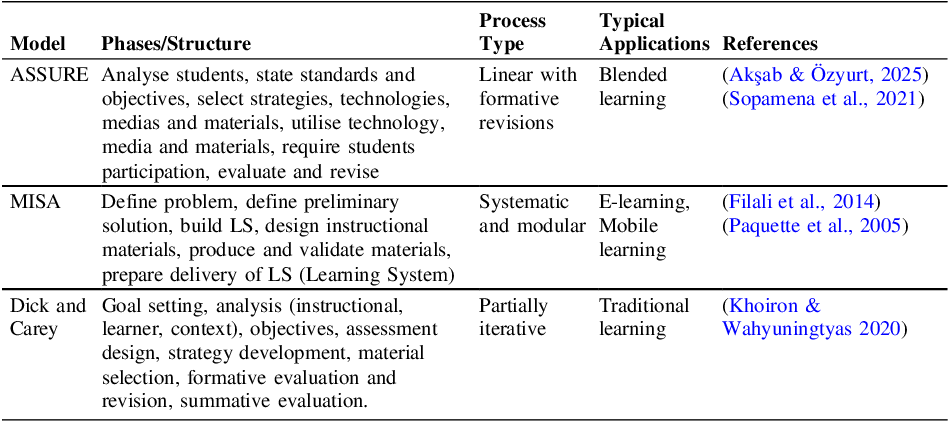
Following this brief presentation, the Table 1 below summarizes the main characteristics of the three remaining instructional design models under study. It highlights their structures, process types, and typical applications to facilitate comparison between the different approaches. Before presenting the table, it is important to clarify the main learning modalities to which these instructional models are generally applied. Four main learning modes can be distinguished according to their delivery format: traditional learning, e-learning, blended learning, and mobile learning. Traditional learning refers to face-to-face instruction conducted in a physical classroom, where the teacher plays a central role in transmitting knowledge directly to learners. E-learning is based entirely on digital technologies and online platforms, allowing learners to access learning content and activities remotely, often asynchronously. Blended learning combines these two approaches by integrating online components into traditional classroom instruction, thus leveraging the flexibility of digital tools while maintaining direct in-person interaction and pedagogical support. Mobile learning, on the other hand, uses mobile devices such as smartphones, tablets, or laptops to access educational content and learning activities anywhere and anytime.
Comparative summary of instructional design models

2.2. Comparative analysis of instructional design models
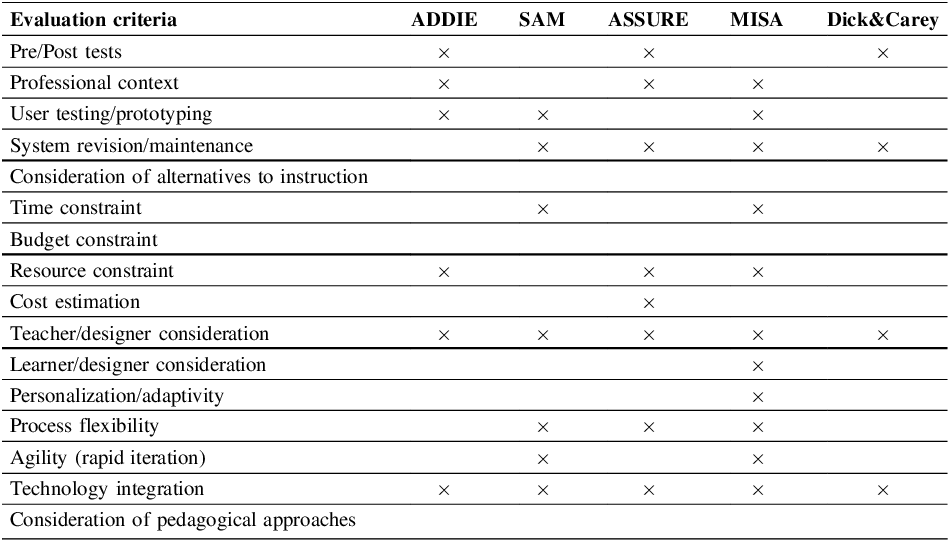
To evaluate these models in a structured and objective way, this study relies on the theoretical framework proposed by Reference GropperGropper (1977), later expanded by Reference Andrews and GoodsonAndrews and Goodson (1980). These authors identified fourteen essential tasks that form the foundation of the instructional design process. The tasks represent both the fundamental components of instructional design and the contextual considerations required to implement an effective and sustainable learning system (Reference Andrews and GoodsonAndrews & Goodson, 1980). Gropper’s criteria cover ten main stages of the instructional design process such as the formulation of clear and measurable objectives, the development of pre- and post-tests to assess the achievement of these objectives, the analysis of the skills to be developed, the sequencing of objectives and content, the analysis of learner characteristics, the formulation of an appropriate instructional strategy, the selection of instructional media, the development of learning materials, the testing and revision phase, and the establishment of maintenance and update procedures to ensure the sustainability of the system. The analytical framework derived from Gropper’s criteria was expanded by Reference Andrews and GoodsonAndrews and Goodson (1980) by four additional criteria highlighting learning needs analysis, the consideration of alternatives to training, the description of the system and its environment precising the professional context as well as time, budget, and resource constraints assessing the feasibility and sustainability of the proposed system. These foundations are completed with complementary elements relevant to Education 4.0 and facing today’s rapidly evolving educational and industrial landscape. The consideration of the teacher/designer and the learner/designer emphasizes the importance of collaboration and co-construction in instructional design. The personalization and adaptivity criterion assesses a model’s ability to adjust content and instructional methods to learners’ profiles and needs. Process flexibility reflects the capacity of a model to adapt to diverse contexts and constraints, while agility refers to its ability to integrate rapid cycles of prototyping, testing, and continuous improvement. The integration of educational technologies evaluates the extent to which digital, immersive, or interactive tools are embedded within the design process. Finally, the consideration of pedagogical approaches examines the diversity and complementarity of teaching methods incorporated into the model such as project-based learning, problem-based learning, simulation learning, blended learning, immersive learning, serious games, and learning factories. Table 2 shows this comparative analysis.
Comparative analysis of instructional design models

The instructional design models were examined to determine the extent to which it integrates the fundamental and contemporary components of the instructional design process through the presented criteria. A binary coding system was used to indicate the presence (×) or absence (blank) of elements within the design models. The analysis focused on the criteria that differentiate the models so that the common elements are not included in the table. While almost all foundations based on Gropper and Andrews and Goodson are shared by the instructional design models, several distinctions emerge when examining the complementary criteria. Pre- and post-testing are absent from the SAM and MISA models. The professional context is not systematically addressed in SAM or Dick & Carey model. This indicates that some models remain primarily academic in orientation, with limited adaptation to professional or industrial environments. None of the model consider non-instructional solutions to a performance problem. Regarding the constraints, their consideration varies widely. Only SAM and MISA explicitly consider time constraints, reflecting their alignment with real project timelines and iterative development. Resource constraints are partially addressed in ADDIE, ASSURE, and MISA, while budget constraints and cost estimation are absent across all models. Flexibility and agility are most evident in SAM, which emphasizes rapid prototyping, iteration, and continuous revision. MISA also demonstrates a degree of flexibility due to its modular and systemic architecture. In contrast, ADDIE and Dick & Carey follow a linear, sequential logic that limits adaptability to evolving learning environments. Regarding human actors, all models acknowledge the role of the teacher or designer, yet none positions the learner as a co-designer of the instructional system, reflecting a persistently top-down logic. Personalization is only partially addressed in MISA, while other models rely on standardized instructional formats. None of the analysed models explicitly integrates pedagogical approaches, although some may indirectly rely on certain strategies depending on the context. No model combines multiple pedagogical approaches in a comprehensive manner.
2.3. Limitations of existing models
Although the instructional design models analyzed provide a solid and structured framework for designing the learning process, several important limitations can be identified.
-
• Model Rigidity and Linear Structure: Most of these models remain prescriptive and linear, which reduces their ability to adapt to constantly evolving learning environments, emerging technologies, and the diversity of learners’ needs. This rigidity limits opportunities for iteration, innovation, and responsiveness elements that are essential in today’s learning systems.
-
• Limited Contextual Adaptability: The models show low contextual adaptability, few of them explicitly consider professional, organizational, or industrial constraints, which restricts their relevance to real learning contexts. Moreover, the lack of systematic consideration for economic and temporal constraints limits their applicability in environments characterized by tight deadlines or limited resources.
-
• Passive Learner Role: The learner’s role remains largely passive. None of the models explicitly integrates the learner as an active participant or co-designer of the learning system, which runs counter to the principles of learner-centered education and collaborative knowledge construction.
-
• Lack of Personalization and Adaptivity: Personalization and adaptivity are either absent or insufficiently developed. Most models are still based on standardized learning paths that fail to account for individual differences in prior knowledge, motivation, or learning pace. Similarly, pedagogical approaches are not explicitly embedded within the design logic, which limits the diversity of strategies and learning experiences.
-
• Limited Integration of Digital Transformation: The analyzed models do not fully consider the impact of digital transformation on educational processes. All of them integrate the use of technology, but only in an instrumental way, limited to tools for content delivery or management. None of the models consider the potential of emerging technologies such as artificial intelligence, learning analytics, or immersive environments to support a truly adaptive and evolving instructional design. This limitation shows that, although these models have evolved with digitalization, they still fall short of the principles of smart and connected education that characterize contemporary learning environments.
-
• Limited Systemic Perspective: Instructional design models such as ADDIE, SAM, ASSURE, MISA, and Dick & Carey focus primarily on the design of a learning module or sequence, that is, on the planning and production of instructional activities at a limited scale. They are mainly intended to structure a specific course or learning program without necessarily integrating the systemic dimension of the overall learning system.
In this research, the objective is to move beyond this modular logic toward the design of a comprehensive pedagogical process integrated within an adaptive learning ecosystem. This process aims not only to address immediate skill development needs but also to foster the continuous and sustainable development of learning within a lifelong learning perspective. The goal is to design an evolving and interconnected learning system capable of adapting to technological, organizational, and human transformations, while aligning the needs of learners, institutions, and companies within a coherent and sustainable learning ecosystem. In light of these findings, it becomes necessary to adopt a new methodological approach capable of overcoming the limitations of traditional instructional design models. The following section therefore presents the methodological framework developed in this research, which combines a systemic perspective with the TRIZ inventive problem-solving method to guide the design of an adaptive and evolving learning system.
3. Method ConNect
As we saw in the previous section, instructional design models mainly structure the steps needed to develop the specifications for a specific educational program. However, they do not generally address a broader systemic view of the learning system, particularly when multiple programs, stakeholders, technological developments, and competency requirements must be considered. That is why we propose using the ConNect engineering method, which is not intended to replace traditional instructional design models. Rather, it is a systemic design method based on TRIZ that aims to structure and model the network of parameters between the multiple parameters involved in a learning system. The objective is not limited to the design of a single educational program but aims to support the design of a learning system that can encompass multiple educational programs. The ConNect method begins with the formulation of structured specifications, which can integrate several systemic levels and various evaluation criteria, as illustrated in Table 2. It then defines the network of parameters for the different parameters of this learning system and, where appropriate, highlights the inherent problems that we need to solve.
3.1. The systemic view of TRIZ-based methods
TRIZ is a russian acronym for the Theory for Inventive Problem Solving (Reference AltshullerAltshuller, 1984), and in border of this research, the authors consider that designing a pedagogical process can be recognized as a problem solving process. One of the main benefits of TRIZ-based methods is that it leads the analysis of a problem by considering the problem through a systemic perspective. It means, that not only the considered system (a pedagogical process, in this article) will be considered, but also: all the components of the system (students, material resources, teachers, and so on, …), and the super-systems (which can the different clients: the university, the industrials, and so on, …). One of the ways to collect information on different levels is the construction of a Problem Graph, or OTSM Network of problem, which is: “a high-level representation of the problem situation that both gathers and analyzes overall knowledge of the initial situation, can be considered as a semantic network linking several aspects of a many-sided problem situation.” (Reference Khomenko, De Guio, Lelait and KaikovKhomenko et al., 2007). To carry out this knowledge collection, the TRIZ methodology requires considering both the relationships between the system and the surrounding systems within the super-system, as well as decomposing the system through an analysis of all its components. Another important aspect of this systemic description is to consider the system’s evolution over time. This dynamic view is represented by the so-called Multi-Screen Scheme (Reference AltshullerAltshuller, 1984). This Problem Graph is built without any specific pattern, then the collected relationships could be rather ambiguous or fuzzy. To overcome this limitation, the generic pattern of the E-N-V model (Reference OrloffOrloff, 2006) will then be used, and any node collected in the graph will be re-formulated through this pattern. The E-N-V (Element, Name of the Parameter, Value) model states than any resource, any element, can be described by a set of parameters, and their inherent values. This model enables to describe any kind of resource, and at various level of genericity.
3.2. ConNect network of parameters
The objective of the ConNect method is to establish a graphical representation of all the influences between the parameters of the considered system. This Network of parameters enable, by application of graph analysis and algorithms such as Djikstra (Reference DijkstraDijkstra, 2022) or eignevector, or pagerank, (Reference Brin and PageBrin & Page, 1998) to identify the most influent parameters of the system. The ConNect method is applied in inventive Design, the identification of the most influential parameter highlights the core of the problem that must be considered in the search for a solution. This problem is therefore formulated as a contradiction, in which the parameter under consideration must exist in two different states in order to satisfy two sets of specifications. The ConNect method is based on three main milestones, but in our study we will focus on the first two steps (as illustrated in Figure 1): 1. Data collection, whose objective is to represent all the knowledge about the considered problem through expert interviews. This can be achieved either by constructing a problem graph (Reference Khomenko, De Guio, Lelait and KaikovKhomenko et al., 2007) or by comparing different systems with complementary performances, or by the Multi-Screen Scheme analysis of the system; 2. Data analysis, whose objective is to enable the hierarchization of the systems of contradictions. To achieve this, the collected data are first validated by organizing all the information within the following pattern: an information item is a parameter of a system element, whose status can be either an Action Parameter if it describes a design choice intended to satisfy certain specifications or an Evaluation Parameter if it describes one of the specifications to be satisfied in the analyzed problem. A table is then constructed to record all the influences among the validated parameters. These influences are used to define a graph of parameters, where the parameters represent the nodes and the influences represent the links. The analysis of this graph highlights the priority system of contradictions to be considered for resolution (Reference Dubois, Chibane and GuioDubois et al., 2023). The prioritization analysis mainly relies on the weighting of the Evaluation Parameters in the specifications and on the eigenvector centrality of each node in the graph.
The steps of the ConNect method

4. Application: case study
In order to experiment with the proposed method, we initiated a project aimed at designing an agile, flexible, and evolutionary learning system model. This model is intended to support the paradigm shift in higher education and workforce upskilling, improve alignment between learning provision and employment needs, and coherently integrate innovative pedagogical approaches to address current technological, organisational, and human transformations. A working group was established, composed of colleagues from the university, the engineering school, and the technical university institute in the Strasbourg area. The project forms part of an ongoing PhD thesis and since September 2024, work sessions have been organised according to a predefined schedule, allowing for reflection periods and for the analysis of materials produced during the sessions. Several tools derived from Lean management and continuous improvement have been employed, particularly to capture client needs through surveys and the voice-of-the-customer approach. The primary “customer” considered at this stage was engineering students, as they represent the direct beneficiaries of the learning system. We conducted the survey during the 2025-2026 academic year and involved approximately 350 students enrolled in an engineering program, including bachelor’s and master’s students beginning a new degree cycle in higher education. This specific field was selected based on the authors’ direct academic involvement. Consequently, the scope of this study remains limited at this stage, and the findings cannot yet be generalised to other academic domains. We selected students who were starting a new degree cycle in order to establish an initial reference point for their expectations. This allows us to compare these expectations with those expressed at the end of the learning period, in order to observe any changes and identify how their perception of a learning system evolves throughout their learning experience. The perspectives of teachers and companies are also currently being collected and analysed.
This enables the expectations of various users and stakeholders in the broader learning system to be considered, across multiple decision-making levels, including ministries, education institutions such as universities and engineering schools, professional organisations such as UIMM (Union of Metallurgical Industries and Trades), regional authorities, employment agencies, university departments and teaching teams, companies and, finally, students. Brainstorming is central to our approach, enabling us to collect and consider diverse inputs, such as policy documents issued by the Ministry, national pedagogical frameworks and ROME (Operational Directory of Professions and Jobs) and RNCP (National Register of Professional Qualifications) reference documents, which describe the required competencies for educational programmes and industry. These elements then inform the identification of parameters that reflect constraints and address needs relating to flexibility, adaptability, personalisation, technological evolution and changing industry skill requirements.
In this section, we illustrate the application of the Method ConNect, specifically Step 1 (Data Collection) and Step 2 (Data Analysis): 1) Considering the expectations of key stakeholders (students, teachers, companies) ; 2) Identifying the elements of the super-system and sub-system: A systemic decomposition of the learning environment was carried out by identifying the elements from the super-system and the sub-system. The Figure 2 below illustrates this decomposition.
Multi-screen scheme applied to our system

Figure 2 Long description
Panel A: In 2010, the instructional design system is characterized by non-standardized institutional programs and a transition from a professional bureaucracy to a mechanistic bureaucracy. The supersystem includes elements like skills blocks, teaching staff, equipment, and reduced financial resources. The system involves tools and learners, while the subsystem emphasizes less autonomy and more practical work. Panel B: In 2025, the instructional design system evolves with a national program that is 20 percent modular. The supersystem includes teaching staff, equipment, materials, software, and various labor market elements. The system still involves tools and learners, while the subsystem details forms of learning, content of modules, educational tools, nature of assessment, and temporary workers. Panel C: The future instructional design system continues to evolve with technological acceleration and financial constraints. The supersystem focuses on the reduction of permanent staff and the acquisition and validation of skills. The system remains centered around tools and learners, with the subsystem details not fully specified.
3) Defining action and evaluation parameters: With the help of the E-N-V model, we defined the action parameters (AP) and the evaluation parameters (EP). The APs act as levers for improvement, while the EPs constitute the performance indicators of the system. These parameters are presented in the Figure 3 below, which shows an excerpt of this structuring.
Extract from the action and evaluation parameters table

4) Analyzing the influences between these parameters, a matrix of influences was constructed to quantify the relationships between the action parameters (AP) and the evaluation parameters (EP). This matrix makes it possible to identify how each PA affects the different EPs, either positively or negatively, and with what intensity, with APs displayed in the columns and the first five rows corresponding to the EPs. The Figure 4 below illustrates this influence.
EP: -2 = strongly worsens, -1 = worsens, 1 = improves, 2 = strongly improves; AP: -2 = strongly decreases, -1 = decreases, 1 = increases, 2 = strongly increases.
Extract from the influence matrix

5) Constructing a parameter network: The influence analysis allows the construction of a parameter network that reveals causality chains and identifies the priority contradiction that must be addressed in the analysis phase. These contradictions will be resolved using the TRIZ method to generate innovative solution concepts. Figure 5 shows this parameter network.
Extract of the parameter network

5. Discussion and conclusion
Industry and higher education are undergoing rapid transformations that generate common challenges: evolution of workforce skills, heterogeneity of learner profiles, partial misalignment between training content and industry needs, limited flexibility in curricula, and slow adoption of new technologies. These issues, observed in both industrial and academic environments, reveal that current learning systems still largely modular do not meet the demands of the Industry 4.0 nor the emerging expectations of learners.
Analysis of existing models has shown that most approaches operate at the level of a specific educational program and follow a structured but mainly linear logic. Although effective for module or sequence development, these models have limitations when it comes to addressing multi-level systemic complexity, particularly in contexts characterized by rapid technological change and constantly evolving skill requirements. The main contribution of our work lies in shifting the focus from program-level structuring to system-level modeling. By introducing an engineering perspective based on TRIZ, ConNect proposes a parametric formalization of specifications and models their interdependencies through a parameter network. This methodological change is not intended to replace existing instructional design models, but to complement them by operating at a higher systemic level. The added value of ConNect at this stage lies in its ability to explicitly represent interactions between parameters, system constraints, and potential contradictions that are not formally addressed in traditional instructional design models. However, this research is still in the design and analysis stage. The influence table needs to be refined, and the identification of key contradictions needs to be completed before the problem-solving process can be fully applied. In addition, no empirical validation has yet been carried out, and this will be the next phase of the research process.





 Open access

