

Introduction: Umvolkung Strikes Back
A structural component of conspiracy theories is the crafting of a powerful, shadowy group secretly plotting to deceive or dominate another group, a nation, or even the world (Butter Reference Butter2020; Byford Reference Byford, Goldberg, Ury and Weiser2021). Then the hero or heroine of the narrative (typically playing the underdog character) enters the story and somehow discovers the secret masterplan of the meeting; by the very act of narrating the conspiracy, the hero or heroine becomes an agentive subject (Saglam Reference Saglam2024, 268), “as both knowing and capable of acting on this knowledge to effect change”; someone “in the known,” possessing crucial yet hidden information, which then leads to the mission of revealing the truth to the world (Cassam Reference Cassam2019). This structure has existed for centuries (Butter Reference Butter2014; Soyer Reference Soyer2019), but it was made infamous by the antisemitic conspiracy theory of the Protocols of the Elders of Zion, the fabricated tale of rabbis convening at midnight in a Prague cemetery to plot world domination (Cohn Reference Cohn1996), yet the structure is far from unique to the Protocols; the Eurabia conspiracy theory follows a similar pattern (Zia-Ebrahimi Reference Zia-Ebrahimi2018), powerful organizations planning to turn Europe into a Muslim continent, Eurabia, by means of migration, and then Oriana Fallaci and Bat Ye’or (the authors of the conspiracy theory) “discovered” the plan and wrote books about it to let Europeans know about it.
Conspiracy theories, as different scholars (Butter Reference Butter2020; Butter and Knight Reference Butter and Knight2020; Byford Reference Byford, Goldberg, Ury and Weiser2021; Cassam Reference Cassam2019) have pointed out, rely on this structure; it is efficient, familiar, Manichean, and emotionally loaded (Hernández Aguilar Reference Hernández Aguilar2026). And in recent decades, conspiracy theories have become a powerful medium and instrument to express and promote the political agendas of the Western far right (Bergmann Reference Bergmann2025) and authoritarian regimes (Giry and Gürpinar Reference Giry, Gürpinar, Butter and Knight2020). In particular, the aforementioned Eurabia but also the Great Replacement, Islamization, and, in German-speaking contexts, Umvolkung conspiracy theories, have been used to problematize the presence and existence of Muslims and migrants; to call for the closure of the European borders; to “rethink” the concept of citizenship and naturalization; and to argue for the “return” to a traditional understanding of gender roles and sexuality, all of this while creating a myriad of threat scenarios from which calls to defend Europe have been formulated.
The familiar narrative architecture of conspiracy theories became uncannily mirrored on 25 November 2023 in the Landhaus Adlon hotel in Potsdam, Germany, where far-right donors and activists, members of the far-right political party Alternative for Germany (AfD), and the leader of the far right Identitarian Movement Martin Sellner, in effect, gathered in a meeting that, as it was reported by the platform of investigative journalism Correctiv, “was meant to remain secret at all costs” (correctiv.org 2024). The event only became widely known in January 2024, when Correctiv’s reporting triggered nationwide controversy and mass demonstrations, transforming the gathering into a focal point of debates about the political consequences of far-right radicalization. According to the investigation, the meeting’s purpose was to develop and fine-tune the remigration program aimed at expelling or forcing the deportation of those deemed “foreigners” to the German nation. The meeting centered on remigration since, according to the report, this program will determine “whether or not we in the West will survive” (correctiv.org 2024). Both members of the AfD and the identitarian movement have been consistent in pointing out the reasons why such a remigration plan is needed. In their view, Germany is undergoing a process of population replacement, an Umvolkung, whereby “native Germans” (einheimische Deutsch) are being replaced by “passport Germans” (Pass deutsche), naturalized “migrants and foreigners” who, in their view, are not “really Germans.” In short, the aforementioned actors got together to develop a masterplan on the basis of their belief in a conspiracy theory; Umvolkung emerged as the problem and remigration as the solution. What transpired in the Landhaus Adlon meeting exemplifies what Andrew McKenzie-McHarg (Reference McKenzie-McHarg2026, 148) terms the “strange mimesis” of conspiracy theories, that is, that “often conspiracy theories either arise from a conspiratorial point of origin or are deployed for conspiratorial ends.” The meeting thus stages a peculiar inversion in which actors mobilizing a conspiracy theory about population replacement convene to deliberate a coordinated political program, a moment where conspiracy theory and conspiracy practice become mimetically entangled.
In this article, I analyze the discursive strategies through which the AfD mobilizes population replacement conspiracy theories, approaching them in terms of their political function rather than their epistemic status (Cassam Reference Cassam2019; Giry and Gürpinar Reference Giry, Gürpinar, Butter and Knight2020; Koper Reference Koper2024, Saglam Reference Saglam2024, Reference Saglam2025). Building on scholarship that conceptualizes conspiracy theories as forms of political propaganda (Cassam Reference Cassam2019; Giry and Gürpinar Reference Giry, Gürpinar, Butter and Knight2020), I argue that their articulation and mobilization seek to advance and legitimize a biopolitical program such as remigration. I pay particular attention to the resurge of Umvolkung now reframed as a conspiracy theory signifying national decline and the existential fear of being replaced. Moreover, I argue that the AfD’s deployment of Umvolkung and the family of replacement conspiracy theories operates as biopolitical technology; it renders statistical concerns about fertility, birth rates, and migration into racialized imperatives about national survival. In doing so, these conspiracy theories recast demographic change as an ontological threat, transforming biopolitical reasoning into a racialized fantasy of survival that delineates who must live and who must be “remigrated.”
The article is divided in four sections: first, I situate Umvolkung within the broader family of population replacement conspiracy theories, namely, Eurabia, the Great Replacement, and Islamization, conceptualizing their interrelations as a discursive palimpsest (Bracke and Hernández Aguilar Reference Bracke and Hernández Aguilar2020, Reference Bracke, Hernández Aguilar, Bracke and Hernández Aguilar2024). Second, I discuss population replacement conspiracy theories as forms of political propaganda (Cassam Reference Cassam2019; Giry and Gürpinar Reference Giry, Gürpinar, Butter and Knight2020) and combine this reading with a Foucauldian (Reference Foucault1997) understanding of biopolitics to argue that these conspiracy theories seek to organize life and death, justify racial governance, and shape who counts as a “true” member of the national social body. Third, I turn to the AfD and its affiliates to analyze how population replacement conspiracy theories circulate across their discourse.Footnote 1 Fourth, I demonstrate how these discursive patterns converge in the AfD’s biopolitical program of remigration, a policy proposal that translates conspiracism into biopolitical desires.
The Palimpsest of Population Replacement
Over the last two decades, there has been a proliferation of discourses prophesizing the end of Europe and the West, an idea that in and of itself is not novel; Oswald Spengler and many others, prophesized already a century ago the Decline of the West (Bracke and Hernández Aguilar Reference Bracke, Hernández Aguilar, Bracke and Hernández Aguilar2024, Reference Bracke and Hernández Aguilar2026; Lucassen Reference Lucassen2022; Wampole Reference Wampole2020). However, in its recent reiteration, such a discourse has been packed in the format of conspiracy theories; that is, the end of Europe is narrated as the outcome of the machinations of a small but rather powerful group of people working in secrecy to replace European populations. Moreover, and in general terms, the replacement of populations is explicated as a plan with at least three different stages, or strategies matching the type of enemies created by conspiracy theories, that is, “‘foreign threats’, ‘deep state’ activities, or ‘enemies within’” (Giry and Gürpinar Reference Giry, Gürpinar, Butter and Knight2020, 318). First, the migration of “non-white” subjects into the continent, the “foreign threat”; second, a demographic takeover in the long run through an alleged higher differential rate of migrants’ birth rates, framed as facilitated by the state; and third, a slow but steady process of indoctrination of white Europeans through the “ideologies” of anti-racism, feminism, gender studies, and LGTBQI agendas, that is, “enemies within.” Altogether these processes, so the conspiracy theory goes, are ensured to transform Europe into an Islamic continent, with Muslims as the ruling majority, imposing, as it were, their own worldviews.
These conspiracy theories have been articulated and ideologically elaborated through different names and plot details, most notably Eurabia, Islamization, the Great Replacement, and Umvolkung. Intellectually elaborated by Bat Ye’or (Reference Ye’or2005), Eurabia emerged around 2006, in the context of the “war on terror,” and postulated that a conglomerate of European and Arab actors, the Euro–Arab Dialogue, has been conspiring to transform Europe into Eurabia through migration (Bangstad Reference Bangstad2013; Carr Reference Carr2006; Zia-Ebrahimi Reference Zia-Ebrahimi2018). Close to Eurabia, and also in the context of the “war on terror” and the clash of civilizations framework, there is the conspiracy theory of Islamization (Schmuck and Matthes Reference Schmuck and Matthes2019), which borrows and repacks orientalist and colonial racial stereotypes to postulate Muslims as the enemy of Europe acting in stealth and in unison to transform every aspect of European life into Islamic.
The Great Replacement took over in the decade of the 2010s to denote and express the racialized fear of a Muslim takeover. Ideologically elaborated by Renaud Camus (Reference Camus2011) in France, the Great Replacement postulates that globalist actors or the “davocracy” guided by the ideology of replacism, along with aggressive Muslims, are “conquering” and “colonizing” Europe by means of replacing populations and every day violence.
Only very recently Umvolkung has been articulated as a conspiracy theory (Bracke and Hernández Aguilar Reference Bracke and Hernández Aguilar2026). The concept first emerged in the 1920s in the writings of ethnologist Karl Christian von Loesch (Reference von Loesch and von Loesch1925), who articulated it within völkisch-nationalist debates about Germany’s post-Versailles “borderlands” (see: Korb Reference Korb2014). Initially, Umvolkung described processes of “de-Germanization,” whereby “ethnic Germans” abroad risked losing their essential Germanness. Rooted in a völkisch conception of the Volk as an organic unity of blood, spirit, culture, and territory (Němec Reference Němec, Fahlbusch, Haar and Pinwinkler2011), Umvolkung condensed anxieties about assimilation and the erosion of a racialized essence of the German people. In the 1930s, however, Umvolkung shifted from denoting a threat of de-Germanization to signifying an active biopolitical project of Germanization and settler colonialism. Under the guidance of figures like Albert Brackmann and Otto Reche, the Ostforschung moved from mapping populations to engineering them through forced resettlement, eugenic selection, and racial screening, culminating in its entanglement with the Generalplan Ost (Burleigh Reference Burleigh1988). Simultaneously, demographers such as Friedrich Burgdörfer (Reference Burgdörfer1929) reframed Umvolkung within a demographic and eugenic logic, especially the fear of being “outborn” by racial others (Burgdörfer Reference Burgdörfer1929). In this articulation, Umvolkung came to signify national survival, whether through selective reproduction and “racial renewal” or through the imagined death of the Volk itself.Footnote 2
After 1945, Umvolkung largely vanished from public discourse. Entwined with Nazi racial engineering, forced resettlement, and genocide, it carried the semantic weight of atrocity. In postwar Germany’s linguistic landscape, Umvolkung entered a kind of exile, yet the anxieties once condensed in Umvolkung persisted through other racial slogans, notably “Das Boot ist voll” (Romeyn Reference Romeyn, Bracke and Hernández Aguilar2024) and “Ausländer raus” (Castles Reference Castles1984), that expressed the same ontological fear of being outnumbered by non-Germans. Umvolkung, then, lingered in the margins of far-right subcultures, never fully absent yet never fully present, surfacing occasionally in traces: a 2000 legal dispute over the song Heimatvertriebenenlied written in 1986, defended by its author as “a song against Umvolkung” (BVerfG 2008, 4), or intelligence reports from the early 2000s noting its use by extremist groups (Niedersächsisches Ministerium für Inneres und Sport 2005, 51).
It was only in the mid-2010s, amid the “refugee crisis” and the strengthening of nationalist and identitarian politics, that Umvolkung fully stepped back into the limelight. In 2015, at a PEGIDA rally in Dresden, novelist Akif Pirinçci invoked Umvolkung as a process being forced by German politicians to the people, in a speech otherwise infamous for its racist, sexist, and dehumanizing statements and its lament that “the concentration camps are no longer operating” (Der Spiegel Reference Spiegel2015). The following year, Pirinçci published the book Umvolkung, How Germans are being quietly replaced with the far-right publishing house Antaios Verlag, cementing the term’s reentry into the cultural lexicon of the New Right. Around the same time, CDU Bundestag member Bettina Kudla used Umvolkung in a tweet criticizing Angela Merkel’s refugee policy, stating that “Umvolkung in Germany began long ago” (AFP/dpa 2016), prompting public outrage and an invitation to Kudla from the AfD to join its ranks (Deutschlandfunk 2016). Through such episodes, Umvolkung returned: a resurrected specter recharged with contemporary biopolitical fears of migration, fertility, and national decline, joining alongside Eurabia, the Great Replacement, and Islamization, the family of population replacement conspiracy theories.
Despite the different names, genealogies, plot details, and geographical sites of emergence, these population replacement conspiracy theories share common characteristics: a) they assume the existence of deleterious forces (globalism) or agents (the European Union, elites, or the corrupt political establishment) conspiring to achieve the replacement of populations; b) they are mounted in a racial Manichean worldview opposing the “white race”/Europeans to Muslims and migrants, casting an “innocent majority of ‘good’ people … perceived to be threatened by an evil ‘them’/‘other’”(Giry and Gürpinar Reference Giry, Gürpinar, Butter and Knight2020, 318); c) they are preoccupied with the biological and social reproduction of the nation racially characterized, invoking gender and sexuality in different ways and for different purposes.
Here I draw on the conceptual metaphor of the palimpsest to think of and describe how population replacement discourse accumulates layers of meanings and sediments over time (Bracke and Hernández Aguilar Reference Bracke and Hernández Aguilar2020, Reference Bracke, Hernández Aguilar, Bracke and Hernández Aguilar2024). As such, Umvolkung, or the Great Replacement, can be seen as layered inscriptions where older colonial, orientalist, eugenic, and racial logics are neither erased nor simply repeated but overwritten, reactivated, and re-signified. This palimpsestic quality allows discourses to appear novel while carrying traces of past racial formations, thus showing both continuity and rupture in the biopolitical imagination of demographic threat; as such, these conspiracy theories operate through a polyvalent mobility (Foucault Reference Foucault1997, 76–77), that is, the capacity to constantly renew and rearticulate itself across different contexts and contents. The palimpsest, in this sense, offers both a genealogical and epistemological map of how Europe’s racial demographic anxieties are continually reinscribed, reanimated, and made to speak again in the present, mobilizing long-standing fears of degeneration and displacement while presenting themselves as fresh diagnoses of contemporary “crises.”
The concept-metaphor of the palimpsest, moreover, allows one to grasp the wide range of discursive strands advanced by the AfD in their expression and promotion of racially coded demographic anxieties. As I argue below, the party uses the different inscriptions of population replacement interchangeably and ad-hoc. At moments, population replacement conspiracy theories have been deployed to stress the existential threat of losing the “German essence,” at other points, they have been mobilized to articulate sexualized and racialized fear of violence or to connote a nefarious plot to create a new people, a new Volk.
Conspiracy Theories as (Bio)political Propaganda
A recurrent topic within the academic study of conspiracy theories is the distinction between a conspiracy and a conspiracy theory. On the one hand, a conspiracy describes an event in which a small group elaborates or sets in motion a plan to commit something unlawful or detrimental (Cassam Reference Cassam2023, 190), the classical example being the US Watergate scandal in the 1970s. On the other hand, conspiracy theories have been defined minimally as “theories about conspiracies” (Dentith Reference Dentith and Uscinski2019, 94, in Cassam Reference Cassam2023, 190). In this case, Eurabia, for instance, would be merely a theory about the alleged conspiracy and operations of the Euro-Arab Dialogue and the demographic changes in Europe. Quassim Cassam (Reference Cassam2023, 190; see also Koper Reference Koper2024) describes this latter conceptualization as the neutral definition of conspiracy theories, since such a characterization neither explicates if these are true or false nor justified or unjustified. Against this neutral definition, Cassam proposes a political approach attentive to the function of conspiracy theories, in which “To talk about the ‘function’ of conspiracy theories is to talk about what they are for, about the purpose they actually serve, rather than the intentions of their proponents” (Cassam Reference Cassam2023, 196). Treating conspiracy theories in terms of their political function rather than their epistemic status foregrounds their role as social and political instruments (Koper Reference Koper2024), allowing the analysis on how such narratives can function as tools for political mobilization, stabilize in-group and political identities, and reshape discourses on national identities while translating diffuse anxieties into actionable political projects (Giry and Gürpinar Reference Giry, Gürpinar, Butter and Knight2020; Koper Reference Koper2024; Saglam Reference Saglam2024). Within this broader functional approach, Cassam (Reference Cassam2023) provides a conceptual distinction disentangling the different dimensions of conspiratorial work by means of distinguishing between the expressive role of conspiracy theories, which conveys specific political ideologies, and the promotional role, which is to advance a political agenda (Cassam Reference Cassam2023, 196). Together, the expressive and promotional roles provide the function of a conspiracy theory, namely, to express and promote an ideology that, as Erol Saglam (Reference Saglam2024, 266) argues, can restore a sense of agency, useful for political mobilizations (Koper Reference Koper2024). Therefore, conspiracy theories can be approached as forms of political propaganda, which, in turn, are understood as “the deliberate attempt to alter, reinforce, or otherwise affect a person’s political views and conduct by manipulating their emotions” (Cassam Reference Cassam2023, 196). This functionalist understanding resonates with a broader interdisciplinary literature that approaches conspiracy theories as political technologies. Julien Giry and Doğan Gürpınar (Reference Giry, Gürpinar, Butter and Knight2020), for instance, propose to analyze conspiracy narratives as instruments of propaganda, particularly within authoritarian and populist contexts. In their account, conspiracy theories allow regimes and movements to craft enemies, consolidate political identities, and legitimize exceptional measures by framing the nation as under constant and diffuse threat, generating what might be described as a climate of ontological insecurity, in which the nation appears perpetually endangered by hidden forces, and thereby conspiracy theories actively structure political perception. This atmosphere of permanent threat functions as a mobilizing device; by invoking narratives of historical victimhood and lost greatness, conspiracy discourse invites audiences to interpret present conflicts as part of an existential struggle. Such dynamics are particularly salient in population replacement discourses, where any type of concrete or imagined demographic change is framed as evidence of intentional subversion and where scapegoated groups are rendered as agents of danger and replacement. Moreover, conspiracy theories are also cultural and historical embedded; that is, they gain traction when they resonate with deep-seated historical imaginaries, civilizational myths, and ethno-cultural anxieties (Giry and Gürpinar Reference Giry, Gürpinar, Butter and Knight2020, 320). And Umvolkung resurgence as a conspiracy theory can be seen in this light, a discourse drawing on long-standing racialized imaginaries of national decline and internal betrayal.
Furthermore, the functional and political approach toward conspiracy theories opens a productive entry point for a Foucauldian reading of population replacement conspiracy theories as expressions of and promotions of biopolitics, the technology of power, identified by Michael Foucault (Reference Foucault1990, Reference Foucault1997), where life and death became the axes of political reasoning, calculations, and strategies. Biopower, broadly defined, is a technology of power centered on and producing the population as a political problem, attentive to and seeking to regulate “a global mass that is affected by overall processes characteristic of birth, death, production, illness and so on” (Foucault Reference Foucault1997, 242–43), but crucially, biopolitics also concerns itself with and addresses “the control over relations between the human race” (Foucault Reference Foucault1997, 245).
Furthermore, Foucault (Reference Foucault1997) locates the emergence of biopolitics in the state’s capacity to inscribe racism into its own mechanisms. Racism, according to Foucault (Reference Foucault1997, 255), introduces a caesura within the biological continuum of the human species, allowing power to “treat that population as a mixture of races, or to be more accurate, to treat the species, to subdivide the species it controls, into the subspecies known, precisely, as races.” This fracture in the population legitimizes the state’s claim to defend society from its “internal dangers,” turning protection into purification and thus enabling the distinction between those who must live and those who may die. Within this biopolitical framework, racism also recodes war as a relation internal to society (Foucault Reference Foucault1997, 81). Survival becomes conditional, a zero-sum game: to preserve the life of one group, another has to die; as such, the killing of others is no longer external violence but part of the very economy of life. The death of the “bad race” is reimagined as the biological improvement of the good one: “The fact that the other dies does not mean simply that I live in the sense that his death guarantees my safety; the death of the other … is something that will make my life in general healthier and purer” (Foucault Reference Foucault1997, 255), an economy of purification in which killing and healing coincide.
Biopolitics, then, expresses a regime of truth in which life becomes the ultimate referent of political rationality. It does so, by expressing and promoting the idea that populations can and should be optimized, protected, and purified; that collective existence is measurable and improvable, but continually threatened by internal enemies. Moreover, in Foucault’s (Reference Foucault1997, 256) formulation, killing not only refers to the literal act of extermination, as it can also denote the production of political death, that is, the banishment of certain bodies from the life of the social body. Biopower, in this sense, does not only manifest through the direct elimination of individuals and groups but also through mechanisms of segregation, exclusion, and expulsion that inscribe death within the very management of life. Biopower then renders the population measurable and manageable with the end goal of persevering homeostasis in order to secure the social body, shielding it from perceived internal threats.
Following this line of thought, population replacement conspiracy theories express, promote, and operate through biopower, as they center as well on the population as a political problem, a population divided by a racial caesura crafting and opposing Europeans to Muslims and migrants, where the mere presence and existence of the latter entails an existential threat to the former, positing an “us” versus “they.” Camus’ (Reference Camus2011) conspiratorial narrative, for instance, operates through the introduction of a racial caesura, rendering contemporary France as populated by the three groups: the replacists (globalist elites orchestrating the replacement), the replacers (“Muslim immigrants from Africa”), and the replacees, the “indigenous French” (in turn, divided in two: the “consenting replacees,” who consciously or not have accepted their replacement, and the “unwilling replacees,” who oppose their replacement at any cost, or in other words, biopolitical soldiers) (Camus Reference Camus2018, 20–22). The characters of the Great Replacement conspiracy theory thus are expressed through biopower, racially dividing the French population into the original people (the “indigenous French”) and its enemies (Muslims and globalist elites), but moreover, this population replacement conspiracy theory also establishes a conditional relation between the life of the “original” people and the death of its enemies; after all, in Camus’ narrative the Great Replacement is tantamount to the death of France.
Population replacement conspiracy theories thus hinge on establishing a conditional relation between the survival of the “original” national social body and the death, exclusion, or expulsion of the enemies, a negative dependent relation crafting the sense of ontological insecurity of the nation (Giry and Gürpinar Reference Giry, Gürpinar, Butter and Knight2020). Biopolitical conspiracy theories such as the Great Replacement, or Umvolkung, then, not only express fear of demographic change but also seek to produce a regime of truth in which the health of the social body is endangered by the infiltration of “alien life.”
From this perspective, the political function of population replacement conspiracy narratives resides in their capacity to reshape perception and agency within a given public and thereby acquiring political traction. Saglam (Reference Saglam2024), for instance, argues that conspiratorial discourse produces agentive subjects by positioning adherents as those “in the know,” which can serve as the basis toward action and intervention. As such, conspiracy theories can be seen as political interventions, performative practices operating within ongoing struggles over meaning and power, crafting political subjects, delineating enemies, and rendering specific interventions thinkable and legitimate (Koper Reference Koper2024). Umvolkung and the family of population replacement conspiracy theories, seek to reconfigure political perception by recoding migration, citizenship, and perceived demographic change as existential threats. In doing so, replacement conspiracy theories produce an agentive subject positioned as both victim (of Umvolkung) and defender of the national body (through remigration). Within this discursive configuration, remigration emerges as the practical horizon of a conspiracist narrative that has already restructured how belonging and threat are discursively imagined.
My argument, then, is that population replacement conspiracy theories are a crucial manifestation of how biopolitical rationalities are strategically translated into political propaganda by rendering life and death calculable in political terrain, transforming demographic anxieties into aspiring governmental imperatives. The AfD’s invocation of Umvolkung, Great Replacement, and so on operates precisely within this logic: it instrumentalizes the statistical management of populations as a call for the defense and purification of the German social body, where migration is crafted both as a biological and a civilizational threat. Through such discourse, the party deploys biopower as a strategic resource, rearticulating categories of health, reproduction, and survival into the language of national protection. The following section examines how these dynamics materialize across the broader family of population replacement conspiracy theories in the AfD’s discourse, before turning to the party’s proposal of remigration as their answer to the call to defend German society.
Setting the Stage for Remigraton; German (White) Society Must Be Defended
Unlike remigration, which I discuss in the next section, Umvolkung does not appear in the official AfD party programs. While the party systematically problematizes migration and Muslims to invoke demographic anxieties about being “outnumbered” by “non-Germans,” it avoids explicitly writing down Umvolkung as demographic takeover in official documents.Footnote 3 For instance, in both its 2021 and 2025 federal electoral programs entitled “Germany but normal” (AfD 2021) and “Time for Germany” (AfD 2025), respectively, there is no direct or explicit reference to a conspiracy theory. In these programs migration and Islam are described as threats to Germany, and there are proposals for boosting German birthrates through an “active family policy” offering financial incentives, but the conspiratorial frame is not fleshed out. Instead Umvolkung, Eurabia, the Great Replacement, or Islamization circulate in the porous borderlands of AfD discourse: in speeches, social media posts, and interviews.
Notoriously, Tino Chrupalla, cochairman of the AfD since 2019, was confronted during an interview on the public broadcaster ZDF (Zweites Deutsches Fernsehen) about his usage of Umvolkung (zdfheute-Nachrichten 2019). When asked whether he distanced himself from radical expressions such as this, Chrupalla insisted on not having used the term: “I did not speak in persona con grata [sic] about Umvolkung. I want to deny that quite clearly” (zdfheute-Nachrichten 2019, 01:14–01:18), though he admitted having heard the term during public consultation hours. Pressed further, after the host cited video evidence of him using the term, Chrupalla somehow conceded but qualified his stance: “Yes, but I don’t consider the term Umvolkung to be right-wing extremist or anything like that” (zdfheute-Nachrichten 2019, 01:29–01:36). The video evidence referenced in the interview comes from another ZDF program, Frontal 21 (Frontal @ZDFfrontal 2018). The segment opens with Chrupalla lamenting and denying being labeled a Nazi before cutting to footage of a public meeting where a person identified in the video as an AfD supporter speaks of a “genocide” against Germans and expresses that Germans will disappear and instead there will be “some kind of racially mixed people” (“irgendein Mischvolk”), to which Chrupalla replies:
That’s exactly the point. These are issues that PEGIDA raised at the beginning, we remember, when we were laughed at, when PEGIDA was laughed at, when we talked about the Islamization of the West, yes. And we can see now that this is reality. And I think I agree with you in part, in that we are being pushed in this direction at a breathtaking pace. And that’s the thing. I completely agree with you in the sense that, of course, there is no separate German family policy. So, it’s not desirable for us to have three or four children. And of course, ethnic and religious cultures that want to come here with many children are being brought in, and of course, the way is being paved for them and they are being given the opportunity to settle here. That’s how I would put it quite simply. And in fact, one can also speak of a certain Umvolkung, that word should simply be used sometimes (Frontal @ZDFfrontal 2018, 00:37–01:25 My emphasis).
In this response, Chrupalla reiterates the concerns of the identified AfD supporter and locates it in the frame of Umvolkung, a profound and existential transformation allegedly driven by migration, higher fertility rates among migrants, and the absence of an “independent German family policy.” Chrupalla’s response distinguishes between two populations: an under-reproducing “German,” and hyper-fertile “ethnic and religious cultures” being “brought in.” This opposition renders migration and fertility as antagonistic biopolitical forces to the German social body: the life of one population depends on the containment of another.
Moreover, by invoking PEGIDA, Chrupalla also situates Umvolkung within the broader family of population replacement conspiracy theories, particularly Islamization, which assumes the supposed covert and silent transformation of Europe into an Islamic continent, popularized internationally by writers such as Bat Ye’or, and Bruce Bawer, and domestically by Thilo Sarrazin and the PEGIDA movement. Footnote 4 Indeed, the period in which Umvolkung re-emerged in public German discourse coincides with the rise of PEGIDA, whose leitmotif was to stand against this “Islamization.” By means of its alignment with PEGIDA, Chrupalla then crafts a collective “we,” an agentive subject (Saglam Reference Saglam2024) who was mocked for speaking about and standing against the truth of Islamization.
Chrupalla’s response, moreover, was to the concern of the citizen on an ongoing genocide against Germans, to which the co-chairman of the AfD partially agreed and, as it were, recommended to speak of a “certain Umvolkung”, crafting an endangered collectivity; a rhetorical intervention that constructs antagonism, produces subject positions, and expands the vocabulary of politics, operating as political practice. By means of this, Chrupalla’s statement reveals the operations of biopower through a racialized demographic logic; then Germany, German society, is appraised as if it were in an imminent danger, a discursive position from which the necessity of defending itself arises. When Chrupalla concludes that “one can also speak of a certain Umvolkung,” he is expressing and promoting the operations of biopower into a single concept, turning population management into a struggle over which lives are to be fostered and which are to be curtailed. This short exchange, moreover, already reveals the polyvalent mobility of Umvolkung and its embedding within a family of population replacement conspiracy theories; a century-old concept is dusted off, rearticulated in the format of conspiracy theories, linked to a movement against Islamization, and mobilized to express and promote a biopolitical agenda.
By and large, members of the AfD show no consistent preference for any single version of population replacement conspiracy theories. Across speeches, social media posts, and campaigns, different party members have deployed Eurabia, the Great Replacement, Islamization, or even the original formulation of Umvolkung as de-germanization depending on context and audience. Thus, the party mobilizes the entire repertoire of population replacement strategically, functioning as sliding signifiers (Hall Reference Hall2017) of demographic anxiety that can be rearticulated to different publics and specific political or social moments.
The usage of de-Germanification by the AfD and its branches partially revives and recovers the original formulation of Umvolkung as elaborated by von Loesch in the 1920s, in which the concept described the potential erosion and disappearance of “German essence” among Germans who lived in the lost German territories after the First World War. As documented in the BfV’s (2025) Expert report, Junge Alternative Sachsen (the officially youth wing of the AfD),Footnote 5 reacted to a headline announcing that former chancellor Olaf Scholz wanted to “bring skilled workers from Kenya to Germany” with the following post:
If Scholz has his way, even more Africans will come to us. More and more migration. Mass migration until the end, until Germany is completely de-Germanized (entdeutsch). That is the real agenda of the old parties. Extremely anti-German! Only the #AfD stands for the German population! For fewer migrants instead of more. For #remigration instead of mass immigration, for #deportation instead of acceptance, for effective #border protection and a #FortressEurope (BfV 2025, 229)
The article (Clement Reference Clement2023) to which the Junge Alternative reacted reports that both countries were in agreement in regard to skilled worker immigration and that Kenyan president William Ruto had declared his country’s readiness to “take back citizens who have no chance of obtaining residency in Germany” (Clement Reference Clement2023). This is the only reference to migration in the piece, and it points toward return migration from Germany to Kenya. This headline, however, is reframed in the Junge Alternative’s tweet as the interpretive material for a conspiratorial reading: that Germany is being deliberately de-Germanized, pushed toward national extinction. The fear of de-Germanization and replacement thus provides the discursive groundwork for biopolitical hashtags and policies aimed at defending Germanness through active state intervention, deportation, and, ultimately, remigration.
Another key articulation of Umvolkung comes from a speech delivered by Björn Höcke, leader of the AfD in Thuringia and one of the party’s most prominent figures, known for his ethnonationalist and revisionist rhetoric. The speech, titled “Zwickau heizt ein!” (“Zwickau fires up!”) (Der blaue Kanal 2022), was held on a snowy day on December 2, 2022. Zwickau, located in Saxony, has become one of the AfD’s strongholds, where the party regularly receives more than a third of the vote and dominates both federal and regional elections (Die Bundeswahlleiterin 2025b),Footnote 6
As I define it, cultural identity and continuity, well, what can one say? The borders are open. The cartel parties have opened the borders. Millions have immigrated into our country. Germans have had too few children for fifty years, and if this continues, our fate is sealed. And I say this very clearly, my homeland, dear friends; one doesn’t only lose one’s homeland through flight and expulsion. One also loses it by becoming a minority in one’s own country. And unfortunately, we Germans are on that very path. The cartel parties are currently creating a new people (Volk); there’s no other way to describe it. There is to be a new citizenship law, and in so-called exceptional cases, which will likely become the rule, an immigrant can become German after just three years. And they don’t even need to speak the German language. It’s enough if they have been ‘civically engaged’. That means, if an immigrant has made noise for three years over at Antifa, and one of those thousands of left-extremists, taxpayer-funded associations gives him a certificate saying, ‘This young immigrant has been socially engaged’, then it’s quite possible that this young man will get German citizenship in three years. Yes, German citizenship is now to be completely devalued. This is a catastrophic development! When I walk through our cities, I always think: what I see here, I should really be able to describe with the term Umvolkung. But I’m not allowed to say Umvolkung, because then I’ll end up with yet another page in the domestic intelligence report. One can no longer say Umvolkung, but ‘replacement migration’, in English, that, one may teach in Germany. ‘Replacement migration’ or ‘resettlement migration’; that one can say. And perhaps even translate it into German, because that is the official terminology of the UN and the EU, and it means nothing other than Ersatzmigration. We Germans are to be replaced, dear friends, and we must not allow that! (Höcke in: Der blaue Kanal 2022, 58:00–1:00:00).
This speech stands as a paradigmatic example of biopolitical articulation and reasoning. Höcke’s homeland (Heimat) is on the brink of disappearing; pessimistically, Höcke articulates the fear of small numbers (Appadurai Reference Appadurai2006); Germans are becoming a minority in Germany. And this is due to many factors, so the argument goes, open borders, and lower birthrates; but above all, the active and intentional creation of a new Volk trough an inclusive citizenship law, and then a word that should not be uttered is uttered Umvolkung, encompassing all of these processes. The inclusion of those deemed non-German into the social German body through naturalization and citizenship reforms is thus recast in a biopolitical framework where inclusion becomes synonymous with the death of the German people, not only of its “cultural identity and continuity” but also of its biological existence, “a death by equality” (Ghumkhor Reference Ghumkhor, Bracke and Hernández Aguilar2024). This is precisely the terrain in which population replacement conspiracy theories operate and are deployed, expressing and promoting a biopolitical vision of life and death, staging a doom scenario in which Germany’s survival depends on halting the process of replacement. In short, the speech articulates the biopolitical dictum Germany must be defended from Umvolkung.
The second part of Höcke’s speech references the United Nations (UN) and the notion of replacement migration. The UN replacement migration conspiracy theory is yet another version of population replacement conspiracy theories, particularly popular in digital spaces. In this version, the UN’s report Replacement Migration (Population Division Department of Economic and Social Affairs 2000) is appraised as undeniable proof of a concerted supranational effort to replace mostly Western population through migration. However, the UN’s report (2000) was merely a technical demographic scenario exercise developed by the Population Division of the UN, with the aim of answering the question if whether “replacement migration is a solution to declining and aging populations” (Population Division Department of Economic and Social Affairs 2000, 1) and examining 8 countries: France, Germany, Italy, Japan, Republic of Korea, Russian Federation, United Kingdom, and United States. As a demographic scenario exercise, the report concluded that “replacement migration” could be mathematically possible but practically implausible as a sole remedy, and it explicitly cautions against treating immigration as a simple or sufficient “solution” to aging populations. However, the results of the report have not been the main interest of far-right forums and conspiratorial actors; deliberately, what is usually extracted and reframed is the title and technical phrase “replacement migration” as proof of an intentional, conspiratorial, elite-driven “population replacement” policy, thereby giving the great replacement an aura of “authenticity.”
On a more recent electoral speech (August 13, 2024) in the city of Suhl, where the AfD secured the direct mandate with 42.1% of the vote in that constituency (Die Bundeswahlleiterin 2025a), Höcke returned to these topics. Once again, lamenting that one cannot speak openly about Umvolkung as he proceeded to do precisely that and repeated his argument that the English term “replacement migration” can be uttered freely, unlike its German counterpart. But in this speech, the AfD leader of Thuringia also seemed to hint toward the actors and the rationale behind the replacement of German population,
…the UN and the EU, well these globalization agencies, I’ll just call them that now, who are acting on behalf of, well, whoever it may be, they simply analyze, there are dying peoples, like the German, like the Western Europeans, all dying peoples, for decades it’s been allowed that we are becoming fewer and fewer, the gaps are getting bigger and bigger. There are gaps, and there we have Africa, they have an enormous birth surplus, by the middle of the century they will probably have doubled their population, from now 1.3 to 2.5, 2.6 billion people. Well, what could be more obvious than simply balancing that out mathematically? There are too many, there are too few, so we’ll just fly them in from Europe. No one asks whether these people are a good fit for us. No one asks whether they share our values. We weren’t asked. And who did it? Who did it? Merkel did it. The CDU did it. (Höcke in: Champ66 2024, 35:50–37:05 [YouTube channel])
Here again, the specter of the UN migration replacement appears and is deployed to entice a sense of suspicion toward the EU and the UN, as powerful supranational globalist agencies calculating demographic prospects and acting upon it. Höcke’s speech in Suhl condenses the entire grammar of Umvolkung into a single passage. Rhetorically, opposing two populations: dying Western Europeans in contraposition to Africans’ “birth surplus” turned into a racial arithmetic of life and death, being managed and organized by “globalization agencies.” Furthermore, Höcke’s reference to the UN and EU as anonymous “globalization agencies” acting “on behalf of whoever it may be” aligns his speech with the style of conspiracy theories. Geopolitics (demographic developments in two continents, migration and border regimes, etc.) is explained as organized and determined by the agency of two powerful supranational actors, the EU and UN, who may be working for yet another even more powerful group or institution, since the EU and UN “are acting on behalf of, well, whoever it may be”; the conspirators are everywhere and nowhere, powerful yet unnamed.
In sum, the AfD’s deployment of population replacement conspiracy theories operates as a form of biopolitical propaganda that both expresses and promotes an existential politics of protection grounded in the discursively crafted fear of being replaced, constructing doom scenarios in which the survival of the national body hinges on decisive interventions in the management of life itself. Population replacement conspiracy theories diagnose and produce a sociopolitical reality of imminent danger: if enemies are seeking to replace the German people through migration, then the closure of Germany’s borders, indeed, of Europe’s borders at large, is presented as a necessary measure to preserve the integrity of the Volk. If population replacement is said to be already underway and “non-European bodies” have become citizens, then citizenship must be redefined not as a legal status but as an expression of “Germanness”. Finally, if differential birth rates are read as demographic decline, then revitalizing German birth rates becomes a patriotic duty (Bracke and Hernández Aguilar, Reference Bracke and Hernández Aguilar2020). In this way, the AfD reactivates the classical biopolitical promise of securing life by governing it through exclusion, reproduction, and the fantasy of demographic restoration, expressing the need for transformations in border, citizenship, and social reproduction regimes. Remigration, as a biopolitical program, thus appears as the logical continuation of this weltanschauung.
From Conspiracy to Policy: Remigration as Biopolitical Plan
After the Landhaus Adlon meeting was revealed to the public and became a national headline, the AfD quickly reacted with a press release clarifying that the party was not officially involved in such a meeting and that the party members who partook in it did so in their capacity as private and not as spokespersons of the party (AfD 2024b). In short, the party distanced itself from what was reported as a conspiratorial meeting, however, it did not distance itself from remigration. In that same press release, the AfD doubled down on remigration as a necessary program for Germany, emphasizing that it conforms to the constitution and that was already proposed in the 2021 federal election program and in the 2024 European election program. In other words, from the side of the AfD, there was no need for a secret meeting since remigration has been laid out in the public for some years now.
Indeed, already in the federal election program in 2021, the AfD (2021) elaborated on remigration as a program for restoring legality and order. Since, according to their calculations, there are around 300,000 rejected asylum seekers who are required to leave the country, however, politicians have failed to enforce this, as they “have capitulated to the task of resolving this contradiction, driven by a powerful anti-deportation industry” (AfD 2021, 95). In the AfD remigration proposal, voluntary return is rhetorically preferred to deportation, yet the proposed measures encompass “a national and supranational … remigration agenda” (AfD 2021, 95), which includes promoting “help on the ground” in countries of origin and transit, the criminalization of deportation prevention, the abolition of tolerance permits, and even the use of Bundeswehr transport for expulsions (AfD 2021, 95). In short, remigration here emerges as a policy of demographic management in which, ideally, the state’s active intervention to reconstitute the national body by reversing migration flows is needed. And in the program for the European elections 2024 (AfD 2023), the proposal of remigration is rather short, explaining how the migration of “millions of young people, from Africa and the middle east” toward Germany is, in effect, damaging the countries of origin, a brain drain (AfD 2023, 17). And thus, the party proposes that when conflicts in countries of origin have finished, asylum seekers who have been accepted in the country need to return. Remigration, moreover, should not be seen as a temporary policy, but rather a strategy to be implemented both at the national, and European supranational level (AfD 2023, 17).
The remigration program detailed on the Landhaus Adlon Hotel (correctiv.org 2024) significantly expands the aims of the AfD’s envisioned proposal and, by and large, builds upon Sellner’s (Reference Sellner2024) book Remigration, a proposal. According to Correctiv’s report, the participants discussed three target groups for remigration: “asylum seekers, non-Germans with residency rights, and ‘non-assimilated’ German citizens” (correctiv.org 2024). This classification closely mirrors Sellner’s own model, who in his book depicts remigration as an “objective and systematic migration policy” (Sellner Reference Sellner2024, 56). Sellner’s remigration model proposes focusing on “remigration target groups” which will be determined via a threefold assessment of “economic, cultural, and criminological burdens” (Sellner Reference Sellner2024, 56). Sellner does not elaborate on who and how these “burdens” would be defined or measured but only arrives to the conclusion that “non-European, Afro-Arabic, and Islamic parallel societies” (Sellner Reference Sellner2024, 56) are the predominant groups in the “burden categorizations.” So, these are the remigration target groups, and then these target groups will be classified into three subdivisions based on legal criteria: a) asylum seekers, b) “other foreigners,” that is, migrants who hold residency permits, and c) non-assimilated naturalized citizens and citizens (Sellner Reference Sellner2024, 57).
In both the meeting and Sellner’s book, the last category was appraised as being the most difficult one to tackle; after all, it flirts with the idea to strip off citizenship from persons who have legally acquired it. Sellner is acutely aware of the resonances with the German past and argues that his remigration proposal does not aim to establish a “racial state” or something alike the “Nuremberg Laws” (Sellner Reference Sellner2024, 67) and that the remigration program assumes “that not all members of a particular ethnic group are equally responsible for certain problems” (Sellner Reference Sellner2024, 56); rather, remigration will supposedly address issues of loyalty of dual and naturalized citizens, that their behavior is compliant to the law, and that they do not become a burden economically, culturally, and “criminologically.” For these reasons, Sellner proposes for this subgroup, “more long-term and moderate approach” that would create “assimilation and remigration pressure” (Sellner Reference Sellner2024, 67). Taken together, Sellner’s blueprint and the leaked discussions from the Landhaus Adlon hotel meeting illustrate how “remigration” had materialized into a policy proposal framework with concrete categories and target populations. It is precisely this normalization, and its public exposure, that triggered a wider political and social reaction.
Similarly, as Umvolkung in 2019, Remigration became the Unwort des Jahres (un-word of the year) of 2023, a term officially recognized as socially and politically harmful (Unwort des Jahres 2024). In January 2024, and according to news media calculations, at least 100,000 people around Germany demonstrated against the remigration plan outlined in Potsdam (dpa Berlin/Brandenburg 2024). And in this context the AfD kept pressing on promoting remigration as a vital program for ensuring the safety of the nation. On January 11, 2024, the AfD’s official account posted a long tweet with the title “Immigration costs €6 billion: Start #remigration now!” (AfD 2024a). The tweet paints a doom scenario for Germany by claiming this exorbitant cost (economic burden) and by contending that continued immigration will, in the long run, deepen a “sustainability gap,” forcing cuts to pensions, welfare, and healthcare; policies the AfD frames as a deliberate impoverishment of the German people by the ruling parties. From this scenario appears the solution proposed by the AfD, remigration:
This makes it all the more imperative to act now: remigration is essential! We want to eliminate financial benefits for asylum seekers and protect our borders to immediately halt the influx into Germany. We want to consistently deport illegal and criminal migrants and exhaust all legal options to revoke German citizenship from criminals with dual citizenship. There are only two options: remigration with the AfD or decline! #That’sWhyAfD #LoudAgainstTheLeft (AfD 2024a)
The tweet is accompanied by an image-cartoon captioned “Immigration costs us 6 billion: Save the social security system, start remigration!” (AfD 2024a). The cartoon depicts a young, blonde, and muscular man pushing uphill a giant boulder engraved with the word “MASS IMMIGRATION.” This imagery and rhetoric (“remigration with the AfD or decline!”) create a visual biopolitical economy; either the German social body needs to be defended through remigration or the alternative: decline. The image of the strong, blond man represents the idealized racially and gendered characterized body upon which the survival of the nation is projected; he, as the embodiment of the German nation, ought to let go of the boulder. Germany has to let go of “MASS IMMIGRATION,” for the task, connotatively depicted, it’s almost impossible and brings with it the prospect and risk of destruction. If the blond man runs out of strength, the boulder will crush him, as will mass immigration crush the social body in the long term via the “sustainability gap.” The tweet thus articulates remigration as biopolitics; the life of the German social body depends on halting or reversing the flow of “mass immigration.” This exemplifies the function of biopolitical conspiracy propaganda: it does not merely claim that Germany is being replaced but renders this replacement as an existential threat that must be countered through decisive biopolitical intervention.
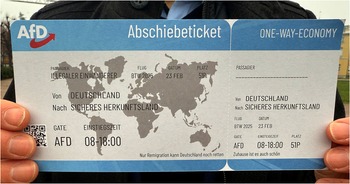
Continuing with the expression and promotion of remigration as a biopolitical solution to the replacement of populations, posters were made and hung on the streets of Germany calling for the “Immediate start of remigration!” expressing a sense of urgency that, in this context, only the AfD could solve. Some other posters depicted a plane of the fictive airline “Deportation -Hansa” and the caption: “Summer–Sun–Remigration” (Pieper Reference Pieper2024). And the AfD fraction of Karlsruhe printed 30,000 flyers resembling plane (remigration) tickets, (Figure 1) and distributed them throughout the city (zdfheute 2025).

The AfD’s “deportation ticket” (REUTERS & Reichert Reference Reichert2025) is a biopolitical imaginary aspiring to become reality: a boarding pass of a one-way flight for the generic passenger “illegal migrant,” departing from Germany towards a “secure country of origin” on February 23, 2025, the day of the federal elections (Bundestagswahl), which is also the flight number (BTW2025). The departure gate for the passenger is the AfD, marking the party itself as the point of transit, and the boarding time is a window between 08:18:00, the official opening hours for casting votes, and also in the neo-Nazi numerology, 18 is a cover for the initials of the name of the German national socialist dictator. Below in the deportation ticket, there is the slogan “Only Remigration can still save Germany,” and next to it in the detachable stub that the passenger keeps is the slogan “home is nice too.” The ticket also has a scannable QR code that leads to the website of AfD Karlsruhe
Although grounded in the present, biopower orients itself toward the future, for defending the society of its “internal enemies” in the time being is about securing the future health of the social body. Biopower is then also about futurity, as it is the AfD’s deportation ticket. The biopolitical boarding pass promotes a vision of the future in which Germany is envisioned as racially homogenous, where remigration can be enacted and directed by the AfD, who aspires to become the government, and which has in some federal states (Thuringia, Saxony, Saxony-Anhalt and Brandenburg) already become the second-largest opposition party.
The deportation ticket is a temporal biopolitical device, inviting its holder to imagine an alternative future. Rhetorically, it mobilizes common imagery (the anatomy of a plane ticket) to entice how would it look like a future where remigration, as a technology for purifying the social body, is official policy. The ticket then conjures up and projects a future in which the life of the racially characterized German social body is secure by the social death of those who have been deemed as not belonging to the nation and in dire need of, alas, remigration. In this sense, the deportation ticket exemplifies a biopolitical futurity; that is, the projection of (future) collective life through the imagination of others’ political death. Here, futurity itself becomes racialized: the life of the imagined German social body is secured through the spectral exclusion of those rendered as threats to its continuity.
Conclusions
Around the same time that the remigration meeting in Potsdam made national headlines, the Bundestag passed a landmark reform of the Nationality Act (Staatsangehörigkeitsgesetz) officially titled the Gesetz zur Modernisierung des Staatsangehörigkeitsrechts (StARModG) (Bundesrat 2024; Die Bundesregierung Reference Bundesregierung2024). The reform aimed to modernize German citizenship law, a process that began in 1999 when the exclusive ius sanguinis principle was complemented with a restricted ius soli norm. The 2024 reform shortened the residence period for naturalization from eight to five years and introduced a fast-track naturalization route of three years for individuals who demonstrate exceptional integration through high-level language skills and proofs of civic engagement. This was dubbed as “turbo-naturalization,” and Höcke’s speech in Zwickau discussed it as a “devaluation of German citizenship.” The reform also abolished the requirement to surrender previous nationality, thereby permitting dual citizenship, a change that the AfD articulated as de-germanizing Germany and tied to its expression and promotions of population replacement conspiracy theories and the remigration program.
The reform was short-lived, just a year later, the Bundestag repeal the “fast-track” naturalization; restoring a minimum five-year residence requirement (Deutscher Bundestag Reference Bundestag2025a). The repeal passed with an overwhelming parliamentary majority: 450 members voted in favor, including 208 from the CDU, 151 from the AfD, and 120 from the SPD, while 134 opposed, among them 85 from the Greens and 64 from The Left (Deutscher Bundestag Reference Bundestag2025b).
Parallel to this, in January 2025, opposition leader and soon-to-become Chancellor, Friedrich Merz (CDU) proposed “Five points to secure border and the end of illegal migration,” calling for strict border enforcement, including permanent controls, rejection of illegal entry, de facto entry bans for undocumented individuals, immediate detention for those required to leave, tighter restrictions on residence for criminals and dangerous persons, and turning away asylum seekers at the border (Drucksache 20/14698 2025). The Bundestag narrowly approved Merz’s five-point migration plan on January 29, 2025, with support from the CDU/CSU, FDP, and the AfD. Although the vote was non-binding, it marked the first time the AfD played a decisive role in passing a federal motion, breaking a longstanding political taboo in Germany against collaborating with the far-right, the firewall, Brandmauer (Sabrow Reference Sabrow2025)
Together, these political and legislative shifts illustrate that the discourses articulated and encapsulated in Umvolkung have moved from far-right rhetoric into policy proposals and into mainstream politics. The AfD’s conspiratorial visions of population replacement finds their institutional echo in a state increasingly preoccupied with safeguarding the cultural boundaries of the nation. The rollback of the “turbo-naturalization” scheme and the tightening of migration and border controls expresses, in bureaucratic form, the same biopolitical anxiety that animates remigration: the conviction that the life and continuity of the German social body depend on excluding and expelling those deemed alien to it. In this sense, Umvolkung and remigration no longer operate merely as ideological slogans but as political concepts structuring political perception and the field of possible governance, where the defense of the nation’s “life” legitimizes the contraction of citizenship and the securitization of mobility.
To conclude, I return to a couple of years before remigration fully entered the German public sphere. Alexander Gauland, co-founder and former party leader of the AfD, declared in an interview in 2018: “We are indeed trying to push the boundaries of what can be said … And yes, there is an expansion of the zone of the sayable, and that is also intentional” (Gauland in: Eppelsheim Reference Eppelsheim2018). In the context of the AfD discourse, expanding the sayable has functioned as a strategy to legitimize historically charged ideas such as Umvolkung but also novel biopolitical articulations such as remigration, moreover, such speech boundary expansion can be seen as seeking to craft social reality and a regime of truth where the replacement of populations can be apprized as “real,” “tangible,” as an everyday experience as Camus (Reference Camus2024, 18–19) has depicted the Great Replacement (Hernández Aguilar Reference Hernández Aguilar2026). The mushrooming of population replacement conspiracy theories in the last two decades has enabled the expansion of the sayable while expressing and promoting political visions of decline, demographic anxiety, and a racially characterized world. Returning to Cassam’s (Reference Cassam2019) argument on conspiracy theories’ functionality as promoting political propaganda, I would add that the political function of population replacement conspiracy theories has also been expanding the frontiers of the sayable, thinkable, and doable. The circulation of Umvolkung and Remigration thus signals not the return of a discredited past but the adaptation of biopolitical reason to a new conjuncture, where the defense of life becomes indistinguishable from the administration of fear through the political mobilization of conspiracy theories.
Financial Support
This work was supported by the Deutsche Forschungsgemeinschaft (DFG, German Research Foundation) under Grant 552742235; the funder played no role in study design, data analysis, or manuscript preparation.
Competing Interests
The author declares none.

 Open access

