

Hostname: page-component-77f85d65b8-5ngxj Total loading time: 0 Render date: 2026-03-26T17:32:08.792Z Has data issue: false hasContentIssue false

Genetic association of cholesterol metabolism with the risk of depression and schizophrenia

Published online by Cambridge University Press:  27 September 2024

Zheng Chen*
Affiliation:
Tianjin Haihe Hospital, Tianjin, China
Guanghong Sui
Affiliation:
Department of Child and Adolescent Psychology, Tianjin Anding Hospital, Tianjin, China
Caixia Yang
Affiliation:
Department of Rehabilitation, Tianjin Anding Hospital, Tianjin, China
Zongshun Lv
Affiliation:
Tianjin Medical University General Hospital, Tianjin, China
Feng Wang*
Affiliation:
Tianjin Medical University General Hospital, Tianjin, China
*
Corresponding authors: Feng Wang; Email: wangfeng0921@126.com and Zheng Chen; Email: Zheng4365@126.com

Abstract

Objective:

Some observational studies have unexpectedly reported the association of cholesterol metabolism with mental and psychological disorders, but a firm conclusion has not been drawn. The aim of this study was to further investigate the effects of peripheral cholesterol traits and cholesterol-lowering therapy on depression and schizophrenia using a Mendelian randomisation approach.

Methods:

Instrumental variables meeting the correlation, independence and exclusivity assumptions were extracted from one genome-wide association study for predicting total cholesterol, low-density lipoprotein (LDL) cholesterol, high-density lipoprotein (HDL) cholesterol and nonHDL cholesterol. Instrumental variables for total cholesterol and LDL cholesterol were also adopted to predict statin use (a type of cholesterol-lowering drug); these instrumental variables should not only satisfy the above assumptions but also be close to 3-hydroxy-3-methylglutaryl coenzyme A reductase (HMGCR, the target gene of statins) on the chromosome. Three methods (including inverse variance weighted) were used to conduct causal inference of the above exposures with depression and schizophrenia. Sensitivity analyses were performed to assess horizontal pleiotropy.

Results:

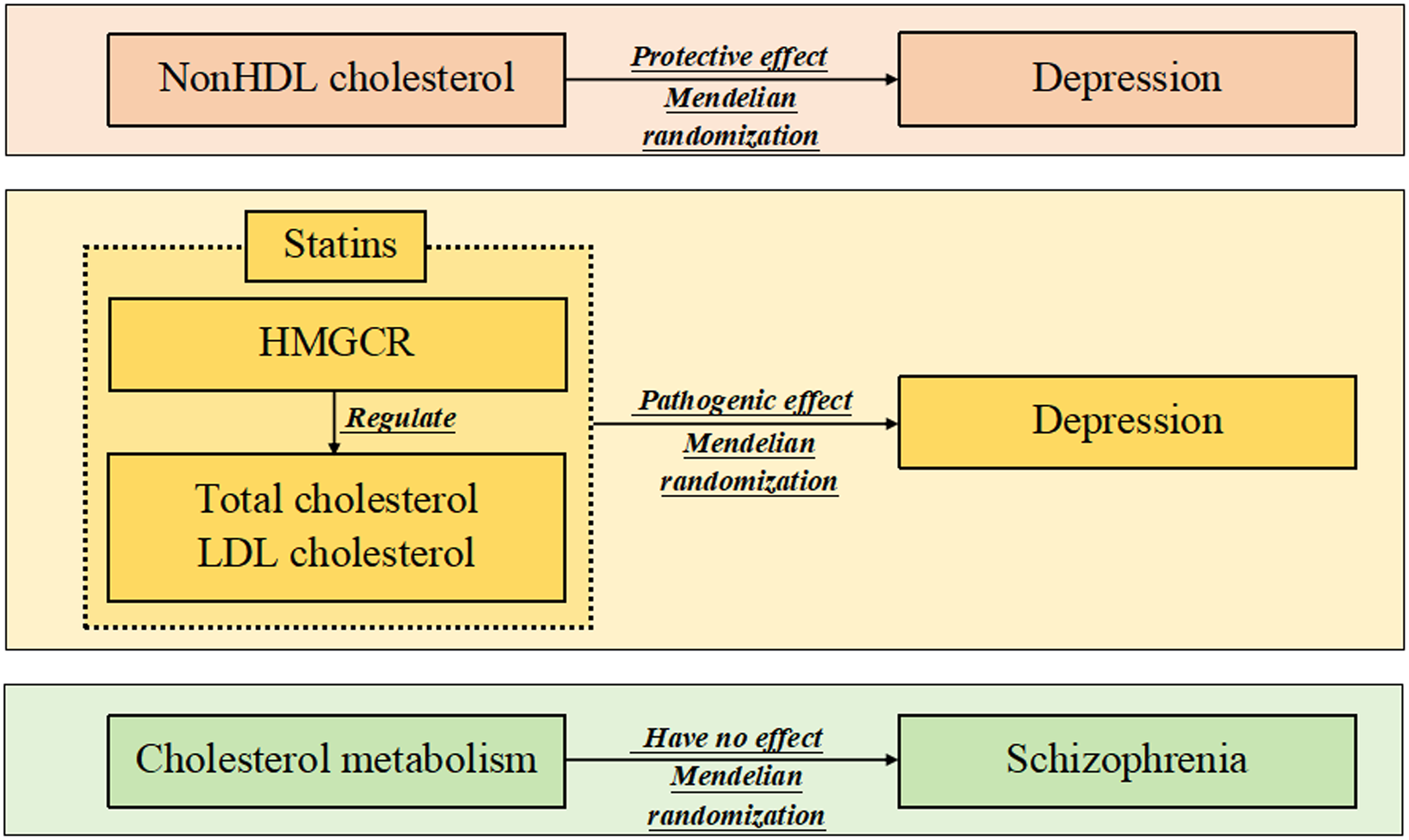
Higher levels of peripheral nonHDL cholesterol were nominally associated with a decreased risk of depression (P = 0.039), and higher levels of HMGCR-mediated total cholesterol and LDL cholesterol were nominally related to a decreased risk of depression (P = 0.013 and P = 0.028, respectively). Moreover, these cholesterol traits cannot affect the risk of schizophrenia. Sensitivity analysis did not reveal any horizontal pleiotropy.

Conclusion:

The study provided some interesting, but less sufficient, evidence that nonHDL cholesterol may have a protective effect on depression, and lowering cholesterol using statins might increase the risk of the disease.

Information

Type
Original Article
Copyright
© The Author(s), 2024. Published by Cambridge University Press on behalf of Scandinavian College of Neuropsychopharmacology

Access options

Get access to the full version of this content by using one of the access options below. (Log in options will check for institutional or personal access. Content may require purchase if you do not have access.)

Article purchase

Temporarily unavailable

Supplementary material: File

Chen et al. supplementary material 1

Chen et al. supplementary material
Download Chen et al. supplementary material 1(File)
File 266.2 KB
Supplementary material: File

Chen et al. supplementary material 2

Chen et al. supplementary material
Download Chen et al. supplementary material 2(File)
File 22.7 KB