

Introduction
Dual-career couples, intimate partners who are both committed to their careers and family lives, have moved from being considered an anomaly to becoming a widely recognised norm in contemporary work contexts (Clarke, Reference Clarke2015). These couples co-construct career trajectories, with decisions about each partner’s career being intrinsically linked. Navigating two potentially competing careers alongside shared domestic responsibilities introduces pressures that require ongoing negotiation and compromise (Scurry & Clarke, Reference Scurry and Clarke2021). Identity orientations, whether work-centric, family-centric, or dual-centric, further shape how career prioritisation is approached within the couple.
Hybrid working, typically involving 1–3 days of remote work per week (Babapour Chafi, Hultberg & Yams, Reference Babapour Chafi, Hultberg and Yams2021; Xie, Elangovan, Hu & Hrabluik, Reference Xie, Elangovan, Hu and Hrabluik2019), has become a lasting feature of the post-pandemic workplace in many global contexts (Allen, Grelle, Lazarus, Popp & Gutierrez, Reference Allen, Grelle, Lazarus, Popp and Gutierrez2024; Ferrer, Treuren, Holland & Bartram, Reference Ferrer, Treuren, Holland and Bartram2025), Yet, as Lovich and Sargeant (Reference Lovich and Sargeant2023) argue, a ‘one size fits all’ approach to hybrid work is fundamentally misaligned with the diverse needs of today’s workforce. While flexibility offers opportunities for more egalitarian arrangements (Kossek, Perrigino & Lautsch, Reference Kossek, Perrigino and Lautsch2023; Petriglieri & Obodaru, Reference Petriglieri and Obodaru2019; Wethal, Ellsworth-krebs, Hansen, Changede & Spaargaren, Reference Wethal, Ellsworth-krebs, Hansen, Changede and Spaargaren2022), research also highlights persistent gendered expectations and role conflicts, particularly for women (Craig & Churchill, Reference Craig and Churchill2021; Hu, Chiang, Liu & Gao, Reference Hu, Chiang, Liu and Gao2021). This study is especially timely given the widespread adoption of hybrid work and the growing interest in flexible arrangements that support gender equity, well-being, and sustainable career development (Chung & Van der Lippe, Reference Chung and Van der Lippe2020).
Our paper explores how partners negotiate work and non-work responsibilities within hybrid work contexts. By including data from each partner within the couple, the study captures relational dynamics that are often overlooked in work–family research (Kossek, Perrigino & Rock, Reference Kossek, Perrigino and Rock2021). Using ideal type analysis (Stapley, O’Keeffe & Midgley, Reference Stapley, O’Keeffe and Midgley2022), we make three key contributions. We advance the literature by offering a typology that moves beyond foundational dual-career classifications developed under conditions of spatial separation, which assume relatively stable identity orientations and clear boundaries between work and home, instead capturing how hybrid working operates as a structural condition that reconfigures how these orientations are enacted and negotiated within dual-career couples. We capture differences in identity centrality, the purpose hybrid work serves within couples, and career coordination strategies that emerge in response to the broader societal shift towards hybrid working as an increasingly structural condition of employment, while avoiding narrow classifications that obscure relational nuance. Second, we show how identity centrality shapes patterns of role behaviour in dual-career couples working in hybrid arrangements, drawing on identity theory to explain how orientations are enacted and coordinated within this context, and to build an empirically grounded typology. Finally, we provide practical value by offering a basis for future research to inform strategic organisational flexibility policies that recognise variation in coordination needs across couple types, while still allowing organisations to develop standardised responses aligned to different couple types rather than relying on individual-level customisation.
Dual-career couples
Dual-career couples are intimate partners who demonstrate commitment to both professional and family identities, navigating the demands of work and care in tandem (Bird & Schnurman‐Crook, Reference Bird and Schnurman‐Crook2005). Unlike dual-income couples, where one partner works mainly for financial or social reasons, both partners in dual-career relationships invest in sustained career development, often in demanding roles (Duxbury, Lyons & Higgins, Reference Duxbury, Lyons and Higgins2007).
Dual-career couples must balance individual career ambitions with shared goals (Petriglieri & Obodaru, Reference Petriglieri and Obodaru2019), and these arrangements, shaped by personal values and societal expectations, often require compromise. Coordinating domestic and caregiving responsibilities is particularly challenging when both partners hold demanding roles involving long hours and sustained work responsibilities (Ford & Collinson, Reference Ford and Collinson2011; Culpepper, Reference Culpepper2024; Hosain, Reference Hosain2025; Neault & Pickerell, Reference Neault and Pickerell2005). These dynamics are often influenced by persistent gendered norms (Scurry & Clarke, Reference Scurry and Clarke2021), contributing to relational strain (Bird & Schnurman‐Crook, Reference Bird and Schnurman‐Crook2005) and sometimes conflict (Rahimi, Salimi Bajestani & Asgari, Reference Rahimi, Salimi Bajestani and Asgari2021).
The importance of work and family identities is central to how dual-career couples organise their lives (Boiarintseva, Ezzedeen & Wilkin, Reference Boiarintseva, Ezzedeen and Wilkin2022; Rapoport & Rapoport, Reference Rapoport and Rapoport1969). Identity theory (Stryker, Reference Stryker1968; Stryker & Burke, Reference Stryker and Burke2000) explains how identity salience shapes role prioritisation, with more central (i.e. more important) identities more likely to be activated and prioritised. Kossek, Ruderman, Braddy and Hannum (Reference Kossek, Ruderman, Braddy and Hannum2012) offer a complementary framework by identifying three orientations, work-focused, family-focused, and balanced, highlighting how individuals relate to roles that carry personal meaning. For dual-career couples, navigating these identities involves ongoing negotiation. Despite shifts in gender roles, the belief that men give more importance to work and women to family continues to shape how roles are prioritised and understood, with direct implications for how dual-career couples manage competing demands and make career-related decisions (Sweet & Moen, Reference Sweet, Moen, Kossek, Pitt-Catsouphes and Sweet2006).
Career prioritisation, defined as ‘the relative priority of a person’s career compared to their partner’s career’ (Greenhaus, Parasuraman, Granrose, Rabinowitz & Beutell, Reference Greenhaus, Parasuraman, Granrose, Rabinowitz and Beutell1989, p. 142), remains a central mechanism for managing interdependence. Couples may consciously scale back one career to reduce strain on family life, with such adjustments historically borne by women while male careers continue to dominate, shaping income trajectories and long-term career development (Becker & Moen, Reference Becker and Moen1999; Pixley, Reference Pixley2008). While much of the literature frames these decisions as trade-offs (Petriglieri & Obodaru, Reference Petriglieri and Obodaru2019), Känsälä, Mäkelä and Suutari (Reference Känsälä, Mäkelä and Suutari2015) offer three coordination models: hierarchical, egalitarian, and loosely coordinated. Unlike hierarchical prioritisation, egalitarian and loosely coordinated approaches value both careers and minimise trade-offs. Hybrid working may expand these possibilities, enabling couples to concurrently maintain rewarding careers and a satisfactory work–life balance (Kossek, Perrigino & Lautsch, Reference Kossek, Perrigino and Lautsch2023; Wethal et al., Reference Wethal, Ellsworth-krebs, Hansen, Changede and Spaargaren2022).
Hybrid working dual-career couples
Hybrid working, where employees work both remotely and in the office (Xie, Elangovan, Hu & Hrabluik, Reference Xie, Elangovan, Hu and Hrabluik2019), typically involves working from home 1–3 days per week (Babapour Chafi, Hultberg & Yams, Reference Babapour Chafi, Hultberg and Yams2021). Post-pandemic, this is increasingly viewed as a permanent feature of contemporary work (Allen et al., Reference Allen, Grelle, Lazarus, Popp and Gutierrez2024; Ferrer et al., Reference Ferrer, Treuren, Holland and Bartram2025). In Australia, remote workdays rose from just 5% pre-pandemic to approximately 25% in its aftermath (Asana, 2022). In the United States, 87% of employees offered flexible arrangements take them, averaging 3 remote days per week (McKinsey Global Institute, 2025). Globally, 64% of organisations have adopted hybrid working models, despite some calls to return to the office (Canal, Ward, Knight & Lebowitz, Reference Canal, Ward, Knight and Lebowitz2023), with evidence showing hybrid work remains highly valued (Bloom, Barrero, Davis, Meyer & Mihaylov, Reference Bloom, Barrero, Davis, Meyer and Mihaylov2023).
Hybrid working is more than a logistical shift; it structurally reconfigures how work, care, and career progression are negotiated. While it can enhance work–life balance and job mobility, particularly for women (Babapour Chafi, Hultberg & Yams, Reference Babapour Chafi, Hultberg and Yams2021), research shows persistent gendered divisions of labour when both partners work from home (Craig & Churchill, Reference Craig and Churchill2021; Hu et al., Reference Hu, Chiang, Liu and Gao2021). These findings highlight the need to critically examine how flexibility is enacted and experienced, including the ways organisational policies shape, enable, or constrain the uptake of hybrid work.
For dual-career couples, the implications are pronounced. Historically, women have borne the cost of flexibility through the ‘motherhood penalty’ (Gangl & Ziefle, Reference Gangl and Ziefle2009), while men have often resisted flexible work due to perceived stigma (Gatrell, Burnett, Cooper & Sparrow, Reference Gatrell, Burnett, Cooper and Sparrow2013). Although flexible working offers control over the boundaries between work and non-work domains (Chung & Van der Lippe, Reference Chung and Van der Lippe2020), it often fails to disrupt gender norms: men use it to extend paid work (Chung & der Horst, Reference Chung and Van der Horst2018), women to accommodate household responsibilities, without reducing their professional workload (Kurowska, Reference Kurowska2020). These asymmetries perpetuate traditional household divisions of labour (Chung, Birkett, Forbes & Seo, Reference Chung, Birkett, Forbes and Seo2021).
Yet hybrid working can enable change as when men assume more caregiving responsibilities through flexible scheduling, women’s career prospects improve (Langner, Reference Langner2018). Realising this potential requires understanding of how couples negotiate hybrid arrangements and how organisational policies support equitable outcomes; without this, flexibility risks reinforcing inequality (Moen & Yu, Reference Moen and Yu2000).
Existing typologies
Typologies offer a valuable theoretical lens for examining complex and interdependent relationships, particularly within social and organisational contexts (Delbridge & Fiss, Reference Delbridge and Fiss2013). In the study of dual-career couples, typologies have long served to illuminate structural sources of role strain. Foundational work by Rapoport and Rapoport (Reference Rapoport and Rapoport1969) defined the dual-career family as one in which both partners pursue highly salient careers while raising at least one child, classifying them into Familistic, Careerist, Conventional, and Coordinate types to reflect differing orientations to work and non-work. Later, Hunt and Hunt (Reference Hunt and Hunt1982) incorporated gender role reversals, while subsequent research broadened the focus to dual-earner households, offering models that occasionally included dual-career configurations (Duxbury, Lyons & Higgins, Reference Duxbury, Lyons and Higgins2007; Masterson & Hoobler, Reference Masterson and Hoobler2015). More recent studies have returned to dual-career couples as a distinct category, reflecting demographic shifts and calls to move beyond income-based framings (Scurry & Clarke, Reference Scurry and Clarke2021; Zucker, Nadeau, Azil & Bennett, Reference Zucker, Nadeau, Azil and Bennett2019). Boiarintseva, Ezzedeen and Wilkin (Reference Boiarintseva, Ezzedeen and Wilkin2022), for instance, examine childfree dual-career couples, identifying Careerist, Conventional, Non-Conventional, and Egalitarian types based on role salience.
While these typologies differ in emphasis and scope, they collectively underscore the diversity of dual-career arrangements and the persistence of neo-traditional divisions of labour, where women disproportionately shoulder caregiving responsibilities. Managing two careers alongside shared domestic responsibilities raises questions about whether both partners can sustain meaningful careers while maintaining a workable balance between professional and personal life (Greenhaus & Powell, Reference Greenhaus and Powell2012).
Taken together, these foundational and contemporary typologies are underpinned by an assumption that structural spatial separation between work and home persists, with roles enacted across relatively distinct domains and supported by stable patterns of identity centrality (see Supplementary Appendix A). As a result, they focus primarily on how roles are prioritised rather than on how identities are negotiated in practice, offering limited insight into how identity is dynamically enacted under conditions where these boundaries are increasingly blurred, such as in hybrid work arrangements.
Identity theory as a conceptual foundation
Identity theory provides a valuable lens for understanding how individuals navigate multiple social roles, including those related to work and family. Rooted in symbolic interactionism, it posits that people hold multiple identities shaped through social interaction (Stryker, Reference Stryker1968). Each identity reflects role meanings, with prominence varying by context. Two key concepts are salience, defined as the likelihood that an identity will be activated in a given context, and centrality, referring to its relative importance within an individual’s overall sense of self. Identity centrality is widely understood to structure patterns of salience, with identities that are most central to the self more likely to be activated across situations and expressed through role behaviour. This distinction is useful for examining how competing roles, such as worker, partner, and caregiver, are prioritised and enacted in everyday life.
In work–family research, identity centrality distinguishes between work-centric, family-centric, and dual-centric orientations (Kossek et al., Reference Kossek, Ruderman, Braddy and Hannum2012). While this typology explains individual boundary management, it overlooks relational dynamics in dual-career couples, where identities are interdependent and shift through shared experiences. Recent studies reinforce the need to conceptualise identity at the couple level. Abeysekera and Gahan (Reference Abeysekera and Gahan2019) show role salience can operate dyadically, with crossover effects shaping work–family demands. Masterton and Hoobler (Reference Masterson and Hoobler2015), though focused on dual-income couples, demonstrate how identity salience, grounded in the relative importance of care and career identities, influences role prioritisation. These insights are particularly salient for dual-career couples, where both partners are simultaneously managing demanding careers alongside shared responsibilities, intensifying the interdependence of identity and coordination.
In summary, while existing typologies map the broad configurations of dual-career arrangements, they give limited attention to the relational processes through which partners negotiate work and family roles, particularly as hybrid work reshapes the structural conditions under which identities are enacted. Hybrid working reconfigures daily routines, increases the visibility of domestic responsibilities, and often reproduces or subtly shifts gendered expectations, creating contexts in which work- and family-based identities may be brought to the fore to varying degrees. Identity theory offers a useful lens for understanding these dynamics by foregrounding how identity centrality structures patterns of salience and, in turn, guides role behaviour within couples. Yet prior research has not fully examined how this identity processes unfold within the hybrid work context, where role boundaries are increasingly permeable and coordination requires ongoing dyadic adjustment. This study addresses this gap with the research question: How do dual-career couples navigate and coordinate the intersection of their professional and domestic identities within the hybrid work context?
Methodology
We adopted a qualitative approach informed by a social constructionist philosophy and interpretive paradigm to explore how dual-career couples experience hybrid working. A dyadic design included both partners to capture relational dynamics.
Participants were knowledge workers engaged in hybrid work, recruited via professional organisations and social media, and who self-identified as committed to both career and family. The development of a typology was not the initial aim of the study, but the patterned variation across couples identified during analysis provided a strong basis for constructing an empirically grounded typology of dual-career configurations within hybrid work contexts. The sample was diverse in terms of sector, profession, age and stage, and hybrid work configurations as recommended by Elhinnawy, Kennedy and Gomes (Reference Elhinnawy, Kennedy and Gomes2023) and McKinsey Global Institute (2023). This supported the development of a typology, as the variation across roles, sectors, life stages, and hybrid-work arrangements provided the conceptual breadth needed to identify patterned differences between couple types (see Supplementary Appendix B).
We conducted 32 individual interviews via Zoom, representing 16 heterosexual dual-career couples, interviewing partners separately to ensure confidentiality and minimise bias. Our focus was not specifically on heterosexual couples, but all participants were mixed gender. For this study, we considered this methodologically sound as it reflects the persistence of gendered norms in the division of labour, as existing research shows that hybrid working often reinforces traditional gender asymmetries such as the motherhood penalty and continued male career prioritisation in heterosexual dyads (Chung et al., Reference Chung, Birkett, Forbes and Seo2021; Craig & Churchill, Reference Craig and Churchill2021). Concentrating on this demographic enabled us to isolate how hybrid work interacts with these deeply ingrained societal scripts.
Interviews ranged from 25 to 70 min (average 42 min) and followed a semi-structured format to allow depth and flexibility. Consistent with dyadic research guidance, we used separate interviews to elicit candid responses (Eisikovits & Koren, Reference Eisikovits and Koren2010; Morgan, Reference Morgan2024). Data collection and analysis proceeded iteratively as part of the broader study on which this paper builds (Mutter & Thorn, Reference Mutter and Thorn2025). To explore differences in how dual-career couples enact and experience hybrid work, we adopted ideal-type analysis, consistent with our social constructionist philosophy. Ideal types are interpretive constructs that help make social reality more understandable by highlighting meaningful patterns across participants’ experiences (Stapley, O’Keeffe & Midgley, Reference Stapley, O’Keeffe and Midgley2022). Although often associated with larger samples, ideal type analysis is also appropriate for exploratory studies of emerging phenomena (Swedberg, Reference Swedberg2018). Each couple was treated as a single case, and the dyadic focus, together with the depth of data collected, enabled cross-case comparisons, despite the modest number.
Our analysis followed Stapley, O’Keeffe & Midgley, (Reference Stapley, O’Keeffe and Midgley2022) seven steps. First, we refamiliarised ourselves with the dataset by revisiting the NVivo analysis from the broader study. Couple-level case reconstructions were then prepared, guided by factors identified in the literature and existing dual-career couple typologies as potentially significant for understanding the relational dynamics in hybrid work. The construction of ideal types was iterative: initial groupings developed for a conference presentation were refined, prompting a return to the case constructions. A spreadsheet was used to sort and filter couple-level coding, allowing key differentiating factors to emerge. For example, partner autonomy over flexibility was initially considered but later omitted, while identity centrality emerged as a primary distinguishing characteristic.
Differentiating factors
The spreadsheet analysis identified three key differentiating factors that operated hierarchically in shaping how dual-career couples navigate hybrid work. Identity centrality emerged as the primary differentiator, capturing how strongly individuals prioritise work, family, or both, with couples displaying orientations ranging from mutually work-centric through dual-centric, to asymmetric combinations where one partner emphasised career while the other balanced family and work. The purpose of hybrid work served as a secondary factor, with couples using flexibility to support female re-entry into the workforce, provide short-term career support, achieve long-term balance, or pursue dual-career success. Finally, coordination strategies served as a tertiary factor, revealing how couples enacted domestic and professional responsibilities, through patterns ranging from temporarily hierarchical arrangements (often linked to life stage) to more egalitarian approaches, with some couples sustaining both careers alongside shared caregiving. Together, these factors illustrate the nuanced ways hybrid work enables couples to negotiate identity, career progression, and family responsibilities. Table 1 provides quotes from the couples that exemplify each of these categories.
Differentiating factors with exemplary quotes
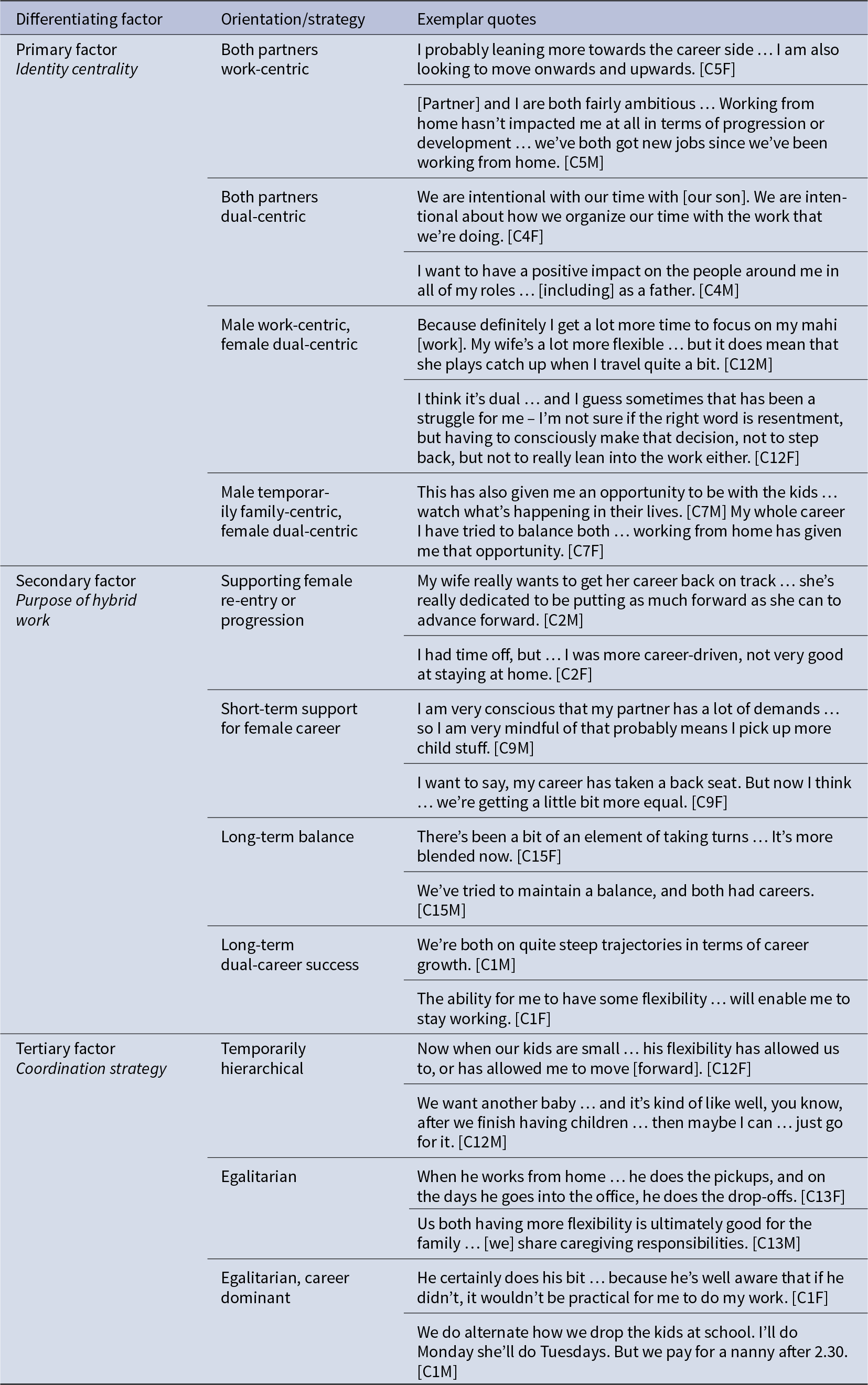
Table 1 Long description
The table organizes interview quotes into three differentiating factors that shape how couples navigate hybrid work: identity centrality, the purpose of hybrid work, and their coordination strategy. For identity centrality, examples span both partners being work-centric and describing ambition and career progression, both partners being dual-centric and emphasizing intentional time for work and parenting, and mixed patterns such as male work-centric with female dual-centric where travel and flexibility shift the load. Another identity pattern shows a male partner temporarily more family-centric while the female partner remains dual-centric, with hybrid work described as enabling more time with children while still balancing career. For the purpose of hybrid work, quotes describe supporting female re-entry or progression, short-term support where one partner picks up more childcare, and longer-term approaches focused on balance, turn-taking, and sustained dual-career success. Coordination strategies range from temporarily hierarchical arrangements tied to childbearing and early parenting stages to egalitarian sharing of school drop-offs and pick-ups, including an egalitarian approach where careers remain demanding and paid childcare supports the arrangement. Across factors, flexibility is repeatedly linked to career advancement and caregiving capacity, but the quotes also note tension and perceived imbalance when one partner’s work demands dominate. The entries are illustrative excerpts from specific couples, so they indicate themes rather than frequencies or outcomes for a broader population.
Source: Authors’ own work.
We then identified an optimal case for each of the four types, selected for coherence with the defining characteristics and capacity to exemplify key differentiating factors. Ideal-type descriptions were drafted and reviewed against the spreadsheet analysis to ensure credibility. The final step, comparative analysis across types, is presented in the following section.
Proposed typology
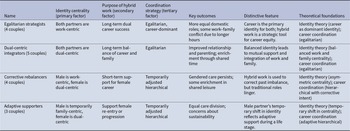
Based on the differentiating factors identified in this research, we propose a typology of dual-career couples engaged in hybrid work – egalitarian strategists, dual-centric integrators, corrective rebalancers, and adaptive supporters (See Table 2).
Typology of dual-career couples engaged in hybrid work
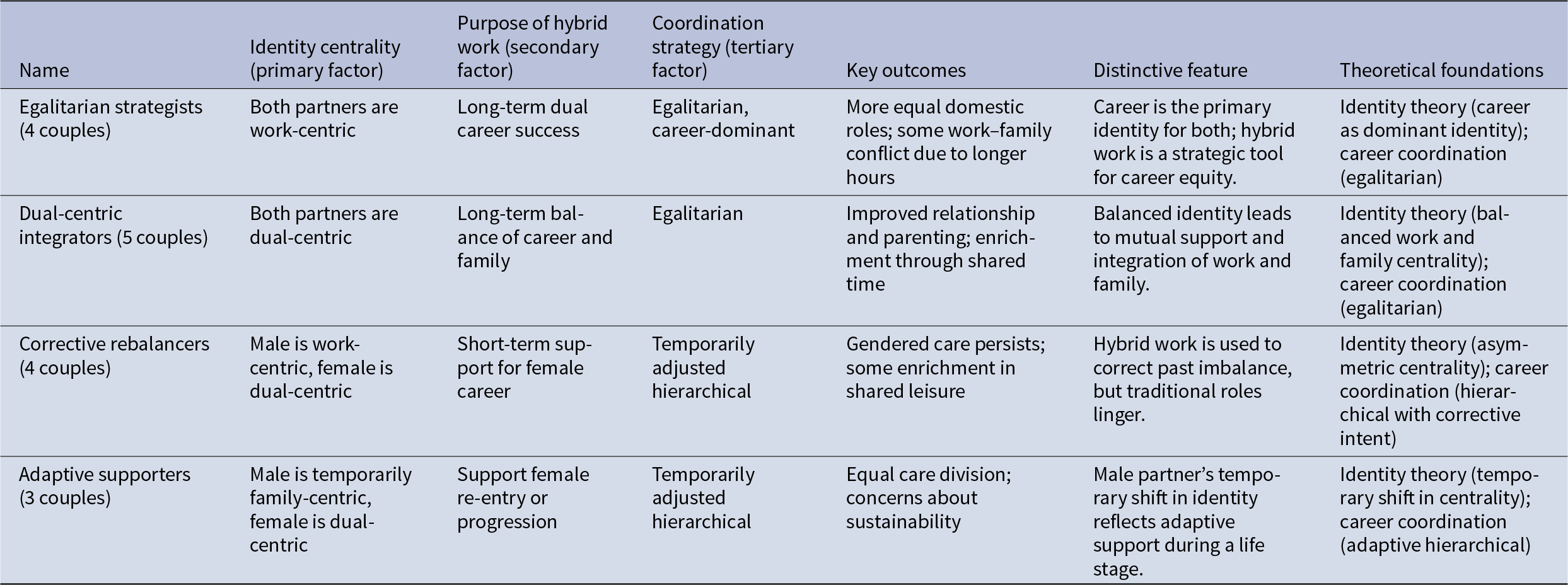
Table 2 Long description
The table classifies dual-career couples using hybrid work into four types based on identity centrality as the primary factor, the purpose of hybrid work as a secondary factor, and coordination strategy as a tertiary factor. Egalitarian Strategists, four couples, have both partners work-centric and use hybrid work for long-term dual career success through egalitarian, career-dominant coordination, leading to more equal domestic roles but some work–family conflict from longer hours. Dual-Centric Integrators, five couples, have both partners dual-centric and pursue long-term balance with egalitarian coordination, reporting improved relationship and parenting and enrichment from shared time. Corrective Rebalancers, four couples, pair a work-centric male with a dual-centric female and use hybrid work for short-term support of the female career via temporarily adjusted hierarchical coordination; gendered care patterns persist alongside some shared-leisure enrichment. Adaptive Supporters, three couples, feature a male temporarily family-centric and a dual-centric female, using temporarily adjusted hierarchical coordination to support female re-entry or progression; care division becomes more equal but sustainability is a concern. Overall, egalitarian coordination aligns with long-term aims and mutual integration, while temporary hierarchical adjustments are tied to transitional goals and lingering or uncertain gender-role dynamics. The typology is interpretive and grounded in identity theory and career coordination concepts, so outcomes should be read as patterns associated with each type rather than universal predictions.
Source: Authors’ own work.
Egalitarian strategists (four couples)
Egalitarian strategists are dual-career partners who both construct career as their primary identity and engage in deliberate egalitarian career coordination to sustain long-term progression for both. Hybrid work is used strategically to support career equity, enabling more equal domestic roles, although this can bring work–family conflict due to the intensity of dual-career investment.
Identity centrality
Couple 14 exemplifies this type, with both partners strongly identifying as work-centric professionals. As lawyers – one a partner in a law firm and the other a practising barrister – they view career advancement as central to their sense of self and speak about work as a shared domain of growth and satisfaction. Their mutual investment is evident in their professional trajectories and articulated goals. The male partner reflected:
I think we are both advancing our careers, and my wife’s become a partner in her firm. She’s moving up the partnership chain in terms of equity. I’ve been able to advance … I am doing a lot of interesting work that’s satisfying … I’m probably doing work that is advancing my career in terms of building my profile. So, in that sense we’re both advancing our careers. [C14M]
This shared orientation reflects a couple who see career not only as individually meaningful but as a joint endeavour, with each partner’s success contributing to a collective sense of progress.
Purpose of hybrid working and coordination strategy
Hybrid work is used deliberately to enable long-term dual-career success. Their coordination is egalitarian in intent and practice, with each partner adjusting work patterns to support the other’s career. Flexibility is not merely logistical but a strategic resource enabling equity in both work and non-work. The female partner noted her progression to partnership was made possible by her partner’s willingness to adapt, stating that without hybrid work ‘he’d have had to take a much bigger step back for it to work’. They are acutely aware of how hybrid work is perceived within professional contexts, but believe that predictability and professionalism can mitigate risks:
I think it is still the prevailing attitude. But if you are hybrid in a predictable and well-managed way, that it is not a problem for most of my profession or my organisation. [C14F]
Their reflections suggest a coordination strategy that is both practical and relational, grounded in mutual respect and shared commitment to advancement.
Outcomes
Strategic coordination has led to more equal domestic roles, particularly in parenting. With two school-aged children, they alternate presence at home, allowing one partner to manage after-school care while the other works a longer day in the city. He described the situation where ‘one person [is] working from home … so that they have additional flexibility to do the kid’s stuff, and the other person will come in [to the city] and work a longer day’. She affirmed this resulted in ‘a much more even split’.
Despite the benefits, they acknowledge the strain of dual-career investment. Their accounts reveal mutual understanding around late hours but also competing demands. She explained:
I just say I’m going to be late tonight, hope that’s okay. And it’s supposed to be the same for him on the days that I’m at home. [C14F]
He added that while he avoids working once the children are home, he often needs to remain responsive:
When the kids come home, I don’t tend to work, but I might have to take some phone calls … Sometimes I have to finish something off later. [C14M]
These reflections highlight the tension between ambition and family life, even within highly coordinated arrangements. For egalitarian strategists, hybrid work shapes the enactment of career centrality in everyday life. By alternating patterns of presence, both partners sustain engagement in demanding professional roles, with this sustained commitment emerging through deliberate coordination across work and home.
Dual-centric integrators (five couples)
Dual-centric integrators are dual-career partners who hold a balanced identity across work and family, viewing both domains equally central to their sense of self. Their coordination strategy reflects a shared commitment to long-term balance, with hybrid work used purposefully to foster mutual support, enriched parenting, and relational well-being through integrated role engagement.
Identity centrality
Couple 11 exemplifies this type through their shared orientation towards both career and family. Rather than privileging one domain, they pursue professional development while remaining actively engaged in parenting. Both partners have undertaken further tertiary education, repurposing commuting time to support their career trajectories while ensuring their son avoids before- or after-school care.
Their reflections reveal a clear dual-centric orientation. The female partner described her identity simply:
I would say, both … As a couple also both. [C11F]
Her partner echoed this, highlighting their differentiated aspirations and mutual support:
I want to build a successful practice … and my wife has aspirations about growing into a leadership role … it’s been a good balance between family and work, and both of us have been supportive of each other. [C11M]
Together, they construct identity through integration rather than segregation of their work and life domains.
Purpose of hybrid working and coordination strategy
Hybrid work is used deliberately to sustain balance and enable mutual support. It allows them to manage professional responsibilities while remaining present in family life. She noted hybrid work gives her time ‘to call my family, or to finish off the housework, so that on Saturday and Sunday I can relax a bit’.
Their coordination strategy is egalitarian and reflexive, shaped by ongoing conversations about fairness. A distinctive feature is their conscious effort to challenge traditional gender norms. He reflected:
I personally think women have it twice as hard as men when it comes to balancing family and work. [C11M]
This awareness informs their use of hybrid work as a mechanism for equity, enabling a more balanced distribution of responsibilities. Their approach is practical and values-driven, aimed at fostering relational well-being and shared growth.
Outcomes
The couple reported positive outcomes, including enriched parenting, improved relationship quality, and greater flexibility. Hybrid work enables responsive parenting, particularly around school routines. She explained:
Definitely I can give more to my kid … I can work with the picking up and dropping off for school. [C11F]
They also described how hybrid work results in reciprocal care and leisure. She noted that when her partner is home, she feels free to ‘visit a friend or go shopping’.
He reflected on the deepened relationship with his son:
I drop my son every single day if I’m working from home … I pick him up every single day … you almost relate to him far better. [C11M]
He also described how hybrid work has created space for everyday connection as a couple:
We can have the odd morning tea … lunch together … these are things which help. [C11M]
These shared moments, though small, were described as enhancing their emotional connection and reinforcing a sense of partnership in daily life.
These outcomes illustrate how hybrid work reshapes the enactment of dual-centric identities. Rather than treating work and family as separate domains, partners integrate these roles within everyday routines, combining professional activity, caregiving, and shared time in ways that create mutually reinforcing relationships between work and family roles, where engagement in one domain supports and enhances participation in the other.
Corrective rebalancers (four couples)
Corrective rebalancers are dual-career couples in which the male partner is work-centric and the female partner is dual-centric, creating an asymmetry in identity centrality at the couple level. Their coordination involves a temporary hierarchical adjustment, with hybrid work used to support the female partner’s career in the short term, aiming to correct past imbalance even as traditional gendered roles persist.
Identity centrality
Couple 10 demonstrates contrasting identity orientations yet shares awareness of the need for rebalancing. The male partner maintains a work-centric stance, acknowledging his career ‘still retains primacy at this point in time’. The female partner integrates career advancement with caregiving, describing how she works around family commitments:
I try and keep it between nine till two, but it gets quite fluid. So, I might do afternoon sessions after picking up the kids, for example, today is quite typical. I’ve taken my children into school with their scooters in the back of the car, and they’re going to scoot home because I’m going to be on a client call between half two and half three. [C10F]
This asymmetry reflects differing identity orientations, with hybrid work enabling her to maintain dual commitments while his identity remains anchored in career.
Purpose of hybrid working and coordination strategy
Their use of hybrid work reflects a shift from a previously traditional arrangement towards a more supportive structure for her career. He described their earlier dynamic as ‘very traditional … 1950s style almost’, where he spent ‘very limited time at home, 3 hours a day maximum, where you weren’t sleeping’. Hybrid work has enabled a reconfiguration of roles, allowing her to take on more substantial projects with his support:
We set in advance, the Thursday being my day, and we talked about that right at the beginning of the project from me saying yes to doing that job and him being the one at home to be there for the kids coming home. [C10F]
She spoke openly about the impact on her professional identity:
Feeling that you know I am valid, going out there into the world of work and doing a really good job. Yeah, hybrid is definitely helping. [C10F]
This arrangement reflects a transitional phase, where hybrid work is leveraged to temporarily rebalance career opportunities in her favour, without disrupting his dominant career trajectory. Coordination remains shaped by economic pragmatism. She acknowledged that ‘he’s in better employment’ and that she has ‘tended to prioritise his working from home needs because he is the primary earner, the main breadwinner’. Nonetheless, hybrid work has created space for her to rebuild her career, while he now commits to 1 day per week of full caregiving:
There’s actually one day where I have said to [partner], that I am at home because of the children, and where she has a commitment to be out at work. [C10M]
Despite this adjustment, his reservations about hybrid work in leadership roles remain:
For people leaders, it’s much easier to manage people when you can see them … there’s a huge amount of pastoral care and care for people required … you don’t know if someone is okay if you can’t see them. [C10M]
Outcomes
While he believes he now contributes meaningfully to domestic life, she continues to experience an uneven distribution of responsibilities. She expressed ongoing frustration:
There is still a bit of ongoing resentment … Hang on! How come I’m still doing all the washing and household tasks. I’m still the one that takes the kids to all their after-school sports and activities, their haircuts … why am I the default? [C10F]
He described his role differently:
I support and contribute to the running of the household … to cook and clean and make sure things are picked up or dropped off … those general household tasks, the weight of them would have fallen onto [partner]. [C10M]
Despite his increased involvement, she seeks more than 1 day of support, and the default expectations around care remain largely unchanged.
At the same time, hybrid work has created new opportunities for shared leisure and relational connection. These moments are not only a result of reduced commuting, but also from both partners being home on the same days. The female partner described how this shift has strengthened family life:
We’ll take the kids to school … then we’d go to the park and walk the dog … have a bit of a chat, and some time together …. It does feel like more of a connected family unit. [C10F]
He echoed this sentiment:
Just spending, being able to spend time with [partner] as well. I get to see her more, so that’s fantastic. [C10M]
These moments of connection coexist with ongoing tensions around unequal caregiving, highlighting the complexity of hybrid work’s impact on gender dynamics. This is reflected in the question ‘why am I the default?’, which captures how hybrid work brings taken-for-granted expectations about care and responsibility into sharper focus when both partners share the same workspace. As these expectations become more visible, partners are pushed to reconsider how they enact work and family roles, as efforts to sustain professional engagement come into tension with persistent assumptions of caregiving. At the same time, shared presence generates relational closeness that sits alongside these asymmetries, reflecting a transitional phase in which arrangements are temporarily rebalanced without fundamentally disrupting established career trajectories.
Adaptive supporters (three couples)
Adaptive supporters are dual-career couples in which the male partner temporarily adopts a family-centric identity while the female partner maintains a dual-centric orientation, reflecting an adaptive shift during a particular life stage. Their coordination strategy is an adaptive hierarchical arrangement, where the male partner softens his work-centric stance to support the female partner’s re-entry or progression. Unlike traditional hierarchical models, this adaptation is time-bound and framed as a relational investment or sacrifice. Hybrid work enables this temporary reordering of priorities, resulting in a more equal division of care, though questions remain about long-term sustainability.
Identity centrality
Couple 3 illustrates a temporary asymmetry in identity orientation. The female partner maintains a dual-centric identity, describing how working enhances her parenting:
What I’ve found is that being a working mum, I’m a better mum … because I’m working I try and make sure that when the kids are here like my time is the children not anything else. [C3F]
The male partner has shifted towards family-centric decisions that prioritise caregiving and household support. He described this shift as a ‘conscious choice’, explaining that ‘it was not easy for her to get back to work’. At present, he identifies as ‘probably more family-focused’, and noted they now ‘make more of a conscious effort to both be available for the kids when we finish work’.
These reflections reveal a couple navigating a life stage in which his temporary shift enables her re-engagement with work, while maintaining a shared commitment to family life.
Purpose of hybrid working and coordination strategy
Hybrid work supports the female partner’s re-entry following maternity leave. She described their shared aspirations and the challenges, noting that they both want to ‘do something that we like and add value’. She explained her partner declined a job offer because it did not allow hybrid work:
I’ve just recently gone back into the workforce … but [partner] didn’t take a job [he was offered] because he wouldn’t have been able to hybrid work … so that’s probably been real hard … the point is we’re still figuring this out. [C3F]
The male partner confirmed that his flexibility was central to enabling her transition:
I was actually offered a role with another company, and I turned it down as they wanted me to be in the office every day, and … [partner] wanted to start work this year and my flexibility could support her aspirations, so that pretty much killed the job. [C3M]
Their coordination reflects an adaptive hierarchical strategy, with him softening his work-centric stance to support her progression. She noted hybrid work is her ‘number one priority’ going forward, while he continues to balance study and long-term career goals. This arrangement is framed as short-term, with the expectation that his career focus will reassert itself as family demands shift.
Outcomes
Hybrid work has enabled a more equal division of care and domestic responsibilities. She described how it helps manage household tasks, allowing chores to be spread across the week rather than concentrating them on weekends. She also noted the benefits of both being home during busy mornings, describing how they ‘both have our little jobs that we do’. Both partners recognise that the domestic labour is now more evenly shared:
The days he works from home he’s doing like the cooking and things like that, whereas prior I wasn’t working so I did all the cooking … he’s definitely doing more, like he’ll do the washing, for example too and if he gets a free moment, or if he’s on a meeting where he’s just got to listen, he’ll sometimes just vacuum because he’s like it’s something that I can do that’s helpful and then I know that on days when he’s in the office that all falls to me. [C3F]
I can put the washing out, I can prep some meals, if we’re both working that I think I’m not sure how we manage if we are leaving home every day at eight and coming home at five, we’d be frantic just trying to catch up on things all the time. [C3M]
He also described a more intentional approach to caregiving, making a ‘conscious effort’ to be present for the children after work.
Despite these gains, both expressed concerns about the sustainability of their arrangement. She observed that working from home does not suit his personality, noting he has ‘lost a bit of his spark’ and misses the energy of being around people. He echoed this, describing how remote work leaves him feeling ‘drained’ and affects his mental well-being. He also reflected on career limitations:
My career, if I want to stay in a primary industry company, I’ve sort of got a few options, I guess, where I could go with my career. I could go to site and start doing some more operational type roles. So, I would be on site all the time. Or if I stay on the corporate side things, then all roads lead back to in the office - people management positions where I think you need to be much more in the office. [C3M]
For adaptive supporters, these patterns highlight how hybrid work reshapes the enactment of identity through temporary shifts in priority within the couple. In this case, the male partner reduces his emphasis on career advancement to support his partner’s re-entry into work, using hybrid flexibility to remain engaged while taking on greater caregiving responsibilities. This reflects a deliberate but time-bound adjustment, as he anticipates that, with their children growing older, the benefits of working from home will diminish and his career focus will re-emerge, underscoring the situational nature of this arrangement.
Discussion
This study presents a new typology of dual-career couples. Typologies offer a useful tool for exploring the complexity of relational patterns within social and organisational contexts (Delbridge & Fiss, Reference Delbridge and Fiss2013). Here, we respond to shifting social and organisational dynamics in the post-pandemic workplace by incorporating hybrid work as a structural condition that reshapes how work and family roles are enacted and negotiated within couples. In doing so, the typology extends prior frameworks developed under conditions of spatial separation, where identity orientations were assumed to be relatively stable and enacted across clearly bounded domains. Grounded in identity theory (Stryker, Reference Stryker1968) and informed by career coordination strategies (Känsälä, Mäkelä & Suutari, Reference Känsälä, Mäkelä and Suutari2015), our typology captures how identity centrality shapes role behaviour as couples navigate the blurred boundaries between work and home inherent in hybrid arrangements.
We make three contributions. First, we extend existing scholarship by presenting a typology that captures variation in identity centrality, the purposes hybrid work serves within couples, and the resulting career coordination strategies, offering a more relationally nuanced perspective. Second, guided by identity theory, we illustrate how identity centrality shapes patterns of role behaviour within dual-career couples navigating hybrid work, constructing an empirically informed typology that reflects contemporary identity enactment. Third, we provide a conceptual basis for future research that can inform the development of more strategic organisational flexibility initiatives, offering a framework that highlights couple-level patterns without necessitating individualised HR policy responses (Cullen, Hammer, Neal & Sinclair, Reference Cullen, Hammer, Neal and Sinclair2009). The typology consists of four types, each reflecting distinct configurations of centrality and coordination that emerge as couples respond to the opportunities and constraints introduced by hybrid work.
Egalitarian strategists share a strong career focus and use hybrid work as a forward-looking tool to support professional growth and coordinated domestic arrangements. Both partners construct career as their dominant identity, shaping how they negotiate flexibility and caregiving. Flexibility becomes a deliberately egalitarian strategy (Känsälä, Känsälä, Mäkelä & Suutari, Reference Känsälä, Mäkelä and Suutari2015) aimed at countering the enduring prioritisation of male careers (Pixley, Reference Pixley2008). Earlier research framed coordination as a series of trade-offs, often disadvantaging women (Becker & Moen, Reference Becker and Moen1999; Petriglieri & Obodaru, Reference Petriglieri and Obodaru2019). In contrast, these couples leverage hybrid work to sustain dual-career progression alongside work–life balance (Kossek, Perrigino & Lautsch, Reference Kossek, Perrigino and Lautsch2023; Wethal et al., Reference Wethal, Ellsworth-krebs, Hansen, Changede and Spaargaren2022). While prior typologies would classify such couples as careerist or egalitarian (e.g. Boiarintseva, Ezzedeen & Wilkin, Reference Boiarintseva, Ezzedeen and Wilkin2022; Masterson & Hoobler, Reference Masterson and Hoobler2015; Rapoport & Rapoport, Reference Rapoport and Rapoport1969), they are grounded in an assumption of spatial separation, where work and family are organised as distinct domains and identity orientations are treated as relatively stable. Within these bounded arrangements, sustaining dual career-centric orientations has often been associated with ongoing tension and work–non-work conflict. By contrast, this type illustrates how, under hybrid conditions, such orientations are actively sustained through ongoing coordination within more integrated work–home contexts.
Dual-centric integrators maintain a sustained investment in both career and family, supported by a balanced identity orientation. Rather than alternating priorities, they coordinate through shared parenting and mutual support, reflecting another deliberately egalitarian strategy (Känsälä, Mäkelä & Suutari, Reference Känsälä, Mäkelä and Suutari2015). This dual centrality aligns with growing trends where individuals synthesise identities across work and non-work roles (Kossek, Reference Kossek2016). Despite limited formal organisational support, these couples craft informal flexibility enabling work–family enrichment (Greenhaus & Powell, Reference Greenhaus and Powell2006) and positive spillover effects for both partners (Carlson, Thompson & Kacmar, Reference Carlson, Thompson and Kacmar2019). Earlier typologies acknowledge forms of high involvement across both work and family domains (e.g. Hunt & Hunt, Reference Hunt and Hunt1982) but tend to situate these within segmented arrangements or treat them as relatively exceptional configurations, such as partners working together in a shared organisational context. For dual-centric integrators, hybrid conditions enable these orientations to be more routinely enacted in practice, with increased spatial permeability supporting the integration of work and family roles within the flow of everyday coordination, rather than requiring their management as distinct or sequential domains.
Corrective rebalancers use hybrid work to address past imbalance rather than establish lasting equity. Coordination is temporarily hierarchical, moulded by the male partner’s work-centric identity and the female partner’s dual focus. While her career rebuilding is supported, traditional roles persist, echoing literature on the challenge of redistributing domestic labour (Känsälä & Oinas, Reference Känsälä and Oinas2016). Indeed, gendered expectations reproduce rather than transform established patterns of ‘doing gender’ (West & Zimmerman, Reference West and Zimmerman1987), revealing the potential limitations of hybrid work as a tool for sustained equity. Conventional typologies often treat couple configurations as relatively stable, whether defined through enduring role orientations (e.g. Boiarintseva, Ezzedeen & Wilkin, Reference Boiarintseva, Ezzedeen and Wilkin2022; Rapoport & Rapoport, Reference Rapoport and Rapoport1969) or fixed divisions of provision and care (e.g. Masterson & Hoobler, Reference Masterson and Hoobler2015), offering limited insight into how these patterns are reworked over time. For corrective rebalancers, hybrid working functions as a transitional mechanism through which partners adjust their coordination to address prior imbalances, in part by making underlying expectations around care and provision more visible and open to renegotiation. This illustrates how shifts towards greater equity can emerge in practice, even as underlying structural asymmetries persist.
Adaptive supporters reflect a temporary shift in the male partner’s identity, often framed as a relational investment (Scurry & Clarke, Reference Scurry and Clarke2021). This adaptive form of the hierarchical coordination enables short-term responsiveness during a demanding life stage. Although both partners articulate a commitment to dual careers, their experiences diverge: men often view flexible working as a way to deepen their caregiving involvement, whereas women tend to see it as enabling career advancement (de Laat, Reference de Laat2023). These arrangements remain contingent, with hierarchical career prioritisation likely to re-emerge as circumstances shift. While traditional typologies tend to frame asymmetric career prioritisation as an enduring arrangement, whether through fixed accommodating roles or sustained non-conventional configurations (e.g. Boiarintseva, Ezzedeen & Wilkin, Reference Boiarintseva, Ezzedeen and Wilkin2022), they offer limited insight into the temporality of these shifts. For adaptive supporters, hybrid working enables a time-bound adjustment in coordination, allowing one partner to increase caregiving involvement through a deliberate reduction in career emphasis while remaining engaged in work. This maintains an underlying dual-career orientation, with the expectation that earlier patterns of prioritisation will re-emerge.
By foregrounding identity centrality, the purpose hybrid work serves within the couple, and the coordination strategies that emerge, our framework provides greater granularity in understanding how dual-career couples navigate the interdependence of work and non-work under hybrid conditions. Across all four types, couples articulate an egalitarian purpose, even if unevenly realised. Egalitarian strategists and dual-centric integrators illustrate the enabling potential of hybrid arrangements to foster mutual support and more balanced role integration (Kossek, Perrigino & Lautsch, Reference Kossek, Perrigino and Lautsch2023; Petriglieri & Obodaru, Reference Petriglieri and Obodaru2019; Wethal et al., Reference Wethal, Ellsworth-krebs, Hansen, Changede and Spaargaren2022). However, corrective rebalancers and adaptive supporters retain hierarchical elements, suggesting remnants of neo-traditionalism persist. These findings echo concerns that hybrid work may intensify role conflict, particularly for women, facing heightened caregiving demands and enduring gendered expectations when working from home (Craig & Churchill, Reference Craig and Churchill2021; Hu et al., Reference Hu, Chiang, Liu and Gao2021).
The typology highlights how hybrid work simultaneously enables and constrains the enactment of dual-career arrangements, pointing to the need for future research on the sustainability of dual-career arrangements across life stages.
Limitations and future research
The purpose of the typology is to inform future research and guide couples and organisations navigating hybrid working dual-career arrangements. While typologies offer conceptual clarity, they inevitably simplify the fluid realities of couple dynamics. Ideal types are constructed through selective emphasis, which may obscure nuance and variation across time and context; as Wallman (Reference Wallman1984) reminds us, real life rarely conforms to tidy categorisations. Our typology is grounded in a specific sample of heteronormative, hybrid working couples in the knowledge sector within an egalitarian cultural context, underscoring the need for future research in more diverse relational, occupational, and sociocultural settings.
Future research should examine couples with divergent occupational arrangements, including manual labour or asymmetrical access to hybrid work, to understand how flexibility is negotiated across different structural conditions. Research engaging single-sex couples and culturally conservative contexts is needed to explore how relational and sociocultural norms shape hybrid working practices. Intersectional inquiry should address how ethnicity, class, and disability influence access to hybrid work and identity enactment. These future research directions respond to calls for organisational approaches that reflect the diverse realities of working from home and their implications for well-being, engagement, and performance (Khalid, Parry & Ridgway, Reference Khalid, Parry and Ridgway2023).
There is also value in extending inquiry beyond couple-level dynamics to include other household members, particularly children, whose perspectives offer important insights into family life and decision-making (Mutter, Reference Mutter2024). Longitudinal research is essential to examine how dual-career couples navigate evolving demands of work and family over time, including whether both partners can maintain fulfilling careers, achieve work–life balance, and manage caregiving responsibilities.
Implications for management and organisations
Although the typology proposed in this study invites further empirical testing, it offers a useful starting point for organisations to develop more strategic flexibility frameworks that recognise patterned differences in how dual-career couples coordinate hybrid work. Rather than relying on individualised arrangements, managers and HR practitioners could draw on these couple-level patterns to anticipate the forms of flexibility employees are likely to value.
For example, egalitarian strategists may benefit from structured hybrid arrangements and outcome-based performance systems that may safeguard visibility while enabling reciprocal coordination. Consistent with the experiences observed in this study, these couples rely on predictable flexibility to align dual career demands, suggesting that unanticipated changes to hybrid expectations may disrupt coordination. Dual-centric integrators are more likely to value micro-flexibility and core-hours models that support shared caregiving, with the cases examined here indicating how such arrangements enable ongoing negotiation of work and family responsibilities within everyday routines.
Corrective rebalancers may require flexibility to support staged career re-entry and opportunities for men to take up caregiving roles, while adaptive supporters may benefit from time-limited flexibility agreements that protect the long-term career prospects of the partner temporarily stepping back. In these cases, the findings suggest that hybrid work is often used to accommodate temporary asymmetries, indicating the importance of organisational practices that minimise longer-term career penalties associated with such adjustments, particularly through output-focused performance evaluation and reduced emphasis on physical presence.
These examples illustrate how organisations might begin to design clustered flexibility levers that acknowledge diversity in how couples navigate hybrid work without necessitating individual-level customisation. The typology thus provides a conceptual platform for future research to examine whether such couple-level frameworks can enhance equity, well-being, and retention in contemporary hybrid-working environments.
In conclusion, studies grounded in this typology hold potential to generate actionable insights for dual-career couples and for managers seeking to shape supportive organisational policies. By attending to employees’ family contexts, managers can tailor career development, training, and mobility opportunities to support workforce needs and foster organisational commitment. The typology offers a foundation for flexibility policies that respond to different couple configurations without requiring individual-level customisation, offering a potential foundation for future efforts to bridge the longstanding gap between work–family scholarship and practice (Kossek, Baltes & Matthews, Reference Kossek, Baltes and Matthews2011).
Supplementary material.
The supplementary material for this article can be found at https://doi.org/10.1017/jmo.2026.10110.


 Open access

