


Introduction
Czech politics witnessed several major events in 2021. Two ministers of Health and two ministers of Foreign Affairs were replaced in the spring. In October, the general election led to the end of the government led by ANO 2011 (ANO) and resulted in a brutal loss for the Czech left-wing parties. The Czech Social Democratic Party/Česká strana sociálně demokratická (ČSSD) and the Communist Party of Bohemia and Moravia/Komunistická strana Čech a Moravy (KSČM) failed to pass the 5 per cent threshold and lost their representation in the Chamber of Deputies. The election represented a victory for two electoral alliances—Together/SPOLU (SPOLU) and Pirates and Mayors/Piráti a Starostové (PirStan)—that sought to remove Andrej Babiš (ANO) from the position of Prime Minister. The newly formed oversized Cabinet, led by Petr Fiala (Civic Democratic Party/Občanská demokratická strana—ODS), includes five political parties.
Czech–Russian relations worsened in 2021. The revelation of the involvement of two GRU (Russia's foreign military intelligence agency) agents in the Vrbětice ammunition warehouses explosions in 2014 was followed by the expelling of a group of Russian diplomats and the removal of Russian company Rosatom from the tender of the nuclear power plant Dukovany.
President Miloš Zeman's health and his pro-Russian statements played a significant role in the events of 2021. Zeman expressed a willingness to buy the Russian Sputnik COVID-19 vaccine, questioned Russian involvement in the Vrbětice incident and opposed the appointment of the Pirates’ candidate as Minister of Foreign Affairs. In the autumn of 2021, Miloš Zeman's deteriorating health led to his long-term hospitalization and cast doubts on whether he would be able to fulfil his presidential duties.
Election report
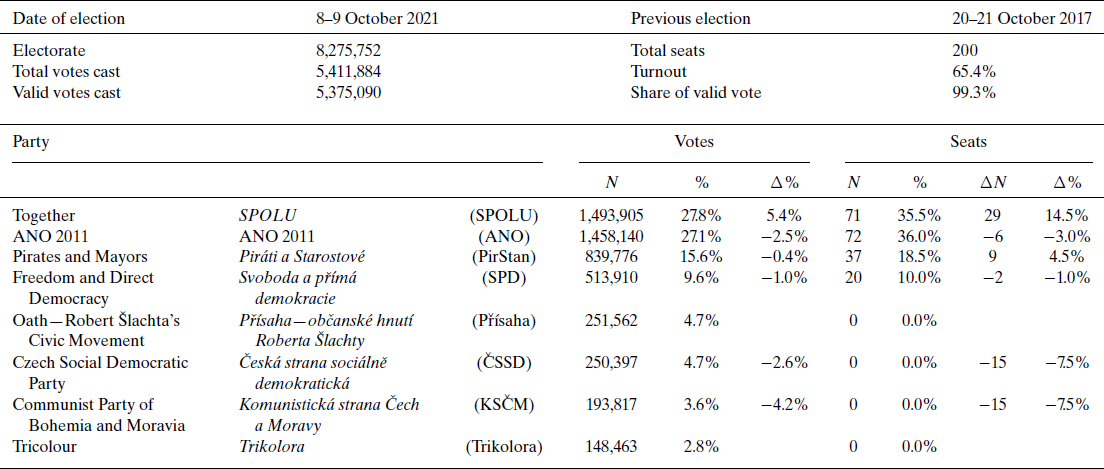
In October 2021, the Czech Republic held an election to the lower house of Parliament (Chamber of Deputies). The election saw a solid performance of two electoral alliances that were consequently able to form a government: SPOLU and Pirates and Mayors—itself an alliance between the Czech Pirate Party/Česká pirátská strana (Piráti) and Mayors and Independents/Starostové a nezávislí (STAN). ANO received the highest number of seats under the new electoral law enacted only a couple of months before the election. The last party to enter the Chamber of Deputies was the radical right Freedom and Direct Democracy/Svoboda a přímá demokracie (SPD), which received 9.6 per cent of the vote. Two historical left-wing parties (ČSSD and KSČM) received their worst election result, leaving them out of the Chamber of Deputies for the first time since 1993 when the Czech Republic was established.
Turnout in the 2021 parliamentary election was 65.4 per cent, 4.6 percentage points higher than in 2017. The campaign was unusually long because President Miloš Zeman decided to announce the election day on 28 December 2020 to ‘provide parties enough time for the campaign’ (Zeman Reference Zeman2020). Long campaigns could be problematic for smaller parties because of lower budgets for their campaign activities (Table 1).
Elections to the lower house of Parliament (Poslanecká sněmovna) in the Czech Republic in 2021

Notes: Together is an electoral alliance of three political parties (ODS, KDU-ČSL and TOP09). These parties ran separately in 2017 and jointly gained 22.4% of the votes in 2017.
Pirates and Mayors is an electoral alliance of two political parties (Czech Pirate Party and Mayors and Independents). These parties ran separately in 2017 and jointly gained 16.0% of the votes in 2017.
Přísaha was founded in 2021 and did not run in the 2017 general election.
Tricolour was founded in 2019 and did not run in the 2017 general election.
Sources: Czech Statistical Office (2021).
The consensus among Czech commentators was that the COVID-19 pandemic was not a strong campaign topic. Instead, the campaign was defined by the geostrategic orientation of the Czech Republic with particular attention to its cooperation with China and Russia, the economic situation, and a possible forthcoming economic recession, welfare spending, the housing situation, the fight against corruption and the controversy surrounding prime Minister Andrej Babiš who was accused of misusing European Union (EU) funds to benefit private companies he indirectly controls.
The position of the ANO party and its leader, Andrej Babiš, was also one of the main motivations for forming the two new election alliances: SPOLU and Pirates and Mayors. SPOLU was an electoral coalition consisting of three conservative parties: the ODS, TOP 09/TOP 09 and the Christian and Democratic Union–Czechoslovak People's Party/Křesťanská a demokratická unie–Československá strana lidová (KDU-ČSL). Petr Fiala (ODS) was the electoral leader and prospective prime minister of SPOLU. In contrast, Piráti and STAN formed a liberal coalition with two leaders: Vít Rakušan (STAN) and Ivan Bartoš (Piráti), who was also the prospective Prime Minister.
Immediately after the election, President Miloš Zeman announced he would offer Andrej Babiš, as leader of the political party securing the highest number of seats in the Chamber of Deputies, to form a government. However, SPOLU and Pirates and Mayors signed an agreement to exclude ANO from any future government negotiations. Therefore, Babiš’s attempts to discuss a possible cooperation were rejected by these parties. Unable to muster a majority, Babiš asked Zeman not to offer him the first attempt at government formation. As the leader of the biggest party of the most successful coalition, Petr Fiala was then tasked with forming a government, which he did based on mutual negotiations between the five parties contained in SPOLU and Pirates and Mayors.
While Piráti had expected immense electoral success based on pre-election public opinion polls, their result was perceived as highly disappointing. Besides obtaining a lower vote share than expected, they also received a low number of seats due to preferential votes heavily favouring their coalition partner STAN (four mandates Piráti versus 33 for STAN). Piráti blamed this result on massive disinformation campaigns and tendencies to promote preferential voting among STAN supporters (Aktualne.cz 2021a; Pirátská strana 2021).
Czech left-wing parties were the main losers of the 2021 election. ČSSD received 4.7 per cent of the vote and KSČM 3.6 per cent, leaving both parties outside the Chamber of Deputies. ČSSD was the incumbent governing party, and KSČM was a party supporting the minority government. While ČSSD was the main left-wing political party and played a central role in Czech politics since their electoral success in 1996, KSČM used to rely on the relatively stable, long-term support from older, less educated people on low incomes. According to experts, it was the ČSSD's participation in government (and the KSČM's support for the government) that contributed to their poor performance in the election (Aktualne.cz 2021b). Post-election analysis suggests that both parties lost a major share of their electorate to ANO (Český Rozhlas 2021c). ANO gradually shifted from the centre-right to the left, with a programme focused on increasing the role of the state in welfare, infrastructure and security (Rovny Reference Rovny2021). Unlike ANO, both ČSSD and KSČM failed to provide strong and trustworthy leaders.
A new party, Oath—Robert Šlachta's Civic Movement/Přísaha—občanské hnutí Roberta Šlachty (Přísaha), fell short of the 5 per cent threshold. Přísaha was founded in January 2021 and reached 4.7 per cent of the votes. The party was formed around Robert Šlachta, a former policeman and director of the abolished Unit for Combating Organized Crime. Their main topic was the fight against corruption and injustice.
Cabinet report
In 2021, the Cabinet of Andrej Babiš experienced several changes. Following the October Chamber of Deputies election, a new Cabinet was formed.
Babiš II Cabinet
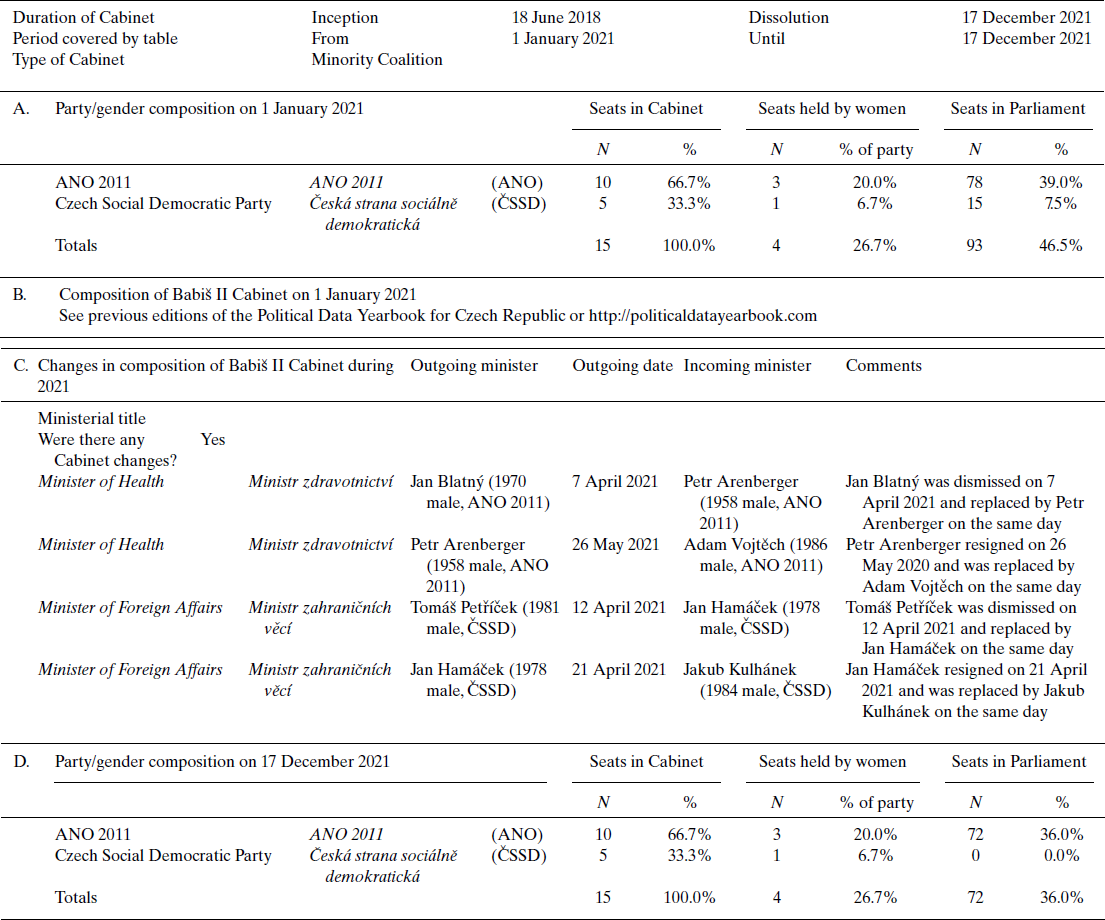
Four members of Babiš’s Cabinet were replaced during the year: the Minister of Health and the Minister of Foreigner Affairs were both changed twice. Minister of Health Jan Blatný (ANO) was dismissed on 7 April 2021. In his last press conference, Blatný stressed that one of the reasons for his dismissal was his refusal to allow vaccination with the unregistered Sputnik vaccine, which President Miloš Zeman advocated. Blatný was replaced by dermatologist Petr Arenberger (ANO), who used to be head of Královské Vinohrady Hospital. However, Arenberger was forced to resign less than two months after his inauguration because he failed to declare ownership of several properties in his asset declaration. In reaction to Arenberger's resignation, Prime Minister Andrej Babiš announced that Adam Vojtěch (ANO), who had been in post between 13 December 2017 and 21 September 2020, was set to return to the position of Minister of Health (Table 2).
Cabinet composition of Babiš II in the Czech Republic in 2021

Source: Government of the Czech Republic website (2021).
The other two changes in government took place at the Ministry of Foreign Affairs, where Tomáš Petříček (ČSSD) was temporarily replaced by Jan Hamáček (ČSSD). The dismissal of Petříček was a reaction to losing a bid for party leadership over Hamáček. Hamáček requested Petříček to resign because he was critical of the presence of the ČSSD in government with ANO. Hamáček temporarily took over the portfolio of the Ministry of Foreign Affairs and then offered the position to Lubomír Zaorálek (ČSSD), who at the time served as Minister for Culture. However, Zaorálek refused to change posts. Consequently, Jakub Kulhánek, who previously served as Deputy Interior Minister, was appointed Minister of Foreign Affairs on 21 April 2021.
Fiala I Cabinet
President Zeman gave his formal approval to Petr Fiala (ODS) to form a new government on 9 November. Fiala secured the signatures of other coalition parties’ leaders to establish a government following the 2021 general election. The number of ministers assigned to each party was a result of several negotiations between party leaders Fiala, Marian Jurečka (KDU-ČSL), Markéta Pekarová Adamová (TOP09), Vít Rakušan (STAN) and Ivan Bartoš (Piráti).
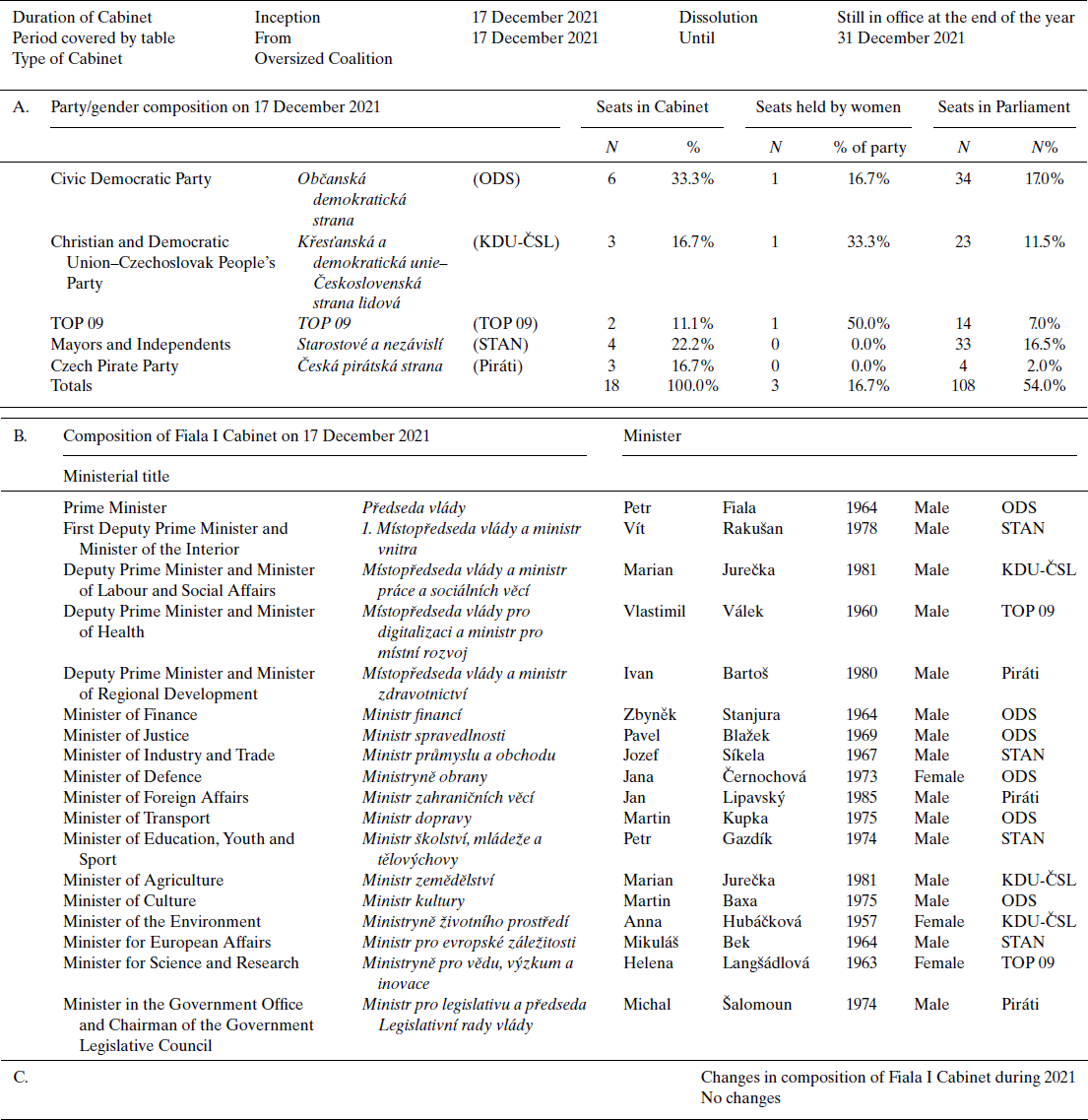
Some members of the Piráti questioned the party's participation in government because they perceived the electoral result as disappointing and unfair (concerning the distribution of seats between Piráti and their coalition partner, STAN). Although Piráti had a deal with STAN to avoid personalized campaigns and promote their candidates for preferential voting, Piráti received only four mandates (29 fewer than STAN and 18 fewer than in the previous parliamentary election of 2017). This result meant the Pirates were not needed for forming a government, and several party members questioned if they should join the Cabinet at all. However, 82 per cent of Piráti party members approved their government participation in an internal party ballot (Table 3).
Cabinet composition of Fiala I in the Czech Republic in 2021

Source: Government of the Czech Republic website (2021).
The new government consists of 18 ministers: six represent ODS, four STAN, three KDU-ČSL, three Piráti and TOP09 obtained two ministers. President Miloš Zeman opposed appointing Jan Lipavský (Piráti) as Minister of Foreign Affairs. He argued that Lipavský lacked the necessary experience for such a job; however, after a series of negotiations with Petr Fiala, Zeman agreed with the nomination. By the end of 2021, the oversized government of Fiala had not attempted to obtain a vote of confidence in the Chamber of Deputies.
Parliament report
The COVID-19 pandemic significantly influenced the workings of the Chamber of Deputies in 2021. Several MPs caught the virus (and one MP died) and many had to enter quarantine. There was a general agreement among political parties throughout 2021 that only half of the MPs would attend Chamber meetings to slow the spread of the virus. Two independent MPs (Lubomír Volný and Marian Bojko, both originally from SPD) repeatedly refused to wear mandatory face masks in the Chamber, resulting in conflicts between them and other MPs (one of these conflicts ended in physical aggression in the Chamber when Volný attacked Tomáš Hanzel from ČSSD).
Five MP changes occurred before the October 2021 election and one after the election. Miroslav Kalousek (1960 male, TOP09), who served twice as Minister of Finance and had been an MP since June 1998, resigned from his mandate in January. Kalousek, one of the most influential and controversial Czech politicians, decided to leave politics and not to run in the October election. He was replaced by Jan Jakob (1982 male, TOP09). Having violated government measures against COVID-19 in January, Milan Hnilička (1973 male, ANO) resigned from his seat and was replaced by Miroslav Samaš (1966 male, ANO). Jiří Ventruba (1950 male, ODS) died of COVID-19 after being hospitalized with the virus for several days in March. He was replaced by Libor Hoppe (1962 male, ODS). Ilona Mauritzová (1959 female, ODS) became a regional council leader (hejtman) in Pilsen in November 2020 and decided to step down as an MP. After complications with finding a substitute (as three alternative nominees either did not want or could not take the MP seat), she resigned and was replaced by Pavel Šindelář (1980 male, ODS) in March 2021. Following accusations of sexual assault by several women, Dominik Feri (1996 male, TOP09) stepped down in May. Feri, the youngest elected member of the lower house and a social media celebrity, withdrew himself from politics entirely and was replaced by Olga Sommerová (1949 female, Liberal Environmental Party). Radim Holiš (1975 male, ANO), who was last on the party list in the Zlín region, got elected by preferential vote in the October election. After being sworn in October, he resigned from his MP seat in November claiming he wanted to focus solely on his role as regional council leader in Zlín. He was replaced by Margita Balaštíková (1967 female, ANO).
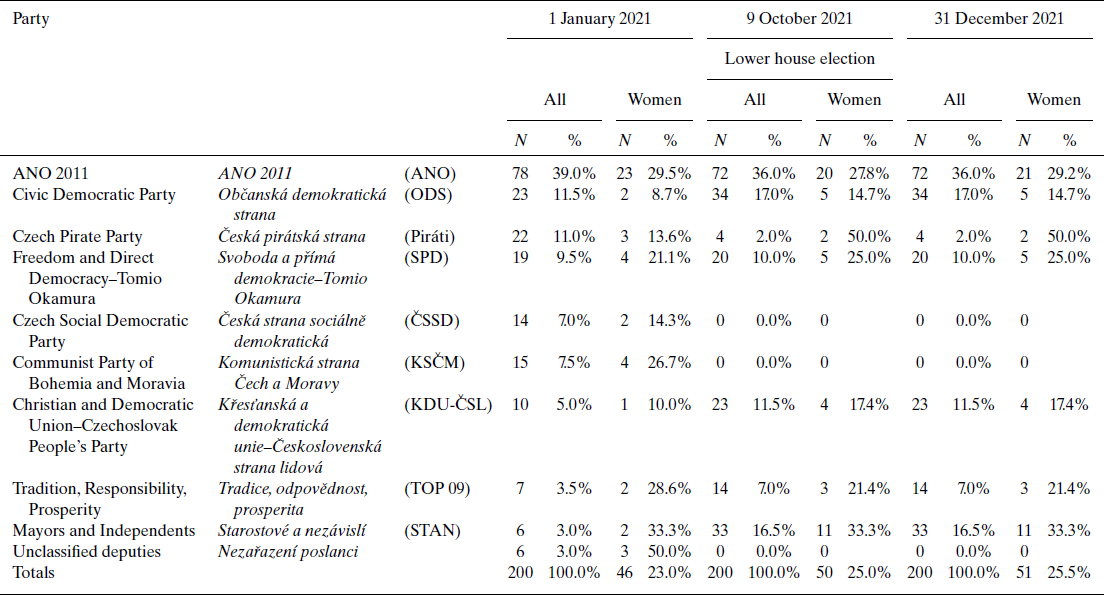
The October 2021 election resulted in seven parties securing seats in the Chamber of Deputies. As the main opposition party, ANO has the largest group of 72 MPs. On the other hand, with only four MPs the Pirates constitute the smallest parliamentary party group, and the smallest group formed after a general election since the establishment of the Czech Republic in 1993 (Table 4).
Party and gender composition of the lower house of Parliament (Poslanecká sněmovna) in the Czech Republic in 2021

Notes: ČSSD did not cross the electoral threshold in the 2021 general election.
KSČM did not cross the electoral threshold in the 2021 general election.
Source: Czech Chamber of Deputies (2021).
Markéta Pekarová Adamová (1984 female, TOP09) was elected as Speaker of the Chamber of Deputies on 10 November 2021 (by gaining 102 out of 122 votes). Věra Kovářová (1964 female, STAN) was elected the first vice-speaker. Four other vice-speakers were elected on 10 November 2021: Jan Bartošek (1971 male, KDU-ČSL), Jan Skopeček (1980 male, ODS), Olga Richterová (1985 female, Piráti) and Jana Mračková Vildumetzová (1973 female, ANO). The position of sixth and final vice-speaker was contested by Radek Vondráček, the former Speaker of the Chamber of Deputies, and Tomio Okamura, the former vice-speaker of the Chamber of Deputies (both held these posts between November 2017 and October 2021). However, as the MPs of the government majority in the Chamber refused to support these candidates on two occasions, the sixth vice-speaker position remained vacant for the rest of 2021.
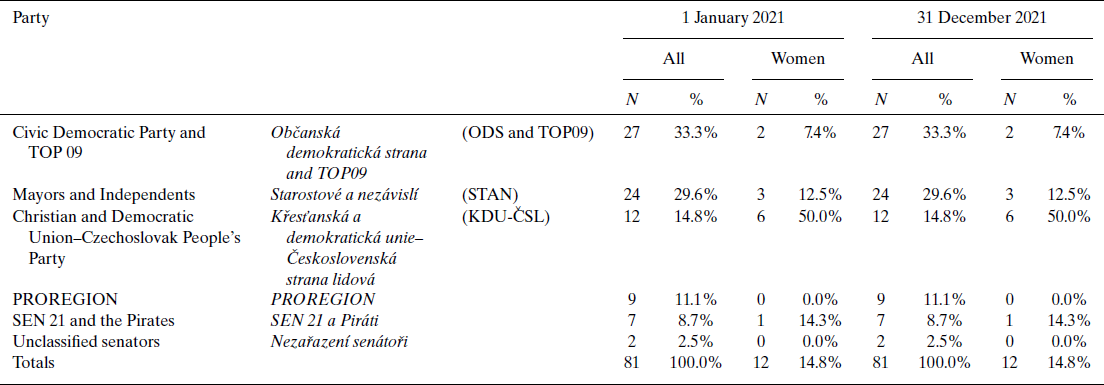
No personal changes happened in the upper house of Parliament (Senát) during 2021. Therefore, party and gender composition during 2021 remained the same as on 31 December 2020 (Table 5).
Party and gender composition of the upper house of Parliament (Senát) in the Czech Republic in 2021

Note: After the October 2020 Senate election, ANO and ČSSD had formed the PROREGION party group (by merging their remaining Senators from their former party groups).
Source: Czech Senate (2021).
Political party report
Four parliamentary parties held general conferences in 2021. Two of these confirmed the previous party leadership. Vít Rakušan (1978 male, STAN) was re-elected as the leader of STAN in August. In November, Markéta Pekarová Adamová (1984 female, TOP09) was confirmed as the leader of TOP09 following her electoral success. Neither Rakušan nor Pekarová Adamová faced any challenger at the respective party conferences.
The Social democrats held two general conferences in 2021. Jan Hamáček (1978 male, ČSSD) was re-elected as the leader of the junior government partner ČSSD in April. Hamáček, Minister of the Interior, beat Foreign Minister Tomáš Petříček (1981 male, ČSSD). Following his loss to Hamáček, Petříček was dismissed as Foreign Minister just three days after the conference. After failing to pass the election threshold in the October election for the first time since the establishment of the Czech Republic in 1993, Hamáček resigned from his party leadership post. The second general conference was held in December 2021. Michal Šmarda (1975 male, ČSSD) was elected as new leader of ČSSD after beating the former Minister of Labour and Social Affairs, Jana Maláčová (1981 female, ČSSD) (Table 6).

Vojtěch Filip (1955 male, KSČM), KSČM leader since 2005, resigned immediately after it was confirmed that the Communist Party had failed to gain any seats in the October general election. Two weeks after this historic election loss, the direct successor of the former ruling Communist Party of Czechoslovakia held a special conference. MEP Kateřina Konečná (1981 female, KSČM) was elected as new leader of KSČM.
Institutional change report
Following a filing by a group of Senators, the Constitutional Court of the Czech Republic repealed several sections of the electoral law governing the election to the Lower Chamber. In particular, the Constitutional Court repealed the D'Hondt electoral formula for distributing seats among political parties within the 14 constituencies. The court argued that the D'Hondt formula violated the principles of equality of votes and equal chances of political parties running in election (Constitutional Court 2021). Political parties in low-population constituencies would have to gain significantly higher shares of votes per seat than in high-population constituencies. The D'Hondt formula and constituency population size significantly disadvantaged small political parties that would not gain any seats in low-population constituencies. Furthermore, the Constitutional Court repealed the electoral threshold of 10 per cent, 15 per cent and 20 per cent of total valid votes for electoral coalitions of two, three and four political parties, respectively.
After the February judgement of the Constitutional Court, the Czech Parliament had only a couple of months to enact electoral law changes before the October lower house election. In April, the lower house enacted a new mechanism for seat assignment (law number 189/2021 Sb.). Based on the number of valid votes cast in 14 constituencies, 200 seats are distributed among the constituencies. The assignment of mandates to parties/coalitions is a two-stage process. The first stage distributes mandates within constituencies. The Imperiali quota is used to determine the minimum number of votes required to gain a seat in a constituency. The second stage pools all seats not assigned during the first stage into a single constituency of the entire Czech Republic. The remaining seats are distributed among political parties/coalitions at the national level using the Hagenbach–Bischoff quota. These seats are then allocated to those constituencies where the electoral party/coalition had the largest remainder of the votes (after the first stage). In the October election, this new two-stage mechanism caused the winning coalition SPOLU to gain one seat fewer than ANO, which obtained 0.67 percentage points fewer votes than SPOLU (whereas under the original D'Hondt formula, SPOLU would have gained one more seat than ANO in 2021). Furthermore, law number 189/2021 Sb. also specified that the election threshold for a coalition of two parties is 8 per cent of total valid votes, and electoral coalitions of more than two parties must gain 11 per cent of total valid votes.
Issues in national politics
Several of the key issues in Czech politics during 2021 were discussed in all of the above sections (see Election report, Cabinet report, Parliament report, Political party report and Institutional change report). Apart from issues related to the COVID-19 pandemic and the 2021 general election, the focus of national politics was mainly on President Miloš Zeman and Czech–Russian relations.
At a press conference on 17 April, Prime Minister Andrej Babiš announced there was reasonable suspicion that Russia was involved in the Vrbětice explosions in 2014. The Czech secret service reported a connection between two agents of the Russian secret service GRU and the explosions of ammunition depots in Vrbětice. As a reaction to this reveal, the government announced it would be expelling 14 diplomats and four other employees of the Russian embassy whom Czech intelligence services identified as officers of the Russian secret services, and Russia would be excluded from the tender for completing the nuclear power plant in Dukovany. In contrast to most Czech politicians, Miloš Zeman questioned the work of the Czech secret service and the Russians’ involvement in the Vrbětice incident.
Additionally, it turned out that Jan Hamáček, Minister of Foreign Affairs at that time, was planning to visit Moscow, even though he already had the information about the Vrbětice investigation. There was a strong suspicion that he intended to make a deal with Russian in exchange for covering up the Vrbětice incident (Seznam Zprávy 2021a). Although Hamáček rejected these accusations, the affair negatively affected his career and possibly weakened the position of ČSSD before the upcoming election.
In 2021, concerns regarding President Miloš Zeman's health condition grew. He started to use a wheelchair regularly due to his neuropathy diagnosis, and he reduced the frequency of his public appearance. Zeman cancelled a planned television interview that was supposed to take place after the election, and several days later, on 10 October, an ambulance escorted him to hospital. The President's office declared he was suffering from dehydration and exhaustion and refused to comment on his condition in more detail. Zeman was hospitalized in the intensive care unit, and along with the lack of information, there was public concern about whether he would be able to fulfil his presidential duties. The President's role is essential in the aftermath of elections because s/he meets the prospective Prime Minister, ministerial candidates and, most notably, sets the official start date of the newly elected Chamber of Deputies. In response to the uncertain situation, Senate speaker Miloš Vystrčil (ODS) requested information from the hospital. The response stated Zeman was unable to work, and it was unlikely he would be able to return within the next few weeks. Therefore, Vystrčil announced a discussion regarding the activation of Article 66 of the Constitution, which would mean transferring the President's powers to the Prime Minister and the speaker of the Chamber of Deputies until he could return to work. However, Article 66 was not activated as Zeman was released from hospital after 1.5 months.


 Open access

