1 English-Medium University Spaces and Decoloniality
I’d comment on the learning materials. The illustrations were of White children braving weather conditions that would never occur near the equator. We branded a mistake any usage that might hint a Hongkonger was from Hong Kong
In Naoise Dolan’s (Reference Dolan2020) debut novel, ‘Exciting Times’, Ava, an Irish English teacher living in Hong Kong, finds herself questioning many aspects of her English language school. Ava problematises the promotion of standardised BANA (British, Australian, and North American) English over localised varieties, and she interrogates the cultural biases found in teaching materials, which centre English as a proxy for Whiteness and the ‘Global North’. Throughout the novel, sharp observations and criticality are employed to draw attention to the uneven power dynamics attached to language use in postcolonial educational settings. Using such observations as a springboard for exploring English-medium university spaces, this Element discusses key concepts such as the colonial legacy of unequal Englishes, linguistic hierarches in English-medium education in multilingual university settings (EMEMUS), neoliberal ideologies, current approaches to linguistic landscaping (LL), and debates around decoloniality. Empirical data from a walking ethnography of a university educationscape in Abu Dhabi, United Arab Emirates (UAE) are analysed along with Emirati university students’ (n = 28) perspectives on their educationscape via a virtual bulletin board. Findings, implications, and practical decolonial steps are discussed with reference to a range of global contexts.
1.1 Educationscapes in EMEMUS
In De Graff’s (Reference DeGraff and Macedo2019) preface to Macedo’s book ‘Decolonizing foreign language education’, there is a prominent call for more critical approaches to English-medium education (EME). As DeGraff (Reference DeGraff and Macedo2019) states, even more pressing than challenging coloniality in foreign language teaching is the urgent need to decolonise schooling systems, ‘where the very medium of education is a foreign language’ (p. xii). Approximately 40 per cent of the world’s population are being educated in a language which is not their first (UNESCO, 2016; Walter & Benson, Reference Walter, Benson and Spolsky2012), and in most cases this language is a colonial language. The most common second language used as a medium of instruction is English (EMI), which is rapidly growing worldwide (Lasagabaster, Reference Lasagabaster2022; Macaro, Reference Macaro, Bolton, Botha and Lin2024; Richards & Pun, Reference Richards and Pun2022; Sah, Reference Sah2022).
English-medium instruction is commonly defined as ‘the use of the English language to teach academic subjects (other than English itself) in countries or jurisdictions where the first language of the majority of the population is not English’ (Macaro, Reference Macaro2018, p. 1). Willans (Reference Willans2022) explains that EMI in higher education generally falls into two categories: ‘old EMI universities’ and ‘new EMI universities’. The former are in postcolonial countries where typically education has only ever been available through the language of the former colonisers, and the latter are universities which have followed the neoliberal-evoked ‘scramble’ (Willans, Reference Willans2022) for, or ‘stampede’ (Lanvers, Reference Lanvers2024) towards, EMI.
Although EMI is the most common term in the literature, in this Element, I use ‘EME’ for ‘English-medium education’ (Dafouz et al., Reference Dafouz, Huettner, Smit, Nikula, Dafouz, Moore and Smit2016), to acknowledge that English does not exist only within classroom walls or for instruction, but rather in whole university ecosystems. Dafouz et al. (Reference Dafouz, Huettner, Smit, Nikula, Dafouz, Moore and Smit2016) argue that the term EMEMUS is particularly accurate in describing many global university ecosystems. This term offers a focus on the broader educational experience, including research cultures, epistemologies, and representation of languages throughout multilingual university spaces. The representation of languages and semiotics in a school is often referred to as its ‘schoolscape’ (Brown, Reference Brown, Marten, Gorter and van Mensel2012), which is ‘the school-based environment where place and text, both written (graphic) and oral, constitute, reproduce, and transform language ideologies’ (p. 282). Krompák et al. (Reference Krompák, Fernández-Mallat, Meyer, Krompák, Fernández-Mallat and Meyer2022) expand the concept of schoolscapes to include not only schools but also universities, colleges, and other educational spaces, by using the term ‘educationscape’, which is a portmanteau of ‘education’ and ‘landscape’.
While the growth of EME and EMI is often presented as a given or ‘an unstoppable train’ (Macaro, Reference Macaro2018), critical applied linguists have questioned the colonial forces of linguistic imperialism that spurred the global spread of English (Phillipson, Reference Phillipson1992), contemporary power structures, and the cultural politics behind the global dominance of English (Pennycook, Reference Pennycook2021; Skutnabb-Kangas, Reference Skutnabb-Kangas2000). Strongly connected to the growth of EME are neoliberal ideologies, norms, and expectations, which emphasise competitiveness with regard to both universities and individuals. The spread of English in universities is embedded in the political-economic structures that sustain globalisation and neoliberalism. Here, the global spread of English operates as part of a system of linguistic commodification, where language proficiency becomes a form of symbolic and economic capital. Foucault’s (Reference Foucault, Burchell, Gordon and Miller1991) concept of governmentality has been used to describe how individuals internalise norms and expectations to the point where they self-manage themselves under the same mentalities pushed forward by governments. In the case of neoliberalism, these mentalities centre around efficiency, competitiveness, self-optimisation, and economic gain (Martin Rojo & Del Percio, Reference Martín Rojo and Del Percio2020). Here, neoliberal ideologies and subjecthood create entrepreneurial learners whose primary motivation for embracing English is as a marketable asset, a form of personal capital, and a means of social mobility (De Costa et al., Reference De Costa, Park and Wee2021). Critical applied linguists also problematise the phenomenon of ‘unequal Englishes’ (Tupas, Reference Tupas2015), where the ‘E’ in EME symbolises ‘Elitism’ (Kuteeva, Reference Kuteeva2023; Kuteeva & Kaufhold, Reference Kuteeva and Kaufhold2024) and where certain Englishes are more valued than others (Dovchin, Reference Dovchin2022; Tupas, Reference Tupas2015). While the legacy of colonialism is particularly apparent in former colonies such as Hong Kong, it is also present in regions without a formal history of colonialism, such as the UAE. Current phenomena such as globalisation, neoliberalism in internationalised educational institutions, and associated linguistic capital equated with certain forms of English, are tied to the broad legacy of colonialism and affect contexts beyond former colonised nations.
The postcolonial legacy of unequal Englishes (Tupas, Reference Tupas2015), linguistic imperialism (Phillipson, Reference Phillipson1992), so-labelled ‘native English-speaker teacher’ biases (Holliday, Reference Holliday2006, Reference Holliday, Galloway and Selvi2025), and White epistemological supremacy (Alqahtani, Reference Alqahtani2024; Gerald, Reference Gerald2020; Meighan, Reference Meighan and Sardoč2024) combine in various configurations to shape stakeholders’ educational, social, and emotional experiences within EMEMUS. With native-speakerism comes the belief that not only are ‘native English-speaker teachers’ the ideal language teachers but also ‘Western methodologies and teaching technologies become more desirable within a native-speakerist paradigm’ (Zheng & Lawrence, Reference Zheng and Lawrence2023). Such ideologies result in ‘centre qualification bias’ (Lowe, Reference Lowe2015), which leads hiring committees to place greater value on degrees awarded from Anglophone or Western institutions (Hopkyns, Reference Hopkyns, Hemmy and Balasubramanian2022a; Ortega, Reference Ortega2021; Piller, Reference Piller2022). This, in turn, leads to the perpetuation of Western pedagogical styles and epistemologies together with Orientalism (Said, Reference Said1978) seen through a ‘native-speakerist “moral mission” to bring a “superior” culture of teaching and learning to students and colleagues who are perceived not to be able to succeed on their own terms’ (Holliday, Reference Holliday2006, p. 386). Despite scholarly and advocacy efforts to promote equality and social justice within EME, the native-speaker fallacy remains a ‘ghost in the machine’ (Cook Reference Cook2016, p. 187) which intersects with ‘the racialisation of English’ (Aneja, Reference Aneja2016) and ‘race-related privileges’ for White teachers in English-medium settings (Alqahtani, Reference Alqahtani2024; Ortega, Reference Ortega2021).
Neoliberal expectations for the use of standardised BANA Englishes in EME higher education have led to the commodification of certain varieties of English over others. Standardised English has become ‘thingified’ as ‘a noun rather than a verb’ (Pennycook & Makoni, Reference Pennycook and Makoni2007) and equated with ‘usefulness’ and ‘value’ (Li & Kelly-Holmes, Reference Li, Kelly-Holmes, Blackwood and Røyneland2022, pp. 17–18). In this sense, English has been likened to a credit card (Manan, Reference Manan2021), which provides affordances and opens doors. Neoliberal ideologies, which focus on the Western trappings of success and individualism, emphasise English as a way of being part of the global elite (Gross, Reference Gross2023). Ideologies surrounding EME point to a ‘future and community orientation’ (Yuan et al., Reference Yuan, Zhang and Li2023, p. 534) where students see English as something worth sticking with despite hardships. Not only EME but higher education itself is also often considered an object to be ranked in the neoliberal market, with English as an academic lingua franca serving to demonstrate an institution’s provision of a global space (Choi et al., Reference Choi, Tatar and Kim2019). Here, ‘global’ or ‘international’ are often used as synonyms for ‘English’, ‘English-medium’, or ‘English-dominant spaces’ (Block & Khan, Reference Block and Khan2021).
1.2 Beyond Lingua-Centric Approaches to Linguistic Landscaping
The current study takes a LL approach to the analysis of a UAE university educationscape. Landry and Bourhis’s (Reference Landry and Bourhis1997) original definition of linguistic landscapes as the ‘visibility and salience of languages on public and commercial signs’ (p. 23) has expanded to incorporate ‘semi-public’ spaces (Gorter, Reference Gorter2018, p. 81) such as government buildings, museums, hospitals, and educational institutions, as well as online spaces. However, the most investigated LLs continue to be those of public spaces such as city streets (Cook, Reference Cook2022) or markets (Blackledge & Creese, Reference Blackledge and Creese2019), also referred to as ‘urban linguistic landscapes’ (Barni & Bagna, Reference Barni, Bagna, Blackwood, Lanza and Woldemariam2016) or ‘publicscapes’ (Antoniou et al., Reference Antoniou, Carraz, Hadjichristou and Tourvas2019). In the Gulf countries, previous LL studies have concentrated on publicscapes such as souks / markets (Karolak, Reference Karolak2020), malls, metro stations, and streets (Ahmed, Reference Ahmed, Siemund and Leimgruber2021; Piller, Reference Piller, Smakman and Heinrich2018), and event-related LLs such as COVID-scapes (Gu, Reference Gu2023a; Hopkyns & van den Hoven, Reference Hopkyns and van den Hoven2022; Lacsina & Yeh, Reference Lacsina and Yeh2022), the LL of EXPO 2020 in Dubai (Fadhillah & Triwinarti, Reference Fadhillah and Triwinarti2023), and the LL of the FIFA World Cup (Hillman & Ahmad, Reference Hillman, Ahmad and Gallagher2025).
1.2.1 Broad Semiotics, Intertextual Products, and Belonging
Recent LL research has moved away from lingua-centric studies, which focus primarily on visualised language on signs in public spaces, towards an expanded semiotic perspective on landscape and space, looking at ‘broad semiotics’ (Shohamy & Pennycook, Reference Cook2022, p. 32). Multisensory semiotic modes of meaning include the analysis of ‘sensescapes’ (Prada, Reference Prada2024), which often incorporate meanings communicated through modes other than written language. This could include objects such as sculptures (Jaworski, Reference Jaworski2015) and soundscapes such as conversations overheard in a space (Blackledge & Creese, Reference Blackledge and Creese2019) and other types of audio messages like the Adhān – Islamic call-to-prayer (Hurley & Elyas, Reference Hurley and Elyas2024). Broad semiotics also include communication through touch, such as braille (Dagenais et al., Reference Dagenais, Moore, Sabatier, Lamarre, Armand, Shohamy and Gorter2008), ‘smellscapes’ (Pennycook & Otsuji, Reference Pennycook and Otsuji2015; Porteous, Reference Porteous1985), and ‘signs in transit’ on transport or clothing (Sebba, Reference Sebba, Jaworski and Thurlow2010), as well as other non-logo-centric communication via images, size, positioning, and colour. In this sense, analysis of educationscapes includes viewing semiotic and linguistic landscapes as ‘intertextual products’ (Choi et al., Reference Choi, Tatar and Kim2019) which connect with stakeholders’ experiences on a multitude of levels, and which relate to belonging in the space.
The concept of belonging is broad and under-theorised (Antonsich, Reference Antonsich2010; Elabdali, Reference Elabdali2024). Slaby and von Scheve (Reference Slaby, von Scheve, Slaby and von Scheve2019) define belonging as a sense of attachment that is constructed in relation to multiple interconnected dimensions. Elabdali (Reference Elabdali2024) states that cultural, social, and political belonging are distinct but also interrelated. Cultural belonging relates to positioning in connection with a group’s knowledge, beliefs, practices, heritage, and ancestry. Social belonging relates to group membership, affinity and community, and political belonging is about the right to participate in conversations about community, society, and the nation. Recent discourse around the concept of belonging emphasises the ‘spatial, material, and affective dimensions of belonging’ (Elabdali, Reference Elabdali2024, p. 58). In exploring notions of belonging in university spaces, there is a need to go beyond established social categories and consider embodied experiences, objects, artefacts, and material cultural productions (Youkhana, Reference Youkhana2015), which include language and broad semiotics in the LL as they relate to emotions. As Milani and Richardson (Reference Milani and Richardson2021) point out ‘affect “circulates” through semiosis’ (p. 675). With both the ‘affective turn’ (Pavlenko, Reference Pavlenko, Gabryś-Barker and Bielska2013) and increased attention on posthumanism in applied linguistics research (Hopkyns, Reference Hopkyns2025c; Kebabi, Reference Kebabi2024), it is recognised that objects acuminate meaning over time and can actively shape social dynamics (Izadi, Reference Izadi2025). Emotions and levels of (un)belonging related to language and objects in spaces are entangled with identities, societal and geopolitical dynamics, ideologies, and experiences (Sah, Reference Sah2023).
1.2.2 Stakeholder Perspectives and Educational Possibilities in LL Studies
A further development in LL studies can be seen through a greater emphasis on stakeholder perspectives and educational possibilities. It is recognised that actively involving stakeholders such as teachers and students in LL research provides sites for language learning and critical awareness of multilingualism in educational spaces and the wider environment (Andrade et al., Reference Andrade, Martins, Simões and Melo-Pfeifer2023; Marshall et al., Reference Marshall, Al Hannash, Mayni, Gorter and Krompák2024). LL studies have moved away from structuralist or descriptive approaches, where one piece of text has one meaning. Rather, the importance of ethnographic approaches is recognised, whereby the context of the sign, the social, political, and cultural history of the place / institution, intended audience, and reactions of those passing by are important to analyse (Malinowski, Reference Malinowski, Shohamy and Gorter2009). Rather than describing only the content of signs, Scollon and Scollon (Reference Scollon and Scollon2003) stress the importance of nexus analysis as an analytical lens. Nexus analysis goes beyond lingua-centrism or ‘logocentrism’ (Canagarajah & Minakova, Reference Canagarajah and Minakova2022) by applying a tripartite focus on: (1) interaction order; (2) discourses in place; (3) historical body (Hult, Reference Hult2014; Scollon & Scollon, Reference Scollon and Scollon2004). These three elements combine to ‘mediate a social action’ (Hult, Reference Hult2014, p. 512) such as creating or displaying signage (see Section 1.6 for a more detailed account of nexus analysis).
Placing greater emphasis on the role individuals play in constructing ‘networks of meaning in space’ (Krompák, Reference Krompák, Krompák, Fernández-Mallat and Meyer2022, p. 149) also signifies a move from descriptive approaches. Here, Lefebvre’s (Reference Lefebvre1974) seminal theory of social space is relevant, where social groups (such as students) actively contribute to producing their own spaces on three levels: perceived space, conceived space, and lived space. Perceived space embodies spatial practices whereby people decipher or perceive the space. Conceived space reflects how people plan or conceive a space through verbal representation of space, and lived space reflects what a space represents to different people in terms of emotions and how they use the space, which embodies non-verbal symbols and signs (Lefebvre, Reference Lefebvre1974, pp. 38–39). Here, in line with the ‘spatial turn’ (Higgins, Reference Higgins and Canagarajah2017) in social sciences, beginning in the 1970s, it is understood that language practices need to be viewed as spatial practices, with ‘spatialisation of LLs’ viewed as both dynamic and socially constructed (Jaworski & Thurlow, Reference Jaworski and Thurlow2010). The humanistic ‘construction of place perspective’ has an emphasis on the human transformation of empty space into meaningful place (Tuan, Reference Tuan1977). Rather than space being a container for language, ‘space is the ongoing construction of human activity and practices’ (Higgins, Reference Higgins and Canagarajah2017, p. 102).
1.2.3 Bridging the Research Gap
While much previous research in EME settings has focused on teaching and learning in classrooms and attitudes from stakeholders towards the medium of instruction, less attention has been given to language use in university spaces outside classrooms, such as ‘third places’ and ‘connecting spaces’. Libraries, cafés, and sports centres are examples of what Oldenburg (Reference Oldenburg1997) calls ‘third places’ as they differ from the home (first place) and the workplace / classroom (second place). Corridors and hallways are seen as ‘interstitial conduits of public and private life’ (MacKay, Reference MacKay2020), which connect (semi) private spaces such as offices and classrooms with social spaces where students gather. Third places together with classrooms, and the language and semiotics represented in such spaces, constitute an ‘educationscape’ (Krompák et al., Reference Krompák, Fernández-Mallat, Meyer, Krompák, Fernández-Mallat and Meyer2022).
Most previous research on educationscapes to date has tended to look at primary and secondary schools in a range of global contexts such as Uganda (Adoko et al., Reference Adoko, Ssentanda, Asiimwe, Gorter and Krompák2024), Philippines (Astillero, Reference Astillero2017), Japan (Oyama et al., Reference Oyama, Moore, Pearce and Melo-Pfeifer2023), and Indonesia (Eliawati et al., Reference Eliawati, Ngadiso and Putra2024), but especially in Anglophone and European nations such as Canada (Liu & Dressler, Reference Liu and Dressler2024), New Zealand (Seals, Reference Seals, Malinowski, Maxim and Dubreil2020), USA (Troyer, Reference Troyer, Dubreil, Malinowski and Maxim2023), Basque region of Spain (Gorter & Cenoz, Reference Gorter, Cenoz, Spolsky, Tannenbaum and Inbar2015), Estonia (Brown, Reference Brown, Marten, Gorter and van Mensel2012), Malta (Grima, Reference Grima, Gorter and Krompák2024), Romania (Biró, Reference Biró2016), Sweden (Sullivan et al., Reference Sullivan, Waldmann, Wiklund, Krompák, Fernández-Mallat and Meyer2022), and Switzerland (Krompák et al., Reference Krompák, Grima and Farrugia2020). Fewer LL studies have taken place in EMEMUS (Dafouz et al., Reference Dafouz, Huettner, Smit, Nikula, Dafouz, Moore and Smit2016), especially outside WEIRD (Western, Educated, Industrialised, Rich, Democratic) contexts (Henrich et al., Reference Henrich, Heine and Norenzayan2010). Existing university-based educationscape studies in Asia and Africa have tended to look at context-specific landscapes related to topics such as psychological health service posters (Huang, Reference Huang, Krompák, Fernández-Mallat and Meyer2022), student activism (De Wilde et al., Reference De Wilde, Verhoene, Tondeur, Van Praet, Krompák, Fernández-Mallat and Meyer2022), academic branding (Hillman, Reference Hillman2025), and hidden curriculums (Bernardo, Reference Bernardo2021). As universities vary considerably based on geopolitical, cultural, and historical factors, the UAE, as an under-researched EME-dominant context, is important to explore. This is especially the case considering the prevalence of EME in the UAE. To the best of my knowledge, there has not yet been a published study on a university educationscape in the context of the UAE, making this the first. The Element aims to bridge a gap in the knowledge base in four ways: First, the current study investigates an English-medium university educationscape in the under-researched context of the UAE. Second, the study uses decoloniality as a lens through which to analyse an educationscape outside the ‘Global North’. Few previous studies have directly applied a decolonial lens to the analysis of multilingual university spaces, with the exception of Marshall et al.’s (Reference Marshall, Al Hannash, Mayni, Gorter and Krompák2024) study in a Canadian university. Third, the Element advances knowledge about linguistic landscapes by applying a novel combination of participant-centred participatory methodologies, including a walking ethnography with stakeholder insights, and gaining student perspectives via a multimodal virtual bulletin board. This combination of data collection methods is decolonial in design by centring participant voices and perspectives (see Section 1.4.2 for more on decolonial methodologies). Finally, the Element explores decoloniality in EME contexts in and beyond the UAE study (in all sections, especially Sections 1 and 5) by foregrounding historical and current debates surrounding wider decolonial movements and by providing practical decolonial steps which can be contextually adapted for a range of global settings.
1.3 Decolonial Movements and Debates
Many possible lenses could be applied to a study on educationscapes in English-medium universities. A prominent legacy of colonialism is the power of English as a colonial language, which has turned into a global language. Specifically, the power of standardised English associated with Western Anglophone countries, which is also racialised, is seen through representation in educational spaces and ‘native speaker’ hiring biases (Alqahtani, Reference Alqahtani2024; Hopkyns, Reference Hopkyns, Hemmy and Balasubramanian2022a). Not only in the Hong Kong language school described in this Element’s opening quote (Dolan, Reference Dolan2020), but in other educational contexts where English is used as a mandatory foreign language or as a medium of instruction, the legacy of colonialism continues to impact education. Coloniality is construed as how power relations and attitudes to knowledge formed in colonial times continue to influence knowledge production in postcolonial times (Mignolo & Walsh, Reference Mignolo and Walsh2018). The legacy of colonialism, or coloniality, also leaves its mark on language use in educationscapes, together with associated epistemologies.
1.3.1 Decolonial Movements
Both global movements and small steps towards decolonising multiple aspects of life, including universities, have been made across time and space. Following the ‘decolonial turn’ in the mid 2000s, the current decade has seen ‘a new global mood’ of ‘decolonial fever’ (Keet, Reference Keet, Makoni and van der Merwe2025), leading some to describe the 2020s as ‘decolonising times’ (Marshall et al., Reference Marshall, Al Hannash, Mayni, Gorter and Krompák2024), along with other ways we could describe the decade based on major phenomena such as the COVID-19 pandemic and the prominence of Artificial Intelligence (AI).
Decoloniality can be defined as ‘the undoing of the impact of colonialism’ (Montoya, Reference Montoya, Hudley, Mallinson and Bucholtz2024, p. 26), ‘a process designed to shed and recover from the ill effects of colonisation’ (Miller, Reference Miller2008, p. 15), and an ‘intentional decentering of dominant voices’ (Simungala et al., Reference Simungala, Chipindi, Mupeta, Lopez and Singh2024, p. 198). In this sense, decoloniality ‘seeks to make visible, open up, and advance radically distinct perspectives and possibilities of existence, analysis and thought’ (Mignolo & Walsh, Reference Mignolo and Walsh2018, p. 17). Depending on the context under investigation, scholars have placed emphasis on different issues related to the legacy of colonialism. In the Arab World, France colonised countries such as Algeria, Tunisia, and Morocco, and Britain colonised countries such as Egypt and Sudan, as well as maintaining a dominant political and economic influence over Gulf countries through treaties, which made states like Bahrain, Qatar, and the Trucial States (now the UAE) protectorates. Following the collapse of the Ottoman Empire during and after World War I, colonialism in the Arab World not only led to adopting and integrating Western languages, such as English and French, but also shaped ‘a general influential thought that Western research is superior and unchangeable’ (Habib, Reference Habib2025, p. 24). Although the UAE as a British protectorate from 1892 to 1971, was not formally colonised, it was considered an ‘informal colony’ (Onley, Reference Onley2009) due to this status. During this period and beyond, English has had a marked presence in the country as a lingua franca in an Arabic-speaking region with a rich ecology of multilingualism due to transnational residents outnumbering Emiratis (see Section 1.6 for more on the UAE’s background). In higher education, English dominates in terms of being the main medium of instruction and a prominent language in both online and offline educationscapes. EME in the UAE is influenced primarily by neoliberal values relating to English as capital within the larger structure of capitalism as a driver for economic and social competition and success.
A renewed surge of interest in decoloniality became especially prominent during and following the COVID-19 pandemic, which particularly highlighted social injustices and ever-widening gulfs between ‘the haves and the have nots’ in many areas of life, including educational contexts. The wide range of recent publications that use ‘decolonising’ and ‘decolonial’ in their titles serves as a testament to this intensified interest. In the field of applied linguistics alone, examples include ‘Decolonising linguistics’ (Charity Hudley et al., Reference Charity Hudley, Mallinson and Bucholtz2024), ‘Decolonising foreign language education’ (Macedo, Reference Macedo and Macedo2019), ‘From Southern theory to decolonising sociolinguistics’ (Deumert & Makoni, Reference Deumert and Makoni2023), ‘Decolonial voices, language and race’ (Makoni et al., Reference Makoni, Maday-Saá, Antia and Lomeu Gomes2022), ‘Language and decoloniality in higher education’ (Bock & Stroud, Reference Bock and Stroud2021), and ‘Translanguaging, coloniality and decolonial cracks’ (Tyler, Reference Tyler2023). Other recent books which do not use the term decolonising / decolonial directly but cover closely related issues include ‘English linguistic imperialism from below’ (Mathew, Reference Mathew2022) and ‘Liberating language education’ (Lytra et al., Reference Lytra, Solé, Anderson, J. and Macleroy2022), to name just a few. Decoloniality has been discussed and used as an analytical lens in a wide array of areas such as literature (Ngũgĩ Wa Thiong’o, Reference wa Thiong’o1986), educational policy (Phyak, Reference Phyak2021), pedagogies (Nakagawa & Kouritzin, Reference Nakagawa and Kouritzin2021; Phyak et al., Reference Phyak, Sánchez, Makalela, García, McKinney, Makoe and Zavala2023), English-medium instruction (Sah & Fang, Reference Sah and Fang2024), academic publishing (Selvi, Reference Selvi2024; Tupas & Tarrayo, Reference Tupas and Tarrayo2024), and multilingualism (Phipps, Reference Phipps2019). However, to the best of my knowledge, there has yet to be an Element-length study using decoloniality as a lens to explore an educationscape in a non-WEIRD context.
Such publications on decoloniality, as mentioned previously, often draw on seminal texts from the 1960s to 1980s such as ‘The wretched of the earth’ (Fanon, Reference Fanon1963), ‘The colonizer and the colonized’ (Memmi, Reference Memmi1974) and ‘Decolonising the mind’ (Ngũgĩ Wa Thiong’o, Reference wa Thiong’o1986), which present powerful discussions around the multifaceted effects of colonialism. These texts relate to the times in which they were written but still have relevance to decolonising discourse today. For example, although Fanon (Reference Fanon1963) wrote ‘The wretched of the earth’ at the height of the Algerian war of independence, it is viewed as a polemic which allows us ‘to look well beyond the immediacies of its anticolonial context … toward a critique of the configurations of contemporary globalisation (Bhabha, Reference Bhabha and Fanon (Ed2004, p. xiii). Despite being ‘a thing of the past [ … ] the voice breaks through to the present’ (Clark, Reference Clark2024, p. 3) and has thus provided inspiration for decolonising movements ever since. As Bhabha (Reference Bhabha and Fanon (Ed2004) states, this is due to the critical language of duality – whether colonial or global – which is ‘part of the spatial imagination that seems to come so naturally to geopolitical thinking of a progressive, postcolonial cast of mind: margin and metropole, centre and periphery, the global and the local, the nation and the world’ (p. xiv). Such content is still very much relevant to studies on coloniality.
1.3.2 Decoloniality in Universities
As current university learning environments have strong ties to a colonial history (Tran, Reference Tran2021, p. 7) through ‘Western genealogy’ (Icaza & Vázquez, Reference Icaza, Vázquez, Bhambra, Gebrial and Nisancioglu2018, p. 111), the tension between coloniality and a growing push towards thoughtful change across all layers of higher education is present in decolonising discourse (Tran, Reference Tran2021). In relation to decolonising universities, South Africa has been at the forefront. On 9th March 2015, University of Cape Town activists started what turned into the ‘Rhodes Must Fall’ global movement, by campaigning to remove from the campus the bronze statue of Cecil Rhodes, a nineteenth-century industrialist and colonist. Here, students and staff collectively took direct action against institutional racism and the presence of British colonial influence in their university educationscape. The ‘Rhodes Must Fall’ decolonising movement spread to other universities globally both through physical demonstrations as well as online through the hashtag #RhodesMustFall on X (formerly Twitter), Facebook, and Instagram. Such efforts had varying degrees of success. For example, a year later, stakeholders at the University of Oxford campaigned to have its Rhodes statue removed, which stands on the façade of Oriel College. Here, the task had political and financial barriers as Rhodes was an alumnus and a generous benefactor of the college with the ‘Rhodes scholarship’ helping international students with their studies in Oxford, including former US president Bill Clinton (Riley, Reference Riley2025). Although at points during the campaign, the removal of Oriel College’s Rhodes statue seemed likely, ultimately the removal was refused due to potential loss of donations to the college and further ‘considerable obstacles to its removal’ such as planning permission (Race, Reference Race2021, p. 2). The removal of statues in decolonising campaigns has been called ‘the easy option’ and a ‘displacement activity’ that distracts from issues which are harder to address. Such actions are often viewed as part of a broader ‘politics of distraction’ agenda whereby relatively superficial or sensationalised events are given more coverage to distract attention from more holistic, complex, or critical issues such as the entangled legacy of colonialism in multiple aspects of educationscapes and epistemologies (Hopkyns et al., Reference Hopkyns, Dovchin and Sultana2024). However, while highly visible and symbolic activism, such as removing colonial statues, is insufficient on its own, it arguably raises awareness and opens dialogue for more substantial changes to take place in the form of bottom-up activism across a multitude of areas (Shohamy, Reference Shohamy, Pütz and Mundt2019; Srinivasan, Reference Srinivasan2016).
1.3.3 Contextual Decoloniality
Decolonising is an ‘emotive topic which can spark an array of reactions among individuals engaging with its term and related arguments’ (Tran, Reference Tran2021, p. 1). There is a foreboding and daunting sense of prohibition surrounding the topic due to its recognised depth and wide-reaching impact. Even starting with such subject matter can be hard due to its significance and the gatekeeping logic that surrounds the topic (Calsado, Reference Calsado2023; Salonga et al., Reference Salonga, Buso, Manalastas and Saqueton2025). Decolonising agendas can be difficult to translate into practical interventions and measurable outputs (Tran, Reference Tran2021), which can lead to a ‘wariness’ in approach (Salonga et al., Reference Salonga, Buso, Manalastas and Saqueton2025, p. 58). Some scholars believe that decolonising relates only to land reclamation, and any other application of the term equates to using it ‘as a metaphor’ (Tuck & Yang, Reference Tuck and Yang2012) or ‘hijacking’ the term (Shah, Reference Shah2024). Such arguments can make scholars shy away from applying it as a lens for fear of critique and finger pointing around using decolonising as a ‘buzzword’, wanting to be ‘in vogue in the academy’ (Moosavi, Reference Moosavi2020), or jumping on the ‘decolonial bandwagon’ (Simungala et al., Reference Simungala, Chipindi, Mupeta, Lopez and Singh2024) and not engaging deeply enough with the term’s global history. However, other scholars argue that despite the scope and effects of coloniality being wide and therefore daunting to approach, the legacy of colonialism affects specific contexts, situations, and realities in different ways, with each aspect being worthy of investigation. In this sense, decoloniality can be used flexibly by looking beyond only applying the term to land rights (Shah, Reference Shah2024). For example, Bhatt et al. (Reference Bhatt, Badwan and Madiba2022) argue that there is a strong connection between coloniality and language by stating, ‘language issues, apropos linguistic justice, multilingualism and the like, are absolutely central to decoloniality’ (p. 426). Such a position is not new. Arguments placing language, and associated culture and epistemologies, at the centre of coloniality have been made in seminal texts which have emphasised coloniality of the mind (Ngũgĩ wa Thiong’o, Reference wa Thiong’o1986). Although students being educated in English-medium universities are not the literal ‘colonial children’ Ngũgĩ wa Thiong’o (Reference wa Thiong’o1986) refers to in his seminal text, the imposition of a powerful language as a medium of instruction is far from a ‘neutral’ pedagogical decision, and the imposition of EME also elicits ‘sentiments of cultural erasure, occupation, and identity loss’ (Bhatt et al., Reference Bhatt, Badwan and Madiba2022, p. 425) and leads to linguistic and cultural displacements (Phillipson, Reference Phillipson2017; Skuttnabb-Kangas et al., Reference Skuttnabb-Kangas, Phillipson, Mohanty and Panda2009). R’boul et al. (Reference R’boul, Barnawi and Bin Rashed2025) warn against a binary framing of epistemic and material coloniality, which points to competing priorities. Here, ‘the “epistemic” cannot be dismissed as secondary to “real” material struggle’ as this ‘ignores how coloniality interweaves control over resources with control over thought for a tighter grip’ (p. 40). With these arguments in mind, this Element recognises that there is no singular approach to decolonising within a university, curriculum, campus, or classroom (Tran, Reference Tran2021). Rather, challenges and actions are context-specific. Equally, this Element does not claim to ‘decolonise a university’, as it is recognised that decolonisation is not a process with an end-point or a lineal point of arrival. Rather, a critical lens is applied to the analysis of a multilingual educationscape in the UAE at a time when global agendas for universities, especially English-medium universities, have turned towards ‘decolonial cracks’ (Tyler, Reference Tyler2023) and implementation of concrete and contextual steps towards social justice.
1.4 Researcher Reflexivity and Decolonial Research Methodologies
Along with decolonising debates comes the question of who can do research on and write about such issues. Views on who can / should write about certain topics often relate to aspects of author identities in terms of race, class, gender, and linguistic background, to mention only a few. For example, Jeanine Cummins, the White American author of the novel ‘American Dirt’, was widely criticised for writing about migrant experiences in the context of Mexico (Abcarian, Reference Abcarian2020) as an ‘outsider’. There are similar debates around ‘the right to write’ in relation to emotionally loaded and sensitive topics such as decoloniality.
Over the last two years, since collecting data for the current study, I have given multiple conference talks and been part of panel sessions on the topic of this Element, both online and in person, in Algeria, Australia, Canada, Kuwait, Malaysia, Turkey, the UK, and the USA. Especially at the 2024 Sociolinguistics Symposium in Perth, Australia, lively debates followed a colloquium named ‘Translanguaging as a decolonising tool: An invitation / non-conclusion’. Questions such as ‘why decolonising as an approach?’ and ‘can decolonising be used for contexts without formal colonial histories?’ were discussed, which led to further reading and questioning, as reflected upon in Section 1.3 of this Element. Partly as a result of such conference discussions, I am sharply aware of the need to look at my own positionality in relation to the topic of this study and the way in which the research is conducted.
1.4.1 Researcher Reflexivity
It is important to discuss my own identity as a researcher to understand how it may influence my analysis. Although I was born in the United Kingdom (UK), have dual UK and Canadian citizenship, am White, and have English as my mother tongue, I have spent most of my adult life living and working abroad in Japan, Canada, and the UAE. I therefore identify more strongly as a global citizen than with any one nationality. I have been influenced and shaped by my various ‘homes’, and especially my eleven years (2012–2023) living in the UAE is where I grew the most as an academic, researcher, and educator. Like the protagonist in this Element’s opening quote, who applies a critical lens to her Hong Kong teaching context, I found myself questioning a lot of what I saw and experienced in my Abu Dhabi-based English-medium university. During my time at the university, I was engaged with not only my teaching role but also with my deep interest in sociolinguistics and language in education. This led me to conduct numerous UAE-based studies on critical approaches to EMI/ EME, English as a global language and its impact on cultural identities, and symbolic power in linguistic and semiotic landscapes (see Hopkyns, Reference Hopkyns2020; Hopkyns et al., Reference Hopkyns, Zoghbor and Hassall2021; Hopkyns & Gkonou, Reference Hopkyns and Gkonou2023; Hopkyns & van den Hoven, Reference Hopkyns and van den Hoven2022, to name just a few). I also compared dynamics in UAE EME universities with those in other global contexts by working with scholars in, or with experience of, countries such as Australia, Bangladesh, Japan, Mongolia, and Saudi Arabia (Hopkyns & Dovchin, Reference Dovchin2024; Hopkyns & Elyas, Reference Hopkyns, Elyas, Hopkyns and Zoghbor2022; Hopkyns & Sultana, Reference Hopkyns, Sultana, Dovchin, Oliver and W2024; Hopkyns et al., Reference Hopkyns, Dovchin and Sultana2024). While I am not a ‘local voice’ in the literal sense, as I am a non-Emirati scholar, my sense of ‘civic nationalism’ (Esseili, Reference Esseili and McIntosh2020) and place affinity (Hopkyns, Reference Hopkyns2023) as a long-term resident of the UAE, enable me to bring my ‘life capital’ (Consoli, Reference Consoli2022) or my own lived experience to the research which enriches the interpretation of empirical understandings. Ironically, since moving back to my country of birth, the UK, in summer 2023, I have become more dedicated to my Arabic-learning journey and have visited my ‘second home’ of Abu Dhabi regularly for research, talks, and events. I am aware of the privilege I have in being a UAE golden visa holder (a ten-year residency visa), which allows me to remain officially connected, and gives me the advantage of having both belonging as a returning resident and arguably sharper observations after time away as to changing trends and phenomena. I also recognise the importance of participatory approaches to research as part of decolonising decolonial research, which is explained in the following section.
1.4.2 Decolonial Research Methodologies
As part of decolonial scholarship, there is a need to ensure that methodologies and interpretations do not replicate colonial paradigms, especially in light of recent critiques of decolonial research practices and calls to ‘decolonise decoloniality’ (Tupas, Reference Tupas2025). While ‘there is no unified, consistent, theoretically based set of premises that underlies the decolonial critique’ (Denscombe, Reference Denscombe2025, p. 233), there are several core practices that run through most decolonial research. First, decolonial research has a transformational agenda that leads to understanding the world as a vehicle for social change, and there are clear benefits for those involved (Despagne, Reference Despagne2021). Second, decolonial research rejects the idea of externally imposed agendas and instead aims to involve groups in the design and conduct of the research. This takes place through participatory approaches via the creation of an ‘informal community’ designed around notions of equality, reciprocity, sociality, and diversity (Jenkins et al., Reference Jenkins, Ito and boyd2016). Here ethics and respect are important in order to prioritise the interests of the participants, with relations being ‘open, transparent, and democratic’ (Denscombe, Reference Denscombe2025, p. 234) and not transgressing local norms. Employing local practices in research serves to centre local ontologies and create a safe space to share perspectives. For example, in the UAE this can take the form of a majlis discussion (traditional seating area for group discussions) or, in the case of the current study, gaining cultural and linguistic insights from stakeholders through a walking ethnography and a multimodal digital forum, a mode very familiar and comfortable for young Emiratis. Equally, in other contexts, participatory approaches may involve the researcher joining ‘nomadic reminiscing circles’ in the case of nomadic communities in Mongolia (Dovchin, Reference Dovchin2025) or ‘yarning circles’ in Australian indigenous communities as a trusted, culturally integral way of creating knowledge (Cantley, Reference Cantley2025). Third, positivistic world views found in Western research are rejected due to positivism’s ontological and epistemological assumptions supporting the premise that there is only one way to produce worthwhile knowledge (Ndlovu-Gatsheni, Reference Ndlovu-Gatsheni2019). Rather, qualitative approaches within a constructivist paradigm are favoured as suitable in challenging the hegemony of ‘one best method’ notions. Finally, reflexivity and self-awareness are needed to ensure the researcher does not ‘unwittingly import a colonial vision of the phenomenon they wish to investigate’ (Denscombe, Reference Denscombe2025, p. 235).
In the study I followed decolonial research principles in the design of the research as a qualitative study, which centres stakeholders’ perspectives in a respectful and transparent way. The design of the study allowed participants to share as much or as little as they liked through the multimodal virtual bulletin board Padlet (see Section 1.6.2). This ‘participant-directed methodology’ follows decolonial research principles by centring participant knowledge (Tufi & Peck, Reference Tufi, Peck and Bagga-Gupta2025), with an emphasis on voluntary narratives by staff and faculty informally consulted during the walking ethnography, as well as students choosing to comment anonymously on the Padlet (see Section 1.6 for a full description of the study’s methodology). When analysing the data, I thought carefully about my own interpretations through ‘cultural humility’ (Tervalon & Murray-Garcia, Reference Tervalon and Murray-García1998) as a guiding principle and ethos. Cultural humility is a commitment to ongoing self-evaluation and critique, addressing power imbalances, and developing respectful relationships with people from diverse backgrounds. It involves approaching others with openness to learn about experiences and perspectives and the active unlearning of internal biases rather than assuming expertise. I also focused on introspection and co-learning. For example, I recognised my multilingual ‘linguistic incompetence’ (Phipps, Reference Phipps2019) as a researcher with only basic Arabic and the need to learn from participants in the study to gain nuanced linguistic insights. I also carefully considered ethical issues and local cultural sensitivities, such as not showing pictures of faces or pictures which may result in ‘visual Othering’ such as foregrounding differences in appearances, like national dress. The UAE tends to be presented as a ‘tabula rasa’ in international media, where cultural complexities are erased in favour of blanket portrayals which serve to strengthen stereotypes (Derderian, Reference Derderian2017). I carefully worked to avoid such a misguided representation. Lastly, I considered the influence my positionality and decisions were having on the research (Woodin, Reference Woodin and Hua2016) and was transparent in the reporting of this throughout the project.
1.5 An Outline of the Element
Section 1 of this Element has discussed the ‘scramble for EMI’ (Willans, Reference Willans2022) as part of the broader global growth of English-medium education (EME) in multilingual university settings (EMEMUS) (Dafouz et al., Reference Dafouz, Huettner, Smit, Nikula, Dafouz, Moore and Smit2016). Key concepts have been defined and discussed, including educationscapes, coloniality, the colonial legacy of unequal Englishes, and decoloniality in higher education contexts. Following this outline, Section 1 closes with the contextual and methodological details of the study, which include information about the UAE context, participants, procedure, and data analysis. Section 2 of this Element presents and discusses data from the study in relation to the first two themes, ‘the dominance of English’ and ‘imbalanced bilingualism’. As well as presenting linguistic landscape data and student perspectives, the section discusses findings in relation to previous studies in other global contexts. Section 3 looks at a further theme to emerge from the study, which is ‘bottom-up translanguaging’. Before examining how this theme is apparent in the educationscape, the ordinariness of translanguaging (Dovchin & Lee, Reference Dovchin and Lee2019) and ideologies surrounding translanguaging are discussed. The section ends with a discussion on how translanguaging is used as a decolonising tool in the study context and other settings. Section 4 gives attention to everyday nationalism (Fox & Miller-Idriss, Reference Fox and Miller-Idriss2008) and the dual concepts of sticky places (Badwan & Hall, Reference Badwan and Hall2020) and sticky objects (Ahmed, Reference Ahmed2014). Here, forms of linguistic and cultural belonging in educationscapes are explored in relation to emotions and ‘authenticity’ in the space. In the concluding part of the Element, Section 5, key concepts and theories are revisited in light of the study’s findings, and practical suggestions are made. The Element ends with ideas for future research directions.
1.6 Contextual and Methodological Notes
In this final sub-section in the Element’s introduction, I provide an overview of the UAE context, university setting, and methodology for the empirical data sections (2–4) which follow. Although the data sections of this Element (2–4) focus on one university educationscape in the UAE context, the spaces within the university and emerging themes share parallels with a range of EMEMUS and therefore discussions not only relate to context-specific issues, but also broader issues seen in other global contexts.
1.6.1 The UAE Context
As touched upon briefly in Section 1.3, the UAE was not a former British colony but rather a former ‘informal colony’ (Onley, Reference Onley2009) as a British protectorate from 1892 to 1971. Not only Arabic and English, but over 100 other languages are part of the UAE’s current linguistic ecology. Especially since the 1990s, multilingualism has mushroomed due to waves of migration connected with oil wealth and fast-paced development, together with globalisation. These factors have affected the UAE’s demographics in that 88.5 per cent of the population are foreign residents, originating from almost 200 countries, with the largest group being from the Indian subcontinent (The World Bank, 2021). Although Arabic is the official language of the nation, English is the most common lingua franca in many areas of public and semi-public life, including educational contexts (Piller, Reference Piller, Smakman and Heinrich2018). With Arabic being a diglossic language, including many forms such as Classical Arabic, Modern Standard Arabic, and Khaleeji dialects, an added layer of complexity is present in the UAE’s linguistic ecology (Hopkyns, Reference Hopkyns2020).
Although the phenomenon of EME is on the rise globally (Macaro, Reference Macaro2018; Siemund & Leimgruber, Reference Siemund, Al-Issa and Leimgruber2021), it is particularly widespread and dominant in the context of UAE higher education. There are currently forty-five licensed higher education institutions in the UAE, including international branch campuses, private universities, and government institutions (UAE Ministry of Education, 2022). While these institutions vary considerably in composition and character, they run most / all their courses through the medium of English (Hopkyns et al., Reference Hopkyns, Zoghbor and Hassall2021). There are some indications that this ‘choiceless choice’ (Troudi & Jendli, Reference Troudi, Jendli, Al-Issa and Dahan2011) regarding medium of instruction is starting to change, with some programmes being taught in Arabic or partially in Arabic in recent years. For example, since 2021, Hamdan bin Mohamed Smart University has taught an MA in Education (gifted education) in Arabic, which is the first master’s to be taught in Arabic in the UAE (Hamdan bin Mohamed Smart University, 2021), and some parts of pre-service undergraduate degree courses have been taught through the medium of Arabic since 2020, whereas previously they were taught fully in English (Gallagher & Dillon, Reference Gallagher, Dillon, Coelho and Steinhagen2023). Rather than English being reserved only for instruction, many other aspects of the educational experience are also affected by English, such as social spaces, library content, research output, and assessment (Freimuth, Reference Freimuth, Hopkyns and Zoghbor2022). While classroom instruction is dominated by English, university ecosystems in the UAE are linguistically diverse. Faculty members and staff in UAE government universities come from a range of different countries, and many are non-Arabic speakers (Toth, Reference Toth, Lenze and Schriwer2020), with only 11.1 per cent of the UAE higher education’s approximate 2,960 faculty members being UAE nationals (Sim, Reference Sim2020). While Emirati university students generally have Arabic as their L1 and take English-medium classes, university ecologies commonly involve the fluid and frequent mixing of linguistic resources through translanguaging (see Section 3). Many Emirati students attending government EMI universities, such as the one in this study, have varied linguistic repertoires including languages learned later in life, such as Korean, Japanese, and Turkish, due in part to the popularity of these languages via dramas, music, art, and fashion (Hopkyns & Wang, Reference Hopkyns and Wang2024).
1.6.2 Study Setting, Research Questions, and Procedure
The current study was set in a large Abu Dhabi government university, which also has a campus in Dubai. At the time of the data collection in spring 2022, it was gender segregated in line with cultural values of the UAE (Bristol-Rhys, Reference Bristol-Rhys2010). Most of the students at the university attended state schools where they had EMI for core subjects but Arabic-medium Instruction for other subjects. The students in the study were all female, as I was teaching on the female side at the time. It should be noted that government higher education institutions are dominated by female students, with 74 per cent of the approximately 43,100 Emirati students being female (Sim, Reference Sim2020), due in part to male Emirati students often studying abroad, in private universities, and Western branch campuses, or completing military service, which delays university. An ethnographic approach to LL was taken to explore the educationscape. Ethnography involves the researcher becoming immersed in the culture through the state of being a participant in the culture (Dewalt et al., Reference Dewalt, Dewalt, Wayland and Russell1998). The study took place from March to May 2022 and aimed to address two main research questions:
RQ1) How are language(s) and semiotics used in the university educationscape?
RQ2) What are university students’ perspectives on their educationscape with regard to levels of linguistic inclusion and belonging?
True to the ethnographic approach, a variety of research tools were used to collect data. The study involved three steps as outlined in the following:
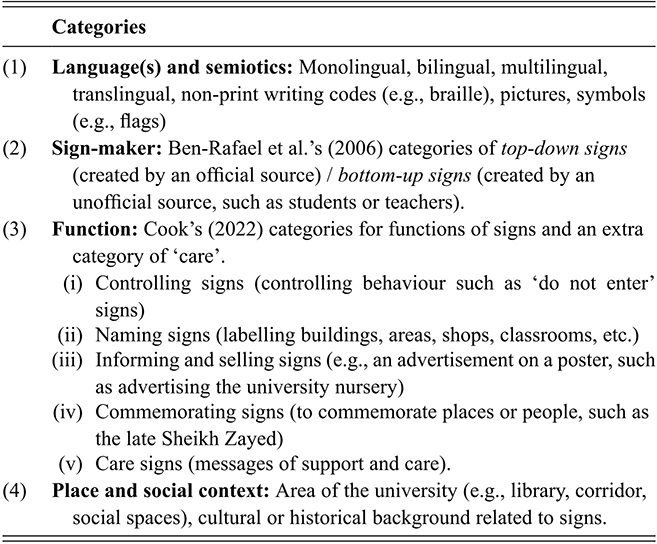
Step 1 A ‘walking ethnography’ (Urquijo, Reference Urquijo2022) was conducted in March 2022. This involved walking from one end of the campus to the other and taking pictures of all the signage and semiotic objects along the way. Areas covered included learning spaces (library, spaces outside offices, business centre, and study areas) and social spaces (corridors, cafés, the promenade and courtyard, outside classrooms, and prayer rooms). The timing of the first walk was at 7 am, before classes began, to take clear pictures of the signage without people around. The second walk took place two days later during the busy lunch hour (12:30–1:30 pm). The purpose was to observe the social context around signage and semiotic objects and to ask Emirati colleagues to comment on monolingual Arabic signs that had specific cultural meanings. Here Pétonnet’s (Reference Pétonnet1982) approach of a ‘floating observation’ comes into play, whereby I allowed myself to be directed and guided by those who had greater linguistic and cultural insights into the space. For example, I admitted my ‘linguistic incompetence’ (Phipps, Reference Phipps2019) as a speaker of only basic Arabic and I noted down Arabic language and cultural insights from Arabic-speaking faculty. I also noted down my observations of how students and faculty interacted with spaces, such as whether ‘controlling signs’ (Table 1) were followed or whether certain places on campus were popular with students. The walking ethnography resulted in a corpus of 482 photographs of signs and semiotic objects.
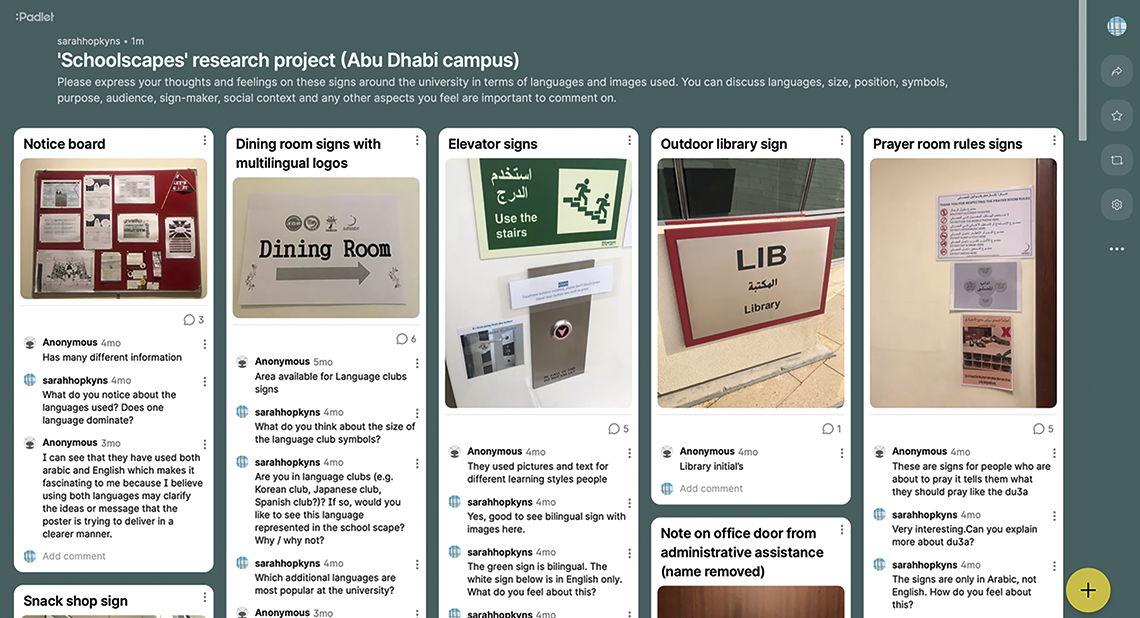
Step 2 I selected a representative sample of forty signs and semiotic objects from the corpus of 482 photographs. The forty selected photographs represented a range of spaces within the university, as well as a range of language(s), semiotics, functions, and top-down (produced by management / institution / government) and bottom-up (made by students / faculty / staff) signs and semiotic objects. I uploaded the forty pictures onto a virtual bulletin board on the website Padlet (Figure 1).
Step 3 A description of the research project was shared with a class of female students (n = 28). The students, who were studying in a language and literature course in the College of Education, were all Emirati and aged between nineteen and twenty-six. The students had all attended ‘government schools’, which is the term used in the UAE to refer to state schools. In their schools, they had been taught through EMI for STEM subjects and in Arabic for other subjects. It was their second year at the university, meaning they were used to the educationscape and were not new to it. One of the students in the group was legally blind, so experienced the space through senses other than sight. It should be noted that this relatively small group of students’ views cannot be generalised to represent the views of UAE university students in other subject fields within the same university or in other educational institutions in the UAE. Standard ethical procedures were followed, and students were informed that participation in the study was optional, and pseudonyms would be used. Students were asked to share their perspectives anonymously, which reduced biases and allowed for freedom of expression without concerns over judgements. After students had written comments, I asked follow-up questions on the Padlet to elicit further reflection on certain images. Figure 1 shows a screenshot from the Padlet with posts and comments.
Padlet as a data collection tool for Step 3 of the project
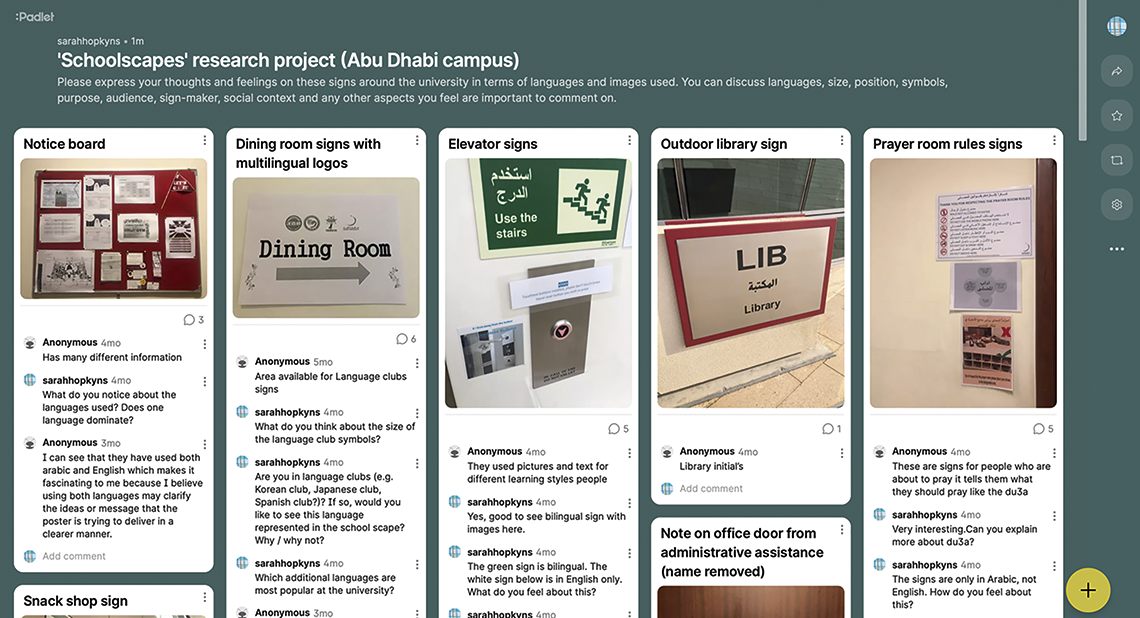
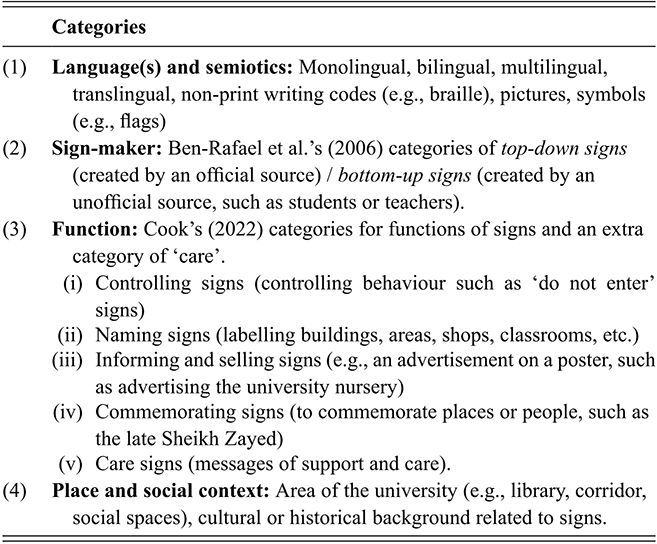
Table 1 Long description
The table consists of four rows. The first row describes languages and semiotics on signs including monolingual, bilingual, multilingual, translingual, non-print, writing codes such as braille, pictures, and symbols such as flags. The second row of the table describes how signmakers are divided into top-down and bottom-up categories. Top-down signs are official, such as government signs. Bottom-up signs are made by individuals such as teachers and students. The third row describes how signs can be categorised according to fuction such as controlling signs, naming signs, informing and selling signs, commemorating signs, and care signs. The fourth row describes how signs can be categorised according to place and social context such as location or area and historical background.
1.6.3 Data Analysis
Data collected from Steps 1–3 consisted of two types: (1) a corpus of signage from the university educationscape (482 photographs); and (2) stakeholders’ perspectives on their educationscape (28 students’ Padlet comments, and faculty and staff input during the walking ethnography). I conducted the analysis on both sets of data in two stages.
Stage 1: Categorising Signage
Signage from the educationscape (n = 482) was categorised according to five criteria, drawing on the work of Ben-Rafael et al. (Reference Ben-Rafael, Shohamy, Amara and Trumper-Hecht2006) and Cook (Reference Cook2022), as seen in Table 1. I added an extra function to Cook’s (Reference Cook2022) ‘function categories’, named ‘care signs’ due to the prominence of such signs in the educationscape (see Section 3).
In addition to analysing signage using the categories in Table 1, field notes on actors’ interaction with signage were drawn upon, as well as insights from colleagues and staff informally interviewed during the walking ethnography. To analyse the signage, I used nexus analysis (Scollon & Scollon, Reference Scollon and Scollon2003, Reference Scollon and Scollon2004) which is part of a ‘critical turn’ (Barni & Bagna, Reference Barni, Bagna, Blackwood, Lanza and Woldemariam2016) in LL research where attention is paid to the position, size, space, images, readership, and sociolinguistic implications of messages (Shohamy, Reference Shohamy, Pütz and Mundt2019), specifically considering ‘interaction order, discourses in place, and historical body’ (Hult, Reference Hult2014; Scollon & Scollon, Reference Scollon and Scollon2003, Reference Scollon and Scollon2004). Social norms and expectations about language and space were considered via analysing ‘interaction order’, where the appearance or absence of language(s) on signage indicates values attached to language(s). Furthermore, societal beliefs about languages and speakers of languages that affect language choices on signs were considered through looking at ‘discourses in place’. For example, rather than a descriptive account of languages being given, ideologies in societies were considered, such as the relationship between neoliberalism and the dominance of English in EME educationscapes. As educationscapes do not exist in a vacuum, ‘historical body’ was also part of the analysis by analysing relevant habits, practices, and values of individuals who view or make signs (Hult, Reference Hult2014). Such analysis of the historical body included the influence of historical colonialism and continuing coloniality, which intersects with neoliberalism in the ‘coloniality-neoliberalism nexus’ (Shah, Reference Shah2025).
Stage 2: Identifying Themes within the Corpus
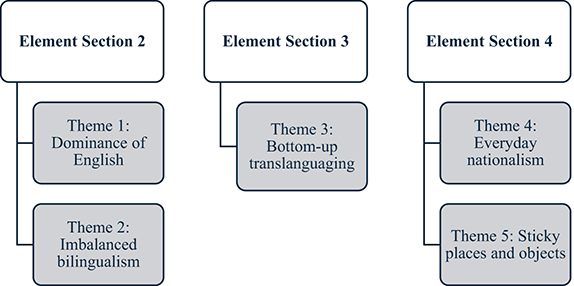
In line with decolonial research, I completed respondent validation, also known as member checking, to verify that my interpretations of information and perspectives on the Padlet and insights from faculty and staff were accurate and resonated with experiences. I used thematic analysis to identify key themes within the data set by following Braun and Clarke’s (Reference Braun and Clarke2022) six-phase process. First, I familiarised myself with the data, which involved the categorisation process as described above. Here, I not only looked carefully at the images I had collected on the walking ethnography but also closely read through students’ Padlet comments and field notes from informal interviews with Arabic-speaking faculty and my own notes on how signs were interacted with. This provided an overall picture. Second, in the next more systematic phase, I generated initial codes by closely reading and grouping patterns of characteristics together. For example, the occurrence of flags, cultural images, and monolingual Arabic signs related to UAE history were grouped together under the theme of ‘Everyday nationalism’ together with comments from students relating to national pride. I then moved to the third and fourth phase of TA, which involved reviewing my initial codes, and searching for themes, before defining and labelling these themes in Phase 5, and deciding how to report the data in Phase 6 (Braun & Clark, Reference Braun and Clarke2022). To authentically represent the data in participants’ own words, I identified representative quotes from the students’ Padlet and faculty and staff’s informal interviews, which ‘gave voice’ (Willig, Reference Willig2013) to the participants. Five key themes were found across the data sets (Figure 2), which will be the focus of Sections 2–4 of the Element.
Five key themes in the university educationscape
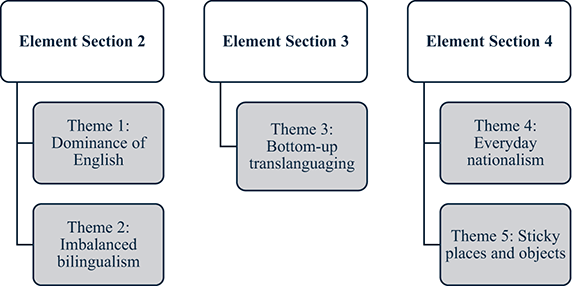
2 The Dominance of English and Imbalanced Bilingualism
In this section, I discuss the first two themes to emerge from the study: The dominance of English and imbalanced bilingualism (Figure 2).
2.1 The Dominance of English
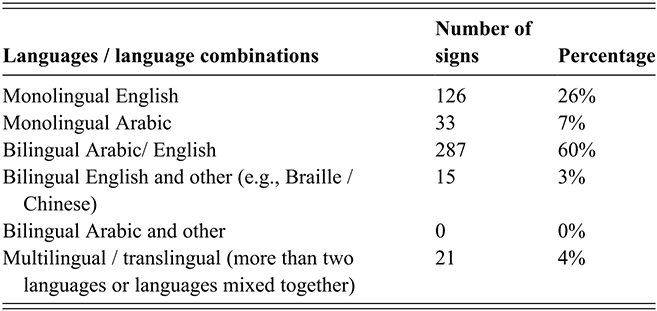
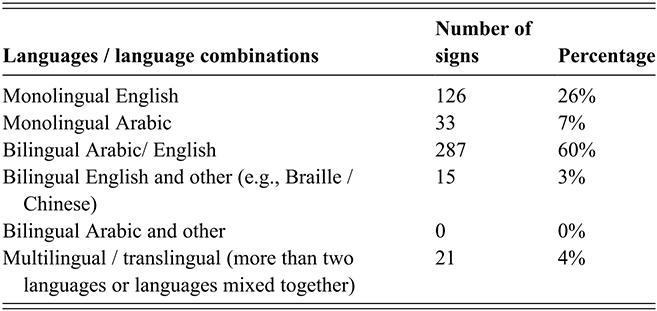
The first main theme to emerge from the analysis of the university educationscape was the dominance of English. English appears on its own and next to other print languages, such as Arabic, or non-print writing codes such as braille (Table 2). English dominates the educationscape as it appears on 93 per cent of the signs in the 482-sign corpus, whether alone (26 per cent) or in combination with other languages (67 per cent). The second most common language in the educationscape, Arabic, appears on 74 per cent of the signs in the corpus. It should be noted that repeated signs, such as classroom signs, were just counted once.
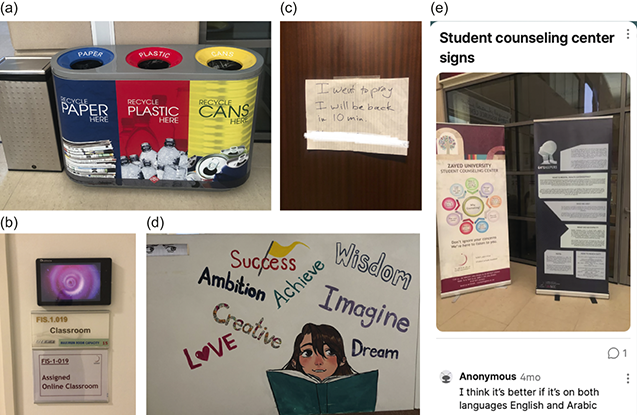
The presence of monolingual English-only signs in the educationscape is partly related to globalisation, with English as a global language being part of the phenomenon. For example, English-only signs commonly appeared on imported objects or what Benson (Reference Benson2021) names, ‘language-bearing assemblages’ (p. 83), which carry language into the world and thus give language its spatiality. An example of an imported language-bearing assemblage can be seen through the recycling bins in Figure 3a. Such items were most likely ordered from an international company that uses English as a default language, and this English-only object has thus travelled into the educationscape. According to the International Trade Administration’s labelling and marking guidelines for importing products to the UAE, all products must be labelled in Arabic only or Arabic and English (International Trade Administration, 2023). However, it seems such guidelines are not always followed, as is the case in Figure 3a and as was found in previous UAE-based studies where café and shop names in multilingual Abu Dhabi neighbourhoods appeared only in English in some instances (Hopkyns & van den Hoven, Reference Hopkyns and van den Hoven2022).
2.1.1 Linguistic Inclusivity, Aesthetic Representation, and Values
Further examples of English-dominated signs include ‘naming signs’ (Cook, Reference Cook2022), such as classroom and office signs (Figure 3b). The cluster of signs in Figure 3b (one digital and two printed) appears only in English, with one line of braille for the classroom number. One of the student participants, Rana (pseudonym used), who is legally blind and is classified in the UAE as a ‘person of determination’, commented that she would appreciate more braille in the educationscape. To note, the term ‘people of determination’, which was introduced by Sheikh Mohammed bin Rashid Al Maktoum in 2017 (Shiakh, Reference Shiakh2024), is used in place of ‘disabled’ in the UAE to focus on strength and inclusion (UAE Information and Services, 2025). While Rana was pleased that braille appeared on classroom door signs and outside elevators, which is the case in many global contexts (Dagenais et al., Reference Dagenais, Moore, Sabatier, Lamarre, Armand, Shohamy and Gorter2008), she stated that braille was missing in the places it was needed most, such as outside washrooms (Extract 1).
Extract 1
‘The braille outside classrooms is “shortcut braille”. In the elevator the braille is helpful, but they do not put braille for washrooms. They should put more braille around the university, especially in important places’
When Rana refers to ‘shortcut braille’ (Extract 1), this means it uses contractions for commonly occurring words or groups of letters, partly to reduce the amount of space required, and partly to speed up the process of reading and writing (Braille Literacy Canada, 2025). For example, the word altogether would consume ten symbols in uncontracted braille, but only three in contracted braille (Braille Literacy Canada, 2025).
Another student, Shamma, pointed out the need for signage in the educationscape to accommodate diverse needs. In Extract 2, Shamma stresses the need for inclusivity not only via multilingualism but via non-text signage too.
Extract 2
‘I believe that signs must cater to diverse needs of students in any environment. In other words, students of determination’ needs must be considered such as using braille so that they are able to read what is posted’
In addition to English dominating office and classroom signs, bottom-up handmade signs were often monolingual (English only). For example, Figure 3c shows a handwritten sign taped to an administration office door (name removed for anonymity). Although the sign-maker’s first language was Arabic and the message refers to praying in a prayer room for Muslims on campus, only English is used to communicate the message. Similarly, another English monolingual bottom-up sign can be seen in Figure 3d, which shows a library desk covered with verbs and nouns such as ‘Ambition’, ‘Success’, and ‘Achieve’. The words could be said to reflect neoliberal goals of EME, which focus on individual success and capital rather than appreciating and valuing knowledge. The use of only English in association with these words also cements the connection between English and future success and ambition in the educationscape. Furthermore, not only language choices symbolise belonging in the space, but also semiotics such as images. The image of a student reading a book represents a mix between local and global aesthetics (Figure 3d). While the girl in the image has long dark hair like many of the students, she wears her hair down and uncovered, which is not typical for Emirati students at the university, who mostly wear abayas (long black gowns) and shailas (black headscarves).
Monolingual English signs in the university educationscape
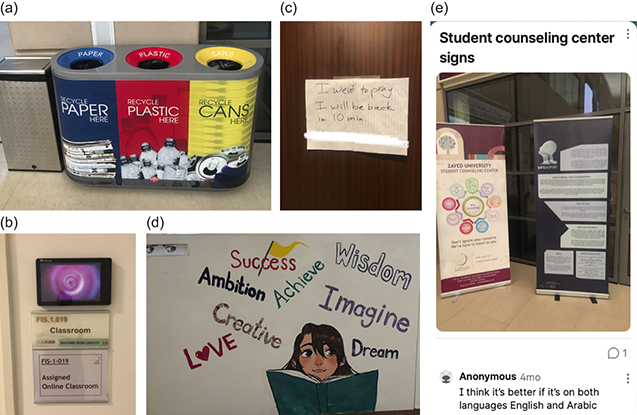
Figure 3 Long description
A: A recycling bin with three sections. From left to right, the blue section is for paper, the red section is for plastic, and the yellow section is for cans. English words and images of paper, plastic, and cans are on the bin.
B: Three signs on a classroom door. The top one is digital and shows a screen saver space scene. The middle one says classroom in English and the number of the classroom in English and Braille. The bottom one says assigned online classroom.
C: A handwritten note on an administration office door saying I went to pray. I will be back in 10 min. The sign-maker's name has been removed for anonymity.
D: A sign in the library with a drawing of a girl reading a book. She has long brown hair, brown eyes, and pale skin with rosy cheeks. She is surrounded by the words success, ambition, creative, love, achieve, wisdom, imagine, and dream.
E: A screenshot of a Padlet post of two large signs at the student counseling center about its services. The signs are in English. An anonymous student commented on the Padlet that it would be better if both English and Arabic could be on the signs.
2.1.2 Whiteness as a Proxy for English
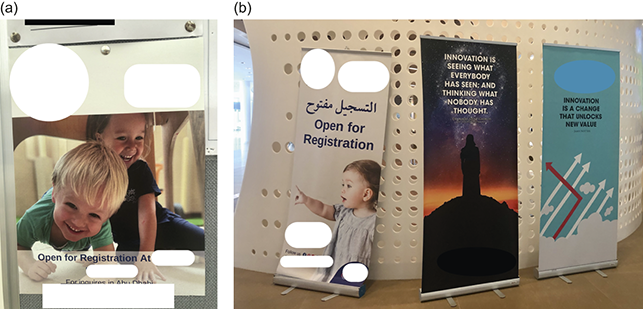
Not only language but images on signs often represent values associated with the coloniality-neoliberalism nexus (Shah, Reference Shah2025). For example, the signs in Figure 4 show Whiteness as a proxy for English and individualism being valued over collectivism.
Bilingual and monolingual English signs: Whiteness and individualism
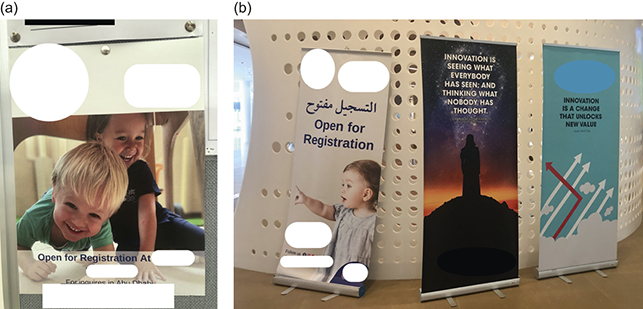
Figure 4 Long description
A: A sign advertising the university nursery with information about how to register and an image of a 3-year-old boy with blond hair and a 4-year-old girl with light brown hair. Both are smiling. The name of the nursery has been removed.
B: Three signs. One advertises the university nursey showing a two-year-old child, and English and Arabic registration information. The others show innovation in English with images of a person on a mountain and an arrow pointing away from others.
The ‘selling sign’ (Cook, Reference Cook2022) in Figure 4a and the left sign in Figure 4b show advertisements for the on-site university nursery. The nursery name appears only in English (removed here for ethical reasons). The message ‘open for registration’ is written in both English and Arabic in Figure 4b and only in English in Figure 4a. Images of only White toddlers with blond and light-brown hair are shown. Most children attending the nursery are the university students’ children, who have Arabic as their L1, as it is not uncommon for students to be married with children while also studying in the UAE and other Gulf states. The nursery advertisement signs in Figures 4a and 4b centre Whiteness, and thus the race and ethnicities of the student body are not reflected in the posters but rather Whiteness is presented as the norm. Although students did not comment on the centring of Whiteness on the Padlet, this perhaps speaks to its normativity, rather than an intentional omission. While reasons for the absence of comments on race were not probed in the current study, this finding offers a compelling opportunity to explore how multilingual speakers internalise and navigate dominant linguistic and racial ideologies in the space. It should be noted that the large transnational population in the UAE and the prominence of English outside the university as a lingua franca may contribute to the perceived normalcy of English and to some extent Whiteness. However, most of the UAE’s transnational population is from South Asian countries, meaning that even if the signs in Figures 4a and 4b were aimed at being inclusive of the UAE’s transnational resident population, they fail to capture its diversity by only featuring White children. Anecdotally, similar signs that over-represent White people outside the university are common, such as posters for hospitals and clinics. It is recognised that ‘White normativity’ (Dovchin & Wang, Reference Dovchin and Wang2024; Jenks & Lee, Reference Jenks and Lee2020) is a global phenomenon rather than a UAE-based phenomenon and connects with capitalism, coloniality, and power. This is especially apparent in relation to commercial signs or ‘selling signs’ (Cook, Reference Cook2022). The centring of Whiteness has been described as a multilevel marketing pyramid scheme (Gerald, Reference Gerald2020, Reference Gerald2022) where ‘the White brand’ (Alqahtani, Reference Alqahtani2024, p. 4) has become an organising feature of ‘a powerful self-serving scheme in all areas of society’ which is closely tied to coloniality (Dovchin, Reference Dovchin2024, p. 2). Applied linguistics scholars argue for the need to pay attention not only to linguistic hierarchies in multilingual spaces but also for a deeper unravelling of racism (Kubota, Reference Kubota2002, Reference Kubota2019) to combat White normativity in educationscapes and educational materials (Ndura, Reference Ndura2004; Sherlock, Reference Sherlock2016).
Also related to symbolism around English are the signs in the middle and on the right in Figure 4b, which focus on innovation. The images strongly reflect individualism over collectivism with the figure of one person standing high on a mountain in the middle sign and the image of a red arrow going in the opposite direction to a series of White arrows on the right-hand poster. The images on these signs send out subtle messages related to neoliberal ideologies, which connect with an emphasis on individualism, innovation, and success, only communicated through English.
2.2 Imbalanced Bilingualism
A second theme to emerge from the study was ‘imbalanced bilingualism’ in the educationscape. On many of the bilingual signs, English took more space than Arabic and other languages. As seen in Table 2, 63 per cent of the signs in the 482-sign corpus were bilingual, with 60 per cent of these containing Arabic and English and 3 per cent using English and another print language or non-print code, such as Chinese or Braille.
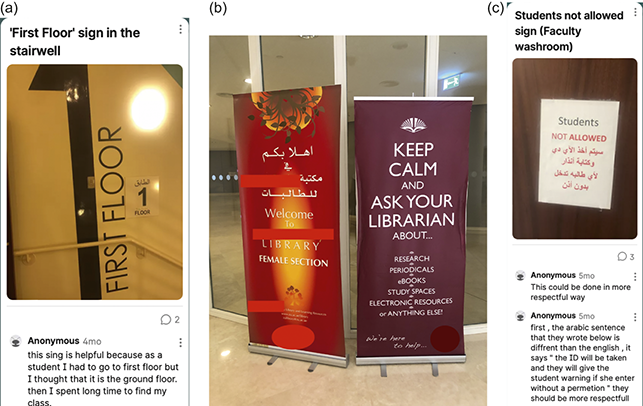
2.2.1 Imbalanced English–Arabic and English–Braille Signs
Students at the university, who mainly have Arabic as their first language, English as a second language, and knowledge of other languages (Hopkyns & Wang, Reference Hopkyns and Wang2024), mix linguistic resources fluidly in daily practice (Hopkyns, Reference Hopkyns2020; Siemund et al., Reference Siemund, Al-Issa and Leimgruber2021). However, bilingual signs in the university tend to appear side-by-side as ‘two solitudes’ (Cummins, Reference Cummins2007). This format replicates bilingual signage in public spaces in the UAE, which also often appears side-by-side (Hopkyns & van den Hoven, Reference Hopkyns and van den Hoven2022). Not only are languages on bilingual signs mainly kept separate, but the balance between languages and codes is often uneven. An example of imbalanced bilingual signage can be seen in Figure 5a, which shows the Arabic and English words for floor on the right but only the English version in much larger writing on the left. On the Padlet, students left this imbalance unquestioned. Instead, the usefulness of a large sign pointing out which floor they were on was valued due to cultural differences in the naming of floors (Figure 5a). They focused on meaning over mode.
A further example of imbalanced bilingualism can be seen on the two signs placed together in Figure 5b, which appear at the entrance to the university library. The signs function as a unit with the one on the left welcoming students to the female section of the library and the one on the right encouraging students to ask librarians for help if needed. When viewed together, the amount of Arabic is much less than that of English. Moreover, English is used in a friendly way, whereas Arabic is used more formally. The right sign in Figure 5b creates a mood of friendliness which Wee and Goh (Reference Wee and Goh2020) call ‘the semiotics of conviviality’ (p. 110), often found in ‘third places’ (Oldenburg, Reference Oldenburg1997) where importance is placed on ‘fostering a sense of belonging and encouraging civic engagement’ (Wee & Goh, Reference Wee and Goh2020, p. 103). For example, the English-dominated sign on the right creatively adapts the globally popular slogan ‘keep calm and carry on’ and uses a friendly and informal font for the statement ‘we’re here to help’ in italics at the bottom. Coined in 1939, the British wartime slogan ‘keep calm and carry on’ became popular worldwide from 2000 onwards after being rediscovered in a Northumberland bookstore (University of London, 2014). The message ‘keep calm and carry on’ now appears on all sorts of products and signs, either in its original form or adapted, as is the case with the library sign in Figure 5b, where an open book image replaces the original crown. Outside the university too, UAE adaptations of this slogan can be seen on products from key rings to clothing, such as ‘keep calm, it never rains’ or ‘keep calm, we have oil’. It could be argued that the popularity of the historically British poster highlights Anglophone cultural influences as well as English as a global language.
Imbalanced bilingual signs in the university educationscape
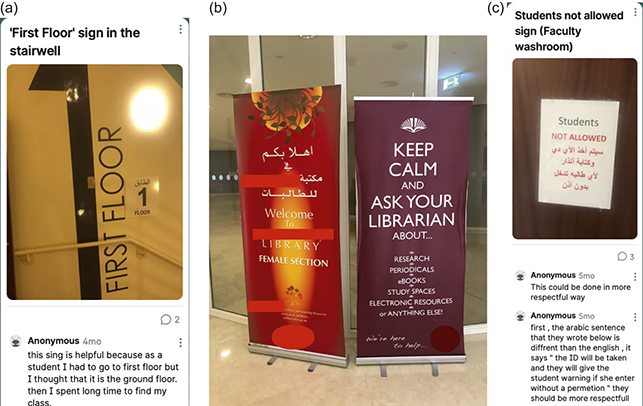
Figure 5 Long description
A: A Padlet post of a sign saying First Floor in English and Arabic. The English writing is much bigger than the Arabic writing. An anonymous student commented that the sign is helpful to know it is not the ground floor.
B: Two signs outside the library. The first is bilingual English/Arabic and says welcome. The second is only in English. It says keep calm and ask your librarian about a range of features. It is modeled after the World War 2 poster Keep calm and carry on.
C: A Padlet post of a bilingual English and Arabic sign outside a female washroom saying students not allowed. Two anonymous student comments say the Arabic message on the sign is different from the English message and should be more respectful.
An exception to English-dominated bilingualism was bilingual bottom-up signs made by staff at the university (handmade signs). These signs tended to have a ‘controlling’ function (Cook, Reference Cook2022) in the educationscape with more Arabic than English. For example, Figure 5c shows a bilingual (English and Arabic) sign on a faculty washroom door stating in English ‘Students not allowed’. The use of red capital letters stresses the urgency of the message. Chesnut et al. (Reference Chesnut, Curran and Kim2022) identified such signs as ‘multilingual commanding urgency’ where the purpose is to target a certain audience who are ‘guilty’ of breaking the rules by using their first language to directly address them. In this sense, if second or third languages are only included as part of ‘reminder’ or ‘warning’ signs rather than being routinely present across all signage in an area, the use of the additional language may feel like a targeted accusation rather than an act of inclusion and belonging in the space (Hopkyns, Reference Hopkyns and Gallagher2025a). This has been the case in previous studies in diverse contexts globally. For example, Vietnamese was added to signs in an otherwise monolingual Korean neighbourhood in relation to the correct disposal of garbage (Chesnut et al., Reference Chesnut, Curran and Kim2022). In the UAE, Filipino was added to English and Arabic signs in a residential clubhouse (Hopkyns, Reference Hopkyns and Gallagher2025a), but only for warning signs (‘paalala’ in Filipino), thus indirectly accusing live-in Filipino nannies and houseworkers in the residential complex of breaking rules (Hopkyns, Reference Hopkyns and Gallagher2025a). In this sense, the sign in Figure 5c has the same effect by using a longer Arabic message to target a certain group: Emirati students. When commenting on the sign in Figure 5c on the Padlet, students pointed out that the Arabic version of the message is different and more prohibitive, as the Arabic version informs students that if they enter the faculty washroom, their ID will be taken, and they will be given a warning. Multiple students commented that the Arabic used in the sign was particularly disrespectful and led to a sense of unbelonging due to the harsh way in which the sign is written. Some students suggested a more polite rephrasing of the sign.
2.2.2 Imbalanced English and Chinese Bilingual Signs
A final point on the theme of imbalanced bilingualism relates to the use of English and languages other than Arabic in the educationscape. The most prominent ‘third language’ which appeared on bilingual signs within the edcationscape was Chinese. Chinese has grown as a ‘third linguistic and cultural player’ in the UAE over the last decade (Hopkyns & Wang, Reference Hopkyns and Wang2024). As part of China’s Belt and Road Initiative, a series of large-scale projects have been launched in the Gulf due to its geopolitically strategic position. Chinese has also increased dramatically in commercial spaces (Gu, Reference Gu2023b) and in a range of educational contexts such as schools and universities (Wang, Reference Wang2020) with around 54,000 Emirati students learning Chinese as a third language in almost 160 public schools in the UAE (Abdulkader & Hassan, Reference Abdulkader and Hassan2022) as well as students learning Chinese through the two Confucius Institutes attached to UAE universities (Hopkyns & Wang, Reference Hopkyns and Wang2024). In 2022, the Confucius Institute at the university in which the study took place was celebrating its ten-year anniversary. Unlike Arabic and English bilingual signs, which can be found all over the university, Chinese and English signs were contained within the ‘Chinese Centre’ on the male side of the campus (Figure 6a) and the ‘Chinese Corner’ in the library, which is available for both male and female students on different days. Like the English and Arabic bilingual signs, the English and Chinese signs also tended to be imbalanced in favour of English, with Figure 6b being most notably so. In Figure 6b, the history behind a Chinese character 贝 (bèi – shell/ value) is provided in English (not Arabic). Students can take this information away with them too (sign in transit). Figure 6c shows a larger, more comprehensive, bilingual sign about the origin of Chinese characters.
English and Chinese bilingual signs in the university’s Chinese Centre and ‘Chinese Corner’ in the library
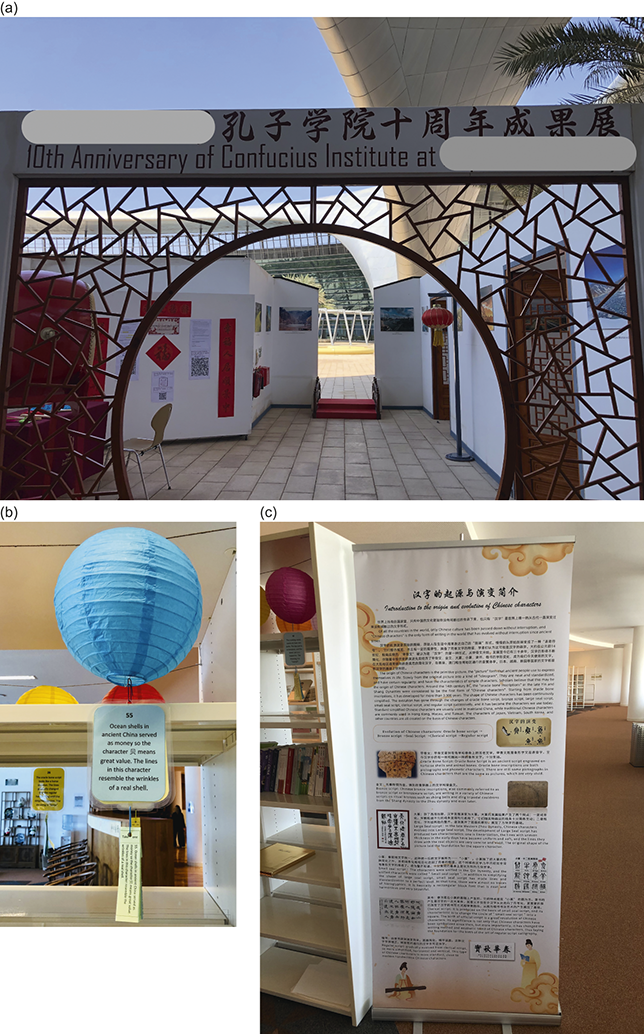
Figure 6 Long description
A: A sign over the entrance to the University’s Chinese Centre announcing the tenth anniversary of the university’s Confucius Centre in English and Chinese. The archway is in the courtyard with blue sky and the edge of a palm tree in view.
B: A coloured paper lantern with a small sign hanging from it, which explains the meaning of a Chinese word in English. It is in the Chinese corner of the library. It is one of many colourful lanterns and Chinese word signs in the space.
C: A large sign about Chinese characters written in English, except for the title of the sign, which is in English and Chinese. There are also images on the sign. It is in the Chinese corner of the library.
Students’ responses to the presence of Chinese in the educationscape were generally positive as exemplified by Nour’s Padlet comment in Extract 3.
Extract 3
‘It’s good to see more languages in the university. Chinese is becoming more important in the world these days and in UAE schools too’
Such findings are supported by a previous study looking specifically at stakeholder perspectives on Chinese in the same UAE university educationscape, in the form of student questionnaires and interviews with students and the Confucius Institute Director (Hopkyns & Wang, Reference Hopkyns and Wang2024).
2.3 Critical Approaches to Unequal Englishes
When referring to universities as EMI institutions, there is the assumption that the main function of English is for instructional purposes. However, often English expectations and the dominance of English and Anglophone cultural dimensions flood outside classrooms into the landscape of third places, social spaces, and connecting spaces (Jenkins & Mauranen, Reference Jenkins, Mauranen, Jenkins and Mauranen2019). This was the main finding from the analysis of the current study’s first two themes, where monolingual English and imbalanced bilingual signs dominated a range of spaces. Race and epistemologies associated with English, such as ‘Whiteness as standard’ (Swift, Reference Swift2024) and neoliberal individualism (Al-Ribdi, Reference Al-Ribdi2020) through the construction of ‘the entrepreneurial subject’ (Martín Rojo, Reference Martín Rojo, Rojo and Percio2020), also made their way onto English-only or English-dominated signage. Here we see a clash between the multilingual ecology of the university and its English-dominated educationscape. As language carries with it symbolic power (Badwan, Reference Badwan2020; Bourdieu, Reference Bourdieu1991; Kramsch, Reference Kramsch2021), symbolic capital (O’Regan, Reference O’Regan2021), and often symbolic violence (Bourdieu, Reference Bourdieu1991; Tupas & Tarrayo, Reference Tupas and Tarrayo2024), the presence or absence of certain languages and cultural elements in the educationscape can affect the identities of stakeholders in terms of levels of (un)belonging in the space.
The dominance of English and lack of ‘third’ languages in the educationscape of this multilingual university relates to Bhatt et al.’s (Reference Bhatt, Badwan and Madiba2022) concept of the ‘language problem’. Bhatt et al. (Reference Bhatt, Badwan and Madiba2022) explain that the ‘language problem’ refers to the strong tie between the dominance of English in the worldwide knowledge economy and its resultant effect on language hierarchies in classrooms and in broader educationscapes of multilingual universities. As the global capitalist economy in most parts of the world is an ‘aggressive penetration’ (Bhatt et al., Reference Bhatt, Badwan and Madiba2022) which affects linguistic hierarchies and ‘pecking orders’ (Hua & Kramsch, Reference Hua and Kramsch2016), uneven power dynamics are prominent. Together with ‘the language problem’, Meighan’s (Reference Meighan2023) term ‘colonialingualism’ is fitting when reflecting on the dominance of English and imbalanced bilingualism in the educationscape, where the privileging of dominant colonial languages and knowledges overshadows local languages and epistemologies.
The ‘language problem’ and ‘colonialingualism’ are not only found in UAE university educationscapes but rather in multiple global settings. For example, in Marshall et al.’s (Reference Marshall, Al Hannash, Mayni, Gorter and Krompák2024) LL study of an internationalised Canadian university, it was found that lecture halls and other spaces were often named after Europeans such as ‘Robert C. Brown Hall’ and ‘Shrum Physics Building’, thus representing a ‘Eurocentric campus’ together with a focus on White Eurocentric and Anglocentric histories through bagpipe bands and English only signage. Similarly, in Jenkins et al.’s (Reference Jenkins, Baker, Doubleday, Wang, Jenkins and Mauranen2019) study of linguistic diversity in a UK university, it was found that despite its website emphasising the international nature of the university, with over 6,500 international students from more than 135 countries, this commitment to diversity was superficial in its largely monolingual English LL. For example, all but two signs in its School of Education were English-only, leading Jenkins et al. (Reference Jenkins, Baker, Doubleday, Wang, Jenkins and Mauranen2019) to conclude that ‘the university’s LL is in stark contrast to its linguistic soundscape, where many languages other than English are evident’ (p. 248). In non-Anglophone EME universities too, imbalances between English and local languages have been found, as well as the dominance of cultural ideologies associated with the Anglophone West. For example, in the LL part of Fang and Xie’s (Reference Fang, Xie, Jenkins and Mauranen2019) study on linguistic diversity in a Chinese EME university, English dominated certain areas such as the ‘Centre for Independent Language Learning’ (CILL) where signage was in English only and messages read ‘Kindly keep all conversation in CILL in foreign languages’ with accompanying images of White people (p. 139). Furthermore, handwritten ‘corrections’ of English parts of signs showed an acceptance of only standardised English over local varieties (Fang and Xie, Reference Fang, Xie, Jenkins and Mauranen2019). In the analysis of a Turkish university educationscape, Karakas and Bayyurt (Reference Karakas, Bayyurt, Jenkins and Mauranen2019) found that Turkish and English held much more power than other languages, which were only present on 7 per cent of signage. For the English signs, Karakas and Bayyurt (Reference Karakas, Bayyurt, Jenkins and Mauranen2019) concluded that the institution appeared to attach ‘particular connotations to English, and most likely aims to project internationality, competitiveness, and Western orientation’ (p. 107). Findings from the current study, together with those from previous studies, support Mathew’s (Reference Mathew2022) observation that, ‘though imperialism is over, the political, economic and cultural subjugation of social life through English has only intensified’ (p. 3). This is seen through the prominence of neoliberal expectations, which continue to promote English as capital and the norm.
While some students in the current study pointed out how English-only signage jarred with the linguistically diverse composition of the stakeholders inhabiting the space as well as expressing general dissatisfaction with imbalanced bilingualism on signage, others left such imbalances unquestioned. Students’ responses to the monolingual English signs shared on the Padlet mainly related to the content of the sign rather than looking more deeply at societal ideologies and policy-making related to the language choices of the sign-maker. Typical comments on imbalanced bilingualism in the educationscape implied vague disappointment, such as, ‘I think it’s better if it’s (the sign) in both languages’ (Figure 3e). Students tended not to go deeper with their Padlet comments. For example, little attention was given to the underlying reasons for the dominance of English, such as the legacy of colonialism, neoliberalism, linguistic hierarchies, and English-medium policies affecting more than just instruction. Unquestioning and ambivalent responses to the dominance of monolingual English signage in multilingual educational settings have also been found in other global contexts. For example, Marshall (Reference Marshall2022) found that university students in the linguistically diverse city of Vancouver, Canada, often accepted monolingual signage (English only) without question despite the high number of multilingual students at the university. It could be argued that the lack of strong objection to monolingual English signage represents uncritical acceptance, which speaks to the symbolic power of English in postcolonial settings, the strength and depth of neoliberal values, and the commodity of English in EME universities (Jenkins & Mauranen, Reference Jenkins, Mauranen, Jenkins and Mauranen2019; Kramsch, Reference Kramsch2021; Marshall, Reference Marshall2022).
3 Bottom-Up Translanguaging
In this section, I discuss the third theme to emerge from the study: Bottom-up translanguaging. I start this section by defining translanguaging and surrounding ideologies and debates. I then present an analysis of translingual signage and student perspectives. The section closes with suggestions for ways in which bottom-up translanguaging can be used as a decolonising tool.
3.1 Translanguaging as Quotidian
The term ‘translanguaging’ is the English translation of the Welsh word trawsieithu, which was coined by Cen Williams. Williams (Reference Williams1994) used ‘translanguaging’ to refer to teaching strategies where students read in one language and responded in another. When theorising the concept further, García and Li (Reference García and Li2014) called into question the existence of linguistic boundaries, moving away from a structuralist (objectified) view of individual languages to a post-structuralist focus on hybridity, mobility, and fluidity. This involves the breaking of boundaries between named languages through recognition of ‘human communication as a fluid, dynamic, and multi-scalar process that involves the use of a diversity of semiotic means’ (Li & Kelly-Holmes, Reference Li, Kelly-Holmes, Blackwood and Røyneland2022, p. 16). The use of translanguaging has been advocated as a way of decolonising EME in postcolonial contexts through recognising stakeholders’ linguistic and cultural capital (Fang et al., Reference Fang, Zhang and Sah2022). In this sense, the concept of translanguaging has been ‘infused with social justice purposes, with the possibilities of challenging linguistically structured inequalities and transforming language-minoritised students’ learning environments’ (Paulsrud et al., Reference Paulsrud, Tian and Toth2021, p. xxii) in a range of global contexts (Flores & Garcìa, Reference Flores, García, Little, Leung and Van Avermaet2013; Mazak & Carroll, Reference Mazak and Carroll2016).
Previous studies looking at translanguaging in Gulf higher education have tended to focus mainly on attitudes and classroom-based projects (Al-Bataineh & Gallagher, Reference Al-Bataineh and Gallagher2021; Palfreyman & Al-Bataineh, Reference Palfreyman and Al-Bataineh2018). Little attention has been given to print-based translanguaging outside classrooms, such as linguistic and semiotic landscapes of social spaces. An exception is Hopkyns and Sultana’s (Reference Hopkyns, Sultana, Dovchin, Oliver and W2024) recent study, which revealed print-based bottom-up translanguaging within the same UAE university educationscape as the current study, as well as translingual messages in faculty emails.
Translanguaging is considered ‘second nature’ (Hopkyns et al., Reference Hopkyns, Zoghbor and Hassall2021), ‘ordinary’ (Dovchin & Lee, Reference Dovchin and Lee2019), and ‘regular’ (Bolander & Sultana, Reference Bolander and Sultana2019) in multilingual societies. However, ways of viewing translanguaging vary significantly according to domain and context. In popular culture and on social media, translanguaging is often viewed positively as creative, clever, and charming (Mendoza, Reference Mendoza2021). For example, during Dubai EXPO 2020, many of the souvenirs involved a playful combination of English and Arabic words, such as ‘Hello Habibi’ (Hello baby / darling). Translingual pop art and ‘wearable texts’ (Jaworski & Lou, Reference Jaworski and Lou2021) on T-shirts and caps are also common in the UAE context (Hopkyns, Reference Hopkyns2020). However, previous studies in UAE higher education have revealed that both spoken and written translanguaging tends to be devalued or ‘frowned upon’ (Creese & Blackledge, Reference Creese and Blackledge2010, p. 105) in more formal setting such as EMI classrooms (Al-Bataineh, & Gallagher, Reference Al-Bataineh and Gallagher2021; Carroll, Reference Carroll, Hopkyns and Zoghbor2022; Hopkyns & Elyas, Reference Hopkyns, Elyas, Hopkyns and Zoghbor2022; van den Hoven & Carroll, Reference van den Hoven, Carroll and Buckingham2016).
Reasons for the rejection of translanguaging in educational contexts include monolingual ideologies of stakeholders and an ‘ought to’ mentality around using standardised English. Monolingual English high-stakes assessments in EME settings add to students’ perception of translanguaging being a ‘guilty’ practice (Manan et al., Reference Manan, Channa and Haidar2022). In UAE-based university assessment rubrics, students are penalised for using languages other than English or for localised forms of English, yet content teachers are often reluctant to provide language support in class time, seeing this as outside the scope of their role (Hopkyns et al., Reference Hopkyns, Dillon and Čigoja Piper2025). In other global EME contexts too, such as Italy, the emphasis on standardised English in assessment rubrics clashes with a lack of explicit focus on language by content teachers in classes (Gronchi, Reference Gronchi2024). Monolingual ideologies, language purity beliefs, and an ‘ought to’ mentality around standardised use of languages in formal settings, together with the lack of legitimisation of translanguaging, go hand in hand with an overall absence of translingual signage in the educationscape.
3.2 ‘Talking Back’ via Handwritten Bottom-Up Translanguaging
Despite standardised English being at the top of the educationscape’s linguistic hierarchy (Section 2), some translanguaging in written form was found. The translingual signs in the corpus were all ‘bottom up’ (made by stakeholders such as students and faculty members), and they were all handwritten and ‘temporary’. These signs made up only 4 per cent of the corpus (21 signs from the corpus of 482 signs) (see Table 2). Most of the translingual signs were in the university’s main social space on the female side, known as the ‘promenade’. In the promenade there is a large white sculpture spelling out the word ‘Happiness’ in English capital letters (Figure 7). Each letter of the sign was counted as one sign (nine signs in total), as each letter of the sculpture was a rich source of translingual communication. The messages were written mainly by students. I witnessed students gradually adding messages to the sculpture on daily visits to the promenade to get my morning coffee, and some messages were also written by faculty members who tended to distinguish themselves by using ‘Dr.’ and their full names.
Monolingual English ‘Happiness’ sculpture with bottom-up translingual handwritten messages
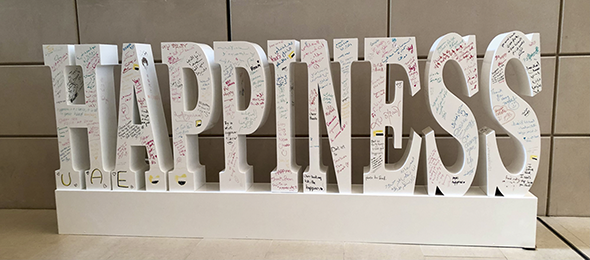
The ‘Happiness’ sculpture is connected to a larger movement in the UAE, which started on the 20th March 2016 when Sheikh Mohammed bin Rashid Al Maktoum approved the ‘National Charter for Happiness’, which aimed to instill a culture of happiness and well-being inside federal government entities and outside to ensure community happiness (The Official Portal of the UAE Government, 2024). The charter included appointing a Minister of State for Happiness, Well-Being Officers in workplaces, and establishing a Council for Happiness and Well-Being at federal entities. Especially during the COVID-19 pandemic, the need to ‘counter emotions (such as) anxiety, despondency, (and) low self-esteem by helping people realise their potential for optimism, fulfilment, benevolence, gratitude, and human connection’ (Wright, Reference Wright2021, p. 3) was a major goal globally but was formally implemented in the UAE.
To look more closely at the handwritten translingual messages on the happiness sculpture, Figure 8 shows zoomed in images of two of the letters.
Bottom-up handwritten messages from students and faculty
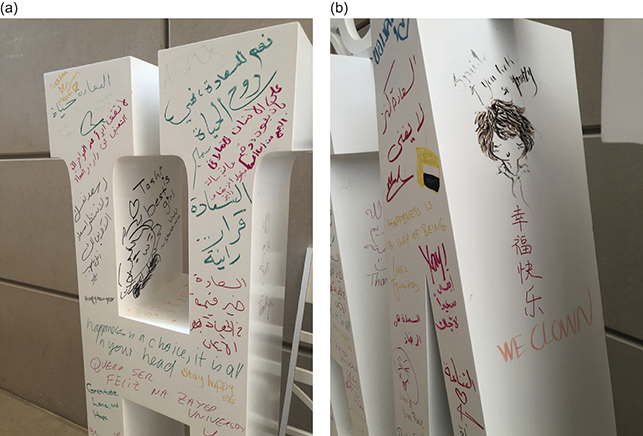
Figure 8 Long description
A: The letter H from a sculpture spelling happiness. The H is covered with handwritten messages in many languages, together with a cartoon person.
B: The letter N from a sculpture spelling happiness. The N is covered with handwritten messages in many languages, together with cartoon people, symbols, and a U.A.E. flag.
Shohamy (Reference Shohamy, Pütz and Mundt2019) describes the notion of ‘talking back’ to the LL as a ‘response where it is possible to see how people are engaged with and react to the LL’ (p. 31). Such interactions with the LL often shine a light on the need to change the LL to make spaces more inclusive and just. Similarly, Blackwood et al. (Reference Blackwood, Lanza and Woldemariam2016) discuss how actors negotiate and contest LLs by asserting translingual identities in the space. In Figures 8a and 8b, there is evidence of stakeholders (mainly students) ‘talking back’ (Shohamy, Reference Shohamy, Pütz and Mundt2019) to the monolingual and imbalanced bilingual educationscape and affectively stamping their translingual identities on the space. Their multilingual and translingual messages on the monolingual sculpture are indirectly stating that it is a linguistically diverse space, and these languages deserve to be seen in the esducationscape. In this sense, although the language object itself is monolingual (English), the way in which students and faculty decorated the sign with messages and drawings highlights linguistic diversity within the university as well as the agency of stakeholders to express themselves authentically.
Looking closely at the letter ‘H’ (8a) and ‘N’ (8b), a mixture of Arabic, English and other languages such as Chinese and Portuguese can be seen, which reflect third languages or ‘LXs’ (Dewaele & Saito, Reference Dewaele and Saito2022) at the university, where students may be part of language clubs or learning additional languages through popular apps such as Duolingo and through other means. As a result of the national ‘Charter of Happiness’ and the fact that the sculpture itself spells out ‘Happiness’, it is not surprising that the content of stakeholders’ messages related to happiness, well-being, and positivity. The signs in Figure 8 have the function of ‘care’ (see Table 1), with messages such as ‘happiness is a choice, it’s all in your head’, ‘yes, yes to happiness, the spirit of life’, ‘stay happy’, and ‘make yourself happy’ using a range of languages / combinations of languages. In addition, semiotics such as drawings of UAE flags and people represent stakeholders’ multimodal semiotic repertoires. There is a lighthearted tone to many of the messages, such as ‘we clown’ written in English with ‘happiness’ written in Chinese characters under an anime drawing of a smiling girl’s face in Figure 8b. The playful use of translingual messages supports findings from previous studies where the mixing of linguistic and semiotic resources is seen as a practice reserved for informal communication only (Alasmari et al., Reference Alasmari, Qasem, Ahmed and Alrayes2022; Carroll & van den Hoven, Reference Carroll, van den Hoven, Mazak and Carroll2017; Hopkyns & Sultana, Reference Hopkyns, Sultana, Dovchin, Oliver and W2024).
3.2.1 The Ethos of Care in Translingual Messages
The ‘ethos of care’ seen in bottom-up handwritten translingual messages in Figure 8 also appeared in other places around the educationscape. For example, often temporary handwritten notes could be seen pinned to notice boards in corridors. Mostly, the notes were either related to religion (as will be explored in Section 4 of this Element) or well-being, hope, and solidarity during stressful times. For example, the translingual (but mainly English) message in Figure 9 echoes the ‘ethos of care’ sentiments of the shorter messages in Figure 8. The handwritten note in Figure 9 was pinned to a noticeboard on one of the female side corridors, and it offers support, optimism, and resilience for the final exams and for life at the EME university in general. The message is informal, with abbreviations used such as ‘wanna’, ‘idk’ (I don’t know), and ‘ILY’ (I love you) and affectionate terms such as ‘babe’ and heart symbols drawn as they would appear in a text message (<3). The only word written in Arabic is al-khamīs (الخميس), meaning ‘Thursday’, at the top (under the date). In response to Figure 9, students commented on the Padlet that the note made them feel cared for, ‘seen’, and supported, as voiced by Noura in Extract 4.
Translingual (mainly English) handwritten note of encouragement and solidarity relating to emotions in the university
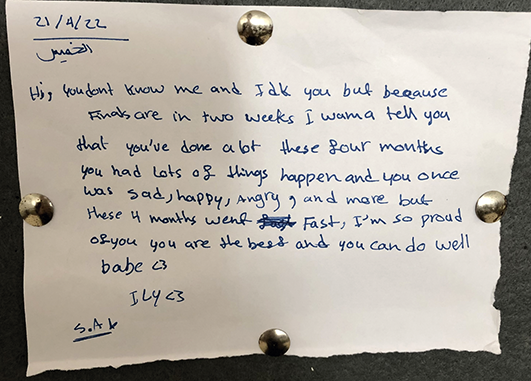
Figure 9 Long description
The date is at the top, which is 21/4/22. The message reads: Hi, you don’t know me and Idk you but because finals are in two weeks I wanna tell you that you’ve done a lot these four months. You had lots of things happen and you once was sad, happy, angry, and more but these 4 months went fast. I'm so proud of you, you are the best and you can do well babe. Heart symbol. I L Y Heart symbol. S.A.L.
Extract 4
‘It’s a kind and sweet note. The student who wrote it wants to show she cares about other students and their mental health. I feel that she sees the stress students are having, including me, and she wants to support us’
Messages of care are often spontaneous, related to times of hardship, and handwritten, as can be seen in previous studies related to messages of care in publicscapes during the COVID-19 pandemic. For example, bottom-up handwritten messages of care, solidarity, and hope were found in public or semi-public spaces in West Vancouver during the COVID years, with words such as ‘smile’, ‘love’, and ‘you’re the best’ appearing on objects in the environment, like stones or trees (Hopkyns, Reference Hopkyns2022b). Such signs contained no informational or utilitarian purpose; they rather portrayed messages of positivity and solidarity during difficult times.
3.2.2 Translingual Messages – ‘Fun’ and ‘Real’
Other bottom-up translingual handwritten messages could be seen in the library’s ‘Chinese Corner’ guest book (Figure 10). Following a similar pattern to the top-down signs in the area, which were either English only or English and Chinese (without Arabic), the comments in the guest book show a mixture of Chinese and English with an emphasis on ‘fun’ (mentioned six times). Note that although the writing on the book’s cover is English-only due to it perhaps being an imported item, students’ knowledge of and interest in Chinese is evident inside the guest book, with Chinese characters used for ‘I like to speak Chinese’ and transliteration used for ‘thank you’ (Xie Xie).
Translingual practice (English and Chinese) in the library’s China Corner guest book
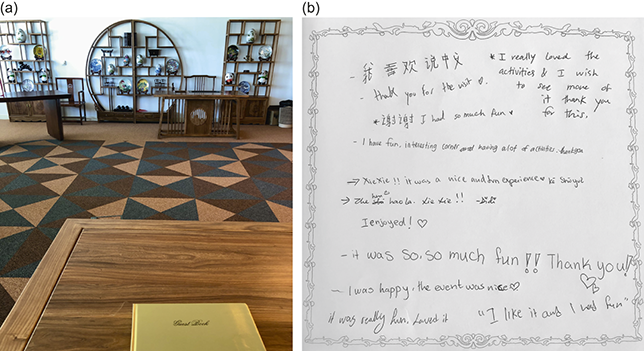
Figure 10 Long description
A: In the foreground is a guestbook on a table. Guestbook is written in English. In the background is a multi-coloured, patterned rug and bookcases with Chinese cultural items on the shelves, including vases and toy pandas.
B: A page of the guestbook in the Chinese corner of the library. There are translingual messages in Chinese and English written by students. There are also heart symbols. All the messages are positive.
When students commented on bottom-up translingual handwritten signs on the Padlet, their responses were generally positive. This stands in contrast to previous studies, which found that attitudes towards translanguaging in EME spaces tend to be mixed or negative (Al-Bataineh & Gallagher, Reference Al-Bataineh and Gallagher2021; Carroll, Reference Carroll, Hopkyns and Zoghbor2022; Hopkyns et al., Reference Hopkyns, Zoghbor and Hassall2021). Students’ comments on the Padlet related to why certain languages had been used, how the messages made them feel, and how the signs represented ‘real’ communication’ as well as fun or creativity, as seen in Extract 5.
Extract 5
‘Maybe students who are part of the Chinese club wrote that’ (Sumaya)
‘The students are having fun with the messages. Some messages and drawings make me think of happiness and do something to make me happy’
‘Students are being real. They use a mix of language and pictures to talk about happiness’
While the comments in Extract 5 emphasise authenticity and fun, the use of translingual practice in the university could also be seen as a form of solidarity and ‘talking back’ to ‘English only’ expectations and monolingual ideologies (Hopkyns & Sultana, Reference Hopkyns, Sultana, Dovchin, Oliver and W2024; Shohamy, Reference Shohamy, Pütz and Mundt2019).
3.3 Translanguaging as a Decolonising Tool
The bottom-up translingual messages explored in this section of the Element stand in sharp contrast to the English-dominated top-down printed messages discussed in Section 2. While translanguaging is very common in the university’s soundscape, such as in corridor conversations, only a small number of signs (4 per cent) included translanguaging (Table 2).
The translingual signs shared a characteristic; they were all handwritten. Handwritten signs on walls or objects tend to be ‘time-fixed or spontaneous and temporary’ (Li & Hua, Reference Li and Hua2021, p. 63) and act as ‘informal encounters’ between the sign-maker and the sign-reader (Elsheshtawy, Reference Elsheshtawy2011) due to the absence of intermediary software and printers, leading to a more direct relationship (Li & Hua, Reference Li and Hua2021). On the one hand, handwritten signs are seen as personal, inviting, and more intimate than printed signs, which even leads some businesses to manufacture signs using a font that imitates handwriting (Li & Hua, Reference Li and Hua2021). On the other hand, handwritten signs also tend to be perceived as messy, disorderly, and of less value when compared with top-down permanent signs, especially if the handwritten signs are classified as graffiti, which is traditionally viewed as antisocial (Pennycook, Reference Pennycook, Jaworski and Thurlow2010). Such mixed attitudes towards handwritten signs together with the increase of digitalisation, have led to a decline in the number of handwritten signs in publicscapes such as the London Borough of Newham (Li & Hua, Reference Li and Hua2021) and Hong Kong (Hutton, Reference Hutton, Messling, Lapple and Trabant2011).
The scarcity of translingual signs in the educationscape, especially on top-down signage, connects with societal ideologies around unequal Englishes and language purity beliefs. As such, translingual signs are reserved for handwritten temporary spaces and are seen as ‘playful’ above all else. The ‘dark side’ or ‘precariousness’ of translingual practice appears in its lack of acceptance in formal domains such as EME universities (Dovchin et al., Reference Dovchin, Oliver and Li2024), despite it being quotidian for multilingual speakers. Translingual discrimination (Dovchin, Reference Dovchin2022), due to grand narratives favouring standardised so-labelled ‘native speaker’ Englishes, is common not only in the UAE context but globally (Sadoudi & Holliday, Reference Sadoudi and Holliday2023). For example, Gao and Park (Reference Goa and Park2015) discuss the pursuit of ‘native speaker’ English in the countryside village of Yangshou, known as ‘the biggest English Corner in China’, where flocks of working professionals go to improve their spoken English by conversing with employees from the US. Similarly, Gao and Park (Reference Goa and Park2015) describe the South Korean trend of jogi yuhak (early study abroad) where young children from middle class Korean families are sent to the US or Australia to ‘secure an advantageous position in the harsh competition of the Korean educational and job market deeply affected by neoliberalism’ (p. 81). Jogi yuhak parent participants in Gao and Park’s study (Reference Goa and Park2015) display negative attitudes to Englishes outside ‘native speaker’ countries such as Singapore, calling Singlish ‘cheap English’, ‘a problem’, and ‘a headache’. Similar attitudes towards translanguaging exist in many global contexts where pejorative terms are used around mixing languages, such as basasa gado-gado (mixed-up language) in Indonesia, bahasa rojak (salad language) in Malaysia (Rasman, Reference Rasman2021), and Banglicised English symbolising ‘hick’ identities in Bangladesh (Hopkyns & Sultana, Reference Hopkyns, Sultana, Dovchin, Oliver and W2024). Similarly, previous studies found translanguaging to be acceptable only in informal contexts such as during virtual office hours (Alasmari et al., Reference Alasmari, Qasem, Ahmed and Alrayes2022; Carroll & van den Hoven, Reference Carroll, van den Hoven, Mazak and Carroll2017) but viewed as ‘unprofessional’ (Hopkyns & Sultana, p. 208) and attached to emotions of guilt, shame, and transgression (Al-Bataineh & Gallagher, Reference Al-Bataineh and Gallagher2021; Hillman, Reference Hillman, Hopkyns and Zoghbor2022) in most EME spaces. To summarise, from previous studies and the analysis of the educationscape in the current study, translanguaging is viewed as ‘fun’ and ‘real’ if used informally but becomes precarious when used more formally and when compared with ‘native speaker’ standardised norms.
4 Everyday Nationalism and Sticky Places / Objects
In this section of the Element, I look at the final two themes to arise from the study: Everyday nationalism and sticky places and objects.
4.1 Everyday Nationalism
Data from the study revealed many signs that represented ‘everyday nationalism’ (Fox & Miller-Idriss, Reference Fox and Miller-Idriss2008), where students felt pride in national identity and belonging in the space. The concept of ‘everyday nationalism’ builds on Billig’s (Reference Billig1995) concept of ‘banal nationalism’, which refers to the everyday unconscious flagging of nationalism whereby ‘a nation enters people’s daily lives in unremarkable ways’ (Antonsich, Reference Antonsich2020, p. 1230) and where ideological habits are reproduced in the daily lives of people in a geographical area (Billig, Reference Billig1995). As a sister concept, ‘everyday nationalism’ expands upon Billig’s term by refocusing attention on human agency within nationalism. In this sense, everyday nationalism looks at the role and relevance of the everyday, and relevance of the lived experience of nationalism (Fox & Miller-Idriss, Reference Fox and Miller-Idriss2008) with a focus on ‘the agency of ordinary people as opposed to elites, as the co-constituents, participants, and consumers of national symbols, rituals, and identities’ (Knott, Reference Knott2016). Everyday nationalism looks at the everyday as the ‘domain of enquiry’ (Fox & Miller-Idriss, Reference Fox and Miller-Idriss2008, p. 557) and how national identity is talked about, experienced, and given meaning in different ways by the ordinary people it affects (Knott, Reference Knott2016). Here, nationalistic symbols and expressions in everyday life can be ‘both banal and/or contentious for different people residing in the nation’ (Benwell, Reference Benwell, Stone, Dennis, Rizova, Smith and Hou2016, p. 2). In this sense, it is recognised that national symbols can evoke different emotions amongst citizens and residents of a country, resulting in backdrops which connect with intercultural experiences (Najar, Reference Najar2015). For example, flags in a space may cause a spectrum of feelings (Jones & Merriman, Reference Jones and Merriman2009), ranging from pride and joy, to ambivalence, to irritation and exclusion. Antonsich (Reference Antonsich2020) stresses the important role that individuals play in producing, reproducing, challenging, subverting, or rejecting everyday nationalism and the fact that it ebbs and flows and changes shape according to space, time, and interaction patterns.
4.1.1 Hanging of Flags
Examples of material displays of everyday nationalism in the educationscape include the hanging of flags, which acts as a ‘gentle symbolic reminder’ that people are in a specific nation that is celebrated and embraced (Wade, Reference Wade2011). Figure 11a shows a ‘National Day’ display in the university library with an assemblage of UAE flags, pictures of UAE leaders, and books on UAE history. Even though the UAE celebrated its Golden Jubilee in December 2021, the display remained in place into mid-2022. Flags and pictures of national leaders are not a temporary feature connected with a social occasion like National Day, but rather remain part of the landscape throughout the year (Figures 11–13). Even faculty members’ office door signs are decorated with mini flags, as seen on my own office door in Figure 12.
The hanging of flags in the university educationscape
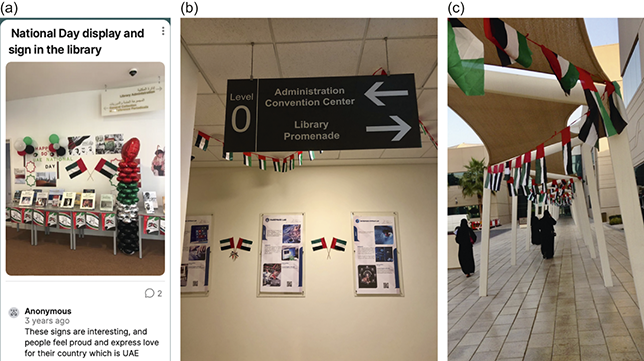
Figure 11 Long description
A: A Padlet post with signs in the library celebrating U.A.E. National Day. There are many U.A.E. flags and balloons in the U.A.E. flag colours. Writing is in English. A display of books on U.A.E. leaders and history is on tables below the signs.
B: A sign hanging from the ceiling signposting the directions of the library and promenade on the right and administration and convention center on the left, in 0 level. Behind this sign on the wall and hanging from the ceiling are many U.A.E. flags.
C: An outdoor walkway with U.A.E. flags hanging from the top of the walkway. Two Emirati students dressed in national dress are walking into the building with their backs turned, not showing their faces.
Flags next to faculty office signs
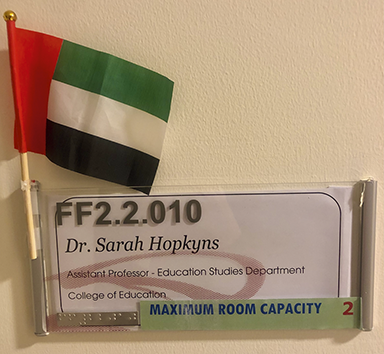
Regarding how students perceive these signs, the Padlet comment in Figure 11a represents a typical response, indicating emotions of pride and love for the nation. An aspect which leaps out at me as a researcher, and transnational resident / partial ‘outsider’, is how most flags and assemblages of everyday nationalism are offset by the dominance of monolingual English signs (as discussed in Section 2). In other places in the educationscape, streams of UAE flags appear without language, such as in the outdoor walkway in Figure 11c. The flagging here has a particularly powerful effect as if those entering the university via the walkway are being showered in national symbolism.
4.1.2 Commemorating Signs of National Leaders and the Union of the Emirates
Commemorating signs, which commemorate places or people (Cook, Reference Cook2022), were common in the educationscape, as seen in Figure 13 (a and b), which shows images of the founding father Sheikh Zayed bin Sultan Al Nahyan, who was the ruler of Abu Dhabi and president of the UAE until his death in 2004.
Sheikh Zayed bin Sultan Al Nahyan on posters, as art, and in university slogans
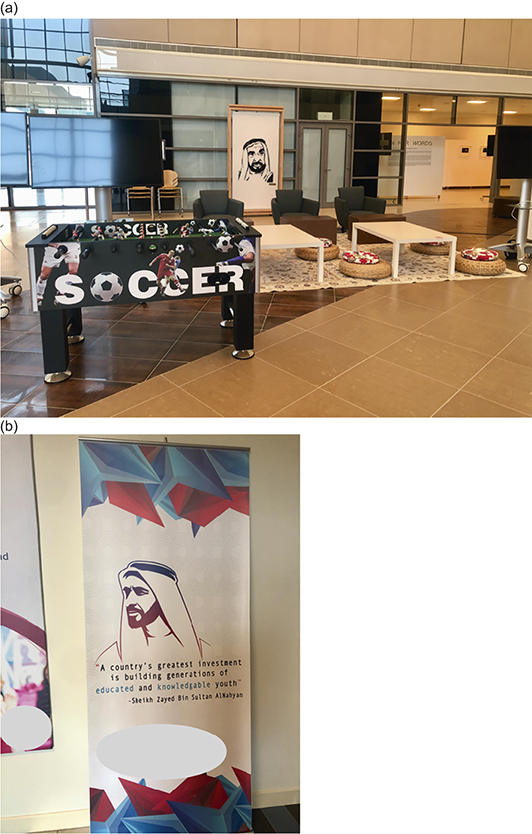
Figure 13 Long description
A: A large painting of Sheikh Zayed in the university promenade. In the forefront is a seating area and a table soccer game.
B: A sign in English reading: A country's greatest investment is building generations of educated and knowledgeable youth, Sheikh Zayed Bin Sultan Al Nahyan, with an image of Sheikh Zayed.
In addition to commemorating Sheikh Zayed bin Sultan Al Nahyan, Arabic wall stickers celebrating the birth of the nation symbolise everyday nationalism in the space. For example, Figure 14 shows a large wall sticker in the business centre which reads ‘Long live the union of our emirates. The house is one body’ (referring to the coming together of the emirates) and continues with ‘We will sacrifice our souls for you, O homeland’. The unity of the seven emirates (Abu Dhabi, Ajman, Dubai, Fujairah, Ras Al Khaimah, Sharjah, and Umm Al-Quwain) is a marker of national pride. When asking an Emirati staff member about this sign during the walking ethnography, she commented that stickers like this one are commonly sold in bookstores, especially around the time of National Day on December 2nd each year. She added that the sign in Figure 14 had been at the university since before she started working there four years ago, meaning that it was a permanent feature, rather than a temporary sign (Extract 6).
National pride in a message about the union of the emirates
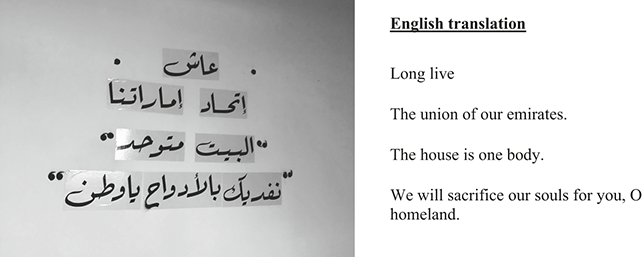
Extract 6
‘You can buy the stickers in shops. In book shops. You see these stickers on walls and on cars especially around National Day. This one has been here since before I started working here. It’s a usual message about the union of the seven emirates’
Overall, there was a sense that displays of everyday nationalism induced emotions of national pride (as voiced on the Padlet), but that they were also part of the wallpaper, in that these displays were so widespread, they almost appeared as a backdrop in the lived space, as also occurs in the pubicscape. After the influx of oil wealth in the 1960s, national symbols such as camels and falcons were less visible in favour of modern symbols like cars, which suited newly built infrastructures (Ledstrup, Reference Ledstrup2019). However, since the 1990s, camels resurfaced as cultural symbols aimed at ‘preserving Emirati local heritage’ (Ledstrup, Reference Ledstrup2019, p. 3) through what Khalaf (Reference Khalaf2000, p. 244) calls ‘the invention of camel culture’. This was a response to globalisation being seen as a threat to ‘authentic’ Emirati culture and a resultant heritage revival (Picton, Reference Picton2010). Recently, the question of authenticity has been raised by local scholars, as is explored in the following section.
4.2 Sticky Places and Sticky Objects
The fifth and final theme to emerge from the study was ‘sticky places and sticky objects’. Sticky places and sticky objects refer to places and objects of emotion which circulate and have become metaphorically ‘sticky, or saturated with affect’ (Ahmed, Reference Ahmed2014, p. 11). Such stickiness, attached to places or objects, connects with repetition and movement, and may represent sites of tension, sites of belonging, or entangled emotions (see Hopkyns, Reference Hopkyns2025b). For spaces of belonging, the related concept of ‘happy objects’ is also relevant, whereby certain places and objects are associated with happiness, or expectations of happiness (Ahmed, Reference Ahmed2014; Miller & Gkonou, Reference Miller and Gkonou2023).
Ahmed (Reference Ahmed2014) stresses that objects of emotion circulate rather than emotions themselves. ‘Objects’ can literally refer to artefacts or metaphorically refer to concepts or people who are objectified, and ‘places’ refer to space (perceived, conceived, and lived space) often containing a multitude of objects and interactions. Familiar and comfortable places or objects ‘stick’ to individuals and have appeal. For instance, in Mahmud’s (Reference Mahmud2025) study with Iraqi Kurdish migrants living in the UK, deep emotional connections were attached to cultural and linguistic material objects which symbolised belonging, ‘home’, and childhood. Similarly, in Badwan and Hall’s (Reference Badwan and Hall2020) study, Manchester-based Algerian international student, Samiya, felt that a Muslim-dominated area of Manchester was a sticky place of belonging for her while away from home due to shared cultural aspects, religious artefacts, and the Arabic language. On the other hand, sticky places / objects are not always connected with positive emotions. Ahmed (Reference Ahmed2014) discusses how religion and race can also be sticky objects. Once a term or concept gets ‘stuck’ to a group of people, it acts as a blockage. For example, as Ahmed (Reference Ahmed2014) states, ‘any bodies who “look Muslim or Middle Eastern” have been the victims of racial assault or abuse because they are associated with terrorism, or “could be” terrorists’ (p. 98). Here sticky places or objects relate to negative emotions such as distress due to people or places being objectified, interpellated, or assigned a certain identity (Ahmed, Reference Ahmed2012).
A further example of how concepts as ‘objects’ can become sticky was seen through an earlier study at the same UAE university, where Emirati students shared perspectives on emotions in the space. Here, EMI / EME was seen as a sticky object in that these concepts were ‘stuck to’ notions of success and capital (Hopkyns & Gkonou, Reference Hopkyns and Gkonou2023). EMI / EME could also be described as a ‘happy object’ due to expectations of happiness in the future attached to the phenomenon (Ahmed, Reference Ahmed2014). As happy objects are highly normative, such as a wedding as a happy occasion for a bride and groom, if the person feels anything other than ‘expected’ emotions, these unwanted feelings can lead to disillusionment and the masking of genuine emotions. In the case of EME as a sticky object or happy object, students may feel reluctance to stray from the grand narrative of ‘English as the key to success, a highly paid job, and social capital’.
In the case of the current study, from both my own observations and from students’ comments on the Padlet images, certain places and ‘objects’ in the university were viewed as sticky and evoked strong emotions. These included places of cultural and linguistic familiarity that had been created for them by employees at the university, and bottom-up sticky objects in the form of notes relating to Islam and cultural practices. Sticky places and objects commented on in the study tended to be those associated with increased belonging and positive emotions.
4.2.1 Sticky Places and Objects Produced by Others: Dukkan and Majlis
Several ‘sticky places’ were identified in the university’s promenade, which is an indoor space lined with cafés, social lounges, nail salons, flower shops, and stationery stores. Students commented on both linguistic and cultural belonging related to certain places and objects within the space, which had been placed there by university staff, shop workers and others.
Mainly signs in the promenade were ‘selling signs’ (Cook, Reference Cook2022) appearing inside and outside shops and cafés. Most of these were Western brands such as ‘Starbucks’. Others used English names which were translated into Arabic, such as ‘Deb’s Café’ and ‘Royal Nails Salon’, with English appearing at the top of the sign and Arabic appearing below.
An exception to this norm is ‘Dukkan’ café and snack shop (Figure 15). Unlike the other ‘selling signs’ in the promenade, Dukkan is an Arabic word meaning ‘traditional grocery store’ and it is transliterated into English. Dukkans, also known as baqqalahs, are still an important part of traditional UAE neighbourhoods (Freejs), but they play a lesser role in the lives of younger Emiratis due to changes in infrastructure leading to mall-based social hubs replacing many traditional neighbourhoods (Al Mutawa, Reference Al Mutawa2020). From students’ comments on images of Dukkan’s storefront and café menu (Figure 15), it represented a ‘sticky place’ within the English-dominated university. This is due to the culturally significant designs on its cups (Figure 16) and its menu with regional comfort food and drinks such as ‘Chips Oman laban’ (spicy crisps made in neighbouring Oman mixed with drinking yoghurt), ‘Takees yoghurt’ (Takis crisps with Greek yogurt – popular in the Arab world from the UAE to Egypt), ‘Karak’ which is Masala Chi or literally ‘strong tea’ (Moaswes, Reference Moaswes, Rahman and Al-Azm2023) and ‘Habba Hambra’ (custard and red seeds often served at festivals) (Figure 15).
To look at the Tiffany-blue Dukkan disposable cup design in more detail (Figure 16), it is covered in multimodal messages seen through Arabic and English words (Karak, Dukkan [in Arabic script], perfect, amazing [in English]) and traditional cultural symbols such as the hennaed hand. The words on the cup were all printed in a font that looked like handwriting for a friendly, informal effect (Figure 16), and the henna design on the cup is an old-fashioned one reminding students of earlier times (Extract 8). Furthermore, the cup holder is designed to resemble a battoulah (face covering traditionally worn by women in the region). Dukkan Café acts as a ‘sticky place’ due to its association with culture from childhood. It stands in contrast to Western imported brands, which dominate the promenade.
Dukkan as a sticky place
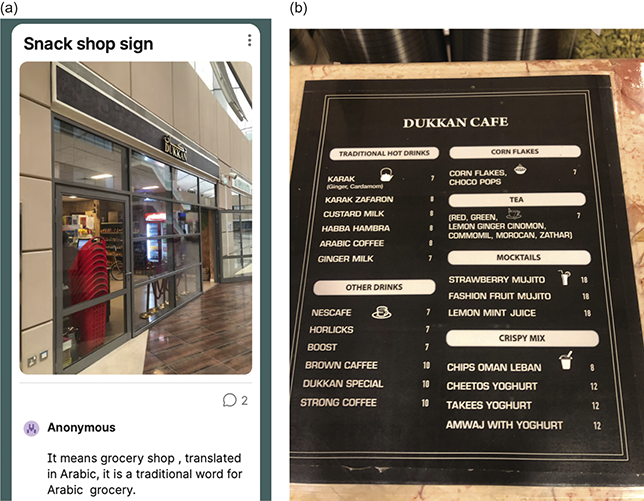
Figure 15 Long description
A: A Padlet post of Dukkan snack store. The storefront shows shopping baskets and the name Dukkan in Arabic script and transliterated. An anonymous student commented that Dukkan is a traditional word for an Arabic grocery.
B: The Dukkan menu, including traditional hot drinks, other drinks, corn flakes, tea, mocktails, and crispy mix, as sections of the menu. There is one image for each section. It is in English script.
Dukkan cups as sticky objects
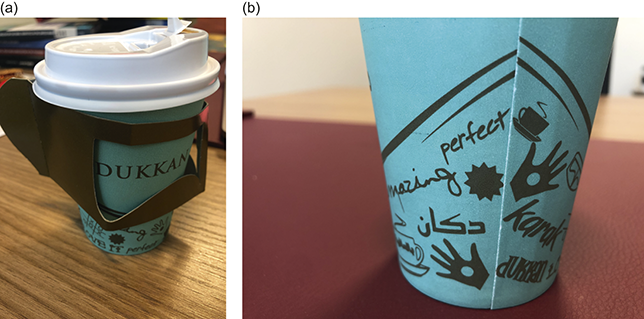
Figure 16 Long description
A: A Dukkan cup with a cup holder shaped like a traditional metal face covering. The cup is for warm drinks and has a white plastic lid. The cup is Tiffany blue and has English and Arabic words and symbols on it.
B: A close-up of writing on the Dukkan cup. English words include perfect, Dukkan, Karak, and amazing. The Arabic script is used for Dukkan, and there are images of a hand with henna and a coffee cup.
The Dukkan cups (Figure 16) are most often filled with freshly made karak, which seems to be the most popular drink choice amongst students, who often queue for it at a separate counter in Dukkan café / shop. Asma and Mariam’s Padlet comments in Extract 7 and Extract 8 indicate that karak (in the cup) and henna (pictured on the cup) are sticky objects, within Dukkan as a sticky place, which bring back memories and invoke warm emotions.
Extract 7
‘Dukkan is popular with students. I go there most days to get karak. It’s a traditional drink from childhood and still now it’s very popular. It says ‘karak’ on the cup and ‘perfect’, which is correct!’
Extract 8
‘The henna design on the hand is an old-fashioned one and not common these days [ … ] it’s special to see that henna. It gives me a happy feeling because it’s part of Emirati culture in the university’
It should be noted, however, that although karak is often viewed as part of Gulf culture (Extract 7), the drink originally comes from India, where the largest percentage of UAE transnational residents are from. In Moaswes’s (Reference Moaswes, Rahman and Al-Azm2023) study looking at the politics of karak in the UAE, complex symbolism surrounds this sticky object. While the adoption of Western and other Arab influences might be seen as threatening to national culture, karak instead has been adopted as a symbol of UAE culture without fear of outside influence (Kapiszewski, Reference Kapiszewski2004). This, according to Moaswe (Reference Moaswes, Rahman and Al-Azm2023), demonstrates ‘coloniality of appropriation’ in that the UAE is ‘fully in control of the contestations that surround South Asian cultural integration into the social fabric of the country’ (p. 73).
In addition to Dukkan as a sticky place, students also saw majlis (traditional Arabian seating areas with cushions on the floor) as sticky places. Majlis either appeared temporarily in the space as part of events or were permanently in the space on both the female side of the campus (Figure 17a) and the male side of the campus (Figure 17b). These areas were seen as sticky due to representing familiarity, comfort, and conviviality, as seen in Fatima’s Padlet comment in Extract 9.
Extract 9
‘The majlis is a comfortable place to sit with friends between classes. It is traditional in Emirati culture’
Majlis as sticky places
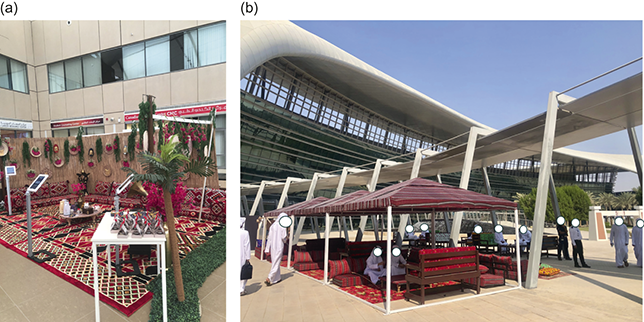
Figure 17 Long description
A: A Majlis, or traditional seating area on the female side of the campus. There are cushions on the floor and a patterned rug. There are traditional baskets and greenery surrounding the seating area.
B: A Majlis on the male side of the campus in the courtyard. Rugs, cushions, and low sofas with tent-like coverings. The university building is in the backdrop. Some students are in the picture, but their faces are covered for anonymity.
Here, both Dukkan and the majlis are places that evoke positive emotions amongst students due to cultural symbolism attached to familiar practices and aesthetics in an otherwise English-medium space.
4.2.2 Creation of Sticky Places and Objects by Students
Students not only appreciated spaces of belonging which had been created for them by others (Dukkan and majlis), but they also attached positive emotions to self-made sticky places and objects of belonging in the educationscape. For example, students commented on comfort and belonging in ‘hidden places’ on campus where they could be alone or with a small group of friends, away from the main social areas. From a previous study on the same campus, forty-six Emirati university students (male and female) shared their perspectives on sticky places at the university, with most identifying ‘hidden places’ in the library or an empty classroom as being attached to positive emotions, as a way of escaping from the stresses of their studies at the EME university (Hopkyns, Reference Hopkyns2025b). In this sense, students sought out their own sticky places attached to emotions of belonging and comfort. Similarly, Alzeer’s (Reference Alzeer2017) ethnographic study at a government university in Dubai revealed that female Emirati students adopted ‘cocooning’ as a spatial practice, whereby they chose to gather in ‘hidden spaces under stairwells, within locker areas, and any other available hidden corners that offered seclusion and privacy’ (p. 1031).
As well as creating spaces of comfort such as ‘hidden places’, sticky objects in the educationscape were also seen via shared religious practices. This was apparent via handwritten notes on notice boards, which focused on faith and forgiveness relating to sick or recently deceased relatives or friends. From talking with an Emirati colleague during the walking ethnography, the practice of posting prayers for loved ones in public places is a longstanding tradition in the Gulf, and decades ago it tended to be a way of communicating the news in a neighbourhood as well as a way of asking for absolution or forgiveness of the sins of the deceased. Usually, the posting of such prayers took place within forty days of the death when it is believed that the soul is still ‘wandering in a purgatory-like phase’ (Azhar, Reference Azhar, Carpenter and Redcay2020, p. 13). In Figures 18–20, the transporting of traditional practices such as the posting of handwritten prayers into the English-medium university can be seen. This takes the form of asking Allah for forgiveness (Figure 18), a heart-shaped note about light after darkness (Figure 19), and a more specific note praying for a recently deceased loved one to be cherished after death (Figure 20).
Faith as a sticky place
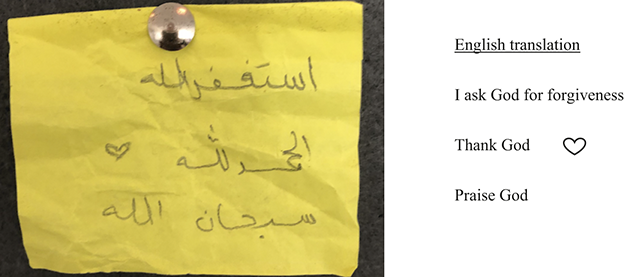
Message of comfort and optimism
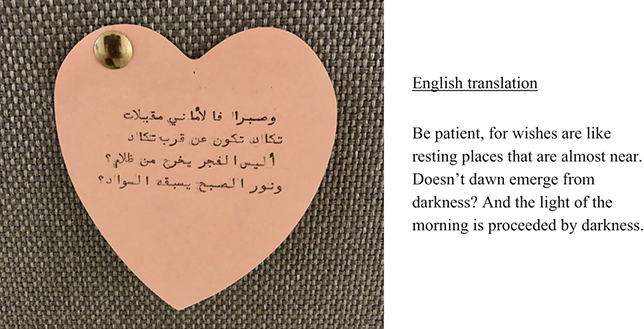
Prayer for a loved one
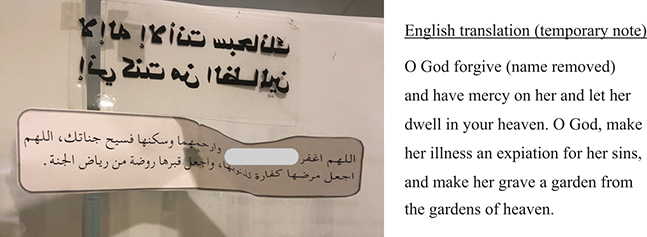
The strong connection between Arabic and Islam is evident in Figures 18–20. In contrast to most handwritten notes in the educationscape, which were translingual (Section 3) or in English (Section 2), bottom-up signs related to religion were in Arabic. Here, Arabic is a sticky object attached to shared religious identities amongst students, and such signs were viewed positively, as voiced by Leila in Extract 10.
Extract 10
‘It’s natural to write prayers in Arabic because Arabic is the language of the Qur’an. It is part of students’ identity, and it is a good message to see in the university’
Similarly, in Etherington et al.’s (Reference Etherington, Hanks and Al-Shehri2020) study, which looked at twelve language teachers’ perspectives on sticky objects in their workplaces, Saudi Arabian teacher, Sara, stated that Arabic as a language and cultural events were sticky objects for her as they resulted in emotions of belonging and connectedness with her Arabic-speaking students. To summarise, places and objects (which involve language and symbols) seen as ‘sticky’ were both produced for students in the space (Dukkan and majlis) and were self-created (hidden spaces and handwritten prayers posted on walls).
4.3 Belonging in the Educationscape
Language and semiotics on signs which relate to everyday nationalism (Theme 4) and sticky places / objects (Theme 5) prompted students to comment on national pride, cultural and linguistic belonging, and religious beliefs and practices.
Findings revealed that UAE flags, images of the nation’s founder, and cultural artefacts were prominent in the English-dominated educationscape. The students interpreted displays of ‘everyday nationalism’ positively. The active flagging of nationhood and Emirati history coincides with ongoing discussions in public discourse and media on the need to strengthen Emirati national and cultural identities. Although globalisation and the dominance of English are present in many internationalised contexts, the UAE’s historical background as a former British protectorate, its relatively short period of time as a nation, its very large transnational population, and the dominance of EME and associated neoliberalism contribute to a sense of ‘cultural fragility’ (Hopkyns, Reference Hopkyns2020). Nation-building, creating a national brand, and shaping national identity have therefore been at the forefront of priorities in recent times (Al-Issa, Reference Al-Issa2017).
Not only are UAE flags and cultural symbols common in the current educationscape, but similar patterns and habits are also seen within other levels of education and in society in general. For example, initiatives aimed at strengthening the Arabic language and national identities can be seen in both public and private school soundscapes through routinely starting the day with the national anthem (Ahmed, Reference Ahmed2009) and curriculums which include lessons on UAE heritage, Islamic values, and Arabic as a first or second language (Singh, Reference Singh, Lopez and Singh2024). In public spaces, too, such as in restaurants, there is the mandating of Arabic on menus (Dubai menus, 2016). Re-traditionalisation movements can be seen across UAE spaces with the aim of cultivating ‘culturally authentic’ spaces through promoting traditional pastimes as part of ‘cultural nationalism’ (Al-Kawari, Reference Al-Kawari2016, pp. 21–22) or ‘heritage preservation’ (MacLean, Reference MacLean2017, p. 168). Culture-based and identity-oriented designs act as ‘branded architectural discourse’ (Theodoropoulou, Reference Theodoropoulou, Theodoropoulou and Tovar2021), which is aimed at affirming national identities, especially in environments where English dominates.
While such culture-based and identity-oriented actions and planning could be seen as a way of countering the dominance of English and influence of Western artefacts, re-traditionalisation movements have been critiqued in terms of presenting unhelpful binaries of ‘traditional’ and ‘modern’. Here, Arabic and national identity tend to collocate with tradition, whereas English and global identities become attached to modernity in the form of linguistic dualism (Findlow, Reference Findlow2006). Rana Al Mutawa, an Emirati scholar, argues that authenticity is socially constructed rather than being connected with a modern / traditional dichotomy. Rather than one ‘national narrative’ which concentrates on ‘surface history’ such as flags, appearance, pearl diving or Bedouin life, Al Mutawa (Reference Al Mutawa2020) argues for rich and socially diverse lived realities to be acknowledged. In this sense, diversity, ‘small cultures’ (Holliday, Reference Holliday1999), and lived realities are more authentic than a top-down projection of national identity connected with re-traditionalisation initiatives and notions of monolithic oneness.
Although in the study, mainly ‘traditional’ objects or places were seen as ‘sticky’ due to shared memories and comfort around culturally meaningful menu items, spaces, and bottom-up religious signs, it is also the case that imported spaces, such as the Starbucks, which sits on the other side of the promenade, may also evoke notions of belongingness. The first Starbucks arrived in the UAE in 2000 in Deira City Centre, Dubai, and was designed to look like a traditional UAE desert home. There are now over 250 Starbucks stores in the UAE (Starbucks.ae, 2025), so it is a very familiar brand that is older than most of the students. It, therefore, could be equally sticky for students in terms of warm familiarity. Al Mutawa (Reference Al Mutawa2018) reflects on this point, stating that Emiratis may feel so-called ‘non-places’ such as shopping malls and imported stores are equally attached to childhood memories and thus are also sticky. For example, when Al Mutawa (Reference Al Mutawa2018) reflects on meaningful spaces in her own childhood, she states ‘the older generation may remember their childhoods in the dikkan (or bodega), but my memories from my childhood were in the Spinneys chain that people complained about when it first arrived [ … ] I think that chain played a similar social role for me as the dikkan did for others’ (p. 9).
As Al Mutawa (Reference Al Mutawa2018) suggests, there are, however, some negative connotations attached to Western chains in the Gulf such as McDonald’s, which symbolically connect with language use. For example, the terms ‘chicken nugget’ (Al-Alawi, Reference Al-Alawi2022) and ‘McChicken’ (Hayat & Al-Bader, Reference Hayat and Al-Bader2022) emerged around 2010 and refer to Gulf nationals who adopt English as their first language and who favour Western ways of being (Al Hasan, Reference Al Hasan2013). Being identified or self-identifying as a ‘chicken nugget’ brings with it complex and multilayered connotations as a source of pride due to English being a desired commodity but also shame as an ‘inhibitor of authenticity’ (Al-Alawi, Reference Al-Alawi2022, p. 646). While participants in the current study did not reference transnational chains or brands as sites of belonging, future studies might explore how such spaces intersect with hybrid identities.
5 Conclusion: Decolonial Agentive Shaping of Spaces
‘Atmospheres do change. Our smallest actions create norms. Our norms create values. Our values drive behaviour. And our behaviours cascade’
As a springboard for exploring multilingual university spaces and decoloniality, a quote from Dolan’s (Reference Dolan2020) debut novel was used at the start of this Element. The quote came from a teacher critically observing ‘the language problem’ (Bhatt et al., Reference Bhatt, Badwan and Madiba2022), ‘colonialingualism’ (Meighan, Reference Meighan2023), and linguistic ‘pecking orders’ (Hua & Kramsch, Reference Hua and Kramsch2016) in her Hong Kong educational institution. While the opening quote identifies many ‘problems’, the quote at the start of this Element’s concluding section points towards ways in which these problematic norms can be challenged.
Thompson’s words (Reference Thompson2025) in this section’s opening quote come from his Atlantic magazine article, ‘The anti-social century’. Although he speaks of changing social norms, these words are applicable to a range of issues, including the neoliberal-colonial nexus found alive and kicking in EMEMUS globally. In this final section of the Element, I begin by revisiting the Element’s core concepts in light of the study’s findings. I then provide practical suggestions for small actions and big actions to be taken with regard to changing norms and levels of belonging within multilingual university spaces.
5.1 Revisiting Multilingual University Spaces
This Element has presented empirical data from an under-researched context which falls outside dominant WEIRD research perspectives (Selvi, Reference Selvi2024) and has covered fresh ground not previously explored in other studies. Through taking an ethnographic approach to the exploration of an English-medium Abu Dhabi university educationscape, and by gaining perspectives from students, faculty, and staff, five key themes emerged: The dominance of English, imbalanced bilingualism, bottom-up translanguaging, everyday nationalism, and sticky places / objects.
Section 2 of the Element looked at the dominance of English in the educationscape and imbalanced bilingual signage. In the university’s main spaces, such as the library, corridors, and social areas, monolingual English top-down signs were used for most ‘naming signs’ (Cook, Reference Cook2022), such as for the naming of offices and classrooms. As the official language of the UAE is Arabic and the students at the university are UAE nationals, many of the top-down signs were also bilingual in Arabic and English. However, on many of the Arabic / English bilingual signs, English was the more dominant language in terms of space and content. This was a pattern seen on English / Chinese bilingual signs in the Chinese Corner of the library and English / Braille signs too. Through nexus analysis, social norms and expectations about language and space were considered via looking at ‘interaction order’ in relation to the data (Hult, Reference Hult2014; Scollon & Scollon, Reference Scollon and Scollon2003). Here, the appearance and absence of language(s) on signage indicated values attached to language(s), with English being at the top of the linguistic hierarchy in terms of its frequency. The multilingual soundscape and ecology of the university were not mirrored in its LL.
Accompanying English-dominated signage were certain ideologies and values, such as neoliberal-evoked messages promoting success, ambition, and individualism. English was also connected with the aesthetics of Whiteness. Here, images of White children were used to advertise the university nursery, and such images did not reflect the student body. Mena and Garcia (Reference Mena and García2021) argue that White is often viewed as unmarked, and this is not accidental or natural, but rather due to a historical semiotic process of ‘unmarking’. Students’ perspectives on the dominance of English and semiotics centring Whiteness were largely uncritical. While some advocated for a balance between important print languages such as English and Arabic and non-print writing codes such as braille, others were ambivalent, or such issues went uncommented on.
Section 3 revealed that while translanguaging is common in the university soundscape, as easily overheard from chats in corridors between students, faculty, and staff, it scarcely appeared in print form on signage. Translanguaging only appeared on bottom-up handwritten signs, which students perceived as both ‘fun’ and ‘real’. Often messages on translingual notes were informal and tended to centre on the ‘ethos of care’. The handwritten translingual notes, which are usually seen as less valuable (Li & Hua, Reference Li and Hua2021; Pennycook, Reference Pennycook, Jaworski and Thurlow2010) than top-down signs, were temporary in nature and therefore arguably less legitimate in the space. As part of the nexus analysis, societal beliefs about languages and speakers of languages that affect language choices on signs were considered. Looking at ‘discourses in place’ (Scollon and Scollon, Reference Scollon and Scollon2003) and societal ideologies around translanguaging (Al-Bataineh & Gallagher, Reference Al-Bataineh and Gallagher2021; Hopkyns & Elyas, Reference Hopkyns, Elyas, Hopkyns and Zoghbor2022; van den Hoven & Carroll, Reference van den Hoven, Carroll and Buckingham2016), a connection was found between its lack of acceptance in formal domains and its scarcity in the EME educationscape.
In Section 4, findings from the last two themes represent ways in which the university, and students within the university, created spaces of belonging in the educationscape. Although the university is dominated by English, displays of everyday nationalism in the form of flagging and commemorating leaders and the country were frequent. Students’ reactions to these displays related to pride in their nation. Certain signs and semiotics represented ‘sticky objects’ and ‘sticky places’ for students as they were ‘saturated with affect’ (Ahmed, Reference Ahmed2014, p. 11). Most of the places and objects that students found ‘sticky’ connected with cultural traditions and memories from childhood, such as the traditional café and shop ‘Dukkan’, traditional seating areas (majlis), and handwritten notes about religious beliefs. Here ‘historical body’ (Hult, Reference Hult2014; Scollon and Scollon, Reference Scollon and Scollon2003), which is part of nexus analysis, was shown to be important in revealing how habits, practices, and values of sign makers influenced the space. The grand narrative of national pride seen through displays of everyday nationalism, together with re-traditionalisation movements, influenced the educationscape.
In light of the findings, I provide six practical suggestions in the following three subsections (two in each subsection). These steps focus on transformative actions that aim to change neoliberal and neocolonial norms, values, and atmospheres in the study’s educationscape. These suggestions, with contextual adaptations, are applicable to a wide range of global EMEMUS.
5.2 Countering English as Standard and Whiteness as the Norm
Steps can be taken with regard to the dominance of English, imbalanced bilingualism, and associated epistemologies found in multilingual university spaces. Two practical suggestions involve: (1) More targeted LL projects where prompts and questions directly relate to the dominance of English, imbalanced bilingualism, and epistemic bias; (2) Raising awareness about power dynamics and ideologies behind linguistic and semiotic choices in educationscapes and beyond. The aim behind such decolonising steps is for bottom-up situated changes to occur.
First, the relative lack of criticality from stakeholders around the dominance of English and imbalanced bilingualism in multilingual ecologies can be challenged by actively involving students in LL projects which involve thinking more deeply and specifically about language and semiotics. Examples of such activities can be seen in the contexts of Canada, the UK, and South Africa, as described in the following. It should be recognised, however, that any decolonising actions need to be tailored to the setting, as appropriate actions are highly contextual (R’boul et al., Reference R’boul, Barnawi and Bin Rashed2025; Tupas, Reference Tupas2025). In this sense, the concept of ‘hyper-contextualisation’ (Hampson, Reference Hampson2025) is important to apply, where consideration of micro, meso, and macro contexts influences courses of action. For example, while Canada and South Africa have histories of settler colonialism (Tuck & Yang, Reference Tuck and Yang2012) and London is the heart of old imperialism, the UAE has a very different background, involving a history of ‘informal’ colonialism (Onley, Reference Onley2009) and, more prominently, its participation in the ‘scramble for EMI’ (Willans, Reference Willans2022) driven by rapid globalisation together with neoliberal discourse.
With this acknowledged, examples of awareness raising tailored to certain global educationscapes include studies by Sterzuk (Reference Sterzuk, Malinowski, Maxim and Dubreil2020) and Marshall et al. (Reference Marshall, Al Hannash, Mayni, Gorter and Krompák2024), both in Canadian contexts, where LLs were used as a tool for ‘developing multilingual critical awareness and noticing the textual practices of public spaces to build awareness of colonial history and imperialistic oppression’ (Marshall et al., Reference Marshall, Al Hannash, Mayni, Gorter and Krompák2024, p. 198). Specifically, Marshall et al.’s (Reference Marshall, Al Hannash, Mayni, Gorter and Krompák2024) study involved university students walking around their campus and collecting images of signage. Rather than commenting on the signage in an unstructured and broad way, the students were asked to write retrospective reflections specifically on their perceptions of Eurocentric dominance and monolingualism in the space. The students then further reflected on ways in which universities could move towards addressing ‘colonial cultural hegemony’ (p. 195) on multilingual and multicultural Canadian campuses. Moreover, in the context of Bloomsbury, where the School of Oriental and African Studies and University College London campuses are located, Amir (Reference Amir2024) advocates for ‘decolonising walks’ where stakeholders specifically pay attention to how coloniality has historically shaped the space. In the context of South African higher education, Mapaling and Shabalala (Reference Mapaling and Shabalala2025) discuss how stakeholders can claim space by actively challenging ‘spatialised forms of exclusion’ (p. 7). In Mapaling and Shabalala’s (Reference Mapaling and Shabalala2025) case, action took the form of placing books by Black authors on a coffee table in a social space within the university which had long been characterised by White Eurocentrism. This symbolised a quiet refusal to ‘let history be the only story told in that room’ and a refusal to be a ‘custodian of White nostalgia’ (p. 8). In the case of the UAE, where there is no public framing of its history as colonial, and official discourse rarely acknowledges colonialism explicitly, decolonial action relates primarily to the colonial-neoliberal nexus and linguistic hierarchies. Thus, hyper-contextualised and targeted approaches to raising awareness and levels of criticality are needed. The benefits of stakeholders, especially students, analysing their educationscape include becoming more aware of the symbolic power of languages in the space (Cenoz & Gorter, Reference Cenoz and Gorter2008). As Shohamy (Reference Shohamy, Pütz and Mundt2019) states, LLs can be viewed as mirrors that reflect societies and can therefore be used as tools for learners to become aware of social, economic, and political issues that intersect with equality, inclusion, and exclusion, at a deep cultural level, leading to activism. Such contextualised approaches focus on activism and transformation, which are informed by broader historical epistemic and material-based decolonial discourses. This juxtaposes with ‘domesticated decoloniality’ (R’Boul et al., Reference R’boul, Barnawi and Bin Rashed2025) whereby shallow or ‘sanitised’ forms of decolonising are adopted, often by institutions, with the purpose of causing minimum disruption to existing neoliberal agendas.
Second, awareness raising and action are not only needed regarding language hierarchies in educationscapes but also associated epistemic biases towards Western modes of thought (Faruque, Reference Faruque2024; Kuteeva & Andersson, Reference Kuteeva and Andersson2024; Lumbard, Reference Lumbard2024; Mahboob et al., Reference Mahboob, Mallet and Koay2025; R’boul & Barnawi, Reference R’boul and Barnawi2024). The pairing of English-only signage with values and aesthetics associated with Western epistemologies was evident in the study but not remarked upon by students. As part of wider decolonial movements, scholars have argued that Muslim stakeholders are often aware of the dominance of Western epistemologies but ‘know they must adhere to a system that recognises the epistemic sovereignty of the secular Euro-American paradigm if they are to gain recognition or even be heard within it’ (Lumbard, Reference Lumbard2024, p. 7). In this sense, there may be an attitude of ‘playing the game’ despite the rules being unjust due to a ‘credibility deficit’ attributed to the Islamic world and ‘credibility excess’ attributed to Euro–American epistemologies (Fricker, Reference Fricker2007). As language use is closely connected to culture, ideologies, and identities, the dominance of a language such as English can result in coloniality of the mind (Ngũgĩ wa Thiong’o, Reference wa Thiong’o1986), also referred to as ‘colonial mentality’ (Dalaqua, Reference Dalaqua2020). A further way in which colonial mentality presents itself is the dominance of White people on signs for services in which most of the customers and users are not White. Here, Whiteness is taken as the norm together with English. Challenging the colonial legacy of linguistic, epistemic, and racial biases becomes harder still in the age of AI (Kuteeva & Andersson, Reference Kuteeva and Andersson2024). Increasingly, AI is being used not only for the creation of signs (both print and digital) but also for an increasing number of everyday tasks inside and outside universities, which ‘may inadvertently perpetuate stereotypes or cultural biases’ (Hua et al., Reference Hua, Dai and Brandt2025, p. 817). As Kuteeva and Andersson (Reference Kuteeva and Andersson2024) rightly argue, ‘contrary to decolonisation’s goals to increase diversity in perspectives and to promote epistemic justice and equal participation, AI-assisted Large Language Models are likely to drive knowledge communication towards further convergence’ (p. 562). Although this Element does not allow for a full exploration how AI may exacerbate issues emerging from the findings, its presence and impact cannot be ignored (see Jenks, Reference Jenks2023).
Despite such entrenched challenges relating to ‘English as standard and Whiteness as the norm’, decolonial actions can be taken by individuals. For example, as part of designer Johanna Burai’s ‘World White Web’ project, she challenged Google over the dominance of White images on the Internet (World White Web, 2025). Burai noticed that when she searched for a picture of a hand for a college assignment, only White hands appeared. When she searched for a ‘Black hand’, only animated Black hands were shown. When searching for an ‘African hand’, racism was revealed as images appeared of ‘White hands reaching from above like grabbing a Black hand saying almost “I’m going to help you”’, Burai told BBC reporter Oriana Storey (Reference Storey2016). Through her ‘World White Web’ project, Burai shared images of Black hands and encouraged people to share them online to change algorithms to help end the norm of Whiteness on the Internet. From a Google search I did in January 2025, the first two images of a ‘hand’ were Black, showing the effectiveness of Burai’s project. However, when searching for ‘foot’ or ‘elbow’ on Google, the page was full of White images, showing there is still more activism needed to challenge White centricity in online and offline semiotic landscapes. Sharing examples such as Burai’s project and creating similar projects in online and physical spaces would be a decolonial step to help counter ‘Whiteness as the standard’ (Swift, Reference Swift2024) and ‘English as the norm’. Digital environments can also be used as a space to raise awareness on the importance of decolonising everyday practices (Young, Reference Young2020), with projects being shared widely online using popular hashtags such as #decoloniseeducation, #decoloniseyourlife, and #decolonisethisplace as part of a wider decolonising movement.
5.3 Legitimising Translanguaging in Educationscapes
It is important to consider whole university ecosystems in terms of language use and representation. Along with the ‘critical trans era’ (Fang et al., Reference Fang, Zhang and Sah2022) in classrooms, translanguaging can be more actively promoted in other university spaces via awareness raising and the agentive shaping of spaces by stakeholders, with the purpose of empowering translingual identities of plurilingual speakers (García & Li, Reference García and Li2014; Li & Kelly-Holmes, Reference Li, Kelly-Holmes, Blackwood and Røyneland2022). Legitimising translanguaging in educational linguistic and semiotic landscapes would help diffuse dominant monolingual ideologies promoting the linguistic capital of English in neoliberal modernity. To take steps towards decolonising the educationscape, there is a need to ‘defy grand narratives’ (Sadoudi & Holliday, Reference Sadoudi and Holliday2023) around translanguaging as precarious and as only suitable for informal or playful contexts. More holistic inclusion of translanguaging in the educationscape would help erode such notions. Two practical suggestions for using translanguaging as a decolonising tool involve: (1) Raising awareness to the agentive shaping of spaces by stakeholders in educationscapes; (2) Challenging the way translanguaging is deemed only suitable for informal and handwritten signs.
First, previous studies have stressed the importance of ‘smuggling the vernacular into the classroom’ (Probyn, Reference Probyn2009), problematising the ‘E’ (for English) in EME (Sahan & Rose, Reference Sahan, Rose, Paulsrud, Tian and Toth2021) and leaning into a ‘translanguaging instinct’ (Holliday, Reference Holliday, Galloway and Selvi2025; Li, Reference Li2018). While awareness has been raised as to the ‘critical trans era’ in classrooms (Fang et al., Reference Fang, Zhang and Sah2022), less attention has been given to the inclusion of translanguaging as part of broader university educationscapes. Greater awareness needs to be raised as to ways in which spaces can be agentively shaped by stakeholders to represent authentic translingual ways of communicating. This can be achieved by drawing students’ attention to the positive emotions translanguging can bring (as seen in Section 3) in its ‘realness’ and its ability to shift students’ translingual identities from the periphery to the centre. This could take place through class projects or discussions as part of the many language clubs offered in the university. Questions could be posed such as, ‘why do we hear such rich linguistic repertoires as part of the university soundscape but only see translanguaging on a small percentage of signs?’ Asking critical questions such as this can encourage deeper thinking about language ideologies and power in the space.
Second, the study revealed underlying ideologies around written translanguaging as only suitable for informal bottom-up messages as opposed to printed permanent signs. There was a sense that handwritten translingual notes were only for fun and / or for personal messages of support. Such beliefs strengthen linguistic hierarchies and unequal Englishes by attributing higher status to monolingual standardised English (and Arabic) than localised varieties, which often involve translanguaging. To challenge beliefs that translanguaging is only suitable for informal handwritten signs, incorporating translanguaging onto more formal printed signs would help give weight and legitimacy to its presence in the educationscape. An example of how this could be done was shared with me via Twitter (now X) by a colleague traveling on the Eurostar who photographed a translingual top-down digital sign on his train. In the sign, English and French appeared fluidly in the same sentence, reading, ‘No smoking or vaping on board s’il vous plait’ and ‘Remember, some people like to travel in tranquillité’.
Having students design translingual messages with the intention of implementing changes to some official signs in the educationscape would help ‘crumble the colonial wall’ (Shah, Reference Shah2025, p. 1) of unequal Englishes and linguistic hierarchies. Rather than placing languages side by side, like those in the current educationscape, designing translingual signs would contribute to accurately representing the way plurilingual speakers frequently use language through the ‘blending of communicative resources and the crossing and transgressing of boundaries’ (Baynham & Lee, Reference Baynham and Lee2019, p. 13). Designing such signs would present an opportunity to question surrounding language purity ideologies and ‘native speaker’ norms in favour of an acceptance of the ordinariness of translanguaging, not just for informal chatting and handwritten notes.
5.4 Socially Constructed Spaces of Belonging
Regarding everyday nationalism, and sticky places / objects in the space, two recommendations can be made, which aim to more deeply nurture stakeholders’ linguistic and cultural belonging in the space: (1) Looking beyond national narratives of belonging; (2) Raising awareness around how emotions and space interact for increased belonging.
First, there is a need to bridge dichotomies seen in the educationscape. From the analysis of Theme 4 (signs of everyday nationalism), semiotics in the space that relate to local identities tend to focus on a ‘national narrative’ rather than diverse experiences. UAE flags, images of the founding father, and signs relating to ‘Etihad’ (the union of the emirates) are juxtaposed with English-dominated signage. Such patterns are also seen in broader society and through digitalscapes. Especially in 2025, which was named the ‘Year of Community’ in the UAE, goals point to diversity in belonging. However, paradoxes and dichotomies often persist around how this message is promoted. For example, in a popular English language entertainment magazine, an announcement for the ‘Year of Community’ has the title ‘creating spaces where everybody belongs’ written only in English which is juxtaposed with a national focus on preserving culture illustrated through an image of two Emirati men in national dress waving a large UAE flag in the desert. In the current climate of English-dominated neoliberalism with bursts of intense everyday nationalism, there is a need to look more deeply at what belonging means to stakeholders in the space. Fanon (Reference Fanon1963) warns against postcolonial nationalism as potentially creating systems of elitism rather than looking to diversity and co-construction. Equally, flagging and re-traditionalisation movements may act as distractions in the form of simple symbolism rather than a richer focus on diversity. Awareness raising projects could involve ‘going deeper’ and looking at ways in which the space can foster more diverse and meaningful levels of belonging. Such projects would involve discussions on cultural and national symbolism at the university and its relationship to belonging. Although the university is a public university with an Emirati student body, other stakeholders in the space, including faculty and staff, are mainly transnational residents. The emphasis on ‘preserving culture’ and ‘creating spaces where everyone belongs’ could be unpacked, with the posing of key questions such as ‘how can diversity and lived experiences be prioritised over, or shared with, national displays of tradition within the EME space?’.
Second, as part of the ‘affective turn’ (Pavlenko, Reference Pavlenko, Gabryś-Barker and Bielska2013) in applied linguistics, understanding stakeholders’ emotions in EME contexts is important for sustainable education, improved well-being, and increased levels of belonging (Hopkyns, Reference Hopkyns2025b). This is especially the case in today’s era, where there is an increased recognition of the legacy of colonialism in terms of language, culture, and epistemologies across multiple domains (Baker et al., Reference Baker, Morán Panero and Valencia2024; Phyak et al., Reference Phyak, Sánchez, Makalela, García, McKinney, Makoe and Zavala2023; Sah & Fang, Reference Sah and Fang2024). From a post-structuralist approach to the theorising of emotions (Benesch, Reference Benesch2017; De Costa et al., Reference De Costa, Li, Rawal and Peters2019), emotions are recognised as not being merely internal feelings to be worked through, but rather they are entangled with various intersections of identities and contextual factors such as neoliberalism and top-down language education policies (Sah, Reference Sah2023). Connected with EME being ‘stuck to’ future success, which results in increased pressure, many of the handwritten bottom-up messages from students focused on the ‘ethos of care’, indicating the need for bolstering self-esteem, confidence, and comradery in the space. This could also be seen via the importance of ‘sticky places’, which evoked warm feelings in the space. Including more student-initiated ‘spaces of belonging’ would give agency to stakeholders to more freely shape their ‘lived space’ (Lefebvre, Reference Lefebvre1974). Paying attention to the ‘emotional landscape’ (Hillman et al., Reference Hillman, Li and Şahan2023) by considering emotions attached to language and semiotics in a space and listening to students’ perspectives on sticky places and objects is important in crafting spaces of deeper meaning.
5.5 Future Directions
Especially in recent times, there has been a surge of studies and publications arguing for critical changes to be implemented to multiple areas of EMEMUS (Canagarajah, Reference Canagarajah2023; Kramsch, Reference Kramsch and Macedo2019; Macedo, Reference Macedo and Macedo2019; Phipps, Reference Phipps2019; Phyak et al., Reference Phyak, Sánchez, Makalela, García, McKinney, Makoe and Zavala2023; Sah & Fang, Reference Sah and Fang2024; Selvi, Reference Selvi2024; Tupas & Tarrayo, Reference Tupas and Tarrayo2024). This Element adds to and builds upon previous research by breaking fresh ground as the first LL study of a UAE university educationscape, to the best of my knowledge. Despite the large number of current studies interrogating the coloniality-neoliberalism nexus (Shah, Reference Shah2025) in higher education, practical interventions and measurable outputs are slow to materialise (Tran, Reference Tran2021). Part of the challenge is the lack of visibility of research findings from studies looking at coloniality in education. While the tearing down of imperial statues attracts attention and is widely covered in the news, more complex and holistic issues related to coloniality tend to reach a mainly academic audience. For example, Jenkins’s (Reference Jenkins2014) study, which explored international universities in East Asia, Europe, South America, and the Anglosphere, found that even when well-known scholars published on the topic of decolonising, the universities in which they worked seldom made their suggested changes. Jenkins (Reference Jenkins2014) gave specific examples by juxtaposing publications on decolonising from esteemed scholars with the monolingual English and Eurocentric websites and LLs of their institutions to show this discrepancy between research and action in tangible terms. While the recommendations in the final section of this Element centre around raising awareness, challenging problematic norms, and hearing stakeholder voices, for these recommendations to be heard outside the ivory tower of academia, public-facing dissemination is important to reach a wider audience, including the eyes and ears of policy makers embedded in English-medium universities globally.
It is important to recognise the limitations of the current research and point to future directions. The study was small in scale as only one university campus was explored and only twenty-eight female students’ perspectives were gained, along with informal interviews with faculty and staff during the walking ethnography. To develop this research further, a larger group of stakeholder perspectives could be gained, including male and female students and transnational faculty from both campuses: Abu Dhabi and Dubai. In addition, other types of higher education institutions could be explored such as international branch universities. Having a small group of students accompany the researcher on the walking ethnography using the ‘tourist guide technique’ (Biró, Reference Biró2016) modelled on Garvin’s (Reference Garvin, Shohamy, Ben-Rafael and Barni2010) ‘walking tour’ methodology, would also provide deeper insights into the educationscape which were perhaps not fully expanded upon in the Padlet boards. Adopting methodologies such as ‘photovoice’ (Wang & Burris, Reference Wang and Burris1997) and ‘empowering photography’ (Pietkäinen, Reference Pietikäinen, Gardner and Martin-Jones2012) would also give students the agency to decide which signs in the university to photograph and comment on, rather than the researcher selecting the forty signs from the 482-sign corpus.
To conclude, ethnographic LL studies can allow for often unquestioned language practices and ideologies in postcolonial contexts to be unpacked and critically examined as well as leading to practical action. This Element joins many other critical educationscape studies globally but represents just the beginning of educationscape research in the UAE. I encourage other scholars to build on this research in the under-researched context of the Gulf and other non-WEIRD contexts affected by coloniality. Perhaps the primary message to come from the Element is, in Soja’s (Reference Soja, Wharf and Arias2009) words, ‘space matters’, and therefore regularly revisiting and reanalysing multilingual university educationscapes is needed for sustainable and socially just education.
Acknowledgements
I would like to thank the editors of Cambridge Elements in Applied Linguistics, Zhu Hua and Li Wei for supporting me with this book project and Becky Taylor from Cambridge University Press for her encouragement and patience. I would also like to thank the participants in this study for generously sharing their perspectives and insights.
I am grateful to my institutions, the University of St Andrews, Scotland and University College London, and my academic community at the Oxford Centre for Islamic Studies for supporting and encouraging my research and providing beautiful spaces in which to work. A big thank you must also go to the anonymous reviewers whose feedback was valuable in shaping the final version of this Element.
I want to give special thanks and recognition to my international researcher friends Melanie van den Hoven, Sara Hillman, and Anna Dillon for our regular chats about all things Gulf-related, research-focused, and much more, usually while walking – me in Oxfordshire fields, Melanie on Chamonix mountain trails, Sara in Doha, and Anna in Abu Dhabi (now Slovenia). I greatly treasure these walks and talks!
I have also benefited from the knowledge and critique of ‘critical friends’ who have pushed my thinking further regarding some of the concepts explored in this Element and their applications in multilingual university educationscapes. Especially valuable were conversations following the ‘Translanguaging as a decolonising tool: An invitation / non-conclusion’ colloquium I was part of at the 2024 Sociolinguistic Symposium (SS25) in Perth, Australia. Thank you to Pramod Sah, Sender Dovchin, Shaila Sultana, Alastair Pennycook, Yecid Ortega, and Ibrar Bhatt (later via Zoom) for your valuable insights.
Finally, a big thank you to my fantastic family, especially my husband Dan and son Thomas for all their support, for listening to me talk about the writing process (probably too much!) and for much-needed breaks in the form of sitting around the fire (Dan) and park runs (Thomas). I am very lucky to have you both, and I know it!
University College London
Li Wei is Chair of Applied Linguistics at the UCL Institute of Education, University College London (UCL), and Fellow of Academy of Social Sciences, UK. His research covers different aspects of bilingualism and multilingualism. He was the founding editor of the following journals: International Journal of Bilingualism (Sage), Applied Linguistics Review (De Gruyter), Language, Culture and Society (Benjamins), Chinese Language and Discourse (Benjamins) and Global Chinese (De Gruyter), and is currently Editor of the International Journal of Bilingual Education and Bilingualism (Taylor and Francis). His books include the Blackwell Guide to Research Methods in Bilingualism and Multilingualism (with Melissa Moyer) and Translanguaging: Language, Bilingualism and Education (with Ofelia Garcia) which won the British Association of Applied Linguistics Book Prize.
University College London
Zhu Hua is Professor of Language Learning and Intercultural Communication at the UCL Institute of Education, University College London (UCL) and is a Fellow of Academy of Social Sciences, UK. Her research is centred around multilingual and intercultural communication. She has also studied child language development and language learning. She is book series co-editor for Routledge Studies in Language and Intercultural Communication and Cambridge Key Topics in Applied Linguistics, and Forum and Book Reviews Editor of Applied Linguistics (Oxford University Press).
About the Series
Mirroring the Cambridge Key Topics in Applied Linguistics, this Elements series focuses on the key topics, concepts and methods in Applied Linguistics today. It revisits core conceptual and methodological issues in different subareas of Applied Linguistics. It also explores new emerging themes and topics. All topics are examined in connection with real-world issues and the broader political, economic and ideological contexts.