


14.1 Introduction
In 2022, the online magazine Vice discussed the impact of influencers on business and society by highlighting the problematic practices of influencers on social media platforms like Instagram, YouTube, and other social media channels.Footnote 1 Examples of problematic practices included damaging public property for photo opportunities, trivializing serious historical issues, exploiting personal relationships for content, and buying followers and likes to expand their social media channels and presences. In 2024, the BBC reported for the fifth time about Andrew Tate, the “self-proclaimed misogynist influencer” whose content, which often includes disparaging remarks about women, influences young men and boys, many of whom view him as a role model, despite his controversial statements and actions even after his arrest in 2022.Footnote 2 Given the current sentiment in the media, influencers and their online and offline activities (are perceived to) have a negative impact on business and society.
Yet, the global influencer marketing market is growing rapidly. The global market tripled since 2020 and is expected to achieve a valuation of US$32.5 billion in 2025.Footnote 3 Considering the fast growth of this influencer economy and the negative impacts of social media content creation, if a set of best practices is to emerge, studies of current practices in influencer content production and sharing are essential. This chapter relies on in-depth interviews to propose a case study of INSTINCT3, an influencer management agency in the German video game industry, a vibrant and rapidly growing sector within the broader gaming ecosystem of online and offline video gaming. The Governing Knowledge Commons (GKC) framework (Frischmann et al. Reference Frischmann, Madison and Strandburg2014; Sanfilippo et al. Reference Sanfilippo, Frischmann and Standburg2018) is mobilized to understand how INSTINCT3 governs two action arenas – its online influencer communities and its offline employee community.
14.2 The Influencer Industry
Influencers can be identified as internet users who reach significant followings on social media platforms by sharing written and visual narratives of their personal lives and lifestyles (Schulz Reference Schulz, Idowu and Schmidpeter2020). Through active interaction with their audience in both online and offline settings, influencers monetize their platforms primarily by integrating “advertorials” within their posts or social media content. In recent years, many studies have addressed the “dark side” of the social media industry, where influencers and their practices have been linked with the promotion of online gaming (Haenlein et al. Reference Haenlein, Anadol and Farnsworth2020), parasocial (or one-sided) interactions with human and virtual influencers (Stein et al. Reference Stein, Breves and Anders2022), and addiction (Bhargava and Velasquez, Reference Bhargava and Velasquez2021). Moreover, a growing number of studies also addresses the well-being of influencers as content creators, including for example the anxiety of influencers as both a negative side-effect of content production and an unethical tactic to gain attention from followers on social media (Hund Reference Hund2023; Lehto Reference Lehto2022).
Overall, influencers are often portrayed by both media and academic sources as inconsiderate, unethical, and self-centered digital entrepreneurs. They are characterized as exploiting their online communities irresponsibly, prioritizing personal profit over ethical considerations. This raises the question of how organizations operating in this industry are developing ethical or value-based community practices and how they might translate these values to their large followings online.
14.2.1 Influencer Management Agencies
Influencers are increasingly managed by or integrated into larger organizations known as influencer management agencies (IMA). IMAs represent a new development in the institutionalization of online content creation and online community interaction. An IMA recruits, manages, and supports influencers in creating, sharing, and promoting content on specific topics (e.g., video gaming, traveling, lifestyle); handles contract negotiations, campaign planning, and reputation management; and assists in building and maintaining their online and offline communities. INSTINCT3 is a German IMA specialized in video gaming, a term that here refers to both online and offline games that may offer online interactions with other players. As most games now provide online interactions, the distinction between video games and online games is no longer used.
Influencers play a crucial role in the industry, shaping the video gaming landscape, connecting with audiences, and driving engagement with video gaming content (using, for example, YouTube reviews or live gaming streams platforms such as Twitch). Video game influencers engage with their followers (users interested in online or offline video gaming) through online communities on platforms such as YouTube, Twitch, TikTok, or X (Twitter). IMAs support the development of influencers, and help them create and share special interest content with these communities and its members, including in collaboration with different organizational actors, such as artists and project managers, creative designers, content developers, editors, and other influencers. IMAs are involved in the management of their influencers’ online communities by monitoring comments and engaging with community members. They respond to participants who comment on content shared by influencers, and interact with readers and viewers who reach out via direct messages or emails. Overall, IMAs are key actors that craft an organizational community of practice that develops and operates influencer channels, aiming to produce high-quality, engaging content while safeguarding the reputation of the influencers involved.
14.2.2 IMAs and Communityship
The activities of IMAs align with Mintzberg’s (Reference Mintzberg2009) concept of communityship, which emphasizes the importance of cultivating a sense of community within organizations. For Mintzberg (2009, 2–3), the combination of individual leadership and collective citizenship is essential for the creation of communityship, which requires what he calls “engaged and distributed management” (wherein a community leader is personally engaged in order to engage others) and “just enough leadership” (which involves intervening when appropriate) so that anyone and everyone can exercise initiative and collaborate toward the achievement of a shared purpose. These principles have proven valuable in creating resilient and adaptive organizations, such as Wikipedia, which thrive on collective effort and shared values.
Given that they coexist in close relation with the online communities they operate and govern, IMAs deploy communityship beyond the boundaries of a single organization. Online communities are computer-mediated online forums where individuals exchange text or audiovisual content to discuss, share information, or learn about topics of interest (Schulz Reference Schulz, Idowu and Schmidpeter2020). These communities facilitate public and private communication among participants. They can be organization-driven (e.g., about a public or commercial organization) or citizen-driven (e.g., forming around certain societal topics or goals). Influencer communities can be defined as organization-driven online groups or forums where influencers are the primary content producers and channel owners – sharing organizational, industry, and personal content pertaining to their chosen topic of interest, according to a well-specified business model – and citizens, viewing or commenting on the content produced by the influencers and other participants. Both influencers and citizens can individually or jointly promote ideas, seek answers, offer critiques, or provide improvement tips within these communities (Schulz Reference Schulz2021).
14.3 Governing Knowledge Commons in the Influencer Industry
The study of a specific case in the German video game influencer industry proposed in this chapter draws on the GKC framework (Hess and Ostrom Reference Hess, Ostrom, Charlotte Hess and Ostrom2007; Frischmann et al. Reference Frischmann, Madison and Strandburg2014; Cole Reference Cole, Frischmann, Madison and Strandburg2014; Standburg et al. Reference Strandburg, Frischmann, Madison, Strandburg, Frischmann and Madison2017; Sanfilippo et al. Reference Sanfilippo, Frischmann and Standburg2018), which is an extension of the Ostromian Institutional Analysis and Development (IAD) framework (Ostrom Reference Ostrom2005, Reference Ostrom2010) to knowledge commons – namely, to the community-led governance of creating and sharing of information, data, ideas, and various other forms of intellectual and cultural resources. Specifically, the study examines how actors in the German video game industry are producing and sharing information, innovations, and creative works to cultivate communityship, and based on the rule-in-use of communityship govern their offline and online community(ies).
14.3.1 The GKC Framework
The study focuses on the flow of information and knowledge both within the IMA and within its online communities, and considers its impact on the continuity, mutual trust, and safety of these two communities. To connect these two worlds, I rely to earlier work (Schulz et al. Reference Schulz, Jonker and Faber2018; Schulz Reference Schulz2021) using the inside–out (organization-driven) perspective in online community communication and the evaluation of specific community practices. This perspective reveals how organizations engage with citizens in cocreating community processes and resources, but aim to control these as providers of resources, which is to say online content.
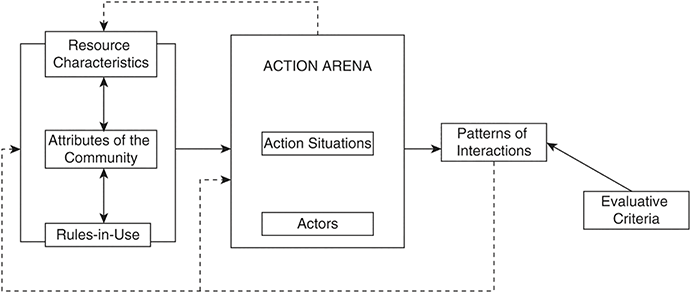
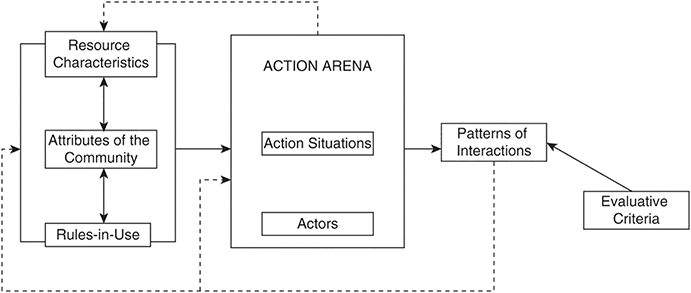
All the relevant actors engage in various action situations within specified action arenas. In this case, there are two organization-driven action arenas: (1) the organizational community, which is mostly offline and consists of the IMA’s employees; and (2) the online community, which includes IMA employees and a range of online community members. Specifically, in both action arenas, actors “engage with the particular narratives of the community, which may be grounded in storytelling, metaphor, history and analog” (Frischmann et al. Reference Frischmann, Madison and Strandburg2014, 25) and “interact with rules, resources, and each other” in a manner that is “inextricably linked with and determinative of the form and content of the knowledge or informational output of the commons” (Frischmann et al. Reference Frischmann, Madison and Strandburg2014, 27). The multiple resources pooled in both action arenas include communication practices and their outcomes, such as personal values, ideas, concepts, processes, feedback, and agreements, all of which are related to the development and sharing of audiovisual and written content. These resources and their characteristics, along with community attributes (including members and their roles) and a set of governing rules-in-use, serve as “inputs to an action arena” (Sanfilippo et al. Reference Sanfilippo, Frischmann and Standburg2018, 123), where various actors “interact with resources, rules, and one another” (Strandburg et al. Reference Strandburg, Frischmann, Madison, Strandburg, Frischmann and Madison2017, 16). This analytical setup is captured in Figure 14.1.
The GKC framework.
The GKC framework was recently applied by Gradoz and Raux (Reference Gradoz, Raux, Erwin Dekker and Kuchař2021) to study within a French online video game community the rules-in-use of troll forums, where abusive and provocative content about societal topics is shared. This online forum and its community – the local commons – is valued by its members, while society calls for the closure of these transgressive spaces. This chapter extends this type of research by investigating the rules-in-use of a specific IMA, with a special focus on how its communities are maintained and governed by a specific set of value-based practices. These practices capture the rules-in-use, which can be understood as “what is considered acceptable to do within the community” (Gradoz and Raux Reference Gradoz, Raux, Erwin Dekker and Kuchař2021, 219). They are reflected in the communication and interactions between the actors in both action arenas, and because their goal is to mediate among “communities with different default norms” (Frischmann et al. Reference Frischmann, Madison and Strandburg2014, 33), they are central to the knowledge commons under consideration.
14.3.2 Research Questions
To help researchers study knowledge commons, and more specifically to help researchers evaluate case studies using the GKC framework, Sanfilippo et al. (Reference Sanfilippo, Frischmann and Standburg2018) have provided a useful set of representative research questions (Table 14.1).
Background environment
What is the background context (legal, cultural, etc.) of this particular commons?
What normative values are relevant for this community?
What is the “default” status of the resources involved in the commons (patented, copyrighted, open, or other)?
How does this community fit into a larger context?
What relevant domains overlap in this context?
Attributes
What resources are pooled and how are they created or obtained?
What are the characteristics of the resources?
Are they rival or nonrival, tangible or intangible?
Is there shared infrastructure?
What is personal information relative to resources in this action arena?
What technologies and skills are needed to create, obtain, maintain, and use the resources?
What are considered to be appropriate resource flows?
How is appropriateness of resource use structured or protected?
Who are the community members and what are their roles?
What are the degree and nature of openness with respect to each type of community member and the general public?
Which noncommunity members are impacted?
What are the goals and objectives of the commons and its members, including obstacles or dilemmas to overcome?
Who determines goals and objectives?
What values are reflected in goals and objectives?
What are the history and narrative of the commons?
What is the value of knowledge production in this context?
Governance
What are the relevant action arenas and how do they relate to the goals and objective of the commons and the relationships among various types of participants and with the general public?
Are action arenas perceived to be legitimate?
What legal structures (e.g., intellectual property, subsidies, contract, licensing, tax, and antitrust) apply?
What are the governance mechanisms (e.g., membership rules, resource contribution or extraction standards and requirements, conflict resolution mechanisms, and sanctions for rule violation)?
What are the institutions and technological infrastructures that structure and govern decision-making?
What informal norms govern the commons?
What institutions are perceived to be legitimate or illegitimate?
How are institutional illegitimacies addressed?
Who are the decision-makers and how are they selected?
Are decision-makers perceived to be legitimate?
How do nonmembers interact with the commons?
What institutions govern those interactions?
Are there impacted groups that have no say in governance?
Patterns and outcomes
What benefits are delivered to members and to others (e.g., innovations and creative output, production, sharing, and dissemination to a broader audience, and social interactions that emerge from the commons)?
What costs and risks are associated with the commons, including any negative externalities?
Are outcomes perceived to be legitimate by members?
By decision-makers?
By impacted outsiders?
To understand how INSTINCT3 governs its online influencer communities and its offline employee community, the GKC framework and these representative research questions informed the research. Two general questions served as central themes for the case study:
1. What rules, routines, roles, and mindsets are essential for a value-driven and responsible employee community?
2. How are these elements introduced, practiced, and evaluated by different actors? Based on these questions an interview guide was developed. The following paragraph outlines how the GKC framework and the representative research questions were integrated in the research methodology.
14.4 Methods
To understand an IMA’s action arenas, their rules-in-use, and their governing mechanisms from an inside-out perspective, a single case study looking into community practices of INSTINCT3 was developed. My qualitative inquiry is based on semi-structured interviews and additional desk research. The GKC framework serves as a reference for data collection, while the research questions outlined in Table 14.1 help structure the analysis.
A case study can have three important uses: (1) motivation, showing why a phenomenon is important, or using a real-life situation as appealing example, (2) inspiration for new ideas, and (3) illustration to make a conceptual contribution (Siggelkow Reference Siggelkow2007). In this context, the primary goal is to provide insights into the emerging influencer economy, focusing on the self-governing mechanisms of influencer management agencies and online special interest communities led by influencers. In this sense, I apply the GKC framework to a novel and significant domain of research and industry that has not been previously explored in the existing literature on knowledge commons, in order to make a conceptual contribution and further research about knowledge commons in digital spaces.
14.4.1 Introducing the INSTINCT3 Case
INSTINCT3 was chosen because this agency recently entered the market (in 2018) and grew into a full-service agency in influencer management and creative content production, employing eighty professionals with various backgrounds, including creative concepting, artist management, influencer marketing, production, editing, HRM, finance, and project management.Footnote 4 Additionally, this company has developed a novel approach in building interdisciplinary teams that work together in a community-like setting to develop online concepts and content (e.g., text, images, live or prerecorded videos) and manage and support influencers who share this content addressing online and offline gaming with their communities on social media platforms such as YouTube, Twitch, TikTok, Instagram, and X/Twitter. INSTINCT3 combines artist management and creative agency services and externally recruits or trains influencers in-house, with the aim of providing a permanent contract for internal influencers or to collaborate with external influencers based on a project fee. Influencers employed by the company are also supported by various teams in the areas of creative concepting, video editing, project management, event management, innovation, merchandising, and so on. Essentially, they are provided with relationship-, reputation, and legal management services to help them deal with everything from brand partnerships to crisis management.
All the employees, including artists and project managers, creative designers, content developers, editors, and influencers, form an organizational community of practice. Together, they develop and implement rules, roles, and agreements for content creation, production, distribution, and online community interaction. As such, they are both users of and contributors to the shared knowledge and information developed within this community of practice. For example, they engage in collaborative research for content production, jointly develop creative ideas and outputs, and share content through online communities. Knowledge commons research distinguishes specific actors, such as users “appropriating digital information at any point in time,” providers who “make content available,” and information managers who may be “a voluntary and self-governing community of insiders” contributing to, using, and managing a knowledge commons (Hess and Ostrom Reference Hess, Ostrom, Charlotte Hess and Ostrom2007, 48) – digital information and creative works/content in our case. These actors can be identified at INSTINCT3, where creative content is developed, produced, shared, and governed by members of this organizational community (in close relation) with members of their online communities.
14.4.2 Selection of Interviewees, Interview Guide, and Planning
Interviewees were selected with the support of the company, with the aim of meeting employees from various departments, roles, work experiences, and backgrounds. Prior to the interview, interviewees were provided with an interview guide outlining details of the study, such as its aim and the topics to discuss. Additionally, at the outset each interviewee was informed about the secure handling of data and the steps taken to ensure respondents’ anonymity. The interview guide covered a range of topics, starting with familiar and overarching subjects, such as the individual’s position within the company and their professional as well as personal use of social media platforms. Subsequent questions delved into specifics regarding responsibilities, policies, core beliefs, and engagements within the organization, including interactions with online community members.
The interview guide, which was developed in close relation with the GKC framework, included two central topics, with additional sub-questions. In essence, this study addresses two types of communities (the action arenas), specifically from an inside-out viewpoint. The first action arena revolves around the interaction and communication within INSTINCT3’s offline community of employees, including its CEO, artists and project managers, creative designers, content developers, editors, and influencers. The second action arena exists in communication and interaction with the online influencers’ communities operated by INSTINCT3, and consists of influencers and their supporting team of artists and project managers, creative designers, content developers, editors, and active community members, including moderators and followers who comment on content or engage with others within the social media channel of the influencer.
The offline community within INSTINCT3 was studied in terms of organizational communityship, which has been used in the literature on healthcare management to study staffing (Kerfoot and Douglas Reference Kerfoot and Douglas2010) and the literature on higher education to foster collective creative practice (Nerantzi et al. Reference Nerantzi, Gillaspy and Sinfield2024). As explained in Section 14.2.2, the general question raised by this concept is whether people working for a company see themselves as responsible citizens of the broader community. In this chapter, I explore how organizational community members of INSTINCT3 translate individual values into community values for the organization, and vice versa. Interview questions sought to capture the interviewees’ views about the rules-in-use that are essential for the development of a value-oriented and responsible employee communityship. Interviewees were furthermore invited to reflect on how these elements are introduced, practiced, and/or evaluated.
The online community was examined through the concept of influencer-driven communityship, which I suggest can emerge through circular communication between influencers, their supporting team, and their online community members. Thus, interview questions also sought to capture the interviewees’ views about whether and how rules-in-use of organizational members (influencers) were transferred through interaction and communication in their online communities. Interviewees were also asked about whether and how online community members provided feedback, and how this feedback influenced the way in which the company shaped the communication between the organizational offline and influencer online community.
The semi-structured interviews with the employees were conducted between December 2022 and June 2023. After analysis of this data, further interviews and evaluations of the findings with the founders took place in March 2024. Each interview lasted approximately sixty to ninety minutes. A total of sixteen interviews were conducted: fourteen with employees, and two specifically dedicated to evaluating findings with the company founders. Interviews were conducted at locations convenient for the interviewees, such as their workplaces or home offices (two interviews were held via Microsoft teams).
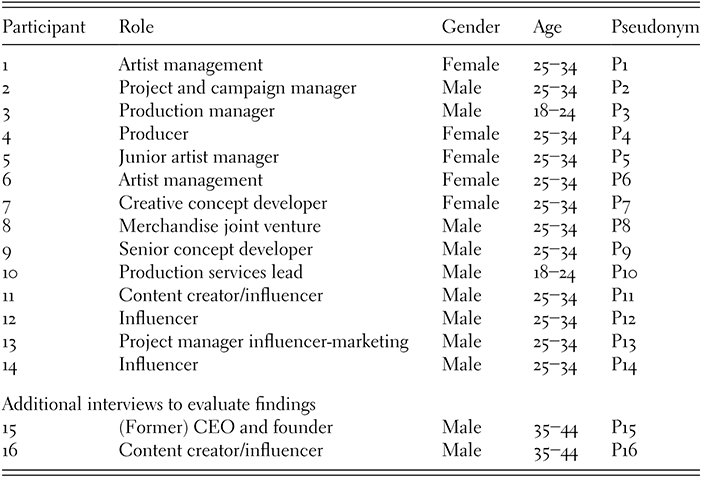
Table 14.2 presents an overview of the interviewees’ roles (as described by the interviewees), gender, age, and reporting pseudonym.
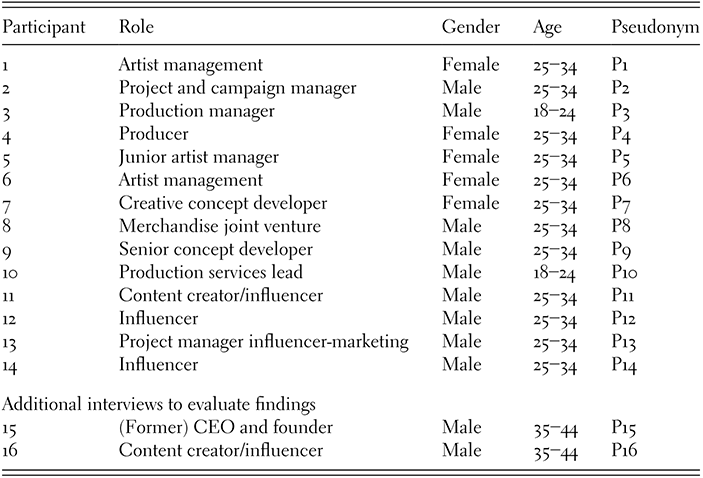
Table 14.2 Long description
The table has five columns: Participant, Role, Gender, Age, and Pseudonym. It reads as follows. 1: Artist management; Female; 25 to 34; P1. 2: Project and campaign manager: Male; 25 to 34; P2. 3: Production manager; Male; 18 to 24; P3. 4: Producer; Female; 25 to 34; P4. 5: Junior artist manager; Female; 25 to 34; P5. 6: Artist management; Female; 25 to 34; P6. 7: Creative concept developer; Female; 25 to 34; P7. 8: Merchandise joint venture; Male; 25 to 34; P8. 9: Senior concept developer; Male; 25 to 34; P9. 10: Production services lead; Male; 18 to 24; P10. 11: Content creator or influencer; Male; 25 to 34; P11. 12: Influencer; Male; 25 to 34; P12. 13: Project manager influencer-marketing; Male; 25 to 34; P13. 14: Influencer; Male; 25 to 34; P14. Under Additional interviews to evaluate findings. 15: (Former) C E O and founder; Male; 35 to 44; P15. 16: Content creator or influencer; Male; 35 to 44; P16.
14.4.3 Transcription and Analysis
The interviews were transcribed by two student assistants who had entered into a confidentiality agreement prior to the beginning of their work. This agreement was established to guarantee confidentiality and secure deletion of all data once the students had completed their tasks. Upon transcription and anonymization, the data was transferred to ATLAS.tiFootnote 5 for thematic analysis, exploring the dataset to uncover patterns or themes for new insights (Braun and Clarke Reference Braun and Clarke2013). Initially, two overarching themes were deduced based on the German interview guide topics – organizational communityship and influencer-driven communityship – and their related sub-questions. The translated interview guide can be found in Appendix A. The process involved two rounds of inductive coding, where four interviews were independently coded by two coders. The codes were reviewed, refined, and merged. A final codebook was then developed for the fourteen interviews, consisting of three top-level codes (demographics/community characteristics, organizational communityship, and influencer-driven communityship) and twenty sublevel codes to identify rules-in-use within and across the action arenas. Tables B.1 and C.1 provide an overview of the codes, their assigned definitions, and their connection with the representative research questions listed by Sanfilippo et al. (Reference Sanfilippo, Frischmann and Standburg2018) and reproduced in Table 14.1.
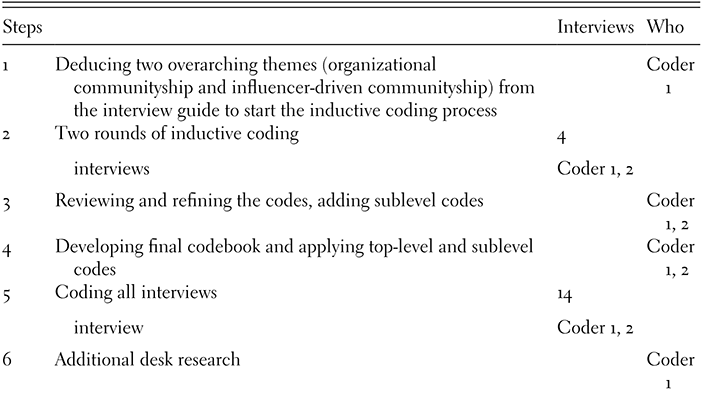
Table 14.3 provides an overview of the various steps taken during coding to ensure validity and reliability. The interview data was analyzed, including multiple evaluation sessions. To prepare both coders independently wrote additional memos to summarize their findings using specific quotes from interviewees to illustrate these findings. These memos and quotes were compared to identify matching and additional themes in line with the research.
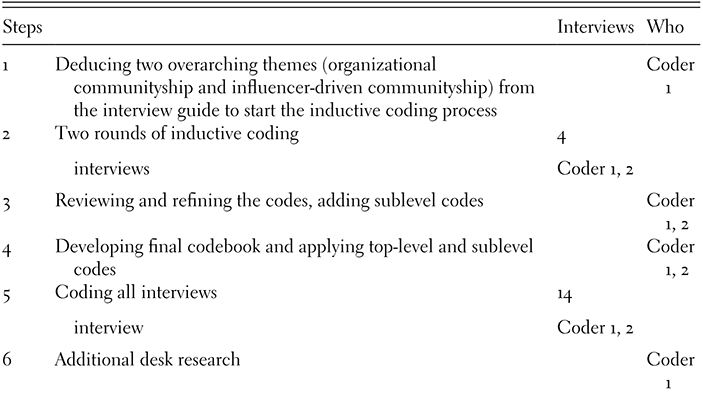
Table 14.3 Long description
The table has three columns: Steps, Interviews, and Who. It reads as follows. 1: Deducing two overarching themes (organizational communityship and influencer-driven communityship) from the interview guide to start the inductive coding process; blank; Coder 1. 2: Two rounds of inductive coding; 4 interviews; Coder 1, 2. 3: Reviewing and refining the codes, adding sublevel codes; blank; Coder 1, 2. 4: Developing final codebook and applying top-level and sublevel codes; blank; Coder 1, 2. 5: Coding all interviews; 14 interviews; Coder 1, 2. 6: Additional desk research; blank; Coder 1. 7: Developing four central themes (role-modeling, feedback culture, work-life balance, and innovative topics and education) from analysis and desk research; blank; blank. 8: Integrate themes into interview guide for additional interviews or evaluation with two CEOs of the company; 2 interviews; Coder 1. 9: Refine and finalize themes based on all interviews; 16 interviews; Coder 1, 2.
Further desk research was conducted to collect information from German-based websites and YouTube channels that shared industry insights, information, or interviews with employees of the company. Four central themes were deduced from the analysis (see Section 14.5) and integrated into a revised interview guide to conduct two additional interviews with the founders. The received feedback and insights from additional desk research were used to evaluate the findings.
14.4.4 Data Storage and Use of AI
The data collected in this study was stored in a safe password-protected university environment, accessible only to the research team. I used a corporate version of Microsoft CopilotFootnote 6 to translate the quotes from German to English, using the following prompt: “Produce a concise translation into English while retaining the context.” Moreover, to shorten and check certain sentences, I applied another prompt: “Refine for clarity, shorten and check grammar.” Additionally, experimental evaluation memos were produced using the ATLAS.ti AI-summary function,Footnote 7 without using prompts, to summarize the interviews and uncover potential insights that may have been missed during coding. No new themes were identified based on this approach. Both ATLAS.ti and Microsoft Copilot safeguard research by ensuring that the data is encrypted and not used to train OpenAI and Microsoft language models.
14.5 Findings
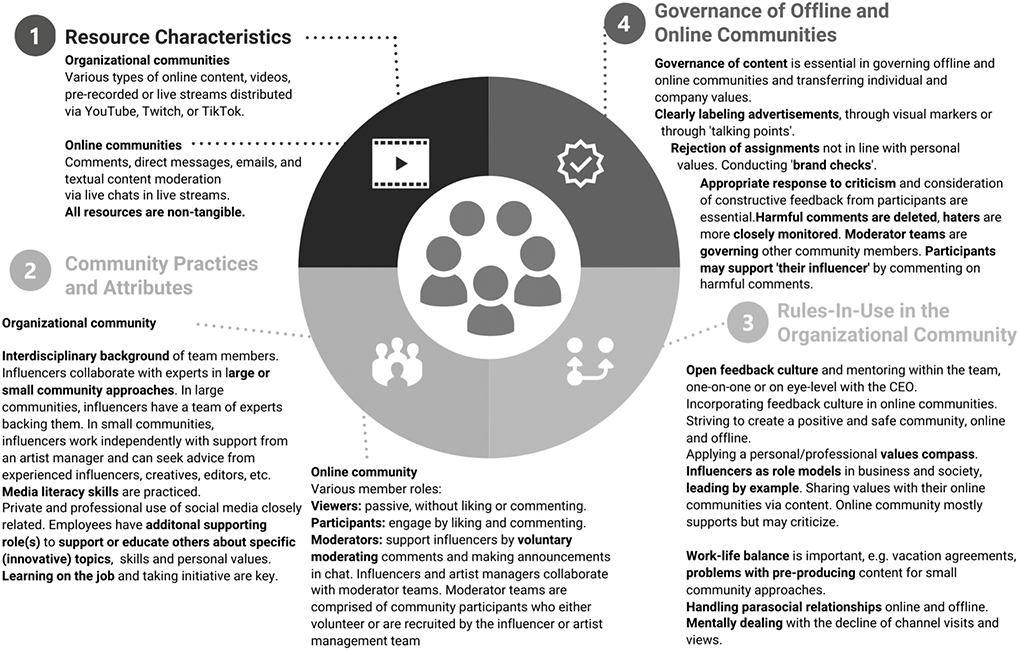
Four central themes were identified during the analysis of the interviews: role-modeling, feedback culture, work–life balance,and innovation and education. These integrate organically into the GKC framework as presented in Figure 14.1 and are supported by the research questions outlined in Table 14.1. I begin with a general characterization of the resources and outputs developed and shared by INSTINCT3, highlighting the two action arenas as described by employees during the interviews, before considering community attributes and rules-in-use that govern interactions and communication within and across these arenas. I then discuss some of the governance mechanisms that are part of the employees’ resource management and engagement with online communities. Finally, I briefly address important outcomes and patterns, including the benefits and risks arising in interactions in offline and online settings.
14.5.1 Resource Characteristics and Action Arenas
The IMA’s main output produced, thanks to these (communication) practices, are various types of online content, including, for example, the conceptual development, creation, production, editing, and sharing of online videos. These videos primarily consist of video game (industry or event) reviews and announcements, and gameplay or interaction with other video game influencers. With their teams, influencers create (daily or weekly) video content, which is recorded either at the company studio or in their home office, in collaboration with the offline organizational community. The content is then shared across various social media platforms with the online influencer communities. YouTube is used as the main outlet to share videos via a main channel (to test and review video games) and a more informal sub-channel (for special announcements and meetups with other internal or external influencers) at a fixed time and day. Another approach is to share live stream videos on Twitch. Community members who follow these platforms and channels can engage by commenting, either after a video is published or during a live stream.
Thus, the main resources created by the online community members are comments, direct messages, e-mails, and textual content moderations via live chats in live streams, which represent and store their ideas and feedback on the content. Communication practices and their outcomes are thus the key intangible and non-rival resources that IMAs strive to develop and rely on to develop and share new audiovisual and written content. These resources are pooled in both action arenas. According to Matzat (2009), online communities function effectively only when members’ interests align with those of the broader group. The same principle applies to IMAs, which operate successfully only when such alignment ensures that enough people are attracted to the community and remain actively engaged. Because online influencer communities therefore thrive on active participants who are passionate about the influencer and the shared content, IMAs are confronted with a perennial collection action problem. The most active members invest time in commenting, sharing their thoughts, answering questions, monitoring discussions, and providing feedback, while others choose to follow a channel and solely view the content created by the influencer and the active participants. The system only works if there is a sufficient number of truly active members.
14.5.2 Community Practices and Their Community Attributes
Interviewees – both at INSTINCT3 and in online influencer communities – singled out openness, transparency, and the principle of treating each other as equals as essential values. The team is often referred to as a “family.” As P13 put it: “It’s a very familial atmosphere, which I find beautiful. However, we don’t lose sight of the professional aspect. We maintain our goals, strive for excellence, and ensure that our quality remains high. I think it’s a well-balanced approach.”
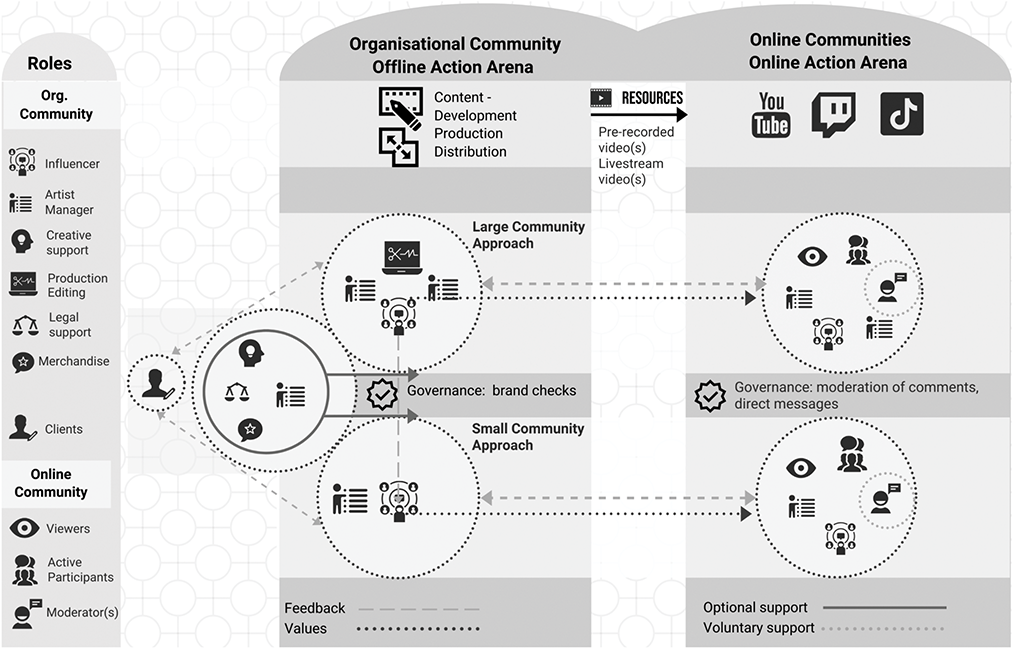
To develop and create content, influencers work via various approaches and in different configurations with other experts. In a large community approach, an influencer operates at a senior level, creating content for an online community with hundreds of, thousands of, or even millions of followers who watch and contribute on a regular basis. These influencers collaborate with a diverse team of creatives, producers, and editors, who support the influencer, in close contact with a team of senior and junior artist managers at the IMA. In a small community approach, an influencer operates at a junior level, creating content for a smaller but growing community, supported by an artist manager and some creative staff. Often these influencers operate independently in different roles to create, edit, and publish content, with the support of an artist manager, and with the option to engage with a more experienced influencer to share ideas and evaluations or to ask questions. As the community grows, an influencer will earn additional income, which can be used to outsource additional tasks, such as editing, to members of a growing team.
14.5.2.1 The Role(s) of Online Community Members
Online community members can have various roles, such as viewers (passive, without liking or commenting), participants (actively liking and commenting), or moderators (supporting the influencer by moderating comments, making announcements in chat, etc.). Influencers and artist managers work together with moderator teams consisting of community participants, who either volunteer or are recruited by the influencer or his/her artist management team. In channels such as YouTube or Twitch, it is possible to grant selected participants administration rights to moderate or flag comments as part of a specific channel, but also to ban other users from the channel if they misbehave. Moderators often work in teams, creating channel guidelines in close alignment with artist managers and/or influencers. These guidelines may address what is (un)acceptable and can cover various topics, such as hate speech, violence, copyrighted material, or “backseat gaming” (offering unsolicited advice, tips, or instructions to an influencer currently playing a video game by a participant). As P5 explained, these roles are taken up on a voluntary basis and moderators mostly connect via digital media with the influencers and their team:
these are mostly people from the community who have distinguished themselves on platforms like Twitch. They were present in every stream, very active in the chat, and even without being moderators themselves, they often reminded other viewers of the rules. We have a moderator now for P14, who is relatively new to the role, but even before becoming a moderator, she used to say, “Hey folks, please no backseat gaming.” These are moments where either established moderators or our team approach people and ask, “Wouldn’t you like to join us?”
Influencers and their team may also meet offline with their moderators and community members at industry-specific events such as the Gamescom – “the biggest games event in the world”Footnote 8 and Europe’s most comprehensive business platform for the gaming industry. As moderators are offering unpaid support, they often receive gifts, such as tickets for events, merchandise, and other game-related items. According to P15, in general moderating teams work on a voluntary basis and view this as an honorary external contributor role.
14.5.2.2 Interdisciplinary Background of the Organizational Community
As Table 14.2 shows, in addition to the four influencers in different stages of their career (two with large and two with small communities), most interviews were conducted with individuals in organizational and management or creative roles. A significant portion of the IMA’s employees are so-called “career changers,” as are most of the influencers. They started their careers in other industries or graduated from nonindustry-related studies (e.g., sociology, history, management science or law, political science, public relations, tourism, insurance). But several interviewees had a degree in industry-related areas, such as film-editing, event management, marketing, video journalism, or multimedia design. Notably, a significant number of interviewees participate in (online) gaming as a recreational activity. Frequently, this engagement began during early childhood or was influenced by family or friends. P13, for example, said:
My father used to play computer games in the past. Not social media, but more like LAN gaming at home with friends – before widespread internet access. I practically grew up in that environment, playing games with friends. It was a lot of fun. While my family encouraged physical activity and social media use, they also emphasized balancing it with school and friendships.
14.5.2.3 Main Roles and Supporting Roles in Line with Education and Innovation
Often employees have a supporting role, next to their main role in the company. Supporting roles can involve responsibilities such as project management, supporting an artist manager, and educating others about specific topics, based on specific expertise, including editing content, learning about Twitch user groups, discussing innovations like AI-produced content and virtual influencers, or addressing societal issues aligned with company values. Employees receive additional time to work on such topics, practice new skills, and share insight, for example, by organizing a forum discussion. As P7 observed:
We’ve just initiated this … and we’re currently organizing the first forum. It’s essentially an after-work forum for anyone interested. Each forum will focus on a specific topic. The first topic will be the basics of gender identities. The second forum will likely discuss why it’s crucial for us to be aware, in our client pitches, that our influencer constellations need to be as diverse as possible. This way, we can represent diversity outwardly. It’s essential to acknowledge that it’s not just the same six gamers who have been around for ten years.
However, often employees learn on the job to operate certain work processes. New employees sometimes find it challenging to learn specific skills due to time constraints, as P4 explained:
Definitely, and overall, there was a lot of self-improvement. I’ve developed significantly, but formal training opportunities were limited. It was mostly learning by doing. Attending a seminar specifically for production skills was always planned but never materialized. Having a team lead who ensures such opportunities would be crucial, I believe.
Additionally, as P4 added, taking initiative is crucial but also rewarding:
specially the continuous learning process – almost with every production, there’s something new to learn. But in terms of significant experiences, for me, it was primarily about a high degree of independence. In this job, self-reliance and initiative are crucial. Waiting for others to solve problems leads to disaster. Everyone needs to stay vigilant every day, ensuring everything functions smoothly and solving challenges as effectively as possible. It’s a significant level of personal responsibility and initiative, but it’s also rewarding.
14.5.2.4 Professional and Private Use of Social Media
For many respondents, private and professional aspects come together, especially on social media platforms such as YouTube, Twitch, and Discord. TikTok and Instagram are used for relaxation and unwinding. X (Twitter) is used for networking and staying up to date, but is also being questioned as the tone has become harsher (e.g., polarizing content, shitstorms). Notably, most of the interviewed influencers use social media only sparingly for personal use, as noted by P14: I primarily use social media for professional purposes, but I still have a few moments or hours each day when I use it briefly for personal reasons.
All respondents demonstrate a critical understanding of social media platforms and have developed strategies for navigating content on these sites. They emphasize the importance of prioritizing their role in (co)producing and engaging with social media, both personally and professionally. P8 explained:
Personally, I consider the sources I look at. For instance, if I come across a YouTube video from an account with only a hundred subscribers and around 500 views, I assume that this might be not legit. However, I do pay attention to accounts with a certain reputation or a substantial following to narrow down my choices. Still, I don’t go as far as researching citations and references immediately. So, I can’t exempt myself from the need to prioritize this issue, which likely applies to many topics and individuals.
Additionally, employees often stress that everyone has to decide on his/her own how they would practice digital literacy, such as fact-checking, and persuading others to do so as well. P5 observed:
when I hear about scandals or incidents – like TikTok users getting hacked and their addresses exposed (which happened in the USA with several journalists) – I take note. It’s an alarm signal for me. However, since we work only with adult creators, and all my colleagues are adults, it’s ultimately a decision each responsible adult must make for themselves. I don’t want to interfere with anyone’s choices. After all, anyone with an Android phone has given their data to Google, and iPhone users have done the same with Apple. So, it’s always a personal decision.
14.5.3 Rules-in-Use in the Organizational Community
Interviewees at INSTINCT3 provided more detailed insights into how their organizational community operates. Various value-based approaches, closely tied to daily practices, emerged during the interviews. These included feedback culture, mentoring, and both professional and mental support. A close connection between personal and organizational values was identified, particularly in terms of how these values are shown and passed on – both within the organization and in online communities – through role-modeling and communication practices. Additionally, work–life balance was a recurring theme, highlighting both the appreciation for supportive practices and the challenges of producing content and engaging in online communities.
14.5.3.1 Feedback Culture
The interviewees frequently discussed the importance of feedback culture and mentoring as part of their organizational community – whether within the team, one-on-one, or at eye level with the CEO. Providing open feedback across various levels of the company is actively promoted and practiced as P6 stressed:
always love to share this because I’m currently involved in many job interviews, and I adore the feedback culture here. You can give feedback to anyone, regardless of their role or whether they’re above you in the organizational hierarchy. You have the freedom to provide honest feedback and express your own thoughts. Additionally, there are weekly meetings with the supervisor where you can pour out your heart, share everything you want, and express how you feel. I’ve never experienced this level of openness and zero tolerance for gossip in any other company.
Or to further develop teamwork, according to P4:
Especially within a team, it’s not only desired but also expected that everyone contributes – not just for personal fulfillment, but also to continually shape the team. It’s crucial that anyone who identifies room for improvement or sees ways to enhance performance shares their ideas.
Often the interviewees positively discussed that both founders stimulate this open feedback culture. P15 also noted that this information is conveyed as part of the onboarding process for new employees. However, some employees faced challenges during their initial period, as P8 pointed out:
Difficult. One had to admit a lot, and it was sometimes painful. I had 1-2 conversations with P15. … It was truly an experience at the beginning – speaking openly with a CEO and even criticizing them, and the CEO actively asking for criticism … and that’s when I discovered a new approach for myself.
Additionally, this feedback culture is also incorporated in interactions with members in online communities, at various levels. For example, after posting, comments are monitored by an interdisciplinary team consisting of artist managers and the influencer involved. When participants provide constructive feedback, it is taken seriously and integrated into strategies or new content, with the team oftentimes discussing the feedback to implement improvements and passing them on to the influencers. As P4 put it:
what many viewers don’t know is that we genuinely read almost everything. Nearly every comment under every video has been read by someone on the team. We’re aware of everything that comes in, and if there’s something genuinely constructive, we even discuss it within the team. We ask ourselves, “Okay, was that feedback? Should we really do it that way in the future?” Or sometimes we admit, “Okay, that didn’t go so well with the project or the video. It wasn’t cool, and they’re right.”
Employees point out that the dialogue between influencers and the community, including constructive criticism, is important. Creating a positive and safe community is crucial for influencers and strengthens the connection among influencers and community members. Influencers also request feedback from their communities, as P4 explained:
It’s quite diverse. We have projects where we actively seek feedback, and others where we ask for tips. For example, an influencer completed Game X, essentially some of the most challenging games on the market. Especially with such projects, the influencer often asks, “Do you have feedback? What could be improved?” We do inquire about it, but sometimes feedback also comes spontaneously, perhaps even a bit too much. If there’s constructive feedback, we take it to heart.
14.5.3.2 Being a Role Model
In the interviews, there was frequent discussion about a personal/professional values compass (e.g., social media behavior in private settings, brand checks, as well as specific topics such as vegetarianism, sexism, gendering, gambling racism, trans, and homophobia). It was also emphasized that personal values must align with organizational values, and that the founders of the company must exemplify these values. Moreover, often employees underlined the important role of influencers as role models in business and society. As P9 emphasized:
It’s about the conscious use of social media and how people perceive it. Unfortunately, many young individuals view it as a given, and they allow it to influence them significantly. Whether it’s about appearance or other aspects, there’s a pressure to conform with. However, social media presents a curated version of people’s lives – it’s not the full reality. As a young person bombarded by this content, you might start believing it represents the entire truth. It’s crucial to consume this image consciously and critically. We need extensive education on this, and content creators can play a role in shaping awareness because they have a voice on these platforms. For me, this is the most critical issue.
Additionally, interviewees also articulated the view that INSTINCT3 operates a “value-based compass” in line with the values of staff, influencers, and founders, and that they strive to connect these while developing and sharing content. This concerns various topics, such as vegetarian lifestyle, animal welfare, anti-racism, and misogyny toward female gamers or female game influencers or advocates for LGBTQ+ rights. P03 observed:
Our company’s general value compass aligns strongly with social aspects. … This is often beautiful because it precisely reflects the interests that P16 holds, which also align with the company’s values. We can delve into topics such as vegetarianism, vegan living, the environment, animals, and social assistance in our content. These are all themes we can seamlessly incorporate and gladly explore.
Influencers also strive to share these values with their communities, for example by sharing their thoughts via video content or during a live stream. Often this is supported by the community, but it can also be criticized by community participants. Influencers or other team members do not actively participate when these views or values are discussed in response to a video or live stream, as long as debaters are respectful toward each other. P14 pointed out that he is not persistently pushing one’s viewpoint onto others, but leads by example:
For me, it would be a bit out of context if I were to say, “You all should gender now because I think it’s cool.” Personally, I just do it naturally. On the internet, there are always people who say, “Why are you bothering with gendering? It’s annoying.” That’s just an old mindset. Some sad souls at home find it bothersome because it doesn’t sound as nice anymore. But for me, it doesn’t make a difference. I know my community very well, and many people genuinely appreciate it. That’s where the focus should be.
14.5.3.3 Work–Life Balance
To support a healthy work–life balance, INSTINCT3 has integrated various rules-in-use. One example that came up during the interviews was an unlimited number of vacation days. Most of the employees appreciate such approaches. However, for influencers, not all of the implemented rules are workable, as they are expected to continually create content. Pre-producing content is a fair solution for influencers with a larger team, but for junior influencers additional workload and stress can develop, which makes it more difficult for them to apply these rules. Another issue that impacts the work–life balance of influencers and their teams is handling parasocial relationships between influencers and followers, and dealing with the decline of channel visits and views. Since there are no formal rules addressing these issues, mentoring plays a crucial role. For instance, the informal rule is that more experienced influencers guide new influencers. This collaborative approach helps them cope more effectively with the challenges they face. In general, the influencer’s community members embrace and even share their values, as P10 stated:
I don’t get recognized on the street very often – occasionally, but it’s super rare. However, the Gamescom event was truly intense. Many people recognized me there, and it’s nice to have the opportunity to briefly interact with them. Even though many of them may not want to engage beyond taking a photo, which I find a bit sad, I understand that it’s what they’re used to. You see, if a major influencer, someone like P16, were in my shoes, they couldn’t move freely because within seconds, a huge crowd would form around them – people wanting photos or something else. It’s a reality we’re aware of. While events like Gamescom are intense, P16 is already frequently approached on the street. But I don’t think it’s bothersome; of course, there are situations where interruptions during meals can be annoying. In those moments, it’s our responsibility to communicate that it’s not cool to interrupt someone while they’re eating. As creators, we’re accountable for our content, and that extends to shaping our community. We can say, “This is my community, and this is how I want it.”’ Of course, if we create objectionable content – like gambling, for example – I know my viewers wouldn’t watch it because we share the same values. It’s about that shared feeling, even at events like Gamescom, where there are so many gaming enthusiasts.
14.5.4 Governance of Offline and Online Communities
At INSTINCT3, the managing content is an essential part of the governance of their offline and online communities, as well as a means of transferring individual and company values. This takes place before, during production, and after the publication of content in their online communities.
14.5.4.1 Content Governance Before or During Production
Advertorials are a component of INSTINCT3’s content. Employees emphasize the importance of clearly labeling advertisements, whether through visual markers or by having influencers utilize “talking points” – scripted reviews of products or services – while always disclosing them as advertisements. However, all employees are free to decide the kind of advertorials they might include in their content. “Brand checks” are carried out by the artist managers and project members when other organizations approach the company with the aim to include their products or services as part of live streams or prerecorded videos. The background of the brand is investigated via desk research and certain keywords. If an organization has a questionable background, a team member but also an influencer can decide to reject the assignment. P6 explained this process:
we discuss the campaigns that express interest in you. We ask for your thoughts and opinions. Personally, I share my own opinion. Before that, we always conduct a brand check. We assess whether the brand has a positive or negative reputation, including any dark history. For instance, consider Beauty-brand X, where antisemitism is prevalent. They’ve never been held accountable, but we refuse to collaborate with them due to our ethical values. We don’t make exceptions just because someone hasn’t faced consequences. Similarly, we avoid working with Food-brand X. However, we give our influencers the freedom to decide if they want to collaborate. We provide them with our research – both positive and negative aspects – so they can make an informed choice.
This can be decided on the individual as well as company level. For example, an employee who experiences that a certain brand is not in line with her/his personal values, he/she may decide not to work on a specific project involving this brand. As P6 added:
we can say that it’s ethically unacceptable for me to work on the campaign. Another Artist Manager should handle it on my behalf, please, because it’s personally intolerable for my ethics. We definitely make that distinction.
14.5.4.2 Content Governance after Distribution
After distribution, participants may also provide feedback on the content in relation to certain advertisers with whom INSTINCT3 collaborates. If an issue was overlooked at the brand-check stage and is broadly addressed by community participants after publication, the team will discuss this issue with the advertiser, as P2 clarified:
We directly approach the client and say, “We’ve recently received the following feedback from the community, and we’d like to reiterate this or address it.” We take a determined approach when communicating with the customer because, as representatives of our artists, we don’t want to limit their opinions. It’s essential for us to be honest with the community, not blindly promoting any products, but rather presenting them in the light they are meant to be seen.
Employees often discussed if and how influencers respond to feedback, especially negative feedback, and how they use constructive criticism to evolve. As mentioned in the previous section, interviewees underlined the appropriate responses to criticism and considered constructive feedback as essential for continuous content improvement. Handling hate comments and filtering feedback were crucial aspects of the process, as was creating a safe environment for creators and their community. As P4 put it:
Everyone [from the team] has access to the channel. … For instance, I can moderate comments. Generally, if we read a comment and think, “Okay, this one is really bad” or “This one is genuinely discriminatory toward a group,” we always ban or delete such comments. But things like subjective rambling about influencers or disliking a video – well, that’s just how it is.
While extreme or harmful comments are deleted, haters are more closely monitored. After upload, team members monitor the comments section within an hour, especially when the influencer also engages with other influencers (specifically female influencers, to make sure that they are not harmed) and the community feels safe and comfortable. P4 added:
They also watch the comments live, and if something hurtful comes up or offends them, or if someone targets the rest of the community just because there was a black sheep involved, that’s why we still moderate a bit more strictly. It’s simply to ensure, as I mentioned, that others in the comment section feel comfortable as well.
More generally, YouTube provides features to block unwanted words in comments using “blocked word lists.” Harmful or extreme comments can be automatically deleted via the platform organizations or manually deleted, hidden or flagged by the team. These mechanisms are also used to govern the amount of hate comments or troll accounts that add negative comments. In some cases, influencers also “pin” negative comments to the top of their comments feed or try to reach out via direct messaging with the comment contributor. Community participants who repeatedly add harmful or disrespectful comments via YouTube, TikTok, or live stream sessions are also warned by influencers and/or their (moderating) team, and eventually are blocked from the channel (temporarily) if the behavior does not change. As noted, moderator teams also play a crucial role in governing other community members, although other participants also may support “their influencer” by commenting on harmful, unjustifiable or superficial comments by others. P14 explained:
the community almost acts a bit protective or defensive toward me. They collectively respond to the comment – since you can also reply to YouTube comments – and they write things like I would: “Well, then just leave”’ or “It’s unpleasant how you’re being offensive here.”’ … Of course, not everyone does this, but if everyone did, it would be overwhelming. Personally, I’m not much of a commenter; I usually just watch without leaving comments. But it’s nice to see the community taking a protective stance in such situations.
14.5.5 Mapping INSTINCT3’s Knowledge Commons
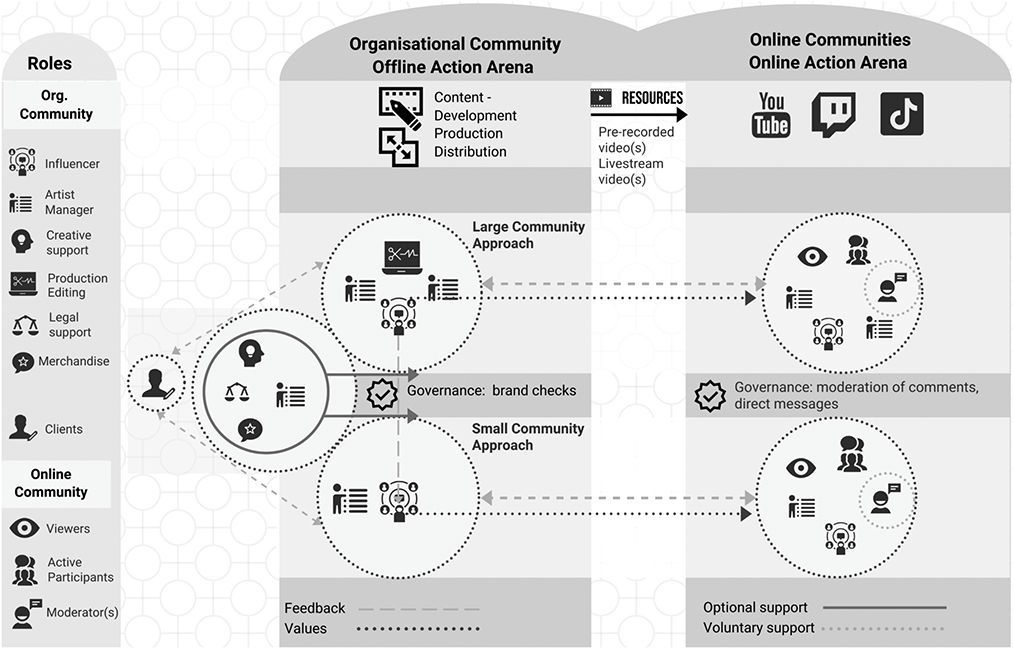
Figure 14.2 visualizes INSTINCT3’s knowledge commons as derived from the interviews.
INSTINCT3’s knowledge commons.
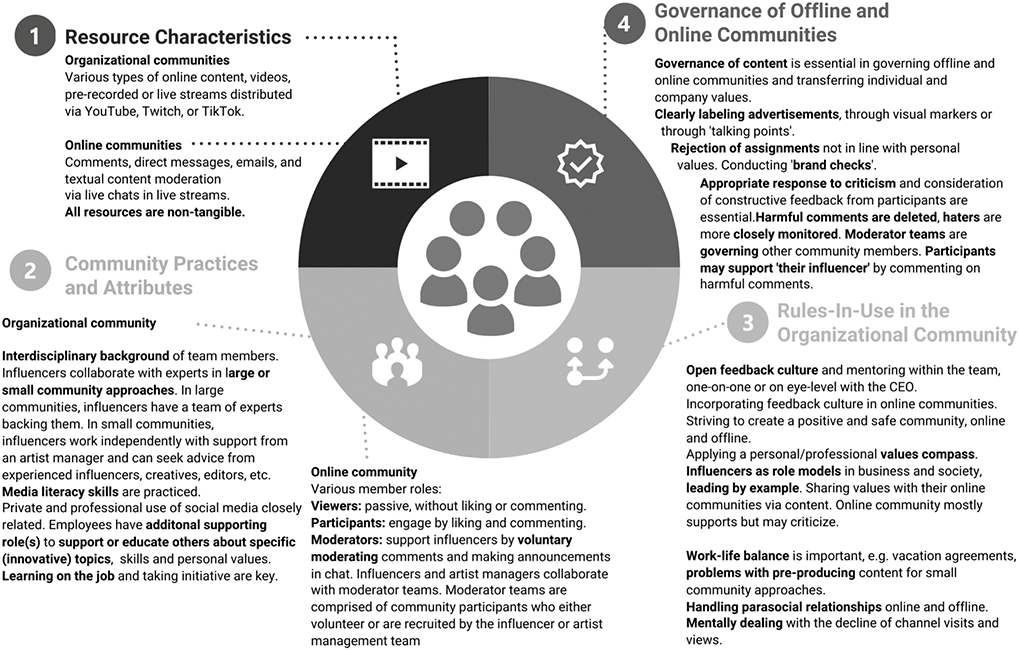
The findings of the study can also be represented in a community map (Figure 14.3) that illustrates how INSTINCT3 employees (managers, producers, creatives, content creators, hereafter influencers) and the followers of the influencer channels managed by INSTINCT3 operate as polycentric communities in offline as well as online action arenas. Specifically, the (circular) transfer of organizational as well as online community rules, routines, roles, and mindsets of both communities are visualized. As noted in Section 14.5.2, two main approaches in fostering communityship were identified: a small-scale and a large-scale community approach. Both coexist in the same organizational action arena but relate to a second action arena – the online communities operated by the influencers and their teams and supported by online community participants. The rules-in-use and values practiced in the offline arena are also transferred into the online action arena, as outlined in Figure 14.2.
Patterns and interactions community map.
14.6 Conclusion
This chapter explored how employees of a Germany-based influencer management agency, INSTINCT3, operate through polycentric communities in two action arenas: an offline or organizational action arena, where the primary actors are the company’s employees, and an online action arena, where influencers–followers interactions are mediated by the influence channels managed by the IMA. The chapter adopted an inside-out perspective, which is to say that it focused on the organization-driven governance of online communities. Reliance on the GKC framework helped disentangle how organizational community values, from the perspective of employees and founders, are transferred from offline to online communities.
The case study provides new theoretical as well as practical insights about online communities developed by organizations and governed by influencers, their supporting teams, and active and passionate community members, such as voluntary moderators. Theoretically, this research shows how various layers of offline and online communication and knowledge sharing may safeguard communities and their members through nonhierarchical, self-organization, mutual adjustment, and communityship approaches. It also aligns with earlier research into online communities relying on the GKC framework: “the commons at hand is considered as a good (as opposed to a bad), in the sense that it is universally understood that this resource has value, and that infrastructures should be built around it in order for the community to enjoy it to the fullest while protecting it” (Gradoz and Raux Reference Gradoz, Raux, Erwin Dekker and Kuchař2021, 235).
This study shows that the IMAs employees are striving to build and protect a joint infrastructure that serves their offline as well online communities by employing distributed leadership in both action arenas. This involves the promotion of a feedback culture among employees, experienced and new influencers, their support teams, and online community members; role modeling by influencers who convey personal and organizational values without imposing them on their community; and educational activities organized by employees to discuss personal values. These practices were identified both as important attributes of the communities and a means for establishing and implementing rules-in-use. My research demonstrates how in both action arenas community attributes, rules-in-use, and value-based communication practices are interconnected and exchanged among the participants. The role of online moderators and their connection with online as well as organizational communities warrants further investigation because in combining voluntary roles with organizational roles, their activities are interesting examples of polycentric and distributed leadership.
The study further uncovered valuable insights into the implementation of organizational communityship and the challenges associated with its integration within the influencer industry. Considering frequent criticism regarding the “commercialization of influence” within the industry (Hund Reference Hund2023, 170), INSTINCT3’s strategy of cultivating an open workplace atmosphere, prioritizing values within the organization, and nurturing a safe and friendly online community culture could serve as a source of inspiration for other small and medium-sized enterprises operating in this sector. INSTINCT3’s foundation is built upon a diverse and interdisciplinary team of employees. The demographic shows career changers with an interest in gaming who apply digital/media literacy skills in professional and private circumstances. All team members work on developing and fostering a safe and open community environment, both offline and online. Employees experience support in different areas and from different actors within their organizational community but, first and foremost, enjoy the prospect of working autonomously, contributing their own ideas, providing and receiving feedback, and having the possibility to opt-out of working on specific projects that do not align with their values. Finally, they can share these values with others through workshops and forum discussions, or even transfer these into the content produced by INSTINCT3. Importantly, influencers and their supporting team members set standards in advertising production based on shared values, and by developing rules-in-use to carry out brand checks. Influencers may struggle with some of the rules-in-use, for example, because their content production schedule prevents them from making use of flexible vacation agreements that INSTINCT3 employees enjoy. This shows that implementing “just enough leadership” (Mintzberg Reference Mintzberg2009) is challenging in situations where influencers cannot exert full control due to external obligations.
With regard to the transfer of values, influencers strive to lead by example and ask for feedback from online community members. Parasocial relationships play a significant role in their engagement with community members, especially for influencers with large communities. However, clear communication about boundaries is essential for influencers with large or small(er) communities. Influencers receive support from moderating teams that operate rules-in-use that cut across the two action arenas to ensure a safe and friendly online environment. Essentially, influencers are aware that they must live with negative comments and even hateful responses, but they also have backing and support from their organizational and online communities when these appear. But influencers often find that their values align with those of most community members.
Because this chapter focused on understanding organizational and online community practices from an inside-out perspective, the data collected solely concerns interviews with employees from INSTINCT3. This means that an essential perspective – the perspective of online community members – is missing. My next study will focus on examining the transfer of offline values to online communities from the perspective of online community members who follow, engage with influencers, or support them as moderators. This will enable a richer analysis of whether and how these communicative community practices, their values, and their rules-in-use are shared by online community members. Whatever the methodology, more research along these lines is needed. The case study developed in this chapter may serve as an example of how to research the interconnections between organizational and online communities in the influencer economy.


 Open access