



Background
The prevalence of nutrition-related disorders, especially complications of overweight and obesity, is on the rise across all ages and socio-economic groups worldwide (World Health Organization, 2003; 2016; Sebiany, Reference Sebiany2013; United States Preventive Services Task Force, 2014). Primary care physicians (PCPs) are a widely consulted source regarding health information (Truswell et al., Reference Truswell, Hiddink and Blom2003) and they are more cost-effective than dietitians in nutritional counseling (Olsen et al., Reference Olsen, Willaing, Ladelund, Jørgensen, Gundgaard and Sørensen2005). Although patients regard PCPs as a reliable and accessible source of nutrition counseling and expect nutritional advice from them (Hiddink et al., Reference Hiddink, Hautvast, Van Woerkum, Fieren and Van’t Hof1997), their expectations are not always met (Tham and Young, Reference Tham and Young2008; Crowley et al., Reference Crowley, Ball, Wall and Leveritt2012). Several factors have been implicated in that, and some of these barriers include lack of time, lack of physicians’ nutritional knowledge, lack of payment and lack of patient adherence to diet (Talip et al., Reference Talip, Steyn, Visser, Charlton and Temple2003). In fact, it was shown that physicians with better knowledge, more access to resources such as dietitians, and more positive attitude towards nutrition-related problems such as obesity, have better skills in weight management and advice (Rurik et al., Reference Rurik, Torzsa, Ilyés, Szigethy, Halmy, Iski, Kolozsvári, Mester, Móczár and Rinfel2013).
In Lebanon, the only study available concerning this topic was done by a group of medical students at the American University of Beirut in 1987, as a project for fulfillment of the requirements of a course. It concluded that the second and third year Lebanese medical students’ nutritional knowledge was poor and it stressed the importance of improvement in medical curriculum concerning nutrition (Al Amin et al., Reference Al-Numair1987). No similar study was done for graduate physicians in Lebanon.
This study targeted PCP because general medicine was found to be most frequently used for consultation in Lebanon in 2012 (Institute of Health Management and Social Protection, 2012), and primary care setting is ideal for opportunistic nutritional advice. PCP is defined here as general practitioners who completed a one-year residency program after their medical school, or family physicians who completed an additional three to four years residency training in family medicine after medical school. We aimed to explore the status of nutritional counseling in primary care in Lebanon by assessing PCPs’ knowledge, attitude, and practice in this topic, and investigating their opinion on possible barriers encountered in their practice, so that specific actions can be recommended for improvement. Knowing that through adoption of lifestyle changes, the risk of chronic disease would decrease (Flesher et al., Reference Flesher, Kinloch, Grenon and Coleman2011) and that patients who are advised to lose weight by physicians are more likely to do so (Nasreddine et al., Reference Nasreddine, Naja, Chamieh, Adra, Sibai and Hwalla2012), it is important to study physicians’ role in nutrition counseling.
Methods
This descriptive study targeted PCPs who attended General Practitioners’ Conference in October 2014 and/or Family Medicine Annual Conference in November 2014, with no exclusion and no duplication. It was a convenient sample, with a total of 251 eligible physicians.
A self-administered anonymous questionnaire was provided to each participant, along with an envelope and an informed consent letter. The estimated time to fill the survey was 10 min. The consent was considered to have been obtained when the physician filled and returned the questionnaire. The questionnaire encompassed items including demographic information and 17 questions with Likert-type scale responses to assess the physician’s perceived knowledge (n=3), attitude (n=3), and practice (n=6) regarding nutrition counseling, as well as opinion about possible barriers (n=5) encountered in this practice.
Before the initiation of the study, the approval of the Institutional Review Board (IRB) at American University of Beirut Medical Center was secured.
Data analysis was conducted with frequencies and bivariate analysis using χ 2 test in IBM SPSS Statistics 19.
Results
Socio-demographic characteristics
The total number of filled questionnaires was 156. After removing students and non-PCPs, 137 questionnaires were included, out of the 251 eligible physicians, resulting in a 54.6% response rate. Respondents were distributed equally across most age groups. Males to females ratio was 1.3. The range of years since graduation varied between 1 and 46 years, with 55% graduates from Lebanese medical schools. Most of the respondents (62%) were affiliated with an academic institution. Also, it is worth noting that around half of them had a body mass index (BMI) more than 25, with obesity in 7% and a nutrition-related health disorder in 22% (Table 1).
Socio-demographic characteristics of the respondents among primary care physicians attending conferences
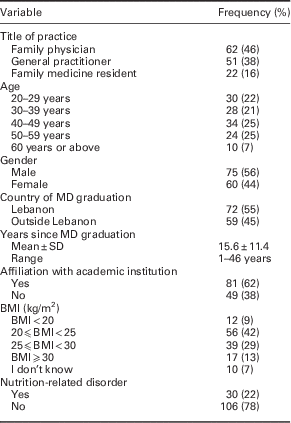
BMI=body mass index.
Self-rating of nutritional education and knowledge
In total, 80% of the PCPs rated their own nutritional knowledge as good or very good. However, only 60% rated nutritional education in Continuing Medical Education (CME) as good or very good; and only 50% rated that of medical school as good or very good. Rating of own nutritional knowledge and of nutritional education received in CME was not associated with any of the studied demographic characteristics; however, rating nutritional education in medical school was significantly associated with the country of medical degree attainment. Physicians graduating from Lebanon rated this knowledge worse than ones who graduated from outside Lebanon (χ 2 test, P=0.02) (Table 2).
Rating of nutritional education and own nutritional knowledge by the respondents among primary care physicians attending conferences
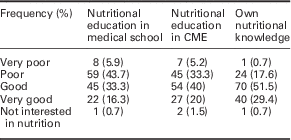
CME=Continuing Medical Education.
Attitude towards nutritional counseling
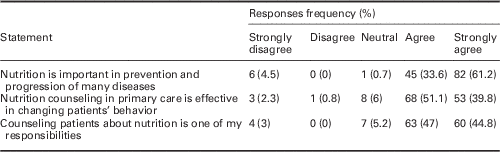
PCPs in this study exhibited a positive attitude towards nutrition, with more than 90% of them agreeing or strongly agreeing about the importance of nutrition, the effectiveness of counseling, and the fact that it is their responsibility to do so. There was no statistical association between any of the three attitude statements’ rating with respect to any of the studied demographic characteristics or to the physicians’ rating of their own nutritional knowledge (Table 3).
Attitude of the respondents among primary care physicians attending conferences towards nutritional counseling
Current practices in nutritional counseling
PCPs self-reported practicing general nutritional skills such as offering advice and asking about dietary intake in most to all patients. More detailed skills such as teaching patients how to read nutritional labels were less common. Around half of respondents reported referring most to all patients to a dietitian if they have a nutrition-related disorder. Correlation between self-rating of knowledge and practices showed that physicians who had better rating of their own nutritional knowledge asked more patients about dietary intake as preventive strategy (χ 2 test, P=0.00) and taught more patients how to read a nutrition facts label (χ 2 test, P=0.00). In addition, physicians who considered nutrition counseling as one of their responsibilities offered more nutritional advice (χ 2 test, P=0.04) and referred more patients to dietitians if they have nutrition-related disorder (χ 2 test, P=0.00) (Table 4).
Nutritional practice of the respondents among primary care physicians attending conferences
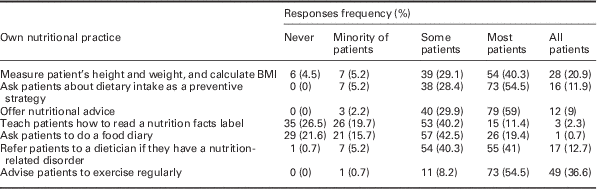
BMI=body mass index.
Barriers to nutritional counseling
Around 62% of PCPs thought that lack of time was a barrier, while around 72% thought that the problem was patients’ poor adherence to dietary advice. On the other hand, only around half of the respondents considered a gap in physician’s knowledge or lack of insurance coverage for dietitian fees as potential barriers. It is worth noting that physicians who considered lack of time a barrier, referred more patients with nutrition-related disorders to dietitians (χ 2 test, P=0.00). However, the referral was not associated with the physicians’ opinion about gap in nutritional knowledge as a barrier (Table 5).
Opinion of the respondents among primary care physicians attending conferences about barriers to nutritional counseling

Discussion
Summary
Overall, the surveyed physicians had a good attitude toward nutritional counseling and their self-reported frequency of nutritional practices was acceptable; however, there was still room for improvement in nutritional counseling in general. Their self-perceived nutritional knowledge was overall good but their actual knowledge is unknown. Barriers identified for nutritional counseling were lack of time, gap in physician knowledge, perceived poor patient adherence to dietary advice and lack of coverage of insurance for fees of dietitians.
Strengths and limitations
This is the first study in Lebanon to explore physicians’ status with respect to nutrition.
The results of our study cannot be generalized to all PCPs in Lebanon, because we only targeted physicians in two conferences. There may have also been volunteer bias.
Comparison with existing literature
In this study, PCPs rated poorly their formal education in nutrition (ie, received in medical school, during residency and in CME), yet considered their nutritional knowledge as good to very good. PCPs seemed to be doing extra effort on their own to enhance their nutritional knowledge, posing a question on their source of information which was not tackled in this study. This perceived gap in nutritional education was also present in other countries. Studies from Western countries such as the United States (Kahn, Reference Kahn2006; Vetter et al., Reference Vetter, Herring, Sood, Shah and Kalet2008) and Canada (Wynn et al., Reference Wynn, Trudeau, Taunton, Gowans and Scott2010) and from the Arab gulf countries (Al-Numair, Reference Al Amin, Arayssi, Birjawi, Chatila, Doughan and Hubeishy2004; Al-Zahrani and Al-Raddadi, Reference Allafi, Alajmi and Al-Haifi2009; Daradkeh et al., Reference Daradkeh, Al Bader and Singh2012) showed that PCPs and physicians-in-training were not very satisfied with their nutritional education and they felt they were not well prepared to give nutritional advice to patients. Moreover, the literature showed bad performance of many PCPs in nutrition quizzes in regional countries including Saudi Arabia (Al-Numair, Reference Al Amin, Arayssi, Birjawi, Chatila, Doughan and Hubeishy2004), Qatar (Daradkeh et al., Reference Daradkeh, Al Bader and Singh2012), Kuwait (Allafi et al., Reference Al-Zahrani and Al-Raddadi2013), Iran (Ahmadi et al., Reference Ahmadi, Ershad, Givzadeh and Mohammad-Beigi2009) and Turkey (Özçelik et al., Reference Özçelik, Sürücüoglu and Alkan2007). The main fear would be if this was the PCPs actual practice of counseling with wrong nutritional information, taking into consideration that the PCPs in Lebanon for example reported a good quantity of practice in this area.
The identified barriers to nutritional counseling were similar to the ones described by Talip et al. in (Reference Talip, Steyn, Visser, Charlton and Temple2003).
PCPs in this study had a positive attitude towards nutrition, which is consistent with the literature findings (Vetter et al., Reference Vetter, Herring, Sood, Shah and Kalet2008). The physician’s health status (eg, BMI) was not correlated with self-rating of nutritional knowledge or with their attitude toward nutritional counseling. This was similar to a systematic review of the literature that concluded that the physicians’ weight status was not found to be significantly correlated to referral or assessment of overweight or obese patients or to their knowledge and skills, considering it part of their duties no matter what their own weight status was (Zhu et al., Reference Zhu, Norman and While2011).
In this study, PCPs also self-reported practicing general nutritional skills such as offering advice and asking about dietary intake in most to all patients. These general nutritional advice lacked detailed information such as teaching patients how to read a nutrition facts label. It was previously shown that physicians were more comfortable discussing general topics in nutrition than those related to chronic disease or special topics such as herbal supplementation (Wynn et al., Reference Wynn, Trudeau, Taunton, Gowans and Scott2010).
Also in this study, approximately half of respondents self-reported referring most or all patients to dietitians if they had a nutrition-related disorder, which is another aspect of positive PCPs’ attitude and practice. Our finding could point out to a better situation in terms of working in multidisciplinary teams, but if physicians depended on referrals, patients who cannot afford multiple fees would not get the chance to get nutritional advice. Even though encouraging referral is a good option, the priority would be to enhance the nutritional knowledge of physicians through well-designed nutrition courses in medical schools, applied nutritional curricula in residency training and mandatory CME nutritional topics. This way, PCPs will be able to provide their patients with accurate targeted nutritional tips and information in a short period of time. Finally, it is important to highlight that the integration of nutrition into medical school curriculum is a continuing challenge worldwide, and different initiatives were started in the United Kingdom and the United States (Ball et al., Reference Ball, Crowley, Laur, Rajput-Ray, Gillam and Ray2014).
Conclusion
Patient centered dietary counseling and advice is an integral part of comprehensive primary care. There is a major gap in PCPs’ formal nutritional education in Lebanon despite their positive attitude towards nutritional counseling. The central step for improvement in PCPs nutrition knowledge is to have a consensus on the minimum nutritional information that physicians should know, with development of evidence-based practice guidelines for PCPs. Then, there should be changes in curricula of medical schools and residency programs for well-designed comprehensive courses about nutrition, as well as in CME topics for obligatory (non-elective) lectures or workshops in nutrition for PCPs. Other suggestions include adding pamphlets about nutrition in patients’ waiting rooms and getting additional paramedical staff (eg, nurses) involved in patients’ nutritional counseling. In addition, adding BMI as a vital sign would make it obligatory on the chart, and hence the doctor would be always aware of the patient’s weight status as a baseline and for follow up.
Acknowledgments
None.
Financial Support
This research received no specific grant from any funding agency, commercial or not-for-profit sectors.
Conflicts of Interest
None.
Ethical standards
Before the initiation of the study, the approval of the IRB at American University of Beirut Medical Center was secured.



